
17 అధ్యాయాలు
పర్సనల్ ఎసెన్స్ మెథడాలజీ
తమ సొంత నిర్ణయాలు, సంబంధాలు మరియు మొదలుపెట్టిన పనిని పూర్తి చేయడంపై ఫలితాలు ఆధారపడే ప్రతి ఒక్కరి కోసం ఒక నిర్మాణాత్మక మెథడాలజీ: మీరు కంపెనీ నడిపినా, బృందానికి నాయకత్వం వహించినా, ఫ్రీలాన్స్ చేసినా లేదా మీ పని తుది ఫలితానికి మీరే బాధ్యులైనా. 30 సంవత్సరాల ఆచరణాత్మక అనుభవం మరియు సంక్షోభం, అస్థిరతల మధ్య 10 సంవత్సరాల క్రమబద్ధీకరణ ఆధారంగా రూపొందించబడింది. 1,041 శాస్త్రీయ మూలాల ఆధారంగా.
- అధ్యాయాలు
- 17
- బిబ్లియోగ్రఫీ
- 1,041 మూలాలు
Volodymyr Zhukov ద్వారా సమీక్షించినవారు Volodymyr Zhukov
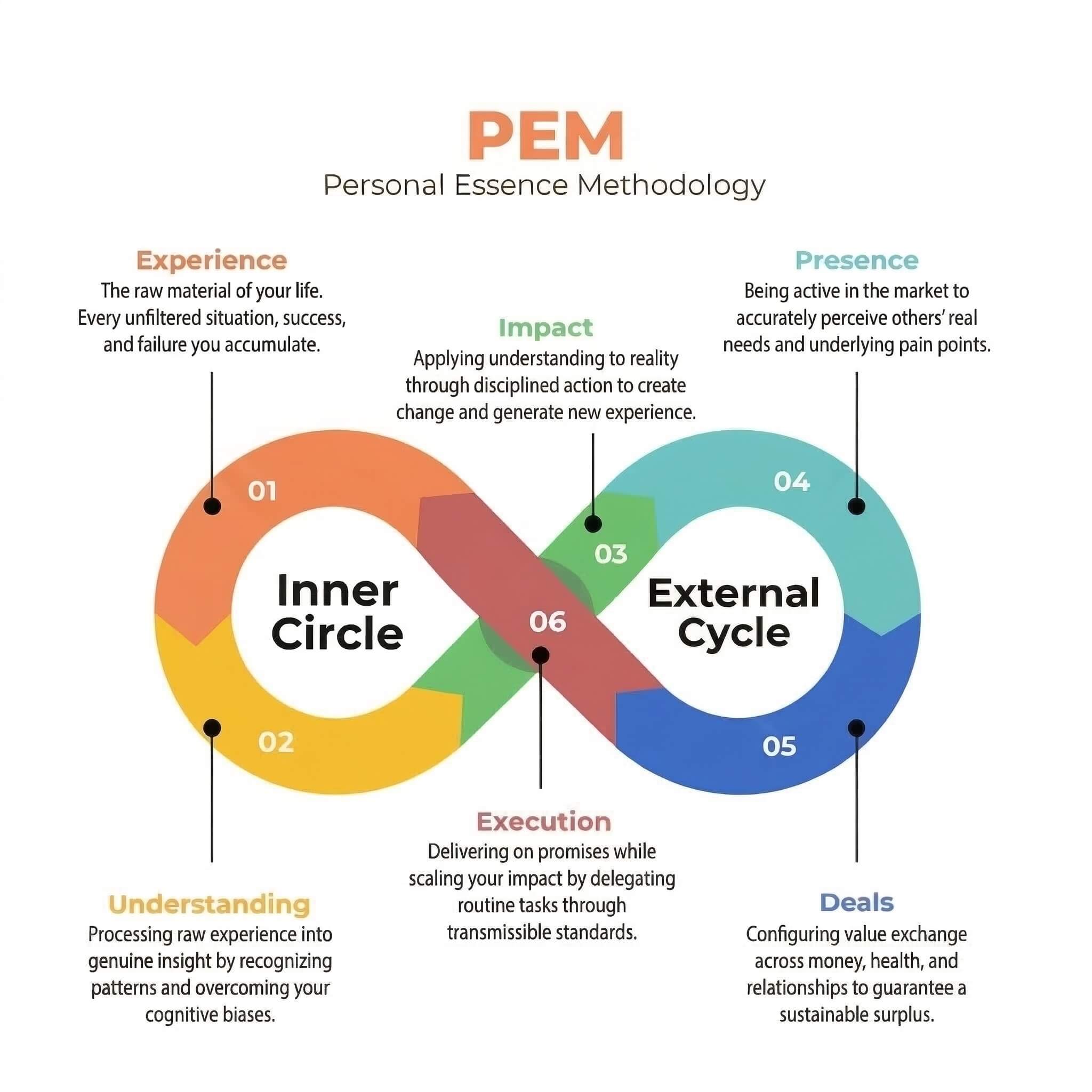
అనుభవం (experience) నుండి అవగాహనను (understanding) పెంపొందించుకోండి, ఏడు మూలస్తంభాల ద్వారా విశ్వాస ఆధారిత ఉనికిని (trust-based presence) నిర్మించుకోండి, మొత్తం ఆరు వనరుల డొమైన్లలో మిమ్మల్ని నిలబెట్టే ఒప్పందాలను (deals) కాన్ఫిగర్ చేసుకోండి, మీరు చేసిన వాగ్దానాన్ని అమలు చేయండి — వ్యక్తిగతంగా ఆర్కిటెక్ట్ మోడ్లో (Architect Mode) మరియు ఇతరులకు అప్పగించడం ద్వారా బిల్డర్ మోడ్లో (Builder Mode) — అలాగే ప్రదర్శించిన ప్రభావం (demonstrated impact) తదుపరి మీరు నమ్మకంగా వాగ్దానం చేయగల మరియు నిర్దేశించగల విషయాలను విస్తరించేలా చేయండి.
విషయ సూచిక
(17 అధ్యాయాలు)- ఈ మెథడాలజీ ఎందుకు? ఇప్పుడే ఎందుకు.
- పునాది
- స్థూల నేపథ్యం: ఈ మెథడాలజీ ఎందుకు పరిణామం చెందాలి
- అప్గ్రేడ్ చేయబడిన వనరుల స్టాక్ (The Upgraded Resource Stack)
- అంతర్గత గొలుసు (Internal Chain): అనుభవాన్ని అవగాహనగా మార్చడం
- మూడు దశలు
- డెలిగేషన్ ప్రిన్సిపుల్: అవగాహన ద్వారా ఇంపాక్ట్ను (ప్రభావాన్ని) పెంచడం (The Delegation Principle)
- రెండు అసమతుల్యతలు
- అధిక నాణ్యత గల డీల్స్గా ఇన్ఫ్లూయెన్స్ (Influence as High-Quality Deals)
- వనరుల సమీకరణం (The Resource Equation)
- పునరావృత చక్రం (The Iterative Cycle)
- సంక్షోభంలో పనిచేయడం: వ్యవస్థాగత ఒత్తిడిలో పద్ధతి (Operating in Crisis: The Methodology Under Systemic Pressure)
- పరిధి మరియు పరిమితులు (Scope and Limitations)
- వైఫల్య రీతులు (Failure Modes)
- అప్లికేషన్ (Application)
- సమగ్ర బయాస్ సూచన: అభిజ్ఞా పక్షపాతాలను మెథడాలజీ దశలకు మ్యాపింగ్ చేయడం (Comprehensive Bias Reference: Mapping Cognitive Biases to Methodology Stages)
- సారాంశం (Summary)
ఈ మెథడాలజీ ఎందుకు? ఇప్పుడే ఎందుకు.
నేను 1987లో, సోవియట్ యూనియన్ విచ్ఛిన్నమవుతున్న కాలంలో పుట్టాను. నేను చూసిన మొదటి ఆర్థిక వ్యవస్థ అప్పుడే ఉనికి కోల్పోయిన ఆర్థిక వ్యవస్థ.
పాఠ్యపుస్తకాలలో "స్థిరమైన పరిస్థితులు" అంటే ఏమిటో అర్థం చేసుకునే వయస్సుకు వచ్చేసరికి, నేను వాటిని ఎన్నడూ అనుభవించలేదు. సోవియట్ పతనం తర్వాత వచ్చిన మార్పులు, విపరీతమైన ద్రవ్యోల్బణాన్ని, సంస్థాగత శూన్యతను, మరియు కొత్తగా స్వాతంత్ర్యం పొందిన ఉక్రెయిన్లో రోజువారీ సర్దుబాట్లనే సాధారణ జీవితంగా మార్చాయి. ఆ తర్వాత 2000ల ప్రారంభంలో దేశీయ ఆర్థిక అల్లకల్లోలం వచ్చింది. ఆపై, 2008-2009 నాటి ప్రపంచ ఆర్థిక సంక్షోభం అభివృద్ధి చెందుతున్న ఆర్థిక వ్యవస్థలను తీవ్రంగా దెబ్బతీసింది. ఆ తర్వాత 2013-2014లో 'రివల్యూషన్ ఆఫ్ డిగ్నిటీ', దేశ రాజకీయ ముఖచిత్రాన్ని రాత్రికి రాత్రే మార్చేసింది. ఆ తర్వాత మొదటి యుద్ధం—క్రిమియా ఆక్రమణ, కాలిపోతున్న డోన్బాస్, మన చుట్టూ ప్రపంచం తనను తాను పునర్వ్యవస్థీకరించుకుంటుండగా, అందులో బతకడానికి మనం కూడా మనల్ని పునర్వ్యవస్థీకరించుకున్నాం. మరియు 2022లో, పూర్తి స్థాయి దండయాత్ర—మనం సిద్ధంగా ఉన్నామా లేదా అని అడగని ఒక సంక్షోభం.
అంతటి గందరగోళంలో కూడా నేను నిర్మిస్తూనే ఉన్నాను. వ్యాపారాలను నిర్మించడం, సంబంధాలను ఏర్పరచుకోవడం, అవగాహన పెంచుకోవడం చేస్తూ వచ్చాను. నాలో ఏదో ఒక ప్రత్యేకమైన స్థితిస్థాపక జన్యువు ఉన్నందుకో, లేదా ఉక్రేనియన్లు అసాధారణంగా కఠినమైనవారైనందుకో కాదు—అయితే ఒక్కోసారి మాకే ఆశ్చర్యం కలిగేంత మొండి పట్టుదల మాకుందన్నది నిజమే. కానీ, ఒక సంక్షోభం అనేది కేవలం అంతరాయంలా కాకుండా మీ శాశ్వత వాతావరణంగా మారినప్పుడు, శాంతియుత సమయాలు నేర్పలేని ఒక విషయాన్ని అది మీకు నేర్పుతుంది: మీరు ఆధారపడే నియమాలు ఎప్పుడైనా విచ్ఛిన్నం కావచ్చు, మరియు అలా జరిగినప్పుడు మీరు పని చేయగల సామర్థ్యం మాత్రమే మీ నుండి ఎవరూ లాక్కోలేని, విలువ తగ్గించలేని, లేదా బాంబులతో నాశనం చేయలేని ఏకైక ఆస్తి అని అర్థమవుతుంది.
పర్సనల్ ఎసెన్స్ మెథడాలజీ (Personal Essence Methodology) ఒక లైబ్రరీలో రూపొందించబడలేదు. అన్నీ సవ్యంగా ఉన్నప్పుడు పని చేస్తుందని ఇతరులు చెప్పిన దానికి, మరియు పరిస్థితులు నిరంతరం మారుతున్నప్పుడు నిజంగా పని చేసిన దానికి మధ్య ఉన్న అంతరంలో ఇది రూపుదిద్దుకుంది. ఈ డాక్యుమెంట్లోని ప్రతి సూత్రం—ఇంటర్నల్ చైన్ (Internal Chain), ట్రస్ట్ ఫార్ములా (Trust Formula), ఆరు వనరుల విభాగాలు, మరియు ప్రతినిధుల శ్రేణి క్రమం—కరెన్సీ విలువ మారే, సరిహద్దులు మూసుకుపోయే, క్లయింట్ మాయమయ్యే, మరియు పని మధ్యలో కరెంటు పోయే అత్యంత ప్రతికూల పరిస్థితులలో పరీక్షించి నిలబడినవే.
అందుకే ఈ మెథడాలజీ ఇప్పుడు అత్యవసరమని నేను నమ్ముతున్నాను.
ఈరోజు మీరు పనిచేస్తున్న ప్రపంచం, మీరెక్కడ ఉన్నప్పటికీ, నా వృత్తి జీవితమంతా నేను అనుభవించిన అస్థిరత్వంలోకి అడుగుపెడుతోంది. భౌగోళిక రాజకీయ విచ్ఛిన్నం వేగవంతమవుతోంది. ఏఐ (AI) విప్లవం అమలు యొక్క ఆర్థిక విధానాలను కళ్లెదుటే మారుస్తోంది. పెట్టుబడి ఇక ఎంతమాత్రం చవక కాదు. సరఫరా గొలుసులు ఇకపై నమ్మదగినవి కావు. ఒకప్పుడు స్థిరత్వాన్ని అందించిన సంస్థలు—ఊహించదగిన మార్కెట్లు, స్థిరమైన కరెన్సీలు, పని చేసే అంతర్జాతీయ క్రమం—తొందరగా పరిష్కారం కాని తీవ్ర ఒత్తిడిలో ఉన్నాయి.
మీరు వ్యవస్థాగత అస్థిరత్వాన్ని మొదటిసారిగా ఎదుర్కొంటుండవచ్చు. కానీ నేను గత మూడు దశాబ్దాలుగా అందులోనే జీవిస్తున్నాను.
నేను నేర్చుకున్నది ఇదే: మీరు వాతావరణాన్ని నియంత్రించలేరు, కానీ మీ అనుభవాలను మీరు ఎంత లోతుగా విశ్లేషించుకుంటారో, మీ సంబంధాలలో మీరు ఎంత నిజాయితీగా ఉంటారో, మీ కట్టుబాట్లను మీరు ఎంత జాగ్రత్తగా రూపొందించుకుంటారో, మరియు మీరు ఇచ్చిన మాటను ఎంత నమ్మకంగా నిలబెట్టుకుంటారో మీరు నియంత్రించగలరు. ఆచరణలో ఈ మెథడాలజీ అంటే అదే. ఆదర్శవంతమైన పరిస్థితులలో ఏది పని చేస్తుందనే దాని గురించి చెప్పే ఒక సిద్ధాంతం కాదు—ఇది ఆదర్శం కానీ పరిస్థితుల్లో పదేపదే పని చేసిన ఒక వ్యవస్థ.
ఈ మెథడాలజీ సంక్షోభాన్ని సులభతరం చేయదు. ఏదీ చేయలేదు. కానీ మీ చుట్టూ ఉన్న వ్యవస్థలు విఫలమవుతున్నప్పుడు పని చేయడానికి ఇది మీకు ఒక నిర్మాణాన్ని ఇస్తుంది. నమ్మకం కరువైనప్పుడు నమ్మకాన్ని పెంపొందించడానికి, నిబంధనలు అస్థిరంగా ఉన్నప్పుడు ఒప్పందాలను కుదుర్చుకోవడానికి, వనరులు పరిమితంగా ఉన్నప్పుడు పనులను అమలు చేయడానికి, మరియు మీ కింది నియమాలు నిరంతరం మారుతున్నప్పుడు మీ అవగాహనను పెంచుకోవడానికి ఇది మీకు సహాయపడుతుంది.
నాకు అవసరం కాబట్టే నేను దీన్ని నిర్మించాను. మీకు కూడా ఇది అవసరమని నమ్ముతున్నాను కాబట్టే పంచుకుంటున్నాను, బహుశా మీరు గ్రహించిన దానికంటే ఇది మరింత అత్యవసరం.
మీ మెథడాలజీని నిర్మించుకోవడానికి సరైన సమయం సంక్షోభం రాకముందే. దానికి ప్రత్యామ్నాయంగా రెండవ ఉత్తమ సమయం ఇప్పుడే.
— Volodymyr Zhukov
పునాది
ప్రతి వ్యక్తి ఒక విలక్షణమైన అనుభవాల సమ్మేళనాన్ని కూడగట్టుకుంటాడు, భిన్నమైన విలువలని ఎదుర్కొంటాడు, మరియు ఒక ప్రత్యేకమైన సంఘటనల పరంపర గుండా జీవిస్తాడు. ఇది వ్యక్తుల మధ్య అర్థవంతమైన వైవిధ్యాన్ని సృష్టిస్తుంది—ఈ వైవిధ్యాలే ఒక విశిష్టమైన విలువకు ఆధారం కాగలవు.
అర్థవంతమైన వైవిధ్యం వర్సెస్ సంపూర్ణ పోలికలేనితనం. మీరు ఇతరుల నుండి కొలవదగిన, ముఖ్యమైన అంశాలలో నిజంగా భిన్నంగా ఉంటారు: వ్యక్తిత్వం, అభిజ్ఞా శైలి, అభివృద్ధి చరిత్ర, సంపాదించిన నైపుణ్యం. ఈ భిన్నత్వాలు వాస్తవమైనవి మరియు ఆర్థికంగా సంబంధితమైనవి. కానీ మీరు ఇతరులతో పోల్చలేనంతగా లేదా కనెక్ట్ కాలేనంత భిన్నంగా ఏమీ ఉండరు. ఇతరులను అర్థం చేసుకోవడానికి మరియు వారిచే అర్థం చేసుకోబడటానికి సరిపోయేంత అభిజ్ఞా మరియు భావోద్వేగ నిర్మాణాన్ని మీరు ఇతర మనుషులతో పంచుకుంటారు. ఈ భాగస్వామ్య నిర్మాణమే సానుభూతిని సాధ్యం చేస్తుంది, మార్పిడిని విలువైనదిగా చేస్తుంది, మరియు నమ్మకాన్ని సాధించగలిగేలా చేస్తుంది. నిజమైన భిన్నత్వం లేకపోతే, మీరు అందించడానికి విశిష్టమైనదేమీ ఉండదు. నిజమైన సారూప్యత లేకపోతే, దానిని అందించడానికి మీకు ఎవరూ ఉండరు. ఈ మెథడాలజీకి రెండూ అవసరం.
అయితే, ముడి అనుభవం మాత్రమే దేనినీ సృష్టించదు. అనుభవాన్ని అన్వయించడానికి ముందు దానిని అర్థం చేసుకోవాలి. మరియు ఏదైనా మార్పు తీసుకురావడానికి ముందు అవగాహన అనేది ఆచరణగా మారాలి. ఇదే బాహ్య ప్రభావకశీలతను సాధ్యం చేసే ఇంటర్నల్ చైన్ (Internal Chain).
అనుభవంఅవగాహనప్రభావం
అనుభవం అనేది ముడిసరుకు. అవగాహన అంటే ఆ ముడిసరుకును ఉపయోగపడే అంతర్దృష్టిగా మార్చడం. ప్రభావం అంటే ప్రపంచంలోని పరిస్థితులను మార్చడానికి ఆ అంతర్దృష్టిని అన్వయించడం.
ఈ గొలుసు పునరావృతమవుతుంది కానీ, సరళ రేఖలా ఒకే దిశలో సాగదు. ప్రభావం కొత్త అనుభవాన్ని సృష్టిస్తుంది. కొత్త అనుభవానికి కొత్త అవగాహన అవసరం. ఈ చక్రం జీవితాంతం కొనసాగుతుంది.
కీలకమైన వ్యత్యాసం: సమాచారం వర్సెస్ అవగాహన
సమాచారం అనేది మీకు వెలుపల ఉండేది—వాస్తవాలు, డేటా, సలహాలు, ఫ్రేమ్వర్క్లు, పరిశోధన ఫలితాలు. ఇది సమృద్ధిగా, చౌకగా దొరుకుతుంది, మరియు ఇప్పుడు ఆర్టిఫిషియల్ ఇంటెలిజెన్స్ (AI) ద్వారా అనంతంగా సృష్టించబడుతోంది.
అవగాహన అనేది మీ లోపల ఉండేది—మీ అనుభవం, మీ నేపథ్యం, మీ వైఫల్యాలు, మీ నిర్దిష్ట పరిస్థితి అనే ఫిల్టర్ ద్వారా సమాచారాన్ని ప్రాసెస్ చేయడం. ఏ సమాచారం ఇప్పుడు ముఖ్యం, ఏ సలహా మీ పరిస్థితులకు వర్తిస్తుంది, మరియు మీరు నిజంగా ఎదుర్కొంటున్న పరిమితులకు ఏ వ్యూహం సరిపోతుందో అవగాహన మీకు చెబుతుంది.
సమాచారం సాధారణమైనది. అవగాహన వ్యక్తిగతమైనది.
అందుబాటులో ఉన్న సమాచార విస్ఫోటనం, మన అవగాహన కూడా పెరిగిందనే భ్రమను సృష్టించింది. కానీ అది నిజం కాదు. సమాచార వరద తరచుగా నెమ్మదిగా, లోతుగా జరిగే ప్రాసెసింగ్ పనిని నిరోధించడం ద్వారా అవగాహనను మరింత కష్టతరం చేస్తుంది. ఈ మెథడాలజీ అనేది అవగాహన-అభివృద్ధి వ్యవస్థ, కానీ జ్ఞానార్జన వ్యవస్థ కాదు. ఆ రెండింటి మధ్య ఉన్న వ్యత్యాసమే, సమాచారం తెలిసి ఉందనుకోవడానికి మరియు నిజంగా ప్రభావవంతంగా ఉండటానికి మధ్య ఉన్న వ్యత్యాసం.
సరళత భ్రమ (fluency illusion) ఈ సమస్యను తీవ్రతరం చేస్తుంది. మనం సులభంగా ప్రాసెస్ చేయగల సమాచారాన్ని ఎదుర్కొన్నప్పుడు—ఎందుకంటే దాన్ని మనం ఇంతకు ముందు చదివి ఉంటాము, లేదా అది స్పష్టంగా ప్రదర్శించబడి ఉంటుంది, లేదా మనం ఇప్పటికే నమ్మే దానిని అది ధృవీకరిస్తుంది కాబట్టి—ఆ సమాచారాన్ని సులభంగా ప్రాసెస్ చేయగలగడాన్ని, మనం ఆ విషయాన్ని పూర్తిగా నేర్చుకున్నామనడానికి నిదర్శనంగా మన మెదడు అన్వయించుకుంటుంది. ఒక ఫ్రేమ్వర్క్ను మళ్లీ చదివి తలూపడం వల్ల ఒక బలమైన ఆత్మాశ్రయ సమర్థతా భావన ఏర్పడుతుంది, కానీ దానికి వాస్తవ సామర్థ్యంతో సంబంధం ఉండదు. సమాచారాన్ని చూస్తున్నప్పుడు గుర్తించడానికి మరియు ఒత్తిడిలో ఉన్నప్పుడు దానిని తిరిగి గుర్తుకు తెచ్చుకోవడానికి మధ్య ఉన్న అంతరం చాలా పెద్దది. ఈ మెథడాలజీ ప్రాసెసింగ్ చేయాలని—రాయడం, పరీక్షించడం, త్రిభుజీకరణ చేయడం—పట్టుబట్టడానికి నిర్దిష్ట కారణం ఈ సామర్థ్య భ్రమను ఓడించడమే.
స్థూల నేపథ్యం: ఈ మెథడాలజీ ఎందుకు పరిణామం చెందాలి
మనము వ్యవస్థాగత మార్పులు తీవ్రమవుతున్న కాలంలో జీవిస్తున్నాము: భౌగోళిక రాజకీయ విచ్ఛిన్నం, ఆర్టిఫిషియల్ ఇంటెలిజెన్స్ (AI) విప్లవం, డీగ్లోబలైజేషన్, చవకైన పెట్టుబడికి ముగింపు, జనాభా మార్పులు మరియు పూర్తి స్థాయి ఇంధన పరివర్తన. ఇవి వేరువేరుగా జరుగుతున్న అంతరాయాలు కావు. అవి ఒకదానితో ఒకటి ప్రభావితం చేసుకుంటాయి, మరియు వాటి పరస్పర చర్యలు అస్థిరత్వాన్ని పెంచుతాయి, పాత నియమాలు కుప్పకూలే వేగాన్ని వేగవంతం చేస్తాయి.
ఏఐ (AI) అంతరాయం
ఆర్టిఫిషియల్ ఇంటెలిజెన్స్ (AI) ఇప్పుడు పనులను అమలు చేసే ఒక యంత్రంగా మారింది. లార్జ్ లాంగ్వేజ్ మోడల్స్ ఉత్పత్తి స్థాయి కోడ్ను, ప్రొఫెషనల్ డాక్యుమెంట్లను, ఫంక్షనల్ ఇంటర్ఫేస్లను మరియు సంక్లిష్టమైన పని తీరును సృష్టిస్తాయి. వైబ్ కోడింగ్ సాధారణ భాషా వివరణలను పనిచేసే సాఫ్ట్వేర్గా మారుస్తుంది. మోడల్ కాంటెక్స్ట్ ప్రొటోకాల్ ఏఐని నేరుగా ప్రొఫెషనల్ టూల్స్కు, కార్యాచరణ మౌలిక సదుపాయాలకు కలుపుతుంది. ఏఐతో నడిచే స్వయంప్రతిపత్త ఏజెంట్లు పరిశోధన, డ్రాఫ్టింగ్, షెడ్యూలింగ్, సమన్వయం మరియు డెలివరీలో బహుళ-దశల వర్క్ఫ్లోలను నిర్వహిస్తాయి.
ఇది వ్యక్తిగత ప్రభావకశీలత యొక్క ఆర్థికశాస్త్ర సూత్రాలను ప్రాథమికంగా మారుస్తుంది. పనులను అమలు చేయడం అనేది ఒక సాధారణ వస్తువుగా మారుతున్నప్పుడు—అంటే, చాలా మంది వ్యక్తులు విక్రయించేది (వారి శ్రమ, పనులు చేయగల వారి సామర్థ్యం) సమృద్ధిగా మరియు చౌకగా మారుతున్నప్పుడు—అమలు చేయడంలో మరింత కష్టపడి పనిచేయడం అంటే మీ కింద వేగం పెరుగుతున్న ట్రెడ్మిల్పై ఇంకా వేగంగా పరిగెత్తడం లాంటిది.
ఏఐ వేటిని సాధారణ వస్తువులుగా మారుస్తుంది
సాధారణ జ్ఞానం. సగటు స్థాయి అమలు. ప్రామాణిక విశ్లేషణ. రోజువారీ ఉత్పత్తి. పైపై కంటెంట్. స్వంత విచక్షణ లేకుండా స్పష్టమైన నిబంధనలను ఉపయోగించి చేయగలిగే ఏ పనైనా.
ఏఐ దేనిని ప్రతిరూపం చేయలేదు
మీ నిర్దిష్ట అనుభవం, అది నిజమైన అవగాహనగా మారిన విధానం. మీ వాస్తవ సంబంధాలు మరియు వాటిలో నిక్షిప్తమై ఉన్న నమ్మకం యొక్క చరిత్ర. అస్పష్టతను నావిగేట్ చేయగల మీ సామర్థ్యం మరియు విలువలు, అనుభవం, సందర్భాలను మేళవించి మీరు తీసుకోగల తీర్పులు. మీ నిజమైన ఉనికి (Presence) పట్ల మీకున్న సామర్థ్యం—మీతో మరొక చైతన్యం అనుసంధానం కావడం ద్వారా వచ్చే మానవ గుర్తింపు.
సాధారణ పనుల అమలు సమృద్ధిగా మరియు ఉచితంగా ఉన్న ప్రపంచంలో, సగటు ప్రభావకశీలత సగటు కంటే తక్కువ ఫలితాలనే ఇస్తుంది. మార్కెట్ ఇప్పుడు రెండుగా విడిపోతోంది: ఒకవైపు అసాధారణమైన మానవ సామర్థ్యానికి డిమాండ్—దీనికి మంచి చెల్లింపులు అందుతాయి—మరోవైపు మిగతావన్నీ, వీటిని ఏఐ లేదా ధరకు ఏఐతో పోటీపడే మనుషులు అంతకంతకూ ఎక్కువగా చేస్తున్నారు. వీటికి మధ్యస్తంగా ఉన్నవి కనుమరుగైపోతున్నాయి.
ఆటోమేషన్ పక్షపాతం (Automation bias) మధ్యస్తంగా ఉండటంలోని ప్రమాదాన్ని తీవ్రతరం చేస్తుంది. ఏఐ మరింత సామర్థ్యం కలదిగా మారే కొద్దీ, ప్రజలు దాని ఫలితాలను విమర్శనాత్మకంగా అంచనా వేయకుండానే ఎక్కువగా ఆమోదిస్తున్నారు—యంత్రం ద్వారా ఉత్పన్నమైన సిఫార్సులను సత్యంగా భావిస్తూ, అల్గారిథమ్కు తమ విమర్శనాత్మక ఆలోచనను అప్పగిస్తున్నారు. ఇది బద్ధకం కాదు; అది మానవైనా, డిజిటల్ అయినా, మనం అధికారంగా భావించే దేనికైనా మన మెదడు వర్తించే ఒక అభిజ్ఞా సత్వరమార్గం. ఏఐ ఒక వ్యూహాన్ని రూపొందించినప్పుడు, కాంట్రాక్టును సమీక్షించినప్పుడు లేదా ఒక సమస్యను గుర్తించినప్పుడు, దాన్ని పరిశీలించకుండా అంగీకరించాలనే ప్రలోభం చాలా బలంగా ఉంటుంది, దానికి ప్రధాన కారణం ఆ ఫలితం ఎంతో మెరుగుగా మరియు నమ్మకంగా కనిపించడమే. తీర్పును జోడించే వ్యక్తి—ఏఐ ఏమి మిస్సయ్యిందో పట్టుకునే వ్యక్తి, అల్గారిథమ్ గ్రహించలేని సందర్భోచిత అసమతుల్యతను పసిగట్టే వ్యక్తి—మార్కెట్ వారి అవగాహనకు ప్రీమియం చెల్లిస్తుంది. కచ్చితమైన పరిశీలన లేకుండా కేవలం ఏఐని పర్యవేక్షించే వ్యక్తి, ఇప్పుడు కనుమరుగవుతున్న ఆ మధ్యస్థ స్థానాన్ని ఆక్రమిస్తాడు.
నమ్మకపు ఆర్థిక వ్యవస్థ
వ్యక్తులకు సంబంధించి అత్యంత పరిణామకరమైన మార్పులలో ఒకటి శ్రద్ధ ఆధారిత ఆర్థిక వ్యవస్థ (Economy of Attention) నుండి **నమ్మకపు ఆర్థిక వ్యవస్థ (Economy of Trust)**కి మారడం.
గత రెండు దశాబ్దాలుగా, ఇంటర్నెట్ మానవుల శ్రద్ధను ఆకర్షించడానికి ఆప్టిమైజ్ చేయబడింది. కంటెంట్ ఒక వస్తువు, మరియు శ్రద్ధ అనేది కరెన్సీ. కానీ ఉత్పాదక ఏఐ (generative AI) కంటెంట్ సృష్టి ఖర్చును దాదాపు సున్నాకు తగ్గించింది. కంటెంట్ అనంతంగా ఉన్నప్పుడు మరియు శ్రద్ధ సులభంగా దారి మళ్లించబడినప్పుడు, ప్రామాణికత మరియు నమ్మకం అత్యంత అరుదైన వనరులుగా మారతాయి. సత్యాన్ని ధృవీకరించగల, సామర్థ్యాన్ని ప్రదర్శించగల, మరియు మానవ ప్రామాణికతను నిరూపించగల వ్యక్తులు, ప్లాట్ఫారమ్లు, మరియు వ్యవస్థల వైపు విలువ మారుతోంది.
సత్య భ్రాంతి ప్రభావం (illusory truth effect) ఈ మార్పును వేగవంతం చేస్తుంది. ప్రజలు పదే పదే ఒకే రకమైన వాదనలను ఎదుర్కొన్నప్పుడు—అవి ఏఐ-ఉత్పత్తి చేసిన కంటెంట్, సోషల్ మీడియా లేదా మార్కెటింగ్ నుండి కావచ్చు—వాటి వాస్తవికతతో సంబంధం లేకుండా, ఆ వాదనలు నిజమయ్యే అవకాశం ఉందని వారి మెదడు నమోదు చేయడం ప్రారంభిస్తుంది. పునరావృతం చేయడం నమ్మకాన్ని సృష్టిస్తుంది. అనంతమైన కంటెంట్ ఉన్న వాతావరణంలో, పదే పదే చేయబడే అబద్ధపు లేదా తప్పుదారి పట్టించే వాదనల పరిమాణం, మనందరం పంచుకునే వాస్తవ పునాదిని నాశనం చేస్తుంది. ఇది ధృవీకరించబడిన ట్రాక్ రికార్డ్లు మరియు పారదర్శక ఉనికి ఆధారంగా నిర్మించబడిన నిజమైన నమ్మకాన్ని—పనిచేసే ఏ సంబంధానికైనా, మార్కెట్కైనా, లేదా సంస్థకైనా అత్యవసరమైన మౌలిక సదుపాయంగా మారుస్తుంది.
పనుల అమలు అరుదుగా ఉన్నప్పుడు, మీరు సామర్థ్యం ఆధారంగా ప్రొవైడర్లను ఎంచుకుంటారు. పనుల అమలు సమృద్ధిగా ఉన్నప్పుడు, మీరు నమ్మకం ఆధారంగా ఎంచుకుంటారు. నమ్మకంతో కుదుర్చుకున్న ఒప్పందాలు తక్కువ లావాదేవీల ఖర్చులను కలిగి ఉంటాయి—తక్కువ ధృవీకరణ, తక్కువ న్యాయపరమైన ఖర్చులు, పర్యవేక్షణపై వృధా అయ్యే తక్కువ శక్తి. ఏఐ-నడిచే పోటీ ధరలను తగ్గిస్తున్న ఆర్థిక వ్యవస్థలో, నమ్మకం ఆధారంగా కుదుర్చుకునే ఒప్పందాల వల్ల కలిగే లాభాలు స్వల్పమైనవి కావు. అవి నిర్ణయాత్మకమైనవి.
విశ్వాస సూత్రం (Trust Formula)
విశ్వాసం అనేది ఒక భావన, వ్యక్తిత్వ లక్షణం లేదా ఆకర్షణ కాదు. విశ్వాసం ఒక సమ్మేళనం—గుణకార సంబంధంలో ఉండే మూడు మూలకాల ఉత్పత్తి:
ఈ గుణకార సంబంధమే కీలకమైన అంతర్దృష్టి. కూడిక అంటే, ఒక రంగంలో ఉండే బలహీనతను మరొక రంగంలో ఉండే బలంతో పూరించవచ్చని అర్థం. కానీ, గుణకారం అంటే ఏ ఒక్క అంశం సున్నా అయినా మొత్తం కూలిపోతుందని అర్థం.
- నిరూపితమైన ప్రభావం
సామర్థ్య విశ్వాసం. మీకు ఒక ట్రాక్ రికార్డ్ ఉంది. మీరు వాగ్దానం చేసినవి అందించారు. ఇతరులు గమనించి, నిర్ధారించుకోగల ఫలితాల ద్వారా మీ సామర్థ్యాలు నిరూపితమయ్యాయి. ఇది అమలు (Execution) దశలో నిర్మించబడుతుంది.
- పారదర్శక ఉనికి
పరోపకార విశ్వాసం. మీరు ఇతరులకు కనిపిస్తారు, నిజాయితీగా ఉంటారు మరియు ఇతరుల వాస్తవికతలతో నిబద్ధతతో మమేకమవుతారు. ఇతరుల అవసరాల గురించి మీరు అనుకునేవి కాదు, వారి అసలు అవసరాలను మీరు గ్రహిస్తారు. మీరు ఉన్నదున్నట్లుగా కనిపిస్తారు కాబట్టి ప్రజలు మిమ్మల్ని కచ్చితంగా అంచనా వేయగలరు. ఇది ఉనికి (Presence) దశలో నిర్మించబడుతుంది.
- స్థిరమైన సమన్వయం
చిత్తశుద్ధి విశ్వాసం. ఒప్పందాల (Deals) సమయంలో మీరు చేసిన వాగ్దానాలకు, అమలు (Execution) సమయంలో మీరు అందించే వాటికి మధ్య ఉన్న వ్యత్యాసం, కాలక్రమేణా మళ్లీ మళ్లీ సున్నాకి దగ్గరగా ఉంటుంది. మీ మాటలు, మీ చేతలు ఒకదానికొకటి సరిపోతాయి. మీ వాగ్దానాలకు, మీ పనితీరుకు మధ్య ఎప్పటినుంచో పొంతన ఉంటుంది. ఇది ఒప్పందాలు-అమలు సరిహద్దు వద్ద నిర్మించబడుతుంది మరియు చక్రాల ద్వారా వృద్ధి చెందుతుంది.
గుణకార సంబంధం ఎందుకు ముఖ్యం
సున్నా ప్రభావం × ఏదైనా × ఏదైనా = సున్నా విశ్వాసం. మీరు అందించలేరు. ఎంత ఆకర్షణ లేదా నమ్మకం ఉన్నా ఇది మారదు.
ఏదైనా × సున్నా ఉనికి × ఏదైనా = సున్నా విశ్వాసం. ఇతరులు మిమ్మల్ని అర్థం చేసుకోలేరు లేదా అంచనా వేయలేరు. అస్పష్టమైన లేదా కనిపించని సామర్థ్యం జాగ్రత్తను సృష్టిస్తుంది కానీ విశ్వాసాన్ని కాదు.
ఏదైనా × ఏదైనా × సున్నా సమన్వయం = సున్నా విశ్వాసం. మీరు మీ మాటను నిలబెట్టుకోరు. ఎప్పుడూ ఎక్కువ వాగ్దానాలు చేసి, తక్కువ అందించే సామర్థ్యం ఉన్నవారు, కనిపించేవారు అత్యంత ప్రమాదకరులు—ఎందుకంటే వారు తాము నిలబెట్టుకోలేని కట్టుబాట్లను ఆకర్షిస్తారు.
ఈ సూత్రం విధానం (Methodology) యొక్క నిర్మాణానికి ఎలా మ్యాప్ అవుతుంది
ఈ మూడు మూలకాలు బాహ్య చక్రం (External Cycle) లోని మూడు దశలకు నేరుగా అనుగుణంగా ఉంటాయి:
- ఉనికి (Presence) → పారదర్శక ఉనికిని (పరోపకార విశ్వాసం) నిర్మిస్తుంది
- ఒప్పందాలు (Deals) → స్థిరమైన సమన్వయాన్ని దేని ఆధారంగా కొలుస్తారో ఆ కట్టుబాట్లను నిర్దేశిస్తాయి
- అమలు (Execution) → నిరూపితమైన ప్రభావాన్ని (సామర్థ్య విశ్వాసం) నిర్మిస్తుంది మరియు స్థిరమైన సమన్వయాన్ని (చిత్తశుద్ధి విశ్వాసం) ధృవీకరిస్తుంది లేదా ఉల్లంఘిస్తుంది
ద్వి-కారక సూత్రం దాచిన దానిని ఈ త్రి-కారక సూత్రం బహిర్గతం చేస్తుంది: ఒప్పందాలు (Deals) అనేవి అమలు (Execution) కు సహకరించే కేవలం ఒక నిర్మాణ దశ మాత్రమే కాదు. మీ చిత్తశుద్ధిని ఏ ప్రమాణం ఆధారంగా అంచనా వేస్తారో మీరు నిర్వచించే దశ ఇది. బాగా నిర్మించబడిన ఒక ఒప్పందం కేవలం మిగులును గరిష్ఠం చేయడమే కాకుండా; మీరు నిజంగా గౌరవించగల కట్టుబాట్లను ఏర్పాటు చేస్తుంది, ఎందుకంటే మీరు చేసుకునే ప్రతి కట్టుబాటు మీ స్థిరమైన సమన్వయానికి ఒక పరీక్ష అవుతుంది. ఒప్పందాల సమయంలో అధిక కట్టుబాట్లు చేసుకోవడం కేవలం వనరుల లోపాన్ని మాత్రమే సృష్టించదు. అది చిత్తశుద్ధి విశ్వాస లోపాన్ని సృష్టిస్తుంది, దానిని ఎంత ప్రభావం లేదా ఉనికి కూడా పూడ్చలేవు.
విశ్వాస ఆర్థిక వ్యవస్థ (Economy of Trust) లో అధిక ఉనికి అసమతుల్యత (Presence-heavy imbalance) ఎందుకు అంత విధ్వంసకరమో కూడా ఇది స్పష్టం చేస్తుంది. అధిక ఉనికి ఉన్న వ్యక్తి బలమైన పారదర్శక ఉనికిని కలిగి ఉంటాడు మరియు తరచుగా నిజమైన ప్రారంభ ప్రభావాన్ని చూపుతాడు—కానీ వారు క్రమపద్ధతిలో తాము అందించగలిగే దానికంటే ఎక్కువ వాగ్దానం చేస్తారు కాబట్టి వారి స్థిరమైన సమన్వయం సున్నాకి చేరువలో ఉంటుంది. దేనినైనా సున్నాతో గుణిస్తే, మీకు సున్నానే వస్తుంది. రెండు బలమైన మూలకాలు ఉన్నప్పటికీ వారి విశ్వాసం కూలిపోతుంది, ఎందుకంటే మూడవది లోపించింది.
అలాగే, అధిక అమలు (Execution-heavy) ఉన్న వ్యక్తి విశ్వాసం తగిన విధంగా ఎందుకు వృద్ధి చెందదో ఇది స్పష్టం చేస్తుంది. వారు బలమైన నిరూపితమైన ప్రభావాన్ని మరియు తరచుగా సహేతుకమైన స్థిరమైన సమన్వయాన్ని కలిగి ఉంటారు—కానీ వారు ఇతరులకు కనిపించరు కాబట్టి వారి పారదర్శక ఉనికి సున్నాకి చేరువలో ఉంటుంది. మళ్ళీ, సున్నాతో గుణించినట్లే.
విశ్వాస నిర్మాణ ప్రారంభ దశలలో హాలో ప్రభావం (halo effect) బలంగా—మరియు ప్రమాదకరంగా—పనిచేస్తుంది. ఒక వ్యక్తి గంభీరమైన కమ్యూనికేషన్, ఆకట్టుకునే అర్హతలు, భౌతిక ఆకర్షణ వంటి ఒక బలమైన సానుకూల లక్షణాన్ని ప్రదర్శించినప్పుడు—ఆ వ్యక్తి సామర్థ్యం, చిత్తశుద్ధి, మంచి తీర్పు వంటి ఇతర సానుకూల లక్షణాలను కూడా కలిగి ఉంటాడని గమనించే వారు అప్రయత్నంగా ఊహిస్తారు. ఈ మానసిక షార్ట్ కట్, ఈ మూడు అంశాలు నిరూపితం కావడానికి ముందే వాటి స్థాయిలను పెంచి, ప్రారంభ విశ్వాస నిర్మాణాన్ని వేగవంతం చేస్తుంది. కానీ హాలో ఆధారిత విశ్వాసం పెళుసైనది. పనితీరు వారి ప్రారంభ అభిప్రాయానికి విరుద్ధంగా ఉన్నప్పుడు అది కూలిపోతుంది మరియు ఈ సరిదిద్దే ప్రక్రియ తరచుగా అసమానమైన కాఠిన్యంతో ఉంటుంది: పరిశీలకుడు తమ విశ్వాసం తారుమారు చేయబడిందని భావించినందున, ఆ వ్యక్తి కేవలం అసమర్థుడు మాత్రమే కాదు మోసగాడు అని కూడా భావిస్తాడు. హాలో ప్రభావం తాత్కాలికంగా ఒక అంశంలోని సున్నాను కప్పిపుచ్చగలదు; కానీ ఈ గుణకార సూత్రం వల్ల చివరికి వాస్తవం మళ్ళీ బయటపడుతుంది.
వృద్ధి చెందడం గురించి: బాహ్య చక్రం (External Cycle) యొక్క పునరావృత చక్రాల ద్వారా విశ్వాసం వృద్ధి చెందుతుంది. ఈ సూత్రాన్ని విశ్వాసం = (నిరూపితమైన ప్రభావం × పారదర్శక ఉనికి × స్థిరమైన సమన్వయం)^చక్రాలు (cycles) గా విస్తరించవచ్చు. కానీ ఇది "నిరూపితమైన" (ఇది ట్రాక్ రికార్డ్ను సూచిస్తుంది, ఒకే సంఘటనను కాదు), "స్థిరమైన" (ఇది పునరావృతాన్ని సూచిస్తుంది) అనే పదాలలో మరియు ఈ విధానం ఇప్పటికే వివరిస్తున్న పునరుక్తి చక్రంలో అంతర్లీనంగా ఉంది. ఈ వృద్ధి నిజమైనది మరియు ముఖ్యమైనది—విశ్వాసాన్ని ఒక క్షణికావేశంగా కాకుండా శాశ్వత ఆస్తిగా మార్చేది ఇదే—కానీ దీనికి ఒక స్పష్టమైన ఘాతాంకాన్ని (exponent) జోడించడం వల్ల, ఈ సూత్రం విధానపరమైన స్పష్టతను జోడించకుండా కమ్యూనికేట్ చేయడానికి కష్టంగా మారే ప్రమాదం ఉంది.
ఈ మార్పు, ఉనికి (presence) అంటే ఏమిటి, ఒప్పందాలు (deals) ఎలా నిర్మించబడతాయి మరియు అమలు (execution) ఏమి అందించాలి అనేవాటిని మారుస్తుంది. ఈ విధానం (methodology) దానిని పరిగణనలోకి తీసుకోవాలి.
అప్గ్రేడ్ చేయబడిన వనరుల స్టాక్ (The Upgraded Resource Stack)
గతంలో, ఈ విధానం (methodology) ఒప్పందాలను (deals) మూడు రంగాల చుట్టూ నిర్మించింది: డబ్బు, ఆరోగ్యం మరియు సంబంధాలు. ఆ నిర్మాణం ఉపయోగకరంగానే ఉంది కానీ అసంపూర్ణమైనది. ప్రస్తుత వాతావరణంలో—ఎక్కడైతే విశ్వాసం ఒక కరెన్సీగా మారిందో, దృష్టిని (attention) ఆకర్షించడానికి పోటీ ఉందో, మరియు జ్ఞానం వేగంగా తరుగుదలకు గురవుతుందో—అక్కడ మరింత కచ్చితమైన వనరుల మ్యాప్ అవసరం.
ప్రతి వ్యక్తి ఆరు ప్రాథమిక వనరుల రంగాలతో పనిచేస్తాడు. ఒప్పందాలు ఆరింటిలోనూ నిర్మించబడతాయి. వీటిలో ఏ ఒక్కదానిలో మిగులు లేదా లోటు ఉన్నా, ఆ ప్రభావం మిగతా వాటిపై పడుతుంది.
1. ఆర్థిక (Financial) — సంపద / నగదు ప్రవాహం (Wealth / Cash Flow)
డబ్బు, పరిహారం, పెట్టుబడి రాబడులు, ఆదాయం. ఇతర వనరులుగా అత్యంత సులభంగా మార్చుకోగలిగే వనరు ఇది—కానీ, దానికదే, వాటిలో దేనినీ భర్తీ చేయలేదు. ఆర్థిక మిగులు ఉంటే, పనులను ఇతరులకు అప్పగించవచ్చు, ప్రత్యామ్నాయాలను ఎంచుకోవచ్చు మరియు కుదుపులను తట్టుకోవచ్చు. ఆర్థిక లోటు ఉంటే ప్రతి ఇతర రంగాన్ని పరిమితం చేస్తుంది.
మానసిక లెక్కలు (Mental accounting) ఆర్థిక వనరుల నిర్వహణను వక్రీకరిస్తాయి
డబ్బు దాని మూలం లేదా ఉద్దేశించిన ప్రయోజనం ఆధారంగా మనం దానిని భిన్నంగా పరిగణిస్తాము—పన్ను వాపసును (tax refund) స్వేచ్ఛగా ఖర్చు చేస్తాము, కానీ పొదుపు చేసిన దానిని ముట్టుకోవడానికి నిరాకరిస్తాము, రెండూ ఒకే రకమైన డబ్బు అయినప్పటికీ. ఇది మన ఆర్థిక ఆలోచనలో అదృశ్య "సీసాలను (jars)" సృష్టిస్తుంది, ఆరు రంగాలలో సరైన కేటాయింపును నిరోధిస్తుంది. ఒక ఫ్రీలాన్సర్ మానసికంగా "ప్రాజెక్ట్ ఆదాయం" ను "సైడ్ హస్టిల్ (side hustle) ఆదాయం" నుండి వేరుచేసి, ఒక్కోదానికి వేర్వేరు ఖర్చు నియమాలను వర్తింపజేయవచ్చు, వనరులను ఒకచోట చేర్చి ప్రాధాన్యత ఆధారంగా కేటాయించడం హేతుబద్ధమైన చర్య అయినప్పటికీ. ఈ విధానం ప్రకారం, ఆర్థిక వనరులను ఒక ఏకీకృత పూల్గా (unified pool) పరిగణించాలి మరియు డబ్బు ఎలా వచ్చిందనే మానసిక ప్రమాదాల ద్వారా కాకుండా వ్యూహాత్మక కేటాయింపు ద్వారా నిర్వహించాలి.
మనీ ఇల్యూజన్ (Money illusion) ఆర్థిక తీర్పును మరింత వక్రీకరిస్తుంది
మనం నామమాత్రపు సంఖ్యల (nominal numbers) పై—పేచెక్ లేదా ధర ట్యాగ్పై ఉన్న సంఖ్య—దృష్టి పెడతాము, ఆ డబ్బు నిజంగా ఏమి కొనుగోలు చేయగలదో అనేదానిపై కాదు. ద్రవ్యోల్బణ (inflation) సమయాల్లో, 6% ద్రవ్యోల్బణాన్ని కవర్ చేయలేని 5% పెంపు కూడా పురోగతిలా అనిపిస్తుంది. ఒప్పందాల నిర్మాణంలో, దీని అర్థం పరిహారం, ధర మరియు పెట్టుబడి రాబడులను వాస్తవ పరంగా—అంటే నామమాత్రపు సంఖ్యల ద్వారా కాకుండా, కొనుగోలు శక్తి ద్వారా—అంచనా వేయడం.
2. జీవశాస్త్రపరమైన (Biological) — ఆరోగ్యం / రోజువారీ శక్తి (Health / Daily Energy)
శారీరక మరియు మానసిక సామర్థ్యం. నిద్ర నాణ్యత, జీవక్రియ ఆరోగ్యం (metabolic health), ఒత్తిడి భారం మరియు కోలుకునే రేటు. మిగతా వాటన్నింటినీ నియంత్రించే వనరు ఇదే—మీ శరీరం శ్రమను తట్టుకోలేకపోతే, ఎంత ఆర్థిక లేదా మేధో మూలధనం (intellectual capital) ఉన్నా ప్రయోజనం లేదు. జీవశాస్త్రపరమైన మిగులు అంటే స్థితిస్థాపకత (resilience) మరియు ఓపిక. జీవశాస్త్రపరమైన లోటు అంటే అవకాశాలతో సంబంధం లేకుండా తగ్గుతున్న పనితీరు.
నిద్ర యొక్క ప్రాధాన్యత
నిద్ర అనేది జీవశాస్త్రపరమైన ఆరోగ్యంలో అత్యంత ముఖ్యమైన భాగం—వ్యాయామం, పోషణ, ఒత్తిడి నిర్వహణ మరియు అన్ని ఇతర ఆరోగ్య అభ్యాసాలు దీనిపైనే ఆధారపడి ఉంటాయి. నిద్రలో, న్యూరల్ రీప్లే (neural replay) మరియు ప్యాటర్న్ ఎక్స్ట్రాక్షన్ (pattern extraction) ద్వారా మెదడు అనుభవాన్ని అవగాహనగా మారుస్తుంది—ఇది నేటి అనుభవాన్ని రేపటి అంతర్దృష్టిగా మార్చడానికి అంతర్గత గొలుసు (Internal Chain) ఉపయోగించే అసలైన యంత్రాంగం. దీర్ఘకాలిక నిద్ర లేమి శక్తిని తగ్గిస్తుంది. అంతకంటే ఘోరం ఏమిటంటే, అవగాహనను ఉత్పత్తి చేసే ప్రక్రియను ఇది నాశనం చేస్తుంది—ఈ అవగాహనే విధానం యొక్క (methodology's) కేంద్ర ఆస్తి. ఏడు నుండి ఎనిమిది గంటల నిద్ర అనేది చర్చించలేని మౌలిక సదుపాయం, అది ఒక ఆరోగ్య విలాసం కాదు.
ప్రొజెక్షన్ బయాస్ (Projection bias) జీవ వనరుల నిర్వహణను దెబ్బతీస్తుంది
మనం ఉత్సాహంగా, ఆరోగ్యంగా ఉన్నప్పుడు, మనం అలసిపోయినప్పుడు, అనారోగ్యంతో ఉన్నప్పుడు లేదా ఒత్తిడికి గురైనప్పుడు ఎలా ఆలోచిస్తాము మరియు ఎలా పనిచేస్తాము అని కచ్చితంగా ఊహించలేము—అలాగే దానికి విరుద్ధంగా కూడా. ఇది మన స్వంత భవిష్యత్తు స్థితులకు వర్తించే హాట్-కోల్డ్ ఎంపతీ గ్యాప్ (hot-cold empathy gap). ఒక మంచి రోజున ఒప్పందాలను (deals) నిర్మించే వ్యక్తి, ఆ కట్టుబాట్ల యొక్క జీవశాస్త్రపరమైన వ్యయాన్ని క్రమపద్ధతిలో తక్కువగా అంచనా వేస్తాడు. బర్న్అవుట్లో (burnout) ఉన్న వ్యక్తి విశ్రాంతి వల్ల వచ్చే కోలుకునే స్థితిని కచ్చితంగా అంచనా వేయలేడు మరియు తాత్కాలిక స్థితుల ఆధారంగా శాశ్వత నిర్ణయాలు తీసుకోవచ్చు. ఒప్పందాలు మీ ఉత్తమ రోజున మీరు ఎలా భావిస్తారనే దానిపై కాకుండా, వాస్తవిక జీవ సామర్థ్యం కోసం నిర్మించబడాలి.
3. సామాజిక (Social) — లోతైన సంబంధాలు (మద్దతు) / విస్తృత నెట్వర్క్ (పరిధి)
ఈ రంగానికి రెండు విభిన్న పొరలు ఉన్నాయి. లోతైన సంబంధాలు (Deep relationships) భావోద్వేగ మద్దతును, నిజాయితీగల అభిప్రాయాన్ని మరియు సంక్షోభ సమయంలో భద్రతా వలయాలను (safety nets) అందిస్తాయి. విస్తృత నెట్వర్క్లు (Broad networks) పరిధిని, ఒప్పందాల ప్రవాహాన్ని (deal flow) మరియు మీరు ఒంటరిగా కనుగొనలేని అవకాశాలను అందిస్తాయి. రెండూ అవసరమే. పరిధి లేకుండా లోతైన సంబంధాలు ఉంటే మార్కెట్ల నుండి వేరుచేయబడటం అని అర్థం. లోతు లేకుండా విస్తృత నెట్వర్క్లు ఉంటే ఒత్తిడి కింద కూలిపోయే పెళుసైన కనెక్షన్లు అని అర్థం.
మర్యాద పక్షపాతం (Courtesy bias) నిశ్శబ్దంగా సామాజిక ఫీడ్బ్యాక్ లూప్లను దిగజారుస్తుంది. మీ నెట్వర్క్లోని వ్యక్తులు—ముఖ్యంగా వృత్తిపరమైన సంబంధాలలో ఉన్నవారు—వారు నిజంగా గమనించే దానికంటే, మీరు ఏమి వినాలనుకుంటున్నారో దానినే మీకు చెబుతారు. దీని వెనుక ఉన్న యంత్రాంగం సామాజిక సరళీకరణ (social lubrication). కానీ దీని అర్థం చాలా మంది అంచనా కోసం ఆధారపడే ఫీడ్బ్యాక్ ఛానెల్ మూలంలోనే పాడైపోయిందని. ఈ విధానం నొక్కి చెప్పే ట్రయాంగులేషన్ (triangulation)—స్తంభింపజేసిన కాలపు రికార్డులు (frozen-in-time records), ప్రస్తుత ప్రతిబింబం మరియు పక్కా బాహ్య డేటా—పాక్షికంగా మానవ అభిప్రాయం మీ వద్దకు చేరేముందు మర్యాద అనే ఫిల్టర్ ద్వారా వస్తుందనే వాస్తవాన్ని భర్తీ చేయడానికి ఉనికిలో ఉంది.
4. కీర్తిపరమైన (Reputational) — విశ్వాసం / వ్యక్తిగత బ్రాండ్ / ప్రేక్షకులు
విశ్వాస ఆర్థిక వ్యవస్థ (Economy of Trust) లో, కీర్తి అనేది మంచి పని వల్ల వచ్చే నిష్క్రియ (passive) ఉప ఉత్పత్తి (byproduct) కాదు. ఇది ఒక క్రియాశీలక, నిర్వహించదగిన ఆస్తి. మీ కీర్తి అనగా వారు మీతో సంభాషించడానికి ముందే మీ గురించి ప్రజలు నమ్మేది. మీ వ్యక్తిగత బ్రాండ్ (personal brand) అనగా మీరు ఉద్దేశపూర్వకంగా ఇచ్చే సంకేతం. మీ ప్రేక్షకులు అనగా నిరూపితమైన విశ్వాసం ఆధారంగా మీకు నిరంతర దృష్టిని (attention) మంజూరు చేసిన వ్యక్తుల సమూహం. కీర్తిపరమైన మిగులు అంటే అవకాశాలు మీ వద్దకు వస్తాయి. కీర్తిపరమైన లోటు అంటే మీరు ప్రతి అవకాశం కోసం మొదటినుండి పోరాడాలి.
కీర్తి ఐదు విభిన్న మార్గాల ద్వారా నిర్మించబడుతుంది: నిరూపితమైన ఫలితాలు (పూర్తి చేసిన ప్రాజెక్ట్లు, పరిష్కరించిన సమస్యలు), నెట్వర్క్ పరిధి (మీ పని ఎవరికి తెలుసు మరియు వారు ఎవరితో మాట్లాడతారు), దృశ్యమానత (visibility - ఈవెంట్లు, కంటెంట్, ప్రొఫెషనల్ కమ్యూనిటీల ద్వారా మీ తక్షణ నెట్వర్క్కు ఆవల తెలియడం), జ్ఞాన భాగస్వామ్యం మరియు కేస్ ప్రెజెంటేషన్ (మీరు సాధించినదే కాకుండా మీరు ఎలా ఆలోచిస్తారో కూడా తెలియజేయడం), మరియు కాలక్రమేణా స్థిరత్వం (సంవత్సరాలుగా నమ్మదగిన ఉనికిని ప్రదర్శించడం ద్వారా కలిగే సమ్మేళన ప్రభావం). కేవలం ఒక మార్గంలో మాత్రమే—సాధారణంగా నిరూపితమైన ఫలితాలు—పెట్టుబడి పెట్టడం వల్ల మిగిలిన నాలుగు నిద్రాణంగా ఉండిపోతాయి, అందుకే అద్భుతమైన పని తరచుగా కనిపించదు.
కేవలం బహిర్గతం కావడం వల్ల కలిగే ప్రభావం (The mere exposure effect) అనేది దృశ్యమానత-ఆధారిత (visibility-based) కీర్తి నిర్మాణానికి అంతర్లీనంగా ఉన్న యంత్రాంగం. ప్రజలు మీ పేరు, మీ పని లేదా మీ ఆలోచనలను ఎంత తరచుగా ఎదుర్కొంటే, వారు మీతో సానుకూల అనుబంధాలను పెంపొందించుకునే అవకాశం అంత ఎక్కువగా ఉంటుంది—ఎందుకో వారు వివరించలేకపోయినా సరే. మానవ జ్ఞానం (cognition) పరిచయాన్ని ఇలాగే ప్రాసెస్ చేస్తుంది. వ్యూహాత్మక దృశ్యమానత—స్థిరమైన కంటెంట్, రెగ్యులర్ ఈవెంట్ హాజరు, ప్రొఫెషనల్ కమ్యూనిటీలలో నమ్మదగిన ఉనికి—ఈ ప్రభావాన్ని నిజాయితీగా ఉపయోగించుకుంటుంది. కీలకమైన మినహాయింపు: కేవలం బహిర్గతం కావడం వెచ్చదనాన్ని (warmth) మరియు గుర్తింపును (recognition) పెంచుతుంది, సామర్థ్య విశ్వాసాన్ని కాదు. ఇది తలుపులు తెరుస్తుంది కానీ ఒప్పందాలను (deals) ఖరారు చేయదు. డెలివరీ (delivery) లేకుండా దృశ్యమానత ఉండటం, అధిక ఉనికి అసమతుల్యత (Presence-heavy imbalance) ని సృష్టిస్తుంది.
బ్యాండ్వాగన్ ప్రభావం (The bandwagon effect) కీర్తిపరమైన వేగాన్ని పెంచుతుంది. ఒకసారి తగినంత మంది వ్యక్తులు (critical mass) మిమ్మల్ని గుర్తించి, విశ్వసించిన తర్వాత, ఇతరులు అనుసరిస్తారు ఎందుకంటే వారు స్వతంత్రంగా మీ పనిని అంచనా వేసి కాదు, ఇతరులు ఇప్పటికే మిమ్మల్ని విశ్వసిస్తున్నారని వారు గమనించినందున. అందుకే కీర్తిపరమైన మూలధనం (reputational capital) నాన్-లీనియర్ పద్ధతిలో (non-linearly) వృద్ధి చెందుతుంది: ప్రారంభ పెట్టుబడి మోస్తరు రాబడిని ఇస్తుంది, కానీ ఒకసారి సామాజిక రుజువు (social proof) స్థాయిని దాటిన తర్వాత, కీర్తి స్వీయ-బలోపేతం (self-reinforcing) అవుతుంది. ఇందులో ప్రమాదం ఏమిటంటే, ఇదే యంత్రాంగం వ్యతిరేకంగా కూడా పనిచేస్తుంది—కీర్తి నష్టం కీర్తి లాభం అంత వేగంగా పతనమవుతుంది.
5. మేధోపరమైన (Intellectual) — జ్ఞానం / కఠిన నైపుణ్యాలు (Hard Skills)
మీకేమి తెలుసు మరియు మీరేమి చేయగలరు. డొమైన్ నైపుణ్యం, సాంకేతిక సామర్థ్యం, ప్యాటర్న్ రికగ్నిషన్ (pattern recognition), తీర్పు కోసం ఫ్రేమ్వర్క్లు. మీ అవగాహనను బదిలీ చేయగలిగేలా మరియు మీ ప్రతినిధిత్వాన్ని (delegation) ప్రభావవంతంగా చేసేది మేధో మూలధనమే (Intellectual capital). AI (కృత్రిమ మేధస్సు) ఉపరితల-స్థాయి జ్ఞానాన్ని వాణిజ్యపరంగా మార్చే ప్రపంచంలో, లోతైన మేధో మూలధనం—కేవలం సమాచారాన్ని తిరిగి పొందడం (information retrieval) మాత్రమే కాకుండా తీర్పును ప్రారంభించే రకం—మరింత విలువైనదిగా మారుతుంది, తక్కువగా కాదు.
గూగుల్ ఎఫెక్ట్ (డిజిటల్ మతిమరుపు - digital amnesia) మేధో మూలధన అవసరాలను పునర్నిర్మిస్తుంది. సమాచారం తక్షణమే అందుబాటులో ఉన్నప్పుడు, మన మెదడు వాస్తవ విషయాలను నిల్వ చేయడం ఆపివేస్తుంది మరియు దానికి బదులుగా సమాచారాన్ని ఎక్కడ కనుగొనాలో గుర్తుంచుకోవడంలో నిపుణులుగా మారుతుంది. ఇది అనుకూలమైన (adaptive) మార్పే అయినప్పటికీ, దీనికి ఒక మూల్యం ఉంది: సమాచారం "ఎక్కడ వెదకాలో తెలిసిన" వ్యక్తికి, ఒత్తిడిలో వేగంగా తీర్పు చెప్పడానికి అవసరమైన అంతర్గత జ్ఞాన బేస్ (internalized knowledge base) ఉండదు. ఈ విధానం (methodology) యొక్క అర్థంలో, లోతైన మేధో మూలధనం అనగా చేతనైన అన్వేషణ (conscious search) లేకుండా పనిచేసే అంతర్గత ప్యాటర్న్ రికగ్నిషన్ (internalized pattern recognition). వెతికి పొందగలిగే సమాచారం దీనికి అర్హత పొందదు. AI శకం ఈ వ్యత్యాసాన్ని మరింత స్పష్టం చేస్తుంది: AI సమాచారాన్ని తిరిగి తీసుకురావడాన్ని (retrieval) నిర్వహిస్తుంది; మీరు తీర్పును (judgment) నిర్వహిస్తారు. మీ మేధో మూలధనం మీరు దేనినైతే వెతకగలరో దానిని మాత్రమే కలిగి ఉంటే, AI దానిని ఇప్పటికే మెరుగ్గా చేస్తోంది.
6. సమయం (Temporal) — కేంద్రీకృత దృష్టి (Focused Attention)
రోజులోని గంటలు మరియు ఆ గంటలలోని దృష్టి (attention) నాణ్యత. సమయం మాత్రమే కూడబెట్టలేని ఏకైక వనరు—దానిని కేటాయించవచ్చు మాత్రమే. కేటాయించిన సమయం విలువను సృష్టిస్తుందా లేదా వృధా అవుతుందా అని నిర్ణయించే గుణకం (multiplier) కేంద్రీకృత దృష్టి. కాలపరమైన మిగులు అంటే వ్యూహాత్మక ఆలోచన, సంబంధాల పెట్టుబడి మరియు కోలుకోవడానికి (recovery) స్థలం అని అర్థం. కాలపరమైన లోటు అంటే ప్రతిచర్యాత్మక జీవితం (reactive living)—ఎప్పుడూ ప్రతిస్పందించడమే తప్ప నిర్దేశించడం ఉండదు.
ఎంపికలు మరియు కాలపరమైన సామర్థ్యం మధ్య సంబంధాన్ని హిక్స్ లా (Hick's Law) నియంత్రిస్తుంది. ఏ క్షణంలోనైనా మీరు ఎదుర్కొనే ఎంపికలు—ఏ ఇమెయిల్కి సమాధానం ఇవ్వాలి, ఏ ప్రాజెక్ట్ను ముందుకు తీసుకెళ్లాలి, ఏ సంబంధంలో పెట్టుబడి పెట్టాలి—ఎంత ఎక్కువగా ఉంటే, మీ మెదడు నిర్ణయం తీసుకోవడానికి అంత ఎక్కువ సమయం తీసుకుంటుంది మరియు నిర్ణయం నాణ్యత క్షీణిస్తుంది. ఇది ఎంపికల పరిమాణం యొక్క సంవర్గమాన ఫంక్షన్ (logarithmic function), క్రమశిక్షణ సమస్య కాదు. వ్యవస్థలు, దినచర్యలు (routines) మరియు ప్రతినిధిత్వం (delegation) ద్వారా చురుకైన (active) నిర్ణయాల సంఖ్యను తగ్గించడం అనేది కాలపరమైన వనరుల యొక్క నిర్మాణాత్మక రక్షణ, ఉత్పాదకత హ్యాక్ (productivity hack) కాదు.
ఆరు రంగాలు ఎలా పరస్పరం వ్యవహరిస్తాయి
ఏ రంగం ఒంటరిగా పనిచేయదు. ఆర్థిక మిగులు కాలపరమైన స్వేచ్ఛను (ప్రతినిధిత్వం, ఆటోమేషన్) కొనుగోలు చేయగలదు. జీవశాస్త్రపరమైన మిగులు లోతైన మేధో పనిని సాధ్యం చేస్తుంది. కీర్తిపరమైన మిగులు ఒప్పందాలను (deals) కుదుర్చుకోవడానికి అవసరమైన కృషినీ తగ్గిస్తుంది. సామాజిక మిగులు సమయం మరియు డబ్బు ఆదా చేసే అవకాశాలను వెలుగులోకి తెస్తుంది. మేధో మిగులు అమలును (execution) మరింత సమర్థవంతంగా చేస్తుంది, జీవశాస్త్రపరమైన మరియు కాలపరమైన వనరులను సంరక్షిస్తుంది.
దీనికి విరుద్ధంగా, ఒక రంగంలో లోటు ఇతరులను హరించివేస్తుంది. ఆర్థిక ఒత్తిడి ఆరోగ్యాన్ని క్షీణింపజేస్తుంది. ఆరోగ్య క్షీణత మేధో ఉత్పాదనను తగ్గిస్తుంది. కీర్తి నష్టం నెట్వర్క్ను తగ్గిస్తుంది. నెట్వర్క్ పతనం ఒప్పందాల ప్రవాహాన్ని (deal flow) తొలగిస్తుంది. పేలవమైన ఒప్పందాలు (deals) సమయాన్ని వినియోగిస్తాయి. కోల్పోయిన సమయం కోలుకోవడాన్ని (recovery) నిరోధిస్తుంది.
ఒప్పందాల (Deals) యొక్క అప్గ్రేడ్ చేయబడిన సూత్రం: కేవలం ఆర్థికంగా మాత్రమే కాకుండా—అన్ని ఆరు వనరుల రంగాలలో మిగులును సృష్టించే ఒప్పందాలను నిర్మించండి. బాగా చెల్లించే కానీ మీ ఆరోగ్యాన్ని, కీర్తిని లేదా సంబంధాలను నాశనం చేసే ఒప్పందం మంచిది కాదు. ఇది డబ్బు కంటే తిరిగి నిర్మించడానికి కష్టమైన ఆస్తుల నెమ్మదిగా జరిగే ద్రవ్యీకరణ (slow liquidation of assets).
అంతర్గత గొలుసు (Internal Chain): అనుభవాన్ని అవగాహనగా మార్చడం
మీ ప్రత్యేకమైన విలువ ఎక్కడ అభివృద్ధి చెందుతుందంటే అది అంతర్గత గొలుసు (Internal Chain)—అనుభవంఅవగాహనప్రభావం(ExperienceUnderstandingImpact) లోనే. ప్రతి లింక్కు ఉద్దేశపూర్వక కృషి అవసరం; ఏదీ దానంతట అదే పనిచేయదు.
ప్రాసెసింగ్ విధానం: నాలుగు ప్రశ్నలు
ఏదైనా ముఖ్యమైన అనుభవం తర్వాత, ఈ నాలుగు ప్రశ్నలను ఒక క్రమపద్ధతిలో, రాతపూర్వకంగా వర్తింపజేయండి:
- నిజంగా ఏమి జరిగింది? ఏమి జరిగిందనే దాని గురించి మీ కథనం కాదు. మీ వివరణ కాదు. అసలు సంఘటనలను సాధ్యమైనంత నిష్పాక్షికంగా (objectively) వివరించాలి. పరిశీలనను, వివరణను వేరుచేయండి.
- దీనికి గల బహుళ కారణాలు ఏమిటి? ఏమి జరిగిందనే దానికి కనీసం మూడు విభిన్న వివరణలను రూపొందించండి. ఇది మీకు మొదటగా తట్టిన సౌకర్యవంతమైన కథనానికి అతుక్కుపోకుండా నిరోధిస్తుంది మరియు కన్ఫర్మేషన్ బయాస్ (confirmation bias) ను ఎదుర్కొంటుంది. ఈ ప్రశ్న నేరుగా కంజంక్షన్ ఫాలసీ (conjunction fallacy)—అంటే సరళమైన వివరణల కంటే వివరణాత్మకమైన, పొందికైన వివరణలను మరింత ఆమోదయోగ్యమైనవిగా భావించే మన ధోరణి—తో పోరాడుతుంది. మీ మూడు వివరణలు ఎంత ఖచ్చితంగా సరిపోయినప్పటికీ, అస్పష్టమైనదైనా విస్తృతమైన వివరణ కంటే, ఒక నిర్దిష్టమైన కథ లాంటి వివరణ వాటంతట అవే ఎక్కువ సంభావ్యతను (probability) కలిగి ఉండవు అనే సూత్రానికి వ్యతిరేకంగా పరీక్షించబడాలి.
- భిన్నమైన దృక్పథం ఉన్న వ్యక్తి ఏమి చూస్తాడు? విభిన్న పక్షపాతాలు, భిన్నమైన నేపథ్యం లేదా భిన్నమైన ప్రోత్సాహకాలు ఉన్న ఒక వ్యక్తి ఇదే పరిస్థితిని గమనిస్తున్నాడని ఊహించుకోండి. మీరు వదిలేసిన ఏ విషయాన్ని వారు గమనిస్తారు? ఈ ప్రశ్న ప్రత్యేకంగా ఫండమెంటల్ అట్రిబ్యూషన్ ఎర్రర్ (fundamental attribution error)—ఇతరుల ప్రవర్తనను వారి లక్షణాల (character) ద్వారా వివరిస్తూ, మన స్వంత ప్రవర్తనను పరిస్థితుల ద్వారా వివరించే మన ధోరణి—ను లక్ష్యంగా చేసుకుంటుంది. మీరు మరొక దృక్పథాన్ని పరిగణనలోకి తీసుకున్నప్పుడు, ఉద్దేశపూర్వకంగా ఇలా అడగండి: నేను గమనించిన ప్రవర్తనకు ఏ పరిస్థితుల ఒత్తిళ్లు కారణమై ఉండవచ్చు? యాక్టర్-అబ్జర్వర్ బయాస్ (actor-observer bias) అంటే మీరు ఈ ధోరణిని చేతనంగా (consciously) వెనక్కి తిప్పితే తప్ప, సహజంగానే మీ కోసం పరిస్థితుల (situational) వివరణలను, ఇతరుల కోసం ప్రవర్తనా (dispositional) వివరణలను సృష్టిస్తారని అర్థం.
- నేను దేనిని నిజంగా పరీక్షించగలను? మీ అవగాహనలో దేనిని పరీక్షించవచ్చో గుర్తించండి. పరీక్షించని అవగాహన ఒక పరికల్పన (hypothesis) మాత్రమే, జ్ఞానం కాదు. మీ వివరణ భవిష్యత్ ఫలితాలను ఊహించినట్లయితే, ఆ అంచనాను పరీక్షించండి.
మీరు ఏ ప్రశ్నలను అడ్డుకుంటారో వాటి ద్వారా ఆ రెండు అసమతుల్యతలు బహిర్గతమవుతాయి. అధిక ఉనికి (Presence-heavy) ఉన్న వ్యక్తులు ఒకటి మరియు నాలుగు ప్రశ్నలతో ఇబ్బంది పడతారు—"నిజంగా ఏమి జరిగింది?" అనేది వారి మెరుగుపెట్టిన కథనానికి ముప్పు కలిగిస్తుంది మరియు "నేను దేనిని పరీక్షించగలను?" అనేది వారు నివారించడానికి ఇష్టపడే అమలును (execution) కోరుతుంది. అధిక అమలు (Execution-heavy) ఉన్న వ్యక్తులు రెండు మరియు మూడు ప్రశ్నలతో ఇబ్బంది పడతారు—బహుళ వివరణలను రూపొందించడం వృధాగా అనిపిస్తుంది, మరియు ఇతర దృక్పథాలను ఊహించడానికి వారు తక్కువ పెట్టుబడి పెట్టే ఉనికి (Presence) అవసరం.
ట్రయాంగులేషన్ అభ్యాసం (The Triangulation Practice)
స్వీయ-జ్ఞానానికి ఏ ఒక్క మూలం కూడా నమ్మదగినది కాదు. మీరు ఆధారపడగలిగే అవగాహనను నిర్మించుకోవడానికి, ఒకదానితో ఒకటి పోల్చబడిన మూడు సూచన పాయింట్లు అవసరం:
మీ స్తంభింపజేసిన కాలపు రికార్డులు (Your frozen-in-time records) — ఫలితం తెలుసుకోకముందు ఏమి జరుగుతోందని మీరు నమ్మారు. జర్నల్స్, నిర్ణయాల లాగ్లు (decision logs) మరియు ఆ సమయంలో రాసిన నోట్స్. ఇవి మీ పక్షపాతాన్ని (bias) అప్పుడు ఉన్నట్లుగానే, తరువాత వచ్చిన తెలివి (hindsight) దానిని తిరిగి రాయకముందే బంధిస్తాయి. ఈ రికార్డులే హిండ్సైట్ బయాస్కు (hindsight bias)—ఫలితాన్ని తెలుసుకున్న తర్వాత సంఘటనలను ముందుగానే ఊహించగలిగేవిగా అనిపించేలా చేసి, మునుపటి నమ్మకాలను తిరిగి రాసే మెదడు యొక్క స్వయంచాలక ధోరణి—వ్యతిరేకంగా మీ ప్రాథమిక రక్షణ. అప్పటికప్పుడు రాసిన (contemporaneous) రికార్డులు లేకుంటే, మీరు నిజంగా ఊహించినదానికి, ఇప్పుడు మీరు ఊహించానని నమ్ముతున్న దానికి మధ్య తేడాను మీరు గుర్తించలేరు. స్వీయ-స్థిరత్వ పక్షపాతం (self-consistency bias) ఈ ప్రక్రియను మరింత భ్రష్టు పట్టిస్తుంది: మీరు ఎప్పుడూ మీ ప్రస్తుత అభిప్రాయాలను కలిగి ఉన్నారని మీ మెదడు ఊహిస్తుంది, స్థిరమైన, పొందికైన వ్యక్తిత్వం అనే భ్రమను కాపాడుకోవడానికి గతం నుంచి మారుతూ వచ్చిన మనసును నిశ్శబ్దంగా చెరిపివేస్తుంది.
మీ ప్రస్తుత జ్ఞాపకశక్తి మరియు ప్రతిబింబం (Your current memory and reflection) — కొంత కాలం గడిచిన తర్వాత, ఇప్పుడు మీరు నమ్ముతున్నది. ఇది ఆ క్షణంలో సాధ్యం కాని ప్యాటర్న్ రికగ్నిషన్ను (pattern recognition) సంగ్రహిస్తుంది. ప్రస్తుత జ్ఞాపకశక్తిని కొంత మేర (calibrated) సంశయంతో పరిగణించండి. ఎంపిక-మద్దతు పక్షపాతం (Choice-supportive bias) వల్ల మీరు తీసుకున్న నిర్ణయాల ఆకర్షణను మీ మెదడు తిరిగి (retroactively) పెంచుతుంది మరియు మీరు తిరస్కరించిన ఎంపికల ఆకర్షణను తగ్గిస్తుంది. మీ ప్రస్తుత జ్ఞాపకశక్తిలో నివసించే గతం యొక్క వెర్షన్, మీ గత ఎంపికలను క్రమపద్ధతిలో పొగడుతుంది.
పక్కా డేటా మరియు బాహ్య ఫీడ్బ్యాక్ (Hard data and external feedback) — మీ బుర్రకు వెలుపల ఉన్న ఆధారాల ప్రకారం నిజంగా ఏమి జరిగింది. సంఖ్యలు, కాలక్రమాలు (timelines), అందించినవి (deliverables), ఫలితాలు మరియు ఇతర వ్యక్తులు గమనించిన మరియు రికార్డ్ చేసిన విషయాలు.
ఈ మూడూ ఎక్కడైతే కలుస్తాయో, అప్పుడు మీరు బహుశా వాస్తవికతకు దగ్గరగా ఉన్నారని అర్థం. ఎక్కడైతే అవి విడిపోతాయో, ఆ విడిపోవడమే ఒక పాఠం—అది మీ పక్షపాతాలు ఎక్కడ పనిచేస్తున్నాయో, అవి ఏ దిశగా లాగుతున్నాయో, మరియు మీ స్వంత ప్రాసెసింగ్ను మీరు ఎంత నమ్మవచ్చో వెల్లడిస్తుంది.
కాగ్నిటివ్ బయాస్ల పాత్ర (The Role of Cognitive Biases)
అంతర్గత గొలుసు (Internal Chain) ప్రతి లింక్ను ప్రభావితం చేసే క్రమబద్ధమైన కాగ్నిటివ్ వక్రీకరణల (cognitive distortions) నుండి స్థిరమైన దాడి కింద పనిచేస్తుంది.
అనుభవాన్ని (ముడిసరుకు) భ్రష్టు పట్టించే పక్షపాతాలు (Biases)
రోజీ రెట్రోస్పెక్షన్ (Rosy retrospection) గతాన్ని అది ఉన్నదానికంటే అందంగా మారుస్తుంది. ఫేడింగ్ ఎఫెక్ట్ బయాస్ (Fading affect bias) సానుకూల భావోద్వేగాల కంటే ప్రతికూల భావోద్వేగాలు వేగంగా మసకబారేలా చేస్తుంది. టెలిస్కోపింగ్ ఎఫెక్ట్ (telescoping effect) మీ కాలక్రమాన్ని తారుమారు చేస్తుంది. మూడ్-కాంగ్రుయెంట్ మెమరీ (Mood-congruent memory) మీ ప్రస్తుత భావోద్వేగ స్థితి ద్వారా మీ చరిత్రను ఫిల్టర్ చేస్తుంది. సోర్స్ మానిటరింగ్ లోపాలు (Source monitoring errors) మీరు వాస్తవానికి ఎన్నడూ పొందని అనుభవాలను ఎక్కించేస్తాయి—మీరు చదివిన లేదా విన్న విషయాలు మీరు జీవించినట్లుగా నమోదు చేయబడతాయి. సర్వైవర్షిప్ బయాస్ (Survivorship bias) అనేది ఏమి జరిగిందో దాని నుండి మాత్రమే మీరు నేర్చుకునేలా చేస్తుంది, ఏమి జరగలేదో దాని నుండి కాదు. అవైలబిలిటీ హ్యూరిస్టిక్ (availability heuristic) నాటకీయ సంఘటనలు ముఖ్యమైనవిగా అనిపించేలా మరియు ముఖ్యమైన నమూనాలు మర్చిపోయేలా చేస్తుంది. పీక్-ఎండ్ రూల్ (peak-end rule) అనేది మీరు మొత్తం అనుభవాలను వాటి అత్యంత తీవ్రమైన క్షణం మరియు వాటి ముగింపు ఆధారంగా అంచనా వేసేలా చేస్తుంది, వ్యవధిని మరియు ప్రాపంచిక మధ్య భాగాన్ని పూర్తిగా విస్మరిస్తుంది—దీని అర్థం మంచిగా ముగిసిన ఒక కఠినమైన ప్రాజెక్ట్ సానుకూలంగా గుర్తుంచుకోబడుతుంది, అయితే చిన్న నిరాశతో ముగిసిన ఒక సజావు ప్రాజెక్ట్, వాస్తవ అనుభవ సమతుల్యతతో సంబంధం లేకుండా ప్రతికూలంగా గుర్తుంచుకోబడుతుంది. వ్యవధి నిర్లక్ష్యం (Duration neglect) దీనిని మరింత తీవ్రతరం చేస్తుంది: ఒక అనుభవం యొక్క పొడవు దానిని మీరు ఎలా గుర్తుంచుకుంటారనే దానికి దాదాపు ఏమీ దోహదం చేయదు, అంటే దీర్ఘకాలిక నిరంతర కృషి వెనక్కి తిరిగి చూసుకున్నప్పుడు మానసికంగా కనిపించకుండా పోతుంది.
అవగాహనను (ప్రాసెసింగ్) వక్రీకరించే పక్షపాతాలు
బయాస్ బ్లైండ్ స్పాట్ (bias blind spot) మీ స్వంత వక్రీకరణలను గుర్తించకుండా చేస్తూ ఇతరుల వక్రీకరణలను చూసేలా చేస్తుంది—మరియు పక్షపాతాల గురించిన జ్ఞానం, మీకు రోగనిరోధక శక్తి ఉందనే భ్రమను సృష్టించడం ద్వారా దీనిని మరింత దిగజార్చుతుంది. కన్ఫర్మేషన్ బయాస్ (Confirmation bias) మీరు ఇప్పటికే నమ్ముతున్న దానికి ఆధారాలు చూసేలా చేస్తుంది మరియు దానికి వ్యతిరేకంగా ఉన్న ఆధారాలను విస్మరిస్తుంది. నైవ్ సిసినిజం (Naïve cynicism) మీరు తటస్థ లేదా సానుకూల సంకేతాలను బెదిరింపులుగా భావించేలా చేస్తుంది. సెమ్మెల్వీస్ రిఫ్లెక్స్ (Semmelweis reflex) మీ అవగాహనను అప్డేట్ చేసే సాక్ష్యాలను మీరు తిరస్కరించేలా చేస్తుంది, ప్రత్యేకించి దానిని అంగీకరించడం మీ గుర్తింపుకు ముప్పు కలిగించినప్పుడు. కాన్ఫాబులేషన్ (Confabulation) మీ స్వంత ప్రవర్తన కోసం మీకే తెలియకుండా తప్పుడు వివరణలను సృష్టిస్తుంది. ఇల్యూజరీ కొరిలేషన్ (Illusory correlation) ఎలాంటి సంబంధం లేని చోట వేరియబుల్స్ మధ్య సంబంధాలను గ్రహించేలా చేస్తుంది—ప్రత్యేకించి జత చేయడం (pairing) భావోద్వేగపరంగా ప్రముఖమైనదిగా ఉన్నప్పుడు లేదా ముందుగా ఉన్న కథనానికి సరిపోయినప్పుడు. వాస్తవ నమూనాల కంటే కొద్దిపాటి గుర్తుంచుకోదగిన ఉదాహరణల ఆధారంగా, నిర్దిష్ట క్లయింట్ పరిశ్రమ ఎల్లప్పుడూ స్కోప్ క్రీప్కు దారితీస్తుందని లేదా ఒక నిర్దిష్ట రకమైన సమావేశం ఎల్లప్పుడూ మంచి నిర్ణయాలను తీసుకుంటుందని మీరు తేల్చవచ్చు. క్లస్టరింగ్ ఇల్యూజన్ (clustering illusion) దీనిని తీవ్రతరం చేస్తుంది: నిజమైన యాదృచ్ఛికత (randomness) ప్యాటర్న్ కోసం ఆకలితో ఉన్న మన మెదడులకు అర్ధవంతమైన ప్యాటర్న్స్ వలె కనిపించే సమూహాలు (clumps) మరియు పరంపరలను (streaks) ఉత్పత్తి చేస్తుంది, మరియు మనం ఆ దెయ్యం (phantom) సంకేతాలపై వ్యూహాలను నిర్మిస్తాము. కన్జర్వేటిజం బయాస్ (conservatism bias)—సంబంధిత కానీ భిన్నమైన వక్రీకరణ—నిజమైన కొత్త సాక్ష్యం వచ్చినప్పుడు మీ నమ్మకాలను చాలా నెమ్మదిగా అప్డేట్ చేసేలా చేస్తుంది, మీరు నాటకీయంగా సర్దుబాటు చేయాల్సిన చోట కొద్దిగా మాత్రమే సర్దుబాటు చేస్తుంది.
ఉనికిని (Presence - ఇతరుల పట్ల అవగాహన) దెబ్బతీసే పక్షపాతాలు
ఫాల్స్ కన్సెన్సస్ ఎఫెక్ట్ (false consensus effect) మీ స్వంత విలువలనూ ప్రాధాన్యతలను ఇతరులపై రుద్దేలా చేస్తుంది. అవుట్-గ్రూప్ హోమోజెనిటీ (Out-group homogeneity) వ్యక్తులను వర్గాలుగా మసకబారేలా చేస్తుంది. మూసపోత పద్ధతి (Stereotyping) ఆ వర్గాలకు స్థిరమైన లక్షణాలను కేటాయిస్తుంది. క్రాస్-రేస్ ఎఫెక్ట్ మరియు పర్సెప్చువల్ కాలిబ్రేషన్ పరిమితులు అంటే మీరు ఏ మోడ్లో ఉన్నారో ఏ అంతర్గత అలారం సంకేతం ఇవ్వకుండానే, మీ అవగాహన తెలిసిన వాటికి బాగా మరియు తెలియని వాటికి పేలవంగా పనిచేస్తుందని అర్థం. స్పాట్లైట్ ఎఫెక్ట్ (spotlight effect) ఇతరులు మీ రూపాన్ని, తప్పులను మరియు ప్రవర్తనలను ఎంతగా గమనిస్తారో మీరు అతిగా అంచనా వేసేలా చేస్తుంది—ఎందుకంటే మీరు మీ స్వంత అనుభవానికి కథానాయకులు మరియు ఇతరులు మీరు మీ జీవితాన్ని ఎంత శ్రద్ధగా గడుపుతున్నారో అంతే శ్రద్ధగా వారు కూడా మీ పనితీరును గమనిస్తున్నారని మీరు అనుకుంటారు. ఇల్యూజన్ ఆఫ్ ట్రాన్స్పరెన్సీ (illusion of transparency) దీనిని తీవ్రతరం చేస్తుంది: మీ అంతర్గత స్థితులు (భయం, ఉత్సాహం, విసుగు) మీ చర్మం నుండి స్పష్టంగా బయటకు ప్రసరిస్తున్నాయని మీరు భావిస్తారు, వాస్తవానికి ఇతరులు మీరు ఊహించిన దానికంటే చాలా తక్కువగా గ్రహిస్తారు. కలసి, ఈ పక్షపాతాలు ఇతరులు మీ ఉనికిని ఎలా అనుభవిస్తారు అనే దాని వక్రీకృత నమూనాను సృష్టిస్తాయి—మీరు ఎక్కువగా గుర్తించబడనప్పటికీ, మీరు నిశితంగా పరిశీలించబడుతున్నారని మరియు ఇతరులు మిమ్మల్ని చదువుతున్నారని మీరు ఊహిస్తారు, మరియు ఈ తప్పుడు ఊహ ఆత్రుతగా ఉండే అతి నిర్వహణకు (over-management of impression) లేదా ఉనికి అత్యంత విలువైనదిగా ఉండే పరిస్థితుల నుండి ఉపసంహరించుకోవడానికి దారితీస్తుంది.
ఇల్యూజన్ ఆఫ్ అసిమెట్రిక్ ఇన్సైట్ (The illusion of asymmetric insight) సానుభూతిని దాని మూలంలోనే భ్రష్టు పట్టిస్తుంది. ఇతరులు మిమ్మల్ని అర్థం చేసుకున్న దానికంటే—మరియు వారు తమను తాము అర్థం చేసుకున్న దానికంటే—మీరు వారి ఉద్దేశాలను బాగా అర్థం చేసుకుంటారని మీరు నమ్ముతారు. ఇది అంతర్దృష్టి (insight) వేషంలో ఉన్న ప్రొజెక్షన్, పరిశోధనాత్మక సానుభూతి కాదు. అవతలి పక్షాన్ని "కనుగొన్నామని" నమ్మి మీటింగ్లోకి వెళ్లే వ్యక్తి, పరిశోధనను ఆపివేసి, ధృవీకరించడం (confirming) ప్రారంభించాడు. సానుభూతిని ఒక భావోద్వేగంగా కాకుండా ఒక క్రమశిక్షణగా (discipline) ఈ విధానం (methodology) నిర్వచించడం ఈ భ్రమను నిరోధించడానికి ప్రత్యేకంగా ఉనికిలో ఉంది: ఇతరుల పట్ల మీ అవగాహనను ఒక పరికల్పనగా (hypothesis) పరిగణించండి, ముగింపుగా కాదు.
హాట్-కోల్డ్ ఎంపతీ గ్యాప్ (hot-cold empathy gap) భావోద్వేగ స్థితులలో ఉనికిని (Presence) దెబ్బతీస్తుంది. మీరు ప్రశాంతంగా, సౌకర్యవంతంగా మరియు మంచి వనరులతో ఉన్నప్పుడు ("కోల్డ్" స్థితి), ఒత్తిడి, భయం, అలసట లేదా నిరాశతో ఉన్నప్పుడు ("హాట్" స్థితి) మీరు లేదా ఇతరులు ఎలా ఆలోచిస్తారు మరియు ఎలా వ్యవహరిస్తారో మీరు కచ్చితంగా అనుకరించలేరు (simulate). దీని అర్థం సౌకర్యవంతమైన స్థానం నుండి నిర్వహించబడే ఉనికి (Presence), సంక్షోభంలో ఉన్న వ్యక్తుల అనుభవాన్ని క్రమపద్ధతిలో తప్పుగా చదువుతుంది. ఆర్థిక భద్రత స్థానం నుండి కష్టపడుతున్న వ్యాపారానికి సలహా ఇచ్చే సలహాదారు (consultant), క్లయింట్ యొక్క నిర్ణయం తీసుకోవడాన్ని రూపొందించే నిరాశను అక్షరాలా అనుభవించలేడు. ఈ అంతరాన్ని అంగీకరించడం—మరియు దానిని భర్తీ చేసే పరిశోధనాత్మక పద్ధతులను రూపొందించడం—నిజమైన ఉనికికి (genuine Presence) చాలా అవసరం.
ఒప్పందాలను (Deals) నాశనం చేసే పక్షపాతాలు
హైపర్బోలిక్ డిస్కౌంటింగ్ (Hyperbolic discounting) పెద్ద భవిష్యత్ రివార్డ్ల కంటే తక్షణ రివార్డ్లను ఎక్కువగా విలువైనవిగా చేస్తుంది, నిరాశతో కూడిన ఒప్పందాల నమూనాలను సృష్టిస్తుంది. డెకాయ్ ఎఫెక్ట్ (decoy effect) అసమానంగా ఆధిపత్యం వహించే ప్రత్యామ్నాయాల ద్వారా మీ ఎంపికలను తారుమారు చేస్తుంది. డిస్టింక్షన్ బయాస్ (Distinction bias) మీ జీవన ప్రమాణాన్ని నిర్ణయించే కొలమానాలను విస్మరిస్తూ, సులభంగా పోల్చదగిన తేడాల (ధర) పట్ల మీరు అమితమైన ఆసక్తిని కనబరిచేలా చేస్తుంది. యాంకరింగ్ (Anchoring) మొదట ప్రస్తావించిన సంఖ్య ఏదైనా "సహేతుకమైనది" అనే మీ భావాన్ని లాక్ చేస్తుంది. లాస్ ఎవర్షన్ (Loss aversion) మంచి ఒప్పందాన్ని పొందుతామనే ఆశ కంటే చెడ్డ ఒప్పందాన్ని కోల్పోతామనే భయాన్ని రెట్టింపు బరువుగా అనిపించేలా చేస్తుంది. స్టేటస్ కో బయాస్ (Status quo bias) మరియు ఎండోమెంట్ ఎఫెక్ట్ (endowment effect) ఇప్పటికే ఉన్న చెడు ఒప్పందాల చుట్టూ మానసిక కోటను సృష్టిస్తాయి. సంక్ కాస్ట్ ఫాలసీ (sunk cost fallacy) మరియు దాని తీవ్రమైన బంధువైన ఎస్కలేషన్ ఆఫ్ కమిట్మెంట్ (escalation of commitment), మిమ్మల్ని హేతుబద్ధతను మించి చాలా కాలం పాటు ఒప్పందాలలో ఉంచుతాయి, ఎందుకంటే ఒప్పందాన్ని వదిలేయడం అంటే గతంలో పెట్టిన పెట్టుబడి వృధా అయిందని అంగీకరించడమే. భావోద్వేగ తర్కం ఏమిటంటే: "నేను ఇప్పటికే ఇందులో చాలా పెట్టాను, నేను ఇప్పుడు ఆపలేను." హేతుబద్ధమైన తర్కం ఏమిటంటే: గత ఖర్చులు పోయాయి; భవిష్యత్తు ఖర్చులు మరియు ప్రయోజనాలు మాత్రమే ముఖ్యం. ఫ్రేమింగ్ ఎఫెక్ట్ (framing effect) అంటే, ఒకే ఒప్పంద నిబంధనలు (deal terms) వాటిని ఎలా ప్రదర్శించారనే దానిపై ఆధారపడి ఆమోదయోగ్యమైనవిగా లేదా దోపిడీగా అనిపించవచ్చు—"10% డిస్కౌంట్" మరియు "పూర్తి ధరలో 90%" గణితశాస్త్రపరంగా ఒకటే కానీ మానసికపరంగా విభిన్నమైనవి. జీరో-సమ్ బయాస్ (Zero-sum bias) అవతలి పక్షానికి ఏ లాభం వచ్చినా అది మీ నష్టానికే రావాలని మీరు భావించేలా చేస్తుంది, రెండు పక్షాలు నిజంగా ప్రయోజనం పొందే ఒప్పందాలకు మిమ్మల్ని గుడ్డివారిని చేస్తుంది.
ఓవర్కాన్ఫిడెన్స్ ఎఫెక్ట్ (The overconfidence effect) ఒప్పందాలు చేసుకోవడంలో వ్యాపిస్తుంది
వ్యక్తులు తాము సరైనవారమని ఎంత నమ్ముతారో, దానికి మించి వారు రాజ్యాంగపరంగా (constitutionally) మరింత కచ్చితంగా ఉంటారు. 100% కచ్చితత్వాన్ని క్లెయిమ్ చేసినప్పుడు, మనం సాధారణంగా 80% సమయం మాత్రమే సరైన వాళ్లము అవుతాము. ఒప్పందాలలో (deals), ఇది మీ పంపిణీ (deliver) సామర్థ్యాన్ని అతిగా అంచనా వేయడం, ప్రాజెక్ట్ సంక్లిష్టతను తక్కువ అంచనా వేయడం మరియు మీరు అందుకోలేని కాలక్రమాలను (timelines) వాగ్దానం చేయడం వలె వ్యక్తమవుతుంది. హార్డ్-ఈజీ ఎఫెక్ట్ దీనిని నిర్దిష్ట మార్గంలో మరింత దిగజార్చుతుంది: మీరు కష్టతరమైన సమస్యలపై (మీ కచ్చితత్వం తక్కువగా ఉన్నచోట) అత్యంత అతి విశ్వాసంతో (overconfident) ఉంటారు మరియు సులభమైన వాటిపై (మీరు వాస్తవానికి బాగా పని చేసే చోట) అత్యంత తక్కువ విశ్వాసంతో (underconfident) ఉంటారు. దీని అర్థం కష్టానికి (difficulty) విశ్వాసం (confidence) దాదాపు కచ్చితంగా తప్పుగా క్రమాంకనం (miscalibrated) చేయబడింది.
ప్లానింగ్ ఫాలసీ (planning fallacy) అనేది ఒప్పందాలు-అమలు సరిహద్దు (Deals-Execution boundary) వద్ద అత్యంత విధ్వంసకరమైన పక్షపాతం. ఒక ప్రాజెక్ట్కి ఎంత సమయం పడుతుంది, ఎంత ఖర్చవుతుంది లేదా ఏ వనరులు అవసరమవుతాయి అని అంచనా వేసినప్పుడు, మీరు పూర్తి చేయడానికి రాపిడి లేని (frictionless) మార్గాన్ని ఊహిస్తారు—కాలక్రమాలను తగ్గించడం, ఖర్చులను తగ్గించడం మరియు నష్టాలను విస్మరించడం. మీరు ఇతరుల ప్రాజెక్టుల పట్ల నిరాశావాది కానీ మీ స్వంత ప్రాజెక్టుల పట్ల ఆశావాది. పదింటిలో తొమ్మిది మెగాప్రాజెక్ట్లు బడ్జెట్ను దాటడానికి ఇదే కారణం. మీరు నిర్మించే ప్రతి ఒప్పందం మీ సమయం మరియు వ్యయ అంచనాలకు క్రమబద్ధమైన పైకి సర్దుబాటును (upward adjustment) చేర్చాలి—ప్రాజెక్ట్ నవ్యతను (novelty) బట్టి మీ ప్రారంభ అంచనాను 1.5 నుండి 2.5 తో గుణించాలని పరిశోధనలు సూచిస్తున్నాయి.
అమలును (Execution) పట్టాలు తప్పించే పక్షపాతాలు: వెల్-ట్రావెల్డ్ రోడ్ ఎఫెక్ట్ (well-traveled road effect) తెలిసిన పనులను అవి ఉన్నదానికంటే సరళంగా అనిపించేలా చేస్తుంది, నిజమైన శ్రద్ధ అవసరమైనప్పుడు ఆటోపైలట్ను ప్రేరేపిస్తుంది. ఫంక్షనల్ ఫిక్స్డ్నెస్ (Functional fixedness) మీ వర్క్ఫ్లోను ఒకే కాన్ఫిగరేషన్లోకి లాక్ చేస్తుంది—అది కుళ్ళిపోయేలా (decomposed) ఉన్నప్పుడు కూడా మీరే అంతా చేస్తారు. ఇకియా ఎఫెక్ట్ (IKEA effect) మీ వ్యక్తిగత అమలు (execution) విలువను పెంచుతుంది, దినచర్య పని (routine work) మీదే అయినందున దానికి కట్టుబడి ఉండేలా చేస్తుంది. యాక్షన్ బయాస్ (Action bias)—ఏమీ చేయకుండా ఉండటం కంటే "ఏదో ఒకటి చేయాలనే" బలవంతం—ప్రత్యేకించి అనిశ్చితి (uncertainty) కింద అమలు సమయంలో ఇది చాలా విధ్వంసకరమైనది. పరిస్థితులు అస్పష్టంగా ఉన్నప్పుడు లేదా కొలమానాలు (metrics) అస్పష్టంగా ఉన్నప్పుడు, వ్యూహాత్మకంగా వేచి ఉండటం మంచి ఫలితాలను ఇస్తుందని తెలిసినా కూడా, కనిపించే చర్య తీసుకోవాలనేది సహజ ప్రవృత్తి. చలనాన్ని ప్రగతితో కలపడం (conflation of motion with progress) వల్ల మీరు అవగాహనను పెంపొందించుకోకుండా, జీవశాస్త్ర మరియు కాలపరమైన వనరులను వినియోగిస్తూనే, ఉత్పాదకతగా భావించే బిజీవర్క్తో అనిశ్చిత కాలాలను నింపేలా చేస్తుంది. జైగార్నిక్ ఎఫెక్ట్ (Zeigarnik effect) దీనిని మరింత తీవ్రతరం చేస్తుంది: మరింత సమాచారం వచ్చే వరకు పనిని తెరిచి ఉంచడమే సరైన చర్య (optimal move) అయినప్పటికీ, అసంపూర్తిగా ఉన్న పనులు "లూప్ను మూసివేయడానికి" ఆవేశపూరిత చర్యకు దారితీసే నిరంతర మానసిక ఒత్తిడిని సృష్టిస్తాయి.
ఇల్యూజన్ ఆఫ్ కంట్రోల్ (illusion of control) అమలు (execution) సమయంలో క్రమబద్ధమైన తప్పుడు అంచనాకు కారణమవుతుంది. ఒక పరిస్థితిలో మీ చురుకైన భాగస్వామ్యం ఉన్నప్పుడు, ఫలితం మీ నియంత్రణకు మించిన కారకాలపై ఆధారపడి ఉన్నప్పటికీ—మీరు ఫలితాన్ని ప్రభావితం చేయగలరని మీ మెదడు స్వయంచాలకంగా ఊహిస్తుంది. తమ వ్యక్తిగత ప్రయత్నం మార్కెట్ సమయాన్ని నిర్ణయిస్తుందని విశ్వసించే వ్యవస్థాపకుడు, వ్యక్తిగత అంతర్దృష్టి ద్వారా తాము "మార్కెట్ను ఓడించగలమని" భావించే పెట్టుబడిదారుడు, జట్టు ఫలితాలను పూర్తిగా తమ నాయకత్వానికే ఆపాదించే మేనేజర్—వీరంతా ఇల్యూజన్ ఆఫ్ కంట్రోల్ను (నియంత్రణ భ్రమను) అనుభవిస్తున్న వారే. ఈ పక్షపాతం చాలా ప్రమాదకరం ఎందుకంటే ఇది ఏజెన్సీ (సంకల్పం) మరియు సామర్థ్యం వలె అనిపిస్తుంది, కాబట్టి ఇది సరిదిద్దుకోవడానికి నిరోధకతను (resistance) కనబరుస్తుంది.
ప్రతినిధిత్వాన్ని (delegation) నిరోధించే పక్షపాతాలు: ఇల్యూజన్ ఆఫ్ ఇండిస్పెన్సబిలిటీ (అనివార్యత అనే భ్రమ) స్వీయ-బలోపేతం—మీరు ఎవరినీ ప్రయత్నించనివ్వరు, కాబట్టి ఎవరూ సామర్థ్యాన్ని పెంపొందించుకోరు, ఇది మీ అనివార్యతను "నిరూపిస్తుంది". కంట్రోల్ బయాస్ మీరు కార్యాచరణ వివరాలలో (operational details) మునిగిపోవడం వల్ల మీ వ్యూహాత్మక ఆలోచన క్షీణించే వరకు ఇతరులకు అప్పగించిన పనుల చుట్టే తిరిగేలా చేస్తుంది. ఇన్వర్టెడ్ ప్లానింగ్ ఫాలసీ (inverted planning fallacy) ప్రతినిధిత్వ (delegation) ఖర్చులను మూడు నుండి పది రెట్లు ఎక్కువగా అంచనా వేస్తుంది. అట్రిబ్యూషన్ ఎర్రర్స్ (Attribution errors) అస్పష్టమైన సూచనలు మరియు లేని ప్రమాణాల వల్ల కలిగే నిర్మాణాత్మక వైఫల్యాలకు (structural failures) ప్రతినిధులను (delegates) నిందిస్తాయి.
కర్స్ ఆఫ్ నాలెడ్జ్ (curse of knowledge) అనేది ప్రతినిధిత్వ-నిర్దిష్ట పక్షపాతం, ఇది బదిలీ చేయగల ప్రమాణాలను సృష్టించడాన్ని చాలా కష్టతరం చేస్తుంది. మీరు ఒక నైపుణ్యాన్ని లేదా డొమైన్ను అంతర్గతీకరించుకున్న (internalized) తర్వాత, దాని గురించి తెలియకపోవడం అంటే ఎలా ఉంటుందో ఊహించే సామర్థ్యాన్ని కోల్పోతారు. మీ వివరణలు మీకు మాత్రమే స్పష్టంగా కనిపించే "స్పష్టమైన (obvious)" దశలను దాటవేస్తాయి. మీ ప్రమాణాలు (standards) ఎంత మౌలికమైనవిగా అనిపిస్తాయంటే, వాటిని వేరొకరు వర్తింపజేయరని మీరు ఊహించలేరు, కాబట్టి అటువంటి ప్రమాణాలను వదిలేస్తాయి. డెలిగేషన్ పారడాక్స్ (delegation paradox)—అప్పగించడం (delegating) మీకు తెలిసిన దాన్ని వ్యక్తపరిచేలా ఒత్తిడి చేస్తుంది, తద్వారా మీ అవగాహనను మరింత లోతుగా చేస్తుంది—ఇది కర్స్ ఆఫ్ నాలెడ్జ్కు ప్రత్యక్ష విరుగుడు. జ్ఞానాన్ని బదిలీ చేయగలిగేలా (transmissible) చేసే ప్రక్రియ అనేది, మీరు తేలికగా తీసుకునే వాటిని ఎదుర్కొనే ప్రక్రియ.
డన్నింగ్-క్రుగెర్ ఎఫెక్ట్ (Dunning-Kruger effect) ప్రతినిధిత్వ (delegation) స్పెక్ట్రమ్ యొక్క రెండు చివర్లలో పనిచేస్తుంది. ఒక డొమైన్లో సామర్థ్యం లేని వ్యక్తులు తమ అసమర్థతను గుర్తించలేరు—బాగా పని చేయడానికి ఏ నైపుణ్యాలైతే అవసరమో, పనితీరును అంచనా వేయడానికి అవే నైపుణ్యాలు అవసరం. దీని అర్థం, ముందుగానే (premature) పనులు అప్పగించేవారు (delegators) తమ ప్రమాణాలు సరిపోవని గుర్తించలేకపోవచ్చు, అయితే ముందుగానే అమలు చేసేవారు (executors) తమ స్వంత పని నాణ్యతను అతిగా అంచనా వేయవచ్చు. నైపుణ్యం కలిగిన (expert) చివరలో ఉన్నవారు, నిజమైన పాండిత్యం (mastery) ఉన్నవారు తరచుగా తమకు సులభమైన పనులు అందరికీ సులభమే అని ఊహిస్తారు, దీనివల్ల సరిపోని శిక్షణ మరియు డాక్యుమెంటేషన్కు దారితీస్తుంది. ఈ రెండు విపరీతాలూ ప్రతినిధిత్వ నాణ్యతను తగ్గిస్తాయి.
ఈ పక్షపాతాలను తొలగించలేము. బాహ్య ఫీడ్బ్యాక్, రాతపూర్వక రికార్డులు, ఉద్దేశపూర్వకంగా డిస్కన్ఫర్మేషన్ను (disconfirmation) వెతకడం, కాలిబ్రేటెడ్ ట్రస్ట్ (calibrated trust) మరియు పైన వివరించిన నిర్మాణాత్మక ప్రాసెసింగ్ విధానం (structured processing methodology) ద్వారా వీటిని నిర్వహించవచ్చు.
మొత్తం గొలుసు (Chain) అంతటా పనిచేసే అదనపు పక్షపాతాలు (Biases)
అనేక కాగ్నిటివ్ పక్షపాతాలు ఏ ఒక్క దశలోనూ సరిగ్గా సరిపోవు కానీ అనుభవం, అవగాహన మరియు ప్రభావాన్ని ఏకకాలంలో ప్రభావితం చేసే వక్రీకరణల (cross-cutting distortions) వలె పనిచేస్తాయి:
నెగటివిటీ బయాస్ (Negativity bias) ప్రతికూల అనుభవాలు, ఫీడ్బ్యాక్ మరియు సమాచారాన్ని, దానికి సమానమైన సానుకూల సంకేతాల కంటే మానసికపరంగా సుమారు రెండు రెట్లు ఎక్కువ బరువు మోసేలా చేస్తుంది. ఒక్క విమర్శనాత్మక ఫీడ్బ్యాక్ పది అభినందనలను కప్పివేస్తుంది. విఫలమైన ఒక్క ప్రాజెక్ట్ మానసికపరంగా అనేక విజయాలను మించిపోతుంది. ఈ పక్షపాతం ప్రతి దశను వక్రీకరిస్తుంది: విజయాల కంటే వైఫల్యాలను మరింత ప్రముఖంగా చేయడం ద్వారా ఇది అనుభవం యొక్క ముడి సరుకును భ్రష్టు పట్టిస్తుంది, అవకాశం-ఆధారిత వివరణల కంటే ముప్పు-ఆధారిత వివరణలను అతుక్కుపోయేలా చేయడం ద్వారా అవగాహనను వక్రీకరిస్తుంది మరియు సానుకూలమైన వాటిపై ఆశ కంటే ప్రతికూల ఫలితాల భయాన్ని మరింతగా పెంచడం ద్వారా ప్రభావాన్ని దెబ్బతీస్తుంది.
కాంట్రాస్ట్ ఎఫెక్ట్ (contrast effect) అంటే మీ మెదడు దేనినీ సంపూర్ణ నిబంధనలలో అంచనా వేయదు—ప్రతిదీ ముందు వచ్చిన దానికి లేదా సమీపంలో ఉన్న దానికి సంబంధించి అంచనా వేయబడుతుంది. ఒక భయంకరమైన ఆఫర్ తర్వాత అవే ఒప్పంద నిబంధనలు (deal terms) అద్భుతమైనవిగా అనిపిస్తాయి మరియు ఉదారమైన దాని తర్వాత సాదాసీదాగా అనిపిస్తాయి, ఒప్పందం మారనప్పటికీ. వైఫల్యాల వారంలో అదే అమలు నాణ్యత ఆకట్టుకునేలా అనిపిస్తుంది మరియు విజయాల వారంలో సాధారణంగా అనిపిస్తుంది. ఈ సాపేక్షత (relativity) ప్రతి దశను ప్రభావితం చేస్తుంది: ఇది మీరు కొత్త అనుభవాలను ఎలా మూల్యాంకనం (evaluate) చేస్తారు (ఇటీవలి వాటికి సంబంధించి), మీరు అవగాహనను ఎలా ప్రాసెస్ చేస్తారు (మునుపటి నమ్మకాలకు సంబంధించి) మరియు మీరు ప్రభావాన్ని ఎలా అంచనా వేస్తారు (సమీప ఫలితాలకు సంబంధించి) అనేవాటిని వక్రీకరిస్తుంది.
బ్యాక్ఫైర్ ఎఫెక్ట్ (backfire effect) అనేది అత్యంత విరుద్ధమైన (counterintuitive) వక్రీకరణ: లోతుగా ఉన్న నమ్మకాలను విరుద్ధమైన ఆధారాలతో సవాలు చేసినప్పుడు, నమ్మకం బలహీనపడటానికి బదులుగా కొన్నిసార్లు బలపడుతుంది. ఇలా ఎందుకు జరుగుతుందంటే, మన నమ్మకాలు మన గుర్తింపుకు మరియు సామాజిక అనుబంధానికి ముడిపడి ఉంటాయి. సాక్ష్యం మనం ఎవరిమి అనేదానికి ముప్పు కలిగించినప్పుడు, మెదడు దానిని దాడిలా పరిగణించి మరింత పట్టుబడుతుంది. ఈ విధానం (methodology) నొక్కి చెప్పే ప్రాసెసింగ్ మరియు డిస్కన్ఫర్మేషన్ (disconfirmation) పట్ల ఇది ప్రత్యక్ష ప్రభావాలను కలిగి ఉంది: మీరు దానికి విరుద్ధంగా ఉన్న డేటాను మీకు మీరుగా ప్రదర్శించుకోలేరు మరియు హేతుబద్ధమైన అప్డేట్ను ఆశించలేరు. ప్రాసెసింగ్ అనేది క్రమంగా జరగాలి, గుర్తింపు-సురక్షితంగా ఉండాలి మరియు ఘర్షణాత్మక స్వీయ-పరీక్ష ద్వారా కాకుండా నిర్మాణాత్మకమైన నాలుగు ప్రశ్నల (Four Questions) ద్వారా నిర్వహించబడాలి.
సైకలాజికల్ రియాక్టెన్స్ (Psychological reactance) అనగా, బాహ్య డిమాండ్ల వల్ల, ఈ విధానం (methodology) యొక్క సూచనల వల్ల లేదా మీ స్వంత నిబద్ధత ప్రణాళికల వల్ల మీ ఎంపిక స్వేచ్ఛకు ముప్పు వాటిల్లిందని మీరు భావించినప్పుడు—మీరు దానికి విరుద్ధంగా చేయడానికి స్వయంచాలక ప్రేరణను అనుభవిస్తారు. ఈ పక్షపాతం, ఈ విధానం ఎలా స్వీకరించబడుతుందనే దానిపై ప్రభావం చూపుతుంది: వ్యవస్థ ఎంత కఠినంగా (rigid) మరియు నిర్దేశనాత్మకంగా అనిపిస్తే, వినియోగదారుడి మెదడు దానికి వ్యతిరేకంగా అంతగా తిరుగుబాటు చేస్తుంది. ఈ విధానం యొక్క పునరుక్తి (iterative) మరియు అనుకూల స్వభావం నిర్మాణాత్మకంగా పటిష్టంగా ఉండటమే కాకుండా, మానసికపరంగా కూడా అవసరం. దృఢమైన (Rigid) వ్యవస్థలు ప్రతిచర్యను (reactance) ప్రేరేపిస్తాయి; అనువైన (flexible) ఫ్రేమ్వర్క్లు భాగస్వామ్యాన్ని ఆహ్వానిస్తాయి.
అంతర్గత గొలుసు కోసం లక్ష్య కేటాయింపు
అంతర్గత గొలుసు (Internal Chain) సరైన సమయ కేటాయింపును కలిగి ఉంటుంది:
25% అనుభవం (Experience) — పనులు చేయడం మరియు ఎదుర్కోవడం ద్వారా ముడి పదార్థాన్ని సేకరించడం. 50% అవగాహన (Understanding) — అనుభవాన్ని నిజమైన అంతర్దృష్టిగా (insight) మార్చే ఉద్దేశపూర్వక ప్రాసెసింగ్ (జర్నలింగ్, ట్రయాంగులేషన్, నాలుగు ప్రశ్నలు (the Four Questions), బాహ్య కాలిబ్రేషన్, కథనాలను ప్రశ్నించడం). 25% ప్రభావం (Impact) — పరిస్థితులను మార్చడానికి మరియు దాని కచ్చితత్వాన్ని పరీక్షించడానికి అవగాహనను వర్తింపజేయడం.
చాలా మంది దీనిని తలక్రిందులు చేస్తారు, ఎక్కువ సమయాన్ని ముడి అనుభవాన్ని కూడబెట్టుకోవడానికి వెచ్చిస్తారు మరియు ప్రాసెసింగ్ కోసం దాదాపు ఏమీ వెచ్చించరు. ఫలితం: సంవత్సరాల అనుభవం నెలలపాటే అవగాహనను ఉత్పత్తి చేస్తుంది.
ఇన్ఫర్మేషన్ బయాస్ (information bias) ఈ తలక్రిందుల విధానాన్ని నడిపిస్తుంది. సమాచారం మనం చేసే పనిని మార్చనప్పటికీ, మరింత సమాచారాన్ని—మరింత అనుభవం, మరింత డేటా, మరింత ఇన్పుట్—వెతకాలని లోతుగా నాటుకుపోయిన ధోరణి మనకు ఉంటుంది. కొత్త అనుభవాలను సేకరించడం ఉత్పాదకతలా అనిపిస్తుంది. ఇప్పటికే ఉన్న అనుభవాన్ని ప్రాసెస్ చేయడం నెమ్మదిగా మరియు అనిశ్చితంగా అనిపిస్తుంది. మెదడు "ఎక్కువ తెలుసుకోవడం" ను "మెరుగ్గా నిర్ణయించడం" తో ముడిపెడుతుంది, కానీ అనేక పరిస్థితుల్లో, ప్రాసెసింగ్ లేని అదనపు అనుభవం ఫలితాలను మెరుగుపరచడానికి పూర్తిగా అసంబద్ధమైనది. ఈ విధానం (methodology) యొక్క 50% అవగాహన కేటాయింపు నేరుగా ఈ పక్షపాతంతో పోరాడుతుంది.
మూడు దశలు
ఇంటర్నల్ చైన్ (Internal Chain) బాహ్య మార్పిడిలో పాల్గొనడానికి వీలు కల్పిస్తుంది. ఈ భాగస్వామ్యం మూడు దశలను అనుసరిస్తుంది.
బాహ్య చక్రానికి లక్ష్యాల కేటాయింపు
50% ప్రెజెన్స్ (Presence) — మార్కెట్లో చురుకుగా పాల్గొనడం, అవసరాలను పసిగట్టడం, సంబంధాలను నిర్మించడం, నమ్మకాన్ని పెంపొందించడం. 25% డీల్స్ (Deals) — విలువ మార్పిడిని తీర్చిదిద్దడం, నిబంధనలను చర్చించడం, మిగులును (surplus) నిర్ధారించుకోవడం. 25% ఎగ్జిక్యూషన్ (Execution) — అవగాహనపై ఆధారపడిన పనిని స్వయంగా పూర్తి చేయడం.
బదిలీ చేయగల ప్రమాణాలు ఏర్పడి, సంస్థాగత నిర్మాణం రూపుదిద్దుకుని, ఏఐ (AI) వర్క్ఫ్లోలు, భాగస్వామ్యాలు పని చేయడం ప్రారంభించినప్పుడు—అంటే డెలిగేషన్ ఇన్ఫ్రాస్ట్రక్చర్ (delegation infrastructure) పూర్తిగా ఏర్పడినప్పుడు మాత్రమే ఈ 25% ఎగ్జిక్యూషన్ కేటాయింపు పనిచేస్తుంది. ఈ డెలిగేషన్ ఇన్ఫ్రాస్ట్రక్చర్ నిర్మాణం జరుగుతున్న సమయంలో, స్వయంగా పనులు పూర్తి చేయడానికి తప్పనిసరిగా ఎక్కువ సమయం, శ్రమ వెచ్చించాల్సి వస్తుంది. అయితే, మీరే స్వయంగా పనులు చేస్తున్నప్పటికీ, ఈ లక్ష్యాలను ట్రాక్ చేయడం ద్వారా మీరు ఏ దిశగా మారాల్సి ఉందో స్పష్టంగా తెలుస్తుంది.
ప్రెజెన్స్
ప్రెజెన్స్ అంటే ఇతర వ్యక్తుల మధ్య, మార్కెట్లలో, సంబంధాలలో, ఈ ప్రపంచంలో మనం ఉండటం (ఉనికిని చాటుకోవడం). దీనికి అభివృద్ధి చెందిన ఎంపతీ (empathy)—అంటే ఇతరుల బాధలు, సమస్యలు, ఆకాంక్షలను పసిగట్టగల సామర్థ్యం—అవసరం. మనుషులందరికీ ఒకరినొకరు అర్థం చేసుకునేంత మేర మానసిక, భావోద్వేగ నిర్మాణం ఒకేలా ఉండటం వల్ల, అదే సమయంలో ఒకరి కోణంలో ఉన్నది మరొకరిలో లేనంతగా భిన్నంగా ఉండటం వల్ల ఈ గ్రహింపు సాధ్యమవుతుంది.
ప్రెజెన్స్ నేరుగా ఇంటర్నల్ చైన్ నుండి గ్రహిస్తుంది. మీరు సంపాదించిన అనుభవాన్ని ఒకసారి అర్థం చేసుకున్న తర్వాత, అది ఇతరుల అవసరాలను చూసే కటకంగా (lens) మారుతుంది. తగినంత అనుభవం, అవగాహన లేకపోతే, ప్రెజెన్స్ లోతు లేకుండా పైపైన మాత్రమే ఉంటుంది. మీరు మాటలు వింటారు కానీ వాటి అర్థాన్ని కోల్పోతారు. సమస్యలను చూస్తారు కానీ వాటి మూలాలను పసిగట్టలేరు.
మీ స్వంత విలువ పట్ల మీకు అవగాహన పెరిగేది కూడా ప్రెజెన్స్లోనే. ఇతరులను కలవడం, వారి కష్టాలను అర్థం చేసుకోవడం ద్వారా, ఇతరులు అంత సులభంగా అందించలేని ఏ పరిష్కారాన్ని మీరు అందించగలరో గుర్తించడం ప్రారంభిస్తారు.
ఒక సెంటిమెంట్గా కాకుండా, ఒక క్రమశిక్షణగా ఎంపతీ
ఇతరులు ఏమి ఫీల్ అవుతున్నారో అదే ఫీల్ అవ్వగలగడం ఎంపతీ కాదు. ఇతరుల అంతర్గత స్థితుల గురించి ఆప్యాయత చూపడం, శ్రద్ధ వహించడం లేదా సహజంగా ఊహించడం (intuition) కూడా ఎంపతీ కాదు. మీ స్వంత అనుభవాన్ని వారి పరిస్థితికి ఆపాదించడానికి బదులుగా, ఇతరులు నిజంగా ఏమి అనుభవిస్తున్నారో క్రమబద్ధంగా దర్యాప్తు చేసే క్రమశిక్షణే ఎంపతీ.
ఎంపతీ అంటే ఇతరులను కేవలం చూసి పసిగట్టడమే అని నమ్మే వ్యక్తి, ఒక గదిలోకి వెళ్లి అక్కడి వాతావరణాన్ని (vibe) గమనించి, అంతా అర్థమైపోయిందని భావించి ఆ అంచనాతోనే పని చేస్తాడు. వారు పూర్తిగా తప్పు అయ్యే అవకాశం ఉంది. కానీ, ఎంపతీని ఒక క్రమశిక్షణగా భావించే వ్యక్తి అదే గదిలోకి వెళ్లి దర్యాప్తు చేస్తాడు—ప్రశ్నిస్తాడు, వింటాడు, తాను ఊహించిన దానికి తాను వింటున్న దానికి సరిపోల్చి చూసుకుంటాడు. ఇతరుల గురించి తనకు ఉన్న అవగాహనను ఒక తుది నిర్ణయంగా కాకుండా, ఒక పరికల్పనగా (hypothesis) మాత్రమే పరిగణిస్తాడు.
శిక్షణ లేని ఎంపతీని దెబ్బతీసే నిర్దిష్ట యంత్రాంగం ఫాల్స్ కన్సెన్సస్ ఎఫెక్ట్ (false consensus effect). చాలా మంది మీలాగే ఆలోచిస్తారని, మీలాగే ఫీల్ అవుతారని, ప్రవర్తిస్తారని మీరు సహజంగానే భావిస్తారు. మీ అభిప్రాయాలను, ఇష్టాలను, ప్రతిచర్యలను పంచుకునే వారు చాలా మంది ఉన్నారని మీ మెదడు ఎక్కువగా ఊహించుకుంటుంది. ఇది ఒక అహంకారపూరితమైన లంగరును (egocentric anchor) సృష్టిస్తుంది, ఇక్కడ మిగతా అందరినీ అర్థం చేసుకోవడానికి మీ స్వంత అనుభవమే డిఫాల్ట్ టెంప్లేట్గా మారుతుంది. ఈ లంగరును ఛేదించడానికే దర్యాప్తు ఆధారిత ఎంపతీ (investigative empathy) ఉంటుంది: మరొక వ్యక్తి అవసరాలు, విలువలు లేదా భావాలకు సంబంధించిన ప్రతి ఊహను స్వయంగా స్పష్టమైనదిగా భావించకుండా ఆధారాలతో సరిచూసుకోవాలి.
సెలెక్టివ్ పర్సెప్షన్ (Selective perception) ఈ సమస్యను మరింత జటిలం చేస్తుంది
మీ మెదడు సామాజిక ప్రపంచాన్ని కేవలం నిష్క్రియాత్మకంగా రికార్డ్ చేయదు, దానికి బదులుగా అంచనాలు, గత అనుభవాలు మరియు ప్రస్తుత భావోద్వేగ స్థితి ఆధారంగా చురుకుగా నిర్మిస్తుంది. మీ ప్రస్తుత ఫ్రేమ్వర్క్లో ఇమడని ప్రవర్తనలు, అవసరాలు మరియు సంకేతాలను మీరు అక్షరాలా చూడలేరు. ఒక నిర్దిష్ట రకమైన క్లయింట్కు ఏమి అవసరమో "తెలిసిన" అనుభవజ్ఞుడైన కన్సల్టెంట్ పూర్తిగా కొత్త సమస్యలను గమనించలేకపోవచ్చు, ఎందుకంటే వారి అవగాహనా వ్యవస్థ (perceptual system) తెలిసిన విషయాలకే అలవాటు పడి ఉంటుంది. ప్రెజెన్స్కు దాన్ని చురుకుగా డీ-ట్యూన్ (de-tune) చేయడం అవసరం: అనగా, మీరు ఆశించని వాటి కోసం ఉద్దేశపూర్వకంగా వెదకడం.
పైకి కనిపించే సమస్యలు వర్సెస్ నిజమైన సమస్యలు (Surface problems vs. real problems)
ప్రజలు తమకు ఏమి అవసరమని చెబుతారో, వాస్తవానికి వారికి కావలసింది అరుదుగా అది అవుతుంది: వారు లక్షణాలను అనుభవిస్తారు మరియు లక్షణాలనే వివరిస్తారు. వారు చెప్పే సమస్య తరచుగా అంతర్గతంగా ఉన్న లోతైన సమస్యకు పైకి కనిపించే రూపం మాత్రమే. ప్రెజెన్స్ అంటే పైపొరను దాటి లోపలికి వెళ్లే ప్రశ్నలు అడగడం: మీకు అది ఎందుకు అవసరమని అనుకుంటున్నారు? అది మీకు ఉంటే ఏమి మారుతుంది? ఈ సమస్య ఎప్పుడు మొదలైంది, అప్పుడు ఏమి మారింది? మీరు ఇప్పటికే ఏమి ప్రయత్నించారు, అది ఎందుకు పని చేయలేదు?
సమస్య వెనుక ఉన్న బాధ (Pain behind the problem)
ప్రతి సమస్య వెనుక ఒక బాధ ఉంటుంది, మరియు సమస్యను అర్థం చేసుకోవడం కంటే ఆ బాధను అర్థం చేసుకోవడం చాలా ముఖ్యం. ఒకే సమస్యను చెప్పే ఇద్దరు వ్యక్తులకు దాని వెనుక పూర్తిగా భిన్నమైన బాధలు ఉండవచ్చు—ఉదాహరణకు, ఒకరికి ఆర్థిక భయం ఉంటే, మరొకరికి గుర్తింపుకు ముప్పు ఉండవచ్చు—మరియు ఇద్దరికీ ఒకే పరిష్కారాన్ని వర్తింపజేస్తే కనీసం ఒకరికైనా అది పరిష్కారం కాకుండా పోతుంది.
సోషల్ డిజైరబిలిటీ బయాస్ (Social desirability bias) ప్రెజెన్స్లో జరిగే ప్రతి పరస్పర చర్యను ఫిల్టర్ చేస్తుంది. ప్రజలు తమను తాము అత్యుత్తమ కోణంలో ప్రదర్శించుకుంటారు—తమ సానుకూల లక్షణాలను అతిశయోక్తి చేస్తూ, ప్రతికూల లక్షణాలను తక్కువ చేసి చూపిస్తూ, తమ గౌరవం మరియు సామాజిక హోదాను కాపాడుకునే విధంగా తమ పరిస్థితులను వివరిస్తారు. ఇది ఒక స్వయంచాలక మరియు చాలావరకు అచేతనంగా జరిగే ప్రక్రియ, అంతేగానీ ఉద్దేశపూర్వక మోసం కాదు. దీనివల్ల ప్రెజెన్స్కు కలిగే ప్రభావం ఏమిటంటే: ప్రజలు తమ పరిస్థితి, తమ అవసరాలు మరియు తమ సామర్థ్యాల గురించి మీకు చెప్పే విషయాలు, వారిని వారు మంచిగా చూపించుకునే వైపు క్రమబద్ధంగా మొగ్గు చూపుతాయి. వారు ప్రదర్శించే వాస్తవికత కేవలం అలంకరించబడినదని, పూర్తి చిత్రం తెలుసుకోవడానికి లోతైన విచారణ అవసరమని గుర్తించడం ద్వారా, దర్యాప్తు ఆధారిత ఎంపతీ (investigative empathy) ఈ ఫిల్టర్ను పరిగణనలోకి తీసుకోవాలి.
ఎకానమీ ఆఫ్ ట్రస్ట్ (Economy of Trust) లో ప్రెజెన్స్
ఎకానమీ ఆఫ్ ట్రస్ట్లో, ప్రెజెన్స్ అనేది భౌతిక మరియు సంబంధిత సామీప్యతకు మించి విస్తరిస్తుంది. ఇది ఇప్పుడు సిగ్నల్ ప్రెజెన్స్ (signal presence) ని కూడా కలిగి ఉంటుంది—అంటే ఏ విధమైన ప్రత్యక్ష పరిచయం జరగకముందే, మీ కీర్తి, మీరు సృష్టించిన కంటెంట్ మరియు మీ పర్సనల్ బ్రాండ్ మిమ్మల్ని ఎంతవరకు కనిపించేలా, విశ్వసనీయంగా మారుస్తాయో చెప్పే స్థాయి.
ఇక్కడే పిల్లర్స్ ఆఫ్ ది ఎకానమీ ఆఫ్ ట్రస్ట్ (Pillars of the Economy of Trust) పనిచేస్తాయి. గందరగోళంతో మరియు కృత్రిమ కంటెంట్తో నిండిపోయిన ప్రపంచంలో, విశ్వాసం ఆధారిత ప్రెజెన్స్ను నిర్మించడానికి, నిర్వహించడానికి మరియు పెంచుకోవడానికి ప్రతి స్తంభం (pillar) ఒక యంత్రాంగంలా పనిచేస్తుంది.
విశ్వాసం ఆధారిత ప్రెజెన్స్ యొక్క ఏడు స్తంభాలు:
- పర్సనల్ బ్రాండింగ్ మరియు అథెంటిసిటీ - ది యాంకర్ (Personal Branding & Authenticity): మీ డిజిటల్ మరియు భౌతిక ప్రతిష్ట. మీరు ఎవరు, మీరు దేనికి కట్టుబడి ఉన్నారు మరియు మీరు తీసుకువచ్చే ప్రత్యేకమైన విలువ ఏమిటి అనే దానిపై స్పష్టత. గందరగోళ ప్రపంచంలో, మీరు ఒక గదిలోకి ప్రవేశించడానికి లేదా ఒక సందేశం పంపడానికి ముందే ఒక బలమైన, ప్రామాణికమైన పర్సనల్ బ్రాండ్ మీ విశ్వసనీయతను ముందుగానే అమ్ముతుంది. ఈ స్తంభం నేరుగా రెప్యుటేషనల్ రిసోర్స్ డొమైన్ (Reputational resource domain) పై ఆధారపడి ఉంటుంది మరియు ఇంటెలెక్చువల్ (Intellectual) మూలధనం ద్వారా బలోపేతం అవుతుంది—మీ గురించి మీరు నిజాయితీగా అర్థం చేసుకోలేని దానిని మీరు బ్రాండ్ చేయలేరు.
పర్సనల్ బ్రాండింగ్లో ఫోరర్ ఎఫెక్ట్ (Forer effect) పట్ల అప్రమత్తంగా ఉండండి. బ్రాండ్ స్టేట్మెంట్లు స్పష్టత లేకుండా ఉన్నప్పుడు—"ప్రజలు తమ పూర్తి సామర్థ్యాన్ని సాధించడంలో నేను సహాయం చేస్తాను," "సంక్లిష్ట సమస్యలకు నేను వ్యూహాత్మక అంతర్దృష్టిని అందిస్తాను"—అవి చాలా ఆకర్షణీయంగా ధ్వనిస్తాయి, ఎందుకంటే అవి దాదాపు ఎవరికైనా వర్తించవచ్చు. ఇటువంటి సాధారణ వ్యక్తిత్వ వివరణలు తమ కోసమే ప్రత్యేకంగా రూపొందించబడ్డాయని నమ్మినప్పుడు, వాటిని అత్యంత ఖచ్చితమైనవిగా భావించేలా ఫోరర్ ఎఫెక్ట్ ప్రజలను చేస్తుంది. మీ బ్రాండ్ తప్పు అని నిరూపించగలిగేంత (falsifiable) స్పష్టంగా ఉండాలి: మీ బ్రాండ్ స్టేట్మెంట్ మీ రంగంలోని వేలాది మంది ఇతర వ్యక్తులను కూడా వర్ణించగలిగితే, అది బ్రాండ్ కాదు. అది ఒక బార్నమ్ స్టేట్మెంట్ (Barnum statement).
- స్ట్రాటజిక్ నెట్వర్కింగ్ - ది వెబ్ (Strategic Networking): కేవలం పరిచయాలను సేకరించడం కాకుండా, ఉద్దేశపూర్వకమైన, పరస్పర ప్రయోజనకరమైన సంబంధాలను నిర్మించడం. ట్రస్ట్ ఎకానమీ (Trust Economy) సంబంధాలపై నడుస్తుంది. అవకాశాలు, భాగస్వామ్యాలు మరియు అంతర్గత జ్ఞానం కోసం మీ నెట్వర్క్ మీ పంపిణీ ఛానెల్. ఈ స్తంభం సోషల్ డొమైన్ (Social domain) అంతటా పనిచేస్తుంది—లోతైన సంబంధాలు మరియు విస్తృత పరిధి రెండింటిలోనూ—మరియు స్థిరంగా కొనసాగించినప్పుడు కాలక్రమేణా ఇది బహుగుణితం అవుతుంది.
- ఆఫ్లైన్ & హై-టచ్ ఈవెంట్స్ - ది యాక్సిలరేటర్ (Offline & High-Touch Events): కాన్ఫరెన్స్లు, డిన్నర్లు, మాస్టర్మైండ్ సమావేశాలు, కాఫీ మీటప్లు. డిజిటల్ ప్లాట్ఫారమ్లు కనెక్షన్లను ప్రారంభిస్తాయి; ముఖాముఖి పరస్పర చర్యలు వాటిని బలోపేతం చేస్తాయి. ఒకరి శారీరక భాషను (body language) చదవడం, అనుభవాన్ని పంచుకోవడం మరియు వారి కళ్ళలోకి చూడటం అనేది నెలల తరబడి ఆన్లైన్ మెసేజింగ్ చేయడం కంటే వేగంగా నమ్మకాన్ని పెంచుతుంది. ఈ స్తంభం సోషల్ మరియు టెంపోరల్ (Temporal) వనరులను వేగవంతమైన రేటుతో రెప్యుటేషనల్ మూలధనంగా మారుస్తుంది.
- కంటెంట్ & థాట్ లీడర్షిప్ - ది మాగ్నెట్ (Content & Thought Leadership): నైపుణ్యం, అంతర్దృష్టులు మరియు కథలను బహిరంగంగా—వ్యాసాలు, వీడియోలు, పాడ్కాస్ట్లు లేదా సోషల్ మీడియా ద్వారా—ఉచితంగా పంచుకోవడం. కంటెంట్ ఒక అయస్కాంతంలా పనిచేస్తుంది, మీ ఆదర్శవంతమైన ప్రేక్షకులను ఆకర్షిస్తుంది. ముందుగానే ఉచితంగా విలువను అందించడం ద్వారా, మీరు మీ సామర్థ్యాన్ని నిరూపించుకుంటారు మరియు పెద్ద ఎత్తున పారాసోషల్ నమ్మకాన్ని (parasocial trust) పెంచుతారు: మిమ్మల్ని కలవకముందే ప్రజలు మిమ్మల్ని తెలుసని మరియు నమ్ముతున్నారని ఫీల్ అవుతారు. ఈ స్తంభం ఇంటెలెక్చువల్ మూలధనాన్ని రెప్యుటేషనల్ మిగులుగా (Reputational surplus) మారుస్తుంది మరియు ఇది టెంపోరల్ వనరులను అత్యుత్తమంగా ఉపయోగించుకునే మార్గాలలో ఒకటి.
మియర్ ఎక్స్పోజర్ ఎఫెక్ట్ (mere exposure effect) అనేది ఈ స్తంభం యొక్క ఇంజిన్. మీ పేరు, ఆలోచనలు మరియు మీ దృక్పథంతో పదేపదే ఎదురుపడటం వల్ల సానుకూల సంఘాలు ఏర్పడతాయి—ప్రేక్షకులు మీ పట్ల ఎందుకు సానుకూలంగా భావిస్తున్నారో వారు స్పష్టంగా చెప్పలేకపోయినప్పటికీ ఇది జరుగుతుంది. స్థిరమైన, నాణ్యమైన కంటెంట్ ఈ అభిజ్ఞా యంత్రాంగాన్ని (cognitive mechanism) నిజాయితీగా ఉపయోగిస్తుంది. కానీ ఇల్యూజరీ ట్రూత్ ఎఫెక్ట్ (illusory truth effect) ఒక హెచ్చరికను జోడిస్తుంది: ఏ వాదననైనా పదేపదే చెప్పడం వల్ల, దాని ప్రామాణికతతో సంబంధం లేకుండా అది మరింత నిజమైనదిగా అనిపిస్తుంది. కంటెంట్ సృష్టికర్తలు తాము పదేపదే చెప్పేది ఖచ్చితమైనదని నిర్ధారించుకోవలసిన నైతిక బాధ్యతను కలిగి ఉంటారు, ఎందుకంటే ఆ కంటెంట్ దానికి అర్హమైనా కాకపోయినా వారి ప్రేక్షకుల మెదడులు ఆ పునరావృతాన్ని నమ్మకంగా మార్చుకుంటాయి.
- సోషల్ ప్రూఫ్ & అడ్వొకసీ - ది మల్టిప్లైయర్ (Social Proof & Advocacy): ఇతర విశ్వసనీయ వ్యక్తుల నుండి టెస్టిమోనియల్స్, కేస్ స్టడీస్, నోటి మాట ద్వారా వచ్చే రిఫరల్స్ మరియు ఎండార్స్మెంట్లు. మీరు గొప్ప వారని మీరే చెప్పుకోవచ్చు, కానీ మరొకరు మీ గురించి అలా చెప్పినప్పుడు దానికి మరింత విలువ ఉంటుంది. థర్డ్-పార్టీ ధ్రువీకరణ అనేది విశ్వసనీయతను అంతిమంగా గుణించేది (multiplier). ఇక్కడే బలమైన ఎగ్జిక్యూషన్ చరిత్ర కనిపిస్తుంది—గతంలో మీరు అందించిన సేవ భవిష్యత్తులో వచ్చే డీల్స్కు ఆజ్యం పోసే సామాజిక రుజువును సృష్టిస్తుంది.
థర్డ్-పర్సన్ ఎఫెక్ట్ (third-person effect) ఇక్కడ మీకు అనుకూలంగా పనిచేస్తుంది. నమ్మకాన్ని కలిగించే కంటెంట్కి తాము వ్యక్తిగతంగా ప్రభావితం కామని, కానీ ఇతరులు దానిచే బలంగా ప్రభావితమవుతారని ప్రజలు నమ్ముతారు. ఆశ్చర్యకరమైన విషయమేమిటంటే, ఎండార్స్మెంట్ల వల్ల తాము ప్రభావితం కామని నమ్మే వ్యక్తులపైనే థర్డ్-పార్టీ ఎండార్స్మెంట్లు ఎక్కువగా పనిచేస్తాయని దీని అర్థం—ఎందుకంటే వారు ఆ ఎండార్స్మెంట్ను ఇతరులను ఒప్పించే ప్రయత్నంగా కాకుండా నిష్పాక్షికమైన ఆధారంగా చూస్తారు.
- ట్రాన్స్పరెన్సీ & వల్నరబిలిటీ - ది గ్లూ (Transparency & Vulnerability): మీ ప్రక్రియల పట్ల నిజాయితీ, తప్పుల బాధ్యతను స్వీకరించడం మరియు కేవలం హైలైట్ రీల్ను మాత్రమే కాకుండా తెరవెనుక ఉన్న వాస్తవాన్ని చూపించడం. పర్ఫెక్షన్ ఎల్లప్పుడూ అనుమానాలకు దారితీస్తుంది; ప్రామాణికత కనెక్షన్ను పెంచుతుంది. వైఫల్యాలు మరియు నేర్చుకున్న విషయాల పట్ల పారదర్శకత మిమ్మల్ని మరింత మానవత్వంతో చూపేలా చేస్తుంది మరియు ఎదురుదెబ్బలు తగిలినప్పుడు నమ్మకం చెదరకుండా నిలబడేలా చేస్తుంది. కొన్నిసార్లు ఎగ్జిక్యూషన్ పరిపూర్ణంగా జరగని అనివార్య సమయాల్లో ఈ స్తంభం రెప్యుటేషనల్ మూలధనాన్ని రక్షిస్తుంది.
- కన్సిస్టెన్సీ & రిలయబిలిటీ - ది ఇంజిన్ (Consistency & Reliability): క్రమం తప్పకుండా మీ ఉనికిని చాటుకోవడం, ఇచ్చిన హామీలను నిలబెట్టుకోవడం మరియు కాలక్రమేణా ప్రధాన విలువల పట్ల కట్టుబడి ఉండటం. నమ్మకం అనేది ఒక్క రోజులో ఏర్పడదు; అది ప్రతిరోజూ నిర్మించబడుతుంది. మీ బ్రాండ్ ఒక హామీ ఇచ్చి, మీ ప్రవర్తన మరొకటి చూపిస్తే, నమ్మకం కుప్పకూలుతుంది. స్థిరత్వం అనేది అన్ని ఇతర స్తంభాలను నిలబెట్టే ఇంజిన్. ప్రెజెన్స్, డీల్స్ మరియు ఎగ్జిక్యూషన్ కచ్చితంగా సమలేఖనం (align) కావాల్సింది ఇక్కడే—వాటి మధ్య ఏ చిన్న గ్యాప్ ఉన్నా అది మొత్తం నమ్మక నిర్మాణాన్ని దిగజార్చుతుంది.
ఈ స్తంభాలు మెథడాలజీ (Methodology) కి ఎలా మ్యాప్ అవుతాయి
ఈ ఏడు స్తంభాలు ప్రెజెన్స్డీల్స్ఎగ్జిక్యూషన్ చక్రానికి వేరుగా ఉండవు. విశ్వాసం ఆధారిత ఆర్థిక వ్యవస్థలో (trust-based economy) ఆ చక్రం పనిచేయడానికి అవే ప్రధాన యంత్రాంగాలు:
- 1–4 స్తంభాలు (యాంకర్, వెబ్, యాక్సిలరేటర్, మాగ్నెట్) ప్రాథమికంగా ప్రెజెన్స్ (Presence) యంత్రాంగాలు. డీల్స్ ప్రతిపాదించబడకముందే ఇవి దృశ్యమానత, విశ్వసనీయత మరియు కనెక్షన్ను నిర్మిస్తాయి.
- 5వ స్తంభం (మల్టిప్లైయర్) అనేది ఎగ్జిక్యూషన్ (Execution) మరియు ప్రెజెన్స్ మధ్య వారధిగా నిలుస్తుంది. గతంలో మీరు చేసిన పని, భవిష్యత్తు ప్రెజెన్స్కు శక్తినిచ్చే సామాజిక రుజువును (social proof) సృష్టిస్తుంది.
- 6వ స్తంభం (గ్లూ) ఎగ్జిక్యూషన్ సమయంలో పనిచేస్తుంది మరియు తప్పనిసరిగా పరిస్థితులు చేయి జారినప్పుడు లేదా తప్పులు జరిగినప్పుడు మీపై ఉన్న నమ్మకాన్ని రక్షిస్తుంది.
- 7వ స్తంభం (ఇంజిన్) ఈ మూడు దశలను విస్తరించి ఉంటుంది. ప్రెజెన్స్లో స్థిరత్వం, డీల్ నిబంధనలలో స్థిరత్వం, మరియు పని అప్పగించడంలో స్థిరత్వం. ఇది అంతటా ఒకేలా ఉండే మార్గదర్శి.
డీల్స్ (Deals) - (మనం కుదుర్చుకునే ఒప్పందాలు)
మార్పిడి (exchange) ఒక నిర్మాణాత్మక రూపాన్ని సంతరించుకునేది, మరియు మీ సమగ్రతకు (integrity) ప్రమాణాలు నిర్దేశించబడేది డీల్స్లోనే. డీల్స్ దశలో మీరు చేసే ప్రతి వాగ్దానం మీ కన్సిస్టెంట్ అలైన్మెంట్కు (Consistent Alignment) ఒక పరీక్షగా మారుతుంది. ట్రస్ట్ ఫార్ములా (Trust Formula) ఈ విషయాన్ని స్పష్టంగా తెలియజేస్తుంది: డీల్స్ అంటే కేవలం ఎగ్జిక్యూషన్కు ఊతమిచ్చే అమరిక దశ మాత్రమే కాదు. మీ మాటలు మరియు మీ చేతలు ఎంతవరకు సరిపోలుతున్నాయో మార్కెట్ అంచనా వేయడానికి ఒక ప్రమాణాన్ని (bar) సెట్ చేసే దశ ఇది. మిగులుతో (surplus) కుదుర్చుకున్న డీల్ను మీరు గౌరవించగలరు (నిలబెట్టుకోగలరు). లోటుతో (deficit) కుదుర్చుకున్న డీల్ అంటే మీరు దాదాపుగా విచ్ఛిన్నం చేయబోయే వాగ్దానం లాంటిది—మరియు విచ్ఛిన్నమైన ప్రతి వాగ్దానం కన్సిస్టెంట్ అలైన్మెంట్ను దిగజారుస్తుంది, ఇది మీ ఇంపాక్ట్ (Impact) లేదా ప్రెజెన్స్ ఎంత బలంగా ఉన్నప్పటికీ నమ్మకాన్ని కుప్పకూల్చేలా చేస్తుంది.
ఆరు ప్రాథమిక వనరుల డొమైన్లలో (resource domains) డీల్స్ కుదుర్చుకోవడం అంటే ఇదే:
ఆర్థిక పరమైనవి (Financial) — పరిహారం, ధర, పెట్టుబడి మరియు వనరుల కేటాయింపు గురించిన ఒప్పందాలు
జీవసంబంధమైనవి (Biological) — సమయం, శక్తి, శారీరక సామర్థ్యం, సుస్థిరమైన వేగం గురించి వాగ్దానాలు
సామాజిక పరమైనవి (Social) — ప్రెజెన్స్, మద్దతు, పరస్పరం ఇచ్చిపుచ్చుకోవడం, సరిహద్దులకు సంబంధించిన అంచనాలు; లోతైన సంబంధాలతో పాటు విస్తృత నెట్వర్క్ యాక్సెస్ కూడా
ప్రతిష్ఠకు సంబంధించినవి (Reputational) — ఆ డీల్ మీ బ్రాండ్, విశ్వసనీయత మరియు పబ్లిక్ ట్రస్ట్కు ఏమి చేస్తుంది; అది మీ పట్ల మీ ప్రేక్షకుల విశ్వాసాన్ని పెంచుతుందా లేదా క్షీణింపజేస్తుందా
మేధోపరమైనవి (Intellectual) — ఆ డీల్ మీ జ్ఞానం మరియు నైపుణ్యాలను అభివృద్ధి చేస్తుందా లేదా ఇప్పటికే ఉన్నవాటిని మాత్రమే వెలికితీస్తుందా; మీరు కొత్త విషయాలు నేర్చుకుంటారా లేదా మీకు ఇప్పటికే తెలిసిన వాటిని మాత్రమే ఖర్చు చేస్తారా
సమయానికి సంబంధించినవి (Temporal) — ఆ డీల్కు మీ సమయం మరియు ఏకాగ్రత ఎంత అవసరం; ఇది వ్యూహాత్మక ఆలోచనల కోసం సమయాన్ని సృష్టిస్తుందా లేదా మింగేస్తుందా
ప్రతి ముఖ్యమైన వాగ్దానంలోనూ ఈ డొమైన్లన్నింటిలో నిబంధనలను తీర్చిదిద్దడం ఉంటుంది. ఉద్యోగం అంటే కేవలం జీతం మాత్రమే కాదు: అందులో జీవసంబంధమైన ఖర్చులు (ఒత్తిడి, గంటలు, క్షీణత), సామాజిక ఖర్చులు (ముఖ్యమైన వ్యక్తులకు దూరంగా ఉండాల్సిన సమయం), ప్రతిష్టపై చూపే ప్రభావాలు (ఈ పని మీ బ్రాండ్ను పెంచుతుందా లేదా పలుచన చేస్తుందా?), మేధోపరమైన పథం (మీరు ఎదుగుతున్నారా లేక స్తబ్దుగా ఉండిపోయారా?), మరియు సమయ భారం (ఇది మరేదైనా చేయడానికి సమయం ఇస్తుందా?) కూడా ఉంటాయి.
మీ సమయాన్ని కాదు, మీ అవగాహనను విక్రయించండి
ధర నిర్ణయించడంలో జరగాల్సిన అత్యంత ప్రాథమికమైన మార్పు: సమయాన్ని అమ్మడం ఆపేసి, అవగాహనను విక్రయించడం ప్రారంభించండి.
సమయం అనేది పరిమితమైనది మరియు కమోడిటైజ్ చేయబడినది. మీరు గంటలను విక్రయిస్తే, మీ ఆదాయం భౌతికశాస్త్రం ద్వారా పరిమితం చేయబడుతుంది మరియు గంటలు విక్రయించే ప్రతి ఒక్కరితో—గంటకు దాదాపు సున్నా ఖర్చుతో పనిచేసే ఏఐ (AI) వ్యవస్థలతో సహా—మీరు పోటీ పడాల్సి ఉంటుంది. కానీ, అవగాహన (understanding)—అనగా, సమస్యలను గుర్తించి, పరిష్కారాలను రూపొందించి, చర్యను నిర్దేశించే విధంగా సంవత్సరాల తరబడి నిర్దిష్ట అనుభవం నుండి పొందిన అంతర్దృష్టి—చాలా అరుదైనది, ఇతరులు అనుకరించలేనిది. దీనిని వర్తింపజేయడానికి పట్టే సమయం ఆధారంగా కాకుండా, అది పరిష్కరించే సమస్య విలువను బట్టి దీనికి ధర నిర్ణయించాలి.
దీనికి ఆచరణాత్మకమైన పరీక్ష ఏమిటంటే: ఆ పరిష్కారం అందించడానికి మీకు అయ్యే ఖర్చు ఆధారంగా కాకుండా, ఆ సమస్య వలన అవతలి పక్షానికి ఎంత నష్టం జరుగుతుందనే దాని ఆధారంగా ధరను నిర్ణయించండి.
వెబర్-ఫెక్నర్ బయాస్ - సాపేక్ష అవగాహనా పక్షపాతం (Weber-Fechner bias) ధర ఎలా గ్రహించబడుతుందో నిర్దేశిస్తుంది. ఒక $2,000 ప్రాజెక్ట్పై $500 తగ్గింపు భారీగా అనిపిస్తుంది, కానీ $50,000 డీల్లో అదే తగ్గింపు చాలా చిన్నదిగా అనిపిస్తుంది—రెండు చోట్లా డాలర్ మొత్తం ఒకటే అయినప్పటికీ. మన మెదడు విలువను శాతాల్లో కొలుస్తుంది తప్ప సంపూర్ణ సంఖ్యల్లో కాదు. అవగాహన ఆధారిత పనికి ధర నిర్ణయించేటప్పుడు దీని అర్థం ఏమిటంటే, $10,000 ఫీజు అనేది మీరు వెచ్చించే గంటలకు సంబంధించి చాలా ఎక్కువగా అనిపిస్తుంది, కానీ అది పరిష్కరించే $200,000 సమస్యకు సంబంధించి చూస్తే న్యాయంగానే అనిపిస్తుంది. మీ సమయం ఖర్చు కంటే సమస్య విలువకు వ్యతిరేకంగా మీ ధరను రూపొందించడం అనేది కేవలం వ్యూహాత్మక స్థానం కోసమే కాకుండా, మానవ మెదడు ఖర్చును వాస్తవంగా ఎలా అంచనా వేస్తుందో దానికి కూడా సరిపోలుతుంది.
డీల్స్/ఎగ్జిక్యూషన్ బౌండరీ (సరిహద్దు)
డీల్స్ మరియు ఎగ్జిక్యూషన్ మధ్య ఉన్న బౌండరీ అనేది ఒక క్రమశిక్షణ, కేవలం ఒక సలహా కాదు. ఎగ్జిక్యూషన్లో ఉన్నప్పుడు, ఎగ్జిక్యూట్ చేయండి. నిరంతరం నిబంధనలపై మళ్లీ చర్చలు జరపకండి. చిన్నచిన్న సర్దుబాట్ల ద్వారా స్కోప్ క్రీప్ (పని పరిధి పెరగడం) జరగనివ్వకండి. డీల్లో భాగం కాని అదనపు పనులను అంగీకరించవద్దు.
నిజంగా కొత్త సమాచారం బయటకు వస్తే—"నేను చెప్పడం మర్చిపోయాను" లేదా "నేను ఇలా ఆలోచిస్తున్నాను" అని కాకుండా, పని యొక్క ప్రాథమిక స్వభావాన్ని మార్చే వాస్తవమైన కొత్త సమాచారం వస్తే—పాజ్ చేయండి, స్పష్టంగా తిరిగి డీల్స్ దశకు వెళ్లండి, మారిన నిబంధనల గురించి లోతైన సంభాషణ జరపండి, ఆ తర్వాత పూర్తి స్పష్టతతో తిరిగి ఎగ్జిక్యూషన్కి రండి.
దశలను కలగలిపేయడం—అంటే నిరంతరం తిరిగి చర్చలు జరుపుతూనే ఎగ్జిక్యూట్ చేయడం—ఫ్లెక్సిబిలిటీ అనిపించుకోదు. ఇది మీ సుస్థిరతను మరియు విశ్వసనీయతను రెండింటినీ నాశనం చేసే గందరగోళం.
కన్సిస్టెంట్ అలైన్మెంట్ నిర్మించబడేది లేదా నాశనం చేయబడేది ఈ బౌండరీ దగ్గరే. ట్రస్ట్ ఫార్ములాలో కన్సిస్టెంట్ అలైన్మెంట్ అనగా డీల్స్ సమయంలో మీరు వాగ్దానం చేసిన దానికి మరియు ఎగ్జిక్యూషన్ సమయంలో మీరు అందించిన దానికి మధ్య ఉన్న అంతరం—ఇది కాలానుగుణంగా, పదేపదే కొలవబడుతుంది. మీరు మౌనంగా సర్దుకుపోయే ప్రతి స్కోప్ క్రీప్, మీరు కుదుర్చుకున్న డీల్కు మరియు మీరు వాస్తవానికి అమలు చేస్తున్న డీల్కు మధ్య అంతరాన్ని పెంచుతుంది. మధ్యలో చేసే ప్రతి పునఃసమీక్ష అవతలి పక్షానికి మీ వాగ్దానాలు కేవలం తాత్కాలికమేనన్న సంకేతాన్ని ఇస్తుంది. బౌండరీ విషయంలో క్రమశిక్షణగా ఉండటమంటే కేవలం మీ వనరులను రక్షించుకోవడం మాత్రమే కాదు, భవిష్యత్తులో మీ వాగ్దానాలకు విశ్వసనీయత చేకూర్చే సమగ్రతా నమ్మకాన్ని (integrity trust) నిలబెట్టుకోవడం.
సూడోసర్టెన్టీ ఎఫెక్ట్ (pseudocertainty effect) ఈ సరిహద్దు వద్ద డీల్ మూల్యాంకనాన్ని వక్రీకరిస్తుంది. డీల్స్లో బహుళ దశలు లేదా షరతులు ఉన్నప్పుడు, మన మనస్సులు అనిశ్చితమైన మొదటి దశలను మానసికంగా "రద్దు చేస్తాయి" మరియు షరతులతో కూడిన ఫలితాలకు హామీ ఉన్నట్లుగా పరిగణిస్తాయి. "ఈ ప్రాజెక్ట్ విజయవంతమైతే, తదుపరి పని విలువ $X ఉంటుంది" అనేది మన మనస్సులలో "తదుపరి పని విలువ $X ఉంటుంది" గా కూలిపోతుంది—షరతు మాయమైపోతుంది. అంతా సవ్యంగా జరిగితే ఏమొస్తుంది అనే దాని ఆధారంగా కాకుండా, వాస్తవానికి ఏమి కట్టుబడి ఉన్నారనే దాని ఆధారంగా డీల్స్ను అంచనా వేయాలి.
బిగినర్ ఎక్సెప్షన్ (ప్రారంభకులకు మినహాయింపు)
మీరు ఇంటర్నల్ చైన్ యొక్క 1వ స్థాయిలో ఉంటే—అంటే ఇప్పటికీ ముడి అనుభవాన్ని నిర్మిస్తూ, భవిష్యత్తులో మీ ప్రాథమిక ఆస్తిగా మారబోయే అవగాహనను ఇంకా అభివృద్ధి చేసుకునే దశలో ఉంటే—లోటుతో లేదా బ్రేక్-ఈవెన్తో (లాభం, నష్టం లేకుండా) పని చేయడం అనేది ఒక పెట్టుబడి అవుతుంది కానీ డీల్స్ దశలో వైఫల్యం కాదు.
కానీ ఈ బిగినర్ ఎక్సెప్షన్ (beginner exception) కు ముందుగానే కట్టుబడి ఉండటం (pre-commitment) అవసరం. థ్రెషోల్డ్ (కనిష్ట పరిమితి) కంటే తక్కువ డీల్ను అంగీకరించే ముందు, మూడు విషయాలను వ్రాతపూర్వకంగా నిర్వచించండి: కచ్చితమైన వ్యవధి (ఒక నిర్దిష్ట తేదీని పెట్టుకోండి కానీ ఒక మైలురాయిని కాదు—ఎందుకంటే మీ అవగాహన ఎప్పుడు సరిపోతుందో అంచనా వేసేంత అవగాహన మీకు ఇంకా ఉండదు), నేర్చుకునే దిశ (మీరు దేనిని అభివృద్ధి చేయడంపై దృష్టి పెట్టాలనుకుంటున్నారు), మరియు ఆ గడువు ముగిసిన తర్వాత మీరు డిమాండ్ చేసే థ్రెషోల్డ్. ఈ పారామితులు లేకపోతే, ఉద్దేశపూర్వక పెట్టుబడిగా మొదలైనది మార్కెట్ నిబంధనల కంటే తక్కువ వద్ద ఉండిపోయే ఒక నిరవధిక ఉచ్చుగా (trap) మారుతుంది.
యాంకరింగ్ ఎఫెక్ట్ (anchoring effect) ప్రీ-కమిట్మెంట్ను అత్యంత కీలకంగా చేస్తుంది. మీరు మొదట ఏ రేటును అంగీకరిస్తారో అదే భవిష్యత్తులో ఆ పక్షంతో చేసే అన్ని చర్చలకు—మరియు మీ స్వంత మనస్సులో కూడా—లంగరులా మారుతుంది. మార్కెట్ కంటే తక్కువైన ప్రారంభ రేటు మిమ్మల్ని మరియు అవతలి పక్షాన్ని మానసికంగా ఆ స్థాయికి కట్టిపడేస్తుంది. దీనివల్ల ఆ తర్వాత రేటు పెంచితే అది న్యాయమైన విలువ వైపు వేసే దిద్దుబాటుగా కాకుండా, ఏదో "అదనపు" డిమాండ్లా అనిపిస్తుంది. ఆ లంగరు శాశ్వతంగా మారకుండా నిరోధించడానికే ప్రీ-కమిట్మెంట్—ముఖ్యంగా వ్రాతపూర్వక థ్రెషోల్డ్ మరియు ముగింపు తేదీ—ఉంటుంది.
ఆచరణలో పెట్టిన అవగాహనే ప్రభావం (Influence as Understanding Applied)
ఇన్ఫ్లూయెన్స్ (ప్రభావం) ఉండేది డీల్స్లోనే. ఇన్ఫ్లూయెన్స్ అంటే అవతలి వారిని ఒప్పించడం లేదా మభ్యపెట్టడం (manipulation) కాదు. ఇన్ఫ్లూయెన్స్ అంటే డీల్స్ను ఈ కింది విధంగా నిర్మించగల సామర్థ్యం:
- మీ ఎగ్జిక్యూషన్ పనితీరుకు సరిపడా వనరులు ఉండాలి
- ఎగ్జిక్యూషన్కు అవసరమైన దానికంటే మించిన మిగులు (surplus) మరియు రిజర్వ్ ఉండాలి
ఇన్ఫ్లూయెన్స్ అనేది నేరుగా ఇంటర్నల్ చైన్ నుండి ప్రవహిస్తుంది. మీ అనుభవం మీకు ఒక స్థానాన్ని ఇస్తుంది. మీ అవగాహన మీకు స్పష్టతను ఇస్తుంది—మీరు ఏమి అందించగలరో మరియు అది ఎలాంటి విలువను సృష్టిస్తుందో మీకు తెలుస్తుంది. ఇంపాక్ట్ పట్ల మీ ట్రాక్ రికార్డ్ (గత చరిత్ర) మీకు విశ్వసనీయతను ఇస్తుంది.
ఇన్ఫ్లూయెన్స్ నిర్దిష్ట యంత్రాంగాల ద్వారా వ్యక్తమవుతుంది: మీ విలువను మీరు చేసే కార్యకలాపాల పరంగా కాకుండా ఫలితాల పరంగా ఫ్రేమ్ చేయడం; సరైన పోలికలతో మీ విలువ అంచనా వేయబడేలా కాంట్రాస్ట్ ద్వారా పొజిషనింగ్ చేయడం; పరిష్కారాలను నేరుగా ప్రతిపాదించడానికి బదులుగా ఇతరులే స్వయంగా కనుక్కునేలా సహాయపడటం ద్వారా రియాక్టివ్ డివాల్యుయేషన్ను (reactive devaluation) అధిగమించడం; మరియు మీరు వెచ్చించిన శ్రమను కాకుండా మీరు అందించే పరివర్తనను ప్రతిబింబించే యాంకర్లను సెట్ చేయడం.
డీల్స్ యొక్క ముఖ్య సూత్రం: మీ బాధ్యతలను నెరవేర్చడానికి అవసరమైన వనరుల కంటే ఆరు డొమైన్ల మీదుగా మీరు పొందే వనరులు మించిపోయేలా డీల్స్ను రూపొందించండి. ఆ రెండింటి మధ్య ఉన్న వ్యత్యాసమే మీ రిజర్వ్ (reserve). రిజర్వ్ లేకుండా, మీరు ఎంత అద్భుతంగా ఎగ్జిక్యూట్ చేసినా చివరికి బర్నౌట్ (burnout) మరియు క్షీణత వైపుకే పయనిస్తారు.
ఎగ్జిక్యూషన్ (Execution)
ఎగ్జిక్యూషన్ అంటే పనితీరు మరియు డెలివరీ (పనిని అందించడం). డీల్స్ సమయంలో చేసిన వాగ్దానాలు నెరవేరేది ఇక్కడే—మరియు మూడు ట్రస్ట్ ఫ్యాక్టర్లలో (trust factors) రెండు నిర్ణయించబడేది కూడా ఇక్కడే. ఎగ్జిక్యూషన్ యొక్క నాణ్యత రెండు విషయాలపై ఆధారపడి ఉంటుంది: మీ వాస్తవ సామర్థ్యం, మరియు ఆ సామర్థ్యాన్ని ఉపయోగించడానికి డీల్స్ మీకు తగినన్ని వనరులను మిగిల్చిందా లేదా అనేది.
ట్రస్ట్ ఫార్ములాలో ఎగ్జిక్యూషన్ ద్వంద్వ పాత్రను పోషిస్తుంది. మీరు అందించే పని యొక్క నాణ్యత మరియు స్థిరత్వం ద్వారా ఇది డెమాన్స్ట్రేటెడ్ ఇంపాక్ట్ (Demonstrated Impact) ను (సామర్థ్య విశ్వాసం) నిర్మిస్తుంది. అంతేకాకుండా, డీల్స్ సమయంలో మీరు చేసిన వాగ్దానాలకు మీ డెలివరీ సరిపోలుతుందో లేదో బయటపెట్టడం ద్వారా, ఇది కన్సిస్టెంట్ అలైన్మెంట్ (Consistent Alignment) ను (సమగ్రతా విశ్వాసం) నిర్ధారిస్తుంది లేదా ఉల్లంఘిస్తుంది. ఎగ్జిక్యూషన్ అనేది ఏకకాలంలో ఒక సామర్థ్య ప్రదర్శన (competence demonstration) మరియు సమగ్రత పరీక్ష (integrity test).
విలువను నిర్వచించేది ఎగ్జిక్యూషన్లో కాదు. అది డీల్స్ దశలోనే జరిగింది. ఎగ్జిక్యూషన్లో విలువ అందించబడుతుంది. ఎగ్జిక్యూషన్లో ఉన్నప్పుడు విలువను పునర్నిర్వచించడానికి ప్రయత్నించడం—ప్రాజెక్ట్ మధ్యలో ఎక్కువ పరిహారం అడగడం, సంక్షోభ సమయంలో సంబంధ నిబంధనలపై తిరిగి చర్చలు జరపడం—సాధారణంగా విఫలమవుతుంది లేదా నమ్మకాన్ని దెబ్బతీస్తుంది. ఆ సంభాషణకు సరైన సమయం డీల్స్ దశ మాత్రమే.
అంతమాత్రాన డీల్స్ ఒప్పందాలను ఎప్పటికీ తిరిగి పరిశీలించకూడదని దీని అర్థం కాదు. నిజమైన కొత్త సమాచారం ఉద్భవించినప్పుడు, డీల్స్ దశకు తిరిగి రావడం చట్టబద్ధమైనదే. కానీ ఇది స్పష్టంగా ఉండాలి: ఎగ్జిక్యూషన్ సమయంలో నెమ్మదిగా నిబంధనలను అస్థిరపరచడం కాకుండా, "మనం తిరిగి చర్చలు జరపాలి" అని స్పష్టంగా చెప్పాలి.
ఎగ్జిక్యూషన్ యొక్క రెండు మోడ్స్ (స్థితులు)
ఎగ్జిక్యూషన్ పని ప్రాథమికంగా రెండు వేర్వేరు మోడ్లలో (modes) పనిచేస్తుంది, వాటిని విచక్షణారహితంగా కలపకూడదు:
ఆర్కిటెక్ట్ మోడ్ - ఆకృతి చేసే స్థితి (Architect Mode - understanding-dependent work) — అనగా అవగాహనపై ఆధారపడిన పని. రోగ నిర్ధారణలాంటి మూల్యాంకనం (diagnosis), వ్యూహం, కీలక నిర్ణయాలు, సంక్లిష్టమైన తీర్పులు, సంబంధాలను ప్రభావితం చేసే కీలక సంభాషణలు ఇందులో భాగం. మీ నిర్దిష్ట అనుభవం ఆధారంగా పనిచేస్తూ, మీ సంస్థలో మరెవరూ అనుకరించలేని అంతర్దృష్టిని ఉత్పత్తి చేసే పని ఇది. ఆర్కిటెక్ట్ మోడ్కు లోతైన ఏకాగ్రత, పూర్తి శక్తి మరియు అంతరాయం లేని సమయం అవసరం.
బిల్డర్ మోడ్ - నిర్మించే స్థితి (Builder Mode - execution-dependent work) — అనగా ఎగ్జిక్యూషన్పై ఆధారపడిన పని. అమలు చేయడం, డెలివరీ, సమన్వయం, పనిని పర్యవేక్షించడం. దీనికి సామర్థ్యం, కృషి అవసరమే కానీ మీ ప్రత్యేకమైన తీర్పు (judgment) అవసరం లేదు. ఇది "మంచి" ఎలా ఉంటుందో మీరు ఒక్కసారి నిర్వచించిన తర్వాత, ఇతరులు మీ ప్రమాణాలను అనుసరించి చేయగలిగే పని.
ఈ రెండు మోడ్ల మధ్య మారడం వల్ల ఒక్కో మార్పుకు పదిహేను నుండి ఇరవై ఐదు నిమిషాల అభిజ్ఞా (cognitive) సమయం వృధా అవుతుంది. పదేపదే ఈ మోడ్స్ను మార్చే రోజులో, ఇలాంటి అదృశ్య పరివర్తనల (invisible transitions) వల్ల గంటల కొద్దీ సమయం పోతుంది. ఒక వ్యవస్థాపకుడు నిర్మించగల అత్యంత విలువైన ఎగ్జిక్యూషన్ సిస్టమ్ ఏమిటంటే, ఈ మోడ్లను వేరుచేసే టైమ్-టేబుల్—బిల్డర్ మోడ్ పనులకు అనుమతి లేకుండా కేవలం ఆర్కిటెక్ట్ మోడ్ కోసం మాత్రమే కొన్ని బ్లాకుల సమయాన్ని రక్షించడం.
రక్షిత గంటలు (Protected Hours): ప్రతి పనిదినంలో మొదటి గంటలు ప్రత్యేకంగా అవగాహన ఆధారిత పని కోసమే కేటాయించాలి. ఎలాంటి ఈమెయిల్స్ చూడకూడదు. ఎలాంటి అడ్మినిస్ట్రేటివ్ పనులు ఉండకూడదు. దినచర్య సమన్వయాలు ఉండకూడదు. న్యూరోసైన్స్ స్పష్టంగా చెబుతోంది: సంక్లిష్టమైన తీర్పులు మరియు సృజనాత్మక ఆలోచనలను నిర్వహించే మీ ప్రీఫ్రంటల్ కార్టెక్స్ (prefrontal cortex)—రోజుకు పరిమితమైన బడ్జెట్తో నడుస్తుంది, అది తీసుకునే ప్రతి నిర్ణయంతోనూ హరించుకుపోతుంది. పదేపదే చేసే సాధారణ పనుల కోసం అత్యుత్తమ అభిజ్ఞా గంటలను (premium cognitive hours) ఉపయోగించడం అంటే, మీకు అందుబాటులో ఉన్న అతి తక్కువ ఏకాగ్రతతో మీ అత్యంత ముఖ్యమైన ఆలోచనలు చేస్తున్నట్లే లెక్క.
ఎగ్జిక్యూషన్ సమయంలో పరాకుగా (absent-minded) ఉండటం అనేది వ్యవస్థలు నిరోధించాల్సిన ఎన్కోడింగ్ (encoding) వైఫల్యం—అంతేగానీ, ఇది వ్యక్తిత్వ లోపం కాదు. మీరు రొటీన్ టాస్క్లను ఆటోపైలట్లో చేస్తున్నప్పుడు, మీరు ఏమి చేస్తున్నారో మీ మెదడు ప్రాప్యత చేయగల మెమరీలోకి (accessible memory) ఎన్కోడ్ చేయదు. అందుకే మీరు మీ తాళాలు ఎక్కడ పెట్టారో కనుక్కోలేరు (వాటిని ఎక్కడ పెట్టారో మీరు ఎప్పుడూ శ్రద్ధ వహించలేదు) లేదా ఒక గదిలోకి వెళ్లి ఎందుకు వెళ్లారో మర్చిపోతారు (మార్గమధ్యలో ఆ ఉద్దేశ్యం కనుమరుగైంది). ఎగ్జిక్యూషన్ కోసం దీని అర్థం ఏమిటంటే: క్లిష్టమైన హ్యాండాఫ్లు, ముఖ్యమైన నిర్ణయాలు మరియు నాణ్యతకు సంబంధించిన సున్నితమైన క్షణాలను తప్పనిసరిగా ఏకాగ్రతను పెంచే యంత్రాంగాలతో—అనగా చెక్లిస్ట్లు, ఉద్దేశపూర్వకంగా ఆగిపోవడం, పర్యావరణ సూచనలతో—జత చేయాలి. ఎందుకంటే, దినచర్య అని భావించే వాటిని మీ మెదడు ఆటోమేటిక్గా భద్రపరచదు.
ఎగ్జిక్యూషన్ మరియు రెప్యుటేషనల్ మూలధనం (Execution and Reputational Capital)
ఎకానమీ ఆఫ్ ట్రస్ట్లో, ఎగ్జిక్యూషన్కి సంబంధించిన ప్రతి చర్యా ఏకకాలంలో ఒక ప్రతిష్టాత్మకమైన సంఘటన. పనిని అందించడం (Delivery) సామాజిక రుజువును (సోషల్ ప్రూఫ్ - 5వ స్తంభం) నిర్మిస్తుంది. కష్టాల్లో ఉన్నప్పుడు పారదర్శకత నమ్మకాన్ని కాపాడుతుంది (6వ స్తంభం). స్థిరమైన డెలివరీ ఇంజిన్ను సజీవంగా ఉంచుతుంది (7వ స్తంభం). సరైన ఎగ్జిక్యూషన్ లేకపోవడం అంటే వెంటనే ఉన్న డీల్లో విఫలమవడమే కాదు—ఇది భవిష్యత్తు డీల్స్ను సాధ్యమయ్యేలా చేసే రెప్యుటేషనల్ మూలధనాన్ని కూడా దిగజార్చుతుంది.
ఇది డీల్స్ దశ యొక్క ప్రమాదాన్ని మరింత పెంచుతుంది. మిమ్మల్ని పేలవమైన ఎగ్జిక్యూషన్కు బలవంతం చేసే డీల్ మీకు కేవలం మీరు ఖర్చు చేసిన వనరుల కంటే ఎక్కువ నష్టాన్ని కలిగిస్తుంది. అది ఏకకాలంలో రెండు ఫ్యాక్టర్ల మీదుగా మీరు నిర్మించుకున్న నమ్మకాన్ని హరించివేస్తుంది. పేలవమైన ఎగ్జిక్యూషన్ డెమాన్స్ట్రేటెడ్ ఇంపాక్ట్ (సామర్థ్య విశ్వాసం) ను దిగజార్చుతుంది, మరియు ఒకవేళ డీల్స్ సమయంలో ఇచ్చిన పరిమితికి మించిన వాగ్దానాల వల్ల ఆ పేలవమైన ఎగ్జిక్యూషన్ ఏర్పడితే, అది కన్సిస్టెంట్ అలైన్మెంట్ (సమగ్రతా విశ్వాసం) ను కూడా దిగజార్చుతుంది. బహుళ అంతస్తులుగా ఉండే ట్రస్ట్ ఫార్ములాలో, ఏకకాలంలో రెండు ఫ్యాక్టర్లు దెబ్బతినడం విపత్కరంగా మారుతుంది. ట్రస్ట్ ఎకానమీలో ఇదే అత్యంత ఖరీదైన వైఫల్యం.
అవుట్కమ్ బయాస్ (outcome bias) మరియు మోరల్ లక్ బయాస్ (moral luck bias) ఇతరులు మీ ఎగ్జిక్యూషన్ను అంచనా వేసే విధానాన్ని వక్రీకరిస్తాయి. ప్రాజెక్ట్ విజయవంతమైతే, పరిశీలకులు (observers) క్రెడిట్ను మీ తీర్పుకు మరియు సామర్థ్యానికే ఇస్తారు. ఒకవేళ అది విఫలమైతే—మీ పనితీరు (process) ఒకేలా ఉన్నప్పటికీ మరియు మీ నియంత్రణలో లేని కారకాల వల్ల ఆ వైఫల్యం సంభవించినప్పటికీ—పరిశీలకులు మీ వ్యక్తిత్వాన్ని మరియు సామర్థ్యాన్ని నిందిస్తారు. బ్యాడ్ లక్ ద్వారా మంచి నిర్ణయాలు కూడా చెడు ఫలితాలకు దారితీయవచ్చు, మరియు గ్రుడ్డి అదృష్టం వల్ల చెడు నిర్ణయాలు కూడా విజయవంతం కావచ్చు. కానీ మార్కెట్ ఫలితాలను అంచనా వేస్తుందే తప్ప ప్రక్రియను కాదు. దీని అర్థం రెప్యుటేషనల్ మూలధనం కొంతవరకు అదృష్టం మీద ఆధారపడి ఉంటుంది. అందుకే దానికి వచ్చే నష్టాన్ని నిర్వహించడం (managing the downside)—అంటే పారదర్శకత (6వ స్తంభం), అనేక ప్రాజెక్టుల్లో స్థిరమైన డెలివరీ (7వ స్తంభం), మరియు అధిక వైవిధ్య ఫలితాలను నివారించే జాగ్రత్తతో కూడిన డీల్ ఎంపిక ద్వారా—అనేది కేవలం ఒక జాగ్రత్త మాత్రమే కాదు, అది అత్యవసరమైన వ్యూహం.
క్రెడిబిలిటీ ఈక్వేషన్ (The Credibility Equation - విశ్వసనీయత సమీకరణం)
మీరు చేసే వాదనలు మీరూపించబడిన సామర్థ్యం కంటే ఒక అడుగు (one step) మించి ఉండకూడదు. ఒక అడుగు అంటే మీ ట్రాక్ రికార్డ్ (గత చరిత్ర) మీరు వాగ్దానం చేస్తున్న దాంట్లో ఎక్కువ భాగానికి మద్దతు ఇస్తుంది, మరియు దానికి అనుసంధానంగా ఉన్న ప్రాంతంలోకి (adjacent territory) మీరు కొద్దిగా చొచ్చుకుపోతున్నారని అర్థం. ఇది మీ పునాదికి విశ్వసనీయతను ఇస్తుంది. రెండు లేదా అంతకంటే ఎక్కువ అడుగులు అంటే మీ గత చరిత్ర మద్దతు ఇవ్వలేని వాదనలు మీరు చేస్తున్నారని అర్థం—మరియు మీ అవగాహన ఎంత వాస్తవమైనప్పటికీ, మార్కెట్ కంటికి కనిపించే ఇంపాక్ట్కు (Demonstrated Impact) విలువనిస్తుందే తప్ప మీ వ్యక్తిగత అంతర్దృష్టికి కాదు.
ఈ పునరావృత చక్రం (iterative cycle) దీన్ని సహజంగానే పరిష్కరిస్తుంది. ప్రతి భ్రమణం (revolution) కొత్త అనుభవాన్ని సృష్టిస్తుంది, అవగాహనను అప్డేట్ చేస్తుంది, ప్రెజెన్స్ను కొద్దిగా మెరుగుపరుస్తుంది, డీల్స్కు కాస్త మెరుగైన మద్దతునిస్తుంది, మరియు ఎగ్జిక్యూషన్ కూడా కొద్దిగా మెరుగ్గా ఉండేలా చేస్తుంది. మీ సామర్థ్యం మరియు మీ విశ్వసనీయ వాదనలు ఏకకాలంలో విస్తరిస్తాయి, ఎందుకంటే వాదనలు ఎల్లప్పుడూ మునుపటి చక్రంలోని మీ పనితీరు ద్వారా మద్దతు పొందుతాయి.
డెలిగేషన్ ప్రిన్సిపుల్: అవగాహన ద్వారా ఇంపాక్ట్ను (ప్రభావాన్ని) పెంచడం (The Delegation Principle)
ఎగ్జిక్యూషన్ గురించి చాలా మంది గ్రహించని విషయం ఏమిటంటే: ఎగ్జిక్యూషన్ అనగానే ప్రతి పనిలోనూ మీ వ్యక్తిగత శ్రమ అవసరం లేదు.
ఇంటర్నల్ చైన్ బదిలీ చేయగల ఒకదాన్ని ఉత్పత్తి చేస్తుంది: అదే అవగాహన (understanding). మీ అనుభవం ఒకసారి నిజమైన అంతర్దృష్టిగా (insight) మారిన తర్వాత, అది ఒక రెసిపీ లాగా మారుతుంది—మీ సొంత చేతులతో చేయగలిగే దానికంటే మించిన చర్యను మార్గనిర్దేశం చేయగల ఒక ఫ్రేమ్వర్క్ (రూపరేఖలు).
ఇదే డెలిగేషన్ ప్రిన్సిపుల్ (పనిని అప్పగించే సూత్రం): కేవలం మీరు సొంతంగా ఎగ్జిక్యూట్ చేయడం మాత్రమే కాకుండా, ఇతరులు చేసేలా దానిని నిర్దేశించడానికి అవగాహన మీకు వీలు కల్పిస్తుంది.
ఆదాయం యొక్క మూడు కొలతలు (The Three Income Dimensions)
మీరు ఆదాయాన్ని ఎలా ఆర్జిస్తారు అనేది మీ వ్యాపారం పెద్దది కాగలదా (scale) లేదా అనేది నిర్ణయిస్తుంది:
టైమ్-టు-మనీ (Time-to-money)
మీరు మీ గంటలను విక్రయిస్తారు. మీ ఆదాయం భౌతికశాస్త్రం ద్వారా పరిమితం చేయబడుతుంది. ప్రిన్సిపల్-ఏజెంట్ సమస్య (principal-agent problem) ఇక్కడ అప్రస్తుతం ఎందుకంటే ఇక్కడ ఏజెంట్ ఎవరూ లేరు—శ్రమించే మీరు మాత్రమే ఉన్నారు. చాలా మంది ఇక్కడే మొదలుపెడతారు మరియు చాలా మంది ఇక్కడే శాశ్వతంగా ఉండిపోతారు.
రిజల్ట్-టు-మనీ (Result-to-money)
మీరు ఫలితాలను విక్రయిస్తారు. మీరు వెచ్చించిన గంటలతో సంబంధం లేకుండా—ఒక పరివర్తన కోసం, పరిష్కరించిన సమస్య కోసం, మీరు అందించే అవుట్పుట్ కోసం క్లయింట్ చెల్లిస్తాడు. ఇది టైమ్-టు-మనీ కంటే మెరుగైనదే, కానీ ప్రాథమికమైన అవగాహన ఆధారిత పనికి ఇప్పటికీ మీ వ్యక్తిగత ప్రమేయం పైనే ఆధారపడుతుంది. అంచులలో డెలిగేషన్ సహాయపడుతుంది—ఎగ్జిక్యూషన్ ఆధారిత పనులను ఇతరులకు అప్పగించవచ్చు—కానీ ప్రతి ఫలితం ఇప్పటికీ మీ తీర్పు ద్వారానే వెలువడుతుంది.
ప్రొడక్ట్-టు-మనీ (Product-to-money)
మీరు ఒక వ్యవస్థను విక్రయిస్తారు—అంటే మీరు అందించిన అవగాహన ప్రకారం ఇతరులు అమలు చేసే ఒక నిర్మాణాత్మక, డాక్యుమెంట్ చేయబడిన, పునరావృత ప్రక్రియ. ఈ "ప్రొడక్ట్" అనేది మీరు బాహ్యీకరించిన (externalize) మీ అవగాహన. దీనిని మీరు ఇతరులకు బదిలీ చేయగల ప్రమాణాలుగా ఎన్కోడ్ చేశారు, తద్వారా ప్రతి చిన్న పనిలో మీ వ్యక్తిగత ప్రమేయం లేకుండా ప్రజలు మరియు వ్యవస్థల నిర్మాణం ఆ ఉత్పత్తిని అందించగలదు. మీ వ్యాపారాన్ని నిజంగా స్కేలబుల్ (పెద్దదిగా విస్తరించేలా) చేసే ఏకైక కోణం ఇదే.
టైమ్-టు-మనీ నుండి రిజల్ట్-టు-మనీ ద్వారా ప్రొడక్ట్-టు-మనీ వైపుకు మారడం అంటే వృత్తి (practice) నుండి వ్యాపారానికి (business) మారడం. దీనికి అంతర్గతంగా ఉన్న మీ జ్ఞానాన్ని (tacit knowledge) బాహ్యంగా కనిపించేలా చేయడం, డాక్యుమెంటేషన్ మౌలిక సదుపాయాలను నిర్మించడం, ఫ్రేమ్వర్క్లను గుడ్డిగా అనుసరించడమే కాకుండా వాటి వెనుక ఉన్న కారణాలను అర్థం చేసుకునేలా ప్రజలకు శిక్షణ ఇవ్వడం మరియు కేవలం పర్యవేక్షణ లేదా ప్రోత్సాహకాల ద్వారా కాకుండా భాగస్వామ్య అవగాహన (shared understanding) ద్వారా ప్రిన్సిపల్-ఏజెంట్ సమస్యను పరిష్కరించడం అవసరం.
డెలిగేషన్ క్రమానుగత శ్రేణి (The Delegation Hierarchy)
ఏ మానవుడినీ ఇందులో భాగం చేయకముందే, ఈ పనిని ఏదైనా వ్యవస్థ చేయగలదా అని ప్రశ్నించుకోండి. ఈ క్రమానుగత శ్రేణి (hierarchy) ఒక నిర్దిష్ట క్రమాన్ని అనుసరిస్తుంది:
మొదటిది: ఆటోమేట్ (Automate)
ఏ వ్యక్తి గంటలనూ తీసుకోకుండా పనిచేసే ఏఐ స్కిల్స్ (AI Skills), సాఫ్ట్వేర్, టెంప్లేట్లు, వర్క్ఫ్లోలు, ప్రక్రియలు. ఆటోమేట్ చేయబడిన ప్రతి పనికీ ఎలాంటి పరిహారం, ఎలాంటి ఆరోగ్య ఖర్చు, ఎలాంటి సంబంధాల పెట్టుబడి, ఎలాంటి మిగులు అమరిక (surplus configuration) అవసరం లేదు. ఏఐ ఇప్పుడు గణనీయమైన స్థాయిలో ఎగ్జిక్యూషన్ ఆధారిత పనులను నిర్వహిస్తోంది: వ్యాపార ప్రక్రియ డాక్యుమెంటేషన్, వర్క్ఫ్లో రేఖాచిత్రాలు, స్లైడ్ ఫార్మాటింగ్, రిపోర్టుల తయారీ, ప్రామాణిక సమాచార ప్రసారాలు, పరిశోధనలను సేకరించడం, మీటింగ్ సారాంశాలు, మొదటి ముసాయిదాలు మరియు డేటా నిర్వహణ. వ్యక్తులకు పనులను అప్పగించడానికి (human delegation) ఎలాంటి డాక్యుమెంటేషన్ మౌలిక సదుపాయాలు అవసరమో—అవుట్పుట్ వివరణలు, నాణ్యతా ప్రమాణాలు, డెసిషన్-పాయింట్ మ్యాప్లు, వివరణాత్మక ఉదాహరణలు—అలాంటి వాటిపైనే ఏఐ డెలిగేషన్ కూడా పూర్తిగా ఆధారపడి ఉంటుంది.
రెండవది: సిస్టమైజ్ (Systematize)
కొన్ని పనులు పూర్తిగా ఆటోమేట్ చేయబడవు, కానీ చెక్లిస్ట్లు, టెంప్లేట్లు, డెసిషన్ ట్రీలు (decision trees) మరియు స్టాండర్డ్ ఆపరేటింగ్ ప్రొసీజర్స్ (standard operating procedures) కు కుదించబడతాయి. ఇవి మీ అవగాహనను ఒక నిర్మాణాత్మక రూపాంలోకి మారుస్తాయి, తద్వారా పనిని ఎగ్జిక్యూట్ చేయడానికి అవసరమైన మీ తీర్పును తగ్గిస్తాయి, స్థిరత్వాన్ని పెంచుతాయి మరియు ఏ ఒక్క వ్యక్తిపైన అయినా ఆధారపడటాన్ని తగ్గిస్తాయి.
మూడవది: మనుషులతో భాగస్వామ్యం—భాగస్వాములుగా (Partner with humans—as partners)
ఏ వ్యవస్థా అనుకరించలేని మానవ తీర్పు, సృజనాత్మకత లేదా సంబంధిత సామర్థ్యం పనికి నిజంగా అవసరమైనప్పుడు మనుషులు అవసరమవుతారు. కానీ తమ సమయాన్ని విక్రయించే వ్యక్తులు కాదు—ఫలితంలో పాలుపంచుకునే వ్యక్తులు. లాభాల భాగస్వామ్యం (Profit-sharing), ఈక్విటీ వాటాలు (equity stakes), ఆదాయ శాతాలు (revenue percentages), ఫలితం-ఆధారిత పరిహారం (outcome-based compensation). పని చేస్తున్న వ్యక్తికి వారి పని నాణ్యతతో ముడిపడిన నిజమైన ప్రయోజనం (upside) ఉండే నిర్మాణాలు. ఇది ప్రిన్సిపల్-ఏజెంట్ సమస్యను నిర్మాణాత్మకంగా పరిష్కరిస్తుంది—ఎవరైనా ఫలితాన్ని పంచుకున్నప్పుడు, వారి ప్రోత్సాహం కేవలం పనిని పూర్తి చేయడం కాదు, దాన్ని బాగా పూర్తి చేయడం మీద ఉంటుంది.
రెండు రకాల ఎగ్జిక్యూషన్ పనులు (The Two Types of Execution Work)
అన్ని ఎగ్జిక్యూషన్ పనులూ సమానం కాదు. ఎగ్జిక్యూషన్ పని రెండు వర్గాలుగా విభజించబడింది:
అవగాహనపై ఆధారపడిన పని (Understanding-dependent work) — మీ నిర్దిష్ట అంతర్దృష్టి, తీర్పు లేదా సంబంధాలు అవసరమైన పనులు. వాటి విలువను కోల్పోకుండా వీటిని ఇతరులకు అప్పగించలేము. సంభాషణల్లో మీ ఉనికి (ప్రెజెన్స్), సంక్లిష్ట నిర్ణయాల్లో మీ తీర్పు (judgment), అవకాశాల తలుపులు తెరిచే మీ సంబంధాలు—ఇవన్నీ మీకు మాత్రమే స్వంతం.
ఎగ్జిక్యూషన్పై ఆధారపడిన పని (Execution-dependent work) — కృషి, సమయం మరియు సామర్థ్యం అవసరం అయ్యే పనులు, కానీ వీటికి మీ ప్రత్యేకమైన అవగాహన అవసరం లేదు. మీకు ఏది "మంచి"గా కనిపిస్తుందో మీకు తెలిసినప్పుడు, ఇతరులు దానిని ఉత్పత్తి చేయగలరు. మీరు నమూనాను (pattern) గుర్తించిన తర్వాత, ఇతరులు దానిని అనుసరించగలరు. మీరు కీలక నిర్ణయాలు తీసుకున్న తర్వాత, ఇతరులు వాటిని అమలు చేయగలరు.
ప్రతి పనీ తానే స్వయంగా చేసే వ్యక్తి ఈ వర్గాలను కలుపుకుంటాడు. చాలా వరకు పని అలా కానప్పటికీ, అతను ఎగ్జిక్యూషన్ పని అంతటినీ అవగాహన ఆధారిత పనిగా (understanding-dependent) పరిగణిస్తాడు. వాళ్ళ ఇంపాక్ట్కు వాళ్ళే ఒక అడ్డంకిగా (bottleneck) మారుతారు.
బదిలీ చేయగల ప్రమాణాలు (Transmissible Standards): డెలిగేషన్ కోసం మౌలిక సదుపాయాలు
మీ తల వెలుపల ఉనికిలో ఉండే ప్రమాణాలు (standards) లేకుండా డెలిగేషన్ విఫలమవుతుంది. అంతర్గత జ్ఞానం (tacit knowledge)—అంటే కేవలం అనిపించేది కానీ సూత్రీకరించబడనిది, సహజంగా వచ్చేదే కానీ ఇతరులకు బోధించలేనిది—అలాంటి దాన్ని ప్రజలకు అప్పగించలేరు లేదా ఏఐ (AI) సిస్టమ్లలో ఎన్కోడ్ చేయలేరు. అవగాహనను స్పష్టంగా తెలిసేలా చేయడమే (making understanding explicit) వ్యక్తిగత నైపుణ్యానికి (personal mastery) మరియు విస్తృత స్థాయి ప్రభావానికి (scaled impact) మధ్య వంతెన.
బదిలీ చేయగల ప్రమాణానికి (Transmissible Standard) గల నాలుగు పొరలు
1వ పొర: పని పూర్తయ్యిందనడానికి రూపం ఎలా ఉంటుంది? (What does done look like?) ఎగ్జిక్యూషన్ అంశాలకు సంబంధించి, నిర్దిష్టంగా మరియు సంపూర్ణంగా ఉండాలి—నిర్దిష్ట పేజీల సంఖ్య, నిర్మాణాత్మక అవసరాలు, ఫార్మాట్ లక్షణాలు, కొలవగల ప్రమాణాలు ఉండాలి. అవగాహన అంశాలకు సంబంధించి, దాని ప్రభావాన్ని వివరించండి: స్వీకరించే వ్యక్తికి ఎలాంటి అనుభవం కలగాలి, ఆ పని ఎలాంటి ముద్ర (impression) వేయాలి అని వివరించండి.
2వ పొర: ఏది మంచిది, ఏది పర్వాలేదు, ఏది చెడ్డది అని దేనిని బట్టి నిర్ణయిస్తారు? (What makes it good versus adequate versus bad?) ప్రతి నాణ్యతా స్థాయిని ఏది వేరు చేస్తుందో వివరిస్తూ పక్కపక్కనే స్పష్టమైన ఉదాహరణలను చూపండి. ఎగ్జిక్యూషన్ అంశాల కోసం, నిర్మాణపరమైన తేడాలను వివరించండి (annotate చేయండి). అవగాహన అంశాల కోసం, కారణాలను వివరించండి: ఈ ఎంపిక ఎందుకు చేయబడింది? వేరే విధానాన్ని ఎంచుకుంటే ఏమయ్యేది?
3వ పొర: ఇది ఎందుకు ముఖ్యం? (Why does it matter?) ఎగ్జిక్యూషన్ అంశాల కోసం, ఎందుకు ముఖ్యం అనేది ఆచరణాత్మకమైనది—దానిని సరిగ్గా చేసినా లేదా తప్పుగా చేసినా వచ్చే ప్రత్యక్ష పర్యవసానం. అవగాహన అంశాల కోసం, ఎందుకు ముఖ్యం అనేది మరింత లోతైనది—ప్రమాణం వెనుక ఉన్న సూత్రం, అది అందించే విలువ, ఆ ప్రమాణంలో స్పష్టంగా కవర్ చేయబడని పరిస్థితిని ఎవరైనా ఎదుర్కొన్నప్పుడు వారికి మార్గనిర్దేశం చేసే తార్కిక ఆలోచన.
4వ పొర: సాధారణంగా ఎదురయ్యే ఉచ్చులు (traps) ఏమిటి? ఎగ్జిక్యూషన్ ఉచ్చులు యాంత్రికమైనవి—తరచుగా జరిగే నిర్దిష్ట తప్పులు. అవగాహన ఉచ్చులు అనేది తీర్పును తప్పుగా వర్తింపజేయడం గురించినవి—అంటే సందర్భం మార్పును కోరుతున్నప్పుడు, ప్రమాణాన్ని అక్షరాలా అనుసరించడం వల్ల తప్పు ఫలితం వచ్చే పరిస్థితులు.
రెండు రకాల ప్రమాణాలు (Two Types of Standards)
అన్ని ప్రమాణాలను ఒకే విధంగా ఎన్కోడ్ చేయకూడదు:
ఎగ్జిక్యూషన్ ప్రమాణాలు (Execution standards) పూర్తిగా లిఖితపూర్వకంగా ఉండాలి—ఒక పైలట్ టేకాఫ్కి ముందు చూసుకునే చెక్లిస్ట్లాగా కచ్చితంగా ఉండాలి. ఎలాంటి అస్పష్టతా ఉండకూడదు, భాష్యాలు (interpretation) చెప్పుకోవడానికి తావుండకూడదు, సొంత తీర్పు అవసరం ఉండకూడదు. ఇవి పూర్తిగా ఆటోమేట్ చేయగలవి మరియు ఏఐ (AI) కి పని అప్పగించడానికి ఇవే మొదటి లక్ష్యాలు కావాలి.
అవగాహన ప్రమాణాలు (Understanding standards) మానవ తీర్పు కోసం ఉద్దేశపూర్వకంగానే ఓపెన్గా ఉంచాలి. అవి ఎంపతీ, సందర్భాన్ని అర్థం చేసుకోవడం (contextual reading) మరియు పరిస్థితులకు తగ్గట్లు ఆలోచించడం (adaptive thinking) అవసరమయ్యే పని భాగాలను తెలియజేస్తాయి—కేవలం పని సరిగ్గా ఉందనడం కంటే, ఆ పనిని విలువైనదిగా మార్చే భాగాలు ఇవి. నిజమైన తీర్పును మీరు ఎప్పుడైతే ఒక డెసిషన్ ట్రీగా (decision tree) కుదించేస్తారో, అప్పుడు మీరు ఒక అల్గోరిథం అనుసరించగలిగే దాన్ని సృష్టిస్తారు—దానితో పాటే మీకు ఎందుకు డబ్బు చెల్లిస్తున్నారో, ఆ విలువైన మీ ప్రమేయాన్నే (involvement) మీరు తీసివేసినట్లు అవుతుంది.
ఈ వ్యత్యాసం మీ విలువను కాపాడుతుంది. మీ మొత్తం మెథడాలజీని గనుక ఎగ్జిక్యూషన్ ప్రమాణాలకు కుదించగలిగితే, అది పూర్తిగా ఆటోమేట్ అవుతుంది—మరియు ఉత్పత్తులు అతి తక్కువ ధరకు పోటీ పడతాయి. అత్యంత లోతైన పొరకు మానవ తీర్పు అవసరమైతే, అది కూడా కేవలం లిఖితపూర్వకంగా కాకుండా ఆలోచించే వైపు మార్గనిర్దేశం చేసే అవగాహన ప్రమాణాల ద్వారా జరిగితే, అప్పుడు మీ వ్యవస్థ పూర్తిగా ఆటోమేట్ కాబడదు. ప్రతి వాదనకూ ఒక మూలం (source) ఉందో లేదో ఒక అల్గారిథమ్ తనిఖీ చేయగలదు. కానీ "క్లయింట్ తనను అర్థం చేసుకున్నారని ఫీల్ అవుతాడా లేక కేవలం ఒక ప్రాసెస్లా ఫీల్ అవుతాడా" అనే ప్రశ్న వేసుకుని అల్గారిథమ్ కూర్చోలేదు.
ఉదాహరణలతో కూడిన లైబ్రరీ (The Annotated Example Library)
నిజమైన పనికి సంబంధించిన కలెక్షన్ అనేది డెలిగేషన్ కోసం అత్యంత శక్తివంతమైన సాధనం—ప్రతిదీ ఎందుకు అద్భుతంగా, ఆమోదయోగ్యంగా లేదా ఆమోదయోగ్యం కాకుండా ఉంటుందో వివరించడానికి ఇవి ఉదాహరణలుగా పని చేస్తాయి (annotated). ఇది ఫ్రేమ్వర్క్ లేదా చెక్లిస్ట్ కాదు. ఉదాహరణలు అనేవి నైపుణ్యం యొక్క శాపాన్ని (curse of expertise - అంటే విషయం తెలియకముందు ఎలా ఉండేదో గుర్తుంచుకోలేకపోవడం) అధిగమిస్తాయి. అవి కేవలం వివరించడమే కాకుండా, కళ్లకు కట్టినట్లు చూపుతాయి. ఎగ్జిక్యూషన్ ఉదాహరణలు "ఇలా చెయ్యి" అని చెబుతాయి. అవగాహన ఉదాహరణలు "దీని గురించి ఆలోచించు" అని చెబుతాయి.
ఈ ఉదాహరణల లైబ్రరీ అనేది ఏఐ డెలిగేషన్కు ప్రాథమిక మౌలిక సదుపాయంగా కూడా ఉపయోగపడుతుంది. ఉదాహరణలు ఫ్యూ-షాట్ ప్రాంప్ట్లుగా (few-shot prompts) మారుతాయి. నాణ్యతా ప్రమాణాలు సమీక్షా చెక్లిస్ట్లుగా (review checklists) మారుతాయి. మనుషులకు డెలిగేట్ చేయడం కోసం నిర్మించిన డాక్యుమెంటేషన్, నేరుగా ఏఐ వర్క్ఫ్లోస్లోకి కూడా బదిలీ అవుతుంది.
ఏఐ సహాయంతో నాణ్యతా సమీక్ష (AI-Assisted Quality Review)
డాక్యుమెంట్ చేయబడిన ప్రమాణాలు స్పష్టంగా, తనిఖీ చేయదగిన రూపంలో ఉన్నప్పుడు, అప్పగించిన పని ఆ ప్రమాణాలకు అనుగుణంగా ఉందో లేదో అని మానవులు చేసే సమీక్ష కంటే (manual review) మించిన ఖచ్చితత్వంతో మరియు స్థిరత్వంతో ఏఐ (AI) ధృవీకరించగలదు. మూడు పొరల (three-layer) సమీక్షా వ్యవస్థ ఇలా ఉంటుంది: పని చేసిన వ్యక్తి దానిని సమర్పించడానికి ముందే నాణ్యతా ఫిల్టర్ను వర్తింపజేస్తాడు; డాక్యుమెంట్ చేయబడిన ఎగ్జిక్యూషన్ ప్రమాణాలకు విరుద్ధంగా ఆ సమర్పణను ఏఐ తనిఖీ చేసి, కంప్లయన్స్ (compliance) లోపాలను ఫ్లాగ్ చేస్తుంది; మొదటి రెండు పొరలను దాటిన వాటిని మాత్రమే మీరు సమీక్షిస్తారు, అది కూడా మీ నిర్దిష్ట తీర్పు అవసరమయ్యే అవగాహన ఆధారిత (understanding-dependent) కోణాలపై మాత్రమే ప్రత్యేకంగా దృష్టి సారిస్తారు. ఈ వ్యవస్థ నాణ్యతను పెంచడమే కాకుండా సమీక్షా సమయాన్ని భారీగా తగ్గిస్తుంది—ఎందుకంటే, అలిసిపోయిన మానవ సమీక్షకులు (human reviewers) వదిలేసిన యాంత్రిక లోపాలను కూడా క్రమబద్ధమైన ఏఐ తనిఖీలు పట్టుకుంటాయి.
ఆటోమేషన్ బయాస్ (Automation bias) అనేది ఏఐ-ఆధారిత సమీక్షలో ఉన్న ప్రధాన ప్రమాదం. ఏఐ పొర "అంతా క్లియర్" అని నివేదించినప్పుడు, మానవ సమీక్షకుని అప్రమత్తత (vigilance) పడిపోతుంది—తరచుగా ఇది భారీ స్థాయిలో ఉంటుంది. మెదడు ఏఐ తనిఖీని అధికారికమైనదిగా పరిగణిస్తుంది మరియు నిజమైన మూల్యాంకనం (evaluation) నుండి కేవలం పైపైన చూసి ధృవీకరించడానికి (cursory confirmation) మారుతుంది. దీనికి రక్షణ ఏమిటంటే: మానవ సమీక్షా పొరను, ఏఐ సమాధానం చెప్పలేని ప్రశ్నలపై (అవగాహన ఆధారిత కోణాలు) మాత్రమే దృష్టి సారించేలా నిర్మించాలి, మరియు ఆ కోణాలపై మానవ తీర్పుకు ప్రత్యామ్నాయంగా ఏఐ తనిఖీని ఎప్పుడూ ఉంచకూడదు. ఏఐ "వారు చెక్లిస్ట్ను అనుసరించారా?" అనే ప్రశ్నను చూసుకుంటుంది. మీరు "ఇది నిజంగా పనిచేస్తుందా?" అనే ప్రశ్నను చూసుకుంటారు.
దీనికి ముందుగా కావాల్సిన అవసరం (prerequisite) వివాదరహితమైనది: డాక్యుమెంట్ చేయబడిన చెక్లిస్ట్లు, మాన్యువల్స్, ప్లేబుక్లు మరియు ప్రమాణాలు లేకుండా, ఏఐ దేని ఆధారంగా తనిఖీ చేయాలో దానికి తెలియదు.
డెలిగేషన్కు మొదట అవగాహన ఎందుకు అవసరం
అవగాహన లేకుండా బాధ్యతలను ఇతరులకు అప్పగించడం (delegation) చేతులెత్తేయడంతో సమానం. మీరు అర్థం చేసుకోలేని దానిని మీరు నిర్దేశించలేరు. మీరు గ్రహించలేని నాణ్యతను మీరు అంచనా వేయలేరు. గమ్యం ఏమిటో తెలియనప్పుడు మీరు దారిని సరిదిద్దలేరు.
అందుకే పరిపక్వత లేని డెలిగేషన్ విఫలమవుతుంది. అవగాహన పెంచుకోకముందే ఇతరులకు పనులు అప్పగించే వ్యక్తి గుడ్డిగా ఆ పని చేస్తాడు. ఆ పని బాగుందో, లేదో వారు చెప్పలేరు. వారు ఉపయోగకరమైన ఫీడ్బ్యాక్ ఇవ్వలేరు. సమస్యలు జటిలం కాకముందే వారు పసిగట్టలేరు. వారి "డెలిగేషన్" వాస్తవానికి మరొకరు ఎలాగోలా చేస్తారనే ఆశ మాత్రమే.
కానీ సరైన అవగాహనతో చేసే డెలిగేషన్ అనేది గుణకారంతో సమానం. మీ అంతర్దృష్టి బహుళ పనుల అమలుకు మార్గనిర్దేశం చేస్తుంది. మీ తీర్పు అనేక ప్రాజెక్టులలో తప్పులను నివారిస్తుంది. ప్యాట్రన్లను గుర్తించే మీ సామర్థ్యం ఇతరుల అభ్యసనను వేగవంతం చేస్తుంది. సరిగ్గా తెలియజేయబడిన ఒక వ్యక్తి అవగాహన, పది మంది అమలుకు నిర్దేశించగలదు.
డెలిగేషన్ పారడాక్స్ (The Delegation Paradox)
సమర్థవంతమైన డెలిగేషన్కు అప్పగించే వ్యక్తి నుండి తక్కువ కాదు, ఎక్కువ అవగాహన అవసరం. మీరు స్వయంగా పని చేస్తున్నప్పుడు, అప్రయత్నమైన నైపుణ్యం (unconscious competence) సరిపోతుంది—మీరు సహజప్రవృత్తితో పని చేస్తారు. మీరు డెలిగేట్ చేస్తున్నప్పుడు, ఈ అప్రయత్న నైపుణ్యం నిరుపయోగంగా మారుతుంది—పనిని స్వీకరించే వ్యక్తికి లేదా సిస్టమ్కు స్పష్టమైన ప్రమాణాలు, నిర్దిష్ట పారామితులు, స్పష్టమైన తర్కం అవసరం. జ్ఞానాన్ని ఇతరులకు బదిలీ చేయగల ప్రక్రియ, మీకు నిజంగా ఏమి తెలుసు మరియు మీరు కేవలం ఏమి భావిస్తున్నారు అనే దానిని పరిశీలించేలా చేస్తుంది. క్లిష్టమైన పనులను డెలిగేట్ చేయాల్సిన ఒత్తిడికి గురైన మేనేజర్లు, ఆ పనులను స్వయంగా చేస్తూనే ఉన్న మేనేజర్ల కంటే ఆ పనులపై మెరుగైన అవగాహనను పెంపొందించుకుంటారని పరిశోధనలు నిర్ధారిస్తున్నాయి.
ప్రతిదీ స్వయంగా చేయాలని పట్టుబట్టే వ్యక్తి తరచుగా దానికి పూర్తి విరుద్ధంగా ఆలోచిస్తాడు. వారు తాము అర్థం చేసుకున్నదానిని స్పష్టంగా వ్యక్తీకరించలేరు—అంతేగాని, డెలిగేషన్ను నివారించడానికి అది ఒక కారణం కాదు. ప్రారంభించడానికి అది ఒక కారణం, ఎందుకంటే ఆ ప్రక్రియే అవగాహనను మరింత లోతుగా, స్పష్టంగా చేస్తుంది.
డెలిగేషన్ పురోగతి (The Delegation Progression)
డెలిగేషన్లో నైపుణ్యం ఒక పురోగతిని అనుసరిస్తుంది:
- స్థాయి 1 (Level 1)
మీరు ప్రతిదీ మీరే చేస్తారు. అందరూ ఇక్కడే ప్రారంభిస్తారు. ఇతరులకు సమర్థవంతంగా మార్గనిర్దేశం చేసే అవగాహన మీకు లోపిస్తుంది. వ్యక్తిగత అమలు ద్వారానే మీరు అవగాహనను నిర్మించుకుంటారు. మీరు అంతా చేయగలరని నిరూపించుకోవడానికి కాదు, ఇతరులకు బదిలీ చేయడానికి సరిపోయేంత లోతైన అవగాహనను పెంపొందించుకోవడమే స్థాయి 1 ఉద్దేశ్యం.
- స్థాయి 2 (Level 2)
మీరు కీలకమైన పనులు చేస్తారు, సాధారణ పనులను డెలిగేట్ చేస్తారు. అవగాహన పెరిగేకొద్దీ, ఏ పనులకు మీ తీర్పు అవసరమో, ఏ పనులకు అవసరం లేదో మీరు గుర్తించగలుగుతారు. మీరు అవగాహన-ఆధారిత పనిని అట్టిపెట్టుకుని, అమలు-ఆధారిత పనిని డెలిగేట్ చేస్తారు—ఆటోమేట్ చేయగల పనులకు ముందుగా AIతో ప్రారంభించి, ఆపై సిస్టమ్స్, ఆ తర్వాత మానవ భాగస్వాములకు అప్పగిస్తారు. ఇది అభివృద్ధి చెందుతున్న నిర్ణయాధికారంతో కూడిన పని బదిలీ.
- స్థాయి 3 (Level 3)
మీరు ప్రమాణాలను నిర్వచించి, ఫలితాలను సమీక్షిస్తారు. లోతైన అవగాహన ద్వారా "మంచి" అనగా ఏమిటో ఫోర్ లేయర్స్ (Four Layers), ఉదాహరణల లైబ్రరీలు, మరియు క్వాలిటీ ఫిల్టర్ల ద్వారా మీరు స్పష్టంగా చెప్పగలుగుతారు. మీరు కేవలం పనులను మాత్రమే కాకుండా, నిర్ణయాలను కూడా డెలిగేట్ చేస్తారు. ఇతరులు—మరియు AI సిస్టమ్స్—ప్రతిసారీ మిమ్మల్ని అడగకుండా మీ లిఖిత ప్రమాణాల లోపల పని చేయగలుగుతారు. నిజమైన పరపతి (leverage) ఇక్కడే మొదలవుతుంది.
- స్థాయి 4 (Level 4)
మీరు ఇతరుల అవగాహనను అభివృద్ధి చేస్తారు. మీ అవగాహన బోధించదగినదిగా మారినప్పుడు అది అత్యున్నత స్థాయి అవుతుంది. మీరు కేవలం అమలును నిర్దేశించరు—మీరు తీసుకునే తీర్పులను తీసుకునే సామర్థ్యాన్ని ఇతరులలో పెంపొందిస్తారు. మీరు ఏమి చేయాలి అనేదాని వెనుక ఉన్న "ఎందుకు" అనే దాన్ని బదిలీ చేస్తారు. ఇతరులు తమ స్వంత ప్రమాణాలను సృష్టించుకునే, మీరు ఎన్నడూ ఊహించని పరిస్థితులను ఎదుర్కొనే, మీరు నిర్దేశించిన దానికి మించి పనిని విస్తరించే సామర్థ్యాన్ని పెంపొందించుకుంటారు. మీ అవగాహన విస్తరిస్తుంది, మరియు మీ ప్రభావం మరింత పెరుగుతుంది.
చాలా మంది ఎప్పుడూ స్థాయి 1 దాటి ముందుకు వెళ్ళరు. వ్యక్తిగతంగా పని చేయడమే ఏకైక "నిజమైన" పని అని వారు నమ్ముతారు. తాము చేయగల పనులను ఇతరులు చేసినప్పుడు వారు అపరాధ భావానికి గురవుతారు. వారు బిజీగా ఉండటాన్నే ప్రభావంగా పొరబడతారు.
మెథడాలజీ దీనిని సరిచేస్తుంది: మీ వ్యక్తిగత పని అనేది అతి తక్కువ స్కేల్ చేయగల ప్రభావ రూపం. సరైన డెలిగేషన్ ద్వారా అనువర్తించబడిన మీ అవగాహన, ప్రపంచంపై మీ ప్రభావాన్ని గుణకారం చేస్తుంది.
జ్ఞాన పరివర్తన: అప్రకటిత స్థితి నుండి బదిలీ వరకు
డెలిగేషన్ పురోగతి అనేది జ్ఞాన పరివర్తన చక్రంతో (knowledge conversion cycle) అనుసంధానించబడి ఉంటుంది: అంతర్గత జ్ఞానం లేదా టాసిట్ నాలెడ్జ్ (tacit knowledge - వ్యక్తిగతమైన, సహజమైన, ఆచరణలో పొందుపరచబడినది) తప్పనిసరిగా స్పష్టమైన జ్ఞానంగా (explicit knowledge - లిఖిత ప్రమాణాలు, వ్యాఖ్యానించిన ఉదాహరణలు, నాణ్యతా ప్రమాణాలు) బాహ్యీకరించబడాలి. ఆ స్పష్టమైన జ్ఞానం తరువాత ఇతర లిఖిత జ్ఞానంతో కలిపి అంతిమంగా ఇతరులచే అంతర్గతీకరించబడుతుంది, అది వారి స్వంత తీర్పుగా మారేంతవరకు సాధన చేయబడుతుంది. మీ అంతర్గత జ్ఞానం నుండి, బాహ్యీకరణ ద్వారా, ఇతరులచే అంతర్గతీకరించబడే వరకు సాగే ఈ పూర్తి చక్రం—ఏ ఒక్క వ్యక్తిపైనా ఆధారపడకుండా సామర్థ్యాన్ని నేర్చుకునే మరియు నిలుపుకునే సంస్థను సృష్టిస్తుంది.
జనరేషన్ ఎఫెక్ట్ (The generation effect) ఈ చక్రానికి మద్దతు ఇస్తుంది. వ్యక్తులు నిష్క్రియాత్మకంగా స్వీకరించే సమాచారం కంటే, తాము చురుకుగా రూపొందించే సమాచారాన్నే మెరుగ్గా గుర్తుంచుకుంటారు. అంటే బదిలీ చేయగల ప్రమాణాలు కేవలం చదవడానికి ఉద్దేశించిన సూచనల మాన్యువల్స్గా కాకుండా, గ్రహీత పనిని ఉత్పత్తి చేయడానికి, సమస్యలను ఎదుర్కోవడానికి మరియు మార్గదర్శక పరిస్థితులలో పరిష్కారాలను రూపొందించడానికి అవసరమైన ఫ్రేమ్వర్క్లుగా రూపొందించబడాలి. మీ వ్యాఖ్యానించిన ఉదాహరణల ద్వారా పనిచేసి, పని చేయడానికి ప్రయత్నించి, ఆపై మీ ప్రమాణాల నుండి వారు ఎక్కడ పక్కదారి పట్టారో సమీక్షించుకునే వ్యక్తి, కేవలం డాక్యుమెంటేషన్ చదివే వ్యక్తి కంటే చాలా లోతుగా ఆ అవగాహనను అంతర్గతీకరించుకుంటాడు.
డెలిగేషన్ మరియు సిక్స్ రిసోర్స్ డొమైన్స్ (The Six Resource Domains)
ఎగ్జిక్యూషన్ (Execution) సమయంలో అప్పటికప్పుడు కాకుండా, డీల్స్ (Deals) సమయంలోనే డెలిగేషన్ను తప్పనిసరిగా కాన్ఫిగర్ చేయాలి.
ఆర్థికపరమైనవి (Financial)
డెలిగేషన్కు వనరులు అవసరం—ఇతరుల పనికి పరిహారం, దాన్ని సులభతరం చేసే సాధనాలు, సమన్వయం చేసే సిస్టమ్లు, మరియు దేనిని ఆటోమేట్ చేయవచ్చో పరీక్షించడానికి AI ప్రయోగాల బడ్జెట్. డీల్స్ దశలో డెలిగేషన్ కోసం బడ్జెట్ను సమకూర్చకపోతే, మీకు ఎంత అవగాహన ఉన్నప్పటికీ మీరు పనులను ఇతరులకు అప్పగించలేరు.
జీవసంబంధమైనవి (Biological)
సరైన విధంగా చేయని డెలిగేషన్ అనేది, స్వయంగా పని చేయడం కంటే ఎక్కువ శక్తిని హరిస్తుంది. ఇతరులను నిర్వహించడం, తప్పులను సరిదిద్దడం మరియు ప్రమాణాలను తెలియజేయడం ఆరోగ్యపరమైన మూల్యాన్ని తీసుకుంటాయి. గట్టిగా డెలిగేషన్ ప్రారంభించిన మొదటి ఆరు నెలలు మీకు మరింత అలసటగా అనిపిస్తుందని ఊహించండి, తక్కువగా కాదు. డెలిగేషన్కు అవసరమైన శక్తిని డీల్స్ పరిగణనలోకి తీసుకోవాలి.
సామాజికమైనవి (Social)
డెలిగేషన్ ఒక సంబంధం. నమ్మకాన్ని పెంపొందించుకోవాలి. కమ్యూనికేషన్ కొనసాగించాలి. మీ కోసం పనులు చేసే వారిని ప్రత్యామ్నాయ శ్రమగా కాకుండా, ప్రభావంలో భాగస్వాములుగా చూడాలి. ఈ సంబంధాలకు సామాజిక డొమైన్ (social domain) లోని లోతైన మరియు విస్తృతమైన పొరలలో పెట్టుబడి అవసరం.
కీర్తిప్రతిష్టలకు సంబంధించినవి (Reputational)
డెలిగేట్ చేయబడిన పని మీ పేరును మోస్తుంది. ఆ పని మరొకరి వల్ల విఫలమైనప్పటికీ, సరైన విధంగా చేయని డెలిగేషన్ మీ కీర్తిని తగ్గిస్తుంది. మీ తరపున ఎవరైనా పని చేసి ఇస్తున్న ప్రతిసారీ, మీ ప్రేక్షకులు, క్లయింట్లు లేదా మార్కెట్తో మీరు నిర్మించుకున్న నమ్మకం ప్రమాదంలో పడుతుంది.
మేధోపరమైనవి (Intellectual)
సమర్థవంతమైన డెలిగేషన్కు, మీ అవగాహనను కమ్యూనికేట్ చేయగల ప్రమాణాలు, ఫ్రేమ్వర్క్లు మరియు ఫీడ్బ్యాక్గా మార్చడం అవసరం. ఇది దానంతటదే ఒక మేధోపరమైన పెట్టుబడి—మరియు ఈ ప్రక్రియలో మీ స్వంత అవగాహన కూడా మరింత లోతుగా మారుతుంది (ది డెలిగేషన్ పారడాక్స్ - the delegation paradox).
కాలపరమైనవి (Temporal)
సమయాన్ని తిరిగి పొందడం కోసమే డెలిగేషన్ ఉనికిలో ఉంటుంది. కానీ సరిగ్గా ప్లాన్ చేయని డెలిగేషన్, అది ఆదా చేసే దానికంటే ఎక్కువ సమయాన్ని వృధా చేస్తుంది—పర్యవేక్షణ, సరిదిద్దడం మరియు పునఃప్రయత్నం ద్వారా ఇది జరుగుతుంది. డెలిగేషన్ వల్ల మీకు కలిగే సమయ లాభం, సహాయక వనరులను డీల్స్ ఎంత బాగా కాన్ఫిగర్ చేసిందనే దానిపై ఆధారపడి ఉంటుంది.
డీల్స్ సమయంలో నిర్దేశించిన మిగులులో (surplus) డెలిగేషన్ కోసం వనరులు ఉండాలి, లేకపోతే డెలిగేషన్ అనేది గుణకారం కాకుండా లోటును సృష్టిస్తుంది.
డెలిగేషన్ ట్రాప్స్ (The Delegation Traps)
ద ప్రెజెన్స్-హెవీ డెలిగేషన్ ట్రాప్ (The Presence-Heavy Delegation Trap): అర్థం చేసుకోకముందే ఆదేశించడం. ప్రెజెన్స్ ఎక్కువగా ఉండే వ్యక్తులు, తాము స్వయంగా పని చేసి నేర్చుకోవాల్సిన స్థాయి 1 (Level 1) పనిని చేయకముందే ఇతరులకు అప్పగిస్తారు. వారు బదిలీ చేయగల ప్రమాణాలకు బదులుగా, గొప్ప లక్ష్యాల గురించి ఉపన్యాసాలు ఇస్తారు. స్పష్టమైన కమ్యూనికేషన్ను, విజయవంతమైన జ్ఞాన బదిలీతో వారు పొరబడతారు—నైపుణ్యం గురించిన వివరణను అర్థం చేసుకోవడం అనేది, ఆ నైపుణ్యాన్ని స్వయంగా కలిగి ఉండటంతో సమానం కాదు. వారి బృందాలు సామర్థ్యం లేకపోవడం వల్ల కాకుండా, వారికి నిర్దిష్టమైన మార్గదర్శకాలు కావలసిన చోట కేవలం ఆకాంక్షలు మాత్రమే అందడం వల్ల విఫలమవుతాయి. దానికి పరిష్కారం: ముందుగా వ్యక్తిగతంగా అమలు చేయండి, మీరు నేర్చుకున్నదాన్ని డాక్యుమెంట్ చేయండి, ఆపై డెలిగేట్ చేయండి.
ది ఎగ్జిక్యూషన్-హెవీ డెలిగేషన్ ట్రాప్ (The Execution-Heavy Delegation Trap): వదులుకోవడానికి నిరాకరించడం. ఎగ్జిక్యూషన్ ఎక్కువగా ఉండే వ్యక్తులు పనులను ఇతరులకు అప్పగించడాన్ని పూర్తిగా వ్యతిరేకిస్తారు, తమలాగా ఎవరూ ఆ పని చేయలేరని వారు నమ్ముతారు. వారి గుర్తింపు వ్యక్తిగత అవుట్పుట్తో ముడిపడి ఉంటుంది. తాము సంపాదించుకున్న కంట్రోల్ ద్వారా కలిగే సౌకర్యాన్ని, నిజమైన అనివార్యతగా (indispensability) వారు పొరబడతారు. ఈ అనివార్యతా భ్రమ తనను తాను బలపరచుకుంటుంది—ఇతరులను ఎప్పుడూ ప్రయత్నించనివ్వకపోవడం ద్వారా, ఎవరూ సామర్థ్యాన్ని పెంపొందించుకోలేరని వారు నిర్ధారిస్తారు, ఇది ఆ పనిని తాము మాత్రమే చేయగలరని "నిరూపిస్తుంది". దానికి పరిష్కారం: డెలిగేట్ చేయబడిన పని ప్రారంభంలో అధ్వాన్నంగా ఉంటుందని అంగీకరించండి. ఇతరుల సామర్థ్యాన్ని పెంపొందించడంలో పెట్టుబడి పెట్టండి. దీర్ఘకాలిక విస్తరణ (scale) కోసం స్వల్పకాలిక నాణ్యతతో రాజీ పడండి. పునరావృతమయ్యే వాటిలో అతి తక్కువ ప్రాముఖ్యత ఉన్న పనితో ప్రారంభించి, క్రమంగా విస్తరించండి.
నాట్-ఇన్వెంటెడ్-హియర్ ట్రాప్ (The Not-Invented-Here trap). టూల్స్, ఫ్రేమ్వర్క్లు, మెథడాలజీలు లేదా టాలెంట్ వంటి మంచి బాహ్య పరిష్కారాలు ఉన్నప్పటికీ—వాటిని తిరస్కరించి అంతర్గతంగా ఏదైనా నిర్మించాలనే ఒక క్రమబద్ధమైన ధోరణి ఉంటుంది. ఎందుకంటే బాహ్యంగా వచ్చే సహకారాలు తమ నైపుణ్యానికి లేదా హోదాకు ముప్పుగా అనిపిస్తాయి. IKEA ఎఫెక్ట్ (IKEA effect - మీరు స్వయంగా నిర్మించుకున్న దానికి ఎక్కువ విలువ ఇవ్వడం) మరియు ఎఫర్ట్ జస్టిఫికేషన్ (effort justification - దేనినైనా సృష్టించడానికి మీరు ఎంత కష్టపడితే, దానికి అంత విలువ ఇవ్వడం) ఈ ఉచ్చును మరింత జటిలం చేస్తాయి. అంతర్గత వ్యవస్థను నిర్మించడానికి నెలల తరబడి సమయం వెచ్చించిన వ్యక్తి, దానికి ప్రత్యామ్నాయంగా అద్భుతమైన బాహ్య వ్యవస్థ ఉన్నా దాన్ని భర్తీ చేయడానికి అంగీకరించడు, ఎందుకంటే అంతర్గత వ్యవస్థను వదిలివేయడం అంటే వారు పెట్టిన కృషినీ, శ్రమను వృధా చేసినట్లే అని వారు భావిస్తారు.
అభివృద్ధి చెందిన అవగాహనకు నిజమైన కొలమానం
మీ అవగాహన పరిపక్వం చెందిందో లేదో తెలుసుకోవడం ఎలాగంటే: మీ డొమైన్లో నాణ్యమైన పనిని ఉత్పత్తి చేయడానికి మీరు మరొకరికి మార్గనిర్దేశం చేయగలరా?
అవును అయితే, మీరు మీ అనుభవం నుండి ఇతరులకు బదిలీ చేయగల అంతర్దృష్టిని గ్రహించారు. మీ అవగాహన నిజమైనది మరియు అమలు చేయదగినది.
లేకపోతే—నాణ్యతకు మీ వ్యక్తిగత అమలు అవసరమైతే—అప్పుడు మీ అవగాహన అసంపూర్ణమైనది లేదా మీరు దాన్ని ఎలా కమ్యూనికేట్ చేయాలో ఇంకా నేర్చుకోలేదు. ఈ రెండూ మీరు చేయాల్సిన పని ఇంకా ఉందని సూచిస్తాయి.
"ఈ పనిని నేను మాత్రమే చేయగలను" అని చెప్పే వ్యక్తి, తరచుగా తన అవగాహనా లోపాన్ని అంగీకరిస్తున్నట్లు లెక్కే గాని, అతనేమీ ఆ పనికి అనివార్యుడని నిరూపించుకోవడం కాదు. నిజమైన నైపుణ్యం (mastery) ఇతరులకు నేర్పించదగినదిగా ఉంటుంది. దాన్ని మీరు ఇతరులకు బదిలీ చేయలేకపోతే, నిజానికి మీరు దాన్ని పూర్తిగా కలిగి లేనట్లే.
రెండు అసమతుల్యతలు
చాలా మంది ఈ మూడు దశల అంతటా సమతుల్యంగా ఉండరు. మీ అసమతుల్యతను అర్థం చేసుకోవడమే దానిని సరిచేయడానికి మొదటి అడుగు. అయితే, స్వీయ-రోగనిర్ధారణ (self-diagnosis) అనేది నమ్మదగినది కాదు—పక్షపాత అంధత్వం (bias blind spot), కల్పన (confabulation), IKEA ఎఫెక్ట్ మరియు ఇల్యూసరీ సుపీరియారిటీ (illusory superiority - భ్రమతో కూడిన ఆధిక్యత) (చాలా మంది వ్యక్తులు స్వీయ-అవగాహనతో సహా దాదాపు అన్ని విషయాల్లో తాము సగటు కంటే మెరుగ్గా ఉన్నామని నమ్ముతారు) ఇవన్నీ స్వీయ-అంచనాను వక్రీకరిస్తాయి. సెల్ఫ్-సర్వింగ్ బయాస్ (self-serving bias) రోగనిర్ధారణను మరింత భ్రష్టు పట్టిస్తుంది: మీరు సహజంగానే మీ విజయాలకు మీ సమతుల్య విధానమే కారణమని నమ్ముతారు, మీ వైఫల్యాలకు బాహ్య పరిస్థితులను నిందిస్తారు, తద్వారా ఈ అసమతుల్యత మీకు లోపల నుండి కనిపించకుండా పోతుంది. వివిధ సందర్భాలలో మీ పనిని గమనించే వ్యక్తుల నుండి వచ్చే బాహ్య ఫీడ్బ్యాక్ (External feedback) అనేది అత్యవసరమైన డేటా, అంతేగాని అది కేవలం ఐచ్ఛికమైన సమాచారం కాదు.
ప్రెజెన్స్-హెవీ ఇంబ్యాలెన్స్ (Presence-Heavy Imbalance - బలమైన ప్రెజెన్స్, బలహీనమైన ఎగ్జిక్యూషన్)
వీరు ప్రెజెన్స్ పరంగా చాలా ముందుంటారు. వారు బాగా మాట్లాడతారు. వారు ఇతరుల సమస్యలను అర్థం చేసుకుంటారు. వారు చెప్పే విలువను చాలా ఆకట్టుకునేలా వివరిస్తారు. వారు అనుకూలమైన ఒప్పందాలను (deals) కూడా రూపొందించుకోగలరు. నమ్మకపు ఆర్థికవ్యవస్థలో (Economy of Trust), వారు వాస్తవంగా చేయాల్సిన డెలివరీని విస్మరిస్తూనే, పిల్లర్స్ 1–4 (బ్రాండింగ్, నెట్వర్కింగ్, ఈవెంట్స్, కంటెంట్)లో రాణించగలరు.
కానీ ఎగ్జిక్యూషన్ (Execution) విషయానికి వస్తే, పనితీరు తగ్గిపోతుంది. ఇచ్చిన మాటలు, చేసిన డెలివరీకి మించిపోతాయి. ప్రకటించిన విలువ మరియు వాస్తవంగా అందించిన విలువకు మధ్య అంతరం పెరుగుతుంది. కాలక్రమేణా, విశ్వసనీయత సన్నగిల్లుతుంది. గతంలో జరిగిన ఎగ్జిక్యూషన్ వైఫల్యాలు గుర్తుండటం వలన ఒప్పందాలు కుదుర్చుకోవడం కష్టమవుతుంది. నమ్మకపు ఆర్థికవ్యవస్థలో, ఈ పతనం వేగవంతమవుతుంది—సోషల్ ప్రూఫ్ లేదా సామాజిక రుజువు (Pillar 5) రివర్స్లో పని చేస్తుంది, ఇది విజయాన్ని ఎంత సమర్థవంతంగా ప్రసారం చేస్తుందో, వైఫల్యాన్ని కూడా అంతే సమర్థవంతంగా అందరికీ తెలియజేస్తుంది.
ఈ ధోరణి కేవలం సబ్ఆప్టిమల్ (suboptimal) మాత్రమే ఎందుకు కాదు, వినాశకరమైనది ఎందుకు అనే విషయాన్ని ట్రస్ట్ ఫార్ములా (The Trust Formula) వివరిస్తుంది. ప్రెజెన్స్ ఎక్కువగా ఉన్న వ్యక్తికి తరచుగా బలమైన పారదర్శక ప్రెజెన్స్ (Transparent Presence) మరియు వాస్తవమైన ప్రారంభ ప్రభావిత ప్రదర్శన (Demonstrated Impact) ఉంటాయి. కానీ వారి స్థిరమైన సమలేఖనం (Consistent Alignment)—అంటే వారు వాగ్దానం చేసిన దానికి, వారు అందించే దానికి మధ్య ఉన్న అనుగుణ్యత—వారు మోయలేని బాధ్యతలు తీసుకునే కొద్దీ దాదాపు సున్నాకి చేరుకుంటుంది. ఈ గుణకార ఫార్ములాలో, రెండు అంశాలపై బలమైన స్కోర్లు ఉండి, మూడవ అంశం సున్నాతో గుణించబడితే, ఫలితం సున్నా వస్తుంది. రెండు బలమైన అంశాలు ఉన్నప్పటికీ నమ్మకం పూర్తిగా కూలిపోతుంది, ఎందుకంటే తప్పిపోయిన ఆ మూడవ అంశం కేవలం బలహీనంగా ఉన్నట్లు కాదు, పూర్తిగా లేనట్లు.
ప్రెజెన్స్ ఎక్కువగా ఉండే వ్యక్తి మాట్లాడటాన్నే పనిగా, ప్రణాళికను అమలు చేయడంగా, మరియు సంభావ్యతను (potential) ఫలితాలుగా పొరబడతాడు. వారి ఇంటర్నల్ చైన్ (Internal Chain) అనుభవం మరియు అవగాహనపై బలంగా ఉంటుంది, కానీ ఇంపాక్ట్ (ప్రభావం) మీద బలహీనంగా ఉంటుంది. వారి అతివిశ్వాసం అనేది ప్రెజెన్స్ పనితీరుకు అనుగుణంగా క్రమాంకనం (calibrated) చేయబడి ఉంటుంది, ఎగ్జిక్యూషన్ పనితీరుకు కాదు—అయితే మెదడు ఈ రెండింటి మధ్య తేడాను గుర్తించదు, కాబట్టి విషయాలను వివరించడంలో ఉన్న విశ్వాసం, డెలివరీపై అవాస్తవిక విశ్వాసంగా పరిణమిస్తుంది.
ప్రెజెన్స్-హెవీ ధోరణికి ఆప్టిమిజం బయాస్ (The optimism bias) అనేది ఒక ఇంజిన్ లాంటిది. వీరు తాము ఇతరులకన్నా విజయవంతం అయ్యే అవకాశం ఎక్కువని మరియు ఇతరులను దెబ్బతీసే సమస్యలను ఎదుర్కొనే అవకాశం తమకు తక్కువని నిజాయితీగా నమ్ముతారు. ఇది అహంకారం కాదు—ఇది కొలవదగిన గణాంక అసాధ్యత, ఇది దాదాపు 80% ప్రజలను ప్రభావితం చేస్తుంది. ప్లానింగ్ ఫాలసీతో (planning fallacy) కలిపి, ఇది ఒక క్రమబద్ధమైన అతికట్టుబాట్లను (overcommitment) ఉత్పత్తి చేస్తుంది: ప్రెజెన్స్ ఎక్కువగా ఉండే వ్యక్తి తాను చేసిన వాగ్దానాన్ని నిలబెట్టుకోగలనని నమ్ముతాడు, ఎందుకంటే ఆ ప్రాజెక్ట్పై వారి మానసిక కల్పనలో (mental simulation) అడ్డంకులు లేని ముగింపు మార్గం కనిపిస్తుంది, వాస్తవికత ఎప్పుడూ అందించే ఆటంకాలను అది పరిగణనలోకి తీసుకోదు.
దీనికి పరిష్కారం: ప్రెజెన్స్ మరియు డీల్స్ కోసం చేసే వాగ్దానాలను, ఎగ్జిక్యూషన్ వాస్తవంగా అందించగలిగే దానికి ఉద్దేశపూర్వకంగా పరిమితం చేయండి. పూర్తిగా నిలబెట్టుకోగలిగే చిన్న కట్టుబాట్ల ద్వారా ఎగ్జిక్యూషన్ సామర్థ్యాన్ని నిర్మించుకోండి. మీరు ప్రదర్శించిన పనితీరును బట్టి, మీరు విశ్వసనీయంగా ఏమి వాగ్దానం చేయగలరో దాన్ని క్రమంగా విస్తరించనివ్వండి. మీరు స్వయంగా పని చేసి నిజమైన అవగాహనను నిర్మించుకునే వరకు, ఇతరులకు పనులు అప్పగించాలనే కోరికను నియంత్రించుకోండి. నమ్మకపు ఆర్థికవ్యవస్థలో, పెద్ద పనులు చేస్తానని వాగ్దానం చేసిన వ్యక్తిగా కన్నా, చిన్న పనులు చేసి ఇచ్చిన వ్యక్తిగా పేరు పొందడం ఉత్తమం.
కీలకమైనది: ప్రెజెన్స్ను పూర్తిగా విడిచిపెట్టడం పరిష్కారం కాదు. ప్రెజెన్స్-హెవీ నుండి ఎగ్జిక్యూషన్-హెవీకి మారడం ద్వారా ఒక అసమతుల్యత నుండి మరో అసమతుల్యతకు మారడమే—విశ్వసనీయత లేమి నుండి తప్పించుకుని, ఔచిత్యం (relevance) లేమి అనే లోయలో పడటమే. ఈ సైకిల్ సమతుల్యంగా ఉండాలని మెథడాలజీ సూచిస్తుంది. ప్రస్తుత ఎగ్జిక్యూషన్ సామర్థ్యానికి సరిపోయేలా డీల్స్ కట్టుబాట్ల పరిధిని పరిమితం చేయండి, అదే సమయంలో చురుకైన ప్రెజెన్స్ను నిర్వహించండి. మార్కెట్లో ఉండండి. సంబంధాలను నిర్మిస్తూనే ఉండండి. కానీ మీరు ఈరోజు ఏమి అందించగలరో దాన్ని మాత్రమే వాగ్దానం చేయండి.
ఎగ్జిక్యూషన్-హెవీ ఇంబ్యాలెన్స్ (Execution-Heavy Imbalance - బలమైన ఎగ్జిక్యూషన్, బలహీనమైన ప్రెజెన్స్)
వీరు పనులను చాలా బాగా అమలు చేస్తారు. వారు వాగ్దానం చేసినది అందిస్తారు. వారి పని నాణ్యత చాలా ఎక్కువగా ఉంటుంది. కానీ వారిలో ప్రెజెన్స్ మరియు డీల్స్ (Deals) తగినంతగా అభివృద్ధి చెందకపోవడం వల్ల, వారు ప్రతికూలమైన ఒప్పందాలను కుదుర్చుకుంటారు.
వారికి ప్రెజెన్స్ లోపిస్తుంది—మార్కెట్లను అర్థం చేసుకోవడానికి, ఇతరుల అవసరాలను గ్రహించడానికి మరియు వారి స్వంత విలువను గుర్తించడానికి వారు తగినంత సమయం కేటాయించరు. మెరుగైన షరతులను రూపొందించుకోవడానికి అవసరమైన అవగాహనను దాటవేసి, వారు నేరుగా అనుభవం నుండి ఎగ్జిక్యూషన్కు వెళ్తారు. వారు మొదటి ఆఫర్ను అంగీకరిస్తారు. వారు బేరసారాలు ఆడరు (negotiate). వారు అందించే సేవ విలువ ఎంతో తెలుసుకునే ప్రెజెన్స్ పనిని చేయకపోవడం వల్ల, తమ సహకారాన్ని తక్కువగా అంచనా వేస్తారు.
నమ్మకపు ఆర్థికవ్యవస్థలో (Economy of Trust), వీరు చాలా విలువైన అవకాశాలను కోల్పోతారు. బలమైన సామాజిక రుజువు లేదా సోషల్ ప్రూఫ్ (Pillar 5) సృష్టించగల డెలివరీ రికార్డ్ వారికి ఉంటుంది, కానీ ఆ రికార్డ్ను ఇతరులకు తెలియజేసే విజిబిలిటీపై (Pillars 1–4) వారు ఎప్పుడూ పెట్టుబడి పెట్టరు. కీర్తిప్రతిష్టలు (reputational capital) నిర్మించుకోవడానికి అవసరమైన ముడిసరుకు—అంటే నిరూపితమైన ఎగ్జిక్యూషన్—వారి వద్ద ఉన్నప్పటికీ, వారి కీర్తి నిర్మించబడకుండా అలాగే మిగిలిపోతుంది.
కేవలం బలమైన ఎగ్జిక్యూషన్ మాత్రమే నమ్మకాన్ని ఎందుకు నిర్మించలేదో ట్రస్ట్ ఫార్ములా (The Trust Formula) వివరిస్తుంది. ఎగ్జిక్యూషన్ ఎక్కువగా ఉండే వ్యక్తికి సాధారణంగా బలమైన ప్రభావిత ప్రదర్శన (Demonstrated Impact) మరియు తగినంత స్థిరమైన సమలేఖనం (Consistent Alignment) ఉంటాయి—అంటే వారు వాగ్దానం చేసిన దాన్ని అందిస్తారు. కానీ మార్కెట్ వారిని చూడలేకపోవడం వల్ల వారి పారదర్శక ప్రెజెన్స్ (Transparent Presence) దాదాపు సున్నాకి చేరుకుంటుంది. రెండు అంశాలపై ఉన్న బలమైన స్కోర్లను మూడవ సున్నాతో గుణించినప్పుడు, మీకు సున్నా మాత్రమే వస్తుంది. వారి నమ్మకం పెరగాల్సిన రీతిలో పెరగదు—వారి పనితీరు సరిగా లేకపోవడం వల్ల కాదు, విజిబిలిటీ లేనప్పుడు వారికి దక్కాల్సిన నమ్మకం ఏర్పడదు కాబట్టి.
AI యుగం ఒక విపత్తును సమీపిస్తోంది. ఎగ్జిక్యూషన్ అరుదుగా ఉన్నప్పుడు, కేవలం నాణ్యత మాత్రమే ఒక కెరీర్ను నిలబెట్టేది. ఆ అరుదైన పరిస్థితి ఇప్పుడు మాయమవుతోంది. ఈ రోజుల్లో, కనిపించని నిపుణుడు కేవలం బాగా మాట్లాడే వ్యక్తులతోనే కాదు, పోటీకి నిలబడగల పనిని ఉత్పత్తి చేస్తూ, ఎవరైనా సులభంగా కనుగొనగలిగే AI సాధనాలతో కూడా పోటీ పడుతున్నాడు. మీకు ప్రెజెన్స్ లేకపోతే—మార్కెట్ మిమ్మల్ని చూడలేకపోతే—AI డిఫాల్ట్గా గెలుస్తుంది. నాణ్యత పరంగా కాదు. విజిబిలిటీ పరంగా.
వారు పనులను ఇతరులకు అప్పగించడంలో (delegate) కూడా విఫలమవుతారు. ఇతరులకు మార్గనిర్దేశం చేయగల అవగాహన వారి వద్ద ఉన్నప్పటికీ, వారు వ్యక్తిగతంగా తామే పని చేయడంలో చిక్కుకుపోతారు. వారు గుణకార స్థాయిలో (exponentially) ఎదగగలిగే సామర్థ్యం ఉన్నప్పటికీ, కేవలం సాధారణ స్థాయిలో (linearly) మాత్రమే ఎదుగుతారు.
ఆస్ట్రిచ్ ఎఫెక్ట్ (The Ostrich effect)—అంటే అసహ్యంగా లేదా అసౌకర్యంగా అనిపించే సమాచారాన్ని నివారించే ధోరణి—ఎగ్జిక్యూషన్ ఎక్కువగా ఉండే వ్యక్తిని వారి మార్కెట్ స్థానాన్ని ఎదుర్కోకుండా ఆపుతుంది. ఇతరులు ఎంత ఛార్జ్ చేస్తున్నారో తనిఖీ చేయడం, మీ స్వంత మార్కెట్ విలువను అంచనా వేయడం, మీ విజిబిలిటీపై ఫీడ్బ్యాక్ కోరడం—ఇవన్నీ అసౌకర్యమైన వాస్తవాలకు దారితీసే అవకాశం ఉంది. ఈ వ్యక్తులు ఎప్పుడూ పనితో బిజీగా ఉండటం ద్వారా ఇలాంటి ప్రశ్నలను నివారిస్తారు, నిరంతర ఎగ్జిక్యూషన్నే అంతా సవ్యంగా ఉందనడానికి ఆధారంగా భావిస్తారు. కానీ సమాచారాన్ని నివారించడం అనేది అంతిమ పరిణామాలను (reckoning) కేవలం వాయిదా వేస్తుంది.
దీని ఫలితమే దీర్ఘకాలికంగా తక్కువగా అంచనా వేయబడటం (undervaluation). మంచి పని, తక్కువ పరిహారం. ఎక్కువ శ్రమ, తక్కువ రాబడి. అంతిమంగా కోపం, అలసట (burnout), లేదా నిశ్శబ్ద నిరాశ మిగులుతాయి.
దీనికి పరిష్కారం: డీల్స్ కుదుర్చుకునే ముందు ఉద్దేశపూర్వకంగా కాసేపు ఆగండి. ప్రెజెన్స్లో పెట్టుబడి పెట్టండి—మార్కెట్లు వాస్తవంగా ఎంత చెల్లిస్తున్నాయో తెలుసుకోండి, మీ పని ఏ సమస్యలను పరిష్కరిస్తుందో అర్థం చేసుకోండి, మీ సామర్థ్యానికి మరియు మీ ప్రస్తుత నిబంధనలకు మధ్య ఉన్న అంతరాన్ని గుర్తించండి. ట్రస్ట్ పిల్లర్స్ (Trust Pillars) పై పెట్టుబడి పెట్టండి: మీ పర్సనల్ బ్రాండ్ను (Pillar 1) నిర్మించుకోండి, వ్యూహాత్మకంగా నెట్వర్క్ (Pillar 2) చేసుకోండి, ఈవెంట్లకు (Pillar 3) హాజరుకండి, మీ నైపుణ్యాన్ని బహిరంగంగా పంచుకోండి (Pillar 4). మీ ఎగ్జిక్యూషన్ చరిత్రను ఇతరులకు కనిపించేలా చేయండి. డీల్స్ను దాటవేయకండి. బేరసారాలు ఆడేటప్పుడు కలిగే అసౌకర్యం, దీర్ఘకాలంలో తక్కువగా అంచనా వేయబడటం వల్ల కలిగే నష్టం కంటే తక్కువే. అవగాహన ఆధారిత పనులకు సమయం కేటాయించడానికి వీలుగా, ఎగ్జిక్యూషన్ ఆధారిత పనులను డెలిగేట్ చేయడం ప్రారంభించండి.
ప్రెజెన్స్ సాధనంగా AI పై ఒక గమనిక: ఎగ్జిక్యూషన్ ఎక్కువగా ఉండే వ్యక్తులు, ముఖ్యంగా సాంకేతిక నేపథ్యం ఉన్నవారు, తాము కష్టంగా భావించే ప్రెజెన్స్ పనుల కోసం AI ని ఉపయోగించుకోగల ప్రత్యేక స్థితిలో ఉన్నారు. AI పోర్ట్ఫోలియో వివరణలను డ్రాఫ్ట్ చేయగలదు, ఔట్రీచ్ సందేశాలను (outreach) రాయగలదు, ప్రాజెక్ట్ ఫలితాల నుండి ప్రొఫెషనల్ కంటెంట్ను సృష్టించగలదు మరియు కేస్ ప్రెజెంటేషన్లను (case presentations) రూపొందించగలదు. అంటే, ప్రెజెన్స్కు సంబంధించిన ఎగ్జిక్యూషన్-ఆధారిత విభాగాలను (రాయడం, ఫార్మాటింగ్, షెడ్యూలింగ్, కంటెంట్ సృష్టి) నిర్వహించడానికి AI ని ఉపయోగించడం అన్నమాట, తద్వారా కేవలం మీరు మాత్రమే అందించగలిగే అవగాహన-ఆధారిత విభాగాలపై మీరు దృష్టి పెట్టవచ్చు: నిజమైన సంబంధాలు, వాస్తవమైన ఎంగేజ్మెంట్, పారదర్శకంగా ముందుకు రావడం వంటి వాటిపై. అంతేగాని, ప్రెజెన్స్ను నకిలీ చేయడం కాదు.
అధిక నాణ్యత గల డీల్స్గా ఇన్ఫ్లూయెన్స్ (Influence as High-Quality Deals)
ప్రభావం (Influence) అనేది ఒక వ్యక్తిత్వ లక్షణం కాదు. డీల్స్ కుదుర్చుకునే నిర్మాణంలో వ్యక్తమయ్యే నైపుణ్యం అది.
ప్రభావశీలుడైన వ్యక్తి ఇతరులకు నిజమైన విలువను సృష్టిస్తూనే, తన ప్రయోజనాలను నెరవేర్చే ఒప్పందాలను కుదుర్చుకుంటాడు. స్థిరమైన మార్పిడికి రెండు పక్షాలూ ప్రయోజనం పొందాలని వారు అర్థం చేసుకుంటారు, అదే సమయంలో మీ స్వంత నిబంధనల కోసం వాదించకపోవడం అంటే ఉదారత్వం కాదు, మిమ్మల్ని మీరు నిర్లక్ష్యం చేసుకోవడమేనని తెలుసుకుంటారు—ఇది అంతిమంగా ఎవరికైనా సేవ చేసే మీ సామర్థ్యాన్ని తగ్గిస్తుంది.
తక్కువ ధరతో నమ్మకం (Trust) ఏర్పడదు. బెనొవెలెన్స్ ట్రస్ట్ (Benevolence trust)—అంటే ఇతరుల ప్రయోజనాల పట్ల మీకు శ్రద్ధ ఉందనే నమ్మకం—అనేది ప్రెజెన్స్ ద్వారా ఏర్పడుతుంది, అంతేగాని తక్కువ ధరకు పని చేయడం వల్ల కాదు. వాస్తవ నాణ్యతతో సంబంధం లేకుండా, తక్కువ ధర అనేది మార్కెట్కు తక్కువ విలువను సూచిస్తుంది. న్యాయమైన ప్రీమియం వసూలు చేస్తూ, క్లయింట్ సమస్యను నిజమైన తాదాత్మ్యంతో పరిశోధించే కన్సల్టెంట్, మూడు రకాల నమ్మకాలను ఏకకాలంలో నిర్మిస్తాడు. అతి తక్కువ ధర వసూలు చేసే కన్సల్టెంట్ తన డెలివరీ ద్వారా సామర్థ్యపు నమ్మకాన్ని (competence trust) నిర్మించుకుంటాడు, కానీ మార్కెట్ ఆ సామర్థ్యాన్ని గ్రహించే మరియు విలువకట్టే తీరును మాత్రం దెబ్బతీస్తాడు.
ఇన్ఫ్లూయెన్స్కు ఈ క్రిందివి అవసరం:
- మీరు ఏమి అందిస్తున్నారు, ఇతరులకు ఏమి కావాలి, మరియు ఈ రెండూ ఎక్కడ కలుస్తాయి అనేవి అర్థం చేసుకోవడానికి తగినంత ప్రెజెన్స్.
- ట్రస్ట్ పిల్లర్స్ (Trust Pillars) లో చురుకైన ప్రమేయం, తద్వారా మీరు బేరసారాలకు వెళ్లే ముందే మీ విశ్వసనీయత అక్కడికి చేరుకుంటుంది.
- డిఫాల్ట్ నిబంధనలను అంగీకరించడం లేదా బేరసారాలను నివారించడం కాకుండా, ఒప్పందాలలో (deals) బహిరంగంగా చర్చించడానికి సిద్ధంగా ఉండటం.
- ఏమాత్రం మిగులును వదిలిపెట్టని నిబంధనలకు కట్టుబడకుండా, ఆరు రిసోర్స్ డొమైన్లలోనూ మిగులు ఉండేలా చూసుకునే క్రమశిక్షణ.
- డీల్స్లో మీరు చేసే వాగ్దానాలను నమ్మశక్యంగా చేసే, మీ ఎగ్జిక్యూషన్ చరిత్ర నుండి వచ్చిన విశ్వసనీయత.
- పనులను అప్పగించే సామర్థ్యం, తద్వారా ప్రభావం అనేది వ్యక్తిగత అలసటగా కాకుండా, విస్తృతమైన ఇంపాక్ట్గా మారుతుంది.
రెస్ట్రెయింట్ బయాస్ (Restraint bias) భవిష్యత్తులో మనకు సంకల్ప బలం (willpower) ఉంటుందనే తప్పుడు భావనను సృష్టించడం ద్వారా ప్రభావాన్ని (influence) దెబ్బతీస్తుంది. ప్రశాంతమైన మరియు నియంత్రిత స్థితి నుండి డీల్స్ కుదుర్చుకుంటున్నప్పుడు, భవిష్యత్తులో వచ్చే ఒత్తిడులను—స్కోప్ క్రీప్ (పని పెరగడం), అదనపు అభ్యర్థనలు మరియు భావోద్వేగపూరితమైన ఒత్తిళ్లు—ఎదుర్కొనే మీ సామర్థ్యాన్ని మీరు అతిగా అంచనా వేస్తారు. ఒత్తిడికి గురైనప్పుడు కూడా మీరు "వద్దు" అని చెప్పగలరని, భవిష్యత్తులో మీరు గీత దాటకుండా ఉంటారని నమ్మకంతో నిబంధనలను అంగీకరిస్తారు. కానీ ఆ సమయం వచ్చినప్పుడు, క్లయింట్ కలత చెందినప్పుడు లేదా గడువు సమీపిస్తున్నప్పుడు, ఆ హేతుబద్ధమైన రక్షణలన్నీ ఆవిరైపోతాయి. ఇన్ఫ్లూయెన్స్ అనగా, అవసరమైనప్పుడు లభించని సంకల్ప బలంపై ఆధారపడటం కంటే, డీల్స్లో నిర్మాణాత్మక రక్షణలను—స్పష్టమైన సరిహద్దులు, స్పష్టమైన పని పరిధి, వ్రాతపూర్వక నిబంధనలను—నిర్మించడం.
ఇన్ఫ్లూయెన్స్ లేకుండా, మిమ్మల్ని నిలబెట్టే డీల్స్ను మీరు రూపొందించుకోలేరు. స్థిరమైన డీల్స్ లేకుండా, మీరు పనితీరును కొనసాగించలేరు. నిర్వహించబడిన పనితీరు లేకుండా, మీ వాల్యూ ప్రొపోజిషన్ క్షీణిస్తుంది. ప్రెజెన్స్ మరియు డీల్స్ సామర్థ్యాన్ని ఎప్పటికీ పెంపొందించుకోని ఎగ్జిక్యూషన్-హెవీ వ్యక్తి యొక్క అధోముఖ పతనం ఇదే.
వనరుల సమీకరణం (The Resource Equation)
ప్రతి డీల్కూ రెండు వైపులా ఉంటాయి:
పొందిన వనరులు (Resources received) — ఆర్థిక పరిహారం, సమయం, శక్తి, మద్దతు, అవకాశం, కీర్తి ప్రయోజనం, అభ్యసనం, నెట్వర్క్ యాక్సెస్.
అవసరమైన వనరులు (Resources required) — శ్రమ, శ్రద్ధ, ఆరోగ్య ఖర్చు, సంబంధాల ఖర్చు, అవకాశ ఖర్చు, కీర్తిప్రతిష్టలకు ప్రమాదం, మేధో వ్యయం, సమయ నిబద్ధత.
ఆరు డొమైన్ల అంతటా మీకు అవసరమైన వనరులు మీరు పొందిన వనరులను మించిపోతే, మీరు లోటులో (deficit) ఉన్నట్లు లెక్క. స్పష్టమైన ఆశించిన రాబడులు ఉన్న స్వల్పకాలిక వ్యవధులకు (ఉదాహరణకు: బిగినర్ ఎక్సెప్షన్ - the Beginner Exception) లోటు కొన్నిసార్లు ఆమోదయోగ్యమైనదే. కానీ దీర్ఘకాలిక లోటు—అంటే అవి అందించేదాని కంటే నిరంతరం ఎక్కువగా ఖర్చు అయ్యే డీల్స్ కుదుర్చుకోవడం—అనివార్యంగా క్షీణతకు (depletion) దారితీస్తుంది.
ఈ మెథడాలజీ యొక్క ప్రధాన ఆచరణాత్మక వాదన ఏమిటంటే: మీరు డీల్స్ సమయంలోనే మిగులును తప్పనిసరిగా కాన్ఫిగర్ చేయాలి, లేకపోతే అది మీకు లభించదు. ఎగ్జిక్యూషన్ (Execution) మిగులును సృష్టించదు. ఎగ్జిక్యూషన్ అనేది డీల్స్ కేటాయించిన దాన్ని మాత్రమే వినియోగిస్తుంది. డీల్స్ దశలోనే ఎలాంటి మార్జిన్ వదలకపోతే, ఎగ్జిక్యూషన్ దానిని సృష్టించలేదు.
ఇది మొత్తం ఆరు డొమైన్లకు వర్తిస్తుంది:
ఆర్థికపరమైనవి (Financial)
పరిహారం మీ ఖర్చులకు మాత్రమే సరిపోతే, అక్కడ కూడబెట్టడం, పెట్టుబడి, భద్రత, మరియు డెలిగేషన్ కోసం బడ్జెట్ అనేవే ఉండవు.
జీవసంబంధమైనవి (Biological)
పనికి మీ శక్తి అంతా అవసరమైతే, మీకు కోలుకోవడానికి, ఎదగడానికి, స్థైర్యానికి మరియు ఇతరులను అభివృద్ధి చేసే సామర్థ్యానికి ఏమాత్రం అవకాశం ఉండదు.
సామాజికమైనవి (Social)
కట్టుబాట్లు మీ సంబంధాల సామర్థ్యాన్ని పూర్తిగా హరించివేస్తే, అక్కడ లోతు, ఆకస్మికత (spontaneity), ఆనందం ఉండవు—మరియు ప్రభావాన్ని గుణకారం చేసే డెలిగేషన్ సంబంధాలను నిర్మించుకునే అవకాశం కూడా ఉండదు.
కీర్తిప్రతిష్టలకు సంబంధించినవి (Reputational)
ప్రతి డీల్ మీ విశ్వసనీయతను నిర్మించకుండా ప్రమాదంలో పడేస్తుంటే, మీ నమ్మకపు మూలధనం (trust capital) క్షీణిస్తుంది. నమ్మకపు ఆర్థికవ్యవస్థలో (Economy of Trust), కీర్తిపరమైన లోటు అనేది అత్యంత ప్రమాదకరమైన క్షీణత—దీని నుండి కోలుకోవడం చాలా కష్టం మరియు ఇది వేగంగా జటిలమవుతుంది.
మేధోపరమైనవి (Intellectual)
మీరు కొత్తగా నేర్చుకోకుండా కేవలం ఉన్న జ్ఞానాన్ని మాత్రమే ఉపయోగిస్తే, మీ నైపుణ్యం స్తంభించిపోతుంది. వేగంగా మారుతున్న సాంకేతిక ప్రపంచంలో, మేధోపరమైన స్తబ్దత అనేది ఔచిత్యం కోల్పోవడానికి కౌంట్డౌన్ లాంటిది.
కాలపరమైనవి (Temporal)
ప్రతి గంటా కట్టుబాట్లతో నిండిపోతే, వ్యూహాత్మక ఆలోచనకు, సంబంధాల నిర్మాణానికి, లేదా విశేషమైన విలువను సృష్టించే సృజనాత్మక పనికి ఏమాత్రం స్థలం ఉండదు. సమయ లోటు మిగతా అన్ని లోట్లను మరింత తీవ్రతరం చేస్తుంది ఎందుకంటే వాటిని పరిష్కరించగల సామర్థ్యాన్నే ఇది లేకుండా చేస్తుంది.
ప్రభావం (Influence) అంటే ఆరు డొమైన్లలో మార్జిన్తో కూడిన డీల్స్ను నిర్మించడం. మార్జిన్ అంటే అదనంగా మిగిల్చుకోవడం కాదు. ఇది బ్రతికి బట్టకట్టడానికి, అభివృద్ధి చెందడానికి మధ్య ఉన్న తేడా. డెలిగేషన్, వృద్ధి మరియు నమ్మకాన్ని నిర్మించుకోవడాన్ని సాధ్యం చేసే స్థలమే ఈ మార్జిన్.
పునరావృత చక్రం (The Iterative Cycle)
ఈ పద్ధతి అనేది మీరు ఒకసారి పూర్తి చేసే క్రమం కాదు, ఇది క్రమంగా పెరిగే ఒక చక్రం.
అనుభవం (Experience) → అవగాహన (Understanding) → ప్రభావం (Impact) → కొత్త అనుభవం → లోతైన అవగాహన → అధిక ప్రభావం
ఉనికి (Presence) → ఒప్పందాలు (Deals) → అమలు (Execution) → కొత్త అనుభవం → మెరుగైన ఉనికి → బలమైన ఒప్పందాలు → అధిక నాణ్యత గల అమలు
ప్రతి చక్రం మునుపటి దానిపై నిర్మించబడుతుంది. కేవలం అవగాహన ద్వారా నేర్చుకోలేని విషయాలను ప్రభావం నేర్పుతుంది. ఆ పాఠాలు అవగాహనను అప్డేట్ చేస్తాయి. అప్డేట్ అయిన అవగాహన మరింత పదునైన ఉనికి, మెరుగైన ఒప్పందాలు మరియు మరింత సమర్థవంతమైన అమలును—వ్యక్తిగతంగా మరియు ఇతరులకు అప్పగించినా—సాధ్యం చేస్తుంది.
చాలా వరకు అమలు ఎందుకు ఏమీ నేర్పదు
మీరు అదే రకమైన ప్రాజెక్ట్ను, అదే రకమైన క్లయింట్ కోసం, అదే విధానాన్ని ఉపయోగించి అమలు చేస్తుంటే, మీరు చక్రాన్ని అనుసరించడం లేదు. మీరు కేవలం పునరావృతం చేస్తున్నారు. నిజమైన అనుభవం—చక్రాన్ని పోషించేది—ఘర్షణ (friction) నుండి వస్తుంది: ఇప్పటికే ఉన్న ఫ్రేమ్వర్క్లకు సరిపోని ప్రాజెక్ట్లు, అనుగుణంగా మారక తప్పని క్లయింట్ల సమస్యలు, ప్రస్తుత అవగాహన పరిమితులను ఎదుర్కొనే అమలు. ప్రతి ప్రాజెక్ట్ సౌకర్యవంతంగా అనిపిస్తే, చక్రం ఆగిపోయినట్లే. నార్మల్సీ బయాస్ (normalcy bias) ఇక్కడ పనిచేస్తుంది: రొటీన్లు స్థిరపడి, ఫలితాలను ఊహించగలిగినప్పుడు, మీ మెదడు ప్రస్తుత స్థితిని "సాధారణం"గా వర్గీకరించి, దానిని సమాచారంగా ప్రాసెస్ చేయడం ఆపివేస్తుంది. అంతరాయాలు—వాస్తవానికి చక్రాన్ని ముందుకు తీసుకువెళ్ళే అనుభవాలు—డేటాగా గుర్తించబడకుండా కేవలం అసాధారణతలుగా కొట్టివేయబడతాయి.
సమ్మేళన ప్రభావం (The compound effect)
ఈ చక్రం నుండి వచ్చే లాభాలు లీనియర్గా ఉండవు. ప్రారంభ చక్రాలు స్వల్ప మెరుగుదలలను ఇస్తాయి. తరువాత వచ్చే చక్రాలు అసమానమైన లాభాలను ఇస్తాయి ఎందుకంటే ప్రతి కొత్త అనుభవం అప్పటికే ఉన్న పెద్ద అవగాహన పునాదితో కలిసిపోతుంది. పదవ డేటా పాయింట్ కంటే వందవ డేటా పాయింట్ మరింత విలువైనది ఎందుకంటే దానిని అనుసంధానించడానికి మీ వద్ద మిగతా తొంభై తొమ్మిది ఉంటాయి. చాలామంది వదిలివేసే దశను దాటిన తర్వాతే ఈ సమ్మేళనం ప్రారంభమవుతుంది కాబట్టి ప్రారంభ దశలలో ఓర్పు ముఖ్యం. ఇంపాక్ట్ బయాస్ (impact bias) ఈ ఓర్పును వక్రీకరిస్తుంది: తక్కువ లాభాలు వచ్చే ప్రారంభ చక్రాలు ఎంత ఇబ్బందికరంగా అనిపిస్తాయో మీరు అతిగా ఊహించుకుంటారు, దీని వల్ల సమ్మేళనం ప్రారంభం కావడానికి ముందే మీరు ఆగిపోతారు. వాస్తవానికి, నెమ్మదిగా జరిగే ప్రారంభ పురోగతి నుండి వచ్చే ప్రతికూల భావాలు మీరు ఊహించిన దానికంటే వేగంగా మసకబారుతాయి మరియు తక్కువ బాధిస్తాయి.
అప్పగింత (Delegation) చక్రాన్ని వేగవంతం చేస్తుంది
మీరు మీ బదిలీ చేయగల ప్రమాణాల (transmissible standards) కింద పనిచేసే బృందానికి అమలును అప్పగించినప్పుడు, బహుళ చక్రాలు ఏకకాలంలో నడుస్తాయి. మీరు కేవలం ఒకే ప్రాజెక్ట్లో మునిగిపోతే కోల్పోయేటటువంటి వివిధ ప్రాజెక్ట్లలోని నమూనాలను గమనిస్తారు. మీ బృందం యొక్క అనుభవం మీ అవగాహనకు ఇన్పుట్గా మారుతుంది. లెవల్ 4 (Level 4) వద్ద, వారి అభివృద్ధి చెందుతున్న అవగాహన మీరు ఒక్కరే ఉత్పత్తి చేయలేని అంతర్దృష్టులను సృష్టిస్తుంది—ఎందుకంటే వారి అనుభవం మరియు దృక్కోణం మీ కంటే భిన్నంగా ఉంటాయి.
సంక్షోభంలో పనిచేయడం: వ్యవస్థాగత ఒత్తిడిలో పద్ధతి (Operating in Crisis: The Methodology Under Systemic Pressure)
ఈ పత్రం ప్రారంభంలో వివరించిన స్థూల సందర్భం (macro context) తాత్కాలికమైనది కాదు. వ్యవస్థాగత పరివర్తనలు—భౌగోళిక రాజకీయ విచ్ఛిన్నం (geopolitical fragmentation), ఏఐ (AI) సృష్టిస్తున్న అంతరాయం, డీగ్లోబలైజేషన్, జనాభా మార్పులు, ఇంధన పరివర్తన మరియు చౌక మూలధనం పతనం కావడం—ఇవన్నీ నిర్మాణాత్మకమైనవి (structural). ఇవి రాబోయే కొన్నేళ్ల పాటు, బహుశా దశాబ్దాల పాటు అస్థిరతను సృష్టిస్తూనే ఉంటాయి.
దీనర్థం, ఈ పద్ధతి (methodology) కేవలం అడపాదడపా వచ్చే అంతరాయాలకే కాకుండా, నిరంతరంగా ఉండే అనిశ్చితిలో (persistent uncertainty) కూడా పనిచేసే విధంగా ఉండాలి.
ప్రతి దశపై సంక్షోభం చూపే ప్రభావం (What Crisis Does to Each Stage)
సంక్షోభ సమయంలో ఉనికి (Presence under crisis)
మార్కెట్లు వేగంగా మారుతాయి. స్థిరంగా ఉన్న అవసరాలు అస్థిరంగా మారుతాయి. నిన్న ప్రజలు విలువనిచ్చిన దానికి రేపు విలువనివ్వకపోవచ్చు. ఉనికి (Presence) మరింత చురుకుగా మరియు మరింత తరచుగా ఉండాలి—ఇతరులకు ఏమి కావాలి మరియు మీరు ఏమి ఇవ్వగలరు అనేదాన్ని నిరంతరం మదింపు (recalibration) చేసుకోవాలి. విశ్వాస స్తంభాలు (Trust Pillars) మరింత ముఖ్యమైనవిగా మారుతాయి, ఎందుకంటే అనిశ్చితి సమయంలో, ప్రజలు అప్పటికే తాము విశ్వసించే వారివైపు మొగ్గు చూపుతారు. సంక్షోభ సమయంలో అవైలబిలిటీ హ్యూరిస్టిక్ (availability heuristic) తీవ్రమవుతుంది: నాటకీయమైన, స్పష్టమైన సంఘటనలు దృష్టిని ఆకర్షిస్తాయి మరియు వాస్తవానికి మార్కెట్కు ఏమి అవసరమో అనే అవగాహనను వక్రీకరిస్తాయి. వాస్తవానికి ప్రాతినిధ్యం వహించే సంకేతానికి (representative signal) బదులుగా అత్యంత బిగ్గరగా వినిపించే సంకేతానికి (loudest signal) తమ ఉనికిని కాలిబ్రేట్ చేసుకునే వ్యక్తి అదృశ్య డిమాండ్ (phantom demand) వెంట పడతాడు.
సంక్షోభ సమయంలో ఒప్పందాలు (Deals under crisis)
గత సంవత్సరం న్యాయంగా ఉన్న షరతులు నేడు దోపిడీగా లేదా నిలకడలేనివిగా మారవచ్చు. సంక్షోభం భయంతో ప్రజలను చెడు ఒప్పందాలకు అంగీకరించేలా ఒత్తిడి చేస్తుంది. మిగులు (surplus) యొక్క క్రమశిక్షణను నిర్వహించడం కష్టమవుతుంది—అలాగే మరింత కీలకం కూడా అవుతుంది. ఒప్పందాలు తక్కువ వ్యవధిలో ఉండాలి, మరింత స్పష్టంగా రద్దు చేసుకునే అవకాశం (revocable) ఉండాలి, మరియు ఆరు వనరుల డొమైన్లలో (resource domains) అనుకోని ఒడిదుడుకులను తట్టుకోవడానికి వీలుగా ఎక్కువ మార్జిన్లతో రూపొందించబడాలి. సంక్షోభ సమయంలో లాస్ ఎవర్షన్ (loss aversion) తీవ్రమవుతుంది: ఉన్నది కోల్పోతామనే భయం అసమానంగా పెరుగుతుంది, దీనివల్ల మీరు పునఃచర్చ లేదా నిష్క్రమణ యొక్క అనిశ్చితిని ఎదుర్కోవడానికి బదులుగా చెడు ఒప్పందాలను పట్టుకుని వేలాడతారు. హైపర్బోలిక్ డిస్కౌంటింగ్ (hyperbolic discounting) కూడా తీవ్రమవుతుంది: ఓర్పు అవసరమయ్యే మెరుగైన ఒప్పందంతో పోలిస్తే, తక్షణ ఉపశమనం కలిగించే నిరాశతో కూడిన ఒప్పందానికి (desperate deal) అధిక విలువ ఇవ్వబడుతుంది.
సంక్షోభ సమయంలో అమలు (Execution under crisis)
అమలు మధ్యలో పరిస్థితులు మారుతాయి. వాగ్దానం చేసిన వనరులు రాకపోవచ్చు. బడ్జెట్లు తగ్గుతున్న కొద్దీ పరిధి (scope) విస్తరిస్తుంది. అప్పగింత సూత్రం (delegation principle) అత్యవసరమవుతుంది—సంక్షోభం సృష్టించే అదనపు అమలు భారాన్ని మీరు స్వయంగా మోయలేరు. కానీ అప్పగింత కూడా ప్రమాదకరం అవుతుంది, ఎందుకంటే సంక్షోభం ఇతరుల సామర్థ్యాన్ని కూడా క్షీణింపజేస్తుంది.
సంక్షోభ-నిర్దిష్ట సూత్రాలు (Crisis-Specific Principles)
ముందుగా జీవ మరియు సమయ వనరులను (biological and temporal resources) రక్షించుకోండి
సంక్షోభ సమయంలో, ఆర్థిక స్థితిని కాపాడుకోవడానికి ఆరోగ్యాన్ని మరియు సమయాన్ని త్యాగం చేయాలనే ప్రలోభం ఉంటుంది. ఇది దాదాపు ఎల్లప్పుడూ తప్పు. ఆరోగ్యకరమైన, స్పష్టమైన ఆలోచనా స్థానం నుండి ఆర్థిక కోలుకోవడం సాధ్యమవుతుంది. కానీ, అలసట (burnout) మరియు క్షీణించిన ఏకాగ్రత (depleted attention) ఉన్న స్థానం నుండి ఆర్థికంగా కోలుకోవడం చాలా కష్టం.
సంక్షోభ సమయంలో ప్రతిష్టాత్మక మూలధనంలో (reputational capital) పెట్టుబడి పెట్టండి
ఇతరులు భయాందోళనలకు గురవుతున్నప్పుడు, వెనుకడుగు వేస్తున్నప్పుడు లేదా నాణ్యతను తగ్గిస్తున్నప్పుడు, విశ్వాస స్తంభాల (Trust Pillars) ద్వారా (ముఖ్యంగా స్థిరత్వం, Pillar 7) నాణ్యత మరియు దృశ్యమానతను (visibility) నిర్వహించడం వల్ల అసమానమైన నమ్మకం ఏర్పడుతుంది. ప్రతిష్టలో వ్యత్యాసం చూపించడానికి (reputational differentiation) సంక్షోభ సమయం చాలా సులభం—ఎందుకంటే ఎక్కువ మంది ప్రజలు దీనిపై పెట్టుబడి పెట్టడం మానేస్తారు.
ఒప్పంద చక్రాలను కుదించండి
అస్థిర పరిస్థితులలో తీసుకున్న దీర్ఘకాలిక నిబద్ధతలు మిమ్మల్ని సమర్థించలేని షరతులలో బంధిస్తాయి. స్పష్టమైన పునరుద్ధరణ (renewal) మరియు పునఃచర్చ (renegotiation) పాయింట్లతో కూడిన తక్కువ వ్యవధి ఒప్పందాలకు ప్రాధాన్యత ఇవ్వండి. ఇది ఆరు వనరుల డొమైన్లలోనూ ప్రత్యామ్నాయ ఎంపికలను (optionality) సంరక్షిస్తుంది.
మేధో మూలధనాన్ని (intellectual capital) పెంపొందించుకోండి
అంతరాయం కలిగే సమయాలు కొత్త వాతావరణాన్ని వేగంగా అర్థం చేసుకునే వారికి ప్రతిఫలాన్ని ఇస్తాయి. నేర్చుకోవడంలో సమయం మరియు ఆర్థిక వనరులను పెట్టుబడిగా పెట్టండి. పరివర్తన (transition) సమయంలో మీరు నిర్మించుకునే మేధో మూలధనమే, కొత్త క్రమం (new order) స్థిరపడినప్పుడు మీ పోటీ ప్రయోజనంగా మారుతుంది.
లోతైన సామాజిక సంబంధాలను బలోపేతం చేసుకోండి
సంక్షోభ సమయంలో విస్తృతమైన నెట్వర్క్లు పలుచబడతాయి—సాధారణ పరిచయాలను నిర్వహించడానికి ప్రజలు వెనుకడుగు వేస్తారు, అదృశ్యమవుతారు లేదా అధిక ఒత్తిడికి గురవుతారు. లోతైన సంబంధాలు మాత్రమే నిలబడతాయి. కేవలం పరిధి (reach) కోసమే కాకుండా నిజమైన మద్దతును అందించే సామాజిక పొరలో (social layer) పెట్టుబడి పెట్టండి.
నార్మల్సీ బయాస్ (normalcy bias) పట్ల జాగ్రత్త వహించండి
పరిస్థితులు సాధారణ స్థితికి చేరుకుంటాయని భావించడమే సంక్షోభానికి అత్యంత ప్రమాదకరమైన ప్రతిస్పందన. నార్మల్సీ బయాస్ నిజమైన ముప్పులకు తక్కువ ప్రతిస్పందించేలా చేస్తుంది—హెచ్చరిక సంకేతాలను విస్మరించడం, ఇకపై ఉపయోగపడని రొటీన్లను కొనసాగించడం, మరియు అంతరాయం నిర్మాణాత్మకమైనదైనప్పటికీ దాన్ని తాత్కాలికమైనదిగా భావించడం చేస్తుంది. ఈ పద్ధతి (methodology) నొక్కిచెప్పే చురుకైన ఉనికి (Presence) మరియు చిన్న ఒప్పంద చక్రాలు ఈ పక్షపాతానికి (bias) వ్యతిరేకంగా ఒక నిర్మాణాత్మక రక్షణగా పనిచేస్తాయి.
పరివర్తన సమయంలో సిస్టమ్ జస్టిఫికేషన్ను (system justification) నిరోధించండి
ఉన్న వ్యవస్థలు విఫలమవుతున్నప్పుడు, అవి ఇంకా ప్రాథమికంగా న్యాయమైనవి మరియు క్రియాత్మకమైనవి అని నమ్మాలనే మానసిక అవసరం బలంగా ఉంటుంది. సిస్టమ్ జస్టిఫికేషన్ బయాస్ (system justification bias) వల్ల ప్రజలు తమకు క్రియాశీలంగా హాని కలిగించే వ్యవస్థలను కూడా సమర్థిస్తారు—తమ దిగజారుతున్న స్థితికి వ్యవస్థాగత మార్పు కంటే వ్యక్తిగత వైఫల్యాన్నే కారణంగా ఆపాదిస్తారు. పరివర్తన సమయాల్లో, పాత నియమాలు ఇక వర్తించవని గుర్తించే సుముఖత కూడా ఒక పోటీ ప్రయోజనమే (competitive advantage).
పరిధి మరియు పరిమితులు (Scope and Limitations)
ఈ పద్ధతి (methodology) వీటికి ప్రత్యేకంగా సరిపోతుంది:
- వ్యక్తిగత అనుభవం మరియు దృక్పథం భిన్నమైన విలువను సృష్టించే పనికి
- షరతులు స్థిరంగా కాకుండా చర్చించుకోవడానికి వీలుగా ఉండే పరిస్థితులకు
- సంపాదించిన అంతర్దృష్టి (insight) మరియు సంబంధాలను పెంపొందించుకునే సామర్థ్యం ప్రాథమిక ఆస్తిగా ఉన్న వ్యక్తులకు
- ప్రామాణిక విధానాలు వాస్తవ అవసరాలను తీర్చలేని సందర్భాలకు
- అవగాహనను ఇతరులకు బదిలీ చేయగల రంగాలకు
- నమ్మకం ప్రాథమిక వ్యత్యాసం చూపే వాతావరణాలకు
- అనుకూలత (adaptability) ఫలితాలను నిర్ణయించే వ్యవస్థాగత పరివర్తన (systemic transition) కాలాలకు
ఈ పద్ధతి వీటికి తక్కువగా సరిపోతుంది:
- వ్యక్తిగత వ్యత్యాసం పెద్దగా ముఖ్యం కాని అత్యంత ప్రామాణికమైన పాత్రలకు
- నిజంగానే షరతులు స్థిరంగా ఉండి, చర్చలకు ఆస్కారం లేని పరిస్థితులకు
- ఒప్పందాల (Deals) పరంగా పైచేయి సాధించడానికి ముందు అమలు (Execution) విశ్వసనీయతను నిర్మించుకోవాల్సిన ప్రారంభ కెరీర్ దశలకు (బిగినర్ మినహాయింపు లేదా Beginner Exception వర్తించినప్పటికీ)
- వ్యక్తిగత కారకాల కంటే సంస్థాగత కారకాలు ఆధిపత్యం వహించే సందర్భాలకు
- నియంత్రణ (regulatory) లేదా నిర్మాణాత్మక పరిమితుల కారణంగా అప్పగించలేని (delegated) పనికి
ఫలితాలు వ్యక్తిగత కారకాలపై (ఈ పద్ధతి వీటిని పరిష్కరిస్తుంది) మరియు పరిస్థితుల కారకాలపై (మార్కెట్ పరిస్థితులు, సమయం, వనరులు, ప్రాప్యత, అదృష్టం) ఆధారపడి ఉంటాయి, వీటిని ఇది నియంత్రించదు. అనుకూల పరిస్థితుల్లో ఒక మోస్తరు పద్ధతి సాధించిన ఫలితాలను, ప్రతికూల పరిస్థితుల్లో ఒక మంచి పద్ధతి సాధించలేకపోవచ్చు. మీ ఇన్పుట్లను (inputs)—మీ సన్నద్ధత, మీ ప్రాసెసింగ్, మీ క్రమశిక్షణను—మీరు నియంత్రిస్తారు. మీ అవుట్పుట్లను (outputs) మీరు నియంత్రించలేరు. ప్రభావం (Impact) అనేది మీ అత్యుత్తమ అవగాహనను క్రమశిక్షణతో చర్యగా మార్చడమే తప్ప, నిర్దిష్ట ఫలితానికి హామీ కాదు.
వైఫల్య రీతులు (Failure Modes)
ఉనికి వైఫల్యాలు (Presence failures):
- తాదాత్మ్యం లేని ఉనికి (ప్రజల చుట్టూ ఉండటమే తప్ప వారిని అర్థం చేసుకోకపోవడం)
- కొనుగోలు శక్తి లేని మార్కెట్ల పట్ల తాదాత్మ్యం (చెల్లించలేని అవసరాలను అర్థం చేసుకోవడం)
- అవగాహన లేని అనుభవం (పరిస్థితులను ఎదుర్కొన్నప్పటికీ ఏమీ నేర్చుకోకపోవడం)
- బయాస్ (bias) తో కలుషితమైన అవగాహన (అనుభవం నుండి తప్పు పాఠాలు నేర్చుకోవడం)
- విశ్వాస స్తంభం నిర్లక్ష్యం (బలమైన వ్యక్తిగత ఉనికి ఉన్నప్పటికీ డిజిటల్ ఆర్థిక వ్యవస్థలో సిగ్నల్ ప్రెజెన్స్ లేకపోవడం)
- పర్సనల్ బ్రాండింగ్లో నకిలీతనం (పరిశీలనలో కుప్పకూలిపోయే కృత్రిమ ఇమేజ్ను ప్రదర్శించడం)
- పరిశోధనకు బదులు అంచనా వేయడం (మీకు కావాల్సిందే ఇతరులకూ కావాలని భావించడం—ఫాల్స్ కన్సెన్సస్ ఎఫెక్ట్)
- అమలు కోసం ఉనికిని విడిచిపెట్టడం (మార్కెట్ నుండి కనుమరుగై పాతబడిపోయిన అవగాహనతో పనిచేయడం)
- స్పాట్లైట్ ఎఫెక్ట్ పక్షవాతం (Spotlight effect paralysis) (ఇతరులు మిమ్మల్ని ఎంత తీవ్రంగా అంచనా వేస్తారో అని అతిగా ఊహించుకుని కనిపించే ఉనికిని నివారించడం)
- ఇల్యూజరీ అసిమెట్రిక్ ఇన్సైట్ (Illusory asymmetric insight) (నిజమైన పరిశోధన లేకుండానే అవతలి వ్యక్తిని మీరు "అర్థం చేసుకున్నారని" నమ్మడం)
- హాట్-కోల్డ్ ఎంపతీ గ్యాప్ (Hot-cold empathy gap) (సౌకర్యవంతమైన స్థితి నుండి ఉనికిని ప్రదర్శిస్తూ, కష్టాల్లో ఉన్న ఇతరులను తప్పుగా అర్థం చేసుకోవడం)
ఒప్పందాల వైఫల్యాలు (Deals failures):
- చర్చలను పూర్తిగా దాటవేయడం (డిఫాల్ట్ షరతులను అంగీకరించడం)
- సామర్థ్యానికి మించి కమిట్ అవ్వడం (అమలు అందించగలిగే దానికంటే ఎక్కువగా వాగ్దానం చేయడం)
- మిగులు (surplus) ఉండేలా చూసుకోవడంలో విఫలమవడం (బ్రేక్-ఈవెన్ లేదా లోటుతో ఒప్పందాలను ఏర్పాటు చేయడం)
- సింగిల్-డొమైన్ ఆలోచన (ఆర్థిక రాబడులను పెంచుకుంటూ జీవ, సామాజిక, ప్రతిష్ట, మేధో మరియు సమయ సంబంధిత ఖర్చులను విస్మరించడం)
- అప్పగింతకు బడ్జెట్ కేటాయించడంలో విఫలమవడం (ప్రభావాన్ని పెంచడానికి వనరులు లేకపోవడం)
- ప్రతిష్టకు సంబంధించిన షరతులను విస్మరించడం (బాగా చెల్లించే కానీ మీ బ్రాండ్ను దెబ్బతీసే ఒప్పందాల్లోకి ప్రవేశించడం)
- అస్థిర పరిస్థితులలో సుదీర్ఘ కమిట్మెంట్లలో చిక్కుకుపోవడం (నిష్క్రమణ లేదా పునఃచర్చ నిబంధనలు లేకపోవడం)
- హైపర్బోలిక్ డిస్కౌంటింగ్ (తక్షణ ఉపశమనం కోసం చెడ్డ షరతులను అంగీకరించడం, నిరాశతో కూడిన ఒప్పందాల నమూనాలను సృష్టించడం)
- తక్కువ ధర ద్వారా నమ్మకాన్ని పెంచుకోవడానికి ప్రయత్నించడం (నమ్మకం అనేది ఉనికి ద్వారా నిర్మించబడుతుంది, ఒప్పందాలలో తక్కువ ఛార్జ్ చేయడం ద్వారా కాదు)
- విశ్వసనీయత సమీకరణాన్ని (credibility equation) ఉల్లంఘించడం (నిరూపితమైన సామర్థ్యాన్ని ఒక అడుగు కంటే ఎక్కువగా మించిపోయే వాదనలు చేయడం)
- సంక్ కాస్ట్ ఎంట్రాప్మెంట్ (Sunk cost entrapment) (భవిష్యత్ రాబడులను మూల్యాంకనం చేయడానికి బదులుగా గత పెట్టుబడి కారణంగా క్షీణిస్తున్న ఒప్పందాలలోనే ఉండిపోవడం)
- జీరో-సమ్ ఫ్రేమింగ్ (Zero-sum framing) (అవతలి పక్షం లాభం మీ నష్టం అని భావించడం, పరస్పర ప్రయోజనకరమైన నిర్మాణాలను కోల్పోవడం)
- ప్రారంభ షరతులకే కట్టుబడటం (Anchoring to initial terms) (పేర్కొన్న మొదటి సంఖ్యే మొత్తం చర్చలకి "సహేతుకమైనది"గా నిర్వచించడానికి అనుమతించడం)
- ప్లానింగ్ ఫాలసీ (Planning fallacy) (ఒప్పంద షరతులను రూపొందించేటప్పుడు సమయం, ఖర్చు మరియు సంక్లిష్టతను తక్కువ అంచనా వేయడం)
- సూడోసెర్టెన్టీ (Pseudocertainty) (ఒప్పందపు విలువను అంచనా వేసేటప్పుడు షరతులతో కూడిన లేదా బహుళ-దశల ఫలితాలను హామీ ఇవ్వబడినవిగా పరిగణించడం)
అమలు వైఫల్యాలు (Execution failures):
- సామర్థ్య లోపం వల్ల అమలులో ఖాళీలు (మీరు వాగ్దానం చేసిన పనిని వాస్తవానికి చేయలేకపోవడం)
- వనరుల లోపం వల్ల అమలులో ఖాళీలు (అమలుకి కావాల్సినవి ఒప్పందాలు అందించకపోవడం)
- అమలు మధ్యలో పునఃచర్చకు ప్రయత్నించడం (నమ్మకం మరియు విశ్వసనీయతను దెబ్బతీయడం)
- దీర్ఘకాలిక లోటు ఒప్పందాల వల్ల అలసట (ఒప్పంద షరతులు నిలకడలేనివిగా ఉండటం)
- అప్పగించడానికి నిరాకరించడం (పరిణతి చెందిన అవగాహన ఉన్నప్పటికీ వ్యక్తిగత అమలులో అడ్డంకులు ఏర్పడటం)
- అపరిపక్వ అప్పగింత (తగినంత అవగాహన పెంచుకోకముందే ఇతరులను నిర్దేశించడం)
- పేలవమైన అప్పగింత (ప్రమాణాలను తెలియజేయడంలో, వనరులను అందించడంలో లేదా సంబంధాలను నిర్వహించడంలో విఫలమవడం)
- అమలు సమయంలో ప్రతిష్టను నిర్లక్ష్యం చేయడం (నాణ్యమైన పనిని అందించినప్పటికీ ఎవరూ చూడకపోవడం లేదా దానిని మీకు ఆపాదించకపోవడం)
- బ్రాండ్ వాగ్దానానికి మరియు డెలివరీ వాస్తవికతకు మధ్య అసమానత (విశ్వాస స్తంభం 7 ను ఉల్లంఘించడం, నమ్మకాన్ని దెబ్బతీయడం)
- మోడ్ మిక్సింగ్ (ఆర్కిటెక్ట్ మరియు బిల్డర్ పనుల మధ్య స్పష్టమైన విభజన లేకుండా మారడం, కాంటెక్స్ట్ స్విచింగ్ వల్ల గంటలు కోల్పోవడం)
- వెల్-ట్రావెల్డ్ రోడ్ ఎఫెక్ట్ (పరిచయం ఉన్న పనిని ఆటోపైలట్లో నడపడం, నిర్దిష్ట శ్రద్ధ అవసరమైన చోట టెంప్లేట్లను వర్తింపజేయడం)
- స్ట్రక్చరల్ అట్రిబ్యూషన్ ఎర్రర్స్ (అస్పష్టమైన ప్రమాణాలు మరియు డాక్యుమెంటేషన్ లేకపోవడం వల్ల జరిగిన వైఫల్యాలకు అప్పగించిన వారిని నిందించడం)
- యాక్షన్ బయాస్ (Action bias) (వ్యూహాత్మక నిరీక్షణకు బదులుగా అనిశ్చిత కాలాలను కనిపించే కానీ ఉత్పాదకత లేని కార్యకలాపాలతో నింపడం)
- ఆటోమేషన్ బయాస్ (Automation bias) (విమర్శనాత్మక మూల్యాంకనం లేకుండా AI-ఉత్పత్తి చేసిన ఫలితాలను అంగీకరించడం, నాణ్యతను క్షీణింపజేయడం)
- ఇల్యూజన్ ఆఫ్ కంట్రోల్ (Illusion of control) (ఫలితాలు మీ ప్రభావానికి మించిన కారకాలపై ఆధారపడి ఉన్నప్పుడు వాటిని మీ వ్యక్తిగత కృషికి ఆపాదించడం)
- నాట్-ఇన్వెంటెడ్-హియర్ సిండ్రోమ్ (Not-invented-here syndrome) (నాసిరకం అంతర్గత పరిష్కారాల కోసం మెరుగైన బాహ్య పరిష్కారాలను తిరస్కరించడం)
అప్లికేషన్ (Application)
ఉనికి (Presence) ఎక్కువగా ఉన్న వ్యక్తికి: మీ తదుపరి అడుగు ఏంటంటే, చిన్న కమిట్మెంట్లు తీసుకుని వాటిని పూర్తిగా బట్వాడా చేయడం. మరింత ఉనికిని చాటుకోవడం లేదా విలువను మెరుగ్గా వ్యక్తీకరించడం కాదు. మీ ఉనికి చేసే వాదనలకు సరిపోయే అమలు (Execution) విశ్వసనీయతను నిర్మించుకోండి. వ్యక్తిగత అమలులో నిజమైన అవగాహన ఏర్పడే వరకు ఇతరులకు అప్పగించకండి. మీ విశ్వాస స్తంభాలు (Trust Pillars) కేవలం ఆకాంక్షలను కాకుండా నిజమైన విజయాలను ప్రతిబింబించేలా చేయండి. ఉనికిని పూర్తిగా వదిలివేసి అతిగా సరిదిద్దుకోకండి—మార్కెట్తో సంబంధాలను కొనసాగిస్తూనే కమిట్మెంట్ల పరిధిని పరిమితం చేయండి. మీ ఒప్పందాలలో ఆప్టిమిజం బయాస్ (optimism bias) మరియు ప్లానింగ్ ఫాలసీ (planning fallacy) పట్ల ప్రత్యేకంగా అప్రమత్తంగా ఉండండి—కమిట్ కావడానికి ముందు మీ సమయం మరియు శ్రమ అంచనాలను కనీసం 1.5 తో గుణించండి.
అమలు (Execution) ఎక్కువగా ఉన్న వ్యక్తికి
మీ తదుపరి అడుగు ఉనికిలో (Presence) పెట్టుబడి పెట్టడం—అంటే, మార్కెట్లను అర్థం చేసుకోవడం, మీ విలువను గుర్తించడం మరియు మెరుగైన ఒప్పందాల (Deals) రూపకల్పనకు అనుమతించే ఉనికిని అభివృద్ధి చేయడంలో సమయం గడపడం. మరింత పని చేయడం లేదా మెరుగైన అమలు చేయడం కాదు. విశ్వాస స్తంభాలను సక్రియం చేయండి: మీ బ్రాండ్ను నిర్మించుకోండి, మీ నైపుణ్యాన్ని పంచుకోండి, మరియు మీ అమలు రికార్డు అందరికీ కనిపించేలా చేయండి. మీ దృశ్యమానత (visibility) పనిలో అమలు-ఆధారిత భాగాలను నిర్వహించడానికి AI ని ఉనికి సాధనంగా ఉపయోగించండి. అవగాహన-ఆధారిత పనులకు సామర్థ్యాన్ని సృష్టించడం కోసం అమలు-ఆధారిత పనులను ఇతరులకు అప్పగించడం ప్రారంభించండి. ఆస్ట్రిచ్ ఎఫెక్ట్ (Ostrich effect) (మార్కెట్ రేటు సమాచారాన్ని నివారించడం) మరియు లాస్ ఎవర్షన్ (loss aversion) (తెలియనిదాని పట్ల భయంతో చెడు ఒప్పందాలను పట్టుకుని వేలాడటం) పట్ల ప్రత్యేకంగా అప్రమత్తంగా ఉండండి. మీ మార్కెట్ స్థానాన్ని పరిశోధించడం వల్ల కలిగే అసౌకర్యం తాత్కాలికమైనదే; కానీ అజ్ఞానపు మూల్యం క్రమంగా పెరుగుతుంది.
సమతుల్యత (balanced) ఉన్న వ్యక్తికి
చక్రాన్ని కొనసాగించండి. అమలు పనితీరు కొత్త అనుభవాన్ని సృష్టిస్తుంది. ఆ కొత్త అనుభవాన్ని సరిగ్గా అర్థం చేసుకుంటే, అది మెరుగైన ఉనికిని సాధ్యం చేస్తుంది. మెరుగైన ఉనికి అత్యున్నత నాణ్యత గల ఒప్పందాలకు మద్దతు ఇస్తుంది. మెరుగైన ఒప్పందాలు బలమైన అమలుకు వనరులను అందిస్తాయి—వ్యక్తిగతమైనా, అప్పగించినా. ఏడు విశ్వాస స్తంభాలలో పెట్టుబడి పెట్టడాన్ని ఒకేసారి చేసే ప్రయత్నంగా కాకుండా నిరంతర అభ్యాసంగా చేయండి. ఎమర్జింగ్ లోపాల కోసం (emerging deficits) ఆరు వనరుల డొమైన్లను పర్యవేక్షించండి. ఈ పురోగతి (spiral) పైకి కదులుతుంది. నార్మల్సీ బయాస్ (normalcy bias) పట్ల అప్రమత్తంగా ఉండండి—సమతుల్య చక్రం ప్రస్తుత పరిస్థితులు అలాగే కొనసాగుతాయని భావించేలా మిమ్మల్ని మభ్యపెట్టగలదు, పర్యావరణం మారినప్పుడు మీరు అనుకూలంగా మారడాన్ని ఇది నెమ్మదిస్తుంది.
అనుభవజ్ఞుడైన (experienced) వ్యక్తికి
మీ అవగాహన మీ స్కేలబుల్ ఆస్తి (scalable asset). సమయం-కోసం-డబ్బు నుండి ఫలితం-కోసం-డబ్బు ద్వారా ఉత్పత్తి-కోసం-డబ్బు వైపు పరివర్తన చెందండి. బదిలీ చేయగల ప్రమాణాల మౌలిక సదుపాయాలను (transmissible standards infrastructure)—నాలుగు పొరలు, ఉదాహరణలతో కూడిన లైబ్రరీలు, క్వాలిటీ ఫిల్టర్లు—నిర్మించండి, ఇది మీ అవగాహనను మీ వ్యక్తిగత గంటలకు మించి ప్రయాణించే రూపాల్లోకి మారుస్తుంది. అప్పగింత సోపానక్రమాన్ని (delegation hierarchy) అనుసరించండి: ముందు ఆటోమేట్ చేయండి, తర్వాత సిస్టమైజ్ చేయండి, చివరగా భాగస్వామిని చేసుకోండి. భారీ స్థాయిలో ప్రమాణాలను నిర్వహించడానికి AI-సహాయక నాణ్యత సమీక్షను ఉపయోగించండి. మీ ప్రభావం కేవలం మీ ద్వారా మాత్రమే కాకుండా బహుళ మనస్సుల ద్వారా పెరిగేలా ఇతరుల అవగాహనను అభివృద్ధి చేయడంలో (లెవల్ 4) పెట్టుబడి పెట్టండి. కర్స్ ఆఫ్ నాలెడ్జ్ (curse of knowledge) (మీకు తెలిసినది తెలియకపోవడాన్ని మీరు ఇకపై ఊహించలేరు, ఇది మీ ప్రమాణాలను అసంపూర్ణంగా మారుస్తుంది) మరియు ఐకియా ఎఫెక్ట్ (IKEA effect) (మీరే స్వయంగా నిర్మించినందున మీ వ్యక్తిగత అమలును అతిగా అంచనా వేయడం) పట్ల ప్రత్యేకంగా అప్రమత్తంగా ఉండండి.
సంక్షోభంలో పనిచేస్తున్న ఎవరికైనా
జీవ మరియు సమయ వనరులను రక్షించుకోండి. ఒప్పంద చక్రాలను కుదించండి. ఇతరులు వెనుకడుగు వేస్తున్నప్పుడు ప్రతిష్టాత్మక మూలధనంలో పెట్టుబడి పెట్టండి. మారుతున్న వాతావరణాన్ని అర్థం చేసుకోవడానికి మేధో మూలధనాన్ని లోతుగా పెంచుకోండి. లోతైన సంబంధాలను బలోపేతం చేసుకోండి. నిజంగా వేరే ప్రత్యామ్నాయం లేకపోతే తప్ప, స్వల్పకాలిక ఆర్థిక మనుగడ కోసం దీర్ఘకాలిక వనరుల స్థానాలను త్యాగం చేయవద్దు. నార్మల్సీ బయాస్ (normalcy bias) (పరిస్థితులు "సాధారణ" స్థితికి తిరిగి వస్తాయని భావించడం), సిస్టమ్ జస్టిఫికేషన్ (system justification) (అనుకూలంగా మారడానికి బదులు విఫలమవుతున్న వ్యవస్థలను సమర్థించడం) మరియు హైపర్బోలిక్ డిస్కౌంటింగ్ (hyperbolic discounting) (తక్షణ ఉపశమనం కోసం చెడు ఒప్పందాలు తీసుకోవడం) పట్ల ప్రత్యేకంగా అప్రమత్తంగా ఉండండి.
సమగ్ర బయాస్ సూచన: అభిజ్ఞా పక్షపాతాలను మెథడాలజీ దశలకు మ్యాపింగ్ చేయడం (Comprehensive Bias Reference: Mapping Cognitive Biases to Methodology Stages)
కింది సూచన మెథడాలజీకి అత్యంత సంబంధితమైన కాగ్నిటివ్ బయాస్లను (cognitive biases) మ్యాప్ చేస్తుంది, ఇవి ప్రధానంగా ఏ దశను ప్రభావితం చేస్తాయో దాన్ని బట్టి నిర్వహించబడ్డాయి. అనేక బయాస్లు బహుళ దశల్లో పనిచేస్తాయి; వాటి ప్రభావం ఎక్కడైతే అత్యంత కీలకమో ఆ జాబితాలో చేర్చబడ్డాయి.
ప్రధానంగా అంతర్గత గొలుసును ప్రభావితం చేసే బయాస్లు (Biases Primarily Affecting the Internal Chain) (అనుభవం → అవగాహన)
| బయాస్ (Bias) | గొలుసుపై ప్రభావం (Effect on the Chain) | రక్షణ (Defense) |
|---|---|---|
| రోజీ రెట్రోస్పెక్షన్ (Rosy retrospection) | గత అనుభవాలు ఉన్నదానికంటే మెరుగైనవిగా గుర్తుంచుకోబడతాయి | ఫ్రోజెన్-ఇన్-టైమ్ రికార్డులు (Frozen-in-time records) |
| ఫేడింగ్ ఎఫెక్ట్ బయాస్ (Fading affect bias) | ప్రతికూల భావోద్వేగాలు వేగంగా మసకబారుతాయి, పాఠాలను వక్రీకరిస్తాయి | కంటెంపొరేనియస్ జర్నలింగ్ (Contemporaneous journaling) |
| హిండ్సైట్ బయాస్ (Hindsight bias) | గత సంఘటనలు ఉన్నదానికంటే ఎక్కువగా ఊహించగలిగేవిగా అనిపిస్తాయి | ఫలితాలకు ముందే వ్రాసిన నిర్ణయ లాగ్లు (Decision logs) |
| సెల్ఫ్-కన్సిస్టెన్సీ బయాస్ (Self-consistency bias) | ప్రస్తుత నమ్మకాలకు సరిపోయేలా గత నమ్మకాలను సవరించడం | గత వైఖరుల యొక్క వ్రాతపూర్వక రికార్డులు |
| పీక్-ఎండ్ రూల్ / డ్యూరేషన్ నెగ్లెక్ట్ (Peak-end rule / Duration neglect) | అనుభవాలు గరిష్ట తీవ్రత మరియు ముగింపుపై మాత్రమే అంచనా వేయబడతాయి | క్రమబద్ధమైన అనుభవ లాగింగ్ (Systematic experience logging) |
| చాయిస్-సపోర్టివ్ బయాస్ (Choice-supportive bias) | గత నిర్ణయాలు అదనంగా మెరుగుపరచబడినట్లు అనిపిస్తాయి | నిర్ణయానికి ముందున్న అంచనాలతో ఫలితాలను పోల్చడం |
| కన్ఫర్మేషన్ బయాస్ (Confirmation bias) | ఇప్పటికే ఉన్న నమ్మకాలకు అనుకూలంగా ఉండే సాక్ష్యానికి ప్రాధాన్యత ఇవ్వబడుతుంది | ఉద్దేశపూర్వకంగా వ్యతిరేక సాక్ష్యాన్ని వెతకడం |
| ఇల్యూజరీ కోరిలేషన్ (Illusory correlation) | ఏ నమూనాలు లేని చోట నమూనాలను గ్రహించడం | వాస్తవ నమూనాల గణాంక ట్రాకింగ్ |
| క్లస్టరింగ్ ఇల్యూజన్ (Clustering illusion) | యాదృచ్ఛికతను అర్థవంతమైన నమూనాలుగా అన్వయించుకోవడం | బేస్-రేట్ అవగాహన (Base-rate awareness) |
| కన్జర్వేటిజం బయాస్ (Conservatism bias) | సాక్ష్యం మారినప్పుడు నమ్మకాలు చాలా నెమ్మదిగా నవీకరించబడతాయి | స్పష్టమైన బయేసియన్ అప్డేటింగ్ (Bayesian updating) అభ్యాసం |
| సర్వైవర్షిప్ బయాస్ (Survivorship bias) | విజయాల నుండి మాత్రమే నేర్చుకోవడం, వైఫల్యాల నుండి కాదు | వైఫల్యాలను ఉద్దేశపూర్వకంగా అధ్యయనం చేయడం |
| సోర్స్ మానిటరింగ్ లోపాలు (Source monitoring errors) | సమాచారం ఎక్కడి నుండి వచ్చిందనే దాని గురించి గందరగోళం | ఆపాదింపు రికార్డులు (Attribution records) |
| క్రిప్టోమ్నేసియా (Cryptomnesia) | ఇతరుల ఆలోచనలను మీ స్వంత ఆలోచనలుగా పొరబడటం | ఆలోచనల మూలాలను డాక్యుమెంట్ చేయడం |
| మూడ్-కంగ్రుయెంట్ మెమరీ (Mood-congruent memory) | ప్రస్తుత మానసిక స్థితి ఏ జ్ఞాపకాలు ఉపరితలానికి వస్తాయో ఫిల్టర్ చేస్తుంది | బహుళ భావోద్వేగ స్థితులలో ప్రాసెస్ చేయడం |
ముఖ్యంగా ఉనికిని (Presence) ప్రభావితం చేసే పక్షపాతాలు
| పక్షపాతం | ఉనికిపై ప్రభావం | రక్షణ |
|---|---|---|
| తప్పుడు ఏకాభిప్రాయ ప్రభావం (False consensus effect) | మీ ఇష్టాలను ఇతరులపై ఆపాదించడం | పరిశోధనాత్మక తాదాత్మ్యం; అడగండి, ఊహించవద్దు |
| ప్రాథమిక ఆపాదన లోపం (Fundamental attribution error) | ఇతరులను వారి గుణాన్ని బట్టి, మిమ్మల్ని మీ పరిస్థితిని బట్టి అంచనా వేయడం | పరిస్థితులకు సంబంధించిన అంశాలను క్రమపద్ధతిలో పరిగణించడం |
| నటుడు-పరిశీలకుడి పక్షపాతం (Actor-observer bias) | తనకు, ఇతరులకు వేర్వేరు వివరణలు ఇవ్వడం | నాలుగు ప్రశ్నల (Four Questions) సాధన |
| హాట్-కోల్డ్ ఎంపతీ గ్యాప్ (Hot-cold empathy gap) | ఇతరుల భావోద్వేగ స్థితులను అర్థం చేసుకోలేకపోవడం | ఈ అంతరాన్ని అంగీకరించడం; ఊహించడం కంటే పరిశోధించడం |
| అసమాన అంతర్దృష్టి భ్రమ (Illusion of asymmetric insight) | ఇతరులు మిమ్మల్ని అర్థం చేసుకున్న దానికంటే, మీరే వారిని బాగా అర్థం చేసుకున్నారని నమ్మడం | ఇతరులను అర్థం చేసుకోవడాన్ని ఒక పరికల్పనగా పరిగణించడం |
| స్పాట్లైట్ ఎఫెక్ట్ (Spotlight effect) | ఇతరులు మిమ్మల్ని ఎంత గమనిస్తున్నారోనని ఎక్కువగా ఊహించుకోవడం | ఇతరులు కూడా తమ గురించే ఆలోచిస్తుంటారని గుర్తించడం |
| పారదర్శకత భ్రమ (Illusion of transparency) | అంతర్గత స్థితులు బయటకు కనిపిస్తున్నాయని భావించడం | ఊహించుకున్న అవగాహన కంటే స్పష్టమైన భావవ్యక్తీకరణ చేయడం |
| ఎంపిక చేసిన అవగాహన (Selective perception) | ఇప్పటికే ఉన్న అంచనాలకు సరిపోయే వాటిని మాత్రమే చూడటం | ఊహించని సంకేతాల కోసం ఉద్దేశపూర్వకంగా వెతకడం |
| మూస పద్ధతి (Stereotyping) / సమూహ వెలుపలి ఏకరూపత (Out-group homogeneity) | వ్యక్తులను వర్గాలుగా కుదించడం | వ్యక్తిగతంగా చూడటం; వర్గాలతో కాకుండా నిర్దిష్ట వ్యక్తులతో మమేకం అవ్వడం |
| సామాజిక ఆమోద పక్షపాతం (Social desirability bias) | ఇతరులు వాస్తవాన్ని అందంగా తీర్చిదిద్ది ప్రదర్శించడం | త్రిముఖీకరించడం; చెప్పబడిన అవసరాలను గమనించిన ప్రవర్తనతో పోల్చి చూడటం |
| మర్యాదపూర్వక పక్షపాతం (Courtesy bias) | నిజాయితీతో కూడిన అంచనాను దాచిపెట్టే మర్యాదపూర్వకమైన అభిప్రాయం | నిజాయితీతో కూడిన అభిప్రాయం కోసం భద్రతను సృష్టించడం; అనామక మార్గాలను ఉపయోగించడం |
ముఖ్యంగా ఒప్పందాలను (Deals) ప్రభావితం చేసే పక్షపాతాలు
| పక్షపాతం | ఒప్పందాలపై ప్రభావం | రక్షణ |
|---|---|---|
| యాంకరింగ్ (Anchoring) | మొదటి సంఖ్య 'సమంజసం' అని నిర్ణయిస్తుంది | ముందుగా మీ స్వంత యాంకర్ను (anchor) నిర్ణయించుకోండి; బెంచ్మార్క్లను పరిశోధించండి |
| ఫ్రేమింగ్ ఎఫెక్ట్ (Framing effect) | ఒకే షరతులు వాటిని ప్రదర్శించే విధానాన్ని బట్టి భిన్నంగా అనిపిస్తాయి | ఒప్పందాలను బహుళ కోణాల్లో మూల్యాంకనం చేయండి |
| నష్టాన్ని నివారించే ధోరణి (Loss aversion) | లాభపడుతామనే ఆశ కంటే నష్టపోతామనే భయం ఎక్కువగా ఉండటం | ప్రస్తుత స్థితితో కాకుండా, భవిష్యత్తు విలువతో షరతులను మూల్యాంకనం చేయండి |
| యథాతథ స్థితి పక్షపాతం (Status quo bias) / ఎండోమెంట్ ఎఫెక్ట్ (Endowment effect) | ఇప్పటికే ఉన్న చెడ్డ ఒప్పందాలను అంటిపెట్టుకుని ఉండటం | కొత్తగా ఎంచుకుంటున్నట్లుగా క్రమం తప్పకుండా తిరిగి మూల్యాంకనం చేయండి |
| సన్క్ కాస్ట్ ఫాలసీ (Sunk cost fallacy) / నిబద్ధతను పెంచడం (Escalation of commitment) | గతంలో పెట్టిన పెట్టుబడుల వల్ల, నిరంతరం చెడ్డ పెట్టుబడులను కొనసాగించడం | భవిష్యత్తు ఖర్చులు మరియు ప్రయోజనాలను మాత్రమే మూల్యాంకనం చేయండి |
| జీరో-సమ్ బయాస్ (Zero-sum bias) | ఒకరి లాభం మరొకరి నష్టమని భావించడం | పరస్పర ప్రయోజనం కోసం చురుకుగా రూపకల్పన చేయండి |
| హైపర్బోలిక్ డిస్కౌంటింగ్ (Hyperbolic discounting) | భవిష్యత్తులో వచ్చే ప్రతిఫలాల కంటే, తక్షణ ప్రతిఫలాలకు ఎక్కువ విలువ ఇవ్వడం | లిఖితపూర్వక గడువులతో ముందుగానే షరతులకు కట్టుబడి ఉండండి |
| ప్లానింగ్ ఫాలసీ (Planning fallacy) | సమయం, ఖర్చు మరియు సంక్లిష్టతను తక్కువగా అంచనా వేయడం | అంచనాలను 1.5–2.5 తో గుణించండి; గత ఉదాహరణల ఆధారంగా (reference class forecasting) అంచనా వేయండి |
| అతి విశ్వాస ప్రభావం (Overconfidence effect) | ఖచ్చితత్వం కంటే ఎక్కువ నమ్మకంతో ఉండటం | గత పనితీరు డేటాను ఉపయోగించి అంచనాలను సరిచేసుకోండి |
| డికోయ్ ఎఫెక్ట్ (Decoy effect) | మూడవ ఎంపిక మిగతా రెండింటి ఎంపికను తారుమారు చేయడం | ప్రతి ఎంపికను స్వతంత్రంగా మూల్యాంకనం చేయండి |
| డిస్టింక్షన్ బయాస్ (Distinction bias) | సులభంగా పోల్చదగిన తేడాల మీద ఎక్కువగా దృష్టి పెట్టడం | ఎంపికలను "ప్రత్యేక మూల్యాంకనం" (separate evaluation) మోడ్లో మూల్యాంకనం చేయండి |
| నకిలీ ఖచ్చితత్వ ప్రభావం (Pseudocertainty effect) | షరతులతో కూడిన ఫలితాలు కూడా గ్యారెంటీగా అనిపించడం | సంభావ్యతను (probability chain) పూర్తిగా మ్యాప్ చేయండి; అనిశ్చిత దశలను విస్మరించవద్దు |
| రియాక్టివ్ డివాల్యూయేషన్ (Reactive devaluation) | ఇష్టం లేని పార్టీల నుండి వచ్చే ప్రతిపాదనల విలువ తగ్గించడం | ప్రతిపాదన వచ్చిన మూలంతో సంబంధం లేకుండా స్వతంత్రంగా మూల్యాంకనం చేయండి |
| మనీ ఇల్యూజన్ (Money illusion) | వాస్తవ విలువ కంటే నామమాత్రపు (nominal) విలువపై దృష్టి పెట్టడం | ఎల్లప్పుడూ వాస్తవిక (ద్రవ్యోల్బణం-సర్దుబాటు చేసిన) నిబంధనలకు (inflation-adjusted terms) మార్చండి |
| వెబర్-ఫెచ్నర్ పక్షపాతం (Weber-Fechner bias) | వాస్తవంగా (absolute) కాకుండా సాపేక్ష (relative) కోణంలో విలువను గ్రహించడం | పొదుపు/ఖర్చులను వాస్తవ మొత్తాలలో (absolute amounts) మూల్యాంకనం చేయండి |
| మెంటల్ అకౌంటింగ్ (Mental accounting) | మూలం లేదా ప్రయోజనం ఆధారంగా డబ్బును భిన్నంగా చూడటం | అన్ని వనరులను ఒకే పూల్గా పరిగణించండి |
| సంయమన పక్షపాతం (Restraint bias) | భవిష్యత్తులో మన సంకల్ప శక్తిని ఎక్కువగా అంచనా వేయడం | ఒప్పందాలలో నిర్మాణాత్మక రక్షణలను పొందుపరచండి |
ముఖ్యంగా అమలును (Execution) ప్రభావితం చేసే పక్షపాతాలు
| పక్షపాతం | అమలుపై ప్రభావం | రక్షణ |
|---|---|---|
| వెల్-ట్రావెల్డ్ రోడ్ ఎఫెక్ట్ (Well-traveled road effect) | తెలిసిన పనులు వాస్తవానికి ఉన్నదానికంటే సులభంగా అనిపించడం | దైనందిన పనుల పట్ల శ్రద్ధ చూపేలా చేసే యంత్రాంగాలు |
| ఫంక్షనల్ ఫిక్స్డ్నెస్ (Functional fixedness) | పనులను ఒకే పద్ధతిలో చేయడానికి అలవాటుపడటం | "దీనికంటే మెరుగైన మార్గం ఉందా?" అని క్రమం తప్పకుండా ప్రశ్నించుకోవడం |
| ఐకియా ఎఫెక్ట్ (IKEA effect) | స్వయంగా చేసిన పని ఫలితాలకు (execution output) ఎక్కువ విలువ ఇవ్వడం | పని నాణ్యతను బాహ్య బెంచ్మార్క్లతో పోల్చడం |
| యాక్షన్ బయాస్ (Action bias) | వేచి ఉండటం ఉత్తమం అయినప్పటికీ, ఏదైనా చేయాలనే బలవంతపు ఒత్తిడికి లోనవడం | పురోగతికి (progress), సాధారణ కదలికకు (motion) మధ్య వ్యత్యాసాన్ని గుర్తించడం |
| నియంత్రణ భ్రమ (Illusion of control) | ఫలితాలపై మన ప్రభావాన్ని ఎక్కువగా ఊహించుకోవడం | వాస్తవానికి మీరు ఏయే అంశాలను నియంత్రించగలరో గుర్తించడం |
| జైగార్నిక్ ఎఫెక్ట్ (Zeigarnik effect) | అసంపూర్తి పనులు విచ్ఛిన్నకరమైన మానసిక ఉద్రిక్తతను సృష్టిస్తాయి | అసంపూర్తి అంశాలను (open items) బాహ్య వ్యవస్థల్లో భద్రపరచడం |
| ఆటోమేషన్ బయాస్ (Automation bias) | AI మరియు సిస్టమ్ ఫలితాలను అతిగా విశ్వసించడం | అవగాహన-ఆధారిత కోణాలపై స్వతంత్ర మూల్యాంకనాన్ని నిర్వహించడం |
| నార్మల్సీ బయాస్ (Normalcy bias) | మారుతున్న పరిస్థితులకు తక్కువగా ప్రతిస్పందించడం | క్రమం తప్పకుండా వాతావరణాన్ని పరిశీలించడం |
| ఏమరుపాటు (Absent-mindedness) | దైనందిన పనుల సమయంలో ఎదురయ్యే అవగాహనా లోపాలు (encoding failures) | చెక్లిస్ట్లు, పర్యావరణ సూచనలు, ఉద్దేశపూర్వకంగా తీసుకునే విరామాలు |
| అవుట్కమ్ బయాస్ (Outcome bias) | నిర్ణయాలను వాటి ప్రక్రియ ద్వారా కాకుండా, ఫలితాల ఆధారంగా నిర్ధారించడం | ఫలితంతో సంబంధం లేకుండా నిర్ణయ నాణ్యతను మూల్యాంకనం చేయడం |
| జ్ఞానపు శాపం (Curse of knowledge) | మీకు తెలిసిన విషయం అసలు తెలియకుండా ఉండటం ఎలా ఉంటుందో ఊహించలేకపోవడం | మీ నేపథ్యం లేని వ్యక్తులతో ప్రమాణాలను పరీక్షించడం |
| డన్నింగ్-క్రూగర్ ఎఫెక్ట్ (Dunning-Kruger effect) | అసమర్థత కారణంగా తమ అసమర్థతను గుర్తించలేకపోవడం | బాహ్య మూల్యాంకనం (External calibration); నిజాయితీతో కూడిన అభిప్రాయాన్ని వెతకడం |
| నాట్-ఇన్వెంటెడ్-హియర్ సిండ్రోమ్ (Not-invented-here syndrome) | అంతర్గత పరిష్కారాలకు అనుకూలంగా బాహ్య పరిష్కారాలను తిరస్కరించడం | పరిష్కారాలను వాటి మూలం (origin) ఆధారంగా కాకుండా, వాటి అర్హతను బట్టి మూల్యాంకనం చేయడం |
క్రాస్-కటింగ్ పక్షపాతాలు (Cross-Cutting Biases - అన్ని దశలలో పనిచేసేవి)
| పక్షపాతం | మెథడాలజీ అంతటా ప్రభావం | రక్షణ |
|---|---|---|
| బయాస్ బ్లైండ్ స్పాట్ (Bias blind spot) | ఇతరుల పక్షపాతాలను చూడగలిగి, మీ స్వంత పక్షపాతాలను చూడలేకపోవడం | మీరు చూడలేని పక్షపాతాలు మీకు ఉన్నాయని అంగీకరించండి; బాహ్య అభిప్రాయంపై ఆధారపడండి |
| నెగటివిటీ బయాస్ (Negativity bias) | ప్రతికూల అనుభవాలు మరియు అభిప్రాయాలకు ~2 రెట్లు ఎక్కువ ప్రాధాన్యత ఇవ్వడం | అసమాన భావోద్వేగ ప్రాధాన్యతను ఉద్దేశపూర్వకంగా పరిగణనలోకి తీసుకోండి |
| కాంట్రాస్ట్ ఎఫెక్ట్ (Contrast effect) | ప్రతిదీ ఇటీవలి సందర్భానికి (recent context) సాపేక్షంగా నిర్ణయించబడుతుంది | ఇటీవలి పోలికలతో కాకుండా, వాస్తవ ప్రమాణాలతో (absolute standards) మూల్యాంకనం చేయండి |
| బ్యాక్ఫైర్ ఎఫెక్ట్ (Backfire effect) | నమ్మకాలను సరిదిద్దడానికి చేసే ప్రయత్నం కొన్నిసార్లు వాటిని మరింత బలోపేతం చేస్తుంది | గుర్తింపుకు ముప్పు లేని (identity-safe) మార్గాల్లో క్రమంగా వ్యతిరేక ఆధారాలను (disconfirming evidence) ప్రాసెస్ చేయండి |
| సైకలాజికల్ రియాక్టెన్స్ (Psychological reactance) | స్వేచ్ఛకు ముప్పు వాటిల్లుతోందని భావించినప్పుడు ఎదురు తిరగడం | మెథడాలజీని కఠినమైన నియమంలా కాకుండా, అనువైన ఫ్రేమ్వర్క్గా భావించండి |
| అహంకార పక్షపాతం (Egocentric bias) | తమ స్వంత సహకారాన్ని (contributions), ప్రాముఖ్యతను ఎక్కువగా అంచనా వేయడం | సహకారాలను నిష్పక్షపాతంగా ట్రాక్ చేయండి; ఇతరుల దృక్కోణాలను అడగండి |
| ఆప్టిమిజం బయాస్ (Optimism bias) | తనకు సంబంధించి సానుకూల ఫలితాలను ఎక్కువగా ఊహించడం | రిఫరెన్స్ క్లాస్ ఫోర్కాస్టింగ్ను (reference class forecasting) ఉపయోగించండి; బేస్ రేట్లను అధ్యయనం చేయండి |
| భ్రమ కలిగించే ఆధిక్యత (Illusory superiority) | చాలా విషయాల్లో మీరు సగటు కంటే మెరుగ్గా ఉన్నారని నమ్మడం | స్వీయ-అంచనాతో కాకుండా, ఆబ్జెక్టివ్ బెంచ్మార్క్లతో పోల్చి సరిచేసుకోండి |
| స్వార్థ పక్షపాతం (Self-serving bias) | విజయానికి తమను తాము ప్రశంసించుకోవడం, వైఫల్యానికి పరిస్థితులను నిందించడం | మీకు, ఇతరులకు ఒకే రకమైన వివరణాత్మక ఫ్రేమ్వర్క్ను (explanatory framework) వర్తింపజేయండి |
| ఇన్ఫర్మేషన్ బయాస్ (Information bias) | నిర్ణయాన్ని మార్చలేని అదనపు డేటా కోసం వెతకడం | అన్వేషించే ముందు, "ఈ సమాచారం నేను చేసేదాన్ని మారుస్తుందా?" అని ప్రశ్నించుకోండి |
| డిక్లైనిజం (Declinism) | కాలక్రమేణా పరిస్థితులు దిగజారిపోతున్నాయని నమ్మడం | వాస్తవమైన ట్రెండ్ డేటా (trend data) మరియు భావోద్వేగ అవగాహన (emotional perception) మధ్య వ్యత్యాసాన్ని గుర్తించండి |
| ఇంపాక్ట్ బయాస్ (Impact bias) | భవిష్యత్ సంఘటనల పట్ల భావోద్వేగ ప్రతిచర్యలను ఎక్కువగా అంచనా వేయడం | మీరు ఊహించిన దానికంటే అనుకూలత (adaptation) వేగంగా ఉంటుందని గుర్తించండి |
సారాంశం (Summary)
మీ అనుభవం (experience), అర్థం చేసుకుని మరియు వర్తింపజేయబడినప్పుడు, ఇతరులలో మీ ఉనికిని (presence) సాధ్యం చేస్తుంది. ఉనికి, మీరు తీర్చగల అవసరాలను తెలియజేస్తుంది. ఎకానమీ ఆఫ్ ట్రస్ట్లో (Economy of Trust), ఆ ఉనికి వ్యక్తిగతంగానూ మరియు సంకేతాల ఆధారంగానూ (signal-based) ఉండాలి — ఇది ప్రామాణికమైన బ్రాండింగ్ (authentic branding), వ్యూహాత్మక నెట్వర్కింగ్ (strategic networking), హై-టచ్ ఈవెంట్లు (high-touch events), థాట్ లీడర్షిప్ (thought leadership), సోషల్ ప్రూఫ్ (social proof), పారదర్శకత (transparency) మరియు స్థిరత్వం (consistency) ద్వారా నిర్మించబడుతుంది.
నమ్మకం (Trust) అనేది మూడు అంశాల గుణకార సమ్మేళనం: ప్రదర్శిత ప్రభావం (Demonstrated Impact) × పారదర్శక ఉనికి (Transparent Presence) × స్థిరమైన సమలేఖనం (Consistent Alignment) — ఇవి వరుసగా సామర్థ్య నమ్మకం (competence trust), దయార్ద్ర నమ్మకం (benevolence trust) మరియు చిత్తశుద్ధి నమ్మకం (integrity trust) లకు అనుగుణంగా ఉంటాయి. ప్రతి అంశం ఎక్స్టర్నల్ సైకిల్ (External Cycle) లోని ఒక దశకు మ్యాప్ చేయబడుతుంది: అమలు (Execution) ప్రభావాన్ని నిర్మిస్తుంది, ఉనికి (Presence) పారదర్శక ఉనికిని నిర్మిస్తుంది, మరియు డీల్స్-అమలుల (Deals-Execution) సరిహద్దు స్థిరమైన సమలేఖనాన్ని నిర్మిస్తుంది. గుణకార సంబంధం అంటే, ఏ ఒక్క అంశంలోనైనా సున్నా ఉన్నా నమ్మకం పూర్తిగా కూలిపోతుంది — దృశ్యమానత (visibility) లేని బలమైన అమలు సున్నా నమ్మకాన్ని ఇస్తుంది, డెలివరీ లేని బలమైన దృశ్యమానత సున్నా నమ్మకాన్ని ఇస్తుంది, అలాగే బలమైన అమలు మరియు బలమైన దృశ్యమానత ఉన్నప్పటికీ వాగ్దానాలను నిలబెట్టుకోకపోతే సున్నా నమ్మకం కలుగుతుంది. నమ్మకం వృద్ధి చెందాలంటే ఈ మూడు అంశాలు సున్నా కాకుండా, పెరుగుతూ ఉండాలి.
అవసరాలను తీర్చడానికి నిర్మాణాత్మక మార్పిడి (structured exchange) అవసరం. ఆ మార్పిడి కేవలం స్పష్టమైన వాటికి మాత్రమే కాకుండా ఆర్థిక (financial), జీవసంబంధ (biological), సామాజిక (social), కీర్తి ప్రతిష్టలు (reputational), మేధోపరమైన (intellectual), మరియు సమయ (temporal) ఆరు వనరుల డొమైన్లలో (resource domains) కాన్ఫిగర్ చేయబడాలి. నిర్మాణాత్మక మార్పిడి ఈ డొమైన్ల అంతటా మీకు మిగులును (surplus) అందించాలి, లేకపోతే అది మిమ్మల్ని తగ్గిస్తుంది. సమయాన్ని కాదు, అవగాహనను (understanding) విక్రయించండి. పని ఖర్చుకు (cost of the labor) కాకుండా, సమస్య యొక్క విలువకు (value of the problem) ధర నిర్ణయించండి.
మిగులు (Surplus) అనేది వ్యక్తిగతమైన మరియు ఇతరులకు అప్పగించిన (delegated) నిరంతర పనితీరును (sustained performance) సాధ్యం చేస్తుంది. డెలిగేషన్ హైరార్కీ (delegation hierarchy) — ముందుగా ఆటోమేట్ చేయండి, తర్వాత సిస్టమటైజ్ చేయండి, మూడవదిగా భాగస్వామ్యం చేసుకోండి (partner) — ప్రసారం చేయగల ప్రమాణాల (transmissible standards) ద్వారా మీ ప్రభావాన్ని గుణిస్తుంది: ఫోర్ లేయర్స్ (Four Layers), ఉల్లేఖన ఉదాహరణ లైబ్రరీలు (annotated example libraries), నాణ్యత ఫిల్టర్లు (quality filters), మరియు AI ఆధారిత రివ్యూ సిస్టమ్స్ (AI-assisted review systems). టైమ్-టు-మనీ (time-to-money) నుండి రిజల్ట్-టు-మనీ (result-to-money), అక్కడినుండి ప్రొడక్ట్-టు-మనీ (product-to-money) కి మారడం అనేది కేవలం ఒక సాధన నుండి స్కేలబుల్ వ్యాపారానికి (scalable business) మారడమే.
నిరంతర పనితీరు కొత్త అనుభవాన్ని సృష్టిస్తుంది, కీర్తి ప్రతిష్టల మూలధనాన్ని (reputational capital) నిర్మిస్తుంది మరియు మేధో నిల్వలను (intellectual reserves) లోతుగా చేస్తుంది. ఈ సైకిల్ కొనసాగుతుంది — మరియు ప్రతి ఆవర్తనంతో కూడుకుని, అవగాహన (understanding) పెరిగేకొద్దీ అసమాన రాబడిని (disproportionate returns) అందిస్తుంది.
అవగాహన అనేది వ్యక్తిగత అమలు (personal execution) స్థాయిని మించి ఉంటుంది. ఇతరుల అమలుకు మార్గనిర్దేశం చేయడానికి — ఏ ఒక్క వ్యక్తో సాధించగలిగే దానికంటే మీ ప్రభావాన్ని గుణించడానికి ఇది మిమ్మల్ని అనుమతిస్తుంది. మీ అవగాహన లోతు, మీ సంభావ్య ప్రభావం (potential impact) యొక్క స్థాయిని నిర్ణయిస్తుంది.
ఈ సైకిల్ యొక్క ప్రతి దశలో అభిజ్ఞా పక్షపాతాలు (Cognitive biases) పనిచేస్తాయి. అవి అనుభవం (experience) అనే ముడి సరుకును భ్రష్టుపట్టిస్తాయి, అవగాహన (understanding) ప్రాసెసింగ్ను వక్రీకరిస్తాయి, ఉనికికి (Presence) అవసరమైన గ్రహణశక్తిని (perception) దెబ్బతీస్తాయి, ఒప్పందాల (Deals) రూపకల్పనను నాశనం చేస్తాయి, మరియు అమలు (Execution) పనితీరును అడ్డుకుంటాయి. వాటిని పూర్తిగా తొలగించడం సాధ్యం కాదు — అవి మానవ ఆలోచనా విధానానికి చెందిన లక్షణాలు, సరిదిద్దాల్సిన బగ్లు (bugs) కావు. కానీ వాటిని నిర్వహించవచ్చు: జ్ఞాపకశక్తిని మార్చకుండా ఉంచే లిఖితపూర్వక రికార్డుల ద్వారా, బయాస్ బ్లైండ్ స్పాట్ను (bias blind spot) దాటవేసే బాహ్య అభిప్రాయం ద్వారా, క్రమబద్ధమైన ఆలోచనను తప్పనిసరి చేసే స్ట్రక్చర్డ్ ప్రాసెసింగ్ ద్వారా, భవిష్యత్ మార్పుల నుండి రక్షించే ముందస్తు కట్టుబాట్ల ద్వారా, మరియు మెథడాలజీ యొక్క పునరావృత సైకిల్ (iterative cycle) ద్వారా — ఇది పదేపదే వాస్తవికతకు గురిచేసి క్రమంగా తీర్పును (judgment) సరిచేస్తుంది.
PEM బిబ్లియోగ్రఫీ
01. కాగ్నిటివ్ బయాసెస్ మరియు హ్యూరిస్టిక్స్ (పునాది)
కాగ్నిటివ్ బయాసెస్ (cognitive biases), హ్యూరిస్టిక్స్ (heuristics), డ్యూయల్-ప్రాసెస్ రీజనింగ్ (dual-process reasoning) మరియు మానవ తీర్పు యొక్క సాధారణ నిర్మాణానికి సంబంధించిన పునాది మరియు అవలోకన (overview) పనులు. ఇక్కడి మూలాధారాలు పక్షపాతాన్ని (bias) ఒక దృగ్విషయంగా (phenomenon) స్థాపిస్తాయి లేదా విస్తృత సాహిత్యాన్ని సంశ్లేషణ చేస్తాయి.
పుస్తకాలు
- R1 — Kahneman, D. (2011). Thinking, Fast and Slow. Farrar, Straus and Giroux.
- R2 — Ariely, D. (2008). Predictably Irrational: The Hidden Forces That Shape Our Decisions. HarperCollins.
- R3 — Ariely, D. (2010). The Upside of Irrationality. HarperCollins.
- R4 — Ariely, D. (2012). The Honest Truth About Dishonesty: How We Lie to Everyone—Especially Ourselves. Harper.
- R7 — Gigerenzer, G. (2007). Gut Feelings: The Intelligence of the Unconscious. Viking.
- R9 — Gigerenzer, G. (2008). Rationality for Mortals: How People Cope with Uncertainty. Oxford University Press.
- R10 — Gigerenzer, G., Todd, P. M., & ABC Research Group. (1999). Simple Heuristics That Make Us Smart. Oxford University Press.
- R15 — Gilovich, T. (1991). How We Know What Isn't So: The Fallibility of Human Reason in Everyday Life. Free Press.
- R16 — Gilovich, T., Griffin, D., & Kahneman, D. (Eds.). (2002). Heuristics and Biases: The Psychology of Intuitive Judgment. Cambridge University Press.
- R22 — Baron, J. (2008). Thinking and Deciding (4th ed.). Cambridge University Press.
- R27 — Heuer, R. J. (1999). Psychology of Intelligence Analysis. Center for the Study of Intelligence.
- R28 — Kahneman, D., Slovic, P., & Tversky, A. (Eds.). (1982). Judgment Under Uncertainty: Heuristics and Biases. Cambridge University Press.
- R48 — Chabris, C., & Simons, D. (2010). The Invisible Gorilla: How Our Intuitions Deceive Us. Crown.
- R55 — Hastie, R., & Dawes, R. M. (2010). Rational Choice in an Uncertain World: The Psychology of Judgment and Decision Making. SAGE Publications.
- R76 — Lewis, M. (2016). The Undoing Project: A Friendship That Changed Our Minds. W. W. Norton.
- R103 — Trivers, R. (2011). The Folly of Fools: The Logic of Deceit and Self-Deception in Human Life. Basic Books.
- R141 — Bazerman, M. H., & Moore, D. A. (2012). Judgment in Managerial Decision Making (8th ed.). Wiley.
- R150 — Shotton, R. (2018). The Choice Factory: 25 Behavioural Biases That Influence What We Buy. Harriman House.
- R152 — Mercier, H., & Sperber, D. (2017). The Enigma of Reason. Harvard University Press.
- R153 — Stanovich, K. E. (2009). What Intelligence Tests Miss: The Psychology of Rational Thought. Yale University Press.
- R215 — Munger, C. (2005). Poor Charlie's Almanack: The Wit and Wisdom of Charles T. Munger. Donning Company.
- R279 — Dobelli, R. (2013). The Art of Thinking Clearly. Harper / HarperCollins.
వ్యాసాలు, పేపర్లు మరియు అధ్యాయాలు
ఫౌండేషనల్ ట్వెర్స్కీ (Tversky) & కానెమాన్ (Kahneman) పేపర్స్
- R289 — Tversky, A., & Kahneman, D. (1973). Availability: A heuristic for judging frequency and probability. Cognitive Psychology, 5(2), 207–232.
- R290 — Tversky, A., & Kahneman, D. (1974). Judgment under uncertainty: Heuristics and biases. Science, 185(4157), 1124–1131.
- R291 — Tversky, A., & Kahneman, D. (1971). Belief in the law of small numbers. Psychological Bulletin, 76(2), 105–110.
- R292 — Tversky, A., & Kahneman, D. (1973). On the psychology of prediction. Psychological Review, 80(4), 237–251.
- R294 — Tversky, A., & Kahneman, D. (1983). Extensional versus intuitive reasoning: The conjunction fallacy in probability judgment. Psychological Review, 90(4), 293–315.
- R298 — Kahneman, D., & Tversky, A. (1972). Subjective probability: A judgment of representativeness. Cognitive Psychology, 3(3), 430–454.
- R305 — Kahneman, D., & Frederick, S. (2002). Representativeness revisited: Attribute substitution in intuitive judgment. In T. Gilovich, D. Griffin, & D. Kahneman (Eds.), Heuristics and Biases: The Psychology of Intuitive Judgment (pp. 49–81). Cambridge University Press.
అవైలబిలిటీ హ్యూరిస్టిక్
- R306 — Schwarz, N., Bless, H., Strack, F., Klumpp, G., Rittenauer-Schatka, H., & Simons, A. (1991). Ease of retrieval as information: Another look at the availability heuristic. Journal of Personality and Social Psychology, 61(2), 195–202.
- R307 — Lichtenstein, S., Slovic, P., Fischhoff, B., Layman, M., & Combs, B. (1978). Judged frequency of lethal events. Journal of Experimental Psychology: Human Learning and Memory, 4(6), 551–578.
- R308 — Kuran, T., & Sunstein, C. R. (1999). Availability cascades and risk regulation. Stanford Law Review, 51(4), 683–768.
బేస్-రేట్, రిప్రజెంటేటివ్నెస్ (Representativeness), కంజంక్షన్ (Conjunction)
- R349 — Gigerenzer, G., & Hoffrage, U. (1995). How to improve Bayesian reasoning without instruction: Frequency formats. Psychological Review, 102(4), 684–704.
- R350 — Bar-Hillel, M. (1980). The base-rate fallacy in probability judgments. Acta Psychologica, 44(3), 211–233.
- R351 — Koehler, J. J. (1996). The base rate fallacy reconsidered. Behavioral and Brain Sciences, 19(1), 1–17.
- R352 — Meehl, P. E., & Rosen, A. (1955). Antecedent probability and the efficiency of psychometric signs, patterns, or cutting scores. Psychological Bulletin, 52(3), 194–216.
- R353 — Hattori, M., & Nishida, Y. (2009). Why does the base rate appear to be ignored? Psychonomic Bulletin & Review, 16(6), 1065–1070.
యాంకరింగ్ (Anchoring) & ఫ్రేమింగ్
- R293 — Tversky, A., & Kahneman, D. (1981). The framing of decisions and the psychology of choice. Science, 211(4481), 453–458.
- R386 — Strack, F., & Mussweiler, T. (1997). Explaining the enigmatic anchoring effect: Mechanisms of selective accessibility. Journal of Personality and Social Psychology, 73(3), 437–446.
- R387 — Epley, N., & Gilovich, T. (2006). The anchoring-and-adjustment heuristic: Why the adjustments are insufficient. Psychological Science, 17(4), 311–318.
- R388 — Englich, B., Mussweiler, T., & Strack, F. (2006). Playing dice with criminal sentences. Personality and Social Psychology Bulletin, 32(2), 188–200.
- R389 — Ariely, D., Loewenstein, G., & Prelec, D. (2003). "Coherent arbitrariness": Stable demand curves without stable preferences. Quarterly Journal of Economics, 118(1), 73–106.
- R390 — Chapman, G. B., & Johnson, E. J. (2002). Incorporating the irrelevant: Anchors in judgments of belief and value. In T. Gilovich, D. Griffin, & D. Kahneman (Eds.), Heuristics and Biases (pp. 120–138). Cambridge University Press.
- R411 — Levin, I. P., Schneider, S. L., & Gaeth, G. J. (1998). All frames are not created equal: A typology and critical analysis of framing effects. Organizational Behavior and Human Decision Processes, 76(2), 149–188.
- R412 — De Martino, B., Kumaran, D., Seymour, B., & Dolan, R. J. (2006). Frames, biases, and rational decision-making in the human brain. Science, 313(5787), 684–687.
- R413 — Levin, I. P., Gaeth, G. J., Schreiber, J., & Lauriola, M. (2002). A new look at framing effects: Distribution of effect sizes, individual differences, and independence of types of effects. Organizational Behavior and Human Decision Processes, 88, 411–429.
కన్ఫర్మేషన్ బయాస్ మరియు రీజనింగ్ ఫెయిల్యూర్స్
- R423 — Wason, P. C. (1960). On the failure to eliminate hypotheses in a conceptual task. Quarterly Journal of Experimental Psychology, 12(3), 129–140.
- R424 — Lord, C. G., Ross, L., & Lepper, M. R. (1979). Biased assimilation and attitude polarization: The effects of prior theories on subsequently considered evidence. Journal of Personality and Social Psychology, 37(11), 2098–2109.
- R425 — Nickerson, R. S. (1998). Confirmation bias: A ubiquitous phenomenon in many guises. Review of General Psychology, 2(2), 175–220.
- R426 — Mercier, H., & Sperber, D. (2011). Why do humans reason? Arguments for an argumentative theory. Behavioral and Brain Sciences, 34(2), 57–74.
- R427 — Klayman, J. (1995). Varieties of confirmation bias. In J. Busemeyer, R. Hastie, & D. L. Medin (Eds.), Decision Making from a Cognitive Perspective (pp. 385–418). Academic Press.
- R428 — Klayman, J., & Ha, Y.-W. (1987). Confirmation, disconfirmation, and information in hypothesis testing. Psychological Review, 94(2), 211–228.
- R429 — Trope, Y., & Bassok, M. (1982). Confirmatory and diagnosing strategies in social information gathering. Journal of Personality and Social Psychology, 43(1), 22–34.
డ్యూయల్-ప్రాసెస్ థియరీ
- R430 — Evans, J. St. B. T. (2007). Hypothetical thinking: Dual processes in reasoning and judgment. Psychology of Learning and Motivation, 46, 1–39.
- R587 — Evans, J. St. B. T. (2008). Dual-processing accounts of reasoning, judgment, and social cognition. Annual Review of Psychology, 59, 255–278.
- R581 — Stupple, E. J. N., Ball, L. J., Evans, J. St. B. T., & Kamal-Smith, E. (2011). When logic and belief collide: Individual differences in reasoning times support a selective processing model. Journal of Cognitive Psychology, 23(8), 931–941.
బయాస్ బ్లైండ్ స్పాట్ మరియు నేవ్ రియలిజం (Naïve realism)
- R472 — Pronin, E., Lin, D. Y., & Ross, L. (2002). The bias blind spot: Perceptions of bias in self versus others. Personality and Social Psychology Bulletin, 28(3), 369–381.
- R473 — Pronin, E., & Kugler, M. B. (2007). Valuing thoughts, ignoring behavior: The introspection illusion as a source of the bias blind spot. Journal of Experimental Social Psychology, 43(4), 565–578.
- R474 — West, R. F., Meserve, R. J., & Stanovich, K. E. (2012). Cognitive sophistication does not attenuate the bias blind spot. Journal of Personality and Social Psychology, 103(3), 506–519.
- R475 — Scopelliti, I., Morewedge, C. K., McCormick, E., Min, H. L., Lebrecht, S., & Kassam, K. S. (2015). Bias blind spot: Structure, measurement, and consequences. Management Science, 61(10), 2468–2486.
- R476 — Morewedge, C. K., Yoon, H., Scopelliti, I., Symborski, C. W., Korris, J. H., & Kassam, K. S. (2015). Debiasing decisions: Improved decision making with a single training intervention. Policy Insights from the Behavioral and Brain Sciences, 2(1), 129–140.
- R477 — Ross, L., & Ward, A. (1996). Naive realism in everyday life. In E. S. Reed, E. Turiel, & T. Brown (Eds.), Values and Knowledge (pp. 103–135). Lawrence Erlbaum Associates.
- R731 — Pronin, E. (2007). Perception and misperception of bias in human judgment. In J. M. Darley, D. M. Messick, & T. R. Tyler (Eds.), Social Influences on Ethical Behavior in Organizations (pp. 37–53). Lawrence Erlbaum Associates.
నేవ్ సినిసిజం (Naïve cynicism)
- R478 — Kruger, J., & Gilovich, T. (1999). "Naïve cynicism": Everyday theories of responsibility assessment. Journal of Personality and Social Psychology, 76(5), 743–753.
- R479 — Benforado, A., & Hanson, J. (2008). Naïve cynicism: Maintaining false perceptions in policy debates. Emory Law Journal, 57(3), 499–596.
- R480 — Takeda, M., & Numazaki, M. (2010). Naïve cynicism among Japanese dating couples. Japanese Journal of Social Psychology, 26(1), 35–42.
- R481 — Mills, C. M., & Keil, F. C. (2005). The development of cynicism. Psychological Science, 16(5), 385–390.
బయాస్ ఓవర్వ్యూస్ మరియు మెటా-అనాలిసిస్
- R469 — Kahan, D. M. (2013). Ideology, motivated reasoning, and cognitive reflection. Judgment and Decision Making, 8(4), 407–424.
- R506 — Nisbett, R., & Ross, L. (1980). Human Inference: Strategies and Shortcomings of Social Judgment. Prentice-Hall.
కాంట్రాస్ట్, డిస్టింక్షన్ (Distinction), మరియు ఎవాల్యుయబిలిటీ (Evaluability)
- R397 — Helson, H. (1964). Adaptation-Level Theory: An Experimental and Systematic Approach to Behavior. Harper & Row.
- R398 — Mussweiler, T. (2003). Comparison processes in social judgment: Mechanisms and consequences. Psychological Review, 110(3), 472–489.
- R399 — Kenrick, D. T., & Gutierres, S. E. (1980). Contrast effects and judgments of physical attractiveness. Journal of Personality and Social Psychology, 38(1), 131–140.
- R400 — Pepitone, A., & DiNubile, M. (1976). Contrast effects in judgments of crime severity and the punishment of criminal violators. Journal of Personality and Social Psychology, 33(4), 448–459.
- R402 — Hsee, C. K., & Zhang, J. (2004). Distinction bias: Misprediction and mischoice due to joint evaluation. Journal of Personality and Social Psychology, 86(5), 680–695.
- R403 — Hsee, C. K. (1996). The evaluability hypothesis. Organizational Behavior and Human Decision Processes, 67(3), 247–257.
- R404 — Bohnet, I., van Geen, A., & Bazerman, M. (2016). When performance trumps gender bias: Joint vs. separate evaluation. Management Science, 62(5), 1225–1234.
- R405 — Anvari, F., Olsen, J., Hung, W. Y., & Feldman, G. (2021). Distinction bias and preference reversals between joint and separate evaluations: A replication and extension. Journal of Experimental Social Psychology, 92, 104059.
ఫోకసింగ్ ఇల్యూషన్ (Focusing illusion)
- R407 — Schkade, D. A., & Kahneman, D. (1998). Does living in California make people happy? A focusing illusion in judgments of life satisfaction. Psychological Science, 9(5), 340–346.
- R408 — Kőszegi, B., & Szeidl, Á. (2013). A model of focusing in economic choice. Quarterly Journal of Economics, 128(1), 53–104.
- R409 — Lam, K. C., Buehler, R., McFarland, C., Ross, M., & Cheung, I. (2005). Cultural differences in affective forecasting: The role of focalism. Personality and Social Psychology Bulletin, 31(9), 1296–1309.
- R410 — Dertwinkel-Kalt, M., & Wenzel, T. (2017). Focusing and framing of risky alternatives. Journal of Economic Behavior & Organization, 159, 289–304.
కన్జర్వేటిజం (Conservatism), బిలీఫ్ రివిజన్ (Belief revision)
- R391 — Edwards, W. (1968). Conservatism in human information processing. In B. Kleinmuntz (Ed.), Formal Representation of Human Judgment. Wiley.
- R392 — Phillips, L. D., & Edwards, W. (1966). Conservatism in a simple probability inference task. Journal of Experimental Psychology, 72(3), 346–354.
- R395 — Corner, A., Harris, A. J. L., & Hahn, U. (2010). Conservatism in belief revision and participant skepticism. Proceedings of the Annual Conference of the Cognitive Science Society.
- R396 — Lefebvre, G., Lebreton, M., Meyniel, F., Bourgeois-Gironde, S., & Palminteri, S. (2017). Behavioural and neural characterization of optimistic reinforcement learning. Nature Human Behaviour, 1, 0067.
ఇల్యూసరీ కోరిలేషన్ (Illusory correlation) మరియు ప్యాటర్న్ పర్సెప్షన్ (Pattern perception)
- R523 — Chapman, L. J., & Chapman, J. P. (1967). Genesis of popular but erroneous psychodiagnostic observations. Journal of Abnormal Psychology, 72(3), 193–204.
- R524 — Chapman, L. J., & Chapman, J. P. (1969). Illusory correlation as an obstacle to the use of valid psychodiagnostic signs. Journal of Abnormal Psychology, 74(3), 271–280.
- R525 — Hamilton, D. L., & Gifford, R. K. (1976). Illusory correlation in interpersonal perception. Journal of Experimental Social Psychology, 12(4), 392–407.
- R526 — Fiedler, K. (2000). Illusory correlations: A simple associative algorithm provides a convergent account of seemingly divergent paradigms. Review of General Psychology, 4(1), 25–58.
- R527 — Redelmeier, D. A., & Tversky, A. (1996). On the belief that arthritis pain is related to the weather. Proceedings of the National Academy of Sciences, 93(7), 2895–2896.
- R528 — Fiedler, K., & Freytag, P. (2004). Pseudocontingencies. In R. Pohl (Ed.), Cognitive Illusions (pp. 97–114). Psychology Press.
తప్పుడు సమాచారం (Misinformation) యొక్క నిరంతర ప్రభావం
- R464 — Johnson, H. M., & Seifert, C. M. (1994). Sources of the continued influence effect. Journal of Experimental Psychology: Learning, Memory, and Cognition, 20(6), 1420–1436.
- R467 — Ecker, U. K. H., Lewandowsky, S., & Tang, D. T. W. (2010). Explicit warnings reduce but do not eliminate the continued influence of misinformation. Memory & Cognition, 38(8), 1087–1100.
బ్యాక్ఫైర్ ఎఫెక్ట్ (Backfire effect)
- R989 — Nyhan, B., & Reifler, J. (2010). When corrections fail: The persistence of political misperceptions. Political Behavior, 32(2), 303–330.
- R990 — Wood, T., & Porter, E. (2019). The elusive backfire effect: Mass attitudes' steadfast factual adherence. Political Behavior, 41(1), 135–163.
- R991 — Kaplan, J. T., Gimbel, S. I., & Harris, S. (2016). Neural correlates of maintaining one's political beliefs in the face of counterevidence. Scientific Reports, 6, 39589.
02. అనిశ్చితి (Uncertainty) కింద తీర్పు మరియు నిర్ణయం తీసుకోవడం
ప్రాస్పెక్ట్ థియరీ, రిస్క్ మరియు అనిశ్చితి (uncertainty) కింద నిర్ణయం, సంభావ్యత తీర్పు (probability judgment), సన్క్-కాస్ట్ రీజనింగ్ (sunk-cost reasoning), ఇంటర్టెంపోరల్ ఎంపిక, మరియు ఎంపిక ప్రవర్తన (choice behavior) యొక్క కేంద్ర క్రమరాహిత్యాలు (central anomalies).
పుస్తకాలు
- R11 — Taleb, N. N. (2005). Fooled by Randomness: The Hidden Role of Chance in Life and in the Markets (2nd ed.). Random House.
- R12 — Taleb, N. N. (2007). The Black Swan: The Impact of the Highly Improbable. Random House.
- R13 — Taleb, N. N. (2012). Antifragile: Things That Gain from Disorder. Random House.
- R14 — Taleb, N. N. (2018). Skin in the Game: Hidden Asymmetries in Daily Life. Random House.
- R24 — Mlodinow, L. (2008). The Drunkard's Walk: How Randomness Rules Our Lives. Pantheon Books.
- R59 — Mauboussin, M. J. (2012). The Success Equation: Untangling Skill and Luck in Business, Sports, and Investing. Harvard Business Review Press.
- R60 — Silver, N. (2012). The Signal and the Noise: Why So Many Predictions Fail—But Some Don't. Penguin Press.
- R64 — Knight, F. H. (1921). Risk, Uncertainty, and Profit. Houghton Mifflin.
- R65 — Savage, L. J. (1954). The Foundations of Statistics. John Wiley & Sons.
- R66 — Ellsberg, D. (2001). Risk, Ambiguity and Decision. Routledge.
- R67 — Gilboa, I. (2009). Theory of Decision under Uncertainty. Cambridge University Press.
- R68 — Hansen, L. P., & Sargent, T. J. (2008). Robustness. Princeton University Press.
- R18 — Tetlock, P. E. (2005). Expert Political Judgment: How Good Is It? How Can We Know? Princeton University Press.
- R19 — Tetlock, P. E., & Gardner, D. (2015). Superforecasting: The Art and Science of Prediction. Crown.
- R195 — Hand, D. J. (2014). The Improbability Principle: Why Coincidences, Miracles, and Rare Events Happen Every Day. Scientific American / Farrar, Straus and Giroux.
- R198 — Gladwell, M. (2005). Blink: The Power of Thinking Without Thinking. Little, Brown.
- R199 — Iyengar, S. (2010). The Art of Choosing. Twelve.
- R200 — Schwartz, B. (2004). The Paradox of Choice: Why More Is Less. Harper Perennial.
- R234 — Meehl, P. E. (1954). Clinical vs. Statistical Prediction: A Theoretical Analysis and a Review of the Evidence. University of Minnesota Press.
- R278 — Duke, A. (2018). Thinking in Bets: Making Smarter Decisions When You Don't Have All the Facts. Portfolio / Penguin.
- R687 — Von Neumann, J., & Morgenstern, O. (1944). Theory of Games and Economic Behavior. Princeton University Press.
లోతైన అనిశ్చితి (Deep uncertainty) కింద నిర్ణయం తీసుకోవడం (చేర్పులు)
- A39 — Lempert, R. J., Popper, S. W., & Bankes, S. C. (2003). Shaping the Next One Hundred Years: New Methods for Quantitative, Long-Term Policy Analysis. RAND Corporation.
- A40 — Marchau, V. A. W. J., Walker, W. E., Bloemen, P. J. T. M., & Popper, S. W. (Eds.). (2019). Decision Making under Deep Uncertainty: From Theory to Practice. Springer.
వ్యాసాలు, పేపర్లు మరియు అధ్యాయాలు
ప్రాస్పెక్ట్ థియరీ (Prospect theory) కోర్
- R295 — Tversky, A., & Kahneman, D. (1992). Advances in prospect theory: Cumulative representation of uncertainty. Journal of Risk and Uncertainty, 5(4), 297–323.
- R296 — Tversky, A., & Kahneman, D. (1991). Loss aversion in riskless choice: A reference-dependent model. Quarterly Journal of Economics, 106(4), 1039–1061.
- R297 — Kahneman, D., & Tversky, A. (1979). Prospect theory: An analysis of decision under risk. Econometrica, 47(2), 263–291.
- R299 — Kahneman, D., & Tversky, A. (1984). Choices, values, and frames. American Psychologist, 39(4), 341–350.
- R300 — Kahneman, D., Knetsch, J. L., & Thaler, R. H. (1990). Experimental tests of the endowment effect and the Coase theorem. Journal of Political Economy, 98(6), 1325–1348.
- R301 — Kahneman, D., Knetsch, J. L., & Thaler, R. H. (1991). Anomalies: The endowment effect, loss aversion, and status quo bias. Journal of Economic Perspectives, 5(1), 193–206.
- R955 — Ruggeri, K., et al. (2020). Replicating patterns of prospect theory for decision under risk. Nature Human Behaviour, 4, 622–633.
- R956 — Gal, D., & Rucker, D. D. (2018). The loss of loss aversion: Will it loom larger than its gain? Journal of Consumer Psychology, 28(3), 497–516.
ఎండోమెంట్ ఎఫెక్ట్ (Endowment effect), విల్లింగ్నెస్ టు పే (willingness to pay) వర్సెస్ యాక్సెప్ట్ (accept)
- R985 — Carmon, Z., & Ariely, D. (2000). Focusing on the forgone: How value can appear so different to buyers and sellers. Journal of Consumer Research, 27(3), 360–370.
- R986 — List, J. A. (2003). Does market experience eliminate market anomalies? Quarterly Journal of Economics, 118(1), 41–71.
- R987 — Plott, C. R., & Zeiler, K. (2005). The willingness to pay–willingness to accept gap, the "endowment effect," subject misconceptions, and experimental procedures for eliciting valuations. American Economic Review, 95(3), 530–545.
- R988 — Maddux, W. W., Yang, H., Falk, C., Adam, H., Adair, W., Endo, Y., et al. (2010). For whom is parting with possessions more painful? Psychological Science, 21(12), 1910–1917.
సన్క్ కాస్ట్ (Sunk cost) మరియు ఎస్కలేషన్ ఆఫ్ కమిట్మెంట్
- R943 — Arkes, H. R., & Blumer, C. (1985). The psychology of sunk cost. Organizational Behavior and Human Decision Processes, 35(1), 124–140.
- R944 — Staw, B. M., & Hoang, H. (1995). Sunk costs in the NBA. Administrative Science Quarterly, 40(3), 474–494.
- R945 — Thaler, R. (1980). Toward a positive theory of consumer choice. Journal of Economic Behavior and Organization, 1, 39–60.
- R946 — Staw, B. M. (1976). Knee-deep in the big muddy: A study of escalating commitment to a chosen course of action. Organizational Behavior and Human Performance, 16(1), 27–44.
- R947 — Staw, B. M., & Ross, J. (1987). Behavior in escalation situations: Antecedents, prototypes, and solutions. Research in Organizational Behavior, 9, 39–78.
- R948 — Keil, M., et al. (2000). A cross-cultural study on escalation of commitment behavior in software projects. MIS Quarterly, 24(2), 299–325.
- R949 — Ross, J., & Staw, B. M. (1993). Organizational escalation and exit: Lessons from the Shoreham Nuclear Power Plant. Academy of Management Journal, 36(4), 701–732.
- R992 — Cho, K. Y., & Critcher, C. R. (2025). Doubling-back aversion: A reluctance to make progress by undoing it. Psychological Science.
- R993 — Arkes, H. R. (1996). The psychology of waste. Journal of Behavioral Decision Making.
స్టేటస్ కో (Status quo), ఒమిషన్ (omission), యాక్షన్ బయాస్ (action bias)
- R344 — Ritov, I., & Baron, J. (1990). Reluctance to vaccinate: Omission bias and ambiguity. Journal of Behavioral Decision Making, 3(4), 263–277.
- R345 — Spranca, M., Minsk, E., & Baron, J. (1991). Omission and commission in judgment and choice. Journal of Experimental Social Psychology, 27(1), 76–105.
- R346 — Baron, J., & Ritov, I. (1994). Reference points and omission bias. Organizational Behavior and Human Decision Processes, 59(3), 475–498.
- R347 — DeScioli, P., & Kurzban, R. (2013). A solution to the mysteries of morality. Psychological Bulletin, 139(2), 477–496.
- R348 — Bar-Eli, M., Azar, O. H., Ritov, I., Keidar-Levin, Y., & Schein, G. (2007). Action bias among elite soccer goalkeepers. Journal of Economic Psychology, 28(5), 606–621.
- R901 — Patt, A., & Zeckhauser, R. (2000). Action bias and environmental decisions. Journal of Risk and Uncertainty, 21(1), 45–72.
- R902 — Barber, B. M., & Odean, T. (2000). Trading is hazardous to your wealth. Journal of Finance, 55(2), 773–806.
- R904 — Berger, R. (2011). Should I stay or should I go? On the goalkeeper's dilemma in penalty shootouts. Journal of Economic Psychology.
- R905 — Ritov, I., & Baron, J. (1992). Status quo and omission biases. Advances in Decision Making (pp. 59–78). Elsevier.
ప్రాబబిలిటీ జడ్జ్మెంట్ (Probability judgment), సపోర్ట్ థియరీ, సబ్-అడిటివిటీ
- R691 — Tversky, A., & Koehler, D. J. (1994). Support theory: A nonextensional representation of subjective probability. Psychological Review, 101(4), 547–567.
- R692 — Fox, C. R., & Tversky, A. (1998). A belief-based account of decision under uncertainty. Management Science, 44(7), 879–895.
- R693 — Redelmeier, D. A., Koehler, D. J., Liberman, V., & Tversky, A. (1995). Probability judgement in medicine. Medical Decision Making, 15(3), 227–230.
- R694 — Bearden, J. N., Wallsten, T. S., & Fox, C. R. (2004). Subadditivity and similarity in probabilistic judgments. Working Paper, University of Arizona.
- R695 — Thomas, R. P., Dougherty, M. R., Sprenger, A. M., & Harbison, J. I. (2008). Diagnostic hypothesis generation and human judgment. Psychological Review, 115(1), 155–185.
- R696 — Koehler, D. J. (2000). Explanation, imagination, and confidence in judgment. In D. Griffin, D. J. Koehler, & N. Harvey (Eds.), Blackwell Handbook of Judgment and Decision Making (pp. 499–519). Blackwell Publishing.
- R500 — Lichtenstein, S., & Slovic, P. (1971). Reversals of preference between bids and choices in gambling decisions. Journal of Experimental Psychology, 89(1), 46–55.
ప్రాబబిలిటీ నెగ్లెక్ట్, డ్రెడ్ రిస్క్ (dread risk), ఎఫెక్ట్ హ్యూరిస్టిక్ ఇన్ రిస్క్ (affect heuristic in risk)
- R498 — Rottenstreich, Y., & Hsee, C. K. (2001). Money, kisses, and electric shocks: On the affective psychology of risk. Psychological Science, 12(3), 185–190.
- R499 — Sunstein, C. R. (2002). Probability neglect: Emotions, worst cases, and law. Yale Law Journal, 112(1), 61–107.
- R501 — Gigerenzer, G. (2004). Dread risk, September 11, and fatal traffic accidents. Psychological Science, 15(4), 286–287.
- R937 — Slovic, P., Finucane, M. L., Peters, E., & MacGregor, D. G. (2002). The affect heuristic. In T. Gilovich, D. Griffin, & D. Kahneman (Eds.), Heuristics and Biases (pp. 397–420). Cambridge University Press.
- R938 — Finucane, M. L., Alhakami, A., Slovic, P., & Johnson, S. M. (2000). The affect heuristic in judgments of risks and benefits. Journal of Behavioral Decision Making, 13(1), 1–17.
- R940 — Loewenstein, G. F., Weber, E. U., Hsee, C. K., & Welch, N. (2001). Risk as feelings. Psychological Bulletin, 127(2), 267–286.
- R942 — Slovic, P., Finucane, M. L., Peters, E., & MacGregor, D. G. (2004). Risk as analysis and risk as feelings. In P. Slovic (Ed.), The Perception of Risk (pp. 137–163). Earthscan.
ఐడెంటిఫయబుల్ విక్టిమ్ ఎఫెక్ట్ (Identifiable victim effect), సైకిక్ నంబింగ్ (psychic numbing), స్కోప్ ఇన్సెన్సిటివిటీ
- R927 — Schelling, T. C. (1968). The life you save may be your own. In S. B. Chase, Jr. (Ed.), Problems in Public Expenditure Analysis (pp. 127–162). Brookings Institution.
- R928 — Small, D. A., & Loewenstein, G. (2003). Helping a victim or helping the victim: Altruism and identifiability. Journal of Risk and Uncertainty, 26(1), 5–16.
- R929 — Kogut, T., & Ritov, I. (2005). The "identified victim" effect: An identified group, or just a single individual? Journal of Behavioral Decision Making, 18(3), 157–167.
- R930 — Small, D. A., Loewenstein, G., & Slovic, P. (2007). Sympathy and callousness: The impact of deliberative thought on donations to identifiable and statistical victims. Organizational Behavior and Human Decision Processes, 102(2), 143–153.
- R931 — Cameron, C. D., & Payne, B. K. (2011). Escaping affect: How motivated emotion regulation creates insensitivity to mass suffering. Journal of Personality and Social Psychology, 100(1), 1–15.
- R932 — Wang, Y., Tang, J., & Wang, X. (2015). Cultural differences in donation decision-making. PLoS ONE, 10(9), e0138219.
- R936 — Jenni, K. E., & Loewenstein, G. (1997). Explaining the "identifiable victim effect." Journal of Risk and Uncertainty, 14(3), 235–257.
- R941 — Slovic, P. (2007). "If I look at the mass I will never act": Psychic numbing and genocide. Judgment and Decision Making, 2(2), 79–95.
హాట్-కోల్డ్ ఎంపతీ గ్యాప్ (Hot-cold empathy gap) మరియు నిర్ణయంపై విసెరల్ (visceral) ప్రభావాలు
- R338 — Loewenstein, G. (1996). Out of control: Visceral influences on behavior. Organizational Behavior and Human Decision Processes, 65(3), 272–292.
- R339 — Ariely, D., & Loewenstein, G. (2006). The heat of the moment: The effect of sexual arousal on sexual decision making. Journal of Behavioral Decision Making, 19(2), 87–98.
- R340 — Van Boven, L., & Loewenstein, G. (2003). Social projection of transient drive states. Personality and Social Psychology Bulletin, 29(9), 1159–1168.
- R341 — Nordgren, L. F., Banas, K., & MacDonald, G. (2011). Empathy gaps for social pain. Journal of Personality and Social Psychology, 100(1), 120–128.
- R343 — Loewenstein, G. (2005). Hot-cold empathy gaps and medical decision making. Health Psychology, 24(4S), S49–S56.
ఇంటర్టెంపోరల్ ఎంపిక (Intertemporal choice) మరియు హైపర్బోలిక్ డిస్కౌంటింగ్ (hyperbolic discounting)
- R913 — Ainslie, G. (1975). Specious reward: A behavioral theory of impulsiveness and impulse control. Psychological Bulletin, 82(4), 463–496.
- R914 — Laibson, D. (1997). Golden eggs and hyperbolic discounting. Quarterly Journal of Economics, 112(2), 443–478.
- R915 — McClure, S. M., Laibson, D. I., Loewenstein, G., & Cohen, J. D. (2004). Separate neural systems value immediate and delayed monetary rewards. Science, 306(5695), 503–507.
- R916 — Kable, J. W., & Glimcher, P. W. (2007). The neural correlates of subjective value during intertemporal choice. Nature Neuroscience, 10(12), 1625–1633.
- R917 — Ruggeri, K., et al. (2022). The globalizability of temporal discounting. Nature Human Behaviour, 6, 1386–1397.
- R918 — Frederick, S., Loewenstein, G., & O'Donoghue, T. (2002). Time discounting and time preference: A critical review. In G. Loewenstein, D. Read, & R. Baumeister (Eds.), Time and Decision (pp. 13–86). Russell Sage Foundation.
- R919 — Steinberg, L., et al. (2018). Around the world, adolescence is a time of heightened sensation seeking and immature self-regulation. Developmental Science, 21(2).
- R120 — Ainslie, G. (2001). Breakdown of Will. Cambridge University Press.
ప్రొజెక్షన్ బయాస్ (Projection bias), రెస్ట్రెయింట్ బయాస్ (restraint bias)
- R797 — Loewenstein, G., O'Donoghue, T., & Rabin, M. (2003). Projection bias in predicting future utility. Quarterly Journal of Economics, 118(4), 1209–1248.
- R798 — Conlin, M., O'Donoghue, T., & Vogelsang, T. J. (2007). Projection bias in catalog orders. American Economic Review, 97(4), 1217–1249.
- R799 — Busse, M. R., Pope, D. G., Pope, J. C., & Silva-Risso, J. (2015). The psychological effect of weather on car purchases. Quarterly Journal of Economics, 130(1), 371–414.
- R800 — Read, D., & van Leeuwen, B. (1998). Predicting hunger: The effects of appetite and delay on choice. Organizational Behavior and Human Decision Processes, 76(2), 189–205.
- R801 — Nordgren, L. F., van Harreveld, F., & van der Pligt, J. (2009). The restraint bias: How the illusion of self-restraint promotes impulsive behavior. Psychological Science, 20(12), 1523–1528.
సూడోసెర్టెనిటీ (Pseudocertainty), ప్రోబబిలిస్టిక్ ఇన్సూరెన్స్, కామన్ రేషియో
- R981 — Wakker, P. P., Thaler, R. H., & Tversky, A. (1997). Probabilistic insurance. Journal of Risk and Uncertainty, 15(1), 7–28.
- R982 — Herrero, C., Tomás, J., & Villar, A. (2006). Decision theories and probabilistic insurance: An experimental test. Spanish Economic Review, 8(1), 35–52.
- R983 — Schmidt, U., & Seidl, C. (2014). Reconsidering the common ratio effect. Theory and Decision, 77(3), 323–339.
- R984 — Li, M., & Chapman, G. B. (2009). "100% of anything looks good": The appeal of one hundred percent. Psychonomic Bulletin & Review, 16(1), 156–162.
ఎఫెక్టివ్ ఆల్ట్రూయిజం (Effective altruism) మరియు డెసిషన్ ఫిలాసఫీ
- R933 — MacAskill, W. (2015). Doing Good Better. Avery.
- R934 — Bloom, P. (2016). Against Empathy: The Case for Rational Compassion. Ecco.
- R935 — Singer, P. (2015). The Most Good You Can Do. Yale University Press.
ఛాయిస్ ఓవర్లోడ్పై (choice overload) అయ్యంగార్ (Iyengar) & లెప్పర్ (Lepper)
- R259 — Iyengar, S. S., & Lepper, M. R. (2000). When choice is demotivating: Can one desire too much of a good thing? Journal of Personality and Social Psychology, 79(6), 995–1006. (Corrected per addendum item 3.)
హాట్ హ్యాండ్ (Hot hand), గ్యాంబ్లర్స్ ఫాలసీ (gambler's fallacy), రాండమ్నెస్ పర్సెప్షన్
- R492 — Gilovich, T., Vallone, R., & Tversky, A. (1985). The hot hand in basketball: On the misperception of random sequences. Cognitive Psychology, 17(3), 295–314.
- R493 — Miller, J. B., & Sanjurjo, A. (2018). Surprised by the hot hand fallacy? A truth in the law of small numbers. Econometrica, 86(6), 2019–2047.
- R494 — Clarke, R. D. (1946). An application of the Poisson distribution. Journal of the Institute of Actuaries, 72(3), 481.
- R495 — Wagenaar, W. A. (1972). Generation of random sequences by human subjects: A critical survey of the literature. Psychological Bulletin, 77(1), 65–72.
- R496 — Falk, R., & Konold, C. (1997). Making sense of randomness: Implicit encoding as a basis for judgment. Psychological Review, 104(2), 301–318.
- R517 — Ayton, P., & Fischer, I. (2004). The hot hand fallacy and the gambler's fallacy: Two faces of subjective randomness? Memory & Cognition, 32(8), 1369–1378.
- R518 — Chen, D., Moskowitz, T., & Shue, K. (2016). Decision making under the gambler's fallacy: Evidence from asylum judges, loan officers, and baseball umpires. Quarterly Journal of Economics, 131(3), 1181–1242.
- R519 — Oppenheimer, D. M., & Monin, B. (2009). The retrospective gambler's fallacy. Judgment and Decision Making, 4(5), 326–334.
- R520 — Bocskocsky, A., Ezekowitz, J., & Stein, C. (2014). The hot hand: A new approach to an old "fallacy." MIT Sloan Sports Analytics Conference.
- R521 — Liu, L., Wang, Y., Sinatra, R., Giles, C. L., Song, C., & Wang, D. (2018). Hot streaks in artistic, cultural, and scientific careers. Nature, 559(7714), 396–399.
- R522 — Wilke, A., & Barrett, H. C. (2009). The hot hand phenomenon as a cognitive adaptation to clumped resources. Evolution and Human Behavior, 30(3), 161–169.
- R672 — Lecoutre, M. P. (1992). Cognitive models and problem spaces in "purely random" situations. Educational Studies in Mathematics, 23, 557–568.
- R497 — Wainer, H., & Zwerling, H. L. (2006). Evidence that smaller schools do not improve student achievement. Phi Delta Kappan, 88(4), 300–303.
టైమ్-సేవింగ్ / MPG ఇల్యూషన్ మరియు డెసిషన్ హ్యూరిస్టిక్స్
- R786 — Svenson, O. (2008). Decisions among time saving options: When intuition is strong and wrong. Acta Psychologica, 127(2), 501–509.
- R787 — Peer, E. (2010). Speeding and the time-saving bias. Accident Analysis & Prevention, 42(6), 1978–1982.
- R788 — Svenson, O. (2011). Biased decisions concerning productivity increase options. Journal of Economic Psychology, 32(3), 440–445.
- R789 — Larrick, R. P., & Soll, J. B. (2008). The MPG illusion. Science, 320(5883), 1593–1594.
- R790 — Fuller, R., et al. (2009). The conditions for inappropriate high speed. Accident Analysis & Prevention, 40(6), 2010–2025.
- R791 — Eriksson, G., Svenson, O., & Eriksson, L. (2013). The time-saving bias: Judgments, cognition, and perception. Judgment and Decision Making, 8(4), 492–497.
- R792 — Svenson, O. (2009). Driving speed changes and subjective estimates of time savings, accident risks and braking. Applied Cognitive Psychology.
03. జ్ఞాపకశక్తి (Memory) మరియు కాగ్నిషన్
జ్ఞాపకశక్తి వ్యవస్థలు (ఎపిసోడిక్, సెమాంటిక్, వర్కింగ్ మెమరీ), తప్పుడు జ్ఞాపకశక్తి, స్మృతి ప్రభావాలు (mnemonic effects), అభ్యాసం మరియు నిలుపుదల (learning and retention), జ్ఞాన ప్రాతినిధ్యం (knowledge representation), మరియు గుర్తుంచుకోవడం మరియు మరచిపోవడం యొక్క అభిజ్ఞా నిర్మాణం (cognitive architecture).
పుస్తకాలు
- R17 — Schacter, D. L. (2001). The Seven Sins of Memory: How the Mind Forgets and Remembers. Houghton Mifflin.
- R29 — Baddeley, A. D., Eysenck, M. W., & Anderson, M. C. (2020). Memory (3rd ed.). Psychology Press.
- R30 — Baddeley, A. D. (2007). Working Memory, Thought, and Action. Oxford University Press.
- R31 — Baddeley, A. D. (1999). Essentials of Human Memory. Psychology Press.
- R32 — Loftus, E. F., & Ketcham, K. (1994). The Myth of Repressed Memory: False Memories and Allegations of Sexual Abuse. St. Martin's Press.
- R33 — Loftus, E. F., & Ketcham, K. (1991). Witness for the Defense: The Accused, the Eyewitness, and the Expert Who Puts Memory on Trial. St. Martin's Press.
- R34 — Thompson-Cannino, J., Cotton, R., & Torneo, E. (2009). Picking Cotton: Our Memoir of Injustice and Redemption. St. Martin's Press.
- R35 — Tulving, E. (1983). Elements of Episodic Memory. Oxford University Press.
- R36 — Brown, P. C., Roediger, H. L., & McDaniel, M. A. (2014). Make It Stick: The Science of Successful Learning. Harvard University Press / Belknap Press.
- R37 — Yates, F. A. (1966). The Art of Memory. University of Chicago Press.
- R38 — Luria, A. R. (1968). The Mind of a Mnemonist: A Little Book about a Vast Memory. Harvard University Press.
- R39 — Shaw, J. (2016). The Memory Illusion: Remembering, Forgetting, and the Science of False Memory. Random House.
- R40 — Brainerd, C. J., & Reyna, V. F. (2005). The Science of False Memory. Oxford University Press.
- R41 — Ebbinghaus, H. (1885/1913). Memory: A Contribution to Experimental Psychology (H. A. Ruger & C. E. Bussenius, Trans.). Teachers College, Columbia University. (Corrected per addendum item 1.)
- R42 — Schwartz, B. L. (2002). Tip-of-the-Tongue States: Phenomenology, Mechanism, and Lexical Retrieval. Lawrence Erlbaum Associates.
- R44 — Cowan, N. (2005). Working Memory Capacity. Psychology Press.
- R45 — Neisser, U., & Hyman, I. E. (Eds.). (2000). Memory Observed: Remembering in Natural Contexts (2nd ed.). Worth Publishers.
- R46 — Rubin, D. C. (Ed.). (1996). Remembering Our Past: Studies in Autobiographical Memory. Cambridge University Press.
- R47 — Surprenant, A. M., & Neath, I. (2009). Principles of Memory. Psychology Press.
- R221 — Paivio, A. (1986). Mental Representations: A Dual Coding Approach. Oxford University Press.
- R222 — Engelkamp, J., & Zimmer, H. D. (1994). The Human Memory: A Multi-Modal Approach. Hogrefe & Huber Publishers.
- R248 — Wegner, D. M. (1987). Transactive Memory: A Contemporary Analysis of the Group Mind. Springer-Verlag.
- R287 — Tulving, E., & Donaldson, W. (Eds.). (1972). Organization of Memory. Academic Press.
- R370 — Paivio, A. (1971). Imagery and Verbal Processes. Holt, Rinehart and Winston.
వ్యాసాలు, పేపర్లు మరియు అధ్యాయాలు
వర్కింగ్ మెమరీ మరియు చంకింగ్ (chunking)
- R702 — Miller, G. A. (1956). The magical number seven, plus or minus two: Some limits on our capacity for processing information. Psychological Review, 63(2), 81–97.
- R703 — Cowan, N. (2001). The magical number 4 in short-term memory. Behavioral and Brain Sciences, 24(1), 87–114.
- R704 — Baddeley, A. D., & Hitch, G. (1974). Working memory. In G. H. Bower (Ed.), The Psychology of Learning and Motivation (Vol. 8, pp. 47–89). Academic Press.
- R705 — Chase, W. G., & Simon, H. A. (1973). Perception in chess. Cognitive Psychology, 4(1), 55–81.
- R706 — Ericsson, K. A., Chase, W. G., & Faloon, S. (1980). Acquisition of a memory skill. Science, 208(4448), 1181–1182.
- R707 — Oberauer, K. (2002). Access to information in working memory: Exploring the focus of attention. Journal of Experimental Psychology: Learning, Memory, and Cognition, 28(3), 411–421.
- R708 — Logie, R. H. (1995). Visuo-spatial working memory. In Working Memory and Cognition (pp. 33–90). Psychology Press.
కాంటెక్స్ట్ (Context), స్టేట్ (state), మూడ్ (mood), మరియు ఎన్కోడింగ్-స్పెసిఫిసిటీ (encoding-specificity)
- R328 — Tulving, E., & Thomson, D. M. (1973). Encoding specificity and retrieval processes in episodic memory. Psychological Review, 80(5), 352–373.
- R329 — Godden, D. R., & Baddeley, A. D. (1975). Context-dependent memory in two natural environments: On land and underwater. British Journal of Psychology, 66(3), 325–331.
- R330 — Eich, J. E. (1980). The cue-dependent nature of state-dependent retrieval. Memory & Cognition, 8(2), 157–173.
- R331 — Tulving, E. (1974). Cue-dependent forgetting. In E. Tulving & W. Donaldson (Eds.), Organization of Memory (pp. 352–373). Academic Press.
- R332 — Bower, G. H. (1981). Mood and memory. American Psychologist, 36(2), 129–148.
- R333 — Forgas, J. P. (1995). Mood and judgment: The Affect Infusion Model (AIM). Psychological Bulletin, 117(1), 39–66.
- R334 — Matt, G. E., Vázquez, C., & Campbell, W. K. (1992). Mood-congruent recall of affectively toned stimuli: A meta-analytic review. Clinical Psychology Review, 12(2), 227–255.
- R335 — Isen, A. M., Daubman, K. A., & Nowicki, G. P. (1987). Positive affect facilitates creative problem solving. Journal of Personality and Social Psychology, 52(6), 1122–1131.
స్మృతి ప్రభావాలు (Mnemonic effects): వింత (bizarreness), హాస్యం (humor), ప్రత్యేకత (distinctiveness)
- R354 — McDaniel, M. A., & Einstein, G. O. (1986). Bizarre imagery as an effective memory aid. Journal of Experimental Psychology: Learning, Memory, and Cognition, 12(1), 54–65.
- R355 — Geraci, L., McDaniel, M. A., Miller, T. M., & Hughes, M. L. (2013). The bizarreness effect: Evidence for the critical influence of retrieval processes. Memory & Cognition, 41, 1228–1237.
- R356 — Nicolas, S., & Marchal, A. (1998). Implicit memory, explicit memory, and the picture bizarreness effect. Acta Psychologica, 99(1), 43–58.
- R357 — McDaniel, M. A., & Einstein, G. O. (1991). Bizarre imagery: Mnemonic benefits and theoretical implications. In R. H. Logie & M. Denis (Eds.), Mental Images in Human Cognition (pp. 183–192). Elsevier.
- R358 — Schmidt, S. R. (1994). Effects of humor on sentence memory. Journal of Experimental Psychology: Learning, Memory, and Cognition, 20(4), 953–967.
- R359 — Schmidt, S. R. (2002). The humour effect: Differential processing and privileged retrieval. Memory, 10(2), 127–138.
- R360 — Kaplan, R. M., & Pascoe, G. C. (1977). Humorous lectures and humorous examples: Some effects upon comprehension and retention. Journal of Educational Psychology, 69(1), 61–65.
- R361 — Takahashi, M., & Inoue, T. (2009). The effects of humor on memory for non-sensical pictures. Acta Psychologica, 132(1), 80–84.
- R362 — Wyer, R. S., & Collins, J. E. (1992). A theory of humor elicitation. Psychological Review, 99(4), 663–688.
- R363 — Chambers, A. M., & Payne, J. D. (2014). The role of sleep in the consolidation of humorous memories. Sleep, 37(3), 1–9.
- R364 — Suls, J. M. (1972). A two-stage model for the appreciation of jokes and cartoons. In J. H. Goldstein & P. E. McGhee (Eds.), The Psychology of Humor (pp. 81–100). Academic Press.
- R365 — Von Restorff, H. (1933). Über die Wirkung von Bereichsbildungen im Spurenfeld. Psychologische Forschung, 18, 299–342.
- R366 — Hunt, R. R. (1995). The subtlety of distinctiveness: What von Restorff really did. Psychonomic Bulletin & Review, 2(1), 105–112.
- R367 — Karis, D., Fabiani, M., & Donchin, E. (1984). "P300" and memory: Individual differences in the von Restorff effect. Cognitive Psychology, 16, 177–216.
- R368 — Schmidt, S. R. (1991). Can we have a distinctive theory of memory? Memory & Cognition, 19(6), 523–542.
- R369 — Hunt, R. R. (2006). The concept of distinctiveness in memory research. In R. R. Hunt & J. B. Worthen (Eds.), Distinctiveness and Memory (pp. 3–25). Oxford University Press.
పిక్చర్ సుపీరియారిటీ మరియు డ్యూయల్ కోడింగ్ (dual coding)
- R371 — Paivio, A., & Csapo, K. (1973). Picture superiority in free recall: Imagery or dual coding? Cognitive Psychology, 5(2), 176–206.
- R372 — Nelson, D. L., Reed, V. S., & Walling, J. R. (1976). Pictorial superiority effect. Journal of Experimental Psychology: Human Learning and Memory, 2(5), 523–528.
- R373 — Weldon, M. S., & Roediger, H. L. (1987). Altering retrieval demands reverses the picture superiority effect. Memory & Cognition, 15(4), 269–280.
- R374 — Curran, T., & Doyle, J. (2011). Picture superiority doubly dissociates the ERP correlates of recollection and familiarity. Journal of Cognitive Neuroscience, 23(5), 1247–1262.
- R375 — Stenberg, G. (2006). Conceptual and perceptual factors in the picture superiority effect. In H. D. Zimmer et al. (Eds.), Handbook of Binding and Memory (pp. 251–273). Oxford University Press.
సెల్ఫ్-రిఫరెన్స్ ఎఫెక్ట్ (Self-reference effect)
- R376 — Rogers, T. B., Kuiper, N. A., & Kirker, W. S. (1977). Self-reference and the encoding of personal information. Journal of Personality and Social Psychology, 35(9), 677–688.
- R377 — Symons, C. S., & Johnson, B. T. (1997). The self-reference effect in memory: A meta-analysis. Psychological Bulletin, 121(3), 371–394.
- R378 — Zhu, Y., Zhang, L., Fan, J., & Han, S. (2007). Neural basis of cultural influence on self-representation. NeuroImage, 34(3), 1310–1316.
- R379 — Philippi, C. L., et al. (2012). Damage to the medial prefrontal cortex abolishes the self-reference effect. Journal of Cognitive Neuroscience, 24(2), 475–481.
- R380 — Denny, B. T., et al. (2012). A meta-analysis of functional neuroimaging studies of self- and other judgments. Journal of Cognitive Neuroscience, 24(8), 1742–1752.
ఇల్యూసరీ ట్రూత్ (Illusory truth), రిపీటీషన్, ఫ్లూయెన్సీ (fluency)
- R314 — Hasher, L., Goldstein, D., & Toppino, T. (1977). Frequency and the conference of referential validity. Journal of Verbal Learning and Verbal Behavior, 16(1), 107–112.
- R315 — Fazio, L. K., Brashier, N. M., Payne, B. K., & Marsh, E. J. (2015). Knowledge does not protect against illusory truth. Journal of Experimental Psychology: General, 144(5), 993–1002.
- R316 — Unkelbach, C., & Rom, S. C. (2017). A referential theory of the repetition-induced truth effect. Cognition, 160, 110–126.
- R317 — Pennycook, G., Cannon, T. D., & Rand, D. G. (2018). Prior exposure increases perceived accuracy of fake news. Journal of Experimental Psychology: General, 147(12), 1865–1880.
- R318 — Newman, E. J., Garry, M., Bernstein, D. M., Christensen, J., & Lindsay, D. S. (2012). Nonprobative photographs (or words) inflate truthiness. Psychonomic Bulletin & Review, 19(5), 969–974.
- R319 — Begg, I., Anas, A., & Farinacci, S. (1992). Dissociation of processes in belief: Source recollection, statement familiarity, and the illusion of truth. Journal of Experimental Psychology: General, 121(4), 446–458.
మేర్ ఎక్స్పోజర్ ఎఫెక్ట్ (Mere exposure effect)
- R320 — Zajonc, R. B. (1968). Attitudinal effects of mere exposure. Journal of Personality and Social Psychology, 9(2, Pt.2), 1–27.
- R321 — Bornstein, R. F. (1989). Exposure and affect: Overview and meta-analysis of research, 1968-1987. Psychological Bulletin, 106(2), 265–289.
- R322 — Montoya, R. M., Horton, R. S., Vevea, J. L., Citkowicz, M., & Lauber, E. A. (2017). A re-examination of the mere exposure effect. Psychological Bulletin, 143(5), 459–498.
- R323 — Ballard, I. C., Hennigan, K., & McClure, S. M. (2017). Neural correlates of the mere exposure effect. Social Cognitive and Affective Neuroscience.
- R324 — Bornstein, R. F. (1992). Subliminal mere exposure effects. In R. F. Bornstein & T. S. Pittman (Eds.), Perception without Awareness (pp. 191–210). Guilford Press.
సోర్స్ మానిటరింగ్, ఫాల్స్ మెమరీ, ఛాయిస్-సపోర్టివ్ బయాస్
- R432 — Mather, M., & Johnson, M. K. (2000). Choice-supportive source monitoring: Do our decisions seem better to us as we age? Psychology and Aging, 15(4), 596–606.
- R433 — Mather, M., Shafir, E., & Johnson, M. K. (2000). Misremembrance of options past: Source monitoring and choice. Psychological Science, 11(2), 132–138.
- R436 — Johnson, M. K., Hashtroudi, S., & Lindsay, D. S. (1993). Source monitoring. Psychological Bulletin, 114(1), 3–28.
ఫ్లాష్బల్బ్ (Flashbulb) మరియు ఆటోబయోగ్రాఫికల్ (autobiographical) మెమరీ; టెలిస్కోపింగ్
- R747 — Neter, J., & Waksberg, J. (1964). A study of response errors in expenditures data from household interviews. Journal of the American Statistical Association, 59(305), 18–55.
- R748 — Brown, N. R., Rips, L. J., & Shevell, S. K. (1985). The subjective dates of natural events in very-long-term memory. Cognitive Psychology, 17(2), 139–177.
- R749 — Neisser, U., & Harsch, N. (1992). Phantom flashbulbs: False recollections of hearing the news about Challenger. In E. Winograd & U. Neisser (Eds.), Affect and Accuracy in Recall (pp. 9–31). Cambridge University Press.
- R750 — Talarico, J. M., & Rubin, D. C. (2003). Confidence, not consistency, characterizes flashbulb memories. Psychological Science, 14(5), 455–461.
- R751 — Bohn, A., & Berntsen, D. (2007). Pleasantness bias in flashbulb memories. Memory & Cognition, 35(3), 565–577.
- R752 — Huttenlocher, J., Hedges, L. V., & Bradburn, N. M. (1990). Reports of elapsed time: Bounding and rounding processes in estimation. Journal of Experimental Psychology: Learning, Memory, and Cognition, 16(2), 196–213.
రోజీ రెట్రోస్పెక్షన్ (Rosy retrospection), ఫేడింగ్ ఎఫెక్ట్ బయాస్ (fading affect bias)
- R753 — Mitchell, T. R., Thompson, L., Peterson, E., & Cronk, R. (1997). Temporal adjustments in the evaluation of events: The "rosy view." Journal of Experimental Social Psychology, 33(4), 421–448.
- R754 — Mitchell, T. R., & Thompson, L. (1994). A theory of temporal adjustments of the evaluation of events. Advances in Managerial Cognition and Organizational Information Processing, 5, 85–114. JAI Press.
- R755 — Ritchie, T. D., et al. (2015). A pancultural perspective on the fading affect bias in autobiographical memory. Memory, 23(3), 278–290.
- R756 — Walker, W. R., & Skowronski, J. J. (2009). The fading affect bias: But what the hell is it for? Applied Cognitive Psychology, 23(8), 1122–1136.
హిండ్సైట్ బయాస్ (Hindsight bias)
- R710 — Fischhoff, B. (1975). Hindsight is not equal to foresight: The effect of outcome knowledge on judgment under uncertainty. Journal of Experimental Psychology: Human Perception and Performance, 1(3), 288–299.
- R757 — Roese, N. J., & Vohs, K. D. (2012). Hindsight bias. Perspectives on Psychological Science, 7(5), 411–426.
- R758 — Hoffrage, U., Hertwig, R., & Gigerenzer, G. (2000). Hindsight bias: A by-product of knowledge updating? Journal of Experimental Psychology: Learning, Memory, and Cognition, 26(3), 566–581.
- R759 — Bernstein, D. M., et al. (2011). The hindsight bias from 3 to 95 years of age. Journal of Experimental Psychology: Learning, Memory, and Cognition, 37(2), 378–391.
- R760 — Harley, E. M., Carlsen, K. A., & Loftus, G. R. (2004). The "saw-it-all-along" effect. Journal of Experimental Psychology: Learning, Memory, and Cognition, 30(5), 960–968.
- R761 — Hawkins, S. A., & Hastie, R. (1990). Hindsight: Biased judgments of past events after the outcomes are known. In R. M. Hogarth (Ed.), Insights in Decision Making (pp. 311–327). University of Chicago Press.
వెర్బల్ ఓవర్షాడోయింగ్ (Verbal overshadowing), పీక్-ఎండ్ (peak-end), డ్యూరేషన్ నెగ్లెక్ట్ (duration neglect)
- R509 — Schooler, J. W., & Engstler-Schooler, T. Y. (1990). Verbal overshadowing of visual memories. Cognitive Psychology, 22(1), 36–71.
- R303 — Kahneman, D., Fredrickson, B. L., Schreiber, C. A., & Redelmeier, D. A. (1993). When more pain is preferred to less: Adding a better end. Psychological Science, 4(6), 401–405.
స్వీయ-స్థిరత్వం (Self-consistency) / ఆటోబయోగ్రాఫికల్ రివిజన్
- R804 — Ross, M. (1989). Relation of implicit theories to the construction of personal histories. Psychological Review, 96(2), 341–357.
- R805 — Markus, G. B. (1986). Stability and change in political attitudes: Observed, recalled, and "explained." Political Behavior, 8(1), 21–44.
- R806 — Conway, M., & Ross, M. (1984). Getting what you want by revising what you had. Journal of Personality and Social Psychology, 47(4), 738–748.
- R807 — Greene, C. M., & Murphy, G. (2020). Can false memories be created for political content? Psychological Science, 31(12), 1584–1597.
- R808 — Wang, Q. (2001). Culture effects on adults' earliest childhood recollection and self-description. Journal of Personality and Social Psychology, 81(2), 220–233.
- R809 — Ross, M., & Wilson, A. E. (2003). Autobiographical memory and conceptions of self: Getting better all the time. In D. L. Schacter & E. Scarry (Eds.), Memory, Brain, and Belief (pp. 199–226). Harvard University Press.
- R810 — Greenwald, A. G. (1980). The totalitarian ego: Fabrication and revision of personal history. American Psychologist.
జనరేషన్ ఎఫెక్ట్ (Generation effect), రిట్రీవల్ ప్రాక్టీస్ (retrieval practice), లెర్నింగ్
- R950 — Slamecka, N. J., & Graf, P. (1978). The generation effect: Delineation of a phenomenon. Journal of Experimental Psychology: Human Learning and Memory, 4(6), 592–604.
- R951 — Rosner, Z. A., Elman, J. A., & Shimamura, A. P. (2013). The generation effect: Activating broad neural circuits during memory encoding. Cortex, 49(7), 1901–1909.
- R952 — Roediger, H. L., & Karpicke, J. D. (2006). Test-enhanced learning: Taking memory tests improves long-term retention. Psychological Science, 17(3), 249–255.
- R953 — Kinoshita, S. (1989). Generation enhances semantic processing? Memory & Cognition, 17(5), 563–571.
- R954 — Jacoby, L. L. (1978). On interpreting the effects of repetition: Solving a problem versus remembering a solution. Journal of Verbal Learning and Verbal Behavior, 17, 649–667.
- R962 — Kornell, N., & Bjork, R. A. (2008). Learning concepts and categories: Is spacing the "enemy of induction"? Psychological Science, 19(6), 585–592.
- R963 — Bjork, R. A. (1994). Memory and metamemory considerations in the training of human beings. In J. Metcalfe & A. Shimamura (Eds.), Metacognition: Knowing About Knowing (pp. 185–205). MIT Press.
- R964 — Bjork, R. A., & Bjork, E. L. (1992). A new theory of disuse and an old theory of stimulus fluctuation. In A. Healy, S. Kosslyn, & R. Shiffrin (Eds.), From Learning Processes to Cognitive Processes (Vol. 2, pp. 35–67). Erlbaum.
నిద్ర మరియు మెమరీ కన్సాలిడేషన్ (చేర్పులు)
- A27 — Diekelmann, S., & Born, J. (2010). The memory function of sleep. Nature Reviews Neuroscience, 11(2), 114–126.
- A28 — Stickgold, R. (2005). Sleep-dependent memory consolidation. Nature, 437(7063), 1272–1278.
- A29 — Rasch, B., & Born, J. (2013). About sleep's role in memory. Physiological Reviews, 93(2), 681–766.
కన్ఫాబ్యులేషన్ (Confabulation) మరియు మెమరీ యొక్క న్యూరోసైకాలజీ
- R484 — Korsakoff, S. (1889). Psychosis polyneuritica seu Cerebropathia psychica toxaemica. Archiv für Psychiatrie und Nervenkrankheiten.
- R485 — Moscovitch, M. (1989). Confabulation and the frontal system: Strategic versus associative retrieval in neuropsychological theories of memory. Annals of the New York Academy of Sciences, 444.
- R486 — Schnider, A. (2003). Spontaneous confabulation and the adaptation of thought to ongoing reality. Nature Reviews Neuroscience, 4(8), 662–671.
- R487 — Fotopoulou, A. (2010). The affective neuropsychology of confabulation and delusion. Cognitive Neuropsychiatry, 15(1-3), 38–63.
- R488 — Sacks, O. (1985). The Man Who Mistook His Wife for a Hat and Other Clinical Tales. Summit Books.
- R489 — Gazzaniga, M. S. (2011). Who's in Charge?: Free Will and the Science of the Brain. Ecco.
- R490 — Kopelman, M. D. (1999). Varieties of Confabulation and Delusion. Cambridge University Press.
- R491 — Gilboa, A. (2006). Strategic retrieval, confabulations, and delusions: Theory and data. In R. Bentall (Ed.), Cognitive Deficits in Brain Disorders (pp. 55–92). Martin Dunitz.
కర్స ఆఫ్ నాలెడ్జ్ (Curse of knowledge)
- R510 — Birch, S. A., & Bloom, P. (2007). The curse of knowledge in reasoning about false beliefs. Psychological Science, 18(5), 382–386.
- R709 — Camerer, C., Loewenstein, G., & Weber, M. (1989). The curse of knowledge in economic settings: An experimental analysis. Journal of Political Economy, 97(5), 1232–1254.
- R711 — Newton, E. L. (1990). The Rocky Road from Actions to Intentions (Doctoral dissertation, Stanford University).
ప్రత్యక్ష సాక్షి జ్ఞాపకశక్తి (Eyewitness memory)
- R624 — Wells, G. L., & Olson, E. A. (2003). Eyewitness testimony. Annual Review of Psychology, 54, 277–295.
04. పర్సెప్షన్, అటెన్షన్ మరియు స్పృహ (Consciousness)
విజువల్ మరియు సోషల్ పర్సెప్షన్ (గ్రహణశక్తి), అటెన్షన్ మరియు అశ్రద్ధ అంధత్వం (inattentional blindness), ఆంత్రోపోమార్ఫిజం మరియు ఏజెన్సీ గుర్తింపు (agency detection), సైకోఫిజిక్స్, ప్రిడిక్టివ్ ప్రాసెసింగ్, అపస్మారక స్థితి (unconscious), మరియు సంబంధిత పునాదులు.
పుస్తకాలు
- R25 — Mlodinow, L. (2012). Subliminal: How Your Unconscious Mind Rules Your Behavior. Pantheon.
- R50 — Clark, A. (2013). Surfing Uncertainty: Prediction, Action, and the Embodied Mind. Oxford University Press.
- R51 — Gregory, R. L. (1997). Eye and Brain: The Psychology of Seeing. Princeton University Press.
- R52 — Pfungst, O. (1911). Clever Hans (The Horse of Mr. Von Osten): A Contribution to Experimental Animal and Human Psychology. Henry Holt.
- R173 — Guthrie, S. (1993). Faces in the Clouds: A New Theory of Religion. Oxford University Press.
- R174 — Barrett, J. L. (2004). Why Would Anyone Believe in God? AltaMira Press.
- R176 — Michotte, A. (1963). The Perception of Causality. Basic Books. (Original work published 1946)
- R228 — Gescheider, G. A. (1997). Psychophysics: The Fundamentals (3rd ed.). Lawrence Erlbaum Associates.
- R229 — Baird, J. C., & Noma, E. (1978). Fundamentals of Scaling and Psychophysics. Wiley.
- R230 — Fechner, G. T. (1860). Elemente der Psychophysik. Breitkopf und Härtel.
- R246 — Bornstein, R. F., & Pittman, T. S. (Eds.). (1992). Perception without Awareness. Guilford Press.
- R260 — Conrad, K. (1958). Die beginnende Schizophrenie. Thieme.
- R261 — Rorschach, H. (1921). Psychodiagnostik. Ernst Bircher.
- R288 — Hubbard, T. (Ed.). (2018). Spatial Biases in Perception and Cognition. Cambridge University Press.
వ్యాసాలు, పేపర్లు మరియు అధ్యాయాలు
అటెన్షన్ (Attention) మరియు అశ్రద్ధ అంధత్వం (inattentional blindness)
- R309 — Bar-Haim, Y., Lamy, D., Pergamin, L., Bakermans-Kranenburg, M. J., & Van Ijzendoorn, M. H. (2007). Threat-related attentional bias in anxious and nonanxious individuals: A meta-analytic study. Psychological Bulletin, 133(1), 1–24.
- R310 — MacLeod, C., Mathews, A., & Tata, P. (1986). Attentional bias in emotional disorders. Journal of Abnormal Psychology, 95(1), 15–20.
- R311 — Simons, D. J., & Chabris, C. F. (1999). Gorillas in our midst: Sustained inattentional blindness for dynamic events. Perception, 28(9), 1059–1074.
- R312 — Drew, T., Võ, M. L. H., & Wolfe, J. M. (2013). The invisible gorilla strikes again: Sustained inattentional blindness in expert observers. Psychological Science, 24(9), 1848–1853.
- R313 — MacLeod, C., & Clarke, P. J. F. (2015). The attentional bias modification approach to anxiety intervention. In S. G. Hofmann (Ed.), Clinical Psychology: A Global Perspective (pp. 236–258). Wiley-Blackwell.
ప్రిడిక్టివ్ ప్రాసెసింగ్ (Predictive processing) మరియు టాప్-డౌన్ పర్సెప్షన్ (top-down perception)
- R325 — Friston, K. (2010). The free-energy principle: A unified brain theory? Nature Reviews Neuroscience, 11(2), 127–138.
- R326 — Firestone, C., & Scholl, B. J. (2016). Cognition does not affect perception: Evaluating the evidence for "top-down" effects. Behavioral and Brain Sciences, 39, e229.
- R327 — Masuda, T., & Nisbett, R. E. (2001). Attending holistically versus analytically: Comparing the context sensitivity of Japanese and Americans. Journal of Personality and Social Psychology, 81(5), 922–934.
ఎంపిక చేసిన గ్రహణశక్తి (Selective perception), నిరీక్షణ (expectation), గ్రహణశక్తి (perception)
- R437 — Bruner, J. S., & Postman, L. (1949). On the perception of incongruity: A paradigm. Journal of Personality, 18, 206–223.
- R438 — Vallone, R. P., Ross, L., & Lepper, M. R. (1985). The hostile media phenomenon. Journal of Personality and Social Psychology, 49(3), 577–585.
- R439 — Strange, W. (2011). Automatic selective perception (ASP) of first and second language speech. Journal of Phonetics, 39(4), 456–466.
ఎక్స్పెరిమెంటర్ ఎఫెక్ట్స్ (Experimenter effects) మరియు అబ్జర్వర్-డిపెండెన్స్ (observer-dependence)
- R440 — Rosenthal, R., & Fode, K. L. (1963). The effect of experimenter bias on the performance of the albino rat. Behavioral Science, 8(3), 183–189.
- R441 — Rosenthal, R., & Jacobson, L. (1968). Pygmalion in the classroom. The Urban Review, 3(1), 16–20.
- R442 — Jussim, L., & Harber, K. D. (2005). Teacher expectations and self-fulfilling prophecies: Knowns and unknowns, resolved and unresolved controversies. Personality and Social Psychology Review, 9(2), 131–155.
- R443 — Dror, I. E., & Hampikian, G. (2011). Subjectivity and bias in forensic DNA mixture interpretation. Science & Justice, 51(4), 204–208.
- R445 — Rosenthal, R. (2002). The Pygmalion effect and its mediating mechanisms. In J. Aronson (Ed.), Improving Academic Achievement: Impact of Psychological Factors on Education (pp. 25–36). Academic Press.
- R446 — Rosenthal, R. (1976). Experimenter expectancy and the reassuring nature of the null hypothesis decision procedure. Psychological Bulletin Monograph Supplement, 70, 30–47.
- R447 — Proietti, M., et al. (2019). Experimental test of local observer-independence. Science Advances, 5(9), eaaw9832.
- R448 — Levitt, S. D., & List, J. A. (2011). Was there really a Hawthorne effect at the Hawthorne plant? American Economic Journal: Applied Economics, 3(1), 224–238.
- R449 — De Quidt, J., Haushofer, J., & Roth, C. (2018). Measuring and bounding experimenter demand. American Economic Review, 108(11), 3266–3302.
ఎఫెక్ట్ మరియు ప్రిఫరెన్సెస్కు ఎటువంటి అనుమితి (inference) అవసరం లేదు (జాజోంక్ - Zajonc)
- R247 — Zajonc, R. B. (1980). Feeling and Thinking: Preferences Need No Inferences. American Psychological Association.
- R939 — Zajonc, R. B. (1980). Feeling and thinking: Preferences need no inferences. American Psychologist, 35(2), 151–175.
పరేడోలియా (Pareidolia) మరియు ఫేస్ పర్సెప్షన్
- R529 — Rossion, B., et al. (2023). Human intracerebral recordings reveal the neural substrate of face pareidolia. Journal of Neuroscience.
- R530 — Taubert, J., et al. (2017). Face pareidolia recruits mechanisms for detecting human social attention. Psychological Science.
- R531 — Tomonaga, M., & Kawakami, F. (2016). Face perception in chimpanzees: Pareidolia and comparative studies. Primates.
ఆంత్రోపోమార్ఫిజం (Anthropomorphism), ఏజెన్సీ గుర్తింపు (agency detection), మైండ్ పర్సెప్షన్
- R532 — Epley, N., Waytz, A., & Cacioppo, J. T. (2007). On seeing human: A three-factor theory of anthropomorphism. Psychological Review, 114(4), 864–886.
- R533 — Heider, F., & Simmel, M. (1944). An experimental study of apparent behavior. American Journal of Psychology, 57(2), 243–259.
- R534 — Gray, H. M., Gray, K., & Wegner, D. M. (2007). Dimensions of mind perception. Science, 315(5812), 619.
- R535 — Harris, L. T., & Fiske, S. T. (2006). Dehumanizing the lowest of the low: Neuroimaging responses to extreme out-groups. Psychological Science, 17(10), 847–853.
- R536 — Waytz, A., Heafner, J., & Epley, N. (2014). The mind in the machine: Anthropomorphism increases trust in an autonomous vehicle. Journal of Experimental Social Psychology, 52, 113–117.
- R537 — Waytz, A., Epley, N., & Cacioppo, J. T. (2010). Social cognition unbound: Insights into anthropomorphism and dehumanization. Current Directions in Psychological Science, 19(1), 58–62.
- R538 — Piaget, J. (1929). The Child's Conception of the World. Routledge & Kegan Paul.
- R539 — Mori, M. (2012). The uncanny valley (K. F. MacDorman & N. Kageki, Trans.). IEEE Robotics and Automation, 19(2), 98–100. (Original work published 1970)
- R723 — Barrett, J. L. (2000). Exploring the natural foundations of religion. Trends in Cognitive Sciences, 4(1), 29–34.
- R724 — Kelemen, D., & Rosset, E. (2009). The human function compunction: Teleological explanation in adults. Cognition, 111(1), 138–143.
- R725 — Haselton, M. G., & Nettle, D. (2006). The paranoid optimist: An integrative evolutionary model of cognitive biases. Personality and Social Psychology Review, 10(1), 47–66.
సైకోఫిజిక్స్ (వెబర్-ఫెచ్నర్-స్టీవెన్స్ - Weber-Fechner-Stevens)
- R401 — Weber, E. H. (1834). Concerning touch. In De Pulsu, resorptione, auditu et tactu. Koehler.
- R420 — Stevens, S. S. (1957). On the psychophysical law. Psychological Review, 64(3), 153–181.
- R421 — Penconek, M. (2025). Weber's Law as the emergent phenomenon of choices based on global inhibition. Frontiers in Neuroscience.
- R422 — Luce, R. D., & Krumhansl, C. L. (1988). Measurement, scaling, and psychophysics. In R. C. Atkinson et al. (Eds.), Stevens' Handbook of Experimental Psychology (Vol. 1, pp. 3–74). Wiley.
చీర్లీడర్ (Cheerleader) / సోపానక్రమ ఎన్కోడింగ్ (hierarchical encoding) ప్రభావాలు
- R634 — Walker, D., & Vul, E. (2014). Hierarchical encoding makes individuals in a group seem more attractive. Psychological Science, 25(1), 230–235.
- R635 — Carragher, D. (2020). The Cheerleader Effect in facial and body attractiveness. Quarterly Journal of Experimental Psychology, 73(5), 785–798.
- R636 — Ojiro, Y., et al. (2015). Two replications of 'Hierarchical encoding makes individuals in a group seem more attractive.' PLOS ONE.
- R637 — Ariely, D. (2001). Seeing sets: Representation by statistical properties. Psychological Science, 12(2), 157–162.
- R638 — Langlois, J. H., & Roggman, L. A. (1990). Attractive faces are only average. Psychological Science, 1(2), 115–121.
- R639 — Brady, T. F., & Alvarez, G. A. (2011). Hierarchical encoding in visual working memory. Visual Cognition (pp. 108–124). Psychology Press.
ఆకర్షణ (Attractiveness) మరియు అందం (beauty)
- R197 — Hamermesh, D. S. (2011). Beauty Pays: Why Attractive People Are More Successful. Princeton University Press.
కొత్తదనం అన్వేషణ (Novelty seeking) మరియు ప్రేరేపణ (arousal)
- R921 — Fantz, R. L. (1964). Visual experience in infants: Decreased attention to familiar patterns relative to novel ones. Science, 146(3644), 668–670.
- R923 — Zuckerman, M. (1979). Sensation Seeking: Beyond the Optimal Level of Arousal. Lawrence Erlbaum Associates.
- R924 — Cloninger, C. R. (1987). A systematic method for clinical description and classification of personality variants. Archives of General Psychiatry, 44(6), 573–588.
05. స్వీయ-గ్రహణశక్తి (Self-Perception) మరియు స్వీయ-జ్ఞానం
ఆత్మపరిశీలన (Introspection) పరిమితులు, స్వీయ-వంచన (self-deception), అతి విశ్వాసం (overconfidence), స్వీయ-సేవ ఆపాదింపులు (self-serving attributions), గుర్తింపు (identity), మైండ్సెట్, స్పాట్లైట్ ప్రభావం (spotlight effect), పారదర్శకత భ్రమ (illusion of transparency), అసమాన అంతర్దృష్టి (asymmetric insight), మరియు స్వీయ-జ్ఞానం (self-knowledge) యొక్క నిర్మాణం.
పుస్తకాలు
- R104 — Epley, N. (2014). Mindwise: Why We Misunderstand What Others Think, Believe, Feel, and Want. Knopf.
- R105 — Dunning, D. (2005). Self-Insight: Roadblocks and Detours on the Path to Knowing Thyself. Psychology Press.
- R106 — Wilson, T. D. (2002). Strangers to Ourselves: Discovering the Adaptive Unconscious. Harvard University Press.
- R107 — Klein, S. B. (2012). The Self and Its Brain in Memory. Psychology Press.
- R108 — Gallagher, S. (2011). The Oxford Handbook of the Self. Oxford University Press.
- R109 — Leary, M. R., & Tangney, J. P. (2011). Handbook of Self and Identity (2nd ed.). Guilford Press.
- R116 — Damasio, A. R. (1994). Descartes' Error: Emotion, Reason, and the Human Brain. Putnam.
- R217 — Maslow, A. (1966). The Psychology of Science: A Reconnaissance. Harper & Row.
మైండ్సెట్ (చేర్పులు)
- A45 — Dweck, C. S. (2006). Mindset: The New Psychology of Success. Random House.
- A46 — Dweck, C. S., & Yeager, D. S. (2019). Mindsets: A view from two eras. Perspectives on Psychological Science, 14(3), 481–496.
వ్యాసాలు, పేపర్లు మరియు అధ్యాయాలు
ఓవర్కాన్ఫిడెన్స్ మరియు మిస్కాలిబ్రేషన్ (miscalibration)
- R811 — Lichtenstein, S., Fischhoff, B., & Phillips, L. D. (1982). Calibration of probabilities: The state of the art to 1980. In D. Kahneman, P. Slovic, & A. Tversky (Eds.), Judgment Under Uncertainty: Heuristics and Biases (pp. 306–334). Cambridge University Press.
- R812 — Moore, D. A., & Healy, P. J. (2008). The trouble with overconfidence. Psychological Review, 115(2), 502–517.
- R813 — Svenson, O. (1981). Are we all less risky and more skillful than our fellow drivers? Acta Psychologica, 47(2), 143–148.
- R814 — Yates, J. F., Lee, J. W., & Shinotsuka, H. (1998). Cross-cultural variations in probability judgment accuracy. Organizational Behavior and Human Decision Processes, 74(2), 106–134.
- R816 — Fischhoff, B. (1982). Debiasing. In D. Kahneman, P. Slovic, & A. Tversky (Eds.), Judgment Under Uncertainty: Heuristics and Biases (pp. 422–444). Cambridge University Press.
- R839 — Lichtenstein, S., & Fischhoff, B. (1977). Do those who know more also know more about how much they know? Organizational Behavior and Human Performance, 20(2), 159–183.
- R840 — Fischhoff, B., Slovic, P., & Lichtenstein, S. (1977). Knowing with certainty: The appropriateness of extreme confidence. Journal of Experimental Psychology: Human Perception and Performance, 3(4), 552–564.
- R841 — Gigerenzer, G., Hoffrage, U., & Kleinbölting, H. (1991). Probabilistic mental models. Psychological Review, 98(4), 506–528.
- R842 — Yates, J. F., Lee, J. W., & Bush, J. G. (1997). General knowledge overconfidence: Cross-national variations, response style, and "reality." Organizational Behavior and Human Decision Processes, 70(2), 87–94.
- R843 — Merkle, E. C. (2009). The disutility of the hard-easy effect in choice confidence. Psychonomic Bulletin & Review, 16(1), 204–213.
- R844 — Baranski, J. V., & Petrusic, W. M. (1994). The calibration and resolution of confidence in perceptual judgments. Perception & Psychophysics, 55(4), 412–428.
డన్నింగ్-క్రుగర్ (Dunning-Kruger) మరియు అన్స్కిల్డ్-అన్అవేర్ (unskilled-unaware)
- R845 — Kruger, J., & Dunning, D. (1999). Unskilled and unaware of it: How difficulties in recognizing one's own incompetence lead to inflated self-assessments. Journal of Personality and Social Psychology, 77(6), 1121–1134.
- R846 — Gignac, G. E., & Zajenkowski, M. (2020). The Dunning-Kruger effect is (mostly) a statistical artefact. Intelligence, 80, 101449.
- R847 — Schlösser, T., Dunning, D., Johnson, K. L., & Kruger, J. (2013). How unaware are the unskilled? Journal of Economic Psychology, 39, 85–100.
- R848 — Dunning, D. (2011). The Dunning-Kruger Effect: On being ignorant of one's own ignorance. In J. Olson & M. P. Zanna (Eds.), Advances in Experimental Social Psychology (Vol. 44, pp. 247–296). Academic Press.
ఎగోసెంట్రిక్ బయాసెస్ (Egocentric biases) మరియు స్వీయ-ప్రాముఖ్యత (self-importance)
- R849 — Ross, M., & Sicoly, F. (1979). Egocentric biases in availability and attribution. Journal of Personality and Social Psychology, 37(3), 322–336.
- R850 — Kruger, J., Epley, N., Parker, J., & Ng, Z. W. (2005). Egocentrism over e-mail: Can we communicate as well as we think? Journal of Personality and Social Psychology, 89(6), 925–936.
- R852 — Schroeder, J., Caruso, E. M., & Epley, N. (2016). Many hands make overlooked work. Journal of Experimental Psychology: Applied, 22(2), 238–246.
- R712 — Keysar, B., & Barr, D. J. (2002). Self-anchoring in conversation: Why language users do not do what they "should." In T. Gilovich, D. Griffin, & D. Kahneman (Eds.), Heuristics and Biases (pp. 150–166). Cambridge University Press.
- R716 — Keysar, B. (1994). The illusory transparency of intention: Linguistic perspective taking in text. Cognitive Psychology, 26(2), 165–208.
ఇల్యూషన్ ఆఫ్ ట్రాన్స్పరెన్సీ (Illusion of transparency) మరియు స్పాట్లైట్ ఎఫెక్ట్ (spotlight effect)
- R713 — Gilovich, T., Savitsky, K., & Medvec, V. H. (1998). The illusion of transparency. Journal of Personality and Social Psychology, 75(2), 332–346.
- R714 — Savitsky, K., & Gilovich, T. (2003). The illusion of transparency and the alleviation of speech anxiety. Journal of Experimental Social Psychology, 39(6), 618–625.
- R715 — Vorauer, J. D., & Claude, S. D. (1998). Perceived versus actual transparency of goals in negotiation. Personality and Social Psychology Bulletin, 24(4), 371–385.
- R717 — Kassin, S. M. (2005). On the psychology of confessions: Does innocence put innocents at risk? American Psychologist, 60(3), 215–228.
- R718 — Gilovich, T., Medvec, V. H., & Savitsky, K. (2000). The spotlight effect in social judgment. Journal of Personality and Social Psychology, 78(2), 211–222.
- R719 — Bateson, M., Nettle, D., & Roberts, G. (2006). Cues of being watched enhance cooperation in a real-world setting. Biology Letters, 2(3), 412–414.
- R720 — Kleck, R. E., & Strenta, A. (1980). Perceptions of the impact of negatively valued physical characteristics on social interaction. Journal of Personality and Social Psychology, 39(5), 861–873.
- R721 — Elkind, D. (1967). Egocentrism in adolescence. Child Development, 38(4), 1025–1034.
- R722 — Gilbert, D. T., Brown, R. P., Pinel, E. C., & Wilson, T. D. (2000). The illusion of external agency. Journal of Personality and Social Psychology, 79(5), 690–700.
ఇల్యూషన్ ఆఫ్ అసిమ్మెట్రిక్ ఇన్సైట్ (Illusion of asymmetric insight), ఇన్విజిబిలిటీ క్లోక్ (invisibility cloak)
- R726 — Pronin, E., Kruger, J., Savitsky, K., & Ross, L. (2001). You don't know me, but I know you: The illusion of asymmetric insight. Journal of Personality and Social Psychology, 81(4), 639–656.
- R727 — Vazire, S. (2010). Who knows what about a person? The Self-Other Knowledge Asymmetry (SOKA) model. Journal of Personality and Social Psychology, 98(2), 281–300.
- R728 — Schroeder, J., & Fishbach, A. (2024). Feeling known versus knowing: The role of perceived understanding in relationship satisfaction. Journal of Experimental Social Psychology.
- R729 — Park, J., Choi, I., & Cho, G. H. (2006). The illusion of asymmetric insight. Korean Journal of Social and Personality Psychology, 20(2), 1–18.
- R730 — Boothby, E. J., Clark, M. S., & Bargh, J. A. (2016). The invisibility cloak illusion. Journal of Personality and Social Psychology.
అవాస్తవిక ఆశావాదం (Unrealistic optimism), సెల్ఫ్-సర్వింగ్ బయాస్ (self-serving bias)
- R853 — Weinstein, N. D. (1980). Unrealistic optimism about future life events. Journal of Personality and Social Psychology, 39(5), 806–820.
- R854 — Sharot, T., Korn, C. W., & Dolan, R. J. (2011). How unrealistic optimism is maintained in the face of reality. Nature Neuroscience, 14(11), 1475–1479.
- R855 — Heine, S. J., & Lehman, D. R. (1995). Cultural variation in unrealistic optimism. Journal of Personality and Social Psychology, 68(4), 595–607.
- R856 — Shepperd, J. A., Klein, W. M. P., Waters, E. A., & Weinstein, N. D. (2013). Taking stock of unrealistic optimism. Perspectives on Psychological Science, 8(4), 395–411.
- R857 — Miller, D. T., & Ross, M. (1975). Self-serving biases in the attribution of causality: Fact or fiction? Psychological Bulletin, 82(2), 213–225.
- R858 — Mezulis, A. H., Abramson, L. Y., Hyde, J. S., & Hankin, B. L. (2004). Is there a universal positivity bias in attributions? Psychological Bulletin, 130(5), 711–747.
- R859 — Blackwood, N. J., et al. (2003). Self-responsibility and the self-serving bias: An fMRI investigation. NeuroImage, 20(2), 1076–1085.
ఆప్టిమిజం బయాస్ (Optimism bias), నిరాశావాదం (pessimism), డిఫెన్సివ్ పెస్సిమిజం (defensive pessimism)
- R117 — Sharot, T. (2011). The Optimism Bias: A Tour of the Irrationally Positive Brain. Vintage / Pantheon.
- R118 — Norem, J. K. (2001). The Positive Power of Negative Thinking. Basic Books.
- R245 — Johnson, D. D. P. (2004). Overconfidence and War: The Havoc and Glory of Positive Illusions. Harvard University Press.
- R779 — Alloy, L. B., & Abramson, L. Y. (1979). Judgment of contingency in depressed and nondepressed students: Sadder but wiser? Journal of Experimental Psychology: General, 108(4), 441–485.
- R780 — Mansour, S. B., Jouini, E., & Napp, C. (2006). Is there a 'pessimistic' bias in individual beliefs? Theory and Decision, 61, 345–362.
- R781 — Nesse, R. M. (2005). Natural selection and the regulation of defenses: A signal detection analysis of the smoke detector principle. Evolution and Human Behavior, 26(1), 88–105.
- R782 — Chang, E. C., & Asakawa, K. (2003). Cultural variations on optimistic and pessimistic bias for self versus a sibling. Journal of Personality and Social Psychology, 84(3), 569–581.
- R784 — Nesse, R. M. (2019). The smoke detector principle: Signal detection and optimal defense regulation. In Good Reasons for Bad Feelings (pp. 75–92). Dutton.
- R785 — Lovallo, D., & Kahneman, D. (2003). Delusions of success: How optimism undermines executives' decisions. Harvard Business Review, 81(7), 56–63.
ఇల్యూషన్ ఆఫ్ కంట్రోల్ (Illusion of control), ఇల్యూసరీ సుపీరియారిటీ (illusory superiority), మోరల్ సుపీరియారిటీ (moral superiority)
- R869 — Langer, E. J. (1975). The illusion of control. Journal of Personality and Social Psychology, 32(2), 311–328.
- R870 — Jenkins, H. H., & Ward, W. C. (1965). Judgment of contingency between responses and outcomes. Psychological Monographs: General and Applied, 79(1), 1–17.
- R871 — Thompson, S. C. (1999). Illusions of control: How we overestimate our personal influence. Current Directions in Psychological Science, 8(6), 187–190.
- R872 — Gino, F., Sharek, Z., & Moore, D. A. (2011). Keeping the illusion of control under control. Organizational Behavior and Human Decision Processes, 114(2), 104–114.
- R873 — Langer, E. J. (1989). Mindfulness. Addison-Wesley.
- R874 — Thompson, S. C. (2004). Illusions of control. In R. F. Pohl (Ed.), Cognitive Illusions (pp. 115–125). Psychology Press.
- R876 — Tappin, B. M., & McKay, R. T. (2017). The illusion of moral superiority. Social Psychological and Personality Science, 8(6), 623–631.
- R877 — Loughnan, S., et al. (2011). Economic inequality is linked to biased self-perception. Psychological Science, 22(10), 1254–1258.
- R878 — Heine, S. J., & Hamamura, T. (2007). In search of East Asian self-enhancement. Personality and Social Psychology Review, 11(1), 4–27.
ఫోరర్ (Forer) / బర్నమ్ ఎఫెక్ట్ (Barnum effect)
- R457 — Forer, B. R. (1949). The fallacy of personal validation: A classroom demonstration of gullibility. Journal of Abnormal and Social Psychology, 44, 118–123.
- R458 — Dickson, D. H., & Kelly, I. W. (1985). The "Barnum effect" in personality assessment: A review of the literature. Psychological Reports, 57, 367–382.
- R459 — Meehl, P. E. (1956). Wanted—A good cookbook. American Psychologist, 11, 263–272.
- R460 — Stagner, R. (1958). The gullibility of personnel managers. Personnel Psychology, 11, 347–352.
- R461 — Rogers, P., & Soule, J. (2009). Cross-cultural differences in the acceptance of Barnum profiles. Journal of Cross-Cultural Psychology, 40(3), 381–399.
- R462 — Snyder, C. R., Shenkel, R. J., & Lowery, C. R. (1977). Acceptance of personality interpretations: The "Barnum effect" and beyond. Journal of Consulting and Clinical Psychology, 45(1), 104–114.
ఆస్ట్రిచ్ ఎఫెక్ట్ (Ostrich effect), ఇన్ఫర్మేషన్ అవాయిడెన్స్ (information avoidance)
- R452 — Karlsson, N., Loewenstein, G., & Seppi, D. (2009). The ostrich effect: Selective attention to information. Journal of Risk and Uncertainty, 38(2), 95–115.
- R453 — Galai, D., & Sade, O. (2006). The "ostrich effect" and the relationship between the liquidity and the yields of financial assets. Journal of Business, 79(5), 2741–2759.
- R454 — Sicherman, N., Loewenstein, G., Seppi, D., & Utkus, S. (2016). Financial attention. Review of Financial Studies, 29(4), 863–897.
- R455 — Banerjee, R., & Zanella, G. (2014). Experiencing breast cancer at the workplace. Journal of Public Economics, 109, 134–152.
- R456 — Li, H., Meng, J., Song, X., & Zheng, S. (2021). Information avoidance and medical screening: A field experiment in China. Management Science, 67(7), 4252–4272.
సెల్ఫ్-హ్యాండిక్యాపింగ్ (Self-handicapping), సెల్ఫ్-అఫర్మేషన్ (self-affirmation), డిస్సోనెన్స్ రిడక్షన్ (dissonance reduction)
- R434 — Lieberman, M. D., Ochsner, K. N., Gilbert, D. T., & Schacter, D. L. (2001). Do amnesics exhibit cognitive dissonance reduction? Psychological Science, 12(2), 135–140.
- R435 — Heine, S. J., & Lehman, D. R. (1997). Culture, dissonance, and self-affirmation. Personality and Social Psychology Bulletin, 23(4), 389–400.
సోషల్ డిజైరబిలిటీ (Social desirability) మరియు రెస్పాన్స్ బయాస్ (response bias)
- R817 — Edwards, A. L. (1953). The relationship between the judged desirability of a trait and the probability that the trait will be endorsed. Journal of Applied Psychology, 37(2), 90–93.
- R818 — Crowne, D. P., & Marlowe, D. (1960). A new scale of social desirability independent of psychopathology. Journal of Consulting Psychology, 24(4), 349–354.
- R819 — Paulhus, D. L. (1984). Two-component models of socially desirable responding. Journal of Personality and Social Psychology, 46(3), 598–609.
- R820 — Jones, E. E., & Sigall, H. (1971). The bogus pipeline: A new paradigm for measuring affect and attitude. Psychological Bulletin, 76(5), 349–364.
- R821 — Lalwani, A. K., Shavitt, S., & Johnson, T. (2006). What is the relation between cultural orientation and socially desirable responding? Journal of Personality and Social Psychology, 90(1), 165–178.
- R822 — Uziel, L. (2010). Rethinking social desirability scales. Perspectives on Psychological Science, 5(3), 243–262.
- R823 — Paulhus, D. L. (1991). Measurement and control of response bias. In J. P. Robinson et al. (Eds.), Measures of Personality and Social Psychological Attitudes. Academic Press.
- R824 — Crowne, D. P., & Marlowe, D. (1964). The Approval Motive: Studies in Evaluative Dependence. Wiley.
- R825 — Paulhus, D. L. (2002). Socially desirable responding: The evolution of a construct. In H. I. Braun, D. N. Jackson, & D. E. Wiley (Eds.), The Role of Constructs in Psychological and Educational Measurement (pp. 49–69). Lawrence Erlbaum Associates.
సెక్సువల్ ఓవర్పర్సెప్షన్ (Sexual overperception)
- R739 — Haselton, M. G., & Buss, D. M. (2000). Error management theory: A new perspective on biases in cross-sex mind reading. Journal of Personality and Social Psychology, 78(1), 81–91.
- R740 — Bendixen, M., & Kennair, L. E. O. (2014). Revisiting the sexual overperception bias. Evolutionary Psychology, 12(5), 879–896.
- R741 — Abbey, A. (1982). Sex differences in attributions for friendly behavior. Journal of Personality and Social Psychology, 42(5), 830–838.
- R742 — Farris, C., Treat, T. A., Viken, R. J., & McFall, R. M. (2008). Perceptual mechanisms that characterize gender differences in decoding women's sexual intent. Psychological Science, 19(4), 348–354.
- R743 — Perilloux, C., Easton, J. A., & Buss, D. M. (2012). The misperception of sexual interest. Psychological Science, 23(2), 146–151.
- R744 — Buss, D. M. (2016). The Evolution of Desire: Strategies of Human Mating (Revised ed.). Basic Books.
- R745 — Haselton, M. G. (2018). Hormonal: The Hidden Intelligence of Hormones. Little, Brown and Company.
- R746 — Haselton, M. G., & Nettle, D. (2006). The paranoid optimist: An integrative evolutionary model of cognitive biases. In D. M. Buss (Ed.), The Handbook of Evolutionary Psychology (pp. 724–746). Wiley.
పునాదులు మరియు శాస్త్రీయ పనులు (Foundations and classical works)
- R43 — James, W. (1890). The Principles of Psychology (Vol. 1). Henry Holt and Company.
06. సోషల్ సైకాలజీ మరియు గ్రూప్ డైనమిక్స్
అనుగుణ్యత (Conformity), విధేయత (obedience), ఆపాదింపు (attribution), గ్రూప్థింక్ (groupthink), సోషల్ కాగ్నిషన్, సామాజిక ప్రభావం (social influence), న్యాయ-ప్రపంచ నమ్మకం (just-world belief), మరియు పునాది (foundational) సామాజిక మనస్తత్వ శాస్త్రం కానన్.
పుస్తకాలు
- R78 — Ross, L., & Nisbett, R. E. (2011). The Person and the Situation: Perspectives of Social Psychology. Pinter & Martin. (Original work published 1991)
- R79 — Heider, F. (1958). The Psychology of Interpersonal Relations. John Wiley & Sons.
- R87 — Greene, J. (2013). Moral Tribes: Emotion, Reason, and the Gap Between Us and Them. Penguin Press.
- R88 — Haidt, J. (2012). The Righteous Mind: Why Good People Are Divided by Politics and Religion. Vintage Books.
- R89 — Sapolsky, R. (2017). Behave: The Biology of Humans at Our Best and Worst. Penguin Press.
- R100 — Festinger, L. (1957). A Theory of Cognitive Dissonance. Stanford University Press.
- R101 — Festinger, L., Riecken, H. W., & Schachter, S. (1956). When Prophecy Fails. University of Minnesota Press.
- R102 — Aronson, E. (2012). The Social Animal (11th ed.). Worth Publishers.
- R110 — Bower, G. H., & Forgas, J. P. (2001). Handbook of Affect and Social Cognition. Lawrence Erlbaum Associates.
- R128 — Janis, I. L. (1982). Groupthink: Psychological Studies of Policy Decisions and Fiascoes. Houghton Mifflin.
- R129 — Janis, I. L. (1972). Victims of Groupthink: A Psychological Study of Foreign-Policy Decisions and Fiascoes. Houghton Mifflin.
- R135 — Surowiecki, J. (2004). The Wisdom of Crowds. Doubleday.
- R183 — Lerner, M. J. (1980). The Belief in a Just World: A Fundamental Delusion. Plenum Press.
- R184 — Montada, L., & Lerner, M. J. (Eds.). (1998). Responses to Victimizations and Belief in a Just World. Plenum Press.
- R185 — Weiner, B. (1995). Judgments of Responsibility: A Foundation for a Theory of Social Conduct. Guilford Press.
- R282 — Milgram, S. (1974). Obedience to Authority: An Experimental View. Harper & Row.
- R283 — Blass, T. (2004). The Man Who Shocked the World: The Life and Legacy of Stanley Milgram. Basic Books.
వ్యాసాలు, పేపర్లు మరియు అధ్యాయాలు
ఇంప్లిసిట్ సోషల్ కాగ్నిషన్ (Implicit social cognition) (సరిదిద్దబడినది)
- R253 — Greenwald, A. G., & Banaji, M. R. (1995). Implicit social cognition: Attitudes, self-esteem, and stereotypes. Psychological Review, 102(1), 4–27. (Corrected per addendum item 2.)
మిల్గ్రామ్ (Milgram) విధేయత అధ్యయనాలు
- R588 — Milgram, S. (1963). Behavioral study of obedience. Journal of Abnormal and Social Psychology, 67(4), 371–378.
- R589 — Milgram, S. (1965). Some conditions of obedience and disobedience to authority. Human Relations, 18(1), 57–76.
- R590 — Haslam, S. A., & Reicher, S. D. (2012). Contesting the "nature" of conformity: What Milgram and Zimbardo's studies really show. PLOS Biology, 10(11), e1001426.
- R591 — Hofling, C. K., Brotzman, E., Dalrymple, S., Graves, N., & Pierce, C. M. (1966). An experimental study in nurse-physician relationships. Journal of Nervous and Mental Disease, 143(2), 171–180.
- R592 — Doliński, D., Grzyb, T., Folwarczny, M., Grzybała, P., Krzyszycha, K., Martynowska, K., & Trojanowski, J. (2017). Would you deliver an electric shock in 2015? Social Psychological and Personality Science, 8(8), 927–933.
- R593 — Blass, T. (1999). The Milgram paradigm after 35 years. In T. Blass (Ed.), Obedience to Authority: Current Perspectives on the Milgram Paradigm (pp. 35–59). Lawrence Erlbaum Associates.
ఆష్ కన్ఫర్మిటీ (Asch conformity), బ్యాండ్వాగన్ (bandwagon), సోషల్ ప్రూఫ్ (social proof)
- R600 — Leibenstein, H. (1950). Bandwagon, snob, and Veblen effects in the theory of consumers' demand. Quarterly Journal of Economics, 64(2), 183–207.
- R601 — Asch, S. E. (1951). Effects of group pressure upon the modification and distortion of judgments. In H. Guetzkow (Ed.), Groups, Leadership and Men (pp. 177–190). Carnegie Press.
- R602 — Bond, R., & Smith, P. B. (1996). Culture and conformity: A meta-analysis of studies using Asch's line judgment task. Psychological Bulletin, 119(1), 111–137.
- R603 — Franzen, A., & Mader, S. (2023). Replication of the Asch conformity experiments in Switzerland. Social Psychology, 54(3), 155–167.
- R604 — Ge, X., & Hou, Y. (2025). Pathogen threat increases conformity to collective choices. Proceedings of the National Academy of Sciences.
- R605 — Asch, S. E. (1956). Studies of independence and conformity. Psychological Monographs: General and Applied, 70(9), 1–70.
- R606 — Asch, S. E. (1946). Forming impressions of personality. Journal of Abnormal and Social Psychology, 41(3), 258–290.
స్పైరల్ ఆఫ్ సైలెన్స్ (Spiral of silence)
- R182 — Noelle-Neumann, E. (1984). The Spiral of Silence: Public Opinion—Our Social Skin. University of Chicago Press.
అట్రిబ్యూషన్ థియరీ (ఫండమెంటల్ అట్రిబ్యూషన్ ఎర్రర్, యాక్టర్-అబ్జర్వర్)
- R838 — Ross, L. (1977). The intuitive psychologist and his shortcomings: Distortions in the attribution process. In L. Berkowitz (Ed.), Advances in Experimental Social Psychology (Vol. 10, pp. 173–220). Academic Press.
- R861 — Kelley, H. H. (1971). Attribution in social interaction. In E. E. Jones et al. (Eds.), Attribution: Perceiving the Causes of Behavior (pp. 1–26). General Learning Press.
- R862 — Jones, E. E., & Nisbett, R. E. (1971). The actor and the observer: Divergent perceptions of the causes of behavior. In E. E. Jones et al. (Eds.), Attribution: Perceiving the Causes of Behavior (pp. 79–94). General Learning Press.
- R863 — Nisbett, R. E., Caputo, C., Legant, P., & Marecek, J. (1973). Behavior as seen by the actor and as seen by the observer. Journal of Personality and Social Psychology, 27(2), 154–164.
- R864 — Storms, M. D. (1973). Videotape and the attribution process: Reversing actors' and observers' points of view. Journal of Personality and Social Psychology, 27(2), 165–175.
- R865 — Malle, B. F. (2006). The actor-observer asymmetry in attribution: A (surprising) meta-analysis. Psychological Bulletin, 132(6), 895–919.
- R866 — Miller, J. G. (1984). Culture and the development of everyday social explanation. Journal of Personality and Social Psychology, 46(5), 961–978.
- R867 — Masuda, T., & Kitayama, S. (2004). Perceiver-induced constraint and attitude attribution in Japan and the US. Journal of Experimental Social Psychology, 40(3), 409–416.
- R868 — Malle, B. F. (2011). Attribution theories: How people make sense of behavior. In D. Chadee (Ed.), Theories in Social Psychology (pp. 72–95). Wiley-Blackwell.
- R879 — Jones, E. E., & Harris, V. A. (1967). The attribution of attitudes. Journal of Experimental Social Psychology, 3(1), 1–24.
- R880 — Gilbert, D. T., & Malone, P. S. (1995). The correspondence bias. Psychological Bulletin, 117(1), 21–38.
- R881 — Choi, I., Nisbett, R. E., & Norenzayan, A. (1999). Causal attribution across cultures: Variation and universality. Psychological Bulletin, 125(1), 47–63.
- R888 — Kammer, D. (1982). Differences in trait ascriptions to self and friend. Psychological Reports, 51, 99–102.
- R889 — Choi, I., & Nisbett, R. E. (1998). Situational salience and cultural differences in the correspondence bias and actor-observer bias. Personality and Social Psychology Bulletin, 24(9), 949–960.
డిఫెన్సివ్ అట్రిబ్యూషన్ (Defensive attribution) మరియు నింద (blame)
- R882 — Shaver, K. G. (1970). Defensive attribution: Effects of severity and relevance on the responsibility assigned for an accident. Journal of Personality and Social Psychology, 14(2), 101–113.
- R883 — Walster, E. (1966). Assignment of responsibility for an accident. Journal of Personality and Social Psychology, 3(1), 73–79.
- R884 — Burger, J. M. (1981). Motivational biases in the attribution of responsibility for an accident. Psychological Bulletin, 90(3), 496–512.
- R885 — Grubb, A., & Harrower, J. (2008). Attribution of blame in cases of rape. Aggression and Violent Behavior, 13(5), 396–405.
- R886 — Gyekye, S. A., & Salminen, S. (2004). Causal attributions of Ghanaian industrial workers for accident occurrence. Journal of Applied Social Psychology, 34(11), 2324–2342.
- R887 — Shaver, K. G. (1985). The attribution of blame: Causality, responsibility, and blameworthiness. In The Attribution of Blame (pp. 1–35). Springer.
జస్ట్-వరల్డ్ బిలీఫ్ (Just-world belief)
- R577 — Lerner, M. J., & Simmons, C. H. (1966). Observer's reaction to the "innocent victim." Journal of Personality and Social Psychology, 4(2), 203–210.
- R578 — Rubin, Z., & Peplau, L. A. (1975). Who believes in a just world? Journal of Social Issues, 31(3), 65–89.
- R579 — Dalbert, C. (1999). The world is more just for me than generally: About the Personal Belief in a Just World Scale's validity. Social Justice Research, 12(2), 79–98.
- R580 — Hafer, C. L., & Bègue, L. (2005). Experimental research on just-world theory. Psychological Bulletin, 131(1), 128–167.
అథారిటీ (Authority), సెవిరిటీ-ఆఫ్-ఇనిషియేషన్ (severity-of-initiation), ఎఫర్ట్ జస్టిఫికేషన్ (effort justification)
- R890 — Aronson, E., & Mills, J. (1959). The effect of severity of initiation on liking for a group. Journal of Abnormal and Social Psychology, 59(2), 177–181.
- R891 — Gerard, H. B., & Mathewson, G. C. (1966). The effects of severity of initiation on liking for a group: A replication. Journal of Experimental Social Psychology, 2(3), 278–287.
- R892 — Axsom, D., & Cooper, J. (1985). Cognitive dissonance and psychotherapy: The role of effort justification in inducing weight loss. Journal of Experimental Social Psychology, 21(2), 149–160.
- R893 — Kitayama, S., et al. (2004). Culture and dissonance: The case of choice. Perspectives on Psychological Science.
పోస్ట్-డెసిషన్ డిస్సోనెన్స్ (Post-decision dissonance), బ్రెయిన్ ఆన్ బిలీఫ్ (brain on belief)
- R431 — Brehm, J. W. (1956). Postdecision changes in the desirability of alternatives. Journal of Abnormal and Social Psychology, 52(3), 384–389.
బైస్టాండర్ (Bystander), పానిక్ (panic), మరియు ఎమర్జెన్సీ బిహేవియర్
- R673 — Quarantelli, E. L. (1954). The nature and conditions of panic. American Journal of Sociology, 60(3), 267–275.
- R674 — Latané, B., & Darley, J. M. (1968). Group inhibition of bystander intervention in emergencies. Journal of Personality and Social Psychology, 10(3), 215–221.
- R675 — Leach, J. (2004). Why people 'freeze' in an emergency. Aviation, Space, and Environmental Medicine, 75(6), 539–542.
మోరల్ లైసెన్సింగ్ (Moral licensing)
- R571 — Monin, B., & Miller, D. T. (2001). Moral credentials and the expression of prejudice. Journal of Personality and Social Psychology, 81(1), 33–43.
- R572 — Khan, U., & Dhar, R. (2006). Licensing effect in consumer choice. Journal of Marketing Research, 43(2), 259–266.
- R573 — Mazar, N., & Zhong, C. B. (2010). Do green products make us better people? Psychological Science, 21(4), 494–498.
- R574 — Sachdeva, S., Iliev, R., & Medin, D. L. (2009). Sinning saints and saintly sinners: The paradox of moral self-regulation. Psychological Science, 20(4), 523–528.
- R575 — Blanken, I., van de Ven, N., & Zeelenberg, M. (2015). A meta-analytic review of moral licensing. Personality and Social Psychology Bulletin, 41(4), 540–558.
- R576 — Effron, D. A., & Raj, M. (2020). Misinformation and morality. Psychological Science, 31(1), 75–87.
ఆర్గ్యుమెంటేషన్ (Argumentation), ఫాలసీస్ (fallacies), సమూహాలలో రీజనింగ్ (reasoning in groups)
- R582 — van Eemeren, F. H., & Grootendorst, R. (2004). A Systematic Theory of Argumentation: The Pragma-Dialectical Approach. Cambridge University Press.
- R583 — Hamblin, C. (1970). Fallacies. Methuen & Co.
- R584 — Walton, D. (1995). A Pragmatic Theory of Fallacy. University of Alabama Press.
- R585 — van Eemeren, F. H. (2010). Strategic Maneuvering in Argumentative Discourse. John Benjamins Publishing.
- R586 — Walton, D. (2010). Why fallacies appear to be better arguments than they are. Informal Logic, 30(2), 159–184.
ఈక్విటీ (Equity), సోషల్ ఎక్స్ఛేంజ్ (social exchange)
- R875 — Van Yperen, N. W., & Buunk, B. P. (1991). Equity theory and exchange and communal orientation from a cross-national perspective. Journal of Social Psychology, 131, 5–20.
ఫాల్స్ కన్సెన్సస్ (False consensus)
- R833 — Ross, L., Greene, D., & House, P. (1977). The "false consensus effect": An egocentric bias in social perception and attribution processes. Journal of Experimental Social Psychology, 13(3), 279–301.
- R834 — Krueger, J. (1994). The truly false consensus effect: An ineradicable and egocentric bias in social perception. Journal of Personality and Social Psychology, 67(4), 596–610.
- R835 — Choi, I., & Cha, O. (2019). Cross-cultural examination of the false consensus effect. International Journal of Psychology, 54(1), 62–74.
- R836 — Bosveld, W., Koomen, W., & Vogelaar, R. (1997). Construing a social issue: Effects on attitudes and the false consensus effect. British Journal of Social Psychology, 36(3), 263–272.
- R837 — Luzsa, R., & Mayr, S. (2021). False consensus in the echo chamber. Cyberpsychology: Journal of Psychosocial Research on Cyberspace, 15(1).
కన్ఫెషన్స్ (Confessions) మరియు మోసాన్ని గుర్తించడం (detection of deception)
- R136 — Vrij, A. (2008). Detecting Lies and Deceit: Pitfalls and Opportunities. Wiley.
- R244 — Gudjonsson, G. H. (2003). The Psychology of Interrogations and Confessions: A Handbook. Wiley.
సర్వే రెస్పాన్స్, కర్టసీ బయాస్ (courtesy bias)
- R906 — Jones, E. L. (1963). The courtesy bias in South-East Asian surveys. International Social Science Journal, 15(1), 70–76.
- R907 — Baumgartner, H., & Steenkamp, J.-B. E. M. (2001). Response styles in marketing research: A cross-national investigation. Journal of Marketing Research, 38(2), 143–156.
- R908 — Blair, G., & Imai, K. (2012). Statistical analysis of list experiments. Political Analysis, 20(1), 47–77.
- R909 — Parkinson, S. (2013). Organizing rebellion: Rethinking high-risk mobilization and social networks in war. American Political Science Review, 107(3), 418–432.
- R910 — Schwarz, N. (1999). Self-reports: How the questions shape the answers. American Psychologist, 54(2), 93–105.
- R911 — Tourangeau, R., Rips, L. J., & Rasinski, K. (2000). The Psychology of Survey Response. Cambridge University Press.
- R912 — Triandis, H. C. (1994). Response styles. In Cross-Cultural Research Methods in Psychology (pp. 143–162). Cambridge University Press.
సమూహాలలో సెల్ఫ్-ఫుల్ఫిల్లింగ్ ప్రొఫెసీ (Self-fulfilling prophecy)
- R482 — Liberman, V., Samuels, S. M., & Ross, L. (2004). The name of the game: Predictive power of reputations versus situational labels in determining Prisoner's Dilemma game moves. Personality and Social Psychology Bulletin, 30(9), 1175–1185.
పారడాక్సికల్ థింకింగ్ ఇంటర్వెన్షన్స్ (Paradoxical thinking interventions)
- R483 — Hameiri, B., Porat, R., Bar-Tal, D., Bieler, A., & Halperin, E. (2014). Paradoxical thinking as a new avenue of intervention to promote peace. Proceedings of the National Academy of Sciences, 111(30), 10996–11001.
07. ఇంటర్గ్రూప్ రిలేషన్స్ మరియు ప్రెజుడీస్
మూస పద్ధతులు (Stereotypes), ఇన్-గ్రూప్/అవుట్-గ్రూప్ డైనమిక్స్, వివక్ష (discrimination), పక్షపాతం (prejudice), సామాజిక గుర్తింపు, అమానవీయత (dehumanization), మరియు ఇంటర్గ్రూప్ కాంటాక్ట్ థియరీ.
పుస్తకాలు
- R80 — Allport, G. W. (1954). The Nature of Prejudice. Addison-Wesley.
- R81 — Tajfel, H. (1981). Human Groups and Social Categories: Studies in Social Psychology. Cambridge University Press.
- R82 — Banaji, M. R., & Greenwald, A. G. (2013). Blindspot: Hidden Biases of Good People. Delacorte Press.
- R83 — Eberhardt, J. L. (2019). Biased: Uncovering the Hidden Prejudice That Shapes What We See, Think, and Do. Viking.
- R84 — Sidanius, J., & Pratto, F. (1999). Social Dominance: An Intergroup Theory of Social Hierarchy and Oppression. Cambridge University Press.
- R85 — Brewer, M. B., & Hewstone, M. (Eds.). (2004). Self and Social Identity. Blackwell Publishing.
- R86 — Gaertner, S. L., & Dovidio, J. F. (2000). Reducing Intergroup Bias: The Common Ingroup Identity Model. Psychology Press.
- R90 — Sherif, M., Harvey, O. J., White, B. J., Hood, W. R., & Sherif, C. W. (1961). Intergroup Conflict and Cooperation: The Robbers Cave Experiment. University of Oklahoma Book Exchange.
- R91 — Sherif, M. (1966). Group Conflict and Cooperation: Their Social Psychology. Routledge & Kegan Paul.
- R92 — Jussim, L. (2012). Social Perception and Social Reality: Why Accuracy Dominates Bias and Self-Fulfilling Prophecy. Oxford University Press.
- R93 — Rosenthal, R., & Jacobson, L. (1968). Pygmalion in the Classroom: Teacher Expectation and Pupils' Intellectual Development. Holt, Rinehart & Winston.
- R94 — Rosenthal, R. (1966). Experimenter Effects in Behavioral Research. Appleton-Century-Crofts.
- R95 — Adorno, T. W., Frenkel-Brunswik, E., Levinson, D. J., & Sanford, R. N. (1950). The Authoritarian Personality. Harper & Brothers.
- R96 — Lippmann, W. (1922). Public Opinion. Harcourt, Brace and Company.
- R97 — Fanon, F. (1952). Black Skin, White Masks. Grove Press.
- R98 — Kendi, I. X. (2019). How to Be an Antiracist. One World.
- R99 — Wilkerson, I. (2020). Caste: The Origins of Our Discontents. Random House.
- R227 — Bar-Tal, D. (2013). Intractable Conflicts: Socio-Psychological Foundations and Dynamics. Cambridge University Press.
- R254 — Payne, K. (2017). The Broken Ladder: How Inequality Affects the Way We Think, Live, and Die. Viking.
వ్యాసాలు, పేపర్లు మరియు అధ్యాయాలు
గ్రూప్ అట్రిబ్యూషన్ ఎర్రర్ (Group attribution error) మరియు అల్టిమేట్ అట్రిబ్యూషన్ ఎర్రర్ (ultimate attribution error)
- R540 — Allison, S. T., & Messick, D. M. (1985). The group attribution error. Journal of Experimental Social Psychology, 21(6), 563–579.
- R541 — Yzerbyt, V. Y., Rogier, A., & Fiske, S. T. (1998). Group entitativity and social attribution. Personality and Social Psychology Bulletin, 24(10), 1089–1103.
- R542 — Corneille, O., Yzerbyt, V. Y., Rogier, A., & Buidin, G. (2001). Threat and the group attribution error. Personality and Social Psychology Bulletin, 27(4), 437–446.
- R543 — Rutchick, A. M., Smyth, J. M., & Konrath, S. (2009). Seeing red (and blue): Effects of electoral college depictions on political group perception. Analyses of Social Issues and Public Policy, 9(1), 269–282.
- R544 — Pettigrew, T. F. (1979). The ultimate attribution error: Extending Allport's cognitive analysis of prejudice. Personality and Social Psychology Bulletin, 5, 461–476.
- R545 — Taylor, D. M., & Jaggi, V. (1974). Ethnocentrism and causal attribution in a South Indian context. Journal of Cross-Cultural Psychology, 5, 162–171.
- R546 — Hewstone, M. (1990). The 'ultimate attribution error'? A review of the literature on intergroup causal attribution. European Journal of Social Psychology, 20, 311–335.
- R547 — Morris, M. W., & Peng, K. (1994). Culture and cause: American and Chinese attributions for social and physical events. Journal of Personality and Social Psychology, 67, 949–971.
- R548 — Waytz, A., Young, L. L., & Ginges, J. (2014). Motive attribution asymmetry for love vs. hate drives intractable conflict. Proceedings of the National Academy of Sciences, 111(44), 15687–15692.
- R549 — Wilder, D. A. (1986). Social categorization: Implications for creation and reduction of intergroup bias. In L. Berkowitz (Ed.), Advances in Experimental Social Psychology (Vol. 19, pp. 291–355). Academic Press.
- R550 — Hewstone, M., & Ward, C. (1985). Ethnocentrism and causal attribution in Southeast Asia. Journal of Personality and Social Psychology, 48, 614–623.
సోషల్ ఐడెంటిటీ, స్టీరియోటైపింగ్, ప్రెజుడీస్ (prejudice)
- R551 — Tajfel, H., & Turner, J. C. (1979). An integrative theory of intergroup conflict. In W. G. Austin & S. Worchel (Eds.), The Social Psychology of Intergroup Relations (pp. 33–47). Brooks/Cole.
- R552 — Fiske, S. T., Cuddy, A. J., Glick, P., & Xu, J. (2002). A model of (often mixed) stereotype content. Journal of Personality and Social Psychology, 82(6), 878–902.
- R553 — Pettigrew, T. F., & Tropp, L. R. (2006). A meta-analytic test of intergroup contact theory. Journal of Personality and Social Psychology, 90(5), 751–783.
- R554 — Devine, P. G. (1989). Stereotypes and prejudice: Their automatic and controlled components. Journal of Personality and Social Psychology, 56(1), 5–18.
- R555 — Buolamwini, J., & Gebru, T. (2018). Gender shades: Intersectional accuracy disparities in commercial gender classification. Proceedings of Machine Learning Research, 81, 1–15.
- R556 — Fiske, S. T. (1998). Stereotyping, prejudice, and discrimination. In D. T. Gilbert, S. T. Fiske, & G. Lindzey (Eds.), The Handbook of Social Psychology (4th ed., pp. 357–411). McGraw-Hill.
సైకలాజికల్ ఎస్సెన్షియలిజం (Psychological essentialism)
- R557 — Medin, D. L., & Ortony, A. (1989). Psychological essentialism. In S. Vosniadou & A. Ortony (Eds.), Similarity and Analogical Reasoning (pp. 179–195). Cambridge University Press.
- R558 — Dar-Nimrod, I., & Heine, S. J. (2011). Genetic essentialism: On the deceptive determinism of DNA. Psychological Bulletin, 137(5), 800–818.
- R559 — Haslam, N., Rothschild, L., & Ernst, D. (2000). Essentialist beliefs about social categories. British Journal of Social Psychology, 39(1), 113–127.
- R560 — Gelman, S. A. (2003). The Essential Child: Origins of Essentialism in Everyday Thought. Oxford University Press.
- R561 — Keil, F. C. (1989). Concepts, Kinds, and Cognitive Development. MIT Press.
- R562 — Hirschfeld, L. A. (1996). Race in the Making: Cognition, Culture, and the Child's Construction of Human Kinds. MIT Press.
- R563 — Yzerbyt, V., Corneille, O., & Estrada, C. (2001). The interplay of subjective essentialism and entitativity in the formation of stereotypes. Personality and Social Psychology Review, 5(2), 141–155.
పెయిన్ అసెస్మెంట్ (Pain assessment) మరియు జాతి పక్షపాతం (racial bias)
- R342 — Hoffman, K. M., Trawalter, S., Axt, J. R., & Oliver, M. N. (2016). Racial bias in pain assessment and treatment recommendations. Proceedings of the National Academy of Sciences, 113(16), 4296–4301.
అవుట్-గ్రూప్ హోమోజెనిటీ (Out-group homogeneity) మరియు ఇన్ఫ్రాహ్యూమనైజేషన్ (infrahumanization)
- R613 — Quattrone, G. A., & Jones, E. E. (1980). The perception of variability within in-groups and out-groups. Journal of Personality and Social Psychology, 38(1), 141–152.
- R614 — Linville, P. W., Fischer, G. W., & Salovey, P. (1989). Perceived distributions of the characteristics of in-group and out-group members. Journal of Personality and Social Psychology, 57(2), 165–188.
- R615 — Leyens, J. P., Paladino, P. M., Rodriguez-Torres, R., Vaes, J., Demoulin, S., Rodriguez-Perez, A., & Gaunt, R. (2000). The emotional side of prejudice. Personality and Social Psychology Review, 4(2), 186–197.
- R616 — Yuki, M., Maddux, W. W., Brewer, M. B., & Takemura, K. (2005). Cross-cultural differences in relationship- and group-based trust. Personality and Social Psychology Bulletin, 31(1), 48–62.
- R618 — Linville, P. W. (1982). The complexity-extremity effect and age-based stereotyping. In M. P. Zanna (Ed.), Advances in Experimental Social Psychology (Vol. 15, pp. 279–328). Academic Press.
AI / LLM లలో హోమోజెనిటీ బయాస్ (సరిదిద్దబడినది)
- R617 — Lee, M. H. J., Montgomery, J. M., & Lai, C. K. (2024). Large language models portray socially subordinate groups as more homogeneous, consistent with a bias observed in humans. Proceedings of the 2024 ACM Conference on Fairness, Accountability, and Transparency (FAccT '24), 1321–1340. (Corrected per addendum item 7.)
క్రాస్-రేస్ (Cross-race) / ఓన్-రేస్ (own-race) ఫేస్ మెమరీ
- R619 — Malpass, R. S., & Kravitz, J. (1969). Recognition for faces of own and other race. Journal of Personality and Social Psychology, 13(4), 330–334.
- R620 — Meissner, C. A., & Brigham, J. C. (2001). Thirty years of investigating the own-race bias in memory for faces: A meta-analytic review. Psychology, Public Policy, and Law, 7(1), 3–35.
- R621 — Hugenberg, K., Young, S. G., Bernstein, M. J., & Sacco, D. F. (2010). The categorization-individuation model. Psychological Review, 117(4), 1168–1187.
- R622 — Kelly, D. J., et al. (2007). Cross-race preferences for same-race faces extend beyond the African versus Caucasian contrast in 3-month-old infants. Infancy, 11(1), 87–95.
- R623 — Sangrigoli, S., Pallier, C., Argenti, A.-M., Ventureyra, V. A. G., & de Schonen, S. (2005). Reversibility of the other-race effect in face recognition during childhood. Psychological Science, 16(6), 440–444.
మినిమల్ గ్రూప్ పారాడిగ్మ్ (Minimal group paradigm) మరియు పరోచియల్ ఆల్ట్రూయిజం (parochial altruism)
- R625 — Tajfel, H. (1970). Experiments in intergroup discrimination. Scientific American, 223(5), 96–102.
- R626 — Choi, J. K., & Bowles, S. (2007). The coevolution of parochial altruism and war. Science, 318(5850), 636–640.
- R627 — Reicher, S., & Haslam, S. A. (2006). Rethinking the psychology of tyranny: The BBC prison study. British Journal of Social Psychology, 45(1), 1–40.
- R628 — Turner, J. C. (1987). A self-categorization theory. In J. C. Turner et al., Rediscovering the Social Group: A Self-Categorization Theory (pp. 42–67). Basil Blackwell.
హాలో ఎఫెక్ట్ (Halo effect) (ముఖ్యంగా అట్రాక్టివ్నెస్ హాలో)
- R629 — Thorndike, E. L. (1920). A constant error in psychological ratings. Journal of Applied Psychology, 4(1), 25–29.
- R630 — Dion, K., Berscheid, E., & Walster, E. (1972). What is beautiful is good. Journal of Personality and Social Psychology, 24(3), 285–290.
- R631 — Nisbett, R. E., & Wilson, T. D. (1977). The halo effect: Evidence for unconscious alteration of judgments. Journal of Personality and Social Psychology, 35(4), 250–256.
- R632 — Batres, C., & Shiramizu, V. (2022). Examining the attractiveness halo effect across cultures. PSA study across 45 countries.
- R633 — Rosenzweig, P. (2007). The Halo Effect... and the Eight Other Business Delusions That Deceive Managers. Free Press.
ఇంటర్గ్రూప్ కాన్ఫ్లిక్ట్ (intergroup conflict) లో రియాక్టివ్ డివాల్యుయేషన్ (Reactive devaluation)
- R654 — Ross, L., & Stillinger, C. (1991). Barriers to conflict resolution. Negotiation Journal, 7(4), 389–404.
- R655 — Maoz, I., Ward, A., Katz, M., & Ross, L. (2002). Reactive devaluation of an "Israeli" vs. "Palestinian" peace proposal. Journal of Conflict Resolution, 46(4), 515–546.
- R656 — Cohen, G. L., Sherman, D. K., Bastardi, A., Hsu, L., McGoey, M., & Ross, L. (2007). Bridging the partisan divide. Journal of Personality and Social Psychology, 93(1), 59–74.
- R657 — Ross, L., & Ward, A. (1995). Psychological barriers to dispute resolution. In M. Zanna (Ed.), Advances in Experimental Social Psychology (Vol. 27, pp. 255–304). Academic Press.
కలెక్టివ్ మెమరీ (Collective memory) మరియు పోటీ పడుతున్న జాతీయ కథనాలు
- R851 — Roediger, H. L., et al. (2019). Competing national memories of World War II. Proceedings of the National Academy of Sciences, 116(34), 16678–16686.
సిస్టమ్ జస్టిఫికేషన్ (System justification)
- R994 — Jost, J. T., & Banaji, M. R. (1994). The role of stereotyping in system-justification and the production of false consciousness. British Journal of Social Psychology, 33(1), 1–27.
08. ఒప్పించడం, ప్రభావం (Influence) మరియు కమ్యూనికేషన్
సియాల్డిని-సంప్రదాయం (Cialdini-tradition) ఒప్పించే (persuasion) పరిశోధన, వాక్చాతుర్యం (rhetoric), కథన ఒప్పించడం (narrative persuasion), ప్రభావం యొక్క ఆపాదింపు (attribution of influence), కమ్యూనికేషన్ సిద్ధాంతం, మరియు ప్రభావం (influence) గురించి భాష.
పుస్తకాలు
- R20 — Cialdini, R. B. (2021). Influence: The Psychology of Persuasion (New and Expanded Edition). Harper Business.
- R21 — Cialdini, R. B. (2006). Influence: The Psychology of Persuasion (Revised Edition). Harper Business.
- R131 — Perloff, R. M. (2014). The Dynamics of Persuasion: Communication and Attitudes in the 21st Century (5th ed.). Routledge.
- R132 — Bryant, J., & Oliver, M. B. (Eds.). (2009). Media Effects: Advances in Theory and Research (3rd ed.). Routledge.
- R133 — McQuail, D. (2010). McQuail's Mass Communication Theory (6th ed.). SAGE Publications.
- R161 — Heath, C., & Heath, D. (2007). Made to Stick: Why Some Ideas Survive and Others Die. Random House.
- R162 — Pinker, S. (2014). The Sense of Style: The Thinking Person's Guide to Writing in the 21st Century. Viking.
- R163 — Pinker, S. (2007). The Stuff of Thought: Language as a Window into Human Nature. Viking.
- R167 — Crystal, D. (2008). Txtng: The Gr8 Db8. Oxford University Press.
- R219 — Few, S. (2012). Show Me the Numbers: Designing Tables and Graphs to Enlighten. Analytics Press.
- R220 — Reynolds, G. (2012). Presentation Zen: Simple Ideas on Presentation Design and Delivery. New Riders.
వ్యాసాలు, పేపర్లు మరియు అధ్యాయాలు
నరేటివ్ పెర్సుయేషన్ (Narrative persuasion), వివిడ్నెస్ (vividness), మరియు బేస్-రేట్ ఇన్సెన్సిటివిటీ (base-rate insensitivity)
- R502 — Borgida, E., & Nisbett, R. E. (1977). The differential impact of abstract vs. concrete information on decisions. Journal of Applied Social Psychology, 7(3), 258–271.
- R503 — Hamill, R., Wilson, T. D., & Nisbett, R. E. (1980). Insensitivity to sample bias: Generalizing from atypical cases. Journal of Personality and Social Psychology, 39(4), 578–589.
- R504 — Green, M. C., & Brock, T. C. (2000). The role of transportation in the persuasiveness of public narratives. Journal of Personality and Social Psychology, 79(5), 701–721.
- R505 — Hornikx, J., & Hoeken, H. (2007). Cultural differences in the persuasiveness of evidence types and evidence quality. Communication Monographs, 74(4), 443–463.
డాక్టర్ ఫాక్స్ ఎఫెక్ట్ (Doctor Fox effect) (విద్యాపరమైన ప్రలోభాలు - educational seduction)
- R463 — Naftulin, D. H., Ware, J. E., & Donnelly, F. A. (1973). The Doctor Fox lecture: A paradigm of educational seduction. Journal of Medical Education, 48(7), 630–635.
థర్డ్-పర్సన్ ఎఫెక్ట్ (Third-person effect) మరియు ప్రిజ్యూమ్డ్ ఇన్ఫ్లూయెన్స్ (presumed influence)
- R826 — Davison, W. P. (1983). The third-person effect in communication. Public Opinion Quarterly, 47(1), 1–15.
- R827 — Paul, B., Salwen, M. B., & Dupagne, M. (2000). The third-person effect: A meta-analysis of the perceptual hypothesis. Mass Communication & Society, 3(1), 57–85.
- R828 — Perloff, R. M. (1999). The third-person effect: A critical review and synthesis. Media Psychology, 1(4), 353–378.
- R829 — Gunther, A. C. (1995). Overrating the X-rating: The third-person perception and support for censorship of pornography. Journal of Communication, 45(1), 27–38.
- R830 — Mutz, D. C. (1989). The influence of perceptions of media influence: Third person effects and the public expression of opinions. International Journal of Public Opinion Research, 1(1), 3–23.
- R831 — Gunther, A. C., & Storey, J. D. (2003). The influence of presumed influence. Journal of Communication, 53(2), 199–215.
- R832 — Lo, V.-H., & Wei, R. (2002). Third-person effect, gender, and pornography on the Internet. Journal of Broadcasting & Electronic Media, 46(1), 13–33.
భాషలో రీసెన్సీ/ఫ్రీక్వెన్సీ ఇల్యూషన్స్ (సరిదిద్దబడినవి & ఏకీకృతం చేయబడినవి)
- R336 — Zwicky, A. (2006). Why are we so illuded? Abstract for LSA 2007. Stanford University. https://web.stanford.edu/~zwicky/LSA07illude.abst.pdf (Corrected per addendum item 4.)
- R515 — van der Meulen, M. (2022). Are we indeed so illuded? Recency and frequency illusions in Dutch prescriptivism. Languages, 7(1), 42. https://doi.org/10.3390/languages7010042 (Corrected per addendum item 6. Consolidated with original entry 337, which was a duplicate.)
- R516 — Zwicky, A. (2005). Just between Dr. Language and I. Language Log.
అపారదర్శక (opaque) ప్రతిపాదన వైఖరులపై నమ్మకం (భాషా తత్వశాస్త్రం - philosophy of language)
- R511 — Bacon, A. (2019). The logic of opacity. Philosophy and Phenomenological Research, 99(1), 81–114.
- R512 — Quine, W. V. O. (1956). Quantifiers and propositional attitudes. Journal of Philosophy, 53(5), 177–187.
- R513 — Frege, G. (1892/1952). On sense and reference. In P. Geach & M. Black (Eds.), Translations from the Philosophical Writings of Gottlob Frege. Blackwell.
- R514 — Kripke, S. (1980). A puzzle about belief. In N. Salmon & S. Soames (Eds.), Propositions and Attitudes. Oxford University Press.
భాష మరియు కమ్యూనికేషన్పై పింకర్ (Pinker)
- R164 — Pinker, S. (2011). The Better Angels of Our Nature: Why Violence Has Declined. Viking.
- R165 — Pinker, S. (2018). Enlightenment Now: The Case for Reason, Science, Humanism, and Progress. Viking.
- R166 — Pinker, S. (2002). The Blank Slate: The Modern Denial of Human Nature. Viking Press.
ప్రీమార్టెమ్ (Premortem) మరియు రిఫరెన్స్-క్లాస్ ఫోర్కాస్టింగ్ (reference-class forecasting) (డెసిషన్-క్వాలిటీ కమ్యూనికేషన్)
- R507 — Klein, G. (2007). Performing a project premortem. Harvard Business Review.
- R508 — Flyvbjerg, B. (2006). From Nobel Prize to project management: Getting risks right. Project Management Journal, 37(3), 5–15.
రాజకీయాల (politics) మూడు భాషలు
- R226 — Kling, A. (2017). The Three Languages of Politics: Talking Across the Political Divides. Cato Institute.
అథారిటీ, మార్కెటింగ్లో సామాజిక ప్రభావం
- R150 — (See section 01 — Shotton 2018, on biases in consumer choice; also a persuasion-adjacent work.)
మాస్ కమ్యూనికేషన్ థియరీ (Mass communication theory) సూచనలు
- R265 — Putnam, R. D. (2000). Bowling Alone: The Collapse and Revival of American Community. Simon & Schuster. (Cross-listed: also relevant in section 12 — Trust/Networks.)
09. బిహేవియరల్ ఎకనామిక్స్ మరియు ఫైనాన్స్
ఈ విభాగం బిహేవియరల్ ఎకనామిక్స్, బిహేవియరల్ ఫైనాన్స్, మనీ ఇల్యూషన్, మెంటల్ అకౌంటింగ్, డిస్పోజిషన్ ఎఫెక్ట్, డినామినేషన్ ఎఫెక్ట్స్, ఈక్విటీ ప్రీమియం పజిల్ మరియు సంబంధిత అంశాలపై మూలాలను సేకరిస్తుంది. విభాగం 02 (అనిశ్చితి కింద తీర్పు మరియు నిర్ణయం తీసుకోవడం), విభాగం 01 (పునాది పక్షపాతాలు), మరియు విభాగం 10 (చర్చలు మరియు డీల్ మేకింగ్) తో దగ్గరి సంబంధం కలిగి ఉంది. ముఖ్యంగా PEM "డీల్స్" దశకు, ఆరు-వనరుల-డొమైన్ (six-resource-domain) ఫ్రేమ్వర్క్కు (ముఖ్యంగా ఫైనాన్షియల్ డొమైన్), "సమయాన్ని కాకుండా అవగాహనను విక్రయించండి (Sell understanding, not time)" అనే సూత్రానికి, మరియు మనీ ఇల్యూషన్, మెంటల్ అకౌంటింగ్ మరియు ప్రైసింగ్లో వెబర్-ఫెచ్నర్ బయాస్ గురించి చర్చకు సంబంధించినది.
పుస్తకాలు
- R5 — Thaler, R. H., & Sunstein, C. R. (2008). Nudge: Improving Decisions About Health, Wealth, and Happiness. Yale University Press.
- R6 — Thaler, R. H. (2015). Misbehaving: The Making of Behavioral Economics. W. W. Norton & Company.
- R69 — Akerlof, G. A., & Shiller, R. J. (2009). Animal Spirits: How Human Psychology Drives the Economy, and Why It Matters for Global Capitalism. Princeton University Press.
- R70 — Fisher, I. (1928). The Money Illusion. Adelphi Company.
- R71 — Keynes, J. M. (1936). The General Theory of Employment, Interest and Money. Macmillan.
- R72 — Shefrin, H. (2000). Beyond Greed and Fear: Understanding Behavioral Finance and the Psychology of Investing. Oxford University Press.
- R73 — Montier, J. (2007). Behavioural Investing: A Practitioner's Guide to Applying Behavioural Finance. Wiley.
- R74 — Shiller, R. J. (2015). Irrational Exuberance (3rd ed.). Princeton University Press.
- R75 — Lewis, M. (2010). The Big Short: Inside the Doomsday Machine. W. W. Norton.
- R77 — Mullainathan, S., & Shafir, E. (2013). Scarcity: Why Having Too Little Means So Much. Times Books.
వ్యాసాలు, పేపర్లు మరియు అధ్యాయాలు
మనీ ఇల్యూషన్ (Money Illusion)
- R414 — Shafir, E., Diamond, P., & Tversky, A. (1997). Money illusion. Quarterly Journal of Economics, 112(2), 341–374.
- R415 — Fehr, E., & Tyran, J.-R. (2001). Does money illusion matter? American Economic Review, 91(5), 1239–1262.
- R416 — Modigliani, F., & Cohn, R. A. (1979). Inflation, rational valuation and the market. Financial Analysts Journal, 35(2), 24–44.
- R417 — Brunnermeier, M. K., & Julliard, C. (2008). Money illusion and housing frenzies. Review of Financial Studies, 21(1), 135–180.
- R418 — Weber, B., Rangel, A., Wibral, M., & Falk, A. (2009). The medial prefrontal cortex exhibits money illusion. Proceedings of the National Academy of Sciences, 106(13), 5025–5028.
- R419 — Akerlof, G. A., Dickens, W. T., & Perry, G. L. (1996). The macroeconomics of low inflation. Brookings Papers on Economic Activity, 1996(1), 1–76.
మెంటల్ అకౌంటింగ్, డిస్పోజిషన్ ఎఫెక్ట్ మరియు సేవింగ్స్ బిహేవియర్
- R666 — Thaler, R. H. (1985). Mental accounting and consumer choice. Marketing Science, 4(3), 199–214.
- R667 — Thaler, R. H. (1999). Mental accounting matters. Journal of Behavioral Decision Making, 12(3), 183–206.
- R668 — Prelec, D., & Loewenstein, G. (1998). The red and the black: Mental accounting of savings and debt. Marketing Science, 17(1), 4–28.
- R669 — Camerer, C., Babcock, L., Loewenstein, G., & Thaler, R. (1997). Labor supply of New York City cabdrivers: One day at a time. Quarterly Journal of Economics, 112(2), 407–441.
- R670 — Shefrin, H., & Statman, M. (1985). The disposition to sell winners too early and ride losers too long. Journal of Finance, 40(3), 777–790.
- R671 — Thaler, R. H., & Benartzi, S. (2004). Save More Tomorrow: Using behavioral economics to increase employee saving. Journal of Political Economy, 112(S1), S164–S187.
ఇన్వెస్టర్ బిహేవియర్ మరియు బిహేవియరల్ ఫైనాన్స్ మోడల్స్
- R393 — Barberis, N., Shleifer, A., & Vishny, R. (1998). A model of investor sentiment. Journal of Financial Economics, 49(3), 307–343.
- R394 — Ball, R., & Brown, P. (1968). An empirical evaluation of accounting income numbers. Journal of Accounting Research, 6(2), 159–178.
- R902 — Barber, B. M., & Odean, T. (2000). Trading is hazardous to your wealth. Journal of Finance, 55(2), 773–806.
- R975 — Odean, T. (1998). Are investors reluctant to realize their losses? Journal of Finance, 53(5), 1775–1798.
- R976 — Grinblatt, M., & Keloharju, M. (2001). What makes investors trade? Journal of Finance, 56(2), 589–616.
- R977 — Barberis, N., & Xiong, W. (2012). Realization utility. Journal of Financial Economics, 104(2), 251–271.
- R978 — Frazzini, A. (2006). The disposition effect and underreaction to news. Journal of Finance, 61(4), 2017–2046.
- R979 — Genesove, D., & Mayer, C. (2001). Loss aversion and seller behavior: Evidence from the housing market. Quarterly Journal of Economics, 116(4), 1233–1260.
- R980 — Barberis, N., & Thaler, R. (2003). A survey of behavioral finance. In G. Constantinides, M. Harris, & R. Stulz (Eds.), Handbook of the Economics of Finance (pp. 1053–1128). Elsevier.
ఈక్విటీ ప్రీమియం పజిల్ (Equity Premium Puzzle)
- A41 — Benartzi, S., & Thaler, R. H. (1995). Myopic loss aversion and the equity premium puzzle. Quarterly Journal of Economics, 110(1), 73–92.
- A42 — Mehra, R., & Prescott, E. C. (1985). The equity premium: A puzzle. Journal of Monetary Economics, 15(2), 145–161.
డినామినేషన్ ఎఫెక్ట్ (Denomination Effect)
- R697 — Raghubir, P., & Srivastava, J. (2009). The denomination effect. Journal of Consumer Research, 36(4), 701–713.
- R698 — Mishra, H., Mishra, A., & Nayakankuppam, D. (2006). Money: A bias for the whole. Journal of Consumer Research, 32(4), 541–549.
- R699 — Di Muro, F., & Noseworthy, T. J. (2013). Money isn't everything, but it helps if it doesn't look used. Journal of Consumer Research, 39(6), 1330–1342.
- R700 — Zenkić, J., Lei, J., Millet, K., & Rotman, J. D. (2024). Reversing the denomination effect in tipping contexts. Journal of Consumer Psychology, 34(2), 351–358. (Corrected per addendum item 9.)
- R701 — Li, Y., & Pandelaere, M. (2021). The denomination–spending matching effect. Journal of Business Research, 128, 338–349. (Corrected per addendum item 10.)
డెసిషన్ థియరీ (Decision Theory) పునాదులు
- R64 — Knight, F. H. (1921). Risk, Uncertainty, and Profit. Houghton Mifflin. (Cross-listed: also relevant in section 02.)
- R65 — Savage, L. J. (1954). The Foundations of Statistics. John Wiley & Sons. (Cross-listed: also relevant in section 02.)
- R687 — Von Neumann, J., & Morgenstern, O. (1944). Theory of Games and Economic Behavior. Princeton University Press. (Cross-listed: also relevant in section 10.)
సిస్టమిక్ క్రైసిస్ (Systemic Crisis), మాక్రో-ఇన్స్టెబిలిటీ (Macro-Instability), మరియు యాంటీఫ్రాజిలిటీ (Antifragility)
- A35 — Reinhart, C. M., & Rogoff, K. S. (2009). This Time Is Different: Eight Centuries of Financial Folly. Princeton University Press.
- A36 — Acemoglu, D., & Robinson, J. A. (2012). Why Nations Fail: The Origins of Power, Prosperity, and Poverty. Crown Business.
- A37 — Tooze, A. (2018). Crashed: How a Decade of Financial Crises Changed the World. Viking.
- A38 — Goldin, I., & Mariathasan, M. (2014). The Butterfly Defect: How Globalization Creates Systemic Risks, and What to Do About It. Princeton University Press.
లోతైన అనిశ్చితి (Deep Uncertainty) కింద నిర్ణయం తీసుకోవడం
- A39 — Lempert, R. J., Popper, S. W., & Bankes, S. C. (2003). Shaping the Next One Hundred Years: New Methods for Quantitative, Long-Term Policy Analysis. RAND Corporation.
- A40 — Marchau, V. A. W. J., Walker, W. E., Bloemen, P. J. T. M., & Popper, S. W. (Eds.). (2019). Decision Making under Deep Uncertainty: From Theory to Practice. Springer.
10. నెగోషియేషన్ మరియు డీల్ మేకింగ్
ఈ విభాగం నెగోషియేషన్ థియరీ (negotiation theory), డీల్ కాన్ఫిగరేషన్, జీరో-సమ్ బయాస్, వాల్యూ-బేస్డ్ ప్రైసింగ్, మరియు బేరసారాలపై మూలాలను సేకరిస్తుంది. విభాగం 09 (బిహేవియరల్ ఎకనామిక్స్) మరియు విభాగం 12 (నమ్మకం, కీర్తి, నెట్వర్క్లు) తో దగ్గరి సంబంధం కలిగి ఉంది. నేరుగా PEM "డీల్స్" దశకు, ఆరు వనరుల డొమైన్లలో (resource domains) ఒప్పందాల ఆకృతీకరణకు (configuration of agreements), "సమయాన్ని కాకుండా అవగాహనను విక్రయించండి" అనే సూత్రానికి, నైపుణ్యం యొక్క వాల్యూ-బేస్డ్ ప్రైసింగ్కి, డీల్స్/ఎగ్జిక్యూషన్ సరిహద్దుకు, మరియు చర్చల (negotiation) లో జీరో-సమ్ బయాస్, యాంకరింగ్ (anchoring) మరియు రియాక్టివ్ డివాల్యుయేషన్ (reactive devaluation) చర్చలకు సంబంధించినది.
పుస్తకాలు
- R137 — Mnookin, R. (2010). Bargaining with the Devil: When to Negotiate, When to Fight. Simon & Schuster.
- R138 — Fisher, R., Ury, W., & Patton, B. (1981). Getting to Yes: Negotiating Agreement Without Giving In. Penguin Books.
- R139 — Bazerman, M. H., & Neale, M. A. (1992). Negotiating Rationally. Free Press.
- R140 — Thompson, L. (2005). The Mind and Heart of the Negotiator (3rd ed.). Pearson Prentice Hall.
- R141 — Bazerman, M. H., & Moore, D. A. (2012). Judgment in Managerial Decision Making (8th ed.). Wiley. (Cross-listed: also relevant in section 02.)
- A43 — Weiss, A. (2021). Million Dollar Consulting: The Professional's Guide to Growing a Practice (6th ed.). McGraw-Hill.
- A44 — Baker, R. J. (2010). Implementing Value Pricing: A Radical Business Model for Professional Firms. Wiley.
వ్యాసాలు, పేపర్లు మరియు అధ్యాయాలు
నెగోషియేషన్లలో హ్యూరిస్టిక్స్ మరియు బయాసెస్
- R684 — Bazerman, M. H., & Neale, M. A. (1983). Heuristics in negotiation: Limitations to effective dispute resolution. Negotiating in Organizations, 51–67.
జీరో-సమ్ బయాస్ (Zero-Sum Bias)
- R682 — Meegan, D. V. (2010). Zero-sum bias: Perceived competition despite unlimited resources. Frontiers in Psychology, 1, 191.
- R683 — Różycka-Tran, J., Boski, P., & Wojciszke, B. (2015). Belief in a zero-sum game as a social axiom: A 37-nation study. Journal of Cross-Cultural Psychology, 46(4), 525–548.
- R685 — Chinoy, S., Nunn, N., Sequeira, S., & Stantcheva, S. (2024). Zero-sum thinking and the roots of U.S. political divides. NBER Working Paper No. 31688. (Corrected per addendum item 8.)
- R686 — Davidai, S., & Ongis, M. (2019). The politics of zero-sum thinking. Science Advances, 5(12).
రియాక్టివ్ డివాల్యుయేషన్ (Reactive Devaluation) మరియు రిజల్యూషన్కు అడ్డంకులు (Barriers to Resolution)
- R654 — Ross, L., & Stillinger, C. (1991). Barriers to conflict resolution. Negotiation Journal, 7(4), 389–404. (Cross-listed: also relevant in section 07.)
- R655 — Maoz, I., Ward, A., Katz, M., & Ross, L. (2002). Reactive devaluation of an "Israeli" vs. "Palestinian" peace proposal. Journal of Conflict Resolution, 46(4), 515–546. (Cross-listed: also relevant in section 07.)
- R656 — Cohen, G. L., Sherman, D. K., Bastardi, A., Hsu, L., McGoey, M., & Ross, L. (2007). Bridging the partisan divide. Journal of Personality and Social Psychology, 93(1), 59–74. (Cross-listed: also relevant in section 07.)
- R657 — Ross, L., & Ward, A. (1995). Psychological barriers to dispute resolution. In M. Zanna (Ed.), Advances in Experimental Social Psychology (Vol. 27, pp. 255–304). Academic Press. (Cross-listed: also relevant in section 07.)
11. రిస్క్ పర్సెప్షన్, విపత్తు మరియు భద్రత
ఈ విభాగం రిస్క్ పర్సెప్షన్, విపత్తు మనస్తత్వశాస్త్రం, సంస్థాగత ప్రమాదాలు (organizational accidents), మానవ లోపం (human error), రిస్క్ హోమియోస్టాసిస్ (risk homeostasis) మరియు భద్రతా నియంత్రణపై (safety regulation) మూలాలను సేకరిస్తుంది. విభాగం 02 (తీర్పు మరియు నిర్ణయం తీసుకోవడం) మరియు విభాగం 04 (పర్సెప్షన్, అటెన్షన్ మరియు స్పృహ) తో దగ్గరి సంబంధం కలిగి ఉంది. నార్మల్సీ బయాస్, యాక్షన్ బయాస్, ఇల్యూషన్ ఆఫ్ కంట్రోల్ (illusion of control), పెల్ట్జ్మాన్ ఎఫెక్ట్ / రిస్క్ హోమియోస్టాసిస్, సంస్థాగత ప్రమాదాలు మరియు సంక్షోభం (crisis) మరియు దైహిక అనిశ్చితి (systemic uncertainty) పరిస్థితులలో ఆపరేట్ చేయడం వంటి PEM చర్చలకు సంబంధించినది.
పుస్తకాలు
- R53 — Slovic, P. (Ed.). (2000). The Perception of Risk. Earthscan Publications.
- R54 — Slovic, P. (2010). The Feeling of Risk: New Perspectives on Risk Perception. Routledge.
- R56 — Sunstein, C. R. (2005). Laws of Fear: Beyond the Precautionary Principle. Cambridge University Press.
- R57 — Sunstein, C. R. (2002). Risk and Reason: Safety, Law, and the Environment. Cambridge University Press.
- R63 — Breyer, S. (1993). Breaking the Vicious Circle: Toward Effective Risk Regulation. Harvard University Press.
- R142 — Drummond, H. (1996). Escalation in Decision-Making: The Tragedy of Taurus. Oxford University Press.
- R143 — Vaughan, D. (1996). The Challenger Launch Decision: Risky Technology, Culture, and Deviance at NASA. University of Chicago Press.
- R144 — Wohlstetter, R. (1962). Pearl Harbor: Warning and Decision. Stanford University Press.
- R145 — Snook, S. A. (2000). Friendly Fire: The Accidental Shootdown of U.S. Black Hawks over Northern Iraq. Princeton University Press.
- R146 — Gawande, A. (2009). The Checklist Manifesto: How to Get Things Right. Metropolitan Books.
- R147 — Reason, J. (1990). Human Error. Cambridge University Press.
- R148 — Reason, J. (1997). Managing the Risks of Organizational Accidents. Ashgate.
- R149 — Norman, D. A. (2013). The Design of Everyday Things: Revised and Expanded Edition. Basic Books. (Original work published 1988.)
- R192 — Ripley, A. (2008). The Unthinkable: Who Survives When Disaster Strikes—and Why. Crown Publishers.
- R193 — Quarantelli, E. L. (Ed.). (1998). What is a Disaster? Perspectives on the Question. Routledge.
- R194 — Leach, J. (1994). Survival Psychology. Palgrave Macmillan.
- R898 — Wilde, G. J. S. (2001). Target Risk 2: A New Psychology of Safety and Health. PDE Publications.
- R899 — Adams, J. (1995). Risk. UCL Press.
వ్యాసాలు, పేపర్లు మరియు అధ్యాయాలు
విపత్తు మనస్తత్వశాస్త్రం (Disaster Psychology) మరియు భయాందోళన (Panic)
- R673 — Quarantelli, E. L. (1954). The nature and conditions of panic. American Journal of Sociology, 60(3), 267–275.
- R675 — Leach, J. (2004). Why people 'freeze' in an emergency. Aviation, Space, and Environmental Medicine, 75(6), 539–542.
- R676 — Frey, B. S., Savage, D. A., & Torgler, B. (2010). Interaction of natural survival instincts and internalized social norms exploring the Titanic and Lusitania disasters. Proceedings of the National Academy of Sciences, 107(11), 4862–4865.
- R677 — Quarantelli, E. L. (2008). Conventional beliefs and counterintuitive realities. In H. Rodríguez, E. L. Quarantelli, & R. R. Dynes (Eds.), Handbook of Disaster Research (pp. 325–346). Springer.
యాదృచ్ఛిక (Random) మరియు కౌంటర్ఇన్ట్యూటివ్ (Counterintuitive) భౌతిక దృగ్విషయాలు
- R678 — Matthews, R. (1995). Tumbling toast, Murphy's Law and the fundamental constants. European Journal of Physics, 16(4), 172–176.
- R679 — Raymer, D. M., & Smith, D. E. (2007). Spontaneous knotting of an agitated string. Proceedings of the National Academy of Sciences, 104(42), 16432–16437.
- R680 — Redelmeier, D. A., & Tibshirani, R. J. (1999). Why cars in the next lane seem to go faster. Nature, 401(6748), 35.
హ్యూమన్ ఎర్రర్ (Human Error) మరియు స్కిల్స్-రూల్స్-నాలెడ్జ్ (Skills-Rules-Knowledge)
- R681 — Rasmussen, J. (1983). Skills, rules, and knowledge; signals, signs, and symbols. IEEE Transactions on Systems, Man, and Cybernetics, SMC-13(3), 257–266.
రిస్క్ హోమియోస్టాసిస్ (Risk Homeostasis) మరియు పెల్ట్జ్మాన్ ఎఫెక్ట్ (Peltzman Effect)
- R894 — Peltzman, S. (1975). The effects of automobile safety regulation. Journal of Political Economy, 83(4), 677–726.
- R895 — Wilde, G. J. S. (1982). The theory of risk homeostasis: Implications for safety and health. Risk Analysis, 2(4), 209–225.
- R896 — Hedlund, J. (2000). Risky business: Safety regulations, risk compensation, and individual behavior. Injury Prevention, 6(2), 82–89.
- R897 — Adams, J. (1981). The efficacy of seatbelt legislation. Department of Geography, University College London.
- R900 — Peltzman, S. (2004). Regulation and the natural progress of opulence. AEI-Brookings Joint Center 2004 Distinguished Lecture. American Enterprise Institute.
రిస్క్ పర్సెప్షన్ (Risk Perception) మరియు ఆందోళన (Worry)
- R971 — Baron, J., Hershey, J. C., & Kunreuther, H. (1993). Determinants of priority for risk reduction: The role of worry. Risk Analysis, 13(6), 605–618.
- R972 — Viscusi, W. K., Magat, W. A., & Huber, J. (1987). An investigation of the rationality of consumer valuations of multiple health risks. RAND Journal of Economics, 18(4), 465–479.
- R973 — Tversky, A., & Fox, C. R. (1995). Weighing risk and uncertainty. Psychological Review, 102(2), 269–283. (Cross-listed: also relevant in section 02.)
- R974 — Slovic, P. (1987). Perception of risk. Science, 236, 280–285.
ఐట్రోజెనిక్ రిస్క్ (Iatrogenic Risk) మరియు మెడికల్ హిస్టరీ (Medical History)
- R903 — Starko, K. M. (2009). Salicylates and pandemic influenza mortality, 1918–1919. Clinical Infectious Diseases, 49(9), 1405–1410.
12. నమ్మకం (Trust), కీర్తి, నెట్వర్క్లు మరియు వ్యక్తిగత బ్రాండ్
ఈ విభాగం ట్రస్ట్ థియరీ, సోషల్ నెట్వర్క్లు మరియు సోషల్ క్యాపిటల్, కీర్తి (reputation) మరియు పర్సనల్ బ్రాండింగ్పై మూలాలను సేకరిస్తుంది. ఈ విభాగం PEM "ట్రస్ట్ ఫార్ములా" (ప్రదర్శిత ప్రభావం × పారదర్శక ఉనికి × స్థిరమైన అమరిక), "ఎకానమీ ఆఫ్ ట్రస్ట్", నమ్మక-ఆధారిత ఉనికి యొక్క ఏడు మూలస్తంభాలు (పర్సనల్ బ్రాండింగ్, స్ట్రాటజిక్ నెట్వర్కింగ్, ఆఫ్లైన్ ఈవెంట్లు, కంటెంట్ & థాట్ లీడర్షిప్, సోషల్ ప్రూఫ్, పారదర్శకత, స్థిరత్వం) మరియు కీర్తి (Reputational) మరియు సామాజిక (Social) వనరుల డొమైన్లకు పునాది.
పుస్తకాలు
- R262 — Botsman, R. (2017). Who Can You Trust? How Technology Brought Us Together and Why It Might Drive Us Apart. PublicAffairs / Penguin Portfolio.
- R263 — Covey, S. M. R., with Merrill, R. R. (2006). The SPEED of Trust: The One Thing That Changes Everything. Free Press.
- R264 — Fukuyama, F. (1995). Trust: The Social Virtues and the Creation of Prosperity. Free Press.
- R265 — Putnam, R. D. (2000). Bowling Alone: The Collapse and Revival of American Community. Simon & Schuster.
- A18 — Burt, R. S. (1992). Structural Holes: The Social Structure of Competition. Harvard University Press.
- A20 — Christakis, N. A., & Fowler, J. H. (2009). Connected: The Surprising Power of Our Social Networks and How They Shape Our Lives. Little, Brown.
- A22 — Maister, D. H., Green, C. H., & Galford, R. M. (2000). The Trusted Advisor. Free Press.
- A23 — Hardin, R. (2002). Trust and Trustworthiness. Russell Sage Foundation.
- A26 — Gandini, A. (2016). The Reputation Economy: Understanding Knowledge Work in Digital Society. Palgrave Macmillan.
వ్యాసాలు, పేపర్లు మరియు అధ్యాయాలు
నెట్వర్క్ థియరీ (Network Theory) మరియు సోషల్ క్యాపిటల్ (Social Capital)
- A17 — Granovetter, M. (1973). The strength of weak ties. American Journal of Sociology, 78(6), 1360–1380.
- A19 — Burt, R. S. (2004). Structural holes and good ideas. American Journal of Sociology, 110(2), 349–399.
ట్రస్ట్ థియరీ (ట్రస్ట్ ఫార్ములాకు పునాది)
- A21 — Mayer, R. C., Davis, J. H., & Schoorman, F. D. (1995). An integrative model of organizational trust. Academy of Management Review, 20(3), 709–734.
పర్సనల్ బ్రాండింగ్ మరియు కీర్తి (Reputation)
- A24 — Peters, T. (1997). The brand called you. Fast Company, 10, 83–90.
- A25 — Khedher, M. (2014). Personal branding phenomenon. International Journal of Information, Business and Management, 6(2), 29–40.
13. నైపుణ్యం (Expertise), అభ్యాసం మరియు నైపుణ్య అభివృద్ధి
ఈ విభాగం నైపుణ్యాభివృద్ధి (expertise development), నిశ్శబ్ద జ్ఞానం (tacit knowledge), అంతర్ దృష్టి (intuition) మరియు ఉద్దేశపూర్వక అభ్యాసం (deliberate practice) పై మూలాలను సేకరిస్తుంది. విభాగం 03 (మెమరీ అండ్ కాగ్నిషన్) మరియు విభాగం 15 (ఆర్గనైజేషనల్ బిహేవియర్) తో దగ్గరి సంబంధం కలిగి ఉంది. PEM ఇంటర్నల్ చైన్ (అనుభవం → అవగాహన → ప్రభావం), "సమాచారం వర్సెస్ అవగాహన (Information vs. Understanding)" వ్యత్యాసం, ప్రసారం చేయగల (transmissible) ప్రమాణాల అభివృద్ధి, మరియు నిశ్శబ్ద జ్ఞానం, ఉద్దేశపూర్వక అభ్యాసం మరియు అంతర్ దృష్టి గురించి చర్చలకు పునాది.
పుస్తకాలు
- R61 — Klein, G. (2013). Seeing What Others Don't: The Remarkable Ways We Gain Insights. PublicAffairs.
- R62 — Klein, G. (2007). The Power of Intuition. Crown Business.
- A11 — Polanyi, M. (1966). The Tacit Dimension. Doubleday.
- A12 — Polanyi, M. (1958). Personal Knowledge: Towards a Post-Critical Philosophy. University of Chicago Press.
- A13 — Collins, H. (2010). Tacit and Explicit Knowledge. University of Chicago Press.
- A15 — Ericsson, K. A., & Pool, R. (2016). Peak: Secrets from the New Science of Expertise. Houghton Mifflin Harcourt.
- A16 — Hogarth, R. M. (2001). Educating Intuition. University of Chicago Press.
వ్యాసాలు, పేపర్లు మరియు అధ్యాయాలు
డెలిబరేట్ ప్రాక్టీస్ (Deliberate Practice)
- A14 — Ericsson, K. A., Krampe, R. T., & Tesch-Römer, C. (1993). The role of deliberate practice in the acquisition of expert performance. Psychological Review, 100(3), 363–406.
లెర్నింగ్ సైన్స్ (Learning Science) మరియు మెమరీ-బేస్డ్ స్కిల్ అక్విజిషన్ (Memory-Based Skill Acquisition)
- R36 — Brown, P. C., Roediger, H. L., & McDaniel, M. A. (2014). Make It Stick: The Science of Successful Learning. Harvard University Press / Belknap Press. (Cross-listed: also relevant in section 03.)
14. ప్రేరణ, భావోద్వేగం మరియు శ్రేయస్సు (Wellbeing)
ఈ విభాగం ప్రేరణ సిద్ధాంతం (motivation theory), అంతర్గత/బాహ్య రివార్డులు (intrinsic/extrinsic rewards), భావోద్వేగం, అఫెక్టివ్ ఫోర్కాస్టింగ్, డ్యూరబిలిటీ బయాస్, సామాజిక-భావోద్వేగ ఎంపిక (socioemotional selectivity), వృద్ధాప్యంలో సానుకూలత ప్రభావం (positivity effect in aging), హాస్య మనస్తత్వశాస్త్రం మరియు శ్రేయస్సు (wellbeing) పై మూలాలను సేకరిస్తుంది. విభాగం 05 (స్వీయ-గ్రహణశక్తి) మరియు విభాగం 03 (మెమరీ) తో దగ్గరి సంబంధం కలిగి ఉంది. PEM బయోలాజికల్ రిసోర్స్ డొమైన్, అఫెక్టివ్ ఫోర్కాస్టింగ్ మరియు డ్యూరబిలిటీ బయాస్ చర్చలు, మోటివేషన్ ప్యూరిటీ బయాస్ మరియు వెల్బీయింగ్ ఫ్రేమింగ్కు సంబంధించినది.
పుస్తకాలు
- R111 — Beck, A. T. (1979). Cognitive Therapy of Depression. Guilford Press.
- R112 — Fredrickson, B. L. (2009). Positivity. Crown Publishers.
- R113 — Hanson, R. (2013). Hardwiring Happiness: The New Brain Science of Contentment, Calm, and Confidence. Harmony Books.
- R114 — Baumeister, R. F., & Tierney, J. (2019). The Power of Bad: How the Negativity Effect Rules Us and How We Can Rule It. Penguin Press.
- R115 — Baumeister, R. F., & Tierney, J. (2011). Willpower: Rediscovering the Greatest Human Strength. Penguin Press.
- R116 — Damasio, A. R. (1994). Descartes' Error: Emotion, Reason, and the Human Brain. Putnam.
- R117 — Sharot, T. (2011). The Optimism Bias: A Tour of the Irrationally Positive Brain. Vintage / Pantheon.
- R118 — Norem, J. K. (2001). The Positive Power of Negative Thinking. Basic Books.
- R119 — Mischel, W. (2014). The Marshmallow Test: Mastering Self-Control. Little, Brown and Company.
- R120 — Ainslie, G. (2001). Breakdown of Will. Cambridge University Press.
- R121 — Pink, D. H. (2009). Drive: The Surprising Truth About What Motivates Us. Riverhead Books.
- R122 — Deci, E. L., & Ryan, R. M. (1985). Intrinsic Motivation and Self-Determination in Human Behavior. Plenum Press.
- R123 — Frankl, V. E. (1959). Man's Search for Meaning. Beacon Press.
- R124 — Shenk, J. W. (2005). Lincoln's Melancholy: How Depression Challenged a President and Fueled His Greatness. Houghton Mifflin.
- R256 — Martin, R. A. (2007). The Psychology of Humor: An Integrative Approach. Academic Press.
- R257 — Ziv, A. (1984). Personality and Sense of Humor. Springer.
- R258 — Ruch, W. (Ed.). (1998). The Sense of Humor: Explorations of a Personality Characteristic. Mouton de Gruyter.
వ్యాసాలు, పేపర్లు మరియు అధ్యాయాలు
ఎక్స్పీరియన్స్డ్ యుటిలిటీ (Experienced Utility) మరియు సంతోషం యొక్క ఫౌండేషనల్ కాన్సెప్ట్లు
- R302 — Kahneman, D., Krueger, A. B., Schkade, D., Schwarz, N., & Stone, A. (2006). Would you be happier if you were richer? A focusing illusion. Science, 312(5782), 1908–1910. (Cross-listed: also relevant in section 01.)
- R304 — Kahneman, D., Wakker, P. P., & Sarin, R. (1997). Back to Bentham? Explorations of experienced utility. Quarterly Journal of Economics, 112(2), 375–406.
సోషియోఎమోషనల్ సెలెక్టివిటీ (Socioemotional Selectivity) మరియు వృద్ధాప్యంలో (Aging) సానుకూలత ప్రభావం
- R640 — Carstensen, L. L., Isaacowitz, D. M., & Charles, S. T. (1999). Taking time seriously: A theory of socioemotional selectivity. American Psychologist, 54(3), 165–181.
- R641 — Mather, M., & Knight, M. (2005). Goal-directed memory: The role of cognitive control in older adults' emotional memory. Psychology and Aging, 20(4), 554–570.
- R642 — Wolpe, N., et al. (2025). Age-related positivity bias in emotion recognition is linked to lower cognitive performance and altered amygdala–orbitofrontal connectivity. Journal of Neuroscience.
- R643 — Reed, A. E., Chan, L., & Mikels, J. A. (2014). Meta-analysis of the age-related positivity effect. Psychology and Aging, 29(1), 1–15.
- R644 — Mather, M., & Carstensen, L. L. (2005). Aging and motivated cognition: The positivity effect in attention and memory. Trends in Cognitive Sciences, 9(10), 496–502.
- R645 — Löckenhoff, C. E., & Carstensen, L. L. (2007). Aging, emotion, and health-related decision strategies. Psychology and Aging, 22(1), 134–146.
ప్రేరణ (Motivation): ఇంట్రిన్సిక్, ఎక్స్ట్రిన్సిక్, మరియు ప్యూరిటీ (Purity)
- R732 — Heath, C. (1999). On the social psychology of agency relationships: Lay theories of motivation overemphasize extrinsic incentives. Organizational Behavior and Human Decision Processes, 78(1), 25–62.
- R733 — Deci, E. L. (1971). Effects of externally mediated rewards on intrinsic motivation. Journal of Personality and Social Psychology, 18(1), 105–115.
- R734 — Lepper, M. R., Greene, D., & Nisbett, R. E. (1973). Undermining children's intrinsic interest with extrinsic reward. Journal of Personality and Social Psychology, 28(1), 129–137.
- R735 — Derfler-Rozin, R., & Pitesa, M. (2020). Motivation purity bias. Academy of Management Journal, 63(6), 1840–1864.
- R736 — Titmuss, R. (1970). The Gift Relationship: From Human Blood to Social Policy. Allen & Unwin.
- R737 — Taylor, F. W. (1911). The Principles of Scientific Management. Harper & Brothers.
- R738 — Ryan, R. M., & Deci, E. L. (2000). Intrinsic and extrinsic motivations: Classic definitions and new directions. Contemporary Educational Psychology, 25(1), 54–67.
అఫెక్టివ్ ఫోర్కాస్టింగ్ (Affective Forecasting) మరియు డ్యూరబిలిటీ బయాస్ (Durability Bias)
- R772 — Gilbert, D. T., Pinel, E. C., Wilson, T. D., Blumberg, S. J., & Wheatley, T. P. (1998). Immune neglect: A source of durability bias in affective forecasting. Journal of Personality and Social Psychology, 75(3), 617–638.
- R773 — Wilson, T. D., Wheatley, T., Meyers, J. M., Gilbert, D. T., & Axsom, D. (2000). Focalism: A source of durability bias in affective forecasting. Journal of Personality and Social Psychology, 78(5), 821–836.
- R774 — Brickman, P., Coates, D., & Janoff-Bulman, R. (1978). Lottery winners and accident victims: Is happiness relative? Journal of Personality and Social Psychology, 36(8), 917–927.
- R775 — Levine, L. J., Lench, H. C., Kaplan, R. L., & Safer, M. A. (2012). Accuracy and artifact: Reexamining the intensity bias in affective forecasting. Journal of Personality and Social Psychology, 103(4), 584–605.
- R776 — Wilson, T. D., & Gilbert, D. T. (2013). The impact bias is alive and well. Journal of Personality and Social Psychology, 105(5), 740–748.
- R777 — Wilson, T. D., & Gilbert, D. T. (2003). Affective forecasting. In M. P. Zanna (Ed.), Advances in Experimental Social Psychology (Vol. 35, pp. 345–411). Academic Press.
- R778 — Loewenstein, G., & Schkade, D. (1999). Wouldn't it be nice? Predicting future feelings. In D. Kahneman, E. Diener, & N. Schwarz (Eds.), Well-Being: The Foundations of Hedonic Psychology (pp. 85–105). Russell Sage Foundation.
శ్రేయస్సు (Wellbeing) మరియు అనుకూలత (Adaptation)
- A47 — Diener, E., & Seligman, M. E. P. (2004). Beyond money: Toward an economy of well-being. Psychological Science in the Public Interest, 5(1), 1–31.
15. ఆర్గనైజేషనల్ బిహేవియర్, మేనేజ్మెంట్ మరియు ఉత్పాదకత
ఈ విభాగం ఆర్గనైజేషనల్ బిహేవియర్, మేనేజ్మెంట్, ప్రొడక్టివిటీ సిస్టమ్స్, నాలెడ్జ్ వర్క్, సంస్థల్లో ఆటోమేషన్, ప్లానింగ్ ఫాలసీ (planning fallacy) మరియు రొటీన్ మరియు టైమ్ పర్సెప్షన్పై మూలాలను సేకరిస్తుంది. విభాగం 13 (నైపుణ్యం) మరియు విభాగం 16 (టెక్నాలజీ మరియు AI) తో దగ్గరి సంబంధం కలిగి ఉంది. PEM డెలిగేషన్ ప్రిన్సిపల్, డెలిగేషన్ సోపానక్రమం (ఆటోమేట్ → సిస్టమైజ్ → పార్టనర్), ఎగ్జిక్యూషన్ యొక్క రెండు మోడ్లు (ఆర్కిటెక్ట్/బిల్డర్), సమయం-నుండి-డబ్బుకు (time-to-money) ఉత్పత్తి-నుండి-డబ్బుకు (product-to-money) మారడం, ప్రసారం చేయగల (transmissible) ప్రమాణాలు, ప్లానింగ్ ఫాలసీ మరియు ఆటోమేషన్ బయాస్కి నేరుగా సంబంధించినది.
పుస్తకాలు
- R216 — Brown, W. J., Malveau, R. C., McCormick, H. W., & Mowbray, T. J. (1998). AntiPatterns: Refactoring Software, Architectures, and Projects in Crisis. Wiley.
- R218 — Kaplan, A. (1964). The Conduct of Inquiry: Methodology for Behavioral Science. Chandler Publishing.
- R231 — Allen, D. (2001). Getting Things Done: The Art of Stress-Free Productivity. Penguin.
- R232 — Newport, C. (2016). Deep Work: Rules for Focused Success in a Distracted World. Grand Central Publishing.
- R235 — Edmondson, A. C. (2018). The Fearless Organization: Creating Psychological Safety in the Workplace for Learning, Innovation, and Growth. Wiley.
- R236 — Bohnet, I. (2016). What Works: Gender Equality by Design. Harvard University Press.
- R237 — Flyvbjerg, B. (2003). Megaprojects and Risk: An Anatomy of Ambition. Cambridge University Press.
- R238 — Flyvbjerg, B. (2021). How Big Things Get Done. Currency.
- R270 — Gerber, M. E. (1995). The E-Myth Revisited: Why Most Small Businesses Don't Work and What to Do About It. HarperBusiness.
- R271 — Sullivan, D., & Hardy, B. (2020). Who Not How: The Formula to Achieve Bigger Goals Through Accelerating Teamwork. Hay House Business.
- R272 — Ferriss, T. (2007). The 4-Hour Workweek: Escape 9–5, Live Anywhere, and Join the New Rich. Crown Publishers.
- R273 — Nonaka, I., & Takeuchi, H. (1995). The Knowledge-Creating Company: How Japanese Companies Create the Dynamics of Innovation. Oxford University Press.
- R274 — Drucker, P. F. (1999). Management Challenges for the 21st Century. HarperBusiness.
- R275 — Drucker, P. F. (1959). Landmarks of Tomorrow: A Report on the New "Post-Modern" World. Harper & Brothers.
- R276 — Clark, D. (2017). Entrepreneurial You: Monetize Your Expertise, Create Multiple Income Streams, and Thrive. Harvard Business Review Press.
- R277 — Vaynerchuk, G. (2009). Crush It! Why NOW Is the Time to Cash In on Your Passion. HarperStudio.
- R280 — Meadows, D. H. (2008). Thinking in Systems: A Primer (D. Wright, Ed.). Chelsea Green Publishing.
- R281 — Senge, P. M. (1990). The Fifth Discipline: The Art and Practice of the Learning Organization. Doubleday / Currency.
- R284 — Parasuraman, R., & Mouloua, M. (Eds.). (1996). Automation and Human Performance: Theory and Applications. Lawrence Erlbaum Associates.
- R285 — Wickens, C. D., & Hollands, J. G. (2000). Engineering Psychology and Human Performance (3rd ed.). Prentice Hall.
- R286 — Lee, J. D., Wickens, C. D., Liu, Y., & Boyle, L. N. (2017). Designing for People: An Introduction to Human Factors Engineering (3rd ed.). CreateSpace.
- R925 — Kim, W. C., & Mauborgne, R. (2005). Blue Ocean Strategy. Harvard Business Review Press.
వ్యాసాలు, పేపర్లు మరియు అధ్యాయాలు
ఆటోమేషన్ బయాస్ (Automation Bias)
- R594 — Skitka, L. J., Mosier, K. L., & Burdick, M. (1999). Does automation bias decision-making? International Journal of Human-Computer Studies, 51(5), 991–1006.
- R595 — Parasuraman, R., & Manzey, D. H. (2010). Complacency and bias in human use of automation: An attentional integration. Human Factors, 52(3), 381–410.
- R596 — Lee, J. D., & See, K. A. (2004). Trust in automation: Designing for appropriate reliance. Human Factors, 46(1), 50–80.
- R597 — Lyell, D., & Coiera, E. (2017). Automation bias and verification complexity: A systematic review. Journal of the American Medical Informatics Association, 24(2), 423–431.
- R598 — Goddard, K., Roudsari, A., & Wyatt, J. C. (2012). Automation bias: A systematic review of frequency, effect mediators, and mitigators. Journal of the American Medical Informatics Association, 19(1), 121–127.
- R599 — Mosier, K. L., & Skitka, L. J. (1996). Human decision makers and automated decision aids. In R. Parasuraman & M. Mouloua (Eds.), Automation and Human Performance (pp. 201–220). Lawrence Erlbaum Associates.
రొటీన్ (Routine) మరియు టైమ్ పర్సెప్షన్ (Time Perception)
- R658 — Avni-Babad, D., & Ritov, I. (2003). Routine and the perception of time. Journal of Experimental Psychology: General, 132(4), 543–550.
- R659 — Roy, M. M., & Christenfeld, N. J. S. (2007). Bias in memory predicts bias in estimation of future task duration. Memory & Cognition, 35(3), 557–564.
- R660 — Roy, M. M., & Christenfeld, N. J. S. (2008). Effect of task length on remembered and predicted duration. Psychonomic Bulletin & Review, 15(1), 202–207.
- R661 — Harms, I. M., et al. (2021). Route familiarity and driving behavior: A systematic review. Transportation Research Part F: Traffic Psychology and Behaviour.
ప్లానింగ్ ఫాలసీ (Planning Fallacy)
- R662 — Buehler, R., Griffin, D., & Ross, M. (1994). Exploring the "planning fallacy": Why people underestimate their task completion times. Journal of Personality and Social Psychology, 67(3), 366–381.
- R663 — Buehler, R., Griffin, D., & Ross, M. (2002). Inside the planning fallacy. In Heuristics and Biases (pp. 250–270). Cambridge University Press.
- R664 — Kahneman, D., & Tversky, A. (1979). Intuitive prediction: Biases and corrective procedures. TIMS Studies in Management Science, 12, 313–327.
- R665 — Kahneman, D., & Lovallo, D. (1993). Timid choices and bold forecasts: A cognitive perspective on risk taking. In R. Rumelt, D. Schendel, & D. Teece (Eds.), Fundamental Issues in Strategy (pp. 71–96). Harvard Business School Press.
16. టెక్నాలజీ, AI మరియు భవిష్యత్ పని (Future of Work)
ఈ విభాగం AI విప్లవం (AI revolution), ఉత్పాదకతపై జనరేటివ్ AI ప్రభావం, పని యొక్క భవిష్యత్తు (future of work) మరియు ఆటోమేషన్ యొక్క ఆర్థిక చిక్కుల (economic implications) పై మూలాలను సేకరిస్తుంది. విభాగం 15 (ఆర్గనైజేషనల్ బిహేవియర్) తో దగ్గరి సంబంధం కలిగి ఉంది. AI అంతరాయం (AI disruption) యొక్క PEM "మాక్రో కాంటెక్స్ట్" చర్చకు, "ఎకానమీ ఆఫ్ ట్రస్ట్" ఫ్రేమింగ్, డెలిగేషన్ హైరార్కీలో AI పాత్ర, AI-సహాయక నాణ్యత సమీక్ష (quality review), మరియు AI దేనిని సరుకుగా (commoditizes) మారుస్తుంది వర్సెస్ దేనిని కాపీ (replicate) చేయలేదనే చర్చకు నేరుగా సంబంధించినది.
పుస్తకాలు
- R266 — Mollick, E. (2024). Co-Intelligence: Living and Working with AI. Portfolio / Penguin.
- R267 — Brynjolfsson, E., & McAfee, A. (2014). The Second Machine Age: Work, Progress, and Prosperity in a Time of Brilliant Technologies. W. W. Norton & Company.
- R268 — Susskind, D. (2020). A World Without Work: Technology, Automation, and How We Should Respond. Metropolitan Books / Henry Holt.
- R269 — Lee, K.-F. (2018). AI Superpowers: China, Silicon Valley, and the New World Order. Houghton Mifflin Harcourt.
వ్యాసాలు, పేపర్లు మరియు అధ్యాయాలు
నాలెడ్జ్ వర్క్ మరియు ఉత్పాదకతపై AI ప్రభావం
- A30 — Brynjolfsson, E., Li, D., & Raymond, L. R. (2025). Generative AI at work. Quarterly Journal of Economics, 140(2), 889–942.
- A31 — Dell'Acqua, F., McFowland, E., Mollick, E., Lifshitz-Assaf, H., Kellogg, K., Rajendran, S., Krayer, L., Candelon, F., & Lakhani, K. R. (2023). Navigating the jagged technological frontier: Field experimental evidence of the effects of AI on knowledge worker productivity and quality. Harvard Business School Working Paper No. 24-013.
- A32 — Noy, S., & Zhang, W. (2023). Experimental evidence on the productivity effects of generative artificial intelligence. Science, 381(6654), 187–192.
- A33 — Eloundou, T., Manning, S., Mishkin, P., & Rock, D. (2024). GPTs are GPTs: Labor market impact potential of LLMs. Science, 384(6702), 1306–1308.
- A34 — Acemoglu, D., & Restrepo, P. (2020). The wrong kind of AI? Artificial intelligence and the future of labor demand. Cambridge Journal of Regions, Economy and Society, 13(1), 25–35.
లాంగ్వేజ్ మోడల్స్ (Language Models) లో AI మరియు బయాస్ (Bias)
- R617 — Lee, M. H. J., Montgomery, J. M., & Lai, C. K. (2024). Large language models portray socially subordinate groups as more homogeneous, consistent with a bias observed in humans. Proceedings of the 2024 ACM Conference on Fairness, Accountability, and Transparency (FAccT '24), 1321–1340. (Cross-listed: also relevant in section 07. Corrected per addendum item 7.)
అల్గారిథమిక్ బయాస్ (Algorithmic Bias)
- R555 — Buolamwini, J., & Gebru, T. (2018). Gender shades: Intersectional accuracy disparities in commercial gender classification. Proceedings of Machine Learning Research, 81, 1–15. (Cross-listed: also relevant in section 07.)
17. ఇన్నోవేషన్, క్రియేటివిటీ మరియు సమస్య పరిష్కారం
ఈ విభాగం ఇన్నోవేషన్ థియరీ, ఫంక్షనల్ ఫిక్స్డ్నెస్ (functional fixedness), అంతర్దృష్టి సమస్యలు (insight problems), నాట్-ఇన్వెంటెడ్-హియర్ (Not-Invented-Here) సిండ్రోమ్, IKEA ప్రభావం (IKEA effect), ఆవిష్కరణల వ్యాప్తి (diffusion of innovations) మరియు సృజనాత్మకతపై మూలాలను సేకరిస్తుంది. విభాగం 13 (నైపుణ్యం) మరియు విభాగం 04 (గ్రహణశక్తి) తో దగ్గరి సంబంధం కలిగి ఉంది. ఎగ్జిక్యూషన్లో ఫంక్షనల్ ఫిక్స్డ్నెస్, డెలిగేషన్లో నాట్-ఇన్వెంటెడ్-హియర్ ట్రాప్, వ్యక్తిగత ఎగ్జిక్యూషన్కు విలువ ఇవ్వడంలో IKEA ప్రభావం, మరియు అవగాహన నవల (novel) పరిష్కారాలుగా ఎలా అనువదించబడుతుందనే (how understanding gets translated into novel solutions) PEM చర్చలకు సంబంధించినది.
పుస్తకాలు
- R201 — Smith, A. (1776). The Wealth of Nations. W. Strahan and T. Cadell.
- R202 — Wright, R. (2000). Nonzero: The Logic of Human Destiny. Pantheon Books.
- R203 — Heffernan, M. (2011). Willful Blindness: Why We Ignore the Obvious at Our Peril. Walker & Company.
- R204 — Chesterton, G. K. (1929). The Thing: Why I Am a Catholic. Sheed & Ward.
- R205 — Burke, E. (1790). Reflections on the Revolution in France. J. Dodsley.
- R206 — Hayek, F. A. (1988). The Fatal Conceit: The Errors of Socialism. University of Chicago Press.
- R207 — Jacobs, J. (1961). The Death and Life of Great American Cities. Random House.
- R208 — Rogers, E. M. (2003). Diffusion of Innovations (5th ed.). Free Press.
- R209 — Morozov, E. (2013). To Save Everything, Click Here: The Folly of Technological Solutionism. PublicAffairs.
- R210 — Sveiby, K. E., Gripenberg, P., & Segercrantz, B. (Eds.). (2012). Challenging the Innovation Paradigm. Routledge.
- R211 — Godin, B. (2015). Innovation Contested: The Idea of Innovation over the Centuries. Routledge.
- R212 — Mazzucato, M. (2013). The Entrepreneurial State: Debunking Public vs. Private Sector Myths. Anthem Press.
- R213 — Hightower, J. (1973). Hard Tomatoes, Hard Times. Schenkman Publishing.
- R214 — Godin, B., & Vinck, D. (Eds.). (2017). Critical Studies of Innovation: Alternative Approaches to the Pro-Innovation Bias. Edward Elgar Publishing.
- R650 — Chesbrough, H. W. (2003). Open Innovation: The New Imperative for Creating and Profiting from Technology. Harvard Business School Press.
- R652 — Morison, E. E. (1966). Men, Machines, and Modern Times. MIT Press.
- R569 — Weisberg, R. W. (2006). Creativity: Understanding Innovation in Problem Solving, Science, Invention, and the Arts. John Wiley & Sons.
వ్యాసాలు, పేపర్లు మరియు అధ్యాయాలు
ఫంక్షనల్ ఫిక్స్డ్నెస్ (Functional Fixedness) మరియు ఇన్సైట్ (Insight)
- R564 — Duncker, K. (1945). On problem-solving. Psychological Monographs, 58(5), i–113.
- R565 — German, T. P., & Defeyter, M. A. (2000). Immunity to functional fixedness in young children. Psychonomic Bulletin & Review, 7(4), 707–712.
- R566 — German, T. P., & Barrett, H. C. (2005). Functional fixedness in a technologically sparse culture. Psychological Science, 16(1), 1–5. (Cross-listed: also relevant in section 18.)
- R567 — Glucksberg, S., & Danks, J. H. (1968). Effects of discriminative labels and of nonsense labels upon availability of novel function. Journal of Verbal Learning and Verbal Behavior, 7, 72–76.
- R568 — McCaffrey, T. (2012). Innovation relies on the obscure: A key to overcoming the classic problem of functional fixedness. Psychological Science, 23(3), 215–218.
- R570 — Ohlsson, S. (2011). Insight. In Deep Learning: How the Mind Overrides Experience (pp. 79–116). Cambridge University Press.
నాట్-ఇన్వెంటెడ్-హియర్ (Not-Invented-Here) సిండ్రోమ్
- R646 — Katz, R., & Allen, T. J. (1982). Investigating the Not Invented Here (NIH) syndrome. R&D Management, 12(1), 7–20.
- R647 — Antons, D., & Piller, F. T. (2015). Opening the black box of "Not Invented Here." Academy of Management Perspectives, 29(2), 193–217.
- R648 — Lichtenthaler, U., & Ernst, H. (2006). Attitudes to externally organizing knowledge management tasks. R&D Management, 36(4), 367–386.
- R649 — Allen, T. J., Katz, R., Grady, J. J., & Slavin, N. (1988). Project team aging and performance. R&D Management, 18(4), 295–308.
- R653 — Huston, L., & Sakkab, N. (2006). Connect and develop: Inside Procter & Gamble's new model for innovation. Harvard Business Review on Innovation (pp. 33–56). Harvard Business School Press.
ఆవిష్కరణల వ్యాప్తి (Diffusion of Innovations)
- R793 — Rogers, E. M. (1962). Diffusion of Innovations. Free Press.
- R794 — Ram, S., & Sheth, J. N. (1989). Consumer resistance to innovations. Journal of Consumer Marketing, 6(2), 5–14.
- R795 — Abrahamson, E. (1996). Management fashion. Academy of Management Review, 21(1), 254–285.
- R796 — Greenhalgh, T., Robert, G., Macfarlane, F., Bate, P., & Kyriakidou, O. (2004). Diffusion of innovations in service organizations. Milbank Quarterly, 82(4), 581–629.
IKEA ప్రభావం (The IKEA Effect)
- R651 — Norton, M. I., Mochon, D., & Ariely, D. (2012). The IKEA effect: When labor leads to love. Journal of Consumer Psychology, 22(3), 453–460.
- R957 — Wang, M., Rieger, M. O., & Hens, T. (2016). How time preferences differ. Journal of Economic Psychology, 52, 115–135.
- R958 — Sarstedt, M., Neubert, D., & Barth, K. (2016). The IKEA effect: A conceptual replication. Journal of Marketing Behavior, 2(1), 56–67.
- R959 — Franke, N., Schreier, M., & Kaiser, U. (2010). The "I designed it myself" effect in mass customization. Management Science, 56(1), 125–140.
- R960 — Marsh, L. E., Gil, J., & Kanngiesser, P. (2022). The IKEA effect across cultures. Developmental Psychology.
- R961 — Belk, R. (1988). Possessions and the extended self. Journal of Consumer Research, 15, 139–168.
18. తత్వశాస్త్రం, సైన్స్ మరియు ఎపిస్టెమాలజీ
ఈ విభాగం తత్వశాస్త్రం మరియు సైన్స్ చరిత్ర, ఎపిస్టెమాలజీ, పునరుత్పత్తి (reproducibility) సంక్షోభం, శాస్త్రీయ ఆవిష్కరణకు ప్రతిఘటన (resistance to scientific discovery) మరియు పునాది (foundational) తాత్విక గ్రంథాలపై మూలాలను సేకరిస్తుంది. విభాగం 01 (పునాది పక్షపాతాలు) తో దగ్గరి సంబంధం కలిగి ఉంది. PEM త్రిభుజీకరణ (triangulation), కాలిబ్రేటెడ్ ట్రస్ట్ (calibrated trust), డిస్కన్ఫర్మేషన్ సీకింగ్ (disconfirmation seeking), సెమ్మెల్వీస్ రిఫ్లెక్స్ (Semmelweis reflex), స్థాపించబడిన వ్యవస్థలలో (established systems) పక్షపాతం (bias) యొక్క నమూనాగా పునరుత్పత్తి సంక్షోభం, మరియు "సమాచారం వర్సెస్ అవగాహన" యొక్క తాత్విక పునాదులకు (philosophical foundations) సంబంధించినది.
పుస్తకాలు
- R151 — Kuhn, T. S. (1962). The Structure of Scientific Revolutions. University of Chicago Press.
- R154 — Chambers, C. (2017). The Seven Deadly Sins of Psychology: A Manifesto for Reforming the Culture of Scientific Practice. Princeton University Press.
- R155 — Proctor, R. N., & Schiebinger, L. (Eds.). (2008). Agnotology: The Making and Unmaking of Ignorance. Stanford University Press.
- R156 — Nuland, S. B. (2003). The Doctors' Plague: Germs, Childbed Fever, and the Strange Story of Ignác Semmelweis. W. W. Norton.
- R157 — Sagan, C. (1995). The Demon-Haunted World: Science as a Candle in the Dark. Random House.
- R158 — Shermer, M. (2011). The Believing Brain. Times Books.
- R159 — Hyman, R. (1989). The Elusive Quarry: A Scientific Appraisal of Psychical Research. Prometheus Books.
- R160 — Sober, E. (2015). Ockham's Razors: A User's Manual. Cambridge University Press.
- R217 — Maslow, A. (1966). The Psychology of Science: A Reconnaissance. Harper & Row. (Cross-listed: also relevant in section 05.)
- R249 — Plato. (~370 BCE). Phaedrus. (Various translations available.)
- R250 — Bacon, F. (1620). Novum Organum.
- R251 — Cicero. (45 BCE). De Natura Deorum [On the Nature of the Gods].
- R252 — Beyerstein, B. L. (1996). Graphology. In G. Stein (Ed.), The Encyclopedia of the Paranormal. Prometheus Books.
- R926 — McCosh, J. (1879). The method of the divine government. In Logic of the Sciences.
వ్యాసాలు, పేపర్లు మరియు అధ్యాయాలు
పునరుత్పత్తి (Reproducibility) మరియు మెటా-సైన్స్ (Meta-Science)
- R444 — Open Science Collaboration. (2015). Estimating the reproducibility of psychological science. Science, 349(6251), aac4716.
- R450 — Ioannidis, J. P. (2005). Why most published research findings are false. PLoS Medicine, 2(8), e124.
- R451 — Munafò, M. R., et al. (2017). A manifesto for reproducible science. Nature Human Behaviour, 1, 0021.
శాస్త్రీయ ఆవిష్కరణకు ప్రతిఘటన (సెమ్మెల్వీస్ రిఫ్లెక్స్ - Semmelweis Reflex)
- R468 — Barber, B. (1961). Resistance by scientists to scientific discovery. Science, 134(3479), 596–602.
- R469 — Kahan, D. M. (2013). Ideology, motivated reasoning, and cognitive reflection. Judgment and Decision Making, 8(4), 407–424.
- R470 — Campanario, J. M. (2009). Rejecting and resisting Nobel class discoveries: Accounts by Nobel Laureates. Scientometrics, 81(2), 549–565.
- R471 — Gross, M., & McGoey, L. (2015). Introduction. In Routledge International Handbook of Ignorance Studies (pp. 1–14). Routledge.
19. సంస్కృతి, సమాజం, రాజకీయాలు మరియు చరిత్ర
ఈ విభాగం సంస్కృతి మరియు అభిజ్ఞాన (culture and cognition), క్రాస్-కల్చరల్ సైకాలజీ, రాజకీయ మరియు చారిత్రక విశ్లేషణ, క్షీణత (declinism), పుకార్ల మనస్తత్వశాస్త్రం (rumor psychology), నైతిక అదృష్టం (moral luck), ప్లాసిబో ప్రభావం (placebo effect) మరియు చారిత్రక కేస్ స్టడీస్పై మూలాలను సేకరిస్తుంది. విభాగం 06 (సోషల్ సైకాలజీ) మరియు విభాగం 07 (ఇంటర్గ్రూప్ రిలేషన్స్) తో దగ్గరి సంబంధం కలిగి ఉంది. బయాసెస్ (పక్షపాతాలు) అంతటా సాంస్కృతిక వైవిధ్యం (cultural variation), మాక్రో కాంటెక్స్ట్లో క్షీణత (declinism), మోరల్ లక్ మరియు అవుట్కమ్ బయాస్, ప్లాసిబో ఎఫెక్ట్ (మనస్సు-శరీర పరస్పర చర్యకు నిదర్శనం), మరియు చారిత్రక పరివర్తన (historical transition) కాలాల్లో పనిచేయడం వంటి PEM చికిత్సలకు సంబంధించినది.
పుస్తకాలు
- R125 — O'Connor, C., & Weatherall, J. O. (2019). The Misinformation Age: How False Beliefs Spread. Yale University Press.
- R168 — Rosling, H., Rosling, O., & Rönnlund, A. R. (2018). Factfulness: Ten Reasons We're Wrong About the World—and Why Things Are Better Than You Think. Flatiron Books.
- R169 — Joffe, J. (2014). The Myth of America's Decline: Politics, Economics, and a Half Century of False Prophecies. Liveright.
- R170 — Spengler, O. (1926). The Decline of the West. Alfred A. Knopf. (Original work published 1918.)
- R171 — Herman, A. (1997). The Idea of Decline in Western History. Free Press.
- R172 — Barnett, C. (1986). The Audit of War: The Illusion and Reality of Britain as a Great Nation. Macmillan.
- R175 — Evans-Pritchard, E. E. (1937). Witchcraft, Oracles and Magic Among the Azande. Oxford University Press.
- R177 — Nisbett, R. E. (2003). The Geography of Thought: How Asians and Westerners Think Differently... and Why. Free Press.
- R178 — Mead, M. (1928). Coming of Age in Samoa. William Morrow.
- R179 — Freeman, D. (1983). Margaret Mead and Samoa: The Making and Unmaking of an Anthropological Myth. Harvard University Press.
- R180 — Foucault, M. (1975). Discipline and Punish: The Birth of the Prison. Gallimard.
- R181 — Hofstede, G. (2001). Culture's Consequences: Comparing Values, Behaviors, Institutions, and Organizations Across Nations (2nd ed.). Sage Publications.
- R186 — Levy, N. (2011). Hard Luck: How Luck Undermines Free Will and Moral Responsibility. Oxford University Press.
- R187 — Williams, B. (1981). Moral Luck: Philosophical Papers 1973-1980. Cambridge University Press.
- R188 — Nussbaum, M. (1986). The Fragility of Goodness: Luck and Ethics in Greek Tragedy and Philosophy. Cambridge University Press.
- R189 — Benedetti, F. (2014). Placebo Effects: Understanding the Mechanisms in Health and Disease (2nd ed.). Oxford University Press.
- R190 — Kaptchuk, T. J., & Miller, F. G. (2018). Placebo Effects in Medicine: Mechanisms and Clinical Implications. Springer.
- R191 — Kirsch, I. (2010). The Emperor's New Drugs: Exploding the Antidepressant Myth. Basic Books.
- R223 — Bergstrom, C. T., & West, J. D. (2020). Calling Bullshit: The Art of Skepticism in a Data-Driven World. Random House.
- R224 — Davis, N. Z. (1983). The Return of Martin Guerre. Harvard University Press.
- R225 — McWhinnie, D. (1974). The Tichborne Claimant: The Greatest Fraud of the Victorian Age. Routledge.
- R255 — Calder, A. (1991). The Myth of the Blitz. Jonathan Cape.
- R922 — Lewis, C. S. (1955). Surprised by Joy. Harcourt.
వ్యాసాలు, పేపర్లు మరియు అధ్యాయాలు
ప్లాసిబో ప్రభావం (Placebo Effect)
- R607 — Beecher, H. K. (1955). The powerful placebo. Journal of the American Medical Association, 159(17), 1602–1606.
- R608 — Hróbjartsson, A., & Gøtzsche, P. C. (2001). Is the placebo powerless? New England Journal of Medicine, 344(21), 1594–1602.
- R609 — Kaptchuk, T. J., et al. (2010). Placebos without deception: A randomized controlled trial in irritable bowel syndrome. PLOS ONE, 5(12), e15591.
- R610 — Hall, K. T., et al. (2012). Catechol-O-methyltransferase val158met polymorphism predicts placebo effect in irritable bowel syndrome. PLOS ONE, 7(10), e48135.
- R611 — Moseley, J. B., et al. (2002). A controlled trial of arthroscopic surgery for osteoarthritis of the knee. New England Journal of Medicine, 347(2), 81–88.
- R612 — Hall, K. T., & Kaptchuk, T. J. (2015). Genetic biomarkers of placebo response. In L. Colloca (Ed.), Placebo and Pain (pp. 245–260). Academic Press.
రూమర్ సైకాలజీ (Rumor Psychology)
- R239 — DiFonzo, N., & Bordia, P. (2007). Rumor Psychology: Social and Organizational Approaches. American Psychological Association.
- R240 — Allport, G. W., & Postman, L. (1947). The Psychology of Rumor. Henry Holt and Company.
- R241 — Shibutani, T. (1966). Improvised News: A Sociological Study of Rumor. Bobbs-Merrill.
- R242 — Kapferer, J. N. (1990). Rumors: Uses, Interpretations, and Images. Transaction Publishers.
- R243 — Fine, G. A. (1992). Manufacturing Tales: Sex and Money in Contemporary Legends. University of Tennessee Press.
మోరల్ లక్ (Moral Luck)
- R766 — Nagel, T. (1979). Moral luck. In Mortal Questions (pp. 24–38). Cambridge University Press.
- R767 — Kneer, M., & Machery, E. (2019). No luck for moral luck. Cognition, 182, 331–348.
- R768 — Knobe, J. (2003). Intentional action and side effects in ordinary language. Analysis, 63(3), 190–194.
- R769 — Zimmerman, M. (2002). Taking luck seriously. Journal of Philosophy, 99(11), 553–576.
- R770 — Elchardus, M., & Spruyt, B. (2016). Populism, persistent republicanism and declinism. Government and Opposition, 51(1), 111–133.
- R771 — Eibach, R. P., & Libby, L. K. (2009). Ideology of the good old days. In J. T. Jost, A. C. Kay, & H. Thorisdottir (Eds.), Social and Psychological Bases of Ideology and System Justification (pp. 402–423). Oxford University Press.
సంస్కృతి మరియు అభిజ్ఞాన (Culture and Cognition)
- R920 — Nisbett, R. E., et al. (2001). Culture and systems of thought: Holistic versus analytic cognition. Psychological Review, 108(2), 291–310.
20. మీడియా, తప్పుడు సమాచారం (Misinformation) మరియు పర్యావరణ సమాచారం
ఈ విభాగం మీడియా ఎఫెక్ట్స్, తప్పుడు సమాచారం (misinformation) మరియు దాని సవరణ, ఫిల్టర్ బబుల్స్ (filter bubbles), అటెన్షన్ ఎకానమీ (attention economy) మరియు ఇన్ఫర్మేషన్ ఎన్విరాన్మెంట్పై మూలాలను సేకరిస్తుంది. విభాగం 08 (పెర్సుయేషన్) మరియు విభాగం 06 (సోషల్ సైకాలజీ) తో దగ్గరి సంబంధం కలిగి ఉంది. ఎకానమీ ఆఫ్ అటెన్షన్ (Economy of Attention), ఎకానమీ ఆఫ్ ట్రస్ట్ (Economy of Trust) కు మారడం అనే PEM "మాక్రో కాంటెక్స్ట్" ఫ్రేమింగ్కు, ఇల్యూసరీ ట్రూత్ ఎఫెక్ట్ (illusory truth effect), కంటెంట్ సంతృప్తత (content saturation), మరియు పర్సెప్షన్ మరియు ట్రస్ట్ ఫార్మేషన్ను (trust formation) రూపొందించడంలో మీడియా పాత్రకు సంబంధించినది.
పుస్తకాలు
- R126 — Lewandowsky, S., & Cook, J. (2020). The Debunking Handbook 2020. University of Queensland.
- R127 — Pariser, E. (2011). The Filter Bubble: What the Internet Is Hiding from You. Penguin Press.
- R130 — Carr, N. (2010). The Shallows: What the Internet Is Doing to Our Brains. W. W. Norton.
- R131 — Perloff, R. M. (2014). The Dynamics of Persuasion: Communication and Attitudes in the 21st Century (5th ed.). Routledge. (Cross-listed: also relevant in section 08.)
- R132 — Bryant, J., & Oliver, M. B. (Eds.). (2009). Media Effects: Advances in Theory and Research (3rd ed.). Routledge.
- R133 — McQuail, D. (2010). McQuail's Mass Communication Theory (6th ed.). SAGE Publications.
- R134 — Mackay, C. (1841). Extraordinary Popular Delusions and the Madness of Crowds. Richard Bentley.
- R135 — Surowiecki, J. (2004). The Wisdom of Crowds. Doubleday.
- R167 — Crystal, D. (2008). Txtng: The Gr8 Db8. Oxford University Press.
- R58 — Sunstein, C. R. (2017). #Republic: Divided Democracy in the Age of Social Media. Princeton University Press.
వ్యాసాలు, పేపర్లు మరియు అధ్యాయాలు
తప్పుడు సమాచారం (Misinformation) మరియు సవరణ (Correction)
- R465 — Lewandowsky, S., Ecker, U. K. H., Seifert, C. M., Schwarz, N., & Cook, J. (2012). Misinformation and its correction. Psychological Science in the Public Interest, 13(3), 106–131.
- R466 — Walter, N., & Murphy, S. T. (2018). How to unring the bell: A meta-analytic approach to correction of misinformation. Communication Monographs, 85(3), 423–441.
- R467 — Ecker, U. K. H., Lewandowsky, S., & Tang, D. T. W. (2010). Explicit warnings reduce but do not eliminate the continued influence of misinformation. Memory & Cognition, 38(8), 1087–1100. (Cross-listed: also relevant in section 01.)
పబ్లిక్ ఒపీనియన్ (Public Opinion) మరియు ఇన్ఫర్మేషన్ స్ప్రెడ్ (Information Spread)
- R182 — Noelle-Neumann, E. (1984). The Spiral of Silence: Public Opinion—Our Social Skin. University of Chicago Press. (Cross-listed: also relevant in section 06.)
- R96 — Lippmann, W. (1922). Public Opinion. Harcourt, Brace and Company. (Cross-listed: also relevant in section 06.)