
17 章節
個人本質方法論(Personal Essence Methodology)
一套結構化方法論,為所有成果取決於自身決策、人脈關係同貫徹力嘅人而設:無論你係營運公司、帶領團隊、做自由工作者,定係承擔工作嘅最終成果。基於 30 年實操經驗與 10 年喺危機同唔穩定之中嘅提煉而建立。以 1,041 篇科學文獻做基礎。
- 章節
- 17
- 參考文獻
- 1,041 篇文獻
作者:Volodymyr Zhukov 審核人 Volodymyr Zhukov
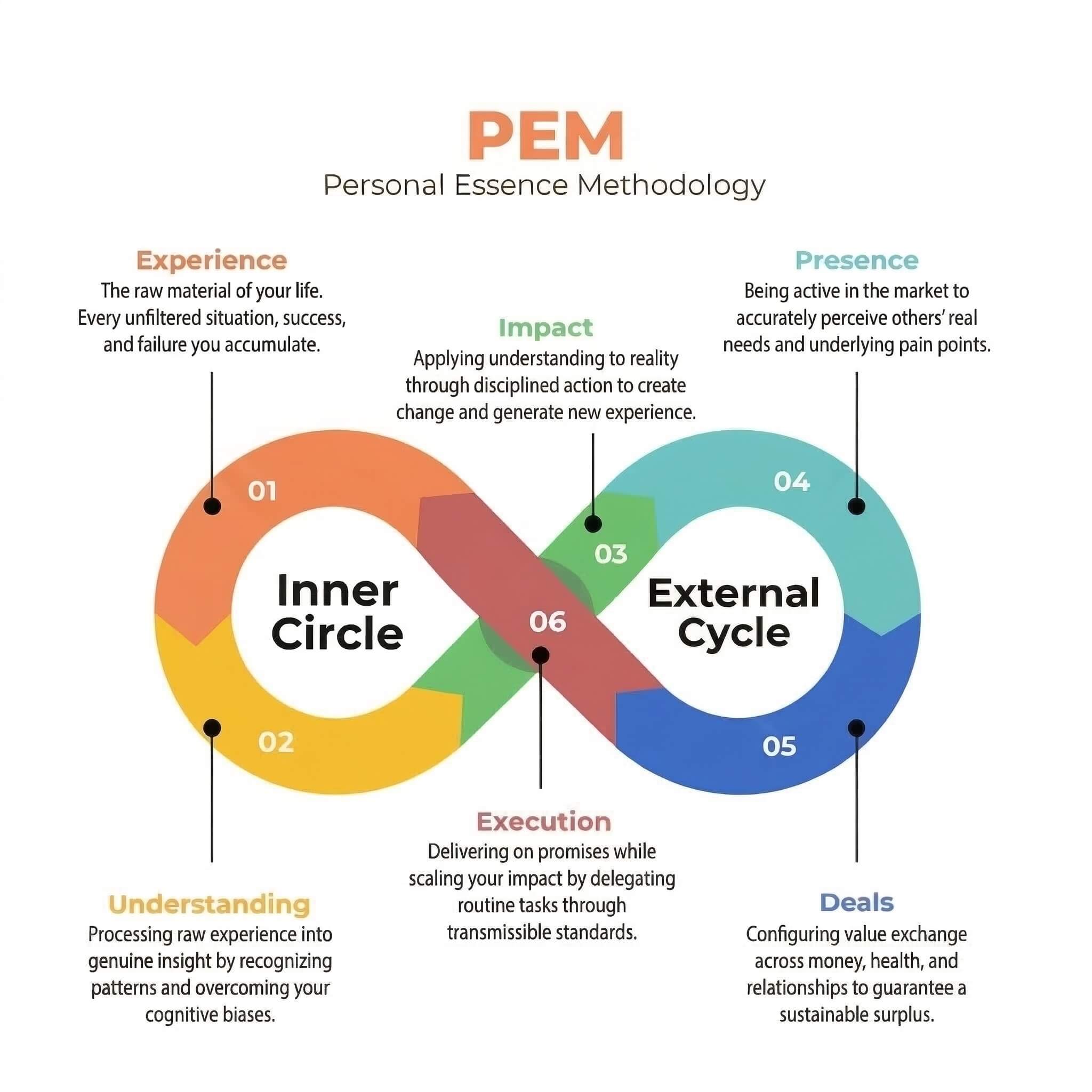
從經驗中發展理解力,透過七大支柱建立以信任為基礎嘅存在感,配置能夠喺六大資源範疇維持你嘅交易,執行你承諾咗嘅嘢——喺建築師模式(Architect Mode)下親力親為、喺建造者模式(Builder Mode)下透過委派——然後讓已證明嘅影響力去擴展你下一步可以可信噉承諾同指揮嘅範圍。
目錄
(17 章節)點解係呢套方法論?點解係而家。
我喺1987年出世,正正係蘇聯解體嗰陣。我人生第一個經濟體系,係一個啱啱先消亡咗嘅經濟體系。
等我大到可以明白教科書入面「穩定環境」係乜嘢意思嗰陣,我從來都未經歷過。後蘇聯時期嘅轉型帶嚟咗惡性通脹、制度真空,同埋日常嘅即興應變——呢啲已經成為咗新獨立嘅烏克蘭入面嘅日常生活。跟住嚟嘅係2000年代初國內經濟動盪。再之後係2008至2009年嘅全球金融危機,對新興經濟體打擊特別猛烈。再之後係2013至2014年嘅尊嚴革命,一夜之間重塑咗成個國家嘅政治版圖。再之後係第一場戰爭——克里米亞被吞併,頓巴斯烽火連天,成個世界圍繞住我哋重新排列,而我哋亦喺當中重新排列自己嚟求存。然後,2022年,全面入侵——呢種危機唔會問你準備好未。
喺呢一切當中,我一路都喺建設。建設生意,建設關係,建設認知。唔係因為我有乜嘢特殊嘅韌性基因,亦唔係因為烏克蘭人特別堅韌——雖然我哋嘅倔強有時連自己都會嚇親。而係因為當危機變成你長期嘅生存環境,而唔係一次打斷嘅時候,佢會教識你一樣和平時期教唔到嘅嘢:你依賴嘅規則會崩塌,而當規則崩塌時你仍然能夠運作嘅能力,係唯一一樣無法被充公、貶值或者炸毀嘅資產。
個人本質方法論(Personal Essence Methodology)唔係喺圖書館裏面設計出嚟嘅。佢係喺「人哋話應該有用嘅嘢」同「當地板不停震動時真正有用嘅嘢」之間嗰個裂縫度鍛造出嚟嘅。呢份文件入面每一條原則——內在鏈條(Internal Chain)、信任公式(Trust Formula)、六大資源領域、委任層級——都係喺貨幣可能會變、邊境可能會封、客戶可能會消失、交付途中可能會停電嘅環境底下經受過壓力測試嘅。
所以我相信呢套方法論喺而家係迫切需要嘅。
你而家運作緊嘅呢個世界,無論你身處邊度,正在進入嗰種我成個職業生涯都身處其中嘅不穩定狀態。地緣政治碎片化正在加速。AI革命正在實時拆解執行層面嘅經濟邏輯。資本唔再廉價。供應鏈唔再可靠。以前提供穩定性嘅制度——可預測嘅市場、穩定嘅貨幣、運作正常嘅國際秩序——正承受住唔會好快解決嘅壓力。
你可能係第一次遇到系統性嘅不穩定。我已經喺入面生活咗三十年。
我學到嘅係呢樣嘢:你控制唔到環境,但你可以控制自己幾深入噉消化經驗,幾誠實噉出現喺你嘅關係入面,幾仔細噉配置你嘅承諾,同埋幾可靠噉兌現你承諾過嘅嘢。呢個就係方法論喺實踐中嘅樣貌。唔係一套關於理想條件下應該點做嘅理論——而係一套已經反覆驗證過嘅系統,喺遠遠唔係理想嘅條件下。
呢套方法論唔會令危機變得舒適。冇嘢做得到。但佢會俾你一個喺周圍結構正在崩塌時仍然可以運作嘅架構。佢會幫你喺信任稀缺嘅時候建立信任,喺條款動盪嘅時候配置交易,喺資源受限嘅時候執行任務,喺規則不斷喺你腳底下變化嘅時候累積你嘅認知。
我建立呢套方法論係因為我需要佢。我分享出嚟係因為我相信你都需要,可能比你意識到嘅更加迫切。
建立你方法論嘅最佳時機係喺危機之前。第二好嘅時機係而家。
— Volodymyr Zhukov
根基
每個人都會累積到獨特嘅經歷組合,遇到唔同嘅價值觀,經歷獨一無二嘅事件序列。呢啲造就咗人與人之間有意義嘅差異——呢啲差異可以成為獨特價值嘅基礎。
有意義嘅差異 vs. 絕對嘅無可比擬。 你同其他人之間確實存在可量度、有重要意義嘅唔同:性格、認知風格、成長經歷、累積嘅專業知識。呢啲差異係真實嘅,而且喺經濟上係有意義嘅。但你又唔係唔同到完全無法比較,或者無法建立連結。你同其他人類共享足夠嘅認知同情感結構,可以理解佢哋,亦俾佢哋理解。呢個共享嘅結構令到同理心成為可能,交換變得有價值,信任變得可以實現。冇真正嘅差異,你就冇獨特嘅嘢可以提供。冇真正嘅相似,你就搵唔到可以提供俾邊個。呢套方法論兩者都需要。
然而,原始經驗本身唔會創造出任何嘢。經驗必須先被理解,然後先可以被應用。而理解必須轉化為行動,先至會改變到任何嘢。呢個就係令到外在成效成為可能嘅內在鏈條(Internal Chain)。
經驗理解影響
經驗係原材料。理解係將呢啲原材料加工成可用洞見嘅過程。影響係將洞見應用嚟改變世界狀況嘅行動。
呢條鏈條係迭代嘅,唔係線性嘅。影響產生新嘅經驗。新嘅經驗需要新嘅理解。呢個循環貫穿成個人生。
關鍵區分:資訊 vs. 理解
資訊係存在於你外面嘅嘢——事實、數據、建議、框架、研究發現。佢係充裕嘅、廉價嘅,而家更加可以由人工智能無限生成。
理解係存在於你裏面嘅嘢——將資訊透過你嘅經驗、你嘅處境、你嘅失敗、你嘅具體情況呢個濾鏡嚟加工處理。理解會話俾你知邊一條資訊喺而家呢個時刻係重要嘅,邊一條建議適用於你嘅實際情況,邊一套策略符合你真正面對嘅制約條件。
資訊係通用嘅。理解係個人嘅。
可獲取資訊嘅爆炸式增長製造咗一個幻象,就係理解同樣擴展咗。但事實並非如此。資訊嘅洪流往往令理解變得更加困難,因為佢阻礙咗更慢、更深層嘅加工處理工作。呢套方法論係一個理解發展系統,唔係一個知識獲取系統。呢兩者之間嘅分別,就係「覺得自己知情」同「真正有效」之間嘅分別。
流暢性幻覺令問題雪上加霜。 當我哋接觸到容易處理嘅資訊——因為之前讀過、因為表述清晰、或者因為佢印證咗我哋已有嘅信念——我哋嘅大腦會將呢種處理嘅流暢感詮釋為已經掌握咗呢啲內容嘅證據。重讀一個框架然後不斷點頭,會產生一種強烈嘅主觀勝任感,但呢種感覺同實際能力係脫節嘅。喺睇住資訊嗰陣能夠認出佢,同喺壓力之下能夠提取佢,兩者之間有住巨大嘅鴻溝。呢套方法論堅持要做加工處理——書寫、測試、三角驗證——正正係為咗擊破呢種勝任感嘅幻覺。
宏觀背景:點解呢套方法論必須進化
我哋正身處一個系統性轉變不斷疊加嘅時期:地緣政治碎片化、AI革命、逆全球化、廉價資本時代嘅終結、人口結構變遷,同埋一場全面嘅能源轉型。呢啲唔係孤立嘅衝擊。佢哋互相作用,而呢啲交互作用放大咗不穩定性,加速咗舊規則瓦解嘅速度。
AI衝擊
AI而家已經係一個執行引擎。大型語言模型能夠生成生產級質素嘅程式碼、專業文件、可運作嘅介面,同埋複雜嘅工作流程。氛圍編程(Vibe coding)將自然語言描述變成可運行嘅軟件。模型上下文協議(Model Context Protocol)將AI直接連接到專業工具同營運基礎設施。AI驅動嘅自主代理處理跨研究、起草、排程、協調同交付嘅多步驟執行工作流程。
呢個從根本上改變咗個人成效嘅經濟邏輯。當執行正在被商品化——當大多數人賣緊嘅嘢(佢哋嘅勞動力、佢哋完成任務嘅能力)正在變得充裕而廉價——噉喺執行層面更加努力,就好似喺一條不斷加速嘅跑步機上面跑得更快。
- AI商品化咗嘅嘢
通用知識。中等水平嘅執行。標準分析。常規生產。表層內容。任何可以簡化為明確規則、唔需要判斷力就可以執行嘅工作。
- AI無法複製嘅嘢
你嘅特定經驗,經過加工處理變成真正嘅理解。你嘅真實關係同埋其中沉澱嘅信任歷史。你駕馭模糊性同作出整合咗價值觀、經驗同情境嘅判斷嘅能力。你真正「同在」(Presence)嘅能力——來自另一個意識同你嘅意識真正交流嘅人類認知。
喺一個通用執行充裕而免費嘅世界入面,中等水平嘅成效只會產生低於平均嘅成果。市場裂成兩半:一邊係對卓越人類能力嘅需求——回報非常豐厚;另一邊係其他所有嘢,越嚟越多由AI或者同AI喺價格上面競爭嘅人類嚟完成。中間地帶正在消失。
自動化偏見令中間地帶嘅危險加劇。 隨住AI變得越嚟越有能力,人哋越嚟越傾向喺冇經過批判性評估嘅情況下接受佢嘅輸出——將機器生成嘅建議當做真理,將批判性思考交俾演算法。呢個唔係懶惰;呢個係我哋嘅大腦對任何被視為權威嘅來源(無論係人定係數碼)所使用嘅認知捷徑。當AI起草咗一份策略、審閱咗一份合約、或者診斷咗一個問題,唔加審視就接受嘅誘惑非常強烈,正正因為輸出睇落去打磨得好靚同好有信心。嗰個能夠加入判斷力嘅人——嗰個能夠捕捉到AI遺漏嘅嘢、感知到演算法無法察覺嘅情境錯配嘅人——就係市場願意付出溢價嘅理解力嘅擁有者。而嗰個只係喺冇真正審視嘅情況下監督AI嘅人,就處於正在消失嘅中間地帶。
信任經濟
對個人嚟講,其中一個最具深遠影響嘅轉變,係從注意力經濟(Economy of Attention)過渡到信任經濟(Economy of Trust)。
二十年嚟,互聯網嘅優化目標係捕獲人類嘅注意力。內容係商品,注意力係貨幣。但生成式AI已經將內容創作嘅成本推到接近零。當內容變成無限、注意力容易被劫持嘅時候,真實性同信任就成為最稀缺嘅資源。價值正在向能夠驗證真相、展示能力、證明人類真實性嘅人、平台同系統遷移。
虛幻真相效應(illusory truth effect)加速咗呢個轉變。當人哋反覆接觸到某啲說法——無論係來自AI生成嘅內容、社交媒體定係市場營銷——佢哋嘅大腦會開始將呢啲說法登記為更有可能係真嘅,而唔理佢哋實際上係咪有效。重複製造信念。喺一個內容無限嘅環境入面,大量重複嘅虛假或誤導性說法侵蝕咗共享真相嘅基線。呢個令到真正嘅信任——建立喺經過驗證嘅往績記錄同透明嘅同在之上嘅信任——成為任何運作良好嘅關係、市場或制度嘅基礎設施。
當執行係稀缺嘅,你基於能力揀選服務提供者。當執行係充裕嘅,你基於信任揀選。基於信任達成嘅交易有更低嘅交易成本——更少嘅驗證、更少嘅法律開支、更少浪費喺監控上面嘅精力。喺一個AI驅動嘅競爭壓縮價格嘅經濟體入面,基於信任嘅交易所帶嚟嘅效率增益唔係邊際嘅。佢哋係決定性嘅。
信任公式(Trust Formula)
信任唔係一種感覺、一種性格特質、或者個人魅力。信任係一個複合體——由三個組成部分以相乘關係結合嘅產物:
相乘關係係最關鍵嘅洞見。如果係相加,噉一個方面嘅弱勢可以由另一個方面嘅強勢嚟彌補。但相乘意味住任何一個因子歸零,成個結果就會歸零。
- 已展示嘅影響力(Demonstrated Impact)
能力信任。你有往績記錄。你交付過成果。你嘅能力係透過其他人可以觀察同驗證嘅結果嚟證明嘅。喺執行(Execution)階段建立。
- 透明嘅同在(Transparent Presence)
善意信任。你係可見嘅、誠實嘅,而且真正投入去理解他人嘅現實。你感知到嘅係佢哋真正嘅需要,唔係你對佢哋需要嘅投射。人哋可以準確噉評估你,因為你以真實嘅自己出現。喺同在(Presence)階段建立。
- 一致嘅對齊(Consistent Alignment)
誠信信任。你喺交易(Deals)中承諾嘅同你喺執行(Execution)中交付嘅之間嘅差距,長期反覆接近零。你嘅言行一致。你嘅承諾同你嘅表現有一貫嘅對應關係。喺交易-執行嘅交界建立,並透過循環不斷複合累積。
點解相乘關係咁重要
零影響力 × 任何值 × 任何值 = 零信任。你交付唔到嘢。再多嘅魅力或者可靠性都改變唔到呢一點。
任何值 × 零同在 × 任何值 = 零信任。你無法被解讀或評估。不透明或者隱形嘅能力產生嘅係戒備,唔係信任。
任何值 × 任何值 × 零對齊 = 零信任。你唔守諾言。有能力、又可見、但持續過度承諾同交付不足嘅人係最危險嘅——因為佢哋吸引到嘅承諾係佢哋兌現唔到嘅。
公式點樣對應到方法論嘅架構
三個組成部分直接對應外在循環(External Cycle)嘅三個階段:
- 同在(Presence) → 建立透明嘅同在(善意信任)
- 交易(Deals) → 配置一致嘅對齊將被衡量嘅承諾
- 執行(Execution) → 建立已展示嘅影響力(能力信任),同時確認或者違反一致嘅對齊(誠信信任)
三因子公式令到一樣喺兩因子公式中被隱藏嘅嘢變得可見:交易唔係單純一個餵入執行嘅配置階段。佢係你定義自己嘅誠信將被評判嘅標準嘅階段。 一筆配置得好嘅交易唔止係最大化盈餘;佢設定嘅係你真正有能力兌現嘅承諾,因為你設定嘅每一個承諾都會成為你一致對齊嘅測試。喺交易階段過度承諾,造成嘅唔止係資源赤字。佢造成嘅係一個誠信信任赤字,無論幾多影響力或者同在都補償唔到。
呢個亦解釋咗點解偏重同在嘅失衡喺信任經濟入面係咁具破壞性。偏重同在嘅人有強烈嘅透明同在,通常亦有真正嘅早期影響力——但佢哋嘅一致對齊接近零,因為佢哋系統性噉承諾多過交付。任何嘢乘以零,結果就係零。佢哋嘅信任崩塌,儘管三個因子入面有兩個好強,因為第三個唔存在。
而呢個亦解釋咗點解偏重執行嘅人嘅信任唔會如期複合累積。佢哋有強勁嘅已展示影響力,通常亦有合理嘅一致對齊——但佢哋嘅透明同在接近零,因為佢哋係隱形嘅。又一次,乘以零。
- 光環效應喺信任形成嘅早期階段運作得非常強烈——而且危險
當一個人展示出一個明顯正面嘅特質——口才了得、資歷出眾、外表吸引——觀察者會無意識噉假設呢個人同時擁有其他正面特質:能力、誠信、良好嘅判斷力。呢個心理捷徑可以加速初期信任嘅形成,喺三個因子被實際展示之前就膨脹咗對佢哋嘅感知。但基於光環效應嘅信任係脆弱嘅。當表現同初始印象矛盾時佢就會崩塌,而且修正往往係不成比例嘅嚴厲:呢個人會被視為係欺騙性嘅,而唔只係能力不足,因為觀察者覺得自己嘅信任被操縱咗。光環效應可以暫時掩蓋其中一個因子嘅零值;相乘公式確保現實最終會重新顯現。
- 關於複合累積
信任透過外在循環嘅反覆循環而複合累積。呢條公式可以擴展為 Trust = (已展示嘅影響力 × 透明嘅同在 × 一致嘅對齊)^循環次數。但呢個已經隱含喺「已展示」(暗示往績記錄,唔係單一事件)、「一致」(暗示反覆性),同方法論已經描述嘅迭代循環之中。複合累積係真實嘅而且必不可少嘅——佢係令到信任成為持久資產而唔係短暫印象嘅原因——但加入明確嘅指數會令公式更難傳達,而唔會增加方法論上嘅清晰度。
呢個轉變改變咗「同在」嘅意義、交易嘅結構方式,同埋執行必須交付嘅嘢。呢套方法論必須將呢啲納入考量。
升級版資源架構(The Upgraded Resource Stack)
之前,呢套方法論將交易圍繞三個領域嚟構建:金錢、健康同關係。呢個框架係有用嘅,但唔完整。喺而家呢個環境入面——信任就係貨幣、注意力受到爭奪、知識快速貶值——我哋需要一幅更精確嘅資源地圖。
每個人都以六個基本資源領域嚟運作。交易喺全部六個領域之間配置。任何一個領域嘅盈餘或赤字都會波及其他領域。
1. 財務 — 財富 / 現金流
金錢、薪酬、投資回報、收入。呢個係最靈活噉轉換成其他資源嘅資源——但單靠佢本身,取代唔到其中任何一種。財務盈餘為委任提供資金、創造選擇權、吸收衝擊。財務赤字制約所有其他領域。
- 心理賬戶扭曲咗財務資源管理
我哋會因應金錢嘅來源或預定用途而用唔同方式對待佢——退稅嘅錢會輕易花掉,但又唔肯動儲蓄,即使兩者都係可互換嘅。呢個喺我哋嘅財務思維入面製造咗隱形嘅「罐子」,阻止咗跨六個領域嘅最優分配。一個自由工作者可能會喺心理上將「項目收入」同「副業收入」分開,對每一種套用唔同嘅消費規則,即使理性嘅做法係將資源匯集起嚟按優先次序分配。呢套方法論要求將財務資源視為一個統一嘅資源池,以策略性分配嚟管理,而唔係受制於金錢到達嘅心理偶然性。
- 貨幣幻覺進一步扭曲咗財務判斷
我哋關注嘅係名義數字——薪金單上嘅數字或者價錢牌——而唔係嗰筆錢實際可以買到乜嘢。喺通脹期間,一個勉強抵消6%通脹嘅5%加薪,感覺上好似有進步。喺配置交易嘅時候,呢個意味住要以實際購買力嚟評估薪酬、定價同投資回報,而唔係名義數字。
2. 生理 — 健康 / 日常精力
身體同精神嘅能量。瞓覺質素、代謝健康、壓力負荷同恢復速度。呢個係決定所有其他嘢上限嘅資源——無論幾多財務或智識資本,如果你嘅身體撐唔住呢個努力,都係白費。生理盈餘意味住韌性同耐力。生理赤字意味住表現下滑,無論機會幾好。
- 瞓覺嘅首要性
瞓覺構成生理健康最重要嘅單一組成部分——係運動、營養、壓力管理同所有其他健康實踐嘅基礎。喺瞓覺期間,大腦透過神經重播同模式提取將經驗整合成理解——呢個就係內在鏈條(Internal Chain)將今日嘅經驗轉化成明日洞見嘅實際機制。長期睡眠不足會削弱精力。更嚴重嘅係,佢破壞咗產生理解嘅過程本身——而理解正正係呢套方法論嘅核心資產。七至八個鐘頭嘅瞓覺係不可妥協嘅基礎設施,唔係健康嘅奢侈品。
- 投射偏見削弱咗生理資源管理
當我哋感覺精力充沛同健康嘅時候,我哋無法準確噉想像當自己耗竭、患病或者承受壓力時會點樣思考同表現——反過嚟亦一樣。呢個係冷熱同理心差距(hot-cold empathy gap)應用喺我哋自己未來狀態上嘅表現。喺狀態好嘅日子配置交易嘅人,會系統性噉低估嗰啲承諾嘅生理成本。而處於倦怠中嘅人又無法準確噉預見休息能夠帶嚟嘅恢復,可能會基於暫時嘅狀態做出永久嘅決定。交易必須按照現實嘅生理承受力嚟配置,而唔係按照你最佳狀態嗰日嘅感覺。
3. 社交 — 深層關係(支持)/ 廣闊網絡(觸達)
呢個領域有兩個唔同嘅層次。深層關係提供情感支持、誠實嘅反饋,同埋危機時嘅安全網。廣闊網絡提供觸達範圍、交易流同你靠自己搵唔到嘅機會。兩者都係必要嘅。有深層關係但冇觸達意味住同市場隔絕。有廣闊網絡但冇深度意味住脆弱嘅連結,喺壓力之下會崩塌。
禮貌偏見悄悄噉侵蝕咗社交反饋迴路。 你網絡入面嘅人——特別係職業關係中嘅人——會系統性噉話佢哋以為你想聽嘅嘢,而唔係佢哋實際觀察到嘅嘢。呢個機制係社交潤滑。但呢個意味住大多數人依賴嚟校準自己嘅反饋渠道,喺源頭上已經被污染咗。呢套方法論堅持三角驗證——凍結喺時間中嘅記錄、當下嘅反思、同硬性嘅外部數據——部分原因就係為咗補償人類反饋喺到達你之前已經被禮貌過濾咗嘅事實。
4. 聲譽 — 信任 / 個人品牌 / 受眾
喺信任經濟入面,聲譽唔再係做好工作嘅被動副產品。佢係一項主動嘅、可管理嘅資產。你嘅聲譽係人哋喺同你互動之前對你嘅信念。你嘅個人品牌係你刻意發出嘅信號。你嘅受眾係基於已展示嘅信任而授予你持續關注嘅一群人。聲譽盈餘意味住機會主動搵上門。聲譽赤字意味住你每一次都要從零開始爭取機會。
聲譽透過五個唔同嘅渠道嚟建立:已展示嘅成果(交付咗嘅項目、解決咗嘅問題)、網絡觸達(邊個知道你嘅工作同佢哋會同邊個講)、能見度(透過活動、內容、專業社群喺你即時網絡之外被認識)、知識分享同案例展示(唔止傳達你做咗乜嘢,仲傳達你點樣思考),同埋時間上嘅一致性(可靠噉持續出現嘅複合效應,年復一年)。只投資其中一個渠道——通常係已展示嘅成果——會令其他四個處於休眠狀態,呢個就係點解出色嘅工作往往保持隱形。
純粹曝光效應(mere exposure effect)係基於能見度嘅聲譽建設背後嘅機制
人哋越頻繁噉接觸到你嘅名字、你嘅工作或者你嘅想法,佢哋就越傾向對你產生正面嘅聯想——即使佢哋講唔出點解。呢個係人類認知處理熟悉感嘅方式。策略性嘅能見度——持續嘅內容產出、定期出席活動、喺專業社群中可靠地出現——誠實噉利用咗呢個效應。關鍵嘅但書:純粹曝光建立嘅係親切感同認知度,唔係能力信任。佢可以打開門,但關唔到交易。冇交付嘅能見度會製造偏重同在嘅失衡。
從眾效應(bandwagon effect)放大咗聲譽嘅動量
一旦有足夠多嘅人認識同信任你,其他人就會跟隨,因為佢哋觀察到其他人已經信任你,而唔係因為佢哋獨立噉評估過你嘅工作。呢個就係點解聲譽資本以非線性方式複合累積:早期投資帶嚟嘅回報比較有限,但一旦跨過社會認同嘅門檻,聲譽就會自我強化。危險在於同一個機制反向運作時一樣強力——聲譽受損嘅級聯效應同聲譽增長一樣迅速。
5. 智識 — 知識 / 硬技能
你知道嘅嘢同你識做嘅嘢。領域專長、技術能力、模式識別、判斷力嘅框架。智識資本係令你嘅理解可以轉移、你嘅委任有效嘅關鍵。喺一個AI商品化咗表層知識嘅世界入面,深層智識資本——嗰種能夠支撐判斷力而唔止係資訊檢索嘅智識資本——變得更有價值,而唔係更冇價值。
Google效應(數碼健忘症)重塑咗智識資本嘅需求。 當資訊可以即時獲取嘅時候,我哋嘅大腦停止咗儲存事實性內容,轉而成為記住喺邊度搵到資訊嘅專家。呢個係一個適應性嘅轉變,但佢有代價:嗰個「識得去邊度查」嘅人,缺乏喺壓力之下快速作出判斷所需嘅內化知識基礎。喺呢套方法論嘅意義上,深層智識資本係毋需有意識搜索就能運作嘅內化模式識別。可檢索嘅資訊唔符合資格。AI時代令呢個區分更加鮮明:AI負責檢索;你負責判斷。如果你嘅智識資本只包含你可以查到嘅嘢,AI已經做得比你好。
6. 時間 — 時間 / 專注注意力
一日入面嘅鐘頭數同嗰啲鐘頭入面注意力嘅質素。時間係唯一一種無法累積嘅資源——佢只能被分配。專注注意力係決定已分配嘅時間產生價值定係浪費嘅乘數。時間盈餘意味住有空間做策略性思考、關係投資同恢復。時間赤字意味住被動式生活——不斷回應,從來唔係主導。
希克定律(Hick's Law)支配住選擇同時間效率之間嘅關係。 你喺任何一個時刻面對嘅選項越多——回邊封電郵、推進邊個項目、投資邊段關係——你嘅大腦做決定就需要越長時間,而且決定嘅質素會下降。呢個係選擇數量嘅對數函數,唔係紀律嘅問題。透過系統、慣例同委任嚟減少活躍決策嘅數量,係對時間資源嘅結構性防禦,唔係一個生產力小技巧。
六大領域點樣互動
冇任何領域係孤立運作嘅。財務盈餘可以購買時間自由(委任、自動化)。生理盈餘令更深層嘅智識工作成為可能。聲譽盈餘減少咗達成交易所需嘅努力。社交盈餘帶出節省時間同金錢嘅機會。智識盈餘令執行更有效率,保存生理同時間資源。
反過嚟,任何一個領域嘅赤字都會消耗其他領域。財務壓力侵蝕健康。健康下降減少智識產出。聲譽受損縮小網絡。網絡崩塌消滅交易流。差勁嘅交易消耗時間。失去嘅時間阻礙恢復。
升級版嘅交易原則:配置喺全部六個資源領域都產生盈餘嘅協議——唔止係財務上嘅。 一筆薪酬豐厚但摧毀你健康、聲譽或關係嘅交易唔係好嘅交易。佢係一場對比金錢更難重建嘅資產嘅緩慢清算。
內在鏈條(Internal Chain):將經歷轉化為理解
內在鏈條(Internal Chain)——經歷理解影響——就係你獨特價值嘅煉成之地。每一環都需要刻意嘅功夫;冇一環係自動運作嘅。
處理方法:四個問題
每次經歷完一件有份量嘅事之後,用書面形式有系統噉應用呢四個問題:
- 到底發生咗咩事? 唔係你對件事嘅故事版本。唔係你嘅詮釋。係盡可能客觀噉描述實際發生嘅事件。將觀察同詮釋分開。
- 可能嘅原因有幾個? 至少搵出三個唔同嘅解釋嚟說明點解件事會噉發生。噉樣可以防止你一嘢就攬住第一個舒服嘅敘事唔放,同時對抗確認偏誤。呢個問題亦都直接對抗合取謬誤(conjunction fallacy)——即係我哋傾向覺得詳細、連貫嘅解釋比簡單嘅解釋更加可信。你嗰三個解釋每一個都應該用呢個原則嚟檢驗:一個具體、故事化嘅解釋,唔會自動比一個模糊但涵蓋更廣嘅解釋更大機會成立,無論佢幾咁吻合。
- 如果換個角度嘅人會點睇? 想像一個有唔同偏見、唔同背景、唔同利益考量嘅人,觀察住同一個情境。佢哋會留意到啲咩係你走漏眼嘅?呢個問題特別針對基本歸因謬誤(fundamental attribution error)——即係我哋傾向用性格嚟解釋別人嘅行為,卻用處境嚟解釋自己嘅行為。當你考慮另一個角度嘅時候,要刻意問自己:有啲咩處境壓力可能驅使咗你觀察到嘅行為?行動者—觀察者偏誤(actor-observer bias)意味住,除非你有意識噉反轉呢個模式,否則你自然會為自己製造處境性嘅解釋,為其他人製造性格性嘅解釋。
- 我實際上可以驗證啲咩? 搵出你嘅理解入面有咩係可以驗證嘅。未經驗證嘅理解係假說,唔係知識。如果你嘅詮釋能夠預測未來嘅結果,就去驗證嗰個預測。
兩種失衡會通過你抗拒嘅問題暴露出嚟。偏重臨在(Presence)嘅人喺第一同第四條問題上會掙扎——「到底發生咗咩事?」威脅到佢哋打磨好嘅敘事,而「我可以驗證啲咩?」要求佢哋去執行,偏偏呢啲係佢哋最想避開嘅。偏重執行(Execution)嘅人喺第二同第三條問題上會掙扎——搵出多個解釋感覺好似嘥氣力,而想像其他人嘅角度需要佢哋投入唔夠嘅臨在。
三角驗證實踐
冇任何單一嘅自我認知來源係可靠嘅。你能夠建基於其上嘅理解,需要三個參考點互相對照:
你嘅即時記錄 ——喺你知道結果之前,你當時相信緊發生緊咩。日記、決策紀錄、即場寫低嘅筆記。呢啲捕捉住你當時嘅偏見原貌,喺事後諸葛亮改寫之前。呢啲記錄係你對抗後見之明偏誤(hindsight bias)嘅第一道防線——大腦會自動喺得知結果之後改寫之前嘅信念,令事件睇落比實際上更加可預測。冇即時記錄,你就分唔清楚你真正預測過咩同你而家以為自己預測過咩。自我一致性偏誤(self-consistency bias)進一步腐蝕呢個過程:你嘅大腦會假定你一直持有你而家嘅觀點,靜雞雞抹走過去嘅改變,以維持一個穩定、連貫嘅自我幻象。
你而家嘅記憶同反思 ——你而家相信嘅嘢,帶住時間距離嘅好處。呢個捕捉住當時冇辦法做到嘅模式識別。對而家嘅記憶要保持校準過嘅懷疑態度。選擇支持偏誤(choice-supportive bias)會令你嘅大腦事後美化你做過嘅決定嘅吸引力,同時貶低你拒絕過嘅選項嘅吸引力。活喺你而家記憶入面嘅過去版本,係有系統噉偏向讚美你過去嘅選擇嘅。
硬數據同外部反饋 ——根據存在於你腦袋以外嘅證據,實際上發生咗咩。數字、時間線、交付成果、結果,同埋其他人觀察到同記錄低嘅嘢。
當三者匯聚嘅時候,你大概接近現實。當三者分歧嘅時候,分歧本身就係教訓——佢揭示你嘅偏見喺邊度運作、向邊個方向拉、同埋你幾大程度可以信任自己嘅處理過程。
認知偏誤嘅角色
內在鏈條(Internal Chain)長期受到系統性認知扭曲嘅攻擊,每一環都受影響。
腐蝕經歷(原材料)嘅偏誤
玫瑰色回憶(rosy retrospection)會將過去美化得比實際更好。情感衰退偏誤(fading affect bias)令負面情緒比正面情緒褪色得更快。伸縮效應(telescoping effect)會搞亂你嘅時間線。情緒一致性記憶(mood-congruent memory)會透過你而家嘅情緒狀態過濾你嘅歷史。來源監控錯誤(source monitoring errors)會將你從未親身經歷過嘅事注入記憶——將你睇過或者聽過嘅嘢歸檔為你親歷過嘅。倖存者偏誤(survivorship bias)令你只從發生咗嘅事學習,而唔係從冇發生嘅事學習。可得性啟發法(availability heuristic)令戲劇性嘅事件感覺重要,而重要嘅模式卻被忽略。峰終定律(peak-end rule)令你根據一段經歷最強烈嘅時刻同佢嘅結尾嚟評價整段經歷,完全丟棄持續時間同平淡嘅中段——意思係一個辛苦但收尾好嘅項目會被記憶為正面嘅,而一個順利但收尾有少少失望嘅項目會被記憶為負面嘅,無論實際經歷嘅平衡係點。持續時間忽略(duration neglect)令呢個問題更加嚴重:一段經歷嘅長度對你點記住佢幾乎冇貢獻,呢個意味住長時間持續嘅努力喺回顧嘅時候可以喺心理上完全隱形。
扭曲理解(處理過程)嘅偏誤
偏見盲點(bias blind spot)令你睇到別人嘅扭曲,但對自己嘅視而不見——而對偏誤嘅認識反而可以令呢個情況更差,因為佢製造咗一種免疫嘅錯覺。確認偏誤(confirmation bias)令你睇到支持你現有信念嘅證據,而忽視反對嘅證據。天真犬儒主義(naïve cynicism)令你將中性或正面嘅信號處理為威脅。塞麥爾維斯反射(Semmelweis reflex)令你拒絕會更新你理解嘅證據,尤其係當接受佢會威脅到你嘅身份認同嘅時候。虛構記憶(confabulation)會喺你完全冇意識到嘅情況下,為你自己嘅行為生成虛假嘅解釋。錯覺相關(illusory correlation)令你感知到變量之間嘅關係,但其實並唔存在——尤其係當配對具有情感顯著性或者符合既有敘事嘅時候。你可能會得出結論,某個特定嘅客戶行業總係導致範圍蔓延,或者某種特定嘅會議總係產生好決策,但其實只係基於少數令人印象深刻嘅實例而非實際模式。聚類錯覺(clustering illusion)加劇呢個問題:真正嘅隨機性會產生堆積同連續,對我哋渴求模式嘅大腦嚟講好似有意義嘅模式,然後我哋就喺呢啲幻影信號上面建立策略。保守主義偏誤(conservatism bias)——一個相關但不同嘅扭曲——令你喺真正嘅新證據到達嘅時候更新信念太慢,喺應該大幅調整嘅時候只做少少調整。
破壞臨在(Presence)(對他人嘅感知)嘅偏誤
虛假共識效應(false consensus effect)令你將自己嘅價值觀同偏好投射到其他人身上。外群體同質性(out-group homogeneity)令你將個體模糊成類別。刻板印象(stereotyping)將固定特質分配畀呢啲類別。跨種族效應(cross-race effect)同感知校準限制意味住你嘅感知對熟悉嘅嘢運作良好,對陌生嘅嘢運作差勁,而冇任何內在警報提示你係處於邊種模式。聚光燈效應(spotlight effect)令你高估其他人對你嘅外貌、錯誤同行為嘅注意程度——因為你係自己經歷嘅主角,會假設其他人同你一樣專注噉睇住你嘅表演。透明度錯覺(illusion of transparency)加劇呢個問題:你覺得自己嘅內在狀態(緊張、熱情、無聊)從皮膚度明顯噉散發出嚟,但實際上其他人感知到嘅遠比你想像嘅少。呢兩個偏誤加埋,創造出一個扭曲嘅模型,令你誤解其他人點樣經歷你嘅臨在——你以為自己被審視同被讀透,但實際上大部分時間都冇被注意到,而呢個錯誤假設要嘛驅使你焦慮噉過度管理印象,要嘛驅使你喺臨在最有價值嘅場合退縮。
不對稱洞察錯覺(illusion of asymmetric insight)從根源上腐蝕同理心
你相信自己對別人嘅動機嘅理解好過佢哋對你嘅理解——甚至好過佢哋對自己嘅理解。呢個係偽裝成洞察力嘅投射,唔係探究式嘅同理心。一個帶住「已經搞清楚」對方嘅信念行入會議嘅人,已經停止咗調查,開始確認。呢套方法論將同理心定義為紀律而非情感,正正係為咗對抗呢個錯覺:將你對任何其他人嘅理解當作假說,而唔係結論。
冷熱同理心落差(hot-cold empathy gap)喺唔同情緒狀態下破壞臨在
當你冷靜、舒適、資源充足(「冷」狀態)嘅時候,你冇辦法準確噉模擬你或者其他人喺壓力大、驚慌、疲憊或者絕望(「熱」狀態)嘅時候會點諗同點做。呢個意味住從舒適位置進行嘅臨在,會系統性噉誤讀處於危機中嘅人嘅經歷。一個從財務安全位置為苦苦掙扎嘅企業提供建議嘅顧問,字面上感受唔到塑造緊客戶決策嘅絕望感。承認呢個落差——並且設計彌補佢嘅探究性實踐——對於真正嘅臨在係不可或缺嘅。
破壞交易(Deals)嘅偏誤
雙曲折現(hyperbolic discounting)令你高估即時獎勵而忽略更大嘅未來回報,造成絕望式嘅交易模式。誘餌效應(decoy effect)透過不對稱嘅劣勢選項操控你嘅選擇。區分偏誤(distinction bias)令你執着於容易比較嘅差異(價格),而忽略決定你生活質素嘅維度。錨定效應(anchoring)將你對「合理」嘅感覺鎖定喺最先提到嘅數字上。損失厭惡(loss aversion)令失去一單差交易嘅恐懼感覺上係得到一單好交易嘅希望嘅兩倍重。現狀偏誤(status quo bias)同禀賦效應(endowment effect)圍繞現有嘅差交易建立心理堡壘。沉沒成本謬誤(sunk cost fallacy)同佢嘅升級版——承諾升級(escalation of commitment),令你喺理性已經指向離開之後,仍然留喺交易入面,因為放棄交易意味住承認過去嘅投入係嘥咗嘅。情感邏輯係:「我已經投入咗噉多,唔可以而家停。」理性邏輯係:過去嘅成本已經冇咗;只有未來嘅成本同收益先至重要。框架效應(framing effect)意味住同樣嘅交易條款,取決於點樣呈現,可以感覺上係可接受嘅或者係剝削性嘅——「九折」同「全價嘅九成」喺數學上完全一樣,但喺心理上完全唔同。零和偏誤(zero-sum bias)令你假設對方嘅任何收益都一定係犧牲你嘅利益,令你睇唔到雙方真正受益嘅交易。
過度自信效應(overconfidence effect)滲透整個交易過程
人天生比佢哋實際正確嘅程度更加肯定。當聲稱百分百確定嘅時候,我哋通常只有大約八成嘅時間係啱嘅。喺交易中,呢個表現為高估自己嘅交付能力、低估項目複雜性、同埋承諾你無法達到嘅時間線。困難—容易效應(hard-easy effect)以一種特定嘅方式令情況更差:你喺最困難嘅問題上最過度自信(而你嘅準確度偏偏最低),喺簡單嘅問題上最唔夠自信(而你實際上會表現得好好)。呢個意味住信心同難度幾乎係完全錯配嘅。
規劃謬誤(planning fallacy)係交易—執行邊界上最具破壞力嘅單一偏誤
當估計一個項目要幾耐、要使幾多、或者需要咩資源嘅時候,你想像住一條冇摩擦嘅完成路徑——壓縮時間線、最小化成本、忽略風險。你對其他人嘅項目係悲觀嘅,但對自己嘅就係樂觀嘅。十個大型項目有九個因為呢個原因超支。你配置嘅每一單交易都應該包括對時間同成本估算嘅系統性上調——研究建議將你嘅初始估算乘以1.5到2.5倍,取決於項目嘅新穎程度。
令執行(Execution)脫軌嘅偏誤
熟路效應(well-traveled road effect)令熟悉嘅任務感覺比實際上簡單,喺真正需要注意力嘅時候觸發自動駕駛模式。功能固着(functional fixedness)將你嘅工作流程鎖定喺單一配置——咩都係你做——但其實可以分解。宜家效應(IKEA effect)令你高估自己親手執行嘅價值,令你死揸住恆常工作唔放,因為嗰啲係你親手做嘅。行動偏誤(action bias)——即係喺不確定嘅時候忍唔住要「做啲嘢」而唔係乜都唔做——喺不確定性下嘅執行期間特別具破壞力。當條件含糊或者指標唔清楚嘅時候,本能反應係採取可見嘅行動,即使策略性嘅等待會產生更好嘅結果。將動作同進步混淆,令你用忙碌嘅工作填滿不確定嘅時段,感覺上好似有生產力,但實際上消耗住生理同時間資源,卻冇推進理解。蔡格尼克效應(Zeigarnik effect)加劇呢個問題:未完成嘅任務會製造持續嘅心理張力,驅使你衝動噉採取行動嚟「關閉迴路」,即使最優嘅做法係喺更多資訊到達之前將任務懸而未決。
控制錯覺(illusion of control)喺執行期間導致系統性嘅判斷失誤
當一個情境涉及你嘅積極參與,你嘅大腦會自動假設你可以影響結果——即使結果取決於完全超出你控制範圍嘅因素。相信自己嘅個人努力決定市場時機嘅創業者、覺得自己可以透過個人洞察力「跑贏大市」嘅投資者、將團隊成果完全歸功於自己領導力嘅經理——全部都喺經歷控制錯覺。呢個偏誤特別危險,因為佢感覺上好似係能動性同能力嘅體現,令佢難以被糾正。
阻礙委派嘅偏誤
不可或缺錯覺(illusion of indispensability)係自我強化嘅——你永遠唔畀其他人試,所以冇其他人發展出能力,而呢個就「證明」咗你嘅不可或缺性。控制偏誤(control bias)令你不斷跟住委派出去嘅工作,直到你嘅策略思維因為沉浸喺營運細節入面而退化。倒轉規劃謬誤(inverted planning fallacy)將委派成本高估三到十倍。歸因錯誤(attribution errors)將模糊指示同缺失標準造成嘅結構性失敗歸咎於被委派嘅人。
知識詛咒(curse of knowledge)係令可傳遞標準如此難以創建嘅委派特定偏誤
一旦你內化咗一項技能或領域,你就失去咗想像唔知道係點嘅能力。你嘅解釋跳過咗「顯而易見」嘅步驟,但呢啲步驟只係對你嚟講顯而易見。你嘅標準遺漏咗你覺得根本到唔可以想像有人唔會應用嘅標準。委派悖論——即委派迫使你清晰表達你知道嘅嘢,從而加深你嘅理解——就係知識詛咒嘅直接解藥。將知識變成可傳遞嘅過程,就係面對你視為理所當然嘅嘢嘅過程。
達克效應(Dunning-Kruger effect)喺委派光譜嘅兩端都運作
喺一個領域缺乏能力嘅人無法認識到自己嘅無能——因為表現好所需嘅技能同評估表現所需嘅技能係同一套。呢個意味住過早委派嘅人可能認識唔到自己嘅標準係不足嘅,而過早執行嘅人可能高估自己工作嘅質素。喺專家嗰端,真正精通嘅人往往假設對佢哋嚟講容易嘅任務對所有人都係容易嘅,導致培訓同文件唔足夠。兩個極端都會降低委派質素。
呢啲偏誤無法消除。佢哋可以透過外部反饋、書面記錄、刻意尋求反證、校準過嘅信任、以及上述嘅結構化處理方法嚟管理。
橫跨整條鏈條運作嘅額外偏誤
有幾種認知偏誤唔係整齊噉歸入某一個階段,而係作為跨階段嘅扭曲,同時影響經歷、理解同影響:
負面偏誤(negativity bias) 令負面嘅經歷、反饋同資訊嘅心理份量大約係同等正面信號嘅兩倍。一條批評性嘅反饋可以蓋過十句讚美。一個失敗嘅項目可以喺心理上壓倒好幾個成功嘅項目。呢個偏誤扭曲每一個階段:佢腐蝕經歷嘅原材料,令失敗比成功更加突出;佢扭曲理解,令基於威脅嘅詮釋比基於機遇嘅詮釋更加黏實;佢破壞影響力,令對負面結果嘅恐懼比對正面結果嘅希望顯得更加龐大。
對比效應(contrast effect) 意味住你嘅大腦唔會用絕對標準評價任何嘢——一切都係根據之前嘅嘢或者旁邊嘅嘢嚟判斷。同樣嘅交易條款,喺一個差嘅提議之後會覺得好好,喺一個大方嘅提議之後會覺得麻麻,即使交易本身冇變過。同樣嘅執行質素,喺一個充滿失敗嘅星期覺得好出色,喺一個充滿成功嘅星期覺得好平凡。呢種相對性影響每一個階段:佢扭曲你點樣評價新嘅經歷(相對於最近嘅經歷)、你點樣處理理解(相對於之前嘅信念)、同埋你點樣評估影響力(相對於相鄰嘅結果)。
逆火效應(backfire effect) 係最違反直覺嘅扭曲:當根深蒂固嘅信念受到矛盾證據嘅挑戰時,信念有時候反而會加強而唔係減弱。呢個現象發生嘅原因係我哋嘅信念同身份認同同社會歸屬感綁喺一齊。當證據威脅到我哋係邊個嘅時候,大腦會將佢當作攻擊,然後加倍堅持。呢個對方法論強調嘅處理同反證尋求有直接嘅啟示:你唔可以簡單噉將矛盾嘅數據擺喺自己面前就期望理性更新。處理必須係漸進嘅、對身份安全嘅,同埋透過結構化嘅四個問題(Four Questions)嚟進行,而唔係透過對抗式嘅自我檢視。
心理抗拒(psychological reactance) 意味住當你覺得自己嘅選擇自由受到外部要求、方法論處方、甚至你自己嘅既定計劃嘅威脅時——你會自動產生做相反嘢嘅動機。呢個偏誤影響方法論本身嘅採用方式:系統越僵化、越處方式,用家嘅大腦就越反抗。方法論嘅迭代性同適應性本質,喺心理上係必要嘅,唔只係結構上合理。僵化嘅系統觸發抗拒;靈活嘅框架邀請投入。
內在鏈條嘅目標分配
內在鏈條有一個最佳嘅時間分配:
25% 經歷 ——透過實踐同接觸嚟累積原材料。50% 理解 ——刻意處理經歷,將佢轉化為真正嘅洞見(寫日記、三角驗證、四個問題、外部校準、質疑敘事)。25% 影響 ——應用理解嚟改變條件同驗證佢嘅準確性。
大多數人將呢個比例倒轉,將絕大部分時間用喺累積原始經歷,幾乎冇花喺處理上面。結果就係:幾年嘅經歷只產生幾個月嘅理解。
資訊偏誤(information bias)驅動呢個倒轉。 我哋有一種根深蒂固嘅傾向去尋求更多資訊——更多經歷、更多數據、更多輸入——即使嗰啲資訊唔會改變我哋嘅行為。累積新經歷感覺上好似有生產力。處理現有嘅經歷感覺上又慢又不確定。大腦將「知道更多」同「決定得更好」混為一談,但喺好多情況下,冇經過處理嘅額外經歷對改善結果係完全無關嘅。方法論中50%理解嘅分配,就係直接對抗呢個偏誤。
三個階段
內在鏈條令你能夠參與外部交換。呢種參與遵循三個階段。
外部循環嘅目標分配
50% 臨在(Presence) ——積極嘅市場參與、需求感知、關係建立、信任發展。25% 交易(Deals) ——配置價值交換、談判條款、確保盈餘。25% 執行(Execution) ——親自交付依賴理解嘅工作。
25%嘅執行分配只有喺委派基礎設施建立好之後先至有效——可傳遞標準建立好、組織結構配置好、AI工作流程同合作夥伴關係運作緊。喺建立委派基礎設施嘅期間,個人執行必然消耗更多。但即使你喺親自執行嘅時候,追蹤呢啲目標都會揭示必要嘅改變方向。
臨在(Presence)
臨在就係存在於其他人之間、市場之中、關係之中、世界之中。佢需要發展咗嘅同理心——即感知其他人嘅痛苦、問題同願望嘅能力。呢種感知之所以可能,係因為人類共享足夠嘅認知同情感架構嚟互相理解,同時又有足夠嘅差異,令每個角度都能提供其他角度所缺乏嘅嘢。
臨在直接汲取自內在鏈條。你累積嘅經歷,一旦被理解,就成為你感知其他人需求嘅鏡頭。如果冇足夠嘅經歷同理解,臨在就係膚淺嘅。你聽到說話但走漏意思。你睇到問題但睇唔到佢嘅根源。
臨在亦都係你發展對自身價值認知嘅地方。透過接觸其他人同理解佢哋嘅掙扎,你開始認識到你可以提供啲咩係其他人唔容易複製嘅。
同理心作為紀律,而非情感
同理心唔係感受另一個人感受嘅能力。唔係溫暖、關懷或者對別人內在狀態嘅直覺。同理心係一種有系統噉調查其他人實際經歷嘅紀律,而唔係將你自己嘅經歷投射到佢哋嘅處境上面。
一個相信同理心係感知嘅人行入一間房,讀到氣氛,假設自己理解咗,然後根據呢個假設行動。佢可能完全搞錯。一個將同理心視為紀律嘅人行入同一間房,進行調查——發問、聆聽、將佢聽到嘅嘢同佢預期嘅嘢對照,將佢對另一個人嘅理解當作假說而唔係結論。
虛假共識效應(false consensus effect)係腐蝕未經訓練嘅同理心嘅具體機制
你自然噉假設大多數人嘅思考、感受同行為方式同你一樣。你嘅大腦膨脹咗幾多人分享你嘅觀點、你嘅偏好同你嘅反應。呢個創造出一個以自我為中心嘅錨,將你自己嘅經歷變成理解所有其他人嘅預設模板。探究式同理心嘅存在就係為咗打破呢個錨:對另一個人需要咩、重視咩、或者感受咩嘅每一個假設,都必須根據證據嚟檢驗,而唔係視為不言自明。
選擇性感知(selective perception)令問題更加複雜
你嘅大腦會根據期望、過去嘅經歷同而家嘅情緒狀態主動建構社會世界,而唔係被動噉記錄佢。你真係會睇唔到唔符合你現有框架嘅行為、需求同信號。一個「知道」某類客戶需要咩嘅資深顧問,可能完全走漏全新嘅問題,因為佢嘅感知系統已經調校咗去睇熟悉嘅嘢。臨在需要主動嘅解調:刻意去尋找你預期之外嘅嘢。
表面問題 vs. 真正問題
人講佢哋需要嘅嘢,好少係佢哋真正需要嘅嘢:佢哋經歷症狀然後描述症狀。陳述出嚟嘅問題通常只係更深層嘢嘅表面呈現。臨在需要問超越表面嘅問題:你點解覺得你需要嗰個?如果你有咗嗰個,會有咩唔同?呢個問題係幾時開始嘅,當時有咩變咗?你已經試過啲咩,點解冇用?
問題背後嘅痛苦
每個問題背後都有痛苦,而理解痛苦通常比理解問題更加重要。兩個有同一個表面問題嘅人,可以有完全唔同嘅底層痛苦——例如財務恐懼對比身份認同威脅——而同一個方案套用喺兩個人身上,至少會走漏其中一個。
社會期望偏誤(social desirability bias)過濾住臨在中嘅每一次互動
人會將自己呈現到最好嘅一面——誇大正面嘅特質、淡化負面嘅、並且用維護佢哋尊嚴同社會地位嘅方式包裝佢哋嘅處境。呢個係自動同大致無意識嘅過程,唔係欺騙。對臨在嘅啟示係:人哋講畀你聽嘅關於佢哋處境、需求同能力嘅嘢,係有系統噉偏向令佢哋自己睇落好嘅。探究式同理心必須計算呢個過濾器,認識到佢哋呈現嘅現實版本係經過篩選嘅,而完整嘅畫面需要更深入嘅探究。
信任經濟中嘅臨在
喺信任經濟(Economy of Trust)入面,臨在超越咗物理同關係上嘅鄰近性。佢而家包括信號臨在——即你嘅聲譽、內容同個人品牌喺任何直接互動發生之前,令你可見同可信嘅程度。
呢度就係**信任經濟嘅支柱(Pillars of the Economy of Trust)**運作嘅地方。每條支柱都係一個喺充斥噪音同合成內容嘅世界入面,建立、維護同擴展基於信任嘅臨在嘅機制。
基於信任嘅臨在嘅七大支柱:
- 個人品牌同真實性(錨): 你嘅數碼同實體聲譽。對你係邊個、你代表咩、同你帶嚟嘅獨特價值嘅清晰認知。喺一個嘈雜嘅世界入面,一個強大、真實嘅個人品牌喺你行入一間房或者發一條訊息之前就預售咗你嘅可信度。呢條支柱直接汲取自聲譽資源領域,並由智識資本驅動——你冇辦法品牌化你自己都唔真正理解嘅嘢。
喺個人品牌化方面要提防巴納姆效應(Forer effect)。 當品牌聲明夠含糊嘅時候——「我幫助人發揮潛力」、「我為複雜問題帶嚟策略性洞見」——聽落好有說服力,因為佢可以套用喺幾乎任何人身上。巴納姆效應令人將籠統嘅性格描述評為高度準確,只要佢哋相信呢啲描述係專門為佢哋度身訂造嘅。你嘅品牌必須具體到可以被證偽:如果你嘅品牌聲明可以描述你行業入面嘅一千個人,嗰個唔係品牌。嗰個係巴納姆聲明。
- 策略性人脈經營(網絡): 建立有意圖、互利嘅關係,而唔係收集聯絡人。信任經濟靠關係運轉。你嘅人脈網絡係你嘅機會、合作同內幕知識嘅分發渠道。呢條支柱橫跨社會領域運作——深度關係同廣泛觸及——並且喺持續維護嘅情況下隨時間複合增長。
- 線下同高接觸活動(加速器): 會議、晚宴、策劃小組、咖啡聚會。數碼平台啟動連結;面對面嘅互動鞏固佢哋。閱讀肢體語言、分享經驗、四目相對,加速信任嘅速度快過幾個月嘅網上訊息往來。呢條支柱以加速嘅速率將社會同時間資源轉化為聲譽資本。
- 內容同思想領導力(磁石): 公開分享專業知識、洞見同故事——透過文章、影片、播客或社交媒體——免費噉。內容就好似磁石,吸引你嘅理想受眾。透過預先免費提供價值,你證明咗能力並且大規模噉建立準社會信任:人喺認識你之前就覺得自己認識你同信任你。呢條支柱將智識資本轉化為聲譽盈餘,係時間資源最高槓桿嘅用途之一。
純粹曝光效應(mere exposure effect)係呢條支柱嘅引擎。 重複接觸你嘅名字、想法同觀點會製造正面聯想——即使受眾講唔出點解佢哋對你有好感。持續、高質素嘅內容誠實噉利用呢個認知機制。但錯覺真相效應(illusory truth effect)帶嚟一個警示:重複任何聲稱都會令佢感覺上更加真實,無論係咪有效。內容創作者有道德義務確保佢哋重複嘅嘢係準確嘅,因為受眾嘅大腦會將重複轉化為信念,無論內容值唔值得。
- 社會證明同倡導(乘數器): 推薦信、案例研究、口碑推薦同來自其他受信任人物嘅背書。你可以話自己好叻,但其他人話就有意義得多。第三方驗證係可信度嘅終極乘數。呢條支柱係強大嘅執行歷史變得可見嘅地方——過去嘅交付創造出推動未來交易嘅社會證明。
第三人效應(third-person effect)喺呢度對你有利。 人相信自己對有說服力嘅內容免疫,但其他人就會受到強烈影響。矛盾嘅係,呢個意味住第三方背書恰恰作用喺嗰啲相信自己唔受背書影響嘅人身上——因為佢哋將背書視為客觀證據而唔係說服。
- 透明度同脆弱性(膠水): 對你嘅過程嘅誠實、對錯誤嘅承認、同埋展示幕後嘅真實而唔係精華片段。完美引起懷疑;真實引起連結。對失敗同學習時刻嘅透明令你更加人性化,令信任喺挫折面前更加有韌性。呢條支柱喺不可避免嘅不完美執行期間保護聲譽資本。
- 一致性同可靠性(引擎): 恆常出現、兌現承諾、同埋隨時間維持核心價值觀。信任唔係一日建成嘅;佢係每日建成嘅。如果你嘅品牌承諾一樣嘢但你嘅行為交付另一樣,信任就會崩潰。一致性係維繫所有其他支柱嘅引擎。呢度就係臨在、交易同執行必須對齊嘅地方——佢哋之間嘅任何落差都會侵蝕整個信任結構。
支柱點樣對應方法論
七大支柱唔係同臨在交易執行循環分開嘅。佢哋係呢個循環喺信任經濟入面運作嘅機制:
- 支柱1–4(錨、網絡、加速器、磁石)主要係臨在機制。佢哋喺交易被提出之前建立可見度、可信度同連結。
- 支柱5(乘數器)橋接執行同臨在。過去嘅交付產生驅動未來臨在嘅社會證明。
- 支柱6(膠水)喺執行期間運作,喺嘢出錯嘅時候保護信任——而出錯係必然嘅。
- 支柱7(引擎)橫跨三個階段。臨在嘅一致性、交易條款嘅一致性、交付嘅一致性。佢係貫穿始終嘅主線。
交易(我哋做嘅交易)
交易係交換被結構化嘅地方——亦都係你嘅誠信標準被定義嘅地方。你喺交易階段作出嘅每一個承諾,都成為你一致性對齊(Consistent Alignment)嘅考驗。信任公式(Trust Formula)將呢點講得好清楚:交易唔僅僅係一個餵飽執行嘅配置階段。佢係你設立標杆嘅階段,而市場會根據呢個標杆嚟判斷你嘅言行係咪一致。一單配置咗盈餘嘅交易,係一單你可以兌現嘅交易。一單配置喺虧損嘅交易,係一個你好大機會會打破嘅承諾——而每一個打破嘅承諾都會侵蝕一致性對齊,令信任崩塌,無論你嘅影響力或臨在幾咁強。
呢個係跨六個基本資源領域嘅交易配置:
財務 ——關於報酬、定價、投資同資源分配嘅協議
生理 ——關於時間、精力、體力容量、可持續節奏嘅承諾
社會 ——關於臨在、支持、互惠、邊界嘅期望;包括深度關係同更廣泛嘅人脈接觸
聲譽 ——呢單交易對你嘅品牌、可信度同公眾信任嘅影響;佢係建立定係侵蝕你受眾對你嘅信心
智識 ——呢單交易係發展你嘅知識同技能,定係純粹抽取現有嘅;你係喺學習定係只係消費你已經知道嘅嘢
時間 ——呢單交易需要幾多你嘅時間同專注注意力;佢係創造定係消耗策略性思考嘅空間
每一個重要嘅承諾都涉及喺呢啲領域之間配置條款。一份工作唔只係人工:佢包括生理成本(壓力、工時、消耗)、社會成本(離開重要嘅人嘅時間)、聲譽影響(呢份工作提升定係稀釋你嘅品牌?)、智識軌跡(你係喺成長定係原地踏步?)、同埋時間負擔(佢有冇為其他嘢留空間?)。
賣理解,唔係賣時間
最根本嘅定價轉變:停止賣時間,開始賣理解。
時間係有限嘅,而且已經商品化。如果你賣鐘數,你嘅收入就受物理定律限制,而你要同所有其他賣鐘數嘅人競爭——包括時薪成本趨近於零嘅AI系統。理解——從多年特定經歷中提煉出嚟嘅洞見,可以識別問題、設計方案、指引行動——係稀缺嘅、唔可複製嘅,而且應該根據佢解決嘅問題嘅價值嚟定價,而唔係根據應用佢所花嘅時間。
實際嘅測試標準:根據問題對對方嘅成本嚟定價,而唔係根據方案對你嘅交付成本。
韋伯—費希納偏誤(Weber-Fechner bias,相對感知偏誤)決定咗定價嘅感知方式。 500美元嘅折扣喺一個2,000美元嘅項目上感覺好大,但喺一個50,000美元嘅項目上覺得微不足道——即使銀碼完全一樣。我哋嘅大腦以百分比衡量價值,唔係以絕對值。當為基於理解嘅工作定價嘅時候,呢個意味住10,000美元嘅費用相對於投入嘅時間感覺好貴,但相對於佢解決嘅200,000美元嘅問題就覺得合理。將你嘅價格錨定喺問題嘅價值而唔係你時間嘅成本,符合人類大腦實際評估成本嘅方式——唔只係策略定位嘅問題。
交易/執行邊界
交易同執行之間嘅邊界係一種紀律,唔係一個建議。喺執行嘅時候,就執行。唔好不斷重新談判。唔好畀範圍透過細微嘅遷就蔓延。唔好接受唔係交易一部分嘅額外要求。
如果真正嘅新資訊出現——唔係「我忘記咗講」或者「我諗住諗住」,而係實際嘅新資訊,改變咗工作嘅根本性質——暫停,明確回到交易階段,就改變咗嘅條款進行真正嘅對話,然後帶住清晰度返到執行。
混合階段——一邊執行一邊不斷重新談判——唔係靈活性。呢個係混亂,侵蝕你嘅可持續性同你嘅可信度。
呢個邊界係一致性對齊被建立或者被摧毀嘅地方
喺信任公式入面,一致性對齊係你喺交易期間承諾嘅嘢同你喺執行期間交付嘅嘢之間嘅差距——反覆量度,隨時間累積。每一次你默默吸收嘅範圍蔓延遷就,都擴大咗你配置嘅交易同你實際執行嘅交易之間嘅差距。每一次執行中途嘅重新談判,都向對方發出信號,話你嘅承諾係臨時性嘅。邊界嘅紀律係關於維護令你未來嘅承諾可信嘅誠信信任,唔只係保護你嘅資源。
偽確定性效應(pseudocertainty effect)喺呢個邊界上扭曲交易評估
當交易涉及多個階段或條件嘅時候,我哋嘅腦海會自動「抵消」不確定嘅第一步,然後將有條件嘅結果當作已保證嘅。「如果呢個項目成功,後續嘅工作將值X」喺我哋腦海入面塌縮為「後續嘅工作將值X」——條件消失咗。交易必須根據實際承諾嘅嘢嚟評估,而唔係根據如果一切順利可能會跟住嚟嘅嘢。
初學者例外
如果你處於內在鏈條嘅第一級——仲喺累積原始經歷、仲喺發展最終會成為你主要資產嘅理解——以虧損或者打和嚟工作係資本投資,唔係交易階段嘅失敗。
但初學者例外需要預先承諾。喺接受低於門檻嘅交易之前,用書面形式定義三樣嘢:確切嘅持續時間(一個具體日期,唔係里程碑——因為你缺乏判斷自己理解何時足夠嘅理解)、一個學習方向(你打算集中發展咩)、同埋你會喺期限結束時要求嘅門檻。冇咗呢啲參數,一個刻意嘅投資開始就會變成一個錨定喺低於市場條款嘅無限期陷阱。
錨定效應(anchoring effect)令預先承諾變得至關重要。 你第一次接受嘅費率會成為你同嗰方所有未來談判嘅錨——以及你自己腦海入面嘅錨。一個低於市場嘅起始費率會令你同對方都心理上錨定喺嗰個水平,令之後嘅加價感覺上係要求「額外」嘅嘢,而唔係向公平價值嘅修正。預先承諾——特別係書面嘅門檻同結束日期——嘅存在就係為咗防止錨變成永久嘅。
影響力作為理解嘅應用
交易係影響力存在嘅地方。影響力唔係說服或者操控。影響力係配置交易嘅能力,令到:
- 你嘅執行表現有足夠嘅資源
- 喺執行需要之外有盈餘同儲備
影響力直接流自內在鏈條。你嘅經歷畀你立足點。你嘅理解畀你清晰度——你知道自己可以交付咩同佢創造咩價值。你嘅影響力紀錄畀你可信度。
影響力通過具體機制表達:用結果而唔係活動嚟框架你嘅價值;通過對比嚟定位,令你嘅價值被放喺適當嘅比較對象旁邊評估;透過幫助其他人自己發現方案而唔係直接提出,嚟應對反應性貶值(reactive devaluation);同埋設立反映你提供嘅轉變而唔係你付出嘅勞動嘅錨點。
交易嘅核心原則:配置交易,令你喺所有六個領域收到嘅資源超過你履行義務所需嘅資源。差額就係你嘅儲備。冇儲備,無論你執行得幾好,你都會走向倦怠同耗竭。
執行
執行就係表現同交付。呢度係你喺交易階段許落嘅承諾得到兌現嘅地方——亦係三個信任要素當中兩個被決定嘅地方。執行嘅質素取決於兩樣嘢:你嘅實際能力,同埋交易(Deals)有冇留俾你足夠嘅資源去發揮嗰個能力。
喺信任公式(Trust Formula)入面,執行扮演雙重角色。佢透過你交付嘅質素同一致性去建立已展現嘅影響力(能力信任)。同時,佢亦會確認或者違反一致嘅對齊(誠信信任)——因為執行會揭示你嘅交付同你喺交易階段做落嘅承諾究竟係咪吻合。每一次執行行為,同時都係一個能力展示同一個誠信測試。
執行唔係定義價值嘅地方。嗰件事喺交易階段已經發生咗。執行係交付價值嘅地方。嘗試喺執行期間重新定義價值——喺項目進行中途要求加錢、喺危機期間重新協商關係條款——通常會失敗或者損害信任。嗰個對話嘅時機係交易階段。
呢個唔代表交易協議永遠唔可以重新檢視。當確實有新信息出現,返去交易階段重新討論係合理嘅。但呢個必須係明確嘅:「我哋需要重新協商」,而唔係喺執行過程中逐漸侵蝕條款。
兩種執行模式
執行工作有兩種根本唔同嘅模式,唔應該隨意混合:
架構師模式(理解依賴型工作)——診斷、策略、關鍵決策、複雜判斷、關係攸關嘅對話。呢啲工作依賴你特定嘅經驗累積,產出嘅洞見係你組織入面冇其他人可以複製嘅。架構師模式需要深度專注、充沛精力同不受干擾嘅時間。
建造者模式(執行依賴型工作)——落實、交付、協調、跟進。呢啲工作需要能力同努力,但唔需要你獨特嘅判斷。一旦你定義咗「好」係點樣嘅,其他人可以按照你嘅標準去做。
喺呢兩種模式之間切換,每次需要十五到二十五分鐘嘅認知重新調整。喺一日之內頻繁切換模式,會有幾個鐘頭消耗喺睇唔見嘅轉換上面。一個創業者可以建立嘅最有價值嘅執行系統,就係一個將呢兩種模式分開嘅時間表——保護住啲時段俾架構師模式,唔容許任何建造者模式嘅工作入侵。
受保護嘅時段
每個工作日嘅頭幾個鐘應該專門留俾理解依賴型工作。唔睇電郵。唔做行政任務。唔處理例行協調。神經科學嘅結論好清晰:你嘅前額葉皮層——負責複雜判斷同創造性思維——每日運作係有限額嘅,每做一個決定就會消耗一啲。用最優質嘅認知時段去做例行工作,等於用你最差嘅注意力去做你最重要嘅思考。
執行過程中嘅心不在焉係一個編碼失敗,系統必須預防——呢個唔係性格缺陷
當你用自動駕駛模式做例行任務嗰陣,你嘅大腦唔會將你做緊嘅嘢編碼成可提取嘅記憶。呢個就係點解你搵唔到你嘅鎖匙(你根本冇留意過自己放喺邊),又或者點解你行入一間房就唔記得自己嚟做乜(意圖喺途中丟失咗)。對執行嘅啟示係:關鍵嘅交接、重要嘅決策同對品質敏感嘅時刻,必須用強制注意力嘅機制去標記——清單、刻意嘅停頓、環境提示——因為你嘅大腦唔會自動保存佢認為係例行嘅嘢。
執行同聲譽資本
喺信任經濟(Economy of Trust)入面,每一次執行同時都係一個聲譽事件。交付建立社會證明(支柱五)。喺困難中保持透明保護信任(支柱六)。持續嘅交付維持引擎運轉(支柱七)。差嘅執行唔止係搞砸眼前嘅交易——佢會損蝕你嘅聲譽資本,令到未來嘅交易變得更難。
呢個提高咗交易階段嘅賭注。一個迫使你做出差勁執行嘅交易,代價唔止係你花咗嘅資源。佢仲會令你失去你喺三個信任要素當中兩個同時建立起嚟嘅信任。差嘅執行會損害已展現嘅影響力(能力信任),而如果差嘅執行係源於喺交易階段過度承諾,佢亦會損害一致嘅對齊(誠信信任)。喺乘法結構嘅信任公式入面,兩個要素同時受損係災難性嘅。喺信任經濟入面,呢個係最昂貴嘅失敗形式。
結果偏誤同道德運氣偏誤會扭曲其他人對你執行表現嘅評價。 如果項目成功,觀察者會歸功於你嘅判斷同能力。如果失敗——即使你嘅過程一模一樣,而失敗係因為你控制唔到嘅因素——觀察者會責怪你嘅品格同能力。好嘅決策可以因為壞運氣而導致壞結果,壞嘅決策可以因為撞彩而成功。但市場評價嘅係結果,唔係過程。呢個意味住聲譽資本有一部分係建立喺運氣之上,所以管理下行風險——透過透明(支柱六)、跨多個項目嘅持續交付(支柱七)、同埋審慎選擇交易以避免高波動性結果——係必要嘅策略,唔係單純嘅謹慎。
可信度方程式
聲稱唔應該超過已展現能力多過一步。一步嘅意思係你嘅過往記錄支持你承諾嘅大部分,而你只係稍微伸延到相鄰嘅領域,嗰個基礎令呢個伸延係可信嘅。兩步或以上就代表你做出嘅聲稱係你嘅歷史無法支持嘅——無論你嘅理解幾真實,市場定價嘅係已展現嘅影響力,唔係私人洞見。
迭代循環自然噉解決咗呢個問題。每一次循環產生新嘅經驗、更新理解、令到稍好嘅呈現(Presence)成為可能、支撐稍好嘅交易、並且需要稍好嘅執行。能力同可信嘅聲稱同步擴展,因為聲稱始終有上一個循環嘅表現作為後盾。
委派原則:透過理解擴展影響力
大多數人對執行嘅理解漏咗一樣嘢:執行唔要求你每個任務都親力親為。
內在鏈條(Internal Chain)產出嘅係一樣可以傳遞嘅嘢:理解。你嘅經驗,一經消化成真正嘅洞見,就變成一種配方——一個可以引導行動超越你雙手所能完成嘅框架。
呢個就係委派原則:理解令你可以指揮執行,而唔止係親自做。
三個收入維度
你產生收入嘅方式決定咗你嘅生意能唔能夠規模化:
- 時間換錢
你賣鐘數。你嘅收入俾物理定律封頂。委託代理問題無關緊要,因為冇代理人——得你一個喺度死磨。呢個係大部分人嘅起點,亦係好多人永遠停留嘅地方。
- 成果換錢
你賣結果。客戶為一個轉變、一個解決咗嘅問題、一個交付物付錢——唔理你用咗幾多鐘。好過時間換錢,但仍然依賴你個人參與嗰個理解依賴型嘅核心部分。委派可以喺邊緣幫到手——執行依賴型嘅部分可以交出去——但每個成果仍然要經過你嘅判斷。
- 產品換錢
你賣一個系統——一個有結構、有文檔、可重複嘅流程,由其他人根據你傳遞嘅理解去執行。呢個「產品」就係你嘅理解外化,編碼成可傳遞嘅標準,令到一班人同系統可以喺你唔需要親自參與每個案例嘅情況下交付。呢個係唯一一個令你嘅生意真正可規模化嘅維度。
由時間換錢,經過成果換錢,去到產品換錢嘅轉變,就係由實踐過渡到生意嘅轉變。呢個過程需要將隱性知識變成顯性知識、建立文檔基礎設施、訓練人唔止跟隨框架而係理解框架背後嘅邏輯,並且透過共享理解而唔係單靠監控或激勵去解決委託代理問題。
委派層級
喺涉及任何人之前,先問一個問題:系統可唔可以做到呢件事。呢個層級跟一個特定嘅順序:
- 第一:自動化
AI 技能、軟件、範本、工作流程、唔需要消耗任何人時間就可以運行嘅流程。每一個自動化咗嘅任務,就係一個唔需要薪酬、冇健康成本、唔需要關係投資、唔需要額外配置嘅任務。AI 而家可以處理好大範圍嘅執行依賴型工作:商業流程文檔、工作流程圖、簡報排版、報告彙編、標準通訊、研究整合、會議摘要、初稿、同數據整理。AI 委派完全依賴同人類委派一樣嘅文檔基礎設施——輸出描述、品質標準、決策點圖、有註釋嘅示例。
- 第二:系統化
有啲工作冇辦法完全自動化,但可以簡化成清單、範本、決策樹同標準操作程序。呢啲就係你嘅理解變成結構性嘅形式,減少執行所需嘅判斷、增加一致性、同埋降低對任何個人嘅依賴。
- 第三:同人合作——作為夥伴
當工作確實需要冇系統可以複製嘅人類判斷、創造力或者關係能力嗰陣,就需要人。但唔係賣時間嘅人——而係分享成果嘅人。利潤分成、股權、收入百分比、基於結果嘅報酬。呢啲結構令到執行嘅人有真正嘅上行空間,同佢哋工作嘅質素掛鈎。呢個從結構上解決咗委託代理問題——當一個人分享成果,佢嘅動機就係做好件事,而唔係單純做完件事。
兩類執行工作
唔係所有執行都係平等嘅。執行工作分成兩類:
理解依賴型工作——需要你特定嘅洞見、判斷或者關係嘅任務。呢啲嘢委派出去就會失去價值。你喺對話中嘅存在、你喺複雜決策中嘅判斷、打開大門嘅關係——呢啲係獨屬於你嘅。
執行依賴型工作——需要努力、時間同能力但唔需要你獨特理解嘅任務。一旦你知道「好」係點樣嘅,其他人可以做到。一旦你辨認出模式,其他人可以跟隨。一旦你做咗關鍵決策,其他人可以落實。
親自執行所有嘢嘅人搞混咗呢兩個類別。佢哋將所有執行工作都當成理解依賴型,但其實好多唔係。佢哋自己變成自己影響力嘅樽頸位。
可傳遞標準:委派嘅基礎設施
冇存在於你腦袋外面嘅標準,委派必定失敗。隱性知識——感受得到但未被表述、直覺但唔具指導性——係冇辦法委派俾人或者編碼入 AI 系統嘅。將理解變成顯性,就係由個人精通到規模化影響力之間嘅橋樑。
可傳遞標準嘅四個層次
- 第一層:完成係點樣嘅?
對於執行元素,要具體而完整——特定嘅頁數、結構要求、格式規範、可量度嘅標準。對於理解元素,描述效果:接收者應該有嘅體驗、作品應該創造嘅印象。
- 第二層:好、合格同差嘅分別係乜?
將具體嘅例子並排展示——附帶註釋,解釋每個質素水平之間嘅區別。對於執行元素,標註結構上嘅差異。對於理解元素,標註背後嘅推理:點解做呢個選擇?如果用另一個方法會點?
- 第三層:點解重要?
對於執行元素,「點解」係實際嘅——做對或者做錯嘅直接後果。對於理解元素,「點解」係更深層嘅——標準背後嘅原則、佢服務嘅價值、當面對標準冇明確涵蓋嘅情況時可以引導判斷嘅推理。
- 第四層:常見嘅陷阱係乜?
執行陷阱係機械性嘅——經常發生嘅具體錯誤。理解陷阱係關於錯誤運用判斷——喺啲情況下逐字跟標準反而會產出錯嘅結果,因為情境要求嘅係變通。
兩種標準
唔係所有標準都應該用同一種方式編碼:
執行標準 應該完全腳本化——精確到好似機師嘅飛行前檢查清單。冇含糊、冇詮釋空間、唔需要判斷。呢啲係完全可以自動化嘅,應該係 AI 委派嘅首要目標。
理解標準 應該刻意留有空間俾人類判斷。佢哋處理嘅係工作中需要同理心、情境解讀同適應性思維嘅部分——令到工作有價值而唔止係正確嘅部分。當你將真正嘅判斷簡化成決策樹嘅一刻,你就創造咗一樣演算法可以跟隨嘅嘢——同時你移除咗令到你嘅參與值得付費嘅那樣嘢。
呢個區分保護住你嘅價值。如果你成套方法論可以被簡化成執行標準,佢就可以被完全自動化——而產品會被競爭到邊際成本。如果最深層需要人類判斷,由理解標準引導去指向思考而唔係腳本化思考,噉你嘅系統就唔可以被完全自動化。演算法可以檢查係咪每個論點都有出處。佢做唔到坐定定去感受一個客戶究竟會覺得自己被理解定被處理。
有註釋嘅範例庫
最有力嘅委派工具係一個真實作品嘅集合——附帶註釋去展示每件作品點解係優秀嘅、可接受嘅、或者不可接受嘅,以及原因。唔係框架或者清單。範例可以繞過專家詛咒(唔記得唔識嘅時候係點樣嘅嗰種無能)。佢哋展示而唔係描述。執行註釋話你聽:做呢個。理解註釋話你聽:諗吓呢個。
範例庫亦都係 AI 委派嘅主要基礎設施。有註釋嘅範例變成 few-shot 提示。品質標準變成審查清單。為人類委派而建立嘅文檔幾乎可以直接轉移到 AI 工作流程入面。
AI 輔助嘅品質審查
當文檔化嘅標準以明確、可檢查嘅形式存在,AI 可以驗證委派出去嘅工作係咪符合嗰啲標準,佢嘅徹底性同一致性超過人手審查。三層審查系統:執行者喺提交之前先用品質過濾器;AI 對照文檔化嘅執行標準檢查提交內容,標記唔合規嘅地方;你只審查通過咗頭兩層嘅嘢,專注於需要你特定判斷嘅理解依賴型維度。呢個系統大幅減少審查時間,同時提高品質——因為系統化嘅 AI 檢查可以捕捉到疲倦嘅人類審查者會漏掉嘅機械錯誤。
自動化偏誤係 AI 輔助審查嘅首要風險。 當 AI 層報告「一切正常」,人類審查者嘅警覺性會下降——通常係急劇下降。大腦將 AI 檢查視為權威,由真正嘅評估轉變為走過場式嘅確認。防禦方法:設計人類審查層,令佢專注於 AI 答唔到嘅問題(理解依賴型維度),並且永遠唔好將 AI 檢查定位為對嗰啲維度嘅人類判斷嘅替代。AI 處理「佢哋有冇跟清單做?」嘅問題。你處理「呢個嘢實際上得唔得?」嘅問題。
先決條件係唔可以商量嘅:冇文檔化嘅清單、手冊、操作手冊同標準,AI 就冇嘢可以對照檢查。
點解委派需要先有理解
冇理解嘅委派係放任。你指揮唔到你唔理解嘅嘢。你評估唔到你感知唔到嘅品質。你糾正唔到方向,如果你連目的地都唔知。
呢個就係點解過早委派會失敗。喺發展出理解之前就委派嘅人,係盲目噉委派。佢哋分唔到件工做得好定差。佢哋俾唔到有用嘅反饋。佢哋喺問題疊加之前捉唔到。佢哋所謂嘅「委派」其實只係寄望其他人搞得掂。
但有理解嘅委派係乘法效應。你嘅洞見引導住多條執行線。你嘅判斷防止咗跨多個項目嘅錯誤。你嘅模式識別加速咗其他人嘅學習。一個人嘅理解,如果傳達得當,可以指揮十個人嘅執行。
委派悖論
有效嘅委派要求委派者有更多嘅理解,而唔係更少。當你親自做工作嗰陣,無意識嘅能力已經足夠——你憑直覺操作。當你委派嗰陣,無意識嘅能力係冇用嘅——接收工作嘅人或系統需要明確嘅標準、清晰嘅準則、清楚表達嘅推理。將知識變成可傳遞嘅過程,迫使你去審視你到底真正知道啲乜,而唔係你只係感覺到啲乜。研究證實,被迫委派複雜任務嘅管理者,對嗰啲任務發展出可量度地更好嘅理解,好過繼續親自做嘅管理者。
堅持乜都自己做嘅人往往啱啱搞反咗。佢哋表達唔到自己嘅理解——而呢個唔係逃避委派嘅理由。呢個反而係開始委派嘅理由,因為呢個過程本身會深化同釐清理解。
委派進程
精通委派跟住一個進程:
- 第一級
你做晒所有嘢。每個人都由呢度開始。你缺乏有效指揮他人嘅理解。親自執行就係你建立理解嘅方法。第一級嘅目的係建立深到可以傳遞嘅理解,而唔係證明你乜都做得到。
- 第二級
你做關鍵任務,委派例行任務。隨住理解嘅發展,你可以識別邊啲任務需要你嘅判斷、邊啲唔需要。你保留理解依賴型嘅工作,委派執行依賴型嘅工作——由可自動化嘅任務開始用 AI,然後係系統,然後係人類夥伴。呢個係帶有初步決策權嘅任務轉移。
- 第三級
你定義標準同審查結果。更深嘅理解令你可以透過四個層次、範例庫同品質過濾器去表達「好」係點樣嘅。你委派嘅係決策,唔止係任務。其他人——同 AI 系統——可以喺你文檔化嘅標準之內運作,唔需要每次都問你。呢度就係真正嘅槓桿開始嘅地方。
- 第四級
你發展其他人嘅理解。最高級別係你嘅理解變得可教授。你唔止係指揮執行——你建立其他人做出你會做嘅判斷嘅能力。你傳遞「乜」底下嘅「點解」。其他人發展出創造自己標準嘅能力,處理你從未預想過嘅情況,並將工作延伸到你指定嘅範圍之外。你嘅理解傳播開去,你嘅影響力進一步擴展。
大部分人永遠冇進步到第一級之後。佢哋相信親自執行係唯一「真正」嘅工作。佢哋喺其他人做佢哋自己都做得到嘅任務嗰陣感到內疚。佢哋將忙碌誤認為影響力。
方法論糾正咗呢一點:你嘅親自執行係最唔可規模化嘅影響力形式。你嘅理解,透過委派妥善運用,將你對世界嘅效用倍增。
知識轉化:由隱性到被傳遞
委派進程對應住一個知識轉化循環:隱性知識(個人嘅、直覺嘅、嵌入喺實踐中嘅)必須被外化成顯性知識(文檔化嘅標準、有註釋嘅範例、品質標準)。嗰啲顯性知識然後同其他文檔化嘅知識結合,最終被其他人內化,經過練習直到變成佢哋自己嘅判斷。完整嘅循環——由你嘅隱性知識經過外化再經過其他人嘅內化——就係創造一個可以學習同保留能力、唔依賴任何單一個人嘅組織嘅過程。
生成效應支持呢個循環。 人對於自己主動產出嘅信息,記得遠好過被動接收嘅信息。呢個意味住可傳遞標準應該被設計成要求接收者產出工作、遇到問題、並喺指導條件下產生解決方案嘅框架——而唔係設計成俾人睇嘅說明書。一個親自做過你嘅標註範例、嘗試過工作、然後檢視自己同你嘅標準邊度唔同嘅人,佢對理解嘅內化程度,遠超過一個只係讀咗文檔嘅人。
委派同六個資源領域
委派必須喺交易(Deals)階段配置,而唔係喺執行階段即興處理。
- 財務
委派需要資源——其他人嘅工作報酬、實現委派嘅工具、協調嘅系統,同埋一個用嚟測試邊啲嘢可以自動化嘅 AI 實驗預算。如果交易冇提供委派嘅預算,你就冇辦法委派,無論你嘅理解幾深。
- 生理
差嘅委派比親自做更消耗精力。管理其他人、糾正錯誤、溝通標準都有健康成本。預計認真委派嘅頭六個月會更消耗精力,而唔係更輕鬆。交易必須計入委派本身所需嘅精力。
- 社交
委派係一種關係。信任需要建立。溝通需要維持。為你執行嘅人必須被當作影響力嘅夥伴,而唔係可替換嘅勞動力。呢啲關係需要喺社交領域嘅深層同廣層都作出投資。
- 聲譽
委派出去嘅工作掛住你嘅名。差嘅委派會損害你嘅聲譽,即使係其他人執行失敗。你同你嘅受眾、客戶或市場建立嘅信任,每次有人代表你交付嗰陣都係押注。
- 知識
有效嘅委派需要將你嘅理解翻譯成可溝通嘅標準、框架同反饋。呢個本身就係一項知識投資——而且佢會喺過程中加深你自己嘅理解(委派悖論)。
- 時間
委派嘅存在係為咗收返時間。但結構差嘅委派消耗嘅時間多過佢節省嘅——透過監督、糾正同返工。委派嘅時間回報取決於交易配置支持資源嘅程度。
喺交易階段配置嘅盈餘必須包含委派嘅資源,否則委派將會製造赤字,而唔係倍增效應。
委派陷阱
- 呈現偏重嘅委派陷阱:喺理解之前就指揮
呈現偏重嘅人喺未做過第一級嘅親自執行工作之前就委派。佢哋發表願景演講而唔係制定可傳遞嘅標準。佢哋將清晰嘅溝通同成功嘅知識轉移搞混——理解一個能力嘅描述唔等同擁有嗰個能力。佢哋嘅團隊掙扎唔係因為無能,而係因為收到嘅係願景,但佢哋需要嘅係規格。糾正方法:先親自執行,記錄你學到嘅嘢,然後先委派。
- 執行偏重嘅委派陷阱:拒絕放手
執行偏重嘅人完全抗拒委派,相信冇人可以做得同佢哋一樣好。佢哋嘅身份認同同個人產出綁定埋。佢哋將「掌控嘅舒適感」同「真正嘅不可替代性」搞混。不可替代嘅幻覺係自我強化嘅——因為從未俾其他人嘗試,佢哋確保冇人發展出能力,噉就「證明」咗只有佢哋做得到。糾正方法:接受委派出去嘅工作一開始會差啲。投資喺建立他人嘅能力上。用短期質素換長期規模。由最唔重要嘅恆常任務開始,逐步擴展。
- 非我發明陷阱
即使有好嘅外部解決方案存在——工具、框架、方法論或者人才——都有一種系統性嘅傾向去拒絕佢哋,偏好自己內部開發,因為外部嘅貢獻畀人感覺係對能力或地位嘅威脅。IKEA 效應(高估自己造嘅嘢)同努力合理化(你為創造一樣嘢受咗幾多苦,你就幾重視佢)加劇咗呢個陷阱。一個花咗幾個月建立內部系統嘅人會抗拒用更好嘅外部方案去取代佢,因為放棄內部嘅嘢就等於否定咗投入嘅心血。
成熟理解嘅真正量度
你點樣知道你嘅理解係成熟嘅:你能唔能夠引導其他人喺你嘅領域做出有品質嘅工作?
如果可以,你就係由你嘅經驗中提取咗可轉移嘅洞見。你嘅理解係真實嘅,可以部署嘅。
如果唔可以——如果品質需要你親自執行——噉要麼你嘅理解仲未完整,要麼你仲未學識點去傳達佢。兩者都代表仲有工作要做。
講「只有我做得到呢件事」嘅人,通常係喺承認一個理解嘅不足,而唔係展示不可替代性。真正嘅精通係可以傳遞嘅。如果你傳遞唔到,你可能並唔係真正擁有佢。
兩種失衡
大多數人喺三個階段之間都唔係平衡嘅。認識到自己嘅失衡,係糾正佢嘅第一步。不過,自我診斷係靠唔住嘅——盲點偏差、虛構記憶、IKEA效應,加上虛幻優越感(大多數人喺幾乎所有方面都覺得自己高過平均水平,包括自我認知能力),全部都會扭曲自我評估。**自利偏差進一步腐蝕診斷過程:你會好自然噉將成功歸功於自己嘅平衡策略,將失敗推俾外在環境,令到失衡從內部睇變成隱形嘅。**來自喺唔同場景觀察過你做嘢嘅人嘅外部回饋,係必需嘅數據,唔係可有可無嘅參考意見。
展示偏重型失衡(展示強,執行弱)
呢類人好有存在感。佢哋好識講,好理解人哋嘅問題,可以好有說服力噉表達價值,甚至可能整到對自己有利嘅交易條件。喺信任經濟(Economy of Trust)入面,佢哋可能喺支柱1–4(個人品牌、社交網絡、活動參與、內容創作)做得好出色,但係就忽略咗實際交付。
但當執行(Execution)嚟到嗰陣,表現就會見真章。承諾多過交付。講出嚟嘅價值同實現到嘅價值之間嘅差距越拉越大。日子一耐,信譽就會被侵蝕。因為之前執行唔掂嘅記憶仲喺度,交易變得越嚟越難做成。喺信任經濟入面,呢種侵蝕仲會加速——社會證明(支柱5)會反向運作,傳播失敗同傳播成功一樣有效率。
**信任公式(Trust Formula)解釋咗點解呢種模式係災難性嘅,而唔只係次優。**展示偏重嘅人通常有強嘅透明存在感(Transparent Presence),甚至喺早期有真實嘅已證實影響力(Demonstrated Impact)。但佢哋嘅持續一致性(Consistent Alignment)——即係承諾同交付之間嘅對應關係——喺過度承諾嘅模式持續落去之後趨近於零。喺一個相乘嘅公式入面,兩個因子嘅高分乘以第三個因子嘅零分,結果都係零。信任會完全崩塌,就算有兩個維度好強都冇用——因為缺少嗰個維度唔係薄弱,係根本缺席。
展示偏重嘅人將講嘢當做嘢,將計劃當執行,將潛力當成果。佢哋嘅內在鏈條(Internal Chain)喺經驗同理解方面好強,但喺影響力方面就弱。佢哋嘅過度自信係校準喺展示表現上,唔係執行表現——而大腦係唔分兩者嘅,所以對表達嘅信心就漏咗入去,變成對交付嘅虛假信心。
**樂觀偏差係展示偏重模式嘅引擎。**呢類人真心相信自己比一般人更有可能成功,更唔容易遇到令其他人翻船嘅問題。呢個唔係自大——呢個係一種可以量度嘅統計上嘅不可能性,影響住大約80%嘅人。加埋計劃謬誤,就產生咗系統性嘅過度承諾:展示偏重嘅人真心相信自己可以交付所承諾嘅,因為佢哋對個項目嘅心理模擬呈現出一條冇摩擦嘅完成路徑,排除咗現實必然會帶嚟嘅阻力。
糾正方法:有意識噉將展示同交易嘅承諾約束喺執行能力實際可以兌現嘅範圍之內。透過完整履行較細嘅承諾嚟建立執行能力。等已證實嘅表現逐步擴展你可以可信噉承諾嘅範圍。喺個人執行建立起真正嘅理解之前,頂住想委派嘅衝動。喺信任經濟入面,因為細嘢做到足而出名,好過因為大嘢淨係講而出名。
**關鍵提醒:糾正唔係要完全放棄展示。**由展示偏重擺去執行偏重,只不過係用一種失衡換咗另一種——逃離咗信譽落差,但跌入咗相關性落差。方法論要求循環保持平衡。將交易承諾嘅範圍約束到同而家嘅執行能力匹配,同時保持積極嘅展示活動。留喺市場入面。繼續建立關係。但只承諾你今日交付得到嘅嘢。
執行偏重型失衡(執行強,展示弱)
呢類人執行得好。佢哋交到所承諾嘅嘢。佢哋嘅工作質素高。但佢哋因為展示同交易能力未夠,所以入咗唔着數嘅交易。
佢哋缺乏存在感——花唔夠時間去了解市場、感知人哋嘅需求、認識自己嘅價值。佢哋直接由經驗跳去執行,略過咗本可以幫佢哋爭取到更好條件嘅理解過程。佢哋接受第一個報價。佢哋唔去談判。佢哋低估自己嘅貢獻,因為佢哋冇做展示嘅功夫去了解嗰份貢獻到底值幾多。
喺信任經濟(Economy of Trust)入面,呢類人嘥咗大量價值。佢哋有交付紀錄可以產生強大嘅社會證明(支柱5),但佢哋從來唔投入去做能令嗰份紀錄被人睇到嘅曝光工作(支柱1–4)。佢哋嘅聲譽資本一直冇建立起嚟,就算佢哋手上有原材料——已證實嘅執行力——正正就係聲譽資本嘅原料。
**信任公式(Trust Formula)解釋咗點解單靠強執行係建立唔到信任嘅。**執行偏重嘅人通常有強嘅已證實影響力(Demonstrated Impact)同合理嘅持續一致性(Consistent Alignment)——佢哋交到所承諾嘅。但佢哋嘅透明存在感(Transparent Presence)趨近於零,因為市場根本睇唔到佢哋。兩個因子嘅高分乘以第三個因子嘅零,結果就係零。佢哋嘅信任冇辦法如預期噉複利增長——唔係因為佢哋嘅工作唔掂,係因為佢哋應得嘅信任喺冇曝光嘅情況下根本形成唔到。
**AI時代正在迫近一場災難。**以前執行力係稀缺嘅,單靠質素就可以維持到一份事業。嗰種稀缺性正在消失。今日,隱形嘅專家唔只係同口才更好嘅人競爭,仲要同產出合格作品而且無限容易被搵到嘅AI工具競爭。如果你冇存在感——如果市場睇唔到你——AI就自動贏。唔係靠質素。靠曝光度。
佢哋亦都唔識委派,困喺個人執行入面,就算佢哋嘅理解力本來可以引導其他人。佢哋線性噉擴展,明明可以指數噉擴展。
**鴕鳥效應——即係迴避可能令人唔舒服嘅資訊嘅傾向——令到執行偏重嘅人唔肯面對自己嘅市場定位。**查吓人哋收幾多、評估自己嘅市場價值、尋求關於自己曝光度嘅回饋——呢啲全部都會帶嚟令人唔舒服嘅認知。執行偏重嘅人透過繼續埋頭做嘢嚟迴避呢啲探究,將持續執行當成一切冇問題嘅證據。但迴避資訊只不過係延遲咗清算嘅到來。
結果就係長期被低估。做得好,但補償差。付出多,回報少。最終,怨氣、倦怠,或者靜靜嘅絕望。
糾正方法:喺入交易之前刻意停一停。投入展示——了解市場實際上付幾多、理解你嘅工作解決緊咩問題、認清你嘅能力同而家嘅條件之間嘅差距。投入信任支柱:建立你嘅個人品牌(支柱1)、策略性噉社交(支柱2)、參加活動(支柱3)、公開分享你嘅專業知識(支柱4)。等你嘅執行歷史被人睇到。唔好跳過交易階段。談判嘅唔舒服,係少過長期被低估嘅代價嘅。開始委派同執行相關嘅任務,騰出精力去做需要理解力嘅嘢。
**關於AI作為展示工具嘅備註:**執行偏重嘅人,特別係有技術背景嘅,喺運用AI做佢哋覺得困難嘅展示工作方面有獨特優勢。AI可以草擬作品集描述、寫外展訊息、用項目成果整專業內容、生成案例展示。呢個係用AI去處理展示工作中同執行相關嘅部分(寫作、排版、排期、內容創作),等你可以專注喺只有你先做到嘅、需要理解力嘅部分:真實嘅關係、真誠嘅互動、透明嘅到場。唔係扮展示。
影響力即係高質素嘅交易
影響力唔係一種性格特質。佢係一種透過交易結構表達嘅技能。
有影響力嘅人,可以整到既服務自己利益、又為人哋創造真正價值嘅協議。佢哋明白可持續嘅交換需要雙方都受益,但同時亦明白唔為自己爭取條件唔係大方——係一種自我忽略,最終會削弱你服務任何人嘅能力。
**信任唔係靠低定價建立嘅。**善意信任(Benevolence trust)——即係相信你關心對方利益嘅信念——係透過展示(Presence)建立嘅,唔係透過收平啲。低定價向市場傳遞嘅信號係低價值,唔理實際質素點樣。收合理溢價同時帶住真誠嘅探究式同理心出現嘅顧問,會同時建立三種類型嘅信任。收到最低價嘅顧問,透過交付建立到能力信任,但同時主動破壞緊市場對嗰份能力嘅認知同評價。
影響力需要:
- 足夠嘅展示(Presence)去理解你提供緊咩、人哋需要咩、以及兩者喺邊度交匯
- 積極參與信任支柱(Trust Pillars),令你嘅信譽喺談判之前就已經行先一步
- 願意明確噉參與交易,而唔係接受默認條件或者迴避談判
- 紀律去確保喺六個資源範疇都有盈餘,唔好承諾到冇任何空間嘅條件
- 來自執行歷史嘅信譽,令你喺交易中提出嘅主張可信
- 委派嘅能力,令影響力可以轉化為規模化嘅影響,而唔係個人嘅透支
**克制偏差透過製造對未來意志力嘅錯誤信心嚟削弱影響力。**當你喺冷靜同掌控嘅狀態下設定交易條件時,你會高估自己喺未來抵抗壓力嘅能力——範圍蔓延、額外要求、情緒操控。你同意咗一啲需要喺壓力下講「唔」嘅條件,有信心你將來嘅自己會守得住。但當嗰個時刻真正嚟到,客戶唔開心或者死線迫埋嚟,理性嘅防線就蒸發咗。影響力需要喺交易入面建立結構性嘅保護——清晰嘅界線、明確嘅範圍定義、白紙黑字嘅條款——而唔係依賴喺需要嗰陣根本唔會出現嘅意志力。
冇影響力,你就設定唔到可以維持自己嘅交易條件。冇可持續嘅交易,你就維持唔到表現。冇維持到嘅表現,你嘅價值主張就會被侵蝕。呢個就係執行偏重嘅人一直唔發展展示同交易能力嘅向下螺旋。
資源方程式
每筆交易都有兩面:
收到嘅資源——財務報酬、時間、精力、支持、機會、聲譽收益、學習、人脈接觸
需要嘅資源——付出、注意力、健康代價、關係代價、機會成本、聲譽風險、知識消耗、時間承諾
如果需要嘅資源喺六個範疇入面超過咗收到嘅資源,你就係赤字。赤字有時係可以接受嘅,前提係短期而且有清晰嘅預期回報(參見:初學者例外)。但長期赤字——即係交易持續噉消耗多過提供嘅——必然導致枯竭。
方法論嘅核心實務主張:你必須喺交易階段設定盈餘,否則你唔會有。執行唔會產生盈餘。執行消耗嘅係交易分配咗嘅嘢。如果交易冇留空間,執行唔會憑空創造一個。
呢個適用於所有六個範疇:
**財務:**如果報酬僅僅夠覆蓋開支,就冇累積、冇投資、冇保障,亦冇預算去做委派。
**生理:**如果份工耗盡你所有精力,就冇恢復、冇成長、冇韌性,亦冇能力去培養其他人。
**社交:**如果承諾消耗晒你所有嘅關係能量,就冇深度、冇自發性、冇樂趣——亦冇頻寬去建立能倍增影響力嘅委派關係。
**聲譽:**如果每筆交易都消耗你嘅信譽而唔係建立佢,你嘅信任資本就會被侵蝕。喺信任經濟入面,聲譽赤字係最危險嘅枯竭形式——佢係最難恢復嘅,亦係複利最快嘅。
**知識:**如果你只係應用現有知識而唔學新嘢,你嘅專業就會停滯。喺科技急速變化嘅世界,知識停滯係一個倒數到過時嘅計時器。
**時間:**如果每個鐘都被佔滿,就冇空間去做策略性思考、建立關係、或者產生超額價值嘅創意工作。時間赤字會令所有其他赤字惡化,因為佢消除咗你處理問題嘅能力。
影響力嘅意思,係喺所有六個範疇結構出有空間嘅交易。唔係過量。係空間。係生存同繁榮之間嘅分別。係令到委派、成長、同建立信任變得可能嘅空間。
迭代循環
呢套方法論係一個複利嘅循環,唔係一個做一次就完嘅流程。
經驗 → 理解 → 影響力 → 新經驗 → 更深嘅理解 → 更大嘅影響力
展示 → 交易 → 執行 → 新經驗 → 更好嘅展示 → 更強嘅交易 → 更高質素嘅執行
每個循環都建基於上一個。影響力教到嘅嘢,係單靠理解教唔到嘅。嗰啲教訓會更新理解。更新咗嘅理解令到展示更加敏銳、交易更加有利、執行更加有效——無論係親自做定係委派做。
**點解大多數執行教唔到嘢:**如果你執行嘅係同一類項目、為同一類客戶、用同一套方法,你唔係喺循環。你係喺重複。真正嘅經驗——嗰種能夠餵養循環嘅——係來自摩擦:啲唔符合現有框架嘅項目、啲問題逼住你要適應嘅客戶、啲令你面對現有理解極限嘅執行。如果每個項目都覺得舒服,個循環就停咗。常態偏差喺呢度起緊作用:當常規建立咗、結果可以預測嗰陣,你嘅大腦就會將現狀歸類為「正常」,然後唔再將佢當成資訊嚟處理。而干擾——正正係嗰啲可以推動循環前進嘅經歷——就被當成異常而非數據噉dismiss咗。
**複利效應:**循環帶嚟嘅回報係非線性嘅。早期循環產生嘅改善好溫和。後期循環產生唔成比例嘅回報,因為每個新經驗都同更大嘅現有理解基礎整合。第一百個數據點比第十個更有價值,因為你有九十九個其他數據點可以連接。早期階段嘅耐性好重要,因為複利效應開始嘅位置,正正就喺大多數人放棄嗰個點之後。影響力偏差扭曲咗呢種耐性:你高估咗早期低回報嘅循環會令你有幾難受,令你喺複利開始之前就放棄。現實中,早期進展緩慢帶嚟嘅負面感受,消退得比你預測嘅更快,亦冇你想像中噉傷。
**委派加速循環。**當你將執行委派俾一個按照你嘅可傳遞標準運作嘅團隊,多個循環就可以同時運行。你觀察到跨項目嘅模式,呢啲模式係你埋頭喺任何單一項目入面就會錯過嘅。你團隊嘅經驗變成你嘅理解嘅輸入。去到第四級,佢哋正在發展嘅理解會產生你一個人唔可能產生嘅洞見——因為佢哋嘅經驗同視角同你唔同。
喺危機中運作:系統性壓力下嘅方法論
本文開頭描述嘅宏觀環境唔係暫時嘅。系統性轉型——地緣政治碎片化、AI顛覆、去全球化、人口結構變遷、能源轉型、同廉價資本嘅崩塌——係結構性嘅。佢哋會繼續產生不穩定,持續數年甚至數十年。
呢個意味住方法論必須考慮喺持續不確定性下運作,而唔只係應付偶爾嘅干擾。
危機對每個階段嘅影響
**危機下嘅展示:**市場快速轉變。本來穩定嘅需求變得波動。尋日人哋重視嘅嘢,聽日可能唔再重視。展示必須變得更加主動、更加頻密——持續重新校準人哋需要咩同你可以提供咩。信任支柱(Trust Pillars)喺呢個時候變得更加重要而唔係冇咁重要,因為喺不確定性之中,人哋會默認信賴佢哋已經信任嘅人。可得性偏誤喺危機時會被放大:戲劇性嘅、鮮明嘅事件會主宰注意力,扭曲對市場實際需要嘅感知。將展示校準去最嘈嗰個信號而唔係最有代表性嗰個信號嘅人,會追住虛幻嘅需求走。
**危機下嘅交易:**上年公平嘅條款,今日可能已經變成剝削性或者不可持續嘅。危機逼人出於恐懼接受差嘅交易。維持盈餘嘅紀律變得更難——但亦更關鍵。交易嘅期限要更短、更明確可以撤銷、設定更大嘅空間去吸收六個資源範疇入面嘅意外衝擊。損失厭惡喺危機時會加劇:害怕失去你擁有嘅嘢嘅恐懼會唔成比例噉增長,令你寧願死守差嘅交易,都唔肯面對重新談判或者離開嘅不確定性。雙曲貼現亦會加劇:提供即時紓解嘅絕望交易被高估,相對於需要耐性嘅更好交易。
**危機下嘅執行:**條件喺執行途中改變。承諾咗嘅資源可能唔會出現。範圍擴大但預算收縮。委派原則變得必不可少——你個人吸收唔到危機帶嚟嘅額外執行負荷。但委派亦變得更有風險,因為危機同樣削弱咗其他人嘅能力。
危機特定嘅原則
**先保護生理同時間資源。**喺危機入面,誘惑係犧牲健康同時間嚟保住財務狀況。呢樣幾乎一定係錯嘅。喺健康、頭腦清醒嘅狀態下,財務恢復係可能嘅。喺倦怠同注意力耗盡嘅狀態下恢復財務,係極之困難嘅。
**喺危機時投資聲譽資本。**當其他人驚慌、退縮、或者偷工減料嗰陣,透過信任支柱(特別係一致性,支柱7)維持質素同曝光度,會建立唔成比例嘅信任。危機正正係聲譽差異化最容易達成嘅時候——因為大多數人停咗投資喺度。
**縮短交易週期。**喺不穩定環境下做出嘅長期承諾,會將你鎖喺可能變得不可持續嘅條款入面。傾向較短嘅合約,設定明確嘅續約同重新談判節點。呢樣可以保留喺所有六個資源範疇嘅靈活性。
**加深知識資本。**顛覆時期獎勵最快理解新格局嘅人。投入時間同財務資源去學習。你喺轉型期間建立嘅知識資本,會喺新秩序穩定之後成為你嘅競爭優勢。
**加強深層社交關係。**廣泛嘅人脈喺危機時會變薄——人退縮、消失、或者壓力大到維持唔到淺層連結。深層關係先會持久。投資喺提供真正支持嘅社交層,唔係淨係追求觸及面。
**防範常態偏差。**對危機最危險嘅反應,就係假設情況會回復正常。常態偏差導致對真實威脅嘅反應不足——忽視警號、維持已經唔再有用嘅常規、將結構性嘅顛覆當成暫時嘅。方法論強調嘅主動展示同短交易週期,正正係對抗呢種偏差嘅結構性防禦。
**喺轉型期間抵制系統辯護。**當現有系統正在失敗嗰陣,人有一種深層嘅心理需要去相信佢哋仲係基本上公平同運作正常嘅。系統辯護偏差令人為主動傷害自己嘅安排辯護——將自己惡化嘅處境歸咎於個人失敗,而唔係系統性變遷。喺轉型期間,願意承認舊規則已經唔再適用,本身就係一種競爭優勢。
適用範圍同限制
呢套方法論特別適合:
- 個人經驗同觀點能夠創造差異化價值嘅工作
- 條件係可以傾嘅,唔係寫死嘅情境
- 主要資產係累積嘅洞察力同關係能力嘅人
- 標準化做法滿足唔到實際需要嘅場景
- 理解可以傳遞畀其他人嘅領域
- 信任係核心差異化因素嘅環境
- 適應力決定結果嘅系統性轉型時期
呢套方法論就冇咁適合:
- 高度標準化嘅角色,個人差異化影響好細
- 條件真係寫死咗、冇傾嘅空間嘅情境
- 職業生涯早期,呢個階段建立執行(Execution)信譽必須行先過交易(Deals)槓桿(不過新手例外適用)
- 制度性因素壓倒個人因素嘅場景
- 因為法規或者結構限制而冇辦法委託嘅工作
結果取決於個人因素(呢套方法論處理嘅嘢)同情境因素(市場狀況、時機、資源、門路、運氣)——後者唔係方法論控制得到嘅。一套穩陣嘅方法論喺惡劣條件下嘅表現,可能仲差過一套普通嘅方法論喺順境下嘅表現。你控制得到嘅係你嘅輸入——你嘅準備、你嘅加工、你嘅紀律。你控制唔到你嘅輸出。影響力係將你最好嘅理解有紀律噉應用喺行動上面,而唔係對某個特定結果嘅保證。
失敗模式
展示(Presence)階段嘅失敗:
- 有存在感但冇共情(身處人群之中但係唔理解佢哋)
- 對冇購買力嘅市場產生共情(理解咗啲付唔起錢嘅需求)
- 有經驗但冇理解(經歷過嘢但乜都冇學到)
- 理解被偏差污染咗(從經驗度得出錯誤嘅教訓)
- 忽略信任支柱(Trust Pillar)(個人展示好強,但喺數碼經濟入面冇信號展示)
- 個人品牌唔真實(投射一個經唔起審視嘅人造形象)
- 投射代替調查(假設人哋想要嘅嘢同你一樣——虛假共識效應)
- 為咗執行而放棄展示(喺市場上消失咗,用過時嘅理解嚟運作)
- 聚光燈效應導致嘅癱瘓(因為高估咗人哋對你嘅批判程度而避開可見嘅展示)
- 虛幻嘅不對稱洞察(自以為已經「睇透」對方,但其實冇真正去調查)
- 冷熱共情落差(喺舒適狀態下做展示,卻誤讀咗處於困境中嘅人嘅感受)
交易(Deals)階段嘅失敗:
- 完全跳過傾價(接受默認條件)
- 過度承諾能力(應承超出執行能力嘅交付)
- 冇確保盈餘(以收支平衡或者虧蝕嘅條件嚟配置交易)
- 單一領域思維(淨係優化財務回報,忽略咗生理、社交、聲譽、智識同時間成本)
- 冇為委託編列預算(冇資源去擴展影響力)
- 忽視聲譽條款(做咗啲報酬豐厚但損害品牌嘅交易)
- 喺波動條件下鎖定長期承諾(冇退出或者重新傾嘅條款)
- 雙曲貼現(為咗即時紓緩而接受差嘅條件,形成絕望交易嘅模式)
- 試圖透過低定價去建立信任(信任係喺展示階段建立嘅,唔係透過喺交易入面收平啲)
- 違反信譽方程(提出超越已證實能力一步以上嘅主張)
- 沉沒成本陷阱(因為過去嘅投入而留喺消耗性嘅交易入面,而唔係評估未來回報)
- 零和博弈思維(假設對方嘅收益就係自己嘅損失,錯過咗雙贏結構)
- 錨定於初始條件(畀第一個提出嘅數字定義咗成個傾價過程入面「合理」嘅標準)
- 計劃謬誤(喺配置交易條件嗰陣低估咗時間、成本同複雜性)
- 偽確定性(喺評估交易價值嗰時,將有條件嘅或者多階段嘅結果當成確定嘅)
執行(Execution)階段嘅失敗:
- 能力赤字導致嘅執行缺口(你實際上做唔到你應承咗嘅嘢)
- 資源赤字導致嘅執行缺口(交易冇提供執行所需要嘅資源)
- 喺執行中途試圖重新傾過(侵蝕信任同信譽)
- 長期虧蝕交易導致嘅倦怠(交易條件唔可以持續)
- 拒絕委託(即使理解已經成熟,仍然以個人執行做樽頸)
- 過早委託(喺理解夠深入之前就去指揮其他人)
- 差嘅委託(做唔到傳達標準、提供資源或者維護關係)
- 執行期間忽略聲譽(高質素嘅工作冇人睇到或者歸功於你)
- 品牌承諾同交付現實唔一致(違反支柱7,摧毀信任)
- 模式混用(喺架構師同建造者工作之間交替切換而唔做分隔,因為上下文切換嘥咗大量時間)
- 熟路效應(對熟悉嘅工作開自動波,喺需要具體關注嘅地方套用範本)
- 結構性歸因錯誤(將因標準模糊同文檔缺失而導致嘅失敗賴喺被委託者身上)
- 行動偏差(喺不確定時期用啲睇得到但冇成效嘅活動填滿時間,而唔係策略性噉等)
- 自動化偏差(唔加批判噉接受 AI 生成嘅產出,導致質素下降)
- 控制幻覺(將實際上取決於自身影響力以外因素嘅結果歸功於個人努力)
- 非我所創綜合症(拒絕更好嘅外部方案,偏好較差嘅內部方案)
應用
畀偏重展示(Presence)嘅人: 你嘅下一步係做啲細規模嘅承諾,然後完整噉交付。唔係要更多展示或者更好嘅價值表達。建立同你展示主張相匹配嘅執行(Execution)信譽。喺個人執行發展出真正嘅理解之前,唔好委託。畀你嘅信任支柱(Trust Pillars)反映真實嘅成就,而唔係願景。唔好矯枉過正噉完全放棄展示——收窄承諾嘅範圍,同時維持市場參與。特別留意你做交易嗰陣嘅樂觀偏差同計劃謬誤——喺承諾之前,將你嘅時間同精力估算至少乘以1.5。
- 畀偏重執行(Execution)嘅人
你嘅下一步係投資展示——花時間去理解市場、認識自己嘅價值、發展能夠支持更好交易(Deals)配置嘅展示。唔係要做更多工作或者更好嘅執行。啟動信任支柱(Trust Pillars):建立你嘅品牌、分享你嘅專業知識、畀你嘅執行記錄變得可見。用 AI 做展示工具嚟處理同執行相關嘅能見度工作。開始委託同執行相關嘅任務,騰出空間做需要理解力嘅嘢。特別留意鴕鳥效應(逃避市場行情資訊)同損失厭惡(因為怕未知而死守住啲差交易)。調查你嘅市場定位嗰陣嘅不適感係暫時嘅;無知嘅代價係會複利噉累積嘅。
- 畀平衡嘅人
維持呢個循環。執行表現產生新嘅經驗。新經驗,經過適當理解之後,支撐更好嘅展示。更好嘅展示支持更高質素嘅交易。更好嘅交易提供資源去做更強嘅執行——無論係個人嘅定係委託嘅。將七條信任支柱當做持續實踐去投資,而唔係一次性嘅功夫。監察全部六個資源領域有冇出現赤字。螺旋向上行。留意常態偏差——平衡嘅循環會令你以為而家嘅條件會一直持續,搞到環境轉變嗰陣你反應得慢。
- 畀有經驗嘅人
你嘅理解係你可以擴展嘅資產。從用時間換錢,過渡到用結果換錢,再走向用產品換錢。建立可傳遞嘅標準基礎設施——四層架構(Four Layers)、有註解嘅案例庫、質素篩選器——將你嘅理解編碼成可以超越你個人工時嘅形式。跟住委託層級嚟做:先自動化,然後系統化,最後搵合作夥伴。用 AI 輔助嘅質素審查嚟維持規模化之下嘅標準。投資發展其他人嘅理解(第四層),令你嘅影響力透過多個頭腦複利增長,而唔係淨靠你自己。特別留意知識嘅詛咒(你已經冇辦法想像唔知道你所知嘅嘢係乜嘢感覺,搞到你嘅標準唔完整)同宜家效應(因為係自己砌嘅就過度高估自己嘅個人執行)。
- 畀喺危機中運作嘅人
保護生理同時間資源。縮短交易周期。趁其他人退縮嗰陣投資聲譽資本。深化智識資本嚟理解變緊嘅環境。加強深層關係。除非真係冇其他選擇,否則唔好為咗短期嘅財務生存而犧牲長期嘅資源位置。特別留意常態偏差(假設條件會回復「正常」)、系統辯護(維護緊失敗嘅系統而唔係去適應)、同雙曲貼現(為咗即時紓緩而接受差嘅交易)。
全面偏差參考:認知偏差對應方法論階段嘅對照表
以下參考資料將同方法論最相關嘅認知偏差按照佢哋主要影響嘅階段嚟整理。好多偏差會跨越多個階段發揮作用;佢哋被列喺影響最關鍵嘅位置。
主要影響內在鏈條(Internal Chain)嘅偏差(經驗 → 理解)
| 偏差 | 對鏈條嘅影響 | 防禦方法 |
|---|---|---|
| 玫瑰色回憶 | 過去嘅經驗被記得比實際更好 | 定格喺當時嘅記錄 |
| 情感消退偏差 | 負面情緒消退得更快,扭曲咗教訓 | 即時日記記錄 |
| 後見之明偏差 | 過去嘅事件顯得比當時更加可預測 | 喺結果出嚟之前寫好決策日誌 |
| 自我一致性偏差 | 過去嘅信念被修改成同而家嘅一致 | 將之前嘅立場寫低留底 |
| 峰值-終點規則 / 持續時間忽略 | 經驗只按最高峰強度同結尾嚟評估 | 系統性嘅經驗記錄 |
| 選擇支持偏差 | 事後美化過去嘅決策 | 將結果同決策前嘅預期做對比 |
| 確認偏差 | 偏向採信支持現有信念嘅證據 | 刻意尋求反證 |
| 虛幻相關 | 喺冇嘅地方感知到模式 | 統計追蹤實際模式 |
| 聚類錯覺 | 將隨機性解讀為有意義嘅模式 | 基準率意識 |
| 保守主義偏差 | 證據改變嗰陣信念更新得太慢 | 明確嘅貝葉斯更新練習 |
| 倖存者偏差 | 淨係從成功中學習,唔理失敗 | 刻意研究失敗案例 |
| 來源監控錯誤 | 搞亂咗資訊嘅來源 | 歸因記錄 |
| 隱性記憶 | 將其他人嘅想法誤認為自己嘅 | 記錄想法嘅來源 |
| 情緒一致性記憶 | 當下嘅情緒篩選咗邊啲記憶會浮現 | 喺多種情緒狀態下處理 |
主要影響展示(Presence)嘅偏差
| 偏差 | 對展示嘅影響 | 防禦方法 |
|---|---|---|
| 虛假共識效應 | 將自己嘅偏好投射到其他人身上 | 調查式共情;去問,唔好假設 |
| 基本歸因謬誤 | 用性格嚟判斷其他人,用處境嚟判斷自己 | 系統性噉考慮情境因素 |
| 行動者-觀察者偏差 | 對自己同其他人嘅解釋唔對稱 | 四個問題(Four Questions)練習 |
| 冷熱共情落差 | 冇辦法模擬其他人嘅情緒狀態 | 承認呢個落差;去調查而唔係投射 |
| 不對稱洞察嘅幻覺 | 以為自己理解其他人多過其他人理解你 | 將所有對他人嘅理解當做假設 |
| 聚光燈效應 | 高估咗其他人留意你嘅程度 | 認識到其他人同樣係專注自己嘅 |
| 透明度幻覺 | 假設內在狀態喺外面睇得到 | 明確溝通,而唔係假設人哋感受得到 |
| 選擇性感知 | 淨係睇到符合現有預期嘅嘢 | 刻意去搵意料之外嘅訊號 |
| 刻板印象 / 外群體同質性 | 將個體模糊成類別 | 個體化;同具體嘅人互動,而唔係同類別互動 |
| 社會讚許偏差 | 其他人展示嘅係經過篩選嘅現實 | 交叉驗證;將佢哋講嘅需求同觀察到嘅行為做比較 |
| 禮貌偏差 | 客氣嘅反饋掩蓋咗誠實嘅評估 | 為誠實反饋創造安全感;用匿名渠道 |
主要影響交易嘅偏誤
| 偏誤 | 對交易嘅影響 | 防禦方法 |
|---|---|---|
| 錨定效應(Anchoring) | 第一個數字決定咗「合理」嘅標準 | 自己先落錨;研究基準數據 |
| 框架效應(Framing effect) | 同一條件因為呈現方式唔同而感覺唔同 | 用多個框架去評估交易 |
| 損失厭惡(Loss aversion) | 怕輸嘅心理壓過想贏嘅期望 | 根據未來價值而非目前處境去評估條款 |
| 現狀偏誤/稟賦效應(Status quo bias / Endowment effect) | 死揸住現有嘅差交易唔放手 | 定期重新評估,當自己從頭揀過噉 |
| 沉沒成本謬誤/承諾升級(Sunk cost fallacy / Escalation of commitment) | 過去嘅投入變成繼續揼錢嘅藉口 | 只評估未來嘅成本同收益 |
| 零和偏誤(Zero-sum bias) | 以為一方得益必定係另一方嘅損失 | 主動設計雙贏方案 |
| 雙曲貼現(Hyperbolic discounting) | 過分高估即時回報、低估長遠回報 | 用書面死線預先承諾條款 |
| 規劃謬誤(Planning fallacy) | 低估時間、成本同複雜程度 | 將估算乘以 1.5–2.5 倍;用參考類別預測法 |
| 過度自信效應(Overconfidence effect) | 信心大過準確度 | 用過往記錄數據去校準 |
| 誘餌效應(Decoy effect) | 第三個選項操縱你喺兩個選項之間嘅取捨 | 逐個選項獨立評估 |
| 區別偏誤(Distinction bias) | 糾結於容易比較嘅差異 | 用「獨立評估」模式去衡量各選項 |
| 偽確定性效應(Pseudocertainty effect) | 有條件嘅結果被當成必然 | 畫出完整嘅概率鏈條;唔好跳過不確定嘅環節 |
| 反射性貶值(Reactive devaluation) | 因為唔鍾意對方而貶低佢嘅提議 | 唔理提案嘅來源,獨立評估內容 |
| 貨幣錯覺(Money illusion) | 只睇名義數值,唔睇實際價值 | 一律換算做實際(經通脹調整)數值 |
| 韋伯-費希納偏誤(Weber-Fechner bias) | 用相對比例而非絕對金額去感知價值 | 用絕對金額去評估節省/成本 |
| 心理賬戶(Mental accounting) | 根據來源或用途將錢分開處理 | 將所有資源視為一個統一池 |
| 克制偏誤(Restraint bias) | 高估自己將來嘅意志力 | 喺交易入面加入結構性保障 |
主要影響執行嘅偏誤
| 偏誤 | 對執行嘅影響 | 防禦方法 |
|---|---|---|
| 熟路效應(Well-traveled road effect) | 熟悉嘅任務感覺比實際簡單 | 對例行工作加入強制注意力機制 |
| 功能固著(Functional fixedness) | 鎖死喺一種做法入面 | 定期問自己「有冇更好嘅方法?」 |
| IKEA 效應(IKEA effect) | 過分高估自己親手做出嚟嘅成果 | 將產出質量同外部基準對比 |
| 行動偏誤(Action bias) | 等待先係最佳策略嗰陣偏偏要動手 | 分清「有動作」同「有進展」 |
| 控制錯覺(Illusion of control) | 高估自己對結果嘅影響力 | 搞清楚你真正控制到邊啲變數 |
| 蔡格尼克效應(Zeigarnik effect) | 未完成嘅任務造成干擾性嘅心理張力 | 將待辦事項記錄喺外部系統 |
| 自動化偏誤(Automation bias) | 過分信賴 AI 同系統嘅輸出 | 對依賴理解力嘅維度保持獨立判斷 |
| 常態偏誤(Normalcy bias) | 對變化中嘅環境反應不足 | 定期掃描外部環境 |
| 心不在焉(Absent-mindedness) | 例行工作時出現編碼失誤 | 用清單、環境提示同刻意停頓 |
| 結果偏誤(Outcome bias) | 以結果而非過程嚟判斷決策好壞 | 獨立於結果去評估決策質素 |
| 知識詛咒(Curse of knowledge) | 冇辦法想像唔知道你所知嘅嘢係咩感覺 | 搵冇你背景嘅人去測試標準 |
| 鄧寧-克魯格效應(Dunning-Kruger effect) | 能力不足令人認唔到自己能力不足 | 靠外部校準;主動尋求坦誠嘅反饋 |
| 非我發明症候群(Not-invented-here syndrome) | 拒絕外部方案、偏好自家做法 | 根據方案本身嘅優劣去評估,唔理出處 |
跨階段偏誤(貫穿所有階段運作)
| 偏誤 | 對整套方法論嘅影響 | 防禦方法 |
|---|---|---|
| 偏誤盲點(Bias blind spot) | 睇得到人哋嘅偏誤,對自己嘅視而不見 | 承認自己有睇唔到嘅偏誤;依賴外部反饋 |
| 負面偏誤(Negativity bias) | 負面經驗同反饋嘅權重約為正面嘅兩倍 | 刻意考慮情緒加權嘅不對稱性 |
| 對比效應(Contrast effect) | 所有判斷都受近期背景影響 | 以絕對標準而非近期比較嚟評估 |
| 逆火效應(Backfire effect) | 糾正信念有時反而強化咗佢 | 循序漸進處理反證,用唔威脅身份認同嘅方式 |
| 心理抗拒(Psychological reactance) | 覺得自由受威脅就會反抗 | 將方法論定位為靈活框架,而唔係硬性規定 |
| 自我中心偏誤(Egocentric bias) | 高估自己嘅貢獻同重要性 | 客觀記錄貢獻;主動徵求他人嘅觀點 |
| 樂觀偏誤(Optimism bias) | 高估自己出現正面結果嘅可能性 | 用參考類別預測法;研究基本比率 |
| 優越錯覺(Illusory superiority) | 覺得自己喺大部分嘢上面都高過平均 | 用客觀基準而非自我評估嚟校準 |
| 自利偏誤(Self-serving bias) | 成功就歸功自己,失敗就賴環境 | 對自己同他人使用同一套解釋框架 |
| 資訊偏誤(Information bias) | 喺唔會改變決策嘅情況下仲要搵更多數據 | 喺搜集之前問:「呢啲資訊會唔會改變我嘅行動?」 |
| 衰退主義(Declinism) | 覺得環境隨時間越嚟越差 | 區分真正嘅趨勢數據同情緒感知 |
| 影響力偏誤(Impact bias) | 高估未來事件帶嚟嘅情緒反應 | 認識到適應速度比你預期嘅要快 |
總結
你嘅經驗,經過理解同應用之後,令你能夠喺人群當中建立存在感。存在感揭示你可以回應嘅需求。喺信任經濟(Economy of Trust)入面,呢種存在感必須兼具個人性同信號性——透過真實嘅品牌建設、策略性嘅人脈經營、高接觸度嘅活動、思想領導力、社會認證、透明度同一致性嚟構建。
信任係三個因素嘅乘數複合體:已證明嘅影響力 × 透明嘅存在感 × 一致嘅對齊——分別對應能力信任、善意信任同誠信信任。每個因素都對應外部循環(External Cycle)嘅一個階段:執行建立影響力,存在感建立透明嘅存在感,而交易—執行嘅邊界建立一致嘅對齊。呢個乘數關係意味住任何一個因素歸零,信任就會完全崩塌——有強大嘅執行但冇可見度,信任係零;有強大嘅可見度但冇交付,信任係零;有強大嘅執行加上強大嘅可見度但食言,信任一樣係零。三個因素都必須非零且持續增長,信任先至會複利增長。
回應需求需要結構化嘅交換。呢個交換必須喺六個資源範疇——財務、生理、社交、聲譽、知識同時間——之間進行配置,而唔係淨係處理表面嗰啲。結構化嘅交換必須令你喺呢啲範疇保持盈餘,否則就會消耗你。賣嘅係理解力,唔係時間。定價要根據問題嘅價值,而唔係勞動嘅成本。
盈餘令你可以持續表現——無論係親力親為定係委派他人。委派嘅層級——先自動化、再系統化、後合夥——透過可傳遞嘅標準嚟倍增你嘅影響力:四層架構(Four Layers)、附註範例庫、質量過濾器同 AI 輔助審核系統。由「用時間換錢」過渡到「用成果換錢」再到「用產品換錢」,就係由個人實踐過渡到可擴展業務嘅過程。
持續嘅表現會產生新嘅經驗、建立聲譽資本、加深知識儲備。循環繼續——而每一次轉動都會複利增長,隨住理解力嘅基礎越做越大,產生不成比例嘅回報。
理解力唔止於個人執行。佢正正係令你可以指導他人執行嘅嘢——將你嘅影響力倍增到超越任何個人單獨可以達到嘅範圍。你理解嘅深度,決定咗你潛在影響力嘅規模。
認知偏誤喺呢個循環嘅每一個階段都運作緊。 佢哋污染經驗嘅原材料、扭曲理解嘅加工過程、削弱存在感所需要嘅感知力、破壞交易嘅配置、令執行嘅表現脫軌。佢哋冇辦法消除——佢哋係人類認知嘅特徵,唔係等住修補嘅漏洞。但係可以管理:透過書面記錄嚟錨定記憶、防止修改;透過外部反饋嚟繞過偏誤盲點(Bias blind spot);透過結構化嘅處理流程嚟強制系統性思考;透過預先承諾嚟保護自己免受未來狀態變化嘅影響;以及透過方法論本身嘅迭代循環——佢產生反覆接觸現實嘅機會,逐步校準判斷力。
PEM 參考書目
01. 認知偏誤同捷思法(基礎篇)
關於認知偏誤、捷思法、雙重歷程推理,同埋人類判斷整體架構嘅基礎同綜覽著作。呢度收錄嘅文獻,一係確立咗某個偏誤真係存在,一係就綜合咗好廣泛嘅相關研究。
書籍
- R1 — Kahneman, D. (2011). Thinking, Fast and Slow. Farrar, Straus and Giroux.
- R2 — Ariely, D. (2008). Predictably Irrational: The Hidden Forces That Shape Our Decisions. HarperCollins.
- R3 — Ariely, D. (2010). The Upside of Irrationality. HarperCollins.
- R4 — Ariely, D. (2012). The Honest Truth About Dishonesty: How We Lie to Everyone—Especially Ourselves. Harper.
- R7 — Gigerenzer, G. (2007). Gut Feelings: The Intelligence of the Unconscious. Viking.
- R9 — Gigerenzer, G. (2008). Rationality for Mortals: How People Cope with Uncertainty. Oxford University Press.
- R10 — Gigerenzer, G., Todd, P. M., & ABC Research Group. (1999). Simple Heuristics That Make Us Smart. Oxford University Press.
- R15 — Gilovich, T. (1991). How We Know What Isn't So: The Fallibility of Human Reason in Everyday Life. Free Press.
- R16 — Gilovich, T., Griffin, D., & Kahneman, D. (Eds.). (2002). Heuristics and Biases: The Psychology of Intuitive Judgment. Cambridge University Press.
- R22 — Baron, J. (2008). Thinking and Deciding (4th ed.). Cambridge University Press.
- R27 — Heuer, R. J. (1999). Psychology of Intelligence Analysis. Center for the Study of Intelligence.
- R28 — Kahneman, D., Slovic, P., & Tversky, A. (Eds.). (1982). Judgment Under Uncertainty: Heuristics and Biases. Cambridge University Press.
- R48 — Chabris, C., & Simons, D. (2010). The Invisible Gorilla: How Our Intuitions Deceive Us. Crown.
- R55 — Hastie, R., & Dawes, R. M. (2010). Rational Choice in an Uncertain World: The Psychology of Judgment and Decision Making. SAGE Publications.
- R76 — Lewis, M. (2016). The Undoing Project: A Friendship That Changed Our Minds. W. W. Norton.
- R103 — Trivers, R. (2011). The Folly of Fools: The Logic of Deceit and Self-Deception in Human Life. Basic Books.
- R141 — Bazerman, M. H., & Moore, D. A. (2012). Judgment in Managerial Decision Making (8th ed.). Wiley.
- R150 — Shotton, R. (2018). The Choice Factory: 25 Behavioural Biases That Influence What We Buy. Harriman House.
- R152 — Mercier, H., & Sperber, D. (2017). The Enigma of Reason. Harvard University Press.
- R153 — Stanovich, K. E. (2009). What Intelligence Tests Miss: The Psychology of Rational Thought. Yale University Press.
- R215 — Munger, C. (2005). Poor Charlie's Almanack: The Wit and Wisdom of Charles T. Munger. Donning Company.
- R279 — Dobelli, R. (2013). The Art of Thinking Clearly. Harper / HarperCollins.
文章、論文同章節
Tversky & Kahneman 基礎論文
- R289 — Tversky, A., & Kahneman, D. (1973). Availability: A heuristic for judging frequency and probability. Cognitive Psychology, 5(2), 207–232.
- R290 — Tversky, A., & Kahneman, D. (1974). Judgment under uncertainty: Heuristics and biases. Science, 185(4157), 1124–1131.
- R291 — Tversky, A., & Kahneman, D. (1971). Belief in the law of small numbers. Psychological Bulletin, 76(2), 105–110.
- R292 — Tversky, A., & Kahneman, D. (1973). On the psychology of prediction. Psychological Review, 80(4), 237–251.
- R294 — Tversky, A., & Kahneman, D. (1983). Extensional versus intuitive reasoning: The conjunction fallacy in probability judgment. Psychological Review, 90(4), 293–315.
- R298 — Kahneman, D., & Tversky, A. (1972). Subjective probability: A judgment of representativeness. Cognitive Psychology, 3(3), 430–454.
- R305 — Kahneman, D., & Frederick, S. (2002). Representativeness revisited: Attribute substitution in intuitive judgment. In T. Gilovich, D. Griffin, & D. Kahneman (Eds.), Heuristics and Biases: The Psychology of Intuitive Judgment (pp. 49–81). Cambridge University Press.
可得性捷思法
- R306 — Schwarz, N., Bless, H., Strack, F., Klumpp, G., Rittenauer-Schatka, H., & Simons, A. (1991). Ease of retrieval as information: Another look at the availability heuristic. Journal of Personality and Social Psychology, 61(2), 195–202.
- R307 — Lichtenstein, S., Slovic, P., Fischhoff, B., Layman, M., & Combs, B. (1978). Judged frequency of lethal events. Journal of Experimental Psychology: Human Learning and Memory, 4(6), 551–578.
- R308 — Kuran, T., & Sunstein, C. R. (1999). Availability cascades and risk regulation. Stanford Law Review, 51(4), 683–768.
基率、代表性、合取
- R349 — Gigerenzer, G., & Hoffrage, U. (1995). How to improve Bayesian reasoning without instruction: Frequency formats. Psychological Review, 102(4), 684–704.
- R350 — Bar-Hillel, M. (1980). The base-rate fallacy in probability judgments. Acta Psychologica, 44(3), 211–233.
- R351 — Koehler, J. J. (1996). The base rate fallacy reconsidered. Behavioral and Brain Sciences, 19(1), 1–17.
- R352 — Meehl, P. E., & Rosen, A. (1955). Antecedent probability and the efficiency of psychometric signs, patterns, or cutting scores. Psychological Bulletin, 52(3), 194–216.
- R353 — Hattori, M., & Nishida, Y. (2009). Why does the base rate appear to be ignored? Psychonomic Bulletin & Review, 16(6), 1065–1070.
錨定同框架效應
- R293 — Tversky, A., & Kahneman, D. (1981). The framing of decisions and the psychology of choice. Science, 211(4481), 453–458.
- R386 — Strack, F., & Mussweiler, T. (1997). Explaining the enigmatic anchoring effect: Mechanisms of selective accessibility. Journal of Personality and Social Psychology, 73(3), 437–446.
- R387 — Epley, N., & Gilovich, T. (2006). The anchoring-and-adjustment heuristic: Why the adjustments are insufficient. Psychological Science, 17(4), 311–318.
- R388 — Englich, B., Mussweiler, T., & Strack, F. (2006). Playing dice with criminal sentences. Personality and Social Psychology Bulletin, 32(2), 188–200.
- R389 — Ariely, D., Loewenstein, G., & Prelec, D. (2003). "Coherent arbitrariness": Stable demand curves without stable preferences. Quarterly Journal of Economics, 118(1), 73–106.
- R390 — Chapman, G. B., & Johnson, E. J. (2002). Incorporating the irrelevant: Anchors in judgments of belief and value. In T. Gilovich, D. Griffin, & D. Kahneman (Eds.), Heuristics and Biases (pp. 120–138). Cambridge University Press.
- R411 — Levin, I. P., Schneider, S. L., & Gaeth, G. J. (1998). All frames are not created equal: A typology and critical analysis of framing effects. Organizational Behavior and Human Decision Processes, 76(2), 149–188.
- R412 — De Martino, B., Kumaran, D., Seymour, B., & Dolan, R. J. (2006). Frames, biases, and rational decision-making in the human brain. Science, 313(5787), 684–687.
- R413 — Levin, I. P., Gaeth, G. J., Schreiber, J., & Lauriola, M. (2002). A new look at framing effects: Distribution of effect sizes, individual differences, and independence of types of effects. Organizational Behavior and Human Decision Processes, 88, 411–429.
確認偏誤同推理失誤
- R423 — Wason, P. C. (1960). On the failure to eliminate hypotheses in a conceptual task. Quarterly Journal of Experimental Psychology, 12(3), 129–140.
- R424 — Lord, C. G., Ross, L., & Lepper, M. R. (1979). Biased assimilation and attitude polarization: The effects of prior theories on subsequently considered evidence. Journal of Personality and Social Psychology, 37(11), 2098–2109.
- R425 — Nickerson, R. S. (1998). Confirmation bias: A ubiquitous phenomenon in many guises. Review of General Psychology, 2(2), 175–220.
- R426 — Mercier, H., & Sperber, D. (2011). Why do humans reason? Arguments for an argumentative theory. Behavioral and Brain Sciences, 34(2), 57–74.
- R427 — Klayman, J. (1995). Varieties of confirmation bias. In J. Busemeyer, R. Hastie, & D. L. Medin (Eds.), Decision Making from a Cognitive Perspective (pp. 385–418). Academic Press.
- R428 — Klayman, J., & Ha, Y.-W. (1987). Confirmation, disconfirmation, and information in hypothesis testing. Psychological Review, 94(2), 211–228.
- R429 — Trope, Y., & Bassok, M. (1982). Confirmatory and diagnosing strategies in social information gathering. Journal of Personality and Social Psychology, 43(1), 22–34.
雙重歷程理論
- R430 — Evans, J. St. B. T. (2007). Hypothetical thinking: Dual processes in reasoning and judgment. Psychology of Learning and Motivation, 46, 1–39.
- R587 — Evans, J. St. B. T. (2008). Dual-processing accounts of reasoning, judgment, and social cognition. Annual Review of Psychology, 59, 255–278.
- R581 — Stupple, E. J. N., Ball, L. J., Evans, J. St. B. T., & Kamal-Smith, E. (2011). When logic and belief collide: Individual differences in reasoning times support a selective processing model. Journal of Cognitive Psychology, 23(8), 931–941.
偏誤盲點同素樸實在論
- R472 — Pronin, E., Lin, D. Y., & Ross, L. (2002). The bias blind spot: Perceptions of bias in self versus others. Personality and Social Psychology Bulletin, 28(3), 369–381.
- R473 — Pronin, E., & Kugler, M. B. (2007). Valuing thoughts, ignoring behavior: The introspection illusion as a source of the bias blind spot. Journal of Experimental Social Psychology, 43(4), 565–578.
- R474 — West, R. F., Meserve, R. J., & Stanovich, K. E. (2012). Cognitive sophistication does not attenuate the bias blind spot. Journal of Personality and Social Psychology, 103(3), 506–519.
- R475 — Scopelliti, I., Morewedge, C. K., McCormick, E., Min, H. L., Lebrecht, S., & Kassam, K. S. (2015). Bias blind spot: Structure, measurement, and consequences. Management Science, 61(10), 2468–2486.
- R476 — Morewedge, C. K., Yoon, H., Scopelliti, I., Symborski, C. W., Korris, J. H., & Kassam, K. S. (2015). Debiasing decisions: Improved decision making with a single training intervention. Policy Insights from the Behavioral and Brain Sciences, 2(1), 129–140.
- R477 — Ross, L., & Ward, A. (1996). Naive realism in everyday life. In E. S. Reed, E. Turiel, & T. Brown (Eds.), Values and Knowledge (pp. 103–135). Lawrence Erlbaum Associates.
- R731 — Pronin, E. (2007). Perception and misperception of bias in human judgment. In J. M. Darley, D. M. Messick, & T. R. Tyler (Eds.), Social Influences on Ethical Behavior in Organizations (pp. 37–53). Lawrence Erlbaum Associates.
素樸犬儒主義
- R478 — Kruger, J., & Gilovich, T. (1999). "Naïve cynicism": Everyday theories of responsibility assessment. Journal of Personality and Social Psychology, 76(5), 743–753.
- R479 — Benforado, A., & Hanson, J. (2008). Naïve cynicism: Maintaining false perceptions in policy debates. Emory Law Journal, 57(3), 499–596.
- R480 — Takeda, M., & Numazaki, M. (2010). Naïve cynicism among Japanese dating couples. Japanese Journal of Social Psychology, 26(1), 35–42.
- R481 — Mills, C. M., & Keil, F. C. (2005). The development of cynicism. Psychological Science, 16(5), 385–390.
偏誤綜覽同後設分析
- R469 — Kahan, D. M. (2013). Ideology, motivated reasoning, and cognitive reflection. Judgment and Decision Making, 8(4), 407–424.
- R506 — Nisbett, R., & Ross, L. (1980). Human Inference: Strategies and Shortcomings of Social Judgment. Prentice-Hall.
對比、區分同可評估性
- R397 — Helson, H. (1964). Adaptation-Level Theory: An Experimental and Systematic Approach to Behavior. Harper & Row.
- R398 — Mussweiler, T. (2003). Comparison processes in social judgment: Mechanisms and consequences. Psychological Review, 110(3), 472–489.
- R399 — Kenrick, D. T., & Gutierres, S. E. (1980). Contrast effects and judgments of physical attractiveness. Journal of Personality and Social Psychology, 38(1), 131–140.
- R400 — Pepitone, A., & DiNubile, M. (1976). Contrast effects in judgments of crime severity and the punishment of criminal violators. Journal of Personality and Social Psychology, 33(4), 448–459.
- R402 — Hsee, C. K., & Zhang, J. (2004). Distinction bias: Misprediction and mischoice due to joint evaluation. Journal of Personality and Social Psychology, 86(5), 680–695.
- R403 — Hsee, C. K. (1996). The evaluability hypothesis. Organizational Behavior and Human Decision Processes, 67(3), 247–257.
- R404 — Bohnet, I., van Geen, A., & Bazerman, M. (2016). When performance trumps gender bias: Joint vs. separate evaluation. Management Science, 62(5), 1225–1234.
- R405 — Anvari, F., Olsen, J., Hung, W. Y., & Feldman, G. (2021). Distinction bias and preference reversals between joint and separate evaluations: A replication and extension. Journal of Experimental Social Psychology, 92, 104059.
聚焦錯覺
- R407 — Schkade, D. A., & Kahneman, D. (1998). Does living in California make people happy? A focusing illusion in judgments of life satisfaction. Psychological Science, 9(5), 340–346.
- R408 — Kőszegi, B., & Szeidl, Á. (2013). A model of focusing in economic choice. Quarterly Journal of Economics, 128(1), 53–104.
- R409 — Lam, K. C., Buehler, R., McFarland, C., Ross, M., & Cheung, I. (2005). Cultural differences in affective forecasting: The role of focalism. Personality and Social Psychology Bulletin, 31(9), 1296–1309.
- R410 — Dertwinkel-Kalt, M., & Wenzel, T. (2017). Focusing and framing of risky alternatives. Journal of Economic Behavior & Organization, 159, 289–304.
保守主義、信念修正
- R391 — Edwards, W. (1968). Conservatism in human information processing. In B. Kleinmuntz (Ed.), Formal Representation of Human Judgment. Wiley.
- R392 — Phillips, L. D., & Edwards, W. (1966). Conservatism in a simple probability inference task. Journal of Experimental Psychology, 72(3), 346–354.
- R395 — Corner, A., Harris, A. J. L., & Hahn, U. (2010). Conservatism in belief revision and participant skepticism. Proceedings of the Annual Conference of the Cognitive Science Society.
- R396 — Lefebvre, G., Lebreton, M., Meyniel, F., Bourgeois-Gironde, S., & Palminteri, S. (2017). Behavioural and neural characterization of optimistic reinforcement learning. Nature Human Behaviour, 1, 0067.
錯覺相關同模式知覺
- R523 — Chapman, L. J., & Chapman, J. P. (1967). Genesis of popular but erroneous psychodiagnostic observations. Journal of Abnormal Psychology, 72(3), 193–204.
- R524 — Chapman, L. J., & Chapman, J. P. (1969). Illusory correlation as an obstacle to the use of valid psychodiagnostic signs. Journal of Abnormal Psychology, 74(3), 271–280.
- R525 — Hamilton, D. L., & Gifford, R. K. (1976). Illusory correlation in interpersonal perception. Journal of Experimental Social Psychology, 12(4), 392–407.
- R526 — Fiedler, K. (2000). Illusory correlations: A simple associative algorithm provides a convergent account of seemingly divergent paradigms. Review of General Psychology, 4(1), 25–58.
- R527 — Redelmeier, D. A., & Tversky, A. (1996). On the belief that arthritis pain is related to the weather. Proceedings of the National Academy of Sciences, 93(7), 2895–2896.
- R528 — Fiedler, K., & Freytag, P. (2004). Pseudocontingencies. In R. Pohl (Ed.), Cognitive Illusions (pp. 97–114). Psychology Press.
錯誤資訊嘅持續影響
- R464 — Johnson, H. M., & Seifert, C. M. (1994). Sources of the continued influence effect. Journal of Experimental Psychology: Learning, Memory, and Cognition, 20(6), 1420–1436.
- R467 — Ecker, U. K. H., Lewandowsky, S., & Tang, D. T. W. (2010). Explicit warnings reduce but do not eliminate the continued influence of misinformation. Memory & Cognition, 38(8), 1087–1100.
逆火效應
- R989 — Nyhan, B., & Reifler, J. (2010). When corrections fail: The persistence of political misperceptions. Political Behavior, 32(2), 303–330.
- R990 — Wood, T., & Porter, E. (2019). The elusive backfire effect: Mass attitudes' steadfast factual adherence. Political Behavior, 41(1), 135–163.
- R991 — Kaplan, J. T., Gimbel, S. I., & Harris, S. (2016). Neural correlates of maintaining one's political beliefs in the face of counterevidence. Scientific Reports, 6, 39589.
02. 唔確定情況下嘅判斷同決策
前景理論、喺風險同唔確定情況下點做決策、概率判斷、沉沒成本推理、跨期選擇,仲有選擇行為入面最核心嘅反常現象。
書籍
- R11 — Taleb, N. N. (2005). Fooled by Randomness: The Hidden Role of Chance in Life and in the Markets (2nd ed.). Random House.
- R12 — Taleb, N. N. (2007). The Black Swan: The Impact of the Highly Improbable. Random House.
- R13 — Taleb, N. N. (2012). Antifragile: Things That Gain from Disorder. Random House.
- R14 — Taleb, N. N. (2018). Skin in the Game: Hidden Asymmetries in Daily Life. Random House.
- R24 — Mlodinow, L. (2008). The Drunkard's Walk: How Randomness Rules Our Lives. Pantheon Books.
- R59 — Mauboussin, M. J. (2012). The Success Equation: Untangling Skill and Luck in Business, Sports, and Investing. Harvard Business Review Press.
- R60 — Silver, N. (2012). The Signal and the Noise: Why So Many Predictions Fail—But Some Don't. Penguin Press.
- R64 — Knight, F. H. (1921). Risk, Uncertainty, and Profit. Houghton Mifflin.
- R65 — Savage, L. J. (1954). The Foundations of Statistics. John Wiley & Sons.
- R66 — Ellsberg, D. (2001). Risk, Ambiguity and Decision. Routledge.
- R67 — Gilboa, I. (2009). Theory of Decision under Uncertainty. Cambridge University Press.
- R68 — Hansen, L. P., & Sargent, T. J. (2008). Robustness. Princeton University Press.
- R18 — Tetlock, P. E. (2005). Expert Political Judgment: How Good Is It? How Can We Know? Princeton University Press.
- R19 — Tetlock, P. E., & Gardner, D. (2015). Superforecasting: The Art and Science of Prediction. Crown.
- R195 — Hand, D. J. (2014). The Improbability Principle: Why Coincidences, Miracles, and Rare Events Happen Every Day. Scientific American / Farrar, Straus and Giroux.
- R198 — Gladwell, M. (2005). Blink: The Power of Thinking Without Thinking. Little, Brown.
- R199 — Iyengar, S. (2010). The Art of Choosing. Twelve.
- R200 — Schwartz, B. (2004). The Paradox of Choice: Why More Is Less. Harper Perennial.
- R234 — Meehl, P. E. (1954). Clinical vs. Statistical Prediction: A Theoretical Analysis and a Review of the Evidence. University of Minnesota Press.
- R278 — Duke, A. (2018). Thinking in Bets: Making Smarter Decisions When You Don't Have All the Facts. Portfolio / Penguin.
- R687 — Von Neumann, J., & Morgenstern, O. (1944). Theory of Games and Economic Behavior. Princeton University Press.
深度唔確定下嘅決策(補充)
- A39 — Lempert, R. J., Popper, S. W., & Bankes, S. C. (2003). Shaping the Next One Hundred Years: New Methods for Quantitative, Long-Term Policy Analysis. RAND Corporation.
- A40 — Marchau, V. A. W. J., Walker, W. E., Bloemen, P. J. T. M., & Popper, S. W. (Eds.). (2019). Decision Making under Deep Uncertainty: From Theory to Practice. Springer.
文章、論文同章節
前景理論核心
- R295 — Tversky, A., & Kahneman, D. (1992). Advances in prospect theory: Cumulative representation of uncertainty. Journal of Risk and Uncertainty, 5(4), 297–323.
- R296 — Tversky, A., & Kahneman, D. (1991). Loss aversion in riskless choice: A reference-dependent model. Quarterly Journal of Economics, 106(4), 1039–1061.
- R297 — Kahneman, D., & Tversky, A. (1979). Prospect theory: An analysis of decision under risk. Econometrica, 47(2), 263–291.
- R299 — Kahneman, D., & Tversky, A. (1984). Choices, values, and frames. American Psychologist, 39(4), 341–350.
- R300 — Kahneman, D., Knetsch, J. L., & Thaler, R. H. (1990). Experimental tests of the endowment effect and the Coase theorem. Journal of Political Economy, 98(6), 1325–1348.
- R301 — Kahneman, D., Knetsch, J. L., & Thaler, R. H. (1991). Anomalies: The endowment effect, loss aversion, and status quo bias. Journal of Economic Perspectives, 5(1), 193–206.
- R955 — Ruggeri, K., et al. (2020). Replicating patterns of prospect theory for decision under risk. Nature Human Behaviour, 4, 622–633.
- R956 — Gal, D., & Rucker, D. D. (2018). The loss of loss aversion: Will it loom larger than its gain? Journal of Consumer Psychology, 28(3), 497–516.
稟賦效應、願付價格同願受價格
- R985 — Carmon, Z., & Ariely, D. (2000). Focusing on the forgone: How value can appear so different to buyers and sellers. Journal of Consumer Research, 27(3), 360–370.
- R986 — List, J. A. (2003). Does market experience eliminate market anomalies? Quarterly Journal of Economics, 118(1), 41–71.
- R987 — Plott, C. R., & Zeiler, K. (2005). The willingness to pay–willingness to accept gap, the "endowment effect," subject misconceptions, and experimental procedures for eliciting valuations. American Economic Review, 95(3), 530–545.
- R988 — Maddux, W. W., Yang, H., Falk, C., Adam, H., Adair, W., Endo, Y., et al. (2010). For whom is parting with possessions more painful? Psychological Science, 21(12), 1910–1917.
沉沒成本同承諾升級
- R943 — Arkes, H. R., & Blumer, C. (1985). The psychology of sunk cost. Organizational Behavior and Human Decision Processes, 35(1), 124–140.
- R944 — Staw, B. M., & Hoang, H. (1995). Sunk costs in the NBA. Administrative Science Quarterly, 40(3), 474–494.
- R945 — Thaler, R. (1980). Toward a positive theory of consumer choice. Journal of Economic Behavior and Organization, 1, 39–60.
- R946 — Staw, B. M. (1976). Knee-deep in the big muddy: A study of escalating commitment to a chosen course of action. Organizational Behavior and Human Performance, 16(1), 27–44.
- R947 — Staw, B. M., & Ross, J. (1987). Behavior in escalation situations: Antecedents, prototypes, and solutions. Research in Organizational Behavior, 9, 39–78.
- R948 — Keil, M., et al. (2000). A cross-cultural study on escalation of commitment behavior in software projects. MIS Quarterly, 24(2), 299–325.
- R949 — Ross, J., & Staw, B. M. (1993). Organizational escalation and exit: Lessons from the Shoreham Nuclear Power Plant. Academy of Management Journal, 36(4), 701–732.
- R992 — Cho, K. Y., & Critcher, C. R. (2025). Doubling-back aversion: A reluctance to make progress by undoing it. Psychological Science.
- R993 — Arkes, H. R. (1996). The psychology of waste. Journal of Behavioral Decision Making.
現狀偏誤、不作為偏誤、行動偏誤
- R344 — Ritov, I., & Baron, J. (1990). Reluctance to vaccinate: Omission bias and ambiguity. Journal of Behavioral Decision Making, 3(4), 263–277.
- R345 — Spranca, M., Minsk, E., & Baron, J. (1991). Omission and commission in judgment and choice. Journal of Experimental Social Psychology, 27(1), 76–105.
- R346 — Baron, J., & Ritov, I. (1994). Reference points and omission bias. Organizational Behavior and Human Decision Processes, 59(3), 475–498.
- R347 — DeScioli, P., & Kurzban, R. (2013). A solution to the mysteries of morality. Psychological Bulletin, 139(2), 477–496.
- R348 — Bar-Eli, M., Azar, O. H., Ritov, I., Keidar-Levin, Y., & Schein, G. (2007). Action bias among elite soccer goalkeepers. Journal of Economic Psychology, 28(5), 606–621.
- R901 — Patt, A., & Zeckhauser, R. (2000). Action bias and environmental decisions. Journal of Risk and Uncertainty, 21(1), 45–72.
- R902 — Barber, B. M., & Odean, T. (2000). Trading is hazardous to your wealth. Journal of Finance, 55(2), 773–806.
- R904 — Berger, R. (2011). Should I stay or should I go? On the goalkeeper's dilemma in penalty shootouts. Journal of Economic Psychology.
- R905 — Ritov, I., & Baron, J. (1992). Status quo and omission biases. Advances in Decision Making (pp. 59–78). Elsevier.
概率判斷、支持理論、次可加性
- R691 — Tversky, A., & Koehler, D. J. (1994). Support theory: A nonextensional representation of subjective probability. Psychological Review, 101(4), 547–567.
- R692 — Fox, C. R., & Tversky, A. (1998). A belief-based account of decision under uncertainty. Management Science, 44(7), 879–895.
- R693 — Redelmeier, D. A., Koehler, D. J., Liberman, V., & Tversky, A. (1995). Probability judgement in medicine. Medical Decision Making, 15(3), 227–230.
- R694 — Bearden, J. N., Wallsten, T. S., & Fox, C. R. (2004). Subadditivity and similarity in probabilistic judgments. Working Paper, University of Arizona.
- R695 — Thomas, R. P., Dougherty, M. R., Sprenger, A. M., & Harbison, J. I. (2008). Diagnostic hypothesis generation and human judgment. Psychological Review, 115(1), 155–185.
- R696 — Koehler, D. J. (2000). Explanation, imagination, and confidence in judgment. In D. Griffin, D. J. Koehler, & N. Harvey (Eds.), Blackwell Handbook of Judgment and Decision Making (pp. 499–519). Blackwell Publishing.
- R500 — Lichtenstein, S., & Slovic, P. (1971). Reversals of preference between bids and choices in gambling decisions. Journal of Experimental Psychology, 89(1), 46–55.
概率忽視、恐懼風險、風險入面嘅情感捷思法
- R498 — Rottenstreich, Y., & Hsee, C. K. (2001). Money, kisses, and electric shocks: On the affective psychology of risk. Psychological Science, 12(3), 185–190.
- R499 — Sunstein, C. R. (2002). Probability neglect: Emotions, worst cases, and law. Yale Law Journal, 112(1), 61–107.
- R501 — Gigerenzer, G. (2004). Dread risk, September 11, and fatal traffic accidents. Psychological Science, 15(4), 286–287.
- R937 — Slovic, P., Finucane, M. L., Peters, E., & MacGregor, D. G. (2002). The affect heuristic. In T. Gilovich, D. Griffin, & D. Kahneman (Eds.), Heuristics and Biases (pp. 397–420). Cambridge University Press.
- R938 — Finucane, M. L., Alhakami, A., Slovic, P., & Johnson, S. M. (2000). The affect heuristic in judgments of risks and benefits. Journal of Behavioral Decision Making, 13(1), 1–17.
- R940 — Loewenstein, G. F., Weber, E. U., Hsee, C. K., & Welch, N. (2001). Risk as feelings. Psychological Bulletin, 127(2), 267–286.
- R942 — Slovic, P., Finucane, M. L., Peters, E., & MacGregor, D. G. (2004). Risk as analysis and risk as feelings. In P. Slovic (Ed.), The Perception of Risk (pp. 137–163). Earthscan.
可辨識受害者效應、心理麻木、範圍不敏感
- R927 — Schelling, T. C. (1968). The life you save may be your own. In S. B. Chase, Jr. (Ed.), Problems in Public Expenditure Analysis (pp. 127–162). Brookings Institution.
- R928 — Small, D. A., & Loewenstein, G. (2003). Helping a victim or helping the victim: Altruism and identifiability. Journal of Risk and Uncertainty, 26(1), 5–16.
- R929 — Kogut, T., & Ritov, I. (2005). The "identified victim" effect: An identified group, or just a single individual? Journal of Behavioral Decision Making, 18(3), 157–167.
- R930 — Small, D. A., Loewenstein, G., & Slovic, P. (2007). Sympathy and callousness: The impact of deliberative thought on donations to identifiable and statistical victims. Organizational Behavior and Human Decision Processes, 102(2), 143–153.
- R931 — Cameron, C. D., & Payne, B. K. (2011). Escaping affect: How motivated emotion regulation creates insensitivity to mass suffering. Journal of Personality and Social Psychology, 100(1), 1–15.
- R932 — Wang, Y., Tang, J., & Wang, X. (2015). Cultural differences in donation decision-making. PLoS ONE, 10(9), e0138219.
- R936 — Jenni, K. E., & Loewenstein, G. (1997). Explaining the "identifiable victim effect." Journal of Risk and Uncertainty, 14(3), 235–257.
- R941 — Slovic, P. (2007). "If I look at the mass I will never act": Psychic numbing and genocide. Judgment and Decision Making, 2(2), 79–95.
冷熱同理心差距同內臟因素對決策嘅影響
- R338 — Loewenstein, G. (1996). Out of control: Visceral influences on behavior. Organizational Behavior and Human Decision Processes, 65(3), 272–292.
- R339 — Ariely, D., & Loewenstein, G. (2006). The heat of the moment: The effect of sexual arousal on sexual decision making. Journal of Behavioral Decision Making, 19(2), 87–98.
- R340 — Van Boven, L., & Loewenstein, G. (2003). Social projection of transient drive states. Personality and Social Psychology Bulletin, 29(9), 1159–1168.
- R341 — Nordgren, L. F., Banas, K., & MacDonald, G. (2011). Empathy gaps for social pain. Journal of Personality and Social Psychology, 100(1), 120–128.
- R343 — Loewenstein, G. (2005). Hot-cold empathy gaps and medical decision making. Health Psychology, 24(4S), S49–S56.
跨期選擇同雙曲貼現
- R913 — Ainslie, G. (1975). Specious reward: A behavioral theory of impulsiveness and impulse control. Psychological Bulletin, 82(4), 463–496.
- R914 — Laibson, D. (1997). Golden eggs and hyperbolic discounting. Quarterly Journal of Economics, 112(2), 443–478.
- R915 — McClure, S. M., Laibson, D. I., Loewenstein, G., & Cohen, J. D. (2004). Separate neural systems value immediate and delayed monetary rewards. Science, 306(5695), 503–507.
- R916 — Kable, J. W., & Glimcher, P. W. (2007). The neural correlates of subjective value during intertemporal choice. Nature Neuroscience, 10(12), 1625–1633.
- R917 — Ruggeri, K., et al. (2022). The globalizability of temporal discounting. Nature Human Behaviour, 6, 1386–1397.
- R918 — Frederick, S., Loewenstein, G., & O'Donoghue, T. (2002). Time discounting and time preference: A critical review. In G. Loewenstein, D. Read, & R. Baumeister (Eds.), Time and Decision (pp. 13–86). Russell Sage Foundation.
- R919 — Steinberg, L., et al. (2018). Around the world, adolescence is a time of heightened sensation seeking and immature self-regulation. Developmental Science, 21(2).
- R120 — Ainslie, G. (2001). Breakdown of Will. Cambridge University Press.
投射偏誤、自制力偏誤
- R797 — Loewenstein, G., O'Donoghue, T., & Rabin, M. (2003). Projection bias in predicting future utility. Quarterly Journal of Economics, 118(4), 1209–1248.
- R798 — Conlin, M., O'Donoghue, T., & Vogelsang, T. J. (2007). Projection bias in catalog orders. American Economic Review, 97(4), 1217–1249.
- R799 — Busse, M. R., Pope, D. G., Pope, J. C., & Silva-Risso, J. (2015). The psychological effect of weather on car purchases. Quarterly Journal of Economics, 130(1), 371–414.
- R800 — Read, D., & van Leeuwen, B. (1998). Predicting hunger: The effects of appetite and delay on choice. Organizational Behavior and Human Decision Processes, 76(2), 189–205.
- R801 — Nordgren, L. F., van Harreveld, F., & van der Pligt, J. (2009). The restraint bias: How the illusion of self-restraint promotes impulsive behavior. Psychological Science, 20(12), 1523–1528.
偽確定性、概率保險、共同比率
- R981 — Wakker, P. P., Thaler, R. H., & Tversky, A. (1997). Probabilistic insurance. Journal of Risk and Uncertainty, 15(1), 7–28.
- R982 — Herrero, C., Tomás, J., & Villar, A. (2006). Decision theories and probabilistic insurance: An experimental test. Spanish Economic Review, 8(1), 35–52.
- R983 — Schmidt, U., & Seidl, C. (2014). Reconsidering the common ratio effect. Theory and Decision, 77(3), 323–339.
- R984 — Li, M., & Chapman, G. B. (2009). "100% of anything looks good": The appeal of one hundred percent. Psychonomic Bulletin & Review, 16(1), 156–162.
有效利他主義同決策哲學
- R933 — MacAskill, W. (2015). Doing Good Better. Avery.
- R934 — Bloom, P. (2016). Against Empathy: The Case for Rational Compassion. Ecco.
- R935 — Singer, P. (2015). The Most Good You Can Do. Yale University Press.
Iyengar & Lepper 嘅選擇過載研究
- R259 — Iyengar, S. S., & Lepper, M. R. (2000). When choice is demotivating: Can one desire too much of a good thing? Journal of Personality and Social Psychology, 79(6), 995–1006. (Corrected per addendum item 3.)
手感效應、賭徒謬誤同隨機性知覺
- R492 — Gilovich, T., Vallone, R., & Tversky, A. (1985). The hot hand in basketball: On the misperception of random sequences. Cognitive Psychology, 17(3), 295–314.
- R493 — Miller, J. B., & Sanjurjo, A. (2018). Surprised by the hot hand fallacy? A truth in the law of small numbers. Econometrica, 86(6), 2019–2047.
- R494 — Clarke, R. D. (1946). An application of the Poisson distribution. Journal of the Institute of Actuaries, 72(3), 481.
- R495 — Wagenaar, W. A. (1972). Generation of random sequences by human subjects: A critical survey of the literature. Psychological Bulletin, 77(1), 65–72.
- R496 — Falk, R., & Konold, C. (1997). Making sense of randomness: Implicit encoding as a basis for judgment. Psychological Review, 104(2), 301–318.
- R517 — Ayton, P., & Fischer, I. (2004). The hot hand fallacy and the gambler's fallacy: Two faces of subjective randomness? Memory & Cognition, 32(8), 1369–1378.
- R518 — Chen, D., Moskowitz, T., & Shue, K. (2016). Decision making under the gambler's fallacy: Evidence from asylum judges, loan officers, and baseball umpires. Quarterly Journal of Economics, 131(3), 1181–1242.
- R519 — Oppenheimer, D. M., & Monin, B. (2009). The retrospective gambler's fallacy. Judgment and Decision Making, 4(5), 326–334.
- R520 — Bocskocsky, A., Ezekowitz, J., & Stein, C. (2014). The hot hand: A new approach to an old "fallacy." MIT Sloan Sports Analytics Conference.
- R521 — Liu, L., Wang, Y., Sinatra, R., Giles, C. L., Song, C., & Wang, D. (2018). Hot streaks in artistic, cultural, and scientific careers. Nature, 559(7714), 396–399.
- R522 — Wilke, A., & Barrett, H. C. (2009). The hot hand phenomenon as a cognitive adaptation to clumped resources. Evolution and Human Behavior, 30(3), 161–169.
- R672 — Lecoutre, M. P. (1992). Cognitive models and problem spaces in "purely random" situations. Educational Studies in Mathematics, 23, 557–568.
- R497 — Wainer, H., & Zwerling, H. L. (2006). Evidence that smaller schools do not improve student achievement. Phi Delta Kappan, 88(4), 300–303.
省時/MPG 錯覺同決策捷思法
- R786 — Svenson, O. (2008). Decisions among time saving options: When intuition is strong and wrong. Acta Psychologica, 127(2), 501–509.
- R787 — Peer, E. (2010). Speeding and the time-saving bias. Accident Analysis & Prevention, 42(6), 1978–1982.
- R788 — Svenson, O. (2011). Biased decisions concerning productivity increase options. Journal of Economic Psychology, 32(3), 440–445.
- R789 — Larrick, R. P., & Soll, J. B. (2008). The MPG illusion. Science, 320(5883), 1593–1594.
- R790 — Fuller, R., et al. (2009). The conditions for inappropriate high speed. Accident Analysis & Prevention, 40(6), 2010–2025.
- R791 — Eriksson, G., Svenson, O., & Eriksson, L. (2013). The time-saving bias: Judgments, cognition, and perception. Judgment and Decision Making, 8(4), 492–497.
- R792 — Svenson, O. (2009). Driving speed changes and subjective estimates of time savings, accident risks and braking. Applied Cognitive Psychology.
03. 記憶同認知
記憶系統(情節記憶、語意記憶、工作記憶)、虛假記憶、記憶效應、學習同點樣keep住啲記憶、知識表徵,以及記憶同遺忘嘅認知架構。
書籍
- R17 — Schacter, D. L. (2001). The Seven Sins of Memory: How the Mind Forgets and Remembers. Houghton Mifflin.
- R29 — Baddeley, A. D., Eysenck, M. W., & Anderson, M. C. (2020). Memory (3rd ed.). Psychology Press.
- R30 — Baddeley, A. D. (2007). Working Memory, Thought, and Action. Oxford University Press.
- R31 — Baddeley, A. D. (1999). Essentials of Human Memory. Psychology Press.
- R32 — Loftus, E. F., & Ketcham, K. (1994). The Myth of Repressed Memory: False Memories and Allegations of Sexual Abuse. St. Martin's Press.
- R33 — Loftus, E. F., & Ketcham, K. (1991). Witness for the Defense: The Accused, the Eyewitness, and the Expert Who Puts Memory on Trial. St. Martin's Press.
- R34 — Thompson-Cannino, J., Cotton, R., & Torneo, E. (2009). Picking Cotton: Our Memoir of Injustice and Redemption. St. Martin's Press.
- R35 — Tulving, E. (1983). Elements of Episodic Memory. Oxford University Press.
- R36 — Brown, P. C., Roediger, H. L., & McDaniel, M. A. (2014). Make It Stick: The Science of Successful Learning. Harvard University Press / Belknap Press.
- R37 — Yates, F. A. (1966). The Art of Memory. University of Chicago Press.
- R38 — Luria, A. R. (1968). The Mind of a Mnemonist: A Little Book about a Vast Memory. Harvard University Press.
- R39 — Shaw, J. (2016). The Memory Illusion: Remembering, Forgetting, and the Science of False Memory. Random House.
- R40 — Brainerd, C. J., & Reyna, V. F. (2005). The Science of False Memory. Oxford University Press.
- R41 — Ebbinghaus, H. (1885/1913). Memory: A Contribution to Experimental Psychology (H. A. Ruger & C. E. Bussenius, Trans.). Teachers College, Columbia University. (Corrected per addendum item 1.)
- R42 — Schwartz, B. L. (2002). Tip-of-the-Tongue States: Phenomenology, Mechanism, and Lexical Retrieval. Lawrence Erlbaum Associates.
- R44 — Cowan, N. (2005). Working Memory Capacity. Psychology Press.
- R45 — Neisser, U., & Hyman, I. E. (Eds.). (2000). Memory Observed: Remembering in Natural Contexts (2nd ed.). Worth Publishers.
- R46 — Rubin, D. C. (Ed.). (1996). Remembering Our Past: Studies in Autobiographical Memory. Cambridge University Press.
- R47 — Surprenant, A. M., & Neath, I. (2009). Principles of Memory. Psychology Press.
- R221 — Paivio, A. (1986). Mental Representations: A Dual Coding Approach. Oxford University Press.
- R222 — Engelkamp, J., & Zimmer, H. D. (1994). The Human Memory: A Multi-Modal Approach. Hogrefe & Huber Publishers.
- R248 — Wegner, D. M. (1987). Transactive Memory: A Contemporary Analysis of the Group Mind. Springer-Verlag.
- R287 — Tulving, E., & Donaldson, W. (Eds.). (1972). Organization of Memory. Academic Press.
- R370 — Paivio, A. (1971). Imagery and Verbal Processes. Holt, Rinehart and Winston.
文章、論文同章節
工作記憶同組塊化
- R702 — Miller, G. A. (1956). The magical number seven, plus or minus two: Some limits on our capacity for processing information. Psychological Review, 63(2), 81–97.
- R703 — Cowan, N. (2001). The magical number 4 in short-term memory. Behavioral and Brain Sciences, 24(1), 87–114.
- R704 — Baddeley, A. D., & Hitch, G. (1974). Working memory. In G. H. Bower (Ed.), The Psychology of Learning and Motivation (Vol. 8, pp. 47–89). Academic Press.
- R705 — Chase, W. G., & Simon, H. A. (1973). Perception in chess. Cognitive Psychology, 4(1), 55–81.
- R706 — Ericsson, K. A., Chase, W. G., & Faloon, S. (1980). Acquisition of a memory skill. Science, 208(4448), 1181–1182.
- R707 — Oberauer, K. (2002). Access to information in working memory: Exploring the focus of attention. Journal of Experimental Psychology: Learning, Memory, and Cognition, 28(3), 411–421.
- R708 — Logie, R. H. (1995). Visuo-spatial working memory. In Working Memory and Cognition (pp. 33–90). Psychology Press.
情境、狀態、情緒同編碼特定性
- R328 — Tulving, E., & Thomson, D. M. (1973). Encoding specificity and retrieval processes in episodic memory. Psychological Review, 80(5), 352–373.
- R329 — Godden, D. R., & Baddeley, A. D. (1975). Context-dependent memory in two natural environments: On land and underwater. British Journal of Psychology, 66(3), 325–331.
- R330 — Eich, J. E. (1980). The cue-dependent nature of state-dependent retrieval. Memory & Cognition, 8(2), 157–173.
- R331 — Tulving, E. (1974). Cue-dependent forgetting. In E. Tulving & W. Donaldson (Eds.), Organization of Memory (pp. 352–373). Academic Press.
- R332 — Bower, G. H. (1981). Mood and memory. American Psychologist, 36(2), 129–148.
- R333 — Forgas, J. P. (1995). Mood and judgment: The Affect Infusion Model (AIM). Psychological Bulletin, 117(1), 39–66.
- R334 — Matt, G. E., Vázquez, C., & Campbell, W. K. (1992). Mood-congruent recall of affectively toned stimuli: A meta-analytic review. Clinical Psychology Review, 12(2), 227–255.
- R335 — Isen, A. M., Daubman, K. A., & Nowicki, G. P. (1987). Positive affect facilitates creative problem solving. Journal of Personality and Social Psychology, 52(6), 1122–1131.
記憶效應:奇異性、幽默、獨特性
- R354 — McDaniel, M. A., & Einstein, G. O. (1986). Bizarre imagery as an effective memory aid. Journal of Experimental Psychology: Learning, Memory, and Cognition, 12(1), 54–65.
- R355 — Geraci, L., McDaniel, M. A., Miller, T. M., & Hughes, M. L. (2013). The bizarreness effect: Evidence for the critical influence of retrieval processes. Memory & Cognition, 41, 1228–1237.
- R356 — Nicolas, S., & Marchal, A. (1998). Implicit memory, explicit memory, and the picture bizarreness effect. Acta Psychologica, 99(1), 43–58.
- R357 — McDaniel, M. A., & Einstein, G. O. (1991). Bizarre imagery: Mnemonic benefits and theoretical implications. In R. H. Logie & M. Denis (Eds.), Mental Images in Human Cognition (pp. 183–192). Elsevier.
- R358 — Schmidt, S. R. (1994). Effects of humor on sentence memory. Journal of Experimental Psychology: Learning, Memory, and Cognition, 20(4), 953–967.
- R359 — Schmidt, S. R. (2002). The humour effect: Differential processing and privileged retrieval. Memory, 10(2), 127–138.
- R360 — Kaplan, R. M., & Pascoe, G. C. (1977). Humorous lectures and humorous examples: Some effects upon comprehension and retention. Journal of Educational Psychology, 69(1), 61–65.
- R361 — Takahashi, M., & Inoue, T. (2009). The effects of humor on memory for non-sensical pictures. Acta Psychologica, 132(1), 80–84.
- R362 — Wyer, R. S., & Collins, J. E. (1992). A theory of humor elicitation. Psychological Review, 99(4), 663–688.
- R363 — Chambers, A. M., & Payne, J. D. (2014). The role of sleep in the consolidation of humorous memories. Sleep, 37(3), 1–9.
- R364 — Suls, J. M. (1972). A two-stage model for the appreciation of jokes and cartoons. In J. H. Goldstein & P. E. McGhee (Eds.), The Psychology of Humor (pp. 81–100). Academic Press.
- R365 — Von Restorff, H. (1933). Über die Wirkung von Bereichsbildungen im Spurenfeld. Psychologische Forschung, 18, 299–342.
- R366 — Hunt, R. R. (1995). The subtlety of distinctiveness: What von Restorff really did. Psychonomic Bulletin & Review, 2(1), 105–112.
- R367 — Karis, D., Fabiani, M., & Donchin, E. (1984). "P300" and memory: Individual differences in the von Restorff effect. Cognitive Psychology, 16, 177–216.
- R368 — Schmidt, S. R. (1991). Can we have a distinctive theory of memory? Memory & Cognition, 19(6), 523–542.
- R369 — Hunt, R. R. (2006). The concept of distinctiveness in memory research. In R. R. Hunt & J. B. Worthen (Eds.), Distinctiveness and Memory (pp. 3–25). Oxford University Press.
圖像優勢同雙重編碼
- R371 — Paivio, A., & Csapo, K. (1973). Picture superiority in free recall: Imagery or dual coding? Cognitive Psychology, 5(2), 176–206.
- R372 — Nelson, D. L., Reed, V. S., & Walling, J. R. (1976). Pictorial superiority effect. Journal of Experimental Psychology: Human Learning and Memory, 2(5), 523–528.
- R373 — Weldon, M. S., & Roediger, H. L. (1987). Altering retrieval demands reverses the picture superiority effect. Memory & Cognition, 15(4), 269–280.
- R374 — Curran, T., & Doyle, J. (2011). Picture superiority doubly dissociates the ERP correlates of recollection and familiarity. Journal of Cognitive Neuroscience, 23(5), 1247–1262.
- R375 — Stenberg, G. (2006). Conceptual and perceptual factors in the picture superiority effect. In H. D. Zimmer et al. (Eds.), Handbook of Binding and Memory (pp. 251–273). Oxford University Press.
自我參照效應
- R376 — Rogers, T. B., Kuiper, N. A., & Kirker, W. S. (1977). Self-reference and the encoding of personal information. Journal of Personality and Social Psychology, 35(9), 677–688.
- R377 — Symons, C. S., & Johnson, B. T. (1997). The self-reference effect in memory: A meta-analysis. Psychological Bulletin, 121(3), 371–394.
- R378 — Zhu, Y., Zhang, L., Fan, J., & Han, S. (2007). Neural basis of cultural influence on self-representation. NeuroImage, 34(3), 1310–1316.
- R379 — Philippi, C. L., et al. (2012). Damage to the medial prefrontal cortex abolishes the self-reference effect. Journal of Cognitive Neuroscience, 24(2), 475–481.
- R380 — Denny, B. T., et al. (2012). A meta-analysis of functional neuroimaging studies of self- and other judgments. Journal of Cognitive Neuroscience, 24(8), 1742–1752.
真相錯覺、重複、流暢性
- R314 — Hasher, L., Goldstein, D., & Toppino, T. (1977). Frequency and the conference of referential validity. Journal of Verbal Learning and Verbal Behavior, 16(1), 107–112.
- R315 — Fazio, L. K., Brashier, N. M., Payne, B. K., & Marsh, E. J. (2015). Knowledge does not protect against illusory truth. Journal of Experimental Psychology: General, 144(5), 993–1002.
- R316 — Unkelbach, C., & Rom, S. C. (2017). A referential theory of the repetition-induced truth effect. Cognition, 160, 110–126.
- R317 — Pennycook, G., Cannon, T. D., & Rand, D. G. (2018). Prior exposure increases perceived accuracy of fake news. Journal of Experimental Psychology: General, 147(12), 1865–1880.
- R318 — Newman, E. J., Garry, M., Bernstein, D. M., Christensen, J., & Lindsay, D. S. (2012). Nonprobative photographs (or words) inflate truthiness. Psychonomic Bulletin & Review, 19(5), 969–974.
- R319 — Begg, I., Anas, A., & Farinacci, S. (1992). Dissociation of processes in belief: Source recollection, statement familiarity, and the illusion of truth. Journal of Experimental Psychology: General, 121(4), 446–458.
純粹接觸效應
- R320 — Zajonc, R. B. (1968). Attitudinal effects of mere exposure. Journal of Personality and Social Psychology, 9(2, Pt.2), 1–27.
- R321 — Bornstein, R. F. (1989). Exposure and affect: Overview and meta-analysis of research, 1968-1987. Psychological Bulletin, 106(2), 265–289.
- R322 — Montoya, R. M., Horton, R. S., Vevea, J. L., Citkowicz, M., & Lauber, E. A. (2017). A re-examination of the mere exposure effect. Psychological Bulletin, 143(5), 459–498.
- R323 — Ballard, I. C., Hennigan, K., & McClure, S. M. (2017). Neural correlates of the mere exposure effect. Social Cognitive and Affective Neuroscience.
- R324 — Bornstein, R. F. (1992). Subliminal mere exposure effects. In R. F. Bornstein & T. S. Pittman (Eds.), Perception without Awareness (pp. 191–210). Guilford Press.
來源監控、虛假記憶同選擇支持偏誤
- R432 — Mather, M., & Johnson, M. K. (2000). Choice-supportive source monitoring: Do our decisions seem better to us as we age? Psychology and Aging, 15(4), 596–606.
- R433 — Mather, M., Shafir, E., & Johnson, M. K. (2000). Misremembrance of options past: Source monitoring and choice. Psychological Science, 11(2), 132–138.
- R436 — Johnson, M. K., Hashtroudi, S., & Lindsay, D. S. (1993). Source monitoring. Psychological Bulletin, 114(1), 3–28.
閃光燈記憶同自傳式記憶;時間伸縮效應
- R747 — Neter, J., & Waksberg, J. (1964). A study of response errors in expenditures data from household interviews. Journal of the American Statistical Association, 59(305), 18–55.
- R748 — Brown, N. R., Rips, L. J., & Shevell, S. K. (1985). The subjective dates of natural events in very-long-term memory. Cognitive Psychology, 17(2), 139–177.
- R749 — Neisser, U., & Harsch, N. (1992). Phantom flashbulbs: False recollections of hearing the news about Challenger. In E. Winograd & U. Neisser (Eds.), Affect and Accuracy in Recall (pp. 9–31). Cambridge University Press.
- R750 — Talarico, J. M., & Rubin, D. C. (2003). Confidence, not consistency, characterizes flashbulb memories. Psychological Science, 14(5), 455–461.
- R751 — Bohn, A., & Berntsen, D. (2007). Pleasantness bias in flashbulb memories. Memory & Cognition, 35(3), 565–577.
- R752 — Huttenlocher, J., Hedges, L. V., & Bradburn, N. M. (1990). Reports of elapsed time: Bounding and rounding processes in estimation. Journal of Experimental Psychology: Learning, Memory, and Cognition, 16(2), 196–213.
玫瑰色回顧、情感消退偏誤
- R753 — Mitchell, T. R., Thompson, L., Peterson, E., & Cronk, R. (1997). Temporal adjustments in the evaluation of events: The "rosy view." Journal of Experimental Social Psychology, 33(4), 421–448.
- R754 — Mitchell, T. R., & Thompson, L. (1994). A theory of temporal adjustments of the evaluation of events. Advances in Managerial Cognition and Organizational Information Processing, 5, 85–114. JAI Press.
- R755 — Ritchie, T. D., et al. (2015). A pancultural perspective on the fading affect bias in autobiographical memory. Memory, 23(3), 278–290.
- R756 — Walker, W. R., & Skowronski, J. J. (2009). The fading affect bias: But what the hell is it for? Applied Cognitive Psychology, 23(8), 1122–1136.
後見之明偏誤
- R710 — Fischhoff, B. (1975). Hindsight is not equal to foresight: The effect of outcome knowledge on judgment under uncertainty. Journal of Experimental Psychology: Human Perception and Performance, 1(3), 288–299.
- R757 — Roese, N. J., & Vohs, K. D. (2012). Hindsight bias. Perspectives on Psychological Science, 7(5), 411–426.
- R758 — Hoffrage, U., Hertwig, R., & Gigerenzer, G. (2000). Hindsight bias: A by-product of knowledge updating? Journal of Experimental Psychology: Learning, Memory, and Cognition, 26(3), 566–581.
- R759 — Bernstein, D. M., et al. (2011). The hindsight bias from 3 to 95 years of age. Journal of Experimental Psychology: Learning, Memory, and Cognition, 37(2), 378–391.
- R760 — Harley, E. M., Carlsen, K. A., & Loftus, G. R. (2004). The "saw-it-all-along" effect. Journal of Experimental Psychology: Learning, Memory, and Cognition, 30(5), 960–968.
- R761 — Hawkins, S. A., & Hastie, R. (1990). Hindsight: Biased judgments of past events after the outcomes are known. In R. M. Hogarth (Ed.), Insights in Decision Making (pp. 311–327). University of Chicago Press.
語言遮蔽效應、峰終效應、持續時間忽略
- R509 — Schooler, J. W., & Engstler-Schooler, T. Y. (1990). Verbal overshadowing of visual memories. Cognitive Psychology, 22(1), 36–71.
- R303 — Kahneman, D., Fredrickson, B. L., Schreiber, C. A., & Redelmeier, D. A. (1993). When more pain is preferred to less: Adding a better end. Psychological Science, 4(6), 401–405.
自我一致性/自傳式修正
- R804 — Ross, M. (1989). Relation of implicit theories to the construction of personal histories. Psychological Review, 96(2), 341–357.
- R805 — Markus, G. B. (1986). Stability and change in political attitudes: Observed, recalled, and "explained." Political Behavior, 8(1), 21–44.
- R806 — Conway, M., & Ross, M. (1984). Getting what you want by revising what you had. Journal of Personality and Social Psychology, 47(4), 738–748.
- R807 — Greene, C. M., & Murphy, G. (2020). Can false memories be created for political content? Psychological Science, 31(12), 1584–1597.
- R808 — Wang, Q. (2001). Culture effects on adults' earliest childhood recollection and self-description. Journal of Personality and Social Psychology, 81(2), 220–233.
- R809 — Ross, M., & Wilson, A. E. (2003). Autobiographical memory and conceptions of self: Getting better all the time. In D. L. Schacter & E. Scarry (Eds.), Memory, Brain, and Belief (pp. 199–226). Harvard University Press.
- R810 — Greenwald, A. G. (1980). The totalitarian ego: Fabrication and revision of personal history. American Psychologist.
生成效應、提取練習、學習
- R950 — Slamecka, N. J., & Graf, P. (1978). The generation effect: Delineation of a phenomenon. Journal of Experimental Psychology: Human Learning and Memory, 4(6), 592–604.
- R951 — Rosner, Z. A., Elman, J. A., & Shimamura, A. P. (2013). The generation effect: Activating broad neural circuits during memory encoding. Cortex, 49(7), 1901–1909.
- R952 — Roediger, H. L., & Karpicke, J. D. (2006). Test-enhanced learning: Taking memory tests improves long-term retention. Psychological Science, 17(3), 249–255.
- R953 — Kinoshita, S. (1989). Generation enhances semantic processing? Memory & Cognition, 17(5), 563–571.
- R954 — Jacoby, L. L. (1978). On interpreting the effects of repetition: Solving a problem versus remembering a solution. Journal of Verbal Learning and Verbal Behavior, 17, 649–667.
- R962 — Kornell, N., & Bjork, R. A. (2008). Learning concepts and categories: Is spacing the "enemy of induction"? Psychological Science, 19(6), 585–592.
- R963 — Bjork, R. A. (1994). Memory and metamemory considerations in the training of human beings. In J. Metcalfe & A. Shimamura (Eds.), Metacognition: Knowing About Knowing (pp. 185–205). MIT Press.
- R964 — Bjork, R. A., & Bjork, E. L. (1992). A new theory of disuse and an old theory of stimulus fluctuation. In A. Healy, S. Kosslyn, & R. Shiffrin (Eds.), From Learning Processes to Cognitive Processes (Vol. 2, pp. 35–67). Erlbaum.
睡眠同記憶鞏固(補充)
- A27 — Diekelmann, S., & Born, J. (2010). The memory function of sleep. Nature Reviews Neuroscience, 11(2), 114–126.
- A28 — Stickgold, R. (2005). Sleep-dependent memory consolidation. Nature, 437(7063), 1272–1278.
- A29 — Rasch, B., & Born, J. (2013). About sleep's role in memory. Physiological Reviews, 93(2), 681–766.
虛談症同記憶嘅神經心理學
- R484 — Korsakoff, S. (1889). Psychosis polyneuritica seu Cerebropathia psychica toxaemica. Archiv für Psychiatrie und Nervenkrankheiten.
- R485 — Moscovitch, M. (1989). Confabulation and the frontal system: Strategic versus associative retrieval in neuropsychological theories of memory. Annals of the New York Academy of Sciences, 444.
- R486 — Schnider, A. (2003). Spontaneous confabulation and the adaptation of thought to ongoing reality. Nature Reviews Neuroscience, 4(8), 662–671.
- R487 — Fotopoulou, A. (2010). The affective neuropsychology of confabulation and delusion. Cognitive Neuropsychiatry, 15(1-3), 38–63.
- R488 — Sacks, O. (1985). The Man Who Mistook His Wife for a Hat and Other Clinical Tales. Summit Books.
- R489 — Gazzaniga, M. S. (2011). Who's in Charge?: Free Will and the Science of the Brain. Ecco.
- R490 — Kopelman, M. D. (1999). Varieties of Confabulation and Delusion. Cambridge University Press.
- R491 — Gilboa, A. (2006). Strategic retrieval, confabulations, and delusions: Theory and data. In R. Bentall (Ed.), Cognitive Deficits in Brain Disorders (pp. 55–92). Martin Dunitz.
知識嘅詛咒
- R510 — Birch, S. A., & Bloom, P. (2007). The curse of knowledge in reasoning about false beliefs. Psychological Science, 18(5), 382–386.
- R709 — Camerer, C., Loewenstein, G., & Weber, M. (1989). The curse of knowledge in economic settings: An experimental analysis. Journal of Political Economy, 97(5), 1232–1254.
- R711 — Newton, E. L. (1990). The Rocky Road from Actions to Intentions (Doctoral dissertation, Stanford University).
目擊者記憶
- R624 — Wells, G. L., & Olson, E. A. (2003). Eyewitness testimony. Annual Review of Psychology, 54, 277–295.
04. 知覺、注意力同意識
視覺同社會知覺、注意力同非注意盲視、擬人化同能動性偵測、心理物理學、預測性處理、潛意識,以及相關嘅基礎研究。
書籍
- R25 — Mlodinow, L. (2012). Subliminal: How Your Unconscious Mind Rules Your Behavior. Pantheon.
- R50 — Clark, A. (2013). Surfing Uncertainty: Prediction, Action, and the Embodied Mind. Oxford University Press.
- R51 — Gregory, R. L. (1997). Eye and Brain: The Psychology of Seeing. Princeton University Press.
- R52 — Pfungst, O. (1911). Clever Hans (The Horse of Mr. Von Osten): A Contribution to Experimental Animal and Human Psychology. Henry Holt.
- R173 — Guthrie, S. (1993). Faces in the Clouds: A New Theory of Religion. Oxford University Press.
- R174 — Barrett, J. L. (2004). Why Would Anyone Believe in God? AltaMira Press.
- R176 — Michotte, A. (1963). The Perception of Causality. Basic Books. (Original work published 1946)
- R228 — Gescheider, G. A. (1997). Psychophysics: The Fundamentals (3rd ed.). Lawrence Erlbaum Associates.
- R229 — Baird, J. C., & Noma, E. (1978). Fundamentals of Scaling and Psychophysics. Wiley.
- R230 — Fechner, G. T. (1860). Elemente der Psychophysik. Breitkopf und Härtel.
- R246 — Bornstein, R. F., & Pittman, T. S. (Eds.). (1992). Perception without Awareness. Guilford Press.
- R260 — Conrad, K. (1958). Die beginnende Schizophrenie. Thieme.
- R261 — Rorschach, H. (1921). Psychodiagnostik. Ernst Bircher.
- R288 — Hubbard, T. (Ed.). (2018). Spatial Biases in Perception and Cognition. Cambridge University Press.
文章、論文同章節
注意力同非注意盲視
- R309 — Bar-Haim, Y., Lamy, D., Pergamin, L., Bakermans-Kranenburg, M. J., & Van Ijzendoorn, M. H. (2007). Threat-related attentional bias in anxious and nonanxious individuals: A meta-analytic study. Psychological Bulletin, 133(1), 1–24.
- R310 — MacLeod, C., Mathews, A., & Tata, P. (1986). Attentional bias in emotional disorders. Journal of Abnormal Psychology, 95(1), 15–20.
- R311 — Simons, D. J., & Chabris, C. F. (1999). Gorillas in our midst: Sustained inattentional blindness for dynamic events. Perception, 28(9), 1059–1074.
- R312 — Drew, T., Võ, M. L. H., & Wolfe, J. M. (2013). The invisible gorilla strikes again: Sustained inattentional blindness in expert observers. Psychological Science, 24(9), 1848–1853.
- R313 — MacLeod, C., & Clarke, P. J. F. (2015). The attentional bias modification approach to anxiety intervention. In S. G. Hofmann (Ed.), Clinical Psychology: A Global Perspective (pp. 236–258). Wiley-Blackwell.
預測性處理同由上而下嘅知覺
- R325 — Friston, K. (2010). The free-energy principle: A unified brain theory? Nature Reviews Neuroscience, 11(2), 127–138.
- R326 — Firestone, C., & Scholl, B. J. (2016). Cognition does not affect perception: Evaluating the evidence for "top-down" effects. Behavioral and Brain Sciences, 39, e229.
- R327 — Masuda, T., & Nisbett, R. E. (2001). Attending holistically versus analytically: Comparing the context sensitivity of Japanese and Americans. Journal of Personality and Social Psychology, 81(5), 922–934.
選擇性知覺、預期同知覺
- R437 — Bruner, J. S., & Postman, L. (1949). On the perception of incongruity: A paradigm. Journal of Personality, 18, 206–223.
- R438 — Vallone, R. P., Ross, L., & Lepper, M. R. (1985). The hostile media phenomenon. Journal of Personality and Social Psychology, 49(3), 577–585.
- R439 — Strange, W. (2011). Automatic selective perception (ASP) of first and second language speech. Journal of Phonetics, 39(4), 456–466.
實驗者效應同觀察者依賴
- R440 — Rosenthal, R., & Fode, K. L. (1963). The effect of experimenter bias on the performance of the albino rat. Behavioral Science, 8(3), 183–189.
- R441 — Rosenthal, R., & Jacobson, L. (1968). Pygmalion in the classroom. The Urban Review, 3(1), 16–20.
- R442 — Jussim, L., & Harber, K. D. (2005). Teacher expectations and self-fulfilling prophecies: Knowns and unknowns, resolved and unresolved controversies. Personality and Social Psychology Review, 9(2), 131–155.
- R443 — Dror, I. E., & Hampikian, G. (2011). Subjectivity and bias in forensic DNA mixture interpretation. Science & Justice, 51(4), 204–208.
- R445 — Rosenthal, R. (2002). The Pygmalion effect and its mediating mechanisms. In J. Aronson (Ed.), Improving Academic Achievement: Impact of Psychological Factors on Education (pp. 25–36). Academic Press.
- R446 — Rosenthal, R. (1976). Experimenter expectancy and the reassuring nature of the null hypothesis decision procedure. Psychological Bulletin Monograph Supplement, 70, 30–47.
- R447 — Proietti, M., et al. (2019). Experimental test of local observer-independence. Science Advances, 5(9), eaaw9832.
- R448 — Levitt, S. D., & List, J. A. (2011). Was there really a Hawthorne effect at the Hawthorne plant? American Economic Journal: Applied Economics, 3(1), 224–238.
- R449 — De Quidt, J., Haushofer, J., & Roth, C. (2018). Measuring and bounding experimenter demand. American Economic Review, 108(11), 3266–3302.
情感同偏好唔使推理 (Zajonc)
- R247 — Zajonc, R. B. (1980). Feeling and Thinking: Preferences Need No Inferences. American Psychological Association.
- R939 — Zajonc, R. B. (1980). Feeling and thinking: Preferences need no inferences. American Psychologist, 35(2), 151–175.
空想性錯視同面孔知覺
- R529 — Rossion, B., et al. (2023). Human intracerebral recordings reveal the neural substrate of face pareidolia. Journal of Neuroscience.
- R530 — Taubert, J., et al. (2017). Face pareidolia recruits mechanisms for detecting human social attention. Psychological Science.
- R531 — Tomonaga, M., & Kawakami, F. (2016). Face perception in chimpanzees: Pareidolia and comparative studies. Primates.
擬人化、能動性偵測同心智知覺
- R532 — Epley, N., Waytz, A., & Cacioppo, J. T. (2007). On seeing human: A three-factor theory of anthropomorphism. Psychological Review, 114(4), 864–886.
- R533 — Heider, F., & Simmel, M. (1944). An experimental study of apparent behavior. American Journal of Psychology, 57(2), 243–259.
- R534 — Gray, H. M., Gray, K., & Wegner, D. M. (2007). Dimensions of mind perception. Science, 315(5812), 619.
- R535 — Harris, L. T., & Fiske, S. T. (2006). Dehumanizing the lowest of the low: Neuroimaging responses to extreme out-groups. Psychological Science, 17(10), 847–853.
- R536 — Waytz, A., Heafner, J., & Epley, N. (2014). The mind in the machine: Anthropomorphism increases trust in an autonomous vehicle. Journal of Experimental Social Psychology, 52, 113–117.
- R537 — Waytz, A., Epley, N., & Cacioppo, J. T. (2010). Social cognition unbound: Insights into anthropomorphism and dehumanization. Current Directions in Psychological Science, 19(1), 58–62.
- R538 — Piaget, J. (1929). The Child's Conception of the World. Routledge & Kegan Paul.
- R539 — Mori, M. (2012). The uncanny valley (K. F. MacDorman & N. Kageki, Trans.). IEEE Robotics and Automation, 19(2), 98–100. (Original work published 1970)
- R723 — Barrett, J. L. (2000). Exploring the natural foundations of religion. Trends in Cognitive Sciences, 4(1), 29–34.
- R724 — Kelemen, D., & Rosset, E. (2009). The human function compunction: Teleological explanation in adults. Cognition, 111(1), 138–143.
- R725 — Haselton, M. G., & Nettle, D. (2006). The paranoid optimist: An integrative evolutionary model of cognitive biases. Personality and Social Psychology Review, 10(1), 47–66.
心理物理學 (Weber-Fechner-Stevens)
- R401 — Weber, E. H. (1834). Concerning touch. In De Pulsu, resorptione, auditu et tactu. Koehler.
- R420 — Stevens, S. S. (1957). On the psychophysical law. Psychological Review, 64(3), 153–181.
- R421 — Penconek, M. (2025). Weber's Law as the emergent phenomenon of choices based on global inhibition. Frontiers in Neuroscience.
- R422 — Luce, R. D., & Krumhansl, C. L. (1988). Measurement, scaling, and psychophysics. In R. C. Atkinson et al. (Eds.), Stevens' Handbook of Experimental Psychology (Vol. 1, pp. 3–74). Wiley.
啦啦隊效應/階層編碼效應
- R634 — Walker, D., & Vul, E. (2014). Hierarchical encoding makes individuals in a group seem more attractive. Psychological Science, 25(1), 230–235.
- R635 — Carragher, D. (2020). The Cheerleader Effect in facial and body attractiveness. Quarterly Journal of Experimental Psychology, 73(5), 785–798.
- R636 — Ojiro, Y., et al. (2015). Two replications of 'Hierarchical encoding makes individuals in a group seem more attractive.' PLOS ONE.
- R637 — Ariely, D. (2001). Seeing sets: Representation by statistical properties. Psychological Science, 12(2), 157–162.
- R638 — Langlois, J. H., & Roggman, L. A. (1990). Attractive faces are only average. Psychological Science, 1(2), 115–121.
- R639 — Brady, T. F., & Alvarez, G. A. (2011). Hierarchical encoding in visual working memory. Visual Cognition (pp. 108–124). Psychology Press.
吸引力同美感
- R197 — Hamermesh, D. S. (2011). Beauty Pays: Why Attractive People Are More Successful. Princeton University Press.
新奇追求同喚起
- R921 — Fantz, R. L. (1964). Visual experience in infants: Decreased attention to familiar patterns relative to novel ones. Science, 146(3644), 668–670.
- R923 — Zuckerman, M. (1979). Sensation Seeking: Beyond the Optimal Level of Arousal. Lawrence Erlbaum Associates.
- R924 — Cloninger, C. R. (1987). A systematic method for clinical description and classification of personality variants. Archives of General Psychiatry, 44(6), 573–588.
05. 自我知覺同自我認識
內省嘅局限、自我欺騙、過度自信、自利歸因、身份認同、心態、聚光燈效應、透明度錯覺、非對稱洞察錯覺,仲有自我認識嘅架構。
書籍
- R104 — Epley, N. (2014). Mindwise: Why We Misunderstand What Others Think, Believe, Feel, and Want. Knopf.
- R105 — Dunning, D. (2005). Self-Insight: Roadblocks and Detours on the Path to Knowing Thyself. Psychology Press.
- R106 — Wilson, T. D. (2002). Strangers to Ourselves: Discovering the Adaptive Unconscious. Harvard University Press.
- R107 — Klein, S. B. (2012). The Self and Its Brain in Memory. Psychology Press.
- R108 — Gallagher, S. (2011). The Oxford Handbook of the Self. Oxford University Press.
- R109 — Leary, M. R., & Tangney, J. P. (2011). Handbook of Self and Identity (2nd ed.). Guilford Press.
- R116 — Damasio, A. R. (1994). Descartes' Error: Emotion, Reason, and the Human Brain. Putnam.
- R217 — Maslow, A. (1966). The Psychology of Science: A Reconnaissance. Harper & Row.
心態(補充)
- A45 — Dweck, C. S. (2006). Mindset: The New Psychology of Success. Random House.
- A46 — Dweck, C. S., & Yeager, D. S. (2019). Mindsets: A view from two eras. Perspectives on Psychological Science, 14(3), 481–496.
文章、論文同章節
過度自信同校準失誤
- R811 — Lichtenstein, S., Fischhoff, B., & Phillips, L. D. (1982). Calibration of probabilities: The state of the art to 1980. In D. Kahneman, P. Slovic, & A. Tversky (Eds.), Judgment Under Uncertainty: Heuristics and Biases (pp. 306–334). Cambridge University Press.
- R812 — Moore, D. A., & Healy, P. J. (2008). The trouble with overconfidence. Psychological Review, 115(2), 502–517.
- R813 — Svenson, O. (1981). Are we all less risky and more skillful than our fellow drivers? Acta Psychologica, 47(2), 143–148.
- R814 — Yates, J. F., Lee, J. W., & Shinotsuka, H. (1998). Cross-cultural variations in probability judgment accuracy. Organizational Behavior and Human Decision Processes, 74(2), 106–134.
- R816 — Fischhoff, B. (1982). Debiasing. In D. Kahneman, P. Slovic, & A. Tversky (Eds.), Judgment Under Uncertainty: Heuristics and Biases (pp. 422–444). Cambridge University Press.
- R839 — Lichtenstein, S., & Fischhoff, B. (1977). Do those who know more also know more about how much they know? Organizational Behavior and Human Performance, 20(2), 159–183.
- R840 — Fischhoff, B., Slovic, P., & Lichtenstein, S. (1977). Knowing with certainty: The appropriateness of extreme confidence. Journal of Experimental Psychology: Human Perception and Performance, 3(4), 552–564.
- R841 — Gigerenzer, G., Hoffrage, U., & Kleinbölting, H. (1991). Probabilistic mental models. Psychological Review, 98(4), 506–528.
- R842 — Yates, J. F., Lee, J. W., & Bush, J. G. (1997). General knowledge overconfidence: Cross-national variations, response style, and "reality." Organizational Behavior and Human Decision Processes, 70(2), 87–94.
- R843 — Merkle, E. C. (2009). The disutility of the hard-easy effect in choice confidence. Psychonomic Bulletin & Review, 16(1), 204–213.
- R844 — Baranski, J. V., & Petrusic, W. M. (1994). The calibration and resolution of confidence in perceptual judgments. Perception & Psychophysics, 55(4), 412–428.
鄧寧-克魯格效應同能力不足者嘅無自覺
- R845 — Kruger, J., & Dunning, D. (1999). Unskilled and unaware of it: How difficulties in recognizing one's own incompetence lead to inflated self-assessments. Journal of Personality and Social Psychology, 77(6), 1121–1134.
- R846 — Gignac, G. E., & Zajenkowski, M. (2020). The Dunning-Kruger effect is (mostly) a statistical artefact. Intelligence, 80, 101449.
- R847 — Schlösser, T., Dunning, D., Johnson, K. L., & Kruger, J. (2013). How unaware are the unskilled? Journal of Economic Psychology, 39, 85–100.
- R848 — Dunning, D. (2011). The Dunning-Kruger Effect: On being ignorant of one's own ignorance. In J. Olson & M. P. Zanna (Eds.), Advances in Experimental Social Psychology (Vol. 44, pp. 247–296). Academic Press.
自我中心偏誤同自我重要感
- R849 — Ross, M., & Sicoly, F. (1979). Egocentric biases in availability and attribution. Journal of Personality and Social Psychology, 37(3), 322–336.
- R850 — Kruger, J., Epley, N., Parker, J., & Ng, Z. W. (2005). Egocentrism over e-mail: Can we communicate as well as we think? Journal of Personality and Social Psychology, 89(6), 925–936.
- R852 — Schroeder, J., Caruso, E. M., & Epley, N. (2016). Many hands make overlooked work. Journal of Experimental Psychology: Applied, 22(2), 238–246.
- R712 — Keysar, B., & Barr, D. J. (2002). Self-anchoring in conversation: Why language users do not do what they "should." In T. Gilovich, D. Griffin, & D. Kahneman (Eds.), Heuristics and Biases (pp. 150–166). Cambridge University Press.
- R716 — Keysar, B. (1994). The illusory transparency of intention: Linguistic perspective taking in text. Cognitive Psychology, 26(2), 165–208.
透明度錯覺同聚光燈效應
- R713 — Gilovich, T., Savitsky, K., & Medvec, V. H. (1998). The illusion of transparency. Journal of Personality and Social Psychology, 75(2), 332–346.
- R714 — Savitsky, K., & Gilovich, T. (2003). The illusion of transparency and the alleviation of speech anxiety. Journal of Experimental Social Psychology, 39(6), 618–625.
- R715 — Vorauer, J. D., & Claude, S. D. (1998). Perceived versus actual transparency of goals in negotiation. Personality and Social Psychology Bulletin, 24(4), 371–385.
- R717 — Kassin, S. M. (2005). On the psychology of confessions: Does innocence put innocents at risk? American Psychologist, 60(3), 215–228.
- R718 — Gilovich, T., Medvec, V. H., & Savitsky, K. (2000). The spotlight effect in social judgment. Journal of Personality and Social Psychology, 78(2), 211–222.
- R719 — Bateson, M., Nettle, D., & Roberts, G. (2006). Cues of being watched enhance cooperation in a real-world setting. Biology Letters, 2(3), 412–414.
- R720 — Kleck, R. E., & Strenta, A. (1980). Perceptions of the impact of negatively valued physical characteristics on social interaction. Journal of Personality and Social Psychology, 39(5), 861–873.
- R721 — Elkind, D. (1967). Egocentrism in adolescence. Child Development, 38(4), 1025–1034.
- R722 — Gilbert, D. T., Brown, R. P., Pinel, E. C., & Wilson, T. D. (2000). The illusion of external agency. Journal of Personality and Social Psychology, 79(5), 690–700.
非對稱洞察錯覺、隱形斗篷效應
- R726 — Pronin, E., Kruger, J., Savitsky, K., & Ross, L. (2001). You don't know me, but I know you: The illusion of asymmetric insight. Journal of Personality and Social Psychology, 81(4), 639–656.
- R727 — Vazire, S. (2010). Who knows what about a person? The Self-Other Knowledge Asymmetry (SOKA) model. Journal of Personality and Social Psychology, 98(2), 281–300.
- R728 — Schroeder, J., & Fishbach, A. (2024). Feeling known versus knowing: The role of perceived understanding in relationship satisfaction. Journal of Experimental Social Psychology.
- R729 — Park, J., Choi, I., & Cho, G. H. (2006). The illusion of asymmetric insight. Korean Journal of Social and Personality Psychology, 20(2), 1–18.
- R730 — Boothby, E. J., Clark, M. S., & Bargh, J. A. (2016). The invisibility cloak illusion. Journal of Personality and Social Psychology.
不切實際嘅樂觀、自利偏誤
- R853 — Weinstein, N. D. (1980). Unrealistic optimism about future life events. Journal of Personality and Social Psychology, 39(5), 806–820.
- R854 — Sharot, T., Korn, C. W., & Dolan, R. J. (2011). How unrealistic optimism is maintained in the face of reality. Nature Neuroscience, 14(11), 1475–1479.
- R855 — Heine, S. J., & Lehman, D. R. (1995). Cultural variation in unrealistic optimism. Journal of Personality and Social Psychology, 68(4), 595–607.
- R856 — Shepperd, J. A., Klein, W. M. P., Waters, E. A., & Weinstein, N. D. (2013). Taking stock of unrealistic optimism. Perspectives on Psychological Science, 8(4), 395–411.
- R857 — Miller, D. T., & Ross, M. (1975). Self-serving biases in the attribution of causality: Fact or fiction? Psychological Bulletin, 82(2), 213–225.
- R858 — Mezulis, A. H., Abramson, L. Y., Hyde, J. S., & Hankin, B. L. (2004). Is there a universal positivity bias in attributions? Psychological Bulletin, 130(5), 711–747.
- R859 — Blackwood, N. J., et al. (2003). Self-responsibility and the self-serving bias: An fMRI investigation. NeuroImage, 20(2), 1076–1085.
樂觀偏誤、悲觀主義、防禦性悲觀
- R117 — Sharot, T. (2011). The Optimism Bias: A Tour of the Irrationally Positive Brain. Vintage / Pantheon.
- R118 — Norem, J. K. (2001). The Positive Power of Negative Thinking. Basic Books.
- R245 — Johnson, D. D. P. (2004). Overconfidence and War: The Havoc and Glory of Positive Illusions. Harvard University Press.
- R779 — Alloy, L. B., & Abramson, L. Y. (1979). Judgment of contingency in depressed and nondepressed students: Sadder but wiser? Journal of Experimental Psychology: General, 108(4), 441–485.
- R780 — Mansour, S. B., Jouini, E., & Napp, C. (2006). Is there a 'pessimistic' bias in individual beliefs? Theory and Decision, 61, 345–362.
- R781 — Nesse, R. M. (2005). Natural selection and the regulation of defenses: A signal detection analysis of the smoke detector principle. Evolution and Human Behavior, 26(1), 88–105.
- R782 — Chang, E. C., & Asakawa, K. (2003). Cultural variations on optimistic and pessimistic bias for self versus a sibling. Journal of Personality and Social Psychology, 84(3), 569–581.
- R784 — Nesse, R. M. (2019). The smoke detector principle: Signal detection and optimal defense regulation. In Good Reasons for Bad Feelings (pp. 75–92). Dutton.
- R785 — Lovallo, D., & Kahneman, D. (2003). Delusions of success: How optimism undermines executives' decisions. Harvard Business Review, 81(7), 56–63.
控制錯覺、虛假優越感、道德優越感
- R869 — Langer, E. J. (1975). The illusion of control. Journal of Personality and Social Psychology, 32(2), 311–328.
- R870 — Jenkins, H. H., & Ward, W. C. (1965). Judgment of contingency between responses and outcomes. Psychological Monographs: General and Applied, 79(1), 1–17.
- R871 — Thompson, S. C. (1999). Illusions of control: How we overestimate our personal influence. Current Directions in Psychological Science, 8(6), 187–190.
- R872 — Gino, F., Sharek, Z., & Moore, D. A. (2011). Keeping the illusion of control under control. Organizational Behavior and Human Decision Processes, 114(2), 104–114.
- R873 — Langer, E. J. (1989). Mindfulness. Addison-Wesley.
- R874 — Thompson, S. C. (2004). Illusions of control. In R. F. Pohl (Ed.), Cognitive Illusions (pp. 115–125). Psychology Press.
- R876 — Tappin, B. M., & McKay, R. T. (2017). The illusion of moral superiority. Social Psychological and Personality Science, 8(6), 623–631.
- R877 — Loughnan, S., et al. (2011). Economic inequality is linked to biased self-perception. Psychological Science, 22(10), 1254–1258.
- R878 — Heine, S. J., & Hamamura, T. (2007). In search of East Asian self-enhancement. Personality and Social Psychology Review, 11(1), 4–27.
Forer/Barnum 效應
- R457 — Forer, B. R. (1949). The fallacy of personal validation: A classroom demonstration of gullibility. Journal of Abnormal and Social Psychology, 44, 118–123.
- R458 — Dickson, D. H., & Kelly, I. W. (1985). The "Barnum effect" in personality assessment: A review of the literature. Psychological Reports, 57, 367–382.
- R459 — Meehl, P. E. (1956). Wanted—A good cookbook. American Psychologist, 11, 263–272.
- R460 — Stagner, R. (1958). The gullibility of personnel managers. Personnel Psychology, 11, 347–352.
- R461 — Rogers, P., & Soule, J. (2009). Cross-cultural differences in the acceptance of Barnum profiles. Journal of Cross-Cultural Psychology, 40(3), 381–399.
- R462 — Snyder, C. R., Shenkel, R. J., & Lowery, C. R. (1977). Acceptance of personality interpretations: The "Barnum effect" and beyond. Journal of Consulting and Clinical Psychology, 45(1), 104–114.
鴕鳥效應、資訊逃避
- R452 — Karlsson, N., Loewenstein, G., & Seppi, D. (2009). The ostrich effect: Selective attention to information. Journal of Risk and Uncertainty, 38(2), 95–115.
- R453 — Galai, D., & Sade, O. (2006). The "ostrich effect" and the relationship between the liquidity and the yields of financial assets. Journal of Business, 79(5), 2741–2759.
- R454 — Sicherman, N., Loewenstein, G., Seppi, D., & Utkus, S. (2016). Financial attention. Review of Financial Studies, 29(4), 863–897.
- R455 — Banerjee, R., & Zanella, G. (2014). Experiencing breast cancer at the workplace. Journal of Public Economics, 109, 134–152.
- R456 — Li, H., Meng, J., Song, X., & Zheng, S. (2021). Information avoidance and medical screening: A field experiment in China. Management Science, 67(7), 4252–4272.
自我設障、自我肯定、認知失調消減
- R434 — Lieberman, M. D., Ochsner, K. N., Gilbert, D. T., & Schacter, D. L. (2001). Do amnesics exhibit cognitive dissonance reduction? Psychological Science, 12(2), 135–140.
- R435 — Heine, S. J., & Lehman, D. R. (1997). Culture, dissonance, and self-affirmation. Personality and Social Psychology Bulletin, 23(4), 389–400.
社會讚許性同回應偏誤
- R817 — Edwards, A. L. (1953). The relationship between the judged desirability of a trait and the probability that the trait will be endorsed. Journal of Applied Psychology, 37(2), 90–93.
- R818 — Crowne, D. P., & Marlowe, D. (1960). A new scale of social desirability independent of psychopathology. Journal of Consulting Psychology, 24(4), 349–354.
- R819 — Paulhus, D. L. (1984). Two-component models of socially desirable responding. Journal of Personality and Social Psychology, 46(3), 598–609.
- R820 — Jones, E. E., & Sigall, H. (1971). The bogus pipeline: A new paradigm for measuring affect and attitude. Psychological Bulletin, 76(5), 349–364.
- R821 — Lalwani, A. K., Shavitt, S., & Johnson, T. (2006). What is the relation between cultural orientation and socially desirable responding? Journal of Personality and Social Psychology, 90(1), 165–178.
- R822 — Uziel, L. (2010). Rethinking social desirability scales. Perspectives on Psychological Science, 5(3), 243–262.
- R823 — Paulhus, D. L. (1991). Measurement and control of response bias. In J. P. Robinson et al. (Eds.), Measures of Personality and Social Psychological Attitudes. Academic Press.
- R824 — Crowne, D. P., & Marlowe, D. (1964). The Approval Motive: Studies in Evaluative Dependence. Wiley.
- R825 — Paulhus, D. L. (2002). Socially desirable responding: The evolution of a construct. In H. I. Braun, D. N. Jackson, & D. E. Wiley (Eds.), The Role of Constructs in Psychological and Educational Measurement (pp. 49–69). Lawrence Erlbaum Associates.
性意圖過度知覺
- R739 — Haselton, M. G., & Buss, D. M. (2000). Error management theory: A new perspective on biases in cross-sex mind reading. Journal of Personality and Social Psychology, 78(1), 81–91.
- R740 — Bendixen, M., & Kennair, L. E. O. (2014). Revisiting the sexual overperception bias. Evolutionary Psychology, 12(5), 879–896.
- R741 — Abbey, A. (1982). Sex differences in attributions for friendly behavior. Journal of Personality and Social Psychology, 42(5), 830–838.
- R742 — Farris, C., Treat, T. A., Viken, R. J., & McFall, R. M. (2008). Perceptual mechanisms that characterize gender differences in decoding women's sexual intent. Psychological Science, 19(4), 348–354.
- R743 — Perilloux, C., Easton, J. A., & Buss, D. M. (2012). The misperception of sexual interest. Psychological Science, 23(2), 146–151.
- R744 — Buss, D. M. (2016). The Evolution of Desire: Strategies of Human Mating (Revised ed.). Basic Books.
- R745 — Haselton, M. G. (2018). Hormonal: The Hidden Intelligence of Hormones. Little, Brown and Company.
- R746 — Haselton, M. G., & Nettle, D. (2006). The paranoid optimist: An integrative evolutionary model of cognitive biases. In D. M. Buss (Ed.), The Handbook of Evolutionary Psychology (pp. 724–746). Wiley.
基礎同經典著作
- R43 — James, W. (1890). The Principles of Psychology (Vol. 1). Henry Holt and Company.
06. 社會心理學同群體動態
從眾、服從、歸因、群體迷思、社會認知、社會影響力、公正世界信念,同埋社會心理學嘅經典基礎。
書籍
- R78 — Ross, L., & Nisbett, R. E. (2011). The Person and the Situation: Perspectives of Social Psychology. Pinter & Martin. (Original work published 1991)
- R79 — Heider, F. (1958). The Psychology of Interpersonal Relations. John Wiley & Sons.
- R87 — Greene, J. (2013). Moral Tribes: Emotion, Reason, and the Gap Between Us and Them. Penguin Press.
- R88 — Haidt, J. (2012). The Righteous Mind: Why Good People Are Divided by Politics and Religion. Vintage Books.
- R89 — Sapolsky, R. (2017). Behave: The Biology of Humans at Our Best and Worst. Penguin Press.
- R100 — Festinger, L. (1957). A Theory of Cognitive Dissonance. Stanford University Press.
- R101 — Festinger, L., Riecken, H. W., & Schachter, S. (1956). When Prophecy Fails. University of Minnesota Press.
- R102 — Aronson, E. (2012). The Social Animal (11th ed.). Worth Publishers.
- R110 — Bower, G. H., & Forgas, J. P. (2001). Handbook of Affect and Social Cognition. Lawrence Erlbaum Associates.
- R128 — Janis, I. L. (1982). Groupthink: Psychological Studies of Policy Decisions and Fiascoes. Houghton Mifflin.
- R129 — Janis, I. L. (1972). Victims of Groupthink: A Psychological Study of Foreign-Policy Decisions and Fiascoes. Houghton Mifflin.
- R135 — Surowiecki, J. (2004). The Wisdom of Crowds. Doubleday.
- R183 — Lerner, M. J. (1980). The Belief in a Just World: A Fundamental Delusion. Plenum Press.
- R184 — Montada, L., & Lerner, M. J. (Eds.). (1998). Responses to Victimizations and Belief in a Just World. Plenum Press.
- R185 — Weiner, B. (1995). Judgments of Responsibility: A Foundation for a Theory of Social Conduct. Guilford Press.
- R282 — Milgram, S. (1974). Obedience to Authority: An Experimental View. Harper & Row.
- R283 — Blass, T. (2004). The Man Who Shocked the World: The Life and Legacy of Stanley Milgram. Basic Books.
文章、論文同章節
內隱社會認知(已修正)
- R253 — Greenwald, A. G., & Banaji, M. R. (1995). Implicit social cognition: Attitudes, self-esteem, and stereotypes. Psychological Review, 102(1), 4–27. (Corrected per addendum item 2.)
Milgram 服從研究
- R588 — Milgram, S. (1963). Behavioral study of obedience. Journal of Abnormal and Social Psychology, 67(4), 371–378.
- R589 — Milgram, S. (1965). Some conditions of obedience and disobedience to authority. Human Relations, 18(1), 57–76.
- R590 — Haslam, S. A., & Reicher, S. D. (2012). Contesting the "nature" of conformity: What Milgram and Zimbardo's studies really show. PLOS Biology, 10(11), e1001426.
- R591 — Hofling, C. K., Brotzman, E., Dalrymple, S., Graves, N., & Pierce, C. M. (1966). An experimental study in nurse-physician relationships. Journal of Nervous and Mental Disease, 143(2), 171–180.
- R592 — Doliński, D., Grzyb, T., Folwarczny, M., Grzybała, P., Krzyszycha, K., Martynowska, K., & Trojanowski, J. (2017). Would you deliver an electric shock in 2015? Social Psychological and Personality Science, 8(8), 927–933.
- R593 — Blass, T. (1999). The Milgram paradigm after 35 years. In T. Blass (Ed.), Obedience to Authority: Current Perspectives on the Milgram Paradigm (pp. 35–59). Lawrence Erlbaum Associates.
Asch 從眾實驗、從眾效應同社會認證
- R600 — Leibenstein, H. (1950). Bandwagon, snob, and Veblen effects in the theory of consumers' demand. Quarterly Journal of Economics, 64(2), 183–207.
- R601 — Asch, S. E. (1951). Effects of group pressure upon the modification and distortion of judgments. In H. Guetzkow (Ed.), Groups, Leadership and Men (pp. 177–190). Carnegie Press.
- R602 — Bond, R., & Smith, P. B. (1996). Culture and conformity: A meta-analysis of studies using Asch's line judgment task. Psychological Bulletin, 119(1), 111–137.
- R603 — Franzen, A., & Mader, S. (2023). Replication of the Asch conformity experiments in Switzerland. Social Psychology, 54(3), 155–167.
- R604 — Ge, X., & Hou, Y. (2025). Pathogen threat increases conformity to collective choices. Proceedings of the National Academy of Sciences.
- R605 — Asch, S. E. (1956). Studies of independence and conformity. Psychological Monographs: General and Applied, 70(9), 1–70.
- R606 — Asch, S. E. (1946). Forming impressions of personality. Journal of Abnormal and Social Psychology, 41(3), 258–290.
沉默螺旋
- R182 — Noelle-Neumann, E. (1984). The Spiral of Silence: Public Opinion—Our Social Skin. University of Chicago Press.
歸因理論(基本歸因謬誤、行動者–觀察者效應)
- R838 — Ross, L. (1977). The intuitive psychologist and his shortcomings: Distortions in the attribution process. In L. Berkowitz (Ed.), Advances in Experimental Social Psychology (Vol. 10, pp. 173–220). Academic Press.
- R861 — Kelley, H. H. (1971). Attribution in social interaction. In E. E. Jones et al. (Eds.), Attribution: Perceiving the Causes of Behavior (pp. 1–26). General Learning Press.
- R862 — Jones, E. E., & Nisbett, R. E. (1971). The actor and the observer: Divergent perceptions of the causes of behavior. In E. E. Jones et al. (Eds.), Attribution: Perceiving the Causes of Behavior (pp. 79–94). General Learning Press.
- R863 — Nisbett, R. E., Caputo, C., Legant, P., & Marecek, J. (1973). Behavior as seen by the actor and as seen by the observer. Journal of Personality and Social Psychology, 27(2), 154–164.
- R864 — Storms, M. D. (1973). Videotape and the attribution process: Reversing actors' and observers' points of view. Journal of Personality and Social Psychology, 27(2), 165–175.
- R865 — Malle, B. F. (2006). The actor-observer asymmetry in attribution: A (surprising) meta-analysis. Psychological Bulletin, 132(6), 895–919.
- R866 — Miller, J. G. (1984). Culture and the development of everyday social explanation. Journal of Personality and Social Psychology, 46(5), 961–978.
- R867 — Masuda, T., & Kitayama, S. (2004). Perceiver-induced constraint and attitude attribution in Japan and the US. Journal of Experimental Social Psychology, 40(3), 409–416.
- R868 — Malle, B. F. (2011). Attribution theories: How people make sense of behavior. In D. Chadee (Ed.), Theories in Social Psychology (pp. 72–95). Wiley-Blackwell.
- R879 — Jones, E. E., & Harris, V. A. (1967). The attribution of attitudes. Journal of Experimental Social Psychology, 3(1), 1–24.
- R880 — Gilbert, D. T., & Malone, P. S. (1995). The correspondence bias. Psychological Bulletin, 117(1), 21–38.
- R881 — Choi, I., Nisbett, R. E., & Norenzayan, A. (1999). Causal attribution across cultures: Variation and universality. Psychological Bulletin, 125(1), 47–63.
- R888 — Kammer, D. (1982). Differences in trait ascriptions to self and friend. Psychological Reports, 51, 99–102.
- R889 — Choi, I., & Nisbett, R. E. (1998). Situational salience and cultural differences in the correspondence bias and actor-observer bias. Personality and Social Psychology Bulletin, 24(9), 949–960.
防禦性歸因同責備
- R882 — Shaver, K. G. (1970). Defensive attribution: Effects of severity and relevance on the responsibility assigned for an accident. Journal of Personality and Social Psychology, 14(2), 101–113.
- R883 — Walster, E. (1966). Assignment of responsibility for an accident. Journal of Personality and Social Psychology, 3(1), 73–79.
- R884 — Burger, J. M. (1981). Motivational biases in the attribution of responsibility for an accident. Psychological Bulletin, 90(3), 496–512.
- R885 — Grubb, A., & Harrower, J. (2008). Attribution of blame in cases of rape. Aggression and Violent Behavior, 13(5), 396–405.
- R886 — Gyekye, S. A., & Salminen, S. (2004). Causal attributions of Ghanaian industrial workers for accident occurrence. Journal of Applied Social Psychology, 34(11), 2324–2342.
- R887 — Shaver, K. G. (1985). The attribution of blame: Causality, responsibility, and blameworthiness. In The Attribution of Blame (pp. 1–35). Springer.
公正世界信念
- R577 — Lerner, M. J., & Simmons, C. H. (1966). Observer's reaction to the "innocent victim." Journal of Personality and Social Psychology, 4(2), 203–210.
- R578 — Rubin, Z., & Peplau, L. A. (1975). Who believes in a just world? Journal of Social Issues, 31(3), 65–89.
- R579 — Dalbert, C. (1999). The world is more just for me than generally: About the Personal Belief in a Just World Scale's validity. Social Justice Research, 12(2), 79–98.
- R580 — Hafer, C. L., & Bègue, L. (2005). Experimental research on just-world theory. Psychological Bulletin, 131(1), 128–167.
權威、嚴厲入門效應、努力正當化
- R890 — Aronson, E., & Mills, J. (1959). The effect of severity of initiation on liking for a group. Journal of Abnormal and Social Psychology, 59(2), 177–181.
- R891 — Gerard, H. B., & Mathewson, G. C. (1966). The effects of severity of initiation on liking for a group: A replication. Journal of Experimental Social Psychology, 2(3), 278–287.
- R892 — Axsom, D., & Cooper, J. (1985). Cognitive dissonance and psychotherapy: The role of effort justification in inducing weight loss. Journal of Experimental Social Psychology, 21(2), 149–160.
- R893 — Kitayama, S., et al. (2004). Culture and dissonance: The case of choice. Perspectives on Psychological Science.
決策後失調、信念入面嘅大腦
- R431 — Brehm, J. W. (1956). Postdecision changes in the desirability of alternatives. Journal of Abnormal and Social Psychology, 52(3), 384–389.
旁觀者效應、恐慌同緊急行為
- R673 — Quarantelli, E. L. (1954). The nature and conditions of panic. American Journal of Sociology, 60(3), 267–275.
- R674 — Latané, B., & Darley, J. M. (1968). Group inhibition of bystander intervention in emergencies. Journal of Personality and Social Psychology, 10(3), 215–221.
- R675 — Leach, J. (2004). Why people 'freeze' in an emergency. Aviation, Space, and Environmental Medicine, 75(6), 539–542.
道德許可
- R571 — Monin, B., & Miller, D. T. (2001). Moral credentials and the expression of prejudice. Journal of Personality and Social Psychology, 81(1), 33–43.
- R572 — Khan, U., & Dhar, R. (2006). Licensing effect in consumer choice. Journal of Marketing Research, 43(2), 259–266.
- R573 — Mazar, N., & Zhong, C. B. (2010). Do green products make us better people? Psychological Science, 21(4), 494–498.
- R574 — Sachdeva, S., Iliev, R., & Medin, D. L. (2009). Sinning saints and saintly sinners: The paradox of moral self-regulation. Psychological Science, 20(4), 523–528.
- R575 — Blanken, I., van de Ven, N., & Zeelenberg, M. (2015). A meta-analytic review of moral licensing. Personality and Social Psychology Bulletin, 41(4), 540–558.
- R576 — Effron, D. A., & Raj, M. (2020). Misinformation and morality. Psychological Science, 31(1), 75–87.
論辯、謬誤、群體入面嘅推理
- R582 — van Eemeren, F. H., & Grootendorst, R. (2004). A Systematic Theory of Argumentation: The Pragma-Dialectical Approach. Cambridge University Press.
- R583 — Hamblin, C. (1970). Fallacies. Methuen & Co.
- R584 — Walton, D. (1995). A Pragmatic Theory of Fallacy. University of Alabama Press.
- R585 — van Eemeren, F. H. (2010). Strategic Maneuvering in Argumentative Discourse. John Benjamins Publishing.
- R586 — Walton, D. (2010). Why fallacies appear to be better arguments than they are. Informal Logic, 30(2), 159–184.
公平同社會交換
- R875 — Van Yperen, N. W., & Buunk, B. P. (1991). Equity theory and exchange and communal orientation from a cross-national perspective. Journal of Social Psychology, 131, 5–20.
虛假共識
- R833 — Ross, L., Greene, D., & House, P. (1977). The "false consensus effect": An egocentric bias in social perception and attribution processes. Journal of Experimental Social Psychology, 13(3), 279–301.
- R834 — Krueger, J. (1994). The truly false consensus effect: An ineradicable and egocentric bias in social perception. Journal of Personality and Social Psychology, 67(4), 596–610.
- R835 — Choi, I., & Cha, O. (2019). Cross-cultural examination of the false consensus effect. International Journal of Psychology, 54(1), 62–74.
- R836 — Bosveld, W., Koomen, W., & Vogelaar, R. (1997). Construing a social issue: Effects on attitudes and the false consensus effect. British Journal of Social Psychology, 36(3), 263–272.
- R837 — Luzsa, R., & Mayr, S. (2021). False consensus in the echo chamber. Cyberpsychology: Journal of Psychosocial Research on Cyberspace, 15(1).
自白同謊言偵測
- R136 — Vrij, A. (2008). Detecting Lies and Deceit: Pitfalls and Opportunities. Wiley.
- R244 — Gudjonsson, G. H. (2003). The Psychology of Interrogations and Confessions: A Handbook. Wiley.
調查回應、禮貌偏誤
- R906 — Jones, E. L. (1963). The courtesy bias in South-East Asian surveys. International Social Science Journal, 15(1), 70–76.
- R907 — Baumgartner, H., & Steenkamp, J.-B. E. M. (2001). Response styles in marketing research: A cross-national investigation. Journal of Marketing Research, 38(2), 143–156.
- R908 — Blair, G., & Imai, K. (2012). Statistical analysis of list experiments. Political Analysis, 20(1), 47–77.
- R909 — Parkinson, S. (2013). Organizing rebellion: Rethinking high-risk mobilization and social networks in war. American Political Science Review, 107(3), 418–432.
- R910 — Schwarz, N. (1999). Self-reports: How the questions shape the answers. American Psychologist, 54(2), 93–105.
- R911 — Tourangeau, R., Rips, L. J., & Rasinski, K. (2000). The Psychology of Survey Response. Cambridge University Press.
- R912 — Triandis, H. C. (1994). Response styles. In Cross-Cultural Research Methods in Psychology (pp. 143–162). Cambridge University Press.
群體入面嘅自我實現預言
- R482 — Liberman, V., Samuels, S. M., & Ross, L. (2004). The name of the game: Predictive power of reputations versus situational labels in determining Prisoner's Dilemma game moves. Personality and Social Psychology Bulletin, 30(9), 1175–1185.
悖論性思維介入
- R483 — Hameiri, B., Porat, R., Bar-Tal, D., Bieler, A., & Halperin, E. (2014). Paradoxical thinking as a new avenue of intervention to promote peace. Proceedings of the National Academy of Sciences, 111(30), 10996–11001.
07. 群際關係同偏見
刻板印象、內團體/外團體動態、歧視、偏見、社會身份認同、去人性化,同埋群際接觸理論。
書籍
- R80 — Allport, G. W. (1954). The Nature of Prejudice. Addison-Wesley.
- R81 — Tajfel, H. (1981). Human Groups and Social Categories: Studies in Social Psychology. Cambridge University Press.
- R82 — Banaji, M. R., & Greenwald, A. G. (2013). Blindspot: Hidden Biases of Good People. Delacorte Press.
- R83 — Eberhardt, J. L. (2019). Biased: Uncovering the Hidden Prejudice That Shapes What We See, Think, and Do. Viking.
- R84 — Sidanius, J., & Pratto, F. (1999). Social Dominance: An Intergroup Theory of Social Hierarchy and Oppression. Cambridge University Press.
- R85 — Brewer, M. B., & Hewstone, M. (Eds.). (2004). Self and Social Identity. Blackwell Publishing.
- R86 — Gaertner, S. L., & Dovidio, J. F. (2000). Reducing Intergroup Bias: The Common Ingroup Identity Model. Psychology Press.
- R90 — Sherif, M., Harvey, O. J., White, B. J., Hood, W. R., & Sherif, C. W. (1961). Intergroup Conflict and Cooperation: The Robbers Cave Experiment. University of Oklahoma Book Exchange.
- R91 — Sherif, M. (1966). Group Conflict and Cooperation: Their Social Psychology. Routledge & Kegan Paul.
- R92 — Jussim, L. (2012). Social Perception and Social Reality: Why Accuracy Dominates Bias and Self-Fulfilling Prophecy. Oxford University Press.
- R93 — Rosenthal, R., & Jacobson, L. (1968). Pygmalion in the Classroom: Teacher Expectation and Pupils' Intellectual Development. Holt, Rinehart & Winston.
- R94 — Rosenthal, R. (1966). Experimenter Effects in Behavioral Research. Appleton-Century-Crofts.
- R95 — Adorno, T. W., Frenkel-Brunswik, E., Levinson, D. J., & Sanford, R. N. (1950). The Authoritarian Personality. Harper & Brothers.
- R96 — Lippmann, W. (1922). Public Opinion. Harcourt, Brace and Company.
- R97 — Fanon, F. (1952). Black Skin, White Masks. Grove Press.
- R98 — Kendi, I. X. (2019). How to Be an Antiracist. One World.
- R99 — Wilkerson, I. (2020). Caste: The Origins of Our Discontents. Random House.
- R227 — Bar-Tal, D. (2013). Intractable Conflicts: Socio-Psychological Foundations and Dynamics. Cambridge University Press.
- R254 — Payne, K. (2017). The Broken Ladder: How Inequality Affects the Way We Think, Live, and Die. Viking.
文章、論文同章節
群體歸因謬誤同終極歸因謬誤
- R540 — Allison, S. T., & Messick, D. M. (1985). The group attribution error. Journal of Experimental Social Psychology, 21(6), 563–579.
- R541 — Yzerbyt, V. Y., Rogier, A., & Fiske, S. T. (1998). Group entitativity and social attribution. Personality and Social Psychology Bulletin, 24(10), 1089–1103.
- R542 — Corneille, O., Yzerbyt, V. Y., Rogier, A., & Buidin, G. (2001). Threat and the group attribution error. Personality and Social Psychology Bulletin, 27(4), 437–446.
- R543 — Rutchick, A. M., Smyth, J. M., & Konrath, S. (2009). Seeing red (and blue): Effects of electoral college depictions on political group perception. Analyses of Social Issues and Public Policy, 9(1), 269–282.
- R544 — Pettigrew, T. F. (1979). The ultimate attribution error: Extending Allport's cognitive analysis of prejudice. Personality and Social Psychology Bulletin, 5, 461–476.
- R545 — Taylor, D. M., & Jaggi, V. (1974). Ethnocentrism and causal attribution in a South Indian context. Journal of Cross-Cultural Psychology, 5, 162–171.
- R546 — Hewstone, M. (1990). The 'ultimate attribution error'? A review of the literature on intergroup causal attribution. European Journal of Social Psychology, 20, 311–335.
- R547 — Morris, M. W., & Peng, K. (1994). Culture and cause: American and Chinese attributions for social and physical events. Journal of Personality and Social Psychology, 67, 949–971.
- R548 — Waytz, A., Young, L. L., & Ginges, J. (2014). Motive attribution asymmetry for love vs. hate drives intractable conflict. Proceedings of the National Academy of Sciences, 111(44), 15687–15692.
- R549 — Wilder, D. A. (1986). Social categorization: Implications for creation and reduction of intergroup bias. In L. Berkowitz (Ed.), Advances in Experimental Social Psychology (Vol. 19, pp. 291–355). Academic Press.
- R550 — Hewstone, M., & Ward, C. (1985). Ethnocentrism and causal attribution in Southeast Asia. Journal of Personality and Social Psychology, 48, 614–623.
社會身份認同、刻板印象、偏見
- R551 — Tajfel, H., & Turner, J. C. (1979). An integrative theory of intergroup conflict. In W. G. Austin & S. Worchel (Eds.), The Social Psychology of Intergroup Relations (pp. 33–47). Brooks/Cole.
- R552 — Fiske, S. T., Cuddy, A. J., Glick, P., & Xu, J. (2002). A model of (often mixed) stereotype content. Journal of Personality and Social Psychology, 82(6), 878–902.
- R553 — Pettigrew, T. F., & Tropp, L. R. (2006). A meta-analytic test of intergroup contact theory. Journal of Personality and Social Psychology, 90(5), 751–783.
- R554 — Devine, P. G. (1989). Stereotypes and prejudice: Their automatic and controlled components. Journal of Personality and Social Psychology, 56(1), 5–18.
- R555 — Buolamwini, J., & Gebru, T. (2018). Gender shades: Intersectional accuracy disparities in commercial gender classification. Proceedings of Machine Learning Research, 81, 1–15.
- R556 — Fiske, S. T. (1998). Stereotyping, prejudice, and discrimination. In D. T. Gilbert, S. T. Fiske, & G. Lindzey (Eds.), The Handbook of Social Psychology (4th ed., pp. 357–411). McGraw-Hill.
心理本質主義
- R557 — Medin, D. L., & Ortony, A. (1989). Psychological essentialism. In S. Vosniadou & A. Ortony (Eds.), Similarity and Analogical Reasoning (pp. 179–195). Cambridge University Press.
- R558 — Dar-Nimrod, I., & Heine, S. J. (2011). Genetic essentialism: On the deceptive determinism of DNA. Psychological Bulletin, 137(5), 800–818.
- R559 — Haslam, N., Rothschild, L., & Ernst, D. (2000). Essentialist beliefs about social categories. British Journal of Social Psychology, 39(1), 113–127.
- R560 — Gelman, S. A. (2003). The Essential Child: Origins of Essentialism in Everyday Thought. Oxford University Press.
- R561 — Keil, F. C. (1989). Concepts, Kinds, and Cognitive Development. MIT Press.
- R562 — Hirschfeld, L. A. (1996). Race in the Making: Cognition, Culture, and the Child's Construction of Human Kinds. MIT Press.
- R563 — Yzerbyt, V., Corneille, O., & Estrada, C. (2001). The interplay of subjective essentialism and entitativity in the formation of stereotypes. Personality and Social Psychology Review, 5(2), 141–155.
疼痛評估同種族偏誤
- R342 — Hoffman, K. M., Trawalter, S., Axt, J. R., & Oliver, M. N. (2016). Racial bias in pain assessment and treatment recommendations. Proceedings of the National Academy of Sciences, 113(16), 4296–4301.
外團體同質性同低人化
- R613 — Quattrone, G. A., & Jones, E. E. (1980). The perception of variability within in-groups and out-groups. Journal of Personality and Social Psychology, 38(1), 141–152.
- R614 — Linville, P. W., Fischer, G. W., & Salovey, P. (1989). Perceived distributions of the characteristics of in-group and out-group members. Journal of Personality and Social Psychology, 57(2), 165–188.
- R615 — Leyens, J. P., Paladino, P. M., Rodriguez-Torres, R., Vaes, J., Demoulin, S., Rodriguez-Perez, A., & Gaunt, R. (2000). The emotional side of prejudice. Personality and Social Psychology Review, 4(2), 186–197.
- R616 — Yuki, M., Maddux, W. W., Brewer, M. B., & Takemura, K. (2005). Cross-cultural differences in relationship- and group-based trust. Personality and Social Psychology Bulletin, 31(1), 48–62.
- R618 — Linville, P. W. (1982). The complexity-extremity effect and age-based stereotyping. In M. P. Zanna (Ed.), Advances in Experimental Social Psychology (Vol. 15, pp. 279–328). Academic Press.
AI/大型語言模型入面嘅同質性偏誤(已修正)
- R617 — Lee, M. H. J., Montgomery, J. M., & Lai, C. K. (2024). Large language models portray socially subordinate groups as more homogeneous, consistent with a bias observed in humans. Proceedings of the 2024 ACM Conference on Fairness, Accountability, and Transparency (FAccT '24), 1321–1340. (Corrected per addendum item 7.)
跨種族/同種族面孔記憶
- R619 — Malpass, R. S., & Kravitz, J. (1969). Recognition for faces of own and other race. Journal of Personality and Social Psychology, 13(4), 330–334.
- R620 — Meissner, C. A., & Brigham, J. C. (2001). Thirty years of investigating the own-race bias in memory for faces: A meta-analytic review. Psychology, Public Policy, and Law, 7(1), 3–35.
- R621 — Hugenberg, K., Young, S. G., Bernstein, M. J., & Sacco, D. F. (2010). The categorization-individuation model. Psychological Review, 117(4), 1168–1187.
- R622 — Kelly, D. J., et al. (2007). Cross-race preferences for same-race faces extend beyond the African versus Caucasian contrast in 3-month-old infants. Infancy, 11(1), 87–95.
- R623 — Sangrigoli, S., Pallier, C., Argenti, A.-M., Ventureyra, V. A. G., & de Schonen, S. (2005). Reversibility of the other-race effect in face recognition during childhood. Psychological Science, 16(6), 440–444.
最小群體範式同偏狹利他主義
- R625 — Tajfel, H. (1970). Experiments in intergroup discrimination. Scientific American, 223(5), 96–102.
- R626 — Choi, J. K., & Bowles, S. (2007). The coevolution of parochial altruism and war. Science, 318(5850), 636–640.
- R627 — Reicher, S., & Haslam, S. A. (2006). Rethinking the psychology of tyranny: The BBC prison study. British Journal of Social Psychology, 45(1), 1–40.
- R628 — Turner, J. C. (1987). A self-categorization theory. In J. C. Turner et al., Rediscovering the Social Group: A Self-Categorization Theory (pp. 42–67). Basil Blackwell.
光環效應(特別係吸引力光環)
- R629 — Thorndike, E. L. (1920). A constant error in psychological ratings. Journal of Applied Psychology, 4(1), 25–29.
- R630 — Dion, K., Berscheid, E., & Walster, E. (1972). What is beautiful is good. Journal of Personality and Social Psychology, 24(3), 285–290.
- R631 — Nisbett, R. E., & Wilson, T. D. (1977). The halo effect: Evidence for unconscious alteration of judgments. Journal of Personality and Social Psychology, 35(4), 250–256.
- R632 — Batres, C., & Shiramizu, V. (2022). Examining the attractiveness halo effect across cultures. PSA study across 45 countries.
- R633 — Rosenzweig, P. (2007). The Halo Effect... and the Eight Other Business Delusions That Deceive Managers. Free Press.
群際衝突入面嘅反應性貶值
- R654 — Ross, L., & Stillinger, C. (1991). Barriers to conflict resolution. Negotiation Journal, 7(4), 389–404.
- R655 — Maoz, I., Ward, A., Katz, M., & Ross, L. (2002). Reactive devaluation of an "Israeli" vs. "Palestinian" peace proposal. Journal of Conflict Resolution, 46(4), 515–546.
- R656 — Cohen, G. L., Sherman, D. K., Bastardi, A., Hsu, L., McGoey, M., & Ross, L. (2007). Bridging the partisan divide. Journal of Personality and Social Psychology, 93(1), 59–74.
- R657 — Ross, L., & Ward, A. (1995). Psychological barriers to dispute resolution. In M. Zanna (Ed.), Advances in Experimental Social Psychology (Vol. 27, pp. 255–304). Academic Press.
集體記憶同競爭性國族敘事
- R851 — Roediger, H. L., et al. (2019). Competing national memories of World War II. Proceedings of the National Academy of Sciences, 116(34), 16678–16686.
系統正當化
- R994 — Jost, J. T., & Banaji, M. R. (1994). The role of stereotyping in system-justification and the production of false consciousness. British Journal of Social Psychology, 33(1), 1–27.
08. 說服、影響力同溝通
Cialdini 傳統嘅說服研究、修辭學、敘事說服、影響力歸因、傳播理論,仲有關於影響力嘅語言研究。
書籍
- R20 — Cialdini, R. B. (2021). Influence: The Psychology of Persuasion (New and Expanded Edition). Harper Business.
- R21 — Cialdini, R. B. (2006). Influence: The Psychology of Persuasion (Revised Edition). Harper Business.
- R131 — Perloff, R. M. (2014). The Dynamics of Persuasion: Communication and Attitudes in the 21st Century (5th ed.). Routledge.
- R132 — Bryant, J., & Oliver, M. B. (Eds.). (2009). Media Effects: Advances in Theory and Research (3rd ed.). Routledge.
- R133 — McQuail, D. (2010). McQuail's Mass Communication Theory (6th ed.). SAGE Publications.
- R161 — Heath, C., & Heath, D. (2007). Made to Stick: Why Some Ideas Survive and Others Die. Random House.
- R162 — Pinker, S. (2014). The Sense of Style: The Thinking Person's Guide to Writing in the 21st Century. Viking.
- R163 — Pinker, S. (2007). The Stuff of Thought: Language as a Window into Human Nature. Viking.
- R167 — Crystal, D. (2008). Txtng: The Gr8 Db8. Oxford University Press.
- R219 — Few, S. (2012). Show Me the Numbers: Designing Tables and Graphs to Enlighten. Analytics Press.
- R220 — Reynolds, G. (2012). Presentation Zen: Simple Ideas on Presentation Design and Delivery. New Riders.
文章、論文同章節
敘事說服、生動性同基率不敏感
- R502 — Borgida, E., & Nisbett, R. E. (1977). The differential impact of abstract vs. concrete information on decisions. Journal of Applied Social Psychology, 7(3), 258–271.
- R503 — Hamill, R., Wilson, T. D., & Nisbett, R. E. (1980). Insensitivity to sample bias: Generalizing from atypical cases. Journal of Personality and Social Psychology, 39(4), 578–589.
- R504 — Green, M. C., & Brock, T. C. (2000). The role of transportation in the persuasiveness of public narratives. Journal of Personality and Social Psychology, 79(5), 701–721.
- R505 — Hornikx, J., & Hoeken, H. (2007). Cultural differences in the persuasiveness of evidence types and evidence quality. Communication Monographs, 74(4), 443–463.
Fox 博士效應(教育誘惑)
- R463 — Naftulin, D. H., Ware, J. E., & Donnelly, F. A. (1973). The Doctor Fox lecture: A paradigm of educational seduction. Journal of Medical Education, 48(7), 630–635.
第三人效應同推定影響
- R826 — Davison, W. P. (1983). The third-person effect in communication. Public Opinion Quarterly, 47(1), 1–15.
- R827 — Paul, B., Salwen, M. B., & Dupagne, M. (2000). The third-person effect: A meta-analysis of the perceptual hypothesis. Mass Communication & Society, 3(1), 57–85.
- R828 — Perloff, R. M. (1999). The third-person effect: A critical review and synthesis. Media Psychology, 1(4), 353–378.
- R829 — Gunther, A. C. (1995). Overrating the X-rating: The third-person perception and support for censorship of pornography. Journal of Communication, 45(1), 27–38.
- R830 — Mutz, D. C. (1989). The influence of perceptions of media influence: Third person effects and the public expression of opinions. International Journal of Public Opinion Research, 1(1), 3–23.
- R831 — Gunther, A. C., & Storey, J. D. (2003). The influence of presumed influence. Journal of Communication, 53(2), 199–215.
- R832 — Lo, V.-H., & Wei, R. (2002). Third-person effect, gender, and pornography on the Internet. Journal of Broadcasting & Electronic Media, 46(1), 13–33.
語言入面嘅近因/頻率錯覺(已修正及整合)
- R336 — Zwicky, A. (2006). Why are we so illuded? Abstract for LSA 2007. Stanford University. https://web.stanford.edu/~zwicky/LSA07illude.abst.pdf (Corrected per addendum item 4.)
- R515 — van der Meulen, M. (2022). Are we indeed so illuded? Recency and frequency illusions in Dutch prescriptivism. Languages, 7(1), 42. https://doi.org/10.3390/languages7010042 (Corrected per addendum item 6. Consolidated with original entry 337, which was a duplicate.)
- R516 — Zwicky, A. (2005). Just between Dr. Language and I. Language Log.
對不透明命題態度嘅信念(語言哲學)
- R511 — Bacon, A. (2019). The logic of opacity. Philosophy and Phenomenological Research, 99(1), 81–114.
- R512 — Quine, W. V. O. (1956). Quantifiers and propositional attitudes. Journal of Philosophy, 53(5), 177–187.
- R513 — Frege, G. (1892/1952). On sense and reference. In P. Geach & M. Black (Eds.), Translations from the Philosophical Writings of Gottlob Frege. Blackwell.
- R514 — Kripke, S. (1980). A puzzle about belief. In N. Salmon & S. Soames (Eds.), Propositions and Attitudes. Oxford University Press.
Pinker 論語言同溝通
- R164 — Pinker, S. (2011). The Better Angels of Our Nature: Why Violence Has Declined. Viking.
- R165 — Pinker, S. (2018). Enlightenment Now: The Case for Reason, Science, Humanism, and Progress. Viking.
- R166 — Pinker, S. (2002). The Blank Slate: The Modern Denial of Human Nature. Viking Press.
事前驗屍同參考類別預測(決策品質溝通)
- R507 — Klein, G. (2007). Performing a project premortem. Harvard Business Review.
- R508 — Flyvbjerg, B. (2006). From Nobel Prize to project management: Getting risks right. Project Management Journal, 37(3), 5–15.
政治嘅三種語言
- R226 — Kling, A. (2017). The Three Languages of Politics: Talking Across the Political Divides. Cato Institute.
權威、行銷入面嘅社會影響
- R150 — (See section 01 — Shotton 2018, on biases in consumer choice; also a persuasion-adjacent work.)
大眾傳播理論參考文獻
- R265 — Putnam, R. D. (2000). Bowling Alone: The Collapse and Revival of American Community. Simon & Schuster. (Cross-listed: also relevant in section 12 — Trust/Networks.)
09. 行為經濟學同行為金融學
呢度收錄咗行為經濟學、行為金融學、貨幣錯覺、心理帳戶、處置效應、面額效應、股權溢價之謎同相關主題嘅文獻。呢節同第 02 節(唔確定情況下嘅判斷同決策)、第 01 節(基礎偏誤)同第 10 節(談判同達成交易)好有關係。特別係同 PEM 嘅「交易」階段、六個資源領域框架(尤其係財務領域)、「賣理解力唔好賣時間」原則,仲有關於貨幣錯覺、心理帳戶同定價入面 Weber-Fechner 偏誤嘅討論非常切合。
書籍
- R5 — Thaler, R. H., & Sunstein, C. R. (2008). Nudge: Improving Decisions About Health, Wealth, and Happiness. Yale University Press.
- R6 — Thaler, R. H. (2015). Misbehaving: The Making of Behavioral Economics. W. W. Norton & Company.
- R69 — Akerlof, G. A., & Shiller, R. J. (2009). Animal Spirits: How Human Psychology Drives the Economy, and Why It Matters for Global Capitalism. Princeton University Press.
- R70 — Fisher, I. (1928). The Money Illusion. Adelphi Company.
- R71 — Keynes, J. M. (1936). The General Theory of Employment, Interest and Money. Macmillan.
- R72 — Shefrin, H. (2000). Beyond Greed and Fear: Understanding Behavioral Finance and the Psychology of Investing. Oxford University Press.
- R73 — Montier, J. (2007). Behavioural Investing: A Practitioner's Guide to Applying Behavioural Finance. Wiley.
- R74 — Shiller, R. J. (2015). Irrational Exuberance (3rd ed.). Princeton University Press.
- R75 — Lewis, M. (2010). The Big Short: Inside the Doomsday Machine. W. W. Norton.
- R77 — Mullainathan, S., & Shafir, E. (2013). Scarcity: Why Having Too Little Means So Much. Times Books.
文章、論文同章節
貨幣錯覺
- R414 — Shafir, E., Diamond, P., & Tversky, A. (1997). Money illusion. Quarterly Journal of Economics, 112(2), 341–374.
- R415 — Fehr, E., & Tyran, J.-R. (2001). Does money illusion matter? American Economic Review, 91(5), 1239–1262.
- R416 — Modigliani, F., & Cohn, R. A. (1979). Inflation, rational valuation and the market. Financial Analysts Journal, 35(2), 24–44.
- R417 — Brunnermeier, M. K., & Julliard, C. (2008). Money illusion and housing frenzies. Review of Financial Studies, 21(1), 135–180.
- R418 — Weber, B., Rangel, A., Wibral, M., & Falk, A. (2009). The medial prefrontal cortex exhibits money illusion. Proceedings of the National Academy of Sciences, 106(13), 5025–5028.
- R419 — Akerlof, G. A., Dickens, W. T., & Perry, G. L. (1996). The macroeconomics of low inflation. Brookings Papers on Economic Activity, 1996(1), 1–76.
心理帳戶、處置效應同儲蓄行為
- R666 — Thaler, R. H. (1985). Mental accounting and consumer choice. Marketing Science, 4(3), 199–214.
- R667 — Thaler, R. H. (1999). Mental accounting matters. Journal of Behavioral Decision Making, 12(3), 183–206.
- R668 — Prelec, D., & Loewenstein, G. (1998). The red and the black: Mental accounting of savings and debt. Marketing Science, 17(1), 4–28.
- R669 — Camerer, C., Babcock, L., Loewenstein, G., & Thaler, R. (1997). Labor supply of New York City cabdrivers: One day at a time. Quarterly Journal of Economics, 112(2), 407–441.
- R670 — Shefrin, H., & Statman, M. (1985). The disposition to sell winners too early and ride losers too long. Journal of Finance, 40(3), 777–790.
- R671 — Thaler, R. H., & Benartzi, S. (2004). Save More Tomorrow: Using behavioral economics to increase employee saving. Journal of Political Economy, 112(S1), S164–S187.
投資者行為同行為金融模型
- R393 — Barberis, N., Shleifer, A., & Vishny, R. (1998). A model of investor sentiment. Journal of Financial Economics, 49(3), 307–343.
- R394 — Ball, R., & Brown, P. (1968). An empirical evaluation of accounting income numbers. Journal of Accounting Research, 6(2), 159–178.
- R902 — Barber, B. M., & Odean, T. (2000). Trading is hazardous to your wealth. Journal of Finance, 55(2), 773–806.
- R975 — Odean, T. (1998). Are investors reluctant to realize their losses? Journal of Finance, 53(5), 1775–1798.
- R976 — Grinblatt, M., & Keloharju, M. (2001). What makes investors trade? Journal of Finance, 56(2), 589–616.
- R977 — Barberis, N., & Xiong, W. (2012). Realization utility. Journal of Financial Economics, 104(2), 251–271.
- R978 — Frazzini, A. (2006). The disposition effect and underreaction to news. Journal of Finance, 61(4), 2017–2046.
- R979 — Genesove, D., & Mayer, C. (2001). Loss aversion and seller behavior: Evidence from the housing market. Quarterly Journal of Economics, 116(4), 1233–1260.
- R980 — Barberis, N., & Thaler, R. (2003). A survey of behavioral finance. In G. Constantinides, M. Harris, & R. Stulz (Eds.), Handbook of the Economics of Finance (pp. 1053–1128). Elsevier.
股權溢價之謎
- A41 — Benartzi, S., & Thaler, R. H. (1995). Myopic loss aversion and the equity premium puzzle. Quarterly Journal of Economics, 110(1), 73–92.
- A42 — Mehra, R., & Prescott, E. C. (1985). The equity premium: A puzzle. Journal of Monetary Economics, 15(2), 145–161.
面額效應
- R697 — Raghubir, P., & Srivastava, J. (2009). The denomination effect. Journal of Consumer Research, 36(4), 701–713.
- R698 — Mishra, H., Mishra, A., & Nayakankuppam, D. (2006). Money: A bias for the whole. Journal of Consumer Research, 32(4), 541–549.
- R699 — Di Muro, F., & Noseworthy, T. J. (2013). Money isn't everything, but it helps if it doesn't look used. Journal of Consumer Research, 39(6), 1330–1342.
- R700 — Zenkić, J., Lei, J., Millet, K., & Rotman, J. D. (2024). Reversing the denomination effect in tipping contexts. Journal of Consumer Psychology, 34(2), 351–358. (Corrected per addendum item 9.)
- R701 — Li, Y., & Pandelaere, M. (2021). The denomination–spending matching effect. Journal of Business Research, 128, 338–349. (Corrected per addendum item 10.)
決策理論基礎
- R64 — Knight, F. H. (1921). Risk, Uncertainty, and Profit. Houghton Mifflin. (Cross-listed: also relevant in section 02.)
- R65 — Savage, L. J. (1954). The Foundations of Statistics. John Wiley & Sons. (Cross-listed: also relevant in section 02.)
- R687 — Von Neumann, J., & Morgenstern, O. (1944). Theory of Games and Economic Behavior. Princeton University Press. (Cross-listed: also relevant in section 10.)
系統性危機、宏觀不穩定性同反脆弱性
- A35 — Reinhart, C. M., & Rogoff, K. S. (2009). This Time Is Different: Eight Centuries of Financial Folly. Princeton University Press.
- A36 — Acemoglu, D., & Robinson, J. A. (2012). Why Nations Fail: The Origins of Power, Prosperity, and Poverty. Crown Business.
- A37 — Tooze, A. (2018). Crashed: How a Decade of Financial Crises Changed the World. Viking.
- A38 — Goldin, I., & Mariathasan, M. (2014). The Butterfly Defect: How Globalization Creates Systemic Risks, and What to Do About It. Princeton University Press.
深度唔確定下嘅決策
- A39 — Lempert, R. J., Popper, S. W., & Bankes, S. C. (2003). Shaping the Next One Hundred Years: New Methods for Quantitative, Long-Term Policy Analysis. RAND Corporation.
- A40 — Marchau, V. A. W. J., Walker, W. E., Bloemen, P. J. T. M., & Popper, S. W. (Eds.). (2019). Decision Making under Deep Uncertainty: From Theory to Practice. Springer.
10. 談判同達成交易
呢度收錄咗談判理論、交易結構設計、零和偏誤、價值導向定價同議價嘅文獻。同第 09 節(行為經濟學)及第 12 節(信任、聲譽、人脈網絡)好有關係。直接對應 PEM 嘅「交易」階段、跨六個資源領域嘅協議配置、「賣理解力唔好賣時間」原則、專業知識嘅價值導向定價、交易同執行之間嘅分界,仲有談判入面零和偏誤、錨定效應同反應性貶值嘅討論。
書籍
- R137 — Mnookin, R. (2010). Bargaining with the Devil: When to Negotiate, When to Fight. Simon & Schuster.
- R138 — Fisher, R., Ury, W., & Patton, B. (1981). Getting to Yes: Negotiating Agreement Without Giving In. Penguin Books.
- R139 — Bazerman, M. H., & Neale, M. A. (1992). Negotiating Rationally. Free Press.
- R140 — Thompson, L. (2005). The Mind and Heart of the Negotiator (3rd ed.). Pearson Prentice Hall.
- R141 — Bazerman, M. H., & Moore, D. A. (2012). Judgment in Managerial Decision Making (8th ed.). Wiley. (Cross-listed: also relevant in section 02.)
- A43 — Weiss, A. (2021). Million Dollar Consulting: The Professional's Guide to Growing a Practice (6th ed.). McGraw-Hill.
- A44 — Baker, R. J. (2010). Implementing Value Pricing: A Radical Business Model for Professional Firms. Wiley.
文章、論文同章節
談判入面嘅捷思法同偏誤
- R684 — Bazerman, M. H., & Neale, M. A. (1983). Heuristics in negotiation: Limitations to effective dispute resolution. Negotiating in Organizations, 51–67.
零和偏誤
- R682 — Meegan, D. V. (2010). Zero-sum bias: Perceived competition despite unlimited resources. Frontiers in Psychology, 1, 191.
- R683 — Różycka-Tran, J., Boski, P., & Wojciszke, B. (2015). Belief in a zero-sum game as a social axiom: A 37-nation study. Journal of Cross-Cultural Psychology, 46(4), 525–548.
- R685 — Chinoy, S., Nunn, N., Sequeira, S., & Stantcheva, S. (2024). Zero-sum thinking and the roots of U.S. political divides. NBER Working Paper No. 31688. (Corrected per addendum item 8.)
- R686 — Davidai, S., & Ongis, M. (2019). The politics of zero-sum thinking. Science Advances, 5(12).
反應性貶值同解決障礙
- R654 — Ross, L., & Stillinger, C. (1991). Barriers to conflict resolution. Negotiation Journal, 7(4), 389–404. (Cross-listed: also relevant in section 07.)
- R655 — Maoz, I., Ward, A., Katz, M., & Ross, L. (2002). Reactive devaluation of an "Israeli" vs. "Palestinian" peace proposal. Journal of Conflict Resolution, 46(4), 515–546. (Cross-listed: also relevant in section 07.)
- R656 — Cohen, G. L., Sherman, D. K., Bastardi, A., Hsu, L., McGoey, M., & Ross, L. (2007). Bridging the partisan divide. Journal of Personality and Social Psychology, 93(1), 59–74. (Cross-listed: also relevant in section 07.)
- R657 — Ross, L., & Ward, A. (1995). Psychological barriers to dispute resolution. In M. Zanna (Ed.), Advances in Experimental Social Psychology (Vol. 27, pp. 255–304). Academic Press. (Cross-listed: also relevant in section 07.)
11. 風險知覺、災難同安全
呢度收錄咗風險知覺、災難心理學、組織事故、人為錯誤、風險恆定性及安全規管嘅文獻。同第 02 節(判斷同決策)及第 04 節(知覺、注意力同意識)好有關係。同 PEM 入面講到嘅正常化偏誤、行動偏誤、控制錯覺、Peltzman 效應/風險恆定性、組織事故,以及喺危機同系統性唔確定嘅環境下點樣運作嘅討論有關。
書籍
- R53 — Slovic, P. (Ed.). (2000). The Perception of Risk. Earthscan Publications.
- R54 — Slovic, P. (2010). The Feeling of Risk: New Perspectives on Risk Perception. Routledge.
- R56 — Sunstein, C. R. (2005). Laws of Fear: Beyond the Precautionary Principle. Cambridge University Press.
- R57 — Sunstein, C. R. (2002). Risk and Reason: Safety, Law, and the Environment. Cambridge University Press.
- R63 — Breyer, S. (1993). Breaking the Vicious Circle: Toward Effective Risk Regulation. Harvard University Press.
- R142 — Drummond, H. (1996). Escalation in Decision-Making: The Tragedy of Taurus. Oxford University Press.
- R143 — Vaughan, D. (1996). The Challenger Launch Decision: Risky Technology, Culture, and Deviance at NASA. University of Chicago Press.
- R144 — Wohlstetter, R. (1962). Pearl Harbor: Warning and Decision. Stanford University Press.
- R145 — Snook, S. A. (2000). Friendly Fire: The Accidental Shootdown of U.S. Black Hawks over Northern Iraq. Princeton University Press.
- R146 — Gawande, A. (2009). The Checklist Manifesto: How to Get Things Right. Metropolitan Books.
- R147 — Reason, J. (1990). Human Error. Cambridge University Press.
- R148 — Reason, J. (1997). Managing the Risks of Organizational Accidents. Ashgate.
- R149 — Norman, D. A. (2013). The Design of Everyday Things: Revised and Expanded Edition. Basic Books. (Original work published 1988.)
- R192 — Ripley, A. (2008). The Unthinkable: Who Survives When Disaster Strikes—and Why. Crown Publishers.
- R193 — Quarantelli, E. L. (Ed.). (1998). What is a Disaster? Perspectives on the Question. Routledge.
- R194 — Leach, J. (1994). Survival Psychology. Palgrave Macmillan.
- R898 — Wilde, G. J. S. (2001). Target Risk 2: A New Psychology of Safety and Health. PDE Publications.
- R899 — Adams, J. (1995). Risk. UCL Press.
文章、論文同章節
災難心理學同恐慌
- R673 — Quarantelli, E. L. (1954). The nature and conditions of panic. American Journal of Sociology, 60(3), 267–275.
- R675 — Leach, J. (2004). Why people 'freeze' in an emergency. Aviation, Space, and Environmental Medicine, 75(6), 539–542.
- R676 — Frey, B. S., Savage, D. A., & Torgler, B. (2010). Interaction of natural survival instincts and internalized social norms exploring the Titanic and Lusitania disasters. Proceedings of the National Academy of Sciences, 107(11), 4862–4865.
- R677 — Quarantelli, E. L. (2008). Conventional beliefs and counterintuitive realities. In H. Rodríguez, E. L. Quarantelli, & R. R. Dynes (Eds.), Handbook of Disaster Research (pp. 325–346). Springer.
隨機同反直覺嘅物理現象
- R678 — Matthews, R. (1995). Tumbling toast, Murphy's Law and the fundamental constants. European Journal of Physics, 16(4), 172–176.
- R679 — Raymer, D. M., & Smith, D. E. (2007). Spontaneous knotting of an agitated string. Proceedings of the National Academy of Sciences, 104(42), 16432–16437.
- R680 — Redelmeier, D. A., & Tibshirani, R. J. (1999). Why cars in the next lane seem to go faster. Nature, 401(6748), 35.
人為錯誤同技能–規則–知識框架
- R681 — Rasmussen, J. (1983). Skills, rules, and knowledge; signals, signs, and symbols. IEEE Transactions on Systems, Man, and Cybernetics, SMC-13(3), 257–266.
風險恆定性同 Peltzman 效應
- R894 — Peltzman, S. (1975). The effects of automobile safety regulation. Journal of Political Economy, 83(4), 677–726.
- R895 — Wilde, G. J. S. (1982). The theory of risk homeostasis: Implications for safety and health. Risk Analysis, 2(4), 209–225.
- R896 — Hedlund, J. (2000). Risky business: Safety regulations, risk compensation, and individual behavior. Injury Prevention, 6(2), 82–89.
- R897 — Adams, J. (1981). The efficacy of seatbelt legislation. Department of Geography, University College London.
- R900 — Peltzman, S. (2004). Regulation and the natural progress of opulence. AEI-Brookings Joint Center 2004 Distinguished Lecture. American Enterprise Institute.
風險知覺同憂慮
- R971 — Baron, J., Hershey, J. C., & Kunreuther, H. (1993). Determinants of priority for risk reduction: The role of worry. Risk Analysis, 13(6), 605–618.
- R972 — Viscusi, W. K., Magat, W. A., & Huber, J. (1987). An investigation of the rationality of consumer valuations of multiple health risks. RAND Journal of Economics, 18(4), 465–479.
- R973 — Tversky, A., & Fox, C. R. (1995). Weighing risk and uncertainty. Psychological Review, 102(2), 269–283. (Cross-listed: also relevant in section 02.)
- R974 — Slovic, P. (1987). Perception of risk. Science, 236, 280–285.
醫源性風險同醫學史
- R903 — Starko, K. M. (2009). Salicylates and pandemic influenza mortality, 1918–1919. Clinical Infectious Diseases, 49(9), 1405–1410.
12. 信任、聲譽、人脈網絡同個人品牌
呢度收錄咗信任理論、社會網絡同社會資本、聲譽及個人品牌嘅文獻。呢節係 PEM「信任公式」(Trust Formula)(已證明的影響力 × 透明的存在感 × 一致的對齊)、「信任經濟」、信任型存在感嘅七大支柱(個人品牌、策略性人脈經營、線下活動、內容與思想領導力、社會認證、透明度、一致性),仲有聲譽同社交資源領域嘅理論基礎。
書籍
- R262 — Botsman, R. (2017). Who Can You Trust? How Technology Brought Us Together and Why It Might Drive Us Apart. PublicAffairs / Penguin Portfolio.
- R263 — Covey, S. M. R., with Merrill, R. R. (2006). The SPEED of Trust: The One Thing That Changes Everything. Free Press.
- R264 — Fukuyama, F. (1995). Trust: The Social Virtues and the Creation of Prosperity. Free Press.
- R265 — Putnam, R. D. (2000). Bowling Alone: The Collapse and Revival of American Community. Simon & Schuster.
- A18 — Burt, R. S. (1992). Structural Holes: The Social Structure of Competition. Harvard University Press.
- A20 — Christakis, N. A., & Fowler, J. H. (2009). Connected: The Surprising Power of Our Social Networks and How They Shape Our Lives. Little, Brown.
- A22 — Maister, D. H., Green, C. H., & Galford, R. M. (2000). The Trusted Advisor. Free Press.
- A23 — Hardin, R. (2002). Trust and Trustworthiness. Russell Sage Foundation.
- A26 — Gandini, A. (2016). The Reputation Economy: Understanding Knowledge Work in Digital Society. Palgrave Macmillan.
文章、論文同章節
網絡理論同社會資本
- A17 — Granovetter, M. (1973). The strength of weak ties. American Journal of Sociology, 78(6), 1360–1380.
- A19 — Burt, R. S. (2004). Structural holes and good ideas. American Journal of Sociology, 110(2), 349–399.
信任理論(信任公式嘅基礎)
- A21 — Mayer, R. C., Davis, J. H., & Schoorman, F. D. (1995). An integrative model of organizational trust. Academy of Management Review, 20(3), 709–734.
個人品牌同聲譽
- A24 — Peters, T. (1997). The brand called you. Fast Company, 10, 83–90.
- A25 — Khedher, M. (2014). Personal branding phenomenon. International Journal of Information, Business and Management, 6(2), 29–40.
13. 專業知識、學習同技能發展
呢度收錄咗專業發展、隱性知識、直覺及刻意練習嘅文獻。同第 03 節(記憶同認知)及第 15 節(組織行為)好有關係。佢係 PEM 內在鏈(Internal Chain)(經驗 → 理解 → 影響力)、「資訊同理解」嘅分別、可傳遞標準嘅發展,仲有關於隱性知識、刻意練習同直覺討論嘅基礎。
書籍
- R61 — Klein, G. (2013). Seeing What Others Don't: The Remarkable Ways We Gain Insights. PublicAffairs.
- R62 — Klein, G. (2007). The Power of Intuition. Crown Business.
- A11 — Polanyi, M. (1966). The Tacit Dimension. Doubleday.
- A12 — Polanyi, M. (1958). Personal Knowledge: Towards a Post-Critical Philosophy. University of Chicago Press.
- A13 — Collins, H. (2010). Tacit and Explicit Knowledge. University of Chicago Press.
- A15 — Ericsson, K. A., & Pool, R. (2016). Peak: Secrets from the New Science of Expertise. Houghton Mifflin Harcourt.
- A16 — Hogarth, R. M. (2001). Educating Intuition. University of Chicago Press.
文章、論文同章節
刻意練習
- A14 — Ericsson, K. A., Krampe, R. T., & Tesch-Römer, C. (1993). The role of deliberate practice in the acquisition of expert performance. Psychological Review, 100(3), 363–406.
學習科學同基於記憶嘅技能習得
- R36 — Brown, P. C., Roediger, H. L., & McDaniel, M. A. (2014). Make It Stick: The Science of Successful Learning. Harvard University Press / Belknap Press. (Cross-listed: also relevant in section 03.)
14. 動機、情緒同幸福感
呢度收錄咗動機理論、內在/外在獎勵、情緒、情感預測、持久性偏誤、社會情緒選擇性、老化過程嘅正向效應、幽默心理學及幸福感嘅文獻。同第 05 節(自我知覺)及第 03 節(記憶)好有關係。同 PEM 嘅生理資源領域、情感預測同持久性偏誤嘅討論、動機純粹性偏誤,仲有幸福感嘅框架有關。
書籍
- R111 — Beck, A. T. (1979). Cognitive Therapy of Depression. Guilford Press.
- R112 — Fredrickson, B. L. (2009). Positivity. Crown Publishers.
- R113 — Hanson, R. (2013). Hardwiring Happiness: The New Brain Science of Contentment, Calm, and Confidence. Harmony Books.
- R114 — Baumeister, R. F., & Tierney, J. (2019). The Power of Bad: How the Negativity Effect Rules Us and How We Can Rule It. Penguin Press.
- R115 — Baumeister, R. F., & Tierney, J. (2011). Willpower: Rediscovering the Greatest Human Strength. Penguin Press.
- R116 — Damasio, A. R. (1994). Descartes' Error: Emotion, Reason, and the Human Brain. Putnam.
- R117 — Sharot, T. (2011). The Optimism Bias: A Tour of the Irrationally Positive Brain. Vintage / Pantheon.
- R118 — Norem, J. K. (2001). The Positive Power of Negative Thinking. Basic Books.
- R119 — Mischel, W. (2014). The Marshmallow Test: Mastering Self-Control. Little, Brown and Company.
- R120 — Ainslie, G. (2001). Breakdown of Will. Cambridge University Press.
- R121 — Pink, D. H. (2009). Drive: The Surprising Truth About What Motivates Us. Riverhead Books.
- R122 — Deci, E. L., & Ryan, R. M. (1985). Intrinsic Motivation and Self-Determination in Human Behavior. Plenum Press.
- R123 — Frankl, V. E. (1959). Man's Search for Meaning. Beacon Press.
- R124 — Shenk, J. W. (2005). Lincoln's Melancholy: How Depression Challenged a President and Fueled His Greatness. Houghton Mifflin.
- R256 — Martin, R. A. (2007). The Psychology of Humor: An Integrative Approach. Academic Press.
- R257 — Ziv, A. (1984). Personality and Sense of Humor. Springer.
- R258 — Ruch, W. (Ed.). (1998). The Sense of Humor: Explorations of a Personality Characteristic. Mouton de Gruyter.
文章、論文同章節
體驗效用同幸福感嘅基礎概念
- R302 — Kahneman, D., Krueger, A. B., Schkade, D., Schwarz, N., & Stone, A. (2006). Would you be happier if you were richer? A focusing illusion. Science, 312(5782), 1908–1910. (Cross-listed: also relevant in section 01.)
- R304 — Kahneman, D., Wakker, P. P., & Sarin, R. (1997). Back to Bentham? Explorations of experienced utility. Quarterly Journal of Economics, 112(2), 375–406.
社會情緒選擇性同老化過程嘅正向效應
- R640 — Carstensen, L. L., Isaacowitz, D. M., & Charles, S. T. (1999). Taking time seriously: A theory of socioemotional selectivity. American Psychologist, 54(3), 165–181.
- R641 — Mather, M., & Knight, M. (2005). Goal-directed memory: The role of cognitive control in older adults' emotional memory. Psychology and Aging, 20(4), 554–570.
- R642 — Wolpe, N., et al. (2025). Age-related positivity bias in emotion recognition is linked to lower cognitive performance and altered amygdala–orbitofrontal connectivity. Journal of Neuroscience.
- R643 — Reed, A. E., Chan, L., & Mikels, J. A. (2014). Meta-analysis of the age-related positivity effect. Psychology and Aging, 29(1), 1–15.
- R644 — Mather, M., & Carstensen, L. L. (2005). Aging and motivated cognition: The positivity effect in attention and memory. Trends in Cognitive Sciences, 9(10), 496–502.
- R645 — Löckenhoff, C. E., & Carstensen, L. L. (2007). Aging, emotion, and health-related decision strategies. Psychology and Aging, 22(1), 134–146.
動機:內在、外在同純粹性
- R732 — Heath, C. (1999). On the social psychology of agency relationships: Lay theories of motivation overemphasize extrinsic incentives. Organizational Behavior and Human Decision Processes, 78(1), 25–62.
- R733 — Deci, E. L. (1971). Effects of externally mediated rewards on intrinsic motivation. Journal of Personality and Social Psychology, 18(1), 105–115.
- R734 — Lepper, M. R., Greene, D., & Nisbett, R. E. (1973). Undermining children's intrinsic interest with extrinsic reward. Journal of Personality and Social Psychology, 28(1), 129–137.
- R735 — Derfler-Rozin, R., & Pitesa, M. (2020). Motivation purity bias. Academy of Management Journal, 63(6), 1840–1864.
- R736 — Titmuss, R. (1970). The Gift Relationship: From Human Blood to Social Policy. Allen & Unwin.
- R737 — Taylor, F. W. (1911). The Principles of Scientific Management. Harper & Brothers.
- R738 — Ryan, R. M., & Deci, E. L. (2000). Intrinsic and extrinsic motivations: Classic definitions and new directions. Contemporary Educational Psychology, 25(1), 54–67.
情感預測同持久性偏誤
- R772 — Gilbert, D. T., Pinel, E. C., Wilson, T. D., Blumberg, S. J., & Wheatley, T. P. (1998). Immune neglect: A source of durability bias in affective forecasting. Journal of Personality and Social Psychology, 75(3), 617–638.
- R773 — Wilson, T. D., Wheatley, T., Meyers, J. M., Gilbert, D. T., & Axsom, D. (2000). Focalism: A source of durability bias in affective forecasting. Journal of Personality and Social Psychology, 78(5), 821–836.
- R774 — Brickman, P., Coates, D., & Janoff-Bulman, R. (1978). Lottery winners and accident victims: Is happiness relative? Journal of Personality and Social Psychology, 36(8), 917–927.
- R775 — Levine, L. J., Lench, H. C., Kaplan, R. L., & Safer, M. A. (2012). Accuracy and artifact: Reexamining the intensity bias in affective forecasting. Journal of Personality and Social Psychology, 103(4), 584–605.
- R776 — Wilson, T. D., & Gilbert, D. T. (2013). The impact bias is alive and well. Journal of Personality and Social Psychology, 105(5), 740–748.
- R777 — Wilson, T. D., & Gilbert, D. T. (2003). Affective forecasting. In M. P. Zanna (Ed.), Advances in Experimental Social Psychology (Vol. 35, pp. 345–411). Academic Press.
- R778 — Loewenstein, G., & Schkade, D. (1999). Wouldn't it be nice? Predicting future feelings. In D. Kahneman, E. Diener, & N. Schwarz (Eds.), Well-Being: The Foundations of Hedonic Psychology (pp. 85–105). Russell Sage Foundation.
幸福感同適應
- A47 — Diener, E., & Seligman, M. E. P. (2004). Beyond money: Toward an economy of well-being. Psychological Science in the Public Interest, 5(1), 1–31.
15. 組織行為、管理同生產力
呢度收錄咗組織行為、管理、生產力系統、知識工作、組織入面嘅自動化、規模化嘅計劃謬誤,以及例行程序同時間知覺嘅文獻。同第 13 節(專業知識)及第 16 節(科技同人工智能)好有關係。直接對應 PEM 嘅委託原則、委託層級(自動化 → 系統化 → 合作夥伴)、兩種執行模式(架構師/建設者)、由時間換錢過渡到產品換錢嘅轉型、可傳遞標準、計劃謬誤,以及自動化偏誤。
書籍
- R216 — Brown, W. J., Malveau, R. C., McCormick, H. W., & Mowbray, T. J. (1998). AntiPatterns: Refactoring Software, Architectures, and Projects in Crisis. Wiley.
- R218 — Kaplan, A. (1964). The Conduct of Inquiry: Methodology for Behavioral Science. Chandler Publishing.
- R231 — Allen, D. (2001). Getting Things Done: The Art of Stress-Free Productivity. Penguin.
- R232 — Newport, C. (2016). Deep Work: Rules for Focused Success in a Distracted World. Grand Central Publishing.
- R235 — Edmondson, A. C. (2018). The Fearless Organization: Creating Psychological Safety in the Workplace for Learning, Innovation, and Growth. Wiley.
- R236 — Bohnet, I. (2016). What Works: Gender Equality by Design. Harvard University Press.
- R237 — Flyvbjerg, B. (2003). Megaprojects and Risk: An Anatomy of Ambition. Cambridge University Press.
- R238 — Flyvbjerg, B. (2021). How Big Things Get Done. Currency.
- R270 — Gerber, M. E. (1995). The E-Myth Revisited: Why Most Small Businesses Don't Work and What to Do About It. HarperBusiness.
- R271 — Sullivan, D., & Hardy, B. (2020). Who Not How: The Formula to Achieve Bigger Goals Through Accelerating Teamwork. Hay House Business.
- R272 — Ferriss, T. (2007). The 4-Hour Workweek: Escape 9–5, Live Anywhere, and Join the New Rich. Crown Publishers.
- R273 — Nonaka, I., & Takeuchi, H. (1995). The Knowledge-Creating Company: How Japanese Companies Create the Dynamics of Innovation. Oxford University Press.
- R274 — Drucker, P. F. (1999). Management Challenges for the 21st Century. HarperBusiness.
- R275 — Drucker, P. F. (1959). Landmarks of Tomorrow: A Report on the New "Post-Modern" World. Harper & Brothers.
- R276 — Clark, D. (2017). Entrepreneurial You: Monetize Your Expertise, Create Multiple Income Streams, and Thrive. Harvard Business Review Press.
- R277 — Vaynerchuk, G. (2009). Crush It! Why NOW Is the Time to Cash In on Your Passion. HarperStudio.
- R280 — Meadows, D. H. (2008). Thinking in Systems: A Primer (D. Wright, Ed.). Chelsea Green Publishing.
- R281 — Senge, P. M. (1990). The Fifth Discipline: The Art and Practice of the Learning Organization. Doubleday / Currency.
- R284 — Parasuraman, R., & Mouloua, M. (Eds.). (1996). Automation and Human Performance: Theory and Applications. Lawrence Erlbaum Associates.
- R285 — Wickens, C. D., & Hollands, J. G. (2000). Engineering Psychology and Human Performance (3rd ed.). Prentice Hall.
- R286 — Lee, J. D., Wickens, C. D., Liu, Y., & Boyle, L. N. (2017). Designing for People: An Introduction to Human Factors Engineering (3rd ed.). CreateSpace.
- R925 — Kim, W. C., & Mauborgne, R. (2005). Blue Ocean Strategy. Harvard Business Review Press.
文章、論文同章節
自動化偏誤
- R594 — Skitka, L. J., Mosier, K. L., & Burdick, M. (1999). Does automation bias decision-making? International Journal of Human-Computer Studies, 51(5), 991–1006.
- R595 — Parasuraman, R., & Manzey, D. H. (2010). Complacency and bias in human use of automation: An attentional integration. Human Factors, 52(3), 381–410.
- R596 — Lee, J. D., & See, K. A. (2004). Trust in automation: Designing for appropriate reliance. Human Factors, 46(1), 50–80.
- R597 — Lyell, D., & Coiera, E. (2017). Automation bias and verification complexity: A systematic review. Journal of the American Medical Informatics Association, 24(2), 423–431.
- R598 — Goddard, K., Roudsari, A., & Wyatt, J. C. (2012). Automation bias: A systematic review of frequency, effect mediators, and mitigators. Journal of the American Medical Informatics Association, 19(1), 121–127.
- R599 — Mosier, K. L., & Skitka, L. J. (1996). Human decision makers and automated decision aids. In R. Parasuraman & M. Mouloua (Eds.), Automation and Human Performance (pp. 201–220). Lawrence Erlbaum Associates.
例行程序同時間知覺
- R658 — Avni-Babad, D., & Ritov, I. (2003). Routine and the perception of time. Journal of Experimental Psychology: General, 132(4), 543–550.
- R659 — Roy, M. M., & Christenfeld, N. J. S. (2007). Bias in memory predicts bias in estimation of future task duration. Memory & Cognition, 35(3), 557–564.
- R660 — Roy, M. M., & Christenfeld, N. J. S. (2008). Effect of task length on remembered and predicted duration. Psychonomic Bulletin & Review, 15(1), 202–207.
- R661 — Harms, I. M., et al. (2021). Route familiarity and driving behavior: A systematic review. Transportation Research Part F: Traffic Psychology and Behaviour.
計劃謬誤
- R662 — Buehler, R., Griffin, D., & Ross, M. (1994). Exploring the "planning fallacy": Why people underestimate their task completion times. Journal of Personality and Social Psychology, 67(3), 366–381.
- R663 — Buehler, R., Griffin, D., & Ross, M. (2002). Inside the planning fallacy. In Heuristics and Biases (pp. 250–270). Cambridge University Press.
- R664 — Kahneman, D., & Tversky, A. (1979). Intuitive prediction: Biases and corrective procedures. TIMS Studies in Management Science, 12, 313–327.
- R665 — Kahneman, D., & Lovallo, D. (1993). Timid choices and bold forecasts: A cognitive perspective on risk taking. In R. Rumelt, D. Schendel, & D. Teece (Eds.), Fundamental Issues in Strategy (pp. 71–96). Harvard Business School Press.
16. 科技、人工智能同未來工作
呢度收錄咗人工智能革命、生成式 AI 對生產力嘅影響、未來工作模式及自動化帶來嘅經濟影響嘅文獻。同第 15 節(組織行為)好有關係。直接對應 PEM「宏觀背景」入面講到 AI 帶嚟嘅顛覆、「信任經濟」框架、AI 喺委託層級入面扮演嘅角色、AI 輔助審核品質,仲有討論 AI 會將啲咩商品化、又有啲咩係佢複製唔到嘅。
書籍
- R266 — Mollick, E. (2024). Co-Intelligence: Living and Working with AI. Portfolio / Penguin.
- R267 — Brynjolfsson, E., & McAfee, A. (2014). The Second Machine Age: Work, Progress, and Prosperity in a Time of Brilliant Technologies. W. W. Norton & Company.
- R268 — Susskind, D. (2020). A World Without Work: Technology, Automation, and How We Should Respond. Metropolitan Books / Henry Holt.
- R269 — Lee, K.-F. (2018). AI Superpowers: China, Silicon Valley, and the New World Order. Houghton Mifflin Harcourt.
文章、論文同章節
AI 對知識工作同生產力嘅影響
- A30 — Brynjolfsson, E., Li, D., & Raymond, L. R. (2025). Generative AI at work. Quarterly Journal of Economics, 140(2), 889–942.
- A31 — Dell'Acqua, F., McFowland, E., Mollick, E., Lifshitz-Assaf, H., Kellogg, K., Rajendran, S., Krayer, L., Candelon, F., & Lakhani, K. R. (2023). Navigating the jagged technological frontier: Field experimental evidence of the effects of AI on knowledge worker productivity and quality. Harvard Business School Working Paper No. 24-013.
- A32 — Noy, S., & Zhang, W. (2023). Experimental evidence on the productivity effects of generative artificial intelligence. Science, 381(6654), 187–192.
- A33 — Eloundou, T., Manning, S., Mishkin, P., & Rock, D. (2024). GPTs are GPTs: Labor market impact potential of LLMs. Science, 384(6702), 1306–1308.
- A34 — Acemoglu, D., & Restrepo, P. (2020). The wrong kind of AI? Artificial intelligence and the future of labor demand. Cambridge Journal of Regions, Economy and Society, 13(1), 25–35.
AI 同語言模型入面嘅偏誤
- R617 — Lee, M. H. J., Montgomery, J. M., & Lai, C. K. (2024). Large language models portray socially subordinate groups as more homogeneous, consistent with a bias observed in humans. Proceedings of the 2024 ACM Conference on Fairness, Accountability, and Transparency (FAccT '24), 1321–1340. (Cross-listed: also relevant in section 07. Corrected per addendum item 7.)
演算法偏誤
- R555 — Buolamwini, J., & Gebru, T. (2018). Gender shades: Intersectional accuracy disparities in commercial gender classification. Proceedings of Machine Learning Research, 81, 1–15. (Cross-listed: also relevant in section 07.)
17. 創新、創造力同解決問題
呢度收錄咗創新理論、功能固著、頓悟問題、非我發明症候群、IKEA 效應、創新擴散及創造力嘅文獻。同第 13 節(專業知識)及第 04 節(知覺)好有關係。同 PEM 入面講執行時嘅功能固著、委託時遇到嘅「非我發明」陷阱、覺得自己親手做會矜貴啲嘅 IKEA 效應,以及理解力點樣轉化為創新解決方案嘅討論有關。
書籍
- R201 — Smith, A. (1776). The Wealth of Nations. W. Strahan and T. Cadell.
- R202 — Wright, R. (2000). Nonzero: The Logic of Human Destiny. Pantheon Books.
- R203 — Heffernan, M. (2011). Willful Blindness: Why We Ignore the Obvious at Our Peril. Walker & Company.
- R204 — Chesterton, G. K. (1929). The Thing: Why I Am a Catholic. Sheed & Ward.
- R205 — Burke, E. (1790). Reflections on the Revolution in France. J. Dodsley.
- R206 — Hayek, F. A. (1988). The Fatal Conceit: The Errors of Socialism. University of Chicago Press.
- R207 — Jacobs, J. (1961). The Death and Life of Great American Cities. Random House.
- R208 — Rogers, E. M. (2003). Diffusion of Innovations (5th ed.). Free Press.
- R209 — Morozov, E. (2013). To Save Everything, Click Here: The Folly of Technological Solutionism. PublicAffairs.
- R210 — Sveiby, K. E., Gripenberg, P., & Segercrantz, B. (Eds.). (2012). Challenging the Innovation Paradigm. Routledge.
- R211 — Godin, B. (2015). Innovation Contested: The Idea of Innovation over the Centuries. Routledge.
- R212 — Mazzucato, M. (2013). The Entrepreneurial State: Debunking Public vs. Private Sector Myths. Anthem Press.
- R213 — Hightower, J. (1973). Hard Tomatoes, Hard Times. Schenkman Publishing.
- R214 — Godin, B., & Vinck, D. (Eds.). (2017). Critical Studies of Innovation: Alternative Approaches to the Pro-Innovation Bias. Edward Elgar Publishing.
- R650 — Chesbrough, H. W. (2003). Open Innovation: The New Imperative for Creating and Profiting from Technology. Harvard Business School Press.
- R652 — Morison, E. E. (1966). Men, Machines, and Modern Times. MIT Press.
- R569 — Weisberg, R. W. (2006). Creativity: Understanding Innovation in Problem Solving, Science, Invention, and the Arts. John Wiley & Sons.
文章、論文同章節
功能固著同頓悟
- R564 — Duncker, K. (1945). On problem-solving. Psychological Monographs, 58(5), i–113.
- R565 — German, T. P., & Defeyter, M. A. (2000). Immunity to functional fixedness in young children. Psychonomic Bulletin & Review, 7(4), 707–712.
- R566 — German, T. P., & Barrett, H. C. (2005). Functional fixedness in a technologically sparse culture. Psychological Science, 16(1), 1–5. (Cross-listed: also relevant in section 18.)
- R567 — Glucksberg, S., & Danks, J. H. (1968). Effects of discriminative labels and of nonsense labels upon availability of novel function. Journal of Verbal Learning and Verbal Behavior, 7, 72–76.
- R568 — McCaffrey, T. (2012). Innovation relies on the obscure: A key to overcoming the classic problem of functional fixedness. Psychological Science, 23(3), 215–218.
- R570 — Ohlsson, S. (2011). Insight. In Deep Learning: How the Mind Overrides Experience (pp. 79–116). Cambridge University Press.
非我發明症候群
- R646 — Katz, R., & Allen, T. J. (1982). Investigating the Not Invented Here (NIH) syndrome. R&D Management, 12(1), 7–20.
- R647 — Antons, D., & Piller, F. T. (2015). Opening the black box of "Not Invented Here." Academy of Management Perspectives, 29(2), 193–217.
- R648 — Lichtenthaler, U., & Ernst, H. (2006). Attitudes to externally organizing knowledge management tasks. R&D Management, 36(4), 367–386.
- R649 — Allen, T. J., Katz, R., Grady, J. J., & Slavin, N. (1988). Project team aging and performance. R&D Management, 18(4), 295–308.
- R653 — Huston, L., & Sakkab, N. (2006). Connect and develop: Inside Procter & Gamble's new model for innovation. Harvard Business Review on Innovation (pp. 33–56). Harvard Business School Press.
創新擴散
- R793 — Rogers, E. M. (1962). Diffusion of Innovations. Free Press.
- R794 — Ram, S., & Sheth, J. N. (1989). Consumer resistance to innovations. Journal of Consumer Marketing, 6(2), 5–14.
- R795 — Abrahamson, E. (1996). Management fashion. Academy of Management Review, 21(1), 254–285.
- R796 — Greenhalgh, T., Robert, G., Macfarlane, F., Bate, P., & Kyriakidou, O. (2004). Diffusion of innovations in service organizations. Milbank Quarterly, 82(4), 581–629.
IKEA 效應
- R651 — Norton, M. I., Mochon, D., & Ariely, D. (2012). The IKEA effect: When labor leads to love. Journal of Consumer Psychology, 22(3), 453–460.
- R957 — Wang, M., Rieger, M. O., & Hens, T. (2016). How time preferences differ. Journal of Economic Psychology, 52, 115–135.
- R958 — Sarstedt, M., Neubert, D., & Barth, K. (2016). The IKEA effect: A conceptual replication. Journal of Marketing Behavior, 2(1), 56–67.
- R959 — Franke, N., Schreier, M., & Kaiser, U. (2010). The "I designed it myself" effect in mass customization. Management Science, 56(1), 125–140.
- R960 — Marsh, L. E., Gil, J., & Kanngiesser, P. (2022). The IKEA effect across cultures. Developmental Psychology.
- R961 — Belk, R. (1988). Possessions and the extended self. Journal of Consumer Research, 15, 139–168.
18. 哲學、科學同知識論
呢度收錄咗科學哲學同科學史、知識論、可重複性危機、對科學發現嘅抗拒,以及基礎哲學文本嘅文獻。同第 01 節(基礎偏誤)好有關係。同 PEM 強調嘅三角驗證、校準信任、尋求反證、Semmelweis 反射、將可重複性危機當做既有系統偏誤嘅模型,以及「資訊同理解」嘅哲學基礎有關。
書籍
- R151 — Kuhn, T. S. (1962). The Structure of Scientific Revolutions. University of Chicago Press.
- R154 — Chambers, C. (2017). The Seven Deadly Sins of Psychology: A Manifesto for Reforming the Culture of Scientific Practice. Princeton University Press.
- R155 — Proctor, R. N., & Schiebinger, L. (Eds.). (2008). Agnotology: The Making and Unmaking of Ignorance. Stanford University Press.
- R156 — Nuland, S. B. (2003). The Doctors' Plague: Germs, Childbed Fever, and the Strange Story of Ignác Semmelweis. W. W. Norton.
- R157 — Sagan, C. (1995). The Demon-Haunted World: Science as a Candle in the Dark. Random House.
- R158 — Shermer, M. (2011). The Believing Brain. Times Books.
- R159 — Hyman, R. (1989). The Elusive Quarry: A Scientific Appraisal of Psychical Research. Prometheus Books.
- R160 — Sober, E. (2015). Ockham's Razors: A User's Manual. Cambridge University Press.
- R217 — Maslow, A. (1966). The Psychology of Science: A Reconnaissance. Harper & Row. (Cross-listed: also relevant in section 05.)
- R249 — Plato. (~370 BCE). Phaedrus. (Various translations available.)
- R250 — Bacon, F. (1620). Novum Organum.
- R251 — Cicero. (45 BCE). De Natura Deorum [On the Nature of the Gods].
- R252 — Beyerstein, B. L. (1996). Graphology. In G. Stein (Ed.), The Encyclopedia of the Paranormal. Prometheus Books.
- R926 — McCosh, J. (1879). The method of the divine government. In Logic of the Sciences.
文章、論文同章節
可重複性同後設科學
- R444 — Open Science Collaboration. (2015). Estimating the reproducibility of psychological science. Science, 349(6251), aac4716.
- R450 — Ioannidis, J. P. (2005). Why most published research findings are false. PLoS Medicine, 2(8), e124.
- R451 — Munafò, M. R., et al. (2017). A manifesto for reproducible science. Nature Human Behaviour, 1, 0021.
對科學發現嘅抗拒(Semmelweis 反射)
- R468 — Barber, B. (1961). Resistance by scientists to scientific discovery. Science, 134(3479), 596–602.
- R469 — Kahan, D. M. (2013). Ideology, motivated reasoning, and cognitive reflection. Judgment and Decision Making, 8(4), 407–424.
- R470 — Campanario, J. M. (2009). Rejecting and resisting Nobel class discoveries: Accounts by Nobel Laureates. Scientometrics, 81(2), 549–565.
- R471 — Gross, M., & McGoey, L. (2015). Introduction. In Routledge International Handbook of Ignorance Studies (pp. 1–14). Routledge.
19. 文化、社會、政治同歷史
呢度收錄咗文化同認知、跨文化心理學、政治同歷史分析、衰退主義、謠言心理學、道德運氣、安慰劑效應及歷史案例研究嘅文獻。同第 06 節(社會心理學)及第 07 節(群際關係)好有關係。同 PEM 點樣處理偏誤嘅文化差異、宏觀背景入面講嘅衰退主義、道德運氣同結果偏誤、安慰劑效應作為身心交互作用嘅證據,以及喺歷史轉型時期點樣運作嘅討論有關。
書籍
- R125 — O'Connor, C., & Weatherall, J. O. (2019). The Misinformation Age: How False Beliefs Spread. Yale University Press.
- R168 — Rosling, H., Rosling, O., & Rönnlund, A. R. (2018). Factfulness: Ten Reasons We're Wrong About the World—and Why Things Are Better Than You Think. Flatiron Books.
- R169 — Joffe, J. (2014). The Myth of America's Decline: Politics, Economics, and a Half Century of False Prophecies. Liveright.
- R170 — Spengler, O. (1926). The Decline of the West. Alfred A. Knopf. (Original work published 1918.)
- R171 — Herman, A. (1997). The Idea of Decline in Western History. Free Press.
- R172 — Barnett, C. (1986). The Audit of War: The Illusion and Reality of Britain as a Great Nation. Macmillan.
- R175 — Evans-Pritchard, E. E. (1937). Witchcraft, Oracles and Magic Among the Azande. Oxford University Press.
- R177 — Nisbett, R. E. (2003). The Geography of Thought: How Asians and Westerners Think Differently... and Why. Free Press.
- R178 — Mead, M. (1928). Coming of Age in Samoa. William Morrow.
- R179 — Freeman, D. (1983). Margaret Mead and Samoa: The Making and Unmaking of an Anthropological Myth. Harvard University Press.
- R180 — Foucault, M. (1975). Discipline and Punish: The Birth of the Prison. Gallimard.
- R181 — Hofstede, G. (2001). Culture's Consequences: Comparing Values, Behaviors, Institutions, and Organizations Across Nations (2nd ed.). Sage Publications.
- R186 — Levy, N. (2011). Hard Luck: How Luck Undermines Free Will and Moral Responsibility. Oxford University Press.
- R187 — Williams, B. (1981). Moral Luck: Philosophical Papers 1973-1980. Cambridge University Press.
- R188 — Nussbaum, M. (1986). The Fragility of Goodness: Luck and Ethics in Greek Tragedy and Philosophy. Cambridge University Press.
- R189 — Benedetti, F. (2014). Placebo Effects: Understanding the Mechanisms in Health and Disease (2nd ed.). Oxford University Press.
- R190 — Kaptchuk, T. J., & Miller, F. G. (2018). Placebo Effects in Medicine: Mechanisms and Clinical Implications. Springer.
- R191 — Kirsch, I. (2010). The Emperor's New Drugs: Exploding the Antidepressant Myth. Basic Books.
- R223 — Bergstrom, C. T., & West, J. D. (2020). Calling Bullshit: The Art of Skepticism in a Data-Driven World. Random House.
- R224 — Davis, N. Z. (1983). The Return of Martin Guerre. Harvard University Press.
- R225 — McWhinnie, D. (1974). The Tichborne Claimant: The Greatest Fraud of the Victorian Age. Routledge.
- R255 — Calder, A. (1991). The Myth of the Blitz. Jonathan Cape.
- R922 — Lewis, C. S. (1955). Surprised by Joy. Harcourt.
文章、論文同章節
安慰劑效應
- R607 — Beecher, H. K. (1955). The powerful placebo. Journal of the American Medical Association, 159(17), 1602–1606.
- R608 — Hróbjartsson, A., & Gøtzsche, P. C. (2001). Is the placebo powerless? New England Journal of Medicine, 344(21), 1594–1602.
- R609 — Kaptchuk, T. J., et al. (2010). Placebos without deception: A randomized controlled trial in irritable bowel syndrome. PLOS ONE, 5(12), e15591.
- R610 — Hall, K. T., et al. (2012). Catechol-O-methyltransferase val158met polymorphism predicts placebo effect in irritable bowel syndrome. PLOS ONE, 7(10), e48135.
- R611 — Moseley, J. B., et al. (2002). A controlled trial of arthroscopic surgery for osteoarthritis of the knee. New England Journal of Medicine, 347(2), 81–88.
- R612 — Hall, K. T., & Kaptchuk, T. J. (2015). Genetic biomarkers of placebo response. In L. Colloca (Ed.), Placebo and Pain (pp. 245–260). Academic Press.
謠言心理學
- R239 — DiFonzo, N., & Bordia, P. (2007). Rumor Psychology: Social and Organizational Approaches. American Psychological Association.
- R240 — Allport, G. W., & Postman, L. (1947). The Psychology of Rumor. Henry Holt and Company.
- R241 — Shibutani, T. (1966). Improvised News: A Sociological Study of Rumor. Bobbs-Merrill.
- R242 — Kapferer, J. N. (1990). Rumors: Uses, Interpretations, and Images. Transaction Publishers.
- R243 — Fine, G. A. (1992). Manufacturing Tales: Sex and Money in Contemporary Legends. University of Tennessee Press.
道德運氣
- R766 — Nagel, T. (1979). Moral luck. In Mortal Questions (pp. 24–38). Cambridge University Press.
- R767 — Kneer, M., & Machery, E. (2019). No luck for moral luck. Cognition, 182, 331–348.
- R768 — Knobe, J. (2003). Intentional action and side effects in ordinary language. Analysis, 63(3), 190–194.
- R769 — Zimmerman, M. (2002). Taking luck seriously. Journal of Philosophy, 99(11), 553–576.
- R770 — Elchardus, M., & Spruyt, B. (2016). Populism, persistent republicanism and declinism. Government and Opposition, 51(1), 111–133.
- R771 — Eibach, R. P., & Libby, L. K. (2009). Ideology of the good old days. In J. T. Jost, A. C. Kay, & H. Thorisdottir (Eds.), Social and Psychological Bases of Ideology and System Justification (pp. 402–423). Oxford University Press.
文化同認知
- R920 — Nisbett, R. E., et al. (2001). Culture and systems of thought: Holistic versus analytic cognition. Psychological Review, 108(2), 291–310.
20. 媒體、錯誤資訊同資訊環境
呢度收錄咗媒體效應、錯誤資訊同埋點樣更正、過濾氣泡、注意力經濟及資訊環境嘅文獻。同第 08 節(說服)及第 06 節(社會心理學)好有關係。同 PEM「宏觀背景」入面由注意力經濟轉向信任經濟嘅框架、真相錯覺效應、內容飽和,以及媒體喺塑造知覺同建立信任入面扮演嘅角色有關。
書籍
- R126 — Lewandowsky, S., & Cook, J. (2020). The Debunking Handbook 2020. University of Queensland.
- R127 — Pariser, E. (2011). The Filter Bubble: What the Internet Is Hiding from You. Penguin Press.
- R130 — Carr, N. (2010). The Shallows: What the Internet Is Doing to Our Brains. W. W. Norton.
- R131 — Perloff, R. M. (2014). The Dynamics of Persuasion: Communication and Attitudes in the 21st Century (5th ed.). Routledge. (Cross-listed: also relevant in section 08.)
- R132 — Bryant, J., & Oliver, M. B. (Eds.). (2009). Media Effects: Advances in Theory and Research (3rd ed.). Routledge.
- R133 — McQuail, D. (2010). McQuail's Mass Communication Theory (6th ed.). SAGE Publications.
- R134 — Mackay, C. (1841). Extraordinary Popular Delusions and the Madness of Crowds. Richard Bentley.
- R135 — Surowiecki, J. (2004). The Wisdom of Crowds. Doubleday.
- R167 — Crystal, D. (2008). Txtng: The Gr8 Db8. Oxford University Press.
- R58 — Sunstein, C. R. (2017). #Republic: Divided Democracy in the Age of Social Media. Princeton University Press.
文章、論文同章節
錯誤資訊同更正
- R465 — Lewandowsky, S., Ecker, U. K. H., Seifert, C. M., Schwarz, N., & Cook, J. (2012). Misinformation and its correction. Psychological Science in the Public Interest, 13(3), 106–131.
- R466 — Walter, N., & Murphy, S. T. (2018). How to unring the bell: A meta-analytic approach to correction of misinformation. Communication Monographs, 85(3), 423–441.
- R467 — Ecker, U. K. H., Lewandowsky, S., & Tang, D. T. W. (2010). Explicit warnings reduce but do not eliminate the continued influence of misinformation. Memory & Cognition, 38(8), 1087–1100. (Cross-listed: also relevant in section 01.)
輿論同資訊傳播
- R182 — Noelle-Neumann, E. (1984). The Spiral of Silence: Public Opinion—Our Social Skin. University of Chicago Press. (Cross-listed: also relevant in section 06.)
- R96 — Lippmann, W. (1922). Public Opinion. Harcourt, Brace and Company. (Cross-listed: also relevant in section 06.)