
17 Capítulos
Metodologia da Essência Pessoal
Uma metodologia estrutural para qualquer pessoa cujos resultados dependem das suas próprias decisões, relações e capacidade de execução: quer dirija uma empresa, lidere uma equipa, trabalhe por conta própria ou responda pelo resultado final do seu trabalho. Criada com base em 30 anos de experiência prática e 10 anos de sistematização em condições de crise e instabilidade. Fundamentada em 1.041 fontes científicas.
- Capítulos
- 17
- Bibliografia
- 1.041 fontes
Por Volodymyr Zhukov Revisto por Volodymyr Zhukov
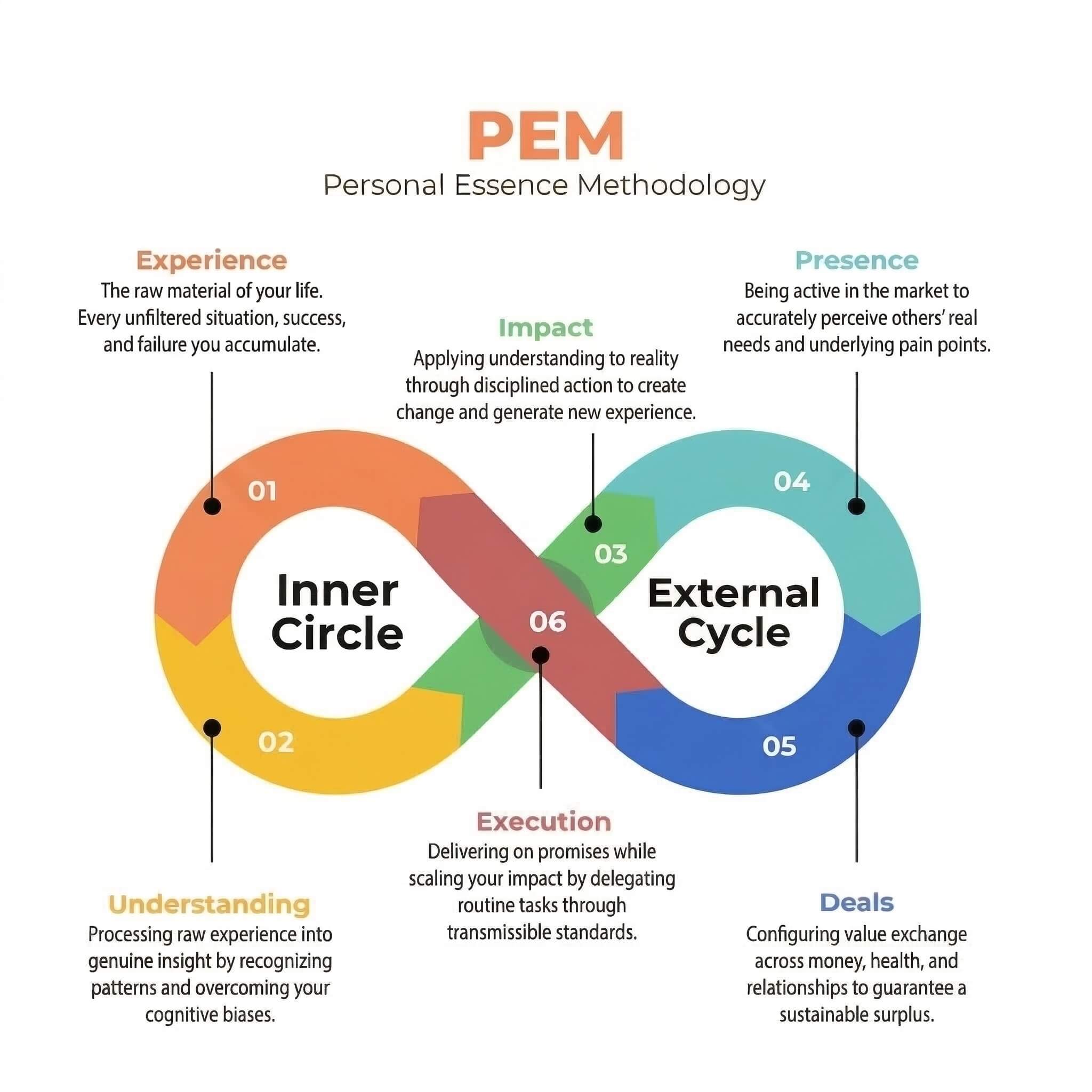
Desenvolva o entendimento a partir da experiência, construa uma presença baseada na confiança através dos sete pilares, configure acordos que o sustentem transversalmente a todos os seis domínios de recursos, execute o que prometeu — pessoalmente no Modo Arquiteto e através de delegação no Modo Construtor — e deixe que o impacto demonstrado expanda aquilo que pode credivelmente prometer e direcionar a seguir.
Índice
(17 capítulos)- Porquê Esta Metodologia? Porquê Agora.
- A Base
- O Contexto Macro: Porque Motivo Esta Metodologia Tem de Evoluir
- O Conjunto de Recursos Atualizado
- A Cadeia Interna (Internal Chain): Processar a Experiência em Entendimento
- As Três Fases
- O Princípio da Delegação: Escalar o Impacto Através do Entendimento
- Os Dois Desequilíbrios
- Influência como Acordos de Alta Qualidade
- A Equação de Recursos
- O Ciclo Iterativo
- Operar em Crise: A Metodologia Sob Pressão Sistémica
- Âmbito e Limitações
- Modos de Falha
- Aplicação
- Referência Abrangente de Vieses: Mapear Vieses Cognitivos para as Fases da Metodologia
- Resumo
Porquê Esta Metodologia? Porquê Agora.
Nasci em 1987, na altura em que a União Soviética entrou em colapso. A minha primeira economia foi uma economia que tinha acabado de deixar de existir.
Quando finalmente tive idade suficiente para compreender o significado de "condições estáveis" num manual escolar, nunca as tinha experienciado. A transição pós-soviética trouxe a hiperinflação, um vazio institucional e a improvisação diária que se tornou o normal da vida numa Ucrânia recém-independente. Depois, veio a turbulência económica interna do início dos anos 2000. Seguiu-se a crise financeira global de 2008–2009, que atingiu as economias emergentes com especial violência. Depois, a Revolução da Dignidade em 2013–2014, que reconfigurou o panorama político do país da noite para o dia. A seguir veio a primeira guerra — a Crimeia anexada, o Donbas a arder, o mundo a reorganizar-se à nossa volta enquanto nós próprios nos reorganizávamos para sobreviver. E depois, em 2022, a invasão em grande escala — o tipo de crise que não nos pergunta se estamos preparados.
Durante tudo isto, andei a construir. A construir negócios, a construir relações, a construir entendimento. Não porque eu tivesse algum gene especial de resiliência ou porque os ucranianos fossem singularmente duros — embora sejamos teimosos de formas que, por vezes, surpreendem até a nós mesmos. Mas porque uma crise, quando se torna o nosso ambiente permanente em vez de um contratempo, ensina-nos algo que os tempos de paz não conseguem: as regras de que dependemos acabarão por falhar, e a nossa capacidade de funcionar quando isso acontece é o único ativo que não pode ser confiscado, desvalorizado ou bombardeado.
A Metodologia da Essência Pessoal (Personal Essence Methodology) não foi concebida numa biblioteca. Foi forjada no abismo entre o que me disseram que devia funcionar e aquilo que realmente funcionava quando o chão não parava de tremer. Todos os princípios deste documento — a Cadeia Interna (Internal Chain), a Fórmula de Confiança (Trust Formula), os seis domínios de recursos, a hierarquia de delegação — foram testados sob stresse em condições onde a moeda podia mudar, as fronteiras podiam fechar, o cliente podia desaparecer e a luz podia ir abaixo a meio de uma entrega.
É por isto que considero que a metodologia é tão urgente agora.
O mundo em que se move hoje em dia, esteja onde estiver, está a entrar no mesmo tipo de instabilidade que foi toda a minha vida profissional. A fragmentação geopolítica está a acelerar. A revolução da IA está a desmantelar a economia da execução em tempo real. O capital já não é barato. As cadeias de abastecimento já não são de confiança. As instituições que outrora proporcionavam estabilidade — mercados previsíveis, moedas estáveis, uma ordem internacional funcional — estão sob uma pressão que não se irá resolver a curto prazo.
Talvez esteja a deparar-se com uma instabilidade sistémica pela primeira vez. Eu tenho vivido dentro dela durante três décadas.
Foi isto o que aprendi: não pode controlar o ambiente à sua volta, mas pode controlar a profundidade com que processa a sua experiência, a honestidade com que se apresenta nas suas relações, a cautela com que configura os seus compromissos e a fiabilidade com que entrega aquilo que prometeu. Isso é a metodologia na prática. Não é uma teoria sobre aquilo que devia funcionar em condições ideais — é um sistema que já funcionou, repetidamente, em condições que foram tudo menos ideais.
A metodologia não tornará a crise confortável. Nada o consegue fazer. Mas vai dar-lhe uma estrutura para operar quando as estruturas à sua volta estiverem a ruir. Vai ajudá-lo a construir confiança quando esta escasseia, a configurar acordos quando os termos são voláteis, a executar quando os recursos são limitados e a acumular o seu entendimento quando as regras não param de mudar debaixo dos seus pés.
Construí isto porque precisava. E estou a partilhá-lo porque acredito que também precisa disto, talvez com mais urgência do que pensa.
A melhor altura para construir a sua metodologia foi antes da crise. A segunda melhor altura é agora.
— Volodymyr Zhukov
A Base
Cada pessoa acumula uma combinação distinta de experiências, depara-se com valores diferentes e vive uma sequência única de eventos. Isto cria uma diferenciação significativa entre as pessoas — diferenças que podem tornar-se a base para um valor distinto.
Diferenciação significativa vs. incomparabilidade absoluta. É genuinamente diferente dos outros de formas mensuráveis e significativas: personalidade, estilo cognitivo, histórico de desenvolvimento, conhecimentos acumulados. Estas diferenças são reais e economicamente relevantes. Mas não é assim tão diferente ao ponto de a comparação não ter sentido ou de a ligação ser impossível. Partilha arquitetura cognitiva e emocional suficiente com os outros seres humanos para os compreender e para ser compreendido. É esta arquitetura partilhada que torna a empatia possível, a troca valiosa e a confiança alcançável. Sem uma diferença genuína, não tem nada de distinto para oferecer. Sem uma semelhança genuína, não tem a quem o oferecer. A metodologia exige ambas.
Contudo, a experiência em estado bruto, por si só, não cria nada. A experiência tem de ser compreendida antes de poder ser aplicada. E o entendimento tem de se traduzir em ação antes que possa mudar alguma coisa. Esta é a cadeia interna (internal chain) que torna possível a eficácia externa.
ExperiênciaEntendimentoImpacto
A experiência é a matéria-prima. O entendimento é o processamento dessa matéria-prima num discernimento utilizável. O impacto é a aplicação desse discernimento para alterar as condições no mundo.
Esta cadeia é iterativa, não linear. O impacto gera nova experiência. A nova experiência exige novo entendimento. O ciclo continua ao longo da vida.
A Distinção Crítica: Informação vs. Entendimento
A informação é aquilo que existe fora de si — factos, dados, conselhos, modelos conceptuais, resultados de investigação. É abundante, barata e agora infinitamente gerável pela inteligência artificial.
O entendimento é o que existe dentro de si — o processamento de informação através do filtro da sua experiência, do seu contexto, dos seus fracassos, da sua situação específica. É o entendimento que lhe diz qual a parte da informação que importa neste exato momento, qual o conselho que se aplica às suas circunstâncias e qual a estratégia que se adequa aos constrangimentos que enfrenta na realidade.
A informação é genérica. O entendimento é pessoal.
A explosão da informação disponível criou a ilusão de que o entendimento também se expandiu. Mas não se expandiu. A enxurrada de informação, frequentemente, dificulta o entendimento por impedir o trabalho de processamento, que é mais lento e profundo. A metodologia é um sistema de desenvolvimento de entendimento, não um sistema de aquisição de conhecimento. A diferença entre essas duas coisas é a diferença entre sentir-se informado e ser eficaz.
A ilusão de fluência agrava o problema. Quando deparamos com informação que parece fácil de processar — porque já a lemos antes, porque está apresentada de forma clara ou porque confirma o que já acreditamos —, os nossos cérebros interpretam essa fluência de processamento como prova de que dominamos o material. Reler um modelo conceptual e abanar a cabeça em sinal de concordância cria um poderoso sentido subjetivo de competência que está desvinculado da nossa capacidade real. O abismo entre reconhecer a informação enquanto olhamos para ela e conseguir recuperá-la sob pressão é enorme. A insistência da metodologia no processamento — escrever, testar, triangular — existe especificamente para derrotar esta ilusão de competência.
O Contexto Macro: Porque Motivo Esta Metodologia Tem de Evoluir
Estamos a viver um período de transições sistémicas cumulativas: fragmentação geopolítica, a revolução da IA, a desglobalização, o fim do capital barato, as mudanças demográficas e uma transição energética à escala global. Estas não são ruturas isoladas. Elas interagem, e as suas interações amplificam a instabilidade e aceleram o ritmo ao qual as antigas regras entram em colapso.
A Disrupção da IA
A IA é agora um motor de execução. Os grandes modelos de linguagem geram código com qualidade de produção, documentos profissionais, interfaces funcionais e fluxos de trabalho complexos. O "vibe coding" transforma descrições em linguagem natural em software funcional. O Model Context Protocol liga a IA diretamente a ferramentas profissionais e infraestruturas operacionais. Agentes autónomos movidos a IA gerem fluxos de execução de múltiplos passos, abrangendo a investigação, a redação, o agendamento, a coordenação e a entrega.
Isto altera a economia da eficácia pessoal pela base. Quando a execução se está a transformar numa commodity — quando a coisa que a maioria das pessoas vende (o seu trabalho, a sua capacidade de realizar tarefas) se está a tornar abundante e barata —, então, trabalhar mais arduamente na execução é correr mais depressa numa passadeira que acelera debaixo dos nossos pés.
O que a IA comoditiza
O conhecimento genérico. A execução de nível médio. A análise padrão. A produção de rotina. O conteúdo superficial. Qualquer trabalho que possa ser reduzido a regras explícitas aplicadas sem critério.
O que a IA não consegue replicar
A sua experiência específica, processada num entendimento genuíno. As suas relações reais e o histórico de confiança nelas enraizado. A sua capacidade de navegar na ambiguidade e de tomar decisões que integrem valores, experiência e contexto. A sua capacidade para uma Presença genuína — o reconhecimento humano que advém de uma outra consciência a interagir com a sua.
Num mundo em que a execução genérica é abundante e gratuita, uma eficácia mediana produz resultados abaixo da média. O mercado divide-se entre a procura por capacidades humanas excecionais — que paga muito bem — e tudo o resto, cada vez mais realizado por IA ou por humanos a competir com a IA no preço. O meio está a desaparecer.
O viés de automação agrava o perigo de estar no meio. À medida que a IA se torna mais capaz, as pessoas remetem cada vez mais para os seus resultados sem uma avaliação crítica — tratando as recomendações geradas por máquinas como verdade, rendendo o pensamento crítico ao algoritmo. Isto não é preguiça; é um atalho cognitivo que os nossos cérebros aplicam perante qualquer autoridade apercebida, seja ela humana ou digital. Quando a IA rascunha uma estratégia, revê um contrato ou diagnostica um problema, a tentação de aceitar sem escrutínio é poderosa, precisamente porque o resultado parece polido e confiante. A pessoa que acrescenta critério — que apanha o que escapou à IA, que sente o desfasamento contextual que o algoritmo não consegue percecionar — é a pessoa pelo entendimento da qual o mercado pagará um prémio. A pessoa que apenas supervisiona a IA sem um escrutínio genuíno ocupa o meio que está a desaparecer.
A Economia da Confiança
Uma das mudanças com maiores consequências para os indivíduos é a transição da Economia da Atenção para a Economia da Confiança.
Durante duas décadas, a internet otimizou-se para captar a atenção humana. O conteúdo era o produto, e a atenção era a moeda. Mas a IA generativa baixou o custo da criação de conteúdo para quase zero. Quando o conteúdo é infinito e a atenção é facilmente sequestrada, a autenticidade e a confiança tornam-se os recursos mais escassos. O valor está a migrar para pessoas, plataformas e sistemas que conseguem verificar a verdade, demonstrar competência e provar a autenticidade humana.
O efeito da verdade ilusória acelera esta mudança. Quando as pessoas se deparam com afirmações repetidas — seja de conteúdo gerado por IA, de redes sociais ou de marketing —, os seus cérebros começam a registar essas afirmações como sendo mais suscetíveis de ser verdade, independentemente da sua validade real. A repetição fabrica crença. Num ambiente de conteúdo infinito, o simples volume de afirmações falsas ou enganosas que são repetidas corrói a base de uma verdade partilhada. Isto torna a confiança genuína — construída a partir de históricos comprovados e de uma presença transparente — na infraestrutura essencial para qualquer relação, mercado ou instituição funcional.
Quando a execução é escassa, escolhemos os fornecedores com base nas suas capacidades. Quando a execução é abundante, escolhemo-los com base na confiança. Os negócios feitos com confiança têm custos de transação mais baixos — menos verificação, menos carga legal, menos energia desperdiçada na monitorização. Numa economia onde a concorrência movida pela IA comprime os preços, os ganhos de eficiência decorrentes de negócios baseados na confiança não são marginais. São decisivos.
A Fórmula de Confiança (Trust Formula)
A confiança não é um sentimento, um traço de personalidade ou carisma. A confiança é um composto — o produto de três componentes numa relação multiplicativa:
A relação multiplicativa é a ideia central. A adição significaria que a fraqueza numa área poderia ser compensada pela força noutra. A multiplicação significa que um zero em qualquer um dos fatores faz colapsar o todo.
- Impacto Demonstrado
confiança na competência. Tem um histórico comprovado. Já entregou resultados. As suas capacidades são provadas através de resultados que os outros podem observar e verificar. Construída na fase de Execução (Execution).
- Presença Transparente
confiança na benevolência. É visível, honesto e envolve-se de forma genuína com as realidades dos outros. Apercebe-se das verdadeiras necessidades deles, e não da sua projeção dessas necessidades. As pessoas podem avaliá-lo com precisão porque se mostra tal como é. Construída na fase de Presença (Presence).
- Alinhamento Consistente
confiança na integridade. O desfasamento entre aquilo com que se compromete durante os Acordos (Deals) e aquilo que entrega durante a Execução mantém-se perto de zero, repetidamente, ao longo do tempo. As suas palavras e as suas ações coincidem. As suas promessas e o seu desempenho têm um histórico de correspondência. Construída na fronteira entre Acordos-Execução e acumulada através de ciclos.
Por Que Motivo a Relação Multiplicativa Importa
Zero Impacto × qualquer coisa × qualquer coisa = zero confiança. Não consegue entregar resultados. Nenhuma quantidade de charme ou de fiabilidade muda isto.
Qualquer coisa × zero Presença × qualquer coisa = zero confiança. Não consegue ser lido ou avaliado. Uma competência que é opaca ou invisível gera desconfiança, não confiança.
Qualquer coisa × qualquer coisa × zero Alinhamento = zero confiança. Não cumpre a sua palavra. As pessoas competentes e visíveis que, de forma consistente, prometem em demasia e entregam de menos são as mais perigosas — porque atraem compromissos que não conseguem honrar.
Como a Fórmula se Mapeia na Arquitetura da Metodologia
Os três componentes correspondem diretamente às três fases do Ciclo Externo (External Cycle):
- Presença → constrói a Presença Transparente (confiança na benevolência)
- Acordos → configura os compromissos face aos quais o Alinhamento Consistente será medido
- Execução → constrói o Impacto Demonstrado (confiança na competência) e confirma ou viola o Alinhamento Consistente (confiança na integridade)
A fórmula de três fatores torna visível algo que a fórmula de dois fatores escondia: Os Acordos não são apenas uma fase de configuração que alimenta a Execução. É a fase onde se define o padrão face ao qual a sua integridade será julgada. Um Acordo bem configurado faz mais do que maximizar o excedente; define compromissos que consegue realmente honrar, porque cada compromisso que assume torna-se num teste ao seu Alinhamento Consistente. Comprometer-se em demasia durante os Acordos cria mais do que um défice de recursos. Cria um défice de confiança na integridade que nenhuma quantidade de Impacto ou de Presença consegue compensar.
Isto também clarifica por que motivo o desequilíbrio focado na Presença é tão destrutivo na Economia da Confiança. A pessoa focada na Presença tem uma forte Presença Transparente e, frequentemente, um Impacto inicial genuíno — mas o seu Alinhamento Consistente aproxima-se de zero porque promete sistematicamente mais do que aquilo que entrega. Multiplique qualquer coisa por zero e obtém zero. A sua confiança colapsa apesar de ter dois componentes fortes, porque o terceiro está em falta.
E clarifica por que motivo a confiança da pessoa focada na Execução não se acumula como devia. Têm um forte Impacto Demonstrado e, muitas vezes, um Alinhamento Consistente razoável — mas a sua Presença Transparente aproxima-se de zero porque são invisíveis. Mais uma vez, multiplique por zero.
O efeito halo opera de forma poderosa — e perigosa — nas fases iniciais da formação de confiança. Quando uma pessoa demonstra uma qualidade fortemente positiva — comunicação eloquente, credenciais impressionantes, atratividade física —, os observadores assumem inconscientemente que essa pessoa também possui outras qualidades positivas: competência, integridade, bom critério. Este atalho mental pode acelerar a formação de confiança inicial ao inflacionar os níveis apercebidos de todos os três fatores antes mesmo de terem sido demonstrados. Mas a confiança baseada no efeito halo é frágil. Ela colapsa quando o desempenho contradiz a impressão inicial, e a correção é, muitas vezes, desproporcionalmente dura: a pessoa é vista como enganadora, e não apenas desadequada, porque o observador sente que a sua confiança foi manipulada. O efeito halo pode mascarar temporariamente um zero num fator; a fórmula multiplicativa garante que a realidade, eventualmente, volta a impor-se.
Sobre a acumulação (compounding): A confiança acumula-se através de ciclos repetidos do Ciclo Externo. A fórmula poderia ser estendida para Confiança = (Impacto Demonstrado × Presença Transparente × Alinhamento Consistente)^ciclos. Mas isto está implícito na palavra "Demonstrado" (que implica um histórico, não um evento único), em "Consistente" (que implica repetição) e no ciclo iterativo que a metodologia já descreve. A acumulação é real e essencial — é o que torna a confiança num ativo duradouro e não numa impressão momentânea —, mas adicionar um expoente explícito corre o risco de tornar a fórmula menos comunicável sem adicionar clareza metodológica.
Esta mudança altera o que significa estar presente, como os acordos são estruturados e o que a execução tem de entregar. A metodologia tem de ter isto em conta.
O Conjunto de Recursos Atualizado
Anteriormente, a metodologia estruturava os acordos em torno de três domínios: Dinheiro, Saúde e Relações. Essa estrutura era útil, mas incompleta. No ambiente atual — onde a confiança é a moeda de troca, a atenção é disputada e o conhecimento deprecia rapidamente —, é necessário um mapa de recursos mais preciso.
Cada pessoa opera com seis domínios fundamentais de recursos. Os Acordos (Deals) são configurados transversalmente a todos os seis. Um excedente ou défice em qualquer um deles repercute-se nos outros.
1. Financeiro — Riqueza / Fluxo de Caixa
Dinheiro, remuneração, retorno de investimentos, receitas. O recurso que se converte de forma mais flexível noutros recursos — mas que não consegue, por si só, substituir nenhum deles. O excedente financeiro financia a delegação, cria opcionalidade e absorve choques. O défice financeiro condiciona todos os outros domínios.
A contabilidade mental distorce a gestão dos recursos financeiros
Tratamos o dinheiro de forma diferente consoante a sua origem ou o seu propósito pretendido — gastando livremente um reembolso de impostos enquanto nos recusamos a mexer nas poupanças, mesmo quando ambos são fungíveis. Isto cria "frascos" invisíveis no nosso pensamento financeiro que impedem uma alocação ideal pelos seis domínios. Um trabalhador independente (freelancer) pode separar mentalmente o "rendimento de projetos" do "rendimento de biscates (side hustle)" e aplicar regras de gastos diferentes a cada um, mesmo quando a decisão racional seria juntar os recursos e alocá-los com base nas prioridades. A metodologia exige que se encarem os recursos financeiros como um fundo unificado, governado por uma alocação estratégica e não pelos acidentes psicológicos da forma como o dinheiro chegou.
A ilusão do dinheiro distorce ainda mais o critério financeiro
Focamo-nos em números nominais — o valor no recibo de vencimento ou a etiqueta de preço — em vez de nos focarmos naquilo que esse dinheiro consegue realmente comprar. Durante períodos de inflação, um aumento de 5% que mal cobre uma inflação de 6% parece um progresso. Na configuração de acordos, isto significa avaliar remunerações, preços e retornos de investimento em termos reais — poder de compra, não números nominais.
2. Biológico — Saúde / Energia Diária
Capacidade física e mental. Qualidade do sono, saúde metabólica, carga de stresse e taxa de recuperação. Este é o recurso que condiciona todos os outros — nenhuma quantidade de capital financeiro ou intelectual importa se o seu corpo não conseguir sustentar o esforço. Um excedente biológico significa resiliência e vigor. Um défice biológico significa declínio de desempenho, independentemente das oportunidades.
A primazia do sono
O sono constitui a componente mais importante da saúde biológica — o alicerce sobre o qual assentam o exercício, a nutrição, a gestão de stresse e todas as outras práticas de saúde. Durante o sono, o cérebro consolida a experiência em entendimento através da repetição neural e da extração de padrões — o mecanismo literal através do qual a Cadeia Interna (Internal Chain) converte a experiência de hoje no discernimento de amanhã. A privação crónica de sono degrada a energia. Pior ainda, sabota o próprio processo que produz o entendimento — o ativo central da metodologia. Sete a oito horas de sono são uma infraestrutura inegociável, não um luxo de saúde.
O viés de projeção compromete a gestão dos recursos biológicos
Quando nos sentimos com energia e saudáveis, não conseguimos imaginar com precisão como iremos pensar e agir quando estivermos esgotados, doentes ou stressados — e vice-versa. Trata-se do fosso de empatia quente-frio (hot-cold empathy gap) aplicado aos nossos próprios estados futuros. A pessoa que configura acordos num dia bom subestima sistematicamente o custo biológico desses compromissos. A pessoa em esgotamento (burnout) não consegue projetar com precisão a recuperação que o descanso proporcionaria, podendo tomar decisões permanentes com base em estados temporários. Os acordos têm de ser configurados para uma capacidade biológica realista e não para a forma como se sente no seu melhor dia.
3. Social — Relações Profundas (Apoio) / Rede Alargada (Alcance)
Este domínio tem duas camadas distintas. As relações profundas providenciam apoio emocional, feedback honesto e redes de segurança durante uma crise. As redes alargadas providenciam alcance, fluxo de negócios (deal flow) e acesso a oportunidades que não conseguiria encontrar sozinho. Ambas são necessárias. Relações profundas sem alcance significam isolamento dos mercados. Redes alargadas sem profundidade significam ligações frágeis que colapsam sob pressão.
O viés de cortesia degrada silenciosamente os ciclos de feedback social. As pessoas na sua rede — especialmente em relações profissionais — dizem-lhe sistematicamente aquilo que acham que quer ouvir, em vez daquilo que realmente observam. O mecanismo é a lubrificação social. Mas isto significa que o canal de feedback em que a maioria das pessoas confia para se calibrar está corrompido na fonte. A insistência da metodologia na triangulação — registos congelados no tempo, reflexão atual e dados externos concretos — existe em parte para compensar o facto de o feedback humano ser filtrado pela cortesia antes de chegar a si.
4. Reputacional — Confiança / Marca Pessoal / Audiência
Na Economia da Confiança, a reputação deixou de ser um subproduto passivo de um bom trabalho. É um ativo gerível e ativo. A sua reputação é o que as pessoas acreditam sobre si antes de interagirem consigo. A sua marca pessoal é o sinal que emite deliberadamente. A sua audiência é o grupo de pessoas que lhe concedeu uma atenção contínua baseada em confiança demonstrada. Um excedente reputacional significa que as oportunidades vêm ter consigo. Um défice reputacional significa que tem de lutar por cada oportunidade a partir do zero.
A reputação constrói-se através de cinco canais distintos: resultados demonstrados (projetos entregues, problemas resolvidos), alcance da rede (quem conhece o seu trabalho e com quem falam), visibilidade (ser conhecido além da sua rede imediata, através de eventos, conteúdo, comunidades profissionais), partilha de conhecimento e apresentação de casos (comunicar não apenas o que alcançou, mas como pensa), e consistência ao longo do tempo (o efeito composto de marcar presença de forma fiável, ano após ano). Investir em apenas um canal — tipicamente nos resultados demonstrados — deixa os outros quatro adormecidos, o que explica por que motivo um trabalho excelente permanece muitas vezes invisível.
O efeito de mera exposição é o mecanismo subjacente à construção de reputação baseada na visibilidade. Quanto mais frequentemente as pessoas se deparam com o seu nome, o seu trabalho ou as suas ideias, mais tendem a desenvolver associações positivas consigo — mesmo que não consigam articular o motivo. É assim que a cognição humana processa a familiaridade. A visibilidade estratégica — conteúdo consistente, presença regular em eventos, presença fiável em comunidades profissionais — alavanca este efeito de forma honesta. A ressalva crítica: a mera exposição constrói empatia e reconhecimento, não confiança na competência. Abre portas, mas não fecha acordos. A visibilidade sem entrega de resultados cria o desequilíbrio focado na Presença (Presence-heavy imbalance).
O efeito de adesão (bandwagon effect) amplifica o ímpeto reputacional. Assim que uma massa crítica de pessoas o reconhece e confia em si, outras seguem-no porque observam que os outros já confiam em si, e não porque tenham avaliado o seu trabalho de forma independente. É por este motivo que o capital reputacional se acumula de forma não linear: o investimento inicial gera retornos modestos, mas assim que o limiar da prova social é ultrapassado, a reputação torna-se autorreforçadora. O perigo é que o mesmo mecanismo funciona ao contrário — os danos reputacionais propagam-se em cascata com a mesma rapidez que os ganhos reputacionais.
5. Intelectual — Conhecimento / Competências Técnicas (Hard Skills)
O que sabe e o que consegue fazer. Especialização no domínio, capacidade técnica, reconhecimento de padrões, modelos para tomar decisões. O capital intelectual é aquilo que torna o seu entendimento transferível e a sua delegação eficaz. Num mundo onde a IA banaliza o conhecimento superficial, o capital intelectual profundo — o tipo que possibilita o critério próprio, e não apenas a recuperação de informação — torna-se mais valioso, não menos.
O efeito Google (amnésia digital) reformula as exigências de capital intelectual. Quando a informação está instantaneamente acessível, os nossos cérebros param de armazenar conteúdo factual e tornam-se, em vez disso, especialistas em lembrar onde encontrar a informação. Esta é uma mudança adaptativa, mas tem um custo: a pessoa que "sabe onde pesquisar" não possui a base de conhecimento interiorizada necessária para tomar decisões rápidas sob pressão. O capital intelectual profundo, no sentido da metodologia, é o reconhecimento de padrões interiorizado que opera sem procura consciente. Informação recuperável não se qualifica. A era da IA torna esta distinção mais nítida: a IA trata da recuperação; você trata do critério. Se o seu capital intelectual consiste apenas naquilo que consegue pesquisar, a IA já o faz melhor.
6. Temporal — Tempo / Atenção Focada
As horas do dia e a qualidade da atenção durante essas horas. O tempo é o único recurso que não pode ser acumulado — apenas pode ser alocado. A atenção focada é o multiplicador que determina se o tempo alocado produz valor ou desperdício. Um excedente temporal significa espaço para pensamento estratégico, investimento em relações e recuperação. Um défice temporal significa uma vida reativa — constantemente a responder, nunca a direcionar.
A Lei de Hick rege a relação entre as escolhas e a eficiência temporal. Quantas mais opções enfrentar num determinado momento — qual email responder, qual projeto avançar, em que relação investir —, mais o seu cérebro demora a decidir e a qualidade da decisão degrada-se. É uma função logarítmica da quantidade de opções, não um problema de disciplina. Reduzir o número de decisões ativas através de sistemas, rotinas e delegação é uma defesa estrutural dos recursos temporais, e não um truque de produtividade.
Como os Seis Domínios Interagem
Nenhum domínio opera isolado. O excedente financeiro pode comprar liberdade temporal (delegação, automação). O excedente biológico possibilita um trabalho intelectual mais profundo. O excedente reputacional reduz o esforço necessário para fechar acordos. O excedente social revela oportunidades que poupam tempo e dinheiro. O excedente intelectual torna a execução mais eficiente, preservando os recursos biológicos e temporais.
Inversamente, um défice num domínio drena os outros. O stresse financeiro corrói a saúde. O declínio da saúde reduz o rendimento intelectual. Os danos reputacionais encolhem a rede de contactos. O colapso da rede elimina o fluxo de negócios. Maus acordos consomem tempo. O tempo perdido impede a recuperação.
O princípio atualizado dos Acordos: Configure acordos que gerem excedentes em todos os seis domínios de recursos — não apenas no financeiro. Um acordo que paga bem, mas destrói a sua saúde, reputação ou relações não é bom. É uma liquidação lenta de ativos que são mais difíceis de reconstruir do que o dinheiro.
A Cadeia Interna (Internal Chain): Processar a Experiência em Entendimento
A Cadeia Interna — ExperiênciaEntendimentoImpacto— é onde o seu valor distinto é desenvolvido. Cada elo exige um trabalho deliberado; nenhum funciona de forma automática.
A Metodologia de Processamento: As Quatro Perguntas
Após qualquer experiência significativa, aplique as quatro perguntas sistematicamente e por escrito:
- O que aconteceu realmente? Não a sua história sobre o que aconteceu. Não a sua interpretação. Os eventos reais descritos da forma mais objetiva possível. Separe a observação da interpretação.
- Quais foram as múltiplas causas possíveis? Gere pelo menos três explicações diferentes para o que aconteceu. Isto impede que se agarre à primeira narrativa confortável e contraria o viés de confirmação. Esta pergunta também combate diretamente a falácia da conjunção — a nossa tendência para achar explicações detalhadas e coerentes mais plausíveis do que as mais simples. Cada uma das suas três explicações deve ser testada face ao princípio de que uma explicação específica, em formato de história, não é automaticamente mais provável do que uma explicação mais vaga, mas mais abrangente, por melhor que se encaixe.
- O que é que alguém com uma perspetiva diferente veria? Imagine alguém com vieses diferentes, um passado diferente ou incentivos diferentes a observar a mesma situação. O que notariam eles que lhe passou ao lado? Esta pergunta visa especificamente o erro fundamental de atribuição — a nossa tendência para explicar o comportamento dos outros através do caráter, enquanto explicamos o nosso através das circunstâncias. Quando considerar outra perspetiva, pergunte deliberadamente: Que pressões situacionais podem ter motivado o comportamento que observei? O viés do ator-observador significa que, naturalmente, irá gerar explicações situacionais para si mesmo e explicações disposicionais para os outros, a menos que reverta conscientemente este padrão.
- O que posso efetivamente testar? Identifique o que é testável no seu entendimento. Um entendimento que permanece por testar é uma hipótese, não conhecimento. Se a sua interpretação prevê resultados futuros, teste a previsão.
Os dois desequilíbrios revelam-se através das perguntas às quais resiste. As pessoas focadas na Presença (Presence-heavy) têm dificuldade com a primeira e a quarta pergunta — "o que aconteceu realmente?" ameaça a sua narrativa polida, e "o que posso testar?" exige a execução que preferem evitar. As pessoas focadas na Execução (Execution-heavy) têm dificuldade com a segunda e a terceira pergunta — gerar múltiplas explicações parece um desperdício, e imaginar outras perspetivas exige a Presença na qual subinvestem.
A Prática da Triangulação
Nenhuma fonte única de autoconhecimento é fiável. O entendimento sobre o qual se pode construir requer três pontos de referência, comparados entre si:
Os seus registos congelados no tempo — aquilo em que acreditava estar a acontecer antes de conhecer o resultado. Diários, registos de decisões e notas escritas no momento. Estes captam o seu viés tal como existia então, antes que o benefício da retrospetiva o reescrevesse. Estes registos são a sua principal defesa contra o viés de retrospetiva — a tendência automática do cérebro para reescrever crenças anteriores após conhecer um resultado, fazendo com que os eventos pareçam mais previsíveis do que eram. Sem registos contemporâneos, não consegue distinguir aquilo que realmente previu daquilo que agora acredita ter previsto. O viés de autoconsistência corrompe ainda mais este processo: o seu cérebro assume que sempre teve as suas opiniões atuais, apagando silenciosamente as mudanças de ideias passadas para manter a ilusão de um "eu" estável e coerente.
A sua memória e reflexão atuais — aquilo em que acredita agora, com o benefício do distanciamento. Isto capta o reconhecimento de padrões que não era possível no momento. Trate a memória atual com um ceticismo calibrado. O viés de apoio à escolha leva o seu cérebro a aumentar retroativamente a atratividade das decisões que tomou e a diminuir a atratividade das opções que rejeitou. A versão do passado que vive na sua memória atual é sistematicamente lisonjeira para as suas escolhas passadas.
Dados concretos e feedback externo — o que aconteceu realmente de acordo com provas que existem fora da sua cabeça. Números, cronogramas, entregáveis, resultados e aquilo que as outras pessoas observaram e registaram.
Onde os três convergem, provavelmente está perto da realidade. Onde divergem, a divergência em si é a lição — revela onde os seus vieses operam, em que direção puxam e até que ponto pode confiar no seu próprio processamento.
O Papel dos Vieses Cognitivos
A Cadeia Interna (Internal Chain) opera sob constante ataque de distorções cognitivas sistemáticas que afetam cada elo.
Vieses que corrompem a experiência (a matéria-prima)
A retrospetiva otimista (rosy retrospection) torna o passado mais bonito do que era. O viés do afeto desvanecido (fading affect bias) faz com que as emoções negativas desapareçam mais rapidamente do que as positivas. O efeito telescópico baralha a sua linha do tempo. A memória congruente com o humor filtra o seu histórico através do seu estado emocional atual. Os erros de monitorização da fonte (source monitoring errors) injetam experiências que nunca teve realmente — coisas que leu ou ouviu arquivadas como coisas que viveu. O viés de sobrevivência faz com que aprenda apenas com o que aconteceu, e não com o que não aconteceu. A heurística da disponibilidade faz com que eventos dramáticos pareçam importantes e que padrões importantes pareçam esquecíveis. A regra do pico-fim (peak-end rule) faz com que avalie experiências inteiras com base no seu momento mais intenso e no seu fim, descartando por completo a duração e o meio mundano — o que significa que um projeto extenuante que acabou bem é lembrado como positivo, enquanto um projeto tranquilo que acabou com uma pequena desilusão é lembrado como negativo, independentemente do saldo real da experiência. A negligência da duração agrava isto: a duração de uma experiência quase não contribui para a forma como a recorda, o que significa que longos períodos de esforço sustentado podem ser psicologicamente invisíveis em retrospetiva.
Vieses que distorcem o entendimento (o processamento)
O ponto cego de viés faz com que veja as distorções dos outros enquanto permanece cego às suas — e o conhecimento sobre vieses pode piorar isto ao criar uma ilusão de imunidade. O viés de confirmação faz com que veja evidências daquilo em que já acredita e ignore evidências em contrário. O cinismo ingénuo faz com que processe sinais neutros ou positivos como ameaças. O reflexo de Semmelweis faz com que rejeite evidências que atualizariam o seu entendimento, especialmente quando aceitá-las ameaça a sua identidade. A confabulação gera falsas explicações para o seu próprio comportamento sem qualquer consciência de que o está a fazer. A correlação ilusória faz com que percecione relações entre variáveis onde elas não existem — especialmente quando a associação é emocionalmente saliente ou se encaixa numa narrativa pré-existente. Poderá concluir que uma determinada indústria cliente conduz sempre a aumentos de âmbito, ou que um tipo específico de reunião produz sempre boas decisões, com base num punhado de casos memoráveis em vez de padrões reais. A ilusão de agrupamento (clustering illusion) agrava isto: a verdadeira aleatoriedade produz concentrações e sequências que parecem padrões com significado para os nossos cérebros esfomeados de padrões, e nós construímos estratégias com base nesses sinais fantasma. O viés do conservadorismo — uma distorção relacionada, mas distinta — faz com que atualize as suas crenças de forma demasiado lenta quando chegam novas evidências genuínas, ajustando-se apenas ligeiramente quando devia ajustar-se de forma drástica.
Vieses que comprometem a Presença (perceção dos outros)
O efeito do falso consenso faz com que projete os seus próprios valores e preferências nos outros. A homogeneidade do grupo externo (out-group homogeneity) faz com que reduza indivíduos a categorias. A estereotipagem atribui traços fixos a essas categorias. O efeito de raça cruzada e os limites da calibração percetual significam que a sua perceção funciona bem para o que lhe é familiar e mal para o desconhecido, sem qualquer alarme interno a sinalizar em que modo se encontra. O efeito de holofote (spotlight effect) faz com que sobrestime o quanto os outros reparam na sua aparência, nos seus erros e nos seus comportamentos — porque você é o protagonista da sua própria experiência e assume que os outros estão a assistir à sua prestação com a mesma intensidade com que a está a viver. A ilusão de transparência agrava isto: sente que os seus estados internos (nervosismo, entusiasmo, tédio) estão a irradiar de forma visível da sua pele, quando, na verdade, os outros percecionam muito menos do que imagina. Juntos, estes vieses criam um modelo distorcido da forma como os outros experienciam a sua presença — assume que está a ser escrutinado e lido quando, em grande medida, passa despercebido, e esta falsa suposição conduz a uma ansiosa super-gestão de impressões ou à retirada de situações onde a presença seria mais valiosa.
A ilusão do discernimento assimétrico corrompe a empatia na sua raiz
Acredita que entende as motivações dos outros melhor do que eles entendem as suas — e melhor do que eles se entendem a si próprios. Isto é projeção disfarçada de discernimento, não empatia investigativa. A pessoa que entra numa reunião acreditando que já "topou" a outra parte parou de investigar e começou a confirmar. A definição da metodologia de que a empatia é uma disciplina, e não um sentimento, existe especificamente para neutralizar esta ilusão: trate o seu entendimento sobre qualquer outra pessoa como uma hipótese, não como uma conclusão.
O fosso de empatia quente-frio prejudica a Presença nos vários estados emocionais
Quando está calmo, confortável e com bons recursos (um estado "frio"), não consegue simular com precisão como você ou os outros irão pensar e agir quando estiverem stressados, assustados, exaustos ou desesperados (um estado "quente"). Isto significa que a Presença exercida a partir de uma posição de conforto lê sistematicamente de forma errada a experiência de pessoas em crise. O consultor que aconselha uma empresa em dificuldades a partir de uma posição de segurança financeira não consegue literalmente sentir o desespero que molda a tomada de decisão do cliente. Reconhecer este fosso — e conceber práticas investigativas que o compensem — é essencial para uma Presença genuína.
Vieses que sabotam os Acordos (Deals)
O desconto hiperbólico faz com que sobrevalorize recompensas imediatas face a recompensas futuras maiores, criando padrões de negociação desesperada. O efeito de chamariz (decoy effect) manipula as suas escolhas através de alternativas assimetricamente dominadas. O viés de distinção faz com que fique obcecado com diferenças facilmente comparáveis (preço) enquanto ignora dimensões que determinam a sua qualidade de vida. A ancoragem fixa o seu sentido de "razoável" a qualquer número que tenha sido mencionado em primeiro lugar. A aversão à perda faz com que o medo de perder um mau acordo pareça duas vezes mais pesado do que a esperança de ganhar um bom. O viés do status quo e o efeito de dotação (endowment effect) criam uma fortaleza psicológica à volta de maus acordos existentes. A falácia dos custos afundados (sunk cost fallacy) e a sua prima em escalada, a escalada de compromisso, mantêm-no em acordos muito para lá do ponto de racionalidade, porque abandonar o acordo exigiria reconhecer que o investimento passado foi desperdiçado. A lógica emocional é: "Já investi tanto nisto que não posso parar agora." A lógica racional é: os custos passados já se foram; apenas os custos e benefícios futuros importam. O efeito de enquadramento (framing effect) significa que os mesmos termos de um acordo podem parecer aceitáveis ou exploradores dependendo da forma como são apresentados — um "desconto de 10%" e "90% do preço total" são matematicamente idênticos, mas psicologicamente diferentes. O viés de soma zero faz com que assuma que qualquer ganho para a outra parte tem de vir às suas custas, cegando-o para acordos em que ambas as partes beneficiam genuinamente.
O efeito do excesso de confiança (overconfidence effect) permeia a negociação de acordos
As pessoas estão constitucionalmente mais seguras do que estão corretas. Quando afirmam 100% de certeza, normalmente só têm razão em cerca de 80% das vezes. Nos acordos, isto manifesta-se através da sobrestimação da sua capacidade de entregar, subestimação da complexidade do projeto e promessas de prazos que não consegue cumprir. O efeito difícil-fácil agrava isto de uma forma específica: é mais excessivamente confiante nos problemas mais difíceis (onde a sua precisão é menor) e menos confiante nos problemas fáceis (onde teria um bom desempenho). Isto significa que a confiança está calibrada quase precisamente ao contrário em relação à dificuldade.
A falácia do planeamento é o viés mais destrutivo na fronteira entre Acordos-Execução
Ao estimar quanto tempo demorará um projeto, o que custará, ou de que recursos necessitará, imagina um caminho sem atritos até à conclusão — comprimindo prazos, minimizando custos e ignorando riscos. É um pessimista em relação aos projetos dos outros, mas um otimista em relação aos seus próprios. Nove em cada dez megaprojetos ultrapassam o orçamento por esta razão. Todos os acordos que configurar deverão incluir um ajuste sistemático para cima nas suas estimativas de tempo e de custo — as investigações sugerem multiplicar a estimativa inicial por 1,5 a 2,5, dependendo da novidade do projeto.
Vieses que fazem descarrilar a Execução
O efeito do caminho bem percorrido (well-traveled road effect) faz com que tarefas familiares pareçam mais simples do que são, acionando o piloto automático quando é necessária uma verdadeira atenção. A fixidez funcional bloqueia o seu fluxo de trabalho numa única configuração — você está a fazer tudo — quando poderia ser decomposto. O efeito IKEA inflaciona o valor da sua execução pessoal, levando-o a agarrar-se a trabalho de rotina porque é seu. O viés de ação — a compulsão para "fazer alguma coisa" em vez de nada — é particularmente destrutivo durante a execução sob incerteza. Quando as condições são ambíguas ou as métricas não são claras, o instinto é agir de forma visível, mesmo quando a espera estratégica produziria melhores resultados. A confusão entre movimento e progresso faz com que preencha períodos de incerteza com trabalho para encher (busywork) que parece produtivo enquanto consome recursos biológicos e temporais sem avançar o entendimento. O efeito Zeigarnik agrava isto: as tarefas inacabadas criam uma tensão mental persistente que impulsiona a ação impulsiva para "fechar o ciclo", mesmo quando a jogada ideal é deixar a tarefa em aberto enquanto chega mais informação.
A ilusão de controlo causa um erro de julgamento sistemático durante a execução
Quando uma situação envolve a sua participação ativa, o seu cérebro assume automaticamente que pode influenciar o resultado — mesmo quando os resultados dependem de fatores inteiramente fora do seu controlo. O empreendedor que acredita que o seu esforço pessoal determina o tempo do mercado, o investidor que sente que pode "bater o mercado" através do seu próprio discernimento individual, o gestor que atribui os resultados da equipa inteiramente à sua liderança — todos estão a vivenciar a ilusão de controlo. Este viés é especialmente perigoso porque se sente como agência e competência, tornando-o resistente à correção.
Vieses que bloqueiam a delegação
A ilusão de indispensabilidade é autorreforçadora — nunca deixa mais ninguém tentar, por isso mais ninguém desenvolve a capacidade, o que "prova" a sua indispensabilidade. O viés de controlo (control bias) faz com que persiga de perto o trabalho delegado até o seu pensamento estratégico se degradar devido à imersão nos detalhes operacionais. A falácia do planeamento invertida sobrestima os custos de delegação por um fator de três a dez. Os erros de atribuição culpam os delegados por falhas estruturais causadas por instruções vagas e ausência de padrões.
A maldição do conhecimento (curse of knowledge) é o viés específico da delegação que torna tão difícil criar padrões transmissíveis. Assim que interioriza uma competência ou um domínio, perde a capacidade de imaginar como é não o saber. As suas explicações saltam passos "óbvios" que são óbvios apenas para si. Os seus padrões omitem critérios que parecem tão fundamentais que nem consegue conceber que alguém não os aplique. O paradoxo da delegação — o facto de que delegar o obriga a articular o que sabe, aprofundando assim o seu entendimento — é o antídoto direto para a maldição do conhecimento. O processo de tornar o conhecimento transmissível é o processo de confrontar aquilo que toma por garantido.
O efeito Dunning-Kruger opera em ambos os extremos do espetro da delegação. As pessoas a quem falta competência num domínio não conseguem reconhecer a sua incompetência — as mesmas competências necessárias para ter um bom desempenho são necessárias para avaliar o desempenho. Isto significa que os delegantes prematuros podem não reconhecer que os seus padrões são inadequados, enquanto os executores prematuros podem sobrestimar a qualidade do seu próprio trabalho. Na ponta dos peritos, os que possuem um domínio genuíno presumem frequentemente que as tarefas que são fáceis para eles são fáceis para todos, o que leva a formação e documentação inadequadas. Ambos os extremos degradam a qualidade da delegação.
Estes vieses não podem ser eliminados. Podem ser geridos através de feedback externo, registos escritos, procura deliberada por não confirmação, confiança calibrada e da metodologia de processamento estruturado acima descrita.
Vieses Adicionais que Operam em Toda a Cadeia
Vários vieses cognitivos não se encaixam de forma nítida numa única fase, operando antes como distorções transversais que afetam a experiência, o entendimento e o impacto em simultâneo:
O viés de negatividade (negativity bias) faz com que experiências, feedback e informações negativas carreguem sensivelmente o dobro do peso psicológico de sinais positivos equivalentes. Uma única peça de feedback crítico pode ofuscar dez elogios. Um único projeto falhado pode pesar mais psicologicamente do que vários sucessos. Este viés distorce todas as fases: corrompe a matéria-prima da experiência ao tornar os fracassos mais salientes que os sucessos; distorce o entendimento ao tornar as interpretações baseadas em ameaças mais persistentes do que as baseadas em oportunidades; e prejudica o impacto ao fazer com que o medo de resultados negativos se sobreponha à esperança de resultados positivos.
O efeito de contraste significa que o seu cérebro não avalia nada em termos absolutos — tudo é julgado em relação ao que veio antes ou ao que está por perto. Os mesmos termos num acordo parecem excelentes a seguir a uma oferta terrível e medíocres a seguir a uma oferta generosa, mesmo que o acordo em si não tenha mudado. A mesma qualidade de execução parece impressionante numa semana de fracassos e banal numa semana de sucessos. Esta relatividade afeta todas as fases: distorce a forma como avalia novas experiências (em relação a experiências recentes), a forma como processa o entendimento (em relação a crenças anteriores) e a forma como avalia o impacto (em relação a resultados adjacentes).
O efeito de tiro pela culatra (backfire effect) é a distorção mais contraintuitiva: quando crenças profundamente enraizadas são desafiadas com evidências contraditórias, a crença por vezes fortalece-se em vez de enfraquecer. Isto acontece porque as nossas crenças estão ligadas à identidade e à pertença social. Quando uma evidência ameaça quem somos, o cérebro trata-a como um ataque e redobra a aposta. Isto tem implicações diretas para a ênfase que a metodologia coloca no processamento e na não confirmação: não pode simplesmente apresentar-se com dados contraditórios e esperar uma atualização racional. O processamento tem de ser gradual, seguro para a identidade, e conduzido através das Quatro Perguntas estruturadas e não através de uma autoanálise confrontacional.
A reatância psicológica significa que, quando sente que a sua liberdade de escolha é ameaçada por exigências externas, por prescrições da metodologia ou até mesmo pelos planos com que se comprometeu — experiencia uma motivação automática para fazer o oposto. Este viés afeta a forma como a própria metodologia é adotada: quanto mais rígido e prescritivo o sistema parecer, mais o cérebro do utilizador se rebela contra ele. A natureza iterativa e adaptativa da metodologia é psicologicamente necessária, e não apenas estruturalmente sólida. Sistemas rígidos desencadeiam reatância; quadros de trabalho (frameworks) flexíveis convidam ao envolvimento.
Alocação Alvo para a Cadeia Interna
A Cadeia Interna tem uma alocação de tempo ideal:
25% Experiência — acumulação de matéria-prima através do "fazer" e das vivências. 50% Entendimento — processamento deliberado da experiência num discernimento genuíno (escrever diários, triangulação, as Quatro Perguntas, calibração externa, questionamento de narrativas). 25% Impacto — aplicação do entendimento para alterar as condições e testar a sua precisão.
A maioria das pessoas inverte isto, gastando a esmagadora maioria na acumulação bruta de experiências e quase nenhum tempo no processamento. O resultado: anos de experiência que geram meses de entendimento.
O viés de informação (information bias) impulsiona esta inversão. Temos uma tendência profunda para procurar mais informação — mais experiência, mais dados, mais contributos (input) — mesmo quando essa informação não vai mudar aquilo que fazemos. Reunir novas experiências parece produtivo. Processar a experiência existente parece lento e incerto. O cérebro confunde "saber mais" com "decidir melhor", mas em muitas situações, mais experiência sem processamento é completamente irrelevante para a melhoria de resultados. A alocação de 50% para o entendimento preconizada pela metodologia combate este viés de forma direta.
As Três Fases
A cadeia interna possibilita a participação nas trocas externas. Esta participação segue três fases.
Alocação Alvo para o Ciclo Externo
50% Presença (Presence) — envolvimento ativo com o mercado, perceção de necessidades, construção de relações, desenvolvimento de confiança. 25% Acordos (Deals) — configuração da troca de valor, negociação de termos, garantia de excedente. 25% Execução (Execution) — entrega pessoal de trabalho dependente do entendimento.
A alocação de 25% à Execução só funciona quando a infraestrutura de delegação está estabelecida — padrões transmissíveis construídos, estrutura organizacional configurada, fluxos de trabalho de IA e parcerias operacionais. Enquanto a infraestrutura de delegação está a ser construída, a execução pessoal consome, inevitavelmente, mais tempo. Mas, mesmo enquanto executa pessoalmente, acompanhar estes alvos revela a direção da mudança necessária.
Presença
A Presença é estar presente entre outras pessoas, nos mercados, nas relações, no mundo. Requer uma empatia desenvolvida — a capacidade de percecionar as dores, os problemas e as aspirações dos outros. Esta perceção é possível porque os seres humanos partilham arquitetura cognitiva e emocional suficiente para se compreenderem uns aos outros, mas diferem o suficiente para que cada perspetiva ofereça algo que falta às outras.
A Presença apoia-se diretamente na cadeia interna. A sua experiência acumulada, uma vez compreendida, torna-se a lente através da qual perceciona as necessidades dos outros. Sem experiência e entendimento suficientes, a Presença é superficial. Ouve palavras, mas perde o seu significado. Vê problemas, mas não as suas raízes.
É também na Presença que desenvolve a consciência do seu próprio valor. Ao deparar-se com os outros e compreender as suas lutas, começa a reconhecer aquilo que pode oferecer e que os outros não conseguem replicar facilmente.
Empatia como Disciplina, Não como Sentimento
A empatia não é a capacidade de sentir o que a outra pessoa sente. Não é afeto, cuidado ou intuição sobre os estados internos dos outros. A empatia é a disciplina de investigar sistematicamente o que os outros realmente experienciam, em vez de projetar a sua própria experiência na situação deles.
A pessoa que acredita que a empatia é perceção entra numa sala, lê a atmosfera, assume que percebeu, e age com base nessa suposição. Pode estar completamente errada. A pessoa que trata a empatia como uma disciplina entra na mesma sala e investiga — pergunta, ouve, verifica o que ouve comparando com o que esperava, tratando o seu entendimento sobre outra pessoa como uma hipótese em vez de uma conclusão.
O efeito do falso consenso é o mecanismo específico que corrompe a empatia não treinada
Assume naturalmente que a maioria das pessoas pensa, sente e se comporta da mesma forma que você. O seu cérebro inflaciona quantos outros partilham das suas opiniões, das suas preferências e das suas reações. Isto cria uma âncora egocêntrica em que a sua própria experiência se torna o modelo padrão para compreender todos os outros. A empatia investigativa existe para quebrar esta âncora: qualquer suposição sobre aquilo que outra pessoa precisa, valoriza ou sente tem de ser verificada face às evidências, e não tratada como autoevidente.
A perceção seletiva agrava o problema
O seu cérebro constrói ativamente o mundo social com base nas suas expectativas, experiências passadas e estado emocional atual, em vez de o registar passivamente. De facto, não consegue sequer ver os comportamentos, necessidades e sinais que não encaixam na sua estrutura pré-existente. O consultor experiente que "sabe" o que um determinado tipo de cliente precisa pode ignorar problemas totalmente novos porque o seu sistema percetual está afinado para o que é familiar. A Presença requer uma desafinação ativa: procurar deliberadamente por aquilo que não espera.
Problemas de superfície vs. problemas reais
Aquilo que as pessoas dizem precisar é raramente aquilo de que realmente precisam: elas vivenciam sintomas e descrevem sintomas. O problema enunciado é frequentemente uma manifestação superficial de algo mais profundo. A Presença requer fazer perguntas que ultrapassem a superfície: Porque é que acha que precisa disso? O que seria diferente se o tivesse? Quando é que esse problema começou e o que é que mudou? O que é que já tentou e porque é que não funcionou?
A dor por trás do problema
Por trás de cada problema há uma dor, e compreender a dor é, muitas vezes, mais importante do que compreender o problema. Duas pessoas com o mesmo problema enunciado podem ter dores subjacentes completamente diferentes — medo financeiro versus ameaça à identidade, por exemplo — e a mesma solução aplicada a ambas falhará, pelo menos, com uma delas.
O viés de desejabilidade social filtra todas as interações na Presença
As pessoas apresentam-se da melhor forma possível — exagerando qualidades positivas, minimizando as negativas e enquadrando as suas situações de forma a manterem a sua dignidade e estatuto social. É um processo automático e em grande parte inconsciente, não é enganoso. A implicação para a Presença: o que as pessoas lhe dizem sobre a sua situação, as suas necessidades e as suas capacidades está sistematicamente enviesado para aquilo que as faz parecer bem. A empatia investigativa tem de ter em conta este filtro, reconhecendo que a versão da realidade que as pessoas apresentam é editada, e que a imagem completa requer uma investigação mais profunda.
A Presença na Economia da Confiança
Na Economia da Confiança, a Presença vai para além da proximidade física e relacional. Agora inclui também a presença de sinal — o grau em que a sua reputação, o seu conteúdo e a sua marca pessoal o tornam visível e credível antes de ocorrer qualquer interação direta.
É aqui que os Pilares da Economia da Confiança operam. Cada pilar é um mecanismo para construir, manter e escalar uma presença baseada na confiança num mundo saturado de ruído e conteúdo sintético.
Os Sete Pilares da Presença Baseada na Confiança:
- Marca Pessoal e Autenticidade (A Âncora): A sua reputação física e digital. Clareza sobre quem é, o que defende e o valor único que traz. Num mundo ruidoso, uma marca pessoal autêntica e forte pré-vende a sua credibilidade antes de entrar numa sala ou enviar uma mensagem. Este pilar apoia-se diretamente no domínio do recurso Reputacional e é alimentado pelo capital Intelectual — não pode criar uma marca em torno daquilo que não compreende genuinamente sobre si próprio.
Cuidado com o efeito Forer na marca pessoal. Quando as declarações de marca são suficientemente vagas — "Ajudo as pessoas a alcançarem o seu potencial", "Trago discernimento estratégico a problemas complexos" —, elas soam convincentes porque poderiam aplicar-se a quase qualquer um. O efeito Forer faz com que as pessoas avaliem descrições de personalidade genéricas como sendo altamente precisas quando acreditam que tais descrições foram feitas especificamente para elas. A sua marca tem de ser específica o suficiente para ser falsificável: se a sua declaração de marca pudesse descrever outras mil pessoas no seu setor, não é uma marca. É uma declaração de Barnum.
- Networking Estratégico (A Teia) Construir relações intencionais e mutuamente benéficas, em vez de apenas colecionar contactos. A Economia da Confiança funciona à base de relações. A sua rede é o seu canal de distribuição para oportunidades, parcerias e conhecimento interno. Este pilar opera em todo o domínio Social — tanto nas relações profundas como no alcance alargado — e acumula valor ao longo do tempo quando mantido com consistência.
- Eventos Presenciais e de Alto Contato (O Acelerador) Conferências, jantares, masterminds, encontros para um café. As plataformas digitais iniciam ligações; as interações frente a frente solidificam-nas. Ler a linguagem corporal, partilhar experiências e olhar alguém nos olhos acelera a confiança de forma mais rápida do que meses de troca de mensagens online. Este pilar converte recursos Sociais e Temporais em capital Reputacional a um ritmo acelerado.
- Conteúdo e Liderança de Pensamento (O Íman) Partilhar publicamente e de forma gratuita a sua especialidade, discernimentos e histórias — através de artigos, vídeos, podcasts ou redes sociais. O conteúdo atua como um íman, atraindo a sua audiência ideal. Ao oferecer valor à partida, prova a sua competência e constrói confiança parassocial à escala: as pessoas sentem que o conhecem e confiam em si antes de se encontrarem consigo. Este pilar converte o capital Intelectual num excedente Reputacional e é um dos usos de maior alavancagem para os recursos Temporais.
O efeito de mera exposição é o motor deste pilar. Deparar-se repetidamente com o seu nome, as suas ideias e a sua perspetiva cria associações positivas — mesmo quando a audiência não consegue articular o porquê de se sentirem favoráveis a si. Um conteúdo consistente e de qualidade usa este mecanismo cognitivo de forma honesta. Mas o efeito da verdade ilusória introduz uma nota de prudência: a repetição de qualquer afirmação fá-la parecer mais verdadeira, independentemente da sua validade. Os criadores de conteúdo têm a obrigação ética de garantir que aquilo que repetem é exato, porque o cérebro da sua audiência irá converter a repetição em crença, quer o conteúdo o mereça ou não.
- Prova Social e Promoção (O Multiplicador) Testemunhos, estudos de caso, referências boca a boca e recomendações de outras figuras de confiança. Pode dizer que é excelente, mas tem muito mais peso quando é outra pessoa a dizê-lo. A validação por terceiros é o derradeiro multiplicador de credibilidade. É neste pilar que um histórico de Execução forte se torna visível — a entrega passada cria a prova social que alimenta os futuros Acordos.
O efeito da terceira pessoa opera aqui a seu favor. As pessoas acreditam que estão pessoalmente imunes a conteúdos persuasivos, mas que os outros são fortemente influenciados por eles. Paradoxalmente, isto significa que as recomendações de terceiros funcionam nas mesmas pessoas que acreditam não ser influenciadas por elas — porque percecionam a recomendação como uma evidência objetiva e não como persuasão.
- Transparência e Vulnerabilidade (A Cola) Ser honesto em relação aos seus processos, assumir os erros e mostrar os bastidores da realidade em vez de mostrar apenas os melhores momentos. A perfeição gera suspeita; a autenticidade gera conexão. A transparência sobre os fracassos e os momentos de aprendizagem humaniza-o e torna a confiança resiliente perante os contratempos. Este pilar protege o capital Reputacional durante os períodos inevitáveis de Execução imperfeita.
- Consistência e Fiabilidade (O Motor) Marcar presença de forma regular, cumprir o prometido e manter valores essenciais ao longo do tempo. A confiança não se constrói num dia; constrói-se diariamente. Se a sua marca promete uma coisa, mas o seu comportamento entrega outra, a confiança colapsa. A consistência é o motor que sustenta todos os outros pilares. É aqui que a Presença, os Acordos e a Execução têm de se alinhar — qualquer desfasamento entre eles degrada toda a estrutura de confiança.
Como os Pilares se Mapeiam na Metodologia
Os sete pilares não estão separados do ciclo Presença → Acordos → Execução. Eles são os mecanismos através dos quais esse ciclo opera numa economia baseada na confiança:
- Pilares 1–4 (A Âncora, A Teia, O Acelerador, O Íman) são primariamente mecanismos de Presença. Eles constroem a visibilidade, a credibilidade e a conexão antes de serem propostos quaisquer acordos.
- Pilar 5 (O Multiplicador) estabelece a ponte entre Execução e Presença. A entrega passada gera a prova social que impulsiona a presença futura.
- Pilar 6 (A Cola) opera durante a Execução e protege a confiança quando as coisas correm mal — o que acontecerá, inevitavelmente.
- Pilar 7 (O Motor) abrange todas as três fases. Consistência na presença, consistência nos termos dos acordos, consistência na entrega. É o fio condutor.
Acordos (Deals) — Os Acordos que Fazemos
Os Acordos são o local onde a troca é estruturada — e onde o padrão da sua integridade é definido. Cada compromisso que assume durante os Acordos torna-se um teste ao seu Alinhamento Consistente (Consistent Alignment). A Fórmula de Confiança (Trust Formula) torna isto explícito: os Acordos não são meramente uma fase de configuração que alimenta a Execução (Execution). São a fase em que se define a fasquia pela qual o mercado irá julgar se as suas palavras e as suas ações coincidem. Um acordo configurado com excedente é um acordo que consegue honrar. Um acordo configurado com défice é uma promessa que, muito provavelmente, irá quebrar — e cada promessa quebrada degrada o Alinhamento Consistente, o que faz colapsar a confiança, por muito forte que seja o seu Impacto (Impact) ou a sua Presença (Presence).
Isto é a negociação de acordos através dos seis domínios fundamentais de recursos:
Financeiro — acordos sobre remuneração, preços, investimento e alocação de recursos
Biológico — compromissos sobre tempo, energia, capacidade física e um ritmo sustentável
Social — expectativas sobre presença, apoio, reciprocidade, limites; tanto nas relações profundas como no acesso à rede mais alargada
Reputacional — o que o acordo faz à sua marca, credibilidade e confiança pública; se constrói ou se corrói a confiança da sua audiência em si
Intelectual — se o acordo desenvolve o seu conhecimento e as suas competências ou se apenas extrai os já existentes; se aprende ou se apenas gasta aquilo que já sabe
Temporal — quanto do seu tempo e da sua atenção focada é que o acordo requer; se cria ou se consome o espaço para o pensamento estratégico
Cada compromisso significativo envolve a configuração de termos transversalmente a estes domínios. Um emprego é mais do que um salário: inclui custos biológicos (stresse, horas, esgotamento), custos sociais (tempo longe das pessoas que importam), implicações reputacionais (este trabalho melhora ou dilui a sua marca?), trajetória intelectual (está a crescer ou a estagnar?) e a carga temporal (deixa espaço para alguma outra coisa?).
Venda Entendimento, Não Tempo
A mudança mais fundamental na fixação de preços: pare de vender tempo e comece a vender entendimento.
O tempo é finito e está banalizado. Se vender horas, o seu rendimento é limitado pela física, e compete contra todos os outros que vendem horas — incluindo sistemas de IA cujo custo horário se aproxima de zero. O entendimento — o discernimento extraído de anos de experiência específica que identifica problemas, desenha soluções e direciona a ação — é escasso, não replicável e deve ter o seu preço definido face ao valor do problema que resolve, e não face ao tempo que demora a ser aplicado.
O teste prático: defina o preço com base no que o problema custa à outra parte, não no que a solução lhe custa a entregar.
O viés de Weber-Fechner (viés de perceção relativa) rege a forma como os preços são percecionados. Um desconto de $500 parece massivo num projeto de $2.000, mas trivial num compromisso de $50.000 — embora o valor monetário seja idêntico. Os nossos cérebros medem o valor em percentagens, não em termos absolutos. Na definição do preço de um trabalho baseado no entendimento, isto significa que um honorário de $10.000 parece elevado em relação às horas envolvidas, mas razoável face ao problema de $200.000 que resolve. Enquadrar o seu preço face ao valor do problema, em vez do custo do seu tempo, alinha-se com a forma como o cérebro humano avalia efetivamente os custos — não se trata apenas de posicionamento estratégico.
A Fronteira entre Acordos/Execução
A fronteira entre os Acordos e a Execução é uma disciplina, não uma sugestão. Quando estiver na Execução, execute. Não renegoceie continuamente. Não permita que o aumento de âmbito (scope creep) se infiltre através de pequenas cedências. Não aceite adições que não faziam parte do acordo.
Se surgir informação genuinamente nova — não um "esqueci-me de mencionar" ou "estive a pensar", mas informação realmente nova que altere a natureza fundamental do trabalho —, faça uma pausa, regresse explicitamente aos Acordos, tenha uma conversa real sobre a alteração dos termos, e depois regresse à Execução com clareza.
Misturar as fases — executar enquanto renegoceia constantemente — não é flexibilidade. É um caos que corrói tanto a sua sustentabilidade como a sua credibilidade.
Esta fronteira é onde o Alinhamento Consistente é construído ou destruído
Na Fórmula de Confiança, o Alinhamento Consistente é o desfasamento entre aquilo com que se comprometeu durante os Acordos e o que entrega durante a Execução — medido repetidamente, ao longo do tempo. Cada cedência de aumento de âmbito (scope creep) que absorve silenciosamente aumenta o fosso entre o acordo que configurou e o acordo que está a executar na realidade. Cada renegociação a meio da execução sinaliza à outra parte que os seus compromissos são provisórios. A disciplina desta fronteira trata de manter a confiança na integridade que torna os seus futuros compromissos credíveis, e não apenas de proteger os seus recursos.
O efeito de pseudocerteza distorce a avaliação dos acordos nesta fronteira
Quando os acordos envolvem múltiplas fases ou condições, as nossas mentes "anulam" mentalmente os primeiros passos incertos e tratam resultados condicionais como garantidos. "Se este projeto for bem-sucedido, o trabalho de continuidade valerá $X" colapsa na nossa mente para "o trabalho de continuidade valerá $X" — a condicional desaparece. Os acordos têm de ser avaliados com base no que está realmente comprometido, não naquilo que poderá seguir-se se tudo correr bem.
A Exceção do Iniciante
Se está no Nível 1 da Cadeia Interna — ainda a construir a sua experiência em bruto, ainda a desenvolver o entendimento que acabará por se tornar o seu ativo principal —, trabalhar com défice ou sem lucro (break-even) é um investimento de capital, não uma falha na fase de Acordos.
Mas a exceção do iniciante requer um pré-compromisso. Antes de aceitar um acordo abaixo do limiar, defina três coisas por escrito: a duração exata (uma data específica, não um marco — porque lhe falta o entendimento para julgar quando é que o seu entendimento é suficiente), uma direção de aprendizagem (aquilo em que pretende focar o seu desenvolvimento) e o limiar que irá exigir quando o período terminar. Sem estes parâmetros, aquilo que começa como um investimento deliberado torna-se numa armadilha indefinida ancorada a termos abaixo do mercado.
O efeito de ancoragem torna o pré-compromisso crítico. Qualquer que seja o preço (rate) que aceitar primeiro, ele torna-se na âncora para todas as futuras negociações com essa parte — e na sua própria mente. Um preço inicial abaixo do mercado ancora-o, psicologicamente, a si e à outra parte, a esse nível, fazendo com que aumentos subsequentes de preço pareçam exigências de algo "extra" em vez de correções para um valor justo. O pré-compromisso — especialmente o limiar escrito e a data de fim — existe para impedir que a âncora se torne permanente.
A Influência como Entendimento Aplicado
Os Acordos são onde a influência vive. Influência não é persuasão nem manipulação. Influência é a capacidade de estruturar acordos de tal forma que:
- Existam recursos suficientes para a sua prestação na Execução
- Exista um excedente e uma reserva além daquilo que a execução requer
A influência flui diretamente da Cadeia Interna. A sua experiência confere-lhe estatuto. O seu entendimento dá-lhe clareza — sabe o que consegue entregar e o valor que isso cria. O seu histórico de impacto dá-lhe credibilidade.
A influência expressa-se através de mecanismos específicos: enquadrar o seu valor em termos de resultados em vez de atividades; o posicionamento através do contraste, para que o seu valor seja avaliado face a comparações adequadas; navegar a desvalorização reativa ajudando os outros a descobrir soluções em vez de as propor diretamente; e definir âncoras que reflitam a transformação que proporciona, e não o trabalho que despende.
O princípio central dos Acordos: Configure acordos de forma a que os recursos que recebe através de todos os seis domínios excedam os recursos necessários para cumprir as suas obrigações. A diferença é a sua reserva. Sem reserva, caminha para o esgotamento (burnout) e a exaustão, independentemente da excelência da sua execução.
Execução (Execution)
A Execução é prestação e entrega. É aqui que os compromissos assumidos durante os Acordos são cumpridos — e onde dois dos três fatores de confiança são determinados. A qualidade da Execução depende de duas coisas: a sua capacidade real, e se os Acordos lhe deixaram recursos suficientes para aplicar essa capacidade.
Na Fórmula de Confiança, a Execução tem um papel duplo. Ela constrói Impacto Demonstrado (confiança na competência) através da qualidade e consistência daquilo que entrega. E confirma ou viola o Alinhamento Consistente (confiança na integridade) ao revelar se a sua entrega coincide com os compromissos que assumiu durante os Acordos. Cada ato de execução é simultaneamente uma demonstração de competência e um teste de integridade.
A Execução não é onde o valor é definido. Isso aconteceu durante os Acordos. A Execução é onde o valor é entregue. A tentativa de redefinir o valor durante a Execução — pedir mais compensação a meio de um projeto, renegociar os termos da relação durante uma crise — falha tipicamente ou danifica a confiança. O momento para essa conversa foram os Acordos.
Isto não significa que os compromissos dos Acordos não possam nunca ser revisitados. Quando surge informação genuinamente nova, regressar aos Acordos é legítimo. Mas isso deve ser explícito: "Precisamos de renegociar", e não uma erosão gradual dos termos durante a execução.
Dois Modos de Execução
O trabalho de Execução opera em dois modos fundamentalmente diferentes que não devem ser misturados indiscriminadamente:
Modo Arquiteto (Architect Mode — trabalho dependente do entendimento) — diagnóstico, estratégia, decisões-chave, avaliações complexas, conversas críticas para as relações. Trabalho que se baseia na sua acumulação específica de experiência e produz um discernimento que mais ninguém na sua organização consegue replicar. O Modo Arquiteto requer um foco profundo, energia total e tempo ininterrupto.
Modo Construtor (Builder Mode — trabalho dependente da execução) — implementação, entrega, coordenação, acompanhamento. Trabalho que exige competência e esforço, mas não o seu julgamento único. Trabalho que, uma vez definido aquilo que "bom" significa, pode ser realizado por outros seguindo os seus padrões.
A mudança de contexto entre estes modos custa entre quinze a vinte e cinco minutos de reorientação cognitiva por cada mudança. Num dia com frequentes mudanças de modo, perdem-se horas em transições invisíveis. O sistema de execução mais valioso que um empreendedor pode construir é um horário que separe estes modos — protegendo blocos de tempo para o Modo Arquiteto, onde nenhum trabalho do Modo Construtor é permitido.
Horas Protegidas: As primeiras horas de cada dia de trabalho devem ser reservadas exclusivamente para trabalho dependente do entendimento. Nada de e-mail. Nada de tarefas administrativas. Nada de coordenação rotineira. A neurociência é clara: o seu córtex pré-frontal — que lida com o julgamento complexo e o pensamento criativo — opera com um orçamento diário limitado que se esgota a cada decisão. Usar horas cognitivas premium em trabalho de rotina significa fazer o seu pensamento mais importante com a sua pior atenção disponível.
A distração durante a execução é uma falha de codificação que os sistemas têm de prevenir — não uma falha de caráter. Quando realiza tarefas de rotina em piloto automático, o seu cérebro não codifica o que está a fazer numa memória acessível. É por isso que não consegue encontrar as suas chaves (nunca prestou atenção onde as colocou) ou porque é que entra numa sala e se esquece do motivo (a intenção perdeu-se no trajeto). A implicação para a execução: transferências de responsabilidade (handoffs) críticas, decisões importantes e momentos sensíveis à qualidade têm de ser sinalizados com mecanismos que forcem a atenção — listas de verificação, pausas deliberadas, pistas ambientais —, porque o seu cérebro não irá preservar automaticamente aquilo que considera rotina.
Execução e Capital Reputacional
Na Economia da Confiança, cada ato de Execução é, simultaneamente, um evento reputacional. A entrega constrói prova social (Pilar 5). A transparência durante as dificuldades protege a confiança (Pilar 6). A entrega consistente sustenta o motor (Pilar 7). Uma execução fraca faz mais do que falhar o acordo imediato — degrada o capital reputacional que torna possíveis os acordos futuros.
Isto eleva os riscos (stakes) da fase de Acordos. Um acordo que o força a uma execução fraca custa-lhe mais do que os recursos que gastou. Custa-lhe a confiança que construiu transversalmente em dois dos três fatores em simultâneo. A execução fraca degrada o Impacto Demonstrado (confiança na competência), e se a execução fraca resultar de um compromisso excessivo durante os Acordos, degrada também o Alinhamento Consistente (confiança na integridade). Na Fórmula de Confiança multiplicativa, danos simultâneos em dois fatores são catastróficos. Numa economia de confiança, essa é a forma mais cara de falhar.
O viés de resultado e o viés de sorte moral distorcem a forma como os outros avaliam a sua execução. Se o projeto for bem-sucedido, os observadores creditam o seu julgamento e competência. Se falhar — mesmo que o seu processo tenha sido idêntico e a falha se deva a fatores alheios ao seu controlo —, os observadores culpam o seu caráter e a sua capacidade. Boas decisões podem levar a maus resultados por azar, e más decisões podem ter sucesso por pura sorte. Mas o mercado avalia os resultados, não o processo. Isto significa que o capital reputacional é, em parte, construído com base na sorte, o que torna a gestão do lado negativo — através de transparência (Pilar 6), entrega consistente em vários projetos (Pilar 7) e cuidadosa seleção de acordos que evite resultados de alta variância — uma estratégia essencial, e não uma mera precaução.
A Equação da Credibilidade
As promessas e alegações (claims) nunca devem exceder a capacidade demonstrada em mais do que um passo. Um passo significa que o seu histórico apoia a maior parte daquilo que está a prometer, e que se está a esticar ligeiramente para um território adjacente que a sua base torna credível. Dois ou mais passos significa que está a fazer alegações que o seu histórico não consegue suportar — e por mais real que seja o seu entendimento, o mercado avalia o Impacto demonstrado, e não o discernimento privado.
O ciclo iterativo resolve isto de forma natural. Cada rotação gera nova experiência, atualiza o entendimento, possibilita uma Presença ligeiramente melhor, suporta Acordos ligeiramente melhores e exige uma Execução ligeiramente melhor. A capacidade e as promessas credíveis expandem-se em simultâneo porque as promessas são sempre apoiadas pelo desempenho do ciclo anterior.
O Princípio da Delegação: Escalar o Impacto Através do Entendimento
Eis o que a maioria das pessoas não percebe sobre a Execução (Execution): a execução não requer o seu trabalho pessoal em cada tarefa.
A Cadeia Interna (Internal Chain) produz algo transferível: entendimento. A sua experiência, uma vez processada num discernimento genuíno, torna-se uma espécie de receita — um quadro de trabalho (framework) que pode guiar a ação para além do que as suas próprias mãos conseguem realizar.
Este é o princípio da delegação: o Entendimento permite-lhe direcionar a execução, e não apenas realizá-la.
As Três Dimensões de Rendimento
A forma como gera rendimento determina se o seu negócio pode escalar:
- Tempo-por-dinheiro
Vende horas. O seu rendimento é limitado pela física. O problema principal-agente é irrelevante porque não existe nenhum agente — apenas você, na labuta. É aqui que a maioria das pessoas começa e onde muitas permanecem permanentemente.
- Resultado-por-dinheiro
Vende resultados. Um cliente paga por uma transformação, por um problema resolvido, por um produto final (deliverable) — independentemente das horas. É melhor do que tempo-por-dinheiro, mas ainda depende do seu envolvimento pessoal para o núcleo dependente do entendimento. A delegação ajuda nas margens — as partes dependentes da execução podem ser passadas adiante —, mas cada resultado continua a fluir através do seu julgamento.
- Produto-por-dinheiro
Vende um sistema — um processo estruturado, documentado e repetível que outros executam de acordo com o seu entendimento transmitido. O "produto" é o seu entendimento externalizado, codificado em padrões transmissíveis que uma estrutura de pessoas e sistemas consegue entregar sem o seu envolvimento pessoal em cada ocorrência. Esta é a única dimensão que torna o seu negócio genuinamente escalável.
A transição de tempo-por-dinheiro, passando por resultado-por-dinheiro até produto-por-dinheiro, é a transição de uma prática para um negócio. Exige tornar explícito o conhecimento tácito, construir infraestrutura de documentação, treinar pessoas não apenas para seguirem quadros de trabalho, mas para compreenderem o raciocínio por trás deles, e resolver o problema principal-agente através da partilha de entendimento em vez de, apenas, da monitorização ou de incentivos.
A Hierarquia da Delegação
Antes de envolver qualquer ser humano, pergunte se um sistema o consegue fazer. A hierarquia segue uma ordem específica:
Primeiro: Automatizar
Competências de IA (AI Skills), software, modelos (templates), fluxos de trabalho, processos que funcionam sem consumir as horas de ninguém. Cada tarefa automatizada é uma tarefa que não requer remuneração, nem custos de saúde, nem investimento relacional, nem configuração de excedente. A IA lida atualmente com uma gama significativa de trabalho dependente da execução: documentação de processos de negócio, diagramas de fluxo de trabalho, formatação de diapositivos (slides), compilação de relatórios, comunicações padrão, agregação de pesquisa, resumos de reuniões, primeiros rascunhos e organização de dados. A delegação para a IA depende inteiramente da mesma infraestrutura de documentação que a delegação humana exige — descrições de output, critérios de qualidade, mapas de pontos de decisão, exemplos comentados.
Segundo: Sistematizar
Algum trabalho não pode ser totalmente automatizado, mas pode ser reduzido a listas de verificação, modelos, árvores de decisão e procedimentos operacionais padrão. Estes representam o seu entendimento tornado estrutural, reduzindo o julgamento necessário para a execução, aumentando a consistência e diminuindo a dependência de qualquer indivíduo.
Terceiro: Parceiros humanos — como parceiros
Quando o trabalho requer genuinamente o julgamento, a criatividade ou a capacidade relacional humana que nenhum sistema consegue replicar, então as pessoas são necessárias. Mas não pessoas a venderem o seu tempo — pessoas a partilharem o resultado. Partilha de lucros, participações no capital, percentagens de receita, remuneração baseada em resultados. Estruturas onde a pessoa que executa tem uma vantagem (upside) genuína ligada à qualidade do seu trabalho. Isto resolve o problema principal-agente de forma estrutural — quando alguém partilha o resultado, o seu incentivo é o de completar bem a tarefa, e não o de meramente a completar.
Os Dois Tipos de Trabalho de Execução
Nem toda a execução é igual. O trabalho de execução divide-se em duas categorias:
Trabalho dependente do entendimento (Understanding-dependent work) — tarefas que requerem o seu discernimento, julgamento ou relações específicas. Estas não podem ser delegadas sem se perder o valor. A sua presença em conversas, o seu julgamento em decisões complexas, as relações que abrem portas — isso pertence-lhe exclusivamente.
Trabalho dependente da execução (Execution-dependent work) — tarefas que requerem esforço, tempo e competência, mas não o seu entendimento único. Assim que sabe o que "bom" significa, outros conseguem produzi-lo. Assim que tiver identificado o padrão, outros conseguem segui-lo. Assim que tiver tomado as decisões-chave, outros conseguem implementá-las.
A pessoa que executa tudo pessoalmente confunde estas categorias. Trata todo o trabalho de Execução como se fosse dependente do entendimento, quando muito dele não o é. Acaba por se tornar o estrangulamento (bottleneck) do seu próprio impacto.
Padrões Transmissíveis: A Infraestrutura da Delegação
A delegação falha sem padrões que existam fora da sua cabeça. O conhecimento tácito — sentido mas não formulado, instintivo mas não instrucional — não pode ser delegado a pessoas nem codificado em sistemas de IA. Tornar o entendimento explícito é a ponte entre a mestria pessoal e o impacto à escala.
As Quatro Camadas de um Padrão Transmissível
Camada 1: Qual é o aspeto de "concluído"?
Para elementos de execução, seja concreto e completo — contagem específica de páginas, requisitos estruturais, especificações de formato, critérios mensuráveis. Para elementos de entendimento, descreva o efeito: a experiência que o destinatário deve ter, a impressão que o trabalho deve criar.
Camada 2: O que o torna bom versus adequado versus mau?
Mostre exemplos concretos lado a lado — comentados, com explicações sobre o que distingue cada nível de qualidade. Para elementos de execução, anote as diferenças estruturais. Para elementos de entendimento, anote o raciocínio: porque é que esta escolha foi feita? O que teria acontecido com uma abordagem diferente?
Camada 3: Porque é que importa?
Para elementos de execução, o porquê é prático — a consequência direta de o fazer bem ou mal. Para elementos de entendimento, o porquê é mais profundo — o princípio por trás do padrão, o valor que serve, o raciocínio que guiaria alguém a enfrentar uma situação que o padrão não cobre explicitamente.
Camada 4: Quais são as armadilhas comuns?
As armadilhas de execução são mecânicas — erros específicos que ocorrem frequentemente. As armadilhas de entendimento prendem-se com o julgamento mal aplicado — situações em que seguir o padrão de forma literal produz o resultado errado porque o contexto exige adaptação.
Dois Tipos de Padrões
Nem todos os padrões devem ser codificados da mesma forma:
Os padrões de execução devem ser totalmente roteirizados (scripted) — tão precisos como a lista de verificação pré-voo de um piloto. Sem ambiguidade, sem espaço para interpretação, sem necessidade de julgamento. Estes são totalmente automatizáveis e devem ser os primeiros alvos para delegação à IA.
Os padrões de entendimento devem ser deixados deliberadamente em aberto para julgamento humano. Eles abordam as partes do trabalho em que são exigidas empatia, leitura contextual e pensamento adaptativo — as partes que tornam o trabalho valioso, e não meramente correto. No momento em que reduz um julgamento genuíno a uma árvore de decisão, cria algo que um algoritmo pode seguir — e remove a própria coisa que fez com que valesse a pena pagar pelo seu envolvimento.
Esta distinção protege o seu valor. Se toda a sua metodologia puder ser reduzida a padrões de execução, ela pode ser totalmente automatizada — e os produtos entram numa concorrência que os reduz ao custo marginal. Se a camada mais profunda requerer julgamento humano, guiado por padrões de entendimento que apontem para o pensamento em vez de o roteirizar, então o seu sistema não pode ser totalmente automatizado. Um algoritmo consegue verificar se todas as alegações têm uma fonte. Não consegue ponderar a questão de saber se um cliente se vai sentir compreendido ou processado.
A Biblioteca de Exemplos Comentados
A ferramenta de delegação mais poderosa é uma coleção de trabalho real — comentada para mostrar o que torna cada peça excelente, aceitável ou inaceitável, e porquê. Não um quadro de trabalho (framework) ou uma lista de verificação. Os exemplos contornam a maldição da perícia (a incapacidade de lembrar como era não saber). Eles mostram, em vez de descrever. As anotações de execução dizem: faça isto. As anotações de entendimento dizem: pense sobre isto.
A biblioteca de exemplos também serve como a infraestrutura principal para a delegação à IA. Exemplos comentados tornam-se instruções baseadas em poucos exemplos (few-shot prompts). Os critérios de qualidade tornam-se listas de verificação de revisão. A documentação construída para a delegação humana transfere-se quase diretamente para os fluxos de trabalho da IA.
Revisão de Qualidade Assistida por IA
Quando existem padrões documentados de forma explícita e verificável, a IA consegue verificar se o trabalho delegado cumpre esses padrões com uma minúcia e consistência que excedem a revisão manual. O sistema de revisão em três camadas: o executor aplica o filtro de qualidade antes de submeter; a IA verifica a submissão face aos padrões de execução documentados, assinalando não conformidades; você revê apenas aquilo que passar pelas duas primeiras camadas, focando-se exclusivamente nas dimensões dependentes do entendimento que exigem o seu julgamento específico. Este sistema reduz drasticamente o tempo de revisão, ao mesmo tempo que melhora a qualidade — porque as verificações sistemáticas da IA apanham erros mecânicos que revisores humanos cansados deixam passar.
O viés de automação é o principal risco da revisão assistida por IA. Quando a camada de IA relata que "está tudo limpo (all clear)", a vigilância do revisor humano cai — muitas vezes de forma dramática. O cérebro trata a verificação da IA como autoritária e muda de uma avaliação genuína para uma confirmação superficial. A defesa: estruture a camada de revisão humana de forma a que se foque exclusivamente em questões a que a IA não consegue responder (dimensões dependentes do entendimento), e nunca posicione a verificação da IA como um substituto do julgamento humano nessas dimensões. A IA lida com a pergunta "eles seguiram a lista de verificação?". Você lida com a pergunta "isto funciona realmente?".
O pré-requisito é inegociável: sem listas de verificação, manuais, guias (playbooks) e padrões documentados, a IA não tem nada com que comparar.
Porque é que a Delegação Requer Primeiro o Entendimento
Delegação sem entendimento é abdicação. Não pode direcionar aquilo que não compreende. Não pode avaliar uma qualidade que não consegue percecionar. Não pode corrigir a rota (course-correct) quando não conhece o destino.
É por isso que a delegação prematura falha. A pessoa que delega antes de desenvolver entendimento delega às cegas. Não consegue distinguir se o trabalho é bom ou mau. Não consegue fornecer feedback útil. Não consegue detetar problemas antes que eles se agravem. A sua "delegação" é, na verdade, apenas a esperança de que outra pessoa descubra a solução (figures it out).
Mas a delegação com entendimento é multiplicação. O seu discernimento guia múltiplas correntes de execução. O seu julgamento previne erros em muitos projetos. O seu reconhecimento de padrões acelera a aprendizagem dos outros. O entendimento de uma só pessoa, se devidamente comunicado, consegue direcionar a execução de dez pessoas.
O Paradoxo da Delegação
A delegação eficaz exige mais entendimento por parte do delegante, não menos. Quando faz o trabalho pessoalmente, a competência inconsciente é suficiente — opera por instinto. Quando delega, a competência inconsciente é inútil — a pessoa ou o sistema que recebe o trabalho precisa de critérios explícitos, padrões claros, raciocínio articulado. O processo de tornar o conhecimento transmissível obriga-o a examinar aquilo que efetivamente sabe versus o que meramente sente. A investigação confirma que os gestores forçados a delegar tarefas complexas desenvolvem um entendimento mensuravelmente melhor dessas mesmas tarefas do que os gestores que continuam a realizá-las pessoalmente.
A pessoa que insiste em fazer tudo pessoalmente está, muitas vezes, a ver as coisas exatamente ao contrário. Não consegue articular o que entende — e isso não é motivo para evitar a delegação. É um motivo para começar, porque o próprio processo aprofunda e clarifica o entendimento.
A Progressão da Delegação
A mestria da delegação segue uma progressão:
- Nível 1
Faz tudo. É aqui que todos começam. Falta-lhe o entendimento para direcionar os outros de forma eficaz. A execução pessoal é a forma como se constrói entendimento. O objetivo do Nível 1 é construir entendimento suficientemente profundo para o transmitir, e não para provar que consegue fazer tudo.
- Nível 2
Faz as tarefas críticas, delega as rotineiras. À medida que o entendimento se desenvolve, consegue identificar que tarefas exigem o seu julgamento e quais não. Mantém para si o trabalho dependente do entendimento e delega o trabalho dependente da execução — começando pela IA para tarefas automatizáveis, depois sistemas, e depois parceiros humanos. Esta é uma transferência de tarefas com uma emergente autoridade de decisão.
- Nível 3
Define padrões e revê resultados. Um entendimento mais profundo permite-lhe articular aquilo que "bom" significa através das Quatro Camadas, bibliotecas de exemplos e filtros de qualidade. Delega decisões, e não apenas tarefas. Os outros — e os sistemas de IA — conseguem operar dentro dos seus padrões documentados sem lhe perguntarem de cada vez. É aqui que começa a verdadeira alavancagem.
- Nível 4
Desenvolve o entendimento dos outros. O nível mais elevado é quando o seu entendimento se torna ensinável. Não apenas direciona a execução — constrói nos outros a capacidade de fazerem os julgamentos que você faria. Transmite o porquê por trás do quê. Os outros desenvolvem a capacidade de criar os seus próprios padrões, de lidar com situações que você nunca antecipou, e de alargar o trabalho para além do que você especificou. O seu entendimento propaga-se, e o seu impacto escala ainda mais.
A maioria das pessoas nunca progride além do Nível 1. Acreditam que a execução pessoal é o único trabalho "real". Sentem-se culpadas quando outros fazem tarefas que elas próprias poderiam fazer. Confundem "estar ocupado" com impacto.
A metodologia corrige isto: a sua execução pessoal é a forma de impacto menos escalável. O seu entendimento, devidamente aplicado através da delegação, multiplica o seu efeito no mundo.
Conversão de Conhecimento: Do Tácito ao Transmitido
A progressão da delegação mapeia-se num ciclo de conversão de conhecimento: o conhecimento tácito (pessoal, instintivo, incorporado na prática) tem de ser externalizado em conhecimento explícito (padrões documentados, exemplos comentados, critérios de qualidade). Esse conhecimento explícito é depois combinado com outro conhecimento documentado e, eventualmente, interiorizado por outros, praticado até se tornar o seu próprio julgamento. O ciclo completo — desde o seu conhecimento tácito, passando pela externalização, até à interiorização por parte dos outros — é aquilo que cria uma organização que aprende e retém capacidade de forma independente de qualquer pessoa individual.
O efeito de geração (generation effect) apoia este ciclo. As pessoas lembram-se muito melhor da informação que geram ativamente do que da informação que recebem passivamente. Isto significa que os padrões transmissíveis devem ser desenhados como quadros de trabalho (frameworks) que exigem que o destinatário produza trabalho, depare-se com problemas e gere soluções sob condições orientadas — e não como manuais de instruções para serem lidos. A pessoa que trabalha sobre os seus exemplos comentados, tenta fazer o trabalho e depois revê onde é que se desviou dos seus padrões, interioriza o entendimento de forma muito mais profunda do que a pessoa que simplesmente lê a documentação.
A Delegação e os Seis Domínios de Recursos
A delegação tem de ser configurada durante os Acordos, e não improvisada durante a Execução.
- Financeiro
A delegação exige recursos — remuneração pelo trabalho dos outros, ferramentas para o viabilizar, sistemas para o coordenar, e um orçamento de experimentação em IA para testar o que pode ser automatizado. Se os Acordos não fornecerem um orçamento para a delegação, não pode delegar, independentemente do entendimento.
- Biológico
Uma delegação deficiente drena mais energia do que a execução pessoal. Gerir outros, corrigir erros e comunicar padrões têm custos para a saúde. Espere que os primeiros seis meses de delegação a sério sejam mais desgastantes, e não menos. Os Acordos têm de contabilizar a energia que a própria delegação requer.
- Social
A delegação é uma relação. A confiança tem de ser construída. A comunicação tem de ser mantida. Aqueles que executam por si devem ser tratados como parceiros no impacto, e não como mão de obra intercambiável. Estas relações requerem investimento tanto nas camadas profundas como nas camadas amplas do domínio social.
- Reputacional
O trabalho delegado carrega o seu nome. Uma delegação deficiente degrada a sua reputação, mesmo que a falha tenha sido da execução de outra pessoa. A confiança que construiu com a sua audiência, clientes ou mercado está em jogo cada vez que alguém faz uma entrega em seu nome.
- Intelectual
A delegação eficaz exige a tradução do seu entendimento em padrões comunicáveis, quadros de trabalho (frameworks) e feedback. Isto, por si só, é um investimento intelectual — e aprofunda o seu próprio entendimento durante o processo (o paradoxo da delegação).
- Temporal
A delegação existe para recuperar tempo. Mas uma delegação mal estruturada consome mais tempo do que aquele que poupa — através de supervisão, correção e retrabalho (rework). O retorno temporal da delegação depende da eficácia com que os Acordos configuraram os recursos de apoio.
O excedente configurado durante os Acordos tem de incluir recursos para a delegação, caso contrário, a delegação criará um défice, e não uma multiplicação.
As Armadilhas da Delegação
A Armadilha da Delegação Focada na Presença (Presence-Heavy): Direcionar Antes de Compreender. As pessoas muito focadas na Presença delegam antes de terem feito o trabalho de execução pessoal do Nível 1. Fazem discursos de visão em vez de produzirem padrões transmissíveis. Confundem a comunicação clara com a transferência de conhecimento bem-sucedida — compreender a descrição de uma competência não é o mesmo que possuir essa competência. As suas equipas debatem-se, não por incompetência, mas por receberem aspirações quando precisavam de especificações. A correção: execute pessoalmente primeiro, documente o que aprende, e só depois delegue.
A Armadilha da Delegação Focada na Execução (Execution-Heavy): Recusar Largar o Controlo
As pessoas muito focadas na Execução resistem inteiramente à delegação, acreditando que mais ninguém consegue fazer o trabalho tão bem quanto elas. A sua identidade está ligada à produção (output) pessoal. Confundem o conforto do controlo conquistado com indispensabilidade genuína. A ilusão de indispensabilidade é autorreforçadora — ao nunca deixarem os outros tentarem, garantem que ninguém desenvolve capacidade, o que "prova" que só elas o conseguem fazer. A correção: aceite que o trabalho delegado será inicialmente pior. Invista na construção da capacidade dos outros. Troque a qualidade a curto prazo pela escala a longo prazo. Comece com a tarefa recorrente menos importante e expanda gradualmente.
A Armadilha "Não Foi Inventado Aqui" (Not-Invented-Here)
Mesmo quando existem boas soluções externas — ferramentas, quadros de trabalho, metodologias ou talento —, existe uma tendência sistemática para as rejeitar em favor da construção de algo interno, porque as contribuições externas parecem ameaças à competência ou ao estatuto. O efeito IKEA (sobrevalorizar o que você próprio construiu) e a justificação do esforço (quanto mais sofreu para criar algo, mais o valoriza) agravam esta armadilha. A pessoa que passou meses a construir um sistema interno resistirá a substituí-lo por um externo superior, porque abandonar o sistema interno invalidaria o esforço investido.
A Verdadeira Medida do Entendimento Desenvolvido
Eis como saber se o seu entendimento é maduro: Consegue guiar outra pessoa para que esta produza um trabalho de qualidade no seu domínio?
Se sim, você extraiu um discernimento transferível da sua experiência. O seu entendimento é real e aplicável.
Se não — se a qualidade exige a sua execução pessoal —, então ou o seu entendimento está incompleto, ou ainda não aprendeu a comunicá-lo. Ambas as situações indicam que há mais trabalho a fazer.
A pessoa que diz "eu sou o único que consegue fazer isto" está frequentemente a confessar um défice de entendimento, não a demonstrar indispensabilidade. A verdadeira mestria é transmissível. Se não a consegue transmitir, pode ser que não a possua verdadeiramente.
Os Dois Desequilíbrios
A maioria das pessoas não está equilibrada pelas três fases. Compreender o seu desequilíbrio é o primeiro passo para o corrigir. No entanto, o autodiagnóstico não é fiável — o ponto cego de viés, a confabulação, o efeito IKEA e a superioridade ilusória (a maioria das pessoas acredita estar acima da média em quase tudo, incluindo na autoconsciência) distorcem a autoavaliação. O viés de autoconveniência (self-serving bias) corrompe ainda mais o diagnóstico: irá naturalmente creditar os seus sucessos à sua abordagem equilibrada e atribuir os seus fracassos a circunstâncias externas, tornando o desequilíbrio invisível a partir de dentro. Feedback externo de pessoas que observam o seu trabalho em contextos diferentes é um dado essencial, não um contributo (input) opcional.
Desequilíbrio Focado na Presença (Forte Presença, Fraca Execução)
Estas pessoas estão altamente presentes. Falam bem. Compreendem os problemas dos outros. Articulam o valor de forma convincente. Podem até estruturar acordos favoráveis. Na Economia da Confiança, podem ser excelentes nos Pilares 1–4 (marca, networking, eventos, conteúdo) enquanto negligenciam a verdadeira entrega.
Mas quando chega a Execução, a prestação fica aquém das expectativas. As promessas excedem a entrega. O fosso entre o valor declarado e o valor realizado cresce. Com o tempo, a credibilidade corrói-se. Os Acordos tornam-se mais difíceis de fechar porque as falhas de Execução passadas são lembradas. Numa economia de confiança, esta erosão é acelerada — a prova social (Pilar 5) funciona ao contrário, difundindo o fracasso de forma tão eficiente quanto difunde o sucesso.
A Fórmula de Confiança explica porque é que este padrão é catastrófico e não apenas subótimo. A pessoa muito focada na Presença tem frequentemente uma Presença Transparente forte e, inclusivamente, um autêntico Impacto Demonstrado inicial. Mas o seu Alinhamento Consistente — a correspondência entre o que promete e o que entrega — aproxima-se de zero à medida que o padrão de excesso de compromissos continua. Numa fórmula multiplicativa, pontuações altas em dois fatores multiplicadas por zero no terceiro produzem zero. A confiança colapsa completamente, apesar da existência de duas componentes fortes, porque a componente em falta está ausente e não meramente fraca.
A pessoa muito focada na Presença confunde "falar" com "fazer", "planear" com "executar" e "potencial" com "resultados". A sua cadeia interna é forte em experiência e entendimento, mas fraca em impacto. O seu excesso de confiança está calibrado para a prestação na Presença, não na Execução — e o cérebro não distingue entre os dois, por isso a confiança na articulação vaza para uma confiança não merecida na entrega.
O viés de otimismo é o motor do padrão focado na Presença. Estes indivíduos acreditam genuinamente que têm maior probabilidade do que a média de serem bem-sucedidos e menor probabilidade de encontrarem os problemas que fazem os outros descarrilar. Isto não é arrogância — é uma impossibilidade estatística mensurável que afeta cerca de 80% das pessoas. Combinado com a falácia do planeamento, produz um excesso de compromisso sistemático: a pessoa muito focada na Presença acredita sinceramente que consegue entregar o que promete, porque a sua simulação mental do projeto apresenta um caminho sem atritos até à conclusão, excluindo o atrito que a realidade invariavelmente proporciona.
A correção: Restrinja deliberadamente a Presença e os compromissos dos Acordos àquilo que a Execução consegue realmente entregar. Construa capacidade de execução através de compromissos mais pequenos totalmente honrados. Deixe que o desempenho demonstrado expanda gradualmente aquilo que pode prometer com credibilidade. Resista ao impulso de delegar até que a execução pessoal tenha construído um entendimento genuíno. Na Economia da Confiança, é melhor ser conhecido por pequenas coisas entregues do que por grandes coisas prometidas.
Crítico: A correção não é abandonar totalmente a Presença. Oscilar de uma forte aposta na Presença para uma forte aposta na Execução troca um desequilíbrio por outro — fugindo do fosso de credibilidade apenas para cair num fosso de relevância. A metodologia requer que o ciclo se mantenha equilibrado. Restrinja o âmbito dos compromissos dos Acordos para coincidir com a atual capacidade de Execução enquanto mantém uma Presença ativa. Permaneça no mercado. Continue a construir relações. Mas prometa apenas aquilo que consegue entregar hoje.
Desequilíbrio Focado na Execução (Forte Execução, Fraca Presença)
Estas pessoas executam bem. Entregam aquilo que prometem. A qualidade do seu trabalho é alta. Mas entram em acordos desfavoráveis porque a Presença e os Acordos estão subdesenvolvidos.
Falta-lhes presença — tempo insuficiente gasto a compreender os mercados, a percecionar as necessidades dos outros e a reconhecer o seu próprio valor. Passam diretamente da experiência para a execução, saltando o entendimento que lhes permitiria configurar termos melhores. Aceitam a primeira oferta. Não negoceiam. Desvalorizam a sua contribuição porque não fizeram o trabalho de Presença de compreender quanto essa contribuição vale.
Na Economia da Confiança, estas pessoas deixam um enorme valor em cima da mesa. Têm o histórico de entrega que geraria uma prova social poderosa (Pilar 5), mas nunca investem na visibilidade (Pilares 1–4) que tornaria esse histórico conhecido. O seu capital reputacional permanece por construir, apesar de terem a matéria-prima — a execução comprovada — da qual o capital reputacional é feito.
A Fórmula de Confiança explica porque é que uma forte execução, por si só, não consegue construir confiança. A pessoa muito focada na Execução tem, tipicamente, um forte Impacto Demonstrado e um Alinhamento Consistente razoável — entrega aquilo que promete. Mas a sua Presença Transparente aproxima-se de zero porque o mercado não a consegue ver. Se multiplicar pontuações fortes em dois fatores por zero no terceiro, obtém zero. A sua confiança não acumula como deveria — não porque o seu trabalho seja fraco, mas porque a confiança que merece não se consegue formar na ausência de visibilidade.
A era da IA está a aproximar-se de um desastre. Quando a execução era escassa, a qualidade, por si só, conseguia sustentar uma carreira. Essa escassez está a dissolver-se. Hoje, o perito invisível não compete apenas contra pessoas que falam melhor, mas também contra ferramentas de IA que produzem um trabalho competente e que são infinitamente fáceis de descobrir. Se não tiver Presença — se o mercado não o conseguir ver —, a IA ganha por defeito. Não pela qualidade. Pela visibilidade.
Também falham em delegar, permanecendo presos na execução pessoal mesmo quando o seu entendimento poderia guiar os outros. Escalam de forma linear quando poderiam escalar de forma exponencial.
O efeito avestruz (Ostrich effect) — a tendência para evitar informações que possam ser desagradáveis — impede a pessoa focada na Execução de confrontar a sua posição no mercado. Verificar o que os outros cobram, avaliar o seu próprio valor de mercado, procurar feedback sobre a sua visibilidade — tudo isto cria a possibilidade de perceções desconfortáveis. A pessoa focada na Execução evita estas indagações mantendo-se ocupada com o próprio trabalho, tratando a execução contínua como evidência de que está tudo bem. Mas evitar a informação apenas adia a prestação de contas.
O resultado é uma subvalorização crónica. Bom trabalho, fraca remuneração. Muito esforço, baixo retorno. Eventualmente, ressentimento, esgotamento (burnout) ou desespero silencioso.
A correção: Faça uma pausa deliberada antes de entrar em acordos. Invista na Presença — aprendendo o que os mercados realmente pagam, compreendendo os problemas que o seu trabalho resolve, reconhecendo o fosso entre a sua capacidade e os seus termos atuais. Invista nos Pilares da Confiança: construa a sua marca pessoal (Pilar 1), faça networking estratégico (Pilar 2), participe em eventos (Pilar 3), partilhe a sua especialidade publicamente (Pilar 4). Deixe que o seu histórico de execução se torne visível. Não salte os Acordos. O desconforto da negociação é menor do que o custo a longo prazo da subvalorização. Comece a delegar tarefas dependentes da execução para libertar capacidade para tarefas dependentes do entendimento.
Nota sobre a IA como ferramenta de Presença: Pessoas muito focadas na Execução, especialmente aquelas com formação técnica, estão numa posição única para usarem a IA no trabalho de Presença que consideram difícil. A IA pode redigir descrições de portefólio, compor mensagens de contacto, criar conteúdo profissional a partir de resultados de projetos e gerar apresentações de casos de estudo. Isto é usar a IA para lidar com as porções da Presença dependentes da execução (escrita, formatação, agendamento, criação de conteúdo), para que se possa focar nas porções dependentes do entendimento, que só você consegue fornecer: relações genuínas, envolvimento autêntico, um "marcar presença" transparente. E não falsificar a Presença.
Influência como Acordos de Alta Qualidade
A influência não é um traço de personalidade. É uma competência expressa na estrutura dos acordos.
Uma pessoa com influência configura acordos que servem os seus interesses enquanto criam valor genuíno para os outros. Ela compreende que uma troca sustentável requer que ambas as partes beneficiem, mas também que falhar na defesa dos seus próprios termos é uma autonegligência que acaba por degradar a sua capacidade de servir quem quer que seja — não é generosidade.
A confiança não se constrói através de preços baixos. A confiança na benevolência (benevolence trust) — a crença de que se preocupa com os interesses dos outros — constrói-se através da Presença, e não por cobrar a menos. Preços baixos sinalizam baixo valor para o mercado, independentemente da qualidade real. O consultor que cobra um prémio justo e se apresenta com uma genuína empatia investigativa constrói os três tipos de confiança em simultâneo. O consultor que cobra valores baixíssimos constrói confiança na competência através da entrega, ao mesmo tempo que mina ativamente a forma como o mercado perceciona e valoriza essa competência.
A influência requer:
- Presença suficiente para compreender o que oferece, o que os outros precisam, e onde é que estas coisas se intersetam
- Envolvimento ativo com os Pilares da Confiança para que a sua credibilidade o preceda nas negociações
- Vontade de se envolver em acordos de forma explícita, em vez de aceitar termos por defeito (default) ou de evitar a negociação
- Disciplina para garantir um excedente transversalmente a todos os seis domínios de recursos, ao não se comprometer com termos que não deixam margem
- Credibilidade advinda do histórico de Execução que torne as suas promessas nos Acordos acreditáveis
- Capacidade de delegar para que a influência se traduza em impacto escalado, e não em exaustão pessoal
O viés de contenção (restraint bias) prejudica a influência ao criar uma falsa sensação de força de vontade futura. Ao configurar acordos a partir de uma posição de calma e controlo, sobrestima a sua capacidade de resistir a pressões futuras — aumento de âmbito (scope creep), pedidos adicionais e manipulação emocional. Concorda com termos que vão exigir dizer "não" sob pressão, confiante de que o seu eu futuro manterá a sua posição. Mas quando o momento chega, e o cliente está aborrecido ou o prazo está a aproximar-se, as defesas racionais evaporam-se. A influência requer a construção de proteções estruturais nos acordos — limites claros, definições explícitas de âmbito, termos escritos —, em vez de confiar numa força de vontade que não estará disponível quando for necessária.
Sem influência, não consegue configurar acordos que o sustentem. Sem acordos sustentáveis, não consegue manter o desempenho. Sem desempenho mantido, a sua proposta de valor corrói-se. Esta é a espiral descendente da pessoa focada na Execução que nunca desenvolve a capacidade de Presença e Acordos.
A Equação de Recursos
Cada acordo tem dois lados:
Recursos recebidos — compensação financeira, tempo, energia, apoio, oportunidade, benefício reputacional, aprendizagem, acesso à rede
Recursos requeridos — esforço, atenção, custo para a saúde, custo relacional, custo de oportunidade, risco reputacional, dispêndio intelectual, compromisso de tempo
Se os recursos requeridos excederem os recursos recebidos ao longo dos seis domínios, você está em défice. O défice é, por vezes, aceitável durante curtos períodos com retornos esperados claros (ver: A Exceção do Iniciante). Mas o défice crónico — acordos que custam consistentemente mais do que aquilo que fornecem — conduz inevitavelmente à exaustão (depletion).
A alegação prática central da metodologia: tem de configurar o excedente durante os Acordos, caso contrário, não o terá. A Execução não gera excedente. A Execução consome aquilo que os Acordos alocaram. Se os Acordos não deixaram margem, a Execução não irá criar uma.
Isto aplica-se aos seis domínios:
- Financeiro
Se a remuneração mal cobre as despesas, não há acumulação, não há investimento, não há segurança e não há orçamento para delegação.
- Biológico
Se o trabalho requer toda a sua energia, não há recuperação, não há crescimento, não há resiliência e não há capacidade para desenvolver os outros.
- Social
Se os compromissos consomem toda a sua capacidade relacional, não há profundidade, não há espontaneidade, não há alegria — e não há largura de banda (bandwidth) para construir as relações de delegação que multiplicam o impacto.
- Reputacional
Se cada acordo põe em risco a sua credibilidade sem a construir, o seu capital de confiança corrói-se. Na Economia da Confiança, o défice reputacional é a forma mais perigosa de exaustão — é a mais difícil de recuperar e a mais rápida a agravar-se.
- Intelectual
Se aplica apenas o conhecimento existente sem aprender, a sua especialidade estagna. Num mundo de rápida mudança tecnológica, a estagnação intelectual é uma contagem decrescente para a irrelevância.
- Temporal
Se cada hora está comprometida, não há espaço para pensamento estratégico, para a construção de relações, ou para o trabalho criativo que gera um valor desmesurado. O défice temporal agrava todos os outros défices porque elimina a capacidade de os resolver.
Influência significa estruturar acordos com uma margem em todos os seis domínios. Não excesso. Margem. A diferença entre sobreviver e prosperar. O espaço que torna possível a delegação, o crescimento e a construção de confiança.
O Ciclo Iterativo
A metodologia é um ciclo que acumula (compounds), e não uma sequência que conclui apenas uma vez.
Experiência → Entendimento → Impacto → Nova Experiência → Entendimento Mais Profundo → Maior Impacto
Presença → Acordos → Execução → Nova Experiência → Melhor Presença → Acordos Mais Fortes → Execução de Maior Qualidade
Cada ciclo constrói sobre o anterior. O impacto ensina coisas que o entendimento, por si só, não conseguiria ensinar. Essas lições atualizam o entendimento. O entendimento atualizado permite uma Presença mais afiada, Acordos melhores e uma Execução mais eficaz — tanto pessoal como delegada.
Porque é que a maior parte da execução não ensina nada
Se executa o mesmo tipo de projeto, para o mesmo tipo de cliente, utilizando a mesma abordagem, não está a ciclar. Está a repetir. A verdadeira experiência — o tipo que alimenta o ciclo — provém do atrito (friction): projetos que não encaixam nos quadros de trabalho (frameworks) existentes, clientes cujos problemas forçam a adaptação, execução que confronta os limites do entendimento atual. Se cada projeto parece confortável, o ciclo estagnou. O viés de normalidade (normalcy bias) opera aqui: quando as rotinas estão estabelecidas e os resultados são previsíveis, o seu cérebro categoriza o estado atual como "normal" e deixa de o processar como informação. As disrupções — as próprias experiências que fariam avançar o ciclo — são descartadas como anomalias em vez de serem reconhecidas como dados.
O efeito composto
Os retornos dos ciclos são não-lineares. Os primeiros ciclos produzem melhorias modestas. Os ciclos posteriores produzem retornos desproporcionais, porque cada nova experiência se integra com uma base maior de entendimento já existente. O centésimo ponto de dados é mais valioso do que o décimo, porque tem outros noventa e nove aos quais o ligar. A paciência nas fases iniciais importa porque o efeito composto começa imediatamente a seguir ao ponto em que a maioria das pessoas desiste. O viés de impacto distorce esta paciência: você sobrestima quão maus se irão sentir os primeiros ciclos de baixo retorno, o que o leva a desistir antes de o efeito composto começar. Na realidade, os sentimentos negativos advindos de um progresso inicial lento desvanecem-se mais depressa e doem menos do que você prevê.
A delegação acelera o ciclo
Quando delega a execução a uma equipa a operar sob os seus padrões transmissíveis, correm múltiplos ciclos em simultâneo. Você observa padrões ao longo de vários projetos que passariam despercebidos se estivesse enterrado em apenas um. A experiência da sua equipa torna-se um contributo (input) para o seu entendimento. No Nível 4, o entendimento em desenvolvimento deles gera discernimentos que você não conseguiria ter produzido sozinho — porque a experiência deles e o seu ponto de vista (vantage point) diferem dos seus.
Operar em Crise: A Metodologia Sob Pressão Sistémica
O contexto macroeconómico descrito na abertura deste documento não é temporário. As transições sistémicas — fragmentação geopolítica, disrupção pela IA, desglobalização, mudanças demográficas, transformação energética e o colapso do capital barato — são estruturais. Continuarão a gerar instabilidade durante anos, possivelmente décadas.
Isto significa que a metodologia tem de contabilizar a operação sob incerteza persistente, e não apenas sob uma disrupção ocasional.
O Que a Crise Faz a Cada Fase
- Presença sob crise
Os mercados mudam rapidamente. Necessidades que eram estáveis tornam-se voláteis. Aquilo que as pessoas valorizavam ontem, podem não valorizar amanhã. A Presença tem de se tornar mais ativa e mais frequente — uma recalibração constante daquilo que os outros precisam e daquilo que você pode oferecer. Os Pilares da Confiança tornam-se mais importantes, não menos, porque na incerteza as pessoas recorrem, por defeito, àqueles em quem já confiam. A heurística de disponibilidade (availability heuristic) é amplificada durante uma crise: eventos dramáticos e vívidos dominam a atenção e distorcem a perceção daquilo que o mercado realmente precisa. A pessoa que calibra a sua Presença pelo sinal mais ruidoso, em vez de o fazer pelo sinal mais representativo, irá perseguir uma procura fantasma.
- Acordos sob crise
Termos que eram justos no ano passado podem ser exploratórios ou insustentáveis hoje. A crise pressiona as pessoas a aceitarem maus acordos por medo. A disciplina do excedente torna-se mais difícil de manter — e mais crítica. Os Acordos têm de ser mais curtos em duração, mais explicitamente revogáveis e configurados com margens maiores para absorver choques inesperados transversalmente a todos os seis domínios de recursos. A aversão à perda intensifica-se durante uma crise: o medo de perder o que tem cresce desproporcionalmente, levando-o a agarrar-se a maus acordos em vez de arriscar a incerteza da renegociação ou da partida. O desconto hiperbólico (hyperbolic discounting) também se intensifica: o acordo desesperado que proporciona alívio imediato é sobrevalorizado em relação ao acordo melhor que requer paciência.
- Execução sob crise
As condições mudam a meio da execução. Recursos que foram prometidos podem não se materializar. O âmbito (scope) expande-se enquanto os orçamentos contraem. O princípio da delegação torna-se essencial — você não consegue absorver pessoalmente a carga de execução adicional que uma crise cria. Mas a delegação também se torna mais arriscada, porque uma crise também degrada a capacidade dos outros.
Princípios Específicos para a Crise
Proteja primeiro os recursos biológicos e temporais
Numa crise, a tentação é sacrificar a saúde e o tempo para preservar a posição financeira. Isto é quase sempre errado. A recuperação financeira é possível a partir de uma posição saudável e com clareza de ideias. A recuperação financeira a partir de uma posição de esgotamento (burnout) e de atenção exaurida é extremamente difícil.
Invista em capital reputacional durante uma crise
Quando os outros estão em pânico, a retraírem-se, ou a cortarem caminho (cutting corners), manter a qualidade e a visibilidade através dos Pilares da Confiança (especialmente a Consistência, Pilar 7) constrói uma confiança desproporcional. Uma crise é a altura em que a diferenciação reputacional é mais fácil de alcançar — porque a maioria das pessoas deixa de investir nela.
Encurte os ciclos dos acordos
Compromissos de longo prazo feitos durante condições instáveis prendem-no a termos que se podem tornar insustentáveis. Prefira envolvimentos mais curtos com pontos de renovação e renegociação explícitos. Isto preserva a opcionalidade ao longo de todos os seis domínios de recursos.
Aprofunde o capital intelectual
Períodos de disrupção recompensam aqueles que compreendem mais depressa a nova paisagem. Invista recursos temporais e financeiros na aprendizagem. O capital intelectual que construir durante uma transição torna-se a sua vantagem competitiva quando a nova ordem estabilizar.
Fortaleça relações sociais profundas
Redes alargadas tornam-se mais ténues durante a crise — as pessoas retraem-se, desaparecem ou ficam demasiado stressadas para manter ligações casuais. As relações profundas perduram. Invista na camada social que proporciona um apoio genuíno, e não apenas alcance.
Previna-se contra o viés de normalidade
A resposta mais perigosa a uma crise é o pressuposto de que as condições vão voltar ao normal. O viés de normalidade causa uma sub-reação a ameaças genuínas — descartando sinais de aviso, mantendo rotinas que já não servem e tratando a disrupção como temporária quando ela é estrutural. A ênfase da metodologia na Presença ativa e em ciclos de acordos curtos é uma defesa estrutural contra este viés.
Resista à justificação do sistema (system justification) durante a transição
Quando os sistemas existentes estão a falhar, há uma profunda necessidade psicológica de acreditar que eles continuam a ser fundamentalmente justos e funcionais. O viés de justificação do sistema leva as pessoas a defenderem arranjos que as prejudicam ativamente — atribuindo a deterioração da sua posição a falha pessoal e não a uma mudança sistémica. Durante as transições, a vontade de reconhecer que as velhas regras já não se aplicam é, por si só, uma vantagem competitiva.
Âmbito e Limitações
Esta metodologia é particularmente adequada para:
- Trabalho onde a experiência e perspetiva pessoais criam valor diferenciado
- Situações em que os termos são negociáveis em vez de fixos
- Pessoas cujo principal ativo é o discernimento acumulado e a capacidade relacional
- Contextos em que as abordagens padronizadas não servem devidamente (underserve) as necessidades reais
- Domínios em que o entendimento pode ser transmitido a outros
- Ambientes em que a confiança é um diferenciador primário
- Períodos de transição sistémica em que a adaptabilidade determina os resultados
Esta metodologia é menos adequada para:
- Funções altamente padronizadas onde a diferenciação individual pouco importa
- Situações com termos genuinamente fixos e sem espaço de negociação
- Fases iniciais de carreira onde a construção de credibilidade na Execução tem de preceder a alavancagem nos Acordos (embora a Exceção do Iniciante se aplique)
- Contextos em que fatores institucionais dominam os fatores pessoais
- Trabalho que não pode ser delegado devido a restrições regulamentares ou estruturais
Os resultados dependem tanto de fatores pessoais (que esta metodologia aborda) como de fatores situacionais (condições de mercado, timing, recursos, acesso, sorte), os quais ela não controla. Uma metodologia sólida aplicada em condições hostis pode ter um desempenho inferior ao de uma metodologia medíocre em condições favoráveis. Você controla os seus contributos (inputs) — a sua preparação, o seu processamento, a sua disciplina. Não controla os seus resultados (outputs). O impacto é a aplicação disciplinada do seu melhor entendimento à ação, e não a garantia de um resultado específico.
Modos de Falha
Falhas de Presença:
- Presença sem empatia (estar perto de pessoas, mas não as compreender)
- Empatia por mercados sem poder de compra (compreender necessidades que não conseguem pagar)
- Experiência sem entendimento (viver as coisas, mas não aprender nada)
- Entendimento contaminado por viés (tirar lições erradas da experiência)
- Negligência dos Pilares da Confiança (forte presença pessoal, mas sem presença de sinal numa economia digital)
- Inautenticidade na marca pessoal (projetar uma imagem fabricada que colapsa sob escrutínio)
- Projeção em vez de investigação (assumir que os outros querem o que você quer — o efeito do falso consenso)
- Abandonar a Presença pela Execução (desaparecer do mercado e operar com base num entendimento desatualizado)
- Paralisia do efeito de holofote (spotlight effect) (evitar uma Presença visível por sobrestimar quão duramente os outros o irão julgar)
- Discernimento assimétrico ilusório (acreditar que já "decifrou" a outra parte sem uma investigação genuína)
- Fosso de empatia quente-frio (hot-cold empathy gap) (conduzir a Presença a partir de um estado confortável e interpretar mal os outros que estão em aflição)
Falhas de Acordos:
- Saltar totalmente a negociação (aceitar termos por defeito)
- Comprometer capacidade em excesso (prometer mais do que a Execução consegue entregar)
- Falhar em garantir excedente (configurar acordos no ponto de equilíbrio ou em défice)
- Pensamento de domínio único (otimizar retornos financeiros ignorando os custos biológicos, sociais, reputacionais, intelectuais e temporais)
- Falhar na orçamentação para delegação (sem recursos para escalar o impacto)
- Ignorar termos reputacionais (entrar em acordos que pagam bem mas danificam a sua marca)
- Prender-se a compromissos longos durante condições voláteis (sem cláusulas de saída ou renegociação)
- Desconto hiperbólico (aceitar maus termos por alívio imediato, criando padrões de fecho de acordos desesperados)
- Tentar construir confiança através de preços baixos (a confiança constrói-se na Presença, e não cobrando a menos nos Acordos)
- Violar a equação da credibilidade (fazer promessas que excedem a capacidade demonstrada em mais de um passo)
- Armadilha dos custos irrecuperáveis (sunk cost entrapment) (permanecer em acordos que o exaurem devido a investimentos passados, em vez de avaliar os retornos futuros)
- Enquadramento de soma zero (assumir que o ganho da outra parte é a sua perda, falhando estruturas mutuamente benéficas)
- Ancoragem aos termos iniciais (permitir que o primeiro número mencionado defina o que é "razoável" para toda a negociação)
- Falácia do planeamento (subestimar tempo, custo e complexidade ao configurar os termos do acordo)
- Pseudocerteza (tratar resultados condicionais ou de múltiplas fases como garantidos ao avaliar o valor do acordo)
Falhas de Execução:
- Lacunas de execução por défice de capacidade (não consegue efetivamente fazer o que prometeu)
- Lacunas de execução por défice de recursos (Os Acordos não forneceram o que a Execução necessita)
- Tentar renegociar a meio da execução (corroendo a confiança e a credibilidade)
- Esgotamento por acordos em défice crónico (os termos do Acordo eram insustentáveis)
- Recusar delegar (estrangulamento pela execução pessoal apesar de um entendimento maduro)
- Delegação prematura (direcionar os outros antes de desenvolver entendimento suficiente)
- Delegação deficiente (falhar na comunicação de padrões, no fornecimento de recursos ou na manutenção de relações)
- Negligência reputacional durante a execução (entregar um trabalho de qualidade que ninguém vê ou lhe atribui a si)
- Inconsistência entre a promessa da marca e a realidade da entrega (violar o Pilar 7, destruindo a confiança)
- Mistura de modos (alternar entre o trabalho de Arquiteto e de Construtor sem separação, perdendo horas na mudança de contexto)
- Efeito do caminho já conhecido (well-traveled road effect) (realizar trabalho familiar em piloto automático, aplicando modelos onde é necessária atenção específica)
- Erros de atribuição estrutural (culpar os delegados por falhas causadas por padrões vagos e documentação ausente)
- Viés de ação (preencher períodos incertos com atividades visíveis, mas improdutivas, em vez de uma espera estratégica)
- Viés de automação (aceitar resultados gerados por IA sem avaliação crítica, degradando a qualidade)
- Ilusão de controlo (atribuir resultados ao esforço pessoal quando eles dependem de fatores para além da sua influência)
- Síndrome "Não foi inventado aqui" (rejeitar soluções externas superiores a favor de soluções internas inferiores)
Aplicação
Para a pessoa muito focada na Presença (Presence-heavy): O seu próximo passo são compromissos mais pequenos totalmente entregues. Não é mais presença ou melhor articulação de valor. Construa uma credibilidade de Execução que coincida com as promessas da sua Presença. Não delegue até que a execução pessoal tenha desenvolvido um entendimento genuíno. Deixe que os seus Pilares da Confiança reflitam realizações reais, não aspirações. Não corrija em excesso (overcorrect) abandonando a Presença por completo — restrinja o âmbito dos compromissos enquanto mantém o envolvimento no mercado. Esteja especificamente atento ao viés de otimismo e à falácia do planeamento na sua estruturação de acordos — multiplique as suas estimativas de tempo e esforço por pelo menos 1.5 antes de se comprometer.
Para a pessoa muito focada na Execução (Execution-heavy)
O seu próximo passo é o investimento na Presença — tempo passado a compreender os mercados, a reconhecer o seu valor e a desenvolver a presença que permite uma melhor configuração de Acordos. Não é mais trabalho ou melhor execução. Ative os Pilares da Confiança: construa a sua marca, partilhe a sua especialidade e deixe que o seu histórico de execução se torne visível. Use a IA como uma ferramenta de Presença para lidar com as porções do trabalho de visibilidade que dependem da execução. Comece a delegar tarefas dependentes da execução para criar capacidade para tarefas dependentes do entendimento. Esteja especificamente atento ao efeito avestruz (evitar informação sobre os valores de mercado) e à aversão à perda (agarrar-se a maus acordos por medo do desconhecido). O desconforto de investigar a sua posição no mercado é temporário; o custo da ignorância agrava-se.
Para a pessoa equilibrada
Mantenha o ciclo. O desempenho na execução gera uma nova experiência. Uma nova experiência, devidamente compreendida, permite uma melhor Presença. Uma melhor presença apoia Acordos de maior qualidade. Melhores acordos fornecem recursos para uma Execução mais forte — tanto pessoal como delegada. Invista em todos os sete Pilares da Confiança como uma prática contínua, não como um esforço único. Monitorize todos os seis domínios de recursos em busca de défices emergentes. A espiral move-se para cima. Esteja atento ao viés de normalidade — o ciclo equilibrado pode embalá-lo no pressuposto de que as condições atuais irão persistir, tornando-o lento a adaptar-se quando o ambiente muda.
Para a pessoa experiente
O seu entendimento é o seu ativo escalável. Faça a transição de tempo-por-dinheiro, passando por resultado-por-dinheiro, em direção a produto-por-dinheiro. Construa a infraestrutura de padrões transmissíveis — as Quatro Camadas, bibliotecas de exemplos comentados, filtros de qualidade — que codifica o seu entendimento em formatos que viajam para além das suas horas pessoais. Siga a hierarquia de delegação: primeiro automatizar, segundo sistematizar, terceiro parcerias. Use a revisão de qualidade assistida por IA para manter os padrões à escala. Invista no desenvolvimento do entendimento dos outros (Nível 4) para que o seu impacto se acumule (compounds) através de múltiplas mentes, e não apenas da sua. Esteja especificamente atento à maldição do conhecimento (você já não consegue imaginar não saber o que sabe, tornando os seus padrões incompletos) e ao efeito IKEA (sobrevalorizar a sua execução pessoal porque foi você próprio que a construiu).
Para qualquer pessoa a operar em crise
Proteja os recursos biológicos e temporais. Encurte os ciclos dos acordos. Invista em capital reputacional enquanto os outros se retraem. Aprofunde o capital intelectual para compreender a paisagem em mudança. Fortaleça relações profundas. Não sacrifique posições de recursos a longo prazo por sobrevivência financeira a curto prazo, a não ser que não exista genuinamente outra alternativa. Esteja especificamente atento ao viés de normalidade (assumir que as condições vão voltar ao "normal"), justificação do sistema (defender sistemas a falhar em vez de se adaptar) e desconto hiperbólico (aceitar maus acordos por alívio imediato).
Referência Abrangente de Vieses: Mapear Vieses Cognitivos para as Fases da Metodologia
A referência seguinte mapeia os vieses cognitivos mais relevantes para a metodologia, organizados pela fase que afetam primariamente. Muitos vieses operam em múltiplas fases; eles estão listados onde o seu impacto é mais crítico.
Vieses que Afetam Primariamente a Cadeia Interna (Experiência → Entendimento)
| Viés | Efeito na Cadeia | Defesa |
|---|---|---|
| Retrospeção cor-de-rosa | As experiências passadas são lembradas como melhores do que foram | Registos congelados no tempo |
| Viés de esbatimento afetivo | Emoções negativas desvanecem-se mais rápido, distorcendo as lições | Diários (journaling) contemporâneos |
| Viés de retrospetiva (Hindsight bias) | Os eventos passados parecem mais previsíveis do que foram | Registos de decisão escritos antes dos resultados |
| Viés de autoconsistência | As crenças passadas são revistas para coincidir com as atuais | Registos escritos de posições anteriores |
| Regra de pico-fim / Negligência da duração | As experiências são avaliadas apenas pela intensidade máxima e pelo final | Registo sistemático de experiências |
| Viés de apoio à escolha | Decisões passadas são melhoradas retroativamente | Comparar os resultados com as expectativas pré-decisão |
| Viés de confirmação | A evidência que favorece as crenças existentes é privilegiada | Procura deliberada de desconfirmação |
| Correlação ilusória | Percecionar padrões onde eles não existem | Monitorização estatística de padrões reais |
| Ilusão de agrupamento (Clustering illusion) | A aleatoriedade é interpretada como padrões com significado | Consciência da taxa base (base-rate awareness) |
| Viés de conservadorismo | As crenças são atualizadas demasiado devagar quando a evidência muda | Prática explícita de atualização bayesiana |
| Viés de sobrevivência | Aprender apenas com os sucessos, não com os fracassos | Estudar deliberadamente os fracassos |
| Erros de monitorização de fonte | Confusão sobre a origem da informação | Registos de atribuição |
| Criptomnésia | Confundir as ideias dos outros com as suas | Documentar as fontes das ideias |
| Memória congruente com o estado de espírito | O estado de espírito atual filtra as memórias que vêm à tona | Processar em múltiplos estados emocionais |
Vieses que Afetam Primariamente a Presença
| Viés | Efeito na Presença | Defesa |
|---|---|---|
| Efeito do falso consenso | Projetar as suas preferências nos outros | Empatia investigativa; pergunte, não presuma |
| Erro fundamental de atribuição | Julgar os outros pelo caráter, a si próprio pela situação | Considerar sistematicamente os fatores situacionais |
| Viés ator-observador | Explicações assimétricas para si mesmo vs. outros | Prática das Quatro Perguntas |
| Fosso de empatia quente-frio | Não conseguir simular os estados emocionais dos outros | Reconhecer o fosso; investigar em vez de projetar |
| Ilusão de discernimento assimétrico | Acreditar que compreende os outros melhor do que eles o compreendem a si | Tratar todo o entendimento sobre os outros como uma hipótese |
| Efeito de holofote (Spotlight effect) | Sobrestimar o quanto os outros reparam em si | Reconhecer que os outros também estão focados em si próprios |
| Ilusão de transparência | Presumir que os estados internos são visíveis externamente | Comunicação explícita em vez de perceção presumida |
| Perceção seletiva | Ver apenas o que se enquadra nas expectativas existentes | Procurar deliberadamente sinais inesperados |
| Estereotipagem / Homogeneidade do grupo externo | Diluir indivíduos em categorias | Individualizar; envolver-se com pessoas específicas, não com categorias |
| Viés de desejabilidade social | Os outros apresentam uma versão curada da realidade | Triangular; comparar as necessidades declaradas com o comportamento observado |
| Viés de cortesia | Feedback educado que mascara uma avaliação honesta | Criar segurança para feedback honesto; usar canais anónimos |
Vieses que Afetam Primariamente os Acordos
| Viés | Efeito nos Acordos | Defesa |
|---|---|---|
| Ancoragem | O primeiro número define o que é "razoável" | Defina a sua própria âncora primeiro; pesquise valores de referência (benchmarks) |
| Efeito de enquadramento (Framing effect) | Os mesmos termos parecem diferentes consoante a apresentação | Avaliar os acordos sob múltiplos enquadramentos |
| Aversão à perda | O medo de perder supera a esperança de ganhar | Avaliar os termos face ao valor futuro, não à posição atual |
| Viés do status quo / Efeito de dotação | Agarrar-se a maus acordos existentes | Reavaliar regularmente como se estivesse a escolher de novo |
| Falácia dos custos irrecuperáveis / Escalada de compromisso | O investimento passado justifica um mau investimento contínuo | Avaliar apenas custos e benefícios futuros |
| Viés de soma zero | Assumir que o ganho de uma parte é a perda da outra | Desenhar ativamente para benefício mútuo |
| Desconto hiperbólico | Sobrevalorizar recompensas imediatas face a recompensas futuras | Pré-comprometer-se com termos com prazos escritos |
| Falácia do planeamento | Subestimar tempo, custo e complexidade | Multiplicar estimativas por 1.5–2.5; usar previsão por classe de referência |
| Efeito de excesso de confiança | Mais certeza do que exatidão | Calibrar utilizando dados do histórico (track record) |
| Efeito chamariz (Decoy effect) | A terceira opção manipula a escolha entre as outras duas | Avaliar cada opção de forma independente |
| Viés de distinção | Obsessão por diferenças facilmente comparáveis | Avaliar as opções em modo de "avaliação separada" |
| Efeito de pseudocerteza | Resultados condicionais tratados como garantidos | Mapear a cadeia de probabilidade completa; não cancelar passos incertos |
| Desvalorização reativa | Desvalorizar propostas de partes de quem não se gosta | Avaliar propostas de forma independente da fonte |
| Ilusão do dinheiro | Foco no valor nominal em vez do valor real | Converter sempre para termos reais (ajustados à inflação) |
| Viés de Weber-Fechner | Percecionar valor em termos relativos, não absolutos | Avaliar poupanças/custos em montantes absolutos |
| Contabilidade mental | Tratar o dinheiro de forma diferente por fonte ou propósito | Tratar todos os recursos como uma reserva unificada |
| Viés de contenção | Sobrestimar a força de vontade futura | Construir proteções estruturais nos acordos |
Vieses que Afetam Primariamente a Execução
| Viés | Efeito na Execução | Defesa |
|---|---|---|
| Efeito do caminho já conhecido (Well-traveled road effect) | Tarefas familiares parecem mais simples do que são | Mecanismos que forçam a atenção para trabalho de rotina |
| Fixidez funcional | Ficar preso a uma única forma de fazer as coisas | Questionar regularmente "haverá uma forma melhor?" |
| Efeito IKEA | Sobrevalorizar o resultado da execução pessoal | Comparar a qualidade do resultado com referências (benchmarks) externas |
| Viés de ação | Compulsão para agir quando esperar é o ideal | Distinguir movimento de progresso |
| Ilusão de controlo | Sobrestimar a influência nos resultados | Identificar que variáveis é que realmente controla |
| Efeito Zeigarnik | Tarefas inacabadas criam uma tensão mental disruptiva | Capturar itens abertos em sistemas externos |
| Viés de automação | Confiar em excesso nos resultados da IA e dos sistemas | Manter uma avaliação independente das dimensões dependentes do entendimento |
| Viés de normalidade | Sub-reagir à mudança de condições | Monitorização regular do ambiente |
| Distração (Absent-mindedness) | Falhas de codificação durante o trabalho de rotina | Listas de verificação, pistas ambientais, pausas deliberadas |
| Viés de resultado | Julgar decisões pelos resultados em vez do processo | Avaliar a qualidade da decisão de forma independente do resultado |
| Maldição do conhecimento | Não conseguir imaginar não saber o que sabe | Testar os padrões com pessoas que não têm a sua bagagem |
| Efeito Dunning-Kruger | A incompetência está a impedir o reconhecimento da incompetência | Calibração externa; procurar feedback honesto |
| Síndrome "Não foi inventado aqui" | Rejeitar soluções externas em favor de soluções internas | Avaliar as soluções pelo mérito, não pela origem |
Vieses Transversais (Operam em Todas as Fases)
| Viés | Efeito ao Longo da Metodologia | Defesa |
|---|---|---|
| Ponto cego do viés (Bias blind spot) | Ver os vieses dos outros ao mesmo tempo que se está cego para os seus | Aceitar que tem vieses que não consegue ver; confiar no feedback externo |
| Viés de negatividade | Experiências e feedback negativos ponderados ~2x | Contabilizar deliberadamente a ponderação emocional assimétrica |
| Efeito de contraste | Tudo é julgado em relação a um contexto recente | Avaliar em relação a padrões absolutos, não a comparações recentes |
| Efeito de tiro pela culatra (Backfire effect) | A correção de crenças por vezes fortalece-as | Processar a evidência desconfirmadora gradualmente, de formas seguras para a identidade |
| Reatância psicológica | Rebelião contra ameaças percecionadas à liberdade | Enquadrar a metodologia como uma estrutura de trabalho (framework) flexível, não como uma prescrição rígida |
| Viés egocêntrico | Sobrestimar as suas próprias contribuições e importância | Monitorizar as contribuições de forma objetiva; solicitar as perspetivas dos outros |
| Viés de otimismo | Sobrestimar os resultados positivos para si próprio | Usar a previsão por classe de referência; estudar as taxas base (base rates) |
| Superioridade ilusória | Acreditar que se está acima da média na maioria das coisas | Calibrar face a referências objetivas, não a autoavaliações |
| Viés de autoconveniência (Self-serving bias) | Atribuir a si próprio o crédito pelo sucesso, culpar as circunstâncias pelo fracasso | Aplicar a mesma estrutura explicativa a si mesmo e aos outros |
| Viés de informação | Procurar mais dados quando isso não irá mudar a decisão | Perguntar "Será que esta informação mudaria o que vou fazer?" antes de a procurar |
| Declinismo | Acreditar que as condições estão a piorar ao longo do tempo | Distinguir entre dados reais de tendências e perceção emocional |
| Viés de impacto | Sobrestimar as reações emocionais a eventos futuros | Reconhecer que a adaptação é mais rápida do que prevê |
Resumo
A sua experiência, compreendida e aplicada, permite a presença entre os outros. A presença revela necessidades a que pode dar resposta. Na Economia da Confiança, essa presença tem de ser tanto pessoal como baseada em sinais — construída através de marca autêntica (branding), networking estratégico, eventos de alto contacto (high-touch), liderança de pensamento (thought leadership), prova social, transparência e consistência.
A confiança é o composto multiplicativo de três fatores: Impacto Demonstrado × Presença Transparente × Alinhamento Consistente (Consistent Alignment) — correspondendo à confiança na competência, confiança na benevolência e confiança na integridade. Cada fator mapeia-se para uma fase do Ciclo Externo: a Execução constrói Impacto, a Presença constrói Presença Transparente, e a fronteira Acordos-Execução constrói Alinhamento Consistente. A relação multiplicativa significa que um zero em qualquer fator singular colapsa a confiança por inteiro — execução forte sem visibilidade produz zero confiança, visibilidade forte sem entrega produz zero confiança e execução forte com forte visibilidade mas promessas quebradas produz zero confiança. Todos os três fatores têm de ser não-nulos e crescentes para que a confiança se acumule.
Dar resposta a necessidades requer uma troca estruturada. Essa troca tem de ser configurada transversalmente a seis domínios de recursos — financeiro, biológico, social, reputacional, intelectual e temporal —, e não apenas aos óbvios. A troca estruturada tem de o deixar com excedente ao longo destes domínios, caso contrário, irá exauri-lo. Venda entendimento, não tempo. Estabeleça o preço em função do valor do problema, não do custo do trabalho.
O excedente permite um desempenho sustentado — tanto pessoal como delegado. A hierarquia de delegação — primeiro automatizar, segundo sistematizar, terceiro parcerias — multiplica o seu impacto através de padrões transmissíveis: as Quatro Camadas, bibliotecas de exemplos comentados, filtros de qualidade e sistemas de revisão assistida por IA. A transição de tempo-por-dinheiro, passando por resultado-por-dinheiro, até produto-por-dinheiro é a transição de uma prática para um negócio escalável.
O desempenho sustentado gera nova experiência, constrói capital reputacional e aprofunda as reservas intelectuais. O ciclo continua — e cada revolução acumula (compounds), produzindo retornos desproporcionais à medida que a base de entendimento cresce.
O entendimento vai para além da execução pessoal. É o que lhe permite guiar a execução dos outros — multiplicar o seu impacto para além daquilo que qualquer indivíduo poderia alcançar sozinho. A profundidade do seu entendimento determina a escala do seu impacto potencial.
Os vieses cognitivos operam em todas as fases deste ciclo. Eles corrompem a matéria-prima da experiência, distorcem o processamento do entendimento, minam a perceção que a Presença requer, sabotam a configuração dos Acordos e descarrilam o desempenho da Execução. Eles não podem ser eliminados — são características (features) da cognição humana, e não falhas (bugs) a ser corrigidas. Mas podem ser geridos: através de registos escritos que ancoram a memória contra a revisão, através de feedback externo que contorna o ponto cego do viés, através de um processamento estruturado que força um pensamento sistemático, através de pré-compromissos que protegem contra mudanças de estado futuras e através do próprio ciclo iterativo da metodologia — que gera a exposição repetida à realidade que gradualmente calibra o julgamento.
Bibliografia PEM
01. Vieses cognitivos e heurísticas (fundamentos)
Obras basilares e panorâmicas sobre vieses cognitivos, heurísticas, raciocínio de processo duplo e a arquitetura geral do julgamento humano. As fontes incluídas ou estabelecem um viés como fenómeno ou sintetizam a literatura mais ampla.
Livros
- R1 — Kahneman, D. (2011). Thinking, Fast and Slow. Farrar, Straus and Giroux.
- R2 — Ariely, D. (2008). Predictably Irrational: The Hidden Forces That Shape Our Decisions. HarperCollins.
- R3 — Ariely, D. (2010). The Upside of Irrationality. HarperCollins.
- R4 — Ariely, D. (2012). The Honest Truth About Dishonesty: How We Lie to Everyone—Especially Ourselves. Harper.
- R7 — Gigerenzer, G. (2007). Gut Feelings: The Intelligence of the Unconscious. Viking.
- R9 — Gigerenzer, G. (2008). Rationality for Mortals: How People Cope with Uncertainty. Oxford University Press.
- R10 — Gigerenzer, G., Todd, P. M., & ABC Research Group. (1999). Simple Heuristics That Make Us Smart. Oxford University Press.
- R15 — Gilovich, T. (1991). How We Know What Isn't So: The Fallibility of Human Reason in Everyday Life. Free Press.
- R16 — Gilovich, T., Griffin, D., & Kahneman, D. (Eds.). (2002). Heuristics and Biases: The Psychology of Intuitive Judgment. Cambridge University Press.
- R22 — Baron, J. (2008). Thinking and Deciding (4th ed.). Cambridge University Press.
- R27 — Heuer, R. J. (1999). Psychology of Intelligence Analysis. Center for the Study of Intelligence.
- R28 — Kahneman, D., Slovic, P., & Tversky, A. (Eds.). (1982). Judgment Under Uncertainty: Heuristics and Biases. Cambridge University Press.
- R48 — Chabris, C., & Simons, D. (2010). The Invisible Gorilla: How Our Intuitions Deceive Us. Crown.
- R55 — Hastie, R., & Dawes, R. M. (2010). Rational Choice in an Uncertain World: The Psychology of Judgment and Decision Making. SAGE Publications.
- R76 — Lewis, M. (2016). The Undoing Project: A Friendship That Changed Our Minds. W. W. Norton.
- R103 — Trivers, R. (2011). The Folly of Fools: The Logic of Deceit and Self-Deception in Human Life. Basic Books.
- R141 — Bazerman, M. H., & Moore, D. A. (2012). Judgment in Managerial Decision Making (8th ed.). Wiley.
- R150 — Shotton, R. (2018). The Choice Factory: 25 Behavioural Biases That Influence What We Buy. Harriman House.
- R152 — Mercier, H., & Sperber, D. (2017). The Enigma of Reason. Harvard University Press.
- R153 — Stanovich, K. E. (2009). What Intelligence Tests Miss: The Psychology of Rational Thought. Yale University Press.
- R215 — Munger, C. (2005). Poor Charlie's Almanack: The Wit and Wisdom of Charles T. Munger. Donning Company.
- R279 — Dobelli, R. (2013). The Art of Thinking Clearly. Harper / HarperCollins.
Artigos, estudos e capítulos
Artigos basilares de Tversky & Kahneman
- R289 — Tversky, A., & Kahneman, D. (1973). Availability: A heuristic for judging frequency and probability. Cognitive Psychology, 5(2), 207–232.
- R290 — Tversky, A., & Kahneman, D. (1974). Judgment under uncertainty: Heuristics and biases. Science, 185(4157), 1124–1131.
- R291 — Tversky, A., & Kahneman, D. (1971). Belief in the law of small numbers. Psychological Bulletin, 76(2), 105–110.
- R292 — Tversky, A., & Kahneman, D. (1973). On the psychology of prediction. Psychological Review, 80(4), 237–251.
- R294 — Tversky, A., & Kahneman, D. (1983). Extensional versus intuitive reasoning: The conjunction fallacy in probability judgment. Psychological Review, 90(4), 293–315.
- R298 — Kahneman, D., & Tversky, A. (1972). Subjective probability: A judgment of representativeness. Cognitive Psychology, 3(3), 430–454.
- R305 — Kahneman, D., & Frederick, S. (2002). Representativeness revisited: Attribute substitution in intuitive judgment. In T. Gilovich, D. Griffin, & D. Kahneman (Eds.), Heuristics and Biases: The Psychology of Intuitive Judgment (pp. 49–81). Cambridge University Press.
Heurística de disponibilidade
- R306 — Schwarz, N., Bless, H., Strack, F., Klumpp, G., Rittenauer-Schatka, H., & Simons, A. (1991). Ease of retrieval as information: Another look at the availability heuristic. Journal of Personality and Social Psychology, 61(2), 195–202.
- R307 — Lichtenstein, S., Slovic, P., Fischhoff, B., Layman, M., & Combs, B. (1978). Judged frequency of lethal events. Journal of Experimental Psychology: Human Learning and Memory, 4(6), 551–578.
- R308 — Kuran, T., & Sunstein, C. R. (1999). Availability cascades and risk regulation. Stanford Law Review, 51(4), 683–768.
Taxa base, representatividade, conjunção
- R349 — Gigerenzer, G., & Hoffrage, U. (1995). How to improve Bayesian reasoning without instruction: Frequency formats. Psychological Review, 102(4), 684–704.
- R350 — Bar-Hillel, M. (1980). The base-rate fallacy in probability judgments. Acta Psychologica, 44(3), 211–233.
- R351 — Koehler, J. J. (1996). The base rate fallacy reconsidered. Behavioral and Brain Sciences, 19(1), 1–17.
- R352 — Meehl, P. E., & Rosen, A. (1955). Antecedent probability and the efficiency of psychometric signs, patterns, or cutting scores. Psychological Bulletin, 52(3), 194–216.
- R353 — Hattori, M., & Nishida, Y. (2009). Why does the base rate appear to be ignored? Psychonomic Bulletin & Review, 16(6), 1065–1070.
Ancoragem e enquadramento
- R293 — Tversky, A., & Kahneman, D. (1981). The framing of decisions and the psychology of choice. Science, 211(4481), 453–458.
- R386 — Strack, F., & Mussweiler, T. (1997). Explaining the enigmatic anchoring effect: Mechanisms of selective accessibility. Journal of Personality and Social Psychology, 73(3), 437–446.
- R387 — Epley, N., & Gilovich, T. (2006). The anchoring-and-adjustment heuristic: Why the adjustments are insufficient. Psychological Science, 17(4), 311–318.
- R388 — Englich, B., Mussweiler, T., & Strack, F. (2006). Playing dice with criminal sentences. Personality and Social Psychology Bulletin, 32(2), 188–200.
- R389 — Ariely, D., Loewenstein, G., & Prelec, D. (2003). "Coherent arbitrariness": Stable demand curves without stable preferences. Quarterly Journal of Economics, 118(1), 73–106.
- R390 — Chapman, G. B., & Johnson, E. J. (2002). Incorporating the irrelevant: Anchors in judgments of belief and value. In T. Gilovich, D. Griffin, & D. Kahneman (Eds.), Heuristics and Biases (pp. 120–138). Cambridge University Press.
- R411 — Levin, I. P., Schneider, S. L., & Gaeth, G. J. (1998). All frames are not created equal: A typology and critical analysis of framing effects. Organizational Behavior and Human Decision Processes, 76(2), 149–188.
- R412 — De Martino, B., Kumaran, D., Seymour, B., & Dolan, R. J. (2006). Frames, biases, and rational decision-making in the human brain. Science, 313(5787), 684–687.
- R413 — Levin, I. P., Gaeth, G. J., Schreiber, J., & Lauriola, M. (2002). A new look at framing effects: Distribution of effect sizes, individual differences, and independence of types of effects. Organizational Behavior and Human Decision Processes, 88, 411–429.
Viés de confirmação e falhas de raciocínio
- R423 — Wason, P. C. (1960). On the failure to eliminate hypotheses in a conceptual task. Quarterly Journal of Experimental Psychology, 12(3), 129–140.
- R424 — Lord, C. G., Ross, L., & Lepper, M. R. (1979). Biased assimilation and attitude polarization: The effects of prior theories on subsequently considered evidence. Journal of Personality and Social Psychology, 37(11), 2098–2109.
- R425 — Nickerson, R. S. (1998). Confirmation bias: A ubiquitous phenomenon in many guises. Review of General Psychology, 2(2), 175–220.
- R426 — Mercier, H., & Sperber, D. (2011). Why do humans reason? Arguments for an argumentative theory. Behavioral and Brain Sciences, 34(2), 57–74.
- R427 — Klayman, J. (1995). Varieties of confirmation bias. In J. Busemeyer, R. Hastie, & D. L. Medin (Eds.), Decision Making from a Cognitive Perspective (pp. 385–418). Academic Press.
- R428 — Klayman, J., & Ha, Y.-W. (1987). Confirmation, disconfirmation, and information in hypothesis testing. Psychological Review, 94(2), 211–228.
- R429 — Trope, Y., & Bassok, M. (1982). Confirmatory and diagnosing strategies in social information gathering. Journal of Personality and Social Psychology, 43(1), 22–34.
Teoria do processo dual
- R430 — Evans, J. St. B. T. (2007). Hypothetical thinking: Dual processes in reasoning and judgment. Psychology of Learning and Motivation, 46, 1–39.
- R587 — Evans, J. St. B. T. (2008). Dual-processing accounts of reasoning, judgment, and social cognition. Annual Review of Psychology, 59, 255–278.
- R581 — Stupple, E. J. N., Ball, L. J., Evans, J. St. B. T., & Kamal-Smith, E. (2011). When logic and belief collide: Individual differences in reasoning times support a selective processing model. Journal of Cognitive Psychology, 23(8), 931–941.
Ponto cego do viés e realismo ingénuo
- R472 — Pronin, E., Lin, D. Y., & Ross, L. (2002). The bias blind spot: Perceptions of bias in self versus others. Personality and Social Psychology Bulletin, 28(3), 369–381.
- R473 — Pronin, E., & Kugler, M. B. (2007). Valuing thoughts, ignoring behavior: The introspection illusion as a source of the bias blind spot. Journal of Experimental Social Psychology, 43(4), 565–578.
- R474 — West, R. F., Meserve, R. J., & Stanovich, K. E. (2012). Cognitive sophistication does not attenuate the bias blind spot. Journal of Personality and Social Psychology, 103(3), 506–519.
- R475 — Scopelliti, I., Morewedge, C. K., McCormick, E., Min, H. L., Lebrecht, S., & Kassam, K. S. (2015). Bias blind spot: Structure, measurement, and consequences. Management Science, 61(10), 2468–2486.
- R476 — Morewedge, C. K., Yoon, H., Scopelliti, I., Symborski, C. W., Korris, J. H., & Kassam, K. S. (2015). Debiasing decisions: Improved decision making with a single training intervention. Policy Insights from the Behavioral and Brain Sciences, 2(1), 129–140.
- R477 — Ross, L., & Ward, A. (1996). Naive realism in everyday life. In E. S. Reed, E. Turiel, & T. Brown (Eds.), Values and Knowledge (pp. 103–135). Lawrence Erlbaum Associates.
- R731 — Pronin, E. (2007). Perception and misperception of bias in human judgment. In J. M. Darley, D. M. Messick, & T. R. Tyler (Eds.), Social Influences on Ethical Behavior in Organizations (pp. 37–53). Lawrence Erlbaum Associates.
Cinismo ingénuo
- R478 — Kruger, J., & Gilovich, T. (1999). "Naïve cynicism": Everyday theories of responsibility assessment. Journal of Personality and Social Psychology, 76(5), 743–753.
- R479 — Benforado, A., & Hanson, J. (2008). Naïve cynicism: Maintaining false perceptions in policy debates. Emory Law Journal, 57(3), 499–596.
- R480 — Takeda, M., & Numazaki, M. (2010). Naïve cynicism among Japanese dating couples. Japanese Journal of Social Psychology, 26(1), 35–42.
- R481 — Mills, C. M., & Keil, F. C. (2005). The development of cynicism. Psychological Science, 16(5), 385–390.
Visões gerais sobre vieses e meta-análises
- R469 — Kahan, D. M. (2013). Ideology, motivated reasoning, and cognitive reflection. Judgment and Decision Making, 8(4), 407–424.
- R506 — Nisbett, R., & Ross, L. (1980). Human Inference: Strategies and Shortcomings of Social Judgment. Prentice-Hall.
Contraste, distinção e avaliabilidade
- R397 — Helson, H. (1964). Adaptation-Level Theory: An Experimental and Systematic Approach to Behavior. Harper & Row.
- R398 — Mussweiler, T. (2003). Comparison processes in social judgment: Mechanisms and consequences. Psychological Review, 110(3), 472–489.
- R399 — Kenrick, D. T., & Gutierres, S. E. (1980). Contrast effects and judgments of physical attractiveness. Journal of Personality and Social Psychology, 38(1), 131–140.
- R400 — Pepitone, A., & DiNubile, M. (1976). Contrast effects in judgments of crime severity and the punishment of criminal violators. Journal of Personality and Social Psychology, 33(4), 448–459.
- R402 — Hsee, C. K., & Zhang, J. (2004). Distinction bias: Misprediction and mischoice due to joint evaluation. Journal of Personality and Social Psychology, 86(5), 680–695.
- R403 — Hsee, C. K. (1996). The evaluability hypothesis. Organizational Behavior and Human Decision Processes, 67(3), 247–257.
- R404 — Bohnet, I., van Geen, A., & Bazerman, M. (2016). When performance trumps gender bias: Joint vs. separate evaluation. Management Science, 62(5), 1225–1234.
- R405 — Anvari, F., Olsen, J., Hung, W. Y., & Feldman, G. (2021). Distinction bias and preference reversals between joint and separate evaluations: A replication and extension. Journal of Experimental Social Psychology, 92, 104059.
Ilusão de focagem
- R407 — Schkade, D. A., & Kahneman, D. (1998). Does living in California make people happy? A focusing illusion in judgments of life satisfaction. Psychological Science, 9(5), 340–346.
- R408 — Kőszegi, B., & Szeidl, Á. (2013). A model of focusing in economic choice. Quarterly Journal of Economics, 128(1), 53–104.
- R409 — Lam, K. C., Buehler, R., McFarland, C., Ross, M., & Cheung, I. (2005). Cultural differences in affective forecasting: The role of focalism. Personality and Social Psychology Bulletin, 31(9), 1296–1309.
- R410 — Dertwinkel-Kalt, M., & Wenzel, T. (2017). Focusing and framing of risky alternatives. Journal of Economic Behavior & Organization, 159, 289–304.
Conservadorismo, revisão de crenças
- R391 — Edwards, W. (1968). Conservatism in human information processing. In B. Kleinmuntz (Ed.), Formal Representation of Human Judgment. Wiley.
- R392 — Phillips, L. D., & Edwards, W. (1966). Conservatism in a simple probability inference task. Journal of Experimental Psychology, 72(3), 346–354.
- R395 — Corner, A., Harris, A. J. L., & Hahn, U. (2010). Conservatism in belief revision and participant skepticism. Proceedings of the Annual Conference of the Cognitive Science Society.
- R396 — Lefebvre, G., Lebreton, M., Meyniel, F., Bourgeois-Gironde, S., & Palminteri, S. (2017). Behavioural and neural characterization of optimistic reinforcement learning. Nature Human Behaviour, 1, 0067.
Correlação ilusória e perceção de padrões
- R523 — Chapman, L. J., & Chapman, J. P. (1967). Genesis of popular but erroneous psychodiagnostic observations. Journal of Abnormal Psychology, 72(3), 193–204.
- R524 — Chapman, L. J., & Chapman, J. P. (1969). Illusory correlation as an obstacle to the use of valid psychodiagnostic signs. Journal of Abnormal Psychology, 74(3), 271–280.
- R525 — Hamilton, D. L., & Gifford, R. K. (1976). Illusory correlation in interpersonal perception. Journal of Experimental Social Psychology, 12(4), 392–407.
- R526 — Fiedler, K. (2000). Illusory correlations: A simple associative algorithm provides a convergent account of seemingly divergent paradigms. Review of General Psychology, 4(1), 25–58.
- R527 — Redelmeier, D. A., & Tversky, A. (1996). On the belief that arthritis pain is related to the weather. Proceedings of the National Academy of Sciences, 93(7), 2895–2896.
- R528 — Fiedler, K., & Freytag, P. (2004). Pseudocontingencies. In R. Pohl (Ed.), Cognitive Illusions (pp. 97–114). Psychology Press.
Influência contínua da desinformação
- R464 — Johnson, H. M., & Seifert, C. M. (1994). Sources of the continued influence effect. Journal of Experimental Psychology: Learning, Memory, and Cognition, 20(6), 1420–1436.
- R467 — Ecker, U. K. H., Lewandowsky, S., & Tang, D. T. W. (2010). Explicit warnings reduce but do not eliminate the continued influence of misinformation. Memory & Cognition, 38(8), 1087–1100.
Efeito de ricochete
- R989 — Nyhan, B., & Reifler, J. (2010). When corrections fail: The persistence of political misperceptions. Political Behavior, 32(2), 303–330.
- R990 — Wood, T., & Porter, E. (2019). The elusive backfire effect: Mass attitudes' steadfast factual adherence. Political Behavior, 41(1), 135–163.
- R991 — Kaplan, J. T., Gimbel, S. I., & Harris, S. (2016). Neural correlates of maintaining one's political beliefs in the face of counterevidence. Scientific Reports, 6, 39589.
02. Julgamento e tomada de decisão sob incerteza
Teoria do prospeto, decisão sob risco e incerteza, julgamento de probabilidade, raciocínio de custos irrecuperáveis, escolha intertemporal e as anomalias centrais do comportamento de escolha.
Livros
- R11 — Taleb, N. N. (2005). Fooled by Randomness: The Hidden Role of Chance in Life and in the Markets (2nd ed.). Random House.
- R12 — Taleb, N. N. (2007). The Black Swan: The Impact of the Highly Improbable. Random House.
- R13 — Taleb, N. N. (2012). Antifragile: Things That Gain from Disorder. Random House.
- R14 — Taleb, N. N. (2018). Skin in the Game: Hidden Asymmetries in Daily Life. Random House.
- R24 — Mlodinow, L. (2008). The Drunkard's Walk: How Randomness Rules Our Lives. Pantheon Books.
- R59 — Mauboussin, M. J. (2012). The Success Equation: Untangling Skill and Luck in Business, Sports, and Investing. Harvard Business Review Press.
- R60 — Silver, N. (2012). The Signal and the Noise: Why So Many Predictions Fail—But Some Don't. Penguin Press.
- R64 — Knight, F. H. (1921). Risk, Uncertainty, and Profit. Houghton Mifflin.
- R65 — Savage, L. J. (1954). The Foundations of Statistics. John Wiley & Sons.
- R66 — Ellsberg, D. (2001). Risk, Ambiguity and Decision. Routledge.
- R67 — Gilboa, I. (2009). Theory of Decision under Uncertainty. Cambridge University Press.
- R68 — Hansen, L. P., & Sargent, T. J. (2008). Robustness. Princeton University Press.
- R18 — Tetlock, P. E. (2005). Expert Political Judgment: How Good Is It? How Can We Know? Princeton University Press.
- R19 — Tetlock, P. E., & Gardner, D. (2015). Superforecasting: The Art and Science of Prediction. Crown.
- R195 — Hand, D. J. (2014). The Improbability Principle: Why Coincidences, Miracles, and Rare Events Happen Every Day. Scientific American / Farrar, Straus and Giroux.
- R198 — Gladwell, M. (2005). Blink: The Power of Thinking Without Thinking. Little, Brown.
- R199 — Iyengar, S. (2010). The Art of Choosing. Twelve.
- R200 — Schwartz, B. (2004). The Paradox of Choice: Why More Is Less. Harper Perennial.
- R234 — Meehl, P. E. (1954). Clinical vs. Statistical Prediction: A Theoretical Analysis and a Review of the Evidence. University of Minnesota Press.
- R278 — Duke, A. (2018). Thinking in Bets: Making Smarter Decisions When You Don't Have All the Facts. Portfolio / Penguin.
- R687 — Von Neumann, J., & Morgenstern, O. (1944). Theory of Games and Economic Behavior. Princeton University Press.
Tomada de decisão sob profunda incerteza (aditamentos)
- A39 — Lempert, R. J., Popper, S. W., & Bankes, S. C. (2003). Shaping the Next One Hundred Years: New Methods for Quantitative, Long-Term Policy Analysis. RAND Corporation.
- A40 — Marchau, V. A. W. J., Walker, W. E., Bloemen, P. J. T. M., & Popper, S. W. (Eds.). (2019). Decision Making under Deep Uncertainty: From Theory to Practice. Springer.
Artigos, estudos e capítulos
Núcleo da teoria do prospeto
- R295 — Tversky, A., & Kahneman, D. (1992). Advances in prospect theory: Cumulative representation of uncertainty. Journal of Risk and Uncertainty, 5(4), 297–323.
- R296 — Tversky, A., & Kahneman, D. (1991). Loss aversion in riskless choice: A reference-dependent model. Quarterly Journal of Economics, 106(4), 1039–1061.
- R297 — Kahneman, D., & Tversky, A. (1979). Prospect theory: An analysis of decision under risk. Econometrica, 47(2), 263–291.
- R299 — Kahneman, D., & Tversky, A. (1984). Choices, values, and frames. American Psychologist, 39(4), 341–350.
- R300 — Kahneman, D., Knetsch, J. L., & Thaler, R. H. (1990). Experimental tests of the endowment effect and the Coase theorem. Journal of Political Economy, 98(6), 1325–1348.
- R301 — Kahneman, D., Knetsch, J. L., & Thaler, R. H. (1991). Anomalies: The endowment effect, loss aversion, and status quo bias. Journal of Economic Perspectives, 5(1), 193–206.
- R955 — Ruggeri, K., et al. (2020). Replicating patterns of prospect theory for decision under risk. Nature Human Behaviour, 4, 622–633.
- R956 — Gal, D., & Rucker, D. D. (2018). The loss of loss aversion: Will it loom larger than its gain? Journal of Consumer Psychology, 28(3), 497–516.
Efeito de dotação, disposição para pagar vs. aceitar
- R985 — Carmon, Z., & Ariely, D. (2000). Focusing on the forgone: How value can appear so different to buyers and sellers. Journal of Consumer Research, 27(3), 360–370.
- R986 — List, J. A. (2003). Does market experience eliminate market anomalies? Quarterly Journal of Economics, 118(1), 41–71.
- R987 — Plott, C. R., & Zeiler, K. (2005). The willingness to pay–willingness to accept gap, the "endowment effect," subject misconceptions, and experimental procedures for eliciting valuations. American Economic Review, 95(3), 530–545.
- R988 — Maddux, W. W., Yang, H., Falk, C., Adam, H., Adair, W., Endo, Y., et al. (2010). For whom is parting with possessions more painful? Psychological Science, 21(12), 1910–1917.
Custos irrecuperáveis e escalada de compromisso
- R943 — Arkes, H. R., & Blumer, C. (1985). The psychology of sunk cost. Organizational Behavior and Human Decision Processes, 35(1), 124–140.
- R944 — Staw, B. M., & Hoang, H. (1995). Sunk costs in the NBA. Administrative Science Quarterly, 40(3), 474–494.
- R945 — Thaler, R. (1980). Toward a positive theory of consumer choice. Journal of Economic Behavior and Organization, 1, 39–60.
- R946 — Staw, B. M. (1976). Knee-deep in the big muddy: A study of escalating commitment to a chosen course of action. Organizational Behavior and Human Performance, 16(1), 27–44.
- R947 — Staw, B. M., & Ross, J. (1987). Behavior in escalation situations: Antecedents, prototypes, and solutions. Research in Organizational Behavior, 9, 39–78.
- R948 — Keil, M., et al. (2000). A cross-cultural study on escalation of commitment behavior in software projects. MIS Quarterly, 24(2), 299–325.
- R949 — Ross, J., & Staw, B. M. (1993). Organizational escalation and exit: Lessons from the Shoreham Nuclear Power Plant. Academy of Management Journal, 36(4), 701–732.
- R992 — Cho, K. Y., & Critcher, C. R. (2025). Doubling-back aversion: A reluctance to make progress by undoing it. Psychological Science.
- R993 — Arkes, H. R. (1996). The psychology of waste. Journal of Behavioral Decision Making.
Viés de status quo, omissão, ação
- R344 — Ritov, I., & Baron, J. (1990). Reluctance to vaccinate: Omission bias and ambiguity. Journal of Behavioral Decision Making, 3(4), 263–277.
- R345 — Spranca, M., Minsk, E., & Baron, J. (1991). Omission and commission in judgment and choice. Journal of Experimental Social Psychology, 27(1), 76–105.
- R346 — Baron, J., & Ritov, I. (1994). Reference points and omission bias. Organizational Behavior and Human Decision Processes, 59(3), 475–498.
- R347 — DeScioli, P., & Kurzban, R. (2013). A solution to the mysteries of morality. Psychological Bulletin, 139(2), 477–496.
- R348 — Bar-Eli, M., Azar, O. H., Ritov, I., Keidar-Levin, Y., & Schein, G. (2007). Action bias among elite soccer goalkeepers. Journal of Economic Psychology, 28(5), 606–621.
- R901 — Patt, A., & Zeckhauser, R. (2000). Action bias and environmental decisions. Journal of Risk and Uncertainty, 21(1), 45–72.
- R902 — Barber, B. M., & Odean, T. (2000). Trading is hazardous to your wealth. Journal of Finance, 55(2), 773–806.
- R904 — Berger, R. (2011). Should I stay or should I go? On the goalkeeper's dilemma in penalty shootouts. Journal of Economic Psychology.
- R905 — Ritov, I., & Baron, J. (1992). Status quo and omission biases. Advances in Decision Making (pp. 59–78). Elsevier.
Julgamento de probabilidade, teoria de suporte, subaditividade
- R691 — Tversky, A., & Koehler, D. J. (1994). Support theory: A nonextensional representation of subjective probability. Psychological Review, 101(4), 547–567.
- R692 — Fox, C. R., & Tversky, A. (1998). A belief-based account of decision under uncertainty. Management Science, 44(7), 879–895.
- R693 — Redelmeier, D. A., Koehler, D. J., Liberman, V., & Tversky, A. (1995). Probability judgement in medicine. Medical Decision Making, 15(3), 227–230.
- R694 — Bearden, J. N., Wallsten, T. S., & Fox, C. R. (2004). Subadditivity and similarity in probabilistic judgments. Working Paper, University of Arizona.
- R695 — Thomas, R. P., Dougherty, M. R., Sprenger, A. M., & Harbison, J. I. (2008). Diagnostic hypothesis generation and human judgment. Psychological Review, 115(1), 155–185.
- R696 — Koehler, D. J. (2000). Explanation, imagination, and confidence in judgment. In D. Griffin, D. J. Koehler, & N. Harvey (Eds.), Blackwell Handbook of Judgment and Decision Making (pp. 499–519). Blackwell Publishing.
- R500 — Lichtenstein, S., & Slovic, P. (1971). Reversals of preference between bids and choices in gambling decisions. Journal of Experimental Psychology, 89(1), 46–55.
Negligência da probabilidade, risco temido, heurística do afeto no risco
- R498 — Rottenstreich, Y., & Hsee, C. K. (2001). Money, kisses, and electric shocks: On the affective psychology of risk. Psychological Science, 12(3), 185–190.
- R499 — Sunstein, C. R. (2002). Probability neglect: Emotions, worst cases, and law. Yale Law Journal, 112(1), 61–107.
- R501 — Gigerenzer, G. (2004). Dread risk, September 11, and fatal traffic accidents. Psychological Science, 15(4), 286–287.
- R937 — Slovic, P., Finucane, M. L., Peters, E., & MacGregor, D. G. (2002). The affect heuristic. In T. Gilovich, D. Griffin, & D. Kahneman (Eds.), Heuristics and Biases (pp. 397–420). Cambridge University Press.
- R938 — Finucane, M. L., Alhakami, A., Slovic, P., & Johnson, S. M. (2000). The affect heuristic in judgments of risks and benefits. Journal of Behavioral Decision Making, 13(1), 1–17.
- R940 — Loewenstein, G. F., Weber, E. U., Hsee, C. K., & Welch, N. (2001). Risk as feelings. Psychological Bulletin, 127(2), 267–286.
- R942 — Slovic, P., Finucane, M. L., Peters, E., & MacGregor, D. G. (2004). Risk as analysis and risk as feelings. In P. Slovic (Ed.), The Perception of Risk (pp. 137–163). Earthscan.
Efeito da vítima identificável, entorpecimento psíquico, insensibilidade ao alcance
- R927 — Schelling, T. C. (1968). The life you save may be your own. In S. B. Chase, Jr. (Ed.), Problems in Public Expenditure Analysis (pp. 127–162). Brookings Institution.
- R928 — Small, D. A., & Loewenstein, G. (2003). Helping a victim or helping the victim: Altruism and identifiability. Journal of Risk and Uncertainty, 26(1), 5–16.
- R929 — Kogut, T., & Ritov, I. (2005). The "identified victim" effect: An identified group, or just a single individual? Journal of Behavioral Decision Making, 18(3), 157–167.
- R930 — Small, D. A., Loewenstein, G., & Slovic, P. (2007). Sympathy and callousness: The impact of deliberative thought on donations to identifiable and statistical victims. Organizational Behavior and Human Decision Processes, 102(2), 143–153.
- R931 — Cameron, C. D., & Payne, B. K. (2011). Escaping affect: How motivated emotion regulation creates insensitivity to mass suffering. Journal of Personality and Social Psychology, 100(1), 1–15.
- R932 — Wang, Y., Tang, J., & Wang, X. (2015). Cultural differences in donation decision-making. PLoS ONE, 10(9), e0138219.
- R936 — Jenni, K. E., & Loewenstein, G. (1997). Explaining the "identifiable victim effect." Journal of Risk and Uncertainty, 14(3), 235–257.
- R941 — Slovic, P. (2007). "If I look at the mass I will never act": Psychic numbing and genocide. Judgment and Decision Making, 2(2), 79–95.
Lacuna de empatia frio-quente e influências viscerais na decisão
- R338 — Loewenstein, G. (1996). Out of control: Visceral influences on behavior. Organizational Behavior and Human Decision Processes, 65(3), 272–292.
- R339 — Ariely, D., & Loewenstein, G. (2006). The heat of the moment: The effect of sexual arousal on sexual decision making. Journal of Behavioral Decision Making, 19(2), 87–98.
- R340 — Van Boven, L., & Loewenstein, G. (2003). Social projection of transient drive states. Personality and Social Psychology Bulletin, 29(9), 1159–1168.
- R341 — Nordgren, L. F., Banas, K., & MacDonald, G. (2011). Empathy gaps for social pain. Journal of Personality and Social Psychology, 100(1), 120–128.
- R343 — Loewenstein, G. (2005). Hot-cold empathy gaps and medical decision making. Health Psychology, 24(4S), S49–S56.
Escolha intertemporal e desconto hiperbólico
- R913 — Ainslie, G. (1975). Specious reward: A behavioral theory of impulsiveness and impulse control. Psychological Bulletin, 82(4), 463–496.
- R914 — Laibson, D. (1997). Golden eggs and hyperbolic discounting. Quarterly Journal of Economics, 112(2), 443–478.
- R915 — McClure, S. M., Laibson, D. I., Loewenstein, G., & Cohen, J. D. (2004). Separate neural systems value immediate and delayed monetary rewards. Science, 306(5695), 503–507.
- R916 — Kable, J. W., & Glimcher, P. W. (2007). The neural correlates of subjective value during intertemporal choice. Nature Neuroscience, 10(12), 1625–1633.
- R917 — Ruggeri, K., et al. (2022). The globalizability of temporal discounting. Nature Human Behaviour, 6, 1386–1397.
- R918 — Frederick, S., Loewenstein, G., & O'Donoghue, T. (2002). Time discounting and time preference: A critical review. In G. Loewenstein, D. Read, & R. Baumeister (Eds.), Time and Decision (pp. 13–86). Russell Sage Foundation.
- R919 — Steinberg, L., et al. (2018). Around the world, adolescence is a time of heightened sensation seeking and immature self-regulation. Developmental Science, 21(2).
- R120 — Ainslie, G. (2001). Breakdown of Will. Cambridge University Press.
Viés de projeção, viés de restrição
- R797 — Loewenstein, G., O'Donoghue, T., & Rabin, M. (2003). Projection bias in predicting future utility. Quarterly Journal of Economics, 118(4), 1209–1248.
- R798 — Conlin, M., O'Donoghue, T., & Vogelsang, T. J. (2007). Projection bias in catalog orders. American Economic Review, 97(4), 1217–1249.
- R799 — Busse, M. R., Pope, D. G., Pope, J. C., & Silva-Risso, J. (2015). The psychological effect of weather on car purchases. Quarterly Journal of Economics, 130(1), 371–414.
- R800 — Read, D., & van Leeuwen, B. (1998). Predicting hunger: The effects of appetite and delay on choice. Organizational Behavior and Human Decision Processes, 76(2), 189–205.
- R801 — Nordgren, L. F., van Harreveld, F., & van der Pligt, J. (2009). The restraint bias: How the illusion of self-restraint promotes impulsive behavior. Psychological Science, 20(12), 1523–1528.
Pseudocerteza, seguro probabilístico, rácio comum
- R981 — Wakker, P. P., Thaler, R. H., & Tversky, A. (1997). Probabilistic insurance. Journal of Risk and Uncertainty, 15(1), 7–28.
- R982 — Herrero, C., Tomás, J., & Villar, A. (2006). Decision theories and probabilistic insurance: An experimental test. Spanish Economic Review, 8(1), 35–52.
- R983 — Schmidt, U., & Seidl, C. (2014). Reconsidering the common ratio effect. Theory and Decision, 77(3), 323–339.
- R984 — Li, M., & Chapman, G. B. (2009). "100% of anything looks good": The appeal of one hundred percent. Psychonomic Bulletin & Review, 16(1), 156–162.
Altruísmo eficaz e filosofia de decisão
- R933 — MacAskill, W. (2015). Doing Good Better. Avery.
- R934 — Bloom, P. (2016). Against Empathy: The Case for Rational Compassion. Ecco.
- R935 — Singer, P. (2015). The Most Good You Can Do. Yale University Press.
Iyengar & Lepper sobre a sobrecarga de escolha
- R259 — Iyengar, S. S., & Lepper, M. R. (2000). When choice is demotivating: Can one desire too much of a good thing? Journal of Personality and Social Psychology, 79(6), 995–1006. (Corrected per addendum item 3.)
Mão quente, falácia do jogador, perceção de aleatoriedade
- R492 — Gilovich, T., Vallone, R., & Tversky, A. (1985). The hot hand in basketball: On the misperception of random sequences. Cognitive Psychology, 17(3), 295–314.
- R493 — Miller, J. B., & Sanjurjo, A. (2018). Surprised by the hot hand fallacy? A truth in the law of small numbers. Econometrica, 86(6), 2019–2047.
- R494 — Clarke, R. D. (1946). An application of the Poisson distribution. Journal of the Institute of Actuaries, 72(3), 481.
- R495 — Wagenaar, W. A. (1972). Generation of random sequences by human subjects: A critical survey of the literature. Psychological Bulletin, 77(1), 65–72.
- R496 — Falk, R., & Konold, C. (1997). Making sense of randomness: Implicit encoding as a basis for judgment. Psychological Review, 104(2), 301–318.
- R517 — Ayton, P., & Fischer, I. (2004). The hot hand fallacy and the gambler's fallacy: Two faces of subjective randomness? Memory & Cognition, 32(8), 1369–1378.
- R518 — Chen, D., Moskowitz, T., & Shue, K. (2016). Decision making under the gambler's fallacy: Evidence from asylum judges, loan officers, and baseball umpires. Quarterly Journal of Economics, 131(3), 1181–1242.
- R519 — Oppenheimer, D. M., & Monin, B. (2009). The retrospective gambler's fallacy. Judgment and Decision Making, 4(5), 326–334.
- R520 — Bocskocsky, A., Ezekowitz, J., & Stein, C. (2014). The hot hand: A new approach to an old "fallacy." MIT Sloan Sports Analytics Conference.
- R521 — Liu, L., Wang, Y., Sinatra, R., Giles, C. L., Song, C., & Wang, D. (2018). Hot streaks in artistic, cultural, and scientific careers. Nature, 559(7714), 396–399.
- R522 — Wilke, A., & Barrett, H. C. (2009). The hot hand phenomenon as a cognitive adaptation to clumped resources. Evolution and Human Behavior, 30(3), 161–169.
- R672 — Lecoutre, M. P. (1992). Cognitive models and problem spaces in "purely random" situations. Educational Studies in Mathematics, 23, 557–568.
- R497 — Wainer, H., & Zwerling, H. L. (2006). Evidence that smaller schools do not improve student achievement. Phi Delta Kappan, 88(4), 300–303.
Economia de tempo / Ilusão do MPG e heurísticas de decisão
- R786 — Svenson, O. (2008). Decisions among time saving options: When intuition is strong and wrong. Acta Psychologica, 127(2), 501–509.
- R787 — Peer, E. (2010). Speeding and the time-saving bias. Accident Analysis & Prevention, 42(6), 1978–1982.
- R788 — Svenson, O. (2011). Biased decisions concerning productivity increase options. Journal of Economic Psychology, 32(3), 440–445.
- R789 — Larrick, R. P., & Soll, J. B. (2008). The MPG illusion. Science, 320(5883), 1593–1594.
- R790 — Fuller, R., et al. (2009). The conditions for inappropriate high speed. Accident Analysis & Prevention, 40(6), 2010–2025.
- R791 — Eriksson, G., Svenson, O., & Eriksson, L. (2013). The time-saving bias: Judgments, cognition, and perception. Judgment and Decision Making, 8(4), 492–497.
- R792 — Svenson, O. (2009). Driving speed changes and subjective estimates of time savings, accident risks and braking. Applied Cognitive Psychology.
03. Memória e cognição
Sistemas de memória (episódica, semântica, memória de trabalho), memórias falsas, efeitos mnemónicos, aprendizagem e retenção, representação do conhecimento e a arquitetura cognitiva do recordar e esquecer.
Livros
- R17 — Schacter, D. L. (2001). The Seven Sins of Memory: How the Mind Forgets and Remembers. Houghton Mifflin.
- R29 — Baddeley, A. D., Eysenck, M. W., & Anderson, M. C. (2020). Memory (3rd ed.). Psychology Press.
- R30 — Baddeley, A. D. (2007). Working Memory, Thought, and Action. Oxford University Press.
- R31 — Baddeley, A. D. (1999). Essentials of Human Memory. Psychology Press.
- R32 — Loftus, E. F., & Ketcham, K. (1994). The Myth of Repressed Memory: False Memories and Allegations of Sexual Abuse. St. Martin's Press.
- R33 — Loftus, E. F., & Ketcham, K. (1991). Witness for the Defense: The Accused, the Eyewitness, and the Expert Who Puts Memory on Trial. St. Martin's Press.
- R34 — Thompson-Cannino, J., Cotton, R., & Torneo, E. (2009). Picking Cotton: Our Memoir of Injustice and Redemption. St. Martin's Press.
- R35 — Tulving, E. (1983). Elements of Episodic Memory. Oxford University Press.
- R36 — Brown, P. C., Roediger, H. L., & McDaniel, M. A. (2014). Make It Stick: The Science of Successful Learning. Harvard University Press / Belknap Press.
- R37 — Yates, F. A. (1966). The Art of Memory. University of Chicago Press.
- R38 — Luria, A. R. (1968). The Mind of a Mnemonist: A Little Book about a Vast Memory. Harvard University Press.
- R39 — Shaw, J. (2016). The Memory Illusion: Remembering, Forgetting, and the Science of False Memory. Random House.
- R40 — Brainerd, C. J., & Reyna, V. F. (2005). The Science of False Memory. Oxford University Press.
- R41 — Ebbinghaus, H. (1885/1913). Memory: A Contribution to Experimental Psychology (H. A. Ruger & C. E. Bussenius, Trans.). Teachers College, Columbia University. (Corrected per addendum item 1.)
- R42 — Schwartz, B. L. (2002). Tip-of-the-Tongue States: Phenomenology, Mechanism, and Lexical Retrieval. Lawrence Erlbaum Associates.
- R44 — Cowan, N. (2005). Working Memory Capacity. Psychology Press.
- R45 — Neisser, U., & Hyman, I. E. (Eds.). (2000). Memory Observed: Remembering in Natural Contexts (2nd ed.). Worth Publishers.
- R46 — Rubin, D. C. (Ed.). (1996). Remembering Our Past: Studies in Autobiographical Memory. Cambridge University Press.
- R47 — Surprenant, A. M., & Neath, I. (2009). Principles of Memory. Psychology Press.
- R221 — Paivio, A. (1986). Mental Representations: A Dual Coding Approach. Oxford University Press.
- R222 — Engelkamp, J., & Zimmer, H. D. (1994). The Human Memory: A Multi-Modal Approach. Hogrefe & Huber Publishers.
- R248 — Wegner, D. M. (1987). Transactive Memory: A Contemporary Analysis of the Group Mind. Springer-Verlag.
- R287 — Tulving, E., & Donaldson, W. (Eds.). (1972). Organization of Memory. Academic Press.
- R370 — Paivio, A. (1971). Imagery and Verbal Processes. Holt, Rinehart and Winston.
Artigos, estudos e capítulos
Memória de trabalho e agrupamento (chunking)
- R702 — Miller, G. A. (1956). The magical number seven, plus or minus two: Some limits on our capacity for processing information. Psychological Review, 63(2), 81–97.
- R703 — Cowan, N. (2001). The magical number 4 in short-term memory. Behavioral and Brain Sciences, 24(1), 87–114.
- R704 — Baddeley, A. D., & Hitch, G. (1974). Working memory. In G. H. Bower (Ed.), The Psychology of Learning and Motivation (Vol. 8, pp. 47–89). Academic Press.
- R705 — Chase, W. G., & Simon, H. A. (1973). Perception in chess. Cognitive Psychology, 4(1), 55–81.
- R706 — Ericsson, K. A., Chase, W. G., & Faloon, S. (1980). Acquisition of a memory skill. Science, 208(4448), 1181–1182.
- R707 — Oberauer, K. (2002). Access to information in working memory: Exploring the focus of attention. Journal of Experimental Psychology: Learning, Memory, and Cognition, 28(3), 411–421.
- R708 — Logie, R. H. (1995). Visuo-spatial working memory. In Working Memory and Cognition (pp. 33–90). Psychology Press.
Contexto, estado, humor e especificidade de codificação
- R328 — Tulving, E., & Thomson, D. M. (1973). Encoding specificity and retrieval processes in episodic memory. Psychological Review, 80(5), 352–373.
- R329 — Godden, D. R., & Baddeley, A. D. (1975). Context-dependent memory in two natural environments: On land and underwater. British Journal of Psychology, 66(3), 325–331.
- R330 — Eich, J. E. (1980). The cue-dependent nature of state-dependent retrieval. Memory & Cognition, 8(2), 157–173.
- R331 — Tulving, E. (1974). Cue-dependent forgetting. In E. Tulving & W. Donaldson (Eds.), Organization of Memory (pp. 352–373). Academic Press.
- R332 — Bower, G. H. (1981). Mood and memory. American Psychologist, 36(2), 129–148.
- R333 — Forgas, J. P. (1995). Mood and judgment: The Affect Infusion Model (AIM). Psychological Bulletin, 117(1), 39–66.
- R334 — Matt, G. E., Vázquez, C., & Campbell, W. K. (1992). Mood-congruent recall of affectively toned stimuli: A meta-analytic review. Clinical Psychology Review, 12(2), 227–255.
- R335 — Isen, A. M., Daubman, K. A., & Nowicki, G. P. (1987). Positive affect facilitates creative problem solving. Journal of Personality and Social Psychology, 52(6), 1122–1131.
Efeitos mnemónicos: bizarria, humor, distintividade
- R354 — McDaniel, M. A., & Einstein, G. O. (1986). Bizarre imagery as an effective memory aid. Journal of Experimental Psychology: Learning, Memory, and Cognition, 12(1), 54–65.
- R355 — Geraci, L., McDaniel, M. A., Miller, T. M., & Hughes, M. L. (2013). The bizarreness effect: Evidence for the critical influence of retrieval processes. Memory & Cognition, 41, 1228–1237.
- R356 — Nicolas, S., & Marchal, A. (1998). Implicit memory, explicit memory, and the picture bizarreness effect. Acta Psychologica, 99(1), 43–58.
- R357 — McDaniel, M. A., & Einstein, G. O. (1991). Bizarre imagery: Mnemonic benefits and theoretical implications. In R. H. Logie & M. Denis (Eds.), Mental Images in Human Cognition (pp. 183–192). Elsevier.
- R358 — Schmidt, S. R. (1994). Effects of humor on sentence memory. Journal of Experimental Psychology: Learning, Memory, and Cognition, 20(4), 953–967.
- R359 — Schmidt, S. R. (2002). The humour effect: Differential processing and privileged retrieval. Memory, 10(2), 127–138.
- R360 — Kaplan, R. M., & Pascoe, G. C. (1977). Humorous lectures and humorous examples: Some effects upon comprehension and retention. Journal of Educational Psychology, 69(1), 61–65.
- R361 — Takahashi, M., & Inoue, T. (2009). The effects of humor on memory for non-sensical pictures. Acta Psychologica, 132(1), 80–84.
- R362 — Wyer, R. S., & Collins, J. E. (1992). A theory of humor elicitation. Psychological Review, 99(4), 663–688.
- R363 — Chambers, A. M., & Payne, J. D. (2014). The role of sleep in the consolidation of humorous memories. Sleep, 37(3), 1–9.
- R364 — Suls, J. M. (1972). A two-stage model for the appreciation of jokes and cartoons. In J. H. Goldstein & P. E. McGhee (Eds.), The Psychology of Humor (pp. 81–100). Academic Press.
- R365 — Von Restorff, H. (1933). Über die Wirkung von Bereichsbildungen im Spurenfeld. Psychologische Forschung, 18, 299–342.
- R366 — Hunt, R. R. (1995). The subtlety of distinctiveness: What von Restorff really did. Psychonomic Bulletin & Review, 2(1), 105–112.
- R367 — Karis, D., Fabiani, M., & Donchin, E. (1984). "P300" and memory: Individual differences in the von Restorff effect. Cognitive Psychology, 16, 177–216.
- R368 — Schmidt, S. R. (1991). Can we have a distinctive theory of memory? Memory & Cognition, 19(6), 523–542.
- R369 — Hunt, R. R. (2006). The concept of distinctiveness in memory research. In R. R. Hunt & J. B. Worthen (Eds.), Distinctiveness and Memory (pp. 3–25). Oxford University Press.
Superioridade da imagem e codificação dupla
- R371 — Paivio, A., & Csapo, K. (1973). Picture superiority in free recall: Imagery or dual coding? Cognitive Psychology, 5(2), 176–206.
- R372 — Nelson, D. L., Reed, V. S., & Walling, J. R. (1976). Pictorial superiority effect. Journal of Experimental Psychology: Human Learning and Memory, 2(5), 523–528.
- R373 — Weldon, M. S., & Roediger, H. L. (1987). Altering retrieval demands reverses the picture superiority effect. Memory & Cognition, 15(4), 269–280.
- R374 — Curran, T., & Doyle, J. (2011). Picture superiority doubly dissociates the ERP correlates of recollection and familiarity. Journal of Cognitive Neuroscience, 23(5), 1247–1262.
- R375 — Stenberg, G. (2006). Conceptual and perceptual factors in the picture superiority effect. In H. D. Zimmer et al. (Eds.), Handbook of Binding and Memory (pp. 251–273). Oxford University Press.
Efeito de autorreferência
- R376 — Rogers, T. B., Kuiper, N. A., & Kirker, W. S. (1977). Self-reference and the encoding of personal information. Journal of Personality and Social Psychology, 35(9), 677–688.
- R377 — Symons, C. S., & Johnson, B. T. (1997). The self-reference effect in memory: A meta-analysis. Psychological Bulletin, 121(3), 371–394.
- R378 — Zhu, Y., Zhang, L., Fan, J., & Han, S. (2007). Neural basis of cultural influence on self-representation. NeuroImage, 34(3), 1310–1316.
- R379 — Philippi, C. L., et al. (2012). Damage to the medial prefrontal cortex abolishes the self-reference effect. Journal of Cognitive Neuroscience, 24(2), 475–481.
- R380 — Denny, B. T., et al. (2012). A meta-analysis of functional neuroimaging studies of self- and other judgments. Journal of Cognitive Neuroscience, 24(8), 1742–1752.
Verdade ilusória, repetição, fluência
- R314 — Hasher, L., Goldstein, D., & Toppino, T. (1977). Frequency and the conference of referential validity. Journal of Verbal Learning and Verbal Behavior, 16(1), 107–112.
- R315 — Fazio, L. K., Brashier, N. M., Payne, B. K., & Marsh, E. J. (2015). Knowledge does not protect against illusory truth. Journal of Experimental Psychology: General, 144(5), 993–1002.
- R316 — Unkelbach, C., & Rom, S. C. (2017). A referential theory of the repetition-induced truth effect. Cognition, 160, 110–126.
- R317 — Pennycook, G., Cannon, T. D., & Rand, D. G. (2018). Prior exposure increases perceived accuracy of fake news. Journal of Experimental Psychology: General, 147(12), 1865–1880.
- R318 — Newman, E. J., Garry, M., Bernstein, D. M., Christensen, J., & Lindsay, D. S. (2012). Nonprobative photographs (or words) inflate truthiness. Psychonomic Bulletin & Review, 19(5), 969–974.
- R319 — Begg, I., Anas, A., & Farinacci, S. (1992). Dissociation of processes in belief: Source recollection, statement familiarity, and the illusion of truth. Journal of Experimental Psychology: General, 121(4), 446–458.
Efeito de mera exposição
- R320 — Zajonc, R. B. (1968). Attitudinal effects of mere exposure. Journal of Personality and Social Psychology, 9(2, Pt.2), 1–27.
- R321 — Bornstein, R. F. (1989). Exposure and affect: Overview and meta-analysis of research, 1968-1987. Psychological Bulletin, 106(2), 265–289.
- R322 — Montoya, R. M., Horton, R. S., Vevea, J. L., Citkowicz, M., & Lauber, E. A. (2017). A re-examination of the mere exposure effect. Psychological Bulletin, 143(5), 459–498.
- R323 — Ballard, I. C., Hennigan, K., & McClure, S. M. (2017). Neural correlates of the mere exposure effect. Social Cognitive and Affective Neuroscience.
- R324 — Bornstein, R. F. (1992). Subliminal mere exposure effects. In R. F. Bornstein & T. S. Pittman (Eds.), Perception without Awareness (pp. 191–210). Guilford Press.
Monitorização da fonte, falsa memória, viés de apoio à escolha
- R432 — Mather, M., & Johnson, M. K. (2000). Choice-supportive source monitoring: Do our decisions seem better to us as we age? Psychology and Aging, 15(4), 596–606.
- R433 — Mather, M., Shafir, E., & Johnson, M. K. (2000). Misremembrance of options past: Source monitoring and choice. Psychological Science, 11(2), 132–138.
- R436 — Johnson, M. K., Hashtroudi, S., & Lindsay, D. S. (1993). Source monitoring. Psychological Bulletin, 114(1), 3–28.
Memória relâmpago e autobiográfica; efeito telescópico
- R747 — Neter, J., & Waksberg, J. (1964). A study of response errors in expenditures data from household interviews. Journal of the American Statistical Association, 59(305), 18–55.
- R748 — Brown, N. R., Rips, L. J., & Shevell, S. K. (1985). The subjective dates of natural events in very-long-term memory. Cognitive Psychology, 17(2), 139–177.
- R749 — Neisser, U., & Harsch, N. (1992). Phantom flashbulbs: False recollections of hearing the news about Challenger. In E. Winograd & U. Neisser (Eds.), Affect and Accuracy in Recall (pp. 9–31). Cambridge University Press.
- R750 — Talarico, J. M., & Rubin, D. C. (2003). Confidence, not consistency, characterizes flashbulb memories. Psychological Science, 14(5), 455–461.
- R751 — Bohn, A., & Berntsen, D. (2007). Pleasantness bias in flashbulb memories. Memory & Cognition, 35(3), 565–577.
- R752 — Huttenlocher, J., Hedges, L. V., & Bradburn, N. M. (1990). Reports of elapsed time: Bounding and rounding processes in estimation. Journal of Experimental Psychology: Learning, Memory, and Cognition, 16(2), 196–213.
Retrospetiva cor-de-rosa, viés de desvanecimento do afeto
- R753 — Mitchell, T. R., Thompson, L., Peterson, E., & Cronk, R. (1997). Temporal adjustments in the evaluation of events: The "rosy view." Journal of Experimental Social Psychology, 33(4), 421–448.
- R754 — Mitchell, T. R., & Thompson, L. (1994). A theory of temporal adjustments of the evaluation of events. Advances in Managerial Cognition and Organizational Information Processing, 5, 85–114. JAI Press.
- R755 — Ritchie, T. D., et al. (2015). A pancultural perspective on the fading affect bias in autobiographical memory. Memory, 23(3), 278–290.
- R756 — Walker, W. R., & Skowronski, J. J. (2009). The fading affect bias: But what the hell is it for? Applied Cognitive Psychology, 23(8), 1122–1136.
Viés retrospetivo
- R710 — Fischhoff, B. (1975). Hindsight is not equal to foresight: The effect of outcome knowledge on judgment under uncertainty. Journal of Experimental Psychology: Human Perception and Performance, 1(3), 288–299.
- R757 — Roese, N. J., & Vohs, K. D. (2012). Hindsight bias. Perspectives on Psychological Science, 7(5), 411–426.
- R758 — Hoffrage, U., Hertwig, R., & Gigerenzer, G. (2000). Hindsight bias: A by-product of knowledge updating? Journal of Experimental Psychology: Learning, Memory, and Cognition, 26(3), 566–581.
- R759 — Bernstein, D. M., et al. (2011). The hindsight bias from 3 to 95 years of age. Journal of Experimental Psychology: Learning, Memory, and Cognition, 37(2), 378–391.
- R760 — Harley, E. M., Carlsen, K. A., & Loftus, G. R. (2004). The "saw-it-all-along" effect. Journal of Experimental Psychology: Learning, Memory, and Cognition, 30(5), 960–968.
- R761 — Hawkins, S. A., & Hastie, R. (1990). Hindsight: Biased judgments of past events after the outcomes are known. In R. M. Hogarth (Ed.), Insights in Decision Making (pp. 311–327). University of Chicago Press.
Sombreamento verbal, regra pico-fim, negligência da duração
- R509 — Schooler, J. W., & Engstler-Schooler, T. Y. (1990). Verbal overshadowing of visual memories. Cognitive Psychology, 22(1), 36–71.
- R303 — Kahneman, D., Fredrickson, B. L., Schreiber, C. A., & Redelmeier, D. A. (1993). When more pain is preferred to less: Adding a better end. Psychological Science, 4(6), 401–405.
Autoconsistência / revisão autobiográfica
- R804 — Ross, M. (1989). Relation of implicit theories to the construction of personal histories. Psychological Review, 96(2), 341–357.
- R805 — Markus, G. B. (1986). Stability and change in political attitudes: Observed, recalled, and "explained." Political Behavior, 8(1), 21–44.
- R806 — Conway, M., & Ross, M. (1984). Getting what you want by revising what you had. Journal of Personality and Social Psychology, 47(4), 738–748.
- R807 — Greene, C. M., & Murphy, G. (2020). Can false memories be created for political content? Psychological Science, 31(12), 1584–1597.
- R808 — Wang, Q. (2001). Culture effects on adults' earliest childhood recollection and self-description. Journal of Personality and Social Psychology, 81(2), 220–233.
- R809 — Ross, M., & Wilson, A. E. (2003). Autobiographical memory and conceptions of self: Getting better all the time. In D. L. Schacter & E. Scarry (Eds.), Memory, Brain, and Belief (pp. 199–226). Harvard University Press.
- R810 — Greenwald, A. G. (1980). The totalitarian ego: Fabrication and revision of personal history. American Psychologist.
Efeito de geração, prática de recuperação, aprendizagem
- R950 — Slamecka, N. J., & Graf, P. (1978). The generation effect: Delineation of a phenomenon. Journal of Experimental Psychology: Human Learning and Memory, 4(6), 592–604.
- R951 — Rosner, Z. A., Elman, J. A., & Shimamura, A. P. (2013). The generation effect: Activating broad neural circuits during memory encoding. Cortex, 49(7), 1901–1909.
- R952 — Roediger, H. L., & Karpicke, J. D. (2006). Test-enhanced learning: Taking memory tests improves long-term retention. Psychological Science, 17(3), 249–255.
- R953 — Kinoshita, S. (1989). Generation enhances semantic processing? Memory & Cognition, 17(5), 563–571.
- R954 — Jacoby, L. L. (1978). On interpreting the effects of repetition: Solving a problem versus remembering a solution. Journal of Verbal Learning and Verbal Behavior, 17, 649–667.
- R962 — Kornell, N., & Bjork, R. A. (2008). Learning concepts and categories: Is spacing the "enemy of induction"? Psychological Science, 19(6), 585–592.
- R963 — Bjork, R. A. (1994). Memory and metamemory considerations in the training of human beings. In J. Metcalfe & A. Shimamura (Eds.), Metacognition: Knowing About Knowing (pp. 185–205). MIT Press.
- R964 — Bjork, R. A., & Bjork, E. L. (1992). A new theory of disuse and an old theory of stimulus fluctuation. In A. Healy, S. Kosslyn, & R. Shiffrin (Eds.), From Learning Processes to Cognitive Processes (Vol. 2, pp. 35–67). Erlbaum.
Sono e consolidação da memória (aditamentos)
- A27 — Diekelmann, S., & Born, J. (2010). The memory function of sleep. Nature Reviews Neuroscience, 11(2), 114–126.
- A28 — Stickgold, R. (2005). Sleep-dependent memory consolidation. Nature, 437(7063), 1272–1278.
- A29 — Rasch, B., & Born, J. (2013). About sleep's role in memory. Physiological Reviews, 93(2), 681–766.
Confabulação e neuropsicologia da memória
- R484 — Korsakoff, S. (1889). Psychosis polyneuritica seu Cerebropathia psychica toxaemica. Archiv für Psychiatrie und Nervenkrankheiten.
- R485 — Moscovitch, M. (1989). Confabulation and the frontal system: Strategic versus associative retrieval in neuropsychological theories of memory. Annals of the New York Academy of Sciences, 444.
- R486 — Schnider, A. (2003). Spontaneous confabulation and the adaptation of thought to ongoing reality. Nature Reviews Neuroscience, 4(8), 662–671.
- R487 — Fotopoulou, A. (2010). The affective neuropsychology of confabulation and delusion. Cognitive Neuropsychiatry, 15(1-3), 38–63.
- R488 — Sacks, O. (1985). The Man Who Mistook His Wife for a Hat and Other Clinical Tales. Summit Books.
- R489 — Gazzaniga, M. S. (2011). Who's in Charge?: Free Will and the Science of the Brain. Ecco.
- R490 — Kopelman, M. D. (1999). Varieties of Confabulation and Delusion. Cambridge University Press.
- R491 — Gilboa, A. (2006). Strategic retrieval, confabulations, and delusions: Theory and data. In R. Bentall (Ed.), Cognitive Deficits in Brain Disorders (pp. 55–92). Martin Dunitz.
Maldição do conhecimento
- R510 — Birch, S. A., & Bloom, P. (2007). The curse of knowledge in reasoning about false beliefs. Psychological Science, 18(5), 382–386.
- R709 — Camerer, C., Loewenstein, G., & Weber, M. (1989). The curse of knowledge in economic settings: An experimental analysis. Journal of Political Economy, 97(5), 1232–1254.
- R711 — Newton, E. L. (1990). The Rocky Road from Actions to Intentions (Doctoral dissertation, Stanford University).
Memória de testemunhas oculares
- R624 — Wells, G. L., & Olson, E. A. (2003). Eyewitness testimony. Annual Review of Psychology, 54, 277–295.
04. Perceção, atenção e consciência
Perceção visual e social, atenção e cegueira por inatenção, antropomorfismo e deteção de agência, psicofísica, processamento preditivo, o inconsciente e fundamentos relacionados.
Livros
- R25 — Mlodinow, L. (2012). Subliminal: How Your Unconscious Mind Rules Your Behavior. Pantheon.
- R50 — Clark, A. (2013). Surfing Uncertainty: Prediction, Action, and the Embodied Mind. Oxford University Press.
- R51 — Gregory, R. L. (1997). Eye and Brain: The Psychology of Seeing. Princeton University Press.
- R52 — Pfungst, O. (1911). Clever Hans (The Horse of Mr. Von Osten): A Contribution to Experimental Animal and Human Psychology. Henry Holt.
- R173 — Guthrie, S. (1993). Faces in the Clouds: A New Theory of Religion. Oxford University Press.
- R174 — Barrett, J. L. (2004). Why Would Anyone Believe in God? AltaMira Press.
- R176 — Michotte, A. (1963). The Perception of Causality. Basic Books. (Original work published 1946)
- R228 — Gescheider, G. A. (1997). Psychophysics: The Fundamentals (3rd ed.). Lawrence Erlbaum Associates.
- R229 — Baird, J. C., & Noma, E. (1978). Fundamentals of Scaling and Psychophysics. Wiley.
- R230 — Fechner, G. T. (1860). Elemente der Psychophysik. Breitkopf und Härtel.
- R246 — Bornstein, R. F., & Pittman, T. S. (Eds.). (1992). Perception without Awareness. Guilford Press.
- R260 — Conrad, K. (1958). Die beginnende Schizophrenie. Thieme.
- R261 — Rorschach, H. (1921). Psychodiagnostik. Ernst Bircher.
- R288 — Hubbard, T. (Ed.). (2018). Spatial Biases in Perception and Cognition. Cambridge University Press.
Artigos, estudos e capítulos
Atenção e cegueira por inatenção
- R309 — Bar-Haim, Y., Lamy, D., Pergamin, L., Bakermans-Kranenburg, M. J., & Van Ijzendoorn, M. H. (2007). Threat-related attentional bias in anxious and nonanxious individuals: A meta-analytic study. Psychological Bulletin, 133(1), 1–24.
- R310 — MacLeod, C., Mathews, A., & Tata, P. (1986). Attentional bias in emotional disorders. Journal of Abnormal Psychology, 95(1), 15–20.
- R311 — Simons, D. J., & Chabris, C. F. (1999). Gorillas in our midst: Sustained inattentional blindness for dynamic events. Perception, 28(9), 1059–1074.
- R312 — Drew, T., Võ, M. L. H., & Wolfe, J. M. (2013). The invisible gorilla strikes again: Sustained inattentional blindness in expert observers. Psychological Science, 24(9), 1848–1853.
- R313 — MacLeod, C., & Clarke, P. J. F. (2015). The attentional bias modification approach to anxiety intervention. In S. G. Hofmann (Ed.), Clinical Psychology: A Global Perspective (pp. 236–258). Wiley-Blackwell.
Processamento preditivo e perceção descendente
- R325 — Friston, K. (2010). The free-energy principle: A unified brain theory? Nature Reviews Neuroscience, 11(2), 127–138.
- R326 — Firestone, C., & Scholl, B. J. (2016). Cognition does not affect perception: Evaluating the evidence for "top-down" effects. Behavioral and Brain Sciences, 39, e229.
- R327 — Masuda, T., & Nisbett, R. E. (2001). Attending holistically versus analytically: Comparing the context sensitivity of Japanese and Americans. Journal of Personality and Social Psychology, 81(5), 922–934.
Perceção seletiva, expectativa, perceção
- R437 — Bruner, J. S., & Postman, L. (1949). On the perception of incongruity: A paradigm. Journal of Personality, 18, 206–223.
- R438 — Vallone, R. P., Ross, L., & Lepper, M. R. (1985). The hostile media phenomenon. Journal of Personality and Social Psychology, 49(3), 577–585.
- R439 — Strange, W. (2011). Automatic selective perception (ASP) of first and second language speech. Journal of Phonetics, 39(4), 456–466.
Efeitos do experimentador e dependência do observador
- R440 — Rosenthal, R., & Fode, K. L. (1963). The effect of experimenter bias on the performance of the albino rat. Behavioral Science, 8(3), 183–189.
- R441 — Rosenthal, R., & Jacobson, L. (1968). Pygmalion in the classroom. The Urban Review, 3(1), 16–20.
- R442 — Jussim, L., & Harber, K. D. (2005). Teacher expectations and self-fulfilling prophecies: Knowns and unknowns, resolved and unresolved controversies. Personality and Social Psychology Review, 9(2), 131–155.
- R443 — Dror, I. E., & Hampikian, G. (2011). Subjectivity and bias in forensic DNA mixture interpretation. Science & Justice, 51(4), 204–208.
- R445 — Rosenthal, R. (2002). The Pygmalion effect and its mediating mechanisms. In J. Aronson (Ed.), Improving Academic Achievement: Impact of Psychological Factors on Education (pp. 25–36). Academic Press.
- R446 — Rosenthal, R. (1976). Experimenter expectancy and the reassuring nature of the null hypothesis decision procedure. Psychological Bulletin Monograph Supplement, 70, 30–47.
- R447 — Proietti, M., et al. (2019). Experimental test of local observer-independence. Science Advances, 5(9), eaaw9832.
- R448 — Levitt, S. D., & List, J. A. (2011). Was there really a Hawthorne effect at the Hawthorne plant? American Economic Journal: Applied Economics, 3(1), 224–238.
- R449 — De Quidt, J., Haushofer, J., & Roth, C. (2018). Measuring and bounding experimenter demand. American Economic Review, 108(11), 3266–3302.
Afeto e preferências não precisam de inferência (Zajonc)
- R247 — Zajonc, R. B. (1980). Feeling and Thinking: Preferences Need No Inferences. American Psychological Association.
- R939 — Zajonc, R. B. (1980). Feeling and thinking: Preferences need no inferences. American Psychologist, 35(2), 151–175.
Pareidolia e perceção facial
- R529 — Rossion, B., et al. (2023). Human intracerebral recordings reveal the neural substrate of face pareidolia. Journal of Neuroscience.
- R530 — Taubert, J., et al. (2017). Face pareidolia recruits mechanisms for detecting human social attention. Psychological Science.
- R531 — Tomonaga, M., & Kawakami, F. (2016). Face perception in chimpanzees: Pareidolia and comparative studies. Primates.
Antropomorfismo, deteção de agência, perceção da mente
- R532 — Epley, N., Waytz, A., & Cacioppo, J. T. (2007). On seeing human: A three-factor theory of anthropomorphism. Psychological Review, 114(4), 864–886.
- R533 — Heider, F., & Simmel, M. (1944). An experimental study of apparent behavior. American Journal of Psychology, 57(2), 243–259.
- R534 — Gray, H. M., Gray, K., & Wegner, D. M. (2007). Dimensions of mind perception. Science, 315(5812), 619.
- R535 — Harris, L. T., & Fiske, S. T. (2006). Dehumanizing the lowest of the low: Neuroimaging responses to extreme out-groups. Psychological Science, 17(10), 847–853.
- R536 — Waytz, A., Heafner, J., & Epley, N. (2014). The mind in the machine: Anthropomorphism increases trust in an autonomous vehicle. Journal of Experimental Social Psychology, 52, 113–117.
- R537 — Waytz, A., Epley, N., & Cacioppo, J. T. (2010). Social cognition unbound: Insights into anthropomorphism and dehumanization. Current Directions in Psychological Science, 19(1), 58–62.
- R538 — Piaget, J. (1929). The Child's Conception of the World. Routledge & Kegan Paul.
- R539 — Mori, M. (2012). The uncanny valley (K. F. MacDorman & N. Kageki, Trans.). IEEE Robotics and Automation, 19(2), 98–100. (Original work published 1970)
- R723 — Barrett, J. L. (2000). Exploring the natural foundations of religion. Trends in Cognitive Sciences, 4(1), 29–34.
- R724 — Kelemen, D., & Rosset, E. (2009). The human function compunction: Teleological explanation in adults. Cognition, 111(1), 138–143.
- R725 — Haselton, M. G., & Nettle, D. (2006). The paranoid optimist: An integrative evolutionary model of cognitive biases. Personality and Social Psychology Review, 10(1), 47–66.
Psicofísica (Weber-Fechner-Stevens)
- R401 — Weber, E. H. (1834). Concerning touch. In De Pulsu, resorptione, auditu et tactu. Koehler.
- R420 — Stevens, S. S. (1957). On the psychophysical law. Psychological Review, 64(3), 153–181.
- R421 — Penconek, M. (2025). Weber's Law as the emergent phenomenon of choices based on global inhibition. Frontiers in Neuroscience.
- R422 — Luce, R. D., & Krumhansl, C. L. (1988). Measurement, scaling, and psychophysics. In R. C. Atkinson et al. (Eds.), Stevens' Handbook of Experimental Psychology (Vol. 1, pp. 3–74). Wiley.
Efeito cheerleader / codificação hierárquica
- R634 — Walker, D., & Vul, E. (2014). Hierarchical encoding makes individuals in a group seem more attractive. Psychological Science, 25(1), 230–235.
- R635 — Carragher, D. (2020). The Cheerleader Effect in facial and body attractiveness. Quarterly Journal of Experimental Psychology, 73(5), 785–798.
- R636 — Ojiro, Y., et al. (2015). Two replications of 'Hierarchical encoding makes individuals in a group seem more attractive.' PLOS ONE.
- R637 — Ariely, D. (2001). Seeing sets: Representation by statistical properties. Psychological Science, 12(2), 157–162.
- R638 — Langlois, J. H., & Roggman, L. A. (1990). Attractive faces are only average. Psychological Science, 1(2), 115–121.
- R639 — Brady, T. F., & Alvarez, G. A. (2011). Hierarchical encoding in visual working memory. Visual Cognition (pp. 108–124). Psychology Press.
Atratividade e beleza
- R197 — Hamermesh, D. S. (2011). Beauty Pays: Why Attractive People Are More Successful. Princeton University Press.
Procura de novidade e excitação
- R921 — Fantz, R. L. (1964). Visual experience in infants: Decreased attention to familiar patterns relative to novel ones. Science, 146(3644), 668–670.
- R923 — Zuckerman, M. (1979). Sensation Seeking: Beyond the Optimal Level of Arousal. Lawrence Erlbaum Associates.
- R924 — Cloninger, C. R. (1987). A systematic method for clinical description and classification of personality variants. Archives of General Psychiatry, 44(6), 573–588.
05. Autoperceção e autoconhecimento
Limites da introspeção, autoengano, excesso de confiança, atribuições a favor do ego, identidade, mentalidade, o efeito de holofote, ilusão de transparência, perspicácia assimétrica e a arquitetura do autoconhecimento.
Livros
- R104 — Epley, N. (2014). Mindwise: Why We Misunderstand What Others Think, Believe, Feel, and Want. Knopf.
- R105 — Dunning, D. (2005). Self-Insight: Roadblocks and Detours on the Path to Knowing Thyself. Psychology Press.
- R106 — Wilson, T. D. (2002). Strangers to Ourselves: Discovering the Adaptive Unconscious. Harvard University Press.
- R107 — Klein, S. B. (2012). The Self and Its Brain in Memory. Psychology Press.
- R108 — Gallagher, S. (2011). The Oxford Handbook of the Self. Oxford University Press.
- R109 — Leary, M. R., & Tangney, J. P. (2011). Handbook of Self and Identity (2nd ed.). Guilford Press.
- R116 — Damasio, A. R. (1994). Descartes' Error: Emotion, Reason, and the Human Brain. Putnam.
- R217 — Maslow, A. (1966). The Psychology of Science: A Reconnaissance. Harper & Row.
Mentalidade (Mindset) (aditamentos)
- A45 — Dweck, C. S. (2006). Mindset: The New Psychology of Success. Random House.
- A46 — Dweck, C. S., & Yeager, D. S. (2019). Mindsets: A view from two eras. Perspectives on Psychological Science, 14(3), 481–496.
Artigos, estudos e capítulos
Excesso de confiança e erro de calibração
- R811 — Lichtenstein, S., Fischhoff, B., & Phillips, L. D. (1982). Calibration of probabilities: The state of the art to 1980. In D. Kahneman, P. Slovic, & A. Tversky (Eds.), Judgment Under Uncertainty: Heuristics and Biases (pp. 306–334). Cambridge University Press.
- R812 — Moore, D. A., & Healy, P. J. (2008). The trouble with overconfidence. Psychological Review, 115(2), 502–517.
- R813 — Svenson, O. (1981). Are we all less risky and more skillful than our fellow drivers? Acta Psychologica, 47(2), 143–148.
- R814 — Yates, J. F., Lee, J. W., & Shinotsuka, H. (1998). Cross-cultural variations in probability judgment accuracy. Organizational Behavior and Human Decision Processes, 74(2), 106–134.
- R816 — Fischhoff, B. (1982). Debiasing. In D. Kahneman, P. Slovic, & A. Tversky (Eds.), Judgment Under Uncertainty: Heuristics and Biases (pp. 422–444). Cambridge University Press.
- R839 — Lichtenstein, S., & Fischhoff, B. (1977). Do those who know more also know more about how much they know? Organizational Behavior and Human Performance, 20(2), 159–183.
- R840 — Fischhoff, B., Slovic, P., & Lichtenstein, S. (1977). Knowing with certainty: The appropriateness of extreme confidence. Journal of Experimental Psychology: Human Perception and Performance, 3(4), 552–564.
- R841 — Gigerenzer, G., Hoffrage, U., & Kleinbölting, H. (1991). Probabilistic mental models. Psychological Review, 98(4), 506–528.
- R842 — Yates, J. F., Lee, J. W., & Bush, J. G. (1997). General knowledge overconfidence: Cross-national variations, response style, and "reality." Organizational Behavior and Human Decision Processes, 70(2), 87–94.
- R843 — Merkle, E. C. (2009). The disutility of the hard-easy effect in choice confidence. Psychonomic Bulletin & Review, 16(1), 204–213.
- R844 — Baranski, J. V., & Petrusic, W. M. (1994). The calibration and resolution of confidence in perceptual judgments. Perception & Psychophysics, 55(4), 412–428.
Dunning-Kruger e inábil-inconsciente
- R845 — Kruger, J., & Dunning, D. (1999). Unskilled and unaware of it: How difficulties in recognizing one's own incompetence lead to inflated self-assessments. Journal of Personality and Social Psychology, 77(6), 1121–1134.
- R846 — Gignac, G. E., & Zajenkowski, M. (2020). The Dunning-Kruger effect is (mostly) a statistical artefact. Intelligence, 80, 101449.
- R847 — Schlösser, T., Dunning, D., Johnson, K. L., & Kruger, J. (2013). How unaware are the unskilled? Journal of Economic Psychology, 39, 85–100.
- R848 — Dunning, D. (2011). The Dunning-Kruger Effect: On being ignorant of one's own ignorance. In J. Olson & M. P. Zanna (Eds.), Advances in Experimental Social Psychology (Vol. 44, pp. 247–296). Academic Press.
Vieses egocêntricos e importância pessoal
- R849 — Ross, M., & Sicoly, F. (1979). Egocentric biases in availability and attribution. Journal of Personality and Social Psychology, 37(3), 322–336.
- R850 — Kruger, J., Epley, N., Parker, J., & Ng, Z. W. (2005). Egocentrism over e-mail: Can we communicate as well as we think? Journal of Personality and Social Psychology, 89(6), 925–936.
- R852 — Schroeder, J., Caruso, E. M., & Epley, N. (2016). Many hands make overlooked work. Journal of Experimental Psychology: Applied, 22(2), 238–246.
- R712 — Keysar, B., & Barr, D. J. (2002). Self-anchoring in conversation: Why language users do not do what they "should." In T. Gilovich, D. Griffin, & D. Kahneman (Eds.), Heuristics and Biases (pp. 150–166). Cambridge University Press.
- R716 — Keysar, B. (1994). The illusory transparency of intention: Linguistic perspective taking in text. Cognitive Psychology, 26(2), 165–208.
Ilusão de transparência e efeito de holofote
- R713 — Gilovich, T., Savitsky, K., & Medvec, V. H. (1998). The illusion of transparency. Journal of Personality and Social Psychology, 75(2), 332–346.
- R714 — Savitsky, K., & Gilovich, T. (2003). The illusion of transparency and the alleviation of speech anxiety. Journal of Experimental Social Psychology, 39(6), 618–625.
- R715 — Vorauer, J. D., & Claude, S. D. (1998). Perceived versus actual transparency of goals in negotiation. Personality and Social Psychology Bulletin, 24(4), 371–385.
- R717 — Kassin, S. M. (2005). On the psychology of confessions: Does innocence put innocents at risk? American Psychologist, 60(3), 215–228.
- R718 — Gilovich, T., Medvec, V. H., & Savitsky, K. (2000). The spotlight effect in social judgment. Journal of Personality and Social Psychology, 78(2), 211–222.
- R719 — Bateson, M., Nettle, D., & Roberts, G. (2006). Cues of being watched enhance cooperation in a real-world setting. Biology Letters, 2(3), 412–414.
- R720 — Kleck, R. E., & Strenta, A. (1980). Perceptions of the impact of negatively valued physical characteristics on social interaction. Journal of Personality and Social Psychology, 39(5), 861–873.
- R721 — Elkind, D. (1967). Egocentrism in adolescence. Child Development, 38(4), 1025–1034.
- R722 — Gilbert, D. T., Brown, R. P., Pinel, E. C., & Wilson, T. D. (2000). The illusion of external agency. Journal of Personality and Social Psychology, 79(5), 690–700.
Ilusão de perspicácia assimétrica, manto de invisibilidade
- R726 — Pronin, E., Kruger, J., Savitsky, K., & Ross, L. (2001). You don't know me, but I know you: The illusion of asymmetric insight. Journal of Personality and Social Psychology, 81(4), 639–656.
- R727 — Vazire, S. (2010). Who knows what about a person? The Self-Other Knowledge Asymmetry (SOKA) model. Journal of Personality and Social Psychology, 98(2), 281–300.
- R728 — Schroeder, J., & Fishbach, A. (2024). Feeling known versus knowing: The role of perceived understanding in relationship satisfaction. Journal of Experimental Social Psychology.
- R729 — Park, J., Choi, I., & Cho, G. H. (2006). The illusion of asymmetric insight. Korean Journal of Social and Personality Psychology, 20(2), 1–18.
- R730 — Boothby, E. J., Clark, M. S., & Bargh, J. A. (2016). The invisibility cloak illusion. Journal of Personality and Social Psychology.
Otimismo irrealista, viés a favor do ego
- R853 — Weinstein, N. D. (1980). Unrealistic optimism about future life events. Journal of Personality and Social Psychology, 39(5), 806–820.
- R854 — Sharot, T., Korn, C. W., & Dolan, R. J. (2011). How unrealistic optimism is maintained in the face of reality. Nature Neuroscience, 14(11), 1475–1479.
- R855 — Heine, S. J., & Lehman, D. R. (1995). Cultural variation in unrealistic optimism. Journal of Personality and Social Psychology, 68(4), 595–607.
- R856 — Shepperd, J. A., Klein, W. M. P., Waters, E. A., & Weinstein, N. D. (2013). Taking stock of unrealistic optimism. Perspectives on Psychological Science, 8(4), 395–411.
- R857 — Miller, D. T., & Ross, M. (1975). Self-serving biases in the attribution of causality: Fact or fiction? Psychological Bulletin, 82(2), 213–225.
- R858 — Mezulis, A. H., Abramson, L. Y., Hyde, J. S., & Hankin, B. L. (2004). Is there a universal positivity bias in attributions? Psychological Bulletin, 130(5), 711–747.
- R859 — Blackwood, N. J., et al. (2003). Self-responsibility and the self-serving bias: An fMRI investigation. NeuroImage, 20(2), 1076–1085.
Viés de otimismo, pessimismo, pessimismo defensivo
- R117 — Sharot, T. (2011). The Optimism Bias: A Tour of the Irrationally Positive Brain. Vintage / Pantheon.
- R118 — Norem, J. K. (2001). The Positive Power of Negative Thinking. Basic Books.
- R245 — Johnson, D. D. P. (2004). Overconfidence and War: The Havoc and Glory of Positive Illusions. Harvard University Press.
- R779 — Alloy, L. B., & Abramson, L. Y. (1979). Judgment of contingency in depressed and nondepressed students: Sadder but wiser? Journal of Experimental Psychology: General, 108(4), 441–485.
- R780 — Mansour, S. B., Jouini, E., & Napp, C. (2006). Is there a 'pessimistic' bias in individual beliefs? Theory and Decision, 61, 345–362.
- R781 — Nesse, R. M. (2005). Natural selection and the regulation of defenses: A signal detection analysis of the smoke detector principle. Evolution and Human Behavior, 26(1), 88–105.
- R782 — Chang, E. C., & Asakawa, K. (2003). Cultural variations on optimistic and pessimistic bias for self versus a sibling. Journal of Personality and Social Psychology, 84(3), 569–581.
- R784 — Nesse, R. M. (2019). The smoke detector principle: Signal detection and optimal defense regulation. In Good Reasons for Bad Feelings (pp. 75–92). Dutton.
- R785 — Lovallo, D., & Kahneman, D. (2003). Delusions of success: How optimism undermines executives' decisions. Harvard Business Review, 81(7), 56–63.
Ilusão de controlo, superioridade ilusória, superioridade moral
- R869 — Langer, E. J. (1975). The illusion of control. Journal of Personality and Social Psychology, 32(2), 311–328.
- R870 — Jenkins, H. H., & Ward, W. C. (1965). Judgment of contingency between responses and outcomes. Psychological Monographs: General and Applied, 79(1), 1–17.
- R871 — Thompson, S. C. (1999). Illusions of control: How we overestimate our personal influence. Current Directions in Psychological Science, 8(6), 187–190.
- R872 — Gino, F., Sharek, Z., & Moore, D. A. (2011). Keeping the illusion of control under control. Organizational Behavior and Human Decision Processes, 114(2), 104–114.
- R873 — Langer, E. J. (1989). Mindfulness. Addison-Wesley.
- R874 — Thompson, S. C. (2004). Illusions of control. In R. F. Pohl (Ed.), Cognitive Illusions (pp. 115–125). Psychology Press.
- R876 — Tappin, B. M., & McKay, R. T. (2017). The illusion of moral superiority. Social Psychological and Personality Science, 8(6), 623–631.
- R877 — Loughnan, S., et al. (2011). Economic inequality is linked to biased self-perception. Psychological Science, 22(10), 1254–1258.
- R878 — Heine, S. J., & Hamamura, T. (2007). In search of East Asian self-enhancement. Personality and Social Psychology Review, 11(1), 4–27.
Efeito Forer / Barnum
- R457 — Forer, B. R. (1949). The fallacy of personal validation: A classroom demonstration of gullibility. Journal of Abnormal and Social Psychology, 44, 118–123.
- R458 — Dickson, D. H., & Kelly, I. W. (1985). The "Barnum effect" in personality assessment: A review of the literature. Psychological Reports, 57, 367–382.
- R459 — Meehl, P. E. (1956). Wanted—A good cookbook. American Psychologist, 11, 263–272.
- R460 — Stagner, R. (1958). The gullibility of personnel managers. Personnel Psychology, 11, 347–352.
- R461 — Rogers, P., & Soule, J. (2009). Cross-cultural differences in the acceptance of Barnum profiles. Journal of Cross-Cultural Psychology, 40(3), 381–399.
- R462 — Snyder, C. R., Shenkel, R. J., & Lowery, C. R. (1977). Acceptance of personality interpretations: The "Barnum effect" and beyond. Journal of Consulting and Clinical Psychology, 45(1), 104–114.
Efeito de avestruz, evitação de informação
- R452 — Karlsson, N., Loewenstein, G., & Seppi, D. (2009). The ostrich effect: Selective attention to information. Journal of Risk and Uncertainty, 38(2), 95–115.
- R453 — Galai, D., & Sade, O. (2006). The "ostrich effect" and the relationship between the liquidity and the yields of financial assets. Journal of Business, 79(5), 2741–2759.
- R454 — Sicherman, N., Loewenstein, G., Seppi, D., & Utkus, S. (2016). Financial attention. Review of Financial Studies, 29(4), 863–897.
- R455 — Banerjee, R., & Zanella, G. (2014). Experiencing breast cancer at the workplace. Journal of Public Economics, 109, 134–152.
- R456 — Li, H., Meng, J., Song, X., & Zheng, S. (2021). Information avoidance and medical screening: A field experiment in China. Management Science, 67(7), 4252–4272.
Auto-sabotagem, autoafirmação, redução da dissonância
- R434 — Lieberman, M. D., Ochsner, K. N., Gilbert, D. T., & Schacter, D. L. (2001). Do amnesics exhibit cognitive dissonance reduction? Psychological Science, 12(2), 135–140.
- R435 — Heine, S. J., & Lehman, D. R. (1997). Culture, dissonance, and self-affirmation. Personality and Social Psychology Bulletin, 23(4), 389–400.
Desejabilidade social e viés de resposta
- R817 — Edwards, A. L. (1953). The relationship between the judged desirability of a trait and the probability that the trait will be endorsed. Journal of Applied Psychology, 37(2), 90–93.
- R818 — Crowne, D. P., & Marlowe, D. (1960). A new scale of social desirability independent of psychopathology. Journal of Consulting Psychology, 24(4), 349–354.
- R819 — Paulhus, D. L. (1984). Two-component models of socially desirable responding. Journal of Personality and Social Psychology, 46(3), 598–609.
- R820 — Jones, E. E., & Sigall, H. (1971). The bogus pipeline: A new paradigm for measuring affect and attitude. Psychological Bulletin, 76(5), 349–364.
- R821 — Lalwani, A. K., Shavitt, S., & Johnson, T. (2006). What is the relation between cultural orientation and socially desirable responding? Journal of Personality and Social Psychology, 90(1), 165–178.
- R822 — Uziel, L. (2010). Rethinking social desirability scales. Perspectives on Psychological Science, 5(3), 243–262.
- R823 — Paulhus, D. L. (1991). Measurement and control of response bias. In J. P. Robinson et al. (Eds.), Measures of Personality and Social Psychological Attitudes. Academic Press.
- R824 — Crowne, D. P., & Marlowe, D. (1964). The Approval Motive: Studies in Evaluative Dependence. Wiley.
- R825 — Paulhus, D. L. (2002). Socially desirable responding: The evolution of a construct. In H. I. Braun, D. N. Jackson, & D. E. Wiley (Eds.), The Role of Constructs in Psychological and Educational Measurement (pp. 49–69). Lawrence Erlbaum Associates.
Perceção sexual exagerada
- R739 — Haselton, M. G., & Buss, D. M. (2000). Error management theory: A new perspective on biases in cross-sex mind reading. Journal of Personality and Social Psychology, 78(1), 81–91.
- R740 — Bendixen, M., & Kennair, L. E. O. (2014). Revisiting the sexual overperception bias. Evolutionary Psychology, 12(5), 879–896.
- R741 — Abbey, A. (1982). Sex differences in attributions for friendly behavior. Journal of Personality and Social Psychology, 42(5), 830–838.
- R742 — Farris, C., Treat, T. A., Viken, R. J., & McFall, R. M. (2008). Perceptual mechanisms that characterize gender differences in decoding women's sexual intent. Psychological Science, 19(4), 348–354.
- R743 — Perilloux, C., Easton, J. A., & Buss, D. M. (2012). The misperception of sexual interest. Psychological Science, 23(2), 146–151.
- R744 — Buss, D. M. (2016). The Evolution of Desire: Strategies of Human Mating (Revised ed.). Basic Books.
- R745 — Haselton, M. G. (2018). Hormonal: The Hidden Intelligence of Hormones. Little, Brown and Company.
- R746 — Haselton, M. G., & Nettle, D. (2006). The paranoid optimist: An integrative evolutionary model of cognitive biases. In D. M. Buss (Ed.), The Handbook of Evolutionary Psychology (pp. 724–746). Wiley.
Fundamentos e obras clássicas
- R43 — James, W. (1890). The Principles of Psychology (Vol. 1). Henry Holt and Company.
06. Psicologia social e dinâmicas de grupo
Conformidade, obediência, atribuição, pensamento de grupo, cognição social, influência social, crença num mundo justo e o cânone basilar da psicologia social.
Livros
- R78 — Ross, L., & Nisbett, R. E. (2011). The Person and the Situation: Perspectives of Social Psychology. Pinter & Martin. (Original work published 1991)
- R79 — Heider, F. (1958). The Psychology of Interpersonal Relations. John Wiley & Sons.
- R87 — Greene, J. (2013). Moral Tribes: Emotion, Reason, and the Gap Between Us and Them. Penguin Press.
- R88 — Haidt, J. (2012). The Righteous Mind: Why Good People Are Divided by Politics and Religion. Vintage Books.
- R89 — Sapolsky, R. (2017). Behave: The Biology of Humans at Our Best and Worst. Penguin Press.
- R100 — Festinger, L. (1957). A Theory of Cognitive Dissonance. Stanford University Press.
- R101 — Festinger, L., Riecken, H. W., & Schachter, S. (1956). When Prophecy Fails. University of Minnesota Press.
- R102 — Aronson, E. (2012). The Social Animal (11th ed.). Worth Publishers.
- R110 — Bower, G. H., & Forgas, J. P. (2001). Handbook of Affect and Social Cognition. Lawrence Erlbaum Associates.
- R128 — Janis, I. L. (1982). Groupthink: Psychological Studies of Policy Decisions and Fiascoes. Houghton Mifflin.
- R129 — Janis, I. L. (1972). Victims of Groupthink: A Psychological Study of Foreign-Policy Decisions and Fiascoes. Houghton Mifflin.
- R135 — Surowiecki, J. (2004). The Wisdom of Crowds. Doubleday.
- R183 — Lerner, M. J. (1980). The Belief in a Just World: A Fundamental Delusion. Plenum Press.
- R184 — Montada, L., & Lerner, M. J. (Eds.). (1998). Responses to Victimizations and Belief in a Just World. Plenum Press.
- R185 — Weiner, B. (1995). Judgments of Responsibility: A Foundation for a Theory of Social Conduct. Guilford Press.
- R282 — Milgram, S. (1974). Obedience to Authority: An Experimental View. Harper & Row.
- R283 — Blass, T. (2004). The Man Who Shocked the World: The Life and Legacy of Stanley Milgram. Basic Books.
Artigos, estudos e capítulos
Cognição social implícita (corrigido)
- R253 — Greenwald, A. G., & Banaji, M. R. (1995). Implicit social cognition: Attitudes, self-esteem, and stereotypes. Psychological Review, 102(1), 4–27. (Corrected per addendum item 2.)
Estudos de obediência de Milgram
- R588 — Milgram, S. (1963). Behavioral study of obedience. Journal of Abnormal and Social Psychology, 67(4), 371–378.
- R589 — Milgram, S. (1965). Some conditions of obedience and disobedience to authority. Human Relations, 18(1), 57–76.
- R590 — Haslam, S. A., & Reicher, S. D. (2012). Contesting the "nature" of conformity: What Milgram and Zimbardo's studies really show. PLOS Biology, 10(11), e1001426.
- R591 — Hofling, C. K., Brotzman, E., Dalrymple, S., Graves, N., & Pierce, C. M. (1966). An experimental study in nurse-physician relationships. Journal of Nervous and Mental Disease, 143(2), 171–180.
- R592 — Doliński, D., Grzyb, T., Folwarczny, M., Grzybała, P., Krzyszycha, K., Martynowska, K., & Trojanowski, J. (2017). Would you deliver an electric shock in 2015? Social Psychological and Personality Science, 8(8), 927–933.
- R593 — Blass, T. (1999). The Milgram paradigm after 35 years. In T. Blass (Ed.), Obedience to Authority: Current Perspectives on the Milgram Paradigm (pp. 35–59). Lawrence Erlbaum Associates.
Conformidade de Asch, efeito de rebanho, prova social
- R600 — Leibenstein, H. (1950). Bandwagon, snob, and Veblen effects in the theory of consumers' demand. Quarterly Journal of Economics, 64(2), 183–207.
- R601 — Asch, S. E. (1951). Effects of group pressure upon the modification and distortion of judgments. In H. Guetzkow (Ed.), Groups, Leadership and Men (pp. 177–190). Carnegie Press.
- R602 — Bond, R., & Smith, P. B. (1996). Culture and conformity: A meta-analysis of studies using Asch's line judgment task. Psychological Bulletin, 119(1), 111–137.
- R603 — Franzen, A., & Mader, S. (2023). Replication of the Asch conformity experiments in Switzerland. Social Psychology, 54(3), 155–167.
- R604 — Ge, X., & Hou, Y. (2025). Pathogen threat increases conformity to collective choices. Proceedings of the National Academy of Sciences.
- R605 — Asch, S. E. (1956). Studies of independence and conformity. Psychological Monographs: General and Applied, 70(9), 1–70.
- R606 — Asch, S. E. (1946). Forming impressions of personality. Journal of Abnormal and Social Psychology, 41(3), 258–290.
Espiral do silêncio
- R182 — Noelle-Neumann, E. (1984). The Spiral of Silence: Public Opinion—Our Social Skin. University of Chicago Press.
Teoria da atribuição (erro fundamental de atribuição, ator-observador)
- R838 — Ross, L. (1977). The intuitive psychologist and his shortcomings: Distortions in the attribution process. In L. Berkowitz (Ed.), Advances in Experimental Social Psychology (Vol. 10, pp. 173–220). Academic Press.
- R861 — Kelley, H. H. (1971). Attribution in social interaction. In E. E. Jones et al. (Eds.), Attribution: Perceiving the Causes of Behavior (pp. 1–26). General Learning Press.
- R862 — Jones, E. E., & Nisbett, R. E. (1971). The actor and the observer: Divergent perceptions of the causes of behavior. In E. E. Jones et al. (Eds.), Attribution: Perceiving the Causes of Behavior (pp. 79–94). General Learning Press.
- R863 — Nisbett, R. E., Caputo, C., Legant, P., & Marecek, J. (1973). Behavior as seen by the actor and as seen by the observer. Journal of Personality and Social Psychology, 27(2), 154–164.
- R864 — Storms, M. D. (1973). Videotape and the attribution process: Reversing actors' and observers' points of view. Journal of Personality and Social Psychology, 27(2), 165–175.
- R865 — Malle, B. F. (2006). The actor-observer asymmetry in attribution: A (surprising) meta-analysis. Psychological Bulletin, 132(6), 895–919.
- R866 — Miller, J. G. (1984). Culture and the development of everyday social explanation. Journal of Personality and Social Psychology, 46(5), 961–978.
- R867 — Masuda, T., & Kitayama, S. (2004). Perceiver-induced constraint and attitude attribution in Japan and the US. Journal of Experimental Social Psychology, 40(3), 409–416.
- R868 — Malle, B. F. (2011). Attribution theories: How people make sense of behavior. In D. Chadee (Ed.), Theories in Social Psychology (pp. 72–95). Wiley-Blackwell.
- R879 — Jones, E. E., & Harris, V. A. (1967). The attribution of attitudes. Journal of Experimental Social Psychology, 3(1), 1–24.
- R880 — Gilbert, D. T., & Malone, P. S. (1995). The correspondence bias. Psychological Bulletin, 117(1), 21–38.
- R881 — Choi, I., Nisbett, R. E., & Norenzayan, A. (1999). Causal attribution across cultures: Variation and universality. Psychological Bulletin, 125(1), 47–63.
- R888 — Kammer, D. (1982). Differences in trait ascriptions to self and friend. Psychological Reports, 51, 99–102.
- R889 — Choi, I., & Nisbett, R. E. (1998). Situational salience and cultural differences in the correspondence bias and actor-observer bias. Personality and Social Psychology Bulletin, 24(9), 949–960.
Atribuição defensiva e culpa
- R882 — Shaver, K. G. (1970). Defensive attribution: Effects of severity and relevance on the responsibility assigned for an accident. Journal of Personality and Social Psychology, 14(2), 101–113.
- R883 — Walster, E. (1966). Assignment of responsibility for an accident. Journal of Personality and Social Psychology, 3(1), 73–79.
- R884 — Burger, J. M. (1981). Motivational biases in the attribution of responsibility for an accident. Psychological Bulletin, 90(3), 496–512.
- R885 — Grubb, A., & Harrower, J. (2008). Attribution of blame in cases of rape. Aggression and Violent Behavior, 13(5), 396–405.
- R886 — Gyekye, S. A., & Salminen, S. (2004). Causal attributions of Ghanaian industrial workers for accident occurrence. Journal of Applied Social Psychology, 34(11), 2324–2342.
- R887 — Shaver, K. G. (1985). The attribution of blame: Causality, responsibility, and blameworthiness. In The Attribution of Blame (pp. 1–35). Springer.
Crença num mundo justo
- R577 — Lerner, M. J., & Simmons, C. H. (1966). Observer's reaction to the "innocent victim." Journal of Personality and Social Psychology, 4(2), 203–210.
- R578 — Rubin, Z., & Peplau, L. A. (1975). Who believes in a just world? Journal of Social Issues, 31(3), 65–89.
- R579 — Dalbert, C. (1999). The world is more just for me than generally: About the Personal Belief in a Just World Scale's validity. Social Justice Research, 12(2), 79–98.
- R580 — Hafer, C. L., & Bègue, L. (2005). Experimental research on just-world theory. Psychological Bulletin, 131(1), 128–167.
Autoridade, severidade da iniciação, justificação do esforço
- R890 — Aronson, E., & Mills, J. (1959). The effect of severity of initiation on liking for a group. Journal of Abnormal and Social Psychology, 59(2), 177–181.
- R891 — Gerard, H. B., & Mathewson, G. C. (1966). The effects of severity of initiation on liking for a group: A replication. Journal of Experimental Social Psychology, 2(3), 278–287.
- R892 — Axsom, D., & Cooper, J. (1985). Cognitive dissonance and psychotherapy: The role of effort justification in inducing weight loss. Journal of Experimental Social Psychology, 21(2), 149–160.
- R893 — Kitayama, S., et al. (2004). Culture and dissonance: The case of choice. Perspectives on Psychological Science.
Dissonância pós-decisão, cérebro na crença
- R431 — Brehm, J. W. (1956). Postdecision changes in the desirability of alternatives. Journal of Abnormal and Social Psychology, 52(3), 384–389.
Efeito do espetador, pânico e comportamento de emergência
- R673 — Quarantelli, E. L. (1954). The nature and conditions of panic. American Journal of Sociology, 60(3), 267–275.
- R674 — Latané, B., & Darley, J. M. (1968). Group inhibition of bystander intervention in emergencies. Journal of Personality and Social Psychology, 10(3), 215–221.
- R675 — Leach, J. (2004). Why people 'freeze' in an emergency. Aviation, Space, and Environmental Medicine, 75(6), 539–542.
Licenciamento moral
- R571 — Monin, B., & Miller, D. T. (2001). Moral credentials and the expression of prejudice. Journal of Personality and Social Psychology, 81(1), 33–43.
- R572 — Khan, U., & Dhar, R. (2006). Licensing effect in consumer choice. Journal of Marketing Research, 43(2), 259–266.
- R573 — Mazar, N., & Zhong, C. B. (2010). Do green products make us better people? Psychological Science, 21(4), 494–498.
- R574 — Sachdeva, S., Iliev, R., & Medin, D. L. (2009). Sinning saints and saintly sinners: The paradox of moral self-regulation. Psychological Science, 20(4), 523–528.
- R575 — Blanken, I., van de Ven, N., & Zeelenberg, M. (2015). A meta-analytic review of moral licensing. Personality and Social Psychology Bulletin, 41(4), 540–558.
- R576 — Effron, D. A., & Raj, M. (2020). Misinformation and morality. Psychological Science, 31(1), 75–87.
Argumentação, falácias, raciocínio em grupo
- R582 — van Eemeren, F. H., & Grootendorst, R. (2004). A Systematic Theory of Argumentation: The Pragma-Dialectical Approach. Cambridge University Press.
- R583 — Hamblin, C. (1970). Fallacies. Methuen & Co.
- R584 — Walton, D. (1995). A Pragmatic Theory of Fallacy. University of Alabama Press.
- R585 — van Eemeren, F. H. (2010). Strategic Maneuvering in Argumentative Discourse. John Benjamins Publishing.
- R586 — Walton, D. (2010). Why fallacies appear to be better arguments than they are. Informal Logic, 30(2), 159–184.
Equidade, intercâmbio social
- R875 — Van Yperen, N. W., & Buunk, B. P. (1991). Equity theory and exchange and communal orientation from a cross-national perspective. Journal of Social Psychology, 131, 5–20.
Falso consenso
- R833 — Ross, L., Greene, D., & House, P. (1977). The "false consensus effect": An egocentric bias in social perception and attribution processes. Journal of Experimental Social Psychology, 13(3), 279–301.
- R834 — Krueger, J. (1994). The truly false consensus effect: An ineradicable and egocentric bias in social perception. Journal of Personality and Social Psychology, 67(4), 596–610.
- R835 — Choi, I., & Cha, O. (2019). Cross-cultural examination of the false consensus effect. International Journal of Psychology, 54(1), 62–74.
- R836 — Bosveld, W., Koomen, W., & Vogelaar, R. (1997). Construing a social issue: Effects on attitudes and the false consensus effect. British Journal of Social Psychology, 36(3), 263–272.
- R837 — Luzsa, R., & Mayr, S. (2021). False consensus in the echo chamber. Cyberpsychology: Journal of Psychosocial Research on Cyberspace, 15(1).
Confissões e deteção de engano
- R136 — Vrij, A. (2008). Detecting Lies and Deceit: Pitfalls and Opportunities. Wiley.
- R244 — Gudjonsson, G. H. (2003). The Psychology of Interrogations and Confessions: A Handbook. Wiley.
Resposta a inquéritos, viés de cortesia
- R906 — Jones, E. L. (1963). The courtesy bias in South-East Asian surveys. International Social Science Journal, 15(1), 70–76.
- R907 — Baumgartner, H., & Steenkamp, J.-B. E. M. (2001). Response styles in marketing research: A cross-national investigation. Journal of Marketing Research, 38(2), 143–156.
- R908 — Blair, G., & Imai, K. (2012). Statistical analysis of list experiments. Political Analysis, 20(1), 47–77.
- R909 — Parkinson, S. (2013). Organizing rebellion: Rethinking high-risk mobilization and social networks in war. American Political Science Review, 107(3), 418–432.
- R910 — Schwarz, N. (1999). Self-reports: How the questions shape the answers. American Psychologist, 54(2), 93–105.
- R911 — Tourangeau, R., Rips, L. J., & Rasinski, K. (2000). The Psychology of Survey Response. Cambridge University Press.
- R912 — Triandis, H. C. (1994). Response styles. In Cross-Cultural Research Methods in Psychology (pp. 143–162). Cambridge University Press.
Profecia autorrealizável em grupos
- R482 — Liberman, V., Samuels, S. M., & Ross, L. (2004). The name of the game: Predictive power of reputations versus situational labels in determining Prisoner's Dilemma game moves. Personality and Social Psychology Bulletin, 30(9), 1175–1185.
Intervenções de pensamento paradoxal
- R483 — Hameiri, B., Porat, R., Bar-Tal, D., Bieler, A., & Halperin, E. (2014). Paradoxical thinking as a new avenue of intervention to promote peace. Proceedings of the National Academy of Sciences, 111(30), 10996–11001.
07. Relações intergrupais e preconceito
Estereótipos, dinâmicas de endogrupo/exogrupo, discriminação, preconceito, identidade social, desumanização e teoria do contacto intergrupal.
Livros
- R80 — Allport, G. W. (1954). The Nature of Prejudice. Addison-Wesley.
- R81 — Tajfel, H. (1981). Human Groups and Social Categories: Studies in Social Psychology. Cambridge University Press.
- R82 — Banaji, M. R., & Greenwald, A. G. (2013). Blindspot: Hidden Biases of Good People. Delacorte Press.
- R83 — Eberhardt, J. L. (2019). Biased: Uncovering the Hidden Prejudice That Shapes What We See, Think, and Do. Viking.
- R84 — Sidanius, J., & Pratto, F. (1999). Social Dominance: An Intergroup Theory of Social Hierarchy and Oppression. Cambridge University Press.
- R85 — Brewer, M. B., & Hewstone, M. (Eds.). (2004). Self and Social Identity. Blackwell Publishing.
- R86 — Gaertner, S. L., & Dovidio, J. F. (2000). Reducing Intergroup Bias: The Common Ingroup Identity Model. Psychology Press.
- R90 — Sherif, M., Harvey, O. J., White, B. J., Hood, W. R., & Sherif, C. W. (1961). Intergroup Conflict and Cooperation: The Robbers Cave Experiment. University of Oklahoma Book Exchange.
- R91 — Sherif, M. (1966). Group Conflict and Cooperation: Their Social Psychology. Routledge & Kegan Paul.
- R92 — Jussim, L. (2012). Social Perception and Social Reality: Why Accuracy Dominates Bias and Self-Fulfilling Prophecy. Oxford University Press.
- R93 — Rosenthal, R., & Jacobson, L. (1968). Pygmalion in the Classroom: Teacher Expectation and Pupils' Intellectual Development. Holt, Rinehart & Winston.
- R94 — Rosenthal, R. (1966). Experimenter Effects in Behavioral Research. Appleton-Century-Crofts.
- R95 — Adorno, T. W., Frenkel-Brunswik, E., Levinson, D. J., & Sanford, R. N. (1950). The Authoritarian Personality. Harper & Brothers.
- R96 — Lippmann, W. (1922). Public Opinion. Harcourt, Brace and Company.
- R97 — Fanon, F. (1952). Black Skin, White Masks. Grove Press.
- R98 — Kendi, I. X. (2019). How to Be an Antiracist. One World.
- R99 — Wilkerson, I. (2020). Caste: The Origins of Our Discontents. Random House.
- R227 — Bar-Tal, D. (2013). Intractable Conflicts: Socio-Psychological Foundations and Dynamics. Cambridge University Press.
- R254 — Payne, K. (2017). The Broken Ladder: How Inequality Affects the Way We Think, Live, and Die. Viking.
Artigos, estudos e capítulos
Erro de atribuição ao grupo e erro final de atribuição
- R540 — Allison, S. T., & Messick, D. M. (1985). The group attribution error. Journal of Experimental Social Psychology, 21(6), 563–579.
- R541 — Yzerbyt, V. Y., Rogier, A., & Fiske, S. T. (1998). Group entitativity and social attribution. Personality and Social Psychology Bulletin, 24(10), 1089–1103.
- R542 — Corneille, O., Yzerbyt, V. Y., Rogier, A., & Buidin, G. (2001). Threat and the group attribution error. Personality and Social Psychology Bulletin, 27(4), 437–446.
- R543 — Rutchick, A. M., Smyth, J. M., & Konrath, S. (2009). Seeing red (and blue): Effects of electoral college depictions on political group perception. Analyses of Social Issues and Public Policy, 9(1), 269–282.
- R544 — Pettigrew, T. F. (1979). The ultimate attribution error: Extending Allport's cognitive analysis of prejudice. Personality and Social Psychology Bulletin, 5, 461–476.
- R545 — Taylor, D. M., & Jaggi, V. (1974). Ethnocentrism and causal attribution in a South Indian context. Journal of Cross-Cultural Psychology, 5, 162–171.
- R546 — Hewstone, M. (1990). The 'ultimate attribution error'? A review of the literature on intergroup causal attribution. European Journal of Social Psychology, 20, 311–335.
- R547 — Morris, M. W., & Peng, K. (1994). Culture and cause: American and Chinese attributions for social and physical events. Journal of Personality and Social Psychology, 67, 949–971.
- R548 — Waytz, A., Young, L. L., & Ginges, J. (2014). Motive attribution asymmetry for love vs. hate drives intractable conflict. Proceedings of the National Academy of Sciences, 111(44), 15687–15692.
- R549 — Wilder, D. A. (1986). Social categorization: Implications for creation and reduction of intergroup bias. In L. Berkowitz (Ed.), Advances in Experimental Social Psychology (Vol. 19, pp. 291–355). Academic Press.
- R550 — Hewstone, M., & Ward, C. (1985). Ethnocentrism and causal attribution in Southeast Asia. Journal of Personality and Social Psychology, 48, 614–623.
Identidade social, estereotipagem, preconceito
- R551 — Tajfel, H., & Turner, J. C. (1979). An integrative theory of intergroup conflict. In W. G. Austin & S. Worchel (Eds.), The Social Psychology of Intergroup Relations (pp. 33–47). Brooks/Cole.
- R552 — Fiske, S. T., Cuddy, A. J., Glick, P., & Xu, J. (2002). A model of (often mixed) stereotype content. Journal of Personality and Social Psychology, 82(6), 878–902.
- R553 — Pettigrew, T. F., & Tropp, L. R. (2006). A meta-analytic test of intergroup contact theory. Journal of Personality and Social Psychology, 90(5), 751–783.
- R554 — Devine, P. G. (1989). Stereotypes and prejudice: Their automatic and controlled components. Journal of Personality and Social Psychology, 56(1), 5–18.
- R555 — Buolamwini, J., & Gebru, T. (2018). Gender shades: Intersectional accuracy disparities in commercial gender classification. Proceedings of Machine Learning Research, 81, 1–15.
- R556 — Fiske, S. T. (1998). Stereotyping, prejudice, and discrimination. In D. T. Gilbert, S. T. Fiske, & G. Lindzey (Eds.), The Handbook of Social Psychology (4th ed., pp. 357–411). McGraw-Hill.
Essencialismo psicológico
- R557 — Medin, D. L., & Ortony, A. (1989). Psychological essentialism. In S. Vosniadou & A. Ortony (Eds.), Similarity and Analogical Reasoning (pp. 179–195). Cambridge University Press.
- R558 — Dar-Nimrod, I., & Heine, S. J. (2011). Genetic essentialism: On the deceptive determinism of DNA. Psychological Bulletin, 137(5), 800–818.
- R559 — Haslam, N., Rothschild, L., & Ernst, D. (2000). Essentialist beliefs about social categories. British Journal of Social Psychology, 39(1), 113–127.
- R560 — Gelman, S. A. (2003). The Essential Child: Origins of Essentialism in Everyday Thought. Oxford University Press.
- R561 — Keil, F. C. (1989). Concepts, Kinds, and Cognitive Development. MIT Press.
- R562 — Hirschfeld, L. A. (1996). Race in the Making: Cognition, Culture, and the Child's Construction of Human Kinds. MIT Press.
- R563 — Yzerbyt, V., Corneille, O., & Estrada, C. (2001). The interplay of subjective essentialism and entitativity in the formation of stereotypes. Personality and Social Psychology Review, 5(2), 141–155.
Avaliação da dor e viés racial
- R342 — Hoffman, K. M., Trawalter, S., Axt, J. R., & Oliver, M. N. (2016). Racial bias in pain assessment and treatment recommendations. Proceedings of the National Academy of Sciences, 113(16), 4296–4301.
Homogeneidade do exogrupo e infra-humanização
- R613 — Quattrone, G. A., & Jones, E. E. (1980). The perception of variability within in-groups and out-groups. Journal of Personality and Social Psychology, 38(1), 141–152.
- R614 — Linville, P. W., Fischer, G. W., & Salovey, P. (1989). Perceived distributions of the characteristics of in-group and out-group members. Journal of Personality and Social Psychology, 57(2), 165–188.
- R615 — Leyens, J. P., Paladino, P. M., Rodriguez-Torres, R., Vaes, J., Demoulin, S., Rodriguez-Perez, A., & Gaunt, R. (2000). The emotional side of prejudice. Personality and Social Psychology Review, 4(2), 186–197.
- R616 — Yuki, M., Maddux, W. W., Brewer, M. B., & Takemura, K. (2005). Cross-cultural differences in relationship- and group-based trust. Personality and Social Psychology Bulletin, 31(1), 48–62.
- R618 — Linville, P. W. (1982). The complexity-extremity effect and age-based stereotyping. In M. P. Zanna (Ed.), Advances in Experimental Social Psychology (Vol. 15, pp. 279–328). Academic Press.
Viés de homogeneidade em IA / LLMs (corrigido)
- R617 — Lee, M. H. J., Montgomery, J. M., & Lai, C. K. (2024). Large language models portray socially subordinate groups as more homogeneous, consistent with a bias observed in humans. Proceedings of the 2024 ACM Conference on Fairness, Accountability, and Transparency (FAccT '24), 1321–1340. (Corrected per addendum item 7.)
Memória facial inter-racial / da própria raça
- R619 — Malpass, R. S., & Kravitz, J. (1969). Recognition for faces of own and other race. Journal of Personality and Social Psychology, 13(4), 330–334.
- R620 — Meissner, C. A., & Brigham, J. C. (2001). Thirty years of investigating the own-race bias in memory for faces: A meta-analytic review. Psychology, Public Policy, and Law, 7(1), 3–35.
- R621 — Hugenberg, K., Young, S. G., Bernstein, M. J., & Sacco, D. F. (2010). The categorization-individuation model. Psychological Review, 117(4), 1168–1187.
- R622 — Kelly, D. J., et al. (2007). Cross-race preferences for same-race faces extend beyond the African versus Caucasian contrast in 3-month-old infants. Infancy, 11(1), 87–95.
- R623 — Sangrigoli, S., Pallier, C., Argenti, A.-M., Ventureyra, V. A. G., & de Schonen, S. (2005). Reversibility of the other-race effect in face recognition during childhood. Psychological Science, 16(6), 440–444.
Paradigma do grupo mínimo e altruísmo paroquial
- R625 — Tajfel, H. (1970). Experiments in intergroup discrimination. Scientific American, 223(5), 96–102.
- R626 — Choi, J. K., & Bowles, S. (2007). The coevolution of parochial altruism and war. Science, 318(5850), 636–640.
- R627 — Reicher, S., & Haslam, S. A. (2006). Rethinking the psychology of tyranny: The BBC prison study. British Journal of Social Psychology, 45(1), 1–40.
- R628 — Turner, J. C. (1987). A self-categorization theory. In J. C. Turner et al., Rediscovering the Social Group: A Self-Categorization Theory (pp. 42–67). Basil Blackwell.
Efeito de halo (especialmente halo de atratividade)
- R629 — Thorndike, E. L. (1920). A constant error in psychological ratings. Journal of Applied Psychology, 4(1), 25–29.
- R630 — Dion, K., Berscheid, E., & Walster, E. (1972). What is beautiful is good. Journal of Personality and Social Psychology, 24(3), 285–290.
- R631 — Nisbett, R. E., & Wilson, T. D. (1977). The halo effect: Evidence for unconscious alteration of judgments. Journal of Personality and Social Psychology, 35(4), 250–256.
- R632 — Batres, C., & Shiramizu, V. (2022). Examining the attractiveness halo effect across cultures. PSA study across 45 countries.
- R633 — Rosenzweig, P. (2007). The Halo Effect... and the Eight Other Business Delusions That Deceive Managers. Free Press.
Desvalorização reativa em conflitos intergrupais
- R654 — Ross, L., & Stillinger, C. (1991). Barriers to conflict resolution. Negotiation Journal, 7(4), 389–404.
- R655 — Maoz, I., Ward, A., Katz, M., & Ross, L. (2002). Reactive devaluation of an "Israeli" vs. "Palestinian" peace proposal. Journal of Conflict Resolution, 46(4), 515–546.
- R656 — Cohen, G. L., Sherman, D. K., Bastardi, A., Hsu, L., McGoey, M., & Ross, L. (2007). Bridging the partisan divide. Journal of Personality and Social Psychology, 93(1), 59–74.
- R657 — Ross, L., & Ward, A. (1995). Psychological barriers to dispute resolution. In M. Zanna (Ed.), Advances in Experimental Social Psychology (Vol. 27, pp. 255–304). Academic Press.
Memória coletiva e narrativas nacionais concorrentes
- R851 — Roediger, H. L., et al. (2019). Competing national memories of World War II. Proceedings of the National Academy of Sciences, 116(34), 16678–16686.
Justificação do sistema
- R994 — Jost, J. T., & Banaji, M. R. (1994). The role of stereotyping in system-justification and the production of false consciousness. British Journal of Social Psychology, 33(1), 1–27.
08. Persuasão, influência e comunicação
Investigação sobre persuasão na tradição de Cialdini, retórica, persuasão narrativa, atribuição de influência, teoria da comunicação e a linguagem da influência.
Livros
- R20 — Cialdini, R. B. (2021). Influence: The Psychology of Persuasion (New and Expanded Edition). Harper Business.
- R21 — Cialdini, R. B. (2006). Influence: The Psychology of Persuasion (Revised Edition). Harper Business.
- R131 — Perloff, R. M. (2014). The Dynamics of Persuasion: Communication and Attitudes in the 21st Century (5th ed.). Routledge.
- R132 — Bryant, J., & Oliver, M. B. (Eds.). (2009). Media Effects: Advances in Theory and Research (3rd ed.). Routledge.
- R133 — McQuail, D. (2010). McQuail's Mass Communication Theory (6th ed.). SAGE Publications.
- R161 — Heath, C., & Heath, D. (2007). Made to Stick: Why Some Ideas Survive and Others Die. Random House.
- R162 — Pinker, S. (2014). The Sense of Style: The Thinking Person's Guide to Writing in the 21st Century. Viking.
- R163 — Pinker, S. (2007). The Stuff of Thought: Language as a Window into Human Nature. Viking.
- R167 — Crystal, D. (2008). Txtng: The Gr8 Db8. Oxford University Press.
- R219 — Few, S. (2012). Show Me the Numbers: Designing Tables and Graphs to Enlighten. Analytics Press.
- R220 — Reynolds, G. (2012). Presentation Zen: Simple Ideas on Presentation Design and Delivery. New Riders.
Artigos, estudos e capítulos
Persuasão narrativa, vivacidade e insensibilidade à taxa base
- R502 — Borgida, E., & Nisbett, R. E. (1977). The differential impact of abstract vs. concrete information on decisions. Journal of Applied Social Psychology, 7(3), 258–271.
- R503 — Hamill, R., Wilson, T. D., & Nisbett, R. E. (1980). Insensitivity to sample bias: Generalizing from atypical cases. Journal of Personality and Social Psychology, 39(4), 578–589.
- R504 — Green, M. C., & Brock, T. C. (2000). The role of transportation in the persuasiveness of public narratives. Journal of Personality and Social Psychology, 79(5), 701–721.
- R505 — Hornikx, J., & Hoeken, H. (2007). Cultural differences in the persuasiveness of evidence types and evidence quality. Communication Monographs, 74(4), 443–463.
Efeito Dr. Fox (sedução educacional)
- R463 — Naftulin, D. H., Ware, J. E., & Donnelly, F. A. (1973). The Doctor Fox lecture: A paradigm of educational seduction. Journal of Medical Education, 48(7), 630–635.
Efeito de terceira pessoa e influência presumida
- R826 — Davison, W. P. (1983). The third-person effect in communication. Public Opinion Quarterly, 47(1), 1–15.
- R827 — Paul, B., Salwen, M. B., & Dupagne, M. (2000). The third-person effect: A meta-analysis of the perceptual hypothesis. Mass Communication & Society, 3(1), 57–85.
- R828 — Perloff, R. M. (1999). The third-person effect: A critical review and synthesis. Media Psychology, 1(4), 353–378.
- R829 — Gunther, A. C. (1995). Overrating the X-rating: The third-person perception and support for censorship of pornography. Journal of Communication, 45(1), 27–38.
- R830 — Mutz, D. C. (1989). The influence of perceptions of media influence: Third person effects and the public expression of opinions. International Journal of Public Opinion Research, 1(1), 3–23.
- R831 — Gunther, A. C., & Storey, J. D. (2003). The influence of presumed influence. Journal of Communication, 53(2), 199–215.
- R832 — Lo, V.-H., & Wei, R. (2002). Third-person effect, gender, and pornography on the Internet. Journal of Broadcasting & Electronic Media, 46(1), 13–33.
Ilusões de recência/frequência na linguagem (corrigido e consolidado)
- R336 — Zwicky, A. (2006). Why are we so illuded? Abstract for LSA 2007. Stanford University. https://web.stanford.edu/~zwicky/LSA07illude.abst.pdf (Corrected per addendum item 4.)
- R515 — van der Meulen, M. (2022). Are we indeed so illuded? Recency and frequency illusions in Dutch prescriptivism. Languages, 7(1), 42. https://doi.org/10.3390/languages7010042 (Corrected per addendum item 6. Consolidated with original entry 337, which was a duplicate.)
- R516 — Zwicky, A. (2005). Just between Dr. Language and I. Language Log.
Crença em atitudes proposicionais opacas (filosofia da linguagem)
- R511 — Bacon, A. (2019). The logic of opacity. Philosophy and Phenomenological Research, 99(1), 81–114.
- R512 — Quine, W. V. O. (1956). Quantifiers and propositional attitudes. Journal of Philosophy, 53(5), 177–187.
- R513 — Frege, G. (1892/1952). On sense and reference. In P. Geach & M. Black (Eds.), Translations from the Philosophical Writings of Gottlob Frege. Blackwell.
- R514 — Kripke, S. (1980). A puzzle about belief. In N. Salmon & S. Soames (Eds.), Propositions and Attitudes. Oxford University Press.
Pinker sobre linguagem e comunicação
- R164 — Pinker, S. (2011). The Better Angels of Our Nature: Why Violence Has Declined. Viking.
- R165 — Pinker, S. (2018). Enlightenment Now: The Case for Reason, Science, Humanism, and Progress. Viking.
- R166 — Pinker, S. (2002). The Blank Slate: The Modern Denial of Human Nature. Viking Press.
Pre-mortem e previsão de classe de referência (comunicação para a qualidade da decisão)
- R507 — Klein, G. (2007). Performing a project premortem. Harvard Business Review.
- R508 — Flyvbjerg, B. (2006). From Nobel Prize to project management: Getting risks right. Project Management Journal, 37(3), 5–15.
Três linguagens da política
- R226 — Kling, A. (2017). The Three Languages of Politics: Talking Across the Political Divides. Cato Institute.
Autoridade, influência social no marketing
- R150 — (See section 01 — Shotton 2018, on biases in consumer choice; also a persuasion-adjacent work.)
Referências da teoria da comunicação de massas
- R265 — Putnam, R. D. (2000). Bowling Alone: The Collapse and Revival of American Community. Simon & Schuster. (Cross-listed: also relevant in section 12 — Trust/Networks.)
09. Economia e finanças comportamentais
Esta secção reúne fontes sobre economia comportamental, finanças comportamentais, ilusão do dinheiro, contabilidade mental, o efeito de disposição, efeitos de denominação, enigma do prémio de risco das ações e tópicos relacionados. Estreitamente ligada à secção 02 (Julgamento e tomada de decisão sob incerteza), secção 01 (vieses basilares) e secção 10 (Negociação e fecho de acordos). Particularmente relevante para a fase de "Acordos" da PEM, os seis domínios de recursos (especialmente o domínio Financeiro), o princípio "Venda compreensão, não tempo" e a discussão sobre a ilusão do dinheiro, contabilidade mental e o viés Weber-Fechner na fixação de preços.
Livros
- R5 — Thaler, R. H., & Sunstein, C. R. (2008). Nudge: Improving Decisions About Health, Wealth, and Happiness. Yale University Press.
- R6 — Thaler, R. H. (2015). Misbehaving: The Making of Behavioral Economics. W. W. Norton & Company.
- R69 — Akerlof, G. A., & Shiller, R. J. (2009). Animal Spirits: How Human Psychology Drives the Economy, and Why It Matters for Global Capitalism. Princeton University Press.
- R70 — Fisher, I. (1928). The Money Illusion. Adelphi Company.
- R71 — Keynes, J. M. (1936). The General Theory of Employment, Interest and Money. Macmillan.
- R72 — Shefrin, H. (2000). Beyond Greed and Fear: Understanding Behavioral Finance and the Psychology of Investing. Oxford University Press.
- R73 — Montier, J. (2007). Behavioural Investing: A Practitioner's Guide to Applying Behavioural Finance. Wiley.
- R74 — Shiller, R. J. (2015). Irrational Exuberance (3rd ed.). Princeton University Press.
- R75 — Lewis, M. (2010). The Big Short: Inside the Doomsday Machine. W. W. Norton.
- R77 — Mullainathan, S., & Shafir, E. (2013). Scarcity: Why Having Too Little Means So Much. Times Books.
Artigos, estudos e capítulos
Ilusão do dinheiro
- R414 — Shafir, E., Diamond, P., & Tversky, A. (1997). Money illusion. Quarterly Journal of Economics, 112(2), 341–374.
- R415 — Fehr, E., & Tyran, J.-R. (2001). Does money illusion matter? American Economic Review, 91(5), 1239–1262.
- R416 — Modigliani, F., & Cohn, R. A. (1979). Inflation, rational valuation and the market. Financial Analysts Journal, 35(2), 24–44.
- R417 — Brunnermeier, M. K., & Julliard, C. (2008). Money illusion and housing frenzies. Review of Financial Studies, 21(1), 135–180.
- R418 — Weber, B., Rangel, A., Wibral, M., & Falk, A. (2009). The medial prefrontal cortex exhibits money illusion. Proceedings of the National Academy of Sciences, 106(13), 5025–5028.
- R419 — Akerlof, G. A., Dickens, W. T., & Perry, G. L. (1996). The macroeconomics of low inflation. Brookings Papers on Economic Activity, 1996(1), 1–76.
Contabilidade mental, efeito de disposição e comportamento de poupança
- R666 — Thaler, R. H. (1985). Mental accounting and consumer choice. Marketing Science, 4(3), 199–214.
- R667 — Thaler, R. H. (1999). Mental accounting matters. Journal of Behavioral Decision Making, 12(3), 183–206.
- R668 — Prelec, D., & Loewenstein, G. (1998). The red and the black: Mental accounting of savings and debt. Marketing Science, 17(1), 4–28.
- R669 — Camerer, C., Babcock, L., Loewenstein, G., & Thaler, R. (1997). Labor supply of New York City cabdrivers: One day at a time. Quarterly Journal of Economics, 112(2), 407–441.
- R670 — Shefrin, H., & Statman, M. (1985). The disposition to sell winners too early and ride losers too long. Journal of Finance, 40(3), 777–790.
- R671 — Thaler, R. H., & Benartzi, S. (2004). Save More Tomorrow: Using behavioral economics to increase employee saving. Journal of Political Economy, 112(S1), S164–S187.
Comportamento do investidor e modelos financeiros comportamentais
- R393 — Barberis, N., Shleifer, A., & Vishny, R. (1998). A model of investor sentiment. Journal of Financial Economics, 49(3), 307–343.
- R394 — Ball, R., & Brown, P. (1968). An empirical evaluation of accounting income numbers. Journal of Accounting Research, 6(2), 159–178.
- R902 — Barber, B. M., & Odean, T. (2000). Trading is hazardous to your wealth. Journal of Finance, 55(2), 773–806.
- R975 — Odean, T. (1998). Are investors reluctant to realize their losses? Journal of Finance, 53(5), 1775–1798.
- R976 — Grinblatt, M., & Keloharju, M. (2001). What makes investors trade? Journal of Finance, 56(2), 589–616.
- R977 — Barberis, N., & Xiong, W. (2012). Realization utility. Journal of Financial Economics, 104(2), 251–271.
- R978 — Frazzini, A. (2006). The disposition effect and underreaction to news. Journal of Finance, 61(4), 2017–2046.
- R979 — Genesove, D., & Mayer, C. (2001). Loss aversion and seller behavior: Evidence from the housing market. Quarterly Journal of Economics, 116(4), 1233–1260.
- R980 — Barberis, N., & Thaler, R. (2003). A survey of behavioral finance. In G. Constantinides, M. Harris, & R. Stulz (Eds.), Handbook of the Economics of Finance (pp. 1053–1128). Elsevier.
Enigma do prémio de risco das ações
- A41 — Benartzi, S., & Thaler, R. H. (1995). Myopic loss aversion and the equity premium puzzle. Quarterly Journal of Economics, 110(1), 73–92.
- A42 — Mehra, R., & Prescott, E. C. (1985). The equity premium: A puzzle. Journal of Monetary Economics, 15(2), 145–161.
Efeito de denominação
- R697 — Raghubir, P., & Srivastava, J. (2009). The denomination effect. Journal of Consumer Research, 36(4), 701–713.
- R698 — Mishra, H., Mishra, A., & Nayakankuppam, D. (2006). Money: A bias for the whole. Journal of Consumer Research, 32(4), 541–549.
- R699 — Di Muro, F., & Noseworthy, T. J. (2013). Money isn't everything, but it helps if it doesn't look used. Journal of Consumer Research, 39(6), 1330–1342.
- R700 — Zenkić, J., Lei, J., Millet, K., & Rotman, J. D. (2024). Reversing the denomination effect in tipping contexts. Journal of Consumer Psychology, 34(2), 351–358. (Corrected per addendum item 9.)
- R701 — Li, Y., & Pandelaere, M. (2021). The denomination–spending matching effect. Journal of Business Research, 128, 338–349. (Corrected per addendum item 10.)
Fundamentos da teoria da decisão
- R64 — Knight, F. H. (1921). Risk, Uncertainty, and Profit. Houghton Mifflin. (Cross-listed: also relevant in section 02.)
- R65 — Savage, L. J. (1954). The Foundations of Statistics. John Wiley & Sons. (Cross-listed: also relevant in section 02.)
- R687 — Von Neumann, J., & Morgenstern, O. (1944). Theory of Games and Economic Behavior. Princeton University Press. (Cross-listed: also relevant in section 10.)
Crise sistémica, macro-instabilidade e antifragilidade
- A35 — Reinhart, C. M., & Rogoff, K. S. (2009). This Time Is Different: Eight Centuries of Financial Folly. Princeton University Press.
- A36 — Acemoglu, D., & Robinson, J. A. (2012). Why Nations Fail: The Origins of Power, Prosperity, and Poverty. Crown Business.
- A37 — Tooze, A. (2018). Crashed: How a Decade of Financial Crises Changed the World. Viking.
- A38 — Goldin, I., & Mariathasan, M. (2014). The Butterfly Defect: How Globalization Creates Systemic Risks, and What to Do About It. Princeton University Press.
Tomada de decisão sob profunda incerteza
- A39 — Lempert, R. J., Popper, S. W., & Bankes, S. C. (2003). Shaping the Next One Hundred Years: New Methods for Quantitative, Long-Term Policy Analysis. RAND Corporation.
- A40 — Marchau, V. A. W. J., Walker, W. E., Bloemen, P. J. T. M., & Popper, S. W. (Eds.). (2019). Decision Making under Deep Uncertainty: From Theory to Practice. Springer.
10. Negociação e fecho de acordos
Esta secção reúne fontes sobre teoria da negociação, configuração de acordos, viés de soma zero, fixação de preços baseada no valor e regateio. Estreitamente relacionada com a secção 09 (Economia comportamental) e a secção 12 (Confiança, reputação, redes). Diretamente relevante para a fase de "Acordos" da PEM, a configuração de acordos nos seis domínios de recursos, o princípio "Venda compreensão, não tempo", o preço da especialização baseado no valor, a fronteira Acordos/Execução e as discussões sobre o viés de soma zero, ancoragem e desvalorização reativa na negociação.
Livros
- R137 — Mnookin, R. (2010). Bargaining with the Devil: When to Negotiate, When to Fight. Simon & Schuster.
- R138 — Fisher, R., Ury, W., & Patton, B. (1981). Getting to Yes: Negotiating Agreement Without Giving In. Penguin Books.
- R139 — Bazerman, M. H., & Neale, M. A. (1992). Negotiating Rationally. Free Press.
- R140 — Thompson, L. (2005). The Mind and Heart of the Negotiator (3rd ed.). Pearson Prentice Hall.
- R141 — Bazerman, M. H., & Moore, D. A. (2012). Judgment in Managerial Decision Making (8th ed.). Wiley. (Cross-listed: also relevant in section 02.)
- A43 — Weiss, A. (2021). Million Dollar Consulting: The Professional's Guide to Growing a Practice (6th ed.). McGraw-Hill.
- A44 — Baker, R. J. (2010). Implementing Value Pricing: A Radical Business Model for Professional Firms. Wiley.
Artigos, estudos e capítulos
Heurísticas e vieses na negociação
- R684 — Bazerman, M. H., & Neale, M. A. (1983). Heuristics in negotiation: Limitations to effective dispute resolution. Negotiating in Organizations, 51–67.
Viés de soma zero
- R682 — Meegan, D. V. (2010). Zero-sum bias: Perceived competition despite unlimited resources. Frontiers in Psychology, 1, 191.
- R683 — Różycka-Tran, J., Boski, P., & Wojciszke, B. (2015). Belief in a zero-sum game as a social axiom: A 37-nation study. Journal of Cross-Cultural Psychology, 46(4), 525–548.
- R685 — Chinoy, S., Nunn, N., Sequeira, S., & Stantcheva, S. (2024). Zero-sum thinking and the roots of U.S. political divides. NBER Working Paper No. 31688. (Corrected per addendum item 8.)
- R686 — Davidai, S., & Ongis, M. (2019). The politics of zero-sum thinking. Science Advances, 5(12).
Desvalorização reativa e barreiras à resolução
- R654 — Ross, L., & Stillinger, C. (1991). Barriers to conflict resolution. Negotiation Journal, 7(4), 389–404. (Cross-listed: also relevant in section 07.)
- R655 — Maoz, I., Ward, A., Katz, M., & Ross, L. (2002). Reactive devaluation of an "Israeli" vs. "Palestinian" peace proposal. Journal of Conflict Resolution, 46(4), 515–546. (Cross-listed: also relevant in section 07.)
- R656 — Cohen, G. L., Sherman, D. K., Bastardi, A., Hsu, L., McGoey, M., & Ross, L. (2007). Bridging the partisan divide. Journal of Personality and Social Psychology, 93(1), 59–74. (Cross-listed: also relevant in section 07.)
- R657 — Ross, L., & Ward, A. (1995). Psychological barriers to dispute resolution. In M. Zanna (Ed.), Advances in Experimental Social Psychology (Vol. 27, pp. 255–304). Academic Press. (Cross-listed: also relevant in section 07.)
11. Perceção de risco, desastres e segurança
Esta secção reúne fontes sobre perceção de risco, psicologia do desastre, acidentes organizacionais, erro humano, homeostasia do risco e regulamentação de segurança. Estreitamente ligada à secção 02 (Julgamento e tomada de decisão) e à secção 04 (Perceção, atenção e consciência). Relevante para as discussões da PEM sobre o viés de normalidade, viés de ação, ilusão de controlo, o efeito Peltzman / homeostasia do risco, acidentes organizacionais e a atuação sob condições de crise e incerteza sistémica.
Livros
- R53 — Slovic, P. (Ed.). (2000). The Perception of Risk. Earthscan Publications.
- R54 — Slovic, P. (2010). The Feeling of Risk: New Perspectives on Risk Perception. Routledge.
- R56 — Sunstein, C. R. (2005). Laws of Fear: Beyond the Precautionary Principle. Cambridge University Press.
- R57 — Sunstein, C. R. (2002). Risk and Reason: Safety, Law, and the Environment. Cambridge University Press.
- R63 — Breyer, S. (1993). Breaking the Vicious Circle: Toward Effective Risk Regulation. Harvard University Press.
- R142 — Drummond, H. (1996). Escalation in Decision-Making: The Tragedy of Taurus. Oxford University Press.
- R143 — Vaughan, D. (1996). The Challenger Launch Decision: Risky Technology, Culture, and Deviance at NASA. University of Chicago Press.
- R144 — Wohlstetter, R. (1962). Pearl Harbor: Warning and Decision. Stanford University Press.
- R145 — Snook, S. A. (2000). Friendly Fire: The Accidental Shootdown of U.S. Black Hawks over Northern Iraq. Princeton University Press.
- R146 — Gawande, A. (2009). The Checklist Manifesto: How to Get Things Right. Metropolitan Books.
- R147 — Reason, J. (1990). Human Error. Cambridge University Press.
- R148 — Reason, J. (1997). Managing the Risks of Organizational Accidents. Ashgate.
- R149 — Norman, D. A. (2013). The Design of Everyday Things: Revised and Expanded Edition. Basic Books. (Original work published 1988.)
- R192 — Ripley, A. (2008). The Unthinkable: Who Survives When Disaster Strikes—and Why. Crown Publishers.
- R193 — Quarantelli, E. L. (Ed.). (1998). What is a Disaster? Perspectives on the Question. Routledge.
- R194 — Leach, J. (1994). Survival Psychology. Palgrave Macmillan.
- R898 — Wilde, G. J. S. (2001). Target Risk 2: A New Psychology of Safety and Health. PDE Publications.
- R899 — Adams, J. (1995). Risk. UCL Press.
Artigos, estudos e capítulos
Psicologia do desastre e pânico
- R673 — Quarantelli, E. L. (1954). The nature and conditions of panic. American Journal of Sociology, 60(3), 267–275.
- R675 — Leach, J. (2004). Why people 'freeze' in an emergency. Aviation, Space, and Environmental Medicine, 75(6), 539–542.
- R676 — Frey, B. S., Savage, D. A., & Torgler, B. (2010). Interaction of natural survival instincts and internalized social norms exploring the Titanic and Lusitania disasters. Proceedings of the National Academy of Sciences, 107(11), 4862–4865.
- R677 — Quarantelli, E. L. (2008). Conventional beliefs and counterintuitive realities. In H. Rodríguez, E. L. Quarantelli, & R. R. Dynes (Eds.), Handbook of Disaster Research (pp. 325–346). Springer.
Fenómenos físicos aleatórios e contraintuitivos
- R678 — Matthews, R. (1995). Tumbling toast, Murphy's Law and the fundamental constants. European Journal of Physics, 16(4), 172–176.
- R679 — Raymer, D. M., & Smith, D. E. (2007). Spontaneous knotting of an agitated string. Proceedings of the National Academy of Sciences, 104(42), 16432–16437.
- R680 — Redelmeier, D. A., & Tibshirani, R. J. (1999). Why cars in the next lane seem to go faster. Nature, 401(6748), 35.
Erro humano e competências-regras-conhecimento
- R681 — Rasmussen, J. (1983). Skills, rules, and knowledge; signals, signs, and symbols. IEEE Transactions on Systems, Man, and Cybernetics, SMC-13(3), 257–266.
Homeostasia do risco e efeito Peltzman
- R894 — Peltzman, S. (1975). The effects of automobile safety regulation. Journal of Political Economy, 83(4), 677–726.
- R895 — Wilde, G. J. S. (1982). The theory of risk homeostasis: Implications for safety and health. Risk Analysis, 2(4), 209–225.
- R896 — Hedlund, J. (2000). Risky business: Safety regulations, risk compensation, and individual behavior. Injury Prevention, 6(2), 82–89.
- R897 — Adams, J. (1981). The efficacy of seatbelt legislation. Department of Geography, University College London.
- R900 — Peltzman, S. (2004). Regulation and the natural progress of opulence. AEI-Brookings Joint Center 2004 Distinguished Lecture. American Enterprise Institute.
Perceção de risco e preocupação
- R971 — Baron, J., Hershey, J. C., & Kunreuther, H. (1993). Determinants of priority for risk reduction: The role of worry. Risk Analysis, 13(6), 605–618.
- R972 — Viscusi, W. K., Magat, W. A., & Huber, J. (1987). An investigation of the rationality of consumer valuations of multiple health risks. RAND Journal of Economics, 18(4), 465–479.
- R973 — Tversky, A., & Fox, C. R. (1995). Weighing risk and uncertainty. Psychological Review, 102(2), 269–283. (Cross-listed: also relevant in section 02.)
- R974 — Slovic, P. (1987). Perception of risk. Science, 236, 280–285.
Risco iatrogénico e história médica
- R903 — Starko, K. M. (2009). Salicylates and pandemic influenza mortality, 1918–1919. Clinical Infectious Diseases, 49(9), 1405–1410.
12. Confiança, reputação, redes e marca pessoal
Esta secção reúne fontes sobre teoria da confiança, redes sociais e capital social, reputação e marca pessoal. É basilar para a Fórmula de Confiança da PEM (Impacto Demonstrado × Presença Transparente × Alinhamento Consistente), a "Economia da Confiança", os Sete Pilares da presença baseada na confiança (Marca Pessoal, Redes Estratégicas, Eventos Offline, Conteúdo e Liderança de Pensamento, Prova Social, Transparência, Consistência), e os domínios de recursos Reputacional e Social.
Livros
- R262 — Botsman, R. (2017). Who Can You Trust? How Technology Brought Us Together and Why It Might Drive Us Apart. PublicAffairs / Penguin Portfolio.
- R263 — Covey, S. M. R., with Merrill, R. R. (2006). The SPEED of Trust: The One Thing That Changes Everything. Free Press.
- R264 — Fukuyama, F. (1995). Trust: The Social Virtues and the Creation of Prosperity. Free Press.
- R265 — Putnam, R. D. (2000). Bowling Alone: The Collapse and Revival of American Community. Simon & Schuster.
- A18 — Burt, R. S. (1992). Structural Holes: The Social Structure of Competition. Harvard University Press.
- A20 — Christakis, N. A., & Fowler, J. H. (2009). Connected: The Surprising Power of Our Social Networks and How They Shape Our Lives. Little, Brown.
- A22 — Maister, D. H., Green, C. H., & Galford, R. M. (2000). The Trusted Advisor. Free Press.
- A23 — Hardin, R. (2002). Trust and Trustworthiness. Russell Sage Foundation.
- A26 — Gandini, A. (2016). The Reputation Economy: Understanding Knowledge Work in Digital Society. Palgrave Macmillan.
Artigos, estudos e capítulos
Teoria das redes e capital social
- A17 — Granovetter, M. (1973). The strength of weak ties. American Journal of Sociology, 78(6), 1360–1380.
- A19 — Burt, R. S. (2004). Structural holes and good ideas. American Journal of Sociology, 110(2), 349–399.
Teoria da confiança (base para a Fórmula de Confiança)
- A21 — Mayer, R. C., Davis, J. H., & Schoorman, F. D. (1995). An integrative model of organizational trust. Academy of Management Review, 20(3), 709–734.
Marca pessoal e reputação
- A24 — Peters, T. (1997). The brand called you. Fast Company, 10, 83–90.
- A25 — Khedher, M. (2014). Personal branding phenomenon. International Journal of Information, Business and Management, 6(2), 29–40.
13. Especialização, aprendizagem e desenvolvimento de competências
Esta secção reúne fontes sobre o desenvolvimento de especialização, conhecimento tácito, intuição e prática deliberada. Estreitamente relacionada com a secção 03 (Memória e cognição) e a secção 15 (Comportamento organizacional). Basilar para a Cadeia Interna da PEM (Experiência → Compreensão → Impacto), a distinção entre "Informação vs. Compreensão", o desenvolvimento de padrões transmissíveis e as discussões sobre conhecimento tácito, prática deliberada e intuição.
Livros
- R61 — Klein, G. (2013). Seeing What Others Don't: The Remarkable Ways We Gain Insights. PublicAffairs.
- R62 — Klein, G. (2007). The Power of Intuition. Crown Business.
- A11 — Polanyi, M. (1966). The Tacit Dimension. Doubleday.
- A12 — Polanyi, M. (1958). Personal Knowledge: Towards a Post-Critical Philosophy. University of Chicago Press.
- A13 — Collins, H. (2010). Tacit and Explicit Knowledge. University of Chicago Press.
- A15 — Ericsson, K. A., & Pool, R. (2016). Peak: Secrets from the New Science of Expertise. Houghton Mifflin Harcourt.
- A16 — Hogarth, R. M. (2001). Educating Intuition. University of Chicago Press.
Artigos, estudos e capítulos
Prática deliberada
- A14 — Ericsson, K. A., Krampe, R. T., & Tesch-Römer, C. (1993). The role of deliberate practice in the acquisition of expert performance. Psychological Review, 100(3), 363–406.
Ciência da aprendizagem e aquisição de competências baseada na memória
- R36 — Brown, P. C., Roediger, H. L., & McDaniel, M. A. (2014). Make It Stick: The Science of Successful Learning. Harvard University Press / Belknap Press. (Cross-listed: also relevant in section 03.)
14. Motivação, emoção e bem-estar
Esta secção reúne fontes sobre teoria da motivação, recompensas intrínsecas/extrínsecas, emoção, previsão afetiva, o viés de durabilidade, seletividade socioemocional, o efeito de positividade no envelhecimento, psicologia do humor e bem-estar. Estreitamente ligada à secção 05 (Autoperceção) e à secção 03 (Memória). Relevante para o domínio de recursos Biológico da PEM, as discussões sobre previsão afetiva e viés de durabilidade, o viés de pureza da motivação e o enquadramento do bem-estar.
Livros
- R111 — Beck, A. T. (1979). Cognitive Therapy of Depression. Guilford Press.
- R112 — Fredrickson, B. L. (2009). Positivity. Crown Publishers.
- R113 — Hanson, R. (2013). Hardwiring Happiness: The New Brain Science of Contentment, Calm, and Confidence. Harmony Books.
- R114 — Baumeister, R. F., & Tierney, J. (2019). The Power of Bad: How the Negativity Effect Rules Us and How We Can Rule It. Penguin Press.
- R115 — Baumeister, R. F., & Tierney, J. (2011). Willpower: Rediscovering the Greatest Human Strength. Penguin Press.
- R116 — Damasio, A. R. (1994). Descartes' Error: Emotion, Reason, and the Human Brain. Putnam.
- R117 — Sharot, T. (2011). The Optimism Bias: A Tour of the Irrationally Positive Brain. Vintage / Pantheon.
- R118 — Norem, J. K. (2001). The Positive Power of Negative Thinking. Basic Books.
- R119 — Mischel, W. (2014). The Marshmallow Test: Mastering Self-Control. Little, Brown and Company.
- R120 — Ainslie, G. (2001). Breakdown of Will. Cambridge University Press.
- R121 — Pink, D. H. (2009). Drive: The Surprising Truth About What Motivates Us. Riverhead Books.
- R122 — Deci, E. L., & Ryan, R. M. (1985). Intrinsic Motivation and Self-Determination in Human Behavior. Plenum Press.
- R123 — Frankl, V. E. (1959). Man's Search for Meaning. Beacon Press.
- R124 — Shenk, J. W. (2005). Lincoln's Melancholy: How Depression Challenged a President and Fueled His Greatness. Houghton Mifflin.
- R256 — Martin, R. A. (2007). The Psychology of Humor: An Integrative Approach. Academic Press.
- R257 — Ziv, A. (1984). Personality and Sense of Humor. Springer.
- R258 — Ruch, W. (Ed.). (1998). The Sense of Humor: Explorations of a Personality Characteristic. Mouton de Gruyter.
Artigos, estudos e capítulos
Conceitos basilares de utilidade vivida e felicidade
- R302 — Kahneman, D., Krueger, A. B., Schkade, D., Schwarz, N., & Stone, A. (2006). Would you be happier if you were richer? A focusing illusion. Science, 312(5782), 1908–1910. (Cross-listed: also relevant in section 01.)
- R304 — Kahneman, D., Wakker, P. P., & Sarin, R. (1997). Back to Bentham? Explorations of experienced utility. Quarterly Journal of Economics, 112(2), 375–406.
Seletividade socioemocional e efeito de positividade no envelhecimento
- R640 — Carstensen, L. L., Isaacowitz, D. M., & Charles, S. T. (1999). Taking time seriously: A theory of socioemotional selectivity. American Psychologist, 54(3), 165–181.
- R641 — Mather, M., & Knight, M. (2005). Goal-directed memory: The role of cognitive control in older adults' emotional memory. Psychology and Aging, 20(4), 554–570.
- R642 — Wolpe, N., et al. (2025). Age-related positivity bias in emotion recognition is linked to lower cognitive performance and altered amygdala–orbitofrontal connectivity. Journal of Neuroscience.
- R643 — Reed, A. E., Chan, L., & Mikels, J. A. (2014). Meta-analysis of the age-related positivity effect. Psychology and Aging, 29(1), 1–15.
- R644 — Mather, M., & Carstensen, L. L. (2005). Aging and motivated cognition: The positivity effect in attention and memory. Trends in Cognitive Sciences, 9(10), 496–502.
- R645 — Löckenhoff, C. E., & Carstensen, L. L. (2007). Aging, emotion, and health-related decision strategies. Psychology and Aging, 22(1), 134–146.
Motivação: intrínseca, extrínseca e pureza
- R732 — Heath, C. (1999). On the social psychology of agency relationships: Lay theories of motivation overemphasize extrinsic incentives. Organizational Behavior and Human Decision Processes, 78(1), 25–62.
- R733 — Deci, E. L. (1971). Effects of externally mediated rewards on intrinsic motivation. Journal of Personality and Social Psychology, 18(1), 105–115.
- R734 — Lepper, M. R., Greene, D., & Nisbett, R. E. (1973). Undermining children's intrinsic interest with extrinsic reward. Journal of Personality and Social Psychology, 28(1), 129–137.
- R735 — Derfler-Rozin, R., & Pitesa, M. (2020). Motivation purity bias. Academy of Management Journal, 63(6), 1840–1864.
- R736 — Titmuss, R. (1970). The Gift Relationship: From Human Blood to Social Policy. Allen & Unwin.
- R737 — Taylor, F. W. (1911). The Principles of Scientific Management. Harper & Brothers.
- R738 — Ryan, R. M., & Deci, E. L. (2000). Intrinsic and extrinsic motivations: Classic definitions and new directions. Contemporary Educational Psychology, 25(1), 54–67.
Previsão afetiva e viés de durabilidade
- R772 — Gilbert, D. T., Pinel, E. C., Wilson, T. D., Blumberg, S. J., & Wheatley, T. P. (1998). Immune neglect: A source of durability bias in affective forecasting. Journal of Personality and Social Psychology, 75(3), 617–638.
- R773 — Wilson, T. D., Wheatley, T., Meyers, J. M., Gilbert, D. T., & Axsom, D. (2000). Focalism: A source of durability bias in affective forecasting. Journal of Personality and Social Psychology, 78(5), 821–836.
- R774 — Brickman, P., Coates, D., & Janoff-Bulman, R. (1978). Lottery winners and accident victims: Is happiness relative? Journal of Personality and Social Psychology, 36(8), 917–927.
- R775 — Levine, L. J., Lench, H. C., Kaplan, R. L., & Safer, M. A. (2012). Accuracy and artifact: Reexamining the intensity bias in affective forecasting. Journal of Personality and Social Psychology, 103(4), 584–605.
- R776 — Wilson, T. D., & Gilbert, D. T. (2013). The impact bias is alive and well. Journal of Personality and Social Psychology, 105(5), 740–748.
- R777 — Wilson, T. D., & Gilbert, D. T. (2003). Affective forecasting. In M. P. Zanna (Ed.), Advances in Experimental Social Psychology (Vol. 35, pp. 345–411). Academic Press.
- R778 — Loewenstein, G., & Schkade, D. (1999). Wouldn't it be nice? Predicting future feelings. In D. Kahneman, E. Diener, & N. Schwarz (Eds.), Well-Being: The Foundations of Hedonic Psychology (pp. 85–105). Russell Sage Foundation.
Bem-estar e adaptação
- A47 — Diener, E., & Seligman, M. E. P. (2004). Beyond money: Toward an economy of well-being. Psychological Science in the Public Interest, 5(1), 1–31.
15. Comportamento organizacional, gestão e produtividade
Esta secção reúne fontes sobre comportamento organizacional, gestão, sistemas de produtividade, trabalho do conhecimento, automação nas organizações, a falácia do planeamento em escala, rotina e perceção do tempo. Estreitamente ligada à secção 13 (Especialização) e à secção 16 (Tecnologia e IA). Diretamente relevante para o Princípio da Delegação da PEM, a Hierarquia da Delegação (Automatizar → Sistematizar → Formar Parcerias), os Dois Modos de Execução (Arquiteto/Construtor), a transição de tempo por dinheiro para produto por dinheiro, padrões transmissíveis, a falácia do planeamento e o viés de automação.
Livros
- R216 — Brown, W. J., Malveau, R. C., McCormick, H. W., & Mowbray, T. J. (1998). AntiPatterns: Refactoring Software, Architectures, and Projects in Crisis. Wiley.
- R218 — Kaplan, A. (1964). The Conduct of Inquiry: Methodology for Behavioral Science. Chandler Publishing.
- R231 — Allen, D. (2001). Getting Things Done: The Art of Stress-Free Productivity. Penguin.
- R232 — Newport, C. (2016). Deep Work: Rules for Focused Success in a Distracted World. Grand Central Publishing.
- R235 — Edmondson, A. C. (2018). The Fearless Organization: Creating Psychological Safety in the Workplace for Learning, Innovation, and Growth. Wiley.
- R236 — Bohnet, I. (2016). What Works: Gender Equality by Design. Harvard University Press.
- R237 — Flyvbjerg, B. (2003). Megaprojects and Risk: An Anatomy of Ambition. Cambridge University Press.
- R238 — Flyvbjerg, B. (2021). How Big Things Get Done. Currency.
- R270 — Gerber, M. E. (1995). The E-Myth Revisited: Why Most Small Businesses Don't Work and What to Do About It. HarperBusiness.
- R271 — Sullivan, D., & Hardy, B. (2020). Who Not How: The Formula to Achieve Bigger Goals Through Accelerating Teamwork. Hay House Business.
- R272 — Ferriss, T. (2007). The 4-Hour Workweek: Escape 9–5, Live Anywhere, and Join the New Rich. Crown Publishers.
- R273 — Nonaka, I., & Takeuchi, H. (1995). The Knowledge-Creating Company: How Japanese Companies Create the Dynamics of Innovation. Oxford University Press.
- R274 — Drucker, P. F. (1999). Management Challenges for the 21st Century. HarperBusiness.
- R275 — Drucker, P. F. (1959). Landmarks of Tomorrow: A Report on the New "Post-Modern" World. Harper & Brothers.
- R276 — Clark, D. (2017). Entrepreneurial You: Monetize Your Expertise, Create Multiple Income Streams, and Thrive. Harvard Business Review Press.
- R277 — Vaynerchuk, G. (2009). Crush It! Why NOW Is the Time to Cash In on Your Passion. HarperStudio.
- R280 — Meadows, D. H. (2008). Thinking in Systems: A Primer (D. Wright, Ed.). Chelsea Green Publishing.
- R281 — Senge, P. M. (1990). The Fifth Discipline: The Art and Practice of the Learning Organization. Doubleday / Currency.
- R284 — Parasuraman, R., & Mouloua, M. (Eds.). (1996). Automation and Human Performance: Theory and Applications. Lawrence Erlbaum Associates.
- R285 — Wickens, C. D., & Hollands, J. G. (2000). Engineering Psychology and Human Performance (3rd ed.). Prentice Hall.
- R286 — Lee, J. D., Wickens, C. D., Liu, Y., & Boyle, L. N. (2017). Designing for People: An Introduction to Human Factors Engineering (3rd ed.). CreateSpace.
- R925 — Kim, W. C., & Mauborgne, R. (2005). Blue Ocean Strategy. Harvard Business Review Press.
Artigos, estudos e capítulos
Viés de automação
- R594 — Skitka, L. J., Mosier, K. L., & Burdick, M. (1999). Does automation bias decision-making? International Journal of Human-Computer Studies, 51(5), 991–1006.
- R595 — Parasuraman, R., & Manzey, D. H. (2010). Complacency and bias in human use of automation: An attentional integration. Human Factors, 52(3), 381–410.
- R596 — Lee, J. D., & See, K. A. (2004). Trust in automation: Designing for appropriate reliance. Human Factors, 46(1), 50–80.
- R597 — Lyell, D., & Coiera, E. (2017). Automation bias and verification complexity: A systematic review. Journal of the American Medical Informatics Association, 24(2), 423–431.
- R598 — Goddard, K., Roudsari, A., & Wyatt, J. C. (2012). Automation bias: A systematic review of frequency, effect mediators, and mitigators. Journal of the American Medical Informatics Association, 19(1), 121–127.
- R599 — Mosier, K. L., & Skitka, L. J. (1996). Human decision makers and automated decision aids. In R. Parasuraman & M. Mouloua (Eds.), Automation and Human Performance (pp. 201–220). Lawrence Erlbaum Associates.
Rotina e perceção do tempo
- R658 — Avni-Babad, D., & Ritov, I. (2003). Routine and the perception of time. Journal of Experimental Psychology: General, 132(4), 543–550.
- R659 — Roy, M. M., & Christenfeld, N. J. S. (2007). Bias in memory predicts bias in estimation of future task duration. Memory & Cognition, 35(3), 557–564.
- R660 — Roy, M. M., & Christenfeld, N. J. S. (2008). Effect of task length on remembered and predicted duration. Psychonomic Bulletin & Review, 15(1), 202–207.
- R661 — Harms, I. M., et al. (2021). Route familiarity and driving behavior: A systematic review. Transportation Research Part F: Traffic Psychology and Behaviour.
Falácia do planeamento
- R662 — Buehler, R., Griffin, D., & Ross, M. (1994). Exploring the "planning fallacy": Why people underestimate their task completion times. Journal of Personality and Social Psychology, 67(3), 366–381.
- R663 — Buehler, R., Griffin, D., & Ross, M. (2002). Inside the planning fallacy. In Heuristics and Biases (pp. 250–270). Cambridge University Press.
- R664 — Kahneman, D., & Tversky, A. (1979). Intuitive prediction: Biases and corrective procedures. TIMS Studies in Management Science, 12, 313–327.
- R665 — Kahneman, D., & Lovallo, D. (1993). Timid choices and bold forecasts: A cognitive perspective on risk taking. In R. Rumelt, D. Schendel, & D. Teece (Eds.), Fundamental Issues in Strategy (pp. 71–96). Harvard Business School Press.
16. Tecnologia, IA e o futuro do trabalho
Esta secção reúne fontes sobre a revolução da IA, o impacto da IA generativa na produtividade, o futuro do trabalho e as implicações económicas da automação. Estreitamente ligada à secção 15 (Comportamento organizacional). Diretamente relevante para a discussão do "Contexto Macro" da PEM acerca da disrupção da IA, o enquadramento da "Economia da Confiança", o papel da IA na Hierarquia da Delegação, a revisão de qualidade assistida por IA e a questão do que a IA mercantiliza versus o que não consegue replicar.
Livros
- R266 — Mollick, E. (2024). Co-Intelligence: Living and Working with AI. Portfolio / Penguin.
- R267 — Brynjolfsson, E., & McAfee, A. (2014). The Second Machine Age: Work, Progress, and Prosperity in a Time of Brilliant Technologies. W. W. Norton & Company.
- R268 — Susskind, D. (2020). A World Without Work: Technology, Automation, and How We Should Respond. Metropolitan Books / Henry Holt.
- R269 — Lee, K.-F. (2018). AI Superpowers: China, Silicon Valley, and the New World Order. Houghton Mifflin Harcourt.
Artigos, estudos e capítulos
Impacto da IA no trabalho do conhecimento e na produtividade
- A30 — Brynjolfsson, E., Li, D., & Raymond, L. R. (2025). Generative AI at work. Quarterly Journal of Economics, 140(2), 889–942.
- A31 — Dell'Acqua, F., McFowland, E., Mollick, E., Lifshitz-Assaf, H., Kellogg, K., Rajendran, S., Krayer, L., Candelon, F., & Lakhani, K. R. (2023). Navigating the jagged technological frontier: Field experimental evidence of the effects of AI on knowledge worker productivity and quality. Harvard Business School Working Paper No. 24-013.
- A32 — Noy, S., & Zhang, W. (2023). Experimental evidence on the productivity effects of generative artificial intelligence. Science, 381(6654), 187–192.
- A33 — Eloundou, T., Manning, S., Mishkin, P., & Rock, D. (2024). GPTs are GPTs: Labor market impact potential of LLMs. Science, 384(6702), 1306–1308.
- A34 — Acemoglu, D., & Restrepo, P. (2020). The wrong kind of AI? Artificial intelligence and the future of labor demand. Cambridge Journal of Regions, Economy and Society, 13(1), 25–35.
IA e viés em modelos de linguagem
- R617 — Lee, M. H. J., Montgomery, J. M., & Lai, C. K. (2024). Large language models portray socially subordinate groups as more homogeneous, consistent with a bias observed in humans. Proceedings of the 2024 ACM Conference on Fairness, Accountability, and Transparency (FAccT '24), 1321–1340. (Cross-listed: also relevant in section 07. Corrected per addendum item 7.)
Viés algorítmico
- R555 — Buolamwini, J., & Gebru, T. (2018). Gender shades: Intersectional accuracy disparities in commercial gender classification. Proceedings of Machine Learning Research, 81, 1–15. (Cross-listed: also relevant in section 07.)
17. Inovação, criatividade e resolução de problemas
Esta secção reúne fontes sobre teoria da inovação, fixidez funcional, problemas de insight, a síndrome do Não-Inventado-Aqui, o efeito IKEA, a difusão de inovações e a criatividade. Estreitamente ligada à secção 13 (Especialização) e à secção 04 (Perceção). Relevante para as discussões da PEM sobre a fixidez funcional na execução, a armadilha do Não-Inventado-Aqui na delegação, o efeito IKEA na valorização da execução pessoal e como a compreensão se traduz em soluções inovadoras.
Livros
- R201 — Smith, A. (1776). The Wealth of Nations. W. Strahan and T. Cadell.
- R202 — Wright, R. (2000). Nonzero: The Logic of Human Destiny. Pantheon Books.
- R203 — Heffernan, M. (2011). Willful Blindness: Why We Ignore the Obvious at Our Peril. Walker & Company.
- R204 — Chesterton, G. K. (1929). The Thing: Why I Am a Catholic. Sheed & Ward.
- R205 — Burke, E. (1790). Reflections on the Revolution in France. J. Dodsley.
- R206 — Hayek, F. A. (1988). The Fatal Conceit: The Errors of Socialism. University of Chicago Press.
- R207 — Jacobs, J. (1961). The Death and Life of Great American Cities. Random House.
- R208 — Rogers, E. M. (2003). Diffusion of Innovations (5th ed.). Free Press.
- R209 — Morozov, E. (2013). To Save Everything, Click Here: The Folly of Technological Solutionism. PublicAffairs.
- R210 — Sveiby, K. E., Gripenberg, P., & Segercrantz, B. (Eds.). (2012). Challenging the Innovation Paradigm. Routledge.
- R211 — Godin, B. (2015). Innovation Contested: The Idea of Innovation over the Centuries. Routledge.
- R212 — Mazzucato, M. (2013). The Entrepreneurial State: Debunking Public vs. Private Sector Myths. Anthem Press.
- R213 — Hightower, J. (1973). Hard Tomatoes, Hard Times. Schenkman Publishing.
- R214 — Godin, B., & Vinck, D. (Eds.). (2017). Critical Studies of Innovation: Alternative Approaches to the Pro-Innovation Bias. Edward Elgar Publishing.
- R650 — Chesbrough, H. W. (2003). Open Innovation: The New Imperative for Creating and Profiting from Technology. Harvard Business School Press.
- R652 — Morison, E. E. (1966). Men, Machines, and Modern Times. MIT Press.
- R569 — Weisberg, R. W. (2006). Creativity: Understanding Innovation in Problem Solving, Science, Invention, and the Arts. John Wiley & Sons.
Artigos, estudos e capítulos
Fixidez funcional e insight
- R564 — Duncker, K. (1945). On problem-solving. Psychological Monographs, 58(5), i–113.
- R565 — German, T. P., & Defeyter, M. A. (2000). Immunity to functional fixedness in young children. Psychonomic Bulletin & Review, 7(4), 707–712.
- R566 — German, T. P., & Barrett, H. C. (2005). Functional fixedness in a technologically sparse culture. Psychological Science, 16(1), 1–5. (Cross-listed: also relevant in section 18.)
- R567 — Glucksberg, S., & Danks, J. H. (1968). Effects of discriminative labels and of nonsense labels upon availability of novel function. Journal of Verbal Learning and Verbal Behavior, 7, 72–76.
- R568 — McCaffrey, T. (2012). Innovation relies on the obscure: A key to overcoming the classic problem of functional fixedness. Psychological Science, 23(3), 215–218.
- R570 — Ohlsson, S. (2011). Insight. In Deep Learning: How the Mind Overrides Experience (pp. 79–116). Cambridge University Press.
Síndrome do Não-Inventado-Aqui
- R646 — Katz, R., & Allen, T. J. (1982). Investigating the Not Invented Here (NIH) syndrome. R&D Management, 12(1), 7–20.
- R647 — Antons, D., & Piller, F. T. (2015). Opening the black box of "Not Invented Here." Academy of Management Perspectives, 29(2), 193–217.
- R648 — Lichtenthaler, U., & Ernst, H. (2006). Attitudes to externally organizing knowledge management tasks. R&D Management, 36(4), 367–386.
- R649 — Allen, T. J., Katz, R., Grady, J. J., & Slavin, N. (1988). Project team aging and performance. R&D Management, 18(4), 295–308.
- R653 — Huston, L., & Sakkab, N. (2006). Connect and develop: Inside Procter & Gamble's new model for innovation. Harvard Business Review on Innovation (pp. 33–56). Harvard Business School Press.
Difusão de inovações
- R793 — Rogers, E. M. (1962). Diffusion of Innovations. Free Press.
- R794 — Ram, S., & Sheth, J. N. (1989). Consumer resistance to innovations. Journal of Consumer Marketing, 6(2), 5–14.
- R795 — Abrahamson, E. (1996). Management fashion. Academy of Management Review, 21(1), 254–285.
- R796 — Greenhalgh, T., Robert, G., Macfarlane, F., Bate, P., & Kyriakidou, O. (2004). Diffusion of innovations in service organizations. Milbank Quarterly, 82(4), 581–629.
O efeito IKEA
- R651 — Norton, M. I., Mochon, D., & Ariely, D. (2012). The IKEA effect: When labor leads to love. Journal of Consumer Psychology, 22(3), 453–460.
- R957 — Wang, M., Rieger, M. O., & Hens, T. (2016). How time preferences differ. Journal of Economic Psychology, 52, 115–135.
- R958 — Sarstedt, M., Neubert, D., & Barth, K. (2016). The IKEA effect: A conceptual replication. Journal of Marketing Behavior, 2(1), 56–67.
- R959 — Franke, N., Schreier, M., & Kaiser, U. (2010). The "I designed it myself" effect in mass customization. Management Science, 56(1), 125–140.
- R960 — Marsh, L. E., Gil, J., & Kanngiesser, P. (2022). The IKEA effect across cultures. Developmental Psychology.
- R961 — Belk, R. (1988). Possessions and the extended self. Journal of Consumer Research, 15, 139–168.
18. Filosofia, ciência e epistemologia
Esta secção reúne fontes sobre filosofia e história da ciência, epistemologia, a crise da reprodutibilidade, resistência à descoberta científica e textos filosóficos basilares. Estreitamente ligada à secção 01 (vieses basilares). Relevante para a ênfase da PEM na triangulação, confiança calibrada, procura de refutação, o reflexo de Semmelweis, a crise da reprodutibilidade como modelo de viés em sistemas estabelecidos e os fundamentos filosóficos da distinção "Informação vs. Compreensão".
Livros
- R151 — Kuhn, T. S. (1962). The Structure of Scientific Revolutions. University of Chicago Press.
- R154 — Chambers, C. (2017). The Seven Deadly Sins of Psychology: A Manifesto for Reforming the Culture of Scientific Practice. Princeton University Press.
- R155 — Proctor, R. N., & Schiebinger, L. (Eds.). (2008). Agnotology: The Making and Unmaking of Ignorance. Stanford University Press.
- R156 — Nuland, S. B. (2003). The Doctors' Plague: Germs, Childbed Fever, and the Strange Story of Ignác Semmelweis. W. W. Norton.
- R157 — Sagan, C. (1995). The Demon-Haunted World: Science as a Candle in the Dark. Random House.
- R158 — Shermer, M. (2011). The Believing Brain. Times Books.
- R159 — Hyman, R. (1989). The Elusive Quarry: A Scientific Appraisal of Psychical Research. Prometheus Books.
- R160 — Sober, E. (2015). Ockham's Razors: A User's Manual. Cambridge University Press.
- R217 — Maslow, A. (1966). The Psychology of Science: A Reconnaissance. Harper & Row. (Cross-listed: also relevant in section 05.)
- R249 — Plato. (~370 BCE). Phaedrus. (Various translations available.)
- R250 — Bacon, F. (1620). Novum Organum.
- R251 — Cicero. (45 BCE). De Natura Deorum [On the Nature of the Gods].
- R252 — Beyerstein, B. L. (1996). Graphology. In G. Stein (Ed.), The Encyclopedia of the Paranormal. Prometheus Books.
- R926 — McCosh, J. (1879). The method of the divine government. In Logic of the Sciences.
Artigos, estudos e capítulos
Reprodutibilidade e meta-ciência
- R444 — Open Science Collaboration. (2015). Estimating the reproducibility of psychological science. Science, 349(6251), aac4716.
- R450 — Ioannidis, J. P. (2005). Why most published research findings are false. PLoS Medicine, 2(8), e124.
- R451 — Munafò, M. R., et al. (2017). A manifesto for reproducible science. Nature Human Behaviour, 1, 0021.
Resistência à descoberta científica (reflexo de Semmelweis)
- R468 — Barber, B. (1961). Resistance by scientists to scientific discovery. Science, 134(3479), 596–602.
- R469 — Kahan, D. M. (2013). Ideology, motivated reasoning, and cognitive reflection. Judgment and Decision Making, 8(4), 407–424.
- R470 — Campanario, J. M. (2009). Rejecting and resisting Nobel class discoveries: Accounts by Nobel Laureates. Scientometrics, 81(2), 549–565.
- R471 — Gross, M., & McGoey, L. (2015). Introduction. In Routledge International Handbook of Ignorance Studies (pp. 1–14). Routledge.
19. Cultura, sociedade, política e história
Esta secção reúne fontes sobre cultura e cognição, psicologia intercultural, análise política e histórica, declinismo, psicologia do boato, sorte moral, o efeito placebo e estudos de caso históricos. Estreitamente ligada à secção 06 (Psicologia social) e à secção 07 (Relações intergrupais). Relevante para o tratamento que a PEM dá à variação cultural dos vieses, ao declinismo no contexto macro, à sorte moral e ao viés de resultado, ao efeito placebo como evidência da interação mente-corpo e à atuação em períodos de transição histórica.
Livros
- R125 — O'Connor, C., & Weatherall, J. O. (2019). The Misinformation Age: How False Beliefs Spread. Yale University Press.
- R168 — Rosling, H., Rosling, O., & Rönnlund, A. R. (2018). Factfulness: Ten Reasons We're Wrong About the World—and Why Things Are Better Than You Think. Flatiron Books.
- R169 — Joffe, J. (2014). The Myth of America's Decline: Politics, Economics, and a Half Century of False Prophecies. Liveright.
- R170 — Spengler, O. (1926). The Decline of the West. Alfred A. Knopf. (Original work published 1918.)
- R171 — Herman, A. (1997). The Idea of Decline in Western History. Free Press.
- R172 — Barnett, C. (1986). The Audit of War: The Illusion and Reality of Britain as a Great Nation. Macmillan.
- R175 — Evans-Pritchard, E. E. (1937). Witchcraft, Oracles and Magic Among the Azande. Oxford University Press.
- R177 — Nisbett, R. E. (2003). The Geography of Thought: How Asians and Westerners Think Differently... and Why. Free Press.
- R178 — Mead, M. (1928). Coming of Age in Samoa. William Morrow.
- R179 — Freeman, D. (1983). Margaret Mead and Samoa: The Making and Unmaking of an Anthropological Myth. Harvard University Press.
- R180 — Foucault, M. (1975). Discipline and Punish: The Birth of the Prison. Gallimard.
- R181 — Hofstede, G. (2001). Culture's Consequences: Comparing Values, Behaviors, Institutions, and Organizations Across Nations (2nd ed.). Sage Publications.
- R186 — Levy, N. (2011). Hard Luck: How Luck Undermines Free Will and Moral Responsibility. Oxford University Press.
- R187 — Williams, B. (1981). Moral Luck: Philosophical Papers 1973-1980. Cambridge University Press.
- R188 — Nussbaum, M. (1986). The Fragility of Goodness: Luck and Ethics in Greek Tragedy and Philosophy. Cambridge University Press.
- R189 — Benedetti, F. (2014). Placebo Effects: Understanding the Mechanisms in Health and Disease (2nd ed.). Oxford University Press.
- R190 — Kaptchuk, T. J., & Miller, F. G. (2018). Placebo Effects in Medicine: Mechanisms and Clinical Implications. Springer.
- R191 — Kirsch, I. (2010). The Emperor's New Drugs: Exploding the Antidepressant Myth. Basic Books.
- R223 — Bergstrom, C. T., & West, J. D. (2020). Calling Bullshit: The Art of Skepticism in a Data-Driven World. Random House.
- R224 — Davis, N. Z. (1983). The Return of Martin Guerre. Harvard University Press.
- R225 — McWhinnie, D. (1974). The Tichborne Claimant: The Greatest Fraud of the Victorian Age. Routledge.
- R255 — Calder, A. (1991). The Myth of the Blitz. Jonathan Cape.
- R922 — Lewis, C. S. (1955). Surprised by Joy. Harcourt.
Artigos, estudos e capítulos
Efeito placebo
- R607 — Beecher, H. K. (1955). The powerful placebo. Journal of the American Medical Association, 159(17), 1602–1606.
- R608 — Hróbjartsson, A., & Gøtzsche, P. C. (2001). Is the placebo powerless? New England Journal of Medicine, 344(21), 1594–1602.
- R609 — Kaptchuk, T. J., et al. (2010). Placebos without deception: A randomized controlled trial in irritable bowel syndrome. PLOS ONE, 5(12), e15591.
- R610 — Hall, K. T., et al. (2012). Catechol-O-methyltransferase val158met polymorphism predicts placebo effect in irritable bowel syndrome. PLOS ONE, 7(10), e48135.
- R611 — Moseley, J. B., et al. (2002). A controlled trial of arthroscopic surgery for osteoarthritis of the knee. New England Journal of Medicine, 347(2), 81–88.
- R612 — Hall, K. T., & Kaptchuk, T. J. (2015). Genetic biomarkers of placebo response. In L. Colloca (Ed.), Placebo and Pain (pp. 245–260). Academic Press.
Psicologia do boato
- R239 — DiFonzo, N., & Bordia, P. (2007). Rumor Psychology: Social and Organizational Approaches. American Psychological Association.
- R240 — Allport, G. W., & Postman, L. (1947). The Psychology of Rumor. Henry Holt and Company.
- R241 — Shibutani, T. (1966). Improvised News: A Sociological Study of Rumor. Bobbs-Merrill.
- R242 — Kapferer, J. N. (1990). Rumors: Uses, Interpretations, and Images. Transaction Publishers.
- R243 — Fine, G. A. (1992). Manufacturing Tales: Sex and Money in Contemporary Legends. University of Tennessee Press.
Sorte moral
- R766 — Nagel, T. (1979). Moral luck. In Mortal Questions (pp. 24–38). Cambridge University Press.
- R767 — Kneer, M., & Machery, E. (2019). No luck for moral luck. Cognition, 182, 331–348.
- R768 — Knobe, J. (2003). Intentional action and side effects in ordinary language. Analysis, 63(3), 190–194.
- R769 — Zimmerman, M. (2002). Taking luck seriously. Journal of Philosophy, 99(11), 553–576.
- R770 — Elchardus, M., & Spruyt, B. (2016). Populism, persistent republicanism and declinism. Government and Opposition, 51(1), 111–133.
- R771 — Eibach, R. P., & Libby, L. K. (2009). Ideology of the good old days. In J. T. Jost, A. C. Kay, & H. Thorisdottir (Eds.), Social and Psychological Bases of Ideology and System Justification (pp. 402–423). Oxford University Press.
Cultura e cognição
- R920 — Nisbett, R. E., et al. (2001). Culture and systems of thought: Holistic versus analytic cognition. Psychological Review, 108(2), 291–310.
20. Imprensa, desinformação e ambiente de informação
Esta secção reúne fontes sobre os efeitos dos meios de comunicação, a desinformação e a sua correção, bolhas de filtro, a economia da atenção e o ambiente de informação. Estreitamente ligada à secção 08 (Persuasão) e à secção 06 (Psicologia social). Relevante para o enquadramento do "Contexto Macro" da PEM — a passagem da Economia da Atenção para a Economia da Confiança —, o efeito de verdade ilusória, a saturação de conteúdos e o papel dos meios de comunicação na formação da perceção e da confiança.
Livros
- R126 — Lewandowsky, S., & Cook, J. (2020). The Debunking Handbook 2020. University of Queensland.
- R127 — Pariser, E. (2011). The Filter Bubble: What the Internet Is Hiding from You. Penguin Press.
- R130 — Carr, N. (2010). The Shallows: What the Internet Is Doing to Our Brains. W. W. Norton.
- R131 — Perloff, R. M. (2014). The Dynamics of Persuasion: Communication and Attitudes in the 21st Century (5th ed.). Routledge. (Cross-listed: also relevant in section 08.)
- R132 — Bryant, J., & Oliver, M. B. (Eds.). (2009). Media Effects: Advances in Theory and Research (3rd ed.). Routledge.
- R133 — McQuail, D. (2010). McQuail's Mass Communication Theory (6th ed.). SAGE Publications.
- R134 — Mackay, C. (1841). Extraordinary Popular Delusions and the Madness of Crowds. Richard Bentley.
- R135 — Surowiecki, J. (2004). The Wisdom of Crowds. Doubleday.
- R167 — Crystal, D. (2008). Txtng: The Gr8 Db8. Oxford University Press.
- R58 — Sunstein, C. R. (2017). #Republic: Divided Democracy in the Age of Social Media. Princeton University Press.
Artigos, estudos e capítulos
Desinformação e correção
- R465 — Lewandowsky, S., Ecker, U. K. H., Seifert, C. M., Schwarz, N., & Cook, J. (2012). Misinformation and its correction. Psychological Science in the Public Interest, 13(3), 106–131.
- R466 — Walter, N., & Murphy, S. T. (2018). How to unring the bell: A meta-analytic approach to correction of misinformation. Communication Monographs, 85(3), 423–441.
- R467 — Ecker, U. K. H., Lewandowsky, S., & Tang, D. T. W. (2010). Explicit warnings reduce but do not eliminate the continued influence of misinformation. Memory & Cognition, 38(8), 1087–1100. (Cross-listed: also relevant in section 01.)
Opinião pública e propagação de informação
- R182 — Noelle-Neumann, E. (1984). The Spiral of Silence: Public Opinion—Our Social Skin. University of Chicago Press. (Cross-listed: also relevant in section 06.)
- R96 — Lippmann, W. (1922). Public Opinion. Harcourt, Brace and Company. (Cross-listed: also relevant in section 06.)