
17 Chương
Phương pháp Bản chất Cá nhân
Một phương pháp luận có cấu trúc dành cho bất kỳ ai mà kết quả phụ thuộc vào quyết định, mối quan hệ và khả năng hoàn thành công việc của chính mình: dù bạn điều hành công ty, dẫn dắt đội nhóm, làm tự do, hay tự chịu trách nhiệm về kết quả cuối cùng. Được xây dựng trên 30 năm kinh nghiệm thực tiễn và 10 năm đúc kết qua khủng hoảng và sự bất ổn. Dựa trên 1.041 nguồn khoa học.
- Chương
- 17
- Tài liệu tham khảo
- 1.041 nguồn
Bởi Volodymyr Zhukov Thẩm định bởi Volodymyr Zhukov
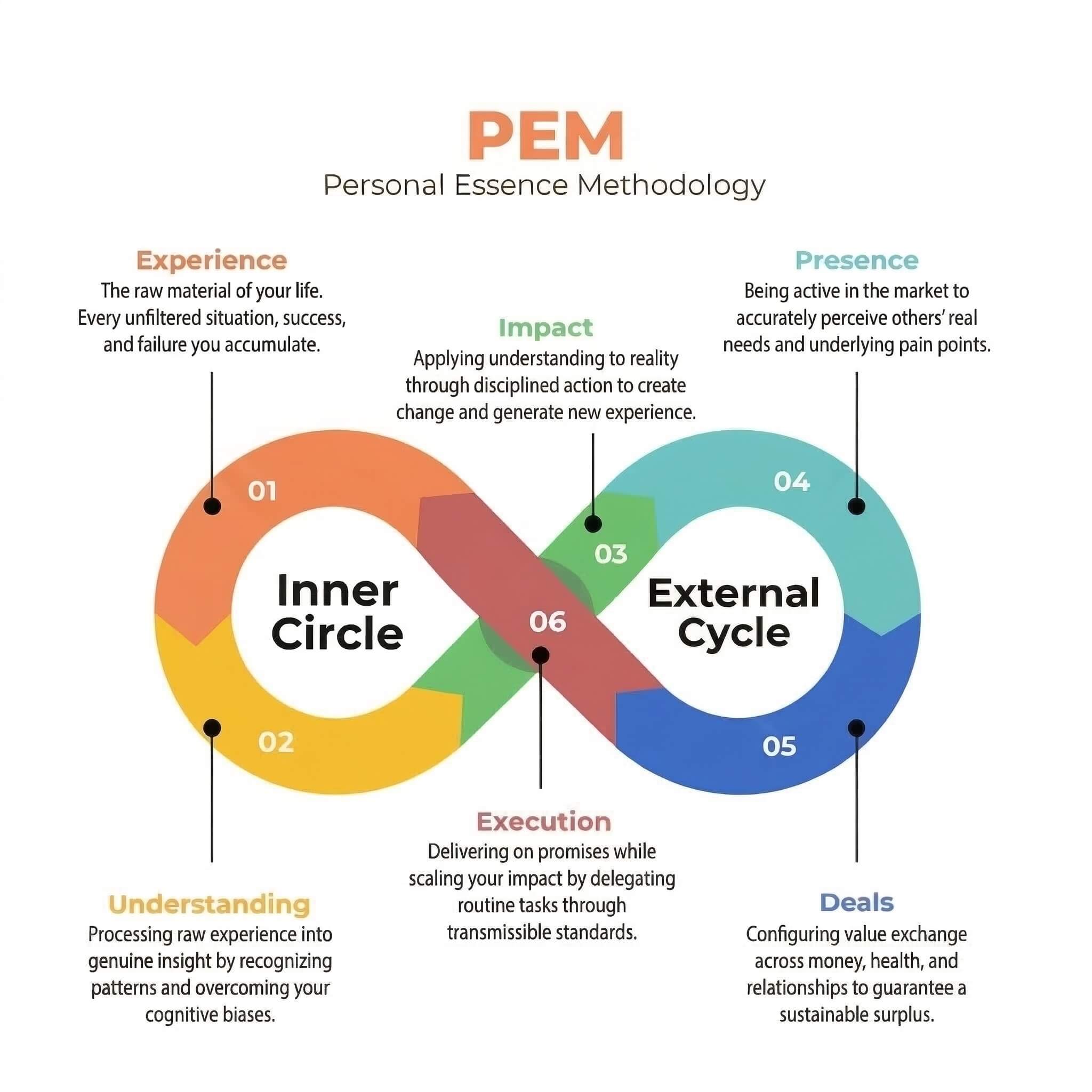
Phát triển sự thấu hiểu từ trải nghiệm, xây dựng một sự hiện diện dựa trên niềm tin thông qua bảy trụ cột, thiết lập những thỏa thuận có thể duy trì được bạn trên khắp cả sáu lĩnh vực tài nguyên, thực thi những gì bạn đã hứa—đích thân bạn trong Chế độ Kiến trúc sư và thông qua sự ủy quyền trong Chế độ Thợ xây—và để cho tác động được chứng minh mở rộng những gì mà bạn có thể hứa hẹn một cách đáng tin cậy và định hướng tiếp theo.
Mục lục
(17 chương)- Tại Sao Lại Là Phương Pháp Luận Này? Tại Sao Lại Là Bây Giờ.
- Nền Tảng
- Bối Cảnh Vĩ Mô: Tại Sao Phương Pháp Luận Này Phải Tiến Hóa
- Hệ Thống Tài Nguyên Được Nâng Cấp
- Chuỗi Nội lực (Internal Chain): Xử Lý Trải Nghiệm Thành Sự Thấu Hiểu
- Ba Giai Đoạn
- Nguyên Tắc Ủy Quyền: Mở Rộng Tác Động Thông Qua Sự Thấu Hiểu
- Hai Sự Mất Cân Bằng
- Sự Ảnh Hưởng Như Là Những Thỏa Thuận Chất Lượng Cao
- Phương Trình Tài Nguyên
- Chu Kỳ Lặp Đi Lặp Lại
- Hoạt Động Trong Khủng Hoảng: Phương Pháp Luận Dưới Áp Lực Hệ Thống
- Phạm Vi Và Những Giới Hạn
- Những Phương Thức Thất Bại
- Ứng Dụng
- Tài Liệu Tham Khảo Toàn Diện Về Thiên Kiến: Ánh Xạ Các Thiên Kiến Nhận Thức Lên Các Giai Đoạn Của Phương Pháp Luận
- Tóm Tắt
Tại Sao Lại Là Phương Pháp Luận Này? Tại Sao Lại Là Bây Giờ.
Tôi sinh năm 1987, vào thời điểm Liên Xô sụp đổ. Nền kinh tế đầu tiên mà tôi biết là một nền kinh tế vừa mới ngừng tồn tại.
Đến khi tôi đủ lớn để hiểu "những điều kiện ổn định" trong sách giáo khoa nghĩa là gì, tôi chưa từng được trải nghiệm chúng. Thời kỳ chuyển đổi hậu Xô viết đã mang theo siêu lạm phát, khoảng trống về thể chế, và sự ứng biến hàng ngày đã trở thành cuộc sống bình thường ở một Ukraine mới độc lập. Rồi đến những biến động kinh tế trong nước vào đầu những năm 2000. Tiếp đó, cuộc khủng hoảng tài chính toàn cầu năm 2008–2009, giáng một đòn đặc biệt mạnh vào các nền kinh tế mới nổi. Sau đó là Cách mạng Nhân phẩm năm 2013–2014, thứ đã thay đổi hoàn toàn bối cảnh chính trị của đất nước chỉ sau một đêm. Kế đến là cuộc chiến tranh đầu tiên—Crimea bị sáp nhập, Donbas chìm trong khói lửa, thế giới tự sắp xếp lại quanh chúng tôi trong khi chúng tôi phải tự sắp xếp lại để sinh tồn trong đó. Và rồi, vào năm 2022, cuộc xâm lược toàn diện—kiểu khủng hoảng không bao giờ hỏi xem bạn đã sẵn sàng hay chưa.
Xuyên suốt ngần ấy biến cố, tôi vẫn luôn xây dựng. Xây dựng các doanh nghiệp, xây dựng các mối quan hệ, xây dựng sự thấu hiểu. Không phải vì tôi có một bộ gen kiên cường đặc biệt nào đó hay vì người Ukraine bẩm sinh đã ngoan cường—dù rằng đôi khi sự bướng bỉnh của chúng tôi khiến chính chúng tôi cũng phải ngạc nhiên. Mà là vì một cuộc khủng hoảng, khi nó trở thành môi trường thường trực thay vì một sự gián đoạn nhất thời, sẽ dạy bạn những điều mà thời bình không thể: những quy tắc mà bạn dựa vào rồi sẽ bị phá vỡ, và khả năng duy trì hoạt động của bạn khi điều đó xảy ra chính là tài sản duy nhất không thể bị tịch thu, phá giá, hay đánh bom.
Phương pháp luận Tinh hoa Cá nhân (Personal Essence Methodology) không được thiết kế trong một thư viện. Nó được trui rèn từ chính khoảng cách giữa những gì tôi được dạy là sẽ hiệu quả và những gì thực sự hiệu quả khi mặt đất dưới chân không ngừng rung chuyển. Mỗi nguyên tắc trong tài liệu này—Chuỗi Nội lực (Internal Chain), Công thức Niềm tin (Trust Formula), sáu lĩnh vực nguồn lực, hệ thống phân cấp ủy quyền—đều đã được thử lửa trong những điều kiện mà đồng tiền có thể thay đổi, biên giới có thể bị phong tỏa, khách hàng có thể biến mất, và điện có thể bị cắt ngay giữa chừng công việc.
Đó là lý do tại sao tôi tin rằng phương pháp luận này đang trở nên cấp bách hơn bao giờ hết.
Thế giới mà bạn đang hoạt động ngày nay, bất kể bạn ở đâu, cũng đang bước vào một thời kỳ bất ổn giống hệt như những gì tôi đã trải qua trong suốt cuộc đời làm việc của mình. Sự phân mảnh địa chính trị đang tăng tốc. Cuộc cách mạng AI đang phá vỡ tính kinh tế của việc thực thi công việc theo thời gian thực. Vốn không còn rẻ nữa. Các chuỗi cung ứng không còn đáng tin cậy. Những thể chế từng mang lại sự ổn định—các thị trường có thể dự đoán được, tiền tệ ổn định, trật tự quốc tế vận hành bình thường—đang phải chịu một áp lực lớn và sẽ không dễ dàng được giải quyết trong nay mai.
Bạn có thể mới đối mặt với sự bất ổn mang tính hệ thống lần đầu tiên. Còn tôi thì đã sống trong đó suốt ba thập kỷ qua.
Và đây là những gì tôi đã học được: bạn không thể kiểm soát môi trường xung quanh, nhưng bạn có thể kiểm soát mức độ sâu sắc mà bạn xử lý trải nghiệm của mình, sự chân thành khi bạn xuất hiện trong các mối quan hệ, sự cẩn trọng khi bạn thiết lập các cam kết, và mức độ đáng tin cậy khi bạn thực hiện những gì đã hứa. Đó chính là phương pháp luận trong thực tiễn. Nó không phải là một lý thuyết về những gì nên phát huy tác dụng trong những điều kiện lý tưởng—nó là một hệ thống đã chứng minh được hiệu quả, hết lần này đến lần khác, trong những điều kiện chẳng có chút gì gọi là lý tưởng.
Phương pháp luận này sẽ không làm cho khủng hoảng trở nên dễ chịu hơn. Không có gì có thể làm được điều đó. Nhưng nó sẽ mang đến cho bạn một cấu trúc để vận hành khi những cấu trúc xung quanh bạn đang sụp đổ. Nó sẽ giúp bạn xây dựng niềm tin khi niềm tin là thứ khan hiếm, thiết lập các thỏa thuận khi các điều khoản còn đang biến động, thực thi khi nguồn lực bị hạn chế, và bồi đắp sự thấu hiểu của bạn khi các quy tắc dưới chân bạn không ngừng thay đổi.
Tôi xây dựng điều này vì tôi cần nó. Tôi chia sẻ nó vì tôi tin rằng bạn cũng cần nó, có lẽ còn cấp bách hơn cả những gì bạn đang nhận ra.
Thời điểm tốt nhất để xây dựng phương pháp luận của riêng bạn là trước khi khủng hoảng xảy ra. Thời điểm tốt thứ hai chính là bây giờ.
— Volodymyr Zhukov
Nền Tảng
Mỗi người đều tích lũy một tổ hợp trải nghiệm khác biệt, tiếp xúc với những hệ giá trị khác nhau, và trải qua một chuỗi sự kiện độc nhất. Điều này tạo ra sự khác biệt đầy ý nghĩa giữa con người với nhau—những khác biệt có thể trở thành nền tảng cho những giá trị đặc thù.
Sự khác biệt đầy ý nghĩa và sự hoàn toàn không thể so sánh. Bạn thực sự khác biệt với những người khác ở những khía cạnh quan trọng và có thể đo lường được: tính cách, phong cách nhận thức, lịch sử phát triển, chuyên môn tích lũy. Những khác biệt này là có thật và có giá trị về mặt kinh tế. Nhưng bạn không khác biệt đến mức mọi sự so sánh đều trở nên vô nghĩa hay không thể tạo ra bất kỳ sự kết nối nào. Bạn chia sẻ đủ cấu trúc nhận thức và cảm xúc với những người khác để thấu hiểu họ và được họ thấu hiểu. Chính cấu trúc chung này là thứ làm cho sự đồng cảm trở nên khả thi, sự trao đổi trở nên có giá trị, và niềm tin có thể đạt được. Nếu không có một sự khác biệt thực sự, bạn sẽ chẳng có gì đặc biệt để trao đi. Nếu không có những điểm tương đồng thực sự, bạn sẽ chẳng có ai để trao những thứ đó cho họ. Phương pháp luận đòi hỏi cả hai yếu tố này.
Tuy nhiên, chỉ riêng những trải nghiệm thô sơ thì không tạo ra điều gì cả. Trải nghiệm cần phải được thấu hiểu trước khi nó có thể được áp dụng. Và sự thấu hiểu đó phải được chuyển hóa thành hành động trước khi nó tạo ra bất kỳ sự thay đổi nào. Đây chính là Chuỗi Nội lực (Internal Chain) giúp cho hiệu quả bên ngoài trở nên khả thi.
Trải nghiệmThấu hiểuTác động
Trải nghiệm là vật liệu thô. Thấu hiểu là quá trình xử lý vật liệu đó thành những hiểu biết có thể sử dụng được. Tác động là việc áp dụng những hiểu biết đó để thay đổi các điều kiện trong thế giới thực.
Chuỗi này mang tính lặp lại, chứ không phải một đường thẳng. Tác động tạo ra trải nghiệm mới. Trải nghiệm mới đòi hỏi sự thấu hiểu mới. Vòng tuần hoàn này tiếp diễn trong suốt cuộc đời.
Sự Khác Biệt Cốt Lõi: Thông tin và Sự Thấu Hiểu
Thông tin là những gì tồn tại bên ngoài bạn—sự thật, dữ liệu, lời khuyên, khung tư duy, kết quả nghiên cứu. Nó thì dồi dào, rẻ mạt, và ngày nay có thể được tạo ra vô hạn bởi trí tuệ nhân tạo.
Sự thấu hiểu là những gì tồn tại bên trong bạn—quá trình xử lý thông tin thông qua lăng kính của trải nghiệm, bối cảnh, những thất bại, và tình huống cụ thể của riêng bạn. Sự thấu hiểu nói cho bạn biết mảnh thông tin nào là quan trọng ngay lúc này, lời khuyên nào phù hợp với hoàn cảnh của bạn, và chiến lược nào vừa vặn với những hạn chế mà bạn đang thực sự phải đối mặt.
Thông tin mang tính chung chung. Sự thấu hiểu mang tính cá nhân.
Sự bùng nổ của thông tin sẵn có đã tạo ra ảo tưởng rằng sự thấu hiểu cũng được mở rộng. Không hề. Trận lụt thông tin thường khiến cho việc thấu hiểu trở nên khó khăn hơn do nó cản trở công việc xử lý chậm rãi và sâu sắc hơn. Phương pháp luận này là một hệ thống phát triển sự thấu hiểu, không phải là một hệ thống thu nạp kiến thức. Sự khác biệt giữa hai điều này chính là sự khác biệt giữa cảm giác có hiểu biết và việc thực sự hiệu quả.
Ảo tưởng về sự trôi chảy khiến vấn đề trở nên tồi tệ hơn. Khi chúng ta bắt gặp những thông tin có cảm giác dễ tiếp thu—bởi vì ta đã từng đọc qua nó, vì nó được trình bày rõ ràng, hay vì nó củng cố cho những gì ta vốn đã tin tưởng—bộ não của chúng ta sẽ diễn giải sự trôi chảy trong quá trình tiếp thu đó như một bằng chứng cho thấy ta đã làm chủ được kiến thức. Việc đọc đi đọc lại một khung tư duy và gật gù đồng tình tạo ra một cảm giác chủ quan mạnh mẽ về năng lực, nhưng lại hoàn toàn đứt gãy với khả năng thực tế. Khoảng cách giữa việc nhận diện được thông tin khi nhìn vào nó và việc truy xuất nó dưới áp lực là rất lớn. Sự khăng khăng của phương pháp luận về việc phải xử lý thông tin—bằng cách viết, thử nghiệm, định vị đa chiều—tồn tại chính xác là để đánh bại cái ảo tưởng về năng lực này.
Bối Cảnh Vĩ Mô: Tại Sao Phương Pháp Luận Này Phải Tiến Hóa
Chúng ta đang sống qua một thời kỳ của những quá trình chuyển đổi hệ thống mang tính cộng dồn: sự phân mảnh địa chính trị, cuộc cách mạng AI, phi toàn cầu hóa, sự chấm dứt của kỷ nguyên vốn rẻ, những biến đổi về nhân khẩu học, và một cuộc chuyển đổi năng lượng toàn diện. Đây không phải là những sự đứt gãy đơn lẻ. Chúng tương tác với nhau, và chính sự tương tác đó khuếch đại tính bất ổn và đẩy nhanh tốc độ sụp đổ của những quy tắc cũ.
Sự Đứt Gãy Do AI
AI giờ đây đã trở thành một cỗ máy thực thi. Các mô hình ngôn ngữ lớn có khả năng tạo ra mã nguồn đạt chuẩn sản phẩm thực tế, các tài liệu chuyên nghiệp, giao diện hoạt động trơn tru, và những quy trình làm việc phức tạp. Trào lưu "vibe coding" biến những mô tả bằng ngôn ngữ tự nhiên thành một phần mềm hoạt động được. Giao thức Ngữ cảnh Mô hình (Model Context Protocol) kết nối AI trực tiếp với các công cụ chuyên nghiệp và hạ tầng vận hành. Các tác tử tự trị được trang bị AI có thể xử lý những quy trình thực thi nhiều bước từ nghiên cứu, phác thảo, lên lịch, điều phối, cho đến bàn giao kết quả.
Điều này làm thay đổi một cách căn bản tính kinh tế của sự hiệu quả cá nhân. Khi việc thực thi đang bị hàng hóa hóa—khi thứ mà hầu hết mọi người mang đi bán (sức lao động của họ, khả năng hoàn thành các tác vụ của họ) đang trở nên dồi dào và rẻ mạt—thì việc cố gắng làm việc chăm chỉ hơn ở khâu thực thi chẳng khác nào đang chạy nhanh hơn trên một chiếc máy chạy bộ đang tăng tốc ngay dưới chân bạn.
Những gì AI sẽ hàng hóa hóa
Kiến thức chung chung. Khả năng thực thi ở mức trung bình. Phân tích tiêu chuẩn. Sản xuất rập khuôn. Nội dung bề mặt. Bất kỳ công việc nào có thể được rút gọn thành những quy tắc rõ ràng được áp dụng mà không cần đến sự phán đoán.
Những gì AI không thể sao chép
Trải nghiệm cụ thể của bạn, được xử lý thành sự thấu hiểu thực sự. Các mối quan hệ thực tế của bạn và lịch sử niềm tin được gắn kết trong đó. Khả năng điều hướng trong sự mơ hồ và đưa ra các quyết định phán đoán có sự tích hợp giữa các giá trị, trải nghiệm, và bối cảnh. Năng lực của bạn cho một Sự Hiện Diện (Presence) chân thực—sự công nhận giữa người với người xuất phát từ việc một ý thức khác đang gắn kết với ý thức của bạn.
Trong một thế giới nơi khả năng thực thi chung chung là dư thừa và miễn phí, một mức độ hiệu quả trung bình sẽ chỉ mang lại những kết quả dưới mức trung bình. Thị trường bị chia tách giữa nhu cầu về những năng lực xuất chúng của con người—những thứ được trả công rất cao—và mọi thứ còn lại, vốn ngày càng được thực hiện bởi AI hoặc bởi những người đang cạnh tranh về giá với AI. Khoảng giữa đang dần biến mất.
Thiên kiến tự động hóa làm trầm trọng thêm mối nguy hiểm của khoảng giữa này. Khi AI trở nên giỏi hơn, con người ngày càng phụ thuộc vào kết quả đầu ra của nó mà không có sự đánh giá cẩn trọng—họ đối xử với những khuyến nghị do máy móc tạo ra như một sự thật, và đầu hàng tư duy phản biện trước thuật toán. Đây không phải là sự lười biếng; nó là một lối tắt nhận thức mà bộ não của chúng ta áp dụng đối với bất kỳ thực thể nào được coi là có thẩm quyền, dù là con người hay kỹ thuật số. Khi AI phác thảo một chiến lược, xem xét một bản hợp đồng, hay chẩn đoán một vấn đề, sự cám dỗ của việc chấp nhận mà không thắc mắc là cực kỳ lớn, chính xác là vì kết quả đầu ra trông quá trau chuốt và đầy tự tin. Người có thể bổ sung thêm sự phán đoán—người nắm bắt được những gì AI đã bỏ sót, người cảm nhận được sự lệch pha về bối cảnh mà thuật toán không thể nhận thức được—mới chính là người có mức độ thấu hiểu mà thị trường sẽ sẵn sàng trả giá cao. Người chỉ đơn thuần giám sát AI mà không có sự xem xét thực sự sẽ chiếm giữ cái khoảng giữa đang biến mất ấy.
Nền Kinh Tế Của Niềm Tin
Một trong những sự chuyển dịch gây ra nhiều hệ quả nhất đối với các cá nhân chính là sự chuyển đổi từ Nền Kinh tế của Sự Chú ý sang Nền Kinh tế của Niềm tin.
Trong suốt hai thập kỷ qua, internet đã được tối ưu hóa để thu hút sự chú ý của con người. Nội dung là hàng hóa, còn sự chú ý là tiền tệ. Nhưng AI tạo sinh đã kéo chi phí tạo ra nội dung xuống gần như bằng không. Khi nội dung là vô hạn, và sự chú ý thì dễ dàng bị thao túng, tính xác thực và niềm tin trở thành những nguồn lực khan hiếm nhất. Giá trị đang dịch chuyển về phía những cá nhân, nền tảng, và hệ thống có khả năng xác minh sự thật, chứng minh năng lực, và khẳng định tính xác thực của con người.
Hiệu ứng chân lý ảo tưởng càng đẩy nhanh sự chuyển dịch này. Khi con người bắt gặp những tuyên bố lặp đi lặp lại—dù là từ nội dung do AI tạo ra, từ mạng xã hội, hay từ tiếp thị—bộ não của họ bắt đầu ghi nhận những tuyên bố đó như thể chúng có nhiều khả năng là đúng hơn, bất kể tính hợp lệ thực tế của chúng là gì. Sự lặp lại chế tạo ra niềm tin. Trong một môi trường có lượng nội dung vô hạn, khối lượng khổng lồ của những tuyên bố sai lệch hoặc gây hiểu lầm được lặp đi lặp lại sẽ làm xói mòn đi nền tảng cơ sở của một sự thật được chia sẻ chung. Điều này khiến cho niềm tin chân chính—được xây dựng dựa trên những thành tích đã được xác minh và một sự hiện diện minh bạch—trở thành một cơ sở hạ tầng thiết yếu cho bất kỳ một mối quan hệ, thị trường, hay thể chế nào đang vận hành.
Khi việc thực thi còn khan hiếm, bạn chọn nhà cung cấp dựa trên năng lực. Khi việc thực thi trở nên dư thừa, bạn lựa chọn dựa trên niềm tin. Những thỏa thuận được tạo ra bằng niềm tin sẽ có chi phí giao dịch thấp hơn—ít sự xác minh hơn, ít chi phí pháp lý hơn, ít năng lượng bị lãng phí cho việc giám sát hơn. Trong một nền kinh tế nơi sự cạnh tranh do AI thúc đẩy đang dồn ép giá cả, những lợi ích về mặt hiệu quả từ các thỏa thuận dựa trên niềm tin không hề nhỏ bé. Chúng mang tính quyết định.
Công thức Niềm tin (Trust Formula)
Niềm tin không phải là một cảm giác, một đặc điểm tính cách, hay sự thu hút. Niềm tin là một hợp chất—tích số của ba thành phần trong một mối quan hệ nhân (multiplicative relationship):
Mối quan hệ nhân chính là một hiểu biết mang tính cốt lõi. Phép cộng sẽ có nghĩa là sự yếu kém ở một lĩnh vực có thể được bù đắp bằng thế mạnh ở một lĩnh vực khác. Phép nhân có nghĩa là một điểm không (0) ở bất kỳ yếu tố nào cũng sẽ làm sụp đổ toàn bộ tổng thể.
- Tác động được Chứng minh
niềm tin vào năng lực. Bạn có một bề dày thành tích. Bạn đã mang lại kết quả. Năng lực của bạn được chứng minh thông qua những kết quả mà người khác có thể quan sát và kiểm chứng. Được xây dựng trong giai đoạn Thực thi (Execution).
- Sự Hiện diện Minh bạch
niềm tin vào thiện ý. Bạn hữu hình, trung thực, và gắn kết một cách chân thành với thực tế của người khác. Bạn nhận thức được nhu cầu thực sự của họ, chứ không phải sự phóng chiếu của bạn về nhu cầu của họ. Mọi người có thể đánh giá bạn một cách chính xác bởi vì bạn xuất hiện đúng như con người thật của bạn. Được xây dựng trong giai đoạn Hiện diện (Presence).
- Sự Đồng điệu Nhất quán
niềm tin vào sự chính trực. Khoảng cách giữa những gì bạn cam kết trong giai đoạn Thỏa thuận (Deals) và những gì bạn mang lại trong giai đoạn Thực thi luôn ở mức gần bằng không, được lặp đi lặp lại, theo thời gian. Lời nói và hành động của bạn luôn khớp với nhau. Những lời hứa và hiệu suất thực tế của bạn có một lịch sử tương đồng. Được xây dựng tại ranh giới giữa Thỏa thuận và Thực thi, và được nhân lên qua các chu kỳ.
Tại Sao Mối Quan Hệ Nhân Lại Quan Trọng
Tác động bằng Không × bất cứ thứ gì × bất cứ thứ gì = không có niềm tin. Bạn không thể mang lại kết quả. Không một sự quyến rũ hay mức độ đáng tin cậy nào có thể thay đổi được điều này.
Bất cứ thứ gì × Hiện diện bằng Không × bất cứ thứ gì = không có niềm tin. Không ai có thể đọc vị hay đánh giá bạn. Một năng lực mờ ám hoặc vô hình chỉ tạo ra sự cảnh giác, chứ không phải niềm tin.
Bất cứ thứ gì × bất cứ thứ gì × Đồng điệu bằng Không = không có niềm tin. Bạn không giữ lời. Những người có năng lực, có độ nhận diện cao mà liên tục hứa hẹn quá mức nhưng thực hiện lại kém cỏi chính là những người nguy hiểm nhất—bởi vì họ thu hút được những cam kết mà họ không thể tôn trọng.
Cách Công Thức Này Áp Dụng Vào Cấu Trúc Của Phương Pháp Luận
Ba thành phần này tương ứng trực tiếp với ba giai đoạn của Chu kỳ Bên ngoài (External Cycle):
- Hiện diện (Presence) → xây dựng Sự Hiện diện Minh bạch (niềm tin vào thiện ý)
- Thỏa thuận (Deals) → thiết lập các cam kết vốn sẽ là thước đo cho Sự Đồng điệu Nhất quán
- Thực thi (Execution) → xây dựng Tác động được Chứng minh (niềm tin vào năng lực) và hoặc là xác nhận, hoặc là vi phạm Sự Đồng điệu Nhất quán (niềm tin vào sự chính trực)
Công thức ba yếu tố này làm rõ ràng một điều mà các công thức hai yếu tố thường che khuất: Thỏa thuận không chỉ đơn thuần là một giai đoạn thiết lập nhằm cung cấp nguyên liệu cho việc Thực thi. Đó là giai đoạn mà bạn định ra tiêu chuẩn để đánh giá sự chính trực của bản thân. Một Thỏa thuận được thiết lập tốt làm được nhiều việc hơn là chỉ tối đa hóa lợi ích thặng dư; nó thiết lập những cam kết mà bạn thực sự có thể tôn trọng, bởi vì mỗi một cam kết mà bạn đặt ra sẽ trở thành một bài kiểm tra cho Sự Đồng điệu Nhất quán của bạn. Việc hứa hẹn quá mức trong giai đoạn Thỏa thuận tạo ra nhiều thứ hơn là chỉ sự thiếu hụt về nguồn lực. Nó tạo ra một sự thâm hụt niềm tin vào tính chính trực mà không một lượng Tác động hay Sự Hiện diện nào có thể bù đắp được.
Điều này cũng làm rõ lý do tại sao sự mất cân bằng nghiêng về Hiện diện lại mang tính phá hoại đến thế trong Nền Kinh tế của Niềm tin. Người có thiên hướng Hiện diện nặng nề thường có Sự Hiện diện Minh bạch mạnh mẽ và thường xuyên tạo ra những Tác động thực sự ở giai đoạn đầu—nhưng Sự Đồng điệu Nhất quán của họ lại tiến gần đến mức không bởi vì họ có hệ thống thói quen hứa nhiều hơn làm. Lấy bất cứ thứ gì nhân với số không, bạn sẽ nhận được số không. Niềm tin ở họ sụp đổ bất chấp việc họ có hai thành phần mạnh mẽ, bởi vì thành phần thứ ba đã bị thiếu.
Và nó làm rõ lý do tại sao niềm tin của một người có thiên hướng Thực thi lại không cộng dồn theo cách mà nó nên như thế. Họ có năng lực Tác động được Chứng minh rất mạnh mẽ và thường có Sự Đồng điệu Nhất quán ở mức hợp lý—nhưng Sự Hiện diện Minh bạch của họ lại tiến gần đến mức không vì họ vô hình. Một lần nữa, hãy nhân với số không.
Hiệu ứng hào quang hoạt động một cách mạnh mẽ—và đầy nguy hiểm—trong những giai đoạn đầu của việc hình thành niềm tin. Khi một người thể hiện một phẩm chất tích cực mạnh mẽ—khả năng giao tiếp hùng hồn, thông tin xác thực ấn tượng, sức hấp dẫn về ngoại hình—những người quan sát sẽ vô thức cho rằng người đó cũng sở hữu những phẩm chất tích cực khác: năng lực, sự chính trực, óc phán đoán tốt. Lối tắt tinh thần này có thể đẩy nhanh tốc độ hình thành niềm tin ban đầu bằng cách thổi phồng mức độ nhận thức về cả ba yếu tố trước khi chúng thực sự được chứng minh. Nhưng niềm tin dựa trên hào quang thì rất mong manh. Nó sẽ sụp đổ khi hiệu suất thực tế mâu thuẫn với ấn tượng ban đầu, và sự điều chỉnh thường diễn ra một cách khắc nghiệt không tương xứng: người đó sẽ bị coi là kẻ dối trá, chứ không chỉ đơn thuần là người kém cỏi, bởi vì người quan sát cảm thấy niềm tin của họ đã bị thao túng. Hiệu ứng hào quang có thể tạm thời che giấu một con số không ở một yếu tố; nhưng công thức nhân này đảm bảo rằng thực tế cuối cùng sẽ tự khẳng định lại bản thân nó.
Về khía cạnh cộng dồn: Niềm tin được cộng dồn thông qua các vòng lặp lặp đi lặp lại của Chu kỳ Bên ngoài. Công thức này có thể được mở rộng thành Niềm tin = (Tác động được Chứng minh × Sự Hiện diện Minh bạch × Sự Đồng điệu Nhất quán)^số_chu_kỳ. Nhưng điều này đã được ngầm hiểu trong từ "Được chứng minh" (ám chỉ một bề dày thành tích, không phải một sự kiện đơn lẻ), "Nhất quán" (ám chỉ sự lặp lại), và chu trình lặp lại mà phương pháp luận này vốn đã mô tả. Quá trình cộng dồn là có thật và cực kỳ thiết yếu—đó là thứ biến niềm tin trở thành một tài sản bền vững thay vì chỉ là một ấn tượng chớp nhoáng—nhưng việc thêm vào một số mũ rõ ràng lại có nguy cơ khiến cho công thức này trở nên khó truyền đạt hơn mà không làm tăng thêm sự rõ ràng về mặt phương pháp luận.
Sự chuyển dịch này làm thay đổi ý nghĩa của việc hiện diện, cách cấu trúc các thỏa thuận, và những gì mà việc thực thi phải mang lại. Phương pháp luận này phải tính đến điều đó.
Hệ Thống Tài Nguyên Được Nâng Cấp
Trước đây, phương pháp luận đóng khung các thỏa thuận xoay quanh ba lĩnh vực: Tiền bạc, Sức khỏe, và Các Mối quan hệ. Khung tư duy đó từng rất hữu ích nhưng lại không đầy đủ. Trong môi trường hiện tại—nơi niềm tin là tiền tệ, sự chú ý bị tranh giành, và kiến thức mất giá đi nhanh chóng—chúng ta cần một bản đồ tài nguyên chính xác hơn.
Mỗi người đều hoạt động với sáu lĩnh vực tài nguyên nền tảng. Các thỏa thuận (Deals) được thiết lập trên cả sáu lĩnh vực này. Sự dư thừa hay thâm hụt ở bất kỳ một lĩnh vực nào cũng sẽ tạo ra hiệu ứng gợn sóng lan sang các lĩnh vực khác.
1. Tài Chính — Sự Giàu Có / Dòng Tiền
Tiền bạc, thù lao, lợi tức đầu tư, doanh thu. Đây là nguồn tài nguyên có khả năng chuyển đổi linh hoạt nhất thành các nguồn tài nguyên khác—nhưng tự bản thân nó không thể thay thế cho bất kỳ nguồn tài nguyên nào. Sự dư thừa về tài chính sẽ tài trợ cho việc ủy quyền, tạo ra các sự lựa chọn và hấp thụ các cú sốc. Sự thâm hụt về tài chính sẽ hạn chế mọi lĩnh vực khác.
Kế toán tinh thần làm sai lệch việc quản lý tài nguyên tài chính
Chúng ta đối xử với tiền bạc theo những cách khác nhau tùy thuộc vào nguồn gốc hay mục đích dự kiến của nó—tiêu xài một khoản hoàn thuế một cách thoải mái trong khi kiên quyết không đụng đến tiền tiết kiệm, mặc dù cả hai đều có thể thay thế cho nhau. Điều này tạo ra những "chiếc lọ" vô hình trong tư duy tài chính của chúng ta, ngăn cản việc phân bổ tối ưu trên khắp sáu lĩnh vực. Một người làm nghề tự do có thể phân tách "thu nhập từ dự án" với "thu nhập từ nghề tay trái" ở trong đầu và áp dụng những quy tắc chi tiêu khác nhau cho mỗi khoản, ngay cả khi hành động hợp lý nhất là gộp chung các nguồn tài nguyên lại và phân bổ dựa trên sự ưu tiên. Phương pháp luận đòi hỏi phải đối xử với các nguồn tài nguyên tài chính như một quỹ chung được quản lý bởi sự phân bổ mang tính chiến lược, chứ không phải bởi những sự tình cờ về mặt tâm lý của việc đồng tiền đã đến bằng cách nào.
Ảo giác tiền tệ càng làm sai lệch thêm các phán đoán tài chính
Chúng ta tập trung vào các con số danh nghĩa—con số trên tờ séc nhận lương hay trên bảng giá—thay vì những gì mà số tiền đó thực sự có thể mua được. Trong những thời kỳ lạm phát, một mức tăng lương 5% trong khi chỉ vừa đủ bù đắp cho mức lạm phát 6% lại tạo ra cảm giác như một sự tiến triển. Trong việc thiết lập thỏa thuận, điều này có nghĩa là phải đánh giá mức thù lao, giá cả, và lợi tức đầu tư theo những giá trị thực—tức là sức mua, chứ không phải là những con số danh nghĩa.
2. Sinh Học — Sức Khỏe / Năng Lượng Hằng Ngày
Năng lực về mặt thể chất và tinh thần. Chất lượng giấc ngủ, sức khỏe trao đổi chất, mức độ căng thẳng, và tốc độ phục hồi. Đây là nguồn tài nguyên đóng vai trò kiểm soát mọi thứ khác—sẽ chẳng có một lượng vốn tài chính hay vốn trí tuệ nào có ý nghĩa nếu cơ thể của bạn không thể duy trì được nỗ lực. Sự dư thừa về mặt sinh học đồng nghĩa với sức bật và sự dẻo dai. Sự thâm hụt về mặt sinh học đồng nghĩa với hiệu suất suy giảm bất chấp việc bạn có cơ hội hay không.
Sự tối thượng của giấc ngủ
Giấc ngủ cấu thành nên yếu tố quan trọng nhất của sức khỏe sinh học—là nền tảng để dựa vào đó chúng ta thực hiện việc tập thể dục, dinh dưỡng, quản lý căng thẳng, và mọi hoạt động chăm sóc sức khỏe khác. Trong khi ngủ, bộ não củng cố các trải nghiệm thành sự thấu hiểu thông qua việc phát lại hệ thần kinh và trích xuất các khuôn mẫu—đó là một cơ chế theo đúng nghĩa đen, mà thông qua đó Chuỗi Nội lực (Internal Chain) sẽ chuyển hóa trải nghiệm của ngày hôm nay thành hiểu biết của ngày mai. Sự thiếu ngủ mãn tính làm suy giảm năng lượng. Tệ hơn nữa, nó phá hoại chính cái quá trình tạo ra sự thấu hiểu—tài sản trung tâm của phương pháp luận. Bảy đến tám giờ ngủ là một cơ sở hạ tầng không thể thương lượng, chứ không phải là một sự xa xỉ về sức khỏe.
Thiên kiến phóng chiếu phá hoại việc quản lý tài nguyên sinh học
Khi cảm thấy tràn đầy năng lượng và khỏe mạnh, chúng ta không thể hình dung một cách chính xác xem mình sẽ suy nghĩ và hoạt động như thế nào khi bị cạn kiệt, ốm đau, hay căng thẳng—và ngược lại. Đây là khoảng trống đồng cảm nóng-lạnh (hot-cold empathy gap) được áp dụng vào các trạng thái tương lai của chính chúng ta. Một người thiết lập các thỏa thuận vào một ngày vui vẻ sẽ có xu hướng đánh giá thấp chi phí sinh học của những cam kết đó một cách có hệ thống. Một người đang trong tình trạng kiệt sức thì không thể dự phóng chính xác được sự phục hồi mà việc nghỉ ngơi có thể mang lại và có thể sẽ đưa ra những quyết định mang tính vĩnh viễn dựa trên những trạng thái tạm thời. Các thỏa thuận phải được thiết lập cho một năng lực sinh học thực tế, chứ không phải cho cách mà bạn cảm thấy vào ngày tuyệt vời nhất của mình.
3. Xã Hội — Mối Quan Hệ Sâu Sắc (Sự Hỗ Trợ) / Mạng Lưới Rộng (Tầm Tiếp Cận)
Lĩnh vực này có hai lớp riêng biệt. Các mối quan hệ sâu sắc cung cấp sự hỗ trợ về mặt cảm xúc, những phản hồi trung thực, và những mạng lưới an toàn trong lúc khủng hoảng. Mạng lưới rộng mang lại tầm tiếp cận, dòng chảy của các thỏa thuận, và sự tiếp cận với những cơ hội mà bạn không thể tự mình tìm thấy. Cả hai đều cần thiết. Có các mối quan hệ sâu sắc mà không có tầm tiếp cận nghĩa là bạn bị cô lập khỏi các thị trường. Có mạng lưới rộng mà không có chiều sâu nghĩa là bạn chỉ có những kết nối mong manh vốn sẽ sụp đổ dưới áp lực.
Thiên kiến lịch sự âm thầm làm suy thoái các vòng lặp phản hồi xã hội. Những người trong mạng lưới của bạn—đặc biệt là những người trong các mối quan hệ công việc—sẽ có xu hướng nói cho bạn nghe những gì họ nghĩ là bạn muốn nghe thay vì những gì họ thực sự quan sát được một cách có hệ thống. Cơ chế ở đây là sự bôi trơn xã hội. Nhưng điều đó có nghĩa là cái kênh phản hồi mà hầu hết mọi người dựa vào để tự hiệu chỉnh bản thân đã bị làm hỏng ngay từ đầu nguồn. Sự khăng khăng của phương pháp luận về việc định vị đa chiều—những hồ sơ được đóng băng trong quá khứ, sự phản chiếu của hiện tại, và những dữ liệu cứng từ bên ngoài—tồn tại một phần là để bù đắp cho thực tế rằng những phản hồi của con người đã bị lọc qua sự lịch sự trước khi chúng đến được với bạn.
4. Danh Tiếng — Niềm Tin / Thương Hiệu Cá Nhân / Khán Giả
Trong Nền Kinh tế của Niềm tin (Economy of Trust), danh tiếng không còn là một sản phẩm phụ thụ động của một công việc tốt nữa. Nó là một tài sản có thể quản lý được và mang tính chủ động. Danh tiếng của bạn là những gì mọi người tin về bạn trước khi họ tương tác với bạn. Thương hiệu cá nhân của bạn là tín hiệu mà bạn cố tình phát ra. Khán giả của bạn là nhóm người đã trao cho bạn sự chú ý liên tục dựa trên niềm tin đã được chứng minh. Sự dư thừa về danh tiếng có nghĩa là các cơ hội sẽ tự tìm đến bạn. Sự thâm hụt về danh tiếng có nghĩa là bạn phải chiến đấu cho từng cơ hội một ngay từ vạch xuất phát.
Danh tiếng được xây dựng thông qua năm kênh riêng biệt: những kết quả được chứng minh (các dự án đã bàn giao, các vấn đề đã được giải quyết), tầm tiếp cận của mạng lưới (ai biết đến công việc của bạn và họ nói chuyện với ai), mức độ nhận diện (được biết đến vượt ra ngoài mạng lưới trực tiếp của bạn thông qua các sự kiện, nội dung, các cộng đồng chuyên môn), chia sẻ kiến thức và trình bày tình huống (không chỉ truyền đạt những gì bạn đã đạt được mà còn cả cách bạn suy nghĩ), và sự nhất quán theo thời gian (hiệu ứng cộng dồn của sự hiện diện đáng tin cậy, năm này qua năm khác). Việc chỉ đầu tư vào một kênh duy nhất—điển hình là các kết quả được chứng minh—sẽ khiến cho bốn kênh còn lại bị ngủ đông, đó là lý do tại sao một công việc xuất sắc thường vẫn nằm trong vòng vô hình.
Hiệu ứng tiếp xúc đơn thuần là cơ chế nền tảng của việc xây dựng danh tiếng dựa trên mức độ nhận diện. Mọi người càng thường xuyên bắt gặp tên tuổi, công việc, hay các ý tưởng của bạn, thì họ càng có xu hướng phát triển những liên tưởng tích cực về bạn—ngay cả khi họ không thể giải thích rõ lý do tại sao. Đây là cách mà nhận thức của con người xử lý sự quen thuộc. Sự nhận diện mang tính chiến lược—nội dung nhất quán, thường xuyên tham dự các sự kiện, sự hiện diện đáng tin cậy trong các cộng đồng chuyên môn—sẽ tận dụng được hiệu ứng này một cách trung thực. Lưu ý cực kỳ quan trọng: sự tiếp xúc đơn thuần chỉ xây dựng nên sự ấm áp và sự nhận biết, chứ không phải niềm tin vào năng lực. Nó mở ra các cánh cửa nhưng không chốt được các thỏa thuận. Độ nhận diện mà không có kết quả chuyển giao sẽ tạo ra sự mất cân bằng nghiêng về Hiện diện (Presence-heavy imbalance).
Hiệu ứng đoàn tàu khuếch đại động lực của danh tiếng. Một khi một lượng người nhất định đã nhận ra và tin tưởng bạn, những người khác sẽ hùa theo bởi vì họ quan sát thấy những người khác đã tin tưởng bạn rồi, chứ không phải vì họ đã độc lập đánh giá công việc của bạn. Đây là lý do tại sao vốn danh tiếng được cộng dồn theo cấp số nhân: những khoản đầu tư ban đầu sẽ mang lại những lợi nhuận khiêm tốn, nhưng một khi đã vượt qua được ngưỡng của bằng chứng xã hội, danh tiếng sẽ trở nên tự củng cố. Điểm nguy hiểm là cơ chế này cũng hoạt động theo chiều ngược lại—sự tổn hại về danh tiếng cũng sẽ đổ sụp xuống nhanh chóng y như cách người ta đạt được nó.
5. Trí Tuệ — Kiến Thức / Kỹ Năng Cứng
Những gì bạn biết và những gì bạn có thể làm. Chuyên môn trong ngành, năng lực kỹ thuật, khả năng nhận diện khuôn mẫu, các khung tư duy cho sự phán đoán. Vốn trí tuệ là thứ khiến cho sự thấu hiểu của bạn có thể chuyển giao được và việc ủy quyền của bạn trở nên hiệu quả. Trong một thế giới nơi AI hàng hóa hóa những kiến thức trên bề mặt, vốn trí tuệ sâu sắc—thứ cho phép việc phán đoán, chứ không chỉ là việc truy xuất thông tin—sẽ trở nên có giá trị hơn, chứ không phải là ít đi.
Hiệu ứng Google (chứng hay quên kỹ thuật số) định hình lại các yêu cầu về vốn trí tuệ. Khi thông tin có thể được truy cập ngay lập tức, bộ não của chúng ta sẽ ngừng lưu trữ các nội dung thực tế và thay vào đó trở thành những chuyên gia trong việc ghi nhớ xem có thể tìm thấy thông tin ở đâu. Đây là một sự chuyển dịch mang tính thích nghi, nhưng nó có một cái giá phải trả: người chỉ "biết nơi để tra cứu nó" sẽ thiếu đi nền tảng kiến thức đã được nội tâm hóa cần thiết cho việc phán đoán nhanh chóng dưới áp lực. Vốn trí tuệ sâu sắc theo ý nghĩa của phương pháp luận này chính là khả năng nhận diện khuôn mẫu đã được nội tâm hóa vốn hoạt động mà không cần đến sự tìm kiếm có ý thức. Những thông tin có thể truy xuất không đủ điều kiện để được tính. Thời đại AI làm cho sự khác biệt này trở nên sắc nét hơn: AI xử lý việc truy xuất; còn bạn xử lý việc phán đoán. Nếu vốn trí tuệ của bạn chỉ bao gồm những gì bạn có thể tra cứu, thì AI đã làm việc đó tốt hơn rồi.
6. Thời Gian — Thời Gian / Sự Chú Ý Tập Trung
Số giờ trong ngày và chất lượng của sự chú ý trong những giờ đó. Thời gian là nguồn tài nguyên duy nhất không thể tích lũy được—nó chỉ có thể được phân bổ. Sự chú ý tập trung là cấp số nhân quyết định xem khoảng thời gian được phân bổ đó sẽ tạo ra giá trị hay sự lãng phí. Sự dư thừa về thời gian có nghĩa là có không gian cho tư duy chiến lược, việc đầu tư vào các mối quan hệ, và sự phục hồi. Sự thâm hụt về thời gian đồng nghĩa với một lối sống mang tính phản ứng—liên tục phải đối phó, và không bao giờ được định hướng.
Định luật Hick chi phối mối quan hệ giữa các sự lựa chọn và tính hiệu quả của thời gian. Càng phải đối mặt với nhiều lựa chọn trong bất kỳ thời điểm nào—trả lời email nào, thúc đẩy dự án nào, đầu tư vào mối quan hệ nào—bộ não của bạn sẽ càng mất nhiều thời gian hơn để quyết định, và chất lượng quyết định cũng sẽ suy giảm. Đó là một hàm logarit của số lượng lựa chọn, không phải là một vấn đề về tính kỷ luật. Việc giảm số lượng các quyết định chủ động thông qua các hệ thống, thói quen, và sự ủy quyền là một sự bảo vệ mang tính cấu trúc đối với tài nguyên thời gian, chứ không phải là một mẹo nhỏ để tăng năng suất.
Sáu Lĩnh Vực Tương Tác Với Nhau Như Thế Nào
Không có lĩnh vực nào hoạt động một cách cô lập. Sự dư thừa về tài chính có thể mua được sự tự do về thời gian (ủy quyền, tự động hóa). Sự dư thừa về sinh học tạo điều kiện cho các công việc trí tuệ sâu sắc hơn. Sự dư thừa về danh tiếng làm giảm nỗ lực cần thiết để chốt các thỏa thuận. Sự dư thừa về mặt xã hội sẽ mang đến những cơ hội giúp tiết kiệm thời gian và tiền bạc. Sự dư thừa về trí tuệ giúp cho việc thực thi trở nên hiệu quả hơn, từ đó bảo tồn được các nguồn tài nguyên sinh học và thời gian.
Ngược lại, sự thâm hụt ở một lĩnh vực sẽ làm cạn kiệt các lĩnh vực khác. Áp lực tài chính làm xói mòn sức khỏe. Sức khỏe suy giảm làm giảm sản lượng trí tuệ. Danh tiếng bị tổn hại sẽ làm thu hẹp mạng lưới. Mạng lưới sụp đổ sẽ triệt tiêu dòng chảy của các thỏa thuận. Các thỏa thuận tồi tệ sẽ tiêu tốn thời gian. Thời gian bị mất đi sẽ ngăn cản sự phục hồi.
Nguyên tắc được nâng cấp của các Thỏa thuận (Deals): Thiết lập các thỏa thuận tạo ra sự dư thừa trên cả sáu lĩnh vực tài nguyên—chứ không chỉ riêng tài chính. Một thỏa thuận mang lại khoản tiền tốt nhưng lại phá hủy sức khỏe, danh tiếng, hay các mối quan hệ của bạn thì không phải là một thỏa thuận tốt. Nó là sự thanh lý chậm chạp những loại tài sản vốn khó xây dựng lại hơn rất nhiều so với tiền bạc.
Chuỗi Nội lực (Internal Chain): Xử Lý Trải Nghiệm Thành Sự Thấu Hiểu
Chuỗi Nội lực (Internal Chain)—Trải nghiệmThấu hiểuTác động—là nơi mà giá trị đặc thù của bạn được phát triển. Mỗi mắt xích đều đòi hỏi một nỗ lực có chủ đích; không có mắt xích nào hoạt động một cách tự động.
Phương Pháp Xử Lý: Bốn Câu Hỏi
Sau bất kỳ trải nghiệm quan trọng nào, hãy áp dụng bốn câu hỏi này một cách có hệ thống, bằng văn bản:
- Chuyện gì đã thực sự xảy ra? Không phải câu chuyện của bạn về những gì đã xảy ra. Không phải cách diễn giải của bạn. Các sự kiện thực tế được mô tả một cách khách quan nhất có thể. Tách biệt sự quan sát khỏi sự diễn giải.
- Những nguyên nhân khả dĩ nào có thể đã xảy ra? Đưa ra ít nhất ba lời giải thích khác nhau cho những gì đã xảy ra. Điều này ngăn chặn việc bám víu vào câu chuyện thoải mái đầu tiên nảy ra và chống lại thiên kiến xác nhận. Câu hỏi này cũng trực tiếp chiến đấu chống lại ngụy biện liên kết—xu hướng của chúng ta cho rằng những lời giải thích chi tiết, mạch lạc thì có vẻ hợp lý hơn những lời giải thích đơn giản. Mỗi lời giải thích trong số ba lời giải thích của bạn nên được kiểm chứng dựa trên nguyên tắc rằng một lời giải thích cụ thể, có tính kể chuyện không tự động có khả năng xảy ra cao hơn một lời giải thích mơ hồ nhưng rộng hơn, bất kể nó có vẻ phù hợp đến mức nào.
- Một người với góc nhìn khác sẽ nhìn thấy điều gì? Hãy tưởng tượng một người có những thiên kiến khác, xuất thân khác, hoặc động cơ khác đang quan sát cùng một tình huống đó. Họ sẽ chú ý đến điều gì mà bạn đã bỏ lỡ? Câu hỏi này nhắm mục tiêu cụ thể vào lỗi quy gán cơ bản—xu hướng của chúng ta trong việc giải thích hành vi của người khác thông qua tính cách trong khi lại giải thích hành vi của chính mình thông qua hoàn cảnh. Khi bạn xem xét một góc nhìn khác, hãy chủ động đặt câu hỏi: Những áp lực hoàn cảnh nào có thể đã thúc đẩy hành vi mà tôi quan sát được? Thiên kiến người hành động-người quan sát có nghĩa là bạn sẽ tự nhiên tạo ra những lời giải thích mang tính hoàn cảnh cho bản thân và những lời giải thích mang tính bản chất cho người khác, trừ khi bạn có ý thức đảo ngược mô thức này.
- Tôi thực sự có thể kiểm chứng điều gì? Xác định những gì có thể kiểm chứng được trong sự thấu hiểu của bạn. Một sự thấu hiểu vẫn chưa được kiểm chứng thì chỉ là một giả thuyết, chứ không phải kiến thức. Nếu sự diễn giải của bạn dự đoán các kết quả trong tương lai, hãy kiểm chứng dự đoán đó.
Hai sự mất cân bằng bộc lộ bản thân chúng thông qua những câu hỏi mà bạn chống lại. Những người có thiên hướng Hiện diện nặng nề (Presence-heavy) sẽ gặp khó khăn với câu hỏi một và bốn—"chuyện gì đã thực sự xảy ra?" đe dọa câu chuyện đã được trau chuốt của họ, và "tôi có thể kiểm chứng điều gì?" đòi hỏi một sự thực thi mà họ thà né tránh. Những người có thiên hướng Thực thi nặng nề (Execution-heavy) sẽ gặp khó khăn với câu hỏi hai và ba—việc tạo ra nhiều lời giải thích mang lại cảm giác lãng phí, và việc tưởng tượng ra những góc nhìn khác đòi hỏi một Sự Hiện diện (Presence) mà họ đã đầu tư dưới mức.
Thực Hành Định Vị Đa Chiều
Không có một nguồn hiểu biết bản thân đơn lẻ nào là đáng tin cậy. Một sự thấu hiểu mà bạn có thể dựa vào để xây dựng đòi hỏi ba điểm tham chiếu, được đối chiếu với nhau:
Những hồ sơ được đóng băng trong quá khứ của bạn — những gì bạn tin là đang diễn ra trước khi bạn biết được kết quả. Nhật ký, nhật ký quyết định, và các ghi chú được viết ngay tại thời điểm đó. Chúng nắm bắt được những thiên kiến của bạn khi nó tồn tại vào thời điểm đó, trước khi nhận thức muộn màng viết lại nó. Những hồ sơ này là tuyến phòng thủ chính của bạn chống lại thiên kiến nhận thức muộn—xu hướng tự động của bộ não trong việc viết lại những niềm tin trước đó sau khi đã biết được kết quả, khiến cho các sự kiện có vẻ như dễ dự đoán hơn thực tế. Nếu không có những hồ sơ được ghi chép ngay tại thời điểm đó, bạn không thể phân biệt được đâu là những gì bạn thực sự đã dự đoán với đâu là những gì bạn hiện tại tin rằng mình đã dự đoán. Thiên kiến tự nhất quán (self-consistency bias) càng làm hỏng thêm quá trình này: bộ não của bạn mặc định rằng bạn luôn luôn giữ những quan điểm hiện tại của mình, âm thầm xóa đi những sự thay đổi tâm trí trong quá khứ để duy trì ảo tưởng về một cái tôi ổn định và mạch lạc.
Ký ức hiện tại và sự phản chiếu của bạn — những gì bạn tin vào lúc này, với lợi thế của khoảng cách thời gian. Điều này nắm bắt được sự nhận diện khuôn mẫu vốn dĩ không thể thực hiện được vào lúc đó. Hãy đối xử với ký hiện tại bằng một sự hoài nghi đã được cân chỉnh. Thiên kiến hỗ trợ lựa chọn (choice-supportive bias) khiến bộ não của bạn nâng cao tính hấp dẫn của những quyết định bạn đã đưa ra theo cách hồi tố và làm giảm đi tính hấp dẫn của những lựa chọn bạn đã từ chối. Phiên bản của quá khứ đang sống trong ký ức hiện tại của bạn luôn có xu hướng tâng bốc những lựa chọn trong quá khứ của bạn một cách có hệ thống.
Dữ liệu cứng và phản hồi từ bên ngoài — những gì thực sự đã xảy ra dựa trên những bằng chứng tồn tại bên ngoài đầu óc của bạn. Các con số, dòng thời gian, các sản phẩm bàn giao, kết quả, và những gì mà người khác đã quan sát và ghi lại.
Nơi mà cả ba điểm này hội tụ, có lẽ bạn đang tiến gần đến thực tế. Nơi mà chúng phân kỳ, bản thân sự phân kỳ đó chính là bài học—nó tiết lộ xem những thiên kiến của bạn đang hoạt động ở đâu, chúng kéo theo hướng nào, và bạn có thể tin tưởng vào quá trình xử lý của chính mình đến mức nào.
Vai Trò Của Các Thiên Kiến Nhận Thức
Chuỗi Nội lực (Internal Chain) hoạt động dưới sự tấn công liên tục từ những biến dạng nhận thức mang tính hệ thống ảnh hưởng đến từng mắt xích.
Những thiên kiến làm hỏng trải nghiệm (nguyên liệu thô)
Hồi tưởng màu hồng (rosy retrospection) khiến cho quá khứ trông đẹp đẽ hơn thực tế. Thiên kiến mờ nhạt cảm xúc (fading affect bias) khiến cho những cảm xúc tiêu cực phai nhạt nhanh hơn so với những cảm xúc tích cực. Hiệu ứng ống nhòm (telescoping effect) làm xáo trộn dòng thời gian của bạn. Trí nhớ đồng dạng với tâm trạng (mood-congruent memory) sẽ lọc lại lịch sử của bạn thông qua trạng thái cảm xúc hiện tại. Lỗi giám sát nguồn (source monitoring errors) tiêm nhiễm những trải nghiệm mà bạn chưa từng thực sự có—những thứ bạn đọc hoặc nghe được lưu trữ lại như thể những thứ bạn đã đích thân trải qua. Thiên kiến người sống sót (survivorship bias) khiến bạn chỉ học hỏi từ những gì đã xảy ra, chứ không phải từ những gì đã không xảy ra. Phương pháp suy nghiệm về tính sẵn có (availability heuristic) khiến những sự kiện kịch tính có cảm giác quan trọng và những khuôn mẫu quan trọng lại có cảm giác dễ bị lãng quên. Quy tắc đỉnh-cuối (peak-end rule) khiến bạn đánh giá toàn bộ trải nghiệm dựa trên khoảnh khắc mãnh liệt nhất và kết thúc của chúng, loại bỏ hoàn toàn khoảng thời gian diễn ra và phần giữa tẻ nhạt—có nghĩa là một dự án mệt mỏi nhưng kết thúc tốt đẹp sẽ được nhớ đến như một điều tích cực, trong khi một dự án suôn sẻ nhưng kết thúc với một chút thất vọng nhỏ lại được nhớ đến như một điều tiêu cực, bất kể sự cân bằng thực tế của trải nghiệm. Sự lơ là về thời lượng (duration neglect) càng làm trầm trọng thêm điều này: độ dài của một trải nghiệm hầu như không đóng góp gì vào việc bạn nhớ về nó như thế nào, điều này có nghĩa là những khoảng thời gian dài của sự nỗ lực bền bỉ có thể trở nên vô hình về mặt tâm lý khi nhìn lại.
Những thiên kiến làm biến dạng sự thấu hiểu (quá trình xử lý)
Điểm mù thiên kiến (bias blind spot) khiến bạn nhìn thấy những sự biến dạng của người khác trong khi vẫn mù quáng trước những sự biến dạng của chính mình—và kiến thức về các thiên kiến thậm chí có thể làm điều này tồi tệ hơn bằng cách tạo ra một ảo tưởng về sự miễn nhiễm. Thiên kiến xác nhận (confirmation bias) khiến bạn chỉ nhìn thấy những bằng chứng ủng hộ cho những gì bạn vốn đã tin và phớt lờ những bằng chứng đi ngược lại với nó. Sự hoài nghi ngây thơ (naïve cynicism) khiến bạn xử lý những tín hiệu trung tính hoặc tích cực như những mối đe dọa. Phản xạ Semmelweis khiến bạn từ chối những bằng chứng có khả năng cập nhật sự thấu hiểu của bạn, đặc biệt là khi việc chấp nhận nó đe dọa đến bản sắc của bạn. Sự bịa chuyện (confabulation) tạo ra những lời giải thích sai lệch cho hành vi của chính bạn mà bạn không hề nhận thức được rằng mình đang làm điều đó. Tương quan ảo tưởng (illusory correlation) khiến bạn nhận thức được mối quan hệ giữa các biến số ở những nơi không hề tồn tại mối quan hệ nào—đặc biệt là khi sự ghép đôi đó nổi bật về mặt cảm xúc hoặc phù hợp với một câu chuyện có sẵn. Bạn có thể kết luận rằng một ngành nghề cụ thể của khách hàng luôn dẫn đến việc phình to phạm vi dự án, hoặc một kiểu cuộc họp cụ thể luôn tạo ra những quyết định tốt, dựa trên một vài trường hợp đáng nhớ thay vì các khuôn mẫu thực tế. Ảo giác phân cụm (clustering illusion) càng làm cho điều này thêm phần phức tạp: sự ngẫu nhiên thực sự sẽ tạo ra những cụm và vệt trông có vẻ như là những khuôn mẫu đầy ý nghĩa đối với bộ não luôn đói khát khuôn mẫu của chúng ta, và chúng ta xây dựng các chiến lược dựa trên những tín hiệu bóng ma đó. Thiên kiến bảo thủ (conservatism bias)—một sự biến dạng có liên quan nhưng khác biệt—khiến bạn cập nhật niềm tin của mình quá chậm khi có những bằng chứng mới thực sự xuất hiện, chỉ điều chỉnh một chút trong khi bạn lẽ ra phải điều chỉnh một cách quyết liệt.
Những thiên kiến phá hoại Sự Hiện diện (nhận thức về người khác)
Hiệu ứng đồng thuận giả (false consensus effect) khiến bạn phóng chiếu các giá trị và sở thích của riêng mình lên người khác. Tính đồng nhất của nhóm ngoài (out-group homogeneity) khiến bạn làm mờ nhạt các cá nhân vào các danh mục. Sự rập khuôn (stereotyping) gán những đặc điểm cố định cho các danh mục đó. Hiệu ứng khác chủng tộc (cross-race effect) và những giới hạn về sự cân chỉnh nhận thức có nghĩa là nhận thức của bạn hoạt động tốt với những gì quen thuộc và kém với những gì xa lạ, mà không hề có bất kỳ tín hiệu cảnh báo nội bộ nào cho biết bạn đang ở chế độ nào. Hiệu ứng tâm điểm (spotlight effect) khiến bạn đánh giá quá cao mức độ mà người khác chú ý đến ngoại hình, sai lầm, và hành vi của bạn—bởi vì bạn là nhân vật chính trong trải nghiệm của chính mình và mặc định rằng những người khác đang theo dõi màn trình diễn của bạn chăm chú y như cách bạn đang sống trong đó. Ảo giác về sự minh bạch (illusion of transparency) càng làm trầm trọng thêm điều này: bạn cảm thấy các trạng thái nội tâm của mình (sự bồn chồn, lòng nhiệt tình, sự buồn chán) đang tỏa ra rõ rệt từ làn da của bạn, trong khi thực tế người khác nhận thức được ít hơn bạn tưởng tượng rất nhiều. Cùng với nhau, những thiên kiến này tạo ra một mô hình bị biến dạng về cách người khác trải nghiệm sự hiện diện của bạn—bạn mặc định rằng mình đang bị xem xét kỹ lưỡng và đọc vị trong khi phần lớn bạn chẳng hề được chú ý, và giả định sai lầm này dẫn đến việc hoặc là quản lý ấn tượng một cách lo âu thái quá, hoặc là rút lui khỏi những tình huống mà ở đó sự hiện diện sẽ mang lại giá trị lớn nhất.
Ảo giác về sự thấu hiểu bất đối xứng làm hỏng sự đồng cảm ngay từ gốc rễ
Bạn tin rằng mình thấu hiểu động cơ của người khác tốt hơn so với mức độ họ thấu hiểu động cơ của bạn—và tốt hơn cả mức độ họ thấu hiểu chính bản thân họ. Đây là sự phóng chiếu được ngụy trang dưới lớp vỏ thấu hiểu, chứ không phải là sự đồng cảm mang tính điều tra. Người bước vào một cuộc họp với niềm tin rằng họ đã "nhìn thấu" đối phương là người đã ngừng việc điều tra và bắt đầu việc xác nhận. Định nghĩa của phương pháp luận về sự đồng cảm như một kỷ luật thay vì một tình cảm tồn tại cụ thể là để chống lại ảo giác này: hãy đối xử với sự thấu hiểu của bạn về bất kỳ người nào khác như một giả thuyết, chứ không phải một kết luận.
Khoảng trống đồng cảm nóng-lạnh phá hoại Sự Hiện diện xuyên suốt các trạng thái cảm xúc
Khi bạn điềm tĩnh, thoải mái, và có đủ nguồn lực (một trạng thái "lạnh"), bạn không thể mô phỏng một cách chính xác xem bạn hoặc người khác sẽ suy nghĩ và hành động như thế nào khi bị căng thẳng, hoảng sợ, kiệt sức, hoặc tuyệt vọng (một trạng thái "nóng"). Điều này có nghĩa là Sự Hiện diện được thực hiện từ một vị trí thoải mái sẽ đọc sai một cách có hệ thống trải nghiệm của những người đang trong cơn khủng hoảng. Một nhà tư vấn đang đưa ra lời khuyên cho một doanh nghiệp đang gặp khó khăn từ một vị thế an toàn về tài chính theo đúng nghĩa đen là không thể cảm nhận được sự tuyệt vọng vốn đang định hình nên việc ra quyết định của khách hàng. Việc thừa nhận khoảng trống này—và thiết kế các thực hành điều tra để bù đắp cho nó—là điều cốt yếu đối với một Sự Hiện diện chân thực.
Những thiên kiến phá hoại các Thỏa thuận (Deals)
Chiết khấu hyperbol (hyperbolic discounting) khiến bạn đánh giá quá cao những phần thưởng ngay trước mắt so với những phần thưởng lớn hơn trong tương lai, tạo ra những khuôn mẫu của việc thiết lập thỏa thuận một cách tuyệt vọng. Hiệu ứng chim mồi (decoy effect) thao túng những lựa chọn của bạn thông qua các giải pháp thay thế bị chi phối một cách bất đối xứng. Thiên kiến phân biệt (distinction bias) khiến bạn ám ảnh về những sự khác biệt dễ so sánh (giá cả) trong khi phớt lờ đi các khía cạnh quyết định chất lượng cuộc sống của bạn. Hiệu ứng mỏ neo (anchoring) khóa chặt cảm giác về sự "hợp lý" của bạn vào bất kỳ con số nào được nhắc đến đầu tiên. Sự ác cảm mất mát (loss aversion) khiến nỗi sợ mất đi một thỏa thuận tồi tệ có cảm giác nặng nề gấp đôi so với niềm hy vọng đạt được một thỏa thuận tốt. Thiên kiến giữ nguyên hiện trạng (status quo bias) và hiệu ứng sở hữu (endowment effect) tạo ra một pháo đài tâm lý bao quanh những thỏa thuận tồi tệ hiện có. Ngụy biện chi phí chìm (sunk cost fallacy) và người anh em họ leo thang của nó, sự leo thang cam kết (escalation of commitment), giữ bạn ở lại trong những thỏa thuận vượt xa khỏi điểm hợp lý, bởi vì việc từ bỏ thỏa thuận sẽ đòi hỏi phải thừa nhận rằng những khoản đầu tư trong quá khứ đã bị lãng phí. Logic về mặt cảm xúc là: "Tôi đã đổ quá nhiều vào chuyện này, tôi không thể dừng lại bây giờ." Logic về mặt lý trí là: những chi phí trong quá khứ đã biến mất; chỉ có những chi phí và lợi ích trong tương lai mới quan trọng. Hiệu ứng đóng khung (framing effect) có nghĩa là cùng một điều khoản thỏa thuận có thể mang lại cảm giác chấp nhận được hoặc mang tính bóc lột tùy thuộc vào cách nó được trình bày—"giảm giá 10%" và "90% giá đầy đủ" là giống hệt nhau về mặt toán học nhưng lại khác nhau về mặt tâm lý. Thiên kiến tổng bằng không (zero-sum bias) khiến bạn cho rằng bất kỳ khoản lợi nào dành cho đối phương cũng phải đánh đổi bằng sự hao hụt của bạn, làm bạn mù quáng trước những thỏa thuận mà ở đó cả hai bên đều thực sự được hưởng lợi.
Hiệu ứng quá tự tin len lỏi vào khắp quá trình thiết lập thỏa thuận
Theo cấu trúc tự nhiên, con người thường chắc chắn nhiều hơn là mức độ họ thực sự đúng. Khi tuyên bố chắc chắn 100%, chúng ta thường chỉ đúng khoảng 80% số lần. Trong các thỏa thuận, điều này biểu hiện dưới dạng việc đánh giá quá cao khả năng bàn giao của bạn, đánh giá thấp mức độ phức tạp của dự án, và hứa hẹn những dòng thời gian mà bạn không thể đáp ứng. Hiệu ứng khó-dễ (hard-easy effect) làm cho điều này trở nên tồi tệ hơn theo một cách cụ thể: bạn quá tự tin nhất ở những vấn đề khó nhất (nơi mà độ chính xác của bạn là thấp nhất) và thiếu tự tin nhất ở những vấn đề dễ dàng (nơi mà lẽ ra bạn sẽ thực hiện rất tốt). Điều này có nghĩa là sự tự tin hầu như bị cân chỉnh sai lệch một cách chính xác so với độ khó.
Ngụy biện lập kế hoạch là thiên kiến có sức tàn phá lớn nhất ở ranh giới giữa Thỏa thuận và Thực thi. Khi ước tính xem một dự án sẽ mất bao lâu, tốn kém bao nhiêu, hay sẽ cần những nguồn lực nào, bạn tưởng tượng ra một con đường đi đến sự hoàn thành không có chút ma sát nào—nén lại dòng thời gian, tối thiểu hóa chi phí, và phớt lờ đi các rủi ro. Bạn là một người bi quan đối với dự án của người khác nhưng lại là một người lạc quan đối với dự án của chính mình. Chín trong số mười siêu dự án bị vượt ngân sách vì lý do này. Mỗi một thỏa thuận mà bạn thiết lập nên bao gồm một sự điều chỉnh tăng lên một cách có hệ thống đối với những ước tính về thời gian và chi phí của bạn—nghiên cứu gợi ý việc nhân ước tính ban đầu của bạn với 1.5 đến 2.5, tùy thuộc vào mức độ mới lạ của dự án.
Những thiên kiến làm chệch hướng Thực thi (Execution): Hiệu ứng con đường quen thuộc (well-traveled road effect) khiến cho những nhiệm vụ quen thuộc có cảm giác đơn giản hơn thực tế, kích hoạt chế độ lái tự động khi mà sự chú ý thực sự đang được cần đến. Sự cố định chức năng (functional fixedness) khóa chặt quy trình làm việc của bạn vào một cấu hình duy nhất—bạn đang làm mọi thứ—trong khi lẽ ra nó có thể được phân rã ra. Hiệu ứng IKEA thổi phồng giá trị của việc thực thi mang tính cá nhân của bạn, khiến bạn bám víu vào những công việc thường nhật chỉ bởi vì nó là của bạn. Thiên kiến hành động (action bias)—sự thôi thúc phải "làm một cái gì đó" còn hơn là không làm gì—đặc biệt có tính phá hoại trong quá trình thực thi dưới sự không chắc chắn. Khi các điều kiện đang mơ hồ hoặc các số liệu không rõ ràng, bản năng là phải thực hiện một hành động có thể nhìn thấy được, ngay cả khi sự chờ đợi mang tính chiến lược sẽ mang lại những kết quả tốt hơn. Việc gộp chung chuyển động với sự tiến triển khiến bạn lấp đầy những khoảng thời gian không chắc chắn bằng những công việc bận rộn tạo ra cảm giác năng suất trong khi lại đang tiêu thụ các nguồn lực sinh học và thời gian mà chẳng hề thúc đẩy sự thấu hiểu. Hiệu ứng Zeigarnik càng làm trầm trọng thêm điều này: những nhiệm vụ chưa hoàn thành tạo ra một sự căng thẳng tinh thần dai dẳng thúc đẩy những hành động bốc đồng nhằm "đóng lại vòng lặp," ngay cả khi nước đi tối ưu nhất là để ngỏ nhiệm vụ đó trong khi chờ đợi thêm thông tin đến.
Ảo giác về sự kiểm soát gây ra những phán đoán sai lệch có hệ thống trong quá trình thực thi. Khi một tình huống liên quan đến sự tham gia tích cực của bạn, bộ não của bạn sẽ tự động cho rằng bạn có thể ảnh hưởng đến kết quả—ngay cả khi những kết quả đó phụ thuộc vào các yếu tố nằm hoàn toàn ngoài tầm kiểm soát của bạn. Một doanh nhân tin rằng nỗ lực cá nhân của mình quyết định thời điểm của thị trường, một nhà đầu tư cảm thấy họ có thể "đánh bại thị trường" thông qua hiểu biết cá nhân, một người quản lý quy chụp toàn bộ kết quả của nhóm là nhờ vào sự lãnh đạo của mình—tất cả đều đang trải nghiệm ảo giác về sự kiểm soát. Thiên kiến này đặc biệt nguy hiểm bởi vì nó mang lại cảm giác giống như quyền tự quyết và năng lực, khiến cho nó có khả năng chống lại sự sửa sai.
Những thiên kiến cản trở sự ủy quyền: Ảo giác về sự không thể thay thế (illusion of indispensability) mang tính tự củng cố—bạn không bao giờ để cho bất kỳ ai khác thử, vì vậy không ai khác phát triển được năng lực, điều này lại "chứng minh" cho sự không thể thay thế của bạn. Thiên kiến kiểm soát (control bias) khiến bạn theo dõi sát sao những công việc đã được ủy quyền cho đến khi tư duy chiến lược của bạn bị suy thoái do chìm đắm vào các chi tiết vận hành. Ngụy biện lập kế hoạch đảo ngược (inverted planning fallacy) đánh giá quá cao chi phí của sự ủy quyền lên gấp ba đến mười lần. Lỗi quy gán (attribution errors) đổ lỗi cho người được ủy quyền về những sự thất bại mang tính cấu trúc do những hướng dẫn mơ hồ và sự thiếu vắng các tiêu chuẩn.
Lời nguyền kiến thức là thiên kiến đặc thù của sự ủy quyền khiến cho các tiêu chuẩn có thể truyền đạt được trở nên rất khó tạo ra. Một khi bạn đã nội tâm hóa một kỹ năng hay một lĩnh vực, bạn sẽ đánh mất khả năng tưởng tượng xem việc không biết nó thì sẽ như thế nào. Những lời giải thích của bạn bỏ qua những bước "hiển nhiên" vốn chỉ hiển nhiên đối với riêng bạn. Những tiêu chuẩn của bạn bỏ sót đi những tiêu chí cho cảm giác quá đỗi nền tảng đến mức bạn không thể hình dung nổi việc một ai đó lại không áp dụng chúng. Nghịch lý của sự ủy quyền—rằng việc ủy quyền buộc bạn phải diễn đạt rõ ràng những gì bạn biết, qua đó làm sâu sắc thêm sự thấu hiểu của bạn—chính là liều thuốc giải độc trực tiếp cho lời nguyền kiến thức. Quá trình làm cho kiến thức có thể truyền đạt được chính là quá trình đối mặt với những gì mà bạn luôn coi là điều hiển nhiên.
Hiệu ứng Dunning-Kruger hoạt động ở cả hai đầu của quang phổ ủy quyền. Những người thiếu năng lực trong một lĩnh vực không thể nhận ra sự thiếu năng lực của họ—chính những kỹ năng cần thiết để thực hiện tốt cũng là những kỹ năng cần thiết để đánh giá hiệu suất. Điều này có nghĩa là những người ủy quyền quá sớm có thể không nhận ra rằng các tiêu chuẩn của họ là không thỏa đáng, trong khi những người thực thi quá sớm có thể đánh giá quá cao chất lượng công việc của chính mình. Ở phía đầu của chuyên gia, những người có được sự tinh thông thực sự thường mặc định rằng những nhiệm vụ dễ dàng đối với họ thì cũng dễ dàng đối với tất cả mọi người, dẫn đến việc đào tạo và làm tài liệu không thỏa đáng. Cả hai thái cực này đều làm suy giảm chất lượng của sự ủy quyền.
Những thiên kiến này không thể bị loại bỏ. Chúng có thể được quản lý thông qua các phản hồi từ bên ngoài, những hồ sơ được ghi chép, việc chủ ý tìm kiếm sự bác bỏ, niềm tin được cân chỉnh, và phương pháp xử lý có cấu trúc đã được mô tả ở trên.
Những Thiên Kiến Bổ Sung Hoạt Động Xuyên Suốt Toàn Bộ Chuỗi
Một số thiên kiến nhận thức không nằm gọn trong một giai đoạn duy nhất mà hoạt động như những sự biến dạng mang tính cắt ngang, ảnh hưởng đồng thời đến trải nghiệm, sự thấu hiểu, và tác động:
Thiên kiến tiêu cực (negativity bias) khiến cho những trải nghiệm, phản hồi, và thông tin mang tính tiêu cực mang một sức nặng tâm lý gấp đôi so với những tín hiệu tích cực tương đương. Một lời phản hồi chỉ trích duy nhất có thể làm lu mờ mười lời khen ngợi. Một dự án thất bại duy nhất có thể lấn át vài dự án thành công về mặt tâm lý. Thiên kiến này làm biến dạng mọi giai đoạn: nó làm hỏng nguyên liệu thô của trải nghiệm bằng cách làm cho những thất bại trở nên nổi bật hơn những thành công, nó bóp méo sự thấu hiểu bằng cách làm cho những diễn giải dựa trên mối đe dọa dễ bám rễ hơn những diễn giải dựa trên cơ hội, và nó phá hoại tác động bằng cách làm cho nỗi sợ về những kết quả tiêu cực hiện lên to lớn hơn niềm hy vọng về những kết quả tích cực.
Hiệu ứng tương phản (contrast effect) có nghĩa là bộ não của bạn không đánh giá bất cứ thứ gì theo các khía cạnh tuyệt đối—mọi thứ đều được phán xét một cách tương đối so với những gì đã xảy ra trước đó hoặc những gì đang ở gần đó. Cùng một điều khoản thỏa thuận có thể mang lại cảm giác tuyệt vời sau một lời đề nghị tồi tệ và cảm giác tầm thường sau một lời đề nghị hào phóng, mặc dù bản thân thỏa thuận đó không hề thay đổi. Cùng một chất lượng thực thi có thể mang lại cảm giác ấn tượng trong một tuần đầy những thất bại và cảm giác bình thường trong một tuần đầy những thành công. Tính tương đối này ảnh hưởng đến mọi giai đoạn: nó làm biến dạng cách bạn đánh giá những trải nghiệm mới (tương đối so với những trải nghiệm gần đây), cách bạn xử lý sự thấu hiểu (tương đối so với những niềm tin trước đó), và cách bạn đánh giá tác động (tương đối so với những kết quả liền kề).
Hiệu ứng dội ngược (backfire effect) là sự biến dạng đi ngược lại với trực giác nhất: khi những niềm tin được giữ gìn sâu sắc bị thách thức bởi những bằng chứng mâu thuẫn, niềm tin đó đôi khi lại trở nên mạnh mẽ hơn thay vì yếu đi. Điều này xảy ra bởi vì niềm tin của chúng ta được gắn liền với bản sắc và sự thuộc về mặt xã hội. Khi một bằng chứng đe dọa đến việc chúng ta là ai, bộ não sẽ coi đó là một cuộc tấn công và lại càng cố chấp bảo vệ niềm tin đó. Điều này có những hệ lụy trực tiếp đến sự nhấn mạnh của phương pháp luận đối với quá trình xử lý và việc tìm kiếm sự bác bỏ: bạn không thể chỉ đơn giản là tự đưa cho mình những dữ liệu mâu thuẫn rồi kỳ vọng vào một sự cập nhật mang tính lý trí. Quá trình xử lý phải diễn ra từ từ, an toàn đối với bản sắc, và được thực hiện thông qua Bốn Câu hỏi có cấu trúc thay vì thông qua một sự tự xem xét bản thân mang tính đối đầu.
Sự phản kháng tâm lý (psychological reactance) có nghĩa là khi bạn cảm thấy quyền tự do lựa chọn của mình bị đe dọa bởi những yêu cầu từ bên ngoài, bởi những chỉ định của phương pháp luận, hay thậm chí là bởi chính những kế hoạch mà bạn đã cam kết—bạn sẽ trải qua một động lực tự động thôi thúc bạn làm điều ngược lại. Thiên kiến này ảnh hưởng đến cách mà chính phương pháp luận này được áp dụng: một hệ thống càng mang lại cảm giác cứng nhắc và áp đặt, bộ não của người dùng sẽ càng nổi loạn chống lại nó. Bản chất lặp đi lặp lại và mang tính thích nghi của phương pháp luận này là cần thiết về mặt tâm lý, chứ không chỉ hợp lý về mặt cấu trúc. Những hệ thống cứng nhắc sẽ kích hoạt sự phản kháng; những khuôn khổ linh hoạt sẽ mời gọi sự gắn kết.
Phân Bổ Mục Tiêu Cho Chuỗi Nội Lực (Internal Chain)
Chuỗi Nội lực (Internal Chain) có một mức phân bổ thời gian tối ưu:
25% Trải nghiệm — tích lũy nguyên liệu thô thông qua việc thực hiện và va chạm. 50% Thấu hiểu — việc xử lý trải nghiệm một cách có chủ đích thành những hiểu biết thực sự (viết nhật ký, định vị đa chiều, Bốn Câu hỏi, cân chỉnh với bên ngoài, đặt câu hỏi cho những câu chuyện tự sự). 25% Tác động — áp dụng sự thấu hiểu để thay đổi các điều kiện và kiểm chứng mức độ chính xác của nó.
Hầu hết mọi người lại làm ngược lại điều này, dành phần lớn thời gian cho việc tích lũy trải nghiệm thô và hầu như chẳng dành chút nào cho việc xử lý. Kết quả là: những năm tháng trải nghiệm chỉ tạo ra được những tháng ngày thấu hiểu.
Thiên kiến thông tin thúc đẩy sự đảo ngược này. Chúng ta có một xu hướng bám rễ sâu sắc trong việc tìm kiếm thêm thông tin—thêm trải nghiệm, thêm dữ liệu, thêm đầu vào—ngay cả khi thông tin đó sẽ không thay đổi những gì chúng ta làm. Việc thu thập những trải nghiệm mới mang lại cảm giác năng suất. Việc xử lý những trải nghiệm hiện có lại mang lại cảm giác chậm chạp và không chắc chắn. Bộ não đánh đồng việc "biết nhiều hơn" với việc "quyết định tốt hơn," nhưng trong nhiều tình huống, những trải nghiệm bổ sung mà không có quá trình xử lý thì hoàn toàn chẳng liên quan gì đến việc cải thiện kết quả. Mức phân bổ 50% cho sự thấu hiểu của phương pháp luận này chính là để trực tiếp chiến đấu chống lại thiên kiến đó.
Ba Giai Đoạn
Chuỗi nội lực cho phép sự tham gia vào quá trình trao đổi bên ngoài. Sự tham gia này tuân theo ba giai đoạn.
Phân Bổ Mục Tiêu Cho Chu kỳ Bên Ngoài (External Cycle)
50% Hiện diện (Presence) — sự tham gia tích cực vào thị trường, nhận thức về các nhu cầu, xây dựng mối quan hệ, phát triển niềm tin. 25% Thỏa thuận (Deals) — thiết lập việc trao đổi giá trị, đàm phán các điều khoản, đảm bảo sự dư thừa. 25% Thực thi (Execution) — việc đích thân bàn giao những công việc phụ thuộc vào sự thấu hiểu.
Mức phân bổ 25% cho Thực thi chỉ phát huy tác dụng khi cơ sở hạ tầng ủy quyền đã được thiết lập—các tiêu chuẩn có thể truyền đạt được xây dựng, cấu trúc tổ chức được thiết lập, quy trình làm việc của AI và các quan hệ đối tác đã đi vào hoạt động. Trong khi cơ sở hạ tầng ủy quyền đang được xây dựng, việc đích thân thực thi tất yếu sẽ tiêu tốn nhiều hơn. Nhưng ngay cả khi đang đích thân thực thi, việc theo dõi những mục tiêu này sẽ bộc lộ ra hướng đi của những sự thay đổi cần thiết.
Hiện diện (Presence)
Hiện diện là việc có mặt ở giữa những người khác, trong các thị trường, trong các mối quan hệ, trên thế giới. Nó đòi hỏi một sự đồng cảm đã được phát triển—năng lực để nhận thức được những nỗi đau, những vấn đề, và những khát vọng của người khác. Sự nhận thức này là khả thi bởi vì con người chia sẻ đủ cấu trúc nhận thức và cảm xúc để có thể thấu hiểu lẫn nhau, trong khi lại đủ khác biệt để mỗi một góc nhìn lại mang đến một thứ gì đó mà những người khác còn thiếu.
Sự Hiện diện rút ra trực tiếp từ Chuỗi Nội lực (Internal Chain). Những trải nghiệm đã tích lũy của bạn, một khi được thấu hiểu, sẽ trở thành lăng kính mà qua đó bạn nhận thức được nhu cầu của người khác. Nếu không có đủ trải nghiệm và sự thấu hiểu, Sự Hiện diện sẽ trở nên nông cạn. Bạn nghe thấy lời nói nhưng lại bỏ lỡ đi ý nghĩa. Bạn nhìn thấy những vấn đề nhưng không thấy được tận gốc rễ của chúng.
Sự Hiện diện cũng là nơi mà bạn phát triển nhận thức về giá trị của chính mình. Thông qua việc tiếp xúc với người khác và thấu hiểu những khó khăn của họ, bạn bắt đầu nhận ra những gì mình có thể mang lại mà những người khác không thể dễ dàng sao chép.
Sự Đồng Cảm Như Một Kỷ Luật, Chứ Không Phải Tình Cảm
Sự đồng cảm không phải là khả năng cảm nhận những gì người khác cảm nhận. Nó không phải là sự ấm áp, sự quan tâm, hay trực giác về các trạng thái nội tâm của người khác. Sự đồng cảm là kỷ luật của việc điều tra một cách có hệ thống xem những người khác thực sự trải nghiệm điều gì, thay vì phóng chiếu trải nghiệm của riêng bạn lên tình huống của họ.
Người tin rằng sự đồng cảm là sự nhận thức sẽ bước vào một căn phòng, đọc vị bầu không khí, tự cho rằng mình đã hiểu, và hành động dựa trên cái giả định đó. Họ có thể hoàn toàn sai lầm. Người đối xử với sự đồng cảm như một kỷ luật sẽ bước vào cùng một căn phòng đó và điều tra—đặt câu hỏi, lắng nghe, kiểm tra lại những gì họ nghe được so với những gì họ mong đợi, đối xử với sự thấu hiểu của mình về một người khác như một giả thuyết chứ không phải là một kết luận.
Hiệu ứng đồng thuận giả (false consensus effect) là một cơ chế cụ thể làm hỏng đi sự đồng cảm chưa được rèn luyện. Bạn sẽ tự nhiên cho rằng hầu hết mọi người đều suy nghĩ, cảm nhận, và cư xử theo cái cách mà bạn làm. Bộ não của bạn thổi phồng số lượng những người khác chia sẻ quan điểm, sở thích, và phản ứng của bạn. Điều này tạo ra một mỏ neo mang tính vị kỷ nơi mà trải nghiệm của riêng bạn trở thành một khuôn mẫu mặc định để thấu hiểu mọi người khác. Sự đồng cảm mang tính điều tra tồn tại để phá vỡ chiếc mỏ neo này: mọi giả định về những gì một người khác cần, coi trọng, hay cảm nhận đều phải được kiểm chứng dựa trên bằng chứng, chứ không được coi là một điều hiển nhiên.
Sự nhận thức có chọn lọc (selective perception) làm cho vấn đề trở nên phức tạp hơn
Bộ não của bạn chủ động kiến tạo nên thế giới xã hội dựa trên những kỳ vọng, những trải nghiệm trong quá khứ, và trạng thái cảm xúc hiện tại, thay vì ghi lại nó một cách thụ động. Bạn thực sự (theo đúng nghĩa đen) không thể nhìn thấy những hành vi, những nhu cầu, và những tín hiệu không phù hợp với khung tư duy hiện có của bạn. Một nhà tư vấn giàu kinh nghiệm, người luôn "biết" một kiểu khách hàng cụ thể cần gì, có thể bỏ lỡ hoàn toàn những vấn đề mới lạ bởi vì hệ thống nhận thức của họ đã được tinh chỉnh cho những thứ quen thuộc. Sự Hiện diện đòi hỏi việc chủ động phá bỏ đi sự tinh chỉnh đó: cố ý tìm kiếm những gì mà bạn không hề mong đợi.
Những vấn đề bề nổi và những vấn đề thực sự
Những gì mọi người nói là họ cần thì hiếm khi là những gì họ thực sự cần: họ trải qua các triệu chứng và mô tả các triệu chứng đó. Vấn đề được nêu ra thường là một biểu hiện trên bề mặt của một thứ gì đó sâu xa hơn. Sự Hiện diện đòi hỏi phải đặt ra những câu hỏi vượt qua khỏi lớp bề mặt: Tại sao bạn lại nghĩ mình cần điều đó? Điều gì sẽ khác biệt nếu bạn có được nó? Vấn đề này bắt đầu từ khi nào, và điều gì đã thay đổi? Bạn đã từng thử những gì rồi, và tại sao nó không hiệu quả?
Nỗi đau đằng sau vấn đề
Đằng sau mỗi một vấn đề là một nỗi đau, và việc thấu hiểu nỗi đau đó thường quan trọng hơn là thấu hiểu vấn đề. Hai người có cùng một vấn đề được nêu ra có thể có một nỗi đau tiềm ẩn hoàn toàn khác nhau—chẳng hạn như nỗi sợ hãi về tài chính so với mối đe dọa về bản sắc—và cùng một giải pháp được áp dụng cho cả hai người sẽ bỏ lỡ ít nhất là một trong số họ.
Thiên kiến khao khát xã hội (social desirability bias) lọc mọi tương tác trong Sự Hiện diện. Mọi người thể hiện bản thân dưới một ánh sáng tốt nhất có thể—phóng đại những phẩm chất tích cực, giảm thiểu những phẩm chất tiêu cực, và đóng khung các tình huống của họ theo những cách để duy trì phẩm giá và địa vị xã hội của mình. Đó là một quá trình tự động và phần lớn là vô thức, không phải là sự lừa dối. Ý nghĩa của điều này đối với Sự Hiện diện: những gì mọi người kể cho bạn nghe về tình huống của họ, nhu cầu của họ, và năng lực của họ đã bị chệch đi một cách có hệ thống theo hướng những gì làm cho họ trông có vẻ tốt đẹp. Sự đồng cảm mang tính điều tra phải tính đến bộ lọc này bằng cách nhận ra rằng phiên bản của thực tế mà họ đang trình bày là một phiên bản đã được sắp xếp kỹ lưỡng, và để có được bức tranh toàn cảnh thì sẽ cần đến những sự điều tra sâu hơn.
Sự Hiện Diện Trong Nền Kinh Tế Của Niềm Tin (Economy of Trust)
Trong Nền Kinh tế của Niềm tin, Sự Hiện diện mở rộng vượt ra ngoài sự gần gũi về mặt vật lý và mối quan hệ. Giờ đây nó bao gồm cả sự hiện diện của tín hiệu—mức độ mà danh tiếng, nội dung, và thương hiệu cá nhân của bạn làm cho bạn trở nên dễ nhận diện và đáng tin cậy trước khi bất kỳ sự tương tác trực tiếp nào diễn ra.
Đây chính là nơi mà các Trụ cột của Nền Kinh tế của Niềm tin phát huy tác dụng. Mỗi một trụ cột là một cơ chế để xây dựng, duy trì, và mở rộng quy mô của một sự hiện diện dựa trên niềm tin trong một thế giới bão hòa với những tiếng ồn và nội dung tổng hợp.
Bảy Trụ Cột Của Sự Hiện Diện Dựa Trên Niềm Tin:
- Thương hiệu Cá nhân & Tính Xác thực (Mỏ neo): Danh tiếng trên nền tảng kỹ thuật số và thực tế của bạn. Sự rõ ràng về việc bạn là ai, bạn đại diện cho điều gì, và giá trị độc nhất mà bạn mang lại. Trong một thế giới đầy tiếng ồn, một thương hiệu cá nhân mạnh mẽ, xác thực sẽ bán trước độ tin cậy của bạn trước khi bạn bước vào một căn phòng hay gửi đi một tin nhắn. Trụ cột này rút ra trực tiếp từ lĩnh vực tài nguyên Danh tiếng và được tiếp nhiên liệu bởi vốn Trí tuệ—bạn không thể xây dựng thương hiệu cho những gì mà bạn không thực sự thấu hiểu về chính bản thân mình.
Hãy coi chừng hiệu ứng Forer trong việc xây dựng thương hiệu cá nhân. Khi những lời tuyên bố về thương hiệu đủ độ mơ hồ—"Tôi giúp mọi người đạt được tiềm năng của họ," "Tôi mang đến những hiểu biết mang tính chiến lược cho các vấn đề phức tạp"—chúng nghe có vẻ đầy thuyết phục bởi vì chúng có thể được áp dụng cho gần như bất kỳ ai. Hiệu ứng Forer khiến mọi người đánh giá những mô tả tính cách chung chung là có độ chính xác rất cao khi họ tin rằng những mô tả đó được nhào nặn ra dành riêng cho họ. Thương hiệu của bạn phải đủ cụ thể để có thể bị chứng minh là sai (falsifiable): nếu tuyên bố về thương hiệu của bạn có thể dùng để mô tả một ngàn người khác trong lĩnh vực của bạn, thì nó không phải là một thương hiệu. Nó là một câu tuyên bố kiểu Barnum.
- Mạng lưới Chiến lược (Mạng nhện): Xây dựng những mối quan hệ có chủ ý, đôi bên cùng có lợi thay vì chỉ là thu thập danh bạ. Nền Kinh tế của Niềm tin vận hành dựa trên các mối quan hệ. Mạng lưới của bạn là kênh phân phối cho các cơ hội, những mối quan hệ đối tác, và những kiến thức của người trong cuộc. Trụ cột này hoạt động trên khắp lĩnh vực Xã hội—cả những mối quan hệ sâu sắc và tầm tiếp cận rộng mở—và cộng dồn theo thời gian khi được duy trì một cách nhất quán.
- Các Sự kiện Trực tiếp & Điểm chạm Cao (Máy gia tốc): Các hội nghị, những buổi ăn tối, những nhóm kết nối tinh hoa (mastermind), những buổi gặp mặt cà phê. Các nền tảng kỹ thuật số khởi tạo ra sự kết nối; sự tương tác mặt đối mặt sẽ củng cố chúng. Việc đọc ngôn ngữ cơ thể, chia sẻ trải nghiệm, và nhìn thẳng vào mắt ai đó sẽ gia tốc cho niềm tin nhanh hơn cả nhiều tháng trời nhắn tin trên mạng. Trụ cột này chuyển đổi các nguồn tài nguyên Xã hội và Thời gian thành vốn Danh tiếng ở một tốc độ được tăng tốc.
- Nội dung & Lãnh đạo Tư duy (Nam châm): Chia sẻ chuyên môn, những hiểu biết sâu sắc, và những câu chuyện một cách công khai—thông qua các bài báo, video, podcast, hoặc mạng xã hội—hoàn toàn miễn phí. Nội dung hoạt động như một thỏi nam châm, thu hút lượng khán giả lý tưởng của bạn. Bằng cách trao đi giá trị trước, bạn chứng minh được năng lực của mình và xây dựng được niềm tin cận xã hội (parasocial trust) ở quy mô lớn: mọi người cảm thấy họ đã biết và tin tưởng bạn trước cả khi họ gặp bạn. Trụ cột này chuyển đổi vốn Trí tuệ thành sự dư thừa về Danh tiếng và là một trong những cách sử dụng tài nguyên Thời gian có đòn bẩy cao nhất.
Hiệu ứng tiếp xúc đơn thuần chính là động cơ của trụ cột này. Những cuộc chạm trán lặp đi lặp lại với tên tuổi, ý tưởng, và góc nhìn của bạn sẽ tạo ra những liên tưởng tích cực—ngay cả khi khán giả không thể diễn đạt rõ lý do tại sao họ lại cảm thấy có thiện cảm với bạn. Nội dung chất lượng, nhất quán sẽ sử dụng cơ chế nhận thức này một cách trung thực. Nhưng hiệu ứng chân lý ảo tưởng lại bổ sung thêm một lời cảnh báo: sự lặp lại của bất kỳ một tuyên bố nào cũng khiến cho nó có cảm giác đúng đắn hơn, bất kể tính hợp lệ của nó là gì. Những người sáng tạo nội dung có một nghĩa vụ về mặt đạo đức trong việc đảm bảo rằng những gì họ lặp lại là chính xác, bởi vì bộ não của khán giả sẽ chuyển đổi sự lặp lại thành niềm tin, bất kể nội dung đó có xứng đáng với điều đó hay không.
- Bằng chứng Xã hội & Sự Ủng hộ (Hệ số nhân): Những lời chứng thực, các nghiên cứu tình huống (case study), những lời giới thiệu truyền miệng, và những sự tán thành từ các nhân vật đáng tin cậy khác. Bạn có thể nói rằng mình tuyệt vời, nhưng điều đó sẽ có ý nghĩa hơn rất nhiều khi một người khác nói ra. Sự xác nhận của bên thứ ba là một hệ số nhân tối thượng của độ tin cậy. Trụ cột này là nơi mà lịch sử Thực thi vững chắc trở nên hữu hình—việc bàn giao trong quá khứ tạo ra bằng chứng xã hội tiếp sức mạnh cho những Thỏa thuận trong tương lai.
Hiệu ứng ngôi thứ ba (third-person effect) hoạt động ở đây theo chiều hướng có lợi cho bạn. Mọi người tin rằng cá nhân họ miễn nhiễm với các nội dung mang tính thuyết phục nhưng những người khác thì lại bị ảnh hưởng nặng nề bởi chúng. Nghịch lý thay, điều này có nghĩa là những lời tán thành của bên thứ ba lại phát huy tác dụng lên chính những người tin rằng họ không bị ảnh hưởng bởi những lời tán thành—bởi vì họ nhận thức những lời tán thành đó như những bằng chứng khách quan thay vì sự thuyết phục.
- Sự Minh bạch & Tính Dễ tổn thương (Chất keo dính): Sự trung thực về các quy trình của bạn, quyền làm chủ trước những sai lầm, và cho thấy những thực tế ở phía hậu trường thay vì chỉ là một đoạn băng nổi bật (highlight reel). Sự hoàn hảo nuôi dưỡng mối nghi ngờ; tính xác thực nuôi dưỡng sự kết nối. Sự minh bạch về những thất bại và những khoảnh khắc học hỏi sẽ nhân bản hóa bạn và làm cho niềm tin trở nên kiên cường trước những bước lùi. Trụ cột này bảo vệ vốn Danh tiếng trong những giai đoạn không thể tránh khỏi của một việc Thực thi không hoàn hảo.
- Sự Nhất quán & Độ Tin cậy (Động cơ): Thường xuyên hiện diện, thực hiện những lời hứa, và duy trì các giá trị cốt lõi theo thời gian. Niềm tin không được xây dựng trong một ngày; nó được xây dựng hàng ngày. Nếu thương hiệu của bạn hứa hẹn một đằng nhưng hành vi của bạn lại mang lại một nẻo, niềm tin sẽ sụp đổ. Sự nhất quán là động cơ duy trì tất cả những trụ cột khác. Đây là nơi mà Hiện diện (Presence), Thỏa thuận (Deals), và Thực thi (Execution) phải đồng điệu—bất kỳ khoảng trống nào giữa chúng đều sẽ làm suy thoái toàn bộ cấu trúc niềm tin.
Cách Các Trụ Cột Áp Dụng Vào Phương Pháp Luận
Bảy trụ cột này không hề tách rời khỏi chu kỳ Hiện diện → Thỏa thuận → Thực thi. Chúng là những cơ chế mà thông qua đó chu kỳ này vận hành trong một nền kinh tế dựa trên niềm tin:
- Các Trụ cột từ 1–4 (Mỏ neo, Mạng nhện, Máy gia tốc, Nam châm) chủ yếu là các cơ chế của Hiện diện (Presence). Chúng xây dựng mức độ nhận diện, độ tin cậy, và sự kết nối trước khi các thỏa thuận được đề xuất.
- Trụ cột 5 (Hệ số nhân) làm cầu nối giữa Thực thi và Hiện diện. Việc bàn giao trong quá khứ tạo ra bằng chứng xã hội tiếp sức mạnh cho sự hiện diện trong tương lai.
- Trụ cột 6 (Chất keo dính) hoạt động trong suốt quá trình Thực thi và bảo vệ niềm tin khi có chuyện không hay xảy ra—những điều chắc chắn sẽ xảy ra.
- Trụ cột 7 (Động cơ) trải dài qua cả ba giai đoạn. Sự nhất quán trong hiện diện, sự nhất quán trong các điều khoản thỏa thuận, sự nhất quán trong việc bàn giao. Đó là đường xuyên suốt.
Thỏa thuận (Những Thỏa thuận Chúng ta Tạo ra)
Thỏa thuận (Deals) là nơi sự trao đổi được thiết lập—và là nơi tiêu chuẩn cho sự chính trực của bạn được định hình. Mỗi một cam kết mà bạn đưa ra trong giai đoạn Thỏa thuận đều trở thành một bài kiểm tra cho Sự Đồng điệu Nhất quán (Consistent Alignment) của bạn. Công thức Niềm tin (Trust Formula) làm cho điều này trở nên rõ ràng: Thỏa thuận không chỉ đơn thuần là một giai đoạn thiết lập nhằm cung cấp cho quá trình Thực thi (Execution). Nó là giai đoạn mà bạn đặt ra một mức tiêu chuẩn để thị trường dựa vào đó đánh giá xem lời nói và hành động của bạn có khớp với nhau hay không. Một thỏa thuận được thiết lập với sự dư thừa là một thỏa thuận mà bạn có thể tôn trọng. Một thỏa thuận được thiết lập ở mức thâm hụt là một lời hứa mà bạn rất có khả năng sẽ phá vỡ—và mỗi một lời hứa bị phá vỡ sẽ làm suy thoái Sự Đồng điệu Nhất quán, thứ sẽ làm sụp đổ niềm tin bất kể Tác động hay Sự Hiện diện của bạn có mạnh mẽ đến đâu đi chăng nữa.
Dưới đây là việc thiết lập thỏa thuận trên sáu lĩnh vực tài nguyên nền tảng:
Tài chính — những thỏa thuận về thù lao, giá cả, đầu tư, và việc phân bổ nguồn lực
Sinh học — những cam kết về thời gian, năng lượng, năng lực thể chất, và nhịp độ bền vững
Xã hội — những kỳ vọng về sự hiện diện, sự hỗ trợ, tính có đi có lại, các ranh giới; bao gồm cả các mối quan hệ sâu sắc và quyền truy cập mạng lưới rộng lớn hơn
Danh tiếng — những gì thỏa thuận đó làm với thương hiệu, độ tin cậy, và niềm tin công chúng của bạn; liệu nó sẽ xây dựng hay làm xói mòn đi sự tự tin mà khán giả dành cho bạn
Trí tuệ — liệu thỏa thuận đó có phát triển kiến thức và kỹ năng của bạn hay chỉ đơn thuần vắt kiệt những gì đã có; liệu bạn có học hỏi được thêm hay chỉ đang tiêu xài những gì mình đã biết
Thời gian — thỏa thuận đó đòi hỏi bao nhiêu thời gian và sự chú ý tập trung của bạn; liệu nó tạo ra hay tiêu thụ đi không gian dành cho tư duy chiến lược
Mỗi một cam kết quan trọng đều liên quan đến việc thiết lập các điều khoản trên khắp các lĩnh vực này. Một công việc không chỉ là tiền lương: nó bao gồm những chi phí sinh học (căng thẳng, số giờ làm việc, sự cạn kiệt), những chi phí xã hội (thời gian phải xa rời những người quan trọng), những hàm ý về danh tiếng (công việc này củng cố hay làm suy yếu thương hiệu của bạn?), quỹ đạo trí tuệ (bạn đang phát triển hay trì trệ?), và gánh nặng về thời gian (nó có để lại không gian cho bất kỳ điều gì khác không?).
Bán Sự Thấu Hiểu, Đừng Bán Thời Gian
Sự chuyển dịch căn bản nhất về việc định giá: hãy ngừng việc bán thời gian và bắt đầu bán sự thấu hiểu.
Thời gian là hữu hạn và bị hàng hóa hóa. Nếu bạn bán số giờ, thu nhập của bạn sẽ bị giới hạn bởi các định luật vật lý, và bạn sẽ phải cạnh tranh với tất cả những người khác đang bán số giờ—bao gồm cả các hệ thống AI có chi phí theo giờ đang tiến gần đến mức không. Sự thấu hiểu—những hiểu biết sâu sắc được đúc kết từ nhiều năm kinh nghiệm cụ thể giúp xác định vấn đề, thiết kế giải pháp, và định hướng hành động—là khan hiếm, không thể sao chép, và nên được định giá dựa trên giá trị của vấn đề mà nó giải quyết, chứ không phải khoảng thời gian cần thiết để áp dụng nó.
Bài kiểm tra thực tế: hãy định giá dựa trên những gì vấn đề đó gây thiệt hại cho đối phương, chứ không phải dựa trên việc giải pháp đó tiêu tốn của bạn bao nhiêu để bàn giao.
Thiên kiến Weber-Fechner (thiên kiến nhận thức tương đối) chi phối cách mà việc định giá được nhìn nhận. Việc giảm giá $500 mang lại cảm giác khổng lồ trên một dự án trị giá $2,000 nhưng lại có vẻ tầm thường trên một thỏa thuận trị giá $50,000—mặc dù số tiền đô la là giống hệt nhau. Bộ não của chúng ta đo lường giá trị theo tỷ lệ phần trăm, chứ không phải theo con số tuyệt đối. Khi định giá những công việc dựa trên sự thấu hiểu, điều này có nghĩa là mức phí $10,000 mang lại cảm giác đắt đỏ khi so sánh với số giờ bỏ ra, nhưng lại hợp lý khi so sánh với vấn đề trị giá $200,000 mà nó giải quyết. Việc đóng khung mức giá của bạn dựa trên giá trị của vấn đề thay vì chi phí thời gian của bạn sẽ phù hợp với cách mà bộ não con người thực sự đánh giá chi phí—chứ không chỉ đơn thuần là việc định vị chiến lược.
Ranh Giới Giữa Thỏa Thuận/Thực Thi
Ranh giới giữa Thỏa thuận và Thực thi là một kỷ luật, không phải là một lời gợi ý. Khi đang trong giai đoạn Thực thi, hãy thực thi. Đừng liên tục đàm phán lại. Đừng để phạm vi công việc phình to (scope creep) thông qua những sự nhượng bộ nhỏ bé. Đừng chấp nhận những thứ được thêm vào mà vốn không phải là một phần của thỏa thuận.
Nếu có thông tin mới thực sự xuất hiện—không phải kiểu "Tôi quên mất chưa nhắc" hay "Tôi đang nghĩ," mà là những thông tin mới thực tế làm thay đổi bản chất cốt lõi của công việc—hãy tạm dừng, quay trở lại giai đoạn Thỏa thuận một cách rõ ràng, có một cuộc trò chuyện thực sự về các điều khoản đã thay đổi, sau đó quay trở lại Thực thi với một sự minh bạch.
Việc pha trộn các giai đoạn—vừa thực thi vừa liên tục đàm phán lại—không phải là sự linh hoạt. Nó là sự hỗn loạn làm xói mòn cả tính bền vững và độ tin cậy của bạn.
Ranh giới này là nơi Sự Đồng điệu Nhất quán được xây dựng hoặc bị phá hủy. Trong Công thức Niềm tin, Sự Đồng điệu Nhất quán là khoảng cách giữa những gì bạn cam kết trong giai đoạn Thỏa thuận và những gì bạn bàn giao trong quá trình Thực thi—được đo lường liên tục, theo thời gian. Mọi sự nhượng bộ cho việc phình to phạm vi mà bạn âm thầm hấp thụ sẽ đào rộng thêm khoảng cách giữa thỏa thuận mà bạn đã thiết lập và thỏa thuận mà bạn đang thực sự thực hiện. Mọi cuộc đàm phán lại ngay giữa quá trình thực thi đều báo hiệu cho đối phương biết rằng những cam kết của bạn chỉ mang tính tạm thời. Kỷ luật của ranh giới này là về việc duy trì niềm tin vào tính chính trực, thứ khiến cho những cam kết trong tương lai của bạn trở nên đáng tin cậy, chứ không chỉ là về việc bảo vệ các nguồn lực của bạn.
Hiệu ứng giả chắc chắn (pseudocertainty effect) làm biến dạng sự đánh giá thỏa thuận tại ranh giới này. Khi các thỏa thuận liên quan đến nhiều giai đoạn hoặc điều kiện, tâm trí chúng ta sẽ ngầm "loại bỏ" những bước đầu tiên không chắc chắn và coi những kết quả có điều kiện như một sự đảm bảo. Câu "Nếu dự án này thành công, những công việc tiếp theo sẽ trị giá $X" sẽ sụp đổ trong tâm trí chúng ta thành "những công việc tiếp theo sẽ trị giá $X"—chữ "Nếu" biến mất. Các thỏa thuận phải được đánh giá dựa trên những gì thực sự đã được cam kết, chứ không phải dựa trên những gì có thể sẽ theo sau nếu mọi chuyện diễn ra suôn sẻ.
Ngoại Lệ Dành Cho Người Bắt Đầu
Nếu bạn đang ở Cấp độ 1 của Chuỗi Nội lực—vẫn đang xây dựng những trải nghiệm thô, vẫn đang phát triển sự thấu hiểu mà cuối cùng sẽ trở thành tài sản chính của bạn—thì việc làm việc ở mức thâm hụt hoặc hòa vốn là một khoản đầu tư vốn, chứ không phải là sự thất bại của giai đoạn Thỏa thuận.
Nhưng ngoại lệ dành cho người bắt đầu đòi hỏi phải có một sự cam kết trước. Trước khi chấp nhận một thỏa thuận dưới mức tiêu chuẩn, hãy xác định bằng văn bản ba điều sau: thời lượng chính xác (một ngày tháng cụ thể, chứ không phải một cột mốc—bởi vì bạn thiếu sự thấu hiểu để đánh giá xem khi nào thì cột mốc của bạn là đủ), một hướng đi học hỏi (những gì bạn dự định sẽ tập trung phát triển), và mức ngưỡng mà bạn sẽ yêu cầu khi khoảng thời gian đó kết thúc. Nếu không có các thông số này, thứ bắt đầu như một khoản đầu tư có chủ đích sẽ trở thành một cái bẫy vô thời hạn bị neo chặt vào những điều khoản dưới mức thị trường.
Hiệu ứng mỏ neo khiến cho sự cam kết trước trở nên cực kỳ quan trọng. Bất kể bạn chấp nhận mức giá nào đầu tiên, nó sẽ trở thành mỏ neo cho tất cả những cuộc đàm phán trong tương lai với bên đó—và ngay trong chính tâm trí của bạn. Một mức giá khởi điểm dưới thị trường sẽ neo giữ tâm lý của cả bạn và đối phương ở mức đó, khiến cho những đợt tăng giá tiếp theo có cảm giác như là việc đòi hỏi một thứ gì đó "thêm vào" thay vì là một sự điều chỉnh về giá trị công bằng. Sự cam kết trước—đặc biệt là mức ngưỡng bằng văn bản và ngày kết thúc—tồn tại để ngăn cho mỏ neo không trở thành vĩnh viễn.
Sự Ảnh Hưởng Chính Là Sự Thấu Hiểu Được Áp Dụng
Thỏa thuận là nơi mà sự ảnh hưởng tồn tại. Sự ảnh hưởng không phải là việc thuyết phục hay thao túng. Sự ảnh hưởng là năng lực cấu trúc các thỏa thuận sao cho:
- Có đủ nguồn lực cho hiệu suất Thực thi của bạn
- Có một khoản thặng dư và dự trữ vượt xa khỏi những gì việc thực thi đòi hỏi
Sự ảnh hưởng chảy trực tiếp từ Chuỗi Nội lực. Trải nghiệm mang lại cho bạn vị thế. Sự thấu hiểu mang lại cho bạn sự rõ ràng—bạn biết mình có thể bàn giao những gì và nó tạo ra giá trị gì. Bề dày thành tích về tác động mang lại cho bạn độ tin cậy.
Sự ảnh hưởng được thể hiện thông qua những cơ chế cụ thể: đóng khung giá trị của bạn bằng những kết quả thay vì các hoạt động; định vị thông qua sự tương phản sao cho giá trị của bạn được đánh giá bằng những sự so sánh phù hợp; điều hướng sự mất giá mang tính phản kháng bằng cách giúp người khác khám phá ra giải pháp thay vì đề xuất chúng một cách trực tiếp; và thiết lập những mỏ neo phản ánh lại sự chuyển hóa mà bạn mang đến thay vì sức lao động mà bạn bỏ ra.
Nguyên tắc cốt lõi của các Thỏa thuận (Deals): Thiết lập các thỏa thuận sao cho các nguồn lực mà bạn nhận được trên cả sáu lĩnh vực phải vượt qua các nguồn lực cần thiết để hoàn thành những nghĩa vụ của bạn. Phần chênh lệch chính là quỹ dự trữ của bạn. Nếu không có dự trữ, bạn sẽ tiến về phía sự kiệt sức và cạn kiệt, bất kể bạn có thực thi tốt đến mức nào.
Thực thi (Execution)
Thực thi là hiệu suất và sự bàn giao. Đây là nơi những cam kết được đưa ra trong giai đoạn Thỏa thuận (Deals) được hoàn thành—và là nơi hai trong số ba yếu tố niềm tin được quyết định. Chất lượng của Thực thi phụ thuộc vào hai điều: năng lực thực tế của bạn, và việc các Thỏa thuận có để lại cho bạn đủ nguồn lực để triển khai năng lực đó hay không.
Trong Công thức Niềm tin (Trust Formula), Thực thi đóng một vai trò kép. Nó xây dựng nên Tác động được Chứng minh (Demonstrated Impact) (niềm tin vào năng lực) thông qua chất lượng và sự nhất quán của những gì bạn bàn giao. Và nó hoặc là xác nhận hoặc là vi phạm Sự Đồng điệu Nhất quán (Consistent Alignment) (niềm tin vào sự chính trực) bằng cách tiết lộ xem việc bàn giao của bạn có khớp với những cam kết mà bạn đã đưa ra trong giai đoạn Thỏa thuận hay không. Mọi hành động thực thi đều đồng thời là một sự thể hiện năng lực và một bài kiểm tra về sự chính trực.
Thực thi không phải là nơi mà giá trị được định nghĩa. Điều đó đã xảy ra trong giai đoạn Thỏa thuận. Thực thi là nơi mà giá trị được bàn giao. Việc cố gắng định nghĩa lại giá trị trong quá trình Thực thi—yêu cầu thêm thù lao vào giữa dự án, đàm phán lại các điều khoản của mối quan hệ trong một cuộc khủng hoảng—thường sẽ thất bại hoặc làm tổn hại đến niềm tin. Thời điểm dành cho cuộc trò chuyện đó là ở giai đoạn Thỏa thuận.
Điều này không có nghĩa là những sự đồng thuận trong Thỏa thuận không bao giờ có thể được xem xét lại. Khi những thông tin mới thực sự xuất hiện, việc quay trở lại giai đoạn Thỏa thuận là hoàn toàn chính đáng. Nhưng điều này phải được diễn ra một cách rõ ràng: "Chúng ta cần phải đàm phán lại," chứ không phải là sự xói mòn dần dần các điều khoản trong quá trình thực thi.
Hai Chế Độ Của Thực Thi
Công việc thực thi hoạt động theo hai chế độ khác biệt nhau về mặt nền tảng và không được trộn lẫn vào nhau một cách bừa bãi:
Chế độ Kiến trúc sư (công việc phụ thuộc vào sự thấu hiểu) — việc chẩn đoán, chiến lược, những quyết định quan trọng, những lời phán đoán phức tạp, những cuộc trò chuyện mang tính sống còn đối với mối quan hệ. Những công việc rút ra từ sự tích lũy kinh nghiệm cụ thể của bạn và tạo ra những hiểu biết sâu sắc mà không một ai khác trong tổ chức của bạn có thể sao chép. Chế độ Kiến trúc sư đòi hỏi một sự tập trung sâu sắc, toàn bộ năng lượng, và khoảng thời gian không bị gián đoạn.
Chế độ Thợ xây (công việc phụ thuộc vào thực thi) — việc triển khai, bàn giao, điều phối, theo dõi đến cùng (follow-through). Những công việc đòi hỏi năng lực và nỗ lực nhưng không cần đến phán đoán độc nhất của bạn. Những công việc mà, một khi bạn đã định nghĩa được thế nào là "tốt," có thể được thực hiện bởi những người khác theo các tiêu chuẩn của bạn.
Việc chuyển đổi bối cảnh giữa những chế độ này tiêu tốn mười lăm đến hai mươi lăm phút để định hướng lại nhận thức cho mỗi lần chuyển đổi. Trong một ngày có những sự chuyển đổi chế độ thường xuyên, hàng giờ đồng hồ sẽ bị mất đi cho những bước chuyển giao vô hình. Hệ thống thực thi giá trị nhất mà một doanh nhân có thể xây dựng là một lịch trình phân tách rạch ròi những chế độ này—bảo vệ những khối thời gian dành cho Chế độ Kiến trúc sư, nơi mà không một công việc nào của Chế độ Thợ xây được phép diễn ra.
Những giờ được bảo vệ: Những giờ đầu tiên của mỗi ngày làm việc nên được dành riêng cho những công việc phụ thuộc vào sự thấu hiểu. Không email. Không các công việc hành chính. Không các sự điều phối thường nhật. Khoa học thần kinh đã chỉ rõ: vỏ não trước trán của bạn—nơi xử lý những phán đoán phức tạp và tư duy sáng tạo—hoạt động dựa trên một ngân sách hạn hẹp mỗi ngày, thứ sẽ cạn kiệt đi sau mỗi một quyết định. Việc sử dụng những giờ phút nhận thức cao cấp cho những công việc thường nhật có nghĩa là bạn đang thực hiện những suy nghĩ quan trọng nhất của mình bằng một sự chú ý khả dụng tồi tệ nhất.
Sự đãng trí trong quá trình thực thi là một sự thất bại trong việc mã hóa mà các hệ thống phải ngăn chặn—chứ không phải là một khiếm khuyết về mặt tính cách. Khi bạn thực hiện các nhiệm vụ thường nhật ở chế độ lái tự động, bộ não của bạn không mã hóa những gì bạn đang làm vào bộ nhớ có thể truy cập được. Đây là lý do tại sao bạn không thể tìm thấy chìa khóa của mình (bạn chưa bao giờ chú ý đến việc mình đã đặt chúng ở đâu) hoặc tại sao bạn bước vào một căn phòng và quên mất lý do tại sao (ý định đó đã bị mất đi trong quá trình dịch chuyển). Ý nghĩa của điều này đối với việc thực thi: những sự bàn giao quan trọng, những quyết định quan trọng, và những khoảnh khắc nhạy cảm về chất lượng phải được gắn cờ bằng những cơ chế buộc phải chú ý—danh sách kiểm tra (checklists), những khoảng dừng có chủ ý, những tín hiệu từ môi trường—bởi vì bộ não của bạn sẽ không tự động bảo lưu những gì nó coi là công việc thường nhật.
Thực Thi và Vốn Danh Tiếng
Trong Nền Kinh tế của Niềm tin, mọi hành động Thực thi đều đồng thời là một sự kiện mang tính danh tiếng. Việc bàn giao xây dựng nên bằng chứng xã hội (Trụ cột 5). Sự minh bạch trong lúc khó khăn bảo vệ niềm tin (Trụ cột 6). Việc bàn giao nhất quán duy trì sự hoạt động của động cơ (Trụ cột 7). Một sự thực thi tồi tệ làm được nhiều việc hơn là chỉ phá hỏng một thỏa thuận ngay trước mắt—nó làm suy thoái đi vốn danh tiếng, thứ giúp cho những thỏa thuận trong tương lai trở nên khả thi.
Điều này làm tăng thêm tiền cược của giai đoạn Thỏa thuận. Một thỏa thuận đẩy bạn vào một sự thực thi tồi tệ sẽ có cái giá đắt hơn nhiều so với những nguồn lực mà bạn đã tiêu tốn. Nó tiêu tốn của bạn niềm tin mà bạn đã xây dựng trên cả hai trong số ba yếu tố cùng một lúc. Sự thực thi tồi tệ làm suy thoái Tác động được Chứng minh (niềm tin vào năng lực), và nếu sự thực thi tồi tệ đó là kết quả của việc cam kết quá mức trong giai đoạn Thỏa thuận, nó cũng sẽ làm suy thoái cả Sự Đồng điệu Nhất quán (niềm tin vào sự chính trực). Trong Công thức Niềm tin mang tính nhân bản, sự tổn hại đồng thời đối với hai yếu tố là một thảm họa. Trong một nền kinh tế của niềm tin, đó là hình thức thất bại đắt đỏ nhất.
Thiên kiến về kết quả (outcome bias) và thiên kiến về sự may mắn đạo đức (moral luck bias) làm biến dạng cách người khác đánh giá sự thực thi của bạn. Nếu dự án thành công, những người quan sát sẽ ghi công cho khả năng phán đoán và năng lực của bạn. Nếu nó thất bại—ngay cả khi quy trình của bạn là giống hệt nhau và sự thất bại đó là do những yếu tố nằm ngoài tầm kiểm soát của bạn—những người quan sát sẽ đổ lỗi cho tính cách và khả năng của bạn. Những quyết định tốt có thể dẫn đến những kết quả tồi tệ thông qua những sự xui xẻo, và những quyết định tồi có thể thành công thông qua những sự may mắn ngớ ngẩn. Nhưng thị trường lại đánh giá kết quả, chứ không phải quy trình. Điều này có nghĩa là vốn danh tiếng được xây dựng một phần dựa trên sự may mắn, và điều này khiến cho việc quản lý rủi ro xuống giá—thông qua sự minh bạch (Trụ cột 6), việc bàn giao nhất quán qua nhiều dự án (Trụ cột 7), và việc lựa chọn thỏa thuận một cách cẩn thận nhằm tránh những kết quả có độ sai số cao—trở thành một chiến lược thiết yếu, chứ không chỉ đơn thuần là sự cẩn trọng.
Phương Trình Của Sự Đáng Tin Cậy
Những lời tuyên bố không bao giờ được vượt quá năng lực đã được chứng minh nhiều hơn một bước. Một bước có nghĩa là bề dày thành tích của bạn ủng hộ cho phần lớn những gì bạn đang hứa hẹn, và bạn chỉ đang vươn tay ra một chút vào vùng lãnh thổ liền kề mà nền tảng đó khiến cho nó trở nên đáng tin cậy. Hai hoặc nhiều bước có nghĩa là bạn đang đưa ra những lời tuyên bố mà lịch sử của bạn không thể nào hỗ trợ—và bất kể sự thấu hiểu của bạn có chân thực đến mức nào, thì thị trường định giá bằng Tác động được Chứng minh, chứ không phải sự hiểu biết sâu sắc của cá nhân.
Chu kỳ lặp đi lặp lại sẽ giải quyết điều này một cách tự nhiên. Mỗi một vòng quay sẽ tạo ra những trải nghiệm mới, cập nhật sự thấu hiểu, cho phép một Sự Hiện diện tốt hơn một chút, hỗ trợ cho những Thỏa thuận tốt hơn một chút, và đòi hỏi một sự Thực thi tốt hơn một chút. Năng lực và những lời tuyên bố đáng tin cậy mở rộng một cách đồng thời, bởi vì những lời tuyên bố luôn được chống lưng bởi hiệu suất từ chu kỳ trước đó.
Nguyên Tắc Ủy Quyền: Mở Rộng Tác Động Thông Qua Sự Thấu Hiểu
Đây là điều mà hầu hết mọi người thường bỏ lỡ về quá trình Thực thi (Execution): việc thực thi không đòi hỏi sức lao động cá nhân của bạn trên mọi nhiệm vụ.
Chuỗi Nội lực (Internal Chain) tạo ra một thứ có thể chuyển giao được: sự thấu hiểu. Trải nghiệm của bạn, một khi được xử lý thành những hiểu biết thực sự, sẽ trở thành một dạng công thức—một khuôn khổ có thể dẫn dắt hành động vượt xa khỏi những gì mà chính đôi tay của bạn có thể hoàn thành.
Đây chính là nguyên tắc ủy quyền: Sự thấu hiểu cho phép bạn định hướng việc thực thi, chứ không chỉ đơn thuần là thực hiện nó.
Ba Chiều Kích Thu Nhập
Cách bạn tạo ra thu nhập sẽ quyết định xem công việc kinh doanh của bạn có thể mở rộng quy mô được hay không:
- Thời gian đổi lấy tiền bạc
Bạn bán số giờ. Thu nhập của bạn bị giới hạn bởi các định luật vật lý. Vấn đề người ủy thác-người đại diện (principal-agent problem) là không liên quan bởi vì chẳng có người đại diện nào cả—chỉ có mình bạn đang cày cuốc. Đây là nơi mà hầu hết mọi người bắt đầu và là nơi mà nhiều người ở lại vĩnh viễn.
- Kết quả đổi lấy tiền bạc
Bạn bán những kết quả đầu ra. Một khách hàng trả tiền cho một sự chuyển hóa, một vấn đề được giải quyết, một sản phẩm bàn giao—bất kể số giờ là bao nhiêu. Điều này tốt hơn so với thời gian đổi lấy tiền bạc, nhưng nó vẫn phụ thuộc vào sự tham gia cá nhân của bạn cho phần cốt lõi phụ thuộc vào sự thấu hiểu. Sự ủy quyền giúp ích ở các phần biên—những phần phụ thuộc vào thực thi có thể được giao lại cho người khác—nhưng mỗi một kết quả vẫn phải chảy qua sự phán đoán của bạn.
- Sản phẩm đổi lấy tiền bạc
Bạn bán một hệ thống—một quy trình có cấu trúc, được lập tài liệu, có thể lặp lại mà những người khác thực thi dựa theo sự thấu hiểu đã được truyền đạt của bạn. "Sản phẩm" ở đây chính là sự thấu hiểu được ngoại hóa của bạn, được mã hóa thành các tiêu chuẩn có thể truyền đạt được mà một cấu trúc gồm những con người và hệ thống có thể bàn giao mà không cần đến sự tham gia cá nhân của bạn trong mỗi trường hợp. Đây là chiều kích duy nhất khiến cho công việc kinh doanh của bạn thực sự có thể mở rộng quy mô.
Sự chuyển đổi từ thời gian đổi lấy tiền bạc sang kết quả đổi lấy tiền bạc rồi sang sản phẩm đổi lấy tiền bạc là một sự chuyển đổi từ thực hành nghề nghiệp (practice) sang kinh doanh (business). Nó đòi hỏi việc biến những kiến thức ngầm thành những kiến thức rõ ràng, xây dựng cơ sở hạ tầng tài liệu, đào tạo con người không chỉ để tuân theo các khuôn khổ mà còn để thấu hiểu những lý lẽ đằng sau chúng, và giải quyết vấn đề người ủy thác-người đại diện thông qua sự thấu hiểu chung thay vì chỉ thông qua việc giám sát hay những ưu đãi đơn thuần.
Hệ Thống Phân Cấp Ủy Quyền
Trước khi lôi kéo bất kỳ một con người nào vào, hãy hỏi xem liệu một hệ thống có thể làm được điều này hay không. Hệ thống phân cấp tuân theo một thứ tự cụ thể:
Đầu tiên: Tự động hóa
Các kỹ năng của AI, phần mềm, các biểu mẫu (templates), các quy trình làm việc (workflows), các quy trình chạy mà không tiêu tốn số giờ của bất kỳ ai. Mỗi một nhiệm vụ được tự động hóa là một nhiệm vụ không đòi hỏi thù lao, không có chi phí về sức khỏe, không cần đầu tư mối quan hệ, không cần thiết lập sự thặng dư. AI giờ đây đã xử lý được một phạm vi đáng kể những công việc phụ thuộc vào thực thi: viết tài liệu cho quy trình kinh doanh, sơ đồ luồng công việc, định dạng trang trình bày (slide), biên soạn báo cáo, các giao tiếp tiêu chuẩn, tổng hợp nghiên cứu, tóm tắt cuộc họp, bản nháp đầu tiên, và tổ chức dữ liệu. Việc ủy quyền cho AI phụ thuộc hoàn toàn vào cùng một cơ sở hạ tầng tài liệu mà việc ủy quyền cho con người đòi hỏi—các mô tả về đầu ra, những tiêu chí chất lượng, sơ đồ các điểm quyết định, những ví dụ có chú thích.
Thứ hai: Hệ thống hóa
Một số công việc không thể được tự động hóa hoàn toàn, nhưng có thể được rút gọn lại thành những danh sách kiểm tra (checklists), các biểu mẫu, cây quyết định (decision trees), và các quy trình vận hành tiêu chuẩn (SOPs). Đây chính là sự thấu hiểu của bạn được chuyển hóa thành cấu trúc, làm giảm bớt đi sự phán đoán cần thiết cho việc thực thi, gia tăng tính nhất quán, và giảm thiểu đi sự phụ thuộc vào bất kỳ một cá nhân nào.
Thứ ba: Hợp tác với con người—với tư cách là những đối tác
Khi một công việc thực sự đòi hỏi khả năng phán đoán, sự sáng tạo, hoặc năng lực quan hệ của con người mà không một hệ thống nào có thể sao chép được, thì con người là điều cần thiết. Nhưng không phải là những người bán thời gian của họ—mà là những người cùng chia sẻ vào kết quả. Chia sẻ lợi nhuận, cổ phần vốn, phần trăm doanh thu, thù lao dựa trên kết quả. Những cấu trúc nơi mà người thực thi có được một sự gia tăng giá trị (upside) thực sự gắn liền với chất lượng công việc của họ. Điều này giải quyết vấn đề người ủy thác-người đại diện một cách có cấu trúc—khi một người nào đó cùng chia sẻ vào kết quả, động lực của họ là hoàn thành nhiệm vụ đó thật tốt, chứ không chỉ đơn thuần là hoàn thành nó.
Hai Kiểu Công Việc Thực Thi
Không phải mọi việc thực thi đều bình đẳng. Công việc thực thi được chia thành hai danh mục:
Công việc phụ thuộc vào sự thấu hiểu — những nhiệm vụ đòi hỏi sự hiểu biết sâu sắc, sự phán đoán, hoặc các mối quan hệ cụ thể của bạn. Những công việc này không thể được ủy quyền mà không làm mất đi giá trị. Sự hiện diện của bạn trong các cuộc trò chuyện, sự phán đoán của bạn trong những quyết định phức tạp, những mối quan hệ giúp mở ra các cánh cửa—đây là những thứ thuộc về riêng bạn.
Công việc phụ thuộc vào thực thi — những nhiệm vụ đòi hỏi nỗ lực, thời gian, và năng lực nhưng không cần đến sự thấu hiểu độc nhất của bạn. Một khi bạn biết thế nào là tốt, những người khác có thể tạo ra nó. Một khi bạn đã xác định được khuôn mẫu, những người khác có thể tuân theo nó. Một khi bạn đã đưa ra những quyết định then chốt, những người khác có thể triển khai chúng.
Người đích thân thực thi mọi thứ đã gộp chung những danh mục này lại với nhau. Họ đối xử với mọi công việc Thực thi như thể nó phụ thuộc vào sự thấu hiểu trong khi phần lớn lại không phải như vậy. Họ trở thành một nút thắt cổ chai trong chính tác động của họ.
Tiêu Chuẩn Có Thể Truyền Đạt: Cơ Sở Hạ Tầng Của Sự Ủy Quyền
Sự ủy quyền sẽ thất bại nếu không có những tiêu chuẩn tồn tại bên ngoài đầu óc của bạn. Kiến thức ngầm—được cảm nhận nhưng không được đúc kết, mang tính bản năng nhưng không mang tính hướng dẫn—không thể được ủy quyền cho con người hay được mã hóa vào trong các hệ thống AI. Việc làm cho sự thấu hiểu trở nên rõ ràng chính là chiếc cầu nối giữa sự tinh thông mang tính cá nhân và tác động được mở rộng quy mô.
Bốn Lớp Của Một Tiêu Chuẩn Có Thể Truyền Đạt
Lớp 1: Thế nào là hoàn thành?
Đối với các yếu tố thực thi, hãy thật cụ thể và trọn vẹn—số lượng trang cụ thể, các yêu cầu về cấu trúc, các thông số kỹ thuật về định dạng, những tiêu chí có thể đo lường. Đối với các yếu tố thấu hiểu, hãy mô tả hiệu ứng: trải nghiệm mà người tiếp nhận sẽ có được, ấn tượng mà công việc đó sẽ tạo ra.
Lớp 2: Điều gì làm cho nó tốt so với tạm ổn so với tồi tệ?
Đưa ra những ví dụ cụ thể đặt cạnh nhau—có chú thích, kèm theo những lời giải thích về điều gì tạo nên sự khác biệt giữa từng mức độ chất lượng. Đối với các yếu tố thực thi, hãy chú thích những sự khác biệt về mặt cấu trúc. Đối với các yếu tố thấu hiểu, hãy chú thích về lý do: tại sao lựa chọn này lại được đưa ra? Điều gì sẽ xảy ra nếu sử dụng một cách tiếp cận khác?
Lớp 3: Tại sao nó lại quan trọng?
Đối với các yếu tố thực thi, lý do tại sao lại mang tính thực tế—những hệ quả trực tiếp của việc làm đúng hay làm sai. Đối với các yếu tố thấu hiểu, lý do tại sao lại sâu sắc hơn—nguyên tắc đằng sau tiêu chuẩn đó, giá trị mà nó phục vụ, những lý lẽ có thể hướng dẫn cho một người đang phải đối mặt với một tình huống mà tiêu chuẩn đó không đề cập đến một cách rõ ràng.
Lớp 4: Những cái bẫy phổ biến là gì?
Những cái bẫy của việc thực thi mang tính cơ học—những sai lầm cụ thể thường xuyên xảy ra. Những cái bẫy của sự thấu hiểu là về việc áp dụng phán đoán sai lầm—những tình huống mà việc tuân theo tiêu chuẩn một cách cứng nhắc lại tạo ra một kết quả sai lầm bởi vì bối cảnh đòi hỏi một sự thích nghi.
Hai Kiểu Tiêu Chuẩn
Không phải tất cả các tiêu chuẩn đều nên được mã hóa theo cùng một cách:
Các tiêu chuẩn Thực thi nên được viết thành kịch bản một cách trọn vẹn—chính xác như danh sách kiểm tra trước chuyến bay của một phi công. Không có sự mơ hồ, không có chỗ cho việc tự diễn giải, không cần phải phán đoán. Những tiêu chuẩn này hoàn toàn có thể tự động hóa được và nên là mục tiêu đầu tiên cho việc ủy quyền bằng AI.
Các tiêu chuẩn Thấu hiểu nên được cố ý để ngỏ cho sự phán đoán của con người. Chúng giải quyết những phần công việc mà ở đó sự đồng cảm, khả năng đọc hiểu bối cảnh, và tư duy thích nghi là cần thiết—những phần khiến cho công việc đó trở nên có giá trị thay vì chỉ đơn thuần là sự chính xác. Khoảnh khắc bạn rút gọn đi sự phán đoán thực sự thành một cây quyết định, bạn đã tạo ra một thứ mà một thuật toán có thể tuân theo—và bạn loại bỏ đi chính cái thứ khiến cho sự tham gia của bạn trở nên đáng để trả tiền.
Sự phân biệt này bảo vệ giá trị của bạn. Nếu toàn bộ phương pháp luận của bạn có thể được rút gọn lại thành các tiêu chuẩn thực thi, nó hoàn toàn có thể được tự động hóa—và các sản phẩm sẽ bị cạnh tranh kéo xuống bằng với chi phí biên. Nếu lớp sâu nhất đòi hỏi sự phán đoán của con người, được dẫn dắt bởi những tiêu chuẩn thấu hiểu vốn chỉ ra hướng tư duy thay vì viết kịch bản cho nó, thì hệ thống của bạn không thể nào được tự động hóa hoàn toàn. Một thuật toán có thể kiểm tra xem mọi tuyên bố có được trích nguồn hay chưa. Nó không thể ngồi đó với câu hỏi liệu một khách hàng sẽ cảm thấy được thấu hiểu hay chỉ đang bị xử lý như một cỗ máy.
Thư Viện Các Ví Dụ Có Chú Thích
Công cụ ủy quyền mạnh mẽ nhất là một bộ sưu tập những công việc thực tế—được chú thích để cho thấy điều gì khiến mỗi một tác phẩm trở nên xuất sắc, chấp nhận được, hay không thể chấp nhận được, và tại sao. Chứ không phải một khuôn khổ hay một danh sách kiểm tra. Các ví dụ sẽ bỏ qua được lời nguyền của sự chuyên môn hóa (curse of expertise - sự bất lực trong việc nhớ lại xem cái cảm giác không biết là như thế nào). Chúng chỉ ra thay vì mô tả. Các chú thích của việc Thực thi nói: hãy làm điều này. Các chú thích của sự Thấu hiểu nói: hãy nghĩ về điều này.
Thư viện ví dụ cũng đóng vai trò như là cơ sở hạ tầng chính cho việc ủy quyền cho AI. Các ví dụ có chú thích sẽ trở thành các câu lệnh few-shot (câu lệnh cung cấp sẵn một vài ví dụ mẫu). Các tiêu chí chất lượng sẽ trở thành các danh sách kiểm tra trong quá trình đánh giá. Tài liệu được xây dựng cho việc ủy quyền cho con người sẽ được chuyển giao gần như trực tiếp vào các quy trình làm việc của AI.
Đánh Giá Chất Lượng Có Sự Hỗ Trợ Của AI
Khi các tiêu chuẩn được lập thành tài liệu tồn tại dưới một dạng thức rõ ràng và có thể kiểm tra được, AI có thể xác minh xem liệu công việc được ủy quyền có đáp ứng những tiêu chuẩn đó hay không với một sự kỹ lưỡng và tính nhất quán vượt xa việc đánh giá thủ công. Hệ thống đánh giá ba lớp: người thực thi sẽ áp dụng bộ lọc chất lượng trước khi nộp bài; AI sẽ kiểm tra bản đệ trình dựa trên các tiêu chuẩn thực thi đã được ghi lại bằng tài liệu, gắn cờ cho những sự không tuân thủ; bạn chỉ đánh giá những gì đã vượt qua được hai lớp đầu tiên, tập trung độc quyền vào những khía cạnh phụ thuộc vào sự thấu hiểu vốn đòi hỏi sự phán đoán cụ thể của bạn. Hệ thống này làm giảm thời gian đánh giá một cách đáng kể trong khi lại cải thiện chất lượng—bởi vì những sự kiểm tra có hệ thống bằng AI sẽ bắt được những lỗi cơ học mà những người đánh giá bằng con người mệt mỏi có thể bỏ sót.
Thiên kiến tự động hóa là rủi ro chính của việc đánh giá có sự hỗ trợ của AI. Khi lớp AI báo cáo "tất cả đều rõ ràng," sự cảnh giác của người đánh giá bằng con người sẽ giảm xuống—thường là một cách đáng kể. Bộ não đối xử với sự kiểm tra của AI như một nguồn thẩm quyền và chuyển từ việc đánh giá thực sự sang việc xác nhận qua loa. Sự phòng thủ: hãy cấu trúc lớp đánh giá bằng con người sao cho nó tập trung độc quyền vào những câu hỏi mà AI không thể trả lời (những khía cạnh phụ thuộc vào sự thấu hiểu), và không bao giờ định vị sự kiểm tra của AI như một sự thay thế cho sự phán đoán của con người ở những khía cạnh đó. AI xử lý câu hỏi "họ có tuân theo danh sách kiểm tra không?". Bạn xử lý câu hỏi "điều này có thực sự hiệu quả không?".
Điều kiện tiên quyết là không thể thương lượng: nếu không có những danh sách kiểm tra, các sách hướng dẫn (manuals), những kịch bản xử lý (playbooks), và các tiêu chuẩn được lập tài liệu, thì AI chẳng có bất cứ thứ gì để dựa vào đó mà kiểm tra cả.
Tại Sao Sự Ủy Quyền Lại Đòi Hỏi Sự Thấu Hiểu Đầu Tiên
Sự ủy quyền mà không có sự thấu hiểu chính là sự thoái thác. Bạn không thể định hướng những gì bạn không thấu hiểu. Bạn không thể đánh giá được cái chất lượng mà bạn không thể nhận thức. Bạn không thể điều chỉnh lộ trình khi bạn không biết đích đến.
Đây là lý do tại sao việc ủy quyền quá sớm lại thất bại. Người ủy quyền trước khi phát triển được sự thấu hiểu đang ủy quyền một cách mù quáng. Họ không thể biết được công việc đó là tốt hay xấu. Họ không thể cung cấp những phản hồi hữu ích. Họ không thể phát hiện ra vấn đề trước khi chúng trở nên phức tạp. Sự "ủy quyền" của họ thực chất chỉ là hy vọng ai đó khác sẽ tìm ra cách giải quyết.
Nhưng sự ủy quyền có sự thấu hiểu chính là phép nhân. Sự hiểu biết sâu sắc của bạn dẫn dắt nhiều luồng thực thi khác nhau. Sự phán đoán của bạn ngăn chặn những sai lầm trên nhiều dự án. Khả năng nhận diện khuôn mẫu của bạn đẩy nhanh việc học hỏi của những người khác. Sự thấu hiểu của một người, nếu được truyền đạt đúng cách, có thể định hướng cho sự thực thi của mười người.
Nghịch Lý Của Sự Ủy Quyền
Một sự ủy quyền hiệu quả đòi hỏi nhiều sự thấu hiểu hơn từ người ủy quyền, chứ không phải ít hơn. Khi bạn đích thân làm việc, năng lực vô thức là đủ—bạn hành động dựa trên bản năng. Khi bạn ủy quyền, năng lực vô thức là vô dụng—người hoặc hệ thống tiếp nhận công việc đó cần những tiêu chí rõ ràng, những tiêu chuẩn minh bạch, những lý lẽ được diễn đạt cụ thể. Quá trình làm cho kiến thức có thể truyền đạt được buộc bạn phải kiểm tra xem bạn thực sự biết được gì so với những gì bạn chỉ đơn thuần là cảm nhận. Nghiên cứu xác nhận rằng những người quản lý bị buộc phải ủy quyền các nhiệm vụ phức tạp sẽ phát triển một sự thấu hiểu tốt hơn một cách có thể đo lường được về những nhiệm vụ đó so với những người quản lý tiếp tục đích thân làm chúng.
Người khăng khăng muốn đích thân làm mọi thứ thường hiểu sai hoàn toàn vấn đề. Họ không thể diễn đạt được những gì họ thấu hiểu—và đó không phải là lý do để trốn tránh việc ủy quyền. Đó chính là lý do để bắt đầu, bởi vì bản thân quá trình đó sẽ làm sâu sắc thêm và làm sáng tỏ sự thấu hiểu.
Tiến Trình Ủy Quyền
Sự tinh thông trong việc ủy quyền tuân theo một tiến trình:
- Cấp độ 1
Bạn làm mọi thứ. Đây là nơi mọi người bắt đầu. Bạn thiếu sự thấu hiểu để định hướng cho người khác một cách hiệu quả. Sự thực thi cá nhân là cách để bạn xây dựng sự thấu hiểu. Mục đích của Cấp độ 1 là xây dựng sự thấu hiểu đủ sâu để truyền đạt, chứ không phải để chứng minh rằng bạn có thể làm mọi thứ.
- Cấp độ 2
Bạn làm những nhiệm vụ quan trọng, ủy quyền những nhiệm vụ thường nhật. Khi sự thấu hiểu phát triển, bạn có thể xác định xem những nhiệm vụ nào đòi hỏi sự phán đoán của mình và những nhiệm vụ nào thì không. Bạn giữ lại công việc phụ thuộc vào sự thấu hiểu và ủy quyền phần công việc phụ thuộc vào thực thi—bắt đầu với AI cho những nhiệm vụ có thể tự động hóa, sau đó là các hệ thống, rồi đến các đối tác con người. Đây là một sự chuyển giao nhiệm vụ cùng với sự xuất hiện của quyền ra quyết định.
- Cấp độ 3
Bạn định nghĩa các tiêu chuẩn và đánh giá kết quả. Một sự thấu hiểu sâu sắc hơn cho phép bạn diễn đạt xem "tốt" là như thế nào thông qua Bốn Lớp, các thư viện ví dụ, và các bộ lọc chất lượng. Bạn ủy quyền cho những quyết định, chứ không chỉ là các nhiệm vụ. Những người khác—và các hệ thống AI—có thể hoạt động trong phạm vi các tiêu chuẩn đã được lập tài liệu của bạn mà không cần phải hỏi bạn trong mỗi lần thực hiện. Đây là nơi mà đòn bẩy thực sự bắt đầu.
- Cấp độ 4
Bạn phát triển sự thấu hiểu của người khác. Cấp độ cao nhất là khi sự thấu hiểu của bạn có thể dạy lại được. Bạn không chỉ định hướng việc thực thi—bạn xây dựng năng lực cho người khác để đưa ra những phán đoán mà bạn sẽ đưa ra. Bạn truyền đạt cái lý do (the why) nằm bên dưới cái điều cần làm (the what). Những người khác phát triển khả năng để tạo ra các tiêu chuẩn của riêng họ, xử lý những tình huống mà bạn chưa từng lường trước, và mở rộng công việc vượt xa khỏi những gì bạn đã chỉ định. Sự thấu hiểu của bạn được nhân rộng, và tác động của bạn được mở rộng quy mô hơn nữa.
Hầu hết mọi người không bao giờ vượt qua khỏi Cấp độ 1. Họ tin rằng sự thực thi cá nhân là công việc "thực sự" duy nhất. Họ cảm thấy tội lỗi khi người khác làm những nhiệm vụ mà tự họ có thể làm. Họ nhầm lẫn sự bận rộn với tác động.
Phương pháp luận này sẽ sửa chữa điều đó: Sự thực thi cá nhân của bạn là hình thức tác động kém khả năng mở rộng quy mô nhất. Sự thấu hiểu của bạn, nếu được áp dụng đúng đắn thông qua sự ủy quyền, sẽ nhân lên nhiều lần sức ảnh hưởng của bạn đối với thế giới.
Chuyển Đổi Kiến Thức: Từ Ngầm Định Đến Được Truyền Đạt
Tiến trình ủy quyền khớp với một chu kỳ chuyển đổi kiến thức: kiến thức ngầm (mang tính cá nhân, bản năng, được nhúng trong thực hành) phải được ngoại hóa thành kiến thức rõ ràng (các tiêu chuẩn được lập tài liệu, các ví dụ có chú thích, những tiêu chí chất lượng). Kiến thức rõ ràng đó sau đó được kết hợp với những kiến thức đã được lập tài liệu khác và cuối cùng được nội tâm hóa bởi những người khác, được thực hành cho đến khi nó trở thành sự phán đoán của riêng họ. Toàn bộ chu kỳ—từ kiến thức ngầm của bạn thông qua sự ngoại hóa rồi đến sự nội tâm hóa bởi người khác—là thứ tạo ra một tổ chức có khả năng học hỏi và duy trì năng lực độc lập với bất kỳ một người duy nhất nào.
Hiệu ứng tạo sinh (generation effect) hỗ trợ cho chu kỳ này. Con người nhớ những thông tin mà họ chủ động tạo ra tốt hơn rất nhiều so với những thông tin mà họ tiếp nhận một cách thụ động. Điều này có nghĩa là các tiêu chuẩn có thể truyền đạt được nên được thiết kế dưới dạng những khuôn khổ đòi hỏi người tiếp nhận phải sản xuất ra công việc, đối mặt với vấn đề, và tạo ra những giải pháp trong các điều kiện được hướng dẫn—chứ không phải dưới dạng các sách hướng dẫn (instruction manuals) để đọc. Người làm việc thông qua những ví dụ có chú thích của bạn, thử sức với công việc, và sau đó đánh giá xem họ đã đi lệch khỏi các tiêu chuẩn của bạn ở đâu sẽ nội tâm hóa được sự thấu hiểu sâu sắc hơn nhiều so với người chỉ đơn giản là đọc các tài liệu.
Sự Ủy Quyền và Sáu Lĩnh Vực Tài Nguyên
Sự ủy quyền phải được thiết lập trong giai đoạn Thỏa thuận (Deals), chứ không phải được ứng biến trong quá trình Thực thi (Execution).
- Tài chính
Sự ủy quyền đòi hỏi các nguồn lực—thù lao cho công việc của người khác, các công cụ để kích hoạt nó, các hệ thống để điều phối nó, và một ngân sách thử nghiệm AI để kiểm tra xem những gì có thể được tự động hóa. Nếu Thỏa thuận không cung cấp một ngân sách cho sự ủy quyền, bạn không thể ủy quyền, bất kể sự thấu hiểu của bạn có ra sao.
- Sinh học
Sự ủy quyền tồi tệ sẽ rút cạn nhiều năng lượng hơn so với việc đích thân thực thi. Việc quản lý người khác, sửa chữa lỗi lầm, và truyền đạt các tiêu chuẩn đều có cái giá phải trả về sức khỏe. Hãy kỳ vọng rằng sáu tháng đầu tiên của một sự ủy quyền nghiêm túc sẽ tiêu hao nhiều sức lực hơn chứ không phải ít đi. Thỏa thuận phải tính đến nguồn năng lượng mà bản thân sự ủy quyền đòi hỏi.
- Xã hội
Sự ủy quyền là một mối quan hệ. Niềm tin phải được xây dựng. Giao tiếp phải được duy trì. Những người thực thi thay cho bạn phải được đối xử như những đối tác trong việc tạo ra tác động, chứ không phải là những lao động có thể thay thế cho nhau. Những mối quan hệ này đòi hỏi sự đầu tư trên cả những tầng sâu sắc và rộng lớn của lĩnh vực xã hội.
- Danh tiếng
Công việc được ủy quyền mang tên bạn. Một sự ủy quyền tồi tệ sẽ làm suy thoái danh tiếng của bạn ngay cả khi sự thất bại đó là do việc thực thi của người khác. Niềm tin mà bạn đã xây dựng với khán giả, khách hàng, hay thị trường của mình sẽ bị đe dọa mỗi khi một ai đó bàn giao thay mặt cho bạn.
- Trí tuệ
Một sự ủy quyền hiệu quả đòi hỏi việc dịch lại sự thấu hiểu của bạn thành những tiêu chuẩn, khuôn khổ, và phản hồi có thể truyền đạt được. Bản thân điều này đã là một sự đầu tư trí tuệ—và nó làm sâu sắc thêm sự thấu hiểu của chính bạn trong quá trình đó (nghịch lý của sự ủy quyền).
- Thời gian
Sự ủy quyền tồn tại để đòi lại thời gian. Nhưng một sự ủy quyền có cấu trúc kém sẽ tiêu tốn nhiều thời gian hơn mức nó tiết kiệm được—thông qua việc giám sát, sửa chữa, và làm lại. Tỷ suất hoàn vốn về thời gian của sự ủy quyền phụ thuộc vào việc các Thỏa thuận đã thiết lập các nguồn lực hỗ trợ tốt đến mức nào.
Sự thặng dư được thiết lập trong giai đoạn Thỏa thuận phải bao gồm các nguồn lực dành cho việc ủy quyền, nếu không sự ủy quyền sẽ tạo ra một sự thâm hụt, chứ không phải là một phép nhân.
Những Cái Bẫy Của Sự Ủy Quyền
Cái bẫy Ủy quyền thiên về Hiện diện nặng nề (Presence-heavy): Định hướng trước khi Thấu hiểu. Những người có thiên hướng Hiện diện nặng nề sẽ ủy quyền trước khi họ hoàn thành công việc ở Cấp độ 1 của sự thực thi cá nhân. Họ đưa ra những bài phát biểu về tầm nhìn thay vì những tiêu chuẩn có thể truyền đạt được. Họ nhầm lẫn một sự giao tiếp rõ ràng với một sự chuyển giao kiến thức thành công—việc hiểu được một lời mô tả về năng lực không giống với việc sở hữu năng lực đó. Đội ngũ của họ vật lộn không phải vì thiếu năng lực mà vì họ nhận được những khát vọng ở nơi mà lẽ ra họ cần những thông số kỹ thuật. Sự sửa chữa: hãy đích thân thực thi trước, lập tài liệu về những gì bạn học được, sau đó mới ủy quyền.
Cái bẫy Ủy quyền thiên về Thực thi nặng nề (Execution-heavy): Từ chối việc buông tay
Những người có thiên hướng Thực thi nặng nề sẽ hoàn toàn kháng cự lại việc ủy quyền, tin rằng không ai có thể làm công việc đó tốt như họ. Bản sắc của họ bị gắn chặt vào sản lượng cá nhân. Họ nhầm lẫn sự thoải mái của quyền kiểm soát giành được với sự không thể thay thế thực sự. Ảo giác về sự không thể thay thế mang tính tự củng cố—bằng cách không bao giờ để người khác thử, họ đảm bảo rằng sẽ không ai phát triển được năng lực, điều này "chứng minh" rằng chỉ có họ mới có thể làm được. Sự sửa chữa: hãy chấp nhận rằng công việc được ủy quyền ban đầu sẽ tệ hơn. Đầu tư vào việc xây dựng năng lực cho người khác. Đánh đổi chất lượng ngắn hạn để lấy quy mô dài hạn. Bắt đầu với những nhiệm vụ lặp đi lặp lại ít quan trọng nhất và mở rộng dần dần.
Cái bẫy Không-được-phát-minh-ở-đây (Not-Invented-Here)
Ngay cả khi có tồn tại những giải pháp tốt từ bên ngoài—các công cụ, khuôn khổ, phương pháp luận, hay nhân tài—vẫn có một xu hướng mang tính hệ thống trong việc từ chối chúng để ưu tiên xây dựng một thứ gì đó trong nội bộ, bởi vì những sự đóng góp từ bên ngoài mang lại cảm giác như những mối đe dọa đối với năng lực hay địa vị. Hiệu ứng IKEA (đánh giá quá cao những gì bạn tự xây dựng) và sự biện minh cho nỗ lực (bạn càng phải chịu đựng nhiều để tạo ra thứ gì đó, bạn càng đánh giá cao nó) làm cho cái bẫy này trở nên trầm trọng hơn. Người đã dành nhiều tháng trời để xây dựng một hệ thống nội bộ sẽ kháng cự lại việc thay thế nó bằng một hệ thống bên ngoài vượt trội hơn, bởi vì việc từ bỏ hệ thống nội bộ sẽ làm mất đi giá trị của những nỗ lực đã đầu tư.
Thước Đo Thực Sự Của Sự Thấu Hiểu Đã Được Phát Triển
Dưới đây là cách để biết xem liệu sự thấu hiểu của bạn đã trưởng thành hay chưa: Bạn có thể hướng dẫn một người khác để tạo ra một công việc chất lượng trong lĩnh vực của bạn hay không?
Nếu có, bạn đã chắt lọc được những hiểu biết sâu sắc có thể chuyển giao từ trải nghiệm của mình. Sự thấu hiểu của bạn là thực tế và có thể triển khai được.
Nếu không—nếu chất lượng đòi hỏi sự thực thi cá nhân của bạn—thì hoặc là sự thấu hiểu của bạn chưa trọn vẹn, hoặc là bạn vẫn chưa học được cách truyền đạt nó. Cả hai điều này đều chỉ ra rằng vẫn còn nhiều việc phải làm.
Người nói rằng "Tôi là người duy nhất có thể làm được việc này" thường đang thú nhận một sự thiếu hụt về thấu hiểu, chứ không phải đang thể hiện sự không thể thay thế. Sự tinh thông thực sự là có thể truyền đạt được. Nếu bạn không thể truyền đạt nó, có thể bạn chưa thực sự sở hữu nó.
Hai Sự Mất Cân Bằng
Hầu hết mọi người đều không được cân bằng giữa ba giai đoạn. Việc thấu hiểu sự mất cân bằng của bạn là bước đầu tiên để sửa chữa nó. Tuy nhiên, việc tự chẩn đoán là không đáng tin cậy—điểm mù thiên kiến, sự bịa chuyện, hiệu ứng IKEA, và sự ưu việt ảo tưởng (illusory superiority) (hầu hết mọi người tin rằng họ ở mức trên trung bình trong gần như mọi thứ, bao gồm cả sự tự nhận thức) tất cả đều làm biến dạng đi sự tự đánh giá. Thiên kiến tư lợi (self-serving bias) càng làm hỏng thêm việc chẩn đoán: bạn sẽ tự nhiên ghi công cho những thành công của mình là nhờ vào một cách tiếp cận cân bằng và quy kết những thất bại của mình cho những hoàn cảnh bên ngoài, khiến cho sự mất cân bằng trở nên vô hình từ góc nhìn bên trong. Những phản hồi từ bên ngoài từ những người quan sát công việc của bạn trong những bối cảnh khác nhau là dữ liệu thiết yếu, chứ không phải là một đầu vào tùy chọn.
Sự Mất Cân Bằng Thiên Về Hiện Diện Nặng Nề (Hiện Diện Mạnh Mẽ, Thực Thi Yếu Kém)
Những người này có sự hiện diện rất cao. Họ ăn nói lưu loát. Họ thấu hiểu những vấn đề của người khác. Họ diễn đạt giá trị một cách đầy sức thuyết phục. Họ thậm chí có thể thiết lập những thỏa thuận có lợi. Trong Nền Kinh tế của Niềm tin, họ có thể xuất sắc ở các Trụ cột từ 1–4 (thương hiệu, mạng lưới quan hệ, sự kiện, nội dung) trong khi lại bỏ bê việc bàn giao thực tế.
Nhưng khi giai đoạn Thực thi (Execution) đến, hiệu suất lại rơi rụng. Những lời hứa hẹn vượt xa khỏi sự bàn giao. Khoảng cách giữa giá trị được tuyên bố và giá trị được hiện thực hóa ngày càng lớn dần. Theo thời gian, độ tin cậy bị xói mòn. Các thỏa thuận trở nên khó chốt hơn bởi vì những sự thất bại trong Thực thi ở quá khứ vẫn được nhớ đến. Trong một nền kinh tế của niềm tin, sự xói mòn này bị đẩy nhanh tốc độ—bằng chứng xã hội (Trụ cột 5) sẽ hoạt động theo chiều ngược lại, phát sóng sự thất bại với sự hiệu quả y hệt như khi nó phát sóng sự thành công.
Công thức Niềm tin (Trust Formula) giải thích tại sao mô thức này lại mang tính thảm họa thay vì chỉ là kém tối ưu. Người thiên về Hiện diện nặng nề (Presence-heavy) thường có một Sự Hiện diện Minh bạch (Transparent Presence) mạnh mẽ và thậm chí là có cả Tác động được Chứng minh (Demonstrated Impact) chân thực ở giai đoạn đầu. Nhưng Sự Đồng điệu Nhất quán (Consistent Alignment) của họ—sự tương ứng giữa những gì họ hứa hẹn và những gì họ bàn giao—lại tiến gần đến mức không khi mà mô thức của việc cam kết quá mức vẫn tiếp tục diễn ra. Trong một công thức mang tính nhân bản, điểm số mạnh ở hai yếu tố nhân với con số không ở yếu tố thứ ba sẽ tạo ra kết quả bằng không. Niềm tin sụp đổ hoàn toàn bất chấp có hai thành tố mạnh mẽ, bởi vì thành tố còn thiếu kia là hoàn toàn vắng mặt, chứ không chỉ đơn thuần là yếu kém.
Người thiên về Hiện diện nặng nề nhầm lẫn giữa nói với làm, giữa lập kế hoạch với thực thi, và giữa tiềm năng với kết quả. Chuỗi nội lực của họ mạnh về mặt trải nghiệm và sự thấu hiểu, nhưng lại yếu về tác động. Sự quá tự tin của họ được cân chỉnh theo hiệu suất của Hiện diện, chứ không phải hiệu suất của Thực thi—và bộ não thì không phân biệt được giữa hai thứ đó, vì vậy sự tự tin trong việc diễn đạt đã rò rỉ sang một sự tự tin chưa giành được bằng thực lực đối với việc bàn giao.
Thiên kiến lạc quan là động cơ của mô thức thiên về Hiện diện nặng nề. Những cá nhân này thực sự tin rằng họ có nhiều khả năng thành công hơn mức trung bình và ít có khả năng gặp phải những vấn đề làm trật bánh người khác hơn. Đây không phải là sự kiêu ngạo—nó là một sự bất khả thi về mặt thống kê có thể đo lường được vốn ảnh hưởng đến khoảng 80% mọi người. Khi được kết hợp với ngụy biện lập kế hoạch, nó tạo ra một sự cam kết quá mức có hệ thống: người thiên về Hiện diện nặng nề thực lòng tin rằng họ có thể bàn giao những gì họ hứa, bởi vì sự mô phỏng trong tâm trí của họ về dự án làm nổi bật một con đường đi đến sự hoàn thành không có chút ma sát nào, thứ vốn dĩ đã loại trừ đi những ma sát mà thực tế luôn luôn mang lại.
Sự sửa chữa: Chủ ý thu hẹp những cam kết về Hiện diện và Thỏa thuận (Deals) lại cho vừa vặn với những gì mà Thực thi thực sự có thể bàn giao. Xây dựng năng lực thực thi thông qua những cam kết nhỏ hơn được tôn trọng một cách trọn vẹn. Hãy để cho hiệu suất đã được chứng minh mở rộng dần những gì mà bạn có thể hứa hẹn một cách đáng tin cậy. Chống lại sự thôi thúc phải ủy quyền cho đến khi sự thực thi cá nhân đã xây dựng được một sự thấu hiểu thực sự. Trong Nền Kinh tế của Niềm tin, tốt hơn hết là được biết đến với những điều nhỏ bé đã được bàn giao thay vì những điều to lớn mới chỉ được hứa hẹn.
Nghiêm trọng: Việc sửa chữa không phải là từ bỏ hoàn toàn Sự Hiện diện. Việc đánh đu từ thiên hướng Hiện diện nặng nề sang Thực thi nặng nề (Execution-heavy) là đánh đổi một sự mất cân bằng này lấy một sự mất cân bằng khác—thoát khỏi khoảng trống về độ tin cậy chỉ để rơi vào khoảng trống về sự liên quan (relevance gap). Phương pháp luận đòi hỏi chu kỳ này phải luôn giữ được sự cân bằng. Giới hạn phạm vi của các cam kết Thỏa thuận sao cho khớp với năng lực Thực thi hiện tại trong khi vẫn duy trì Sự Hiện diện một cách tích cực. Hãy ở lại trong thị trường. Tiếp tục xây dựng các mối quan hệ. Nhưng chỉ hứa hẹn những gì mà bạn có thể bàn giao ngày hôm nay.
Sự Mất Cân Bằng Thiên Về Thực Thi Nặng Nề (Thực Thi Mạnh Mẽ, Hiện Diện Yếu Kém)
Những người này thực thi rất tốt. Họ bàn giao những gì họ hứa. Chất lượng công việc của họ rất cao. Nhưng họ lại tham gia vào những thỏa thuận bất lợi bởi vì Sự Hiện diện và Thỏa thuận chưa được phát triển đầy đủ.
Họ thiếu đi sự hiện diện—không dành đủ thời gian để thấu hiểu thị trường, nhận thức được nhu cầu của người khác, và nhìn nhận giá trị của chính mình. Họ đi thẳng từ trải nghiệm đến thực thi, bỏ qua sự thấu hiểu vốn sẽ cho phép họ thiết lập được những điều khoản tốt hơn. Họ chấp nhận lời đề nghị đầu tiên. Họ không đàm phán. Họ đánh giá thấp đóng góp của mình bởi vì họ chưa thực hiện công việc của Sự Hiện diện là thấu hiểu xem đóng góp đó đáng giá bao nhiêu.
Trong Nền Kinh tế của Niềm tin, những người này bỏ lại một giá trị khổng lồ trên bàn đàm phán. Họ có hồ sơ bàn giao có thể tạo ra bằng chứng xã hội (Trụ cột 5) mạnh mẽ, nhưng họ không bao giờ đầu tư vào sự hiện diện rõ nét (visibility - Các trụ cột 1–4) để làm cho hồ sơ đó được biết đến. Vốn danh tiếng của họ vẫn không được xây dựng mặc dù họ có sẵn nguyên liệu thô—sự thực thi đã được chứng minh—thứ tạo nên vốn danh tiếng.
Công thức Niềm tin (Trust Formula) giải thích tại sao chỉ riêng sự thực thi mạnh mẽ không thể xây dựng nên niềm tin. Người thiên về Thực thi nặng nề (Execution-heavy) thường có Tác động được Chứng minh (Demonstrated Impact) mạnh mẽ và Sự Đồng điệu Nhất quán (Consistent Alignment) hợp lý—họ bàn giao những gì họ hứa. Nhưng Sự Hiện diện Minh bạch (Transparent Presence) của họ lại tiến gần đến mức không bởi vì thị trường không thể nhìn thấy họ. Nhân điểm số cao ở hai yếu tố với con số không ở yếu tố thứ ba, và bạn sẽ nhận được một con số không. Niềm tin của họ không được nhân lên như lẽ ra nó phải thế—không phải vì công việc của họ kém cỏi, mà bởi vì niềm tin mà họ xứng đáng nhận được không thể hình thành khi vắng bóng một sự hiện diện rõ nét.
Kỷ nguyên AI đang tiến gần đến một thảm họa. Khi sự thực thi còn khan hiếm, chỉ riêng chất lượng đã có thể duy trì một sự nghiệp. Sự khan hiếm đó đang dần tan biến. Ngày nay, vị chuyên gia vô hình không chỉ cạnh tranh với những người nói giỏi hơn mà còn cạnh tranh với các công cụ AI tạo ra công việc đủ tốt và lại dễ dàng được tìm thấy vô hạn. Nếu bạn không có Sự Hiện diện—nếu thị trường không thể nhìn thấy bạn—AI sẽ mặc định giành chiến thắng. Không phải dựa trên chất lượng. Mà là dựa trên sự hiện diện rõ nét.
Họ cũng thất bại trong việc ủy quyền, tiếp tục mắc kẹt trong sự thực thi cá nhân ngay cả khi sự thấu hiểu của họ có thể dẫn dắt người khác. Họ mở rộng quy mô theo tuyến tính trong khi lẽ ra họ có thể mở rộng theo cấp số nhân.
Hiệu ứng Đà điểu (Ostrich effect)—xu hướng né tránh những thông tin có thể gây khó chịu—ngăn cản người thiên về Thực thi nặng nề đối mặt với vị thế thị trường của họ. Kiểm tra xem những người khác đang tính phí bao nhiêu, đánh giá giá trị thị trường của chính mình, tìm kiếm phản hồi về sự hiện diện rõ nét của mình—tất cả những điều này đều tạo ra khả năng dẫn đến những sự nhận thức không thoải mái. Người thiên về Thực thi nặng nề né tránh những cuộc điều tra này bằng cách giữ cho mình bận rộn với chính công việc đó, coi việc tiếp tục thực thi như một bằng chứng cho thấy mọi thứ vẫn ổn. Nhưng việc né tránh thông tin chỉ đơn thuần là đang trì hoãn sự đối mặt.
Kết quả là một sự định giá thấp mãn tính. Làm việc tốt, thù lao kém. Nỗ lực cao, lợi nhuận thấp. Cuối cùng sẽ là sự oán hận, kiệt sức, hoặc sự tuyệt vọng trong tĩnh lặng.
Sự sửa chữa: Chủ ý dừng lại một nhịp trước khi bước vào các thỏa thuận. Đầu tư vào Sự Hiện diện—tìm hiểu xem thị trường thực sự đang trả bao nhiêu, thấu hiểu những vấn đề mà công việc của bạn có thể giải quyết, nhận ra khoảng cách giữa năng lực của bạn và các điều khoản hiện tại. Đầu tư vào Các Trụ cột Niềm tin: xây dựng thương hiệu cá nhân của bạn (Trụ cột 1), xây dựng mạng lưới quan hệ một cách có chiến lược (Trụ cột 2), tham dự các sự kiện (Trụ cột 3), chia sẻ chuyên môn của bạn một cách công khai (Trụ cột 4). Hãy để cho lịch sử thực thi của bạn trở nên hữu hình. Đừng bỏ qua giai đoạn Thỏa thuận. Sự khó chịu của việc đàm phán vẫn còn ít hơn so với cái giá dài hạn của việc bị định giá thấp. Bắt đầu ủy quyền các nhiệm vụ phụ thuộc vào thực thi để giải phóng năng lực cho các nhiệm vụ phụ thuộc vào sự thấu hiểu.
Lưu ý về AI như một công cụ Hiện diện: Những người thiên về Thực thi nặng nề, đặc biệt là những người có nền tảng kỹ thuật, có một vị thế độc đáo để sử dụng AI cho những công việc thuộc về Sự Hiện diện mà họ cảm thấy khó khăn. AI có thể phác thảo các mô tả về danh mục đầu tư (portfolio), soạn thảo các thông điệp tiếp cận (outreach), tạo ra những nội dung chuyên nghiệp từ các kết quả dự án, và tạo ra các bài thuyết trình cho những trường hợp điển hình. Đây chính là việc sử dụng AI để xử lý những phần phụ thuộc vào thực thi của Sự Hiện diện (viết, định dạng, lên lịch, tạo nội dung) để bạn có thể tập trung vào những phần phụ thuộc vào sự thấu hiểu mà chỉ có bạn mới có thể cung cấp: những mối quan hệ thực sự, sự gắn kết chân thực, sự xuất hiện minh bạch. Chứ không phải là làm giả Sự Hiện diện.
Sự Ảnh Hưởng Như Là Những Thỏa Thuận Chất Lượng Cao
Sự ảnh hưởng không phải là một đặc điểm tính cách. Nó là một kỹ năng được thể hiện trong cấu trúc của thỏa thuận.
Một người có sức ảnh hưởng sẽ thiết lập những sự đồng thuận vừa phục vụ cho lợi ích của họ trong khi vẫn tạo ra giá trị chân thực cho người khác. Họ thấu hiểu rằng sự trao đổi bền vững đòi hỏi cả hai bên cùng có lợi, nhưng đồng thời việc không đấu tranh cho những điều khoản của riêng mình là một sự bỏ bê bản thân, thứ mà cuối cùng sẽ làm suy thoái đi khả năng phục vụ bất kỳ ai của bạn — chứ đó không phải là sự hào phóng.
Niềm tin không được xây dựng thông qua việc định giá thấp. Niềm tin vào lòng thiện chí—niềm tin rằng bạn quan tâm đến lợi ích của người khác—được xây dựng thông qua Sự Hiện diện, chứ không phải thông qua việc tính phí dưới mức giá trị. Việc định giá thấp phát đi tín hiệu về giá trị thấp cho thị trường, bất kể chất lượng thực tế có ra sao. Vị cố vấn tính một mức phí bảo chứng công bằng và xuất hiện với một sự đồng cảm mang tính điều tra chân thực sẽ xây dựng được cả ba loại niềm tin cùng một lúc. Vị cố vấn tính một mức phí chạm đáy xây dựng được niềm tin vào năng lực thông qua việc bàn giao nhưng đồng thời lại đang chủ động phá hoại cách mà thị trường nhận thức và định giá năng lực đó.
Sự ảnh hưởng đòi hỏi:
- Đủ Sự Hiện diện để thấu hiểu xem bạn cung cấp điều gì, người khác cần điều gì, và nơi mà những điều này giao thoa với nhau
- Sự gắn kết tích cực với Các Trụ cột Niềm tin để cho sự đáng tin cậy của bạn đi trước bạn một bước khi bước vào các cuộc đàm phán
- Sự sẵn sàng tham gia vào các thỏa thuận một cách rõ ràng thay vì chấp nhận các điều khoản mặc định hay né tránh việc đàm phán
- Kỷ luật để đảm bảo được sự thặng dư trên cả sáu lĩnh vực tài nguyên bằng cách không cam kết với những điều khoản không chừa lại một chút biên độ (margin) nào
- Độ tin cậy từ lịch sử Thực thi khiến cho những lời tuyên bố trong Thỏa thuận của bạn trở nên đáng tin
- Năng lực ủy quyền để cho sự ảnh hưởng có thể được chuyển hóa thành một tác động đã được mở rộng quy mô, chứ không phải là sự kiệt sức của cá nhân
Thiên kiến về sự kìm nén (restraint bias) làm suy yếu sức ảnh hưởng bằng cách tạo ra một cảm giác sai lầm về ý chí trong tương lai. Khi thiết lập các thỏa thuận từ một vị thế bình tĩnh và kiểm soát, bạn đánh giá quá cao khả năng của mình trong việc chống lại những áp lực trong tương lai—sự phình to của phạm vi công việc (scope creep), những yêu cầu bổ sung, và sự thao túng về mặt cảm xúc. Bạn đồng ý với những điều khoản đòi hỏi phải nói "không" dưới áp lực, tự tin rằng phiên bản tương lai của bạn sẽ giữ vững lập trường. Nhưng khi khoảnh khắc đó đến, và khách hàng đang khó chịu hoặc hạn chót đang lù lù xuất hiện, những sự phòng thủ mang tính lý trí sẽ bốc hơi. Sự ảnh hưởng đòi hỏi phải xây dựng những sự bảo vệ mang tính cấu trúc vào trong các thỏa thuận—những ranh giới rõ ràng, những định nghĩa rõ ràng về phạm vi, những điều khoản bằng văn bản—thay vì dựa dẫm vào sức mạnh ý chí vốn sẽ không hề hiện diện khi cần thiết.
Nếu không có sức ảnh hưởng, bạn không thể thiết lập những thỏa thuận có thể duy trì được bạn. Nếu không có những thỏa thuận bền vững, bạn không thể duy trì được hiệu suất. Nếu không duy trì được hiệu suất, tuyên bố giá trị của bạn sẽ bị xói mòn. Đây là vòng xoáy đi xuống của người thiên về Thực thi nặng nề vốn không bao giờ phát triển năng lực Hiện diện và Thỏa thuận.
Phương Trình Tài Nguyên
Mọi thỏa thuận đều có hai mặt:
Tài nguyên nhận được — thù lao tài chính, thời gian, năng lượng, sự hỗ trợ, cơ hội, lợi ích về danh tiếng, việc học hỏi, sự tiếp cận với mạng lưới
Tài nguyên đòi hỏi — nỗ lực, sự chú ý, chi phí sức khỏe, chi phí mối quan hệ, chi phí cơ hội, rủi ro danh tiếng, sự tiêu hao trí tuệ, sự cam kết về thời gian
Nếu tài nguyên đòi hỏi vượt quá tài nguyên nhận được trên khắp sáu lĩnh vực, bạn đang rơi vào tình trạng thâm hụt. Sự thâm hụt đôi khi có thể được chấp nhận trong những khoảng thời gian ngắn với những mức lợi nhuận kỳ vọng rõ ràng (xem: Ngoại lệ của Người Mới Bắt Đầu). Nhưng sự thâm hụt mãn tính—những thỏa thuận liên tục tốn kém nhiều hơn mức chúng cung cấp—chắc chắn sẽ dẫn đến sự cạn kiệt.
Lời tuyên bố mang tính thực tiễn và cốt lõi nhất của phương pháp luận: Bạn phải thiết lập sự thặng dư trong giai đoạn Thỏa thuận, hoặc bạn sẽ không có được nó. Thực thi không tạo ra sự thặng dư. Thực thi tiêu thụ những gì mà Thỏa thuận đã phân bổ. Nếu Thỏa thuận không chừa lại một biên độ nào, thì Thực thi sẽ không tạo ra được nó.
Điều này được áp dụng xuyên suốt cả sáu lĩnh vực:
- Tài chính
Nếu thù lao chỉ vừa đủ trang trải cho các chi phí, sẽ không có sự tích lũy, không có sự đầu tư, không có sự an toàn, và không có ngân sách cho việc ủy quyền.
- Sinh học
Nếu công việc đòi hỏi toàn bộ năng lượng của bạn, sẽ không có sự phục hồi, không có sự phát triển, không có khả năng phục hồi, và không có năng lực để phát triển người khác.
- Xã hội
Nếu những cam kết vắt kiệt toàn bộ năng lực quan hệ của bạn, sẽ không có sự sâu sắc, không có sự tự phát, không có niềm vui—và không có băng thông để xây dựng những mối quan hệ ủy quyền có thể nhân lên sức ảnh hưởng.
- Danh tiếng
Nếu mỗi thỏa thuận đều mang sự đáng tin cậy của bạn ra làm rủi ro mà không bồi đắp cho nó, vốn niềm tin của bạn sẽ bị xói mòn. Trong Nền Kinh tế của Niềm tin, sự thâm hụt danh tiếng là hình thức cạn kiệt nguy hiểm nhất—nó là thứ khó phục hồi nhất và có tốc độ cộng dồn nhanh nhất.
- Trí tuệ
Nếu bạn chỉ áp dụng những kiến thức hiện có mà không học hỏi, chuyên môn của bạn sẽ bị đình trệ. Trong một thế giới của sự thay đổi công nghệ nhanh chóng, sự đình trệ về mặt trí tuệ chính là một đợt đếm ngược dẫn đến việc không còn mang giá trị liên quan nữa (irrelevance).
- Thời gian
Nếu mỗi một giờ đồng hồ đều bị trói buộc vào một cam kết, sẽ không còn không gian cho tư duy chiến lược, xây dựng mối quan hệ, hay những công việc sáng tạo có khả năng tạo ra giá trị vượt trội. Sự thâm hụt thời gian khiến cho tất cả những sự thâm hụt khác trở nên tồi tệ hơn bởi vì nó loại bỏ đi năng lực để giải quyết chúng.
Sự ảnh hưởng có nghĩa là cấu trúc các thỏa thuận với một biên độ trong cả sáu lĩnh vực. Không phải là sự dư thừa. Mà là biên độ. Sự khác biệt giữa tồn tại và vươn lên mạnh mẽ. Không gian khiến cho sự ủy quyền, sự phát triển, và việc xây dựng niềm tin trở nên khả thi.
Chu Kỳ Lặp Đi Lặp Lại
Phương pháp luận này là một chu kỳ mang tính cộng dồn, chứ không phải là một chuỗi các bước mà bạn chỉ hoàn thành một lần.
Trải nghiệm → Thấu hiểu → Tác động → Trải nghiệm mới → Thấu hiểu sâu sắc hơn → Tác động lớn hơn
Hiện diện → Thỏa thuận → Thực thi → Trải nghiệm mới → Hiện diện tốt hơn → Thỏa thuận mạnh mẽ hơn → Thực thi chất lượng cao hơn
Mỗi một chu kỳ đều được xây dựng dựa trên chu kỳ trước đó. Tác động dạy cho ta những điều mà chỉ riêng sự thấu hiểu không thể nào dạy được. Những bài học đó cập nhật lại sự thấu hiểu. Sự thấu hiểu được cập nhật cho phép một Sự Hiện diện sắc bén hơn, những Thỏa thuận tốt hơn, và Sự Thực thi hiệu quả hơn—cả ở phương diện cá nhân lẫn ủy quyền.
Tại sao hầu hết việc thực thi chẳng dạy cho ta được điều gì
Nếu bạn thực thi cùng một kiểu dự án, cho cùng một kiểu khách hàng, bằng cách sử dụng cùng một cách tiếp cận, bạn không đang quay vòng chu kỳ. Bạn đang lặp lại. Trải nghiệm thực sự—cái loại trải nghiệm nuôi dưỡng chu kỳ—đến từ sự ma sát: những dự án không khớp với các khuôn khổ hiện có, những khách hàng có vấn đề buộc bạn phải thích nghi, sự thực thi đối mặt với những giới hạn của sự thấu hiểu hiện tại. Nếu mọi dự án đều mang lại cảm giác thoải mái, thì chu kỳ đã bị đình trệ. Thiên kiến về sự bình thường (normalcy bias) hoạt động ở đây: khi những lề thói thường nhật được thiết lập và các kết quả có thể được dự đoán, bộ não của bạn sẽ phân loại trạng thái hiện tại là "bình thường" và ngừng xử lý nó như một thông tin. Những sự gián đoạn—chính những trải nghiệm có khả năng thúc đẩy chu kỳ tiến lên—bị gạt đi như những sự bất thường thay vì được nhìn nhận như một dữ liệu.
Hiệu ứng cộng dồn
Những lợi nhuận thu được từ việc quay vòng chu kỳ là phi tuyến tính. Những chu kỳ đầu tiên tạo ra những sự cải thiện khiêm tốn. Những chu kỳ sau tạo ra những lợi nhuận vượt trội bởi vì mỗi trải nghiệm mới sẽ được tích hợp với một nền tảng sự thấu hiểu hiện có lớn hơn. Điểm dữ liệu thứ một trăm có giá trị hơn so với điểm thứ mười bởi vì bạn có chín mươi chín điểm dữ liệu khác để kết nối với nó. Sự kiên nhẫn trong những giai đoạn đầu là rất quan trọng bởi vì sự cộng dồn bắt đầu ngay sau cái điểm mà hầu hết mọi người đều bỏ cuộc. Thiên kiến về sự tác động (impact bias) làm biến dạng sự kiên nhẫn này: bạn đánh giá quá cao về mức độ tồi tệ mà những chu kỳ đầu tiên, mang lại lợi nhuận thấp sẽ đem lại, khiến bạn bỏ cuộc trước khi sự cộng dồn bắt đầu. Trên thực tế, những cảm xúc tiêu cực từ sự tiến bộ chậm chạp ban đầu sẽ phai nhạt nhanh hơn và ít gây tổn thương hơn so với những gì bạn dự đoán.
Sự ủy quyền đẩy nhanh tốc độ của chu kỳ
Khi bạn ủy quyền việc thực thi cho một đội ngũ đang vận hành dưới những tiêu chuẩn có thể truyền đạt được của bạn, nhiều chu kỳ sẽ diễn ra đồng thời. Bạn quan sát được những khuôn mẫu xuyên suốt các dự án mà bạn sẽ bỏ lỡ nếu như bị chôn vùi trong bất kỳ một dự án riêng lẻ nào. Trải nghiệm của đội ngũ của bạn trở thành đầu vào cho sự thấu hiểu của bạn. Ở Cấp độ 4, sự thấu hiểu đang phát triển của họ tạo ra những hiểu biết sâu sắc mà bạn không thể nào tự mình tạo ra được—bởi vì trải nghiệm và góc nhìn của họ khác với bạn.
Hoạt Động Trong Khủng Hoảng: Phương Pháp Luận Dưới Áp Lực Hệ Thống
Bối cảnh vĩ mô được mô tả ở phần mở đầu của tài liệu này không phải là tạm thời. Những sự chuyển đổi mang tính hệ thống—sự phân mảnh địa chính trị, sự gián đoạn bởi AI, quá trình phi toàn cầu hóa, những thay đổi về nhân khẩu học, quá trình chuyển đổi năng lượng, và sự sụp đổ của nguồn vốn giá rẻ—đều mang tính cấu trúc. Chúng sẽ tiếp tục tạo ra sự bất ổn trong nhiều năm, và có khả năng là nhiều thập kỷ tới.
Điều này có nghĩa là phương pháp luận này phải tính đến việc hoạt động dưới một sự bất trắc dai dẳng, chứ không chỉ là những sự gián đoạn thỉnh thoảng mới xảy ra.
Khủng Hoảng Gây Ra Điều Gì Cho Từng Giai Đoạn
Hiện diện dưới thời kỳ khủng hoảng
Các thị trường thay đổi nhanh chóng. Những nhu cầu vốn từng ổn định nay trở nên đầy biến động. Những gì mà mọi người coi trọng ngày hôm qua, có thể họ sẽ không còn coi trọng vào ngày mai. Sự Hiện diện phải trở nên tích cực hơn và thường xuyên hơn—liên tục hiệu chỉnh lại xem người khác cần gì và bạn có thể cung cấp gì. Các Trụ cột Niềm tin trở nên quan trọng hơn chứ không phải kém đi, bởi vì trong sự bất trắc, con người sẽ tự động quay về với những người mà họ đã tin tưởng từ trước. Suy nghiệm về tính sẵn có (availability heuristic) được khuếch đại trong suốt một cuộc khủng hoảng: những sự kiện đầy kịch tính, sống động sẽ thống trị sự chú ý và làm biến dạng đi nhận thức về những gì mà thị trường thực sự cần. Người hiệu chỉnh Sự Hiện diện của họ theo tín hiệu ồn ào nhất thay vì tín hiệu mang tính đại diện nhất sẽ chỉ đuổi theo một thứ nhu cầu ảo ảnh.
Thỏa thuận dưới thời kỳ khủng hoảng
Những điều khoản vốn từng được coi là công bằng vào năm ngoái có thể trở thành sự bóc lột hoặc không bền vững vào ngày hôm nay. Khủng hoảng gây áp lực buộc mọi người phải chấp nhận những thỏa thuận tồi tệ vì sự sợ hãi. Kỷ luật về sự thặng dư trở nên khó duy trì hơn—và càng mang tính sống còn hơn. Các thỏa thuận phải có thời hạn ngắn hơn, có thể hủy bỏ một cách rõ ràng hơn, và được thiết lập với những biên độ (margins) lớn hơn để hấp thụ những cú sốc bất ngờ trên cả sáu lĩnh vực tài nguyên. Sự ác cảm với mất mát (loss aversion) gia tăng cường độ trong suốt một cuộc khủng hoảng: nỗi sợ mất đi những gì bạn đang có tăng lên một cách không cân xứng, khiến bạn bám víu vào những thỏa thuận tồi tệ thay vì mạo hiểm với sự bất trắc của việc đàm phán lại hoặc rời đi. Sự giảm giá theo hàm hyperbol (hyperbolic discounting) cũng gia tăng cường độ: một thỏa thuận tuyệt vọng mang lại sự giải tỏa ngay lập tức sẽ được định giá quá cao so với một thỏa thuận tốt hơn nhưng lại đòi hỏi sự kiên nhẫn.
Thực thi dưới thời kỳ khủng hoảng
Những điều kiện thay đổi ngay giữa quá trình thực thi. Những nguồn lực đã được hứa hẹn có thể sẽ không thành hiện thực. Phạm vi công việc phình to ra trong khi ngân sách lại thu hẹp lại. Nguyên tắc ủy quyền trở nên thiết yếu—bạn không thể đích thân hấp thụ cái khối lượng thực thi bổ sung mà một cuộc khủng hoảng tạo ra. Nhưng sự ủy quyền cũng trở nên rủi ro hơn, bởi vì một cuộc khủng hoảng cũng làm suy thoái đi năng lực của những người khác.
Những Nguyên Tắc Dành Riêng Cho Khủng Hoảng
Bảo vệ tài nguyên sinh học và thời gian đầu tiên
Trong một cuộc khủng hoảng, sự cám dỗ sẽ là việc hy sinh sức khỏe và thời gian để bảo toàn vị thế tài chính. Điều này hầu như luôn luôn sai lầm. Sự phục hồi tài chính là hoàn toàn khả thi từ một vị thế khỏe mạnh, đầu óc minh mẫn. Sự phục hồi tài chính từ một vị thế kiệt sức và sự chú ý bị cạn kiệt là cực kỳ khó khăn.
Đầu tư vào vốn danh tiếng trong thời kỳ khủng hoảng
Khi những người khác đang hoảng loạn, rút lui, hoặc đi đường tắt, việc duy trì chất lượng và sự hiện diện rõ nét thông qua Các Trụ cột Niềm tin (đặc biệt là Sự Nhất quán, Trụ cột 7) sẽ xây dựng được một niềm tin vượt trội. Một cuộc khủng hoảng là thời điểm mà sự khác biệt về danh tiếng là dễ đạt được nhất—bởi vì hầu hết mọi người đều ngừng đầu tư vào nó.
Rút ngắn các chu kỳ thỏa thuận
Những cam kết dài hạn được thực hiện trong những điều kiện không ổn định sẽ khóa chặt bạn vào những điều khoản có thể trở nên không thể chống đỡ nổi. Hãy ưu tiên những sự gắn kết ngắn hơn với những điểm gia hạn và đàm phán lại rõ ràng. Điều này bảo tồn được quyền lựa chọn (optionality) trên cả sáu lĩnh vực tài nguyên.
Làm sâu sắc thêm vốn trí tuệ
Những thời kỳ gián đoạn sẽ tưởng thưởng cho những ai thấu hiểu được bối cảnh mới nhanh nhất. Hãy đầu tư các nguồn lực thời gian và tài chính vào việc học hỏi. Vốn trí tuệ mà bạn xây dựng được trong suốt quá trình chuyển đổi sẽ trở thành lợi thế cạnh tranh của bạn khi trật tự mới đã đi vào ổn định.
Củng cố những mối quan hệ xã hội sâu sắc
Những mạng lưới rộng lớn sẽ mỏng dần đi trong thời kỳ khủng hoảng—mọi người rút lui, biến mất, hoặc trở nên quá căng thẳng để có thể duy trì những kết nối hời hợt. Những mối quan hệ sâu sắc thì vẫn trường tồn. Hãy đầu tư vào lớp xã hội mang lại sự hỗ trợ chân thành, chứ không chỉ là tầm với (reach).
Đề phòng thiên kiến về sự bình thường (normalcy bias)
Phản ứng nguy hiểm nhất đối với một cuộc khủng hoảng là giả định rằng các điều kiện sẽ trở lại bình thường. Thiên kiến về sự bình thường gây ra sự phản ứng dưới mức cần thiết trước những mối đe dọa thực sự—gạt bỏ đi các tín hiệu cảnh báo, duy trì những lề thói không còn phục vụ cho lợi ích nữa, và coi sự gián đoạn là tạm thời trong khi thực chất nó lại mang tính cấu trúc. Sự nhấn mạnh của phương pháp luận vào Sự Hiện diện tích cực và các chu kỳ thỏa thuận ngắn chính là một sự phòng thủ mang tính cấu trúc nhằm chống lại thiên kiến này.
Chống lại sự biện minh cho hệ thống (system justification) trong quá trình chuyển đổi
Khi các hệ thống hiện có đang sụp đổ, tồn tại một nhu cầu tâm lý sâu sắc muốn tin rằng chúng về cơ bản vẫn công bằng và vận hành tốt. Thiên kiến biện minh cho hệ thống khiến mọi người lên tiếng bảo vệ cho những sự sắp xếp vốn đang chủ động làm hại họ—quy kết vị thế ngày càng tồi tệ của mình cho sự thất bại cá nhân thay vì sự thay đổi của hệ thống. Trong quá trình chuyển đổi, sự sẵn sàng nhận ra rằng những luật chơi cũ không còn được áp dụng nữa tự bản thân nó đã là một lợi thế cạnh tranh.
Phạm Vi Và Những Giới Hạn
Phương pháp luận này đặc biệt phù hợp với:
- Những công việc mà ở đó kinh nghiệm cá nhân và góc nhìn tạo ra giá trị khác biệt
- Những tình huống mà các điều khoản có thể đàm phán được thay vì cố định
- Những người mà tài sản chính của họ là sự hiểu biết sâu sắc được tích lũy và năng lực quan hệ
- Những bối cảnh mà các cách tiếp cận được tiêu chuẩn hóa không phục vụ đủ cho những nhu cầu thực tế
- Những lĩnh vực mà ở đó sự thấu hiểu có thể được truyền đạt cho người khác
- Những môi trường mà ở đó niềm tin là một yếu tố tạo ra sự khác biệt hàng đầu
- Những thời kỳ của sự chuyển đổi mang tính hệ thống nơi mà khả năng thích nghi quyết định các kết quả
Phương pháp luận này ít phù hợp hơn với:
- Những vai trò được tiêu chuẩn hóa cao độ nơi mà sự khác biệt cá nhân ít có ý nghĩa
- Những tình huống có các điều khoản thực sự cố định và không có không gian cho việc đàm phán
- Những giai đoạn đầu của sự nghiệp nơi mà việc xây dựng độ tin cậy của Sự Thực thi (Execution) phải đi trước đòn bẩy của Thỏa thuận (Deals) (mặc dù Ngoại lệ của Người Mới Bắt Đầu vẫn được áp dụng)
- Những bối cảnh mà các yếu tố thuộc về thể chế áp đảo các yếu tố cá nhân
- Những công việc không thể được ủy quyền do những ràng buộc về mặt cấu trúc hoặc quy định
Các kết quả phụ thuộc vào cả những yếu tố cá nhân (những gì mà phương pháp luận này giải quyết) và những yếu tố hoàn cảnh (điều kiện thị trường, thời điểm, nguồn lực, khả năng tiếp cận, sự may mắn), những thứ mà nó không thể kiểm soát. Một phương pháp luận đúng đắn được áp dụng trong những điều kiện thù địch có thể mang lại hiệu suất kém hơn so với một phương pháp luận tầm thường được áp dụng trong những điều kiện thuận lợi. Bạn kiểm soát những đầu vào của mình—sự chuẩn bị của bạn, quá trình xử lý của bạn, kỷ luật của bạn. Bạn không kiểm soát những đầu ra của mình. Tác động là sự áp dụng có kỷ luật của sự thấu hiểu tốt nhất mà bạn có vào hành động, chứ không phải là sự đảm bảo cho một kết quả cụ thể.
Những Phương Thức Thất Bại
Những thất bại của Sự Hiện diện:
- Sự hiện diện mà không có sự đồng cảm (ở xung quanh mọi người nhưng không thấu hiểu họ)
- Sự đồng cảm dành cho những thị trường không có sức mua (thấu hiểu những nhu cầu không thể trả tiền)
- Trải nghiệm mà không có sự thấu hiểu (sống qua nhiều thứ nhưng chẳng học được gì)
- Sự thấu hiểu bị làm ô nhiễm bởi thiên kiến (rút ra những bài học sai lầm từ trải nghiệm)
- Bỏ bê Các Trụ cột Niềm tin (sự hiện diện cá nhân mạnh mẽ nhưng không có sự hiện diện về mặt tín hiệu trong một nền kinh tế kỹ thuật số)
- Sự thiếu chân thực trong thương hiệu cá nhân (phóng chiếu một hình ảnh được dàn dựng thứ sẽ sụp đổ dưới sự soi xét)
- Sự phóng chiếu thay vì sự điều tra (giả định rằng người khác muốn những gì bạn muốn—hiệu ứng đồng thuận giả tạo)
- Từ bỏ Sự Hiện diện (Presence) để dành cho Sự Thực thi (biến mất khỏi thị trường và hoạt động dựa trên sự thấu hiểu đã lỗi thời)
- Sự tê liệt bởi hiệu ứng ánh đèn sân khấu (spotlight effect paralysis) (né tránh một Sự Hiện diện rõ nét bởi vì đánh giá quá cao về mức độ khắc nghiệt mà những người khác sẽ phán xét bạn)
- Sự hiểu biết sâu sắc bất đối xứng ảo tưởng (illusory asymmetric insight) (tin rằng bạn đã "nhìn thấu" bên kia mà không hề có sự điều tra chân thực)
- Khoảng cách đồng cảm nóng-lạnh (hot-cold empathy gap) (thực hiện Sự Hiện diện từ một trạng thái thoải mái và đọc sai những người khác đang trong cơn khốn cùng)
Những thất bại của Thỏa thuận:
- Bỏ qua hoàn toàn việc đàm phán (chấp nhận các điều khoản mặc định)
- Cam kết quá mức về năng lực (hứa hẹn nhiều hơn những gì mà Thực thi có thể bàn giao)
- Thất bại trong việc đảm bảo sự thặng dư (thiết lập các thỏa thuận ở mức hòa vốn hoặc thâm hụt)
- Tư duy đơn lĩnh vực (tối ưu hóa những lợi nhuận tài chính trong khi phớt lờ những chi phí về sinh học, xã hội, danh tiếng, trí tuệ, và thời gian)
- Thất bại trong việc lập ngân sách cho sự ủy quyền (không có nguồn lực để mở rộng quy mô tác động)
- Phớt lờ các điều khoản về danh tiếng (tham gia vào những thỏa thuận trả lương hậu hĩnh nhưng lại làm hỏng thương hiệu của bạn)
- Tự khóa mình vào những cam kết dài hạn trong những điều kiện đầy biến động (không có lối thoát hay các điều khoản đàm phán lại)
- Sự giảm giá theo hàm hyperbol (chấp nhận những điều khoản tồi tệ để có được sự giải tỏa ngay lập tức, tạo ra những mô thức của việc chốt thỏa thuận trong tuyệt vọng)
- Cố gắng xây dựng niềm tin thông qua việc định giá thấp (niềm tin được xây dựng ở Hiện diện, chứ không phải thông qua việc tính phí dưới mức giá trị ở Thỏa thuận)
- Vi phạm phương trình của sự đáng tin cậy (đưa ra những lời tuyên bố vượt quá năng lực đã được chứng minh nhiều hơn một bước)
- Sự mắc bẫy vào chi phí chìm (sunk cost entrapment) (ở lại trong những thỏa thuận đang vắt kiệt sức lực bởi vì sự đầu tư trong quá khứ thay vì đánh giá những lợi nhuận trong tương lai)
- Sự đóng khung theo tổng bằng không (zero-sum framing) (giả định rằng cái được của bên kia là cái mất của mình, bỏ lỡ những cấu trúc có lợi cho cả hai bên)
- Mỏ neo vào những điều khoản ban đầu (anchoring to initial terms) (cho phép con số đầu tiên được nhắc đến định nghĩa sự "hợp lý" cho toàn bộ cuộc đàm phán)
- Ngụy biện lập kế hoạch (planning fallacy) (đánh giá quá thấp về thời gian, chi phí, và độ phức tạp khi thiết lập các điều khoản của thỏa thuận)
- Sự chắc chắn giả tạo (pseudocertainty) (coi những kết quả có điều kiện hoặc trải qua nhiều giai đoạn như là những thứ đã được đảm bảo khi đánh giá giá trị của thỏa thuận)
Những thất bại của Thực thi:
- Những khoảng trống thực thi từ sự thiếu hụt năng lực (bạn thực sự không thể làm được những gì bạn đã hứa)
- Những khoảng trống thực thi từ sự thiếu hụt nguồn lực (Thỏa thuận đã không cung cấp những gì Thực thi cần)
- Cố gắng đàm phán lại vào giữa quá trình thực thi (làm xói mòn niềm tin và sự đáng tin cậy)
- Kiệt sức từ những thỏa thuận thâm hụt mãn tính (Các điều khoản của thỏa thuận là không thể duy trì được)
- Từ chối việc ủy quyền (nút thắt cổ chai về sự thực thi cá nhân bất chấp sự thấu hiểu đã trưởng thành)
- Ủy quyền quá sớm (định hướng người khác trước khi phát triển được một sự thấu hiểu đầy đủ)
- Ủy quyền tồi tệ (thất bại trong việc truyền đạt các tiêu chuẩn, cung cấp các nguồn lực, hay duy trì các mối quan hệ)
- Bỏ bê danh tiếng trong quá trình thực thi (bàn giao công việc chất lượng mà không ai nhìn thấy hay quy cho bạn)
- Sự thiếu nhất quán giữa lời hứa thương hiệu và thực tế bàn giao (vi phạm Trụ cột 7, phá hủy niềm tin)
- Trộn lẫn chế độ (luân phiên giữa công việc của Kiến trúc sư và Thợ xây mà không có sự phân tách, đánh mất hàng giờ đồng hồ cho việc chuyển đổi bối cảnh)
- Hiệu ứng con đường đã đi qua nhiều lần (well-traveled road effect) (chạy những công việc quen thuộc trên chế độ lái tự động, áp dụng các biểu mẫu ở những nơi cần đến sự chú ý cụ thể)
- Những sai lầm về sự quy kết mang tính cấu trúc (đổ lỗi cho những người được ủy quyền về những sự thất bại gây ra bởi các tiêu chuẩn mơ hồ và sự vắng mặt của tài liệu)
- Thiên kiến hành động (action bias) (lấp đầy những khoảng thời gian bất trắc bằng những hoạt động dễ thấy nhưng không hiệu quả thay vì sự chờ đợi có tính chiến lược)
- Thiên kiến tự động hóa (automation bias) (chấp nhận những đầu ra do AI tạo ra mà không có sự đánh giá mang tính phê phán, làm suy thoái chất lượng)
- Ảo giác về quyền kiểm soát (illusion of control) (quy kết kết quả cho những nỗ lực cá nhân khi mà chúng phụ thuộc vào những yếu tố nằm ngoài tầm ảnh hưởng của bạn)
- Hội chứng không-được-phát-minh-ở-đây (not-invented-here syndrome) (từ chối những giải pháp bên ngoài vượt trội để ưu tiên cho những giải pháp nội bộ kém cỏi hơn)
Ứng Dụng
Đối với người thiên về Hiện diện nặng nề (Presence-heavy): Bước tiếp theo của bạn là những cam kết nhỏ hơn được bàn giao một cách trọn vẹn. Chứ không phải là nhiều sự hiện diện hơn hay diễn đạt giá trị tốt hơn. Hãy xây dựng độ tin cậy của Sự Thực thi (Execution) sao cho tương xứng với những tuyên bố trong Sự Hiện diện (Presence) của bạn. Đừng ủy quyền cho đến khi sự thực thi cá nhân đã phát triển được một sự thấu hiểu chân thực. Hãy để cho Các Trụ cột Niềm tin phản ánh những thành tựu thực tế, chứ không phải những khát vọng. Đừng sửa chữa quá đà bằng cách từ bỏ hoàn toàn Sự Hiện diện—hãy giới hạn phạm vi của các cam kết trong khi vẫn duy trì sự gắn kết với thị trường. Hãy đặc biệt chú ý đến thiên kiến lạc quan và ngụy biện lập kế hoạch trong việc thiết lập thỏa thuận của bạn—hãy nhân các ước tính về thời gian và nỗ lực của bạn với ít nhất là 1.5 trước khi cam kết.
Đối với người thiên về Thực thi nặng nề (Execution-heavy)
Bước tiếp theo của bạn là đầu tư vào Sự Hiện diện—dành thời gian để thấu hiểu thị trường, nhận ra giá trị của bản thân, và phát triển một sự hiện diện cho phép thiết lập những Thỏa thuận (Deals) tốt hơn. Chứ không phải là làm việc nhiều hơn hay thực thi tốt hơn. Hãy kích hoạt Các Trụ cột Niềm tin: xây dựng thương hiệu, chia sẻ chuyên môn, và để cho hồ sơ thực thi của bạn trở nên hữu hình. Sử dụng AI như một công cụ Hiện diện để xử lý những phần phụ thuộc vào thực thi của công việc xây dựng sự hiện diện rõ nét (visibility work). Bắt đầu ủy quyền các nhiệm vụ phụ thuộc vào thực thi để tạo ra năng lực cho các nhiệm vụ phụ thuộc vào sự thấu hiểu. Hãy đặc biệt chú ý đến hiệu ứng Đà điểu (né tránh thông tin về giá thị trường) và sự ác cảm với mất mát (bám víu vào những thỏa thuận tồi tệ vì sợ hãi những điều chưa biết). Sự khó chịu khi phải điều tra vị thế thị trường của bạn chỉ là tạm thời; nhưng cái giá của sự thiếu hiểu biết sẽ cộng dồn.
Đối với người cân bằng
Hãy duy trì chu kỳ. Hiệu suất Thực thi tạo ra một trải nghiệm mới. Trải nghiệm mới, nếu được thấu hiểu đúng đắn, sẽ cho phép một Sự Hiện diện tốt hơn. Sự hiện diện tốt hơn hỗ trợ cho những Thỏa thuận chất lượng cao hơn. Những thỏa thuận tốt hơn cung cấp nguồn lực cho một Sự Thực thi mạnh mẽ hơn—cả ở phương diện cá nhân lẫn ủy quyền. Đầu tư vào cả bảy Trụ cột Niềm tin như một thực hành liên tục, chứ không phải là nỗ lực một lần rồi thôi. Theo dõi cả sáu lĩnh vực tài nguyên để phát hiện những sự thâm hụt mới nổi. Vòng xoắn ốc đang di chuyển lên trên. Hãy đề phòng thiên kiến về sự bình thường (normalcy bias)—chu kỳ cân bằng có thể ru ngủ bạn, khiến bạn giả định rằng các điều kiện hiện tại sẽ tiếp tục kéo dài, làm cho bạn chậm chạp trong việc thích nghi khi môi trường thay đổi.
Đối với người giàu kinh nghiệm
Sự thấu hiểu chính là tài sản có thể mở rộng quy mô của bạn. Chuyển đổi từ thời gian đổi lấy tiền bạc sang kết quả đổi lấy tiền bạc rồi hướng tới sản phẩm đổi lấy tiền bạc. Xây dựng cơ sở hạ tầng các tiêu chuẩn có thể truyền đạt được—Bốn Lớp, các thư viện ví dụ có chú thích, các bộ lọc chất lượng—những thứ sẽ mã hóa sự thấu hiểu của bạn thành những dạng thức có thể đi xa hơn những giờ đồng hồ cá nhân của bạn. Tuân theo hệ thống phân cấp ủy quyền: tự động hóa đầu tiên, hệ thống hóa thứ hai, hợp tác thứ ba. Sử dụng việc đánh giá chất lượng có sự hỗ trợ của AI để duy trì các tiêu chuẩn trên quy mô lớn. Đầu tư vào việc phát triển sự thấu hiểu của người khác (Cấp độ 4) để tác động của bạn cộng dồn thông qua nhiều bộ óc, chứ không chỉ riêng bạn. Hãy đặc biệt chú ý đến lời nguyền kiến thức (bạn không còn có thể tưởng tượng được việc không biết những gì bạn đang biết, khiến cho các tiêu chuẩn của bạn không được trọn vẹn) và hiệu ứng IKEA (đánh giá quá cao sự thực thi cá nhân của bạn bởi vì chính bạn đã xây dựng nó).
Đối với bất kỳ ai đang hoạt động trong khủng hoảng
Bảo vệ các nguồn tài nguyên sinh học và thời gian. Rút ngắn các chu kỳ thỏa thuận. Đầu tư vào vốn danh tiếng trong khi những người khác rút lui. Làm sâu sắc thêm vốn trí tuệ để thấu hiểu được bối cảnh đang thay đổi. Củng cố những mối quan hệ sâu sắc. Không hy sinh các vị thế tài nguyên dài hạn vì sự sống còn tài chính ngắn hạn trừ phi thực sự không còn lựa chọn nào khác. Hãy đặc biệt chú ý đến thiên kiến về sự bình thường (giả định rằng các điều kiện sẽ trở lại "bình thường"), sự biện minh cho hệ thống (bảo vệ các hệ thống đang sụp đổ thay vì thích nghi), và sự giảm giá theo hàm hyperbol (chấp nhận những thỏa thuận tồi tệ để có được sự giải tỏa ngay lập tức).
Tài Liệu Tham Khảo Toàn Diện Về Thiên Kiến: Ánh Xạ Các Thiên Kiến Nhận Thức Lên Các Giai Đoạn Của Phương Pháp Luận
Tài liệu tham khảo sau đây sẽ ánh xạ các thiên kiến nhận thức có liên quan nhất đến phương pháp luận, được tổ chức theo giai đoạn mà chúng ảnh hưởng chủ yếu. Nhiều thiên kiến hoạt động xuyên suốt qua nhiều giai đoạn; chúng được liệt kê ở nơi mà tác động của chúng là nghiêm trọng nhất.
Những Thiên Kiến Ảnh Hưởng Chủ Yếu Đến Chuỗi Nội Lực (Trải nghiệm → Thấu hiểu)
| Thiên Kiến | Tác Động Lên Chuỗi | Sự Phòng Thủ |
|---|---|---|
| Hồi tưởng màu hồng (Rosy retrospection) | Những trải nghiệm trong quá khứ được nhớ lại là tốt đẹp hơn so với thực tế | Những hồ sơ được đóng băng thời gian |
| Thiên kiến phai nhạt cảm xúc (Fading affect bias) | Những cảm xúc tiêu cực phai nhạt nhanh hơn, làm biến dạng các bài học | Ghi chép nhật ký đồng thời |
| Thiên kiến nhận thức muộn (Hindsight bias) | Những sự kiện trong quá khứ có vẻ như dễ dự đoán hơn so với thực tế | Nhật ký quyết định được viết trước khi có kết quả |
| Thiên kiến tự nhất quán (Self-consistency bias) | Những niềm tin trong quá khứ được sửa đổi để khớp với những niềm tin hiện tại | Ghi chép bằng văn bản về những lập trường trước đây |
| Quy tắc đỉnh-cuối (Peak-end rule) / Sự bỏ qua thời lượng | Những trải nghiệm chỉ được đánh giá dựa trên cường độ cao điểm và lúc kết thúc | Việc ghi chép trải nghiệm một cách có hệ thống |
| Thiên kiến ủng hộ sự lựa chọn (Choice-supportive bias) | Những quyết định trong quá trình được nâng tầm một cách hồi tố | So sánh kết quả với những kỳ vọng trước khi ra quyết định |
| Thiên kiến xác nhận (Confirmation bias) | Những bằng chứng ủng hộ cho các niềm tin hiện có sẽ được ưu ái | Chủ ý tìm kiếm sự bác bỏ |
| Sự tương quan ảo tưởng (Illusory correlation) | Nhận thức thấy những khuôn mẫu ở nơi mà chúng không hề tồn tại | Theo dõi mang tính thống kê đối với các khuôn mẫu thực tế |
| Ảo giác cụm (Clustering illusion) | Sự ngẫu nhiên được diễn giải thành những khuôn mẫu có ý nghĩa | Nhận thức về tỷ lệ cơ sở (base-rate) |
| Thiên kiến bảo thủ (Conservatism bias) | Những niềm tin được cập nhật quá chậm chạp khi các bằng chứng thay đổi | Thực hành cập nhật theo phương pháp Bayes một cách rõ ràng |
| Thiên kiến kẻ sống sót (Survivorship bias) | Chỉ học hỏi từ những sự thành công, chứ không phải những sự thất bại | Chủ ý nghiên cứu những sự thất bại |
| Lỗi giám sát nguồn gốc (Source monitoring errors) | Nhầm lẫn về việc thông tin đến từ đâu | Hồ sơ quy kết |
| Chứng đãng trí sao chép (Cryptomnesia) | Nhầm lẫn ý tưởng của người khác thành của riêng mình | Lập tài liệu về nguồn gốc của các ý tưởng |
| Trí nhớ phù hợp với tâm trạng (Mood-congruent memory) | Tâm trạng hiện tại đóng vai trò là bộ lọc xem những ký ức nào sẽ trồi lên | Xử lý trong nhiều trạng thái cảm xúc khác nhau |
Những Thiên Kiến Ảnh Hưởng Chủ Yếu Đến Sự Hiện Diện
| Thiên Kiến | Tác Động Lên Sự Hiện Diện | Sự Phòng Thủ |
|---|---|---|
| Hiệu ứng đồng thuận giả tạo (False consensus effect) | Phóng chiếu những sở thích của bạn lên người khác | Sự đồng cảm mang tính điều tra; hãy hỏi, đừng giả định |
| Lỗi quy kết cơ bản (Fundamental attribution error) | Đánh giá người khác bằng tính cách, đánh giá bản thân bằng hoàn cảnh | Cân nhắc các yếu tố hoàn cảnh một cách có hệ thống |
| Thiên kiến người hành động-người quan sát (Actor-observer bias) | Những lời giải thích bất đối xứng cho bản thân so với người khác | Thực hành Bốn Câu hỏi |
| Khoảng cách đồng cảm nóng-lạnh (Hot-cold empathy gap) | Không thể mô phỏng được các trạng thái cảm xúc của người khác | Thừa nhận khoảng cách đó; điều tra thay vì phóng chiếu |
| Sự hiểu biết sâu sắc bất đối xứng ảo tưởng (Illusion of asymmetric insight) | Tin rằng bạn thấu hiểu người khác rõ hơn là họ thấu hiểu bạn | Đối xử với mọi sự thấu hiểu về người khác như một giả thuyết |
| Hiệu ứng ánh đèn sân khấu (Spotlight effect) | Đánh giá quá cao mức độ người khác chú ý đến bạn | Nhận ra rằng những người khác cũng chỉ tập trung vào bản thân họ |
| Ảo giác về sự minh bạch (Illusion of transparency) | Giả định rằng những trạng thái bên trong có thể được nhìn thấy từ bên ngoài | Giao tiếp một cách rõ ràng thay vì giả định về sự nhận thức |
| Sự nhận thức có chọn lọc (Selective perception) | Chỉ nhìn thấy những gì khớp với những kỳ vọng hiện có | Chủ ý tìm kiếm những tín hiệu bất ngờ |
| Rập khuôn (Stereotyping) / Tính đồng nhất của nhóm ngoài | Làm lu mờ các cá nhân vào trong các danh mục | Cá nhân hóa; gắn kết với những con người cụ thể, chứ không phải các danh mục |
| Thiên kiến mong muốn xã hội (Social desirability bias) | Những người khác trình bày một phiên bản thực tế đã được chải chuốt | Lập phép đạc tam giác (triangulate); so sánh những nhu cầu được tuyên bố với hành vi được quan sát |
| Thiên kiến lịch sự (Courtesy bias) | Những phản hồi lịch sự che đậy đi sự đánh giá trung thực | Tạo ra sự an toàn cho những phản hồi trung thực; sử dụng các kênh ẩn danh |
Những Thiên Kiến Ảnh Hưởng Chủ Yếu Đến Thỏa Thuận
| Thiên Kiến | Tác Động Lên Thỏa Thuận | Sự Phòng Thủ |
|---|---|---|
| Mỏ neo (Anchoring) | Con số đầu tiên định nghĩa sự "hợp lý" | Thiết lập mỏ neo của riêng bạn trước; nghiên cứu các tiêu chuẩn (benchmarks) |
| Hiệu ứng đóng khung (Framing effect) | Cùng một điều khoản nhưng mang lại cảm giác khác nhau dựa trên cách trình bày | Đánh giá các thỏa thuận trong nhiều khung nhìn khác nhau |
| Sự ác cảm với mất mát (Loss aversion) | Nỗi sợ mất mát lớn hơn hy vọng đạt được | Đánh giá các điều khoản dựa trên giá trị tương lai, chứ không phải vị thế hiện tại |
| Thiên kiến hiện trạng (Status quo bias) / Hiệu ứng sở hữu (Endowment effect) | Bám víu vào những thỏa thuận tồi tệ hiện có | Thường xuyên đánh giá lại như thể đang đưa ra lựa chọn mới |
| Ngụy biện chi phí chìm (Sunk cost fallacy) / Sự leo thang cam kết (Escalation of commitment) | Sự đầu tư trong quá khứ được dùng để biện minh cho việc tiếp tục một sự đầu tư tồi tệ | Chỉ đánh giá những chi phí và lợi ích trong tương lai |
| Thiên kiến tổng bằng không (Zero-sum bias) | Giả định rằng cái được của một bên là cái mất của bên kia | Chủ động thiết kế vì lợi ích chung |
| Sự giảm giá theo hàm hyperbol (Hyperbolic discounting) | Đánh giá quá cao những phần thưởng ngay lập tức so với những phần thưởng trong tương lai | Cam kết trước với các điều khoản kèm theo những thời hạn (deadlines) bằng văn bản |
| Ngụy biện lập kế hoạch (Planning fallacy) | Đánh giá quá thấp về thời gian, chi phí, và độ phức tạp | Nhân các ước tính với 1.5–2.5; sử dụng dự báo lớp tham chiếu (reference class forecasting) |
| Hiệu ứng quá tự tin (Overconfidence effect) | Chắc chắn nhiều hơn là chính xác | Cân chỉnh bằng cách sử dụng dữ liệu từ bề dày thành tích |
| Hiệu ứng chim mồi (Decoy effect) | Lựa chọn thứ ba thao túng sự lựa chọn giữa hai cái còn lại | Đánh giá từng lựa chọn một cách độc lập |
| Thiên kiến phân biệt (Distinction bias) | Bị ám ảnh bởi những sự khác biệt dễ dàng so sánh | Đánh giá các lựa chọn trong chế độ "đánh giá riêng biệt" |
| Hiệu ứng chắc chắn giả tạo (Pseudocertainty effect) | Những kết quả có điều kiện được coi như là những thứ đã được đảm bảo | Vạch ra toàn bộ chuỗi xác suất; đừng hủy bỏ những bước không chắc chắn |
| Sự mất giá phản ứng (Reactive devaluation) | Đánh giá thấp các đề xuất đến từ những bên không được ưa thích | Đánh giá các đề xuất một cách độc lập với nguồn gốc của chúng |
| Ảo giác tiền tệ (Money illusion) | Tập trung vào giá trị danh nghĩa thay vì giá trị thực | Luôn luôn chuyển đổi sang các điều khoản thực tế (đã điều chỉnh theo lạm phát) |
| Thiên kiến Weber-Fechner | Nhận thức giá trị theo khía cạnh tương đối, chứ không phải tuyệt đối | Đánh giá những khoản tiết kiệm/chi phí bằng số lượng tuyệt đối |
| Kế toán tinh thần (Mental accounting) | Đối xử với tiền bạc một cách khác nhau tùy theo nguồn gốc hay mục đích | Đối xử với tất cả các nguồn lực như một quỹ chung thống nhất |
| Thiên kiến về sự kìm nén (Restraint bias) | Đánh giá quá cao sức mạnh ý chí trong tương lai | Xây dựng những sự bảo vệ mang tính cấu trúc vào trong các thỏa thuận |
Những Thiên Kiến Ảnh Hưởng Chủ Yếu Đến Thực Thi
| Thiên Kiến | Tác Động Lên Thực Thi | Sự Phòng Thủ |
|---|---|---|
| Hiệu ứng con đường đã đi qua nhiều lần (Well-traveled road effect) | Những nhiệm vụ quen thuộc có vẻ đơn giản hơn so với thực tế | Những cơ chế buộc phải chú ý cho các công việc thường nhật |
| Sự cố định chức năng (Functional fixedness) | Bị khóa chặt vào một cách làm duy nhất | Thường xuyên đặt câu hỏi "liệu có cách nào tốt hơn không?" |
| Hiệu ứng IKEA | Đánh giá quá cao kết quả thực thi của cá nhân | So sánh chất lượng đầu ra với các tiêu chuẩn bên ngoài |
| Thiên kiến hành động (Action bias) | Sự thôi thúc phải hành động khi mà việc chờ đợi mới là tối ưu | Phân biệt giữa sự chuyển động và sự tiến bộ |
| Ảo giác về quyền kiểm soát (Illusion of control) | Đánh giá quá cao tầm ảnh hưởng lên các kết quả | Xác định xem bạn thực sự kiểm soát những biến số nào |
| Hiệu ứng Zeigarnik | Những nhiệm vụ chưa hoàn thành tạo ra một sự căng thẳng mang tính phá vỡ trong tâm trí | Ghi lại các hạng mục đang bỏ ngỏ vào các hệ thống bên ngoài |
| Thiên kiến tự động hóa (Automation bias) | Quá tin tưởng vào AI và các kết quả đầu ra của hệ thống | Duy trì một sự đánh giá độc lập đối với những khía cạnh phụ thuộc vào sự thấu hiểu |
| Thiên kiến về sự bình thường (Normalcy bias) | Phản ứng dưới mức cần thiết trước những điều kiện đang thay đổi | Thường xuyên rà soát môi trường |
| Sự đãng trí (Absent-mindedness) | Sự thất bại trong việc mã hóa trong suốt những công việc thường nhật | Những danh sách kiểm tra (checklists), các tín hiệu từ môi trường, những khoảng dừng có chủ ý |
| Thiên kiến về kết quả (Outcome bias) | Đánh giá các quyết định dựa trên kết quả thay vì quy trình | Đánh giá chất lượng của quyết định độc lập với kết quả của nó |
| Lời nguyền kiến thức (Curse of knowledge) | Không thể tưởng tượng được việc không biết những gì bạn đang biết | Kiểm tra các tiêu chuẩn với những người không có cùng nền tảng với bạn |
| Hiệu ứng Dunning-Kruger | Sự thiếu năng lực đang ngăn cản việc nhận ra sự thiếu năng lực đó | Cân chỉnh từ bên ngoài; tìm kiếm những phản hồi trung thực |
| Hội chứng không-được-phát-minh-ở-đây (Not-invented-here syndrome) | Từ chối những giải pháp bên ngoài để ưu tiên cho những giải pháp nội bộ | Đánh giá các giải pháp dựa trên giá trị thực chất, chứ không phải nguồn gốc |
Những Thiên Kiến Xuyên Suốt (Hoạt Động Xuyên Suốt Tất Cả Các Giai Đoạn)
| Thiên Kiến | Tác Động Xuyên Suốt Phương Pháp Luận | Sự Phòng Thủ |
|---|---|---|
| Điểm mù thiên kiến (Bias blind spot) | Nhìn thấy thiên kiến của người khác trong khi lại mù quáng trước thiên kiến của chính mình | Chấp nhận rằng bạn có những thiên kiến mà bạn không thể nhìn thấy; dựa vào những phản hồi bên ngoài |
| Thiên kiến tiêu cực (Negativity bias) | Những trải nghiệm và phản hồi tiêu cực được cân nhắc nặng gấp ~2 lần | Chủ ý tính đến sự chênh lệch bất đối xứng về mặt cảm xúc |
| Hiệu ứng tương phản (Contrast effect) | Mọi thứ đều được đánh giá dựa trên sự tương quan với bối cảnh gần đây | Đánh giá dựa trên các tiêu chuẩn tuyệt đối, chứ không phải những sự so sánh gần đây |
| Hiệu ứng dội ngược (Backfire effect) | Việc sửa chữa những niềm tin đôi khi lại củng cố thêm cho chúng | Xử lý những bằng chứng mang tính bác bỏ một cách từ từ, theo những cách an toàn cho bản sắc cá nhân |
| Sự phản kháng tâm lý (Psychological reactance) | Nổi loạn chống lại những thứ được nhận thức là mối đe dọa đối với sự tự do | Đóng khung phương pháp luận như một khuôn khổ linh hoạt, chứ không phải là một toa thuốc cứng nhắc |
| Thiên kiến vị kỷ (Egocentric bias) | Đánh giá quá cao những đóng góp và tầm quan trọng của bản thân | Theo dõi các đóng góp một cách khách quan; thu thập góc nhìn của những người khác |
| Thiên kiến lạc quan (Optimism bias) | Đánh giá quá cao những kết quả tích cực dành cho bản thân | Sử dụng dự báo lớp tham chiếu; nghiên cứu các tỷ lệ cơ sở |
| Sự vượt trội ảo tưởng (Illusory superiority) | Tin rằng bạn ở mức trên trung bình trong hầu hết mọi việc | Cân chỉnh dựa trên các tiêu chuẩn (benchmarks) khách quan, chứ không phải sự tự đánh giá |
| Thiên kiến tự phục vụ (Self-serving bias) | Ghi công cho bản thân vì sự thành công, đổ lỗi cho hoàn cảnh vì sự thất bại | Áp dụng cùng một khuôn khổ giải thích cho cả bản thân và những người khác |
| Thiên kiến thông tin (Information bias) | Tìm kiếm thêm dữ liệu khi mà điều đó sẽ không làm thay đổi quyết định | Hãy hỏi, "Thông tin này có làm thay đổi những gì tôi làm hay không?" trước khi tìm kiếm nó |
| Chủ nghĩa suy đồi (Declinism) | Tin rằng các điều kiện đang trở nên tồi tệ hơn theo thời gian | Phân biệt giữa dữ liệu xu hướng chân thực và sự nhận thức mang tính cảm xúc |
| Thiên kiến tác động (Impact bias) | Đánh giá quá cao những phản ứng cảm xúc đối với những sự kiện trong tương lai | Nhận ra rằng sự thích nghi diễn ra nhanh hơn so với những gì bạn dự đoán |
Tóm Tắt
Trải nghiệm của bạn, khi được thấu hiểu và áp dụng, sẽ kích hoạt sự hiện diện giữa những người khác. Sự hiện diện tiết lộ những nhu cầu mà bạn có thể giải quyết. Trong Nền Kinh tế của Niềm tin, sự hiện diện đó phải mang tính cá nhân lẫn tính tín hiệu—được xây dựng thông qua thương hiệu chân thực, mạng lưới chiến lược, các sự kiện tiếp xúc cường độ cao (high-touch), tư duy lãnh đạo, bằng chứng xã hội, sự minh bạch, và sự nhất quán.
Niềm tin là hợp chất nhân lên của ba yếu tố: Tác động được Chứng minh × Sự Hiện diện Minh bạch × Sự Đồng điệu Nhất quán—tương ứng với niềm tin vào năng lực, niềm tin vào lòng thiện chí, và niềm tin vào sự chính trực. Mỗi yếu tố ánh xạ đến một giai đoạn của Chu kỳ Ngoại lực: Thực thi (Execution) xây dựng Tác động, Hiện diện (Presence) xây dựng Sự Hiện diện Minh bạch, và ranh giới Thỏa thuận-Thực thi xây dựng Sự Đồng điệu Nhất quán. Mối quan hệ nhân lên có nghĩa là một số 0 ở bất kỳ yếu tố đơn lẻ nào cũng sẽ làm sụp đổ hoàn toàn niềm tin—sự thực thi mạnh mẽ mà không có sự hiện diện rõ nét (visibility) sẽ tạo ra niềm tin bằng 0, sự hiện diện rõ nét mạnh mẽ mà không có sự bàn giao sẽ tạo ra niềm tin bằng 0, và sự thực thi mạnh mẽ cùng với sự hiện diện rõ nét mạnh mẽ nhưng lại phá vỡ lời hứa sẽ tạo ra niềm tin bằng 0. Cả ba yếu tố đều phải khác 0 và đang phát triển thì niềm tin mới có thể cộng dồn.
Giải quyết những nhu cầu đòi hỏi một sự trao đổi có cấu trúc. Sự trao đổi đó phải được thiết lập xuyên suốt sáu lĩnh vực tài nguyên—tài chính, sinh học, xã hội, danh tiếng, trí tuệ, và thời gian—chứ không chỉ những thứ hiển nhiên. Một sự trao đổi có cấu trúc phải chừa lại cho bạn sự thặng dư trên khắp các lĩnh vực này, hoặc là nó sẽ vắt kiệt bạn. Bán sự thấu hiểu, không bán thời gian. Định giá dựa trên giá trị của vấn đề, chứ không phải chi phí của sức lao động.
Sự thặng dư cho phép một hiệu suất bền vững—cả ở phương diện cá nhân lẫn ủy quyền. Hệ thống phân cấp ủy quyền—tự động hóa đầu tiên, hệ thống hóa thứ hai, hợp tác thứ ba—nhân lên tác động của bạn thông qua các tiêu chuẩn có thể truyền đạt được: Bốn Lớp, các thư viện ví dụ có chú thích, các bộ lọc chất lượng, và các hệ thống đánh giá có sự hỗ trợ của AI. Sự chuyển đổi từ thời gian đổi lấy tiền bạc sang kết quả đổi lấy tiền bạc rồi hướng tới sản phẩm đổi lấy tiền bạc chính là sự chuyển đổi từ thực hành sang một doanh nghiệp có thể mở rộng quy mô.
Hiệu suất bền vững tạo ra trải nghiệm mới, xây dựng vốn danh tiếng, và làm sâu sắc thêm những nguồn dự trữ trí tuệ. Chu kỳ tiếp tục—và mỗi một vòng quay lại cộng dồn, tạo ra những lợi nhuận vượt trội khi mà nền tảng của sự thấu hiểu ngày một lớn lên.
Sự thấu hiểu vượt ra khỏi sự thực thi cá nhân. Nó là thứ cho phép bạn định hướng sự thực thi của những người khác—để nhân lên sức ảnh hưởng của bạn vượt xa những gì mà bất kỳ cá nhân nào có thể tự mình đạt được. Độ sâu của sự thấu hiểu sẽ quyết định quy mô tác động tiềm năng của bạn.
Những thiên kiến nhận thức hoạt động ở mọi giai đoạn của chu kỳ này. Chúng làm tha hóa nguyên liệu thô của trải nghiệm, làm biến dạng quá trình xử lý sự thấu hiểu, làm suy yếu sự nhận thức mà Sự Hiện diện đòi hỏi, phá hoại sự thiết lập của Thỏa thuận (Deals), và làm trật bánh hiệu suất của Thực thi. Chúng không thể bị loại bỏ—chúng là những tính năng của nhận thức con người, chứ không phải là những lỗi (bugs) cần được vá. Nhưng chúng có thể được quản lý: thông qua những ghi chép bằng văn bản làm neo giữ trí nhớ để chống lại sự sửa đổi, thông qua phản hồi từ bên ngoài để vượt qua điểm mù thiên kiến, thông qua quá trình xử lý có cấu trúc để ép buộc tư duy hệ thống, thông qua những cam kết từ trước để bảo vệ bản thân chống lại những thay đổi trạng thái trong tương lai, và thông qua chính bản thân chu kỳ lặp đi lặp lại của phương pháp luận—thứ tạo ra sự tiếp xúc lặp đi lặp lại với thực tế để dần dần cân chỉnh lại những phán đoán.
Thư mục Tham khảo PEM
01. Thiên kiến Nhận thức và Phương pháp Suy đoán (Nền tảng)
Các tác phẩm nền tảng và tổng quan về thiên kiến nhận thức, phương pháp suy đoán, lý luận quy trình kép, và kiến trúc tổng thể của phán đoán con người. Các nguồn ở đây hoặc thiết lập một thiên kiến như một hiện tượng hoặc tổng hợp tài liệu rộng hơn.
Sách
- R1 — Kahneman, D. (2011). Thinking, Fast and Slow. Farrar, Straus and Giroux.
- R2 — Ariely, D. (2008). Predictably Irrational: The Hidden Forces That Shape Our Decisions. HarperCollins.
- R3 — Ariely, D. (2010). The Upside of Irrationality. HarperCollins.
- R4 — Ariely, D. (2012). The Honest Truth About Dishonesty: How We Lie to Everyone—Especially Ourselves. Harper.
- R7 — Gigerenzer, G. (2007). Gut Feelings: The Intelligence of the Unconscious. Viking.
- R9 — Gigerenzer, G. (2008). Rationality for Mortals: How People Cope with Uncertainty. Oxford University Press.
- R10 — Gigerenzer, G., Todd, P. M., & ABC Research Group. (1999). Simple Heuristics That Make Us Smart. Oxford University Press.
- R15 — Gilovich, T. (1991). How We Know What Isn't So: The Fallibility of Human Reason in Everyday Life. Free Press.
- R16 — Gilovich, T., Griffin, D., & Kahneman, D. (Eds.). (2002). Heuristics and Biases: The Psychology of Intuitive Judgment. Cambridge University Press.
- R22 — Baron, J. (2008). Thinking and Deciding (4th ed.). Cambridge University Press.
- R27 — Heuer, R. J. (1999). Psychology of Intelligence Analysis. Center for the Study of Intelligence.
- R28 — Kahneman, D., Slovic, P., & Tversky, A. (Eds.). (1982). Judgment Under Uncertainty: Heuristics and Biases. Cambridge University Press.
- R48 — Chabris, C., & Simons, D. (2010). The Invisible Gorilla: How Our Intuitions Deceive Us. Crown.
- R55 — Hastie, R., & Dawes, R. M. (2010). Rational Choice in an Uncertain World: The Psychology of Judgment and Decision Making. SAGE Publications.
- R76 — Lewis, M. (2016). The Undoing Project: A Friendship That Changed Our Minds. W. W. Norton.
- R103 — Trivers, R. (2011). The Folly of Fools: The Logic of Deceit and Self-Deception in Human Life. Basic Books.
- R141 — Bazerman, M. H., & Moore, D. A. (2012). Judgment in Managerial Decision Making (8th ed.). Wiley.
- R150 — Shotton, R. (2018). The Choice Factory: 25 Behavioural Biases That Influence What We Buy. Harriman House.
- R152 — Mercier, H., & Sperber, D. (2017). The Enigma of Reason. Harvard University Press.
- R153 — Stanovich, K. E. (2009). What Intelligence Tests Miss: The Psychology of Rational Thought. Yale University Press.
- R215 — Munger, C. (2005). Poor Charlie's Almanack: The Wit and Wisdom of Charles T. Munger. Donning Company.
- R279 — Dobelli, R. (2013). The Art of Thinking Clearly. Harper / HarperCollins.
Bài báo, Nghiên cứu và Chương sách
Các bài báo nền tảng của Tversky & Kahneman
- R289 — Tversky, A., & Kahneman, D. (1973). Availability: A heuristic for judging frequency and probability. Cognitive Psychology, 5(2), 207–232.
- R290 — Tversky, A., & Kahneman, D. (1974). Judgment under uncertainty: Heuristics and biases. Science, 185(4157), 1124–1131.
- R291 — Tversky, A., & Kahneman, D. (1971). Belief in the law of small numbers. Psychological Bulletin, 76(2), 105–110.
- R292 — Tversky, A., & Kahneman, D. (1973). On the psychology of prediction. Psychological Review, 80(4), 237–251.
- R294 — Tversky, A., & Kahneman, D. (1983). Extensional versus intuitive reasoning: The conjunction fallacy in probability judgment. Psychological Review, 90(4), 293–315.
- R298 — Kahneman, D., & Tversky, A. (1972). Subjective probability: A judgment of representativeness. Cognitive Psychology, 3(3), 430–454.
- R305 — Kahneman, D., & Frederick, S. (2002). Representativeness revisited: Attribute substitution in intuitive judgment. In T. Gilovich, D. Griffin, & D. Kahneman (Eds.), Heuristics and Biases: The Psychology of Intuitive Judgment (pp. 49–81). Cambridge University Press.
Phương pháp suy đoán sẵn có
- R306 — Schwarz, N., Bless, H., Strack, F., Klumpp, G., Rittenauer-Schatka, H., & Simons, A. (1991). Ease of retrieval as information: Another look at the availability heuristic. Journal of Personality and Social Psychology, 61(2), 195–202.
- R307 — Lichtenstein, S., Slovic, P., Fischhoff, B., Layman, M., & Combs, B. (1978). Judged frequency of lethal events. Journal of Experimental Psychology: Human Learning and Memory, 4(6), 551–578.
- R308 — Kuran, T., & Sunstein, C. R. (1999). Availability cascades and risk regulation. Stanford Law Review, 51(4), 683–768.
Tỷ lệ cơ sở, tính đại diện, liên kết
- R349 — Gigerenzer, G., & Hoffrage, U. (1995). How to improve Bayesian reasoning without instruction: Frequency formats. Psychological Review, 102(4), 684–704.
- R350 — Bar-Hillel, M. (1980). The base-rate fallacy in probability judgments. Acta Psychologica, 44(3), 211–233.
- R351 — Koehler, J. J. (1996). The base rate fallacy reconsidered. Behavioral and Brain Sciences, 19(1), 1–17.
- R352 — Meehl, P. E., & Rosen, A. (1955). Antecedent probability and the efficiency of psychometric signs, patterns, or cutting scores. Psychological Bulletin, 52(3), 194–216.
- R353 — Hattori, M., & Nishida, Y. (2009). Why does the base rate appear to be ignored? Psychonomic Bulletin & Review, 16(6), 1065–1070.
Neo giá & đóng khung
- R293 — Tversky, A., & Kahneman, D. (1981). The framing of decisions and the psychology of choice. Science, 211(4481), 453–458.
- R386 — Strack, F., & Mussweiler, T. (1997). Explaining the enigmatic anchoring effect: Mechanisms of selective accessibility. Journal of Personality and Social Psychology, 73(3), 437–446.
- R387 — Epley, N., & Gilovich, T. (2006). The anchoring-and-adjustment heuristic: Why the adjustments are insufficient. Psychological Science, 17(4), 311–318.
- R388 — Englich, B., Mussweiler, T., & Strack, F. (2006). Playing dice with criminal sentences. Personality and Social Psychology Bulletin, 32(2), 188–200.
- R389 — Ariely, D., Loewenstein, G., & Prelec, D. (2003). "Coherent arbitrariness": Stable demand curves without stable preferences. Quarterly Journal of Economics, 118(1), 73–106.
- R390 — Chapman, G. B., & Johnson, E. J. (2002). Incorporating the irrelevant: Anchors in judgments of belief and value. In T. Gilovich, D. Griffin, & D. Kahneman (Eds.), Heuristics and Biases (pp. 120–138). Cambridge University Press.
- R411 — Levin, I. P., Schneider, S. L., & Gaeth, G. J. (1998). All frames are not created equal: A typology and critical analysis of framing effects. Organizational Behavior and Human Decision Processes, 76(2), 149–188.
- R412 — De Martino, B., Kumaran, D., Seymour, B., & Dolan, R. J. (2006). Frames, biases, and rational decision-making in the human brain. Science, 313(5787), 684–687.
- R413 — Levin, I. P., Gaeth, G. J., Schreiber, J., & Lauriola, M. (2002). A new look at framing effects: Distribution of effect sizes, individual differences, and independence of types of effects. Organizational Behavior and Human Decision Processes, 88, 411–429.
Thiên kiến xác nhận và lỗi lý luận
- R423 — Wason, P. C. (1960). On the failure to eliminate hypotheses in a conceptual task. Quarterly Journal of Experimental Psychology, 12(3), 129–140.
- R424 — Lord, C. G., Ross, L., & Lepper, M. R. (1979). Biased assimilation and attitude polarization: The effects of prior theories on subsequently considered evidence. Journal of Personality and Social Psychology, 37(11), 2098–2109.
- R425 — Nickerson, R. S. (1998). Confirmation bias: A ubiquitous phenomenon in many guises. Review of General Psychology, 2(2), 175–220.
- R426 — Mercier, H., & Sperber, D. (2011). Why do humans reason? Arguments for an argumentative theory. Behavioral and Brain Sciences, 34(2), 57–74.
- R427 — Klayman, J. (1995). Varieties of confirmation bias. In J. Busemeyer, R. Hastie, & D. L. Medin (Eds.), Decision Making from a Cognitive Perspective (pp. 385–418). Academic Press.
- R428 — Klayman, J., & Ha, Y.-W. (1987). Confirmation, disconfirmation, and information in hypothesis testing. Psychological Review, 94(2), 211–228.
- R429 — Trope, Y., & Bassok, M. (1982). Confirmatory and diagnosing strategies in social information gathering. Journal of Personality and Social Psychology, 43(1), 22–34.
Lý thuyết quy trình kép
- R430 — Evans, J. St. B. T. (2007). Hypothetical thinking: Dual processes in reasoning and judgment. Psychology of Learning and Motivation, 46, 1–39.
- R587 — Evans, J. St. B. T. (2008). Dual-processing accounts of reasoning, judgment, and social cognition. Annual Review of Psychology, 59, 255–278.
- R581 — Stupple, E. J. N., Ball, L. J., Evans, J. St. B. T., & Kamal-Smith, E. (2011). When logic and belief collide: Individual differences in reasoning times support a selective processing model. Journal of Cognitive Psychology, 23(8), 931–941.
Điểm mù thiên kiến và chủ nghĩa hiện thực ngây thơ
- R472 — Pronin, E., Lin, D. Y., & Ross, L. (2002). The bias blind spot: Perceptions of bias in self versus others. Personality and Social Psychology Bulletin, 28(3), 369–381.
- R473 — Pronin, E., & Kugler, M. B. (2007). Valuing thoughts, ignoring behavior: The introspection illusion as a source of the bias blind spot. Journal of Experimental Social Psychology, 43(4), 565–578.
- R474 — West, R. F., Meserve, R. J., & Stanovich, K. E. (2012). Cognitive sophistication does not attenuate the bias blind spot. Journal of Personality and Social Psychology, 103(3), 506–519.
- R475 — Scopelliti, I., Morewedge, C. K., McCormick, E., Min, H. L., Lebrecht, S., & Kassam, K. S. (2015). Bias blind spot: Structure, measurement, and consequences. Management Science, 61(10), 2468–2486.
- R476 — Morewedge, C. K., Yoon, H., Scopelliti, I., Symborski, C. W., Korris, J. H., & Kassam, K. S. (2015). Debiasing decisions: Improved decision making with a single training intervention. Policy Insights from the Behavioral and Brain Sciences, 2(1), 129–140.
- R477 — Ross, L., & Ward, A. (1996). Naive realism in everyday life. In E. S. Reed, E. Turiel, & T. Brown (Eds.), Values and Knowledge (pp. 103–135). Lawrence Erlbaum Associates.
- R731 — Pronin, E. (2007). Perception and misperception of bias in human judgment. In J. M. Darley, D. M. Messick, & T. R. Tyler (Eds.), Social Influences on Ethical Behavior in Organizations (pp. 37–53). Lawrence Erlbaum Associates.
Chủ nghĩa hoài nghi ngây thơ
- R478 — Kruger, J., & Gilovich, T. (1999). "Naïve cynicism": Everyday theories of responsibility assessment. Journal of Personality and Social Psychology, 76(5), 743–753.
- R479 — Benforado, A., & Hanson, J. (2008). Naïve cynicism: Maintaining false perceptions in policy debates. Emory Law Journal, 57(3), 499–596.
- R480 — Takeda, M., & Numazaki, M. (2010). Naïve cynicism among Japanese dating couples. Japanese Journal of Social Psychology, 26(1), 35–42.
- R481 — Mills, C. M., & Keil, F. C. (2005). The development of cynicism. Psychological Science, 16(5), 385–390.
Tổng quan và phân tích tổng hợp về thiên kiến
- R469 — Kahan, D. M. (2013). Ideology, motivated reasoning, and cognitive reflection. Judgment and Decision Making, 8(4), 407–424.
- R506 — Nisbett, R., & Ross, L. (1980). Human Inference: Strategies and Shortcomings of Social Judgment. Prentice-Hall.
Tương phản, phân biệt và khả năng đánh giá
- R397 — Helson, H. (1964). Adaptation-Level Theory: An Experimental and Systematic Approach to Behavior. Harper & Row.
- R398 — Mussweiler, T. (2003). Comparison processes in social judgment: Mechanisms and consequences. Psychological Review, 110(3), 472–489.
- R399 — Kenrick, D. T., & Gutierres, S. E. (1980). Contrast effects and judgments of physical attractiveness. Journal of Personality and Social Psychology, 38(1), 131–140.
- R400 — Pepitone, A., & DiNubile, M. (1976). Contrast effects in judgments of crime severity and the punishment of criminal violators. Journal of Personality and Social Psychology, 33(4), 448–459.
- R402 — Hsee, C. K., & Zhang, J. (2004). Distinction bias: Misprediction and mischoice due to joint evaluation. Journal of Personality and Social Psychology, 86(5), 680–695.
- R403 — Hsee, C. K. (1996). The evaluability hypothesis. Organizational Behavior and Human Decision Processes, 67(3), 247–257.
- R404 — Bohnet, I., van Geen, A., & Bazerman, M. (2016). When performance trumps gender bias: Joint vs. separate evaluation. Management Science, 62(5), 1225–1234.
- R405 — Anvari, F., Olsen, J., Hung, W. Y., & Feldman, G. (2021). Distinction bias and preference reversals between joint and separate evaluations: A replication and extension. Journal of Experimental Social Psychology, 92, 104059.
Ảo tưởng tập trung
- R407 — Schkade, D. A., & Kahneman, D. (1998). Does living in California make people happy? A focusing illusion in judgments of life satisfaction. Psychological Science, 9(5), 340–346.
- R408 — Kőszegi, B., & Szeidl, Á. (2013). A model of focusing in economic choice. Quarterly Journal of Economics, 128(1), 53–104.
- R409 — Lam, K. C., Buehler, R., McFarland, C., Ross, M., & Cheung, I. (2005). Cultural differences in affective forecasting: The role of focalism. Personality and Social Psychology Bulletin, 31(9), 1296–1309.
- R410 — Dertwinkel-Kalt, M., & Wenzel, T. (2017). Focusing and framing of risky alternatives. Journal of Economic Behavior & Organization, 159, 289–304.
Chủ nghĩa bảo thủ, điều chỉnh niềm tin
- R391 — Edwards, W. (1968). Conservatism in human information processing. In B. Kleinmuntz (Ed.), Formal Representation of Human Judgment. Wiley.
- R392 — Phillips, L. D., & Edwards, W. (1966). Conservatism in a simple probability inference task. Journal of Experimental Psychology, 72(3), 346–354.
- R395 — Corner, A., Harris, A. J. L., & Hahn, U. (2010). Conservatism in belief revision and participant skepticism. Proceedings of the Annual Conference of the Cognitive Science Society.
- R396 — Lefebvre, G., Lebreton, M., Meyniel, F., Bourgeois-Gironde, S., & Palminteri, S. (2017). Behavioural and neural characterization of optimistic reinforcement learning. Nature Human Behaviour, 1, 0067.
Tương quan ảo và nhận diện khuôn mẫu
- R523 — Chapman, L. J., & Chapman, J. P. (1967). Genesis of popular but erroneous psychodiagnostic observations. Journal of Abnormal Psychology, 72(3), 193–204.
- R524 — Chapman, L. J., & Chapman, J. P. (1969). Illusory correlation as an obstacle to the use of valid psychodiagnostic signs. Journal of Abnormal Psychology, 74(3), 271–280.
- R525 — Hamilton, D. L., & Gifford, R. K. (1976). Illusory correlation in interpersonal perception. Journal of Experimental Social Psychology, 12(4), 392–407.
- R526 — Fiedler, K. (2000). Illusory correlations: A simple associative algorithm provides a convergent account of seemingly divergent paradigms. Review of General Psychology, 4(1), 25–58.
- R527 — Redelmeier, D. A., & Tversky, A. (1996). On the belief that arthritis pain is related to the weather. Proceedings of the National Academy of Sciences, 93(7), 2895–2896.
- R528 — Fiedler, K., & Freytag, P. (2004). Pseudocontingencies. In R. Pohl (Ed.), Cognitive Illusions (pp. 97–114). Psychology Press.
Ảnh hưởng kéo dài của thông tin sai lệch
- R464 — Johnson, H. M., & Seifert, C. M. (1994). Sources of the continued influence effect. Journal of Experimental Psychology: Learning, Memory, and Cognition, 20(6), 1420–1436.
- R467 — Ecker, U. K. H., Lewandowsky, S., & Tang, D. T. W. (2010). Explicit warnings reduce but do not eliminate the continued influence of misinformation. Memory & Cognition, 38(8), 1087–1100.
Hiệu ứng phản tác dụng
- R989 — Nyhan, B., & Reifler, J. (2010). When corrections fail: The persistence of political misperceptions. Political Behavior, 32(2), 303–330.
- R990 — Wood, T., & Porter, E. (2019). The elusive backfire effect: Mass attitudes' steadfast factual adherence. Political Behavior, 41(1), 135–163.
- R991 — Kaplan, J. T., Gimbel, S. I., & Harris, S. (2016). Neural correlates of maintaining one's political beliefs in the face of counterevidence. Scientific Reports, 6, 39589.
02. Phán đoán và Ra quyết định trong Điều kiện Bất định
Lý thuyết triển vọng (Prospect Theory), ra quyết định dưới rủi ro và bất định, phán đoán xác suất, lý luận chi phí chìm, lựa chọn liên thời gian, và các bất thường trọng tâm của hành vi lựa chọn.
Sách
- R11 — Taleb, N. N. (2005). Fooled by Randomness: The Hidden Role of Chance in Life and in the Markets (2nd ed.). Random House.
- R12 — Taleb, N. N. (2007). The Black Swan: The Impact of the Highly Improbable. Random House.
- R13 — Taleb, N. N. (2012). Antifragile: Things That Gain from Disorder. Random House.
- R14 — Taleb, N. N. (2018). Skin in the Game: Hidden Asymmetries in Daily Life. Random House.
- R24 — Mlodinow, L. (2008). The Drunkard's Walk: How Randomness Rules Our Lives. Pantheon Books.
- R59 — Mauboussin, M. J. (2012). The Success Equation: Untangling Skill and Luck in Business, Sports, and Investing. Harvard Business Review Press.
- R60 — Silver, N. (2012). The Signal and the Noise: Why So Many Predictions Fail—But Some Don't. Penguin Press.
- R64 — Knight, F. H. (1921). Risk, Uncertainty, and Profit. Houghton Mifflin.
- R65 — Savage, L. J. (1954). The Foundations of Statistics. John Wiley & Sons.
- R66 — Ellsberg, D. (2001). Risk, Ambiguity and Decision. Routledge.
- R67 — Gilboa, I. (2009). Theory of Decision under Uncertainty. Cambridge University Press.
- R68 — Hansen, L. P., & Sargent, T. J. (2008). Robustness. Princeton University Press.
- R18 — Tetlock, P. E. (2005). Expert Political Judgment: How Good Is It? How Can We Know? Princeton University Press.
- R19 — Tetlock, P. E., & Gardner, D. (2015). Superforecasting: The Art and Science of Prediction. Crown.
- R195 — Hand, D. J. (2014). The Improbability Principle: Why Coincidences, Miracles, and Rare Events Happen Every Day. Scientific American / Farrar, Straus and Giroux.
- R198 — Gladwell, M. (2005). Blink: The Power of Thinking Without Thinking. Little, Brown.
- R199 — Iyengar, S. (2010). The Art of Choosing. Twelve.
- R200 — Schwartz, B. (2004). The Paradox of Choice: Why More Is Less. Harper Perennial.
- R234 — Meehl, P. E. (1954). Clinical vs. Statistical Prediction: A Theoretical Analysis and a Review of the Evidence. University of Minnesota Press.
- R278 — Duke, A. (2018). Thinking in Bets: Making Smarter Decisions When You Don't Have All the Facts. Portfolio / Penguin.
- R687 — Von Neumann, J., & Morgenstern, O. (1944). Theory of Games and Economic Behavior. Princeton University Press.
Ra quyết định trong bất định sâu (bổ sung)
- A39 — Lempert, R. J., Popper, S. W., & Bankes, S. C. (2003). Shaping the Next One Hundred Years: New Methods for Quantitative, Long-Term Policy Analysis. RAND Corporation.
- A40 — Marchau, V. A. W. J., Walker, W. E., Bloemen, P. J. T. M., & Popper, S. W. (Eds.). (2019). Decision Making under Deep Uncertainty: From Theory to Practice. Springer.
Bài báo, Nghiên cứu và Chương sách
Lý thuyết triển vọng — cốt lõi
- R295 — Tversky, A., & Kahneman, D. (1992). Advances in prospect theory: Cumulative representation of uncertainty. Journal of Risk and Uncertainty, 5(4), 297–323.
- R296 — Tversky, A., & Kahneman, D. (1991). Loss aversion in riskless choice: A reference-dependent model. Quarterly Journal of Economics, 106(4), 1039–1061.
- R297 — Kahneman, D., & Tversky, A. (1979). Prospect theory: An analysis of decision under risk. Econometrica, 47(2), 263–291.
- R299 — Kahneman, D., & Tversky, A. (1984). Choices, values, and frames. American Psychologist, 39(4), 341–350.
- R300 — Kahneman, D., Knetsch, J. L., & Thaler, R. H. (1990). Experimental tests of the endowment effect and the Coase theorem. Journal of Political Economy, 98(6), 1325–1348.
- R301 — Kahneman, D., Knetsch, J. L., & Thaler, R. H. (1991). Anomalies: The endowment effect, loss aversion, and status quo bias. Journal of Economic Perspectives, 5(1), 193–206.
- R955 — Ruggeri, K., et al. (2020). Replicating patterns of prospect theory for decision under risk. Nature Human Behaviour, 4, 622–633.
- R956 — Gal, D., & Rucker, D. D. (2018). The loss of loss aversion: Will it loom larger than its gain? Journal of Consumer Psychology, 28(3), 497–516.
Hiệu ứng sở hữu, sẵn lòng trả so với sẵn lòng chấp nhận
- R985 — Carmon, Z., & Ariely, D. (2000). Focusing on the forgone: How value can appear so different to buyers and sellers. Journal of Consumer Research, 27(3), 360–370.
- R986 — List, J. A. (2003). Does market experience eliminate market anomalies? Quarterly Journal of Economics, 118(1), 41–71.
- R987 — Plott, C. R., & Zeiler, K. (2005). The willingness to pay–willingness to accept gap, the "endowment effect," subject misconceptions, and experimental procedures for eliciting valuations. American Economic Review, 95(3), 530–545.
- R988 — Maddux, W. W., Yang, H., Falk, C., Adam, H., Adair, W., Endo, Y., et al. (2010). For whom is parting with possessions more painful? Psychological Science, 21(12), 1910–1917.
Chi phí chìm và leo thang cam kết
- R943 — Arkes, H. R., & Blumer, C. (1985). The psychology of sunk cost. Organizational Behavior and Human Decision Processes, 35(1), 124–140.
- R944 — Staw, B. M., & Hoang, H. (1995). Sunk costs in the NBA. Administrative Science Quarterly, 40(3), 474–494.
- R945 — Thaler, R. (1980). Toward a positive theory of consumer choice. Journal of Economic Behavior and Organization, 1, 39–60.
- R946 — Staw, B. M. (1976). Knee-deep in the big muddy: A study of escalating commitment to a chosen course of action. Organizational Behavior and Human Performance, 16(1), 27–44.
- R947 — Staw, B. M., & Ross, J. (1987). Behavior in escalation situations: Antecedents, prototypes, and solutions. Research in Organizational Behavior, 9, 39–78.
- R948 — Keil, M., et al. (2000). A cross-cultural study on escalation of commitment behavior in software projects. MIS Quarterly, 24(2), 299–325.
- R949 — Ross, J., & Staw, B. M. (1993). Organizational escalation and exit: Lessons from the Shoreham Nuclear Power Plant. Academy of Management Journal, 36(4), 701–732.
- R992 — Cho, K. Y., & Critcher, C. R. (2025). Doubling-back aversion: A reluctance to make progress by undoing it. Psychological Science.
- R993 — Arkes, H. R. (1996). The psychology of waste. Journal of Behavioral Decision Making.
Thiên kiến nguyên trạng, bỏ sót, hành động
- R344 — Ritov, I., & Baron, J. (1990). Reluctance to vaccinate: Omission bias and ambiguity. Journal of Behavioral Decision Making, 3(4), 263–277.
- R345 — Spranca, M., Minsk, E., & Baron, J. (1991). Omission and commission in judgment and choice. Journal of Experimental Social Psychology, 27(1), 76–105.
- R346 — Baron, J., & Ritov, I. (1994). Reference points and omission bias. Organizational Behavior and Human Decision Processes, 59(3), 475–498.
- R347 — DeScioli, P., & Kurzban, R. (2013). A solution to the mysteries of morality. Psychological Bulletin, 139(2), 477–496.
- R348 — Bar-Eli, M., Azar, O. H., Ritov, I., Keidar-Levin, Y., & Schein, G. (2007). Action bias among elite soccer goalkeepers. Journal of Economic Psychology, 28(5), 606–621.
- R901 — Patt, A., & Zeckhauser, R. (2000). Action bias and environmental decisions. Journal of Risk and Uncertainty, 21(1), 45–72.
- R902 — Barber, B. M., & Odean, T. (2000). Trading is hazardous to your wealth. Journal of Finance, 55(2), 773–806.
- R904 — Berger, R. (2011). Should I stay or should I go? On the goalkeeper's dilemma in penalty shootouts. Journal of Economic Psychology.
- R905 — Ritov, I., & Baron, J. (1992). Status quo and omission biases. Advances in Decision Making (pp. 59–78). Elsevier.
Phán đoán xác suất, lý thuyết hỗ trợ, tính dưới cộng
- R691 — Tversky, A., & Koehler, D. J. (1994). Support theory: A nonextensional representation of subjective probability. Psychological Review, 101(4), 547–567.
- R692 — Fox, C. R., & Tversky, A. (1998). A belief-based account of decision under uncertainty. Management Science, 44(7), 879–895.
- R693 — Redelmeier, D. A., Koehler, D. J., Liberman, V., & Tversky, A. (1995). Probability judgement in medicine. Medical Decision Making, 15(3), 227–230.
- R694 — Bearden, J. N., Wallsten, T. S., & Fox, C. R. (2004). Subadditivity and similarity in probabilistic judgments. Working Paper, University of Arizona.
- R695 — Thomas, R. P., Dougherty, M. R., Sprenger, A. M., & Harbison, J. I. (2008). Diagnostic hypothesis generation and human judgment. Psychological Review, 115(1), 155–185.
- R696 — Koehler, D. J. (2000). Explanation, imagination, and confidence in judgment. In D. Griffin, D. J. Koehler, & N. Harvey (Eds.), Blackwell Handbook of Judgment and Decision Making (pp. 499–519). Blackwell Publishing.
- R500 — Lichtenstein, S., & Slovic, P. (1971). Reversals of preference between bids and choices in gambling decisions. Journal of Experimental Psychology, 89(1), 46–55.
Bỏ qua xác suất, rủi ro kinh hoàng, phương pháp suy đoán cảm xúc trong rủi ro
- R498 — Rottenstreich, Y., & Hsee, C. K. (2001). Money, kisses, and electric shocks: On the affective psychology of risk. Psychological Science, 12(3), 185–190.
- R499 — Sunstein, C. R. (2002). Probability neglect: Emotions, worst cases, and law. Yale Law Journal, 112(1), 61–107.
- R501 — Gigerenzer, G. (2004). Dread risk, September 11, and fatal traffic accidents. Psychological Science, 15(4), 286–287.
- R937 — Slovic, P., Finucane, M. L., Peters, E., & MacGregor, D. G. (2002). The affect heuristic. In T. Gilovich, D. Griffin, & D. Kahneman (Eds.), Heuristics and Biases (pp. 397–420). Cambridge University Press.
- R938 — Finucane, M. L., Alhakami, A., Slovic, P., & Johnson, S. M. (2000). The affect heuristic in judgments of risks and benefits. Journal of Behavioral Decision Making, 13(1), 1–17.
- R940 — Loewenstein, G. F., Weber, E. U., Hsee, C. K., & Welch, N. (2001). Risk as feelings. Psychological Bulletin, 127(2), 267–286.
- R942 — Slovic, P., Finucane, M. L., Peters, E., & MacGregor, D. G. (2004). Risk as analysis and risk as feelings. In P. Slovic (Ed.), The Perception of Risk (pp. 137–163). Earthscan.
Hiệu ứng nạn nhân có thể nhận diện, tê liệt tâm lý, vô cảm phạm vi
- R927 — Schelling, T. C. (1968). The life you save may be your own. In S. B. Chase, Jr. (Ed.), Problems in Public Expenditure Analysis (pp. 127–162). Brookings Institution.
- R928 — Small, D. A., & Loewenstein, G. (2003). Helping a victim or helping the victim: Altruism and identifiability. Journal of Risk and Uncertainty, 26(1), 5–16.
- R929 — Kogut, T., & Ritov, I. (2005). The "identified victim" effect: An identified group, or just a single individual? Journal of Behavioral Decision Making, 18(3), 157–167.
- R930 — Small, D. A., Loewenstein, G., & Slovic, P. (2007). Sympathy and callousness: The impact of deliberative thought on donations to identifiable and statistical victims. Organizational Behavior and Human Decision Processes, 102(2), 143–153.
- R931 — Cameron, C. D., & Payne, B. K. (2011). Escaping affect: How motivated emotion regulation creates insensitivity to mass suffering. Journal of Personality and Social Psychology, 100(1), 1–15.
- R932 — Wang, Y., Tang, J., & Wang, X. (2015). Cultural differences in donation decision-making. PLoS ONE, 10(9), e0138219.
- R936 — Jenni, K. E., & Loewenstein, G. (1997). Explaining the "identifiable victim effect." Journal of Risk and Uncertainty, 14(3), 235–257.
- R941 — Slovic, P. (2007). "If I look at the mass I will never act": Psychic numbing and genocide. Judgment and Decision Making, 2(2), 79–95.
Khoảng cách đồng cảm nóng-lạnh và ảnh hưởng bản năng lên quyết định
- R338 — Loewenstein, G. (1996). Out of control: Visceral influences on behavior. Organizational Behavior and Human Decision Processes, 65(3), 272–292.
- R339 — Ariely, D., & Loewenstein, G. (2006). The heat of the moment: The effect of sexual arousal on sexual decision making. Journal of Behavioral Decision Making, 19(2), 87–98.
- R340 — Van Boven, L., & Loewenstein, G. (2003). Social projection of transient drive states. Personality and Social Psychology Bulletin, 29(9), 1159–1168.
- R341 — Nordgren, L. F., Banas, K., & MacDonald, G. (2011). Empathy gaps for social pain. Journal of Personality and Social Psychology, 100(1), 120–128.
- R343 — Loewenstein, G. (2005). Hot-cold empathy gaps and medical decision making. Health Psychology, 24(4S), S49–S56.
Lựa chọn liên thời gian và chiết khấu hyperbol
- R913 — Ainslie, G. (1975). Specious reward: A behavioral theory of impulsiveness and impulse control. Psychological Bulletin, 82(4), 463–496.
- R914 — Laibson, D. (1997). Golden eggs and hyperbolic discounting. Quarterly Journal of Economics, 112(2), 443–478.
- R915 — McClure, S. M., Laibson, D. I., Loewenstein, G., & Cohen, J. D. (2004). Separate neural systems value immediate and delayed monetary rewards. Science, 306(5695), 503–507.
- R916 — Kable, J. W., & Glimcher, P. W. (2007). The neural correlates of subjective value during intertemporal choice. Nature Neuroscience, 10(12), 1625–1633.
- R917 — Ruggeri, K., et al. (2022). The globalizability of temporal discounting. Nature Human Behaviour, 6, 1386–1397.
- R918 — Frederick, S., Loewenstein, G., & O'Donoghue, T. (2002). Time discounting and time preference: A critical review. In G. Loewenstein, D. Read, & R. Baumeister (Eds.), Time and Decision (pp. 13–86). Russell Sage Foundation.
- R919 — Steinberg, L., et al. (2018). Around the world, adolescence is a time of heightened sensation seeking and immature self-regulation. Developmental Science, 21(2).
- R120 — Ainslie, G. (2001). Breakdown of Will. Cambridge University Press.
Thiên kiến phóng chiếu, thiên kiến kiềm chế
- R797 — Loewenstein, G., O'Donoghue, T., & Rabin, M. (2003). Projection bias in predicting future utility. Quarterly Journal of Economics, 118(4), 1209–1248.
- R798 — Conlin, M., O'Donoghue, T., & Vogelsang, T. J. (2007). Projection bias in catalog orders. American Economic Review, 97(4), 1217–1249.
- R799 — Busse, M. R., Pope, D. G., Pope, J. C., & Silva-Risso, J. (2015). The psychological effect of weather on car purchases. Quarterly Journal of Economics, 130(1), 371–414.
- R800 — Read, D., & van Leeuwen, B. (1998). Predicting hunger: The effects of appetite and delay on choice. Organizational Behavior and Human Decision Processes, 76(2), 189–205.
- R801 — Nordgren, L. F., van Harreveld, F., & van der Pligt, J. (2009). The restraint bias: How the illusion of self-restraint promotes impulsive behavior. Psychological Science, 20(12), 1523–1528.
Tính chắc chắn giả, bảo hiểm xác suất, tỷ lệ chung
- R981 — Wakker, P. P., Thaler, R. H., & Tversky, A. (1997). Probabilistic insurance. Journal of Risk and Uncertainty, 15(1), 7–28.
- R982 — Herrero, C., Tomás, J., & Villar, A. (2006). Decision theories and probabilistic insurance: An experimental test. Spanish Economic Review, 8(1), 35–52.
- R983 — Schmidt, U., & Seidl, C. (2014). Reconsidering the common ratio effect. Theory and Decision, 77(3), 323–339.
- R984 — Li, M., & Chapman, G. B. (2009). "100% of anything looks good": The appeal of one hundred percent. Psychonomic Bulletin & Review, 16(1), 156–162.
Chủ nghĩa vị tha hiệu quả và triết học quyết định
- R933 — MacAskill, W. (2015). Doing Good Better. Avery.
- R934 — Bloom, P. (2016). Against Empathy: The Case for Rational Compassion. Ecco.
- R935 — Singer, P. (2015). The Most Good You Can Do. Yale University Press.
Iyengar & Lepper về quá tải lựa chọn
- R259 — Iyengar, S. S., & Lepper, M. R. (2000). When choice is demotivating: Can one desire too much of a good thing? Journal of Personality and Social Psychology, 79(6), 995–1006. (Corrected per addendum item 3.)
Bàn tay nóng, ngụy biện con bạc, nhận thức ngẫu nhiên
- R492 — Gilovich, T., Vallone, R., & Tversky, A. (1985). The hot hand in basketball: On the misperception of random sequences. Cognitive Psychology, 17(3), 295–314.
- R493 — Miller, J. B., & Sanjurjo, A. (2018). Surprised by the hot hand fallacy? A truth in the law of small numbers. Econometrica, 86(6), 2019–2047.
- R494 — Clarke, R. D. (1946). An application of the Poisson distribution. Journal of the Institute of Actuaries, 72(3), 481.
- R495 — Wagenaar, W. A. (1972). Generation of random sequences by human subjects: A critical survey of the literature. Psychological Bulletin, 77(1), 65–72.
- R496 — Falk, R., & Konold, C. (1997). Making sense of randomness: Implicit encoding as a basis for judgment. Psychological Review, 104(2), 301–318.
- R517 — Ayton, P., & Fischer, I. (2004). The hot hand fallacy and the gambler's fallacy: Two faces of subjective randomness? Memory & Cognition, 32(8), 1369–1378.
- R518 — Chen, D., Moskowitz, T., & Shue, K. (2016). Decision making under the gambler's fallacy: Evidence from asylum judges, loan officers, and baseball umpires. Quarterly Journal of Economics, 131(3), 1181–1242.
- R519 — Oppenheimer, D. M., & Monin, B. (2009). The retrospective gambler's fallacy. Judgment and Decision Making, 4(5), 326–334.
- R520 — Bocskocsky, A., Ezekowitz, J., & Stein, C. (2014). The hot hand: A new approach to an old "fallacy." MIT Sloan Sports Analytics Conference.
- R521 — Liu, L., Wang, Y., Sinatra, R., Giles, C. L., Song, C., & Wang, D. (2018). Hot streaks in artistic, cultural, and scientific careers. Nature, 559(7714), 396–399.
- R522 — Wilke, A., & Barrett, H. C. (2009). The hot hand phenomenon as a cognitive adaptation to clumped resources. Evolution and Human Behavior, 30(3), 161–169.
- R672 — Lecoutre, M. P. (1992). Cognitive models and problem spaces in "purely random" situations. Educational Studies in Mathematics, 23, 557–568.
- R497 — Wainer, H., & Zwerling, H. L. (2006). Evidence that smaller schools do not improve student achievement. Phi Delta Kappan, 88(4), 300–303.
Ảo giác tiết kiệm thời gian / MPG và phương pháp suy đoán quyết định
- R786 — Svenson, O. (2008). Decisions among time saving options: When intuition is strong and wrong. Acta Psychologica, 127(2), 501–509.
- R787 — Peer, E. (2010). Speeding and the time-saving bias. Accident Analysis & Prevention, 42(6), 1978–1982.
- R788 — Svenson, O. (2011). Biased decisions concerning productivity increase options. Journal of Economic Psychology, 32(3), 440–445.
- R789 — Larrick, R. P., & Soll, J. B. (2008). The MPG illusion. Science, 320(5883), 1593–1594.
- R790 — Fuller, R., et al. (2009). The conditions for inappropriate high speed. Accident Analysis & Prevention, 40(6), 2010–2025.
- R791 — Eriksson, G., Svenson, O., & Eriksson, L. (2013). The time-saving bias: Judgments, cognition, and perception. Judgment and Decision Making, 8(4), 492–497.
- R792 — Svenson, O. (2009). Driving speed changes and subjective estimates of time savings, accident risks and braking. Applied Cognitive Psychology.
03. Trí nhớ và Nhận thức
Hệ thống trí nhớ (giai thoại, ngữ nghĩa, trí nhớ làm việc), ký ức sai, hiệu ứng ghi nhớ, học tập và lưu giữ, biểu diễn tri thức, và kiến trúc nhận thức của việc nhớ và quên.
Sách
- R17 — Schacter, D. L. (2001). The Seven Sins of Memory: How the Mind Forgets and Remembers. Houghton Mifflin.
- R29 — Baddeley, A. D., Eysenck, M. W., & Anderson, M. C. (2020). Memory (3rd ed.). Psychology Press.
- R30 — Baddeley, A. D. (2007). Working Memory, Thought, and Action. Oxford University Press.
- R31 — Baddeley, A. D. (1999). Essentials of Human Memory. Psychology Press.
- R32 — Loftus, E. F., & Ketcham, K. (1994). The Myth of Repressed Memory: False Memories and Allegations of Sexual Abuse. St. Martin's Press.
- R33 — Loftus, E. F., & Ketcham, K. (1991). Witness for the Defense: The Accused, the Eyewitness, and the Expert Who Puts Memory on Trial. St. Martin's Press.
- R34 — Thompson-Cannino, J., Cotton, R., & Torneo, E. (2009). Picking Cotton: Our Memoir of Injustice and Redemption. St. Martin's Press.
- R35 — Tulving, E. (1983). Elements of Episodic Memory. Oxford University Press.
- R36 — Brown, P. C., Roediger, H. L., & McDaniel, M. A. (2014). Make It Stick: The Science of Successful Learning. Harvard University Press / Belknap Press.
- R37 — Yates, F. A. (1966). The Art of Memory. University of Chicago Press.
- R38 — Luria, A. R. (1968). The Mind of a Mnemonist: A Little Book about a Vast Memory. Harvard University Press.
- R39 — Shaw, J. (2016). The Memory Illusion: Remembering, Forgetting, and the Science of False Memory. Random House.
- R40 — Brainerd, C. J., & Reyna, V. F. (2005). The Science of False Memory. Oxford University Press.
- R41 — Ebbinghaus, H. (1885/1913). Memory: A Contribution to Experimental Psychology (H. A. Ruger & C. E. Bussenius, Trans.). Teachers College, Columbia University. (Corrected per addendum item 1.)
- R42 — Schwartz, B. L. (2002). Tip-of-the-Tongue States: Phenomenology, Mechanism, and Lexical Retrieval. Lawrence Erlbaum Associates.
- R44 — Cowan, N. (2005). Working Memory Capacity. Psychology Press.
- R45 — Neisser, U., & Hyman, I. E. (Eds.). (2000). Memory Observed: Remembering in Natural Contexts (2nd ed.). Worth Publishers.
- R46 — Rubin, D. C. (Ed.). (1996). Remembering Our Past: Studies in Autobiographical Memory. Cambridge University Press.
- R47 — Surprenant, A. M., & Neath, I. (2009). Principles of Memory. Psychology Press.
- R221 — Paivio, A. (1986). Mental Representations: A Dual Coding Approach. Oxford University Press.
- R222 — Engelkamp, J., & Zimmer, H. D. (1994). The Human Memory: A Multi-Modal Approach. Hogrefe & Huber Publishers.
- R248 — Wegner, D. M. (1987). Transactive Memory: A Contemporary Analysis of the Group Mind. Springer-Verlag.
- R287 — Tulving, E., & Donaldson, W. (Eds.). (1972). Organization of Memory. Academic Press.
- R370 — Paivio, A. (1971). Imagery and Verbal Processes. Holt, Rinehart and Winston.
Bài báo, Nghiên cứu và Chương sách
Trí nhớ làm việc và phân đoạn
- R702 — Miller, G. A. (1956). The magical number seven, plus or minus two: Some limits on our capacity for processing information. Psychological Review, 63(2), 81–97.
- R703 — Cowan, N. (2001). The magical number 4 in short-term memory. Behavioral and Brain Sciences, 24(1), 87–114.
- R704 — Baddeley, A. D., & Hitch, G. (1974). Working memory. In G. H. Bower (Ed.), The Psychology of Learning and Motivation (Vol. 8, pp. 47–89). Academic Press.
- R705 — Chase, W. G., & Simon, H. A. (1973). Perception in chess. Cognitive Psychology, 4(1), 55–81.
- R706 — Ericsson, K. A., Chase, W. G., & Faloon, S. (1980). Acquisition of a memory skill. Science, 208(4448), 1181–1182.
- R707 — Oberauer, K. (2002). Access to information in working memory: Exploring the focus of attention. Journal of Experimental Psychology: Learning, Memory, and Cognition, 28(3), 411–421.
- R708 — Logie, R. H. (1995). Visuo-spatial working memory. In Working Memory and Cognition (pp. 33–90). Psychology Press.
Ngữ cảnh, trạng thái, tâm trạng và tính đặc hiệu mã hóa
- R328 — Tulving, E., & Thomson, D. M. (1973). Encoding specificity and retrieval processes in episodic memory. Psychological Review, 80(5), 352–373.
- R329 — Godden, D. R., & Baddeley, A. D. (1975). Context-dependent memory in two natural environments: On land and underwater. British Journal of Psychology, 66(3), 325–331.
- R330 — Eich, J. E. (1980). The cue-dependent nature of state-dependent retrieval. Memory & Cognition, 8(2), 157–173.
- R331 — Tulving, E. (1974). Cue-dependent forgetting. In E. Tulving & W. Donaldson (Eds.), Organization of Memory (pp. 352–373). Academic Press.
- R332 — Bower, G. H. (1981). Mood and memory. American Psychologist, 36(2), 129–148.
- R333 — Forgas, J. P. (1995). Mood and judgment: The Affect Infusion Model (AIM). Psychological Bulletin, 117(1), 39–66.
- R334 — Matt, G. E., Vázquez, C., & Campbell, W. K. (1992). Mood-congruent recall of affectively toned stimuli: A meta-analytic review. Clinical Psychology Review, 12(2), 227–255.
- R335 — Isen, A. M., Daubman, K. A., & Nowicki, G. P. (1987). Positive affect facilitates creative problem solving. Journal of Personality and Social Psychology, 52(6), 1122–1131.
Hiệu ứng ghi nhớ: kỳ lạ, hài hước, nổi bật
- R354 — McDaniel, M. A., & Einstein, G. O. (1986). Bizarre imagery as an effective memory aid. Journal of Experimental Psychology: Learning, Memory, and Cognition, 12(1), 54–65.
- R355 — Geraci, L., McDaniel, M. A., Miller, T. M., & Hughes, M. L. (2013). The bizarreness effect: Evidence for the critical influence of retrieval processes. Memory & Cognition, 41, 1228–1237.
- R356 — Nicolas, S., & Marchal, A. (1998). Implicit memory, explicit memory, and the picture bizarreness effect. Acta Psychologica, 99(1), 43–58.
- R357 — McDaniel, M. A., & Einstein, G. O. (1991). Bizarre imagery: Mnemonic benefits and theoretical implications. In R. H. Logie & M. Denis (Eds.), Mental Images in Human Cognition (pp. 183–192). Elsevier.
- R358 — Schmidt, S. R. (1994). Effects of humor on sentence memory. Journal of Experimental Psychology: Learning, Memory, and Cognition, 20(4), 953–967.
- R359 — Schmidt, S. R. (2002). The humour effect: Differential processing and privileged retrieval. Memory, 10(2), 127–138.
- R360 — Kaplan, R. M., & Pascoe, G. C. (1977). Humorous lectures and humorous examples: Some effects upon comprehension and retention. Journal of Educational Psychology, 69(1), 61–65.
- R361 — Takahashi, M., & Inoue, T. (2009). The effects of humor on memory for non-sensical pictures. Acta Psychologica, 132(1), 80–84.
- R362 — Wyer, R. S., & Collins, J. E. (1992). A theory of humor elicitation. Psychological Review, 99(4), 663–688.
- R363 — Chambers, A. M., & Payne, J. D. (2014). The role of sleep in the consolidation of humorous memories. Sleep, 37(3), 1–9.
- R364 — Suls, J. M. (1972). A two-stage model for the appreciation of jokes and cartoons. In J. H. Goldstein & P. E. McGhee (Eds.), The Psychology of Humor (pp. 81–100). Academic Press.
- R365 — Von Restorff, H. (1933). Über die Wirkung von Bereichsbildungen im Spurenfeld. Psychologische Forschung, 18, 299–342.
- R366 — Hunt, R. R. (1995). The subtlety of distinctiveness: What von Restorff really did. Psychonomic Bulletin & Review, 2(1), 105–112.
- R367 — Karis, D., Fabiani, M., & Donchin, E. (1984). "P300" and memory: Individual differences in the von Restorff effect. Cognitive Psychology, 16, 177–216.
- R368 — Schmidt, S. R. (1991). Can we have a distinctive theory of memory? Memory & Cognition, 19(6), 523–542.
- R369 — Hunt, R. R. (2006). The concept of distinctiveness in memory research. In R. R. Hunt & J. B. Worthen (Eds.), Distinctiveness and Memory (pp. 3–25). Oxford University Press.
Ưu thế hình ảnh và mã hóa kép
- R371 — Paivio, A., & Csapo, K. (1973). Picture superiority in free recall: Imagery or dual coding? Cognitive Psychology, 5(2), 176–206.
- R372 — Nelson, D. L., Reed, V. S., & Walling, J. R. (1976). Pictorial superiority effect. Journal of Experimental Psychology: Human Learning and Memory, 2(5), 523–528.
- R373 — Weldon, M. S., & Roediger, H. L. (1987). Altering retrieval demands reverses the picture superiority effect. Memory & Cognition, 15(4), 269–280.
- R374 — Curran, T., & Doyle, J. (2011). Picture superiority doubly dissociates the ERP correlates of recollection and familiarity. Journal of Cognitive Neuroscience, 23(5), 1247–1262.
- R375 — Stenberg, G. (2006). Conceptual and perceptual factors in the picture superiority effect. In H. D. Zimmer et al. (Eds.), Handbook of Binding and Memory (pp. 251–273). Oxford University Press.
Hiệu ứng tự tham chiếu
- R376 — Rogers, T. B., Kuiper, N. A., & Kirker, W. S. (1977). Self-reference and the encoding of personal information. Journal of Personality and Social Psychology, 35(9), 677–688.
- R377 — Symons, C. S., & Johnson, B. T. (1997). The self-reference effect in memory: A meta-analysis. Psychological Bulletin, 121(3), 371–394.
- R378 — Zhu, Y., Zhang, L., Fan, J., & Han, S. (2007). Neural basis of cultural influence on self-representation. NeuroImage, 34(3), 1310–1316.
- R379 — Philippi, C. L., et al. (2012). Damage to the medial prefrontal cortex abolishes the self-reference effect. Journal of Cognitive Neuroscience, 24(2), 475–481.
- R380 — Denny, B. T., et al. (2012). A meta-analysis of functional neuroimaging studies of self- and other judgments. Journal of Cognitive Neuroscience, 24(8), 1742–1752.
Sự thật ảo, lặp lại, tính trôi chảy
- R314 — Hasher, L., Goldstein, D., & Toppino, T. (1977). Frequency and the conference of referential validity. Journal of Verbal Learning and Verbal Behavior, 16(1), 107–112.
- R315 — Fazio, L. K., Brashier, N. M., Payne, B. K., & Marsh, E. J. (2015). Knowledge does not protect against illusory truth. Journal of Experimental Psychology: General, 144(5), 993–1002.
- R316 — Unkelbach, C., & Rom, S. C. (2017). A referential theory of the repetition-induced truth effect. Cognition, 160, 110–126.
- R317 — Pennycook, G., Cannon, T. D., & Rand, D. G. (2018). Prior exposure increases perceived accuracy of fake news. Journal of Experimental Psychology: General, 147(12), 1865–1880.
- R318 — Newman, E. J., Garry, M., Bernstein, D. M., Christensen, J., & Lindsay, D. S. (2012). Nonprobative photographs (or words) inflate truthiness. Psychonomic Bulletin & Review, 19(5), 969–974.
- R319 — Begg, I., Anas, A., & Farinacci, S. (1992). Dissociation of processes in belief: Source recollection, statement familiarity, and the illusion of truth. Journal of Experimental Psychology: General, 121(4), 446–458.
Hiệu ứng tiếp xúc đơn thuần
- R320 — Zajonc, R. B. (1968). Attitudinal effects of mere exposure. Journal of Personality and Social Psychology, 9(2, Pt.2), 1–27.
- R321 — Bornstein, R. F. (1989). Exposure and affect: Overview and meta-analysis of research, 1968-1987. Psychological Bulletin, 106(2), 265–289.
- R322 — Montoya, R. M., Horton, R. S., Vevea, J. L., Citkowicz, M., & Lauber, E. A. (2017). A re-examination of the mere exposure effect. Psychological Bulletin, 143(5), 459–498.
- R323 — Ballard, I. C., Hennigan, K., & McClure, S. M. (2017). Neural correlates of the mere exposure effect. Social Cognitive and Affective Neuroscience.
- R324 — Bornstein, R. F. (1992). Subliminal mere exposure effects. In R. F. Bornstein & T. S. Pittman (Eds.), Perception without Awareness (pp. 191–210). Guilford Press.
Giám sát nguồn, ký ức sai, thiên kiến hỗ trợ lựa chọn
- R432 — Mather, M., & Johnson, M. K. (2000). Choice-supportive source monitoring: Do our decisions seem better to us as we age? Psychology and Aging, 15(4), 596–606.
- R433 — Mather, M., Shafir, E., & Johnson, M. K. (2000). Misremembrance of options past: Source monitoring and choice. Psychological Science, 11(2), 132–138.
- R436 — Johnson, M. K., Hashtroudi, S., & Lindsay, D. S. (1993). Source monitoring. Psychological Bulletin, 114(1), 3–28.
Ký ức chớp nhoáng và tự truyện; hiệu ứng kính viễn vọng
- R747 — Neter, J., & Waksberg, J. (1964). A study of response errors in expenditures data from household interviews. Journal of the American Statistical Association, 59(305), 18–55.
- R748 — Brown, N. R., Rips, L. J., & Shevell, S. K. (1985). The subjective dates of natural events in very-long-term memory. Cognitive Psychology, 17(2), 139–177.
- R749 — Neisser, U., & Harsch, N. (1992). Phantom flashbulbs: False recollections of hearing the news about Challenger. In E. Winograd & U. Neisser (Eds.), Affect and Accuracy in Recall (pp. 9–31). Cambridge University Press.
- R750 — Talarico, J. M., & Rubin, D. C. (2003). Confidence, not consistency, characterizes flashbulb memories. Psychological Science, 14(5), 455–461.
- R751 — Bohn, A., & Berntsen, D. (2007). Pleasantness bias in flashbulb memories. Memory & Cognition, 35(3), 565–577.
- R752 — Huttenlocher, J., Hedges, L. V., & Bradburn, N. M. (1990). Reports of elapsed time: Bounding and rounding processes in estimation. Journal of Experimental Psychology: Learning, Memory, and Cognition, 16(2), 196–213.
Hồi tưởng tích cực, thiên kiến mờ dần cảm xúc
- R753 — Mitchell, T. R., Thompson, L., Peterson, E., & Cronk, R. (1997). Temporal adjustments in the evaluation of events: The "rosy view." Journal of Experimental Social Psychology, 33(4), 421–448.
- R754 — Mitchell, T. R., & Thompson, L. (1994). A theory of temporal adjustments of the evaluation of events. Advances in Managerial Cognition and Organizational Information Processing, 5, 85–114. JAI Press.
- R755 — Ritchie, T. D., et al. (2015). A pancultural perspective on the fading affect bias in autobiographical memory. Memory, 23(3), 278–290.
- R756 — Walker, W. R., & Skowronski, J. J. (2009). The fading affect bias: But what the hell is it for? Applied Cognitive Psychology, 23(8), 1122–1136.
Thiên kiến nhìn lại
- R710 — Fischhoff, B. (1975). Hindsight is not equal to foresight: The effect of outcome knowledge on judgment under uncertainty. Journal of Experimental Psychology: Human Perception and Performance, 1(3), 288–299.
- R757 — Roese, N. J., & Vohs, K. D. (2012). Hindsight bias. Perspectives on Psychological Science, 7(5), 411–426.
- R758 — Hoffrage, U., Hertwig, R., & Gigerenzer, G. (2000). Hindsight bias: A by-product of knowledge updating? Journal of Experimental Psychology: Learning, Memory, and Cognition, 26(3), 566–581.
- R759 — Bernstein, D. M., et al. (2011). The hindsight bias from 3 to 95 years of age. Journal of Experimental Psychology: Learning, Memory, and Cognition, 37(2), 378–391.
- R760 — Harley, E. M., Carlsen, K. A., & Loftus, G. R. (2004). The "saw-it-all-along" effect. Journal of Experimental Psychology: Learning, Memory, and Cognition, 30(5), 960–968.
- R761 — Hawkins, S. A., & Hastie, R. (1990). Hindsight: Biased judgments of past events after the outcomes are known. In R. M. Hogarth (Ed.), Insights in Decision Making (pp. 311–327). University of Chicago Press.
Che mờ bằng lời, đỉnh-cuối, bỏ qua thời lượng
- R509 — Schooler, J. W., & Engstler-Schooler, T. Y. (1990). Verbal overshadowing of visual memories. Cognitive Psychology, 22(1), 36–71.
- R303 — Kahneman, D., Fredrickson, B. L., Schreiber, C. A., & Redelmeier, D. A. (1993). When more pain is preferred to less: Adding a better end. Psychological Science, 4(6), 401–405.
Tự nhất quán / điều chỉnh tự truyện
- R804 — Ross, M. (1989). Relation of implicit theories to the construction of personal histories. Psychological Review, 96(2), 341–357.
- R805 — Markus, G. B. (1986). Stability and change in political attitudes: Observed, recalled, and "explained." Political Behavior, 8(1), 21–44.
- R806 — Conway, M., & Ross, M. (1984). Getting what you want by revising what you had. Journal of Personality and Social Psychology, 47(4), 738–748.
- R807 — Greene, C. M., & Murphy, G. (2020). Can false memories be created for political content? Psychological Science, 31(12), 1584–1597.
- R808 — Wang, Q. (2001). Culture effects on adults' earliest childhood recollection and self-description. Journal of Personality and Social Psychology, 81(2), 220–233.
- R809 — Ross, M., & Wilson, A. E. (2003). Autobiographical memory and conceptions of self: Getting better all the time. In D. L. Schacter & E. Scarry (Eds.), Memory, Brain, and Belief (pp. 199–226). Harvard University Press.
- R810 — Greenwald, A. G. (1980). The totalitarian ego: Fabrication and revision of personal history. American Psychologist.
Hiệu ứng tạo sinh, thực hành truy xuất, học tập
- R950 — Slamecka, N. J., & Graf, P. (1978). The generation effect: Delineation of a phenomenon. Journal of Experimental Psychology: Human Learning and Memory, 4(6), 592–604.
- R951 — Rosner, Z. A., Elman, J. A., & Shimamura, A. P. (2013). The generation effect: Activating broad neural circuits during memory encoding. Cortex, 49(7), 1901–1909.
- R952 — Roediger, H. L., & Karpicke, J. D. (2006). Test-enhanced learning: Taking memory tests improves long-term retention. Psychological Science, 17(3), 249–255.
- R953 — Kinoshita, S. (1989). Generation enhances semantic processing? Memory & Cognition, 17(5), 563–571.
- R954 — Jacoby, L. L. (1978). On interpreting the effects of repetition: Solving a problem versus remembering a solution. Journal of Verbal Learning and Verbal Behavior, 17, 649–667.
- R962 — Kornell, N., & Bjork, R. A. (2008). Learning concepts and categories: Is spacing the "enemy of induction"? Psychological Science, 19(6), 585–592.
- R963 — Bjork, R. A. (1994). Memory and metamemory considerations in the training of human beings. In J. Metcalfe & A. Shimamura (Eds.), Metacognition: Knowing About Knowing (pp. 185–205). MIT Press.
- R964 — Bjork, R. A., & Bjork, E. L. (1992). A new theory of disuse and an old theory of stimulus fluctuation. In A. Healy, S. Kosslyn, & R. Shiffrin (Eds.), From Learning Processes to Cognitive Processes (Vol. 2, pp. 35–67). Erlbaum.
Giấc ngủ và củng cố trí nhớ (bổ sung)
- A27 — Diekelmann, S., & Born, J. (2010). The memory function of sleep. Nature Reviews Neuroscience, 11(2), 114–126.
- A28 — Stickgold, R. (2005). Sleep-dependent memory consolidation. Nature, 437(7063), 1272–1278.
- A29 — Rasch, B., & Born, J. (2013). About sleep's role in memory. Physiological Reviews, 93(2), 681–766.
Bịa chuyện và tâm lý thần kinh học trí nhớ
- R484 — Korsakoff, S. (1889). Psychosis polyneuritica seu Cerebropathia psychica toxaemica. Archiv für Psychiatrie und Nervenkrankheiten.
- R485 — Moscovitch, M. (1989). Confabulation and the frontal system: Strategic versus associative retrieval in neuropsychological theories of memory. Annals of the New York Academy of Sciences, 444.
- R486 — Schnider, A. (2003). Spontaneous confabulation and the adaptation of thought to ongoing reality. Nature Reviews Neuroscience, 4(8), 662–671.
- R487 — Fotopoulou, A. (2010). The affective neuropsychology of confabulation and delusion. Cognitive Neuropsychiatry, 15(1-3), 38–63.
- R488 — Sacks, O. (1985). The Man Who Mistook His Wife for a Hat and Other Clinical Tales. Summit Books.
- R489 — Gazzaniga, M. S. (2011). Who's in Charge?: Free Will and the Science of the Brain. Ecco.
- R490 — Kopelman, M. D. (1999). Varieties of Confabulation and Delusion. Cambridge University Press.
- R491 — Gilboa, A. (2006). Strategic retrieval, confabulations, and delusions: Theory and data. In R. Bentall (Ed.), Cognitive Deficits in Brain Disorders (pp. 55–92). Martin Dunitz.
Lời nguyền tri thức
- R510 — Birch, S. A., & Bloom, P. (2007). The curse of knowledge in reasoning about false beliefs. Psychological Science, 18(5), 382–386.
- R709 — Camerer, C., Loewenstein, G., & Weber, M. (1989). The curse of knowledge in economic settings: An experimental analysis. Journal of Political Economy, 97(5), 1232–1254.
- R711 — Newton, E. L. (1990). The Rocky Road from Actions to Intentions (Doctoral dissertation, Stanford University).
Trí nhớ nhân chứng
- R624 — Wells, G. L., & Olson, E. A. (2003). Eyewitness testimony. Annual Review of Psychology, 54, 277–295.
04. Tri giác, Chú ý và Ý thức
Tri giác thị giác và xã hội, chú ý và mù chú ý, nhân hóa và phát hiện tác nhân, tâm vật lý, xử lý dự đoán, vô thức, và các nền tảng liên quan.
Sách
- R25 — Mlodinow, L. (2012). Subliminal: How Your Unconscious Mind Rules Your Behavior. Pantheon.
- R50 — Clark, A. (2013). Surfing Uncertainty: Prediction, Action, and the Embodied Mind. Oxford University Press.
- R51 — Gregory, R. L. (1997). Eye and Brain: The Psychology of Seeing. Princeton University Press.
- R52 — Pfungst, O. (1911). Clever Hans (The Horse of Mr. Von Osten): A Contribution to Experimental Animal and Human Psychology. Henry Holt.
- R173 — Guthrie, S. (1993). Faces in the Clouds: A New Theory of Religion. Oxford University Press.
- R174 — Barrett, J. L. (2004). Why Would Anyone Believe in God? AltaMira Press.
- R176 — Michotte, A. (1963). The Perception of Causality. Basic Books. (Original work published 1946)
- R228 — Gescheider, G. A. (1997). Psychophysics: The Fundamentals (3rd ed.). Lawrence Erlbaum Associates.
- R229 — Baird, J. C., & Noma, E. (1978). Fundamentals of Scaling and Psychophysics. Wiley.
- R230 — Fechner, G. T. (1860). Elemente der Psychophysik. Breitkopf und Härtel.
- R246 — Bornstein, R. F., & Pittman, T. S. (Eds.). (1992). Perception without Awareness. Guilford Press.
- R260 — Conrad, K. (1958). Die beginnende Schizophrenie. Thieme.
- R261 — Rorschach, H. (1921). Psychodiagnostik. Ernst Bircher.
- R288 — Hubbard, T. (Ed.). (2018). Spatial Biases in Perception and Cognition. Cambridge University Press.
Bài báo, Nghiên cứu và Chương sách
Chú ý và mù chú ý
- R309 — Bar-Haim, Y., Lamy, D., Pergamin, L., Bakermans-Kranenburg, M. J., & Van Ijzendoorn, M. H. (2007). Threat-related attentional bias in anxious and nonanxious individuals: A meta-analytic study. Psychological Bulletin, 133(1), 1–24.
- R310 — MacLeod, C., Mathews, A., & Tata, P. (1986). Attentional bias in emotional disorders. Journal of Abnormal Psychology, 95(1), 15–20.
- R311 — Simons, D. J., & Chabris, C. F. (1999). Gorillas in our midst: Sustained inattentional blindness for dynamic events. Perception, 28(9), 1059–1074.
- R312 — Drew, T., Võ, M. L. H., & Wolfe, J. M. (2013). The invisible gorilla strikes again: Sustained inattentional blindness in expert observers. Psychological Science, 24(9), 1848–1853.
- R313 — MacLeod, C., & Clarke, P. J. F. (2015). The attentional bias modification approach to anxiety intervention. In S. G. Hofmann (Ed.), Clinical Psychology: A Global Perspective (pp. 236–258). Wiley-Blackwell.
Xử lý dự đoán và tri giác từ trên xuống
- R325 — Friston, K. (2010). The free-energy principle: A unified brain theory? Nature Reviews Neuroscience, 11(2), 127–138.
- R326 — Firestone, C., & Scholl, B. J. (2016). Cognition does not affect perception: Evaluating the evidence for "top-down" effects. Behavioral and Brain Sciences, 39, e229.
- R327 — Masuda, T., & Nisbett, R. E. (2001). Attending holistically versus analytically: Comparing the context sensitivity of Japanese and Americans. Journal of Personality and Social Psychology, 81(5), 922–934.
Tri giác chọn lọc, kỳ vọng, nhận thức
- R437 — Bruner, J. S., & Postman, L. (1949). On the perception of incongruity: A paradigm. Journal of Personality, 18, 206–223.
- R438 — Vallone, R. P., Ross, L., & Lepper, M. R. (1985). The hostile media phenomenon. Journal of Personality and Social Psychology, 49(3), 577–585.
- R439 — Strange, W. (2011). Automatic selective perception (ASP) of first and second language speech. Journal of Phonetics, 39(4), 456–466.
Hiệu ứng người thí nghiệm và sự phụ thuộc quan sát viên
- R440 — Rosenthal, R., & Fode, K. L. (1963). The effect of experimenter bias on the performance of the albino rat. Behavioral Science, 8(3), 183–189.
- R441 — Rosenthal, R., & Jacobson, L. (1968). Pygmalion in the classroom. The Urban Review, 3(1), 16–20.
- R442 — Jussim, L., & Harber, K. D. (2005). Teacher expectations and self-fulfilling prophecies: Knowns and unknowns, resolved and unresolved controversies. Personality and Social Psychology Review, 9(2), 131–155.
- R443 — Dror, I. E., & Hampikian, G. (2011). Subjectivity and bias in forensic DNA mixture interpretation. Science & Justice, 51(4), 204–208.
- R445 — Rosenthal, R. (2002). The Pygmalion effect and its mediating mechanisms. In J. Aronson (Ed.), Improving Academic Achievement: Impact of Psychological Factors on Education (pp. 25–36). Academic Press.
- R446 — Rosenthal, R. (1976). Experimenter expectancy and the reassuring nature of the null hypothesis decision procedure. Psychological Bulletin Monograph Supplement, 70, 30–47.
- R447 — Proietti, M., et al. (2019). Experimental test of local observer-independence. Science Advances, 5(9), eaaw9832.
- R448 — Levitt, S. D., & List, J. A. (2011). Was there really a Hawthorne effect at the Hawthorne plant? American Economic Journal: Applied Economics, 3(1), 224–238.
- R449 — De Quidt, J., Haushofer, J., & Roth, C. (2018). Measuring and bounding experimenter demand. American Economic Review, 108(11), 3266–3302.
Cảm xúc và sở thích không cần suy luận (Zajonc)
- R247 — Zajonc, R. B. (1980). Feeling and Thinking: Preferences Need No Inferences. American Psychological Association.
- R939 — Zajonc, R. B. (1980). Feeling and thinking: Preferences need no inferences. American Psychologist, 35(2), 151–175.
Pareidolia và nhận diện khuôn mặt
- R529 — Rossion, B., et al. (2023). Human intracerebral recordings reveal the neural substrate of face pareidolia. Journal of Neuroscience.
- R530 — Taubert, J., et al. (2017). Face pareidolia recruits mechanisms for detecting human social attention. Psychological Science.
- R531 — Tomonaga, M., & Kawakami, F. (2016). Face perception in chimpanzees: Pareidolia and comparative studies. Primates.
Nhân hóa, phát hiện tác nhân, nhận thức tâm trí
- R532 — Epley, N., Waytz, A., & Cacioppo, J. T. (2007). On seeing human: A three-factor theory of anthropomorphism. Psychological Review, 114(4), 864–886.
- R533 — Heider, F., & Simmel, M. (1944). An experimental study of apparent behavior. American Journal of Psychology, 57(2), 243–259.
- R534 — Gray, H. M., Gray, K., & Wegner, D. M. (2007). Dimensions of mind perception. Science, 315(5812), 619.
- R535 — Harris, L. T., & Fiske, S. T. (2006). Dehumanizing the lowest of the low: Neuroimaging responses to extreme out-groups. Psychological Science, 17(10), 847–853.
- R536 — Waytz, A., Heafner, J., & Epley, N. (2014). The mind in the machine: Anthropomorphism increases trust in an autonomous vehicle. Journal of Experimental Social Psychology, 52, 113–117.
- R537 — Waytz, A., Epley, N., & Cacioppo, J. T. (2010). Social cognition unbound: Insights into anthropomorphism and dehumanization. Current Directions in Psychological Science, 19(1), 58–62.
- R538 — Piaget, J. (1929). The Child's Conception of the World. Routledge & Kegan Paul.
- R539 — Mori, M. (2012). The uncanny valley (K. F. MacDorman & N. Kageki, Trans.). IEEE Robotics and Automation, 19(2), 98–100. (Original work published 1970)
- R723 — Barrett, J. L. (2000). Exploring the natural foundations of religion. Trends in Cognitive Sciences, 4(1), 29–34.
- R724 — Kelemen, D., & Rosset, E. (2009). The human function compunction: Teleological explanation in adults. Cognition, 111(1), 138–143.
- R725 — Haselton, M. G., & Nettle, D. (2006). The paranoid optimist: An integrative evolutionary model of cognitive biases. Personality and Social Psychology Review, 10(1), 47–66.
Tâm vật lý (Weber-Fechner-Stevens)
- R401 — Weber, E. H. (1834). Concerning touch. In De Pulsu, resorptione, auditu et tactu. Koehler.
- R420 — Stevens, S. S. (1957). On the psychophysical law. Psychological Review, 64(3), 153–181.
- R421 — Penconek, M. (2025). Weber's Law as the emergent phenomenon of choices based on global inhibition. Frontiers in Neuroscience.
- R422 — Luce, R. D., & Krumhansl, C. L. (1988). Measurement, scaling, and psychophysics. In R. C. Atkinson et al. (Eds.), Stevens' Handbook of Experimental Psychology (Vol. 1, pp. 3–74). Wiley.
Hiệu ứng cổ vũ viên / mã hóa phân cấp
- R634 — Walker, D., & Vul, E. (2014). Hierarchical encoding makes individuals in a group seem more attractive. Psychological Science, 25(1), 230–235.
- R635 — Carragher, D. (2020). The Cheerleader Effect in facial and body attractiveness. Quarterly Journal of Experimental Psychology, 73(5), 785–798.
- R636 — Ojiro, Y., et al. (2015). Two replications of 'Hierarchical encoding makes individuals in a group seem more attractive.' PLOS ONE.
- R637 — Ariely, D. (2001). Seeing sets: Representation by statistical properties. Psychological Science, 12(2), 157–162.
- R638 — Langlois, J. H., & Roggman, L. A. (1990). Attractive faces are only average. Psychological Science, 1(2), 115–121.
- R639 — Brady, T. F., & Alvarez, G. A. (2011). Hierarchical encoding in visual working memory. Visual Cognition (pp. 108–124). Psychology Press.
Sức hấp dẫn và vẻ đẹp
- R197 — Hamermesh, D. S. (2011). Beauty Pays: Why Attractive People Are More Successful. Princeton University Press.
Tìm kiếm sự mới lạ và kích thích
- R921 — Fantz, R. L. (1964). Visual experience in infants: Decreased attention to familiar patterns relative to novel ones. Science, 146(3644), 668–670.
- R923 — Zuckerman, M. (1979). Sensation Seeking: Beyond the Optimal Level of Arousal. Lawrence Erlbaum Associates.
- R924 — Cloninger, C. R. (1987). A systematic method for clinical description and classification of personality variants. Archives of General Psychiatry, 44(6), 573–588.
05. Tự nhận thức và Tự hiểu biết
Giới hạn nội quan, tự lừa dối, tự tin thái quá, quy kết tự phục vụ, bản sắc, tư duy phát triển, hiệu ứng sân khấu, ảo tưởng minh bạch, hiểu biết bất đối xứng, và kiến trúc của tự hiểu biết.
Sách
- R104 — Epley, N. (2014). Mindwise: Why We Misunderstand What Others Think, Believe, Feel, and Want. Knopf.
- R105 — Dunning, D. (2005). Self-Insight: Roadblocks and Detours on the Path to Knowing Thyself. Psychology Press.
- R106 — Wilson, T. D. (2002). Strangers to Ourselves: Discovering the Adaptive Unconscious. Harvard University Press.
- R107 — Klein, S. B. (2012). The Self and Its Brain in Memory. Psychology Press.
- R108 — Gallagher, S. (2011). The Oxford Handbook of the Self. Oxford University Press.
- R109 — Leary, M. R., & Tangney, J. P. (2011). Handbook of Self and Identity (2nd ed.). Guilford Press.
- R116 — Damasio, A. R. (1994). Descartes' Error: Emotion, Reason, and the Human Brain. Putnam.
- R217 — Maslow, A. (1966). The Psychology of Science: A Reconnaissance. Harper & Row.
Tư duy phát triển (bổ sung)
- A45 — Dweck, C. S. (2006). Mindset: The New Psychology of Success. Random House.
- A46 — Dweck, C. S., & Yeager, D. S. (2019). Mindsets: A view from two eras. Perspectives on Psychological Science, 14(3), 481–496.
Bài báo, Nghiên cứu và Chương sách
Tự tin thái quá và sai lệch hiệu chuẩn
- R811 — Lichtenstein, S., Fischhoff, B., & Phillips, L. D. (1982). Calibration of probabilities: The state of the art to 1980. In D. Kahneman, P. Slovic, & A. Tversky (Eds.), Judgment Under Uncertainty: Heuristics and Biases (pp. 306–334). Cambridge University Press.
- R812 — Moore, D. A., & Healy, P. J. (2008). The trouble with overconfidence. Psychological Review, 115(2), 502–517.
- R813 — Svenson, O. (1981). Are we all less risky and more skillful than our fellow drivers? Acta Psychologica, 47(2), 143–148.
- R814 — Yates, J. F., Lee, J. W., & Shinotsuka, H. (1998). Cross-cultural variations in probability judgment accuracy. Organizational Behavior and Human Decision Processes, 74(2), 106–134.
- R816 — Fischhoff, B. (1982). Debiasing. In D. Kahneman, P. Slovic, & A. Tversky (Eds.), Judgment Under Uncertainty: Heuristics and Biases (pp. 422–444). Cambridge University Press.
- R839 — Lichtenstein, S., & Fischhoff, B. (1977). Do those who know more also know more about how much they know? Organizational Behavior and Human Performance, 20(2), 159–183.
- R840 — Fischhoff, B., Slovic, P., & Lichtenstein, S. (1977). Knowing with certainty: The appropriateness of extreme confidence. Journal of Experimental Psychology: Human Perception and Performance, 3(4), 552–564.
- R841 — Gigerenzer, G., Hoffrage, U., & Kleinbölting, H. (1991). Probabilistic mental models. Psychological Review, 98(4), 506–528.
- R842 — Yates, J. F., Lee, J. W., & Bush, J. G. (1997). General knowledge overconfidence: Cross-national variations, response style, and "reality." Organizational Behavior and Human Decision Processes, 70(2), 87–94.
- R843 — Merkle, E. C. (2009). The disutility of the hard-easy effect in choice confidence. Psychonomic Bulletin & Review, 16(1), 204–213.
- R844 — Baranski, J. V., & Petrusic, W. M. (1994). The calibration and resolution of confidence in perceptual judgments. Perception & Psychophysics, 55(4), 412–428.
Dunning-Kruger và thiếu kỹ năng-không tự biết
- R845 — Kruger, J., & Dunning, D. (1999). Unskilled and unaware of it: How difficulties in recognizing one's own incompetence lead to inflated self-assessments. Journal of Personality and Social Psychology, 77(6), 1121–1134.
- R846 — Gignac, G. E., & Zajenkowski, M. (2020). The Dunning-Kruger effect is (mostly) a statistical artefact. Intelligence, 80, 101449.
- R847 — Schlösser, T., Dunning, D., Johnson, K. L., & Kruger, J. (2013). How unaware are the unskilled? Journal of Economic Psychology, 39, 85–100.
- R848 — Dunning, D. (2011). The Dunning-Kruger Effect: On being ignorant of one's own ignorance. In J. Olson & M. P. Zanna (Eds.), Advances in Experimental Social Psychology (Vol. 44, pp. 247–296). Academic Press.
Thiên kiến vị kỷ và tự đề cao
- R849 — Ross, M., & Sicoly, F. (1979). Egocentric biases in availability and attribution. Journal of Personality and Social Psychology, 37(3), 322–336.
- R850 — Kruger, J., Epley, N., Parker, J., & Ng, Z. W. (2005). Egocentrism over e-mail: Can we communicate as well as we think? Journal of Personality and Social Psychology, 89(6), 925–936.
- R852 — Schroeder, J., Caruso, E. M., & Epley, N. (2016). Many hands make overlooked work. Journal of Experimental Psychology: Applied, 22(2), 238–246.
- R712 — Keysar, B., & Barr, D. J. (2002). Self-anchoring in conversation: Why language users do not do what they "should." In T. Gilovich, D. Griffin, & D. Kahneman (Eds.), Heuristics and Biases (pp. 150–166). Cambridge University Press.
- R716 — Keysar, B. (1994). The illusory transparency of intention: Linguistic perspective taking in text. Cognitive Psychology, 26(2), 165–208.
Ảo tưởng minh bạch và hiệu ứng sân khấu
- R713 — Gilovich, T., Savitsky, K., & Medvec, V. H. (1998). The illusion of transparency. Journal of Personality and Social Psychology, 75(2), 332–346.
- R714 — Savitsky, K., & Gilovich, T. (2003). The illusion of transparency and the alleviation of speech anxiety. Journal of Experimental Social Psychology, 39(6), 618–625.
- R715 — Vorauer, J. D., & Claude, S. D. (1998). Perceived versus actual transparency of goals in negotiation. Personality and Social Psychology Bulletin, 24(4), 371–385.
- R717 — Kassin, S. M. (2005). On the psychology of confessions: Does innocence put innocents at risk? American Psychologist, 60(3), 215–228.
- R718 — Gilovich, T., Medvec, V. H., & Savitsky, K. (2000). The spotlight effect in social judgment. Journal of Personality and Social Psychology, 78(2), 211–222.
- R719 — Bateson, M., Nettle, D., & Roberts, G. (2006). Cues of being watched enhance cooperation in a real-world setting. Biology Letters, 2(3), 412–414.
- R720 — Kleck, R. E., & Strenta, A. (1980). Perceptions of the impact of negatively valued physical characteristics on social interaction. Journal of Personality and Social Psychology, 39(5), 861–873.
- R721 — Elkind, D. (1967). Egocentrism in adolescence. Child Development, 38(4), 1025–1034.
- R722 — Gilbert, D. T., Brown, R. P., Pinel, E. C., & Wilson, T. D. (2000). The illusion of external agency. Journal of Personality and Social Psychology, 79(5), 690–700.
Ảo tưởng hiểu biết bất đối xứng, áo choàng tàng hình
- R726 — Pronin, E., Kruger, J., Savitsky, K., & Ross, L. (2001). You don't know me, but I know you: The illusion of asymmetric insight. Journal of Personality and Social Psychology, 81(4), 639–656.
- R727 — Vazire, S. (2010). Who knows what about a person? The Self-Other Knowledge Asymmetry (SOKA) model. Journal of Personality and Social Psychology, 98(2), 281–300.
- R728 — Schroeder, J., & Fishbach, A. (2024). Feeling known versus knowing: The role of perceived understanding in relationship satisfaction. Journal of Experimental Social Psychology.
- R729 — Park, J., Choi, I., & Cho, G. H. (2006). The illusion of asymmetric insight. Korean Journal of Social and Personality Psychology, 20(2), 1–18.
- R730 — Boothby, E. J., Clark, M. S., & Bargh, J. A. (2016). The invisibility cloak illusion. Journal of Personality and Social Psychology.
Lạc quan phi thực tế, thiên kiến tự phục vụ
- R853 — Weinstein, N. D. (1980). Unrealistic optimism about future life events. Journal of Personality and Social Psychology, 39(5), 806–820.
- R854 — Sharot, T., Korn, C. W., & Dolan, R. J. (2011). How unrealistic optimism is maintained in the face of reality. Nature Neuroscience, 14(11), 1475–1479.
- R855 — Heine, S. J., & Lehman, D. R. (1995). Cultural variation in unrealistic optimism. Journal of Personality and Social Psychology, 68(4), 595–607.
- R856 — Shepperd, J. A., Klein, W. M. P., Waters, E. A., & Weinstein, N. D. (2013). Taking stock of unrealistic optimism. Perspectives on Psychological Science, 8(4), 395–411.
- R857 — Miller, D. T., & Ross, M. (1975). Self-serving biases in the attribution of causality: Fact or fiction? Psychological Bulletin, 82(2), 213–225.
- R858 — Mezulis, A. H., Abramson, L. Y., Hyde, J. S., & Hankin, B. L. (2004). Is there a universal positivity bias in attributions? Psychological Bulletin, 130(5), 711–747.
- R859 — Blackwood, N. J., et al. (2003). Self-responsibility and the self-serving bias: An fMRI investigation. NeuroImage, 20(2), 1076–1085.
Thiên kiến lạc quan, bi quan, bi quan phòng thủ
- R117 — Sharot, T. (2011). The Optimism Bias: A Tour of the Irrationally Positive Brain. Vintage / Pantheon.
- R118 — Norem, J. K. (2001). The Positive Power of Negative Thinking. Basic Books.
- R245 — Johnson, D. D. P. (2004). Overconfidence and War: The Havoc and Glory of Positive Illusions. Harvard University Press.
- R779 — Alloy, L. B., & Abramson, L. Y. (1979). Judgment of contingency in depressed and nondepressed students: Sadder but wiser? Journal of Experimental Psychology: General, 108(4), 441–485.
- R780 — Mansour, S. B., Jouini, E., & Napp, C. (2006). Is there a 'pessimistic' bias in individual beliefs? Theory and Decision, 61, 345–362.
- R781 — Nesse, R. M. (2005). Natural selection and the regulation of defenses: A signal detection analysis of the smoke detector principle. Evolution and Human Behavior, 26(1), 88–105.
- R782 — Chang, E. C., & Asakawa, K. (2003). Cultural variations on optimistic and pessimistic bias for self versus a sibling. Journal of Personality and Social Psychology, 84(3), 569–581.
- R784 — Nesse, R. M. (2019). The smoke detector principle: Signal detection and optimal defense regulation. In Good Reasons for Bad Feelings (pp. 75–92). Dutton.
- R785 — Lovallo, D., & Kahneman, D. (2003). Delusions of success: How optimism undermines executives' decisions. Harvard Business Review, 81(7), 56–63.
Ảo tưởng kiểm soát, ảo tưởng vượt trội, vượt trội đạo đức
- R869 — Langer, E. J. (1975). The illusion of control. Journal of Personality and Social Psychology, 32(2), 311–328.
- R870 — Jenkins, H. H., & Ward, W. C. (1965). Judgment of contingency between responses and outcomes. Psychological Monographs: General and Applied, 79(1), 1–17.
- R871 — Thompson, S. C. (1999). Illusions of control: How we overestimate our personal influence. Current Directions in Psychological Science, 8(6), 187–190.
- R872 — Gino, F., Sharek, Z., & Moore, D. A. (2011). Keeping the illusion of control under control. Organizational Behavior and Human Decision Processes, 114(2), 104–114.
- R873 — Langer, E. J. (1989). Mindfulness. Addison-Wesley.
- R874 — Thompson, S. C. (2004). Illusions of control. In R. F. Pohl (Ed.), Cognitive Illusions (pp. 115–125). Psychology Press.
- R876 — Tappin, B. M., & McKay, R. T. (2017). The illusion of moral superiority. Social Psychological and Personality Science, 8(6), 623–631.
- R877 — Loughnan, S., et al. (2011). Economic inequality is linked to biased self-perception. Psychological Science, 22(10), 1254–1258.
- R878 — Heine, S. J., & Hamamura, T. (2007). In search of East Asian self-enhancement. Personality and Social Psychology Review, 11(1), 4–27.
Hiệu ứng Forer / Barnum
- R457 — Forer, B. R. (1949). The fallacy of personal validation: A classroom demonstration of gullibility. Journal of Abnormal and Social Psychology, 44, 118–123.
- R458 — Dickson, D. H., & Kelly, I. W. (1985). The "Barnum effect" in personality assessment: A review of the literature. Psychological Reports, 57, 367–382.
- R459 — Meehl, P. E. (1956). Wanted—A good cookbook. American Psychologist, 11, 263–272.
- R460 — Stagner, R. (1958). The gullibility of personnel managers. Personnel Psychology, 11, 347–352.
- R461 — Rogers, P., & Soule, J. (2009). Cross-cultural differences in the acceptance of Barnum profiles. Journal of Cross-Cultural Psychology, 40(3), 381–399.
- R462 — Snyder, C. R., Shenkel, R. J., & Lowery, C. R. (1977). Acceptance of personality interpretations: The "Barnum effect" and beyond. Journal of Consulting and Clinical Psychology, 45(1), 104–114.
Hiệu ứng đà điểu, né tránh thông tin
- R452 — Karlsson, N., Loewenstein, G., & Seppi, D. (2009). The ostrich effect: Selective attention to information. Journal of Risk and Uncertainty, 38(2), 95–115.
- R453 — Galai, D., & Sade, O. (2006). The "ostrich effect" and the relationship between the liquidity and the yields of financial assets. Journal of Business, 79(5), 2741–2759.
- R454 — Sicherman, N., Loewenstein, G., Seppi, D., & Utkus, S. (2016). Financial attention. Review of Financial Studies, 29(4), 863–897.
- R455 — Banerjee, R., & Zanella, G. (2014). Experiencing breast cancer at the workplace. Journal of Public Economics, 109, 134–152.
- R456 — Li, H., Meng, J., Song, X., & Zheng, S. (2021). Information avoidance and medical screening: A field experiment in China. Management Science, 67(7), 4252–4272.
Tự cản trở, tự khẳng định, giảm bất hòa nhận thức
- R434 — Lieberman, M. D., Ochsner, K. N., Gilbert, D. T., & Schacter, D. L. (2001). Do amnesics exhibit cognitive dissonance reduction? Psychological Science, 12(2), 135–140.
- R435 — Heine, S. J., & Lehman, D. R. (1997). Culture, dissonance, and self-affirmation. Personality and Social Psychology Bulletin, 23(4), 389–400.
Mong muốn xã hội và thiên kiến phản hồi
- R817 — Edwards, A. L. (1953). The relationship between the judged desirability of a trait and the probability that the trait will be endorsed. Journal of Applied Psychology, 37(2), 90–93.
- R818 — Crowne, D. P., & Marlowe, D. (1960). A new scale of social desirability independent of psychopathology. Journal of Consulting Psychology, 24(4), 349–354.
- R819 — Paulhus, D. L. (1984). Two-component models of socially desirable responding. Journal of Personality and Social Psychology, 46(3), 598–609.
- R820 — Jones, E. E., & Sigall, H. (1971). The bogus pipeline: A new paradigm for measuring affect and attitude. Psychological Bulletin, 76(5), 349–364.
- R821 — Lalwani, A. K., Shavitt, S., & Johnson, T. (2006). What is the relation between cultural orientation and socially desirable responding? Journal of Personality and Social Psychology, 90(1), 165–178.
- R822 — Uziel, L. (2010). Rethinking social desirability scales. Perspectives on Psychological Science, 5(3), 243–262.
- R823 — Paulhus, D. L. (1991). Measurement and control of response bias. In J. P. Robinson et al. (Eds.), Measures of Personality and Social Psychological Attitudes. Academic Press.
- R824 — Crowne, D. P., & Marlowe, D. (1964). The Approval Motive: Studies in Evaluative Dependence. Wiley.
- R825 — Paulhus, D. L. (2002). Socially desirable responding: The evolution of a construct. In H. I. Braun, D. N. Jackson, & D. E. Wiley (Eds.), The Role of Constructs in Psychological and Educational Measurement (pp. 49–69). Lawrence Erlbaum Associates.
Nhận thức thái quá về tín hiệu tình dục
- R739 — Haselton, M. G., & Buss, D. M. (2000). Error management theory: A new perspective on biases in cross-sex mind reading. Journal of Personality and Social Psychology, 78(1), 81–91.
- R740 — Bendixen, M., & Kennair, L. E. O. (2014). Revisiting the sexual overperception bias. Evolutionary Psychology, 12(5), 879–896.
- R741 — Abbey, A. (1982). Sex differences in attributions for friendly behavior. Journal of Personality and Social Psychology, 42(5), 830–838.
- R742 — Farris, C., Treat, T. A., Viken, R. J., & McFall, R. M. (2008). Perceptual mechanisms that characterize gender differences in decoding women's sexual intent. Psychological Science, 19(4), 348–354.
- R743 — Perilloux, C., Easton, J. A., & Buss, D. M. (2012). The misperception of sexual interest. Psychological Science, 23(2), 146–151.
- R744 — Buss, D. M. (2016). The Evolution of Desire: Strategies of Human Mating (Revised ed.). Basic Books.
- R745 — Haselton, M. G. (2018). Hormonal: The Hidden Intelligence of Hormones. Little, Brown and Company.
- R746 — Haselton, M. G., & Nettle, D. (2006). The paranoid optimist: An integrative evolutionary model of cognitive biases. In D. M. Buss (Ed.), The Handbook of Evolutionary Psychology (pp. 724–746). Wiley.
Nền tảng và các tác phẩm kinh điển
- R43 — James, W. (1890). The Principles of Psychology (Vol. 1). Henry Holt and Company.
06. Tâm lý học Xã hội và Động lực Nhóm
Tuân thủ, vâng lời, quy kết, tư duy nhóm, nhận thức xã hội, ảnh hưởng xã hội, niềm tin vào thế giới công bằng, và các tác phẩm kinh điển nền tảng của tâm lý học xã hội.
Sách
- R78 — Ross, L., & Nisbett, R. E. (2011). The Person and the Situation: Perspectives of Social Psychology. Pinter & Martin. (Original work published 1991)
- R79 — Heider, F. (1958). The Psychology of Interpersonal Relations. John Wiley & Sons.
- R87 — Greene, J. (2013). Moral Tribes: Emotion, Reason, and the Gap Between Us and Them. Penguin Press.
- R88 — Haidt, J. (2012). The Righteous Mind: Why Good People Are Divided by Politics and Religion. Vintage Books.
- R89 — Sapolsky, R. (2017). Behave: The Biology of Humans at Our Best and Worst. Penguin Press.
- R100 — Festinger, L. (1957). A Theory of Cognitive Dissonance. Stanford University Press.
- R101 — Festinger, L., Riecken, H. W., & Schachter, S. (1956). When Prophecy Fails. University of Minnesota Press.
- R102 — Aronson, E. (2012). The Social Animal (11th ed.). Worth Publishers.
- R110 — Bower, G. H., & Forgas, J. P. (2001). Handbook of Affect and Social Cognition. Lawrence Erlbaum Associates.
- R128 — Janis, I. L. (1982). Groupthink: Psychological Studies of Policy Decisions and Fiascoes. Houghton Mifflin.
- R129 — Janis, I. L. (1972). Victims of Groupthink: A Psychological Study of Foreign-Policy Decisions and Fiascoes. Houghton Mifflin.
- R135 — Surowiecki, J. (2004). The Wisdom of Crowds. Doubleday.
- R183 — Lerner, M. J. (1980). The Belief in a Just World: A Fundamental Delusion. Plenum Press.
- R184 — Montada, L., & Lerner, M. J. (Eds.). (1998). Responses to Victimizations and Belief in a Just World. Plenum Press.
- R185 — Weiner, B. (1995). Judgments of Responsibility: A Foundation for a Theory of Social Conduct. Guilford Press.
- R282 — Milgram, S. (1974). Obedience to Authority: An Experimental View. Harper & Row.
- R283 — Blass, T. (2004). The Man Who Shocked the World: The Life and Legacy of Stanley Milgram. Basic Books.
Bài báo, Nghiên cứu và Chương sách
Nhận thức xã hội ngầm (đã chỉnh sửa)
- R253 — Greenwald, A. G., & Banaji, M. R. (1995). Implicit social cognition: Attitudes, self-esteem, and stereotypes. Psychological Review, 102(1), 4–27. (Corrected per addendum item 2.)
Nghiên cứu phục tùng của Milgram
- R588 — Milgram, S. (1963). Behavioral study of obedience. Journal of Abnormal and Social Psychology, 67(4), 371–378.
- R589 — Milgram, S. (1965). Some conditions of obedience and disobedience to authority. Human Relations, 18(1), 57–76.
- R590 — Haslam, S. A., & Reicher, S. D. (2012). Contesting the "nature" of conformity: What Milgram and Zimbardo's studies really show. PLOS Biology, 10(11), e1001426.
- R591 — Hofling, C. K., Brotzman, E., Dalrymple, S., Graves, N., & Pierce, C. M. (1966). An experimental study in nurse-physician relationships. Journal of Nervous and Mental Disease, 143(2), 171–180.
- R592 — Doliński, D., Grzyb, T., Folwarczny, M., Grzybała, P., Krzyszycha, K., Martynowska, K., & Trojanowski, J. (2017). Would you deliver an electric shock in 2015? Social Psychological and Personality Science, 8(8), 927–933.
- R593 — Blass, T. (1999). The Milgram paradigm after 35 years. In T. Blass (Ed.), Obedience to Authority: Current Perspectives on the Milgram Paradigm (pp. 35–59). Lawrence Erlbaum Associates.
Tuân thủ Asch, hiệu ứng bầy đàn, bằng chứng xã hội
- R600 — Leibenstein, H. (1950). Bandwagon, snob, and Veblen effects in the theory of consumers' demand. Quarterly Journal of Economics, 64(2), 183–207.
- R601 — Asch, S. E. (1951). Effects of group pressure upon the modification and distortion of judgments. In H. Guetzkow (Ed.), Groups, Leadership and Men (pp. 177–190). Carnegie Press.
- R602 — Bond, R., & Smith, P. B. (1996). Culture and conformity: A meta-analysis of studies using Asch's line judgment task. Psychological Bulletin, 119(1), 111–137.
- R603 — Franzen, A., & Mader, S. (2023). Replication of the Asch conformity experiments in Switzerland. Social Psychology, 54(3), 155–167.
- R604 — Ge, X., & Hou, Y. (2025). Pathogen threat increases conformity to collective choices. Proceedings of the National Academy of Sciences.
- R605 — Asch, S. E. (1956). Studies of independence and conformity. Psychological Monographs: General and Applied, 70(9), 1–70.
- R606 — Asch, S. E. (1946). Forming impressions of personality. Journal of Abnormal and Social Psychology, 41(3), 258–290.
Vòng xoáy im lặng
- R182 — Noelle-Neumann, E. (1984). The Spiral of Silence: Public Opinion—Our Social Skin. University of Chicago Press.
Lý thuyết quy kết (lỗi quy kết cơ bản, thiên kiến tác nhân-quan sát viên)
- R838 — Ross, L. (1977). The intuitive psychologist and his shortcomings: Distortions in the attribution process. In L. Berkowitz (Ed.), Advances in Experimental Social Psychology (Vol. 10, pp. 173–220). Academic Press.
- R861 — Kelley, H. H. (1971). Attribution in social interaction. In E. E. Jones et al. (Eds.), Attribution: Perceiving the Causes of Behavior (pp. 1–26). General Learning Press.
- R862 — Jones, E. E., & Nisbett, R. E. (1971). The actor and the observer: Divergent perceptions of the causes of behavior. In E. E. Jones et al. (Eds.), Attribution: Perceiving the Causes of Behavior (pp. 79–94). General Learning Press.
- R863 — Nisbett, R. E., Caputo, C., Legant, P., & Marecek, J. (1973). Behavior as seen by the actor and as seen by the observer. Journal of Personality and Social Psychology, 27(2), 154–164.
- R864 — Storms, M. D. (1973). Videotape and the attribution process: Reversing actors' and observers' points of view. Journal of Personality and Social Psychology, 27(2), 165–175.
- R865 — Malle, B. F. (2006). The actor-observer asymmetry in attribution: A (surprising) meta-analysis. Psychological Bulletin, 132(6), 895–919.
- R866 — Miller, J. G. (1984). Culture and the development of everyday social explanation. Journal of Personality and Social Psychology, 46(5), 961–978.
- R867 — Masuda, T., & Kitayama, S. (2004). Perceiver-induced constraint and attitude attribution in Japan and the US. Journal of Experimental Social Psychology, 40(3), 409–416.
- R868 — Malle, B. F. (2011). Attribution theories: How people make sense of behavior. In D. Chadee (Ed.), Theories in Social Psychology (pp. 72–95). Wiley-Blackwell.
- R879 — Jones, E. E., & Harris, V. A. (1967). The attribution of attitudes. Journal of Experimental Social Psychology, 3(1), 1–24.
- R880 — Gilbert, D. T., & Malone, P. S. (1995). The correspondence bias. Psychological Bulletin, 117(1), 21–38.
- R881 — Choi, I., Nisbett, R. E., & Norenzayan, A. (1999). Causal attribution across cultures: Variation and universality. Psychological Bulletin, 125(1), 47–63.
- R888 — Kammer, D. (1982). Differences in trait ascriptions to self and friend. Psychological Reports, 51, 99–102.
- R889 — Choi, I., & Nisbett, R. E. (1998). Situational salience and cultural differences in the correspondence bias and actor-observer bias. Personality and Social Psychology Bulletin, 24(9), 949–960.
Quy kết phòng thủ và đổ lỗi
- R882 — Shaver, K. G. (1970). Defensive attribution: Effects of severity and relevance on the responsibility assigned for an accident. Journal of Personality and Social Psychology, 14(2), 101–113.
- R883 — Walster, E. (1966). Assignment of responsibility for an accident. Journal of Personality and Social Psychology, 3(1), 73–79.
- R884 — Burger, J. M. (1981). Motivational biases in the attribution of responsibility for an accident. Psychological Bulletin, 90(3), 496–512.
- R885 — Grubb, A., & Harrower, J. (2008). Attribution of blame in cases of rape. Aggression and Violent Behavior, 13(5), 396–405.
- R886 — Gyekye, S. A., & Salminen, S. (2004). Causal attributions of Ghanaian industrial workers for accident occurrence. Journal of Applied Social Psychology, 34(11), 2324–2342.
- R887 — Shaver, K. G. (1985). The attribution of blame: Causality, responsibility, and blameworthiness. In The Attribution of Blame (pp. 1–35). Springer.
Niềm tin vào thế giới công bằng
- R577 — Lerner, M. J., & Simmons, C. H. (1966). Observer's reaction to the "innocent victim." Journal of Personality and Social Psychology, 4(2), 203–210.
- R578 — Rubin, Z., & Peplau, L. A. (1975). Who believes in a just world? Journal of Social Issues, 31(3), 65–89.
- R579 — Dalbert, C. (1999). The world is more just for me than generally: About the Personal Belief in a Just World Scale's validity. Social Justice Research, 12(2), 79–98.
- R580 — Hafer, C. L., & Bègue, L. (2005). Experimental research on just-world theory. Psychological Bulletin, 131(1), 128–167.
Quyền lực, mức độ khai tâm nghiêm ngặt, biện minh nỗ lực
- R890 — Aronson, E., & Mills, J. (1959). The effect of severity of initiation on liking for a group. Journal of Abnormal and Social Psychology, 59(2), 177–181.
- R891 — Gerard, H. B., & Mathewson, G. C. (1966). The effects of severity of initiation on liking for a group: A replication. Journal of Experimental Social Psychology, 2(3), 278–287.
- R892 — Axsom, D., & Cooper, J. (1985). Cognitive dissonance and psychotherapy: The role of effort justification in inducing weight loss. Journal of Experimental Social Psychology, 21(2), 149–160.
- R893 — Kitayama, S., et al. (2004). Culture and dissonance: The case of choice. Perspectives on Psychological Science.
Bất hòa sau quyết định, bộ não về niềm tin
- R431 — Brehm, J. W. (1956). Postdecision changes in the desirability of alternatives. Journal of Abnormal and Social Psychology, 52(3), 384–389.
Người ngoài cuộc, hoảng loạn và hành vi khẩn cấp
- R673 — Quarantelli, E. L. (1954). The nature and conditions of panic. American Journal of Sociology, 60(3), 267–275.
- R674 — Latané, B., & Darley, J. M. (1968). Group inhibition of bystander intervention in emergencies. Journal of Personality and Social Psychology, 10(3), 215–221.
- R675 — Leach, J. (2004). Why people 'freeze' in an emergency. Aviation, Space, and Environmental Medicine, 75(6), 539–542.
Giấy phép đạo đức
- R571 — Monin, B., & Miller, D. T. (2001). Moral credentials and the expression of prejudice. Journal of Personality and Social Psychology, 81(1), 33–43.
- R572 — Khan, U., & Dhar, R. (2006). Licensing effect in consumer choice. Journal of Marketing Research, 43(2), 259–266.
- R573 — Mazar, N., & Zhong, C. B. (2010). Do green products make us better people? Psychological Science, 21(4), 494–498.
- R574 — Sachdeva, S., Iliev, R., & Medin, D. L. (2009). Sinning saints and saintly sinners: The paradox of moral self-regulation. Psychological Science, 20(4), 523–528.
- R575 — Blanken, I., van de Ven, N., & Zeelenberg, M. (2015). A meta-analytic review of moral licensing. Personality and Social Psychology Bulletin, 41(4), 540–558.
- R576 — Effron, D. A., & Raj, M. (2020). Misinformation and morality. Psychological Science, 31(1), 75–87.
Lập luận, ngụy biện, lý luận trong nhóm
- R582 — van Eemeren, F. H., & Grootendorst, R. (2004). A Systematic Theory of Argumentation: The Pragma-Dialectical Approach. Cambridge University Press.
- R583 — Hamblin, C. (1970). Fallacies. Methuen & Co.
- R584 — Walton, D. (1995). A Pragmatic Theory of Fallacy. University of Alabama Press.
- R585 — van Eemeren, F. H. (2010). Strategic Maneuvering in Argumentative Discourse. John Benjamins Publishing.
- R586 — Walton, D. (2010). Why fallacies appear to be better arguments than they are. Informal Logic, 30(2), 159–184.
Công bằng, trao đổi xã hội
- R875 — Van Yperen, N. W., & Buunk, B. P. (1991). Equity theory and exchange and communal orientation from a cross-national perspective. Journal of Social Psychology, 131, 5–20.
Đồng thuận sai
- R833 — Ross, L., Greene, D., & House, P. (1977). The "false consensus effect": An egocentric bias in social perception and attribution processes. Journal of Experimental Social Psychology, 13(3), 279–301.
- R834 — Krueger, J. (1994). The truly false consensus effect: An ineradicable and egocentric bias in social perception. Journal of Personality and Social Psychology, 67(4), 596–610.
- R835 — Choi, I., & Cha, O. (2019). Cross-cultural examination of the false consensus effect. International Journal of Psychology, 54(1), 62–74.
- R836 — Bosveld, W., Koomen, W., & Vogelaar, R. (1997). Construing a social issue: Effects on attitudes and the false consensus effect. British Journal of Social Psychology, 36(3), 263–272.
- R837 — Luzsa, R., & Mayr, S. (2021). False consensus in the echo chamber. Cyberpsychology: Journal of Psychosocial Research on Cyberspace, 15(1).
Lời thú tội và phát hiện lừa dối
- R136 — Vrij, A. (2008). Detecting Lies and Deceit: Pitfalls and Opportunities. Wiley.
- R244 — Gudjonsson, G. H. (2003). The Psychology of Interrogations and Confessions: A Handbook. Wiley.
Phản hồi khảo sát, thiên kiến lịch sự
- R906 — Jones, E. L. (1963). The courtesy bias in South-East Asian surveys. International Social Science Journal, 15(1), 70–76.
- R907 — Baumgartner, H., & Steenkamp, J.-B. E. M. (2001). Response styles in marketing research: A cross-national investigation. Journal of Marketing Research, 38(2), 143–156.
- R908 — Blair, G., & Imai, K. (2012). Statistical analysis of list experiments. Political Analysis, 20(1), 47–77.
- R909 — Parkinson, S. (2013). Organizing rebellion: Rethinking high-risk mobilization and social networks in war. American Political Science Review, 107(3), 418–432.
- R910 — Schwarz, N. (1999). Self-reports: How the questions shape the answers. American Psychologist, 54(2), 93–105.
- R911 — Tourangeau, R., Rips, L. J., & Rasinski, K. (2000). The Psychology of Survey Response. Cambridge University Press.
- R912 — Triandis, H. C. (1994). Response styles. In Cross-Cultural Research Methods in Psychology (pp. 143–162). Cambridge University Press.
Lời tiên tri tự ứng nghiệm trong nhóm
- R482 — Liberman, V., Samuels, S. M., & Ross, L. (2004). The name of the game: Predictive power of reputations versus situational labels in determining Prisoner's Dilemma game moves. Personality and Social Psychology Bulletin, 30(9), 1175–1185.
Can thiệp tư duy nghịch lý
- R483 — Hameiri, B., Porat, R., Bar-Tal, D., Bieler, A., & Halperin, E. (2014). Paradoxical thinking as a new avenue of intervention to promote peace. Proceedings of the National Academy of Sciences, 111(30), 10996–11001.
07. Quan hệ Liên nhóm và Định kiến
Khuôn mẫu, động lực nội nhóm/ngoại nhóm, phân biệt đối xử, định kiến, bản sắc xã hội, phi nhân hóa, và lý thuyết tiếp xúc liên nhóm.
Sách
- R80 — Allport, G. W. (1954). The Nature of Prejudice. Addison-Wesley.
- R81 — Tajfel, H. (1981). Human Groups and Social Categories: Studies in Social Psychology. Cambridge University Press.
- R82 — Banaji, M. R., & Greenwald, A. G. (2013). Blindspot: Hidden Biases of Good People. Delacorte Press.
- R83 — Eberhardt, J. L. (2019). Biased: Uncovering the Hidden Prejudice That Shapes What We See, Think, and Do. Viking.
- R84 — Sidanius, J., & Pratto, F. (1999). Social Dominance: An Intergroup Theory of Social Hierarchy and Oppression. Cambridge University Press.
- R85 — Brewer, M. B., & Hewstone, M. (Eds.). (2004). Self and Social Identity. Blackwell Publishing.
- R86 — Gaertner, S. L., & Dovidio, J. F. (2000). Reducing Intergroup Bias: The Common Ingroup Identity Model. Psychology Press.
- R90 — Sherif, M., Harvey, O. J., White, B. J., Hood, W. R., & Sherif, C. W. (1961). Intergroup Conflict and Cooperation: The Robbers Cave Experiment. University of Oklahoma Book Exchange.
- R91 — Sherif, M. (1966). Group Conflict and Cooperation: Their Social Psychology. Routledge & Kegan Paul.
- R92 — Jussim, L. (2012). Social Perception and Social Reality: Why Accuracy Dominates Bias and Self-Fulfilling Prophecy. Oxford University Press.
- R93 — Rosenthal, R., & Jacobson, L. (1968). Pygmalion in the Classroom: Teacher Expectation and Pupils' Intellectual Development. Holt, Rinehart & Winston.
- R94 — Rosenthal, R. (1966). Experimenter Effects in Behavioral Research. Appleton-Century-Crofts.
- R95 — Adorno, T. W., Frenkel-Brunswik, E., Levinson, D. J., & Sanford, R. N. (1950). The Authoritarian Personality. Harper & Brothers.
- R96 — Lippmann, W. (1922). Public Opinion. Harcourt, Brace and Company.
- R97 — Fanon, F. (1952). Black Skin, White Masks. Grove Press.
- R98 — Kendi, I. X. (2019). How to Be an Antiracist. One World.
- R99 — Wilkerson, I. (2020). Caste: The Origins of Our Discontents. Random House.
- R227 — Bar-Tal, D. (2013). Intractable Conflicts: Socio-Psychological Foundations and Dynamics. Cambridge University Press.
- R254 — Payne, K. (2017). The Broken Ladder: How Inequality Affects the Way We Think, Live, and Die. Viking.
Bài báo, Nghiên cứu và Chương sách
Lỗi quy kết nhóm và lỗi quy kết tối hậu
- R540 — Allison, S. T., & Messick, D. M. (1985). The group attribution error. Journal of Experimental Social Psychology, 21(6), 563–579.
- R541 — Yzerbyt, V. Y., Rogier, A., & Fiske, S. T. (1998). Group entitativity and social attribution. Personality and Social Psychology Bulletin, 24(10), 1089–1103.
- R542 — Corneille, O., Yzerbyt, V. Y., Rogier, A., & Buidin, G. (2001). Threat and the group attribution error. Personality and Social Psychology Bulletin, 27(4), 437–446.
- R543 — Rutchick, A. M., Smyth, J. M., & Konrath, S. (2009). Seeing red (and blue): Effects of electoral college depictions on political group perception. Analyses of Social Issues and Public Policy, 9(1), 269–282.
- R544 — Pettigrew, T. F. (1979). The ultimate attribution error: Extending Allport's cognitive analysis of prejudice. Personality and Social Psychology Bulletin, 5, 461–476.
- R545 — Taylor, D. M., & Jaggi, V. (1974). Ethnocentrism and causal attribution in a South Indian context. Journal of Cross-Cultural Psychology, 5, 162–171.
- R546 — Hewstone, M. (1990). The 'ultimate attribution error'? A review of the literature on intergroup causal attribution. European Journal of Social Psychology, 20, 311–335.
- R547 — Morris, M. W., & Peng, K. (1994). Culture and cause: American and Chinese attributions for social and physical events. Journal of Personality and Social Psychology, 67, 949–971.
- R548 — Waytz, A., Young, L. L., & Ginges, J. (2014). Motive attribution asymmetry for love vs. hate drives intractable conflict. Proceedings of the National Academy of Sciences, 111(44), 15687–15692.
- R549 — Wilder, D. A. (1986). Social categorization: Implications for creation and reduction of intergroup bias. In L. Berkowitz (Ed.), Advances in Experimental Social Psychology (Vol. 19, pp. 291–355). Academic Press.
- R550 — Hewstone, M., & Ward, C. (1985). Ethnocentrism and causal attribution in Southeast Asia. Journal of Personality and Social Psychology, 48, 614–623.
Bản sắc xã hội, khuôn mẫu hóa, định kiến
- R551 — Tajfel, H., & Turner, J. C. (1979). An integrative theory of intergroup conflict. In W. G. Austin & S. Worchel (Eds.), The Social Psychology of Intergroup Relations (pp. 33–47). Brooks/Cole.
- R552 — Fiske, S. T., Cuddy, A. J., Glick, P., & Xu, J. (2002). A model of (often mixed) stereotype content. Journal of Personality and Social Psychology, 82(6), 878–902.
- R553 — Pettigrew, T. F., & Tropp, L. R. (2006). A meta-analytic test of intergroup contact theory. Journal of Personality and Social Psychology, 90(5), 751–783.
- R554 — Devine, P. G. (1989). Stereotypes and prejudice: Their automatic and controlled components. Journal of Personality and Social Psychology, 56(1), 5–18.
- R555 — Buolamwini, J., & Gebru, T. (2018). Gender shades: Intersectional accuracy disparities in commercial gender classification. Proceedings of Machine Learning Research, 81, 1–15.
- R556 — Fiske, S. T. (1998). Stereotyping, prejudice, and discrimination. In D. T. Gilbert, S. T. Fiske, & G. Lindzey (Eds.), The Handbook of Social Psychology (4th ed., pp. 357–411). McGraw-Hill.
Chủ nghĩa bản chất tâm lý
- R557 — Medin, D. L., & Ortony, A. (1989). Psychological essentialism. In S. Vosniadou & A. Ortony (Eds.), Similarity and Analogical Reasoning (pp. 179–195). Cambridge University Press.
- R558 — Dar-Nimrod, I., & Heine, S. J. (2011). Genetic essentialism: On the deceptive determinism of DNA. Psychological Bulletin, 137(5), 800–818.
- R559 — Haslam, N., Rothschild, L., & Ernst, D. (2000). Essentialist beliefs about social categories. British Journal of Social Psychology, 39(1), 113–127.
- R560 — Gelman, S. A. (2003). The Essential Child: Origins of Essentialism in Everyday Thought. Oxford University Press.
- R561 — Keil, F. C. (1989). Concepts, Kinds, and Cognitive Development. MIT Press.
- R562 — Hirschfeld, L. A. (1996). Race in the Making: Cognition, Culture, and the Child's Construction of Human Kinds. MIT Press.
- R563 — Yzerbyt, V., Corneille, O., & Estrada, C. (2001). The interplay of subjective essentialism and entitativity in the formation of stereotypes. Personality and Social Psychology Review, 5(2), 141–155.
Đánh giá đau và thiên kiến chủng tộc
- R342 — Hoffman, K. M., Trawalter, S., Axt, J. R., & Oliver, M. N. (2016). Racial bias in pain assessment and treatment recommendations. Proceedings of the National Academy of Sciences, 113(16), 4296–4301.
Đồng nhất ngoại nhóm và phi nhân hóa ngầm
- R613 — Quattrone, G. A., & Jones, E. E. (1980). The perception of variability within in-groups and out-groups. Journal of Personality and Social Psychology, 38(1), 141–152.
- R614 — Linville, P. W., Fischer, G. W., & Salovey, P. (1989). Perceived distributions of the characteristics of in-group and out-group members. Journal of Personality and Social Psychology, 57(2), 165–188.
- R615 — Leyens, J. P., Paladino, P. M., Rodriguez-Torres, R., Vaes, J., Demoulin, S., Rodriguez-Perez, A., & Gaunt, R. (2000). The emotional side of prejudice. Personality and Social Psychology Review, 4(2), 186–197.
- R616 — Yuki, M., Maddux, W. W., Brewer, M. B., & Takemura, K. (2005). Cross-cultural differences in relationship- and group-based trust. Personality and Social Psychology Bulletin, 31(1), 48–62.
- R618 — Linville, P. W. (1982). The complexity-extremity effect and age-based stereotyping. In M. P. Zanna (Ed.), Advances in Experimental Social Psychology (Vol. 15, pp. 279–328). Academic Press.
Thiên kiến đồng nhất trong AI / LLM (đã chỉnh sửa)
- R617 — Lee, M. H. J., Montgomery, J. M., & Lai, C. K. (2024). Large language models portray socially subordinate groups as more homogeneous, consistent with a bias observed in humans. Proceedings of the 2024 ACM Conference on Fairness, Accountability, and Transparency (FAccT '24), 1321–1340. (Corrected per addendum item 7.)
Trí nhớ khuôn mặt khác chủng tộc / cùng chủng tộc
- R619 — Malpass, R. S., & Kravitz, J. (1969). Recognition for faces of own and other race. Journal of Personality and Social Psychology, 13(4), 330–334.
- R620 — Meissner, C. A., & Brigham, J. C. (2001). Thirty years of investigating the own-race bias in memory for faces: A meta-analytic review. Psychology, Public Policy, and Law, 7(1), 3–35.
- R621 — Hugenberg, K., Young, S. G., Bernstein, M. J., & Sacco, D. F. (2010). The categorization-individuation model. Psychological Review, 117(4), 1168–1187.
- R622 — Kelly, D. J., et al. (2007). Cross-race preferences for same-race faces extend beyond the African versus Caucasian contrast in 3-month-old infants. Infancy, 11(1), 87–95.
- R623 — Sangrigoli, S., Pallier, C., Argenti, A.-M., Ventureyra, V. A. G., & de Schonen, S. (2005). Reversibility of the other-race effect in face recognition during childhood. Psychological Science, 16(6), 440–444.
Mô hình nhóm tối thiểu và lòng vị tha cục bộ
- R625 — Tajfel, H. (1970). Experiments in intergroup discrimination. Scientific American, 223(5), 96–102.
- R626 — Choi, J. K., & Bowles, S. (2007). The coevolution of parochial altruism and war. Science, 318(5850), 636–640.
- R627 — Reicher, S., & Haslam, S. A. (2006). Rethinking the psychology of tyranny: The BBC prison study. British Journal of Social Psychology, 45(1), 1–40.
- R628 — Turner, J. C. (1987). A self-categorization theory. In J. C. Turner et al., Rediscovering the Social Group: A Self-Categorization Theory (pp. 42–67). Basil Blackwell.
Hiệu ứng hào quang (đặc biệt hào quang sức hấp dẫn)
- R629 — Thorndike, E. L. (1920). A constant error in psychological ratings. Journal of Applied Psychology, 4(1), 25–29.
- R630 — Dion, K., Berscheid, E., & Walster, E. (1972). What is beautiful is good. Journal of Personality and Social Psychology, 24(3), 285–290.
- R631 — Nisbett, R. E., & Wilson, T. D. (1977). The halo effect: Evidence for unconscious alteration of judgments. Journal of Personality and Social Psychology, 35(4), 250–256.
- R632 — Batres, C., & Shiramizu, V. (2022). Examining the attractiveness halo effect across cultures. PSA study across 45 countries.
- R633 — Rosenzweig, P. (2007). The Halo Effect... and the Eight Other Business Delusions That Deceive Managers. Free Press.
Phản giá trị đối kháng trong xung đột liên nhóm
- R654 — Ross, L., & Stillinger, C. (1991). Barriers to conflict resolution. Negotiation Journal, 7(4), 389–404.
- R655 — Maoz, I., Ward, A., Katz, M., & Ross, L. (2002). Reactive devaluation of an "Israeli" vs. "Palestinian" peace proposal. Journal of Conflict Resolution, 46(4), 515–546.
- R656 — Cohen, G. L., Sherman, D. K., Bastardi, A., Hsu, L., McGoey, M., & Ross, L. (2007). Bridging the partisan divide. Journal of Personality and Social Psychology, 93(1), 59–74.
- R657 — Ross, L., & Ward, A. (1995). Psychological barriers to dispute resolution. In M. Zanna (Ed.), Advances in Experimental Social Psychology (Vol. 27, pp. 255–304). Academic Press.
Ký ức tập thể và các tường thuật quốc gia đối lập
- R851 — Roediger, H. L., et al. (2019). Competing national memories of World War II. Proceedings of the National Academy of Sciences, 116(34), 16678–16686.
Biện minh hệ thống
- R994 — Jost, J. T., & Banaji, M. R. (1994). The role of stereotyping in system-justification and the production of false consciousness. British Journal of Social Psychology, 33(1), 1–27.
08. Thuyết phục, Ảnh hưởng và Giao tiếp
Nghiên cứu thuyết phục theo truyền thống Cialdini, tu từ học, thuyết phục qua tường thuật, quy kết ảnh hưởng, lý thuyết giao tiếp, và ngôn ngữ về ảnh hưởng.
Sách
- R20 — Cialdini, R. B. (2021). Influence: The Psychology of Persuasion (New and Expanded Edition). Harper Business.
- R21 — Cialdini, R. B. (2006). Influence: The Psychology of Persuasion (Revised Edition). Harper Business.
- R131 — Perloff, R. M. (2014). The Dynamics of Persuasion: Communication and Attitudes in the 21st Century (5th ed.). Routledge.
- R132 — Bryant, J., & Oliver, M. B. (Eds.). (2009). Media Effects: Advances in Theory and Research (3rd ed.). Routledge.
- R133 — McQuail, D. (2010). McQuail's Mass Communication Theory (6th ed.). SAGE Publications.
- R161 — Heath, C., & Heath, D. (2007). Made to Stick: Why Some Ideas Survive and Others Die. Random House.
- R162 — Pinker, S. (2014). The Sense of Style: The Thinking Person's Guide to Writing in the 21st Century. Viking.
- R163 — Pinker, S. (2007). The Stuff of Thought: Language as a Window into Human Nature. Viking.
- R167 — Crystal, D. (2008). Txtng: The Gr8 Db8. Oxford University Press.
- R219 — Few, S. (2012). Show Me the Numbers: Designing Tables and Graphs to Enlighten. Analytics Press.
- R220 — Reynolds, G. (2012). Presentation Zen: Simple Ideas on Presentation Design and Delivery. New Riders.
Bài báo, Nghiên cứu và Chương sách
Thuyết phục tường thuật, tính sinh động và vô cảm tỷ lệ cơ sở
- R502 — Borgida, E., & Nisbett, R. E. (1977). The differential impact of abstract vs. concrete information on decisions. Journal of Applied Social Psychology, 7(3), 258–271.
- R503 — Hamill, R., Wilson, T. D., & Nisbett, R. E. (1980). Insensitivity to sample bias: Generalizing from atypical cases. Journal of Personality and Social Psychology, 39(4), 578–589.
- R504 — Green, M. C., & Brock, T. C. (2000). The role of transportation in the persuasiveness of public narratives. Journal of Personality and Social Psychology, 79(5), 701–721.
- R505 — Hornikx, J., & Hoeken, H. (2007). Cultural differences in the persuasiveness of evidence types and evidence quality. Communication Monographs, 74(4), 443–463.
Hiệu ứng Bác sĩ Fox (quyến rũ giáo dục)
- R463 — Naftulin, D. H., Ware, J. E., & Donnelly, F. A. (1973). The Doctor Fox lecture: A paradigm of educational seduction. Journal of Medical Education, 48(7), 630–635.
Hiệu ứng người thứ ba và ảnh hưởng được giả định
- R826 — Davison, W. P. (1983). The third-person effect in communication. Public Opinion Quarterly, 47(1), 1–15.
- R827 — Paul, B., Salwen, M. B., & Dupagne, M. (2000). The third-person effect: A meta-analysis of the perceptual hypothesis. Mass Communication & Society, 3(1), 57–85.
- R828 — Perloff, R. M. (1999). The third-person effect: A critical review and synthesis. Media Psychology, 1(4), 353–378.
- R829 — Gunther, A. C. (1995). Overrating the X-rating: The third-person perception and support for censorship of pornography. Journal of Communication, 45(1), 27–38.
- R830 — Mutz, D. C. (1989). The influence of perceptions of media influence: Third person effects and the public expression of opinions. International Journal of Public Opinion Research, 1(1), 3–23.
- R831 — Gunther, A. C., & Storey, J. D. (2003). The influence of presumed influence. Journal of Communication, 53(2), 199–215.
- R832 — Lo, V.-H., & Wei, R. (2002). Third-person effect, gender, and pornography on the Internet. Journal of Broadcasting & Electronic Media, 46(1), 13–33.
Ảo giác gần đây/tần suất trong ngôn ngữ (đã chỉnh sửa & hợp nhất)
- R336 — Zwicky, A. (2006). Why are we so illuded? Abstract for LSA 2007. Stanford University. https://web.stanford.edu/~zwicky/LSA07illude.abst.pdf (Corrected per addendum item 4.)
- R515 — van der Meulen, M. (2022). Are we indeed so illuded? Recency and frequency illusions in Dutch prescriptivism. Languages, 7(1), 42. https://doi.org/10.3390/languages7010042 (Corrected per addendum item 6. Consolidated with original entry 337, which was a duplicate.)
- R516 — Zwicky, A. (2005). Just between Dr. Language and I. Language Log.
Niềm tin trong thái độ mệnh đề mờ (triết học ngôn ngữ)
- R511 — Bacon, A. (2019). The logic of opacity. Philosophy and Phenomenological Research, 99(1), 81–114.
- R512 — Quine, W. V. O. (1956). Quantifiers and propositional attitudes. Journal of Philosophy, 53(5), 177–187.
- R513 — Frege, G. (1892/1952). On sense and reference. In P. Geach & M. Black (Eds.), Translations from the Philosophical Writings of Gottlob Frege. Blackwell.
- R514 — Kripke, S. (1980). A puzzle about belief. In N. Salmon & S. Soames (Eds.), Propositions and Attitudes. Oxford University Press.
Pinker về ngôn ngữ và giao tiếp
- R164 — Pinker, S. (2011). The Better Angels of Our Nature: Why Violence Has Declined. Viking.
- R165 — Pinker, S. (2018). Enlightenment Now: The Case for Reason, Science, Humanism, and Progress. Viking.
- R166 — Pinker, S. (2002). The Blank Slate: The Modern Denial of Human Nature. Viking Press.
Phân tích tiền tử và dự báo theo lớp tham chiếu (giao tiếp chất lượng quyết định)
- R507 — Klein, G. (2007). Performing a project premortem. Harvard Business Review.
- R508 — Flyvbjerg, B. (2006). From Nobel Prize to project management: Getting risks right. Project Management Journal, 37(3), 5–15.
Ba ngôn ngữ của chính trị
- R226 — Kling, A. (2017). The Three Languages of Politics: Talking Across the Political Divides. Cato Institute.
Quyền lực, ảnh hưởng xã hội trong tiếp thị
- R150 — (See section 01 — Shotton 2018, on biases in consumer choice; also a persuasion-adjacent work.)
Tài liệu tham khảo lý thuyết truyền thông đại chúng
- R265 — Putnam, R. D. (2000). Bowling Alone: The Collapse and Revival of American Community. Simon & Schuster. (Cross-listed: also relevant in section 12 — Trust/Networks.)
09. Kinh tế học Hành vi và Tài chính Hành vi
Phần này tập hợp các nguồn về kinh tế học hành vi, tài chính hành vi, ảo giác tiền tệ, hạch toán tâm lý, hiệu ứng xử lý, hiệu ứng mệnh giá, câu đố phần bù vốn cổ phần, và các chủ đề liên quan. Liên kết chặt chẽ với phần 02 (Phán đoán và Ra quyết định trong Điều kiện Bất định), phần 01 (thiên kiến nền tảng), và phần 10 (Đàm phán và Chốt Giao dịch). Đặc biệt liên quan đến giai đoạn Giao dịch (Deals) của PEM, khung sáu lĩnh vực nguồn lực (six resource domains) (đặc biệt là lĩnh vực Tài chính), nguyên tắc "Bán sự thấu hiểu, không bán thời gian," và thảo luận về ảo giác tiền tệ, hạch toán tâm lý, và thiên kiến Weber-Fechner trong định giá.
Sách
- R5 — Thaler, R. H., & Sunstein, C. R. (2008). Nudge: Improving Decisions About Health, Wealth, and Happiness. Yale University Press.
- R6 — Thaler, R. H. (2015). Misbehaving: The Making of Behavioral Economics. W. W. Norton & Company.
- R69 — Akerlof, G. A., & Shiller, R. J. (2009). Animal Spirits: How Human Psychology Drives the Economy, and Why It Matters for Global Capitalism. Princeton University Press.
- R70 — Fisher, I. (1928). The Money Illusion. Adelphi Company.
- R71 — Keynes, J. M. (1936). The General Theory of Employment, Interest and Money. Macmillan.
- R72 — Shefrin, H. (2000). Beyond Greed and Fear: Understanding Behavioral Finance and the Psychology of Investing. Oxford University Press.
- R73 — Montier, J. (2007). Behavioural Investing: A Practitioner's Guide to Applying Behavioural Finance. Wiley.
- R74 — Shiller, R. J. (2015). Irrational Exuberance (3rd ed.). Princeton University Press.
- R75 — Lewis, M. (2010). The Big Short: Inside the Doomsday Machine. W. W. Norton.
- R77 — Mullainathan, S., & Shafir, E. (2013). Scarcity: Why Having Too Little Means So Much. Times Books.
Bài báo, Nghiên cứu và Chương sách
Ảo giác Tiền tệ
- R414 — Shafir, E., Diamond, P., & Tversky, A. (1997). Money illusion. Quarterly Journal of Economics, 112(2), 341–374.
- R415 — Fehr, E., & Tyran, J.-R. (2001). Does money illusion matter? American Economic Review, 91(5), 1239–1262.
- R416 — Modigliani, F., & Cohn, R. A. (1979). Inflation, rational valuation and the market. Financial Analysts Journal, 35(2), 24–44.
- R417 — Brunnermeier, M. K., & Julliard, C. (2008). Money illusion and housing frenzies. Review of Financial Studies, 21(1), 135–180.
- R418 — Weber, B., Rangel, A., Wibral, M., & Falk, A. (2009). The medial prefrontal cortex exhibits money illusion. Proceedings of the National Academy of Sciences, 106(13), 5025–5028.
- R419 — Akerlof, G. A., Dickens, W. T., & Perry, G. L. (1996). The macroeconomics of low inflation. Brookings Papers on Economic Activity, 1996(1), 1–76.
Hạch toán Tâm lý, Hiệu ứng Xử lý và Hành vi Tiết kiệm
- R666 — Thaler, R. H. (1985). Mental accounting and consumer choice. Marketing Science, 4(3), 199–214.
- R667 — Thaler, R. H. (1999). Mental accounting matters. Journal of Behavioral Decision Making, 12(3), 183–206.
- R668 — Prelec, D., & Loewenstein, G. (1998). The red and the black: Mental accounting of savings and debt. Marketing Science, 17(1), 4–28.
- R669 — Camerer, C., Babcock, L., Loewenstein, G., & Thaler, R. (1997). Labor supply of New York City cabdrivers: One day at a time. Quarterly Journal of Economics, 112(2), 407–441.
- R670 — Shefrin, H., & Statman, M. (1985). The disposition to sell winners too early and ride losers too long. Journal of Finance, 40(3), 777–790.
- R671 — Thaler, R. H., & Benartzi, S. (2004). Save More Tomorrow: Using behavioral economics to increase employee saving. Journal of Political Economy, 112(S1), S164–S187.
Hành vi Nhà đầu tư và Mô hình Tài chính Hành vi
- R393 — Barberis, N., Shleifer, A., & Vishny, R. (1998). A model of investor sentiment. Journal of Financial Economics, 49(3), 307–343.
- R394 — Ball, R., & Brown, P. (1968). An empirical evaluation of accounting income numbers. Journal of Accounting Research, 6(2), 159–178.
- R902 — Barber, B. M., & Odean, T. (2000). Trading is hazardous to your wealth. Journal of Finance, 55(2), 773–806.
- R975 — Odean, T. (1998). Are investors reluctant to realize their losses? Journal of Finance, 53(5), 1775–1798.
- R976 — Grinblatt, M., & Keloharju, M. (2001). What makes investors trade? Journal of Finance, 56(2), 589–616.
- R977 — Barberis, N., & Xiong, W. (2012). Realization utility. Journal of Financial Economics, 104(2), 251–271.
- R978 — Frazzini, A. (2006). The disposition effect and underreaction to news. Journal of Finance, 61(4), 2017–2046.
- R979 — Genesove, D., & Mayer, C. (2001). Loss aversion and seller behavior: Evidence from the housing market. Quarterly Journal of Economics, 116(4), 1233–1260.
- R980 — Barberis, N., & Thaler, R. (2003). A survey of behavioral finance. In G. Constantinides, M. Harris, & R. Stulz (Eds.), Handbook of the Economics of Finance (pp. 1053–1128). Elsevier.
Câu đố Phần bù Vốn Cổ phần
- A41 — Benartzi, S., & Thaler, R. H. (1995). Myopic loss aversion and the equity premium puzzle. Quarterly Journal of Economics, 110(1), 73–92.
- A42 — Mehra, R., & Prescott, E. C. (1985). The equity premium: A puzzle. Journal of Monetary Economics, 15(2), 145–161.
Hiệu ứng Mệnh giá
- R697 — Raghubir, P., & Srivastava, J. (2009). The denomination effect. Journal of Consumer Research, 36(4), 701–713.
- R698 — Mishra, H., Mishra, A., & Nayakankuppam, D. (2006). Money: A bias for the whole. Journal of Consumer Research, 32(4), 541–549.
- R699 — Di Muro, F., & Noseworthy, T. J. (2013). Money isn't everything, but it helps if it doesn't look used. Journal of Consumer Research, 39(6), 1330–1342.
- R700 — Zenkić, J., Lei, J., Millet, K., & Rotman, J. D. (2024). Reversing the denomination effect in tipping contexts. Journal of Consumer Psychology, 34(2), 351–358. (Corrected per addendum item 9.)
- R701 — Li, Y., & Pandelaere, M. (2021). The denomination–spending matching effect. Journal of Business Research, 128, 338–349. (Corrected per addendum item 10.)
Nền tảng Lý thuyết Quyết định
- R64 — Knight, F. H. (1921). Risk, Uncertainty, and Profit. Houghton Mifflin. (Cross-listed: also relevant in section 02.)
- R65 — Savage, L. J. (1954). The Foundations of Statistics. John Wiley & Sons. (Cross-listed: also relevant in section 02.)
- R687 — Von Neumann, J., & Morgenstern, O. (1944). Theory of Games and Economic Behavior. Princeton University Press. (Cross-listed: also relevant in section 10.)
Khủng hoảng Hệ thống, Bất ổn Vĩ mô và Tính Phản mong manh
- A35 — Reinhart, C. M., & Rogoff, K. S. (2009). This Time Is Different: Eight Centuries of Financial Folly. Princeton University Press.
- A36 — Acemoglu, D., & Robinson, J. A. (2012). Why Nations Fail: The Origins of Power, Prosperity, and Poverty. Crown Business.
- A37 — Tooze, A. (2018). Crashed: How a Decade of Financial Crises Changed the World. Viking.
- A38 — Goldin, I., & Mariathasan, M. (2014). The Butterfly Defect: How Globalization Creates Systemic Risks, and What to Do About It. Princeton University Press.
Ra quyết định trong Bất định Sâu
- A39 — Lempert, R. J., Popper, S. W., & Bankes, S. C. (2003). Shaping the Next One Hundred Years: New Methods for Quantitative, Long-Term Policy Analysis. RAND Corporation.
- A40 — Marchau, V. A. W. J., Walker, W. E., Bloemen, P. J. T. M., & Popper, S. W. (Eds.). (2019). Decision Making under Deep Uncertainty: From Theory to Practice. Springer.
10. Đàm phán và Chốt Giao dịch
Phần này tập hợp các nguồn về lý thuyết đàm phán, cấu hình thỏa thuận, thiên kiến tổng bằng không, định giá dựa trên giá trị, và mặc cả. Liên kết chặt chẽ với phần 09 (Kinh tế học Hành vi) và phần 12 (Niềm tin, Danh tiếng, Mạng lưới). Trực tiếp liên quan đến giai đoạn Giao dịch (Deals) của PEM, cấu hình thỏa thuận qua sáu lĩnh vực nguồn lực, nguyên tắc "Bán sự thấu hiểu, không bán thời gian," định giá chuyên môn dựa trên giá trị, ranh giới Giao dịch / Thực thi (Deals/Execution), và các thảo luận về thiên kiến tổng bằng không, neo giá, và phản giá trị đối kháng trong đàm phán.
Sách
- R137 — Mnookin, R. (2010). Bargaining with the Devil: When to Negotiate, When to Fight. Simon & Schuster.
- R138 — Fisher, R., Ury, W., & Patton, B. (1981). Getting to Yes: Negotiating Agreement Without Giving In. Penguin Books.
- R139 — Bazerman, M. H., & Neale, M. A. (1992). Negotiating Rationally. Free Press.
- R140 — Thompson, L. (2005). The Mind and Heart of the Negotiator (3rd ed.). Pearson Prentice Hall.
- R141 — Bazerman, M. H., & Moore, D. A. (2012). Judgment in Managerial Decision Making (8th ed.). Wiley. (Cross-listed: also relevant in section 02.)
- A43 — Weiss, A. (2021). Million Dollar Consulting: The Professional's Guide to Growing a Practice (6th ed.). McGraw-Hill.
- A44 — Baker, R. J. (2010). Implementing Value Pricing: A Radical Business Model for Professional Firms. Wiley.
Bài báo, Nghiên cứu và Chương sách
Phương pháp Suy đoán và Thiên kiến trong Đàm phán
- R684 — Bazerman, M. H., & Neale, M. A. (1983). Heuristics in negotiation: Limitations to effective dispute resolution. Negotiating in Organizations, 51–67.
Thiên kiến Tổng bằng Không
- R682 — Meegan, D. V. (2010). Zero-sum bias: Perceived competition despite unlimited resources. Frontiers in Psychology, 1, 191.
- R683 — Różycka-Tran, J., Boski, P., & Wojciszke, B. (2015). Belief in a zero-sum game as a social axiom: A 37-nation study. Journal of Cross-Cultural Psychology, 46(4), 525–548.
- R685 — Chinoy, S., Nunn, N., Sequeira, S., & Stantcheva, S. (2024). Zero-sum thinking and the roots of U.S. political divides. NBER Working Paper No. 31688. (Corrected per addendum item 8.)
- R686 — Davidai, S., & Ongis, M. (2019). The politics of zero-sum thinking. Science Advances, 5(12).
Phản giá trị Đối kháng và Rào cản Giải quyết
- R654 — Ross, L., & Stillinger, C. (1991). Barriers to conflict resolution. Negotiation Journal, 7(4), 389–404. (Cross-listed: also relevant in section 07.)
- R655 — Maoz, I., Ward, A., Katz, M., & Ross, L. (2002). Reactive devaluation of an "Israeli" vs. "Palestinian" peace proposal. Journal of Conflict Resolution, 46(4), 515–546. (Cross-listed: also relevant in section 07.)
- R656 — Cohen, G. L., Sherman, D. K., Bastardi, A., Hsu, L., McGoey, M., & Ross, L. (2007). Bridging the partisan divide. Journal of Personality and Social Psychology, 93(1), 59–74. (Cross-listed: also relevant in section 07.)
- R657 — Ross, L., & Ward, A. (1995). Psychological barriers to dispute resolution. In M. Zanna (Ed.), Advances in Experimental Social Psychology (Vol. 27, pp. 255–304). Academic Press. (Cross-listed: also relevant in section 07.)
11. Nhận thức Rủi ro, Thảm họa và An toàn
Phần này tập hợp các nguồn về nhận thức rủi ro, tâm lý thảm họa, tai nạn tổ chức, lỗi con người, cân bằng rủi ro nội tại, và quy định an toàn. Liên kết chặt chẽ với phần 02 (Phán đoán và Ra quyết định) và phần 04 (Tri giác, Chú ý và Ý thức). Liên quan đến các thảo luận PEM về thiên kiến bình thường hóa, thiên kiến hành động, ảo tưởng kiểm soát, hiệu ứng Peltzman / cân bằng rủi ro nội tại, tai nạn tổ chức, và vận hành trong điều kiện khủng hoảng và bất định hệ thống.
Sách
- R53 — Slovic, P. (Ed.). (2000). The Perception of Risk. Earthscan Publications.
- R54 — Slovic, P. (2010). The Feeling of Risk: New Perspectives on Risk Perception. Routledge.
- R56 — Sunstein, C. R. (2005). Laws of Fear: Beyond the Precautionary Principle. Cambridge University Press.
- R57 — Sunstein, C. R. (2002). Risk and Reason: Safety, Law, and the Environment. Cambridge University Press.
- R63 — Breyer, S. (1993). Breaking the Vicious Circle: Toward Effective Risk Regulation. Harvard University Press.
- R142 — Drummond, H. (1996). Escalation in Decision-Making: The Tragedy of Taurus. Oxford University Press.
- R143 — Vaughan, D. (1996). The Challenger Launch Decision: Risky Technology, Culture, and Deviance at NASA. University of Chicago Press.
- R144 — Wohlstetter, R. (1962). Pearl Harbor: Warning and Decision. Stanford University Press.
- R145 — Snook, S. A. (2000). Friendly Fire: The Accidental Shootdown of U.S. Black Hawks over Northern Iraq. Princeton University Press.
- R146 — Gawande, A. (2009). The Checklist Manifesto: How to Get Things Right. Metropolitan Books.
- R147 — Reason, J. (1990). Human Error. Cambridge University Press.
- R148 — Reason, J. (1997). Managing the Risks of Organizational Accidents. Ashgate.
- R149 — Norman, D. A. (2013). The Design of Everyday Things: Revised and Expanded Edition. Basic Books. (Original work published 1988.)
- R192 — Ripley, A. (2008). The Unthinkable: Who Survives When Disaster Strikes—and Why. Crown Publishers.
- R193 — Quarantelli, E. L. (Ed.). (1998). What is a Disaster? Perspectives on the Question. Routledge.
- R194 — Leach, J. (1994). Survival Psychology. Palgrave Macmillan.
- R898 — Wilde, G. J. S. (2001). Target Risk 2: A New Psychology of Safety and Health. PDE Publications.
- R899 — Adams, J. (1995). Risk. UCL Press.
Bài báo, Nghiên cứu và Chương sách
Tâm lý Thảm họa và Hoảng loạn
- R673 — Quarantelli, E. L. (1954). The nature and conditions of panic. American Journal of Sociology, 60(3), 267–275.
- R675 — Leach, J. (2004). Why people 'freeze' in an emergency. Aviation, Space, and Environmental Medicine, 75(6), 539–542.
- R676 — Frey, B. S., Savage, D. A., & Torgler, B. (2010). Interaction of natural survival instincts and internalized social norms exploring the Titanic and Lusitania disasters. Proceedings of the National Academy of Sciences, 107(11), 4862–4865.
- R677 — Quarantelli, E. L. (2008). Conventional beliefs and counterintuitive realities. In H. Rodríguez, E. L. Quarantelli, & R. R. Dynes (Eds.), Handbook of Disaster Research (pp. 325–346). Springer.
Hiện tượng Vật lý Ngẫu nhiên và Phản trực giác
- R678 — Matthews, R. (1995). Tumbling toast, Murphy's Law and the fundamental constants. European Journal of Physics, 16(4), 172–176.
- R679 — Raymer, D. M., & Smith, D. E. (2007). Spontaneous knotting of an agitated string. Proceedings of the National Academy of Sciences, 104(42), 16432–16437.
- R680 — Redelmeier, D. A., & Tibshirani, R. J. (1999). Why cars in the next lane seem to go faster. Nature, 401(6748), 35.
Lỗi Con người và Kỹ năng-Quy tắc-Tri thức
- R681 — Rasmussen, J. (1983). Skills, rules, and knowledge; signals, signs, and symbols. IEEE Transactions on Systems, Man, and Cybernetics, SMC-13(3), 257–266.
Cân bằng Rủi ro Nội tại và Hiệu ứng Peltzman
- R894 — Peltzman, S. (1975). The effects of automobile safety regulation. Journal of Political Economy, 83(4), 677–726.
- R895 — Wilde, G. J. S. (1982). The theory of risk homeostasis: Implications for safety and health. Risk Analysis, 2(4), 209–225.
- R896 — Hedlund, J. (2000). Risky business: Safety regulations, risk compensation, and individual behavior. Injury Prevention, 6(2), 82–89.
- R897 — Adams, J. (1981). The efficacy of seatbelt legislation. Department of Geography, University College London.
- R900 — Peltzman, S. (2004). Regulation and the natural progress of opulence. AEI-Brookings Joint Center 2004 Distinguished Lecture. American Enterprise Institute.
Nhận thức Rủi ro và Lo lắng
- R971 — Baron, J., Hershey, J. C., & Kunreuther, H. (1993). Determinants of priority for risk reduction: The role of worry. Risk Analysis, 13(6), 605–618.
- R972 — Viscusi, W. K., Magat, W. A., & Huber, J. (1987). An investigation of the rationality of consumer valuations of multiple health risks. RAND Journal of Economics, 18(4), 465–479.
- R973 — Tversky, A., & Fox, C. R. (1995). Weighing risk and uncertainty. Psychological Review, 102(2), 269–283. (Cross-listed: also relevant in section 02.)
- R974 — Slovic, P. (1987). Perception of risk. Science, 236, 280–285.
Rủi ro Y sinh và Lịch sử Y học
- R903 — Starko, K. M. (2009). Salicylates and pandemic influenza mortality, 1918–1919. Clinical Infectious Diseases, 49(9), 1405–1410.
12. Niềm tin, Danh tiếng, Mạng lưới và Thương hiệu Cá nhân
Phần này tập hợp các nguồn về lý thuyết niềm tin, mạng lưới xã hội và vốn xã hội, danh tiếng, và xây dựng thương hiệu cá nhân. Phần này là nền tảng cho Công thức Niềm tin (Trust Formula) của PEM (Tác động Được chứng minh × Sự hiện diện Minh bạch × Sự nhất quán), "Nền kinh tế Niềm tin," Bảy Trụ cột của Sự hiện diện Dựa trên Niềm tin (Seven Pillars of Trust-Based Presence) (Thương hiệu Cá nhân, Kết nối Chiến lược, Sự kiện Trực tiếp, Nội dung & Dẫn dắt Tư tưởng, Bằng chứng Xã hội, Minh bạch, Nhất quán), và các lĩnh vực nguồn lực Danh tiếng và Xã hội.
Sách
- R262 — Botsman, R. (2017). Who Can You Trust? How Technology Brought Us Together and Why It Might Drive Us Apart. PublicAffairs / Penguin Portfolio.
- R263 — Covey, S. M. R., with Merrill, R. R. (2006). The SPEED of Trust: The One Thing That Changes Everything. Free Press.
- R264 — Fukuyama, F. (1995). Trust: The Social Virtues and the Creation of Prosperity. Free Press.
- R265 — Putnam, R. D. (2000). Bowling Alone: The Collapse and Revival of American Community. Simon & Schuster.
- A18 — Burt, R. S. (1992). Structural Holes: The Social Structure of Competition. Harvard University Press.
- A20 — Christakis, N. A., & Fowler, J. H. (2009). Connected: The Surprising Power of Our Social Networks and How They Shape Our Lives. Little, Brown.
- A22 — Maister, D. H., Green, C. H., & Galford, R. M. (2000). The Trusted Advisor. Free Press.
- A23 — Hardin, R. (2002). Trust and Trustworthiness. Russell Sage Foundation.
- A26 — Gandini, A. (2016). The Reputation Economy: Understanding Knowledge Work in Digital Society. Palgrave Macmillan.
Bài báo, Nghiên cứu và Chương sách
Lý thuyết Mạng lưới và Vốn Xã hội
- A17 — Granovetter, M. (1973). The strength of weak ties. American Journal of Sociology, 78(6), 1360–1380.
- A19 — Burt, R. S. (2004). Structural holes and good ideas. American Journal of Sociology, 110(2), 349–399.
Lý thuyết Niềm tin (Nền tảng cho Công thức Niềm tin)
- A21 — Mayer, R. C., Davis, J. H., & Schoorman, F. D. (1995). An integrative model of organizational trust. Academy of Management Review, 20(3), 709–734.
Thương hiệu Cá nhân và Danh tiếng
- A24 — Peters, T. (1997). The brand called you. Fast Company, 10, 83–90.
- A25 — Khedher, M. (2014). Personal branding phenomenon. International Journal of Information, Business and Management, 6(2), 29–40.
13. Chuyên môn, Học tập và Phát triển Kỹ năng
Phần này tập hợp các nguồn về phát triển chuyên môn, tri thức ngầm, trực giác, và luyện tập có chủ đích. Liên kết chặt chẽ với phần 03 (Trí nhớ và Nhận thức) và phần 15 (Hành vi Tổ chức). Là nền tảng cho Chuỗi Nội tại (Internal Chain) của PEM (Kinh nghiệm → Thấu hiểu → Tác động), sự phân biệt "Thông tin so với Thấu hiểu," phát triển các tiêu chuẩn có thể truyền đạt, và các thảo luận về tri thức ngầm, luyện tập có chủ đích, và trực giác.
Sách
- R61 — Klein, G. (2013). Seeing What Others Don't: The Remarkable Ways We Gain Insights. PublicAffairs.
- R62 — Klein, G. (2007). The Power of Intuition. Crown Business.
- A11 — Polanyi, M. (1966). The Tacit Dimension. Doubleday.
- A12 — Polanyi, M. (1958). Personal Knowledge: Towards a Post-Critical Philosophy. University of Chicago Press.
- A13 — Collins, H. (2010). Tacit and Explicit Knowledge. University of Chicago Press.
- A15 — Ericsson, K. A., & Pool, R. (2016). Peak: Secrets from the New Science of Expertise. Houghton Mifflin Harcourt.
- A16 — Hogarth, R. M. (2001). Educating Intuition. University of Chicago Press.
Bài báo, Nghiên cứu và Chương sách
Luyện tập Có chủ đích
- A14 — Ericsson, K. A., Krampe, R. T., & Tesch-Römer, C. (1993). The role of deliberate practice in the acquisition of expert performance. Psychological Review, 100(3), 363–406.
Khoa học Học tập và Phát triển Kỹ năng Dựa trên Trí nhớ
- R36 — Brown, P. C., Roediger, H. L., & McDaniel, M. A. (2014). Make It Stick: The Science of Successful Learning. Harvard University Press / Belknap Press. (Cross-listed: also relevant in section 03.)
14. Động lực, Cảm xúc và Hạnh phúc
Phần này tập hợp các nguồn về lý thuyết động lực, phần thưởng nội tại/ngoại tại, cảm xúc, dự báo cảm xúc, thiên kiến bền vững, chọn lọc cảm xúc xã hội, hiệu ứng tích cực trong lão hóa, tâm lý hài hước, và hạnh phúc. Liên kết chặt chẽ với phần 05 (Tự nhận thức) và phần 03 (Trí nhớ). Liên quan đến lĩnh vực nguồn lực Sinh học của PEM, các thảo luận về dự báo cảm xúc và thiên kiến bền vững, thiên kiến thuần khiết động lực, và cách đóng khung hạnh phúc.
Sách
- R111 — Beck, A. T. (1979). Cognitive Therapy of Depression. Guilford Press.
- R112 — Fredrickson, B. L. (2009). Positivity. Crown Publishers.
- R113 — Hanson, R. (2013). Hardwiring Happiness: The New Brain Science of Contentment, Calm, and Confidence. Harmony Books.
- R114 — Baumeister, R. F., & Tierney, J. (2019). The Power of Bad: How the Negativity Effect Rules Us and How We Can Rule It. Penguin Press.
- R115 — Baumeister, R. F., & Tierney, J. (2011). Willpower: Rediscovering the Greatest Human Strength. Penguin Press.
- R116 — Damasio, A. R. (1994). Descartes' Error: Emotion, Reason, and the Human Brain. Putnam.
- R117 — Sharot, T. (2011). The Optimism Bias: A Tour of the Irrationally Positive Brain. Vintage / Pantheon.
- R118 — Norem, J. K. (2001). The Positive Power of Negative Thinking. Basic Books.
- R119 — Mischel, W. (2014). The Marshmallow Test: Mastering Self-Control. Little, Brown and Company.
- R120 — Ainslie, G. (2001). Breakdown of Will. Cambridge University Press.
- R121 — Pink, D. H. (2009). Drive: The Surprising Truth About What Motivates Us. Riverhead Books.
- R122 — Deci, E. L., & Ryan, R. M. (1985). Intrinsic Motivation and Self-Determination in Human Behavior. Plenum Press.
- R123 — Frankl, V. E. (1959). Man's Search for Meaning. Beacon Press.
- R124 — Shenk, J. W. (2005). Lincoln's Melancholy: How Depression Challenged a President and Fueled His Greatness. Houghton Mifflin.
- R256 — Martin, R. A. (2007). The Psychology of Humor: An Integrative Approach. Academic Press.
- R257 — Ziv, A. (1984). Personality and Sense of Humor. Springer.
- R258 — Ruch, W. (Ed.). (1998). The Sense of Humor: Explorations of a Personality Characteristic. Mouton de Gruyter.
Bài báo, Nghiên cứu và Chương sách
Khái niệm Nền tảng về Tiện ích Trải nghiệm và Hạnh phúc
- R302 — Kahneman, D., Krueger, A. B., Schkade, D., Schwarz, N., & Stone, A. (2006). Would you be happier if you were richer? A focusing illusion. Science, 312(5782), 1908–1910. (Cross-listed: also relevant in section 01.)
- R304 — Kahneman, D., Wakker, P. P., & Sarin, R. (1997). Back to Bentham? Explorations of experienced utility. Quarterly Journal of Economics, 112(2), 375–406.
Chọn lọc Cảm xúc Xã hội và Hiệu ứng Tích cực trong Lão hóa
- R640 — Carstensen, L. L., Isaacowitz, D. M., & Charles, S. T. (1999). Taking time seriously: A theory of socioemotional selectivity. American Psychologist, 54(3), 165–181.
- R641 — Mather, M., & Knight, M. (2005). Goal-directed memory: The role of cognitive control in older adults' emotional memory. Psychology and Aging, 20(4), 554–570.
- R642 — Wolpe, N., et al. (2025). Age-related positivity bias in emotion recognition is linked to lower cognitive performance and altered amygdala–orbitofrontal connectivity. Journal of Neuroscience.
- R643 — Reed, A. E., Chan, L., & Mikels, J. A. (2014). Meta-analysis of the age-related positivity effect. Psychology and Aging, 29(1), 1–15.
- R644 — Mather, M., & Carstensen, L. L. (2005). Aging and motivated cognition: The positivity effect in attention and memory. Trends in Cognitive Sciences, 9(10), 496–502.
- R645 — Löckenhoff, C. E., & Carstensen, L. L. (2007). Aging, emotion, and health-related decision strategies. Psychology and Aging, 22(1), 134–146.
Động lực: Nội tại, Ngoại tại và Thuần khiết
- R732 — Heath, C. (1999). On the social psychology of agency relationships: Lay theories of motivation overemphasize extrinsic incentives. Organizational Behavior and Human Decision Processes, 78(1), 25–62.
- R733 — Deci, E. L. (1971). Effects of externally mediated rewards on intrinsic motivation. Journal of Personality and Social Psychology, 18(1), 105–115.
- R734 — Lepper, M. R., Greene, D., & Nisbett, R. E. (1973). Undermining children's intrinsic interest with extrinsic reward. Journal of Personality and Social Psychology, 28(1), 129–137.
- R735 — Derfler-Rozin, R., & Pitesa, M. (2020). Motivation purity bias. Academy of Management Journal, 63(6), 1840–1864.
- R736 — Titmuss, R. (1970). The Gift Relationship: From Human Blood to Social Policy. Allen & Unwin.
- R737 — Taylor, F. W. (1911). The Principles of Scientific Management. Harper & Brothers.
- R738 — Ryan, R. M., & Deci, E. L. (2000). Intrinsic and extrinsic motivations: Classic definitions and new directions. Contemporary Educational Psychology, 25(1), 54–67.
Dự báo Cảm xúc và Thiên kiến Bền vững
- R772 — Gilbert, D. T., Pinel, E. C., Wilson, T. D., Blumberg, S. J., & Wheatley, T. P. (1998). Immune neglect: A source of durability bias in affective forecasting. Journal of Personality and Social Psychology, 75(3), 617–638.
- R773 — Wilson, T. D., Wheatley, T., Meyers, J. M., Gilbert, D. T., & Axsom, D. (2000). Focalism: A source of durability bias in affective forecasting. Journal of Personality and Social Psychology, 78(5), 821–836.
- R774 — Brickman, P., Coates, D., & Janoff-Bulman, R. (1978). Lottery winners and accident victims: Is happiness relative? Journal of Personality and Social Psychology, 36(8), 917–927.
- R775 — Levine, L. J., Lench, H. C., Kaplan, R. L., & Safer, M. A. (2012). Accuracy and artifact: Reexamining the intensity bias in affective forecasting. Journal of Personality and Social Psychology, 103(4), 584–605.
- R776 — Wilson, T. D., & Gilbert, D. T. (2013). The impact bias is alive and well. Journal of Personality and Social Psychology, 105(5), 740–748.
- R777 — Wilson, T. D., & Gilbert, D. T. (2003). Affective forecasting. In M. P. Zanna (Ed.), Advances in Experimental Social Psychology (Vol. 35, pp. 345–411). Academic Press.
- R778 — Loewenstein, G., & Schkade, D. (1999). Wouldn't it be nice? Predicting future feelings. In D. Kahneman, E. Diener, & N. Schwarz (Eds.), Well-Being: The Foundations of Hedonic Psychology (pp. 85–105). Russell Sage Foundation.
Hạnh phúc và Thích ứng
- A47 — Diener, E., & Seligman, M. E. P. (2004). Beyond money: Toward an economy of well-being. Psychological Science in the Public Interest, 5(1), 1–31.
15. Hành vi Tổ chức, Quản lý và Năng suất
Phần này tập hợp các nguồn về hành vi tổ chức, quản lý, hệ thống năng suất, công việc tri thức, tự động hóa trong tổ chức, ngụy biện kế hoạch ở quy mô lớn, và thói quen cùng nhận thức thời gian. Liên kết chặt chẽ với phần 13 (Chuyên môn) và phần 16 (Công nghệ và AI). Trực tiếp liên quan đến Nguyên tắc Ủy quyền của PEM, Thứ bậc Ủy quyền (Delegation Hierarchy) (Tự động hóa → Hệ thống hóa → Hợp tác), Hai Phương thức Thực thi (Kiến trúc sư/Thợ xây), sự chuyển đổi từ thời-gian-thành-tiền sang sản-phẩm-thành-tiền, tiêu chuẩn có thể truyền đạt, ngụy biện kế hoạch, và thiên kiến tự động hóa.
Sách
- R216 — Brown, W. J., Malveau, R. C., McCormick, H. W., & Mowbray, T. J. (1998). AntiPatterns: Refactoring Software, Architectures, and Projects in Crisis. Wiley.
- R218 — Kaplan, A. (1964). The Conduct of Inquiry: Methodology for Behavioral Science. Chandler Publishing.
- R231 — Allen, D. (2001). Getting Things Done: The Art of Stress-Free Productivity. Penguin.
- R232 — Newport, C. (2016). Deep Work: Rules for Focused Success in a Distracted World. Grand Central Publishing.
- R235 — Edmondson, A. C. (2018). The Fearless Organization: Creating Psychological Safety in the Workplace for Learning, Innovation, and Growth. Wiley.
- R236 — Bohnet, I. (2016). What Works: Gender Equality by Design. Harvard University Press.
- R237 — Flyvbjerg, B. (2003). Megaprojects and Risk: An Anatomy of Ambition. Cambridge University Press.
- R238 — Flyvbjerg, B. (2021). How Big Things Get Done. Currency.
- R270 — Gerber, M. E. (1995). The E-Myth Revisited: Why Most Small Businesses Don't Work and What to Do About It. HarperBusiness.
- R271 — Sullivan, D., & Hardy, B. (2020). Who Not How: The Formula to Achieve Bigger Goals Through Accelerating Teamwork. Hay House Business.
- R272 — Ferriss, T. (2007). The 4-Hour Workweek: Escape 9–5, Live Anywhere, and Join the New Rich. Crown Publishers.
- R273 — Nonaka, I., & Takeuchi, H. (1995). The Knowledge-Creating Company: How Japanese Companies Create the Dynamics of Innovation. Oxford University Press.
- R274 — Drucker, P. F. (1999). Management Challenges for the 21st Century. HarperBusiness.
- R275 — Drucker, P. F. (1959). Landmarks of Tomorrow: A Report on the New "Post-Modern" World. Harper & Brothers.
- R276 — Clark, D. (2017). Entrepreneurial You: Monetize Your Expertise, Create Multiple Income Streams, and Thrive. Harvard Business Review Press.
- R277 — Vaynerchuk, G. (2009). Crush It! Why NOW Is the Time to Cash In on Your Passion. HarperStudio.
- R280 — Meadows, D. H. (2008). Thinking in Systems: A Primer (D. Wright, Ed.). Chelsea Green Publishing.
- R281 — Senge, P. M. (1990). The Fifth Discipline: The Art and Practice of the Learning Organization. Doubleday / Currency.
- R284 — Parasuraman, R., & Mouloua, M. (Eds.). (1996). Automation and Human Performance: Theory and Applications. Lawrence Erlbaum Associates.
- R285 — Wickens, C. D., & Hollands, J. G. (2000). Engineering Psychology and Human Performance (3rd ed.). Prentice Hall.
- R286 — Lee, J. D., Wickens, C. D., Liu, Y., & Boyle, L. N. (2017). Designing for People: An Introduction to Human Factors Engineering (3rd ed.). CreateSpace.
- R925 — Kim, W. C., & Mauborgne, R. (2005). Blue Ocean Strategy. Harvard Business Review Press.
Bài báo, Nghiên cứu và Chương sách
Thiên kiến Tự động hóa
- R594 — Skitka, L. J., Mosier, K. L., & Burdick, M. (1999). Does automation bias decision-making? International Journal of Human-Computer Studies, 51(5), 991–1006.
- R595 — Parasuraman, R., & Manzey, D. H. (2010). Complacency and bias in human use of automation: An attentional integration. Human Factors, 52(3), 381–410.
- R596 — Lee, J. D., & See, K. A. (2004). Trust in automation: Designing for appropriate reliance. Human Factors, 46(1), 50–80.
- R597 — Lyell, D., & Coiera, E. (2017). Automation bias and verification complexity: A systematic review. Journal of the American Medical Informatics Association, 24(2), 423–431.
- R598 — Goddard, K., Roudsari, A., & Wyatt, J. C. (2012). Automation bias: A systematic review of frequency, effect mediators, and mitigators. Journal of the American Medical Informatics Association, 19(1), 121–127.
- R599 — Mosier, K. L., & Skitka, L. J. (1996). Human decision makers and automated decision aids. In R. Parasuraman & M. Mouloua (Eds.), Automation and Human Performance (pp. 201–220). Lawrence Erlbaum Associates.
Thói quen và Nhận thức Thời gian
- R658 — Avni-Babad, D., & Ritov, I. (2003). Routine and the perception of time. Journal of Experimental Psychology: General, 132(4), 543–550.
- R659 — Roy, M. M., & Christenfeld, N. J. S. (2007). Bias in memory predicts bias in estimation of future task duration. Memory & Cognition, 35(3), 557–564.
- R660 — Roy, M. M., & Christenfeld, N. J. S. (2008). Effect of task length on remembered and predicted duration. Psychonomic Bulletin & Review, 15(1), 202–207.
- R661 — Harms, I. M., et al. (2021). Route familiarity and driving behavior: A systematic review. Transportation Research Part F: Traffic Psychology and Behaviour.
Ngụy biện Kế hoạch
- R662 — Buehler, R., Griffin, D., & Ross, M. (1994). Exploring the "planning fallacy": Why people underestimate their task completion times. Journal of Personality and Social Psychology, 67(3), 366–381.
- R663 — Buehler, R., Griffin, D., & Ross, M. (2002). Inside the planning fallacy. In Heuristics and Biases (pp. 250–270). Cambridge University Press.
- R664 — Kahneman, D., & Tversky, A. (1979). Intuitive prediction: Biases and corrective procedures. TIMS Studies in Management Science, 12, 313–327.
- R665 — Kahneman, D., & Lovallo, D. (1993). Timid choices and bold forecasts: A cognitive perspective on risk taking. In R. Rumelt, D. Schendel, & D. Teece (Eds.), Fundamental Issues in Strategy (pp. 71–96). Harvard Business School Press.
16. Công nghệ, AI và Tương lai của Công việc
Phần này tập hợp các nguồn về cuộc cách mạng AI, tác động của AI tạo sinh lên năng suất, tương lai của công việc, và những hệ quả kinh tế của tự động hóa. Liên kết chặt chẽ với phần 15 (Hành vi Tổ chức). Trực tiếp liên quan đến thảo luận "Bối cảnh Vĩ mô" của PEM về sự gián đoạn AI, cách đóng khung "Nền kinh tế Niềm tin," vai trò của AI trong Thứ bậc Ủy quyền, đánh giá chất lượng có AI hỗ trợ, và thảo luận về những gì AI hàng hóa hóa so với những gì AI không thể tái tạo.
Sách
- R266 — Mollick, E. (2024). Co-Intelligence: Living and Working with AI. Portfolio / Penguin.
- R267 — Brynjolfsson, E., & McAfee, A. (2014). The Second Machine Age: Work, Progress, and Prosperity in a Time of Brilliant Technologies. W. W. Norton & Company.
- R268 — Susskind, D. (2020). A World Without Work: Technology, Automation, and How We Should Respond. Metropolitan Books / Henry Holt.
- R269 — Lee, K.-F. (2018). AI Superpowers: China, Silicon Valley, and the New World Order. Houghton Mifflin Harcourt.
Bài báo, Nghiên cứu và Chương sách
Tác động của AI lên Công việc Tri thức và Năng suất
- A30 — Brynjolfsson, E., Li, D., & Raymond, L. R. (2025). Generative AI at work. Quarterly Journal of Economics, 140(2), 889–942.
- A31 — Dell'Acqua, F., McFowland, E., Mollick, E., Lifshitz-Assaf, H., Kellogg, K., Rajendran, S., Krayer, L., Candelon, F., & Lakhani, K. R. (2023). Navigating the jagged technological frontier: Field experimental evidence of the effects of AI on knowledge worker productivity and quality. Harvard Business School Working Paper No. 24-013.
- A32 — Noy, S., & Zhang, W. (2023). Experimental evidence on the productivity effects of generative artificial intelligence. Science, 381(6654), 187–192.
- A33 — Eloundou, T., Manning, S., Mishkin, P., & Rock, D. (2024). GPTs are GPTs: Labor market impact potential of LLMs. Science, 384(6702), 1306–1308.
- A34 — Acemoglu, D., & Restrepo, P. (2020). The wrong kind of AI? Artificial intelligence and the future of labor demand. Cambridge Journal of Regions, Economy and Society, 13(1), 25–35.
AI và Thiên kiến trong Mô hình Ngôn ngữ
- R617 — Lee, M. H. J., Montgomery, J. M., & Lai, C. K. (2024). Large language models portray socially subordinate groups as more homogeneous, consistent with a bias observed in humans. Proceedings of the 2024 ACM Conference on Fairness, Accountability, and Transparency (FAccT '24), 1321–1340. (Cross-listed: also relevant in section 07. Corrected per addendum item 7.)
Thiên kiến Thuật toán
- R555 — Buolamwini, J., & Gebru, T. (2018). Gender shades: Intersectional accuracy disparities in commercial gender classification. Proceedings of Machine Learning Research, 81, 1–15. (Cross-listed: also relevant in section 07.)
17. Đổi mới, Sáng tạo và Giải quyết Vấn đề
Phần này tập hợp các nguồn về lý thuyết đổi mới, tính cố định chức năng, bài toán trực giác, hội chứng Không-Phát-Minh-Tại-Đây, hiệu ứng IKEA, sự lan truyền đổi mới, và sáng tạo. Liên kết chặt chẽ với phần 13 (Chuyên môn) và phần 04 (Tri giác). Liên quan đến các thảo luận PEM về tính cố định chức năng trong thực thi, bẫy Không-Phát-Minh-Tại-Đây trong ủy quyền, hiệu ứng IKEA trong việc đề cao thực thi cá nhân, và cách thấu hiểu được chuyển hóa thành giải pháp mới.
Sách
- R201 — Smith, A. (1776). The Wealth of Nations. W. Strahan and T. Cadell.
- R202 — Wright, R. (2000). Nonzero: The Logic of Human Destiny. Pantheon Books.
- R203 — Heffernan, M. (2011). Willful Blindness: Why We Ignore the Obvious at Our Peril. Walker & Company.
- R204 — Chesterton, G. K. (1929). The Thing: Why I Am a Catholic. Sheed & Ward.
- R205 — Burke, E. (1790). Reflections on the Revolution in France. J. Dodsley.
- R206 — Hayek, F. A. (1988). The Fatal Conceit: The Errors of Socialism. University of Chicago Press.
- R207 — Jacobs, J. (1961). The Death and Life of Great American Cities. Random House.
- R208 — Rogers, E. M. (2003). Diffusion of Innovations (5th ed.). Free Press.
- R209 — Morozov, E. (2013). To Save Everything, Click Here: The Folly of Technological Solutionism. PublicAffairs.
- R210 — Sveiby, K. E., Gripenberg, P., & Segercrantz, B. (Eds.). (2012). Challenging the Innovation Paradigm. Routledge.
- R211 — Godin, B. (2015). Innovation Contested: The Idea of Innovation over the Centuries. Routledge.
- R212 — Mazzucato, M. (2013). The Entrepreneurial State: Debunking Public vs. Private Sector Myths. Anthem Press.
- R213 — Hightower, J. (1973). Hard Tomatoes, Hard Times. Schenkman Publishing.
- R214 — Godin, B., & Vinck, D. (Eds.). (2017). Critical Studies of Innovation: Alternative Approaches to the Pro-Innovation Bias. Edward Elgar Publishing.
- R650 — Chesbrough, H. W. (2003). Open Innovation: The New Imperative for Creating and Profiting from Technology. Harvard Business School Press.
- R652 — Morison, E. E. (1966). Men, Machines, and Modern Times. MIT Press.
- R569 — Weisberg, R. W. (2006). Creativity: Understanding Innovation in Problem Solving, Science, Invention, and the Arts. John Wiley & Sons.
Bài báo, Nghiên cứu và Chương sách
Tính Cố định Chức năng và Trực giác
- R564 — Duncker, K. (1945). On problem-solving. Psychological Monographs, 58(5), i–113.
- R565 — German, T. P., & Defeyter, M. A. (2000). Immunity to functional fixedness in young children. Psychonomic Bulletin & Review, 7(4), 707–712.
- R566 — German, T. P., & Barrett, H. C. (2005). Functional fixedness in a technologically sparse culture. Psychological Science, 16(1), 1–5. (Cross-listed: also relevant in section 18.)
- R567 — Glucksberg, S., & Danks, J. H. (1968). Effects of discriminative labels and of nonsense labels upon availability of novel function. Journal of Verbal Learning and Verbal Behavior, 7, 72–76.
- R568 — McCaffrey, T. (2012). Innovation relies on the obscure: A key to overcoming the classic problem of functional fixedness. Psychological Science, 23(3), 215–218.
- R570 — Ohlsson, S. (2011). Insight. In Deep Learning: How the Mind Overrides Experience (pp. 79–116). Cambridge University Press.
Hội chứng Không-Phát-Minh-Tại-Đây
- R646 — Katz, R., & Allen, T. J. (1982). Investigating the Not Invented Here (NIH) syndrome. R&D Management, 12(1), 7–20.
- R647 — Antons, D., & Piller, F. T. (2015). Opening the black box of "Not Invented Here." Academy of Management Perspectives, 29(2), 193–217.
- R648 — Lichtenthaler, U., & Ernst, H. (2006). Attitudes to externally organizing knowledge management tasks. R&D Management, 36(4), 367–386.
- R649 — Allen, T. J., Katz, R., Grady, J. J., & Slavin, N. (1988). Project team aging and performance. R&D Management, 18(4), 295–308.
- R653 — Huston, L., & Sakkab, N. (2006). Connect and develop: Inside Procter & Gamble's new model for innovation. Harvard Business Review on Innovation (pp. 33–56). Harvard Business School Press.
Sự Lan truyền Đổi mới
- R793 — Rogers, E. M. (1962). Diffusion of Innovations. Free Press.
- R794 — Ram, S., & Sheth, J. N. (1989). Consumer resistance to innovations. Journal of Consumer Marketing, 6(2), 5–14.
- R795 — Abrahamson, E. (1996). Management fashion. Academy of Management Review, 21(1), 254–285.
- R796 — Greenhalgh, T., Robert, G., Macfarlane, F., Bate, P., & Kyriakidou, O. (2004). Diffusion of innovations in service organizations. Milbank Quarterly, 82(4), 581–629.
Hiệu ứng IKEA
- R651 — Norton, M. I., Mochon, D., & Ariely, D. (2012). The IKEA effect: When labor leads to love. Journal of Consumer Psychology, 22(3), 453–460.
- R957 — Wang, M., Rieger, M. O., & Hens, T. (2016). How time preferences differ. Journal of Economic Psychology, 52, 115–135.
- R958 — Sarstedt, M., Neubert, D., & Barth, K. (2016). The IKEA effect: A conceptual replication. Journal of Marketing Behavior, 2(1), 56–67.
- R959 — Franke, N., Schreier, M., & Kaiser, U. (2010). The "I designed it myself" effect in mass customization. Management Science, 56(1), 125–140.
- R960 — Marsh, L. E., Gil, J., & Kanngiesser, P. (2022). The IKEA effect across cultures. Developmental Psychology.
- R961 — Belk, R. (1988). Possessions and the extended self. Journal of Consumer Research, 15, 139–168.
18. Triết học, Khoa học và Nhận thức luận
Phần này tập hợp các nguồn về triết học và lịch sử khoa học, nhận thức luận, khủng hoảng tái lập, sự kháng cự với phát kiến khoa học, và các tác phẩm triết học nền tảng. Liên kết chặt chẽ với phần 01 (thiên kiến nền tảng). Liên quan đến sự nhấn mạnh của PEM về tam giác đạc, niềm tin được hiệu chuẩn, tìm kiếm phản chứng, phản xạ Semmelweis, khủng hoảng tái lập như mô hình thiên kiến trong hệ thống đã thiết lập, và nền tảng triết học của "Thông tin so với Thấu hiểu."
Sách
- R151 — Kuhn, T. S. (1962). The Structure of Scientific Revolutions. University of Chicago Press.
- R154 — Chambers, C. (2017). The Seven Deadly Sins of Psychology: A Manifesto for Reforming the Culture of Scientific Practice. Princeton University Press.
- R155 — Proctor, R. N., & Schiebinger, L. (Eds.). (2008). Agnotology: The Making and Unmaking of Ignorance. Stanford University Press.
- R156 — Nuland, S. B. (2003). The Doctors' Plague: Germs, Childbed Fever, and the Strange Story of Ignác Semmelweis. W. W. Norton.
- R157 — Sagan, C. (1995). The Demon-Haunted World: Science as a Candle in the Dark. Random House.
- R158 — Shermer, M. (2011). The Believing Brain. Times Books.
- R159 — Hyman, R. (1989). The Elusive Quarry: A Scientific Appraisal of Psychical Research. Prometheus Books.
- R160 — Sober, E. (2015). Ockham's Razors: A User's Manual. Cambridge University Press.
- R217 — Maslow, A. (1966). The Psychology of Science: A Reconnaissance. Harper & Row. (Cross-listed: also relevant in section 05.)
- R249 — Plato. (~370 BCE). Phaedrus. (Various translations available.)
- R250 — Bacon, F. (1620). Novum Organum.
- R251 — Cicero. (45 BCE). De Natura Deorum [On the Nature of the Gods].
- R252 — Beyerstein, B. L. (1996). Graphology. In G. Stein (Ed.), The Encyclopedia of the Paranormal. Prometheus Books.
- R926 — McCosh, J. (1879). The method of the divine government. In Logic of the Sciences.
Bài báo, Nghiên cứu và Chương sách
Tính Tái lập và Siêu Khoa học
- R444 — Open Science Collaboration. (2015). Estimating the reproducibility of psychological science. Science, 349(6251), aac4716.
- R450 — Ioannidis, J. P. (2005). Why most published research findings are false. PLoS Medicine, 2(8), e124.
- R451 — Munafò, M. R., et al. (2017). A manifesto for reproducible science. Nature Human Behaviour, 1, 0021.
Kháng cự Phát kiến Khoa học (Phản xạ Semmelweis)
- R468 — Barber, B. (1961). Resistance by scientists to scientific discovery. Science, 134(3479), 596–602.
- R469 — Kahan, D. M. (2013). Ideology, motivated reasoning, and cognitive reflection. Judgment and Decision Making, 8(4), 407–424.
- R470 — Campanario, J. M. (2009). Rejecting and resisting Nobel class discoveries: Accounts by Nobel Laureates. Scientometrics, 81(2), 549–565.
- R471 — Gross, M., & McGoey, L. (2015). Introduction. In Routledge International Handbook of Ignorance Studies (pp. 1–14). Routledge.
19. Văn hóa, Xã hội, Chính trị và Lịch sử
Phần này tập hợp các nguồn về văn hóa và nhận thức, tâm lý học xuyên văn hóa, phân tích chính trị và lịch sử, chủ nghĩa suy tàn, tâm lý tin đồn, may mắn đạo đức, hiệu ứng giả dược, và nghiên cứu trường hợp lịch sử. Liên kết chặt chẽ với phần 06 (Tâm lý học Xã hội) và phần 07 (Quan hệ Liên nhóm). Liên quan đến cách PEM xử lý biến thiên văn hóa qua các thiên kiến, chủ nghĩa suy tàn trong bối cảnh vĩ mô, may mắn đạo đức và thiên kiến kết quả, hiệu ứng giả dược như bằng chứng tương tác tâm-thân, và vận hành trong giai đoạn chuyển đổi lịch sử.
Sách
- R125 — O'Connor, C., & Weatherall, J. O. (2019). The Misinformation Age: How False Beliefs Spread. Yale University Press.
- R168 — Rosling, H., Rosling, O., & Rönnlund, A. R. (2018). Factfulness: Ten Reasons We're Wrong About the World—and Why Things Are Better Than You Think. Flatiron Books.
- R169 — Joffe, J. (2014). The Myth of America's Decline: Politics, Economics, and a Half Century of False Prophecies. Liveright.
- R170 — Spengler, O. (1926). The Decline of the West. Alfred A. Knopf. (Original work published 1918.)
- R171 — Herman, A. (1997). The Idea of Decline in Western History. Free Press.
- R172 — Barnett, C. (1986). The Audit of War: The Illusion and Reality of Britain as a Great Nation. Macmillan.
- R175 — Evans-Pritchard, E. E. (1937). Witchcraft, Oracles and Magic Among the Azande. Oxford University Press.
- R177 — Nisbett, R. E. (2003). The Geography of Thought: How Asians and Westerners Think Differently... and Why. Free Press.
- R178 — Mead, M. (1928). Coming of Age in Samoa. William Morrow.
- R179 — Freeman, D. (1983). Margaret Mead and Samoa: The Making and Unmaking of an Anthropological Myth. Harvard University Press.
- R180 — Foucault, M. (1975). Discipline and Punish: The Birth of the Prison. Gallimard.
- R181 — Hofstede, G. (2001). Culture's Consequences: Comparing Values, Behaviors, Institutions, and Organizations Across Nations (2nd ed.). Sage Publications.
- R186 — Levy, N. (2011). Hard Luck: How Luck Undermines Free Will and Moral Responsibility. Oxford University Press.
- R187 — Williams, B. (1981). Moral Luck: Philosophical Papers 1973-1980. Cambridge University Press.
- R188 — Nussbaum, M. (1986). The Fragility of Goodness: Luck and Ethics in Greek Tragedy and Philosophy. Cambridge University Press.
- R189 — Benedetti, F. (2014). Placebo Effects: Understanding the Mechanisms in Health and Disease (2nd ed.). Oxford University Press.
- R190 — Kaptchuk, T. J., & Miller, F. G. (2018). Placebo Effects in Medicine: Mechanisms and Clinical Implications. Springer.
- R191 — Kirsch, I. (2010). The Emperor's New Drugs: Exploding the Antidepressant Myth. Basic Books.
- R223 — Bergstrom, C. T., & West, J. D. (2020). Calling Bullshit: The Art of Skepticism in a Data-Driven World. Random House.
- R224 — Davis, N. Z. (1983). The Return of Martin Guerre. Harvard University Press.
- R225 — McWhinnie, D. (1974). The Tichborne Claimant: The Greatest Fraud of the Victorian Age. Routledge.
- R255 — Calder, A. (1991). The Myth of the Blitz. Jonathan Cape.
- R922 — Lewis, C. S. (1955). Surprised by Joy. Harcourt.
Bài báo, Nghiên cứu và Chương sách
Hiệu ứng Giả dược
- R607 — Beecher, H. K. (1955). The powerful placebo. Journal of the American Medical Association, 159(17), 1602–1606.
- R608 — Hróbjartsson, A., & Gøtzsche, P. C. (2001). Is the placebo powerless? New England Journal of Medicine, 344(21), 1594–1602.
- R609 — Kaptchuk, T. J., et al. (2010). Placebos without deception: A randomized controlled trial in irritable bowel syndrome. PLOS ONE, 5(12), e15591.
- R610 — Hall, K. T., et al. (2012). Catechol-O-methyltransferase val158met polymorphism predicts placebo effect in irritable bowel syndrome. PLOS ONE, 7(10), e48135.
- R611 — Moseley, J. B., et al. (2002). A controlled trial of arthroscopic surgery for osteoarthritis of the knee. New England Journal of Medicine, 347(2), 81–88.
- R612 — Hall, K. T., & Kaptchuk, T. J. (2015). Genetic biomarkers of placebo response. In L. Colloca (Ed.), Placebo and Pain (pp. 245–260). Academic Press.
Tâm lý Tin đồn
- R239 — DiFonzo, N., & Bordia, P. (2007). Rumor Psychology: Social and Organizational Approaches. American Psychological Association.
- R240 — Allport, G. W., & Postman, L. (1947). The Psychology of Rumor. Henry Holt and Company.
- R241 — Shibutani, T. (1966). Improvised News: A Sociological Study of Rumor. Bobbs-Merrill.
- R242 — Kapferer, J. N. (1990). Rumors: Uses, Interpretations, and Images. Transaction Publishers.
- R243 — Fine, G. A. (1992). Manufacturing Tales: Sex and Money in Contemporary Legends. University of Tennessee Press.
May mắn Đạo đức
- R766 — Nagel, T. (1979). Moral luck. In Mortal Questions (pp. 24–38). Cambridge University Press.
- R767 — Kneer, M., & Machery, E. (2019). No luck for moral luck. Cognition, 182, 331–348.
- R768 — Knobe, J. (2003). Intentional action and side effects in ordinary language. Analysis, 63(3), 190–194.
- R769 — Zimmerman, M. (2002). Taking luck seriously. Journal of Philosophy, 99(11), 553–576.
- R770 — Elchardus, M., & Spruyt, B. (2016). Populism, persistent republicanism and declinism. Government and Opposition, 51(1), 111–133.
- R771 — Eibach, R. P., & Libby, L. K. (2009). Ideology of the good old days. In J. T. Jost, A. C. Kay, & H. Thorisdottir (Eds.), Social and Psychological Bases of Ideology and System Justification (pp. 402–423). Oxford University Press.
Văn hóa và Nhận thức
- R920 — Nisbett, R. E., et al. (2001). Culture and systems of thought: Holistic versus analytic cognition. Psychological Review, 108(2), 291–310.
20. Truyền thông, Thông tin Sai lệch và Môi trường Thông tin
Phần này tập hợp các nguồn về hiệu ứng truyền thông, thông tin sai lệch và cách sửa chữa, bong bóng lọc, nền kinh tế chú ý, và môi trường thông tin. Liên kết chặt chẽ với phần 08 (Thuyết phục) và phần 06 (Tâm lý học Xã hội). Liên quan đến cách đóng khung "Bối cảnh Vĩ mô" của PEM về sự chuyển đổi từ Nền kinh tế Chú ý sang Nền kinh tế Niềm tin, hiệu ứng sự thật ảo, bão hòa nội dung, và vai trò của truyền thông trong việc định hình nhận thức và hình thành niềm tin.
Sách
- R126 — Lewandowsky, S., & Cook, J. (2020). The Debunking Handbook 2020. University of Queensland.
- R127 — Pariser, E. (2011). The Filter Bubble: What the Internet Is Hiding from You. Penguin Press.
- R130 — Carr, N. (2010). The Shallows: What the Internet Is Doing to Our Brains. W. W. Norton.
- R131 — Perloff, R. M. (2014). The Dynamics of Persuasion: Communication and Attitudes in the 21st Century (5th ed.). Routledge. (Cross-listed: also relevant in section 08.)
- R132 — Bryant, J., & Oliver, M. B. (Eds.). (2009). Media Effects: Advances in Theory and Research (3rd ed.). Routledge.
- R133 — McQuail, D. (2010). McQuail's Mass Communication Theory (6th ed.). SAGE Publications.
- R134 — Mackay, C. (1841). Extraordinary Popular Delusions and the Madness of Crowds. Richard Bentley.
- R135 — Surowiecki, J. (2004). The Wisdom of Crowds. Doubleday.
- R167 — Crystal, D. (2008). Txtng: The Gr8 Db8. Oxford University Press.
- R58 — Sunstein, C. R. (2017). #Republic: Divided Democracy in the Age of Social Media. Princeton University Press.
Bài báo, Nghiên cứu và Chương sách
Thông tin Sai lệch và Chỉnh sửa
- R465 — Lewandowsky, S., Ecker, U. K. H., Seifert, C. M., Schwarz, N., & Cook, J. (2012). Misinformation and its correction. Psychological Science in the Public Interest, 13(3), 106–131.
- R466 — Walter, N., & Murphy, S. T. (2018). How to unring the bell: A meta-analytic approach to correction of misinformation. Communication Monographs, 85(3), 423–441.
- R467 — Ecker, U. K. H., Lewandowsky, S., & Tang, D. T. W. (2010). Explicit warnings reduce but do not eliminate the continued influence of misinformation. Memory & Cognition, 38(8), 1087–1100. (Cross-listed: also relevant in section 01.)
Dư luận và Lan truyền Thông tin
- R182 — Noelle-Neumann, E. (1984). The Spiral of Silence: Public Opinion—Our Social Skin. University of Chicago Press. (Cross-listed: also relevant in section 06.)
- R96 — Lippmann, W. (1922). Public Opinion. Harcourt, Brace and Company. (Cross-listed: also relevant in section 06.)