
17 Hoofdstukken
Personal Essence Methodology
Een structurele methodologie voor iedereen wiens resultaat afhangt van de eigen beslissingen, relaties en het vermogen om dingen af te maken: of je nu een bedrijf runt, een team leidt, als freelancer werkt of verantwoordelijk bent voor de einduitkomst van je werk. Gebouwd op 30 jaar praktische ervaring en 10 jaar distillatie door crisis en onstabiliteit. Onderbouwd door 1.041 wetenschappelijke bronnen.
- Hoofdstukken
- 17
- Bibliografie
- 1.041 bronnen
Door Volodymyr Zhukov Beoordeeld door Volodymyr Zhukov
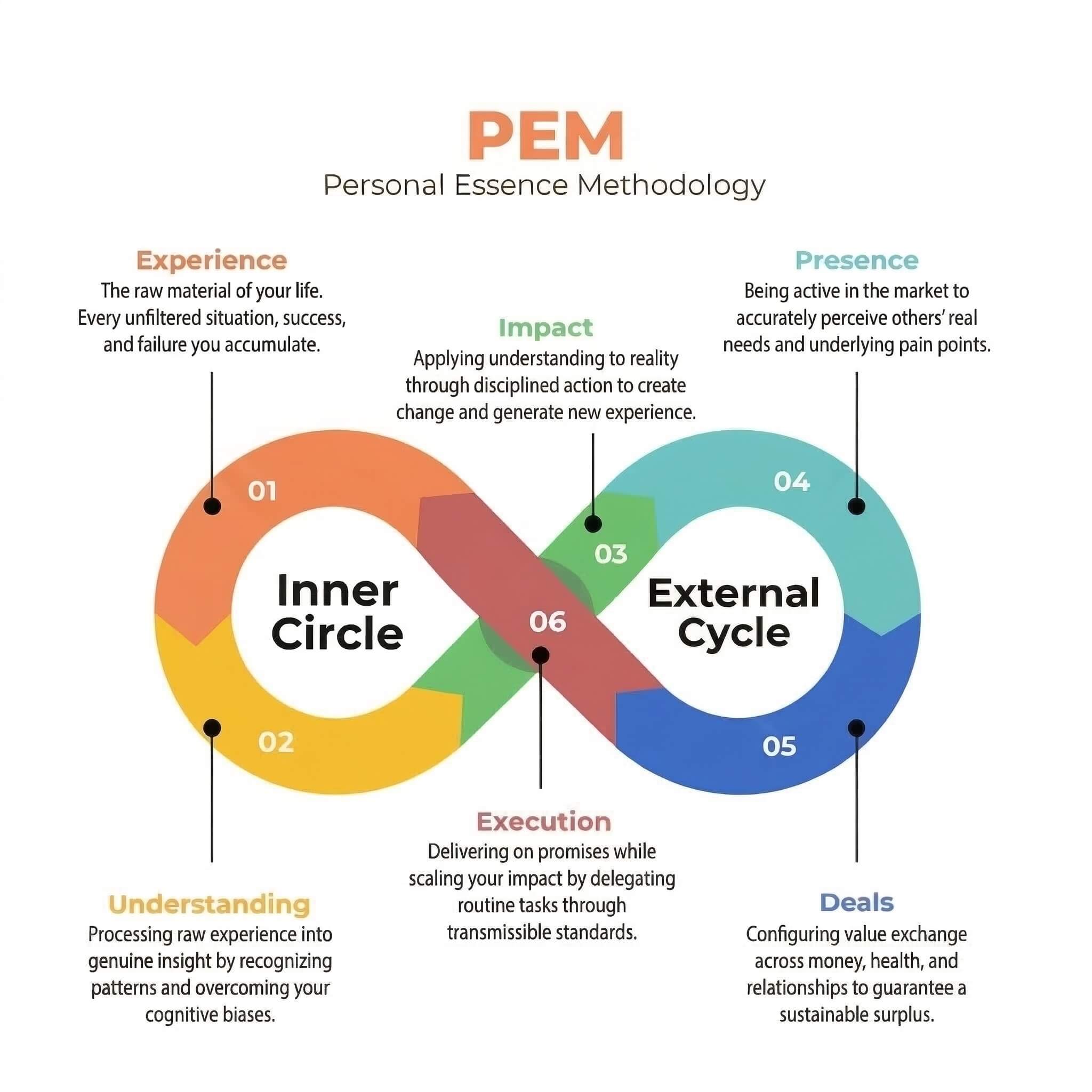
Ontwikkel begrip vanuit ervaring, bouw op vertrouwen gebaseerde aanwezigheid op via de zeven pijlers, configureer deals die u in stand houden over alle zes de brondomeinen, voer uit wat u beloofd heeft—persoonlijk in de Architect-modus en via delegatie in de Bouwer-modus—en laat aangetoonde impact datgene uitbreiden wat u geloofwaardig kunt beloven en hierna kunt sturen.
Inhoudsopgave
(17 hoofdstukken)- Waarom deze methodologie? Waarom nu.
- Fundament
- De Macro-Context: Waarom deze methodologie moet evolueren
- De Geüpgradede Bronnenstapel
- De Interne Keten: Ervaring Verwerken tot Begrip
- De Drie Fasen
- Het Delegatieprincipe: Impact Schalen Door Begrip
- De Twee Onbalansen
- Invloed als Hoogwaardige Deals
- De Middelenvergelijking
- De Iteratieve Cyclus
- Opereren in Crisis: De Methodologie onder Systemische Druk
- Reikwijdte en Beperkingen
- Faalmodi
- Toepassing
- Uitgebreide Referentie van Biases: Cognitieve Biases in Kaart Gebracht naar Methodologiefasen
- Samenvatting
Waarom deze methodologie? Waarom nu.
Ik ben geboren in 1987, in de tijd dat de Sovjet-Unie instortte. Mijn eerste economie was een economie die zojuist had opgehouden te bestaan.
Tegen de tijd dat ik oud genoeg was om uit een studieboek te begrijpen wat 'stabiele omstandigheden' betekenden, had ik ze nog nooit ervaren. De post-Sovjet-transitie bracht hyperinflatie, een institutioneel vacuüm en de dagelijkse improvisatie die het normale leven werd in het pas onafhankelijke Oekraïne. Daarna kwam de binnenlandse economische turbulentie van begin jaren 2000. Vervolgens de wereldwijde financiële crisis van 2008–2009, die de opkomende economieën met bijzondere kracht trof. Daarna de Revolutie van de Waardigheid in 2013–2014, die het politieke landschap van het land van de ene op de andere dag hervormde. Toen de eerste oorlog—de annexatie van de Krim, de brandende Donbas, de wereld die zich om ons heen herschikte terwijl wij onszelf herschikten om erin te overleven. En toen, in 2022, de grootschalige invasie—het soort crisis dat niet vraagt of je er klaar voor bent.
Door dat alles heen was ik aan het bouwen. Bedrijven bouwen, relaties bouwen, begrip bouwen. Niet omdat ik over een speciaal veerkrachtgen beschikte of omdat Oekraïners uniek gehard zijn—hoewel we koppig zijn op manieren die onszelf soms zelfs verbazen. Maar omdat een crisis, wanneer die je permanente omgeving wordt in plaats van een onderbreking, je iets leert wat vredestijd niet kan: de regels waarop je vertrouwt zullen breken, en je vermogen om te functioneren wanneer dat gebeurt, is de enige troef die niet in beslag genomen, gedevalueerd of gebombardeerd kan worden.
De Methodologie van Persoonlijke Essentie (Personal Essence Methodology) is niet ontworpen in een bibliotheek. Ze werd gesmeed in de kloof tussen wat me verteld werd dat zou moeten werken en wat daadwerkelijk werkte toen de grond bleef schuiven. Elk principe in dit document—de Interne Keten (Internal Chain), de Vertrouwensformule (Trust Formula), de zes brondomeinen, de delegatiehiërarchie—is onderworpen aan een stresstest onder omstandigheden waarbij de valuta kon veranderen, de grenzen konden sluiten, de klant kon verdwijnen en de stroom halverwege de levering kon uitvallen.
Dit is waarom ik geloof dat de methodologie nu urgent is.
De wereld waarin u vandaag opereert, waar u ook bent, betreedt het soort instabiliteit dat mijn hele professionele leven heeft gekenmerkt. Geopolitieke fragmentatie versnelt. De AI-revolutie is de economie van uitvoering in realtime aan het ontmantelen. Kapitaal is niet langer goedkoop. Toeleveringsketens zijn niet langer betrouwbaar. De instituties die ooit voor stabiliteit zorgden—voorspelbare markten, stabiele valuta's, een functionerende internationale orde—staan onder druk die niet snel zal wegebben.
Misschien krijgt u voor het eerst te maken met systemische instabiliteit. Ik leef er al drie decennia in.
Dit is wat ik heb geleerd: je kunt de omgeving niet beheersen, maar je kunt wel beheersen hoe diep je je ervaring verwerkt, hoe oprecht je in je relaties staat, hoe zorgvuldig je je verplichtingen structureert, en hoe betrouwbaar je levert wat je hebt beloofd. Dat is de methodologie in de praktijk. Geen theorie over wat in ideale omstandigheden zou moeten werken—een systeem dat, herhaaldelijk, heeft gewerkt in omstandigheden die allesbehalve ideaal waren.
De methodologie zal de crisis niet comfortabel maken. Niets doet dat. Maar ze zal u een structuur geven om in te opereren wanneer de structuren om u heen falen. Ze zal u helpen vertrouwen op te bouwen wanneer vertrouwen schaars is, deals vorm te geven wanneer de voorwaarden volatiel zijn, uit te voeren wanneer middelen beperkt zijn, en uw begrip op te bouwen wanneer de regels onder uw voeten blijven veranderen.
Ik heb dit gebouwd omdat ik het nodig had. Ik deel het omdat ik geloof dat u het ook nodig heeft, misschien wel urgenter dan u zich realiseert.
De beste tijd om uw methodologie op te bouwen was voor de crisis. De op een na beste tijd is nu.
— Volodymyr Zhukov
Fundament
Elk mens verzamelt een onderscheidende combinatie van ervaringen, komt in aanraking met verschillende waarden, en doorleeft een unieke reeks gebeurtenissen. Dit creëert betekenisvolle differentiatie tussen mensen—verschillen die de basis kunnen vormen voor onderscheidende waarde.
Betekenisvolle differentiatie vs. absolute onvergelijkbaarheid. U bent daadwerkelijk anders dan anderen op meetbare, significante manieren: persoonlijkheid, cognitieve stijl, ontwikkelingsgeschiedenis, opgebouwde expertise. Deze verschillen zijn echt en economisch relevant. Maar u bent niet zó anders dat vergelijking zinloos is of dat verbinding onmogelijk is. U deelt genoeg cognitieve en emotionele architectuur met andere mensen om hen te begrijpen en begrepen te worden. Deze gedeelde architectuur is wat empathie mogelijk maakt, uitwisseling waardevol, en vertrouwen haalbaar. Zonder een wezenlijk verschil heeft u niets onderscheidends te bieden. Zonder wezenlijke gelijkenis heeft u niemand om het aan te bieden. De methodologie vereist beide.
Rauwe ervaring alleen creëert echter niets. Ervaring moet worden begrepen voordat ze kan worden toegepast. En begrip moet zich vertalen in actie voordat het iets verandert. Dit is de interne keten die externe effectiviteit mogelijk maakt.
ErvaringBegripImpact
Ervaring is de grondstof. Begrip is de verwerking van die grondstof tot bruikbaar inzicht. Impact is de toepassing van inzicht om de omstandigheden in de wereld te veranderen.
Deze keten is iteratief, niet lineair. Impact genereert nieuwe ervaring. Nieuwe ervaring vereist nieuw begrip. De cyclus gaat het hele leven door.
Het cruciale onderscheid: Informatie vs. Begrip
Informatie is wat zich buiten u bevindt—feiten, data, advies, raamwerken, onderzoeksresultaten. Ze is in overvloed aanwezig, goedkoop, en kan tegenwoordig oneindig worden gegenereerd door kunstmatige intelligentie.
Begrip is wat zich binnenin u bevindt—de verwerking van informatie door het filter van uw ervaring, uw context, uw mislukkingen, uw specifieke situatie. Begrip vertelt u welk stukje informatie op dit moment van belang is, welk advies van toepassing is op uw omstandigheden, en welke strategie past bij de beperkingen waar u daadwerkelijk mee te maken heeft.
Informatie is generiek. Begrip is persoonlijk.
De explosie van beschikbare informatie heeft de illusie gewekt dat ook ons begrip is vergroot. Dat is niet zo. De stortvloed aan informatie maakt begrip vaak juist moeilijker doordat ze het tragere, diepgaandere werk van verwerking in de weg staat. De methodologie is een systeem voor de ontwikkeling van begrip, niet een systeem voor de acquisitie van kennis. Het verschil tussen die twee is het verschil tussen het gevoel geïnformeerd te zijn en daadwerkelijk effectief te zijn.
De vloeiendheidsillusie verergert het probleem. Wanneer we informatie tegenkomen die gemakkelijk te verwerken voelt—omdat we het al eerder hebben gelezen, omdat het helder wordt gepresenteerd, of omdat het bevestigt wat we al geloven—interpreteren onze hersenen die verwerkingsvloeiendheid als bewijs dat we de materie beheersen. Het opnieuw lezen van een raamwerk en instemmend knikken creëert een krachtig subjectief gevoel van competentie dat is losgekoppeld van werkelijke bekwaamheid. De kloof tussen het herkennen van informatie terwijl u ernaar kijkt en het kunnen ophalen ervan onder druk, is enorm. De nadruk die de methodologie legt op verwerking—schrijven, testen, trianguleren—bestaat specifiek om deze illusie van competentie te doorbreken.
De Macro-Context: Waarom deze methodologie moet evolueren
We leven in een periode van elkaar versterkende systemische transities: geopolitieke fragmentatie, de AI-revolutie, deglobalisering, het einde van goedkoop kapitaal, demografische verschuivingen en een volledige energietransitie. Dit zijn geen op zichzelf staande verstoringen. Ze werken op elkaar in, en die interacties versterken de instabiliteit en versnellen het tempo waarin oude regels afbrokkelen.
De AI-verstoring
AI is nu een uitvoeringsmotor. Grote taalmodellen genereren code van productiekwaliteit, professionele documenten, functionele interfaces en complexe workflows. 'Vibe coding' zet beschrijvingen in natuurlijke taal om in werkende software. Het Model Context Protocol verbindt AI direct met professionele tools en operationele infrastructuur. Autonome AI-agenten handelen uit meerdere stappen bestaande uitvoeringsworkflows af op het gebied van onderzoek, conceptontwikkeling, planning, coördinatie en levering.
Dit verandert de economie van persoonlijke effectiviteit fundamenteel. Wanneer uitvoering een 'commodity' wordt—wanneer datgene wat de meeste mensen verkopen (hun arbeid, hun vermogen om taken uit te voeren) in overvloed en goedkoop beschikbaar is—dan is harder werken aan uitvoering als sneller rennen op een loopband die onder u versnelt.
- Wat AI commoditiseert
Generieke kennis. Uitvoering van gemiddeld niveau. Standaardanalyses. Routinematige productie. Oppervlakkige content. Al het werk dat kan worden gereduceerd tot expliciete regels die zonder oordeelsvorming worden toegepast.
- Wat AI niet kan repliceren
Uw specifieke ervaring, verwerkt tot wezenlijk begrip. Uw daadwerkelijke relaties en de vertrouwensgeschiedenis die daarin is ingebed. Uw vermogen om met ambiguïteit om te gaan en knopen door te hakken op basis van een integratie van waarden, ervaring en context. Uw capaciteit voor authentieke Aanwezigheid—de menselijke herkenning die ontstaat wanneer het ene bewustzijn in contact treedt met het andere.
In een wereld waar generieke uitvoering in overvloed en gratis is, leiden gemiddelde prestaties tot ondergemiddelde resultaten. De markt splitst zich tussen de vraag naar uitzonderlijke menselijke capaciteiten—die zeer goed betalen—en al het andere, dat in toenemende mate wordt uitgevoerd door AI of door mensen die op prijs met AI concurreren. Het midden verdwijnt.
Automatisering-bias verergert het gevaar van het midden. Naarmate AI capabeler wordt, vertrouwen mensen steeds meer op de output ervan zonder kritische evaluatie—ze behandelen door machines gegenereerde aanbevelingen als waarheid en geven hun kritisch denken over aan het algoritme. Dit is geen luiheid; het is een cognitieve kortere weg die onze hersenen toepassen bij elke waargenomen autoriteit, of die nu menselijk of digitaal is. Wanneer AI een strategie opstelt, een contract beoordeelt of een probleem diagnosticeert, is de verleiding om het zonder controle te accepteren zo krachtig, juist omdat de output er gepolijst en zelfverzekerd uitziet. De persoon die oordeelsvorming toevoegt—die de fouten van de AI opmerkt, die de mismatch met de context aanvoelt die het algoritme niet kan waarnemen—is de persoon voor wiens begrip de markt een premie wil betalen. De persoon die alleen toezicht houdt op de AI zonder werkelijke controle, bevindt zich in het verdwijnende midden.
De Economie van Vertrouwen
Een van de meest ingrijpende verschuivingen voor individuen is de overgang van de Economie van Aandacht naar de Economie van Vertrouwen.
Twee decennia lang heeft het internet geoptimaliseerd voor het trekken van menselijke aandacht. Content was het handelsproduct en aandacht was de valuta. Maar generatieve AI heeft de kosten van contentcreatie tot bijna nul gereduceerd. Wanneer content oneindig is en aandacht gemakkelijk kan worden gekaapt, worden authenticiteit en vertrouwen de schaarsste middelen. Waarde verschuift naar mensen, platforms en systemen die in staat zijn de waarheid te verifiëren, competentie te tonen en menselijke authenticiteit te bewijzen.
Het illusoire waarheidseffect versnelt deze verschuiving. Wanneer mensen herhaaldelijk met beweringen worden geconfronteerd—of dat nu door AI-gegenereerde content, sociale media of marketing is—beginnen hun hersenen die beweringen als waarschijnlijker te registreren, ongeacht de werkelijke geldigheid ervan. Herhaling creëert geloof. In een omgeving met oneindig veel content tast de enorme hoeveelheid herhaalde valse of misleidende beweringen het fundament van de gedeelde waarheid aan. Dit maakt oprecht vertrouwen—gebouwd op geverifieerde trackrecords en transparante aanwezigheid—essentiële infrastructuur voor elke functionerende relatie, markt of institutie.
Wanneer uitvoering schaars is, kiest u aanbieders op basis van capaciteit. Wanneer uitvoering in overvloed is, kiest u op basis van vertrouwen. Deals die op basis van vertrouwen zijn gesloten, hebben lagere transactiekosten—minder verificatie, minder juridische overhead, minder verspilde energie aan controle. In een economie waar door AI gedreven concurrentie de prijzen drukt, zijn de efficiëntiewinsten van op vertrouwen gebaseerde deals niet marginaal. Ze zijn doorslaggevend.
De Vertrouwensformule (Trust Formula)
Vertrouwen is geen gevoel, geen persoonlijkheidskenmerk of charisma. Vertrouwen is een samenstelling—het product van drie componenten in een vermenigvuldigende relatie:
De vermenigvuldigende relatie is het cruciale inzicht. Optelling zou betekenen dat zwakte op één gebied gecompenseerd kan worden door kracht op een ander gebied. Vermenigvuldiging betekent dat een nul bij een van de factoren het geheel doet instorten.
- Aangetoonde Impact
competentievertrouwen. U heeft een trackrecord. U heeft geleverd. Uw capaciteiten zijn bewezen door resultaten die anderen kunnen waarnemen en verifiëren. Opgebouwd in de Uitvoeringsfase.
- Transparante Aanwezigheid
welwillendheidsvertrouwen. U bent zichtbaar, eerlijk en oprecht betrokken bij de realiteit van anderen. U neemt hun werkelijke behoeften waar, niet uw projectie van hun behoeften. Mensen kunnen u accuraat beoordelen omdat u zich toont zoals u bent. Opgebouwd in de Aanwezigheidsfase.
- Consistente Afstemming
integriteitsvertrouwen. De kloof tussen waartoe u zich verplicht tijdens Deals en wat u levert tijdens Uitvoering blijft in de buurt van nul, herhaaldelijk, over een langere periode. Uw woorden en uw daden komen overeen. Uw beloften en uw prestaties hebben een geschiedenis van overeenstemming. Opgebouwd op de grens tussen Deals en Uitvoering en samengesteld via cycli.
Waarom de vermenigvuldigende relatie ertoe doet
Nul Impact × wat dan ook × wat dan ook = nul vertrouwen. U kunt niet leveren. Geen enkele hoeveelheid charme of betrouwbaarheid verandert hier iets aan.
Wat dan ook × nul Aanwezigheid × wat dan ook = nul vertrouwen. U kunt niet worden gelezen of beoordeeld. Competentie die ondoorzichtig of onzichtbaar is, wekt wantrouwen, geen vertrouwen.
Wat dan ook × wat dan ook × nul Afstemming = nul vertrouwen. U houdt uw woord niet. Competente, zichtbare mensen die consequent te veel beloven en te weinig leveren, zijn het gevaarlijkst—omdat ze toewijding aantrekken die ze niet kunnen waarmaken.
Hoe de formule zich verhoudt tot de architectuur van de methodologie
De drie componenten komen rechtstreeks overeen met de drie fasen van de Externe Cyclus:
- Aanwezigheid → bouwt Transparante Aanwezigheid (welwillendheidsvertrouwen)
- Deals → configureert de verplichtingen waaraan Consistente Afstemming zal worden afgemeten
- Uitvoering → bouwt Aangetoonde Impact (competentievertrouwen) en bevestigt of schendt Consistente Afstemming (integriteitsvertrouwen)
De drie-factoren-formule maakt iets zichtbaar wat de twee-factoren-formule verborgen hield: Deals is niet slechts een configuratiefase die voedt in Uitvoering. Het is de fase waarin u de standaard definieert waaraan uw integriteit zal worden beoordeeld. Een goed geconfigureerde Deal doet meer dan het overschot maximaliseren; het stelt verplichtingen vast die u daadwerkelijk kunt nakomen, omdat elke verplichting die u aangaat een test wordt van uw Consistente Afstemming. Jezelf overmatig vastleggen tijdens Deals creëert meer dan een tekort aan middelen. Het creëert een tekort aan integriteitsvertrouwen dat door geen enkele hoeveelheid Impact of Aanwezigheid kan worden gecompenseerd.
Dit verduidelijkt ook waarom de Aanwezigheids-zware onbalans zo destructief is in de Economie van Vertrouwen. De Aanwezigheids-zware persoon heeft een sterke Transparante Aanwezigheid en vaak daadwerkelijke vroege Impact—maar hun Consistente Afstemming nadert nul omdat ze systematisch meer beloven dan ze leveren. Vermenigvuldig wat dan ook met nul, en je krijgt nul. Hun vertrouwen stort in ondanks twee sterke componenten, omdat de derde ontbreekt.
En het verduidelijkt waarom het vertrouwen van de Uitvoerings-zware persoon niet accumuleert zoals het zou moeten. Ze hebben een sterke Aangetoonde Impact en vaak een redelijke Consistente Afstemming—maar hun Transparante Aanwezigheid nadert nul omdat ze onzichtbaar zijn. Wederom, vermenigvuldig met nul.
Het halo-effect werkt krachtig—en gevaarlijk—in de vroege stadia van vertrouwensvorming
Wanneer een persoon één sterk positieve eigenschap vertoont—welsprekende communicatie, indrukwekkende geloofsbrieven, fysieke aantrekkelijkheid—nemen waarnemers onbewust aan dat die persoon ook andere positieve eigenschappen bezit: competentie, integriteit, goed beoordelingsvermogen. Deze mentale kortere weg kan de initiële vertrouwensvorming versnellen door de waargenomen niveaus van alle drie de factoren op te blazen voordat ze zijn aangetoond. Maar op een halo gebaseerd vertrouwen is kwetsbaar. Het stort in wanneer de prestaties de eerste indruk tegenspreken, en de correctie is vaak onevenredig hard: de persoon wordt gezien als bedrieglijk, niet slechts als inadequaat, omdat de waarnemer het gevoel heeft dat zijn vertrouwen is gemanipuleerd. Het halo-effect kan tijdelijk een nul bij één factor maskeren; de vermenigvuldigende formule zorgt ervoor dat de realiteit zichzelf uiteindelijk weer doet gelden.
Over accumulatie
Vertrouwen accumuleert door herhaalde cycli van de Externe Cyclus. De formule zou uitgebreid kunnen worden naar Vertrouwen = (Aangetoonde Impact × Transparante Aanwezigheid × Consistente Afstemming)^cycli. Maar dit is impliciet aanwezig in het woord "Aangetoonde" (wat een trackrecord impliceert, geen eenmalige gebeurtenis), "Consistente" (wat herhaling impliceert), en de iteratieve cyclus die de methodologie al beschrijft. De accumulatie is reëel en essentieel—het is wat vertrouwen tot een duurzame troef maakt in plaats van een kortstondige indruk—maar het toevoegen van een expliciete exponent riskeert de formule minder goed overdraagbaar te maken zonder dat het methodologische helderheid toevoegt.
Deze verschuiving verandert wat het betekent om aanwezig te zijn, hoe deals worden gestructureerd, en wat uitvoering moet opleveren. De methodologie moet hier rekening mee houden.
De Geüpgradede Bronnenstapel
Voorheen kaderde de methodologie deals in rond drie domeinen: Geld, Gezondheid en Relaties. Die inkadering was nuttig maar onvolledig. In de huidige omgeving—waar vertrouwen de valuta is, om aandacht wordt gestreden en kennis snel in waarde daalt—is een preciezere bronnenkaart vereist.
Elk persoon opereert met zes fundamentele brondomeinen. Deals (Deals) worden over alle zes geconfigureerd. Een overschot of tekort in een van de domeinen werkt door in de andere.
1. Financieel — Vermogen / Kasstroom
Geld, compensatie, beleggingsrendementen, inkomsten. De bron die het meest flexibel kan worden omgezet in andere bronnen—maar op zichzelf geen van de andere kan vervangen. Een financieel overschot financiert delegatie, creëert opties en vangt schokken op. Een financieel tekort beperkt elk ander domein.
Mentale boekhouding (mental accounting) verstoort het beheer van financiële middelen
We behandelen geld verschillend, afhankelijk van de bron of het beoogde doel—we geven een belastingteruggave vrijelijk uit, terwijl we weigeren ons spaargeld aan te raken, zelfs wanneer beide inwisselbaar zijn. Dit creëert onzichtbare "potjes" in ons financiële denken die een optimale toewijzing over de zes domeinen in de weg staan. Een freelancer kan "projectinkomsten" mentaal scheiden van "bijverdiensten" en op elk ervan andere uitgavenregels toepassen, zelfs wanneer het rationeel is om de middelen samen te voegen en toe te wijzen op basis van prioriteit. De methodologie vereist dat financiële middelen worden behandeld als een verenigde pool die wordt bestuurd door strategische toewijzing, niet door de psychologische toevalligheden van hoe het geld is binnengekomen.
De geldillusie (money illusion) verstoort het financiële beoordelingsvermogen verder
We richten ons op nominale getallen—het bedrag op de loonstrook of het prijskaartje—in plaats van op wat we met dat geld daadwerkelijk kunnen kopen. In periodes van inflatie voelt een loonsverhoging van 5% die een inflatie van 6% nauwelijks dekt als vooruitgang. Bij het configureren van deals betekent dit dat compensatie, prijsstelling en beleggingsrendementen in reële termen moeten worden geëvalueerd—koopkracht, geen nominale cijfers.
2. Biologisch — Gezondheid / Dagelijkse Energie
Fysieke en mentale capaciteit. Slaapkwaliteit, metabolische gezondheid, stressbelasting en herstelsnelheid. Dit is de bron die de poort vormt tot al het andere—geen enkele hoeveelheid financieel of intellectueel kapitaal is van belang als uw lichaam de inspanning niet kan volhouden. Een biologisch overschot betekent veerkracht en uithoudingsvermogen. Een biologisch tekort betekent afnemende prestaties, ongeacht de kansen.
Het primaat van slaap
Slaap vormt het belangrijkste onderdeel van de biologische gezondheid—het fundament waarop lichaamsbeweging, voeding, stressmanagement en alle andere gezondheidspraktijken rusten. Tijdens de slaap consolideren de hersenen ervaring tot begrip door middel van 'neural replay' en patroonextractie—het letterlijke mechanisme waarmee de Interne Keten (Internal Chain) de ervaring van vandaag omzet in het inzicht van morgen. Chronisch slaapgebrek tast energie aan. Erger nog, het saboteert precies het proces dat begrip produceert—het belangrijkste bezit binnen de methodologie. Zeven tot acht uur slaap is niet-onderhandelbare infrastructuur, geen gezondheidsluxe.
Projectie-bias ondermijnt het beheer van biologische bronnen
Wanneer we ons energiek en gezond voelen, kunnen we ons niet accuraat voorstellen hoe we zullen denken en presteren wanneer we uitgeput, ziek of gestrest zijn—en vice versa. Dit is de 'hot-cold empathy gap' toegepast op onze eigen toekomstige staten. De persoon die deals configureert op een goede dag, onderschat stelselmatig de biologische kosten van die verplichtingen. De persoon met een burn-out kan het herstel dat rust zou bieden niet accuraat projecteren en neemt mogelijk permanente beslissingen op basis van tijdelijke staten. Deals moeten worden geconfigureerd voor realistische biologische capaciteit, niet voor hoe u zich op uw beste dag voelt.
3. Sociaal — Diepgaande Relaties (Steun) / Breed Netwerk (Bereik)
Dit domein heeft twee verschillende lagen. Diepgaande relaties bieden emotionele steun, eerlijke feedback en vangnetten tijdens een crisis. Brede netwerken bieden bereik, dealflow en toegang tot kansen die u alleen niet zou kunnen vinden. Beide zijn noodzakelijk. Diepgaande relaties zonder bereik betekenen isolatie van markten. Brede netwerken zonder diepgang betekenen fragiele verbindingen die instorten onder druk.
Beleefdheidsbias (courtesy bias) degradeert ongemerkt sociale feedbackloops. Mensen in uw netwerk—vooral in professionele relaties—vertellen u systematisch wat ze denken dat u wilt horen in plaats van wat ze daadwerkelijk waarnemen. Het mechanisme is sociale smering. Maar het betekent dat het feedbackkanaal waar de meeste mensen op vertrouwen voor kalibratie, aan de bron gecorrumpeerd is. De nadruk die de methodologie legt op triangulatie—in-de-tijd-bevroren verslagen, huidige reflectie en harde externe data—bestaat deels om te compenseren voor het feit dat menselijke feedback door beleefdheid wordt gefilterd voordat het u bereikt.
4. Reputationeel — Vertrouwen / Persoonlijk Merk / Publiek
In de Economie van Vertrouwen is reputatie niet langer een passief bijproduct van goed werk. Het is een actief, beheerbaar bezit. Uw reputatie is wat mensen over u geloven voordat ze met u in contact treden. Uw persoonlijke merk is het signaal dat u doelbewust uitzendt. Uw publiek is de groep mensen die u voortdurend aandacht heeft geschonken op basis van aangetoond vertrouwen. Een reputationeel overschot betekent dat kansen naar u toe komen. Een reputationeel tekort betekent dat u voor elke kans helemaal opnieuw moet vechten.
Reputatie wordt opgebouwd via vijf verschillende kanalen: behaalde resultaten (geleverde projecten, opgeloste problemen), netwerkbereik (wie uw werk kent en met wie zij praten), zichtbaarheid (bekend zijn buiten uw directe netwerk via evenementen, content, professionele gemeenschappen), het delen van kennis en presenteren van casussen (niet alleen communiceren wat u heeft bereikt, maar ook hoe u denkt), en consistentie over de tijd (het samengestelde effect van betrouwbaar komen opdagen, jaar in jaar uit). Investeren in slechts één kanaal—doorgaans behaalde resultaten—laat de andere vier slapende, wat de reden is dat uitstekend werk vaak onzichtbaar blijft.
Het loutere-blootstellingseffect (mere exposure effect) is het mechanisme dat ten grondslag ligt aan op zichtbaarheid gebaseerde reputatieopbouw. Hoe vaker mensen uw naam, uw werk of uw ideeën tegenkomen, hoe meer ze de neiging hebben om positieve associaties met u te ontwikkelen—zelfs als ze niet kunnen verwoorden waarom. Dit is hoe menselijke cognitie bekendheid verwerkt. Strategische zichtbaarheid—consistente content, regelmatige aanwezigheid op evenementen, betrouwbare aanwezigheid in professionele gemeenschappen—benut dit effect op een eerlijke manier. Het cruciale voorbehoud: loutere blootstelling bouwt warmte en herkenning op, geen competentievertrouwen. Het opent deuren maar sluit geen deals. Zichtbaarheid zonder levering creëert de Aanwezigheids-zware onbalans.
Het bandwagoneffect versterkt het reputationele momentum. Zodra een kritische massa mensen u herkent en vertrouwt, volgen anderen omdat ze waarnemen dat anderen u al vertrouwen, niet omdat ze uw werk onafhankelijk hebben beoordeeld. Dit is de reden waarom reputationeel kapitaal niet-lineair accumuleert: vroege investeringen leveren bescheiden rendementen op, maar zodra de drempel van sociaal bewijs is overschreden, wordt reputatie zelfversterkend. Het gevaar is dat hetzelfde mechanisme in omgekeerde richting werkt—reputationele schade voltrekt zich net zo snel als reputationele winst.
5. Intellectueel — Kennis / Harde Vaardigheden
Wat u weet en wat u kunt doen. Domeinexpertise, technische capaciteit, patroonherkenning, raamwerken voor oordeelsvorming. Intellectueel kapitaal is wat uw begrip overdraagbaar en uw delegatie effectief maakt. In een wereld waar AI oppervlakkige kennis commoditiseert, wordt diepgaand intellectueel kapitaal—het soort dat oordeelsvorming mogelijk maakt, niet alleen het ophalen van informatie—meer waard, niet minder.
Het Google-effect (digitale amnesie) hervormt de vereisten voor intellectueel kapitaal. Wanneer informatie direct toegankelijk is, stoppen onze hersenen met het opslaan van feitelijke inhoud en worden in plaats daarvan experts in onthouden waar we informatie kunnen vinden. Dit is een adaptieve verschuiving, maar er hangt een prijskaartje aan: de persoon die "weet waar hij het moet opzoeken" mist de geïnternaliseerde kennisbasis die vereist is voor snelle oordeelsvorming onder druk. Diepgaand intellectueel kapitaal in de zin van de methodologie is geïnternaliseerde patroonherkenning die functioneert zonder bewust zoeken. Opvraagbare informatie telt niet mee. Het AI-tijdperk maakt dit onderscheid scherper: AI handelt het opvragen af; u handelt de oordeelsvorming af. Als uw intellectuele kapitaal uitsluitend bestaat uit wat u kunt opzoeken, dan doet AI dat al beter.
6. Temporeel — Tijd / Gefocuste Aandacht
Uren in een dag en de kwaliteit van aandacht binnen die uren. Tijd is de enige bron die niet kan worden geaccumuleerd—ze kan alleen worden toegewezen. Gefocuste aandacht is de vermenigvuldiger die bepaalt of de toegewezen tijd waarde of verspilling oplevert. Een temporeel overschot betekent ruimte voor strategisch denken, investeren in relaties en herstel. Een temporeel tekort betekent reactief leven—voortdurend reageren, nooit sturen.
De Wet van Hick regeert de relatie tussen keuzes en temporele efficiëntie. Hoe meer opties u op een willekeurig moment voor u heeft—welke e-mail u moet beantwoorden, welk project u vooruit moet helpen, in welke relatie u moet investeren—hoe langer uw brein erover doet om te beslissen, en de kwaliteit van de beslissing neemt af. Het is een logaritmische functie van de hoeveelheid keuze, geen disciplineprobleem. Het verminderen van het aantal actieve beslissingen door middel van systemen, routines en delegatie is een structurele verdediging van temporele middelen, geen productiviteitstrucje.
Hoe de Zes Domeinen op Elkaar Inwerken
Geen enkel domein functioneert in een vacuüm. Een financieel overschot kan temporele vrijheid (delegatie, automatisering) kopen. Een biologisch overschot maakt diepgaander intellectueel werk mogelijk. Een reputationeel overschot vermindert de inspanning die nodig is om deals te sluiten. Een sociaal overschot brengt kansen aan de oppervlakte die tijd en geld besparen. Een intellectueel overschot maakt de uitvoering efficiënter, waardoor biologische en temporele middelen behouden blijven.
Omgekeerd put een tekort in het ene domein de andere uit. Financiële stress tast de gezondheid aan. Een afnemende gezondheid vermindert de intellectuele output. Reputationele schade verkleint het netwerk. Netwerkineenstorting elimineert de dealflow. Slechte deals (deals) vreten tijd. Verloren tijd verhindert herstel.
Het geüpgradede principe van Deals: Configureer overeenkomsten die een overschot genereren over alle zes de brondomeinen—niet alleen financieel. Een deal die goed betaalt maar uw gezondheid, reputatie of relaties vernietigt, is niet goed. Het is een langzame liquidatie van activa die moeilijker weer op te bouwen zijn dan geld.
De Interne Keten: Ervaring Verwerken tot Begrip
De Interne Keten (Internal Chain)—ErvaringBegripImpact—is waar uw onderscheidende waarde wordt ontwikkeld. Elke schakel vereist doelbewust werk; geen enkele functioneert automatisch.
De Verwerkingsmethodologie: De Vier Vragen
Na elke significante ervaring stelt u systematisch, en op schrift, de volgende vier vragen:
- Wat is er daadwerkelijk gebeurd? Niet uw verhaal over wat er is gebeurd. Niet uw interpretatie. De daadwerkelijke gebeurtenissen worden zo objectief mogelijk beschreven. Scheid waarneming van interpretatie.
- Wat waren meerdere mogelijke oorzaken? Genereer minstens drie verschillende verklaringen voor wat er is gebeurd. Dit voorkomt dat u zich vastklampt aan het eerste comfortabele narratief en gaat de voorkeursbevestiging (confirmation bias) tegen. Deze vraag bestrijdt ook direct de conjunctiefout (conjunction fallacy)—onze neiging om gedetailleerde, samenhangende verklaringen plausibeler te vinden dan eenvoudigere verklaringen. Elk van uw drie verklaringen moet worden getoetst aan het principe dat een specifieke, verhaalachtige verklaring niet automatisch waarschijnlijker is dan een vagere maar bredere, ongeacht hoe goed deze past.
- Wat zou iemand met een ander perspectief zien? Stel u voor dat iemand met andere vooroordelen, een andere achtergrond of andere drijfveren dezelfde situatie observeert. Wat zou hen opvallen wat u heeft gemist? Deze vraag richt zich specifiek op de fundamentele attributiefout (fundamental attribution error)—onze neiging om het gedrag van anderen te verklaren vanuit hun karakter, terwijl we ons eigen gedrag verklaren vanuit de omstandigheden. Wanneer u een ander perspectief overweegt, vraag uzelf dan bewust af: Welke situationele druk kan de drijfveer zijn geweest voor het gedrag dat ik waarnam? De actor-waarnemer-bias (actor-observer bias) betekent dat u van nature situationele verklaringen voor uzelf zult genereren en dispositionele verklaringen voor anderen, tenzij u dit patroon bewust omdraait.
- Wat kan ik daadwerkelijk testen? Identificeer wat testbaar is in uw begrip. Begrip dat ongetest blijft, is een hypothese, geen kennis. Als uw interpretatie toekomstige uitkomsten voorspelt, test dan die voorspelling.
De twee onbalansen onthullen zichzelf door de vragen waartegen u zich verzet. Aanwezigheids-zware mensen worstelen met vragen één en vier—"wat is er daadwerkelijk gebeurd?" bedreigt hun gepolijste narratief, en "wat kan ik testen?" vereist uitvoering die ze liever vermijden. Uitvoerings-zware mensen worstelen met vragen twee en drie—het genereren van meerdere verklaringen voelt als tijdverspilling, en het voorstellen van andere perspectieven vereist de Aanwezigheid waar zij onvoldoende in investeren.
De Triangulatiepraktijk
Geen enkele op zichzelf staande bron van zelfkennis is betrouwbaar. Begrip waarop u kunt voortbouwen vereist drie referentiepunten, die tegen elkaar worden afgezet:
Uw in-de-tijd-bevroren verslagen — wat u dacht dat er gebeurde vóórdat u de uitkomst kende. Dagboeken, beslissingslogboeken en notities die op dat moment zelf zijn geschreven. Deze leggen uw vooroordeel vast zoals het toen bestond, voordat wijsheid achteraf het herschreef. Deze verslagen zijn uw primaire verdediging tegen de hindsight bias—de automatische neiging van het brein om eerdere overtuigingen te herschrijven nadat het een uitkomst heeft vernomen, waardoor gebeurtenissen voorspelbaarder lijken dan ze waren. Zonder gelijktijdige verslagen kunt u niet onderscheiden wat u daadwerkelijk voorspelde van wat u nu gelooft dat u voorspelde. De self-consistency bias corrumpeert dit proces verder: uw brein neemt aan dat u altijd uw huidige standpunten heeft gehuldigd, en wist stilletjes eerdere meningsveranderingen uit om de illusie van een stabiel, coherent zelf in stand te houden.
Uw huidige geheugen en reflectie — wat u nu gelooft, met het voordeel van afstand. Dit legt patroonherkenning vast die op dat moment niet mogelijk was. Behandel uw huidige geheugen met een gekalibreerde dosis scepsis. Choice-supportive bias zorgt ervoor dat uw brein de aantrekkelijkheid van door u gemaakte beslissingen met terugwerkende kracht vergroot en de aantrekkelijkheid van afgewezen opties verkleint. De versie van het verleden die in uw huidige geheugen leeft, is stelselmatig vleiend voor uw keuzes uit het verleden.
Harde data en externe feedback — wat er daadwerkelijk is gebeurd volgens bewijs dat buiten uw hoofd bestaat. Cijfers, tijdlijnen, 'deliverables', uitkomsten, en wat andere mensen observeerden en vastlegden.
Waar alle drie samenkomen, zit u waarschijnlijk dicht bij de realiteit. Waar ze uiteenlopen, vormt de divergentie zelf de les—het onthult waar uw vooroordelen opereren, in welke richting ze trekken, en in hoeverre u uw eigen verwerking kunt vertrouwen.
De Rol van Cognitieve Vooroordelen
De Interne Keten staat onder voortdurende aanval van systematische cognitieve vervormingen die elke schakel beïnvloeden.
Vooroordelen die ervaring (de grondstof) corrumperen
Roze retrospectie ('rosy retrospection') maakt het verleden mooier dan het was. Fading affect bias zorgt ervoor dat negatieve emoties sneller vervagen dan positieve. Het telescopisch effect gooit uw tijdlijn door elkaar. Stemmingscongruente herinnering filtert uw geschiedenis door uw huidige emotionele toestand. Fouten in bronbewaking ('source monitoring errors') injecteren ervaringen die u nooit daadwerkelijk heeft gehad—dingen die u hebt gelezen of gehoord, worden opgeslagen als dingen die u heeft meegemaakt. 'Survivorship bias' zorgt ervoor dat u alleen leert van wat er is gebeurd, niet van wat er niet is gebeurd. De beschikbaarheidsheuristiek zorgt ervoor dat dramatische gebeurtenissen belangrijk aanvoelen en belangrijke patronen vergeetbaar lijken. De piek-einderegel zorgt ervoor dat u hele ervaringen evalueert op basis van hun meest intense moment en hun einde, waarbij de duur en het alledaagse midden volledig terzijde worden geschoven—wat betekent dat een slopend project dat goed eindigde als positief wordt herinnerd, terwijl een soepel project dat eindigde met een kleine teleurstelling als negatief wordt herinnerd, ongeacht de daadwerkelijke balans van de ervaring. Verwaarlozing van duur ('duration neglect') verergert dit: de lengte van een ervaring draagt bijna niets bij aan hoe u zich deze herinnert, wat betekent dat lange periodes van aanhoudende inspanning achteraf psychologisch onzichtbaar kunnen zijn.
Vooroordelen die begrip (de verwerking) vervormen
De blinde vlek voor vooroordelen zorgt ervoor dat u de vervormingen van anderen ziet, terwijl u blind blijft voor uw eigen vervormingen—en kennis van vooroordelen kan dit verergeren door een illusie van immuniteit te creëren. De voorkeursbevestiging ('confirmation bias') zorgt ervoor dat u bewijs ziet voor wat u al gelooft en bewijs negeert dat ertegen pleit. Naïef cynisme zorgt ervoor dat u neutrale of positieve signalen als bedreigingen verwerkt. Het Semmelweis-reflex zorgt ervoor dat u bewijs verwerpt dat uw begrip zou updaten, vooral wanneer het accepteren ervan uw identiteit bedreigt. Confabulatie genereert valse verklaringen voor uw eigen gedrag zonder dat u zich er überhaupt van bewust bent dat u dit doet. Illusoire correlatie zorgt ervoor dat u relaties waarneemt tussen variabelen waar deze niet bestaan—vooral wanneer de combinatie emotioneel opvallend is of in een reeds bestaand narratief past. U zou kunnen concluderen dat een bepaalde klantensector altijd leidt tot uitdijing van de scope, of dat een specifiek type vergadering altijd goede beslissingen oplevert, gebaseerd op een handvol gedenkwaardige gevallen in plaats van daadwerkelijke patronen. De clustering-illusie verergert dit: echte willekeur produceert klontjes en reeksen die op betekenisvolle patronen lijken voor onze patroonhongerige hersenen, en we bouwen strategieën op die spooksignalen. De conservatisme-bias—een verwante maar afzonderlijke vervorming—zorgt ervoor dat u uw overtuigingen te langzaam aanpast wanneer er echt nieuw bewijs arriveert, waarbij u slechts een beetje bijstuurt terwijl u dramatisch zou moeten bijsturen.
Vooroordelen die Aanwezigheid (perceptie van anderen) ondermijnen
Het valse-consensuseffect zorgt ervoor dat u uw eigen waarden en voorkeuren op anderen projecteert. Out-group-homogeniteit zorgt ervoor dat u individuen in categorieën vervaagt. Stereotypering wijst vaste eigenschappen toe aan die categorieën. Het cross-race-effect en beperkingen van de perceptuele kalibratie betekenen dat uw perceptie goed werkt voor het bekende en slecht voor het onbekende, zonder enig intern alarm dat aangeeft in welke modus u zich bevindt. Het spotlight-effect zorgt ervoor dat u overschat hoezeer anderen letten op uw uiterlijk, fouten en gedrag—omdat u de hoofdrolspeler bent in uw eigen ervaring en u ervan uitgaat dat anderen net zo aandachtig naar uw prestatie kijken als u die beleeft. De illusie van transparantie verergert dit: u voelt dat uw interne staten (nervositeit, enthousiasme, verveling) zichtbaar door uw huid naar buiten stralen, terwijl anderen in werkelijkheid veel minder waarnemen dan u zich voorstelt. Samen creëren deze vooroordelen een vervormd model van hoe anderen uw aanwezigheid ervaren—u neemt aan dat u wordt bestudeerd en gelezen terwijl u grotendeels onopgemerkt blijft, en deze onjuiste aanname drijft u óf tot het angstig overmatig managen van uw indruk, óf tot het zich terugtrekken uit situaties waarin aanwezigheid juist het waardevolst zou zijn.
De illusie van asymmetrisch inzicht corrumpeert empathie in de kern
U gelooft dat u de motivaties van anderen beter begrijpt dan zij die van u begrijpen—en beter dan zij zichzelf begrijpen. Dit is projectie verkleed als inzicht, geen onderzoekende empathie. De persoon die een vergadering binnenloopt in de overtuiging dat hij de andere partij heeft "doorzien", is gestopt met onderzoeken en is begonnen met bevestigen. De definitie van de methodologie van empathie als discipline in plaats van als sentiment bestaat specifiek om deze illusie tegen te gaan: behandel uw begrip van elke andere persoon als een hypothese, niet als een conclusie.
De hot-cold empathy gap ondermijnt Aanwezigheid over emotionele staten heen
Wanneer u kalm, comfortabel en goed voorzien bent (een "koude" staat), kunt u niet accuraat simuleren hoe u of anderen zullen denken en handelen wanneer ze gestrest, bang, uitgeput of wanhopig zijn (een "hete" staat). Dit betekent dat Aanwezigheid, uitgevoerd vanuit een positie van comfort, stelselmatig de ervaring van mensen in crisis verkeerd leest. De consultant die een worstelend bedrijf adviseert vanuit een positie van financiële zekerheid, kan letterlijk de wanhoop niet voelen die de besluitvorming van de klant vormgeeft. Het erkennen van deze kloof—en het ontwerpen van onderzoekspraktijken die deze compenseren—is essentieel voor authentieke Aanwezigheid.
Vooroordelen die Deals saboteren
Hyperbolisch verdisconteren ('hyperbolic discounting') zorgt ervoor dat u onmiddellijke beloningen overwaardeert ten opzichte van grotere toekomstige beloningen, wat patronen van wanhopige deal-making creëert. Het deco-effect manipuleert uw keuzes via asymmetrisch gedomineerde alternatieven. Onderscheidingsbias zorgt ervoor dat u geobsedeerd raakt door gemakkelijk vergelijkbare verschillen (prijs) terwijl u dimensies negeert die uw kwaliteit van leven bepalen. Verankering ('anchoring') zet uw gevoel voor "redelijk" vast op het getal dat als eerste werd genoemd. Verliesaversie zorgt ervoor dat de angst om een slechte deal te verliezen twee keer zo zwaar weegt als de hoop om een goede deal te winnen. Status-quo bias en het bezitseffect creëren een psychologisch fort rond bestaande slechte deals. De 'sunk cost fallacy' en haar escalerende neefje, escalatie van betrokkenheid, houden u veel langer in deals vast dan rationeel is, omdat het opgeven van de deal zou vereisen dat u erkent dat de investering in het verleden is verspild. De emotionele logica is: "Ik heb hier al zoveel in gestopt, ik kan nu niet stoppen." De rationele logica is: in het verleden gemaakte kosten zijn weg; alleen toekomstige kosten en baten tellen. Het framing-effect betekent dat dezelfde dealvoorwaarden acceptabel of uitbuitend kunnen voelen, afhankelijk van hoe ze worden gepresenteerd—een "10% korting" en "90% van de volledige prijs" zijn wiskundig identiek maar psychologisch verschillend. 'Zero-sum bias' zorgt ervoor dat u ervan uitgaat dat elke winst voor de andere partij ten koste van u moet gaan, wat u blind maakt voor deals waar beide partijen wezenlijk van profiteren.
Het overmoedigheidseffect is doordrongen in het maken van deals
Mensen zijn van nature eerder zeker van hun zaak dan dat ze het bij het rechte eind hebben. Wanneer we claimen 100% zeker te zijn, hebben we het doorgaans slechts ongeveer 80% van de tijd bij het rechte eind. In deals manifesteert dit zich in het overschatten van uw vermogen om te leveren, het onderschatten van de complexiteit van een project, en het beloven van tijdlijnen die u niet kunt halen. Het 'hard-easy effect' maakt dit op een specifieke manier erger: u bent het meest overmoedig bij de moeilijkste problemen (waar uw accuratesse het laagst is) en het meest ondermoedig bij makkelijke problemen (waar u het daadwerkelijk goed zou doen). Dit betekent dat zelfvertrouwen bijna exact verkeerd gekalibreerd is ten opzichte van de moeilijkheidsgraad.
De planningsfout ('planning fallacy') is de meest destructieve bias op de grens tussen Deals en Uitvoering. Wanneer u inschat hoe lang een project gaat duren, wat het zal kosten, of welke middelen het zal vereisen, stelt u zich een wrijvingsloos pad naar voltooiing voor—waarbij u tijdlijnen comprimeert, kosten minimaliseert en risico's negeert. U bent een pessimist wat betreft de projecten van anderen, maar een optimist over uw eigen projecten. Negen van de tien megaprojecten overschrijden om deze reden hun budget. Elke deal die u configureert, zou een systematische opwaartse aanpassing van uw tijd- en kostenramingen moeten bevatten—onderzoek suggereert dat u uw aanvankelijke schatting moet vermenigvuldigen met 1,5 tot 2,5, afhankelijk van hoe nieuw het project is.
Vooroordelen die Uitvoering laten ontsporen
Het 'well-traveled road effect' zorgt ervoor dat vertrouwde taken eenvoudiger aanvoelen dan ze zijn, wat de automatische piloot activeert wanneer er daadwerkelijk aandacht nodig is. Functionele gefixeerdheid vergrendelt uw workflow in een enkele configuratie—u doet alles—terwijl deze opgesplitst zou kunnen worden. Het IKEA-effect blaast de waarde van uw persoonlijke uitvoering op, waardoor u zich vastklampt aan routinewerk omdat het van u is. Actiebias—de drang om "iets te doen" in plaats van niets—is bijzonder destructief tijdens uitvoering onder onzekerheid. Wanneer omstandigheden ambigu zijn of meetgegevens onduidelijk, is de neiging om zichtbare actie te ondernemen, zelfs wanneer strategisch afwachten betere resultaten zou opleveren. Het verwarren van beweging met vooruitgang zorgt ervoor dat u onzekere periodes vult met bezigigheidstherapie die productief aanvoelt, maar in feite biologische en temporele middelen verbruikt zonder uw begrip te vergroten. Het Zeigarnik-effect verergert dit: onafgemaakte taken creëren een aanhoudende mentale spanning die aanzet tot impulsieve actie om "de cirkel rond te maken", zelfs wanneer de optimale zet is om de taak open te laten terwijl er meer informatie binnenkomt.
De illusie van controle veroorzaakt systematische misvattingen tijdens de uitvoering
Wanneer een situatie uw actieve deelname vereist, nemen uw hersenen automatisch aan dat u de uitkomst kunt beïnvloeden—zelfs wanneer de resultaten afhangen van factoren die volledig buiten uw controle liggen. De ondernemer die gelooft dat zijn persoonlijke inzet de timing van de markt bepaalt, de investeerder die voelt dat hij de markt kan "verslaan" door individueel inzicht, de manager die de uitkomsten van het team volledig toeschrijft aan zijn leiderschap—allen ervaren de illusie van controle. Deze bias is bijzonder gevaarlijk omdat het voelt als keuzevrijheid ('agency') en competentie, waardoor het bestand is tegen correctie.
Vooroordelen die delegatie blokkeren
De illusie van onmisbaarheid versterkt zichzelf—u laat nooit iemand anders het proberen, dus niemand anders ontwikkelt capaciteiten, wat uw onmisbaarheid "bewijst". Controlebias zorgt ervoor dat u gedelegeerd werk blijft schaduwen totdat uw strategisch denken degradeert door onderdompeling in operationele details. De omgekeerde planningsfout overschat delegatiekosten met een factor drie tot tien. Attributiefouten geven gedelegeerden de schuld van structurele mislukkingen die zijn veroorzaakt door vage instructies en afwezige normen.
De vloek van kennis ('curse of knowledge') is de delegatie-specifieke bias die het creëren van overdraagbare normen zo moeilijk maakt. Zodra u zich een vaardigheid of domein eigen heeft gemaakt, verliest u het vermogen om u voor te stellen hoe het is om het niet te weten. Uw uitleg slaat "voor de hand liggende" stappen over die alleen voor u voor de hand liggend zijn. Uw normen laten criteria weg die zo fundamenteel aanvoelen dat u zich niet kunt voorstellen dat iemand ze niet zou toepassen. De delegatieparadox—dat delegeren u dwingt onder woorden te brengen wat u weet, waardoor uw begrip wordt verdiept—is het directe tegengif tegen de vloek van kennis. Het proces van kennis overdraagbaar maken is het proces waarbij u de confrontatie aangaat met wat u als vanzelfsprekend beschouwt.
Het Dunning-Kruger-effect opereert aan beide uiteinden van het delegatiespectrum. Mensen die competentie missen in een domein, kunnen hun incompetentie niet herkennen—dezelfde vaardigheden die nodig zijn om goed te presteren, zijn nodig om prestaties te evalueren. Dit betekent dat voortijdige delegeerders mogelijk niet inzien dat hun normen ontoereikend zijn, terwijl voortijdige uitvoerders de kwaliteit van hun eigen werk mogelijk overschatten. Aan het expert-uiteinde nemen degenen met daadwerkelijk meesterschap vaak aan dat taken die voor hen gemakkelijk zijn, voor iedereen gemakkelijk zijn, wat leidt tot ontoereikende training en documentatie. Beide uitersten degraderen de kwaliteit van delegatie.
Deze vooroordelen kunnen niet worden geëlimineerd. Ze kunnen worden beheerd door middel van externe feedback, geschreven verslagen, het doelbewust zoeken naar weerlegging, gekalibreerd vertrouwen, en de gestructureerde verwerkingsmethodologie die hierboven is beschreven.
Aanvullende Vooroordelen Die Door de Hele Keten Heen Opereren
Verschillende cognitieve vooroordelen passen niet netjes in één enkele fase, maar opereren als dwarsdoorsnijdende vervormingen die ervaring, begrip en impact tegelijkertijd beïnvloeden:
Negativiteitsbias ('negativity bias') zorgt ervoor dat negatieve ervaringen, feedback en informatie ruwweg twee keer zoveel psychologisch gewicht in de schaal leggen als vergelijkbare positieve signalen. Eén enkel stukje kritische feedback kan tien complimenten overschaduwen. Eén enkel mislukt project kan psychologisch zwaarder wegen dan verschillende successen. Deze bias vervormt elke fase: het corrumpeert de grondstof van ervaring door mislukkingen opvallender te maken dan successen, het verstoort het begrip door op dreiging gebaseerde interpretaties hardnekkiger te maken dan op kansen gebaseerde interpretaties, en het ondermijnt impact doordat de angst voor negatieve uitkomsten zwaarder weegt dan de hoop op positieve.
Het contrasteffect betekent dat uw hersenen niets in absolute termen evalueren—alles wordt beoordeeld in relatie tot wat eraan voorafging of wat in de buurt is. Dezelfde dealvoorwaarden voelen uitstekend aan na een vreselijk aanbod en middelmatig na een genereus aanbod, ook al is de deal zelf niet veranderd. Dezelfde kwaliteit van uitvoering voelt indrukwekkend in een week van mislukkingen en heel gewoon in een week van successen. Deze relativiteit beïnvloedt elke fase: het verstoort hoe u nieuwe ervaringen evalueert (ten opzichte van recente), hoe u begrip verwerkt (ten opzichte van eerdere overtuigingen), en hoe u impact beoordeelt (ten opzichte van aangrenzende uitkomsten).
Het backfire-effect is de meest contra-intuïtieve vervorming: wanneer diepgewortelde overtuigingen worden uitgedaagd met tegenstrijdig bewijs, wordt de overtuiging soms juist sterker in plaats van zwakker. Dit gebeurt omdat onze overtuigingen verbonden zijn met identiteit en sociale verbondenheid. Wanneer bewijs bedreigt wie we zijn, beschouwt het brein dit als een aanval en verdubbelt de inzet. Dit heeft directe implicaties voor de nadruk die de methodologie legt op verwerking en het zoeken naar weerlegging ('disconfirmation'): u kunt uzelf niet simpelweg confronteren met tegenstrijdige data en een rationele aanpassing verwachten. De verwerking moet geleidelijk verlopen, veilig zijn voor de identiteit, en worden uitgevoerd via de gestructureerde Vier Vragen (Four Questions) in plaats van via een confronterend zelfonderzoek.
Psychologische reactantie betekent dat wanneer u het gevoel heeft dat uw keuzevrijheid wordt bedreigd door externe eisen, door de voorschriften van de methodologie, of zelfs door uw eigen vastgelegde plannen—u een automatische drijfveer ervaart om het tegenovergestelde te doen. Deze bias beïnvloedt hoe de methodologie zelf wordt geadopteerd: hoe rigider en prescriptiever het systeem aanvoelt, hoe meer het brein van de gebruiker ertegen in opstand komt. De iteratieve en adaptieve aard van de methodologie is psychologisch noodzakelijk, niet alleen structureel degelijk. Rigide systemen triggeren reactantie; flexibele raamwerken nodigen uit tot betrokkenheid.
Doelallocatie voor de Interne Keten
De Interne Keten (Internal Chain) kent een optimale tijdsallocatie:
25% Ervaring — het verzamelen van grondstof door te doen en mee te maken. 50% Begrip — het doelbewust verwerken van ervaring tot werkelijk inzicht (dagboeken bijhouden, triangulatie, de Vier Vragen, externe kalibratie, het bevragen van narratieven). 25% Impact — het toepassen van begrip om omstandigheden te veranderen en de accuratesse ervan te testen.
De meeste mensen draaien dit om en besteden het overgrote deel van hun tijd aan het puur verzamelen van ervaringen en bijna niets aan de verwerking ervan. Het resultaat: jaren aan ervaring die slechts maanden aan begrip opleveren.
De informatiebias drijft deze omkering. We hebben een diepgewortelde neiging om meer informatie te zoeken—meer ervaring, meer data, meer input—zelfs wanneer die informatie niets zal veranderen aan wat we doen. Het verzamelen van nieuwe ervaringen voelt productief. Het verwerken van bestaande ervaringen voelt traag en onzeker. Het brein verwart "meer weten" met "beter beslissen", maar in veel situaties is extra ervaring zónder verwerking volledig irrelevant voor het verbeteren van uitkomsten. De allocatie van 50% aan begrip binnen de methodologie gaat deze bias direct tegen.
De Drie Fasen
De interne keten maakt deelname aan externe uitwisseling mogelijk. Deze deelname verloopt in drie fasen.
Doelallocatie voor de Externe Cyclus
50% Aanwezigheid — actieve marktbetrokkenheid, perceptie van behoeften, relatieopbouw, vertrouwensontwikkeling. 25% Deals — het configureren van waarde-uitwisseling, onderhandelen over voorwaarden, zorgen voor een overschot. 25% Uitvoering — persoonlijke levering van werk dat afhankelijk is van begrip.
De 25% allocatie voor Uitvoering functioneert alleen wanneer de delegatie-infrastructuur is gevestigd—overdraagbare normen zijn gebouwd, organisatiestructuur is geconfigureerd, AI-workflows en partnerschappen zijn operationeel. Terwijl delegatie-infrastructuur wordt opgebouwd, consumeert persoonlijke uitvoering noodzakelijkerwijs meer. Maar zelfs terwijl u persoonlijk uitvoert, laat het bijhouden van deze doelen de richting van noodzakelijke verandering zien.
Aanwezigheid
Aanwezigheid is aanwezig zijn te midden van andere mensen, in markten, in relaties, in de wereld. Het vereist ontwikkelde empathie—het vermogen om de pijnen, problemen en aspiraties van anderen waar te nemen. Deze perceptie is mogelijk omdat mensen genoeg cognitieve en emotionele architectuur delen om elkaar te begrijpen, terwijl ze genoeg verschillen zodat elk perspectief iets biedt wat de anderen missen.
Aanwezigheid put direct uit de interne keten. Uw opgebouwde ervaring, eenmaal begrepen, wordt de lens waardoor u de behoeften van anderen waarneemt. Zonder voldoende ervaring en begrip is Aanwezigheid oppervlakkig. U hoort woorden maar mist de betekenis. U ziet problemen maar niet de wortels ervan.
Aanwezigheid is ook de plek waar u bewustzijn ontwikkelt van uw eigen waarde. Door anderen te ontmoeten en hun worstelingen te begrijpen, begint u te herkennen wat u kunt bieden dat anderen niet gemakkelijk kunnen repliceren.
Empathie als Discipline, Niet als Sentiment
Empathie is niet het vermogen om te voelen wat een ander persoon voelt. Het is geen warmte, zorgzaamheid of intuïtie over de interne staten van anderen. Empathie is de discipline van het systematisch onderzoeken wat anderen daadwerkelijk ervaren, in plaats van uw eigen ervaring op hun situatie te projecteren.
De persoon die gelooft dat empathie perceptie is, loopt een kamer binnen, leest de sfeer, neemt aan dat hij het begrijpt, en handelt op basis van die aanname. Hij kan er volledig naast zitten. De persoon die empathie als een discipline behandelt, loopt dezelfde kamer binnen en onderzoekt—hij vraagt, luistert, toetst wat hij hoort aan wat hij verwachtte, en behandelt zijn begrip van een andere persoon als een hypothese in plaats van een conclusie.
Het valse-consensuseffect is het specifieke mechanisme dat ongetrainde empathie corrumpeert. U neemt van nature aan dat de meeste mensen denken, voelen en zich gedragen zoals u. Uw hersenen blazen op hoeveel anderen uw opvattingen, uw voorkeuren en uw reacties delen. Dit creëert een egocentrisch anker waarbij uw eigen ervaring het standaardsjabloon wordt om alle anderen te begrijpen. Onderzoekende empathie bestaat om dit anker te doorbreken: elke aanname over wat een ander persoon nodig heeft, waardeert of voelt, moet worden getoetst aan bewijs, niet worden behandeld als vanzelfsprekend.
Selectieve perceptie verergert het probleem
Uw hersenen construeren de sociale wereld actief op basis van verwachtingen, ervaringen uit het verleden en uw huidige emotionele toestand, in plaats van deze passief te registreren. U slaagt er letterlijk niet in om gedragingen, behoeften en signalen te zien die niet in uw bestaande raamwerk passen. De ervaren consultant die "weet" wat een bepaald type klant nodig heeft, kan volstrekt nieuwe problemen volledig missen omdat zijn perceptiesysteem is afgestemd op het bekende. Aanwezigheid vereist actief ontstemmen ('de-tuning'): doelbewust zoeken naar wat u niet verwacht.
Oppervlakkige problemen vs. echte problemen
Wat mensen zeggen nodig te hebben, is zelden wat ze daadwerkelijk nodig hebben: ze ervaren symptomen en beschrijven symptomen. Het gestelde probleem is vaak een oppervlakkige manifestatie van iets diepers. Aanwezigheid vereist het stellen van vragen die verder gaan dan de oppervlakte: Waarom denkt u dat u dat nodig heeft? Wat zou er anders zijn als u het had? Wanneer is dit probleem begonnen, en wat is er toen veranderd? Wat heeft u al geprobeerd, en waarom werkte dat niet?
De pijn achter het probleem
Achter elk probleem schuilt een pijn, en het begrijpen van de pijn is vaak belangrijker dan het begrijpen van het probleem. Twee mensen met hetzelfde gestelde probleem kunnen een compleet verschillende onderliggende pijn hebben—financiële angst versus een bedreiging van identiteit, bijvoorbeeld—en dezelfde oplossing toegepast op beiden zal de plank bij in ieder geval één van hen misslaan.
Sociaal wenselijkheidsbias filtert elke interactie binnen Aanwezigheid
Mensen presenteren zich in het best mogelijke licht—waarbij ze positieve eigenschappen overdrijven, negatieve eigenschappen minimaliseren, en hun situaties zodanig inlijsten ('framing') dat hun waardigheid en sociale status behouden blijven. Het is een automatisch en grotendeels onbewust proces, geen bedrog. De implicatie voor Aanwezigheid: wat mensen u vertellen over hun situatie, hun behoeften en hun capaciteiten, is systematisch bevooroordeeld in de richting van wat hen er goed uit laat zien. Onderzoekende empathie moet rekening houden met dit filter door te erkennen dat de versie van de realiteit die zij presenteren gecureerd is, en dat het volledige plaatje diepgaander onderzoek vereist.
Aanwezigheid in de Economie van Vertrouwen
In de Economie van Vertrouwen reikt Aanwezigheid verder dan fysieke en relationele nabijheid. Het omvat nu signaalaanwezigheid—de mate waarin uw reputatie, content en persoonlijke merk u zichtbaar en geloofwaardig maken vóórdat er enige directe interactie plaatsvindt.
Dit is waar de Pijlers van de Economie van Vertrouwen opereren. Elke pijler is een mechanisme voor het opbouwen, onderhouden en schalen van op vertrouwen gebaseerde aanwezigheid in een wereld die verzadigd is met lawaai en synthetische content.
De Zeven Pijlers van Op Vertrouwen Gebaseerde Aanwezigheid:
- Persoonlijke Branding & Authenticiteit (Het Anker): Uw digitale en fysieke reputatie. Helderheid over wie u bent, waar u voor staat, en de unieke waarde die u brengt. In een lawaaierige wereld verkoopt een sterk, authentiek persoonlijk merk uw geloofwaardigheid vooraf, voordat u een kamer binnenstapt of een bericht verstuurt. Deze pijler put direct uit het Reputationele brondomein en wordt gevoed door Intellectueel kapitaal—u kunt niet branden wat u niet wezenlijk van uzelf begrijpt.
Pas op voor het Forer-effect bij persoonlijke branding. Wanneer merkverklaringen vaag genoeg zijn—"Ik help mensen hun potentieel te bereiken," "Ik breng strategisch inzicht in complexe problemen"—klinken ze overtuigend omdat ze op bijna iedereen van toepassing zouden kunnen zijn. Het Forer-effect zorgt ervoor dat mensen generieke persoonlijkheidsbeschrijvingen als zeer accuraat beoordelen wanneer ze geloven dat die beschrijvingen specifiek voor hen zijn opgesteld. Uw merk moet specifiek genoeg zijn om falsifieerbaar te zijn: als uw merkverklaring duizend andere mensen in uw vakgebied zou kunnen beschrijven, is het geen merk. Het is een Barnum-verklaring.
- Strategisch Netwerken (Het Web): Het opbouwen van doelbewuste, wederzijds voordelige relaties in plaats van het verzamelen van contacten. De Vertrouwenseconomie draait op relaties. Uw netwerk is uw distributiekanaal voor kansen, partnerschappen en insiderkennis. Deze pijler opereert in het hele Sociale domein—zowel diepgaande relaties als breed bereik—en accumuleert over tijd wanneer deze met consistentie wordt onderhouden.
- Offline & High-Touch Evenementen (De Versneller): Conferenties, diners, masterminds, koffie-afspraken. Digitale platforms initiëren verbindingen; face-to-face interacties verstevigen ze. Het lezen van lichaamstaal, het delen van ervaringen en iemand in de ogen kijken versnelt vertrouwen sneller dan maanden van online berichten sturen. Deze pijler zet Sociale en Temporele middelen in een versneld tempo om in Reputationeel kapitaal.
- Content & Thought Leadership (De Magneet): Expertise, inzichten en verhalen publiekelijk delen—via artikelen, video's, podcasts of sociale media—en wel gratis. Content werkt als een magneet die uw ideale publiek aantrekt. Door vooraf gratis waarde weg te geven, bewijst u competentie en bouwt u op schaal parasociaal vertrouwen op: mensen hebben het gevoel u te kennen en te vertrouwen vóórdat ze u ontmoet hebben. Deze pijler zet Intellectueel kapitaal om in Reputationeel overschot en is een van de manieren met de hoogste hefboomwerking om Temporele middelen in te zetten.
Het loutere-blootstellingseffect (mere exposure effect) is de motor van deze pijler. Herhaalde ontmoetingen met uw naam, ideeën en perspectief creëren positieve associaties—zelfs wanneer het publiek niet kan verwoorden waarom ze gunstig over u gestemd zijn. Consistente kwaliteitscontent maakt eerlijk gebruik van dit cognitieve mechanisme. Maar het illusoire waarheidseffect voegt een waarschuwing toe: herhaling van elke bewering doet deze meer waar aanvoelen, ongeacht de geldigheid. Contentmakers hebben de ethische verplichting om ervoor te zorgen dat wat ze herhalen accuraat is, omdat de hersenen van hun publiek herhaling zullen omzetten in geloof, of de content dat nu verdient of niet.
- Sociaal Bewijs & Belangenbehartiging (De Vermenigvuldiger): Testimonials, casestudy's, mond-tot-mondreclame en aanbevelingen van andere vertrouwde figuren. U kunt zelf zeggen dat u geweldig bent, maar het betekent veel meer wanneer iemand anders het zegt. Validatie door derden is de ultieme vermenigvuldiger van geloofwaardigheid. Deze pijler is de plek waar een sterke geschiedenis van Uitvoering zichtbaar wordt—eerdere levering creëert het sociale bewijs dat toekomstige Deals voedt.
Het derde-persoonseffect werkt hier in uw voordeel. Mensen geloven dat zijzelf immuun zijn voor overtuigende content, maar dat anderen er sterk door worden beïnvloed. Paradoxaal genoeg betekent dit dat aanbevelingen door derden juist werken bij de mensen die geloven dat ze niet door aanbevelingen worden beïnvloed—omdat ze de aanbeveling waarnemen als objectief bewijs in plaats van als overtuiging.
- Transparantie & Kwetsbaarheid (De Lijm): Eerlijkheid over uw processen, het nemen van verantwoordelijkheid voor fouten, en het tonen van de realiteit achter de schermen in plaats van het hoogtepuntenfilmpje ('highlight reel'). Perfectie wekt argwaan; authenticiteit kweekt verbinding. Transparantie over mislukkingen en leermomenten vermenselijkt u en maakt vertrouwen bestand tegen tegenslagen. Deze pijler beschermt Reputationeel kapitaal gedurende onvermijdelijke periodes van imperfecte Uitvoering.
- Consistentie & Betrouwbaarheid (De Motor): Regelmatig komen opdagen, beloften nakomen, en kernwaarden in de loop der tijd handhaven. Vertrouwen wordt niet in een dag gebouwd; het wordt dagelijks gebouwd. Als uw merk het een belooft maar uw gedrag het ander levert, stort het vertrouwen in. Consistentie is de motor die alle andere pijlers in stand houdt. Dit is waar Aanwezigheid, Deals en Uitvoering op één lijn moeten liggen—elke kloof hiertussen degradeert de gehele vertrouwensstructuur.
Hoe de Pijlers zich Verhouden tot de Methodologie
De zeven pijlers staan niet los van de Aanwezigheid → Deals → Uitvoering-cyclus. Ze vormen de mechanismen waardoor die cyclus in een op vertrouwen gebaseerde economie opereert:
- Pijlers 1–4 (Anker, Web, Versneller, Magneet) zijn primair Aanwezigheids-mechanismen. Ze bouwen zichtbaarheid, geloofwaardigheid en verbinding op voordat deals worden voorgesteld.
- Pijler 5 (Vermenigvuldiger) slaat een brug tussen Uitvoering en Aanwezigheid. Eerdere levering genereert het sociale bewijs dat toekomstige aanwezigheid aandrijft.
- Pijler 6 (Lijm) opereert gedurende Uitvoering en beschermt vertrouwen wanneer er dingen misgaan—wat onvermijdelijk zal gebeuren.
- Pijler 7 (Motor) omspant alle drie de fasen. Consistentie in aanwezigheid, consistentie in dealvoorwaarden, consistentie in levering. Het is de rode draad.
Deals (De Deals Die We Sluiten)
Deals (Deals) zijn de plek waar uitwisseling wordt gestructureerd—en waar de standaard voor uw integriteit wordt gedefinieerd. Elke verplichting die u aangaat tijdens Deals wordt een test van uw Consistente Afstemming. De Vertrouwensformule (Trust Formula) maakt dit expliciet: Deals is niet slechts een configuratiefase die voedt in Uitvoering. Het is de fase waarin u de lat legt waaraan de markt zal afmeten of uw woorden en uw daden overeenkomen. Een deal die met een overschot is geconfigureerd, is een deal die u kunt nakomen. Een deal die met een tekort is geconfigureerd, is een belofte die u waarschijnlijk zult breken—en elke gebroken belofte degradeert Consistente Afstemming, waardoor vertrouwen instort, ongeacht hoe sterk uw Impact of Aanwezigheid ook mag zijn.
Dit is deal-making over de zes fundamentele brondomeinen heen:
Financieel — afspraken over compensatie, prijsstelling, investeringen en de toewijzing van middelen
Biologisch — verplichtingen over tijd, energie, fysieke capaciteit, een duurzaam tempo
Sociaal — verwachtingen over aanwezigheid, steun, wederkerigheid, grenzen; zowel diepgaande relaties als bredere toegang tot een netwerk
Reputationeel — wat de deal doet met uw merk, geloofwaardigheid en publiek vertrouwen; of het het vertrouwen van uw publiek in u opbouwt of afbreekt
Intellectueel — of de deal uw kennis en vaardigheden ontwikkelt of deze slechts extraheert; of u leert of alleen maar uitgeeft wat u al weet
Temporeel — hoeveel van uw tijd en gefocuste aandacht de deal vereist; of deze ruimte voor strategisch denken creëert of juist opslokt
Elke substantiële verplichting omvat het configureren van voorwaarden over deze domeinen heen. Een baan is meer dan salaris: het omvat biologische kosten (stress, uren, uitputting), sociale kosten (tijd weg van mensen die belangrijk zijn), reputationele implicaties (versterkt of verwatert dit werk uw merk?), een intellectueel traject (groeit u of stagneert u?) en een temporele last (laat het ruimte over voor iets anders?).
Verkoop Begrip, Geen Tijd
De meest fundamentele verschuiving in prijsstelling: stop met het verkopen van tijd en begin met het verkopen van begrip.
Tijd is eindig en gecommoditiseerd. Als u uren verkoopt, wordt uw inkomen begrensd door de wetten van de natuurkunde, en concurreert u met alle anderen die uren verkopen—inclusief AI-systemen waarvan de uurprijs de nul nadert. Begrip—het inzicht geput uit jarenlange specifieke ervaring dat problemen identificeert, oplossingen ontwerpt en actie stuurt—is schaars, niet te repliceren, en zou geprijsd moeten worden naar de waarde van het probleem dat het oplost, niet naar de tijd die het kost om het toe te passen.
De praktische test: prijs op basis van wat het probleem de andere partij kost, niet op basis van wat het ú kost om de oplossing te leveren.
De Weber-Fechner-bias (relatieve waarnemingsbias) regeert hoe prijsstelling wordt waargenomen. Een korting van $500 voelt enorm op een project van $2.000, maar onbeduidend op een opdracht van $50.000—ook al is het bedrag in dollars identiek. Onze hersenen meten waarde in percentages, niet in absolute bedragen. Bij het prijzen van werk gebaseerd op begrip, betekent dit dat een vergoeding van $10.000 stevig aanvoelt in verhouding tot de betrokken uren, maar redelijk in verhouding tot het probleem van $200.000 dat het oplost. Het kaderen ('framing') van uw prijs tegen de waarde van het probleem in plaats van tegen de kosten van uw tijd, sluit aan bij hoe het menselijk brein daadwerkelijk kosten evalueert—het is niet slechts strategische positionering.
De Grens Tussen Deals en Uitvoering
De grens tussen Deals en Uitvoering is een discipline, geen suggestie. Wanneer u zich in Uitvoering bevindt, voer dan uit. Onderhandel niet voortdurend opnieuw. Laat de scope niet binnensluipen door kleine aanpassingen. Accepteer geen toevoegingen die geen deel uitmaakten van de deal.
Als er daadwerkelijk nieuwe informatie aan het licht komt—niet "ik was vergeten te vermelden" of "ik heb zitten denken," maar werkelijk nieuwe informatie die de fundamentele aard van het werk verandert—pauzeer dan, ga expliciet terug naar Deals, voer een echt gesprek over veranderde voorwaarden, en keer daarna met helderheid terug naar Uitvoering.
Het vermengen van de fasen—uitvoeren terwijl u constant heronderhandelt—is geen flexibiliteit. Het is chaos die zowel uw duurzaamheid als uw geloofwaardigheid aantast.
Deze grens is de plek waar Consistente Afstemming wordt opgebouwd of vernietigd. In de Vertrouwensformule is Consistente Afstemming de kloof tussen waartoe u zich tijdens Deals heeft verplicht en wat u tijdens Uitvoering levert—herhaaldelijk gemeten, over een langere periode. Elke uitdijing van de scope die u stilletjes absorbeert, vergroot de kloof tussen de deal die u heeft geconfigureerd en de deal die u daadwerkelijk uitvoert. Elke heronderhandeling halverwege de uitvoering is een signaal naar de andere partij dat uw verplichtingen voorlopig zijn. De discipline van de grens draait om het behouden van het integriteitsvertrouwen dat uw toekomstige verplichtingen geloofwaardig maakt, niet alleen om het beschermen van uw middelen.
Het pseudozekerheidseffect ('pseudocertainty effect') verstoort de evaluatie van deals op deze grens. Wanneer deals meerdere fasen of voorwaarden omvatten, "strepen" onze gedachten onzekere eerste stappen mentaal weg en behandelen ze voorwaardelijke uitkomsten als gegarandeerd. "Als dit project slaagt, zal het vervolgwerk $X waard zijn" stort in onze gedachten in elkaar tot "het vervolgwerk zal $X waard zijn"—de voorwaarde verdwijnt. Deals moeten worden geëvalueerd op basis van wat daadwerkelijk is vastgelegd, niet op wat zou kunnen volgen als alles goed gaat.
De Beginnersuitzondering
Als u zich op Niveau 1 van de Interne Keten bevindt—nog bezig met het opbouwen van rauwe ervaring, nog bezig met het ontwikkelen van het begrip dat uiteindelijk uw belangrijkste bezit zal worden—dan is werken met een tekort of 'break-even' een kapitaalinvestering, en geen falen van de Deals-fase.
Maar de beginnersuitzondering vereist precommitment. Voordat u een deal onder de drempelwaarde accepteert, definieert u drie dingen schriftelijk: de exacte duur (een specifieke datum, geen mijlpaal—omdat het u aan begrip ontbreekt om in te schatten wanneer uw begrip voldoende is), een leerrichting (waar u zich op wilt focussen om te ontwikkelen), en de drempel die u zult eisen wanneer de periode afloopt. Zonder deze parameters wordt wat begint als een bewuste investering een valstrik voor onbepaalde tijd, verankerd aan voorwaarden onder de marktprijs.
Het verankeringseffect ('anchoring effect') maakt precommitment cruciaal. Welk tarief u ook als eerste accepteert, het wordt het anker voor alle toekomstige onderhandelingen met die partij—en in uw eigen hoofd. Een starttarief onder de marktprijs verankert zowel u als de andere partij psychologisch aan dat niveau, waardoor latere tariefsverhogingen aanvoelen als eisen voor iets "extra's" in plaats van als correcties richting eerlijke waarde. De precommitment—vooral de geschreven drempel en einddatum—bestaat om te voorkomen dat het anker permanent wordt.
Invloed als Toegepast Begrip
Deals zijn de plek waar invloed thuishoort. Invloed is geen overtuigingskracht of manipulatie. Invloed is het vermogen om deals zodanig te structureren dat:
- Er voldoende middelen zijn voor uw prestaties in de Uitvoering
- Er een overschot en een reserve is boven wat de uitvoering vereist
Invloed vloeit rechtstreeks voort uit de Interne Keten. Uw ervaring geeft u status. Uw begrip geeft u helderheid—u weet wat u kunt leveren en welke waarde dat creëert. Uw trackrecord van impact geeft u geloofwaardigheid.
Invloed komt tot uiting via specifieke mechanismen: uw waarde kaderen in termen van uitkomsten in plaats van activiteiten; positioneren door middel van contrast zodat uw waarde wordt geëvalueerd tegen passende vergelijkingen; door reactieve devaluatie navigeren door anderen oplossingen te laten ontdekken in plaats van ze direct voor te stellen; en ankers plaatsen die de transformatie weerspiegelen die u levert in plaats van de arbeid die u besteedt.
Het kernprincipe van Deals: Configureer deals zodanig dat de middelen die u ontvangt over alle zes de domeinen heen, de middelen overstijgen die nodig zijn om aan uw verplichtingen te voldoen. Het verschil is uw reserve. Zonder reserve stevent u af op een burn-out en uitputting, ongeacht hoe goed u uitvoert.
Uitvoering
Uitvoering (Execution) is prestatie en levering. Dit is waar verplichtingen die tijdens Deals zijn aangegaan, worden nagekomen—en waar twee van de drie vertrouwensfactoren worden bepaald. De kwaliteit van Uitvoering hangt af van twee dingen: uw daadwerkelijke capaciteit, en of Deals u voldoende middelen heeft nagelaten om die capaciteit in te zetten.
In de Vertrouwensformule vervult Uitvoering een dubbele rol. Het bouwt Aangetoonde Impact (competentievertrouwen) op door de kwaliteit en consistentie van wat u levert. En het bevestigt óf schendt Consistente Afstemming (integriteitsvertrouwen) door te onthullen of uw levering overeenkomt met de verplichtingen die u tijdens Deals bent aangegaan. Elke daad van uitvoering is tegelijkertijd een demonstratie van competentie en een test van integriteit.
Uitvoering is niet de plek waar waarde wordt gedefinieerd. Dat is gebeurd tijdens Deals. Uitvoering is waar waarde wordt geleverd. Proberen om de waarde tijdens de Uitvoering opnieuw te definiëren—halverwege een project om meer compensatie vragen, de voorwaarden van de relatie heronderhandelen tijdens een crisis—mislukt doorgaans of schaadt het vertrouwen. De tijd voor dat gesprek was Deals.
Dit betekent niet dat afspraken uit Deals nooit meer herzien kunnen worden. Wanneer er daadwerkelijk nieuwe informatie aan het licht komt, is terugkeren naar Deals legitiem. Maar dit moet expliciet gebeuren: "We moeten heronderhandelen," en geen geleidelijke uitholling van voorwaarden tijdens de uitvoering.
Twee Modi van Uitvoering
Uitvoerend werk opereert in twee fundamenteel verschillende modi die niet klakkeloos gemengd mogen worden:
Architectenmodus (begripsafhankelijk werk) — diagnose, strategie, belangrijke beslissingen, complexe oordeelsvorming, relatie-kritieke gesprekken. Werk dat put uit uw specifieke accumulatie van ervaring en inzicht produceert dat niemand anders in uw organisatie kan repliceren. De Architectenmodus vereist diepe focus, volledige energie en ononderbroken tijd.
Bouwermodus (uitvoeringsafhankelijk werk) — implementatie, levering, coördinatie, opvolging. Werk dat competentie en inzet vereist, maar niet uw unieke oordeelsvermogen. Werk dat, zodra u heeft gedefinieerd hoe "goed" eruitziet, door anderen kan worden uitgevoerd volgens uw normen.
Contextwisseling tussen deze modi kost vijftien tot vijfentwintig minuten aan cognitieve heroriëntatie per wissel. Op een dag met frequente moduswisselingen gaan er uren verloren aan onzichtbare overgangen. Het meest waardevolle uitvoeringssysteem dat een ondernemer kan bouwen, is een planning die deze modi scheidt—waarbij tijdsblokken worden beschermd voor de Architectenmodus en waarin geen werk in de Bouwermodus is toegestaan.
Beschermde Uren: De eerste uren van elke werkdag zouden exclusief gereserveerd moeten worden voor begripsafhankelijk werk. Geen e-mail. Geen administratieve taken. Geen routinematige coördinatie. De neurowetenschap is duidelijk: uw prefrontale cortex—die complexe oordeelsvorming en creatief denken afhandelt—opereert met een beperkt dagelijks budget dat met elke beslissing uitgeput raakt. Het inzetten van hoogwaardige cognitieve uren voor routinewerk betekent dat u uw belangrijkste denkwerk doet met de slechtst beschikbare aandacht.
Verstrooidheid tijdens de uitvoering is een coderingsfout die systemen moeten voorkomen—geen karakterfout. Wanneer u routinetaken op de automatische piloot uitvoert, coderen uw hersenen niet wat u aan het doen bent naar toegankelijk geheugen. Dit is de reden waarom u uw sleutels niet kunt vinden (u heeft er nooit aandacht aan besteed waar u ze neerlegde) of waarom u een kamer binnenloopt en vergeet waarom (de intentie is onderweg verloren gegaan). De implicatie voor uitvoering: kritieke overdrachten, belangrijke beslissingen en kwaliteitsgevoelige momenten moeten worden gemarkeerd met mechanismen die aandacht afdwingen—checklists, bewuste pauzes, omgevingssignalen—omdat uw hersenen wat zij als routine beschouwen niet automatisch zullen bewaren.
Uitvoering en Reputationeel Kapitaal
In de Economie van Vertrouwen is elke daad van Uitvoering tegelijkertijd een reputationeel evenement. Levering bouwt sociaal bewijs op (Pijler 5). Transparantie tijdens moeilijkheden beschermt vertrouwen (Pijler 6). Consistente levering houdt de motor draaiende (Pijler 7). Slechte uitvoering doet meer dan het laten mislukken van de onmiddellijke deal—het degradeert het reputationele kapitaal dat toekomstige deals mogelijk maakt.
Dit verhoogt de inzet van de Deals-fase. Een deal die u dwingt tot een slechte uitvoering kost meer dan de middelen die u eraan heeft besteed. Het kost u het vertrouwen dat u gelijktijdig over twee van de drie factoren heeft opgebouwd. Slechte uitvoering degradeert Aangetoonde Impact (competentievertrouwen), en als de slechte uitvoering het gevolg is van het aangaan van te veel verplichtingen tijdens Deals, degradeert dit ook Consistente Afstemming (integriteitsvertrouwen). In de vermenigvuldigende Vertrouwensformule is gelijktijdige schade aan twee factoren catastrofaal. In een vertrouwenseconomie is dat de duurste vorm van falen.
Uitkomstbias ('outcome bias') en morele-geluksbias ('moral luck bias') vervormen hoe anderen uw uitvoering beoordelen. Als het project slaagt, schrijven waarnemers dit toe aan uw oordeelsvermogen en competentie. Als het mislukt—zelfs als uw proces identiek was en de mislukking te wijten was aan factoren buiten uw controle—geven waarnemers uw karakter en capaciteiten de schuld. Goede beslissingen kunnen leiden tot slechte uitkomsten door pure pech, en slechte beslissingen kunnen slagen door stom geluk. Maar de markt beoordeelt resultaten, niet het proces. Dit betekent dat reputationeel kapitaal deels is gebouwd op geluk, wat het managen van het neerwaartse risico—door transparantie (Pijler 6), consistente levering over vele projecten heen (Pijler 7), en zorgvuldige deal-selectie die hoog-variabele uitkomsten vermijdt—tot een essentiële strategie maakt, niet slechts tot pure voorzichtigheid.
De Geloofwaardigheidsvergelijking
Claims mogen daadwerkelijk aangetoonde capaciteit nooit met meer dan één stap overschrijden. Eén stap betekent dat uw trackrecord het merendeel ondersteunt van wat u belooft, en dat u zich slechts lichtjes uitstrekt naar aangrenzend gebied dat door uw fundament geloofwaardig wordt gemaakt. Twee of meer stappen betekent dat u claims maakt die uw geschiedenis niet kan onderbouwen—en ongeacht hoe wezenlijk uw begrip is, prijst de markt aangetoonde Impact, niet privaat inzicht.
De iteratieve cyclus lost dit op een natuurlijke manier op. Elke omwenteling genereert nieuwe ervaring, updatet het begrip, maakt iets betere Aanwezigheid mogelijk, ondersteunt iets betere Deals, en vereist iets betere Uitvoering. Capaciteit en geloofwaardige claims breiden zich gelijktijdig uit, omdat de claims altijd worden ondersteund door de prestaties uit de vorige cyclus.
Het Delegatieprincipe: Impact Schalen Door Begrip
Dit is wat de meeste mensen missen als het gaat om Uitvoering: uitvoering vereist niet uw persoonlijke arbeid bij elke taak.
De Interne Keten produceert iets overdraagbaars: begrip. Uw ervaring, eenmaal verwerkt tot werkelijk inzicht, wordt een soort recept—een raamwerk dat actie kan sturen voorbij wat uw eigen handen kunnen bereiken.
Dit is het delegatieprincipe: Begrip stelt u in staat uitvoering te sturen, niet alleen maar zelf te verrichten.
De Drie Inkomensdimensies
Hoe u inkomen genereert, bepaalt of uw bedrijf kan schalen:
Tijd-voor-geld ('Time-to-money')
U verkoopt uren. Uw inkomen wordt begrensd door de natuurkunde. Het principaal-agentprobleem is irrelevant omdat er geen agent is—alleen u, aan het zwoegen. Dit is waar de meeste mensen beginnen en waar velen permanent blijven.
Resultaat-voor-geld ('Result-to-money')
U verkoopt uitkomsten. Een klant betaalt voor een transformatie, een opgelost probleem, een te leveren product—ongeacht de uren. Beter dan tijd-voor-geld, maar het is nog steeds afhankelijk van uw persoonlijke betrokkenheid voor de begripsafhankelijke kern. Delegatie helpt in de marge—uitvoeringsafhankelijke delen kunnen worden overgedragen—maar elk resultaat vloeit nog steeds door uw oordeelsvermogen.
Product-voor-geld ('Product-to-money')
U verkoopt een systeem—een gestructureerd, gedocumenteerd, herhaalbaar proces dat door anderen wordt uitgevoerd volgens uw overgedragen begrip. Het "product" is uw geëxternaliseerde begrip, gecodeerd in overdraagbare normen die een structuur van mensen en systemen kan leveren zonder uw persoonlijke betrokkenheid in elk afzonderlijk geval. Dit is de enige dimensie die uw bedrijf werkelijk schaalbaar maakt.
De overgang van tijd-voor-geld, via resultaat-voor-geld naar product-voor-geld, is de overgang van een praktijk naar een bedrijf. Het vereist het expliciet maken van stilzwijgende kennis ('tacit knowledge'), het bouwen van documentatie-infrastructuur, het trainen van mensen om niet alleen raamwerken te volgen maar ook de redenering erachter te begrijpen, en het oplossen van het principaal-agentprobleem via gedeeld begrip in plaats van uitsluitend via controle of prikkels.
De Delegatiehiërarchie
Voordat u er enig menselijk wezen bij betrekt, vraagt u zich af of een systeem dit kan doen. De hiërarchie volgt een specifieke volgorde:
Ten eerste: Automatiseer
AI-vaardigheden ('AI Skills'), software, sjablonen, workflows, processen die draaien zonder dat ze de uren van wie dan ook opslokken. Elke geautomatiseerde taak is een taak die geen compensatie, geen gezondheidskosten, geen relatie-investering en geen overschotconfiguratie vereist. AI neemt nu een aanzienlijk deel van het uitvoeringsafhankelijke werk voor zijn rekening: documentatie van bedrijfsprocessen, workflowdiagrammen, het opmaken van dia's, het samenstellen van rapporten, standaardcommunicatie, het aggregeren van onderzoek, vergaderingssamenvattingen, eerste concepten en dataorganisatie. AI-delegatie is volledig afhankelijk van dezelfde documentatie-infrastructuur die menselijke delegatie vereist—outputbeschrijvingen, kwaliteitscriteria, beslismomentenkaarten ('decision-point maps'), geannoteerde voorbeelden.
Ten tweede: Systematiseer
Sommige werkzaamheden kunnen niet volledig worden geautomatiseerd, maar kunnen wel worden teruggebracht tot checklists, sjablonen, beslisbomen en standaard operationele procedures (SOP's). Deze vormen uw begrip structureel gemaakt, waardoor de vereiste oordeelsvorming voor de uitvoering wordt verminderd, de consistentie wordt vergroot, en de afhankelijkheid van welk individu dan ook afneemt.
Ten derde: Werk samen met mensen—als partners
Wanneer werk daadwerkelijk menselijk oordeelsvermogen, creativiteit of relationele capaciteit vereist die door geen enkel systeem kan worden gerepliceerd, dan zijn er mensen nodig. Maar niet mensen die hun tijd verkopen—mensen die delen in de uitkomst. Winstdeling, aandelenbelangen, inkomstenpercentages, op uitkomst gebaseerde compensatie. Structuren waarin de persoon die uitvoert een oprechte 'upside' heeft die is gekoppeld aan de kwaliteit van zijn werk. Dit lost het principaal-agentprobleem structureel op—wanneer iemand deelt in de uitkomst, is de drijfveer om de taak goed te voltooien, in plaats van simpelweg om deze te voltooien.
De Twee Soorten Uitvoerend Werk
Niet alle uitvoering is gelijk. Uitvoerend werk wordt in twee categorieën verdeeld:
Begripsafhankelijk werk — taken die uw specifieke inzicht, oordeelsvermogen of relaties vereisen. Deze kunnen niet worden gedelegeerd zonder dat de waarde verloren gaat. Uw aanwezigheid in gesprekken, uw oordeelsvermogen in complexe beslissingen, de relaties die deuren openen—deze zijn uitsluitend van u.
Uitvoeringsafhankelijk werk — taken die inzet, tijd en competentie vereisen, maar niet uw unieke begrip. Zodra u weet hoe "goed" eruitziet, kunnen anderen het produceren. Zodra u het patroon heeft geïdentificeerd, kunnen anderen het volgen. Zodra u de belangrijkste beslissingen heeft genomen, kunnen anderen ze implementeren.
De persoon die alles persoonlijk uitvoert, verwart deze categorieën. Hij behandelt alle Uitvoering als begripsafhankelijk, terwijl een groot deel dat niet is. Hij wordt de flessenhals in zijn eigen impact.
Overdraagbare Normen: De Infrastructuur van Delegatie
Delegatie mislukt zonder normen die buiten uw hoofd bestaan. Stilzwijgende kennis—gevoeld maar niet geformuleerd, instinctief maar niet instructief—kan niet worden gedelegeerd aan mensen of worden gecodeerd in AI-systemen. Het expliciet maken van begrip is de brug tussen persoonlijk meesterschap en geschaalde impact.
De Vier Lagen van een Overdraagbare Norm
Laag 1: Hoe ziet 'klaar' eruit?
Wees voor uitvoeringselementen concreet en compleet—specifieke pagina-aantallen, structurele vereisten, formaatspecificaties, meetbare criteria. Beschrijf voor begripselementen het effect: de ervaring die de ontvanger zou moeten hebben, de indruk die het werk zou moeten wekken.
Laag 2: Wat maakt het goed versus adequaat versus slecht?
Toon concrete voorbeelden naast elkaar—voorzien van annotaties, met uitleg over wat elk kwaliteitsniveau onderscheidt. Annoteer voor uitvoeringselementen de structurele verschillen. Annoteer voor begripselementen de redenering: waarom is deze keuze gemaakt? Wat zou er zijn gebeurd bij een andere aanpak?
Laag 3: Waarom doet het ertoe?
Voor uitvoeringselementen is de 'waarom'-vraag praktisch—het directe gevolg van het goed of fout doen. Voor begripselementen is de 'waarom'-vraag diepgaander—het principe achter de norm, de waarde die het dient, de redenering die iemand zou sturen die geconfronteerd wordt met een situatie die niet expliciet door de norm wordt gedekt.
Laag 4: Wat zijn de veelvoorkomende valkuilen?
Valkuilen bij uitvoering zijn mechanisch—specifieke fouten die vaak voorkomen. Bij begrip gaat het om verkeerd toegepast oordeelsvermogen—situaties waarin het letterlijk volgen van de norm tot het verkeerde resultaat leidt omdat de context om aanpassing vraagt.
Twee Soorten Normen
Niet alle normen zouden op dezelfde manier gecodeerd moeten worden:
Uitvoeringsnormen zouden volledig uitgeschreven ('scripted') moeten zijn—zo precies als de preflight checklist van een piloot. Geen dubbelzinnigheid, geen ruimte voor interpretatie, geen behoefte aan oordeelsvorming. Deze zijn volledig automatiseerbaar en zouden de eerste doelen voor AI-delegatie moeten zijn.
Begripsnormen moeten doelbewust open worden gelaten voor menselijk oordeelsvermogen. Ze richten zich op de delen van het werk waar empathie, het lezen van de context en adaptief denken vereist zijn—de delen die het werk waardevol maken in plaats van slechts correct. Het moment dat u oprecht oordeelsvermogen reduceert tot een beslisboom, creëert u iets dat een algoritme kan volgen—en verwijdert u precies datgene wat uw betrokkenheid de moeite van het betalen waard maakte.
Dit onderscheid beschermt uw waarde. Als uw gehele methodologie gereduceerd kan worden tot uitvoeringsnormen, kan deze volledig geautomatiseerd worden—en concurreren producten elkaar kapot tot de marginale kosten overblijven. Als de diepste laag menselijk oordeelsvermogen vereist, gestuurd door begripsnormen die aanzetten tot nadenken in plaats van het scripten ervan, dan kán uw systeem niet volledig geautomatiseerd worden. Een algoritme kan controleren of elke bewering een bron heeft. Het kan niet stilstaan bij de vraag of een klant zich begrepen of slechts afgehandeld ('processed') zal voelen.
De Geannoteerde Voorbeeldenbibliotheek
Het krachtigste delegatiemiddel is een verzameling van echt werk—geannoteerd om te laten zien wat elk stuk uitstekend, acceptabel of onacceptabel maakt, en waarom. Geen raamwerk of een checklist. Voorbeelden omzeilen de vloek van expertise (het onvermogen om zich te herinneren hoe het was om iets niet te weten). Ze tonen in plaats van te beschrijven. Annotaties voor uitvoering zeggen: doe dit. Annotaties voor begrip zeggen: denk hier over na.
De voorbeeldenbibliotheek dient ook als de primaire infrastructuur voor AI-delegatie. Geannoteerde voorbeelden worden 'few-shot prompts'. Kwaliteitscriteria worden reviewchecklists. De documentatie die gebouwd is voor menselijke delegatie is vrijwel direct overdraagbaar naar AI-workflows.
Door AI Ondersteunde Kwaliteitscontrole
Wanneer gedocumenteerde normen bestaan in een expliciete, controleerbare vorm, kan AI verifiëren of gedelegeerd werk aan die normen voldoet met een grondigheid en consistentie die handmatige controle overstijgt. Het drielaagse reviewsysteem: de uitvoerder past het kwaliteitsfilter toe vóór indiening; AI toetst de inzending aan gedocumenteerde uitvoeringsnormen en markeert non-compliance; u beoordeelt uitsluitend wat de eerste twee lagen passeert, waarbij u zich exclusief richt op de begripsafhankelijke dimensies die uw specifieke oordeelsvermogen vereisen. Dit systeem reduceert de beoordelingstijd drastisch en verbetert tegelijkertijd de kwaliteit—omdat systematische AI-controles mechanische fouten opsporen die vermoeide menselijke beoordelaars missen.
Automatiseringsbias is het primaire risico van door AI ondersteunde controle. Wanneer de AI-laag rapporteert dat alles in orde is ("all clear"), daalt de waakzaamheid van de menselijke beoordelaar—vaak dramatisch. De hersenen behandelen de AI-controle als gezaghebbend en verschuiven van werkelijke evaluatie naar vluchtige bevestiging. De verdediging: structureer de menselijke reviewlaag zodanig dat deze zich exclusief richt op vragen die de AI niet kan beantwoorden (begripsafhankelijke dimensies), en positioneer de AI-controle nooit als een vervanging voor menselijk oordeelsvermogen op die dimensies. De AI handelt de "hebben ze de checklist gevolgd?"-vraag af. U handelt de "werkt dit daadwerkelijk?"-vraag af.
De randvoorwaarde is ononderhandelbaar: zonder gedocumenteerde checklists, handleidingen, playbooks en normen, heeft AI niets om aan te toetsen.
Waarom Delegatie Eerst Begrip Vereist
Delegatie zonder begrip is abdicatie. U kunt niet sturen wat u niet begrijpt. U kunt geen kwaliteit evalueren die u niet kunt waarnemen. U kunt niet bijsturen als u de bestemming niet kent.
Dit is de reden waarom voortijdige delegatie mislukt. De persoon die delegeert voordat hij begrip heeft ontwikkeld, delegeert blind. Hij kan niet vertellen of het werk goed of slecht is. Hij kan geen nuttige feedback geven. Hij kan problemen niet ondervangen voordat ze zich opstapelen. Zijn "delegatie" is eigenlijk niets meer dan hopen dat iemand anders het wel uitvogelt.
Maar delegatie mét begrip is vermenigvuldiging. Uw inzicht stuurt meerdere stromen van uitvoering. Uw oordeelsvermogen voorkomt fouten over vele projecten heen. Uw patroonherkenning versnelt het leren van anderen. Het begrip van één persoon, mits correct gecommuniceerd, kan de uitvoering van tien mensen sturen.
De Delegatieparadox
Effectieve delegatie vereist méér begrip van de delegeerder, niet minder. Wanneer u werk persoonlijk uitvoert, is onbewuste bekwaamheid voldoende—u handelt op instinct. Wanneer u delegeert, is onbewuste bekwaamheid nutteloos—de persoon of het systeem die het werk ontvangt heeft expliciete criteria, heldere normen en gearticuleerde redeneringen nodig. Het proces van kennis overdraagbaar maken dwingt u te onderzoeken wat u daadwerkelijk wéét, tegenover wat u slechts voelt. Onderzoek bevestigt dat managers die gedwongen worden complexe taken te delegeren, een meetbaar beter begrip van die taken ontwikkelen dan managers die ze persoonlijk blijven uitvoeren.
De persoon die erop staat alles persoonlijk te doen, heeft het vaak precies bij het verkeerde eind. Hij kan niet onder woorden brengen wat hij begrijpt—en dat is géén reden om delegatie te vermijden. Het is juist een reden om ermee te beginnen, omdat het proces zelf het begrip verdiept en verheldert.
De Delegatieprogressie
Meesterschap in delegatie volgt een progressie:
- Niveau 1
U doet alles. Dit is waar iedereen begint. Het ontbreekt u aan begrip om anderen effectief te sturen. Persoonlijke uitvoering is de manier waarop u begrip opbouwt. Het doel van Niveau 1 is om begrip op te bouwen dat diep genoeg is om over te dragen, niet om te bewijzen dat u alles kunt doen.
- Niveau 2
U doet kritieke taken, en delegeert routinematige taken. Naarmate begrip zich ontwikkelt, kunt u identificeren welke taken uw oordeelsvermogen vereisen en welke niet. U behoudt het begripsafhankelijke werk en delegeert het uitvoeringsafhankelijke werk—te beginnen met AI voor automatiseerbare taken, dan systemen, dan menselijke partners. Dit is een taakoverdracht met ontluikende beslissingsbevoegdheid.
- Niveau 3
U definieert normen en beoordeelt resultaten. Een diepgaander begrip stelt u in staat te articuleren hoe "goed" eruitziet via de Vier Lagen, voorbeeldenbibliotheken en kwaliteitsfilters. U delegeert beslissingen, niet alleen taken. Anderen—en AI-systemen—kunnen opereren binnen uw gedocumenteerde normen zonder het u elke keer te hoeven vragen. Dit is waar werkelijke hefboomwerking ('leverage') begint.
- Niveau 4
U ontwikkelt het begrip van anderen. Het hoogste niveau is wanneer uw begrip onderwijsbaar wordt. U stuurt niet slechts de uitvoering—u bouwt de capaciteit van anderen op om de oordelen te vellen die u zou vellen. U draagt het 'waarom' onder het 'wat' over. Anderen ontwikkelen het vermogen om hun eigen normen te creëren, situaties af te handelen die u nooit had voorzien, en het werk uit te breiden voorbij wat u had gespecificeerd. Uw begrip propageert zich, en uw impact schaalt verder.
De meeste mensen komen nooit verder dan Niveau 1. Ze geloven dat persoonlijke uitvoering het enige "echte" werk is. Ze voelen zich schuldig wanneer anderen taken doen die ze zelf zouden kunnen doen. Ze verwarren druk-zijn met impact.
De methodologie corrigeert dit: Uw persoonlijke uitvoering is de minst schaalbare vorm van impact. Uw begrip, mits correct toegepast via delegatie, vermenigvuldigt uw effect op de wereld.
Kennisconversie: Van Stilzwijgend naar Overgedragen
De delegatieprogressie is in kaart te brengen op een kennisconversiecyclus: stilzwijgende kennis ('tacit knowledge' - persoonlijk, instinctief, ingebed in praktijk) moet worden geëxternaliseerd naar expliciete kennis (gedocumenteerde normen, geannoteerde voorbeelden, kwaliteitscriteria). Die expliciete kennis wordt vervolgens gecombineerd met andere gedocumenteerde kennis en uiteindelijk geïnternaliseerd door anderen, en geoefend totdat het hun eigen oordeelsvermogen wordt. De volledige cyclus—van uw stilzwijgende kennis via externalisatie naar internalisatie door anderen—is wat een organisatie creëert die leert en capaciteiten vasthoudt, onafhankelijk van enig afzonderlijk persoon.
Het generatie-effect ('generation effect') ondersteunt deze cyclus. Mensen onthouden informatie die ze actief genereren veel beter dan informatie die ze passief ontvangen. Dit betekent dat overdraagbare normen ontworpen moeten worden als raamwerken die vereisen dat de ontvanger werk produceert, problemen tegenkomt, en oplossingen genereert onder begeleide omstandigheden—niet als handleidingen om gelezen te worden. De persoon die uw geannoteerde voorbeelden doorwerkt, het werk probeert uit te voeren, en vervolgens beoordeelt waar hij afweek van uw normen, internaliseert het begrip vele malen dieper dan de persoon die simpelweg de documentatie leest.
Delegatie en de Zes Brondomeinen
Delegatie moet worden geconfigureerd tijdens Deals, niet worden geïmproviseerd tijdens Uitvoering.
- Financieel
Delegatie vereist middelen—compensatie voor het werk van anderen, tools om het mogelijk te maken, systemen om het te coördineren, en een budget voor AI-experimenten om te testen wat geautomatiseerd kan worden. Als Deals geen budget voor delegatie biedt, kunt u niet delegeren, ongeacht uw begrip.
- Biologisch
Slechte delegatie put meer energie uit dan persoonlijke uitvoering. Het managen van anderen, het corrigeren van fouten en het communiceren van normen brengen gezondheidskosten met zich mee. Verwacht dat de eerste zes maanden van serieuze delegatie meer uitputtend zullen zijn, niet minder. Deals moet rekening houden met de energie die delegatie zélf vereist.
- Sociaal
Delegatie is een relatie. Vertrouwen moet worden opgebouwd. Communicatie moet worden onderhouden. Degenen die voor u uitvoeren, moeten worden behandeld als partners in impact, niet als inwisselbare arbeidskrachten. Deze relaties vereisen investeringen in zowel de diepe als de brede lagen van het sociale domein.
- Reputationeel
Gedelegeerd werk draagt uw naam. Slechte delegatie tast uw reputatie aan, zelfs als de mislukking lag aan de uitvoering van iemand anders. Het vertrouwen dat u heeft opgebouwd bij uw publiek, klanten of markt staat op het spel telkens wanneer iemand namens u levert.
- Intellectueel
Effectieve delegatie vereist het vertalen van uw begrip naar overdraagbare normen, raamwerken en feedback. Dit is op zichzelf al een intellectuele investering—en het verdiept uw eigen begrip gedurende het proces (de delegatieparadox).
- Temporeel
Delegatie bestaat om tijd terug te winnen. Maar slecht gestructureerde delegatie verbruikt meer tijd dan het bespaart—door toezicht, correctie en overwerk ('rework'). Het temporele rendement van delegatie hangt af van hoe goed Deals de ondersteunende middelen heeft geconfigureerd.
Het overschot dat tijdens Deals wordt geconfigureerd, moet middelen voor delegatie omvatten, anders zal delegatie een tekort creëren, in plaats van vermenigvuldiging.
De Delegatievalkuilen
De Aanwezigheidszware Delegatievalkuil: Sturen Vóórdat Men Begrijpt
Mensen die sterk leunen op Aanwezigheid ('Presence-heavy'), delegeren voordat ze het Niveau 1-werk van persoonlijke uitvoering hebben gedaan. Ze houden visietoespraken in plaats van overdraagbare normen te geven. Ze verwarren heldere communicatie met succesvolle kennisoverdracht—het begrijpen van een beschrijving van competentie is niet hetzelfde als het bézitten van competentie. Hun teams ploeteren niet uit incompetentie, maar omdat ze aspiraties ontvingen waar ze specificaties nodig hadden. De correctie: voer eerst persoonlijk uit, documenteer wat u leert, en delegeer dán pas.
De Uitvoeringszware Delegatievalkuil: Weigeren Los te Laten
Mensen die sterk leunen op Uitvoering ('Execution-heavy'), verzetten zich volledig tegen delegatie, in de overtuiging dat niemand het werk zo goed kan doen als zijzelf. Hun identiteit is verbonden met persoonlijke output. Ze verwarren het comfort van verdiende controle met werkelijke onmisbaarheid. De illusie van onmisbaarheid is zelfversterkend—door anderen nooit te laten proberen, zorgen ze ervoor dat niemand capaciteiten ontwikkelt, wat "bewijst" dat alleen zij het kunnen. De correctie: accepteer dat gedelegeerd werk in het begin slechter zal zijn. Investeer in het opbouwen van andermans capaciteiten. Ruil kortetermijnkwaliteit in voor langetermijnschaal. Begin met de minst belangrijke terugkerende taak en breid geleidelijk uit.
De Niet-Hier-Uitgevonden-valkuil ('Not-Invented-Here')
Zelfs wanneer er goede externe oplossingen bestaan—tools, raamwerken, methodologieën of talent—is er een systematische neiging om ze af te wijzen ten gunste van het intern bouwen van iets, omdat externe bijdragen voelen als bedreigingen voor competentie of status. Het IKEA-effect (overwaarderen wat u zelf heeft gebouwd) en de rechtvaardiging van inspanning (hoe meer u heeft geleden om iets te creëren, hoe meer u het waardeert) verergeren deze valkuil. De persoon die maanden heeft besteed aan het bouwen van een intern systeem zal zich verzetten tegen vervanging door een superieur extern systeem, omdat het loslaten van het interne systeem de geïnvesterde inspanning ongeldig zou maken.
De Ware Maatstaf voor Ontwikkeld Begrip
Hier is hoe u weet of uw begrip volwassen is: Kunt u iemand anders begeleiden bij het produceren van kwaliteitswerk binnen uw domein?
Zo ja, dan heeft u overdraagbaar inzicht uit uw ervaring geëxtraheerd. Uw begrip is echt en inzetbaar.
Zo nee—als kwaliteit uw persoonlijke uitvoering vereist—dan is óf uw begrip incompleet, óf u heeft nog niet geleerd het te communiceren. Beide wijzen erop dat er meer werk te doen is.
De persoon die zegt: "Ik ben de enige die dit kan," bekent vaak een gebrek aan begrip, in plaats van onmisbaarheid aan te tonen. Waar meesterschap is overdraagbaar. Als u het niet kunt overdragen, bezit u het mogelijk niet werkelijk.
De Twee Onbalansen
De meeste mensen zijn niet in balans over de drie fasen heen. Inzicht in uw onbalans is de eerste stap naar het corrigeren ervan. Zelfdiagnose is echter onbetrouwbaar—de blinde vlek voor vooroordelen, confabulatie, het IKEA-effect en illusoire superioriteit (de meeste mensen geloven dat ze op bijna alle gebieden bovengemiddeld zijn, inclusief zelfbewustzijn) vervormen allemaal de zelfbeoordeling. Het self-serving bias corrumpeert de diagnose verder: u zult uw successen van nature toeschrijven aan uw gebalanceerde aanpak en uw mislukkingen toeschrijven aan externe omstandigheden, waardoor de onbalans van binnenuit onzichtbaar wordt. Externe feedback van mensen die uw werk in verschillende contexten observeren, is essentiële data en geen optionele input.
Aanwezigheidszware Onbalans (Sterke Aanwezigheid, Zwakke Uitvoering)
Deze mensen zijn in hoge mate aanwezig. Ze praten goed. Ze begrijpen de problemen van anderen. Ze articuleren waarde op overtuigende wijze. Ze structureren mogelijk zelfs gunstige deals. In de Economie van Vertrouwen blinken ze misschien uit in de Pijlers 1–4 (branding, netwerken, evenementen, content) terwijl ze de daadwerkelijke levering verwaarlozen.
Maar wanneer Uitvoering aanbreekt, schieten de prestaties tekort. Beloften overtreffen de levering. De kloof tussen de vermelde waarde en de gerealiseerde waarde groeit. Na verloop van tijd brokkelt de geloofwaardigheid af. Deals worden moeilijker te sluiten omdat mislukkingen uit eerdere Uitvoering herinnerd worden. In een vertrouwenseconomie wordt deze afbrokkeling versneld—sociaal bewijs (Pijler 5) werkt in omgekeerde richting, en zendt mislukking net zo efficiënt uit als het succes uitzendt.
De Vertrouwensformule verklaart waarom dit patroon catastrofaal is in plaats van slechts suboptimaal. De Aanwezigheidszware ('Presence-heavy') persoon heeft vaak een sterke Transparante Aanwezigheid en in het begin zelfs werkelijk Aangetoonde Impact. Maar hun Consistente Afstemming—de overeenstemming tussen wat ze beloven en wat ze leveren—nadert de nul naarmate het patroon van het aangaan van te veel verplichtingen ('overcommitment') aanhoudt. In een vermenigvuldigende formule produceren sterke scores op twee factoren vermenigvuldigd met nul op de derde een resultaat van nul. Het vertrouwen stort volledig in, ondanks twee sterke componenten, omdat de ontbrekende component afwezig is, en niet slechts zwak.
De Aanwezigheidszware persoon verwart praten met doen, plannen met uitvoeren, en potentieel met resultaten. Hun interne keten is sterk op het gebied van ervaring en begrip, maar zwak op het gebied van impact. Hun overmoedigheid ('overconfidence') is gekalibreerd op Aanwezigheids-prestaties, niet op Uitvoerings-prestaties—en de hersenen maken geen onderscheid tussen beide, dus zelfvertrouwen in articulatie lekt door naar onverdiend zelfvertrouwen in levering.
De optimismebias is de motor van het Aanwezigheidszware patroon. Deze individuen geloven oprecht dat ze een grotere kans dan gemiddeld hebben op succes en een kleinere kans om de problemen tegen te komen die anderen doen ontsporen. Dit is geen arrogantie—het is een meetbare statistische onmogelijkheid die ruwweg 80% van de mensen beïnvloedt. Gecombineerd met de planningsfout ('planning fallacy') leidt dit tot stelselmatig te grote verplichtingen ('overcommitment'): de Aanwezigheidszware persoon gelooft oprecht dat hij kan leveren wat hij belooft, omdat zijn mentale simulatie van het project een wrijvingsloos pad naar voltooiing schetst, waarbij de wrijving die de realiteit steevast met zich meebrengt, wordt uitgesloten.
De correctie: Beperk Aanwezigheid- en Deals-verplichtingen doelbewust tot wat de Uitvoering daadwerkelijk kan leveren. Bouw uitvoeringscapaciteit op door kleinere verplichtingen die volledig worden nagekomen. Laat aangetoonde prestaties geleidelijk uitbreiden wat u geloofwaardig kunt beloven. Weersta de drang om te delegeren totdat persoonlijke uitvoering een oprecht begrip heeft opgebouwd. In de Economie van Vertrouwen is het beter om bekend te staan om kleine dingen die worden geleverd dan om grote dingen die worden beloofd.
Cruciaal: De correctie is niet om Aanwezigheid volledig op te geven. Doorslaan van Aanwezigheidszwaar naar Uitvoeringszwaar ('Execution-heavy') verruilt de ene onbalans voor de andere—waarbij u ontsnapt aan de geloofwaardigheidskloof om vervolgens in een relevantiekloof te vallen. De methodologie vereist dat de cyclus in balans blijft. Beperk de omvang van Deals-verplichtingen zodat deze overeenkomen met de huidige capaciteit voor Uitvoering, maar behoud tegelijkertijd een actieve Aanwezigheid. Blijf in de markt. Blijf relaties opbouwen. Maar beloof alleen wat u vandaag kunt leveren.
Uitvoeringszware Onbalans (Sterke Uitvoering, Zwakke Aanwezigheid)
Deze mensen voeren goed uit. Ze leveren wat ze beloven. De kwaliteit van hun werk is hoog. Maar ze sluiten ongunstige deals omdat Aanwezigheid en Deals onderontwikkeld zijn.
Het ontbreekt hen aan aanwezigheid—er wordt onvoldoende tijd besteed aan het begrijpen van markten, het waarnemen van andermans behoeften, en het erkennen van hun eigen waarde. Ze gaan direct over van ervaring naar uitvoering, waarbij ze het begrip overslaan dat hen in staat zou stellen betere voorwaarden te configureren. Ze accepteren het eerste aanbod. Ze onderhandelen niet. Ze onderwaarderen hun bijdrage omdat ze niet het Aanwezigheid-werk hebben gedaan om te begrijpen wat die bijdrage waard is.
In de Economie van Vertrouwen laten deze mensen enorm veel waarde op tafel liggen. Ze hebben het leveringstrackrecord ('delivery record') dat krachtig sociaal bewijs (Pijler 5) zou genereren, maar ze investeren nooit in de zichtbaarheid (Pijlers 1–4) die dat trackrecord bekend zou maken. Hun reputationele kapitaal blijft ongebouwd, ondanks dat ze de grondstof hebben—bewezen uitvoering—waar reputationeel kapitaal van is gemaakt.
De Vertrouwensformule verklaart waarom sterke uitvoering alléén geen vertrouwen kan opbouwen. De Uitvoeringszware persoon ('Execution-heavy') heeft typisch een sterke Aangetoonde Impact en een redelijke Consistente Afstemming—ze leveren wat ze beloven. Maar hun Transparante Aanwezigheid nadert de nul omdat de markt hen niet kan zien. Vermenigvuldig sterke scores op twee factoren met nul op de derde, en u krijgt nul. Hun vertrouwen accumuleert niet zoals het zou moeten—niet omdat hun werk slecht is, maar omdat het vertrouwen dat ze verdienen zich niet kan vormen bij afwezigheid van zichtbaarheid.
Het AI-tijdperk stevent af op een ramp. Toen uitvoering schaars was, kon kwaliteit alleen een carrière in stand houden. Die schaarste is aan het oplossen. Vandaag de dag concurreert de onzichtbare expert niet alleen tegen mensen die beter praten, maar tegen AI-tools die competent werk produceren en oneindig vindbaar zijn. Als u geen Aanwezigheid heeft—als de markt u niet kan zien—wint AI standaard. Niet op kwaliteit. Op zichtbaarheid.
Ze falen er ook in om te delegeren, en blijven gevangen in persoonlijke uitvoering, zelfs wanneer hun begrip anderen zou kunnen sturen. Ze schalen lineair terwijl ze exponentieel zouden kunnen schalen.
Het struisvogeleffect—de neiging om informatie te vermijden die mogelijk onplezierig is—weerhoudt de Uitvoeringszware persoon ervan de confrontatie aan te gaan met zijn marktpositie. Controleren wat anderen in rekening brengen, de eigen marktwaarde evalueren, feedback zoeken over zichtbaarheid—al deze zaken creëren de mogelijkheid voor ongemakkelijke realisaties. De Uitvoeringszware persoon vermijdt deze onderzoeken door druk te blijven met het werk zelf, waarbij hij voortdurende uitvoering behandelt als bewijs dat alles in orde is. Maar het vermijden van de informatie stelt de afrekening slechts uit.
Het resultaat is chronische onderwaardering. Goed werk, slechte compensatie. Hoge inzet, laag rendement. Uiteindelijk: wrok, burn-out, of stille wanhoop.
De correctie: Pauzeer doelbewust voordat u deals aangaat. Investeer in Aanwezigheid—leer wat markten daadwerkelijk betalen, begrijp welke problemen uw werk oplost, erken de kloof tussen uw capaciteiten en uw huidige voorwaarden. Investeer in de Vertrouwenspijlers: bouw uw persoonlijke merk op (Pijler 1), netwerk strategisch (Pijler 2), woon evenementen bij (Pijler 3), deel uw expertise publiekelijk (Pijler 4). Laat de geschiedenis van uw uitvoering zichtbaar worden. Sla Deals niet over. Het ongemak van onderhandeling is minder groot dan de langetermijnkosten van onderwaardering. Begin met het delegeren van uitvoeringsafhankelijke taken om capaciteit vrij te maken voor begripsafhankelijke taken.
Noot over AI als een tool voor Aanwezigheid: Uitvoeringszware mensen, met name degenen met een technische achtergrond, bevinden zich in een unieke positie om AI in te zetten voor het Aanwezigheid-werk dat zij moeilijk vinden. AI kan portfoliobeschrijvingen opstellen, outreach ('outreach') componeren, professionele content creëren uit projectresultaten en casuspresentaties genereren. Dit is AI gebruiken om de uitvoeringsafhankelijke delen van Aanwezigheid (schrijven, opmaken, inplannen, contentcreatie) af te handelen, zodat u zich kunt focussen op de begripsafhankelijke delen die alleen ú kunt leveren: oprechte relaties, authentieke betrokkenheid, transparant op komen dagen. Niet het veinzen van Aanwezigheid.
Invloed als Hoogwaardige Deals
Invloed is geen persoonlijkheidskenmerk. Het is een vaardigheid die tot uiting komt in de structuur van een deal.
Een persoon met invloed configureert afspraken die zijn eigen belangen dienen, terwijl hij tegelijkertijd wezenlijke waarde voor anderen creëert. Hij begrijpt dat duurzame uitwisseling vereist dat beide partijen profiteren, maar ook dat het nalaten op te komen voor uw eigen voorwaarden zelfverwaarlozing is, die uiteindelijk uw capaciteit om wie dan ook te dienen afbreekt — en geen vrijgevigheid is.
Vertrouwen wordt niet opgebouwd door lage prijzen. Welwillendheidsvertrouwen ('benevolence trust')—de overtuiging dat u om de belangen van anderen geeft—wordt opgebouwd door Aanwezigheid, niet door te weinig te rekenen. Een lage prijs signaleert een lage waarde naar de markt, ongeacht de daadwerkelijke kwaliteit. De consultant die een eerlijke premie in rekening brengt en komt opdagen met oprechte onderzoekende empathie, bouwt alle drie de soorten vertrouwen tegelijkertijd op. De consultant die bodemprijzen rekent, bouwt competentievertrouwen op door levering, maar ondermijnt tegelijkertijd actief hoe de markt die competentie waarneemt en waardeert.
Invloed vereist:
- Voldoende Aanwezigheid om te begrijpen wat u te bieden heeft, wat anderen nodig hebben, en waar deze elkaar kruisen
- Actieve betrokkenheid bij de Vertrouwenspijlers zodat uw geloofwaardigheid u vooruit is wanneer u de onderhandelingen ingaat
- Bereidheid om expliciet deals aan te gaan, in plaats van standaardvoorwaarden te accepteren of onderhandeling uit de weg te gaan
- Discipline om overschot in alle zes de brondomeinen te waarborgen, door geen verplichtingen aan te gaan die geen marge overlaten
- Geloofwaardigheid uit een trackrecord in Uitvoering die uw claims in Deals geloofwaardig maakt
- Capaciteit om te delegeren, zodat invloed zich vertaalt in geschaalde impact, niet in persoonlijke uitputting
Terughoudendheidsbias ('restraint bias') ondermijnt invloed door een vals gevoel van toekomstige wilskracht te creëren. Wanneer u deals configureert vanuit een positie van rust en controle, overschat u uw vermogen om in de toekomst weerstand te bieden aan druk—uitdijing van scope, extra verzoeken en emotionele manipulatie. U gaat akkoord met voorwaarden die vereisen dat u "nee" zegt onder druk, in het volste vertrouwen dat uw toekomstige zelf voet bij stuk zal houden. Maar wanneer het moment daar is, en de klant is overstuur of de deadline nadert, verdampen de rationele verdedigingslinies. Invloed vereist het inbouwen van structurele bescherming in deals—heldere grenzen, expliciete scopedefinities, geschreven voorwaarden—in plaats van te vertrouwen op wilskracht die niet beschikbaar zal zijn wanneer deze nodig is.
Zonder invloed kunt u geen deals configureren die u in stand houden. Zonder duurzame deals kunt u uw prestaties niet op peil houden. Zonder prestaties op peil te houden, brokkelt uw waardepropositie af. Dit is de neerwaartse spiraal van de Uitvoeringszware ('Execution-heavy') persoon die nooit capaciteiten ontwikkelt in Aanwezigheid en Deals.
De Middelenvergelijking
Elke deal heeft twee kanten:
Ontvangen middelen — financiële compensatie, tijd, energie, steun, kansen, reputationeel voordeel, leren, netwerktoegang
Vereiste middelen — inzet, aandacht, gezondheidskosten, relatiekosten, opportuniteitskosten, reputationeel risico, intellectuele uitgave, tijdsbesteding
Als de vereiste middelen in de zes domeinen groter zijn dan de ontvangen middelen, heeft u een tekort. Een tekort is soms acceptabel voor korte periodes met een duidelijk verwacht rendement (zie: de Beginnersuitzondering). Maar een chronisch tekort—deals die stelselmatig meer kosten dan ze opleveren—leidt onvermijdelijk tot uitputting.
De centrale praktische stelling van de methodologie: U moét tijdens Deals een overschot configureren, anders zult u er geen hebben. Uitvoering genereert geen overschot. Uitvoering consumeert wat Deals heeft toegewezen. Als Deals geen marge heeft overgelaten, zal Uitvoering er ook geen creëren.
Dit geldt in alle zes domeinen:
- Financieel
Als compensatie de uitgaven nog maar net dekt, is er geen accumulatie, geen investering, geen zekerheid, en geen budget voor delegatie.
- Biologisch
Als het werk al uw energie opeist, is er geen herstel, geen groei, geen veerkracht, en geen capaciteit om anderen te ontwikkelen.
- Sociaal
Als verplichtingen al uw relationele capaciteit opslokken, is er geen diepgang, geen spontaniteit, geen vreugde—en geen bandbreedte om de delegatierelaties op te bouwen die de impact vermenigvuldigen.
- Reputationeel
Als elke deal uw geloofwaardigheid in gevaar brengt zonder deze op te bouwen, brokkelt uw vertrouwenskapitaal af. In de Economie van Vertrouwen is een reputationeel tekort de gevaarlijkste vorm van uitputting—het is de vorm waarvan u het moeilijkst herstelt en die zich het snelst opstapelt.
- Intellectueel
Als u uitsluitend bestaande kennis toepast zonder te leren, stagneert uw expertise. In een wereld van snelle technologische verandering is intellectuele stagnatie een aftellen naar irrelevantie.
- Temporeel
Als elk uur is vastgelegd, is er geen ruimte voor strategisch denken, relatieopbouw, of het creatieve werk dat buitenproportionele waarde genereert. Een temporeel tekort maakt alle andere tekorten erger, omdat het de capaciteit elimineert om ze aan te pakken.
Invloed betekent deals structureren met een marge in alle zes de domeinen. Geen overmaat. Marge. Het verschil tussen overleven en floreren. De ruimte die delegatie, groei en vertrouwensopbouw mogelijk maakt.
De Iteratieve Cyclus
De methodologie is een cyclus die zich opstapelt ('compounds'), niet een opeenvolging die u eenmalig voltooit.
Ervaring → Begrip → Impact → Nieuwe Ervaring → Dieper Begrip → Grotere Impact
Aanwezigheid → Deals → Uitvoering → Nieuwe Ervaring → Betere Aanwezigheid → Sterkere Deals → Hogere Kwaliteit Uitvoering
Elke cyclus bouwt voort op de vorige. Impact leert dingen die begrip alleen niet kon leren. Die lessen werken het begrip bij. Bijgewerkt begrip maakt scherpere Aanwezigheid, betere Deals en effectievere Uitvoering mogelijk—zowel persoonlijk als gedelegeerd.
Waarom de meeste uitvoering niets leert
Als u hetzelfde type project uitvoert, voor hetzelfde type klant, met dezelfde aanpak, bent u niet aan het cyclen. U bent aan het herhalen. Echte ervaring—het soort dat de cyclus voedt—komt voort uit wrijving: projecten die niet in bestaande raamwerken passen, klanten wier problemen dwingen tot aanpassing, uitvoering die de grenzen van het huidige begrip confronteert. Als elk project comfortabel voelt, is de cyclus gestagneerd. De normaliteitsbias is hier werkzaam: wanneer routines gevestigd zijn en uitkomsten voorspelbaar zijn, categoriseren uw hersenen de huidige staat als "normaal" en stoppen met het verwerken ervan als informatie. Verstoringen—precies de ervaringen die de cyclus vooruit zouden helpen—worden weggewuifd als anomalieën, in plaats van herkend als data.
Het samengestelde effect ('compound effect')
Het rendement van de cycli is niet-lineair. Vroege cycli leveren bescheiden verbeteringen op. Latere cycli leveren een buitenproportioneel rendement op, omdat elke nieuwe ervaring integreert met een grotere basis van bestaand begrip. Het honderdste datapunt is waardevoller dan het tiende, omdat u negenennegentig andere datapunten heeft om het mee te verbinden. Geduld in de vroege stadia is belangrijk omdat de opstapeling begint net voorbij het punt waar de meeste mensen opgeven. De impactbias vertekent dit geduld: u overschat hoe slecht de vroege cycli met laag rendement zullen voelen, waardoor u stopt voordat de opstapeling begint. In werkelijkheid vervagen de negatieve gevoelens van trage vroege vooruitgang sneller en doen ze minder pijn dan u voorspelt.
Delegatie versnelt de cyclus
Wanneer u de uitvoering delegeert aan een team dat werkt onder uw overdraagbare normen, draaien er meerdere cycli tegelijkertijd. U neemt patronen waar over meerdere projecten heen, die u zou missen als u in een enkel project begraven zou zijn. De ervaring van uw team wordt input voor uw begrip. Op Niveau 4 genereert hun zich ontwikkelende begrip inzichten die u niet alleen had kunnen produceren—omdat hun ervaring en gezichtspunt verschillen van dat van u.
Opereren in Crisis: De Methodologie onder Systemische Druk
De macrocontext die bij de opening van dit document wordt beschreven, is niet tijdelijk. Systemische transities—geopolitieke fragmentatie, AI-disruptie, deglobalisering, demografische verschuivingen, energietransformatie en de ineenstorting van goedkoop kapitaal—zijn structureel. Ze zullen nog jaren, mogelijk decennia, instabiliteit blijven genereren.
Dit betekent dat de methodologie rekening moet houden met het opereren onder aanhoudende onzekerheid, en niet alleen onder incidentele disruptie.
Wat Crisis Doet met Elke Fase
- Aanwezigheid onder crisis
Markten verschuiven razendsnel. Behoeften die stabiel waren, worden volatiel. Wat mensen gisteren waardeerden, waarderen ze morgen mogelijk niet. Aanwezigheid ('Presence') moet actiever en frequenter worden—een constante herkalibratie van wat anderen nodig hebben en wat u kunt bieden. De Vertrouwenspijlers worden belangrijker, niet minder, omdat mensen in onzekerheid terugvallen op degenen die ze al vertrouwen. De beschikbaarheidsheuristiek wordt versterkt tijdens een crisis: dramatische, levendige gebeurtenissen domineren de aandacht en vervormen de perceptie van wat de markt daadwerkelijk nodig heeft. De persoon die zijn Aanwezigheid kalibreert op het luidste signaal in plaats van op het meest representatieve signaal, zal jagen op fantoomvraag.
- Deals onder crisis
Voorwaarden die vorig jaar eerlijk waren, kunnen vandaag de dag uitbuitend of onhoudbaar zijn. Een crisis dwingt mensen ertoe uit angst slechte deals te accepteren. De discipline van overschot wordt moeilijker vol te houden—en wordt tegelijkertijd kritieker. Deals moeten een kortere looptijd hebben, explicieter herroepbaar zijn, en worden geconfigureerd met grotere marges om onverwachte schokken in alle zes de brondomeinen op te vangen. Verliesaversie intensiveert tijdens een crisis: de angst om te verliezen wat men heeft, groeit buitenproportioneel, waardoor men zich vastklampt aan slechte deals in plaats van de onzekerheid van heronderhandeling of vertrek te riskeren. Hyperbolisch verdisconteren ('hyperbolic discounting') intensiveert ook: de wanhopige deal die onmiddellijke verlichting biedt, wordt overgewaardeerd ten opzichte van de betere deal die geduld vereist.
- Uitvoering onder crisis
Omstandigheden veranderen halverwege de uitvoering. Middelen die waren beloofd, materialiseren mogelijk niet. De scope breidt uit, terwijl budgetten krimpen. Het delegatieprincipe wordt essentieel—u kunt persoonlijk de extra uitvoeringslast die een crisis met zich meebrengt niet opvangen. Maar delegatie wordt ook riskanter, omdat een crisis ook de capaciteit van anderen aantast.
Crisis-Specifieke Principes
Bescherm eerst biologische en temporele middelen
In een crisis is de verleiding groot om gezondheid en tijd op te offeren om de financiële positie te behouden. Dit is vrijwel altijd verkeerd. Financieel herstel is mogelijk vanuit een gezonde, heldere positie. Financieel herstel vanuit een positie van burn-out en uitgeputte aandacht is extreem moeilijk.
Investeer in reputationeel kapitaal tijdens een crisis
Wanneer anderen in paniek raken, zich terugtrekken of de kantjes er vanaf lopen, bouwt het handhaven van kwaliteit en zichtbaarheid via de Vertrouwenspijlers (met name Consistentie, Pijler 7) buitenproportioneel veel vertrouwen op. Een crisis is hét moment waarop reputationele differentiatie het makkelijkst te bereiken is—omdat de meeste mensen stoppen erin te investeren.
Verkort dealcycli
Langetermijnverplichtingen die onder onstabiele omstandigheden worden aangegaan, pinnen u vast op voorwaarden die onhoudbaar kunnen worden. Geef de voorkeur aan kortere verbintenissen met expliciete hernieuwings- en heronderhandelingsmomenten. Dit behoudt optionaliteit in alle zes de brondomeinen.
Verdiep intellectueel kapitaal
Perioden van disruptie belonen degenen die het nieuwe landschap het snelst begrijpen. Investeer temporele en financiële middelen in leren. Het intellectuele kapitaal dat u opbouwt tijdens een transitie wordt uw concurrentievoordeel wanneer de nieuwe orde stabiliseert.
Versterk diepe sociale relaties
Brede netwerken dunnen uit tijdens een crisis—mensen trekken zich terug, verdwijnen, of raken te gestrest om oppervlakkige ('casual') connecties te onderhouden. Diepe relaties duren voort. Investeer in de sociale laag die oprechte steun biedt, en niet alleen bereik.
Waak voor normaliteitsbias
De gevaarlijkste reactie op een crisis is de aanname dat de omstandigheden zullen terugkeren naar normaal. Normaliteitsbias veroorzaakt onderreactie op oprechte bedreigingen—het negeren van waarschuwingssignalen, het vasthouden aan routines die niet langer dienend zijn, en het behandelen van disruptie als tijdelijk, terwijl het structureel is. De nadruk van de methodologie op actieve Aanwezigheid en korte dealcycli is een structurele verdediging tegen deze bias.
Weersta systeemrechtvaardiging tijdens een transitie
Wanneer bestaande systemen falen, is er een diepe psychologische behoefte om te geloven dat ze nog steeds fundamenteel eerlijk en functioneel zijn. De systeemrechtvaardigingsbias ('system justification bias') zorgt ervoor dat mensen regelingen verdedigen die hen actief schaden—waarbij ze hun verslechterende positie toeschrijven aan persoonlijk falen in plaats van aan systemische verandering. Tijdens transities is de bereidheid om te erkennen dat de oude regels niet langer van toepassing zijn, op zichzelf een concurrentievoordeel.
Reikwijdte en Beperkingen
Deze methodologie is in het bijzonder geschikt voor:
- Werk waarbij persoonlijke ervaring en perspectief differentiërende waarde creëren
- Situaties waarin voorwaarden onderhandelbaar zijn in plaats van vaststaand
- Mensen wier primaire bezit geaccumuleerd inzicht en relationele capaciteit is
- Contexten waarin gestandaardiseerde benaderingen feitelijke behoeften onvoldoende dienen
- Domeinen waar begrip kan worden overgedragen op anderen
- Omgevingen waar vertrouwen een primaire onderscheidende factor is
- Periodes van systemische transitie waar aanpasbaarheid de uitkomst bepaalt
Deze methodologie is minder geschikt voor:
- Sterk gestandaardiseerde rollen waar individuele differentiatie er weinig toe doet
- Situaties met oprecht vaststaande voorwaarden en geen onderhandelingsruimte
- Vroege carrièrestadia waarin het opbouwen van Uitvoering-geloofwaardigheid vooraf moet gaan aan Deals-hefboomwerking ('leverage') (hoewel de Beginnersuitzondering van toepassing is)
- Contexten waarin institutionele factoren de persoonlijke factoren domineren
- Werk dat niet kan worden gedelegeerd vanwege regelgevende of structurele beperkingen
Uitkomsten zijn afhankelijk van zowel persoonlijke factoren (die deze methodologie aanpakt) als situationele factoren (marktomstandigheden, timing, middelen, toegang, geluk), die zij niet controleert. Een solide methodologie toegepast in vijandige omstandigheden kan slechter presteren dan een middelmatige methodologie in gunstige omstandigheden. U heeft controle over uw inputs—uw voorbereiding, uw verwerking, uw discipline. U heeft geen controle over uw outputs. Impact is de gedisciplineerde toepassing van uw beste begrip in actie, en niet de garantie op een specifiek resultaat.
Faalmodi
Aanwezigheidsfalen ('Presence failures'):
- Aanwezigheid zonder empathie (in de buurt van mensen zijn maar ze niet begrijpen)
- Empathie voor markten zonder koopkracht (behoeften begrijpen die niet kunnen betalen)
- Ervaring zonder begrip (dingen meemaken maar er niets van leren)
- Begrip is besmet door bias (verkeerde lessen trekken uit ervaring)
- Verwaarlozing van Vertrouwenspijlers (sterke persoonlijke aanwezigheid maar geen signaalaanwezigheid in een digitale economie)
- Inauthenticiteit in personal branding (het projecteren van een gefabriceerd imago dat ineenstort bij nadere inspectie)
- Projectie in plaats van onderzoek (ervan uitgaan dat anderen willen wat u wilt—het valse-consensuseffect)
- Aanwezigheid opgeven voor Uitvoering (verdwijnen uit de markt en opereren op verouderd begrip)
- Spotlight-effect verlamming (zichtbare Aanwezigheid vermijden vanwege de overschatting van hoe hard anderen u zullen beoordelen)
- Illusoire asymmetrische inzichten ('Illusory asymmetric insight') (geloven dat u de andere partij heeft "doorgrond" zonder oprecht onderzoek)
- Heet-koud-empathiekloof ('Hot-cold empathy gap') (Aanwezigheid uitvoeren vanuit een comfortabele staat en anderen in nood verkeerd inschatten)
Deals-falen:
- Onderhandeling volledig overslaan (standaardvoorwaarden accepteren)
- Capaciteit overcommitteren (meer beloven dan Uitvoering kan leveren)
- Falen om overschot te waarborgen (deals configureren op break-even of met een tekort)
- Eendomein-denken ('single-domain thinking') (financiële rendementen optimaliseren terwijl biologische, sociale, reputationele, intellectuele en temporele kosten worden genegeerd)
- Falen om te budgetteren voor delegatie (geen middelen om impact te schalen)
- Reputationele voorwaarden negeren (deals aangaan die goed betalen maar uw merk beschadigen)
- Zich vastleggen in langdurige verplichtingen tijdens volatiele omstandigheden (geen exit- of heronderhandelingsclausules)
- Hyperbolisch verdisconteren ('hyperbolic discounting') (slechte voorwaarden accepteren voor onmiddellijke verlichting, wat patronen creëert van wanhopig deals sluiten)
- Proberen vertrouwen op te bouwen door lage prijzen (vertrouwen wordt gebouwd in Aanwezigheid, niet door te weinig te rekenen in Deals)
- De geloofwaardigheidsvergelijking schenden (claims maken die de aangetoonde capaciteit met meer dan één stap overschrijden)
- Verzonken kosten-valstrik ('Sunk cost entrapment') (blijven in uitputtende deals vanwege investeringen uit het verleden, in plaats van toekomstige rendementen te evalueren)
- Nulsom-kadering ('Zero-sum framing') (ervan uitgaan dat de winst van de andere partij uw verlies is, waardoor wederzijds voordelige structuren worden gemist)
- Verankering aan initiële voorwaarden ('Anchoring') (het eerste getal dat genoemd wordt laten bepalen wat "redelijk" is voor de gehele onderhandeling)
- Planningsfout ('Planning fallacy') (tijd, kosten en complexiteit onderschatten bij het configureren van dealvoorwaarden)
- Pseudozekerheid ('Pseudocertainty') (voorwaardelijke of meerfasige uitkomsten als gegarandeerd behandelen bij het evalueren van de dealwaarde)
Uitvoeringsfalen:
- Uitvoeringskloven als gevolg van een capaciteitstekort (u kunt daadwerkelijk niet doen wat u beloofd heeft)
- Uitvoeringskloven als gevolg van een middelentekort (Deals leverde niet wat Uitvoering nodig heeft)
- Proberen te heronderhandelen halverwege de uitvoering (wat vertrouwen en geloofwaardigheid afbreekt)
- Burn-out door chronische-tekort-deals (dealvoorwaarden waren onhoudbaar)
- Weigeren te delegeren (persoonlijke uitvoeringsflessenhals ondanks volwassen begrip)
- Voortijdige delegatie (anderen sturen vóórdat voldoende begrip is ontwikkeld)
- Slechte delegatie (falen in het communiceren van normen, bieden van middelen, of onderhouden van relaties)
- Reputationele verwaarlozing tijdens uitvoering (kwaliteitswerk leveren dat niemand ziet of aan u toeschrijft)
- Inconsistentie tussen merkbelofte en leveringsrealiteit (schending van Pijler 7, waardoor vertrouwen wordt vernietigd)
- Modusvermenging ('Mode mixing') (zonder scheiding wisselen tussen Architect- en Bouwer-werk, waardoor uren verloren gaan aan contextwisseling ('context switching'))
- Platgetreden-pad-effect ('Well-traveled road effect') (bekend werk op de automatische piloot draaien, sjablonen toepassen waar specifieke aandacht nodig is)
- Structurele attributiefouten (delegees de schuld geven van mislukkingen die veroorzaakt worden door vage normen en ontbrekende documentatie)
- Actiebias (onzekere periodes vullen met zichtbare maar onproductieve activiteit in plaats van strategisch wachten)
- Automatiseringsbias (AI-gegenereerde output accepteren zonder kritische evaluatie, waardoor kwaliteit afneemt)
- Illusie van controle (uitkomsten toeschrijven aan persoonlijke inzet terwijl ze afhankelijk zijn van factoren buiten uw invloed)
- Niet-hier-uitgevonden-syndroom ('Not-invented-here syndrome') (superieure externe oplossingen afwijzen ten gunste van inferieure interne oplossingen)
Toepassing
Voor de Aanwezigheidszware ('Presence-heavy') persoon: Uw volgende stap is kleinere verplichtingen die volledig worden nagekomen. Niet méér aanwezigheid of een betere articulatie van waarde. Bouw Uitvoering-geloofwaardigheid op die overeenkomt met uw Aanwezigheid-claims. Delegeer niet totdat persoonlijke uitvoering een oprecht begrip heeft ontwikkeld. Laat uw Vertrouwenspijlers echte prestaties weerspiegelen, geen aspiraties. Overcompenseer niet door Aanwezigheid volledig op te geven—beperk de omvang van uw verplichtingen, maar behoud uw marktbetrokkenheid. Let bij het sluiten van deals specifiek op de optimismebias en de planningsfout ('planning fallacy')—vermenigvuldig uw inschattingen van tijd en inzet met minstens 1,5 voordat u een verplichting aangaat.
Voor de Uitvoeringszware ('Execution-heavy') persoon
Uw volgende stap is een investering in Aanwezigheid—tijd besteed aan het begrijpen van markten, het erkennen van uw waarde, en het ontwikkelen van de aanwezigheid die een betere configuratie van Deals mogelijk maakt. Niet méér werk of betere uitvoering. Activeer de Vertrouwenspijlers: bouw uw merk, deel uw expertise, en laat uw uitvoeringstrackrecord zichtbaar worden. Gebruik AI als een tool voor Aanwezigheid om de uitvoeringsafhankelijke delen van zichtbaarheidswerk af te handelen. Begin met het delegeren van uitvoeringsafhankelijke taken om capaciteit te creëren voor begripsafhankelijke taken. Let specifiek op het struisvogeleffect (het vermijden van markttarief-informatie) en verliesaversie (zich vastklampen aan slechte deals uit angst voor het onbekende). Het ongemak van het onderzoeken van uw marktpositie is tijdelijk; de kosten van onwetendheid stapelen zich op.
Voor de gebalanceerde persoon
Houd de cyclus in stand. Uitvoeringsprestaties genereren een nieuwe ervaring. Nieuwe ervaring, mits goed begrepen, maakt betere Aanwezigheid mogelijk. Betere aanwezigheid ondersteunt Deals van hogere kwaliteit. Betere deals bieden middelen voor sterkere Uitvoering—zowel persoonlijk als gedelegeerd. Investeer in alle zeven Vertrouwenspijlers als een doorlopende praktijk, niet als een eenmalige inspanning. Monitor alle zes de brondomeinen op opkomende tekorten. De spiraal beweegt omhoog. Waak voor de normaliteitsbias—de gebalanceerde cyclus kan u in slaap sussen in de veronderstelling dat de huidige omstandigheden zullen aanhouden, waardoor u traag reageert wanneer de omgeving verschuift.
Voor de ervaren persoon
Uw begrip is uw schaalbare asset. Maak de transitie van tijd-voor-geld, via resultaat-voor-geld naar product-voor-geld. Bouw de infrastructuur voor overdraagbare normen—Vier Lagen, geannoteerde voorbeeldenbibliotheken, kwaliteitsfilters—die uw begrip codeert in vormen die verder reiken dan uw persoonlijke uren. Volg de delegatiehiërarchie: automatiseer eerst, systematiseer als tweede, en ga als derde partnerschappen aan. Gebruik door AI ondersteunde kwaliteitscontrole om normen op schaal te handhaven. Investeer in het ontwikkelen van andermans begrip (Niveau 4), zodat uw impact zich vermenigvuldigt door meerdere geesten, niet alleen die van u. Let specifiek op de vloek van kennis ('curse of knowledge') (u kunt zich niet langer voorstellen dat u níét weet wat u weet, waardoor uw normen incompleet worden) en het IKEA-effect (het overwaarderen van uw persoonlijke uitvoering omdat u het zelf heeft gebouwd).
Voor iedereen die in crisis opereert
Bescherm biologische en temporele middelen. Verkort dealcycli. Investeer in reputationeel kapitaal terwijl anderen zich terugtrekken. Verdiep intellectueel kapitaal om het verschuivende landschap te begrijpen. Versterk diepe relaties. Offer langetermijn-middelenposities niet op voor financieel overleven op de korte termijn, tenzij er oprecht geen alternatief is. Let specifiek op de normaliteitsbias (ervan uitgaan dat omstandigheden terugkeren naar "normaal"), systeemrechtvaardiging (het verdedigen van falende systemen in plaats van zich aan te passen) en hyperbolisch verdisconteren (slechte deals aannemen voor onmiddellijke verlichting).
Uitgebreide Referentie van Biases: Cognitieve Biases in Kaart Gebracht naar Methodologiefasen
De volgende referentie brengt de cognitieve biases in kaart die het meest relevant zijn voor de methodologie, georganiseerd per fase die ze primair beïnvloeden. Veel biases zijn in meerdere fasen werkzaam; ze worden vermeld waar hun impact het meest kritiek is.
Biases Die Primair de Interne Keten Beïnvloeden (Ervaring → Begrip)
| Bias | Effect op de Keten | Verdediging |
|---|---|---|
| Rooskleurige retrospectie ('Rosy retrospection') | Ervaringen uit het verleden worden als beter herinnerd dan ze waren | In-de-tijd-bevroren vastleggingen ('Frozen-in-time records') |
| Vervagend-affect-bias ('Fading affect bias') | Negatieve emoties vervagen sneller, wat lessen vervormt | Gelijktijdig logboek bijhouden |
| Hindsight bias ('Kennis achteraf') | Gebeurtenissen uit het verleden lijken voorspelbaarder dan ze waren | Beslissingslogboeken geschreven vóór de uitkomsten |
| Zelfconsistentie-bias ('Self-consistency bias') | Overtuigingen uit het verleden worden herzien om overeen te komen met de huidige | Schriftelijke vastlegging van eerdere standpunten |
| Peak-end rule / Duration neglect | Ervaringen worden uitsluitend geëvalueerd op piekintensiteit en op het einde | Systematische vastlegging van ervaringen |
| Keuze-ondersteunende bias ('Choice-supportive bias') | Beslissingen uit het verleden worden met terugwerkende kracht verfraaid | Vergelijk uitkomsten met verwachtingen van vóór de beslissing |
| Bevestigingsbias ('Confirmation bias') | Bewijs dat bestaande overtuigingen begunstigt, krijgt voorrang | Doelbewust zoeken naar weerlegging |
| Illusoire correlatie | Patronen waarnemen waar er geen zijn | Statistisch bijhouden van daadwerkelijke patronen |
| Clustering-illusie | Willekeur ('randomness') interpreteren als betekenisvolle patronen | Bewustzijn van basisfrequentie ('Base-rate awareness') |
| Conservatisme-bias | Overtuigingen worden te langzaam bijgewerkt wanneer bewijs verandert | Expliciete 'Bayesiaanse update'-praktijk |
| Survivorship bias ('Overlevingsbias') | Alleen leren van successen, niet van mislukkingen | Doelbewust bestuderen van mislukkingen |
| Bronmonitoring-fouten ('Source monitoring errors') | Verwarring over waar de informatie vandaan kwam | Attributieregisters ('Attribution records') |
| Cryptomnesie ('Cryptomnesia') | De ideeën van anderen aanzien voor die van uzelf | Documenteer bronnen van ideeën |
| Stemmingscongruente herinnering ('Mood-congruent memory') | Huidige stemming filtert welke herinneringen naar boven komen | Verwerk informatie in meerdere emotionele staten |
Biases Die Primair Aanwezigheid Beïnvloeden
| Bias | Effect op Aanwezigheid | Verdediging |
|---|---|---|
| Valse-consensuseffect ('False consensus effect') | Projecteren van uw voorkeuren op anderen | Onderzoekende empathie; vragen in plaats van aannemen |
| Fundamentele attributiefout ('Fundamental attribution error') | Anderen beoordelen op karakter, zichzelf op situatie | Systematisch in overweging nemen van situationele factoren |
| Actor-waarnemer-bias ('Actor-observer bias') | Asymmetrische verklaringen voor zichzelf vs. anderen | Praktijk van de Vier Vragen ('Four Questions') |
| Heet-koud-empathiekloof ('Hot-cold empathy gap') | Niet in staat zijn de emotionele staat van anderen te simuleren | Erken de kloof; onderzoek in plaats van te projecteren |
| Illusie van asymmetrisch inzicht ('Illusion of asymmetric insight') | Geloven dat u anderen beter begrijpt dan zij u begrijpen | Behandel al het begrip van anderen als een hypothese |
| Spotlight-effect | Overschatten hoeveel anderen u opmerken | Erken dat anderen ook op zichzelf gericht zijn |
| Illusie van transparantie ('Illusion of transparency') | Ervan uitgaan dat interne staten extern zichtbaar zijn | Expliciete communicatie in plaats van aangenomen perceptie |
| Selectieve perceptie ('Selective perception') | Alleen zien wat in de bestaande verwachtingen past | Doelbewust zoeken naar onverwachte signalen |
| Stereotypering / Out-group homogeniteit | Individuen doen vervagen tot categorieën | Individueer; ga de interactie aan met specifieke mensen, niet met categorieën |
| Sociaal-wenselijkheidsbias ('Social desirability bias') | Anderen presenteren een gecureerde versie van de realiteit | Trianguleer; vergelijk gestelde behoeften met geobserveerd gedrag |
| Beleefdheidsbias ('Courtesy bias') | Beleefde feedback die een eerlijke beoordeling maskeert | Creëer veiligheid voor eerlijke feedback; gebruik anonieme kanalen |
Biases Die Primair Deals Beïnvloeden
| Bias | Effect op Deals | Verdediging |
|---|---|---|
| Verankering ('Anchoring') | Het eerste getal definieert wat "redelijk" is | Stel eerst uw eigen anker in; onderzoek benchmarks |
| Framingeffect | Dezelfde voorwaarden voelen anders op basis van presentatie | Evalueer deals in meerdere kaders ('frames') |
| Verliesaversie | De angst om te verliezen weegt zwaarder dan de hoop om te winnen | Evalueer voorwaarden ten opzichte van toekomstige waarde, niet de huidige positie |
| Status quo-bias / Bezitseffect ('Endowment effect') | Vastklampen aan bestaande slechte deals | Regelmatig herevalueren alsof u opnieuw een keuze maakt |
| Verzonken-kosten-valstrik / Escalatie van verbondenheid | Investeringen uit het verleden die voortdurende slechte investeringen rechtvaardigen | Evalueer uitsluitend toekomstige kosten en baten |
| Nulsom-bias ('Zero-sum bias') | Ervan uitgaan dat de winst van de ene partij het verlies van de andere is | Ontwerp actief voor wederzijds voordeel |
| Hyperbolisch verdisconteren ('Hyperbolic discounting') | Onmiddellijke beloningen overwaarderen ten opzichte van toekomstige beloningen | Zich vooraf committeren ('pre-commit') aan voorwaarden met geschreven deadlines |
| Planningsfout ('Planning fallacy') | Tijd, kosten en complexiteit onderschatten | Vermenigvuldig schattingen met 1,5–2,5; gebruik referentieklasse-voorspellingen ('reference class forecasting') |
| Overmoedigheidsbias ('Overconfidence effect') | Zekerder dan accuraat | Kalibreer met behulp van trackrecord-data |
| Decoy-effect ('Lokeffect') | De derde optie manipuleert de keuze tussen twee opties | Evalueer elke optie onafhankelijk |
| Onderscheidingsbias ('Distinction bias') | Obsessief bezig zijn met gemakkelijk vergelijkbare verschillen | Evalueer opties in de modus "gescheiden evaluatie" |
| Pseudozekerheids-effect ('Pseudocertainty effect') | Voorwaardelijke uitkomsten behandeld als gegarandeerd | Breng de volledige waarschijnlijkheidsketen in kaart; streep onzekere stappen niet weg |
| Reactieve devaluatie | Het devalueren van voorstellen van partijen waar u een hekel aan heeft | Evalueer voorstellen onafhankelijk van de bron |
| Geldillusie ('Money illusion') | Focus op nominale in plaats van reële waarde | Converteer altijd naar reële (voor inflatie gecorrigeerde) bedragen |
| Weber-Fechner-bias | Waarde waarnemen in relatieve, niet in absolute termen | Evalueer besparingen/kosten in absolute bedragen |
| Mentale boekhouding ('Mental accounting') | Geld verschillend behandelen op basis van bron of doel | Behandel alle middelen als een eenduidige pot |
| Terughoudendheidsbias ('Restraint bias') | Toekomstige wilskracht overschatten | Bouw structurele beschermingen in deals in |
Biases Die Primair Uitvoering Beïnvloeden
| Bias | Effect op Uitvoering | Verdediging |
|---|---|---|
| Platgetreden-pad-effect ('Well-traveled road effect') | Bekende taken voelen simpeler dan ze zijn | Aandacht afdwingende mechanismen voor routinewerk |
| Functionele gefixeerdheid ('Functional fixedness') | Vastzitten in één manier om dingen te doen | Regelmatig de vraag stellen "is er een betere manier?" |
| IKEA-effect | Overwaarderen van de output van persoonlijke uitvoering | Vergelijk de outputkwaliteit met externe benchmarks |
| Actiebias ('Action bias') | De drang om in actie te komen wanneer wachten optimaal is | Maak onderscheid tussen beweging en vooruitgang |
| Illusie van controle ('Illusion of control') | Overschatten van de eigen invloed op uitkomsten | Identificeer welke variabelen u daadwerkelijk controleert |
| Zeigarnik-effect | Onvoltooide taken creëren een verstorende mentale spanning | Leg openstaande punten vast in externe systemen |
| Automatiseringsbias | Blindelings vertrouwen op AI en systeemoutput | Behoud een onafhankelijke evaluatie van begripsafhankelijke dimensies |
| Normaliteitsbias ('Normalcy bias') | Onvoldoende reageren op veranderende omstandigheden | Regelmatig de omgeving scannen |
| Verstrooidheid ('Absent-mindedness') | Coderingsfouten ('encoding failures') tijdens routinewerk | Checklists, omgevingssignalen, doelbewuste pauzes |
| Uitkomstbias ('Outcome bias') | Beslissingen beoordelen op resultaten in plaats van op het proces | Evalueer de kwaliteit van de beslissing onafhankelijk van de uitkomst |
| Vloek van kennis ('Curse of knowledge') | U niet kunnen voorstellen dat u niet weet wat u weet | Test normen met mensen die uw achtergrond missen |
| Dunning-kruger-effect | Incompetentie verhindert het herkennen van incompetentie | Externe kalibratie; zoek eerlijke feedback op |
| Niet-hier-uitgevonden-syndroom ('Not-invented-here syndrome') | Externe oplossingen afwijzen ten gunste van interne oplossingen | Evalueer oplossingen op hun merites, niet op hun herkomst |
Dwarsdoorsnijdende Biases (Werkzaam over Alle Fasen)
| Bias | Effect over de Hele Methodologie | Verdediging |
|---|---|---|
| Blinde vlek voor vooroordelen ('Bias blind spot') | De biases van anderen zien maar blind zijn voor die van uzelf | Accepteer dat u biases heeft die u niet kunt zien; vertrouw op externe feedback |
| Negativiteitsbias ('Negativity bias') | Negatieve ervaringen en feedback wegen ~2x zo zwaar | Houd doelbewust rekening met asymmetrische emotionele weging |
| Contrasteffect | Alles wordt beoordeeld in relatie tot de recente context | Evalueer tegen absolute normen, niet tegen recente vergelijkingen |
| Terugslageffect ('Backfire effect') | Correctie van overtuigingen versterkt ze soms juist | Verwerk weerleggend bewijs geleidelijk, op manieren die veilig zijn voor de identiteit |
| Psychologische reactantie | Rebellie tegen waargenomen bedreigingen van vrijheid | Kader de methodologie als een flexibel raamwerk, niet als een rigide voorschrift |
| Egocentrische bias | Overschatten van de eigen bijdragen en belangrijkheid | Houd bijdragen objectief bij; vraag om de perspectieven van anderen |
| Optimismebias | Overschatten van positieve uitkomsten voor zichzelf | Gebruik referentieklasse-voorspellingen ('reference class forecasting'); bestudeer basisfrequenties ('base rates') |
| Illusoire superioriteit ('Illusory superiority') | Geloven dat u in de meeste dingen bovengemiddeld bent | Kalibreer tegen objectieve benchmarks, niet tegen zelfbeoordeling |
| Self-serving bias | Zichzelf de eer geven voor succes, omstandigheden de schuld geven van mislukking | Pas hetzelfde verklarende kader toe op uzelf als op anderen |
| Informatiebias | Meer data zoeken wanneer dit de beslissing niet zal veranderen | Vraag: "Zou deze informatie veranderen wat ik doe?" voordat u ernaar zoekt |
| Declinisme ('Declinism') | Geloven dat de omstandigheden in de loop van de tijd verslechteren | Maak onderscheid tussen echte trenddata en emotionele perceptie |
| Impactbias | Overschatten van emotionele reacties op toekomstige gebeurtenissen | Erken dat aanpassing sneller verloopt dan u voorspelt |
Samenvatting
Uw ervaring, begrepen en toegepast, maakt aanwezigheid onder anderen mogelijk. Aanwezigheid onthult behoeften die u kunt aanpakken. In de Economie van Vertrouwen moet die aanwezigheid zowel persoonlijk als signaalgebaseerd zijn—opgebouwd door authentieke branding, strategisch netwerken, 'high-touch' evenementen, thought leadership, sociaal bewijs, transparantie en consistentie.
Vertrouwen is de vermenigvuldigende samenstelling van drie factoren: Aangetoonde Impact × Transparante Aanwezigheid × Consistente Afstemming—wat correspondeert met competentievertrouwen, welwillendheidsvertrouwen en integriteitsvertrouwen. Elke factor is in kaart te brengen op een fase van de Externe Cyclus: Uitvoering bouwt Impact op, Aanwezigheid bouwt Transparante Aanwezigheid op, en de Deals-Uitvoering grens bouwt Consistente Afstemming op. De vermenigvuldigende relatie betekent dat een nul op welk van deze factoren dan ook, het vertrouwen volledig doet instorten—sterke uitvoering zonder zichtbaarheid produceert nul vertrouwen, sterke zichtbaarheid zonder levering produceert nul vertrouwen, en sterke uitvoering met sterke zichtbaarheid maar gebroken beloften produceert nul vertrouwen. Alle drie de factoren moeten ongelijk zijn aan nul en groeiende zijn, wil vertrouwen zich kunnen opstapelen.
Het aanpakken van behoeften vereist een gestructureerde uitwisseling. Die uitwisseling moet worden geconfigureerd over zes brondomeinen—financieel, biologisch, sociaal, reputationeel, intellectueel en temporeel—en niet alleen de voor de hand liggende. Een gestructureerde uitwisseling moet u een overschot opleveren in al deze domeinen, anders put het u uit. Verkoop begrip, geen tijd. Bepaal uw prijs tegen de waarde van het probleem, niet tegen de kosten van de arbeid.
Overschot maakt aanhoudende prestaties mogelijk—zowel persoonlijk als gedelegeerd. De delegatiehiërarchie—automatiseer eerst, systematiseer als tweede, en ga als derde partnerschappen aan—vermenigvuldigt uw impact door overdraagbare normen: de Vier Lagen, geannoteerde voorbeeldenbibliotheken, kwaliteitsfilters en door AI ondersteunde beoordelingssystemen. De overgang van tijd-voor-geld via resultaat-voor-geld naar product-voor-geld is de overgang van een praktijk naar een schaalbaar bedrijf.
Aanhoudende prestaties genereren nieuwe ervaringen, bouwen reputationeel kapitaal op en verdiepen de intellectuele reserves. De cyclus gaat door—en elke omwenteling stapelt zich op, wat leidt tot buitenproportionele rendementen naarmate de basis van begrip groeit.
Begrip gaat verder dan persoonlijke uitvoering. Het is wat u in staat stelt de uitvoering van anderen te sturen—om uw impact te vermenigvuldigen voorbij wat een individu alleen zou kunnen bereiken. De diepgang van uw begrip bepaalt de schaal van uw potentiële impact.
Cognitieve biases zijn in elke fase van deze cyclus werkzaam. Ze corrumperen de grondstof van ervaring, vervormen de verwerking van begrip, ondermijnen de perceptie die Aanwezigheid vereist, saboteren de configuratie van Deals, en doen de prestaties van Uitvoering ontsporen. Ze kunnen niet worden geëlimineerd—het zijn eigenschappen ('features') van de menselijke cognitie, geen weeffouten ('bugs') die gepatcht moeten worden. Maar ze kunnen wel worden gemanaged: via schriftelijke vastleggingen die de herinnering verankeren tegen herziening, via externe feedback die de blinde vlek voor vooroordelen omzeilt, via gestructureerde verwerking die systematisch denken afdwingt, via voorafgaande verplichtingen ('pre-commitments') die beschermen tegen toekomstige toestandsveranderingen, en via de iteratieve cyclus van de methodologie zelf—welke de herhaalde blootstelling aan de realiteit genereert die het oordeelsvermogen gaandeweg kalibreert.
PEM Bibliografie
01. Cognitieve Vooroordelen en Heuristieken (Fundamenteel)
Fundamentele en overzichtswerken over cognitieve vooroordelen, heuristieken, duaal-proces redeneren en de algemene architectuur van menselijke oordeelsvorming. Bronnen hierin bevestigen een vooroordeel als fenomeen of synthetiseren de bredere literatuur.
Boeken
- R1 — Kahneman, D. (2011). Thinking, Fast and Slow. Farrar, Straus and Giroux.
- R2 — Ariely, D. (2008). Predictably Irrational: The Hidden Forces That Shape Our Decisions. HarperCollins.
- R3 — Ariely, D. (2010). The Upside of Irrationality. HarperCollins.
- R4 — Ariely, D. (2012). The Honest Truth About Dishonesty: How We Lie to Everyone—Especially Ourselves. Harper.
- R7 — Gigerenzer, G. (2007). Gut Feelings: The Intelligence of the Unconscious. Viking.
- R9 — Gigerenzer, G. (2008). Rationality for Mortals: How People Cope with Uncertainty. Oxford University Press.
- R10 — Gigerenzer, G., Todd, P. M., & ABC Research Group. (1999). Simple Heuristics That Make Us Smart. Oxford University Press.
- R15 — Gilovich, T. (1991). How We Know What Isn't So: The Fallibility of Human Reason in Everyday Life. Free Press.
- R16 — Gilovich, T., Griffin, D., & Kahneman, D. (Eds.). (2002). Heuristics and Biases: The Psychology of Intuitive Judgment. Cambridge University Press.
- R22 — Baron, J. (2008). Thinking and Deciding (4th ed.). Cambridge University Press.
- R27 — Heuer, R. J. (1999). Psychology of Intelligence Analysis. Center for the Study of Intelligence.
- R28 — Kahneman, D., Slovic, P., & Tversky, A. (Eds.). (1982). Judgment Under Uncertainty: Heuristics and Biases. Cambridge University Press.
- R48 — Chabris, C., & Simons, D. (2010). The Invisible Gorilla: How Our Intuitions Deceive Us. Crown.
- R55 — Hastie, R., & Dawes, R. M. (2010). Rational Choice in an Uncertain World: The Psychology of Judgment and Decision Making. SAGE Publications.
- R76 — Lewis, M. (2016). The Undoing Project: A Friendship That Changed Our Minds. W. W. Norton.
- R103 — Trivers, R. (2011). The Folly of Fools: The Logic of Deceit and Self-Deception in Human Life. Basic Books.
- R141 — Bazerman, M. H., & Moore, D. A. (2012). Judgment in Managerial Decision Making (8th ed.). Wiley.
- R150 — Shotton, R. (2018). The Choice Factory: 25 Behavioural Biases That Influence What We Buy. Harriman House.
- R152 — Mercier, H., & Sperber, D. (2017). The Enigma of Reason. Harvard University Press.
- R153 — Stanovich, K. E. (2009). What Intelligence Tests Miss: The Psychology of Rational Thought. Yale University Press.
- R215 — Munger, C. (2005). Poor Charlie's Almanack: The Wit and Wisdom of Charles T. Munger. Donning Company.
- R279 — Dobelli, R. (2013). The Art of Thinking Clearly. Harper / HarperCollins.
Artikelen, Papers en Hoofdstukken
Fundamentele Tversky & Kahneman papers
- R289 — Tversky, A., & Kahneman, D. (1973). Availability: A heuristic for judging frequency and probability. Cognitive Psychology, 5(2), 207–232.
- R290 — Tversky, A., & Kahneman, D. (1974). Judgment under uncertainty: Heuristics and biases. Science, 185(4157), 1124–1131.
- R291 — Tversky, A., & Kahneman, D. (1971). Belief in the law of small numbers. Psychological Bulletin, 76(2), 105–110.
- R292 — Tversky, A., & Kahneman, D. (1973). On the psychology of prediction. Psychological Review, 80(4), 237–251.
- R294 — Tversky, A., & Kahneman, D. (1983). Extensional versus intuitive reasoning: The conjunction fallacy in probability judgment. Psychological Review, 90(4), 293–315.
- R298 — Kahneman, D., & Tversky, A. (1972). Subjective probability: A judgment of representativeness. Cognitive Psychology, 3(3), 430–454.
- R305 — Kahneman, D., & Frederick, S. (2002). Representativeness revisited: Attribute substitution in intuitive judgment. In T. Gilovich, D. Griffin, & D. Kahneman (Eds.), Heuristics and Biases: The Psychology of Intuitive Judgment (pp. 49–81). Cambridge University Press.
Availability heuristic
- R306 — Schwarz, N., Bless, H., Strack, F., Klumpp, G., Rittenauer-Schatka, H., & Simons, A. (1991). Ease of retrieval as information: Another look at the availability heuristic. Journal of Personality and Social Psychology, 61(2), 195–202.
- R307 — Lichtenstein, S., Slovic, P., Fischhoff, B., Layman, M., & Combs, B. (1978). Judged frequency of lethal events. Journal of Experimental Psychology: Human Learning and Memory, 4(6), 551–578.
- R308 — Kuran, T., & Sunstein, C. R. (1999). Availability cascades and risk regulation. Stanford Law Review, 51(4), 683–768.
Base-rate, representativeness, conjunction
- R349 — Gigerenzer, G., & Hoffrage, U. (1995). How to improve Bayesian reasoning without instruction: Frequency formats. Psychological Review, 102(4), 684–704.
- R350 — Bar-Hillel, M. (1980). The base-rate fallacy in probability judgments. Acta Psychologica, 44(3), 211–233.
- R351 — Koehler, J. J. (1996). The base rate fallacy reconsidered. Behavioral and Brain Sciences, 19(1), 1–17.
- R352 — Meehl, P. E., & Rosen, A. (1955). Antecedent probability and the efficiency of psychometric signs, patterns, or cutting scores. Psychological Bulletin, 52(3), 194–216.
- R353 — Hattori, M., & Nishida, Y. (2009). Why does the base rate appear to be ignored? Psychonomic Bulletin & Review, 16(6), 1065–1070.
Anchoring & framing
- R293 — Tversky, A., & Kahneman, D. (1981). The framing of decisions and the psychology of choice. Science, 211(4481), 453–458.
- R386 — Strack, F., & Mussweiler, T. (1997). Explaining the enigmatic anchoring effect: Mechanisms of selective accessibility. Journal of Personality and Social Psychology, 73(3), 437–446.
- R387 — Epley, N., & Gilovich, T. (2006). The anchoring-and-adjustment heuristic: Why the adjustments are insufficient. Psychological Science, 17(4), 311–318.
- R388 — Englich, B., Mussweiler, T., & Strack, F. (2006). Playing dice with criminal sentences. Personality and Social Psychology Bulletin, 32(2), 188–200.
- R389 — Ariely, D., Loewenstein, G., & Prelec, D. (2003). "Coherent arbitrariness": Stable demand curves without stable preferences. Quarterly Journal of Economics, 118(1), 73–106.
- R390 — Chapman, G. B., & Johnson, E. J. (2002). Incorporating the irrelevant: Anchors in judgments of belief and value. In T. Gilovich, D. Griffin, & D. Kahneman (Eds.), Heuristics and Biases (pp. 120–138). Cambridge University Press.
- R411 — Levin, I. P., Schneider, S. L., & Gaeth, G. J. (1998). All frames are not created equal: A typology and critical analysis of framing effects. Organizational Behavior and Human Decision Processes, 76(2), 149–188.
- R412 — De Martino, B., Kumaran, D., Seymour, B., & Dolan, R. J. (2006). Frames, biases, and rational decision-making in the human brain. Science, 313(5787), 684–687.
- R413 — Levin, I. P., Gaeth, G. J., Schreiber, J., & Lauriola, M. (2002). A new look at framing effects: Distribution of effect sizes, individual differences, and independence of types of effects. Organizational Behavior and Human Decision Processes, 88, 411–429.
Confirmation bias en redeneringsfouten
- R423 — Wason, P. C. (1960). On the failure to eliminate hypotheses in a conceptual task. Quarterly Journal of Experimental Psychology, 12(3), 129–140.
- R424 — Lord, C. G., Ross, L., & Lepper, M. R. (1979). Biased assimilation and attitude polarization: The effects of prior theories on subsequently considered evidence. Journal of Personality and Social Psychology, 37(11), 2098–2109.
- R425 — Nickerson, R. S. (1998). Confirmation bias: A ubiquitous phenomenon in many guises. Review of General Psychology, 2(2), 175–220.
- R426 — Mercier, H., & Sperber, D. (2011). Why do humans reason? Arguments for an argumentative theory. Behavioral and Brain Sciences, 34(2), 57–74.
- R427 — Klayman, J. (1995). Varieties of confirmation bias. In J. Busemeyer, R. Hastie, & D. L. Medin (Eds.), Decision Making from a Cognitive Perspective (pp. 385–418). Academic Press.
- R428 — Klayman, J., & Ha, Y.-W. (1987). Confirmation, disconfirmation, and information in hypothesis testing. Psychological Review, 94(2), 211–228.
- R429 — Trope, Y., & Bassok, M. (1982). Confirmatory and diagnosing strategies in social information gathering. Journal of Personality and Social Psychology, 43(1), 22–34.
Dual-process theorie
- R430 — Evans, J. St. B. T. (2007). Hypothetical thinking: Dual processes in reasoning and judgment. Psychology of Learning and Motivation, 46, 1–39.
- R587 — Evans, J. St. B. T. (2008). Dual-processing accounts of reasoning, judgment, and social cognition. Annual Review of Psychology, 59, 255–278.
- R581 — Stupple, E. J. N., Ball, L. J., Evans, J. St. B. T., & Kamal-Smith, E. (2011). When logic and belief collide: Individual differences in reasoning times support a selective processing model. Journal of Cognitive Psychology, 23(8), 931–941.
Bias blind spot en naïve realism
- R472 — Pronin, E., Lin, D. Y., & Ross, L. (2002). The bias blind spot: Perceptions of bias in self versus others. Personality and Social Psychology Bulletin, 28(3), 369–381.
- R473 — Pronin, E., & Kugler, M. B. (2007). Valuing thoughts, ignoring behavior: The introspection illusion as a source of the bias blind spot. Journal of Experimental Social Psychology, 43(4), 565–578.
- R474 — West, R. F., Meserve, R. J., & Stanovich, K. E. (2012). Cognitive sophistication does not attenuate the bias blind spot. Journal of Personality and Social Psychology, 103(3), 506–519.
- R475 — Scopelliti, I., Morewedge, C. K., McCormick, E., Min, H. L., Lebrecht, S., & Kassam, K. S. (2015). Bias blind spot: Structure, measurement, and consequences. Management Science, 61(10), 2468–2486.
- R476 — Morewedge, C. K., Yoon, H., Scopelliti, I., Symborski, C. W., Korris, J. H., & Kassam, K. S. (2015). Debiasing decisions: Improved decision making with a single training intervention. Policy Insights from the Behavioral and Brain Sciences, 2(1), 129–140.
- R477 — Ross, L., & Ward, A. (1996). Naive realism in everyday life. In E. S. Reed, E. Turiel, & T. Brown (Eds.), Values and Knowledge (pp. 103–135). Lawrence Erlbaum Associates.
- R731 — Pronin, E. (2007). Perception and misperception of bias in human judgment. In J. M. Darley, D. M. Messick, & T. R. Tyler (Eds.), Social Influences on Ethical Behavior in Organizations (pp. 37–53). Lawrence Erlbaum Associates.
Naïef cynisme
- R478 — Kruger, J., & Gilovich, T. (1999). "Naïve cynicism": Everyday theories of responsibility assessment. Journal of Personality and Social Psychology, 76(5), 743–753.
- R479 — Benforado, A., & Hanson, J. (2008). Naïve cynicism: Maintaining false perceptions in policy debates. Emory Law Journal, 57(3), 499–596.
- R480 — Takeda, M., & Numazaki, M. (2010). Naïve cynicism among Japanese dating couples. Japanese Journal of Social Psychology, 26(1), 35–42.
- R481 — Mills, C. M., & Keil, F. C. (2005). The development of cynicism. Psychological Science, 16(5), 385–390.
Bias overzichten en meta-analyses
- R469 — Kahan, D. M. (2013). Ideology, motivated reasoning, and cognitive reflection. Judgment and Decision Making, 8(4), 407–424.
- R506 — Nisbett, R., & Ross, L. (1980). Human Inference: Strategies and Shortcomings of Social Judgment. Prentice-Hall.
Contrast, onderscheid, en evalueerbaarheid
- R397 — Helson, H. (1964). Adaptation-Level Theory: An Experimental and Systematic Approach to Behavior. Harper & Row.
- R398 — Mussweiler, T. (2003). Comparison processes in social judgment: Mechanisms and consequences. Psychological Review, 110(3), 472–489.
- R399 — Kenrick, D. T., & Gutierres, S. E. (1980). Contrast effects and judgments of physical attractiveness. Journal of Personality and Social Psychology, 38(1), 131–140.
- R400 — Pepitone, A., & DiNubile, M. (1976). Contrast effects in judgments of crime severity and the punishment of criminal violators. Journal of Personality and Social Psychology, 33(4), 448–459.
- R402 — Hsee, C. K., & Zhang, J. (2004). Distinction bias: Misprediction and mischoice due to joint evaluation. Journal of Personality and Social Psychology, 86(5), 680–695.
- R403 — Hsee, C. K. (1996). The evaluability hypothesis. Organizational Behavior and Human Decision Processes, 67(3), 247–257.
- R404 — Bohnet, I., van Geen, A., & Bazerman, M. (2016). When performance trumps gender bias: Joint vs. separate evaluation. Management Science, 62(5), 1225–1234.
- R405 — Anvari, F., Olsen, J., Hung, W. Y., & Feldman, G. (2021). Distinction bias and preference reversals between joint and separate evaluations: A replication and extension. Journal of Experimental Social Psychology, 92, 104059.
Focusing illusion
- R407 — Schkade, D. A., & Kahneman, D. (1998). Does living in California make people happy? A focusing illusion in judgments of life satisfaction. Psychological Science, 9(5), 340–346.
- R408 — Kőszegi, B., & Szeidl, Á. (2013). A model of focusing in economic choice. Quarterly Journal of Economics, 128(1), 53–104.
- R409 — Lam, K. C., Buehler, R., McFarland, C., Ross, M., & Cheung, I. (2005). Cultural differences in affective forecasting: The role of focalism. Personality and Social Psychology Bulletin, 31(9), 1296–1309.
- R410 — Dertwinkel-Kalt, M., & Wenzel, T. (2017). Focusing and framing of risky alternatives. Journal of Economic Behavior & Organization, 159, 289–304.
Conservatism, belief revision
- R391 — Edwards, W. (1968). Conservatism in human information processing. In B. Kleinmuntz (Ed.), Formal Representation of Human Judgment. Wiley.
- R392 — Phillips, L. D., & Edwards, W. (1966). Conservatism in a simple probability inference task. Journal of Experimental Psychology, 72(3), 346–354.
- R395 — Corner, A., Harris, A. J. L., & Hahn, U. (2010). Conservatism in belief revision and participant skepticism. Proceedings of the Annual Conference of the Cognitive Science Society.
- R396 — Lefebvre, G., Lebreton, M., Meyniel, F., Bourgeois-Gironde, S., & Palminteri, S. (2017). Behavioural and neural characterization of optimistic reinforcement learning. Nature Human Behaviour, 1, 0067.
Illusory correlation en patroonperceptie
- R523 — Chapman, L. J., & Chapman, J. P. (1967). Genesis of popular but erroneous psychodiagnostic observations. Journal of Abnormal Psychology, 72(3), 193–204.
- R524 — Chapman, L. J., & Chapman, J. P. (1969). Illusory correlation as an obstacle to the use of valid psychodiagnostic signs. Journal of Abnormal Psychology, 74(3), 271–280.
- R525 — Hamilton, D. L., & Gifford, R. K. (1976). Illusory correlation in interpersonal perception. Journal of Experimental Social Psychology, 12(4), 392–407.
- R526 — Fiedler, K. (2000). Illusory correlations: A simple associative algorithm provides a convergent account of seemingly divergent paradigms. Review of General Psychology, 4(1), 25–58.
- R527 — Redelmeier, D. A., & Tversky, A. (1996). On the belief that arthritis pain is related to the weather. Proceedings of the National Academy of Sciences, 93(7), 2895–2896.
- R528 — Fiedler, K., & Freytag, P. (2004). Pseudocontingencies. In R. Pohl (Ed.), Cognitive Illusions (pp. 97–114). Psychology Press.
Voortdurende invloed van desinformatie
- R464 — Johnson, H. M., & Seifert, C. M. (1994). Sources of the continued influence effect. Journal of Experimental Psychology: Learning, Memory, and Cognition, 20(6), 1420–1436.
- R467 — Ecker, U. K. H., Lewandowsky, S., & Tang, D. T. W. (2010). Explicit warnings reduce but do not eliminate the continued influence of misinformation. Memory & Cognition, 38(8), 1087–1100.
Backfire effect
- R989 — Nyhan, B., & Reifler, J. (2010). When corrections fail: The persistence of political misperceptions. Political Behavior, 32(2), 303–330.
- R990 — Wood, T., & Porter, E. (2019). The elusive backfire effect: Mass attitudes' steadfast factual adherence. Political Behavior, 41(1), 135–163.
- R991 — Kaplan, J. T., Gimbel, S. I., & Harris, S. (2016). Neural correlates of maintaining one's political beliefs in the face of counterevidence. Scientific Reports, 6, 39589.
02. Oordeelsvorming en Besluitvorming Onder Onzekerheid
Prospect theory, besluitvorming onder risico en onzekerheid, waarschijnlijkheidsoordeel, sunk-cost redenering, intertemporele keuze, en de centrale anomalieën van keuzegedrag.
Boeken
- R11 — Taleb, N. N. (2005). Fooled by Randomness: The Hidden Role of Chance in Life and in the Markets (2nd ed.). Random House.
- R12 — Taleb, N. N. (2007). The Black Swan: The Impact of the Highly Improbable. Random House.
- R13 — Taleb, N. N. (2012). Antifragile: Things That Gain from Disorder. Random House.
- R14 — Taleb, N. N. (2018). Skin in the Game: Hidden Asymmetries in Daily Life. Random House.
- R24 — Mlodinow, L. (2008). The Drunkard's Walk: How Randomness Rules Our Lives. Pantheon Books.
- R59 — Mauboussin, M. J. (2012). The Success Equation: Untangling Skill and Luck in Business, Sports, and Investing. Harvard Business Review Press.
- R60 — Silver, N. (2012). The Signal and the Noise: Why So Many Predictions Fail—But Some Don't. Penguin Press.
- R64 — Knight, F. H. (1921). Risk, Uncertainty, and Profit. Houghton Mifflin.
- R65 — Savage, L. J. (1954). The Foundations of Statistics. John Wiley & Sons.
- R66 — Ellsberg, D. (2001). Risk, Ambiguity and Decision. Routledge.
- R67 — Gilboa, I. (2009). Theory of Decision under Uncertainty. Cambridge University Press.
- R68 — Hansen, L. P., & Sargent, T. J. (2008). Robustness. Princeton University Press.
- R18 — Tetlock, P. E. (2005). Expert Political Judgment: How Good Is It? How Can We Know? Princeton University Press.
- R19 — Tetlock, P. E., & Gardner, D. (2015). Superforecasting: The Art and Science of Prediction. Crown.
- R195 — Hand, D. J. (2014). The Improbability Principle: Why Coincidences, Miracles, and Rare Events Happen Every Day. Scientific American / Farrar, Straus and Giroux.
- R198 — Gladwell, M. (2005). Blink: The Power of Thinking Without Thinking. Little, Brown.
- R199 — Iyengar, S. (2010). The Art of Choosing. Twelve.
- R200 — Schwartz, B. (2004). The Paradox of Choice: Why More Is Less. Harper Perennial.
- R234 — Meehl, P. E. (1954). Clinical vs. Statistical Prediction: A Theoretical Analysis and a Review of the Evidence. University of Minnesota Press.
- R278 — Duke, A. (2018). Thinking in Bets: Making Smarter Decisions When You Don't Have All the Facts. Portfolio / Penguin.
- R687 — Von Neumann, J., & Morgenstern, O. (1944). Theory of Games and Economic Behavior. Princeton University Press.
Besluitvorming onder diepe onzekerheid (toevoegingen)
- A39 — Lempert, R. J., Popper, S. W., & Bankes, S. C. (2003). Shaping the Next One Hundred Years: New Methods for Quantitative, Long-Term Policy Analysis. RAND Corporation.
- A40 — Marchau, V. A. W. J., Walker, W. E., Bloemen, P. J. T. M., & Popper, S. W. (Eds.). (2019). Decision Making under Deep Uncertainty: From Theory to Practice. Springer.
Artikelen, Papers en Hoofdstukken
Prospect theory kern
- R295 — Tversky, A., & Kahneman, D. (1992). Advances in prospect theory: Cumulative representation of uncertainty. Journal of Risk and Uncertainty, 5(4), 297–323.
- R296 — Tversky, A., & Kahneman, D. (1991). Loss aversion in riskless choice: A reference-dependent model. Quarterly Journal of Economics, 106(4), 1039–1061.
- R297 — Kahneman, D., & Tversky, A. (1979). Prospect theory: An analysis of decision under risk. Econometrica, 47(2), 263–291.
- R299 — Kahneman, D., & Tversky, A. (1984). Choices, values, and frames. American Psychologist, 39(4), 341–350.
- R300 — Kahneman, D., Knetsch, J. L., & Thaler, R. H. (1990). Experimental tests of the endowment effect and the Coase theorem. Journal of Political Economy, 98(6), 1325–1348.
- R301 — Kahneman, D., Knetsch, J. L., & Thaler, R. H. (1991). Anomalies: The endowment effect, loss aversion, and status quo bias. Journal of Economic Perspectives, 5(1), 193–206.
- R955 — Ruggeri, K., et al. (2020). Replicating patterns of prospect theory for decision under risk. Nature Human Behaviour, 4, 622–633.
- R956 — Gal, D., & Rucker, D. D. (2018). The loss of loss aversion: Will it loom larger than its gain? Journal of Consumer Psychology, 28(3), 497–516.
Endowment effect, willingness to pay vs. accept
- R985 — Carmon, Z., & Ariely, D. (2000). Focusing on the forgone: How value can appear so different to buyers and sellers. Journal of Consumer Research, 27(3), 360–370.
- R986 — List, J. A. (2003). Does market experience eliminate market anomalies? Quarterly Journal of Economics, 118(1), 41–71.
- R987 — Plott, C. R., & Zeiler, K. (2005). The willingness to pay–willingness to accept gap, the "endowment effect," subject misconceptions, and experimental procedures for eliciting valuations. American Economic Review, 95(3), 530–545.
- R988 — Maddux, W. W., Yang, H., Falk, C., Adam, H., Adair, W., Endo, Y., et al. (2010). For whom is parting with possessions more painful? Psychological Science, 21(12), 1910–1917.
Sunk cost en escalatie van commitment
- R943 — Arkes, H. R., & Blumer, C. (1985). The psychology of sunk cost. Organizational Behavior and Human Decision Processes, 35(1), 124–140.
- R944 — Staw, B. M., & Hoang, H. (1995). Sunk costs in the NBA. Administrative Science Quarterly, 40(3), 474–494.
- R945 — Thaler, R. (1980). Toward a positive theory of consumer choice. Journal of Economic Behavior and Organization, 1, 39–60.
- R946 — Staw, B. M. (1976). Knee-deep in the big muddy: A study of escalating commitment to a chosen course of action. Organizational Behavior and Human Performance, 16(1), 27–44.
- R947 — Staw, B. M., & Ross, J. (1987). Behavior in escalation situations: Antecedents, prototypes, and solutions. Research in Organizational Behavior, 9, 39–78.
- R948 — Keil, M., et al. (2000). A cross-cultural study on escalation of commitment behavior in software projects. MIS Quarterly, 24(2), 299–325.
- R949 — Ross, J., & Staw, B. M. (1993). Organizational escalation and exit: Lessons from the Shoreham Nuclear Power Plant. Academy of Management Journal, 36(4), 701–732.
- R992 — Cho, K. Y., & Critcher, C. R. (2025). Doubling-back aversion: A reluctance to make progress by undoing it. Psychological Science.
- R993 — Arkes, H. R. (1996). The psychology of waste. Journal of Behavioral Decision Making.
Status quo, omission, action bias
- R344 — Ritov, I., & Baron, J. (1990). Reluctance to vaccinate: Omission bias and ambiguity. Journal of Behavioral Decision Making, 3(4), 263–277.
- R345 — Spranca, M., Minsk, E., & Baron, J. (1991). Omission and commission in judgment and choice. Journal of Experimental Social Psychology, 27(1), 76–105.
- R346 — Baron, J., & Ritov, I. (1994). Reference points and omission bias. Organizational Behavior and Human Decision Processes, 59(3), 475–498.
- R347 — DeScioli, P., & Kurzban, R. (2013). A solution to the mysteries of morality. Psychological Bulletin, 139(2), 477–496.
- R348 — Bar-Eli, M., Azar, O. H., Ritov, I., Keidar-Levin, Y., & Schein, G. (2007). Action bias among elite soccer goalkeepers. Journal of Economic Psychology, 28(5), 606–621.
- R901 — Patt, A., & Zeckhauser, R. (2000). Action bias and environmental decisions. Journal of Risk and Uncertainty, 21(1), 45–72.
- R902 — Barber, B. M., & Odean, T. (2000). Trading is hazardous to your wealth. Journal of Finance, 55(2), 773–806.
- R904 — Berger, R. (2011). Should I stay or should I go? On the goalkeeper's dilemma in penalty shootouts. Journal of Economic Psychology.
- R905 — Ritov, I., & Baron, J. (1992). Status quo and omission biases. Advances in Decision Making (pp. 59–78). Elsevier.
Waarschijnlijkheidsoordeel, support theory, subadditivity
- R691 — Tversky, A., & Koehler, D. J. (1994). Support theory: A nonextensional representation of subjective probability. Psychological Review, 101(4), 547–567.
- R692 — Fox, C. R., & Tversky, A. (1998). A belief-based account of decision under uncertainty. Management Science, 44(7), 879–895.
- R693 — Redelmeier, D. A., Koehler, D. J., Liberman, V., & Tversky, A. (1995). Probability judgement in medicine. Medical Decision Making, 15(3), 227–230.
- R694 — Bearden, J. N., Wallsten, T. S., & Fox, C. R. (2004). Subadditivity and similarity in probabilistic judgments. Working Paper, University of Arizona.
- R695 — Thomas, R. P., Dougherty, M. R., Sprenger, A. M., & Harbison, J. I. (2008). Diagnostic hypothesis generation and human judgment. Psychological Review, 115(1), 155–185.
- R696 — Koehler, D. J. (2000). Explanation, imagination, and confidence in judgment. In D. Griffin, D. J. Koehler, & N. Harvey (Eds.), Blackwell Handbook of Judgment and Decision Making (pp. 499–519). Blackwell Publishing.
- R500 — Lichtenstein, S., & Slovic, P. (1971). Reversals of preference between bids and choices in gambling decisions. Journal of Experimental Psychology, 89(1), 46–55.
Probability neglect, dread risk, affect heuristic in risico
- R498 — Rottenstreich, Y., & Hsee, C. K. (2001). Money, kisses, and electric shocks: On the affective psychology of risk. Psychological Science, 12(3), 185–190.
- R499 — Sunstein, C. R. (2002). Probability neglect: Emotions, worst cases, and law. Yale Law Journal, 112(1), 61–107.
- R501 — Gigerenzer, G. (2004). Dread risk, September 11, and fatal traffic accidents. Psychological Science, 15(4), 286–287.
- R937 — Slovic, P., Finucane, M. L., Peters, E., & MacGregor, D. G. (2002). The affect heuristic. In T. Gilovich, D. Griffin, & D. Kahneman (Eds.), Heuristics and Biases (pp. 397–420). Cambridge University Press.
- R938 — Finucane, M. L., Alhakami, A., Slovic, P., & Johnson, S. M. (2000). The affect heuristic in judgments of risks and benefits. Journal of Behavioral Decision Making, 13(1), 1–17.
- R940 — Loewenstein, G. F., Weber, E. U., Hsee, C. K., & Welch, N. (2001). Risk as feelings. Psychological Bulletin, 127(2), 267–286.
- R942 — Slovic, P., Finucane, M. L., Peters, E., & MacGregor, D. G. (2004). Risk as analysis and risk as feelings. In P. Slovic (Ed.), The Perception of Risk (pp. 137–163). Earthscan.
Identifiable victim effect, psychic numbing, scope insensitivity
- R927 — Schelling, T. C. (1968). The life you save may be your own. In S. B. Chase, Jr. (Ed.), Problems in Public Expenditure Analysis (pp. 127–162). Brookings Institution.
- R928 — Small, D. A., & Loewenstein, G. (2003). Helping a victim or helping the victim: Altruism and identifiability. Journal of Risk and Uncertainty, 26(1), 5–16.
- R929 — Kogut, T., & Ritov, I. (2005). The "identified victim" effect: An identified group, or just a single individual? Journal of Behavioral Decision Making, 18(3), 157–167.
- R930 — Small, D. A., Loewenstein, G., & Slovic, P. (2007). Sympathy and callousness: The impact of deliberative thought on donations to identifiable and statistical victims. Organizational Behavior and Human Decision Processes, 102(2), 143–153.
- R931 — Cameron, C. D., & Payne, B. K. (2011). Escaping affect: How motivated emotion regulation creates insensitivity to mass suffering. Journal of Personality and Social Psychology, 100(1), 1–15.
- R932 — Wang, Y., Tang, J., & Wang, X. (2015). Cultural differences in donation decision-making. PLoS ONE, 10(9), e0138219.
- R936 — Jenni, K. E., & Loewenstein, G. (1997). Explaining the "identifiable victim effect." Journal of Risk and Uncertainty, 14(3), 235–257.
- R941 — Slovic, P. (2007). "If I look at the mass I will never act": Psychic numbing and genocide. Judgment and Decision Making, 2(2), 79–95.
Hot-cold empathy gap en viscerale invloeden op besluitvorming
- R338 — Loewenstein, G. (1996). Out of control: Visceral influences on behavior. Organizational Behavior and Human Decision Processes, 65(3), 272–292.
- R339 — Ariely, D., & Loewenstein, G. (2006). The heat of the moment: The effect of sexual arousal on sexual decision making. Journal of Behavioral Decision Making, 19(2), 87–98.
- R340 — Van Boven, L., & Loewenstein, G. (2003). Social projection of transient drive states. Personality and Social Psychology Bulletin, 29(9), 1159–1168.
- R341 — Nordgren, L. F., Banas, K., & MacDonald, G. (2011). Empathy gaps for social pain. Journal of Personality and Social Psychology, 100(1), 120–128.
- R343 — Loewenstein, G. (2005). Hot-cold empathy gaps and medical decision making. Health Psychology, 24(4S), S49–S56.
Intertemporele keuze en hyperbolisch disconteren
- R913 — Ainslie, G. (1975). Specious reward: A behavioral theory of impulsiveness and impulse control. Psychological Bulletin, 82(4), 463–496.
- R914 — Laibson, D. (1997). Golden eggs and hyperbolic discounting. Quarterly Journal of Economics, 112(2), 443–478.
- R915 — McClure, S. M., Laibson, D. I., Loewenstein, G., & Cohen, J. D. (2004). Separate neural systems value immediate and delayed monetary rewards. Science, 306(5695), 503–507.
- R916 — Kable, J. W., & Glimcher, P. W. (2007). The neural correlates of subjective value during intertemporal choice. Nature Neuroscience, 10(12), 1625–1633.
- R917 — Ruggeri, K., et al. (2022). The globalizability of temporal discounting. Nature Human Behaviour, 6, 1386–1397.
- R918 — Frederick, S., Loewenstein, G., & O'Donoghue, T. (2002). Time discounting and time preference: A critical review. In G. Loewenstein, D. Read, & R. Baumeister (Eds.), Time and Decision (pp. 13–86). Russell Sage Foundation.
- R919 — Steinberg, L., et al. (2018). Around the world, adolescence is a time of heightened sensation seeking and immature self-regulation. Developmental Science, 21(2).
- R120 — Ainslie, G. (2001). Breakdown of Will. Cambridge University Press.
Projection bias, restraint bias
- R797 — Loewenstein, G., O'Donoghue, T., & Rabin, M. (2003). Projection bias in predicting future utility. Quarterly Journal of Economics, 118(4), 1209–1248.
- R798 — Conlin, M., O'Donoghue, T., & Vogelsang, T. J. (2007). Projection bias in catalog orders. American Economic Review, 97(4), 1217–1249.
- R799 — Busse, M. R., Pope, D. G., Pope, J. C., & Silva-Risso, J. (2015). The psychological effect of weather on car purchases. Quarterly Journal of Economics, 130(1), 371–414.
- R800 — Read, D., & van Leeuwen, B. (1998). Predicting hunger: The effects of appetite and delay on choice. Organizational Behavior and Human Decision Processes, 76(2), 189–205.
- R801 — Nordgren, L. F., van Harreveld, F., & van der Pligt, J. (2009). The restraint bias: How the illusion of self-restraint promotes impulsive behavior. Psychological Science, 20(12), 1523–1528.
Pseudocertainty, probabilistische verzekering, common ratio
- R981 — Wakker, P. P., Thaler, R. H., & Tversky, A. (1997). Probabilistic insurance. Journal of Risk and Uncertainty, 15(1), 7–28.
- R982 — Herrero, C., Tomás, J., & Villar, A. (2006). Decision theories and probabilistic insurance: An experimental test. Spanish Economic Review, 8(1), 35–52.
- R983 — Schmidt, U., & Seidl, C. (2014). Reconsidering the common ratio effect. Theory and Decision, 77(3), 323–339.
- R984 — Li, M., & Chapman, G. B. (2009). "100% of anything looks good": The appeal of one hundred percent. Psychonomic Bulletin & Review, 16(1), 156–162.
Effectief altruïsme en beslissingsfilosofie
- R933 — MacAskill, W. (2015). Doing Good Better. Avery.
- R934 — Bloom, P. (2016). Against Empathy: The Case for Rational Compassion. Ecco.
- R935 — Singer, P. (2015). The Most Good You Can Do. Yale University Press.
Iyengar & Lepper over choice overload
- R259 — Iyengar, S. S., & Lepper, M. R. (2000). When choice is demotivating: Can one desire too much of a good thing? Journal of Personality and Social Psychology, 79(6), 995–1006. (Corrected per addendum item 3.)
Hot hand, gambler's fallacy, perceptie van willekeur
- R492 — Gilovich, T., Vallone, R., & Tversky, A. (1985). The hot hand in basketball: On the misperception of random sequences. Cognitive Psychology, 17(3), 295–314.
- R493 — Miller, J. B., & Sanjurjo, A. (2018). Surprised by the hot hand fallacy? A truth in the law of small numbers. Econometrica, 86(6), 2019–2047.
- R494 — Clarke, R. D. (1946). An application of the Poisson distribution. Journal of the Institute of Actuaries, 72(3), 481.
- R495 — Wagenaar, W. A. (1972). Generation of random sequences by human subjects: A critical survey of the literature. Psychological Bulletin, 77(1), 65–72.
- R496 — Falk, R., & Konold, C. (1997). Making sense of randomness: Implicit encoding as a basis for judgment. Psychological Review, 104(2), 301–318.
- R517 — Ayton, P., & Fischer, I. (2004). The hot hand fallacy and the gambler's fallacy: Two faces of subjective randomness? Memory & Cognition, 32(8), 1369–1378.
- R518 — Chen, D., Moskowitz, T., & Shue, K. (2016). Decision making under the gambler's fallacy: Evidence from asylum judges, loan officers, and baseball umpires. Quarterly Journal of Economics, 131(3), 1181–1242.
- R519 — Oppenheimer, D. M., & Monin, B. (2009). The retrospective gambler's fallacy. Judgment and Decision Making, 4(5), 326–334.
- R520 — Bocskocsky, A., Ezekowitz, J., & Stein, C. (2014). The hot hand: A new approach to an old "fallacy." MIT Sloan Sports Analytics Conference.
- R521 — Liu, L., Wang, Y., Sinatra, R., Giles, C. L., Song, C., & Wang, D. (2018). Hot streaks in artistic, cultural, and scientific careers. Nature, 559(7714), 396–399.
- R522 — Wilke, A., & Barrett, H. C. (2009). The hot hand phenomenon as a cognitive adaptation to clumped resources. Evolution and Human Behavior, 30(3), 161–169.
- R672 — Lecoutre, M. P. (1992). Cognitive models and problem spaces in "purely random" situations. Educational Studies in Mathematics, 23, 557–568.
- R497 — Wainer, H., & Zwerling, H. L. (2006). Evidence that smaller schools do not improve student achievement. Phi Delta Kappan, 88(4), 300–303.
Time-saving / MPG illusie en beslissingsheuristieken
- R786 — Svenson, O. (2008). Decisions among time saving options: When intuition is strong and wrong. Acta Psychologica, 127(2), 501–509.
- R787 — Peer, E. (2010). Speeding and the time-saving bias. Accident Analysis & Prevention, 42(6), 1978–1982.
- R788 — Svenson, O. (2011). Biased decisions concerning productivity increase options. Journal of Economic Psychology, 32(3), 440–445.
- R789 — Larrick, R. P., & Soll, J. B. (2008). The MPG illusion. Science, 320(5883), 1593–1594.
- R790 — Fuller, R., et al. (2009). The conditions for inappropriate high speed. Accident Analysis & Prevention, 40(6), 2010–2025.
- R791 — Eriksson, G., Svenson, O., & Eriksson, L. (2013). The time-saving bias: Judgments, cognition, and perception. Judgment and Decision Making, 8(4), 492–497.
- R792 — Svenson, O. (2009). Driving speed changes and subjective estimates of time savings, accident risks and braking. Applied Cognitive Psychology.
03. Geheugen en Cognitie
Geheugensystemen (episodisch, semantisch, werkgeheugen), vals geheugen, mnemonische effecten, leren en retentie, kennisrepresentatie, en de cognitieve architectuur van herinneren en vergeten.
Boeken
- R17 — Schacter, D. L. (2001). The Seven Sins of Memory: How the Mind Forgets and Remembers. Houghton Mifflin.
- R29 — Baddeley, A. D., Eysenck, M. W., & Anderson, M. C. (2020). Memory (3rd ed.). Psychology Press.
- R30 — Baddeley, A. D. (2007). Working Memory, Thought, and Action. Oxford University Press.
- R31 — Baddeley, A. D. (1999). Essentials of Human Memory. Psychology Press.
- R32 — Loftus, E. F., & Ketcham, K. (1994). The Myth of Repressed Memory: False Memories and Allegations of Sexual Abuse. St. Martin's Press.
- R33 — Loftus, E. F., & Ketcham, K. (1991). Witness for the Defense: The Accused, the Eyewitness, and the Expert Who Puts Memory on Trial. St. Martin's Press.
- R34 — Thompson-Cannino, J., Cotton, R., & Torneo, E. (2009). Picking Cotton: Our Memoir of Injustice and Redemption. St. Martin's Press.
- R35 — Tulving, E. (1983). Elements of Episodic Memory. Oxford University Press.
- R36 — Brown, P. C., Roediger, H. L., & McDaniel, M. A. (2014). Make It Stick: The Science of Successful Learning. Harvard University Press / Belknap Press.
- R37 — Yates, F. A. (1966). The Art of Memory. University of Chicago Press.
- R38 — Luria, A. R. (1968). The Mind of a Mnemonist: A Little Book about a Vast Memory. Harvard University Press.
- R39 — Shaw, J. (2016). The Memory Illusion: Remembering, Forgetting, and the Science of False Memory. Random House.
- R40 — Brainerd, C. J., & Reyna, V. F. (2005). The Science of False Memory. Oxford University Press.
- R41 — Ebbinghaus, H. (1885/1913). Memory: A Contribution to Experimental Psychology (H. A. Ruger & C. E. Bussenius, Trans.). Teachers College, Columbia University. (Corrected per addendum item 1.)
- R42 — Schwartz, B. L. (2002). Tip-of-the-Tongue States: Phenomenology, Mechanism, and Lexical Retrieval. Lawrence Erlbaum Associates.
- R44 — Cowan, N. (2005). Working Memory Capacity. Psychology Press.
- R45 — Neisser, U., & Hyman, I. E. (Eds.). (2000). Memory Observed: Remembering in Natural Contexts (2nd ed.). Worth Publishers.
- R46 — Rubin, D. C. (Ed.). (1996). Remembering Our Past: Studies in Autobiographical Memory. Cambridge University Press.
- R47 — Surprenant, A. M., & Neath, I. (2009). Principles of Memory. Psychology Press.
- R221 — Paivio, A. (1986). Mental Representations: A Dual Coding Approach. Oxford University Press.
- R222 — Engelkamp, J., & Zimmer, H. D. (1994). The Human Memory: A Multi-Modal Approach. Hogrefe & Huber Publishers.
- R248 — Wegner, D. M. (1987). Transactive Memory: A Contemporary Analysis of the Group Mind. Springer-Verlag.
- R287 — Tulving, E., & Donaldson, W. (Eds.). (1972). Organization of Memory. Academic Press.
- R370 — Paivio, A. (1971). Imagery and Verbal Processes. Holt, Rinehart and Winston.
Artikelen, Papers en Hoofdstukken
Werkgeheugen en chunking
- R702 — Miller, G. A. (1956). The magical number seven, plus or minus two: Some limits on our capacity for processing information. Psychological Review, 63(2), 81–97.
- R703 — Cowan, N. (2001). The magical number 4 in short-term memory. Behavioral and Brain Sciences, 24(1), 87–114.
- R704 — Baddeley, A. D., & Hitch, G. (1974). Working memory. In G. H. Bower (Ed.), The Psychology of Learning and Motivation (Vol. 8, pp. 47–89). Academic Press.
- R705 — Chase, W. G., & Simon, H. A. (1973). Perception in chess. Cognitive Psychology, 4(1), 55–81.
- R706 — Ericsson, K. A., Chase, W. G., & Faloon, S. (1980). Acquisition of a memory skill. Science, 208(4448), 1181–1182.
- R707 — Oberauer, K. (2002). Access to information in working memory: Exploring the focus of attention. Journal of Experimental Psychology: Learning, Memory, and Cognition, 28(3), 411–421.
- R708 — Logie, R. H. (1995). Visuo-spatial working memory. In Working Memory and Cognition (pp. 33–90). Psychology Press.
Context, staat, stemming, en encoding-specificity
- R328 — Tulving, E., & Thomson, D. M. (1973). Encoding specificity and retrieval processes in episodic memory. Psychological Review, 80(5), 352–373.
- R329 — Godden, D. R., & Baddeley, A. D. (1975). Context-dependent memory in two natural environments: On land and underwater. British Journal of Psychology, 66(3), 325–331.
- R330 — Eich, J. E. (1980). The cue-dependent nature of state-dependent retrieval. Memory & Cognition, 8(2), 157–173.
- R331 — Tulving, E. (1974). Cue-dependent forgetting. In E. Tulving & W. Donaldson (Eds.), Organization of Memory (pp. 352–373). Academic Press.
- R332 — Bower, G. H. (1981). Mood and memory. American Psychologist, 36(2), 129–148.
- R333 — Forgas, J. P. (1995). Mood and judgment: The Affect Infusion Model (AIM). Psychological Bulletin, 117(1), 39–66.
- R334 — Matt, G. E., Vázquez, C., & Campbell, W. K. (1992). Mood-congruent recall of affectively toned stimuli: A meta-analytic review. Clinical Psychology Review, 12(2), 227–255.
- R335 — Isen, A. M., Daubman, K. A., & Nowicki, G. P. (1987). Positive affect facilitates creative problem solving. Journal of Personality and Social Psychology, 52(6), 1122–1131.
Mnemonische effecten: bizarreness, humor, distinctiveness
- R354 — McDaniel, M. A., & Einstein, G. O. (1986). Bizarre imagery as an effective memory aid. Journal of Experimental Psychology: Learning, Memory, and Cognition, 12(1), 54–65.
- R355 — Geraci, L., McDaniel, M. A., Miller, T. M., & Hughes, M. L. (2013). The bizarreness effect: Evidence for the critical influence of retrieval processes. Memory & Cognition, 41, 1228–1237.
- R356 — Nicolas, S., & Marchal, A. (1998). Implicit memory, explicit memory, and the picture bizarreness effect. Acta Psychologica, 99(1), 43–58.
- R357 — McDaniel, M. A., & Einstein, G. O. (1991). Bizarre imagery: Mnemonic benefits and theoretical implications. In R. H. Logie & M. Denis (Eds.), Mental Images in Human Cognition (pp. 183–192). Elsevier.
- R358 — Schmidt, S. R. (1994). Effects of humor on sentence memory. Journal of Experimental Psychology: Learning, Memory, and Cognition, 20(4), 953–967.
- R359 — Schmidt, S. R. (2002). The humour effect: Differential processing and privileged retrieval. Memory, 10(2), 127–138.
- R360 — Kaplan, R. M., & Pascoe, G. C. (1977). Humorous lectures and humorous examples: Some effects upon comprehension and retention. Journal of Educational Psychology, 69(1), 61–65.
- R361 — Takahashi, M., & Inoue, T. (2009). The effects of humor on memory for non-sensical pictures. Acta Psychologica, 132(1), 80–84.
- R362 — Wyer, R. S., & Collins, J. E. (1992). A theory of humor elicitation. Psychological Review, 99(4), 663–688.
- R363 — Chambers, A. M., & Payne, J. D. (2014). The role of sleep in the consolidation of humorous memories. Sleep, 37(3), 1–9.
- R364 — Suls, J. M. (1972). A two-stage model for the appreciation of jokes and cartoons. In J. H. Goldstein & P. E. McGhee (Eds.), The Psychology of Humor (pp. 81–100). Academic Press.
- R365 — Von Restorff, H. (1933). Über die Wirkung von Bereichsbildungen im Spurenfeld. Psychologische Forschung, 18, 299–342.
- R366 — Hunt, R. R. (1995). The subtlety of distinctiveness: What von Restorff really did. Psychonomic Bulletin & Review, 2(1), 105–112.
- R367 — Karis, D., Fabiani, M., & Donchin, E. (1984). "P300" and memory: Individual differences in the von Restorff effect. Cognitive Psychology, 16, 177–216.
- R368 — Schmidt, S. R. (1991). Can we have a distinctive theory of memory? Memory & Cognition, 19(6), 523–542.
- R369 — Hunt, R. R. (2006). The concept of distinctiveness in memory research. In R. R. Hunt & J. B. Worthen (Eds.), Distinctiveness and Memory (pp. 3–25). Oxford University Press.
Picture superiority en dual coding
- R371 — Paivio, A., & Csapo, K. (1973). Picture superiority in free recall: Imagery or dual coding? Cognitive Psychology, 5(2), 176–206.
- R372 — Nelson, D. L., Reed, V. S., & Walling, J. R. (1976). Pictorial superiority effect. Journal of Experimental Psychology: Human Learning and Memory, 2(5), 523–528.
- R373 — Weldon, M. S., & Roediger, H. L. (1987). Altering retrieval demands reverses the picture superiority effect. Memory & Cognition, 15(4), 269–280.
- R374 — Curran, T., & Doyle, J. (2011). Picture superiority doubly dissociates the ERP correlates of recollection and familiarity. Journal of Cognitive Neuroscience, 23(5), 1247–1262.
- R375 — Stenberg, G. (2006). Conceptual and perceptual factors in the picture superiority effect. In H. D. Zimmer et al. (Eds.), Handbook of Binding and Memory (pp. 251–273). Oxford University Press.
Self-reference effect
- R376 — Rogers, T. B., Kuiper, N. A., & Kirker, W. S. (1977). Self-reference and the encoding of personal information. Journal of Personality and Social Psychology, 35(9), 677–688.
- R377 — Symons, C. S., & Johnson, B. T. (1997). The self-reference effect in memory: A meta-analysis. Psychological Bulletin, 121(3), 371–394.
- R378 — Zhu, Y., Zhang, L., Fan, J., & Han, S. (2007). Neural basis of cultural influence on self-representation. NeuroImage, 34(3), 1310–1316.
- R379 — Philippi, C. L., et al. (2012). Damage to the medial prefrontal cortex abolishes the self-reference effect. Journal of Cognitive Neuroscience, 24(2), 475–481.
- R380 — Denny, B. T., et al. (2012). A meta-analysis of functional neuroimaging studies of self- and other judgments. Journal of Cognitive Neuroscience, 24(8), 1742–1752.
Illusory truth, repetitie, fluency
- R314 — Hasher, L., Goldstein, D., & Toppino, T. (1977). Frequency and the conference of referential validity. Journal of Verbal Learning and Verbal Behavior, 16(1), 107–112.
- R315 — Fazio, L. K., Brashier, N. M., Payne, B. K., & Marsh, E. J. (2015). Knowledge does not protect against illusory truth. Journal of Experimental Psychology: General, 144(5), 993–1002.
- R316 — Unkelbach, C., & Rom, S. C. (2017). A referential theory of the repetition-induced truth effect. Cognition, 160, 110–126.
- R317 — Pennycook, G., Cannon, T. D., & Rand, D. G. (2018). Prior exposure increases perceived accuracy of fake news. Journal of Experimental Psychology: General, 147(12), 1865–1880.
- R318 — Newman, E. J., Garry, M., Bernstein, D. M., Christensen, J., & Lindsay, D. S. (2012). Nonprobative photographs (or words) inflate truthiness. Psychonomic Bulletin & Review, 19(5), 969–974.
- R319 — Begg, I., Anas, A., & Farinacci, S. (1992). Dissociation of processes in belief: Source recollection, statement familiarity, and the illusion of truth. Journal of Experimental Psychology: General, 121(4), 446–458.
Mere exposure effect
- R320 — Zajonc, R. B. (1968). Attitudinal effects of mere exposure. Journal of Personality and Social Psychology, 9(2, Pt.2), 1–27.
- R321 — Bornstein, R. F. (1989). Exposure and affect: Overview and meta-analysis of research, 1968-1987. Psychological Bulletin, 106(2), 265–289.
- R322 — Montoya, R. M., Horton, R. S., Vevea, J. L., Citkowicz, M., & Lauber, E. A. (2017). A re-examination of the mere exposure effect. Psychological Bulletin, 143(5), 459–498.
- R323 — Ballard, I. C., Hennigan, K., & McClure, S. M. (2017). Neural correlates of the mere exposure effect. Social Cognitive and Affective Neuroscience.
- R324 — Bornstein, R. F. (1992). Subliminal mere exposure effects. In R. F. Bornstein & T. S. Pittman (Eds.), Perception without Awareness (pp. 191–210). Guilford Press.
Source monitoring, vals geheugen, choice-supportive bias
- R432 — Mather, M., & Johnson, M. K. (2000). Choice-supportive source monitoring: Do our decisions seem better to us as we age? Psychology and Aging, 15(4), 596–606.
- R433 — Mather, M., Shafir, E., & Johnson, M. K. (2000). Misremembrance of options past: Source monitoring and choice. Psychological Science, 11(2), 132–138.
- R436 — Johnson, M. K., Hashtroudi, S., & Lindsay, D. S. (1993). Source monitoring. Psychological Bulletin, 114(1), 3–28.
Flashbulb en autobiografisch geheugen; telescoping
- R747 — Neter, J., & Waksberg, J. (1964). A study of response errors in expenditures data from household interviews. Journal of the American Statistical Association, 59(305), 18–55.
- R748 — Brown, N. R., Rips, L. J., & Shevell, S. K. (1985). The subjective dates of natural events in very-long-term memory. Cognitive Psychology, 17(2), 139–177.
- R749 — Neisser, U., & Harsch, N. (1992). Phantom flashbulbs: False recollections of hearing the news about Challenger. In E. Winograd & U. Neisser (Eds.), Affect and Accuracy in Recall (pp. 9–31). Cambridge University Press.
- R750 — Talarico, J. M., & Rubin, D. C. (2003). Confidence, not consistency, characterizes flashbulb memories. Psychological Science, 14(5), 455–461.
- R751 — Bohn, A., & Berntsen, D. (2007). Pleasantness bias in flashbulb memories. Memory & Cognition, 35(3), 565–577.
- R752 — Huttenlocher, J., Hedges, L. V., & Bradburn, N. M. (1990). Reports of elapsed time: Bounding and rounding processes in estimation. Journal of Experimental Psychology: Learning, Memory, and Cognition, 16(2), 196–213.
Rosy retrospection, fading affect bias
- R753 — Mitchell, T. R., Thompson, L., Peterson, E., & Cronk, R. (1997). Temporal adjustments in the evaluation of events: The "rosy view." Journal of Experimental Social Psychology, 33(4), 421–448.
- R754 — Mitchell, T. R., & Thompson, L. (1994). A theory of temporal adjustments of the evaluation of events. Advances in Managerial Cognition and Organizational Information Processing, 5, 85–114. JAI Press.
- R755 — Ritchie, T. D., et al. (2015). A pancultural perspective on the fading affect bias in autobiographical memory. Memory, 23(3), 278–290.
- R756 — Walker, W. R., & Skowronski, J. J. (2009). The fading affect bias: But what the hell is it for? Applied Cognitive Psychology, 23(8), 1122–1136.
Hindsight bias
- R710 — Fischhoff, B. (1975). Hindsight is not equal to foresight: The effect of outcome knowledge on judgment under uncertainty. Journal of Experimental Psychology: Human Perception and Performance, 1(3), 288–299.
- R757 — Roese, N. J., & Vohs, K. D. (2012). Hindsight bias. Perspectives on Psychological Science, 7(5), 411–426.
- R758 — Hoffrage, U., Hertwig, R., & Gigerenzer, G. (2000). Hindsight bias: A by-product of knowledge updating? Journal of Experimental Psychology: Learning, Memory, and Cognition, 26(3), 566–581.
- R759 — Bernstein, D. M., et al. (2011). The hindsight bias from 3 to 95 years of age. Journal of Experimental Psychology: Learning, Memory, and Cognition, 37(2), 378–391.
- R760 — Harley, E. M., Carlsen, K. A., & Loftus, G. R. (2004). The "saw-it-all-along" effect. Journal of Experimental Psychology: Learning, Memory, and Cognition, 30(5), 960–968.
- R761 — Hawkins, S. A., & Hastie, R. (1990). Hindsight: Biased judgments of past events after the outcomes are known. In R. M. Hogarth (Ed.), Insights in Decision Making (pp. 311–327). University of Chicago Press.
Verbal overshadowing, peak-end, duration neglect
- R509 — Schooler, J. W., & Engstler-Schooler, T. Y. (1990). Verbal overshadowing of visual memories. Cognitive Psychology, 22(1), 36–71.
- R303 — Kahneman, D., Fredrickson, B. L., Schreiber, C. A., & Redelmeier, D. A. (1993). When more pain is preferred to less: Adding a better end. Psychological Science, 4(6), 401–405.
Zelfconsistentie / autobiografische herziening
- R804 — Ross, M. (1989). Relation of implicit theories to the construction of personal histories. Psychological Review, 96(2), 341–357.
- R805 — Markus, G. B. (1986). Stability and change in political attitudes: Observed, recalled, and "explained." Political Behavior, 8(1), 21–44.
- R806 — Conway, M., & Ross, M. (1984). Getting what you want by revising what you had. Journal of Personality and Social Psychology, 47(4), 738–748.
- R807 — Greene, C. M., & Murphy, G. (2020). Can false memories be created for political content? Psychological Science, 31(12), 1584–1597.
- R808 — Wang, Q. (2001). Culture effects on adults' earliest childhood recollection and self-description. Journal of Personality and Social Psychology, 81(2), 220–233.
- R809 — Ross, M., & Wilson, A. E. (2003). Autobiographical memory and conceptions of self: Getting better all the time. In D. L. Schacter & E. Scarry (Eds.), Memory, Brain, and Belief (pp. 199–226). Harvard University Press.
- R810 — Greenwald, A. G. (1980). The totalitarian ego: Fabrication and revision of personal history. American Psychologist.
Generation effect, retrieval practice, leren
- R950 — Slamecka, N. J., & Graf, P. (1978). The generation effect: Delineation of a phenomenon. Journal of Experimental Psychology: Human Learning and Memory, 4(6), 592–604.
- R951 — Rosner, Z. A., Elman, J. A., & Shimamura, A. P. (2013). The generation effect: Activating broad neural circuits during memory encoding. Cortex, 49(7), 1901–1909.
- R952 — Roediger, H. L., & Karpicke, J. D. (2006). Test-enhanced learning: Taking memory tests improves long-term retention. Psychological Science, 17(3), 249–255.
- R953 — Kinoshita, S. (1989). Generation enhances semantic processing? Memory & Cognition, 17(5), 563–571.
- R954 — Jacoby, L. L. (1978). On interpreting the effects of repetition: Solving a problem versus remembering a solution. Journal of Verbal Learning and Verbal Behavior, 17, 649–667.
- R962 — Kornell, N., & Bjork, R. A. (2008). Learning concepts and categories: Is spacing the "enemy of induction"? Psychological Science, 19(6), 585–592.
- R963 — Bjork, R. A. (1994). Memory and metamemory considerations in the training of human beings. In J. Metcalfe & A. Shimamura (Eds.), Metacognition: Knowing About Knowing (pp. 185–205). MIT Press.
- R964 — Bjork, R. A., & Bjork, E. L. (1992). A new theory of disuse and an old theory of stimulus fluctuation. In A. Healy, S. Kosslyn, & R. Shiffrin (Eds.), From Learning Processes to Cognitive Processes (Vol. 2, pp. 35–67). Erlbaum.
Slaap en geheugenconsolidatie (toevoegingen)
- A27 — Diekelmann, S., & Born, J. (2010). The memory function of sleep. Nature Reviews Neuroscience, 11(2), 114–126.
- A28 — Stickgold, R. (2005). Sleep-dependent memory consolidation. Nature, 437(7063), 1272–1278.
- A29 — Rasch, B., & Born, J. (2013). About sleep's role in memory. Physiological Reviews, 93(2), 681–766.
Confabulatie en neuropsychologie van het geheugen
- R484 — Korsakoff, S. (1889). Psychosis polyneuritica seu Cerebropathia psychica toxaemica. Archiv für Psychiatrie und Nervenkrankheiten.
- R485 — Moscovitch, M. (1989). Confabulation and the frontal system: Strategic versus associative retrieval in neuropsychological theories of memory. Annals of the New York Academy of Sciences, 444.
- R486 — Schnider, A. (2003). Spontaneous confabulation and the adaptation of thought to ongoing reality. Nature Reviews Neuroscience, 4(8), 662–671.
- R487 — Fotopoulou, A. (2010). The affective neuropsychology of confabulation and delusion. Cognitive Neuropsychiatry, 15(1-3), 38–63.
- R488 — Sacks, O. (1985). The Man Who Mistook His Wife for a Hat and Other Clinical Tales. Summit Books.
- R489 — Gazzaniga, M. S. (2011). Who's in Charge?: Free Will and the Science of the Brain. Ecco.
- R490 — Kopelman, M. D. (1999). Varieties of Confabulation and Delusion. Cambridge University Press.
- R491 — Gilboa, A. (2006). Strategic retrieval, confabulations, and delusions: Theory and data. In R. Bentall (Ed.), Cognitive Deficits in Brain Disorders (pp. 55–92). Martin Dunitz.
Curse of knowledge
- R510 — Birch, S. A., & Bloom, P. (2007). The curse of knowledge in reasoning about false beliefs. Psychological Science, 18(5), 382–386.
- R709 — Camerer, C., Loewenstein, G., & Weber, M. (1989). The curse of knowledge in economic settings: An experimental analysis. Journal of Political Economy, 97(5), 1232–1254.
- R711 — Newton, E. L. (1990). The Rocky Road from Actions to Intentions (Doctoral dissertation, Stanford University).
Ooggetuigengeheugen
- R624 — Wells, G. L., & Olson, E. A. (2003). Eyewitness testimony. Annual Review of Psychology, 54, 277–295.
04. Perceptie, Aandacht en Bewustzijn
Visuele en sociale perceptie, aandacht en inattentional blindness, antropomorfisme en agency detection, psychofysica, predictive processing, het onbewuste, en gerelateerde fundamenten.
Boeken
- R25 — Mlodinow, L. (2012). Subliminal: How Your Unconscious Mind Rules Your Behavior. Pantheon.
- R50 — Clark, A. (2013). Surfing Uncertainty: Prediction, Action, and the Embodied Mind. Oxford University Press.
- R51 — Gregory, R. L. (1997). Eye and Brain: The Psychology of Seeing. Princeton University Press.
- R52 — Pfungst, O. (1911). Clever Hans (The Horse of Mr. Von Osten): A Contribution to Experimental Animal and Human Psychology. Henry Holt.
- R173 — Guthrie, S. (1993). Faces in the Clouds: A New Theory of Religion. Oxford University Press.
- R174 — Barrett, J. L. (2004). Why Would Anyone Believe in God? AltaMira Press.
- R176 — Michotte, A. (1963). The Perception of Causality. Basic Books. (Original work published 1946)
- R228 — Gescheider, G. A. (1997). Psychophysics: The Fundamentals (3rd ed.). Lawrence Erlbaum Associates.
- R229 — Baird, J. C., & Noma, E. (1978). Fundamentals of Scaling and Psychophysics. Wiley.
- R230 — Fechner, G. T. (1860). Elemente der Psychophysik. Breitkopf und Härtel.
- R246 — Bornstein, R. F., & Pittman, T. S. (Eds.). (1992). Perception without Awareness. Guilford Press.
- R260 — Conrad, K. (1958). Die beginnende Schizophrenie. Thieme.
- R261 — Rorschach, H. (1921). Psychodiagnostik. Ernst Bircher.
- R288 — Hubbard, T. (Ed.). (2018). Spatial Biases in Perception and Cognition. Cambridge University Press.
Artikelen, Papers en Hoofdstukken
Aandacht en inattentional blindness
- R309 — Bar-Haim, Y., Lamy, D., Pergamin, L., Bakermans-Kranenburg, M. J., & Van Ijzendoorn, M. H. (2007). Threat-related attentional bias in anxious and nonanxious individuals: A meta-analytic study. Psychological Bulletin, 133(1), 1–24.
- R310 — MacLeod, C., Mathews, A., & Tata, P. (1986). Attentional bias in emotional disorders. Journal of Abnormal Psychology, 95(1), 15–20.
- R311 — Simons, D. J., & Chabris, C. F. (1999). Gorillas in our midst: Sustained inattentional blindness for dynamic events. Perception, 28(9), 1059–1074.
- R312 — Drew, T., Võ, M. L. H., & Wolfe, J. M. (2013). The invisible gorilla strikes again: Sustained inattentional blindness in expert observers. Psychological Science, 24(9), 1848–1853.
- R313 — MacLeod, C., & Clarke, P. J. F. (2015). The attentional bias modification approach to anxiety intervention. In S. G. Hofmann (Ed.), Clinical Psychology: A Global Perspective (pp. 236–258). Wiley-Blackwell.
Predictive processing en top-down perceptie
- R325 — Friston, K. (2010). The free-energy principle: A unified brain theory? Nature Reviews Neuroscience, 11(2), 127–138.
- R326 — Firestone, C., & Scholl, B. J. (2016). Cognition does not affect perception: Evaluating the evidence for "top-down" effects. Behavioral and Brain Sciences, 39, e229.
- R327 — Masuda, T., & Nisbett, R. E. (2001). Attending holistically versus analytically: Comparing the context sensitivity of Japanese and Americans. Journal of Personality and Social Psychology, 81(5), 922–934.
Selectieve perceptie, verwachting, perceptie
- R437 — Bruner, J. S., & Postman, L. (1949). On the perception of incongruity: A paradigm. Journal of Personality, 18, 206–223.
- R438 — Vallone, R. P., Ross, L., & Lepper, M. R. (1985). The hostile media phenomenon. Journal of Personality and Social Psychology, 49(3), 577–585.
- R439 — Strange, W. (2011). Automatic selective perception (ASP) of first and second language speech. Journal of Phonetics, 39(4), 456–466.
Experimentatoreffecten en waarnemerafhankelijkheid
- R440 — Rosenthal, R., & Fode, K. L. (1963). The effect of experimenter bias on the performance of the albino rat. Behavioral Science, 8(3), 183–189.
- R441 — Rosenthal, R., & Jacobson, L. (1968). Pygmalion in the classroom. The Urban Review, 3(1), 16–20.
- R442 — Jussim, L., & Harber, K. D. (2005). Teacher expectations and self-fulfilling prophecies: Knowns and unknowns, resolved and unresolved controversies. Personality and Social Psychology Review, 9(2), 131–155.
- R443 — Dror, I. E., & Hampikian, G. (2011). Subjectivity and bias in forensic DNA mixture interpretation. Science & Justice, 51(4), 204–208.
- R445 — Rosenthal, R. (2002). The Pygmalion effect and its mediating mechanisms. In J. Aronson (Ed.), Improving Academic Achievement: Impact of Psychological Factors on Education (pp. 25–36). Academic Press.
- R446 — Rosenthal, R. (1976). Experimenter expectancy and the reassuring nature of the null hypothesis decision procedure. Psychological Bulletin Monograph Supplement, 70, 30–47.
- R447 — Proietti, M., et al. (2019). Experimental test of local observer-independence. Science Advances, 5(9), eaaw9832.
- R448 — Levitt, S. D., & List, J. A. (2011). Was there really a Hawthorne effect at the Hawthorne plant? American Economic Journal: Applied Economics, 3(1), 224–238.
- R449 — De Quidt, J., Haushofer, J., & Roth, C. (2018). Measuring and bounding experimenter demand. American Economic Review, 108(11), 3266–3302.
Affect en voorkeuren behoeven geen inferentie (Zajonc)
- R247 — Zajonc, R. B. (1980). Feeling and Thinking: Preferences Need No Inferences. American Psychological Association.
- R939 — Zajonc, R. B. (1980). Feeling and thinking: Preferences need no inferences. American Psychologist, 35(2), 151–175.
Pareidolie en gezichtsperceptie
- R529 — Rossion, B., et al. (2023). Human intracerebral recordings reveal the neural substrate of face pareidolia. Journal of Neuroscience.
- R530 — Taubert, J., et al. (2017). Face pareidolia recruits mechanisms for detecting human social attention. Psychological Science.
- R531 — Tomonaga, M., & Kawakami, F. (2016). Face perception in chimpanzees: Pareidolia and comparative studies. Primates.
Antropomorfisme, agency detection, mind perception
- R532 — Epley, N., Waytz, A., & Cacioppo, J. T. (2007). On seeing human: A three-factor theory of anthropomorphism. Psychological Review, 114(4), 864–886.
- R533 — Heider, F., & Simmel, M. (1944). An experimental study of apparent behavior. American Journal of Psychology, 57(2), 243–259.
- R534 — Gray, H. M., Gray, K., & Wegner, D. M. (2007). Dimensions of mind perception. Science, 315(5812), 619.
- R535 — Harris, L. T., & Fiske, S. T. (2006). Dehumanizing the lowest of the low: Neuroimaging responses to extreme out-groups. Psychological Science, 17(10), 847–853.
- R536 — Waytz, A., Heafner, J., & Epley, N. (2014). The mind in the machine: Anthropomorphism increases trust in an autonomous vehicle. Journal of Experimental Social Psychology, 52, 113–117.
- R537 — Waytz, A., Epley, N., & Cacioppo, J. T. (2010). Social cognition unbound: Insights into anthropomorphism and dehumanization. Current Directions in Psychological Science, 19(1), 58–62.
- R538 — Piaget, J. (1929). The Child's Conception of the World. Routledge & Kegan Paul.
- R539 — Mori, M. (2012). The uncanny valley (K. F. MacDorman & N. Kageki, Trans.). IEEE Robotics and Automation, 19(2), 98–100. (Original work published 1970)
- R723 — Barrett, J. L. (2000). Exploring the natural foundations of religion. Trends in Cognitive Sciences, 4(1), 29–34.
- R724 — Kelemen, D., & Rosset, E. (2009). The human function compunction: Teleological explanation in adults. Cognition, 111(1), 138–143.
- R725 — Haselton, M. G., & Nettle, D. (2006). The paranoid optimist: An integrative evolutionary model of cognitive biases. Personality and Social Psychology Review, 10(1), 47–66.
Psychofysica (Weber-Fechner-Stevens)
- R401 — Weber, E. H. (1834). Concerning touch. In De Pulsu, resorptione, auditu et tactu. Koehler.
- R420 — Stevens, S. S. (1957). On the psychophysical law. Psychological Review, 64(3), 153–181.
- R421 — Penconek, M. (2025). Weber's Law as the emergent phenomenon of choices based on global inhibition. Frontiers in Neuroscience.
- R422 — Luce, R. D., & Krumhansl, C. L. (1988). Measurement, scaling, and psychophysics. In R. C. Atkinson et al. (Eds.), Stevens' Handbook of Experimental Psychology (Vol. 1, pp. 3–74). Wiley.
Cheerleader / hiërarchische coderingseffecten
- R634 — Walker, D., & Vul, E. (2014). Hierarchical encoding makes individuals in a group seem more attractive. Psychological Science, 25(1), 230–235.
- R635 — Carragher, D. (2020). The Cheerleader Effect in facial and body attractiveness. Quarterly Journal of Experimental Psychology, 73(5), 785–798.
- R636 — Ojiro, Y., et al. (2015). Two replications of 'Hierarchical encoding makes individuals in a group seem more attractive.' PLOS ONE.
- R637 — Ariely, D. (2001). Seeing sets: Representation by statistical properties. Psychological Science, 12(2), 157–162.
- R638 — Langlois, J. H., & Roggman, L. A. (1990). Attractive faces are only average. Psychological Science, 1(2), 115–121.
- R639 — Brady, T. F., & Alvarez, G. A. (2011). Hierarchical encoding in visual working memory. Visual Cognition (pp. 108–124). Psychology Press.
Aantrekkelijkheid en schoonheid
- R197 — Hamermesh, D. S. (2011). Beauty Pays: Why Attractive People Are More Successful. Princeton University Press.
Novelty seeking en arousal
- R921 — Fantz, R. L. (1964). Visual experience in infants: Decreased attention to familiar patterns relative to novel ones. Science, 146(3644), 668–670.
- R923 — Zuckerman, M. (1979). Sensation Seeking: Beyond the Optimal Level of Arousal. Lawrence Erlbaum Associates.
- R924 — Cloninger, C. R. (1987). A systematic method for clinical description and classification of personality variants. Archives of General Psychiatry, 44(6), 573–588.
05. Zelfperceptie en Zelfkennis
Introspectielimieten, zelfbedrog, overmoed, self-serving attributies, identiteit, mindset, het spotlight effect, illusion of transparency, asymmetric insight, en de architectuur van zelfkennis.
Boeken
- R104 — Epley, N. (2014). Mindwise: Why We Misunderstand What Others Think, Believe, Feel, and Want. Knopf.
- R105 — Dunning, D. (2005). Self-Insight: Roadblocks and Detours on the Path to Knowing Thyself. Psychology Press.
- R106 — Wilson, T. D. (2002). Strangers to Ourselves: Discovering the Adaptive Unconscious. Harvard University Press.
- R107 — Klein, S. B. (2012). The Self and Its Brain in Memory. Psychology Press.
- R108 — Gallagher, S. (2011). The Oxford Handbook of the Self. Oxford University Press.
- R109 — Leary, M. R., & Tangney, J. P. (2011). Handbook of Self and Identity (2nd ed.). Guilford Press.
- R116 — Damasio, A. R. (1994). Descartes' Error: Emotion, Reason, and the Human Brain. Putnam.
- R217 — Maslow, A. (1966). The Psychology of Science: A Reconnaissance. Harper & Row.
Mindset (toevoegingen)
- A45 — Dweck, C. S. (2006). Mindset: The New Psychology of Success. Random House.
- A46 — Dweck, C. S., & Yeager, D. S. (2019). Mindsets: A view from two eras. Perspectives on Psychological Science, 14(3), 481–496.
Artikelen, Papers en Hoofdstukken
Overmoed en miskalibratie
- R811 — Lichtenstein, S., Fischhoff, B., & Phillips, L. D. (1982). Calibration of probabilities: The state of the art to 1980. In D. Kahneman, P. Slovic, & A. Tversky (Eds.), Judgment Under Uncertainty: Heuristics and Biases (pp. 306–334). Cambridge University Press.
- R812 — Moore, D. A., & Healy, P. J. (2008). The trouble with overconfidence. Psychological Review, 115(2), 502–517.
- R813 — Svenson, O. (1981). Are we all less risky and more skillful than our fellow drivers? Acta Psychologica, 47(2), 143–148.
- R814 — Yates, J. F., Lee, J. W., & Shinotsuka, H. (1998). Cross-cultural variations in probability judgment accuracy. Organizational Behavior and Human Decision Processes, 74(2), 106–134.
- R816 — Fischhoff, B. (1982). Debiasing. In D. Kahneman, P. Slovic, & A. Tversky (Eds.), Judgment Under Uncertainty: Heuristics and Biases (pp. 422–444). Cambridge University Press.
- R839 — Lichtenstein, S., & Fischhoff, B. (1977). Do those who know more also know more about how much they know? Organizational Behavior and Human Performance, 20(2), 159–183.
- R840 — Fischhoff, B., Slovic, P., & Lichtenstein, S. (1977). Knowing with certainty: The appropriateness of extreme confidence. Journal of Experimental Psychology: Human Perception and Performance, 3(4), 552–564.
- R841 — Gigerenzer, G., Hoffrage, U., & Kleinbölting, H. (1991). Probabilistic mental models. Psychological Review, 98(4), 506–528.
- R842 — Yates, J. F., Lee, J. W., & Bush, J. G. (1997). General knowledge overconfidence: Cross-national variations, response style, and "reality." Organizational Behavior and Human Decision Processes, 70(2), 87–94.
- R843 — Merkle, E. C. (2009). The disutility of the hard-easy effect in choice confidence. Psychonomic Bulletin & Review, 16(1), 204–213.
- R844 — Baranski, J. V., & Petrusic, W. M. (1994). The calibration and resolution of confidence in perceptual judgments. Perception & Psychophysics, 55(4), 412–428.
Dunning-Kruger en unskilled-unaware
- R845 — Kruger, J., & Dunning, D. (1999). Unskilled and unaware of it: How difficulties in recognizing one's own incompetence lead to inflated self-assessments. Journal of Personality and Social Psychology, 77(6), 1121–1134.
- R846 — Gignac, G. E., & Zajenkowski, M. (2020). The Dunning-Kruger effect is (mostly) a statistical artefact. Intelligence, 80, 101449.
- R847 — Schlösser, T., Dunning, D., Johnson, K. L., & Kruger, J. (2013). How unaware are the unskilled? Journal of Economic Psychology, 39, 85–100.
- R848 — Dunning, D. (2011). The Dunning-Kruger Effect: On being ignorant of one's own ignorance. In J. Olson & M. P. Zanna (Eds.), Advances in Experimental Social Psychology (Vol. 44, pp. 247–296). Academic Press.
Egocentrische vooroordelen en eigendunk
- R849 — Ross, M., & Sicoly, F. (1979). Egocentric biases in availability and attribution. Journal of Personality and Social Psychology, 37(3), 322–336.
- R850 — Kruger, J., Epley, N., Parker, J., & Ng, Z. W. (2005). Egocentrism over e-mail: Can we communicate as well as we think? Journal of Personality and Social Psychology, 89(6), 925–936.
- R852 — Schroeder, J., Caruso, E. M., & Epley, N. (2016). Many hands make overlooked work. Journal of Experimental Psychology: Applied, 22(2), 238–246.
- R712 — Keysar, B., & Barr, D. J. (2002). Self-anchoring in conversation: Why language users do not do what they "should." In T. Gilovich, D. Griffin, & D. Kahneman (Eds.), Heuristics and Biases (pp. 150–166). Cambridge University Press.
- R716 — Keysar, B. (1994). The illusory transparency of intention: Linguistic perspective taking in text. Cognitive Psychology, 26(2), 165–208.
Illusion of transparency en spotlight effect
- R713 — Gilovich, T., Savitsky, K., & Medvec, V. H. (1998). The illusion of transparency. Journal of Personality and Social Psychology, 75(2), 332–346.
- R714 — Savitsky, K., & Gilovich, T. (2003). The illusion of transparency and the alleviation of speech anxiety. Journal of Experimental Social Psychology, 39(6), 618–625.
- R715 — Vorauer, J. D., & Claude, S. D. (1998). Perceived versus actual transparency of goals in negotiation. Personality and Social Psychology Bulletin, 24(4), 371–385.
- R717 — Kassin, S. M. (2005). On the psychology of confessions: Does innocence put innocents at risk? American Psychologist, 60(3), 215–228.
- R718 — Gilovich, T., Medvec, V. H., & Savitsky, K. (2000). The spotlight effect in social judgment. Journal of Personality and Social Psychology, 78(2), 211–222.
- R719 — Bateson, M., Nettle, D., & Roberts, G. (2006). Cues of being watched enhance cooperation in a real-world setting. Biology Letters, 2(3), 412–414.
- R720 — Kleck, R. E., & Strenta, A. (1980). Perceptions of the impact of negatively valued physical characteristics on social interaction. Journal of Personality and Social Psychology, 39(5), 861–873.
- R721 — Elkind, D. (1967). Egocentrism in adolescence. Child Development, 38(4), 1025–1034.
- R722 — Gilbert, D. T., Brown, R. P., Pinel, E. C., & Wilson, T. D. (2000). The illusion of external agency. Journal of Personality and Social Psychology, 79(5), 690–700.
Illusion of asymmetric insight, onzichtbaarheidsmantel
- R726 — Pronin, E., Kruger, J., Savitsky, K., & Ross, L. (2001). You don't know me, but I know you: The illusion of asymmetric insight. Journal of Personality and Social Psychology, 81(4), 639–656.
- R727 — Vazire, S. (2010). Who knows what about a person? The Self-Other Knowledge Asymmetry (SOKA) model. Journal of Personality and Social Psychology, 98(2), 281–300.
- R728 — Schroeder, J., & Fishbach, A. (2024). Feeling known versus knowing: The role of perceived understanding in relationship satisfaction. Journal of Experimental Social Psychology.
- R729 — Park, J., Choi, I., & Cho, G. H. (2006). The illusion of asymmetric insight. Korean Journal of Social and Personality Psychology, 20(2), 1–18.
- R730 — Boothby, E. J., Clark, M. S., & Bargh, J. A. (2016). The invisibility cloak illusion. Journal of Personality and Social Psychology.
Onrealistisch optimisme, self-serving bias
- R853 — Weinstein, N. D. (1980). Unrealistic optimism about future life events. Journal of Personality and Social Psychology, 39(5), 806–820.
- R854 — Sharot, T., Korn, C. W., & Dolan, R. J. (2011). How unrealistic optimism is maintained in the face of reality. Nature Neuroscience, 14(11), 1475–1479.
- R855 — Heine, S. J., & Lehman, D. R. (1995). Cultural variation in unrealistic optimism. Journal of Personality and Social Psychology, 68(4), 595–607.
- R856 — Shepperd, J. A., Klein, W. M. P., Waters, E. A., & Weinstein, N. D. (2013). Taking stock of unrealistic optimism. Perspectives on Psychological Science, 8(4), 395–411.
- R857 — Miller, D. T., & Ross, M. (1975). Self-serving biases in the attribution of causality: Fact or fiction? Psychological Bulletin, 82(2), 213–225.
- R858 — Mezulis, A. H., Abramson, L. Y., Hyde, J. S., & Hankin, B. L. (2004). Is there a universal positivity bias in attributions? Psychological Bulletin, 130(5), 711–747.
- R859 — Blackwood, N. J., et al. (2003). Self-responsibility and the self-serving bias: An fMRI investigation. NeuroImage, 20(2), 1076–1085.
Optimisme bias, pessimisme, defensief pessimisme
- R117 — Sharot, T. (2011). The Optimism Bias: A Tour of the Irrationally Positive Brain. Vintage / Pantheon.
- R118 — Norem, J. K. (2001). The Positive Power of Negative Thinking. Basic Books.
- R245 — Johnson, D. D. P. (2004). Overconfidence and War: The Havoc and Glory of Positive Illusions. Harvard University Press.
- R779 — Alloy, L. B., & Abramson, L. Y. (1979). Judgment of contingency in depressed and nondepressed students: Sadder but wiser? Journal of Experimental Psychology: General, 108(4), 441–485.
- R780 — Mansour, S. B., Jouini, E., & Napp, C. (2006). Is there a 'pessimistic' bias in individual beliefs? Theory and Decision, 61, 345–362.
- R781 — Nesse, R. M. (2005). Natural selection and the regulation of defenses: A signal detection analysis of the smoke detector principle. Evolution and Human Behavior, 26(1), 88–105.
- R782 — Chang, E. C., & Asakawa, K. (2003). Cultural variations on optimistic and pessimistic bias for self versus a sibling. Journal of Personality and Social Psychology, 84(3), 569–581.
- R784 — Nesse, R. M. (2019). The smoke detector principle: Signal detection and optimal defense regulation. In Good Reasons for Bad Feelings (pp. 75–92). Dutton.
- R785 — Lovallo, D., & Kahneman, D. (2003). Delusions of success: How optimism undermines executives' decisions. Harvard Business Review, 81(7), 56–63.
Illusion of control, illusory superiority, morele superioriteit
- R869 — Langer, E. J. (1975). The illusion of control. Journal of Personality and Social Psychology, 32(2), 311–328.
- R870 — Jenkins, H. H., & Ward, W. C. (1965). Judgment of contingency between responses and outcomes. Psychological Monographs: General and Applied, 79(1), 1–17.
- R871 — Thompson, S. C. (1999). Illusions of control: How we overestimate our personal influence. Current Directions in Psychological Science, 8(6), 187–190.
- R872 — Gino, F., Sharek, Z., & Moore, D. A. (2011). Keeping the illusion of control under control. Organizational Behavior and Human Decision Processes, 114(2), 104–114.
- R873 — Langer, E. J. (1989). Mindfulness. Addison-Wesley.
- R874 — Thompson, S. C. (2004). Illusions of control. In R. F. Pohl (Ed.), Cognitive Illusions (pp. 115–125). Psychology Press.
- R876 — Tappin, B. M., & McKay, R. T. (2017). The illusion of moral superiority. Social Psychological and Personality Science, 8(6), 623–631.
- R877 — Loughnan, S., et al. (2011). Economic inequality is linked to biased self-perception. Psychological Science, 22(10), 1254–1258.
- R878 — Heine, S. J., & Hamamura, T. (2007). In search of East Asian self-enhancement. Personality and Social Psychology Review, 11(1), 4–27.
Forer / Barnum effect
- R457 — Forer, B. R. (1949). The fallacy of personal validation: A classroom demonstration of gullibility. Journal of Abnormal and Social Psychology, 44, 118–123.
- R458 — Dickson, D. H., & Kelly, I. W. (1985). The "Barnum effect" in personality assessment: A review of the literature. Psychological Reports, 57, 367–382.
- R459 — Meehl, P. E. (1956). Wanted—A good cookbook. American Psychologist, 11, 263–272.
- R460 — Stagner, R. (1958). The gullibility of personnel managers. Personnel Psychology, 11, 347–352.
- R461 — Rogers, P., & Soule, J. (2009). Cross-cultural differences in the acceptance of Barnum profiles. Journal of Cross-Cultural Psychology, 40(3), 381–399.
- R462 — Snyder, C. R., Shenkel, R. J., & Lowery, C. R. (1977). Acceptance of personality interpretations: The "Barnum effect" and beyond. Journal of Consulting and Clinical Psychology, 45(1), 104–114.
Ostrich effect, informatievermijding
- R452 — Karlsson, N., Loewenstein, G., & Seppi, D. (2009). The ostrich effect: Selective attention to information. Journal of Risk and Uncertainty, 38(2), 95–115.
- R453 — Galai, D., & Sade, O. (2006). The "ostrich effect" and the relationship between the liquidity and the yields of financial assets. Journal of Business, 79(5), 2741–2759.
- R454 — Sicherman, N., Loewenstein, G., Seppi, D., & Utkus, S. (2016). Financial attention. Review of Financial Studies, 29(4), 863–897.
- R455 — Banerjee, R., & Zanella, G. (2014). Experiencing breast cancer at the workplace. Journal of Public Economics, 109, 134–152.
- R456 — Li, H., Meng, J., Song, X., & Zheng, S. (2021). Information avoidance and medical screening: A field experiment in China. Management Science, 67(7), 4252–4272.
Self-handicapping, zelfbevestiging, dissonantiereductie
- R434 — Lieberman, M. D., Ochsner, K. N., Gilbert, D. T., & Schacter, D. L. (2001). Do amnesics exhibit cognitive dissonance reduction? Psychological Science, 12(2), 135–140.
- R435 — Heine, S. J., & Lehman, D. R. (1997). Culture, dissonance, and self-affirmation. Personality and Social Psychology Bulletin, 23(4), 389–400.
Social desirability en response bias
- R817 — Edwards, A. L. (1953). The relationship between the judged desirability of a trait and the probability that the trait will be endorsed. Journal of Applied Psychology, 37(2), 90–93.
- R818 — Crowne, D. P., & Marlowe, D. (1960). A new scale of social desirability independent of psychopathology. Journal of Consulting Psychology, 24(4), 349–354.
- R819 — Paulhus, D. L. (1984). Two-component models of socially desirable responding. Journal of Personality and Social Psychology, 46(3), 598–609.
- R820 — Jones, E. E., & Sigall, H. (1971). The bogus pipeline: A new paradigm for measuring affect and attitude. Psychological Bulletin, 76(5), 349–364.
- R821 — Lalwani, A. K., Shavitt, S., & Johnson, T. (2006). What is the relation between cultural orientation and socially desirable responding? Journal of Personality and Social Psychology, 90(1), 165–178.
- R822 — Uziel, L. (2010). Rethinking social desirability scales. Perspectives on Psychological Science, 5(3), 243–262.
- R823 — Paulhus, D. L. (1991). Measurement and control of response bias. In J. P. Robinson et al. (Eds.), Measures of Personality and Social Psychological Attitudes. Academic Press.
- R824 — Crowne, D. P., & Marlowe, D. (1964). The Approval Motive: Studies in Evaluative Dependence. Wiley.
- R825 — Paulhus, D. L. (2002). Socially desirable responding: The evolution of a construct. In H. I. Braun, D. N. Jackson, & D. E. Wiley (Eds.), The Role of Constructs in Psychological and Educational Measurement (pp. 49–69). Lawrence Erlbaum Associates.
Seksuele overperceptie
- R739 — Haselton, M. G., & Buss, D. M. (2000). Error management theory: A new perspective on biases in cross-sex mind reading. Journal of Personality and Social Psychology, 78(1), 81–91.
- R740 — Bendixen, M., & Kennair, L. E. O. (2014). Revisiting the sexual overperception bias. Evolutionary Psychology, 12(5), 879–896.
- R741 — Abbey, A. (1982). Sex differences in attributions for friendly behavior. Journal of Personality and Social Psychology, 42(5), 830–838.
- R742 — Farris, C., Treat, T. A., Viken, R. J., & McFall, R. M. (2008). Perceptual mechanisms that characterize gender differences in decoding women's sexual intent. Psychological Science, 19(4), 348–354.
- R743 — Perilloux, C., Easton, J. A., & Buss, D. M. (2012). The misperception of sexual interest. Psychological Science, 23(2), 146–151.
- R744 — Buss, D. M. (2016). The Evolution of Desire: Strategies of Human Mating (Revised ed.). Basic Books.
- R745 — Haselton, M. G. (2018). Hormonal: The Hidden Intelligence of Hormones. Little, Brown and Company.
- R746 — Haselton, M. G., & Nettle, D. (2006). The paranoid optimist: An integrative evolutionary model of cognitive biases. In D. M. Buss (Ed.), The Handbook of Evolutionary Psychology (pp. 724–746). Wiley.
Fundamenten en klassieke werken
- R43 — James, W. (1890). The Principles of Psychology (Vol. 1). Henry Holt and Company.
06. Sociale Psychologie en Groepsdynamiek
Conformiteit, gehoorzaamheid, attributie, groupthink, sociale cognitie, sociale invloed, just-world belief, en de fundamentele canon van de sociale psychologie.
Boeken
- R78 — Ross, L., & Nisbett, R. E. (2011). The Person and the Situation: Perspectives of Social Psychology. Pinter & Martin. (Original work published 1991)
- R79 — Heider, F. (1958). The Psychology of Interpersonal Relations. John Wiley & Sons.
- R87 — Greene, J. (2013). Moral Tribes: Emotion, Reason, and the Gap Between Us and Them. Penguin Press.
- R88 — Haidt, J. (2012). The Righteous Mind: Why Good People Are Divided by Politics and Religion. Vintage Books.
- R89 — Sapolsky, R. (2017). Behave: The Biology of Humans at Our Best and Worst. Penguin Press.
- R100 — Festinger, L. (1957). A Theory of Cognitive Dissonance. Stanford University Press.
- R101 — Festinger, L., Riecken, H. W., & Schachter, S. (1956). When Prophecy Fails. University of Minnesota Press.
- R102 — Aronson, E. (2012). The Social Animal (11th ed.). Worth Publishers.
- R110 — Bower, G. H., & Forgas, J. P. (2001). Handbook of Affect and Social Cognition. Lawrence Erlbaum Associates.
- R128 — Janis, I. L. (1982). Groupthink: Psychological Studies of Policy Decisions and Fiascoes. Houghton Mifflin.
- R129 — Janis, I. L. (1972). Victims of Groupthink: A Psychological Study of Foreign-Policy Decisions and Fiascoes. Houghton Mifflin.
- R135 — Surowiecki, J. (2004). The Wisdom of Crowds. Doubleday.
- R183 — Lerner, M. J. (1980). The Belief in a Just World: A Fundamental Delusion. Plenum Press.
- R184 — Montada, L., & Lerner, M. J. (Eds.). (1998). Responses to Victimizations and Belief in a Just World. Plenum Press.
- R185 — Weiner, B. (1995). Judgments of Responsibility: A Foundation for a Theory of Social Conduct. Guilford Press.
- R282 — Milgram, S. (1974). Obedience to Authority: An Experimental View. Harper & Row.
- R283 — Blass, T. (2004). The Man Who Shocked the World: The Life and Legacy of Stanley Milgram. Basic Books.
Artikelen, Papers en Hoofdstukken
Impliciete sociale cognitie (gecorrigeerd)
- R253 — Greenwald, A. G., & Banaji, M. R. (1995). Implicit social cognition: Attitudes, self-esteem, and stereotypes. Psychological Review, 102(1), 4–27. (Corrected per addendum item 2.)
Milgram gehoorzaamheidsstudies
- R588 — Milgram, S. (1963). Behavioral study of obedience. Journal of Abnormal and Social Psychology, 67(4), 371–378.
- R589 — Milgram, S. (1965). Some conditions of obedience and disobedience to authority. Human Relations, 18(1), 57–76.
- R590 — Haslam, S. A., & Reicher, S. D. (2012). Contesting the "nature" of conformity: What Milgram and Zimbardo's studies really show. PLOS Biology, 10(11), e1001426.
- R591 — Hofling, C. K., Brotzman, E., Dalrymple, S., Graves, N., & Pierce, C. M. (1966). An experimental study in nurse-physician relationships. Journal of Nervous and Mental Disease, 143(2), 171–180.
- R592 — Doliński, D., Grzyb, T., Folwarczny, M., Grzybała, P., Krzyszycha, K., Martynowska, K., & Trojanowski, J. (2017). Would you deliver an electric shock in 2015? Social Psychological and Personality Science, 8(8), 927–933.
- R593 — Blass, T. (1999). The Milgram paradigm after 35 years. In T. Blass (Ed.), Obedience to Authority: Current Perspectives on the Milgram Paradigm (pp. 35–59). Lawrence Erlbaum Associates.
Asch conformiteit, bandwagon, social proof
- R600 — Leibenstein, H. (1950). Bandwagon, snob, and Veblen effects in the theory of consumers' demand. Quarterly Journal of Economics, 64(2), 183–207.
- R601 — Asch, S. E. (1951). Effects of group pressure upon the modification and distortion of judgments. In H. Guetzkow (Ed.), Groups, Leadership and Men (pp. 177–190). Carnegie Press.
- R602 — Bond, R., & Smith, P. B. (1996). Culture and conformity: A meta-analysis of studies using Asch's line judgment task. Psychological Bulletin, 119(1), 111–137.
- R603 — Franzen, A., & Mader, S. (2023). Replication of the Asch conformity experiments in Switzerland. Social Psychology, 54(3), 155–167.
- R604 — Ge, X., & Hou, Y. (2025). Pathogen threat increases conformity to collective choices. Proceedings of the National Academy of Sciences.
- R605 — Asch, S. E. (1956). Studies of independence and conformity. Psychological Monographs: General and Applied, 70(9), 1–70.
- R606 — Asch, S. E. (1946). Forming impressions of personality. Journal of Abnormal and Social Psychology, 41(3), 258–290.
Spiral of silence
- R182 — Noelle-Neumann, E. (1984). The Spiral of Silence: Public Opinion—Our Social Skin. University of Chicago Press.
Attributietheorie (fundamentele attributiefout, actor-observer)
- R838 — Ross, L. (1977). The intuitive psychologist and his shortcomings: Distortions in the attribution process. In L. Berkowitz (Ed.), Advances in Experimental Social Psychology (Vol. 10, pp. 173–220). Academic Press.
- R861 — Kelley, H. H. (1971). Attribution in social interaction. In E. E. Jones et al. (Eds.), Attribution: Perceiving the Causes of Behavior (pp. 1–26). General Learning Press.
- R862 — Jones, E. E., & Nisbett, R. E. (1971). The actor and the observer: Divergent perceptions of the causes of behavior. In E. E. Jones et al. (Eds.), Attribution: Perceiving the Causes of Behavior (pp. 79–94). General Learning Press.
- R863 — Nisbett, R. E., Caputo, C., Legant, P., & Marecek, J. (1973). Behavior as seen by the actor and as seen by the observer. Journal of Personality and Social Psychology, 27(2), 154–164.
- R864 — Storms, M. D. (1973). Videotape and the attribution process: Reversing actors' and observers' points of view. Journal of Personality and Social Psychology, 27(2), 165–175.
- R865 — Malle, B. F. (2006). The actor-observer asymmetry in attribution: A (surprising) meta-analysis. Psychological Bulletin, 132(6), 895–919.
- R866 — Miller, J. G. (1984). Culture and the development of everyday social explanation. Journal of Personality and Social Psychology, 46(5), 961–978.
- R867 — Masuda, T., & Kitayama, S. (2004). Perceiver-induced constraint and attitude attribution in Japan and the US. Journal of Experimental Social Psychology, 40(3), 409–416.
- R868 — Malle, B. F. (2011). Attribution theories: How people make sense of behavior. In D. Chadee (Ed.), Theories in Social Psychology (pp. 72–95). Wiley-Blackwell.
- R879 — Jones, E. E., & Harris, V. A. (1967). The attribution of attitudes. Journal of Experimental Social Psychology, 3(1), 1–24.
- R880 — Gilbert, D. T., & Malone, P. S. (1995). The correspondence bias. Psychological Bulletin, 117(1), 21–38.
- R881 — Choi, I., Nisbett, R. E., & Norenzayan, A. (1999). Causal attribution across cultures: Variation and universality. Psychological Bulletin, 125(1), 47–63.
- R888 — Kammer, D. (1982). Differences in trait ascriptions to self and friend. Psychological Reports, 51, 99–102.
- R889 — Choi, I., & Nisbett, R. E. (1998). Situational salience and cultural differences in the correspondence bias and actor-observer bias. Personality and Social Psychology Bulletin, 24(9), 949–960.
Defensieve attributie en schuld
- R882 — Shaver, K. G. (1970). Defensive attribution: Effects of severity and relevance on the responsibility assigned for an accident. Journal of Personality and Social Psychology, 14(2), 101–113.
- R883 — Walster, E. (1966). Assignment of responsibility for an accident. Journal of Personality and Social Psychology, 3(1), 73–79.
- R884 — Burger, J. M. (1981). Motivational biases in the attribution of responsibility for an accident. Psychological Bulletin, 90(3), 496–512.
- R885 — Grubb, A., & Harrower, J. (2008). Attribution of blame in cases of rape. Aggression and Violent Behavior, 13(5), 396–405.
- R886 — Gyekye, S. A., & Salminen, S. (2004). Causal attributions of Ghanaian industrial workers for accident occurrence. Journal of Applied Social Psychology, 34(11), 2324–2342.
- R887 — Shaver, K. G. (1985). The attribution of blame: Causality, responsibility, and blameworthiness. In The Attribution of Blame (pp. 1–35). Springer.
Just-world belief
- R577 — Lerner, M. J., & Simmons, C. H. (1966). Observer's reaction to the "innocent victim." Journal of Personality and Social Psychology, 4(2), 203–210.
- R578 — Rubin, Z., & Peplau, L. A. (1975). Who believes in a just world? Journal of Social Issues, 31(3), 65–89.
- R579 — Dalbert, C. (1999). The world is more just for me than generally: About the Personal Belief in a Just World Scale's validity. Social Justice Research, 12(2), 79–98.
- R580 — Hafer, C. L., & Bègue, L. (2005). Experimental research on just-world theory. Psychological Bulletin, 131(1), 128–167.
Autoriteit, severity-of-initiation, effort justification
- R890 — Aronson, E., & Mills, J. (1959). The effect of severity of initiation on liking for a group. Journal of Abnormal and Social Psychology, 59(2), 177–181.
- R891 — Gerard, H. B., & Mathewson, G. C. (1966). The effects of severity of initiation on liking for a group: A replication. Journal of Experimental Social Psychology, 2(3), 278–287.
- R892 — Axsom, D., & Cooper, J. (1985). Cognitive dissonance and psychotherapy: The role of effort justification in inducing weight loss. Journal of Experimental Social Psychology, 21(2), 149–160.
- R893 — Kitayama, S., et al. (2004). Culture and dissonance: The case of choice. Perspectives on Psychological Science.
Post-decisie dissonantie, brein op geloof
- R431 — Brehm, J. W. (1956). Postdecision changes in the desirability of alternatives. Journal of Abnormal and Social Psychology, 52(3), 384–389.
Bystander, paniek, en noodgedrag
- R673 — Quarantelli, E. L. (1954). The nature and conditions of panic. American Journal of Sociology, 60(3), 267–275.
- R674 — Latané, B., & Darley, J. M. (1968). Group inhibition of bystander intervention in emergencies. Journal of Personality and Social Psychology, 10(3), 215–221.
- R675 — Leach, J. (2004). Why people 'freeze' in an emergency. Aviation, Space, and Environmental Medicine, 75(6), 539–542.
Moral licensing
- R571 — Monin, B., & Miller, D. T. (2001). Moral credentials and the expression of prejudice. Journal of Personality and Social Psychology, 81(1), 33–43.
- R572 — Khan, U., & Dhar, R. (2006). Licensing effect in consumer choice. Journal of Marketing Research, 43(2), 259–266.
- R573 — Mazar, N., & Zhong, C. B. (2010). Do green products make us better people? Psychological Science, 21(4), 494–498.
- R574 — Sachdeva, S., Iliev, R., & Medin, D. L. (2009). Sinning saints and saintly sinners: The paradox of moral self-regulation. Psychological Science, 20(4), 523–528.
- R575 — Blanken, I., van de Ven, N., & Zeelenberg, M. (2015). A meta-analytic review of moral licensing. Personality and Social Psychology Bulletin, 41(4), 540–558.
- R576 — Effron, D. A., & Raj, M. (2020). Misinformation and morality. Psychological Science, 31(1), 75–87.
Argumentatie, drogredenen, redeneren in groepen
- R582 — van Eemeren, F. H., & Grootendorst, R. (2004). A Systematic Theory of Argumentation: The Pragma-Dialectical Approach. Cambridge University Press.
- R583 — Hamblin, C. (1970). Fallacies. Methuen & Co.
- R584 — Walton, D. (1995). A Pragmatic Theory of Fallacy. University of Alabama Press.
- R585 — van Eemeren, F. H. (2010). Strategic Maneuvering in Argumentative Discourse. John Benjamins Publishing.
- R586 — Walton, D. (2010). Why fallacies appear to be better arguments than they are. Informal Logic, 30(2), 159–184.
Equity, sociale uitwisseling
- R875 — Van Yperen, N. W., & Buunk, B. P. (1991). Equity theory and exchange and communal orientation from a cross-national perspective. Journal of Social Psychology, 131, 5–20.
False consensus
- R833 — Ross, L., Greene, D., & House, P. (1977). The "false consensus effect": An egocentric bias in social perception and attribution processes. Journal of Experimental Social Psychology, 13(3), 279–301.
- R834 — Krueger, J. (1994). The truly false consensus effect: An ineradicable and egocentric bias in social perception. Journal of Personality and Social Psychology, 67(4), 596–610.
- R835 — Choi, I., & Cha, O. (2019). Cross-cultural examination of the false consensus effect. International Journal of Psychology, 54(1), 62–74.
- R836 — Bosveld, W., Koomen, W., & Vogelaar, R. (1997). Construing a social issue: Effects on attitudes and the false consensus effect. British Journal of Social Psychology, 36(3), 263–272.
- R837 — Luzsa, R., & Mayr, S. (2021). False consensus in the echo chamber. Cyberpsychology: Journal of Psychosocial Research on Cyberspace, 15(1).
Bekentenissen en detectie van bedrog
- R136 — Vrij, A. (2008). Detecting Lies and Deceit: Pitfalls and Opportunities. Wiley.
- R244 — Gudjonsson, G. H. (2003). The Psychology of Interrogations and Confessions: A Handbook. Wiley.
Enquêterespons, courtesy bias
- R906 — Jones, E. L. (1963). The courtesy bias in South-East Asian surveys. International Social Science Journal, 15(1), 70–76.
- R907 — Baumgartner, H., & Steenkamp, J.-B. E. M. (2001). Response styles in marketing research: A cross-national investigation. Journal of Marketing Research, 38(2), 143–156.
- R908 — Blair, G., & Imai, K. (2012). Statistical analysis of list experiments. Political Analysis, 20(1), 47–77.
- R909 — Parkinson, S. (2013). Organizing rebellion: Rethinking high-risk mobilization and social networks in war. American Political Science Review, 107(3), 418–432.
- R910 — Schwarz, N. (1999). Self-reports: How the questions shape the answers. American Psychologist, 54(2), 93–105.
- R911 — Tourangeau, R., Rips, L. J., & Rasinski, K. (2000). The Psychology of Survey Response. Cambridge University Press.
- R912 — Triandis, H. C. (1994). Response styles. In Cross-Cultural Research Methods in Psychology (pp. 143–162). Cambridge University Press.
Self-fulfilling prophecy in groepen
- R482 — Liberman, V., Samuels, S. M., & Ross, L. (2004). The name of the game: Predictive power of reputations versus situational labels in determining Prisoner's Dilemma game moves. Personality and Social Psychology Bulletin, 30(9), 1175–1185.
Paradoxale denkinventies
- R483 — Hameiri, B., Porat, R., Bar-Tal, D., Bieler, A., & Halperin, E. (2014). Paradoxical thinking as a new avenue of intervention to promote peace. Proceedings of the National Academy of Sciences, 111(30), 10996–11001.
07. Intergroeprelaties en Vooroordelen
Stereotypen, in-group/out-group dynamiek, discriminatie, vooroordelen, sociale identiteit, ontmenselijking, en intergroup contact theory.
Boeken
- R80 — Allport, G. W. (1954). The Nature of Prejudice. Addison-Wesley.
- R81 — Tajfel, H. (1981). Human Groups and Social Categories: Studies in Social Psychology. Cambridge University Press.
- R82 — Banaji, M. R., & Greenwald, A. G. (2013). Blindspot: Hidden Biases of Good People. Delacorte Press.
- R83 — Eberhardt, J. L. (2019). Biased: Uncovering the Hidden Prejudice That Shapes What We See, Think, and Do. Viking.
- R84 — Sidanius, J., & Pratto, F. (1999). Social Dominance: An Intergroup Theory of Social Hierarchy and Oppression. Cambridge University Press.
- R85 — Brewer, M. B., & Hewstone, M. (Eds.). (2004). Self and Social Identity. Blackwell Publishing.
- R86 — Gaertner, S. L., & Dovidio, J. F. (2000). Reducing Intergroup Bias: The Common Ingroup Identity Model. Psychology Press.
- R90 — Sherif, M., Harvey, O. J., White, B. J., Hood, W. R., & Sherif, C. W. (1961). Intergroup Conflict and Cooperation: The Robbers Cave Experiment. University of Oklahoma Book Exchange.
- R91 — Sherif, M. (1966). Group Conflict and Cooperation: Their Social Psychology. Routledge & Kegan Paul.
- R92 — Jussim, L. (2012). Social Perception and Social Reality: Why Accuracy Dominates Bias and Self-Fulfilling Prophecy. Oxford University Press.
- R93 — Rosenthal, R., & Jacobson, L. (1968). Pygmalion in the Classroom: Teacher Expectation and Pupils' Intellectual Development. Holt, Rinehart & Winston.
- R94 — Rosenthal, R. (1966). Experimenter Effects in Behavioral Research. Appleton-Century-Crofts.
- R95 — Adorno, T. W., Frenkel-Brunswik, E., Levinson, D. J., & Sanford, R. N. (1950). The Authoritarian Personality. Harper & Brothers.
- R96 — Lippmann, W. (1922). Public Opinion. Harcourt, Brace and Company.
- R97 — Fanon, F. (1952). Black Skin, White Masks. Grove Press.
- R98 — Kendi, I. X. (2019). How to Be an Antiracist. One World.
- R99 — Wilkerson, I. (2020). Caste: The Origins of Our Discontents. Random House.
- R227 — Bar-Tal, D. (2013). Intractable Conflicts: Socio-Psychological Foundations and Dynamics. Cambridge University Press.
- R254 — Payne, K. (2017). The Broken Ladder: How Inequality Affects the Way We Think, Live, and Die. Viking.
Artikelen, Papers en Hoofdstukken
Groepsattributiefout en ultieme attributiefout
- R540 — Allison, S. T., & Messick, D. M. (1985). The group attribution error. Journal of Experimental Social Psychology, 21(6), 563–579.
- R541 — Yzerbyt, V. Y., Rogier, A., & Fiske, S. T. (1998). Group entitativity and social attribution. Personality and Social Psychology Bulletin, 24(10), 1089–1103.
- R542 — Corneille, O., Yzerbyt, V. Y., Rogier, A., & Buidin, G. (2001). Threat and the group attribution error. Personality and Social Psychology Bulletin, 27(4), 437–446.
- R543 — Rutchick, A. M., Smyth, J. M., & Konrath, S. (2009). Seeing red (and blue): Effects of electoral college depictions on political group perception. Analyses of Social Issues and Public Policy, 9(1), 269–282.
- R544 — Pettigrew, T. F. (1979). The ultimate attribution error: Extending Allport's cognitive analysis of prejudice. Personality and Social Psychology Bulletin, 5, 461–476.
- R545 — Taylor, D. M., & Jaggi, V. (1974). Ethnocentrism and causal attribution in a South Indian context. Journal of Cross-Cultural Psychology, 5, 162–171.
- R546 — Hewstone, M. (1990). The 'ultimate attribution error'? A review of the literature on intergroup causal attribution. European Journal of Social Psychology, 20, 311–335.
- R547 — Morris, M. W., & Peng, K. (1994). Culture and cause: American and Chinese attributions for social and physical events. Journal of Personality and Social Psychology, 67, 949–971.
- R548 — Waytz, A., Young, L. L., & Ginges, J. (2014). Motive attribution asymmetry for love vs. hate drives intractable conflict. Proceedings of the National Academy of Sciences, 111(44), 15687–15692.
- R549 — Wilder, D. A. (1986). Social categorization: Implications for creation and reduction of intergroup bias. In L. Berkowitz (Ed.), Advances in Experimental Social Psychology (Vol. 19, pp. 291–355). Academic Press.
- R550 — Hewstone, M., & Ward, C. (1985). Ethnocentrism and causal attribution in Southeast Asia. Journal of Personality and Social Psychology, 48, 614–623.
Sociale identiteit, stereotypering, vooroordelen
- R551 — Tajfel, H., & Turner, J. C. (1979). An integrative theory of intergroup conflict. In W. G. Austin & S. Worchel (Eds.), The Social Psychology of Intergroup Relations (pp. 33–47). Brooks/Cole.
- R552 — Fiske, S. T., Cuddy, A. J., Glick, P., & Xu, J. (2002). A model of (often mixed) stereotype content. Journal of Personality and Social Psychology, 82(6), 878–902.
- R553 — Pettigrew, T. F., & Tropp, L. R. (2006). A meta-analytic test of intergroup contact theory. Journal of Personality and Social Psychology, 90(5), 751–783.
- R554 — Devine, P. G. (1989). Stereotypes and prejudice: Their automatic and controlled components. Journal of Personality and Social Psychology, 56(1), 5–18.
- R555 — Buolamwini, J., & Gebru, T. (2018). Gender shades: Intersectional accuracy disparities in commercial gender classification. Proceedings of Machine Learning Research, 81, 1–15.
- R556 — Fiske, S. T. (1998). Stereotyping, prejudice, and discrimination. In D. T. Gilbert, S. T. Fiske, & G. Lindzey (Eds.), The Handbook of Social Psychology (4th ed., pp. 357–411). McGraw-Hill.
Psychologisch essentialisme
- R557 — Medin, D. L., & Ortony, A. (1989). Psychological essentialism. In S. Vosniadou & A. Ortony (Eds.), Similarity and Analogical Reasoning (pp. 179–195). Cambridge University Press.
- R558 — Dar-Nimrod, I., & Heine, S. J. (2011). Genetic essentialism: On the deceptive determinism of DNA. Psychological Bulletin, 137(5), 800–818.
- R559 — Haslam, N., Rothschild, L., & Ernst, D. (2000). Essentialist beliefs about social categories. British Journal of Social Psychology, 39(1), 113–127.
- R560 — Gelman, S. A. (2003). The Essential Child: Origins of Essentialism in Everyday Thought. Oxford University Press.
- R561 — Keil, F. C. (1989). Concepts, Kinds, and Cognitive Development. MIT Press.
- R562 — Hirschfeld, L. A. (1996). Race in the Making: Cognition, Culture, and the Child's Construction of Human Kinds. MIT Press.
- R563 — Yzerbyt, V., Corneille, O., & Estrada, C. (2001). The interplay of subjective essentialism and entitativity in the formation of stereotypes. Personality and Social Psychology Review, 5(2), 141–155.
Pijnbeoordeling en raciale bias
- R342 — Hoffman, K. M., Trawalter, S., Axt, J. R., & Oliver, M. N. (2016). Racial bias in pain assessment and treatment recommendations. Proceedings of the National Academy of Sciences, 113(16), 4296–4301.
Out-group homogeniteit en infrahumanisatie
- R613 — Quattrone, G. A., & Jones, E. E. (1980). The perception of variability within in-groups and out-groups. Journal of Personality and Social Psychology, 38(1), 141–152.
- R614 — Linville, P. W., Fischer, G. W., & Salovey, P. (1989). Perceived distributions of the characteristics of in-group and out-group members. Journal of Personality and Social Psychology, 57(2), 165–188.
- R615 — Leyens, J. P., Paladino, P. M., Rodriguez-Torres, R., Vaes, J., Demoulin, S., Rodriguez-Perez, A., & Gaunt, R. (2000). The emotional side of prejudice. Personality and Social Psychology Review, 4(2), 186–197.
- R616 — Yuki, M., Maddux, W. W., Brewer, M. B., & Takemura, K. (2005). Cross-cultural differences in relationship- and group-based trust. Personality and Social Psychology Bulletin, 31(1), 48–62.
- R618 — Linville, P. W. (1982). The complexity-extremity effect and age-based stereotyping. In M. P. Zanna (Ed.), Advances in Experimental Social Psychology (Vol. 15, pp. 279–328). Academic Press.
Homogeniteitsbias in AI / LLM's (gecorrigeerd)
- R617 — Lee, M. H. J., Montgomery, J. M., & Lai, C. K. (2024). Large language models portray socially subordinate groups as more homogeneous, consistent with a bias observed in humans. Proceedings of the 2024 ACM Conference on Fairness, Accountability, and Transparency (FAccT '24), 1321–1340. (Corrected per addendum item 7.)
Cross-race / own-race gezichtsgeheugen
- R619 — Malpass, R. S., & Kravitz, J. (1969). Recognition for faces of own and other race. Journal of Personality and Social Psychology, 13(4), 330–334.
- R620 — Meissner, C. A., & Brigham, J. C. (2001). Thirty years of investigating the own-race bias in memory for faces: A meta-analytic review. Psychology, Public Policy, and Law, 7(1), 3–35.
- R621 — Hugenberg, K., Young, S. G., Bernstein, M. J., & Sacco, D. F. (2010). The categorization-individuation model. Psychological Review, 117(4), 1168–1187.
- R622 — Kelly, D. J., et al. (2007). Cross-race preferences for same-race faces extend beyond the African versus Caucasian contrast in 3-month-old infants. Infancy, 11(1), 87–95.
- R623 — Sangrigoli, S., Pallier, C., Argenti, A.-M., Ventureyra, V. A. G., & de Schonen, S. (2005). Reversibility of the other-race effect in face recognition during childhood. Psychological Science, 16(6), 440–444.
Minimal group paradigm en parochial altruism
- R625 — Tajfel, H. (1970). Experiments in intergroup discrimination. Scientific American, 223(5), 96–102.
- R626 — Choi, J. K., & Bowles, S. (2007). The coevolution of parochial altruism and war. Science, 318(5850), 636–640.
- R627 — Reicher, S., & Haslam, S. A. (2006). Rethinking the psychology of tyranny: The BBC prison study. British Journal of Social Psychology, 45(1), 1–40.
- R628 — Turner, J. C. (1987). A self-categorization theory. In J. C. Turner et al., Rediscovering the Social Group: A Self-Categorization Theory (pp. 42–67). Basil Blackwell.
Halo effect (vooral aantrekkelijkheids-halo)
- R629 — Thorndike, E. L. (1920). A constant error in psychological ratings. Journal of Applied Psychology, 4(1), 25–29.
- R630 — Dion, K., Berscheid, E., & Walster, E. (1972). What is beautiful is good. Journal of Personality and Social Psychology, 24(3), 285–290.
- R631 — Nisbett, R. E., & Wilson, T. D. (1977). The halo effect: Evidence for unconscious alteration of judgments. Journal of Personality and Social Psychology, 35(4), 250–256.
- R632 — Batres, C., & Shiramizu, V. (2022). Examining the attractiveness halo effect across cultures. PSA study across 45 countries.
- R633 — Rosenzweig, P. (2007). The Halo Effect... and the Eight Other Business Delusions That Deceive Managers. Free Press.
Reactive devaluation in intergroepsconflict
- R654 — Ross, L., & Stillinger, C. (1991). Barriers to conflict resolution. Negotiation Journal, 7(4), 389–404.
- R655 — Maoz, I., Ward, A., Katz, M., & Ross, L. (2002). Reactive devaluation of an "Israeli" vs. "Palestinian" peace proposal. Journal of Conflict Resolution, 46(4), 515–546.
- R656 — Cohen, G. L., Sherman, D. K., Bastardi, A., Hsu, L., McGoey, M., & Ross, L. (2007). Bridging the partisan divide. Journal of Personality and Social Psychology, 93(1), 59–74.
- R657 — Ross, L., & Ward, A. (1995). Psychological barriers to dispute resolution. In M. Zanna (Ed.), Advances in Experimental Social Psychology (Vol. 27, pp. 255–304). Academic Press.
Collectief geheugen en concurrerende nationale narratieven
- R851 — Roediger, H. L., et al. (2019). Competing national memories of World War II. Proceedings of the National Academy of Sciences, 116(34), 16678–16686.
Systeemrechtvaardiging
- R994 — Jost, J. T., & Banaji, M. R. (1994). The role of stereotyping in system-justification and the production of false consciousness. British Journal of Social Psychology, 33(1), 1–27.
08. Overtuiging, Invloed en Communicatie
Cialdini-traditie overtuigingsonderzoek, retoriek, narratieve overtuiging, attributie van invloed, communicatietheorie, en taalgebruik rondom invloed.
Boeken
- R20 — Cialdini, R. B. (2021). Influence: The Psychology of Persuasion (New and Expanded Edition). Harper Business.
- R21 — Cialdini, R. B. (2006). Influence: The Psychology of Persuasion (Revised Edition). Harper Business.
- R131 — Perloff, R. M. (2014). The Dynamics of Persuasion: Communication and Attitudes in the 21st Century (5th ed.). Routledge.
- R132 — Bryant, J., & Oliver, M. B. (Eds.). (2009). Media Effects: Advances in Theory and Research (3rd ed.). Routledge.
- R133 — McQuail, D. (2010). McQuail's Mass Communication Theory (6th ed.). SAGE Publications.
- R161 — Heath, C., & Heath, D. (2007). Made to Stick: Why Some Ideas Survive and Others Die. Random House.
- R162 — Pinker, S. (2014). The Sense of Style: The Thinking Person's Guide to Writing in the 21st Century. Viking.
- R163 — Pinker, S. (2007). The Stuff of Thought: Language as a Window into Human Nature. Viking.
- R167 — Crystal, D. (2008). Txtng: The Gr8 Db8. Oxford University Press.
- R219 — Few, S. (2012). Show Me the Numbers: Designing Tables and Graphs to Enlighten. Analytics Press.
- R220 — Reynolds, G. (2012). Presentation Zen: Simple Ideas on Presentation Design and Delivery. New Riders.
Artikelen, Papers en Hoofdstukken
Narratieve overtuiging, levendigheid, en base-rate ongevoeligheid
- R502 — Borgida, E., & Nisbett, R. E. (1977). The differential impact of abstract vs. concrete information on decisions. Journal of Applied Social Psychology, 7(3), 258–271.
- R503 — Hamill, R., Wilson, T. D., & Nisbett, R. E. (1980). Insensitivity to sample bias: Generalizing from atypical cases. Journal of Personality and Social Psychology, 39(4), 578–589.
- R504 — Green, M. C., & Brock, T. C. (2000). The role of transportation in the persuasiveness of public narratives. Journal of Personality and Social Psychology, 79(5), 701–721.
- R505 — Hornikx, J., & Hoeken, H. (2007). Cultural differences in the persuasiveness of evidence types and evidence quality. Communication Monographs, 74(4), 443–463.
Doctor Fox effect (educatieve verleiding)
- R463 — Naftulin, D. H., Ware, J. E., & Donnelly, F. A. (1973). The Doctor Fox lecture: A paradigm of educational seduction. Journal of Medical Education, 48(7), 630–635.
Third-person effect en presumed influence
- R826 — Davison, W. P. (1983). The third-person effect in communication. Public Opinion Quarterly, 47(1), 1–15.
- R827 — Paul, B., Salwen, M. B., & Dupagne, M. (2000). The third-person effect: A meta-analysis of the perceptual hypothesis. Mass Communication & Society, 3(1), 57–85.
- R828 — Perloff, R. M. (1999). The third-person effect: A critical review and synthesis. Media Psychology, 1(4), 353–378.
- R829 — Gunther, A. C. (1995). Overrating the X-rating: The third-person perception and support for censorship of pornography. Journal of Communication, 45(1), 27–38.
- R830 — Mutz, D. C. (1989). The influence of perceptions of media influence: Third person effects and the public expression of opinions. International Journal of Public Opinion Research, 1(1), 3–23.
- R831 — Gunther, A. C., & Storey, J. D. (2003). The influence of presumed influence. Journal of Communication, 53(2), 199–215.
- R832 — Lo, V.-H., & Wei, R. (2002). Third-person effect, gender, and pornography on the Internet. Journal of Broadcasting & Electronic Media, 46(1), 13–33.
Recency/frequency illusies in taal (gecorrigeerd & geconsolideerd)
- R336 — Zwicky, A. (2006). Why are we so illuded? Abstract for LSA 2007. Stanford University. https://web.stanford.edu/~zwicky/LSA07illude.abst.pdf (Corrected per addendum item 4.)
- R515 — van der Meulen, M. (2022). Are we indeed so illuded? Recency and frequency illusions in Dutch prescriptivism. Languages, 7(1), 42. https://doi.org/10.3390/languages7010042 (Corrected per addendum item 6. Consolidated with original entry 337, which was a duplicate.)
- R516 — Zwicky, A. (2005). Just between Dr. Language and I. Language Log.
Geloof in opake propositionele attitudes (taalfilosofie)
- R511 — Bacon, A. (2019). The logic of opacity. Philosophy and Phenomenological Research, 99(1), 81–114.
- R512 — Quine, W. V. O. (1956). Quantifiers and propositional attitudes. Journal of Philosophy, 53(5), 177–187.
- R513 — Frege, G. (1892/1952). On sense and reference. In P. Geach & M. Black (Eds.), Translations from the Philosophical Writings of Gottlob Frege. Blackwell.
- R514 — Kripke, S. (1980). A puzzle about belief. In N. Salmon & S. Soames (Eds.), Propositions and Attitudes. Oxford University Press.
Pinker over taal en communicatie
- R164 — Pinker, S. (2011). The Better Angels of Our Nature: Why Violence Has Declined. Viking.
- R165 — Pinker, S. (2018). Enlightenment Now: The Case for Reason, Science, Humanism, and Progress. Viking.
- R166 — Pinker, S. (2002). The Blank Slate: The Modern Denial of Human Nature. Viking Press.
Premortem en reference-class forecasting (beslissingskwaliteit communicatie)
- R507 — Klein, G. (2007). Performing a project premortem. Harvard Business Review.
- R508 — Flyvbjerg, B. (2006). From Nobel Prize to project management: Getting risks right. Project Management Journal, 37(3), 5–15.
Drie talen van de politiek
- R226 — Kling, A. (2017). The Three Languages of Politics: Talking Across the Political Divides. Cato Institute.
Autoriteit, sociale invloed in marketing
- R150 — (See section 01 — Shotton 2018, on biases in consumer choice; also a persuasion-adjacent work.)
Massacommunicatietheorie referenties
- R265 — Putnam, R. D. (2000). Bowling Alone: The Collapse and Revival of American Community. Simon & Schuster. (Cross-listed: also relevant in section 12 — Trust/Networks.)
09. Gedragseconomie en Financiën
Deze sectie verzamelt bronnen over gedragseconomie, behavioral finance, money illusion, mental accounting, het disposition effect, denomination effects, equity premium puzzle, en gerelateerde onderwerpen. Nauw verbonden met sectie 02 (Oordeelsvorming en Besluitvorming Onder Onzekerheid), sectie 01 (fundamentele vooroordelen) en sectie 10 (Onderhandeling en Deal Making). Bijzonder relevant voor de PEM "Deals" fase, het kader van de zes brondomeinen (vooral het Financiële domein), het principe "Verkoop begrip, geen tijd", en de bespreking van money illusion, mental accounting, en het Weber-Fechner vooroordeel in prijsbepaling.
Boeken
- R5 — Thaler, R. H., & Sunstein, C. R. (2008). Nudge: Improving Decisions About Health, Wealth, and Happiness. Yale University Press.
- R6 — Thaler, R. H. (2015). Misbehaving: The Making of Behavioral Economics. W. W. Norton & Company.
- R69 — Akerlof, G. A., & Shiller, R. J. (2009). Animal Spirits: How Human Psychology Drives the Economy, and Why It Matters for Global Capitalism. Princeton University Press.
- R70 — Fisher, I. (1928). The Money Illusion. Adelphi Company.
- R71 — Keynes, J. M. (1936). The General Theory of Employment, Interest and Money. Macmillan.
- R72 — Shefrin, H. (2000). Beyond Greed and Fear: Understanding Behavioral Finance and the Psychology of Investing. Oxford University Press.
- R73 — Montier, J. (2007). Behavioural Investing: A Practitioner's Guide to Applying Behavioural Finance. Wiley.
- R74 — Shiller, R. J. (2015). Irrational Exuberance (3rd ed.). Princeton University Press.
- R75 — Lewis, M. (2010). The Big Short: Inside the Doomsday Machine. W. W. Norton.
- R77 — Mullainathan, S., & Shafir, E. (2013). Scarcity: Why Having Too Little Means So Much. Times Books.
Artikelen, Papers en Hoofdstukken
Money Illusion
- R414 — Shafir, E., Diamond, P., & Tversky, A. (1997). Money illusion. Quarterly Journal of Economics, 112(2), 341–374.
- R415 — Fehr, E., & Tyran, J.-R. (2001). Does money illusion matter? American Economic Review, 91(5), 1239–1262.
- R416 — Modigliani, F., & Cohn, R. A. (1979). Inflation, rational valuation and the market. Financial Analysts Journal, 35(2), 24–44.
- R417 — Brunnermeier, M. K., & Julliard, C. (2008). Money illusion and housing frenzies. Review of Financial Studies, 21(1), 135–180.
- R418 — Weber, B., Rangel, A., Wibral, M., & Falk, A. (2009). The medial prefrontal cortex exhibits money illusion. Proceedings of the National Academy of Sciences, 106(13), 5025–5028.
- R419 — Akerlof, G. A., Dickens, W. T., & Perry, G. L. (1996). The macroeconomics of low inflation. Brookings Papers on Economic Activity, 1996(1), 1–76.
Mental Accounting, Disposition Effect, en Spaargedrag
- R666 — Thaler, R. H. (1985). Mental accounting and consumer choice. Marketing Science, 4(3), 199–214.
- R667 — Thaler, R. H. (1999). Mental accounting matters. Journal of Behavioral Decision Making, 12(3), 183–206.
- R668 — Prelec, D., & Loewenstein, G. (1998). The red and the black: Mental accounting of savings and debt. Marketing Science, 17(1), 4–28.
- R669 — Camerer, C., Babcock, L., Loewenstein, G., & Thaler, R. (1997). Labor supply of New York City cabdrivers: One day at a time. Quarterly Journal of Economics, 112(2), 407–441.
- R670 — Shefrin, H., & Statman, M. (1985). The disposition to sell winners too early and ride losers too long. Journal of Finance, 40(3), 777–790.
- R671 — Thaler, R. H., & Benartzi, S. (2004). Save More Tomorrow: Using behavioral economics to increase employee saving. Journal of Political Economy, 112(S1), S164–S187.
Beleggersgedrag en Behavioral Finance Modellen
- R393 — Barberis, N., Shleifer, A., & Vishny, R. (1998). A model of investor sentiment. Journal of Financial Economics, 49(3), 307–343.
- R394 — Ball, R., & Brown, P. (1968). An empirical evaluation of accounting income numbers. Journal of Accounting Research, 6(2), 159–178.
- R902 — Barber, B. M., & Odean, T. (2000). Trading is hazardous to your wealth. Journal of Finance, 55(2), 773–806.
- R975 — Odean, T. (1998). Are investors reluctant to realize their losses? Journal of Finance, 53(5), 1775–1798.
- R976 — Grinblatt, M., & Keloharju, M. (2001). What makes investors trade? Journal of Finance, 56(2), 589–616.
- R977 — Barberis, N., & Xiong, W. (2012). Realization utility. Journal of Financial Economics, 104(2), 251–271.
- R978 — Frazzini, A. (2006). The disposition effect and underreaction to news. Journal of Finance, 61(4), 2017–2046.
- R979 — Genesove, D., & Mayer, C. (2001). Loss aversion and seller behavior: Evidence from the housing market. Quarterly Journal of Economics, 116(4), 1233–1260.
- R980 — Barberis, N., & Thaler, R. (2003). A survey of behavioral finance. In G. Constantinides, M. Harris, & R. Stulz (Eds.), Handbook of the Economics of Finance (pp. 1053–1128). Elsevier.
Equity Premium Puzzle
- A41 — Benartzi, S., & Thaler, R. H. (1995). Myopic loss aversion and the equity premium puzzle. Quarterly Journal of Economics, 110(1), 73–92.
- A42 — Mehra, R., & Prescott, E. C. (1985). The equity premium: A puzzle. Journal of Monetary Economics, 15(2), 145–161.
Denomination Effect
- R697 — Raghubir, P., & Srivastava, J. (2009). The denomination effect. Journal of Consumer Research, 36(4), 701–713.
- R698 — Mishra, H., Mishra, A., & Nayakankuppam, D. (2006). Money: A bias for the whole. Journal of Consumer Research, 32(4), 541–549.
- R699 — Di Muro, F., & Noseworthy, T. J. (2013). Money isn't everything, but it helps if it doesn't look used. Journal of Consumer Research, 39(6), 1330–1342.
- R700 — Zenkić, J., Lei, J., Millet, K., & Rotman, J. D. (2024). Reversing the denomination effect in tipping contexts. Journal of Consumer Psychology, 34(2), 351–358. (Corrected per addendum item 9.)
- R701 — Li, Y., & Pandelaere, M. (2021). The denomination–spending matching effect. Journal of Business Research, 128, 338–349. (Corrected per addendum item 10.)
Fundamenten van de Beslissingstheorie
- R64 — Knight, F. H. (1921). Risk, Uncertainty, and Profit. Houghton Mifflin. (Cross-listed: also relevant in section 02.)
- R65 — Savage, L. J. (1954). The Foundations of Statistics. John Wiley & Sons. (Cross-listed: also relevant in section 02.)
- R687 — Von Neumann, J., & Morgenstern, O. (1944). Theory of Games and Economic Behavior. Princeton University Press. (Cross-listed: also relevant in section 10.)
Systemische Crisis, Macro-Instabiliteit, en Antifragiliteit
- A35 — Reinhart, C. M., & Rogoff, K. S. (2009). This Time Is Different: Eight Centuries of Financial Folly. Princeton University Press.
- A36 — Acemoglu, D., & Robinson, J. A. (2012). Why Nations Fail: The Origins of Power, Prosperity, and Poverty. Crown Business.
- A37 — Tooze, A. (2018). Crashed: How a Decade of Financial Crises Changed the World. Viking.
- A38 — Goldin, I., & Mariathasan, M. (2014). The Butterfly Defect: How Globalization Creates Systemic Risks, and What to Do About It. Princeton University Press.
Besluitvorming Onder Diepe Onzekerheid
- A39 — Lempert, R. J., Popper, S. W., & Bankes, S. C. (2003). Shaping the Next One Hundred Years: New Methods for Quantitative, Long-Term Policy Analysis. RAND Corporation.
- A40 — Marchau, V. A. W. J., Walker, W. E., Bloemen, P. J. T. M., & Popper, S. W. (Eds.). (2019). Decision Making under Deep Uncertainty: From Theory to Practice. Springer.
10. Onderhandeling en Deal Making
Deze sectie verzamelt bronnen over onderhandelingstheorie, dealconfiguratie, zero-sum bias, value-based pricing, en onderhandelen. Nauw gerelateerd aan sectie 09 (Gedragseconomie) en sectie 12 (Vertrouwen, Reputatie, Netwerken). Direct relevant voor de PEM "Deals" fase, de configuratie van overeenkomsten over de zes brondomeinen, het principe "Verkoop begrip, geen tijd", value-based pricing van expertise, de Deals/Uitvoering-grens, en de besprekingen van zero-sum bias, anchoring, en reactive devaluation in onderhandelingen.
Boeken
- R137 — Mnookin, R. (2010). Bargaining with the Devil: When to Negotiate, When to Fight. Simon & Schuster.
- R138 — Fisher, R., Ury, W., & Patton, B. (1981). Getting to Yes: Negotiating Agreement Without Giving In. Penguin Books.
- R139 — Bazerman, M. H., & Neale, M. A. (1992). Negotiating Rationally. Free Press.
- R140 — Thompson, L. (2005). The Mind and Heart of the Negotiator (3rd ed.). Pearson Prentice Hall.
- R141 — Bazerman, M. H., & Moore, D. A. (2012). Judgment in Managerial Decision Making (8th ed.). Wiley. (Cross-listed: also relevant in section 02.)
- A43 — Weiss, A. (2021). Million Dollar Consulting: The Professional's Guide to Growing a Practice (6th ed.). McGraw-Hill.
- A44 — Baker, R. J. (2010). Implementing Value Pricing: A Radical Business Model for Professional Firms. Wiley.
Artikelen, Papers en Hoofdstukken
Heuristieken en Vooroordelen in Onderhandeling
- R684 — Bazerman, M. H., & Neale, M. A. (1983). Heuristics in negotiation: Limitations to effective dispute resolution. Negotiating in Organizations, 51–67.
Zero-Sum Bias
- R682 — Meegan, D. V. (2010). Zero-sum bias: Perceived competition despite unlimited resources. Frontiers in Psychology, 1, 191.
- R683 — Różycka-Tran, J., Boski, P., & Wojciszke, B. (2015). Belief in a zero-sum game as a social axiom: A 37-nation study. Journal of Cross-Cultural Psychology, 46(4), 525–548.
- R685 — Chinoy, S., Nunn, N., Sequeira, S., & Stantcheva, S. (2024). Zero-sum thinking and the roots of U.S. political divides. NBER Working Paper No. 31688. (Corrected per addendum item 8.)
- R686 — Davidai, S., & Ongis, M. (2019). The politics of zero-sum thinking. Science Advances, 5(12).
Reactive Devaluation en Barrières voor Resolutie
- R654 — Ross, L., & Stillinger, C. (1991). Barriers to conflict resolution. Negotiation Journal, 7(4), 389–404. (Cross-listed: also relevant in section 07.)
- R655 — Maoz, I., Ward, A., Katz, M., & Ross, L. (2002). Reactive devaluation of an "Israeli" vs. "Palestinian" peace proposal. Journal of Conflict Resolution, 46(4), 515–546. (Cross-listed: also relevant in section 07.)
- R656 — Cohen, G. L., Sherman, D. K., Bastardi, A., Hsu, L., McGoey, M., & Ross, L. (2007). Bridging the partisan divide. Journal of Personality and Social Psychology, 93(1), 59–74. (Cross-listed: also relevant in section 07.)
- R657 — Ross, L., & Ward, A. (1995). Psychological barriers to dispute resolution. In M. Zanna (Ed.), Advances in Experimental Social Psychology (Vol. 27, pp. 255–304). Academic Press. (Cross-listed: also relevant in section 07.)
11. Risicoperceptie, Rampen en Veiligheid
Deze sectie verzamelt bronnen over risicoperceptie, rampenpsychologie, organisatorische ongevallen, menselijke fouten, risicohomeostase, en veiligheidsregulering. Nauw gerelateerd aan sectie 02 (Oordeelsvorming en Besluitvorming) en sectie 04 (Perceptie, Aandacht en Bewustzijn). Relevant voor de PEM besprekingen over normalcy bias, action bias, the illusion of control, the Peltzman effect / risicohomeostase, organisatorische ongevallen, en het opereren onder omstandigheden van crisis en systemische onzekerheid.
Boeken
- R53 — Slovic, P. (Ed.). (2000). The Perception of Risk. Earthscan Publications.
- R54 — Slovic, P. (2010). The Feeling of Risk: New Perspectives on Risk Perception. Routledge.
- R56 — Sunstein, C. R. (2005). Laws of Fear: Beyond the Precautionary Principle. Cambridge University Press.
- R57 — Sunstein, C. R. (2002). Risk and Reason: Safety, Law, and the Environment. Cambridge University Press.
- R63 — Breyer, S. (1993). Breaking the Vicious Circle: Toward Effective Risk Regulation. Harvard University Press.
- R142 — Drummond, H. (1996). Escalation in Decision-Making: The Tragedy of Taurus. Oxford University Press.
- R143 — Vaughan, D. (1996). The Challenger Launch Decision: Risky Technology, Culture, and Deviance at NASA. University of Chicago Press.
- R144 — Wohlstetter, R. (1962). Pearl Harbor: Warning and Decision. Stanford University Press.
- R145 — Snook, S. A. (2000). Friendly Fire: The Accidental Shootdown of U.S. Black Hawks over Northern Iraq. Princeton University Press.
- R146 — Gawande, A. (2009). The Checklist Manifesto: How to Get Things Right. Metropolitan Books.
- R147 — Reason, J. (1990). Human Error. Cambridge University Press.
- R148 — Reason, J. (1997). Managing the Risks of Organizational Accidents. Ashgate.
- R149 — Norman, D. A. (2013). The Design of Everyday Things: Revised and Expanded Edition. Basic Books. (Original work published 1988.)
- R192 — Ripley, A. (2008). The Unthinkable: Who Survives When Disaster Strikes—and Why. Crown Publishers.
- R193 — Quarantelli, E. L. (Ed.). (1998). What is a Disaster? Perspectives on the Question. Routledge.
- R194 — Leach, J. (1994). Survival Psychology. Palgrave Macmillan.
- R898 — Wilde, G. J. S. (2001). Target Risk 2: A New Psychology of Safety and Health. PDE Publications.
- R899 — Adams, J. (1995). Risk. UCL Press.
Artikelen, Papers en Hoofdstukken
Rampenpsychologie en Paniek
- R673 — Quarantelli, E. L. (1954). The nature and conditions of panic. American Journal of Sociology, 60(3), 267–275.
- R675 — Leach, J. (2004). Why people 'freeze' in an emergency. Aviation, Space, and Environmental Medicine, 75(6), 539–542.
- R676 — Frey, B. S., Savage, D. A., & Torgler, B. (2010). Interaction of natural survival instincts and internalized social norms exploring the Titanic and Lusitania disasters. Proceedings of the National Academy of Sciences, 107(11), 4862–4865.
- R677 — Quarantelli, E. L. (2008). Conventional beliefs and counterintuitive realities. In H. Rodríguez, E. L. Quarantelli, & R. R. Dynes (Eds.), Handbook of Disaster Research (pp. 325–346). Springer.
Willekeurige en Contraintuïtieve Fysieke Fenomenen
- R678 — Matthews, R. (1995). Tumbling toast, Murphy's Law and the fundamental constants. European Journal of Physics, 16(4), 172–176.
- R679 — Raymer, D. M., & Smith, D. E. (2007). Spontaneous knotting of an agitated string. Proceedings of the National Academy of Sciences, 104(42), 16432–16437.
- R680 — Redelmeier, D. A., & Tibshirani, R. J. (1999). Why cars in the next lane seem to go faster. Nature, 401(6748), 35.
Menselijke Fouten en Skills-Rules-Knowledge
- R681 — Rasmussen, J. (1983). Skills, rules, and knowledge; signals, signs, and symbols. IEEE Transactions on Systems, Man, and Cybernetics, SMC-13(3), 257–266.
Risicohomeostase en het Peltzman Effect
- R894 — Peltzman, S. (1975). The effects of automobile safety regulation. Journal of Political Economy, 83(4), 677–726.
- R895 — Wilde, G. J. S. (1982). The theory of risk homeostasis: Implications for safety and health. Risk Analysis, 2(4), 209–225.
- R896 — Hedlund, J. (2000). Risky business: Safety regulations, risk compensation, and individual behavior. Injury Prevention, 6(2), 82–89.
- R897 — Adams, J. (1981). The efficacy of seatbelt legislation. Department of Geography, University College London.
- R900 — Peltzman, S. (2004). Regulation and the natural progress of opulence. AEI-Brookings Joint Center 2004 Distinguished Lecture. American Enterprise Institute.
Risicoperceptie en Zorgen
- R971 — Baron, J., Hershey, J. C., & Kunreuther, H. (1993). Determinants of priority for risk reduction: The role of worry. Risk Analysis, 13(6), 605–618.
- R972 — Viscusi, W. K., Magat, W. A., & Huber, J. (1987). An investigation of the rationality of consumer valuations of multiple health risks. RAND Journal of Economics, 18(4), 465–479.
- R973 — Tversky, A., & Fox, C. R. (1995). Weighing risk and uncertainty. Psychological Review, 102(2), 269–283. (Cross-listed: also relevant in section 02.)
- R974 — Slovic, P. (1987). Perception of risk. Science, 236, 280–285.
Iatrogene Risico's en Medische Geschiedenis
- R903 — Starko, K. M. (2009). Salicylates and pandemic influenza mortality, 1918–1919. Clinical Infectious Diseases, 49(9), 1405–1410.
12. Vertrouwen, Reputatie, Netwerken en Personal Brand
Deze sectie verzamelt bronnen over vertrouwenstheorie, sociale netwerken en sociaal kapitaal, reputatie, en personal branding. Deze sectie is fundamenteel voor de PEM "Vertrouwensformule (Trust Formula)" (Aangetoonde Impact × Transparante Aanwezigheid × Consistente Afstemming), de "Economie van Vertrouwen", de Zeven Pijlers van Vertrouwensgebaseerde Aanwezigheid (Personal Branding, Strategisch Netwerken, Offline Evenementen, Content & Thought Leadership, Social Proof, Transparantie, Consistentie), en de Reputatieve en Sociale brondomeinen.
Boeken
- R262 — Botsman, R. (2017). Who Can You Trust? How Technology Brought Us Together and Why It Might Drive Us Apart. PublicAffairs / Penguin Portfolio.
- R263 — Covey, S. M. R., with Merrill, R. R. (2006). The SPEED of Trust: The One Thing That Changes Everything. Free Press.
- R264 — Fukuyama, F. (1995). Trust: The Social Virtues and the Creation of Prosperity. Free Press.
- R265 — Putnam, R. D. (2000). Bowling Alone: The Collapse and Revival of American Community. Simon & Schuster.
- A18 — Burt, R. S. (1992). Structural Holes: The Social Structure of Competition. Harvard University Press.
- A20 — Christakis, N. A., & Fowler, J. H. (2009). Connected: The Surprising Power of Our Social Networks and How They Shape Our Lives. Little, Brown.
- A22 — Maister, D. H., Green, C. H., & Galford, R. M. (2000). The Trusted Advisor. Free Press.
- A23 — Hardin, R. (2002). Trust and Trustworthiness. Russell Sage Foundation.
- A26 — Gandini, A. (2016). The Reputation Economy: Understanding Knowledge Work in Digital Society. Palgrave Macmillan.
Artikelen, Papers en Hoofdstukken
Netwerktheorie en Sociaal Kapitaal
- A17 — Granovetter, M. (1973). The strength of weak ties. American Journal of Sociology, 78(6), 1360–1380.
- A19 — Burt, R. S. (2004). Structural holes and good ideas. American Journal of Sociology, 110(2), 349–399.
Vertrouwenstheorie (Fundament voor de Vertrouwensformule)
- A21 — Mayer, R. C., Davis, J. H., & Schoorman, F. D. (1995). An integrative model of organizational trust. Academy of Management Review, 20(3), 709–734.
Personal Branding en Reputatie
- A24 — Peters, T. (1997). The brand called you. Fast Company, 10, 83–90.
- A25 — Khedher, M. (2014). Personal branding phenomenon. International Journal of Information, Business and Management, 6(2), 29–40.
13. Expertise, Leren en Vaardigheidsontwikkeling
Deze sectie verzamelt bronnen over de ontwikkeling van expertise, tacit knowledge, intuïtie, en deliberate practice. Nauw verbonden met sectie 03 (Geheugen en Cognitie) en sectie 15 (Organisatiegedrag). Fundamenteel voor de PEM Interne Keten (Internal Chain) (Ervaring → Begrip → Impact), het onderscheid tussen "Informatie vs. Begrip", de ontwikkeling van overdraagbare standaarden, en de besprekingen over tacit knowledge, deliberate practice, en intuïtie.
Boeken
- R61 — Klein, G. (2013). Seeing What Others Don't: The Remarkable Ways We Gain Insights. PublicAffairs.
- R62 — Klein, G. (2007). The Power of Intuition. Crown Business.
- A11 — Polanyi, M. (1966). The Tacit Dimension. Doubleday.
- A12 — Polanyi, M. (1958). Personal Knowledge: Towards a Post-Critical Philosophy. University of Chicago Press.
- A13 — Collins, H. (2010). Tacit and Explicit Knowledge. University of Chicago Press.
- A15 — Ericsson, K. A., & Pool, R. (2016). Peak: Secrets from the New Science of Expertise. Houghton Mifflin Harcourt.
- A16 — Hogarth, R. M. (2001). Educating Intuition. University of Chicago Press.
Artikelen, Papers en Hoofdstukken
Deliberate Practice
- A14 — Ericsson, K. A., Krampe, R. T., & Tesch-Römer, C. (1993). The role of deliberate practice in the acquisition of expert performance. Psychological Review, 100(3), 363–406.
Leerwetenschap en Geheugengebaseerde Vaardigheidsverwerving
- R36 — Brown, P. C., Roediger, H. L., & McDaniel, M. A. (2014). Make It Stick: The Science of Successful Learning. Harvard University Press / Belknap Press. (Cross-listed: also relevant in section 03.)
14. Motivatie, Emotie en Welzijn
Deze sectie verzamelt bronnen over motivatietheorie, intrinsieke/extrinsieke beloningen, emotie, affective forecasting, de durability bias, socioemotional selectivity, the positivity effect in aging, humorpsychologie, en welzijn. Nauw verbonden met sectie 05 (Zelfperceptie) en sectie 03 (Geheugen). Relevant voor het PEM Biologische brondomein, de besprekingen van affective forecasting en durability bias, de motivation purity bias, en de omkadering van welzijn.
Boeken
- R111 — Beck, A. T. (1979). Cognitive Therapy of Depression. Guilford Press.
- R112 — Fredrickson, B. L. (2009). Positivity. Crown Publishers.
- R113 — Hanson, R. (2013). Hardwiring Happiness: The New Brain Science of Contentment, Calm, and Confidence. Harmony Books.
- R114 — Baumeister, R. F., & Tierney, J. (2019). The Power of Bad: How the Negativity Effect Rules Us and How We Can Rule It. Penguin Press.
- R115 — Baumeister, R. F., & Tierney, J. (2011). Willpower: Rediscovering the Greatest Human Strength. Penguin Press.
- R116 — Damasio, A. R. (1994). Descartes' Error: Emotion, Reason, and the Human Brain. Putnam.
- R117 — Sharot, T. (2011). The Optimism Bias: A Tour of the Irrationally Positive Brain. Vintage / Pantheon.
- R118 — Norem, J. K. (2001). The Positive Power of Negative Thinking. Basic Books.
- R119 — Mischel, W. (2014). The Marshmallow Test: Mastering Self-Control. Little, Brown and Company.
- R120 — Ainslie, G. (2001). Breakdown of Will. Cambridge University Press.
- R121 — Pink, D. H. (2009). Drive: The Surprising Truth About What Motivates Us. Riverhead Books.
- R122 — Deci, E. L., & Ryan, R. M. (1985). Intrinsic Motivation and Self-Determination in Human Behavior. Plenum Press.
- R123 — Frankl, V. E. (1959). Man's Search for Meaning. Beacon Press.
- R124 — Shenk, J. W. (2005). Lincoln's Melancholy: How Depression Challenged a President and Fueled His Greatness. Houghton Mifflin.
- R256 — Martin, R. A. (2007). The Psychology of Humor: An Integrative Approach. Academic Press.
- R257 — Ziv, A. (1984). Personality and Sense of Humor. Springer.
- R258 — Ruch, W. (Ed.). (1998). The Sense of Humor: Explorations of a Personality Characteristic. Mouton de Gruyter.
Artikelen, Papers en Hoofdstukken
Fundamentele Concepten van Ervaren Nut en Geluk
- R302 — Kahneman, D., Krueger, A. B., Schkade, D., Schwarz, N., & Stone, A. (2006). Would you be happier if you were richer? A focusing illusion. Science, 312(5782), 1908–1910. (Cross-listed: also relevant in section 01.)
- R304 — Kahneman, D., Wakker, P. P., & Sarin, R. (1997). Back to Bentham? Explorations of experienced utility. Quarterly Journal of Economics, 112(2), 375–406.
Socioemotional Selectivity en the Positivity Effect in Aging
- R640 — Carstensen, L. L., Isaacowitz, D. M., & Charles, S. T. (1999). Taking time seriously: A theory of socioemotional selectivity. American Psychologist, 54(3), 165–181.
- R641 — Mather, M., & Knight, M. (2005). Goal-directed memory: The role of cognitive control in older adults' emotional memory. Psychology and Aging, 20(4), 554–570.
- R642 — Wolpe, N., et al. (2025). Age-related positivity bias in emotion recognition is linked to lower cognitive performance and altered amygdala–orbitofrontal connectivity. Journal of Neuroscience.
- R643 — Reed, A. E., Chan, L., & Mikels, J. A. (2014). Meta-analysis of the age-related positivity effect. Psychology and Aging, 29(1), 1–15.
- R644 — Mather, M., & Carstensen, L. L. (2005). Aging and motivated cognition: The positivity effect in attention and memory. Trends in Cognitive Sciences, 9(10), 496–502.
- R645 — Löckenhoff, C. E., & Carstensen, L. L. (2007). Aging, emotion, and health-related decision strategies. Psychology and Aging, 22(1), 134–146.
Motivatie: Intrinsiek, Extrinsiek, en Puurheid
- R732 — Heath, C. (1999). On the social psychology of agency relationships: Lay theories of motivation overemphasize extrinsic incentives. Organizational Behavior and Human Decision Processes, 78(1), 25–62.
- R733 — Deci, E. L. (1971). Effects of externally mediated rewards on intrinsic motivation. Journal of Personality and Social Psychology, 18(1), 105–115.
- R734 — Lepper, M. R., Greene, D., & Nisbett, R. E. (1973). Undermining children's intrinsic interest with extrinsic reward. Journal of Personality and Social Psychology, 28(1), 129–137.
- R735 — Derfler-Rozin, R., & Pitesa, M. (2020). Motivation purity bias. Academy of Management Journal, 63(6), 1840–1864.
- R736 — Titmuss, R. (1970). The Gift Relationship: From Human Blood to Social Policy. Allen & Unwin.
- R737 — Taylor, F. W. (1911). The Principles of Scientific Management. Harper & Brothers.
- R738 — Ryan, R. M., & Deci, E. L. (2000). Intrinsic and extrinsic motivations: Classic definitions and new directions. Contemporary Educational Psychology, 25(1), 54–67.
Affective Forecasting en Durability Bias
- R772 — Gilbert, D. T., Pinel, E. C., Wilson, T. D., Blumberg, S. J., & Wheatley, T. P. (1998). Immune neglect: A source of durability bias in affective forecasting. Journal of Personality and Social Psychology, 75(3), 617–638.
- R773 — Wilson, T. D., Wheatley, T., Meyers, J. M., Gilbert, D. T., & Axsom, D. (2000). Focalism: A source of durability bias in affective forecasting. Journal of Personality and Social Psychology, 78(5), 821–836.
- R774 — Brickman, P., Coates, D., & Janoff-Bulman, R. (1978). Lottery winners and accident victims: Is happiness relative? Journal of Personality and Social Psychology, 36(8), 917–927.
- R775 — Levine, L. J., Lench, H. C., Kaplan, R. L., & Safer, M. A. (2012). Accuracy and artifact: Reexamining the intensity bias in affective forecasting. Journal of Personality and Social Psychology, 103(4), 584–605.
- R776 — Wilson, T. D., & Gilbert, D. T. (2013). The impact bias is alive and well. Journal of Personality and Social Psychology, 105(5), 740–748.
- R777 — Wilson, T. D., & Gilbert, D. T. (2003). Affective forecasting. In M. P. Zanna (Ed.), Advances in Experimental Social Psychology (Vol. 35, pp. 345–411). Academic Press.
- R778 — Loewenstein, G., & Schkade, D. (1999). Wouldn't it be nice? Predicting future feelings. In D. Kahneman, E. Diener, & N. Schwarz (Eds.), Well-Being: The Foundations of Hedonic Psychology (pp. 85–105). Russell Sage Foundation.
Welzijn en Adaptatie
- A47 — Diener, E., & Seligman, M. E. P. (2004). Beyond money: Toward an economy of well-being. Psychological Science in the Public Interest, 5(1), 1–31.
15. Organisatiegedrag, Management en Productiviteit
Deze sectie verzamelt bronnen over organisatiegedrag, management, productiviteitssystemen, kenniswerk, automatisering in organisaties, planning fallacy op schaal, en routine en tijdsperceptie. Nauw gerelateerd aan sectie 13 (Expertise) en sectie 16 (Technologie en AI). Direct relevant voor het PEM Delegatieprincipe, de Delegatiehiërarchie (Automatiseren → Systematiseren → Partneren), de Twee Modi van Uitvoering (Architect/Bouwer), de overgang van tijd-naar-geld naar product-naar-geld, overdraagbare standaarden, de planning fallacy, en automation bias.
Boeken
- R216 — Brown, W. J., Malveau, R. C., McCormick, H. W., & Mowbray, T. J. (1998). AntiPatterns: Refactoring Software, Architectures, and Projects in Crisis. Wiley.
- R218 — Kaplan, A. (1964). The Conduct of Inquiry: Methodology for Behavioral Science. Chandler Publishing.
- R231 — Allen, D. (2001). Getting Things Done: The Art of Stress-Free Productivity. Penguin.
- R232 — Newport, C. (2016). Deep Work: Rules for Focused Success in a Distracted World. Grand Central Publishing.
- R235 — Edmondson, A. C. (2018). The Fearless Organization: Creating Psychological Safety in the Workplace for Learning, Innovation, and Growth. Wiley.
- R236 — Bohnet, I. (2016). What Works: Gender Equality by Design. Harvard University Press.
- R237 — Flyvbjerg, B. (2003). Megaprojects and Risk: An Anatomy of Ambition. Cambridge University Press.
- R238 — Flyvbjerg, B. (2021). How Big Things Get Done. Currency.
- R270 — Gerber, M. E. (1995). The E-Myth Revisited: Why Most Small Businesses Don't Work and What to Do About It. HarperBusiness.
- R271 — Sullivan, D., & Hardy, B. (2020). Who Not How: The Formula to Achieve Bigger Goals Through Accelerating Teamwork. Hay House Business.
- R272 — Ferriss, T. (2007). The 4-Hour Workweek: Escape 9–5, Live Anywhere, and Join the New Rich. Crown Publishers.
- R273 — Nonaka, I., & Takeuchi, H. (1995). The Knowledge-Creating Company: How Japanese Companies Create the Dynamics of Innovation. Oxford University Press.
- R274 — Drucker, P. F. (1999). Management Challenges for the 21st Century. HarperBusiness.
- R275 — Drucker, P. F. (1959). Landmarks of Tomorrow: A Report on the New "Post-Modern" World. Harper & Brothers.
- R276 — Clark, D. (2017). Entrepreneurial You: Monetize Your Expertise, Create Multiple Income Streams, and Thrive. Harvard Business Review Press.
- R277 — Vaynerchuk, G. (2009). Crush It! Why NOW Is the Time to Cash In on Your Passion. HarperStudio.
- R280 — Meadows, D. H. (2008). Thinking in Systems: A Primer (D. Wright, Ed.). Chelsea Green Publishing.
- R281 — Senge, P. M. (1990). The Fifth Discipline: The Art and Practice of the Learning Organization. Doubleday / Currency.
- R284 — Parasuraman, R., & Mouloua, M. (Eds.). (1996). Automation and Human Performance: Theory and Applications. Lawrence Erlbaum Associates.
- R285 — Wickens, C. D., & Hollands, J. G. (2000). Engineering Psychology and Human Performance (3rd ed.). Prentice Hall.
- R286 — Lee, J. D., Wickens, C. D., Liu, Y., & Boyle, L. N. (2017). Designing for People: An Introduction to Human Factors Engineering (3rd ed.). CreateSpace.
- R925 — Kim, W. C., & Mauborgne, R. (2005). Blue Ocean Strategy. Harvard Business Review Press.
Artikelen, Papers en Hoofdstukken
Automation Bias
- R594 — Skitka, L. J., Mosier, K. L., & Burdick, M. (1999). Does automation bias decision-making? International Journal of Human-Computer Studies, 51(5), 991–1006.
- R595 — Parasuraman, R., & Manzey, D. H. (2010). Complacency and bias in human use of automation: An attentional integration. Human Factors, 52(3), 381–410.
- R596 — Lee, J. D., & See, K. A. (2004). Trust in automation: Designing for appropriate reliance. Human Factors, 46(1), 50–80.
- R597 — Lyell, D., & Coiera, E. (2017). Automation bias and verification complexity: A systematic review. Journal of the American Medical Informatics Association, 24(2), 423–431.
- R598 — Goddard, K., Roudsari, A., & Wyatt, J. C. (2012). Automation bias: A systematic review of frequency, effect mediators, and mitigators. Journal of the American Medical Informatics Association, 19(1), 121–127.
- R599 — Mosier, K. L., & Skitka, L. J. (1996). Human decision makers and automated decision aids. In R. Parasuraman & M. Mouloua (Eds.), Automation and Human Performance (pp. 201–220). Lawrence Erlbaum Associates.
Routine en Tijdsperceptie
- R658 — Avni-Babad, D., & Ritov, I. (2003). Routine and the perception of time. Journal of Experimental Psychology: General, 132(4), 543–550.
- R659 — Roy, M. M., & Christenfeld, N. J. S. (2007). Bias in memory predicts bias in estimation of future task duration. Memory & Cognition, 35(3), 557–564.
- R660 — Roy, M. M., & Christenfeld, N. J. S. (2008). Effect of task length on remembered and predicted duration. Psychonomic Bulletin & Review, 15(1), 202–207.
- R661 — Harms, I. M., et al. (2021). Route familiarity and driving behavior: A systematic review. Transportation Research Part F: Traffic Psychology and Behaviour.
Planning Fallacy
- R662 — Buehler, R., Griffin, D., & Ross, M. (1994). Exploring the "planning fallacy": Why people underestimate their task completion times. Journal of Personality and Social Psychology, 67(3), 366–381.
- R663 — Buehler, R., Griffin, D., & Ross, M. (2002). Inside the planning fallacy. In Heuristics and Biases (pp. 250–270). Cambridge University Press.
- R664 — Kahneman, D., & Tversky, A. (1979). Intuitive prediction: Biases and corrective procedures. TIMS Studies in Management Science, 12, 313–327.
- R665 — Kahneman, D., & Lovallo, D. (1993). Timid choices and bold forecasts: A cognitive perspective on risk taking. In R. Rumelt, D. Schendel, & D. Teece (Eds.), Fundamental Issues in Strategy (pp. 71–96). Harvard Business School Press.
16. Technologie, AI en de Toekomst van Werk
Deze sectie verzamelt bronnen over de AI-revolutie, de impact van generatieve AI op productiviteit, de toekomst van werk, en de economische implicaties van automatisering. Nauw gerelateerd aan sectie 15 (Organisatiegedrag). Direct relevant voor de PEM "Macro Context" bespreking van AI-disruptie, de "Economie van Vertrouwen" omkadering, de rol van AI in de Delegatiehiërarchie, AI-ondersteunde kwaliteitscontrole, en de bespreking van wat AI commoditiseert versus wat het niet kan repliceren.
Boeken
- R266 — Mollick, E. (2024). Co-Intelligence: Living and Working with AI. Portfolio / Penguin.
- R267 — Brynjolfsson, E., & McAfee, A. (2014). The Second Machine Age: Work, Progress, and Prosperity in a Time of Brilliant Technologies. W. W. Norton & Company.
- R268 — Susskind, D. (2020). A World Without Work: Technology, Automation, and How We Should Respond. Metropolitan Books / Henry Holt.
- R269 — Lee, K.-F. (2018). AI Superpowers: China, Silicon Valley, and the New World Order. Houghton Mifflin Harcourt.
Artikelen, Papers en Hoofdstukken
De Impact van AI op Kenniswerk en Productiviteit
- A30 — Brynjolfsson, E., Li, D., & Raymond, L. R. (2025). Generative AI at work. Quarterly Journal of Economics, 140(2), 889–942.
- A31 — Dell'Acqua, F., McFowland, E., Mollick, E., Lifshitz-Assaf, H., Kellogg, K., Rajendran, S., Krayer, L., Candelon, F., & Lakhani, K. R. (2023). Navigating the jagged technological frontier: Field experimental evidence of the effects of AI on knowledge worker productivity and quality. Harvard Business School Working Paper No. 24-013.
- A32 — Noy, S., & Zhang, W. (2023). Experimental evidence on the productivity effects of generative artificial intelligence. Science, 381(6654), 187–192.
- A33 — Eloundou, T., Manning, S., Mishkin, P., & Rock, D. (2024). GPTs are GPTs: Labor market impact potential of LLMs. Science, 384(6702), 1306–1308.
- A34 — Acemoglu, D., & Restrepo, P. (2020). The wrong kind of AI? Artificial intelligence and the future of labor demand. Cambridge Journal of Regions, Economy and Society, 13(1), 25–35.
AI en Bias in Taalmodellen
- R617 — Lee, M. H. J., Montgomery, J. M., & Lai, C. K. (2024). Large language models portray socially subordinate groups as more homogeneous, consistent with a bias observed in humans. Proceedings of the 2024 ACM Conference on Fairness, Accountability, and Transparency (FAccT '24), 1321–1340. (Cross-listed: also relevant in section 07. Corrected per addendum item 7.)
Algoritmische Bias
- R555 — Buolamwini, J., & Gebru, T. (2018). Gender shades: Intersectional accuracy disparities in commercial gender classification. Proceedings of Machine Learning Research, 81, 1–15. (Cross-listed: also relevant in section 07.)
17. Innovatie, Creativiteit en Probleemoplossing
Deze sectie verzamelt bronnen over innovatietheorie, functional fixedness, insight problems, het Not-Invented-Here syndroom, the IKEA effect, de diffusie van innovaties, en creativiteit. Nauw gerelateerd aan sectie 13 (Expertise) en sectie 04 (Perceptie). Relevant voor de PEM besprekingen van functional fixedness in uitvoering, de Not-Invented-Here valkuil in delegatie, het IKEA effect in het waarderen van persoonlijke uitvoering, en hoe begrip wordt vertaald naar nieuwe oplossingen.
Boeken
- R201 — Smith, A. (1776). The Wealth of Nations. W. Strahan and T. Cadell.
- R202 — Wright, R. (2000). Nonzero: The Logic of Human Destiny. Pantheon Books.
- R203 — Heffernan, M. (2011). Willful Blindness: Why We Ignore the Obvious at Our Peril. Walker & Company.
- R204 — Chesterton, G. K. (1929). The Thing: Why I Am a Catholic. Sheed & Ward.
- R205 — Burke, E. (1790). Reflections on the Revolution in France. J. Dodsley.
- R206 — Hayek, F. A. (1988). The Fatal Conceit: The Errors of Socialism. University of Chicago Press.
- R207 — Jacobs, J. (1961). The Death and Life of Great American Cities. Random House.
- R208 — Rogers, E. M. (2003). Diffusion of Innovations (5th ed.). Free Press.
- R209 — Morozov, E. (2013). To Save Everything, Click Here: The Folly of Technological Solutionism. PublicAffairs.
- R210 — Sveiby, K. E., Gripenberg, P., & Segercrantz, B. (Eds.). (2012). Challenging the Innovation Paradigm. Routledge.
- R211 — Godin, B. (2015). Innovation Contested: The Idea of Innovation over the Centuries. Routledge.
- R212 — Mazzucato, M. (2013). The Entrepreneurial State: Debunking Public vs. Private Sector Myths. Anthem Press.
- R213 — Hightower, J. (1973). Hard Tomatoes, Hard Times. Schenkman Publishing.
- R214 — Godin, B., & Vinck, D. (Eds.). (2017). Critical Studies of Innovation: Alternative Approaches to the Pro-Innovation Bias. Edward Elgar Publishing.
- R650 — Chesbrough, H. W. (2003). Open Innovation: The New Imperative for Creating and Profiting from Technology. Harvard Business School Press.
- R652 — Morison, E. E. (1966). Men, Machines, and Modern Times. MIT Press.
- R569 — Weisberg, R. W. (2006). Creativity: Understanding Innovation in Problem Solving, Science, Invention, and the Arts. John Wiley & Sons.
Artikelen, Papers en Hoofdstukken
Functional Fixedness en Inzicht
- R564 — Duncker, K. (1945). On problem-solving. Psychological Monographs, 58(5), i–113.
- R565 — German, T. P., & Defeyter, M. A. (2000). Immunity to functional fixedness in young children. Psychonomic Bulletin & Review, 7(4), 707–712.
- R566 — German, T. P., & Barrett, H. C. (2005). Functional fixedness in a technologically sparse culture. Psychological Science, 16(1), 1–5. (Cross-listed: also relevant in section 18.)
- R567 — Glucksberg, S., & Danks, J. H. (1968). Effects of discriminative labels and of nonsense labels upon availability of novel function. Journal of Verbal Learning and Verbal Behavior, 7, 72–76.
- R568 — McCaffrey, T. (2012). Innovation relies on the obscure: A key to overcoming the classic problem of functional fixedness. Psychological Science, 23(3), 215–218.
- R570 — Ohlsson, S. (2011). Insight. In Deep Learning: How the Mind Overrides Experience (pp. 79–116). Cambridge University Press.
Not-Invented-Here Syndroom
- R646 — Katz, R., & Allen, T. J. (1982). Investigating the Not Invented Here (NIH) syndrome. R&D Management, 12(1), 7–20.
- R647 — Antons, D., & Piller, F. T. (2015). Opening the black box of "Not Invented Here." Academy of Management Perspectives, 29(2), 193–217.
- R648 — Lichtenthaler, U., & Ernst, H. (2006). Attitudes to externally organizing knowledge management tasks. R&D Management, 36(4), 367–386.
- R649 — Allen, T. J., Katz, R., Grady, J. J., & Slavin, N. (1988). Project team aging and performance. R&D Management, 18(4), 295–308.
- R653 — Huston, L., & Sakkab, N. (2006). Connect and develop: Inside Procter & Gamble's new model for innovation. Harvard Business Review on Innovation (pp. 33–56). Harvard Business School Press.
Diffusie van Innovaties
- R793 — Rogers, E. M. (1962). Diffusion of Innovations. Free Press.
- R794 — Ram, S., & Sheth, J. N. (1989). Consumer resistance to innovations. Journal of Consumer Marketing, 6(2), 5–14.
- R795 — Abrahamson, E. (1996). Management fashion. Academy of Management Review, 21(1), 254–285.
- R796 — Greenhalgh, T., Robert, G., Macfarlane, F., Bate, P., & Kyriakidou, O. (2004). Diffusion of innovations in service organizations. Milbank Quarterly, 82(4), 581–629.
Het IKEA Effect
- R651 — Norton, M. I., Mochon, D., & Ariely, D. (2012). The IKEA effect: When labor leads to love. Journal of Consumer Psychology, 22(3), 453–460.
- R957 — Wang, M., Rieger, M. O., & Hens, T. (2016). How time preferences differ. Journal of Economic Psychology, 52, 115–135.
- R958 — Sarstedt, M., Neubert, D., & Barth, K. (2016). The IKEA effect: A conceptual replication. Journal of Marketing Behavior, 2(1), 56–67.
- R959 — Franke, N., Schreier, M., & Kaiser, U. (2010). The "I designed it myself" effect in mass customization. Management Science, 56(1), 125–140.
- R960 — Marsh, L. E., Gil, J., & Kanngiesser, P. (2022). The IKEA effect across cultures. Developmental Psychology.
- R961 — Belk, R. (1988). Possessions and the extended self. Journal of Consumer Research, 15, 139–168.
18. Filosofie, Wetenschap en Epistemologie
Deze sectie verzamelt bronnen over de filosofie en geschiedenis van de wetenschap, epistemologie, de reproduceerbaarheidscrisis, weerstand tegen wetenschappelijke ontdekkingen, en fundamentele filosofische teksten. Nauw gerelateerd aan sectie 01 (fundamentele vooroordelen). Relevant voor de PEM nadruk op triangulatie, gekalibreerd vertrouwen, disconfirmation seeking, de Semmelweis reflex, de reproduceerbaarheidscrisis als een model van bias in gevestigde systemen, en de filosofische fundamenten van "Informatie vs. Begrip".
Boeken
- R151 — Kuhn, T. S. (1962). The Structure of Scientific Revolutions. University of Chicago Press.
- R154 — Chambers, C. (2017). The Seven Deadly Sins of Psychology: A Manifesto for Reforming the Culture of Scientific Practice. Princeton University Press.
- R155 — Proctor, R. N., & Schiebinger, L. (Eds.). (2008). Agnotology: The Making and Unmaking of Ignorance. Stanford University Press.
- R156 — Nuland, S. B. (2003). The Doctors' Plague: Germs, Childbed Fever, and the Strange Story of Ignác Semmelweis. W. W. Norton.
- R157 — Sagan, C. (1995). The Demon-Haunted World: Science as a Candle in the Dark. Random House.
- R158 — Shermer, M. (2011). The Believing Brain. Times Books.
- R159 — Hyman, R. (1989). The Elusive Quarry: A Scientific Appraisal of Psychical Research. Prometheus Books.
- R160 — Sober, E. (2015). Ockham's Razors: A User's Manual. Cambridge University Press.
- R217 — Maslow, A. (1966). The Psychology of Science: A Reconnaissance. Harper & Row. (Cross-listed: also relevant in section 05.)
- R249 — Plato. (~370 BCE). Phaedrus. (Various translations available.)
- R250 — Bacon, F. (1620). Novum Organum.
- R251 — Cicero. (45 BCE). De Natura Deorum [On the Nature of the Gods].
- R252 — Beyerstein, B. L. (1996). Graphology. In G. Stein (Ed.), The Encyclopedia of the Paranormal. Prometheus Books.
- R926 — McCosh, J. (1879). The method of the divine government. In Logic of the Sciences.
Artikelen, Papers en Hoofdstukken
Reproduceerbaarheid en Meta-Wetenschap
- R444 — Open Science Collaboration. (2015). Estimating the reproducibility of psychological science. Science, 349(6251), aac4716.
- R450 — Ioannidis, J. P. (2005). Why most published research findings are false. PLoS Medicine, 2(8), e124.
- R451 — Munafò, M. R., et al. (2017). A manifesto for reproducible science. Nature Human Behaviour, 1, 0021.
Weerstand tegen Wetenschappelijke Ontdekkingen (Semmelweis Reflex)
- R468 — Barber, B. (1961). Resistance by scientists to scientific discovery. Science, 134(3479), 596–602.
- R469 — Kahan, D. M. (2013). Ideology, motivated reasoning, and cognitive reflection. Judgment and Decision Making, 8(4), 407–424.
- R470 — Campanario, J. M. (2009). Rejecting and resisting Nobel class discoveries: Accounts by Nobel Laureates. Scientometrics, 81(2), 549–565.
- R471 — Gross, M., & McGoey, L. (2015). Introduction. In Routledge International Handbook of Ignorance Studies (pp. 1–14). Routledge.
19. Cultuur, Maatschappij, Politiek en Geschiedenis
Deze sectie verzamelt bronnen over cultuur en cognitie, cross-culturele psychologie, politieke en historische analyse, declinism, geruchtenpsychologie, moral luck, het placebo-effect, en historische case studies. Nauw gerelateerd aan sectie 06 (Sociale Psychologie) en sectie 07 (Intergroeprelaties). Relevant voor de PEM behandeling van culturele variatie binnen vooroordelen, declinism in de macrocontext, moral luck en outcome bias, het placebo-effect als bewijs van lichaam-geest interactie, en het opereren in periodes van historische transitie.
Boeken
- R125 — O'Connor, C., & Weatherall, J. O. (2019). The Misinformation Age: How False Beliefs Spread. Yale University Press.
- R168 — Rosling, H., Rosling, O., & Rönnlund, A. R. (2018). Factfulness: Ten Reasons We're Wrong About the World—and Why Things Are Better Than You Think. Flatiron Books.
- R169 — Joffe, J. (2014). The Myth of America's Decline: Politics, Economics, and a Half Century of False Prophecies. Liveright.
- R170 — Spengler, O. (1926). The Decline of the West. Alfred A. Knopf. (Original work published 1918.)
- R171 — Herman, A. (1997). The Idea of Decline in Western History. Free Press.
- R172 — Barnett, C. (1986). The Audit of War: The Illusion and Reality of Britain as a Great Nation. Macmillan.
- R175 — Evans-Pritchard, E. E. (1937). Witchcraft, Oracles and Magic Among the Azande. Oxford University Press.
- R177 — Nisbett, R. E. (2003). The Geography of Thought: How Asians and Westerners Think Differently... and Why. Free Press.
- R178 — Mead, M. (1928). Coming of Age in Samoa. William Morrow.
- R179 — Freeman, D. (1983). Margaret Mead and Samoa: The Making and Unmaking of an Anthropological Myth. Harvard University Press.
- R180 — Foucault, M. (1975). Discipline and Punish: The Birth of the Prison. Gallimard.
- R181 — Hofstede, G. (2001). Culture's Consequences: Comparing Values, Behaviors, Institutions, and Organizations Across Nations (2nd ed.). Sage Publications.
- R186 — Levy, N. (2011). Hard Luck: How Luck Undermines Free Will and Moral Responsibility. Oxford University Press.
- R187 — Williams, B. (1981). Moral Luck: Philosophical Papers 1973-1980. Cambridge University Press.
- R188 — Nussbaum, M. (1986). The Fragility of Goodness: Luck and Ethics in Greek Tragedy and Philosophy. Cambridge University Press.
- R189 — Benedetti, F. (2014). Placebo Effects: Understanding the Mechanisms in Health and Disease (2nd ed.). Oxford University Press.
- R190 — Kaptchuk, T. J., & Miller, F. G. (2018). Placebo Effects in Medicine: Mechanisms and Clinical Implications. Springer.
- R191 — Kirsch, I. (2010). The Emperor's New Drugs: Exploding the Antidepressant Myth. Basic Books.
- R223 — Bergstrom, C. T., & West, J. D. (2020). Calling Bullshit: The Art of Skepticism in a Data-Driven World. Random House.
- R224 — Davis, N. Z. (1983). The Return of Martin Guerre. Harvard University Press.
- R225 — McWhinnie, D. (1974). The Tichborne Claimant: The Greatest Fraud of the Victorian Age. Routledge.
- R255 — Calder, A. (1991). The Myth of the Blitz. Jonathan Cape.
- R922 — Lewis, C. S. (1955). Surprised by Joy. Harcourt.
Artikelen, Papers en Hoofdstukken
Placebo Effect
- R607 — Beecher, H. K. (1955). The powerful placebo. Journal of the American Medical Association, 159(17), 1602–1606.
- R608 — Hróbjartsson, A., & Gøtzsche, P. C. (2001). Is the placebo powerless? New England Journal of Medicine, 344(21), 1594–1602.
- R609 — Kaptchuk, T. J., et al. (2010). Placebos without deception: A randomized controlled trial in irritable bowel syndrome. PLOS ONE, 5(12), e15591.
- R610 — Hall, K. T., et al. (2012). Catechol-O-methyltransferase val158met polymorphism predicts placebo effect in irritable bowel syndrome. PLOS ONE, 7(10), e48135.
- R611 — Moseley, J. B., et al. (2002). A controlled trial of arthroscopic surgery for osteoarthritis of the knee. New England Journal of Medicine, 347(2), 81–88.
- R612 — Hall, K. T., & Kaptchuk, T. J. (2015). Genetic biomarkers of placebo response. In L. Colloca (Ed.), Placebo and Pain (pp. 245–260). Academic Press.
Geruchtenpsychologie
- R239 — DiFonzo, N., & Bordia, P. (2007). Rumor Psychology: Social and Organizational Approaches. American Psychological Association.
- R240 — Allport, G. W., & Postman, L. (1947). The Psychology of Rumor. Henry Holt and Company.
- R241 — Shibutani, T. (1966). Improvised News: A Sociological Study of Rumor. Bobbs-Merrill.
- R242 — Kapferer, J. N. (1990). Rumors: Uses, Interpretations, and Images. Transaction Publishers.
- R243 — Fine, G. A. (1992). Manufacturing Tales: Sex and Money in Contemporary Legends. University of Tennessee Press.
Moral Luck
- R766 — Nagel, T. (1979). Moral luck. In Mortal Questions (pp. 24–38). Cambridge University Press.
- R767 — Kneer, M., & Machery, E. (2019). No luck for moral luck. Cognition, 182, 331–348.
- R768 — Knobe, J. (2003). Intentional action and side effects in ordinary language. Analysis, 63(3), 190–194.
- R769 — Zimmerman, M. (2002). Taking luck seriously. Journal of Philosophy, 99(11), 553–576.
- R770 — Elchardus, M., & Spruyt, B. (2016). Populism, persistent republicanism and declinism. Government and Opposition, 51(1), 111–133.
- R771 — Eibach, R. P., & Libby, L. K. (2009). Ideology of the good old days. In J. T. Jost, A. C. Kay, & H. Thorisdottir (Eds.), Social and Psychological Bases of Ideology and System Justification (pp. 402–423). Oxford University Press.
Cultuur en Cognitie
- R920 — Nisbett, R. E., et al. (2001). Culture and systems of thought: Holistic versus analytic cognition. Psychological Review, 108(2), 291–310.
20. Media, Desinformatie en Informatieomgeving
Deze sectie verzamelt bronnen over media-effecten, desinformatie en de correctie ervan, filter bubbles, the attention economy, en de informatieomgeving. Nauw gerelateerd aan sectie 08 (Overtuiging) en sectie 06 (Sociale Psychologie). Relevant voor de PEM "Macro Context" omkadering van the Economy of Attention die verschuift naar the Economy of Trust, het illusory truth effect, content saturation, en de rol van media in het vormen van perceptie en vertrouwensvorming.
Boeken
- R126 — Lewandowsky, S., & Cook, J. (2020). The Debunking Handbook 2020. University of Queensland.
- R127 — Pariser, E. (2011). The Filter Bubble: What the Internet Is Hiding from You. Penguin Press.
- R130 — Carr, N. (2010). The Shallows: What the Internet Is Doing to Our Brains. W. W. Norton.
- R131 — Perloff, R. M. (2014). The Dynamics of Persuasion: Communication and Attitudes in the 21st Century (5th ed.). Routledge. (Cross-listed: also relevant in section 08.)
- R132 — Bryant, J., & Oliver, M. B. (Eds.). (2009). Media Effects: Advances in Theory and Research (3rd ed.). Routledge.
- R133 — McQuail, D. (2010). McQuail's Mass Communication Theory (6th ed.). SAGE Publications.
- R134 — Mackay, C. (1841). Extraordinary Popular Delusions and the Madness of Crowds. Richard Bentley.
- R135 — Surowiecki, J. (2004). The Wisdom of Crowds. Doubleday.
- R167 — Crystal, D. (2008). Txtng: The Gr8 Db8. Oxford University Press.
- R58 — Sunstein, C. R. (2017). #Republic: Divided Democracy in the Age of Social Media. Princeton University Press.
Artikelen, Papers en Hoofdstukken
Desinformatie en Correctie
- R465 — Lewandowsky, S., Ecker, U. K. H., Seifert, C. M., Schwarz, N., & Cook, J. (2012). Misinformation and its correction. Psychological Science in the Public Interest, 13(3), 106–131.
- R466 — Walter, N., & Murphy, S. T. (2018). How to unring the bell: A meta-analytic approach to correction of misinformation. Communication Monographs, 85(3), 423–441.
- R467 — Ecker, U. K. H., Lewandowsky, S., & Tang, D. T. W. (2010). Explicit warnings reduce but do not eliminate the continued influence of misinformation. Memory & Cognition, 38(8), 1087–1100. (Cross-listed: also relevant in section 01.)
Publieke Opinie en Informatieverspreiding
- R182 — Noelle-Neumann, E. (1984). The Spiral of Silence: Public Opinion—Our Social Skin. University of Chicago Press. (Cross-listed: also relevant in section 06.)
- R96 — Lippmann, W. (1922). Public Opinion. Harcourt, Brace and Company. (Cross-listed: also relevant in section 06.)