
17 Chapters
Personal Essence Methodology
A structural methodology for anyone whose results depend on their own decisions, relationships, and follow-through: whether you run a company, lead a team, freelance, or own the final outcome of your work. Built on 30 years of practical experience and 10 years of distillation through crisis and instability. Grounded in 1,041 scientific sources.
- Chapters
- 17
- Bibliography
- 1,041 sources
By Volodymyr Zhukov Reviewed by Volodymyr Zhukov
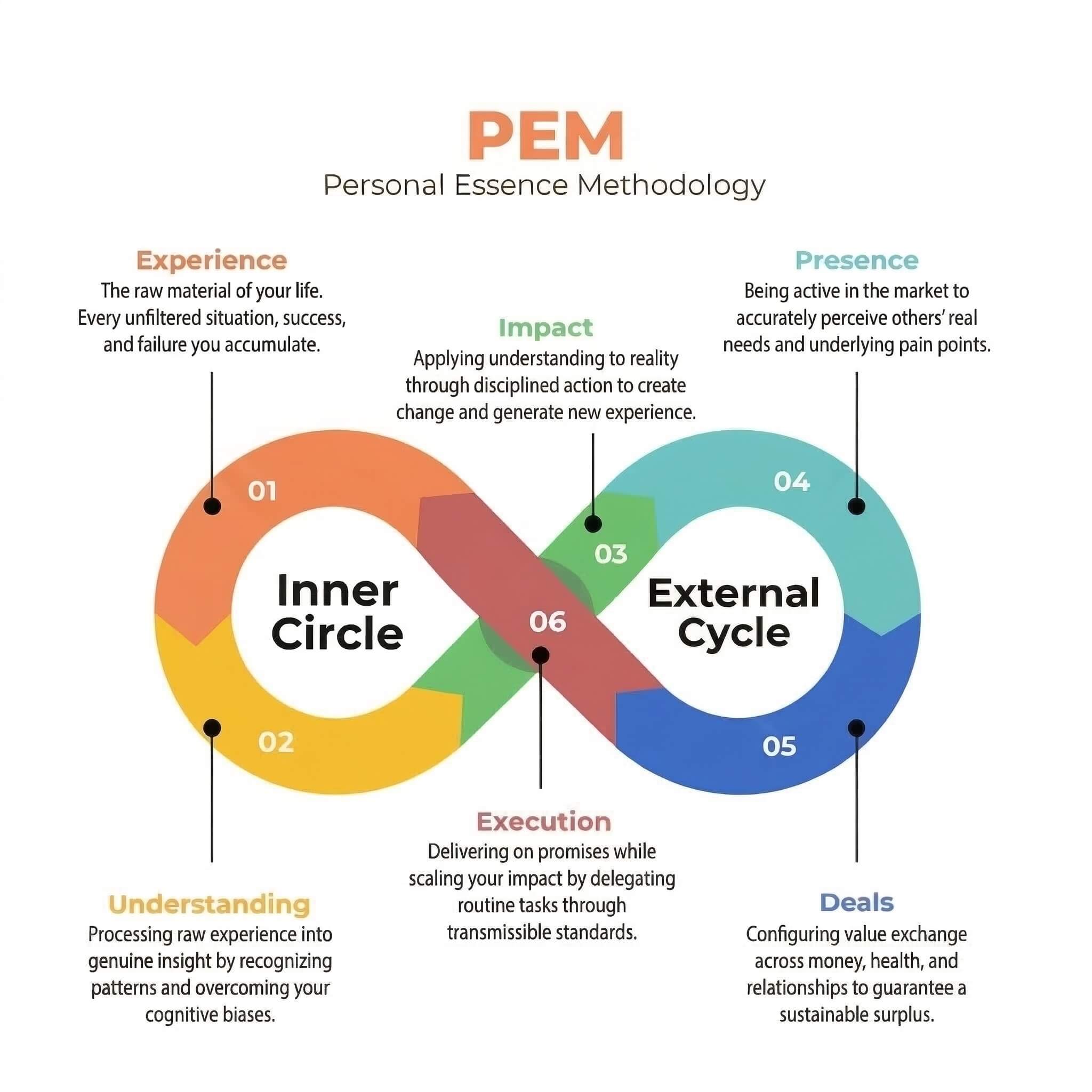
Develop understanding from experience, build trust-based presence through the seven pillars, configure deals that sustain you across all six resource domains, execute what you promised—personally in Architect Mode and through delegation in Builder Mode—and let demonstrated impact expand what you can credibly promise and direct next.
Table of Contents
(17 chapters)- Why This Methodology? Why Now.
- Foundation
- The Macro Context: Why This Methodology Must Evolve
- The Upgraded Resource Stack
- The Internal Chain: Processing Experience Into Understanding
- The Three Stages
- The Delegation Principle: Scaling Impact Through Understanding
- The Two Imbalances
- Influence as High-Quality Deals
- The Resource Equation
- The Iterative Cycle
- Operating in Crisis: The Methodology Under Systemic Pressure
- Scope and Limitations
- Failure Modes
- Application
- Comprehensive Bias Reference: Mapping Cognitive Biases to Methodology Stages
- Summary
Why This Methodology? Why Now.
I was born in 1987, in the time when the Soviet Union collapsed. My first economy was an economy that had just ceased to exist.
By the time I was old enough to understand what "stable conditions" meant in a textbook, I had never experienced them. The post-Soviet transition brought hyperinflation, institutional vacuum, and the daily improvisation that became normal life in newly independent Ukraine. Then came the domestic economic turbulence of the early 2000s. Then, the global financial crisis of 2008–2009, which hit emerging economies with particular force. Then the Revolution of Dignity in 2013–2014, which remade the country's political landscape overnight. Then the first war—Crimea annexed, Donbas burning, the world rearranging itself around us while we rearranged ourselves to survive within it. And then, in 2022, the full-scale invasion—the kind of crisis that does not ask whether you are ready.
Through all of it, I was building. Building businesses, building relationships, building understanding. Not because I had some special resilience gene or because Ukrainians are uniquely tough—though we are stubborn in ways that sometimes surprise even us. But because a crisis, when it becomes your permanent environment rather than an interruption, teaches you something that peacetime cannot: the rules you rely on will break, and your ability to function when they do is the only asset that cannot be confiscated, devalued, or bombed.
The Personal Essence Methodology was not designed in a library. It was forged in the gap between what I was told should work and what actually worked when the floor kept moving. Every principle in this document—the Internal Chain, the Trust Formula, the six resource domains, the delegation hierarchy—was stress-tested under conditions where the currency might change, the borders might close, the client might disappear, and the power might go out mid-delivery.
This is why I believe the methodology is urgent now.
The world you are operating in today, wherever you are, is entering the kind of instability that has been my entire professional life. Geopolitical fragmentation is accelerating. The AI revolution is dismantling the economics of execution in real time. Capital is no longer cheap. Supply chains are no longer reliable. The institutions that once provided stability—predictable markets, stable currencies, functioning international order—are under stress that will not resolve quickly.
You may be encountering systemic instability for the first time. I have been living inside it for three decades.
Here is what I have learned: you cannot control the environment, but you can control how deeply you process your experience, how honestly you show up in your relationships, how carefully you configure your commitments, and how reliably you deliver on what you promised. That is the methodology in practice. Not a theory about what should work in ideal conditions—a system that has worked, repeatedly, in conditions that were anything but ideal.
The methodology will not make the crisis comfortable. Nothing does. But it will give you a structure for operating when the structures around you are failing. It will help you build trust when trust is scarce, configure deals when terms are volatile, execute when resources are constrained, and compound your understanding when the rules keep changing under you.
I built this because I needed it. I am sharing it because I believe you need it too, perhaps more urgently than you realize.
The best time to build your methodology was before the crisis. The second-best time is now.
— Volodymyr Zhukov
Foundation
Each person accumulates a distinct combination of experiences, encounters different values, and lives through a unique sequence of events. This creates meaningful differentiation between people—differences that can become the basis for distinctive value.
Meaningful differentiation vs. absolute incomparability. You are genuinely different from others in measurable, significant ways: personality, cognitive style, developmental history, accumulated expertise. These differences are real and economically relevant. But you are not so different that comparison is meaningless or that connection is impossible. You share enough cognitive and emotional architecture with other humans to understand them and be understood. This shared architecture is what makes empathy possible, exchange valuable, and trust achievable. Without a genuine difference, you have nothing distinctive to offer. Without genuine similarity, you have no one to offer it to. The methodology requires both.
However, raw experience alone creates nothing. Experience must be understood before it can be applied. And understanding must translate into action before it changes anything. This is the internal chain that makes external effectiveness possible.
ExperienceUnderstandingImpact
Experience is the raw material. Understanding is the processing of that material into usable insight. Impact is the application of insight to change conditions in the world.
This chain is iterative, not linear. Impact generates new experience. New experience requires new understanding. The cycle continues throughout life.
The Critical Distinction: Information vs. Understanding
Information is what exists outside of you—facts, data, advice, frameworks, research findings. It is abundant, cheap, and now infinitely generable by artificial intelligence.
Understanding is what exists inside of you—the processing of information through the filter of your experience, your context, your failures, your specific situation. Understanding tells you which piece of information matters right now, which advice applies to your circumstances, and which strategy fits the constraints you actually face.
Information is generic. Understanding is personal.
The explosion of available information has created the illusion that understanding has also expanded. It has not. The flood of information often makes understanding harder by preventing the slower, deeper work of processing. The methodology is an understanding-development system, not a knowledge-acquisition system. The difference between those two things is the difference between feeling informed and being effective.
The fluency illusion compounds the problem. When we encounter information that feels easy to process—because we have read it before, because it is presented clearly, or because it confirms what we already believe—our brains interpret that processing fluency as evidence that we have mastered the material. Re-reading a framework and nodding along creates a powerful subjective sense of competence that is unmoored from actual capability. The gap between recognizing information while looking at it and retrieving it under pressure is vast. The methodology's insistence on processing—writing, testing, triangulating—exists specifically to defeat this illusion of competence.
The Macro Context: Why This Methodology Must Evolve
We are living through a period of compounding systemic transitions: geopolitical fragmentation, the AI revolution, deglobalization, the end of cheap capital, demographic shifts, and a full-scale energy transition. These are not isolated disruptions. They interact, and their interactions amplify instability and accelerate the pace at which old rules break down.
The AI Disruption
AI is now an execution engine. Large language models generate production-quality code, professional documents, functional interfaces, and complex workflows. Vibe coding turns natural-language descriptions into working software. The Model Context Protocol connects AI directly to professional tools and operational infrastructure. AI-powered autonomous agents handle multi-step execution workflows across research, drafting, scheduling, coordination, and delivery.
This changes the economics of personal effectiveness fundamentally. When execution is becoming commoditized—when the thing most people sell (their labor, their ability to do tasks) is becoming abundant and cheap—then working harder at execution is running faster on a treadmill accelerating beneath you.
- What AI commoditizes
Generic knowledge. Average-level execution. Standard analysis. Routine production. Surface-level content. Any work that can be reduced to explicit rules applied without judgment.
- What AI cannot replicate
Your specific experience, processed into genuine understanding. Your actual relationships and the trust history embedded in them. Your ability to navigate ambiguity and make judgment calls that integrate values, experience, and context. Your capacity for genuine Presence—the human recognition that comes from another consciousness engaging with yours.
In a world where generic execution is abundant and free, average effectiveness produces below-average outcomes. The market splits between demand for exceptional human capability—which pays very well—and everything else, increasingly performed by AI or by humans competing with AI on price. The middle is disappearing.
Automation bias compounds the danger of the middle. As AI becomes more capable, people increasingly defer to its outputs without critical evaluation—treating machine-generated recommendations as truth, surrendering critical thinking to the algorithm. This is not laziness; it is a cognitive shortcut our brains apply to any perceived authority, whether human or digital. When AI drafts a strategy, reviews a contract, or diagnoses a problem, the temptation to accept without scrutiny is powerful precisely because the output looks polished and confident. The person who adds judgment—who catches what the AI missed, who senses the contextual mismatch the algorithm cannot perceive—is the person whose understanding the market will pay a premium for. The person who merely supervises AI without genuine scrutiny occupies the disappearing middle.
The Economy of Trust
One of the most consequential shifts for individuals is the transition from the Economy of Attention to the Economy of Trust.
For two decades, the internet optimized for capturing human attention. Content was the commodity, and attention was the currency. But generative AI has driven the cost of content creation to near zero. When content is infinite, and attention is easily hijacked, authenticity and trust become the scarcest resources. Value is migrating toward people, platforms, and systems that can verify truth, demonstrate competence, and prove human authenticity.
The illusory truth effect accelerates this shift. When people encounter repeated claims—whether from AI-generated content, social media, or marketing—their brains begin to register those claims as more likely to be true, regardless of their actual validity. Repetition manufactures belief. In an environment of infinite content, the sheer volume of repeated false or misleading claims erodes the baseline of shared truth. This makes genuine trust—built on verified track records and transparent presence—essential infrastructure for any functioning relationship, market, or institution.
When execution is scarce, you choose providers based on capability. When execution is abundant, you choose based on trust. Deals made with trust have lower transaction costs—less verification, less legal overhead, less energy wasted on monitoring. In an economy where AI-driven competition compresses prices, the efficiency gains from trust-based deals are not marginal. They are decisive.
The Trust Formula
Trust is not a feeling, a personality trait, or charisma. Trust is a compound—the product of three components in a multiplicative relationship:
The multiplicative relationship is the critical insight. Addition would mean weakness in one area can be compensated for by strength in another. Multiplication means zero on any factor collapses the whole.
- Demonstrated Impact
competence trust. You have a track record. You have delivered. Your capabilities are proven through results others can observe and verify. Built in the Execution stage.
- Transparent Presence
benevolence trust. You are visible, honest, and genuinely engaged with others' realities. You perceive their actual needs, not your projection of their needs. People can assess you accurately because you show up as who you are. Built in the Presence stage.
- Consistent Alignment
integrity trust. The gap between what you commit to during Deals and what you deliver during Execution stays near zero, repeatedly, over time. Your words and your actions match. Your promises and your performance have a history of correspondence. Built at the Deals-Execution boundary and compounded through cycles.
Why the Multiplicative Relationship Matters
Zero Impact × anything × anything = zero trust. You cannot deliver. No amount of charm or reliability changes this.
Anything × zero Presence × anything = zero trust. You cannot be read or assessed. Competence that is opaque or invisible generates wariness, not trust.
Anything × anything × zero Alignment = zero trust. You do not keep your word. Competent, visible people who consistently overpromise and underdeliver are the most dangerous—because they attract commitment they cannot honor.
How the Formula Maps to the Methodology's Architecture
The three components correspond directly to the three stages of the External Cycle:
- Presence → builds Transparent Presence (benevolence trust)
- Deals → configures the commitments that Consistent Alignment will be measured against
- Execution → builds Demonstrated Impact (competence trust) and either confirms or violates Consistent Alignment (integrity trust)
The three-factor formula makes visible something the two-factor formula hid: Deals is not just a configuration stage that feeds Execution. It is the stage where you define the standard against which your integrity will be judged. A well-configured Deal does more than maximize surplus; it sets commitments you can actually honor, because every commitment you set becomes a test of your Consistent Alignment. Overcommitting during Deals creates more than a resource deficit. It creates an integrity trust deficit that no amount of Impact or Presence can compensate for.
This also clarifies why the Presence-heavy imbalance is so destructive in the Economy of Trust. The Presence-heavy person has strong Transparent Presence and often genuine early Impact—but their Consistent Alignment approaches zero because they systematically promise more than they deliver. Multiply anything by zero, and you get zero. Their trust collapses despite two strong components, because the third is missing.
And it clarifies why the Execution-heavy person's trust doesn't compound as it should. They have strong Demonstrated Impact and often reasonable Consistent Alignment—but their Transparent Presence approaches zero because they are invisible. Again, multiply by zero.
The halo effect operates powerfully—and dangerously—in the early stages of trust formation. When a person demonstrates one strongly positive quality—eloquent communication, impressive credentials, physical attractiveness—observers unconsciously assume that person possesses other positive qualities as well: competence, integrity, good judgment. This mental shortcut can fast-track initial trust formation by inflating perceived levels of all three factors before they have been demonstrated. But halo-based trust is fragile. It collapses when performance contradicts the initial impression, and the correction is often disproportionately harsh: the person is perceived as deceptive, not just inadequate, because the observer feels their trust was manipulated. The halo effect can temporarily mask a zero in one factor; the multiplicative formula ensures reality eventually reasserts itself.
On compounding: Trust compounds through repeated cycles of the External Cycle. The formula could be extended to Trust = (Demonstrated Impact × Transparent Presence × Consistent Alignment)^cycles. But this is implicit in the word "Demonstrated" (which implies track record, not a single event), "Consistent" (which implies repetition), and the iterative cycle the methodology already describes. The compounding is real and essential—it is what makes trust a durable asset rather than a momentary impression—but adding an explicit exponent risks making the formula less communicable without adding methodological clarity.
This shift changes what it means to be present, how deals are structured, and what execution must deliver. The methodology must account for it.
The Upgraded Resource Stack
Previously, the methodology framed deals around three domains: Money, Health, and Relationships. That framing was useful but incomplete. In the current environment—where trust is currency, attention is contested, and knowledge depreciates rapidly—a more precise resource map is required.
Every person operates with six fundamental resource domains. Deals are configured across all six. Surplus or deficit in any one of them ripples through the others.
1. Financial — Wealth / Cash Flow
Money, compensation, investment returns, revenue. The resource that converts most flexibly into other resources—but cannot, on its own, replace any of them. Financial surplus funds delegation creates optionality and absorbs shocks. Financial deficit constrains every other domain.
Mental accounting distorts financial resource management
We treat money differently depending on its source or intended purpose—spending a tax refund freely while refusing to touch savings, even when both are fungible. This creates invisible "jars" in our financial thinking that prevent optimal allocation across the six domains. A freelancer might mentally separate "project income" from "side hustle income" and apply different spending rules to each, even when the rational move is to pool resources and allocate based on priority. The methodology requires treating financial resources as a unified pool governed by strategic allocation, not by the psychological accidents of how money arrived.
Money illusion further distorts financial judgment
We focus on nominal numbers—the figure on the paycheck or the price tag—rather than what that money can actually purchase. During periods of inflation, a 5% raise that barely covers 6% inflation feels like progress. In deal configuration, this means evaluating compensation, pricing, and investment returns in real terms—purchasing power, not nominal figures.
2. Biological — Health / Daily Energy
Physical and mental capacity. Sleep quality, metabolic health, stress load, and recovery rate. This is the resource that gates everything else—no amount of financial or intellectual capital matters if your body cannot sustain the effort. Biological surplus means resilience and stamina. Biological deficit means declining performance regardless of opportunity.
The primacy of sleep
Sleep constitutes the single most important component of biological health—the foundation on which exercise, nutrition, stress management, and all other health practices rest. During sleep, the brain consolidates experience into understanding through neural replay and pattern extraction—the literal mechanism by which the Internal Chain converts today's experience into tomorrow's insight. Chronic sleep deprivation degrades energy. Worse, it sabotages the very process that produces understanding—the methodology's central asset. Seven to eight hours of sleep is non-negotiable infrastructure, not a health luxury.
Projection bias undermines biological resource management
When we feel energized and healthy, we cannot accurately imagine how we will think and perform when depleted, ill, or stressed—and vice versa. This is the hot-cold empathy gap applied to our own future states. The person configuring deals on a good day systematically underestimates the biological cost of those commitments. The person in burnout cannot accurately project the recovery that rest would provide and may make permanent decisions based on temporary states. Deals must be configured for realistic biological capacity, not for how you feel on your best day.
3. Social — Deep Relationships (Support) / Broad Network (Reach)
This domain has two distinct layers. Deep relationships provide emotional support, honest feedback, and safety nets during a crisis. Broad networks provide reach, deal flow, and access to opportunities you could not find alone. Both are necessary. Deep relationships without reach mean isolation from markets. Broad networks without depth mean fragile connections that collapse under pressure.
Courtesy bias silently degrades social feedback loops. People in your network—especially those in professional relationships—systematically tell you what they think you want to hear rather than what they actually observe. The mechanism is social lubrication. But it means the feedback channel most people rely on for calibration is corrupted at the source. The methodology's insistence on triangulation—frozen-in-time records, current reflection, and hard external data—exists partly to compensate for the fact that human feedback is filtered through politeness before it reaches you.
4. Reputational — Trust / Personal Brand / Audience
In the Economy of Trust, reputation is no longer a passive byproduct of good work. It is an active, manageable asset. Your reputation is what people believe about you before they interact with you. Your personal brand is the signal you deliberately emit. Your audience is the group of people who have granted you ongoing attention based on demonstrated trust. Reputational surplus means opportunities come to you. Reputational deficit means you must fight for every opportunity from scratch.
Reputation is built through five distinct channels: demonstrated results (projects delivered, problems solved), network reach (who knows your work and who they talk to), visibility (being known beyond your immediate network through events, content, professional communities), knowledge sharing and case presentation (communicating not just what you accomplished but how you think), and consistency over time (the compound effect of reliable showing up, year after year). Investing in only one channel—typically demonstrated results—leaves the other four dormant, which is why excellent work often remains invisible.
The mere exposure effect is the mechanism underlying visibility-based reputation building
The more often people encounter your name, your work, or your ideas, the more they tend to develop positive associations with you—even if they cannot articulate why. This is how human cognition processes familiarity. Strategic visibility—consistent content, regular event attendance, reliable presence in professional communities—leverages this effect honestly. The critical caveat: mere exposure builds warmth and recognition, not competence trust. It opens doors but does not close deals. Visibility without delivery creates the Presence-heavy imbalance.
The bandwagon effect amplifies reputational momentum
Once a critical mass of people recognize and trust you, others follow because they observe that others already trust you, not because they have independently evaluated your work. This is why reputational capital compounds non-linearly: early investment yields modest returns, but once the threshold of social proof is crossed, reputation becomes self-reinforcing. The danger is that the same mechanism works in reverse—reputational damage cascades as rapidly as reputational gain.
5. Intellectual — Knowledge / Hard Skills
What you know and what you can do. Domain expertise, technical capability, pattern recognition, frameworks for judgment. Intellectual capital is what makes your understanding transferable and your delegation effective. In a world where AI commoditizes surface-level knowledge, deep intellectual capital—the kind that enables judgment, not just information retrieval—becomes more valuable, not less.
The Google effect (digital amnesia) reshapes intellectual capital requirements. When information is instantly accessible, our brains stop storing factual content and instead become experts at remembering where to find information. This is an adaptive shift, but it has a cost: the person who "knows where to look it up" lacks the internalized knowledge base required for rapid judgment under pressure. Deep intellectual capital in the methodology's sense is internalized pattern recognition that operates without conscious search. Retrievable information doesn't qualify. The AI era makes this distinction sharper: AI handles retrieval; you handle judgment. If your intellectual capital consists only of what you can look up, AI already does it better.
6. Temporal — Time / Focused Attention
Hours in the day and the quality of attention within those hours. Time is the only resource that cannot be accumulated—it can only be allocated. Focused attention is the multiplier that determines whether allocated time produces value or waste. Temporal surplus means space for strategic thinking, relationship investment, and recovery. Temporal deficit means reactive living—constantly responding, never directing.
Hick's Law governs the relationship between choices and temporal efficiency. The more options you face in any given moment—which email to answer, which project to advance, which relationship to invest in—the longer your brain takes to decide, and the decision quality degrades. It's a logarithmic function of choice quantity, not a discipline problem. Reducing the number of active decisions through systems, routines, and delegation is a structural defense of temporal resources, not a productivity hack.
How the Six Domains Interact
No domain operates in isolation. Financial surplus can purchase temporal freedom (delegation, automation). Biological surplus enables deeper intellectual work. Reputational surplus reduces the effort required to close deals. Social surplus surfaces opportunities that save time and money. Intellectual surplus makes execution more efficient, preserving biological and temporal resources.
Conversely, a deficit in one domain drains the others. Financial stress erodes health. Health decline reduces intellectual output. Reputational damage shrinks the network. Network collapse eliminates deal flow. Poor deals consume time. Lost time prevents recovery.
The upgraded principle of Deals: Configure agreements that generate surplus across all six resource domains—not just financial. A deal that pays well but destroys your health, reputation, or relationships is not good. It is a slow liquidation of assets that are harder to rebuild than money.
The Internal Chain: Processing Experience Into Understanding
The Internal Chain—ExperienceUnderstandingImpact—is where your distinctive value is developed. Each link requires deliberate work; none functions automatically.
The Processing Methodology: The Four Questions
After any significant experience, apply the four questions systematically, in writing:
- What actually happened? Not your story about what happened. Not your interpretation. The actual events are described as objectively as possible. Separate observation from interpretation.
- What were multiple possible causes? Generate at least three different explanations for what happened. This prevents latching onto the first comfortable narrative and counteracts confirmation bias. This question also directly combats the conjunction fallacy—our tendency to find detailed, coherent explanations more plausible than simpler ones. Each of your three explanations should be tested against the principle that a specific, story-like explanation is not automatically more probable than a vaguer but broader one, no matter how well it fits.
- What would someone with a different perspective see? Imagine someone with different biases, a different background, or different incentives observing the same situation. What would they notice that you missed? This question specifically targets the fundamental attribution error—our tendency to explain others' behavior through character while explaining our own through circumstances. When you consider another perspective, deliberately ask: What situational pressures might have driven the behavior I observed? The actor-observer bias means you will naturally generate situational explanations for yourself and dispositional explanations for others unless you consciously reverse this pattern.
- What can I actually test? Identify what is testable in your understanding. Understanding that remains untested is a hypothesis, not knowledge. If your interpretation predicts future outcomes, test the prediction.
The two imbalances reveal themselves through the questions you resist. Presence-heavy people struggle with questions one and four—"what actually happened?" threatens their polished narrative, and "what can I test?" demands execution they prefer to avoid. Execution-heavy people struggle with questions two and three—generating multiple explanations feels wasteful, and imagining other perspectives requires the Presence they underinvest in.
The Triangulation Practice
No single source of self-knowledge is reliable. Understanding that you can build on requires three points of reference, compared against each other:
Your frozen-in-time records — what you believed was happening before you knew the outcome. Journals, decision logs, and notes written contemporaneously. These capture your bias as it existed then, before hindsight rewrote it. These records are your primary defense against hindsight bias—the brain's automatic tendency to rewrite prior beliefs after learning an outcome, making events seem more predictable than they were. Without contemporaneous records, you cannot distinguish what you actually predicted from what you now believe you predicted. The self-consistency bias further corrupts this process: your brain assumes you have always held your current views, quietly erasing past changes of mind to maintain the illusion of a stable, coherent self.
Your current memory and reflection — what you believe now, with the benefit of distance. This captures pattern recognition that was not possible at the moment. Treat current memory with calibrated skepticism. Choice-supportive bias causes your brain to retroactively enhance the attractiveness of decisions you made and diminish the attractiveness of options you rejected. The version of the past that lives in your current memory is systematically flattering to your past choices.
Hard data and external feedback — what actually happened according to evidence that exists outside your head. Numbers, timelines, deliverables, outcomes, and what other people observed and recorded.
Where all three converge, you are probably close to reality. Where they diverge, the divergence itself is the lesson—it reveals where your biases operate, which direction they pull, and how much you can trust your own processing.
The Role of Cognitive Biases
The Internal Chain operates under constant assault from systematic cognitive distortions that affect each link.
Biases that corrupt experience (the raw material)
Rosy retrospection makes the past prettier than it was. Fading affect bias causes negative emotions to fade faster than positive ones. The telescoping effect scrambles your timeline. Mood-congruent memory filters your history through your current emotional state. Source monitoring errors inject experiences you never actually had—things you read or heard filed as things you lived through. Survivorship bias makes you learn only from what happened, not from what didn't. The availability heuristic makes dramatic events feel important and important patterns feel forgettable. The peak-end rule causes you to evaluate entire experiences based on their most intense moment and their ending, discarding the duration and the mundane middle entirely—meaning a grueling project that ended well is remembered as positive, while a smooth project that ended with a minor disappointment is remembered as negative, regardless of the actual balance of experience. Duration neglect compounds this: the length of an experience contributes almost nothing to how you remember it, which means long periods of sustained effort can be psychologically invisible in retrospect.
Biases that distort understanding (the processing)
The bias blind spot makes you see others' distortions while remaining blind to your own—and knowledge of biases can worsen this by creating an illusion of immunity. Confirmation bias makes you see evidence for what you already believe and ignore evidence against it. Naïve cynicism makes you process neutral or positive signals as threats. The Semmelweis reflex makes you reject evidence that would update your understanding, especially when accepting it threatens your identity. Confabulation generates false explanations for your own behavior without any awareness that you are doing it. Illusory correlation causes you to perceive relationships between variables where none exist—especially when the pairing is emotionally salient or fits a pre-existing narrative. You might conclude that a particular client industry always leads to scope creep, or that a specific type of meeting always produces good decisions, based on a handful of memorable instances rather than actual patterns. The clustering illusion compounds this: genuine randomness produces clumps and streaks that look like meaningful patterns to our pattern-hungry brains, and we build strategies on those phantom signals. The conservatism bias—a related but distinct distortion—causes you to update your beliefs too slowly when genuine new evidence arrives, adjusting only slightly when you should be adjusting dramatically.
Biases that undermine Presence (perception of others)
The false consensus effect makes you project your own values and preferences onto others. Out-group homogeneity makes you blur individuals into categories. Stereotyping assigns fixed traits to those categories. The cross-race effect and perceptual calibration limits mean your perception works well for the familiar and poorly for the unfamiliar, without any internal alarm signaling which mode you are in. The spotlight effect causes you to overestimate how much others notice your appearance, mistakes, and behaviors—because you are the protagonist of your own experience and assume others are watching your performance as intently as you are living it. The illusion of transparency compounds this: you feel your internal states (nervousness, enthusiasm, boredom) are radiating visibly from your skin, when in fact others perceive far less than you imagine. Together, these biases create a distorted model of how others experience your presence—you assume you are being scrutinized and read when you are largely unnoticed, and this false assumption drives either anxious over-management of impression or withdrawal from situations where presence would be most valuable.
The illusion of asymmetric insight corrupts empathy at its root
You believe you understand others' motivations better than they understand yours—and better than they understand themselves. This is projection dressed as insight, not investigative empathy. The person who walks into a meeting believing they have "figured out" the other party has stopped investigating and started confirming. The methodology's definition of empathy as discipline rather than sentiment exists specifically to counteract this illusion: treat your understanding of any other person as a hypothesis, not a conclusion.
The hot-cold empathy gap undermines Presence across emotional states
When you are calm, comfortable, and well-resourced (a "cold" state), you cannot accurately simulate how you or others will think and act when stressed, frightened, exhausted, or desperate (a "hot" state). This means Presence conducted from a position of comfort systematically misreads the experience of people in crisis. The consultant who advises a struggling business from a position of financial security literally cannot feel the desperation that shapes the client's decision-making. Acknowledging this gap—and designing investigative practices that compensate for it—is essential to genuine Presence.
Biases that sabotage Deals
Hyperbolic discounting makes you overvalue immediate rewards over larger future ones, creating patterns of desperate deal-making. The decoy effect manipulates your choices through asymmetrically dominated alternatives. Distinction bias makes you obsess over easily comparable differences (price) while ignoring dimensions that determine your quality of life. Anchoring locks your sense of "reasonable" to whatever number was mentioned first. Loss aversion makes the fear of losing a bad deal feel twice as heavy as the hope of gaining a good one. Status quo bias and the endowment effect create a psychological fortress around existing bad deals. The sunk cost fallacy and its escalating cousin, escalation of commitment, keep you in deals long past the point of rationality, because abandoning the deal would require acknowledging that past investment was wasted. The emotional logic is: "I've already put so much into this, I can't stop now." The rational logic is: past costs are gone; only future costs and benefits matter. The framing effect means the same deal terms can feel acceptable or exploitative depending on how they are presented—a "10% discount" and a "90% of full price" are mathematically identical but psychologically different. Zero-sum bias causes you to assume that any gain for the other party must come at your expense, blinding you to deals where both parties genuinely benefit.
The overconfidence effect pervades deal-making
People are constitutionally more sure than they are correct. When claiming 100% certainty, we are typically right only about 80% of the time. In deals, this manifests as overestimating your ability to deliver, underestimating project complexity, and promising timelines you cannot meet. The hard-easy effect makes this worse in a specific way: you are most overconfident on the hardest problems (where your accuracy is lowest) and most underconfident on easy ones (where you would actually perform well). This means confidence is almost precisely miscalibrated to difficulty.
The planning fallacy is the single most destructive bias in the Deals-Execution boundary
When estimating how long a project will take, what it will cost, or what resources it will require, you imagine a frictionless path to completion—compressing timelines, minimizing costs, and ignoring risks. You are a pessimist about others' projects but an optimist about your own. Nine out of ten megaprojects go over budget for this reason. Every deal you configure should include a systematic upward adjustment to your time and cost estimates—research suggests multiplying your initial estimate by 1.5 to 2.5, depending on project novelty.
Biases that derail Execution
The well-traveled road effect makes familiar tasks feel simpler than they are, triggering autopilot when genuine attention is needed. Functional fixedness locks your workflow into a single configuration—you're doing everything—when it could be decomposed. The IKEA effect inflates the value of your personal execution, making you cling to routine work because it is yours. Action bias—the compulsion to "do something" rather than nothing—is particularly destructive during execution under uncertainty. When conditions are ambiguous or metrics are unclear, the instinct is to take visible action, even when strategic waiting would produce better outcomes. The conflation of motion with progress causes you to fill uncertain periods with busywork that feels productive while consuming biological and temporal resources without advancing understanding. The Zeigarnik effect compounds this: unfinished tasks create persistent mental tension that drives impulsive action to "close the loop," even when the optimal move is to leave the task open while more information arrives.
The illusion of control causes systematic misjudgment during execution
When a situation involves your active participation, your brain automatically assumes you can influence the outcome—even when results depend on factors entirely beyond your control. The entrepreneur who believes their personal effort determines market timing, the investor who feels they can "beat the market" through individual insight, the manager who attributes team outcomes entirely to their leadership—all are experiencing the illusion of control. This bias is especially dangerous because it feels like agency and competence, making it resistant to correction.
Biases that block delegation
The illusion of indispensability is self-reinforcing—you never let anyone else try, so no one else develops capability, which "proves" your indispensability. Control bias makes you shadow delegated work until your strategic thinking degrades from immersion in operational details. The inverted planning fallacy overestimates delegation costs by a factor of three to ten. Attribution errors blame delegates for structural failures caused by vague instructions and absent standards.
The curse of knowledge is the delegation-specific bias that makes transmissible standards so difficult to create. Once you have internalized a skill or domain, you lose the ability to imagine what it is like not to know it. Your explanations skip "obvious" steps that are obvious only to you. Your standards omit criteria that feel so fundamental you cannot conceive of someone not applying them. The delegation paradox—that delegating forces you to articulate what you know, thereby deepening your understanding—is the direct antidote to the curse of knowledge. The process of making knowledge transmissible is the process of confronting what you take for granted.
The Dunning-Kruger effect operates at both ends of the delegation spectrum. People who lack competence in a domain cannot recognize their incompetence—the same skills needed to perform well are needed to evaluate performance. This means premature delegators may not recognize that their standards are inadequate, while premature executors may overestimate the quality of their own work. At the expert end, those with genuine mastery often assume tasks easy for them are easy for everyone, leading to inadequate training and documentation. Both extremes degrade delegation quality.
These biases cannot be eliminated. They can be managed through external feedback, written records, deliberate disconfirmation seeking, calibrated trust, and the structured processing methodology described above.
Additional Biases That Operate Across the Entire Chain
Several cognitive biases do not fit neatly into a single stage but operate as cross-cutting distortions that affect experience, understanding, and impact simultaneously:
Negativity bias causes negative experiences, feedback, and information to carry roughly twice the psychological weight of equivalent positive signals. A single piece of critical feedback can overshadow ten compliments. A single failed project can psychologically outweigh several successes. This bias distorts every stage: it corrupts the raw material of experience by making failures more salient than successes, it warps understanding by making threat-based interpretations stickier than opportunity-based ones, and it undermines impact by making the fear of negative outcomes loom larger than the hope of positive ones.
The contrast effect means your brain evaluates nothing in absolute terms—everything is judged relative to what came before or what is nearby. The same deal terms feel excellent after a terrible offer and mediocre after a generous one, even though the deal itself has not changed. The same execution quality feels impressive in a week of failures and ordinary in a week of successes. This relativity affects every stage: it distorts how you evaluate new experiences (relative to recent ones), how you process understanding (relative to prior beliefs), and how you assess impact (relative to adjacent outcomes).
The backfire effect is the most counterintuitive distortion: when deeply held beliefs are challenged with contradictory evidence, the belief sometimes strengthens rather than weakens. This happens because our beliefs are tied to identity and social belonging. When evidence threatens who we are, the brain treats it as an attack and doubles down. This has direct implications for the methodology's emphasis on processing and disconfirmation: you cannot simply present yourself with contradicting data and expect rational updating. The processing must be gradual, identity-safe, and conducted through the structured Four Questions rather than through confrontational self-examination.
Psychological reactance means that when you feel your freedom of choice is threatened by external demands, by methodology prescriptions, or even by your own committed plans—you experience an automatic motivation to do the opposite. This bias affects how the methodology itself is adopted: the more rigid and prescriptive the system feels, the more the user's brain rebels against it. The methodology's iterative and adaptive nature is psychologically necessary, not just structurally sound. Rigid systems trigger reactance; flexible frameworks invite engagement.
Target Allocation for the Internal Chain
The Internal Chain has an optimal time allocation:
25% Experience — accumulating raw material through doing and encountering. 50% Understanding — deliberate processing of experience into genuine insight (journaling, triangulation, the Four Questions, external calibration, questioning narratives). 25% Impact — applying understanding to change conditions and test its accuracy.
Most people invert this, spending the vast majority on raw experience accumulation and almost none on processing. The result: years of experience that generate months of understanding.
The information bias drives this inversion. We have a deep-seated tendency to seek more information—more experience, more data, more input—even when that information will not change what we do. Gathering new experiences feels productive. Processing existing experience feels slow and uncertain. The brain conflates "knowing more" with "deciding better," but in many situations, additional experience without processing is completely irrelevant to improving outcomes. The methodology's 50% understanding allocation directly combats this bias.
The Three Stages
The internal chain enables participation in external exchange. This participation follows three stages.
Target Allocation for the External Cycle
50% Presence — active market engagement, perception of needs, relationship building, trust development. 25% Deals — configuring value exchange, negotiating terms, ensuring surplus. 25% Execution — personal delivery of understanding-dependent work.
The 25% Execution allocation functions only when the delegation infrastructure is established—transmissible standards built, organizational structure configured, AI workflows and partnerships operational. While delegation infrastructure is being built, personal execution necessarily consumes more. But even while executing personally, tracking these targets reveals the direction of necessary change.
Presence
Presence is being present among other people, in markets, in relationships, in the world. It requires developed empathy—the capacity to perceive others' pains, problems, and aspirations. This perception is possible because humans share enough cognitive and emotional architecture to understand each other, while differing enough that each perspective offers something the others lack.
Presence draws directly on the internal chain. Your accumulated experience, once understood, becomes the lens through which you perceive others' needs. Without sufficient experience and understanding, Presence is shallow. You hear words but miss the meaning. You see problems but not their roots.
Presence is also where you develop awareness of your own value. By encountering others and understanding their struggles, you begin to recognize what you can offer that others cannot easily replicate.
Empathy as Discipline, Not Sentiment
Empathy is not the ability to feel what another person feels. It is not warmth, caring, or intuition about others' internal states. Empathy is the discipline of systematically investigating what others actually experience, rather than projecting your own experience onto their situation.
The person who believes empathy is perception walks into a room, reads the vibe, assumes they understand, and acts on that assumption. They may be completely wrong. The person who treats empathy as a discipline walks into the same room and investigates—asking, listening, checking what they hear against what they expected, treating their understanding of another person as a hypothesis rather than a conclusion.
The false consensus effect is the specific mechanism that corrupts untrained empathy
You naturally assume that most people think, feel, and behave the way you do. Your brain inflates how many others share your views, your preferences, and your reactions. This creates an egocentric anchor where your own experience becomes the default template for understanding everyone else. Investigative empathy exists to break this anchor: every assumption about what another person needs, values, or feels must be checked against evidence, not treated as self-evident.
Selective perception compounds the problem
Your brain actively constructs the social world based on expectations, past experiences, and current emotional state, rather than passively recording it. You literally fail to see behaviors, needs, and signals that do not fit your existing framework. The experienced consultant who "knows" what a particular type of client needs may miss entirely novel problems because their perceptual system is tuned to the familiar. Presence requires active de-tuning: deliberately looking for what you do not expect.
Surface problems vs. real problems
What people say they need is rarely what they actually need: they experience symptoms and describe symptoms. The stated problem is often a surface manifestation of something deeper. Presence requires asking questions that go past the surface: Why do you think you need that? What would be different if you had it? When did this problem start, and what changed? What have you already tried, and why didn't it work?
Pain behind the problem
Behind every problem is a pain, and understanding the pain often matters more than understanding the problem. Two people with the same stated problem can have completely different underlying pain—financial fear versus identity threat, for instance—and the same solution applied to both will miss at least one of them.
Social desirability bias filters every interaction in Presence
People present themselves in the best possible light—exaggerating positive qualities, minimizing negative ones, and framing their situations in ways that maintain their dignity and social standing. It's an automatic and largely unconscious process, not deception. The implication for Presence: what people tell you about their situation, their needs, and their capabilities is systematically biased toward what makes them look good. Investigative empathy must account for this filter by recognizing that the version of reality they present is curated, and the full picture requires deeper inquiry.
Presence in the Economy of Trust
In the Economy of Trust, Presence extends beyond physical and relational proximity. It now includes signal presence—the degree to which your reputation, content, and personal brand make you visible and credible before any direct interaction occurs.
This is where the Pillars of the Economy of Trust operate. Each pillar is a mechanism for building, maintaining, and scaling trust-based presence in a world saturated with noise and synthetic content.
The Seven Pillars of Trust-Based Presence:
- Personal Branding & Authenticity (The Anchor): Your digital and physical reputation. Clarity on who you are, what you stand for, and the unique value you bring. In a noisy world, a strong, authentic personal brand pre-sells your credibility before you enter a room or send a message. This pillar draws directly on the Reputational resource domain and is fueled by Intellectual capital—you cannot brand what you do not genuinely understand about yourself.
Beware the Forer effect in personal branding. When brand statements are vague enough—"I help people achieve their potential," "I bring strategic insight to complex problems"—they sound compelling because they could apply to almost anyone. The Forer effect causes people to rate generic personality descriptions as highly accurate when they believe those descriptions were crafted specifically for them. Your brand must be specific enough to be falsifiable: if your brand statement could describe a thousand other people in your field, it is not a brand. It is a Barnum statement.
- Strategic Networking (The Web) Building intentional, mutually beneficial relationships rather than collecting contacts. The Trust Economy runs on relationships. Your network is your distribution channel for opportunities, partnerships, and insider knowledge. This pillar operates across the Social domain—both deep relationships and broad reach—and compounds over time when maintained with consistency.
- Offline & High-Touch Events (The Accelerator) Conferences, dinners, masterminds, coffee meetups. Digital platforms initiate connections; face-to-face interactions solidify them. Reading body language, sharing experience, and looking someone in the eye accelerates trust faster than months of online messaging. This pillar converts Social and Temporal resources into Reputational capital at an accelerated rate.
- Content & Thought Leadership (The Magnet) Sharing expertise, insights, and stories publicly—via articles, videos, podcasts, or social media—for free. Content acts as a magnet, attracting your ideal audience. By giving away value upfront, you prove competence and build parasocial trust at scale: people feel they know and trust you before they have met you. This pillar converts Intellectual capital into Reputational surplus and is one of the highest-leverage uses of Temporal resources.
The mere exposure effect is the engine of this pillar. Repeated encounters with your name, ideas, and perspective create positive associations—even when the audience cannot articulate why they feel favorable toward you. Consistent, quality content uses this cognitive mechanism honestly. But the illusory truth effect adds a caution: repetition of any claim makes it feel more true, regardless of validity. Content creators have an ethical obligation to ensure that what they repeat is accurate, because their audience's brains will convert repetition into belief, whether the content deserves it or not.
- Social Proof & Advocacy (The Multiplier) Testimonials, case studies, word-of-mouth referrals, and endorsements from other trusted figures. You can say you are great, but it means far more when someone else says it. Third-party validation is the ultimate multiplier of credibility. This pillar is where strong Execution history becomes visible—past delivery creates the social proof that fuels future Deals.
The third-person effect operates here in your favor. People believe they are personally immune to persuasive content but that others are strongly influenced by it. Paradoxically, this means third-party endorsements work on the very people who believe they are not influenced by endorsements—because they perceive the endorsement as objective evidence rather than persuasion.
- Transparency & Vulnerability (The Glue) Honesty about your processes, ownership of mistakes, and showing the behind-the-scenes reality rather than the highlight reel. Perfection breeds suspicion; authenticity breeds connection. Transparency about failures and learning moments humanizes you and makes trust resilient against setbacks. This pillar protects Reputational capital during inevitable periods of imperfect Execution.
- Consistency & Reliability (The Engine) Showing up regularly, delivering on promises, and maintaining core values over time. Trust is not built in a day; it is built daily. If your brand promises one thing but your behavior delivers another, trust collapses. Consistency is the engine that sustains all other pillars. This is where Presence, Deals, and Execution must align—any gap between them degrades the entire trust structure.
How the Pillars Map to the Methodology
The seven pillars are not separate from the Presence → Deals → Execution cycle. They are the mechanisms through which that cycle operates in a trust-based economy:
- Pillars 1–4 (Anchor, Web, Accelerator, Magnet) are primarily Presence mechanisms. They build visibility, credibility, and connection before deals are proposed.
- Pillar 5 (Multiplier) bridges Execution and Presence. Past delivery generates the social proof that powers future presence.
- Pillar 6 (Glue) operates during Execution and protects trust when things go wrong—which they inevitably will.
- Pillar 7 (Engine) spans all three stages. Consistency in presence, consistency in deal terms, consistency in delivery. It is the throughline.
Deals (The Deals We Make)
Deals are where exchange is structured—and where the standard for your integrity is defined. Every commitment you make during Deals becomes a test of your Consistent Alignment. The Trust Formula makes this explicit: Deals is not merely a configuration stage that feeds Execution. It is the stage where you set the bar against which the market will judge whether your words and your actions match. A deal configured with surplus is a deal you can honor. A deal configured at a deficit is a promise you are likely to break—and every broken promise degrades Consistent Alignment, which collapses trust regardless of how strong your Impact or Presence may be.
This is deal-making across the six fundamental resource domains:
Financial — agreements about compensation, pricing, investment, and resource allocation
Biological — commitments about time, energy, physical capacity, sustainable pace
Social — expectations about presence, support, reciprocity, boundaries; both deep relationships and broader network access
Reputational — what the deal does to your brand, credibility, and public trust; whether it builds or erodes your audience's confidence in you
Intellectual — whether the deal develops your knowledge and skills or merely extracts existing ones; whether you learn or only spend what you already know
Temporal — how much of your time and focused attention the deal requires; whether it creates or consumes the space for strategic thinking
Every significant commitment involves configuring terms across these domains. A job is more than salary: it includes biological costs (stress, hours, depletion), social costs (time away from people who matter), reputational implications (does this work enhance or dilute your brand?), intellectual trajectory (are you growing or stagnating?), and temporal burden (does it leave space for anything else?).
Sell Understanding, Not Time
The most fundamental pricing shift: stop selling time and start selling understanding.
Time is finite and commoditized. If you sell hours, your income is capped by physics, and you compete against everyone else selling hours—including AI systems whose hourly cost approaches zero. Understanding—the insight drawn from years of specific experience that identifies problems, designs solutions, and directs action—is scarce, non-replicable, and should be priced against the value of the problem it solves, not the time it takes to apply.
The practical test: price based on what the problem costs the other party, not on what the solution costs you to deliver.
The Weber-Fechner bias (relative perception bias) governs how pricing is perceived. A $500 discount feels massive on a $2,000 project but trivial on a $50,000 engagement—even though the dollar amount is identical. Our brains measure value in percentages, not absolutes. When pricing understanding-based work, this means a $10,000 fee feels steep relative to the hours involved but reasonable relative to the $200,000 problem it solves. Framing your price against the value of the problem rather than the cost of your time aligns with how the human brain actually evaluates cost—not just strategic positioning.
The Deals/Execution Boundary
The boundary between Deals and Execution is a discipline, not a suggestion. When in Execution, execute. Do not continuously renegotiate. Do not let scope creep through small accommodations. Do not accept additions that were not part of the deal.
If genuinely new information emerges—not "I forgot to mention" or "I've been thinking," but actual new information that changes the fundamental nature of the work—pause, return to Deals explicitly, have a real conversation about changed terms, then return to Execution with clarity.
Blending the stages—executing while constantly renegotiating—is not flexibility. It is chaos that erodes both your sustainability and your credibility.
This boundary is where Consistent Alignment is built or destroyed
In the Trust Formula, Consistent Alignment is the gap between what you committed to during Deals and what you deliver during Execution—measured repeatedly, over time. Every scope creep accommodation you silently absorb widens the gap between the deal you configured and the deal you are actually performing. Every mid-execution renegotiation signals to the other party that your commitments are provisional. The discipline of the boundary is about maintaining the integrity trust that makes your future commitments credible, not just about protecting your resources.
The pseudocertainty effect distorts deal evaluation at this boundary
When deals involve multiple stages or conditions, our minds mentally "cancel out" uncertain first steps and treat conditional outcomes as guaranteed. "If this project succeeds, the follow-on work will be worth $X" collapses in our minds to "the follow-on work will be worth $X"—the conditional vanishes. Deals must be evaluated based on what is actually committed, not on what might follow if everything goes well.
The Beginner Exception
If you are at Level 1 of the Internal Chain—still building raw experience, still developing the understanding that will eventually become your primary asset—working at a deficit or break-even is a capital investment, not a failure of the Deals stage.
But the beginner exception requires pre-commitment. Before accepting a below-threshold deal, define three things in writing: the exact duration (a specific date, not a milestone—because you lack the understanding to judge when your understanding is sufficient), a learning direction (what you intend to focus on developing), and the threshold you will demand when the period ends. Without these parameters, what starts as a deliberate investment becomes an indefinite trap anchored to below-market terms.
The anchoring effect makes pre-commitment critical. Whatever rate you accept first becomes the anchor for all future negotiations with that party—and in your own mind. A below-market starting rate psychologically anchors both you and the other party to that level, making subsequent rate increases feel like demands for something "extra" rather than corrections toward fair value. The pre-commitment—especially the written threshold and end date—exists to prevent the anchor from becoming permanent.
Influence as Understanding Applied
Deals are where influence lives. Influence is not persuasion or manipulation. Influence is the capacity to structure deals such that:
- There are sufficient resources for your Execution performance
- There is a surplus and reserve beyond what execution requires
Influence flows directly from the Internal Chain. Your experience gives you standing. Your understanding gives you clarity—you know what you can deliver and what value it creates. Your track record of impact gives you credibility.
Influence is expressed through specific mechanisms: framing your value in terms of outcomes rather than activities; positioning through contrast so your value is evaluated against appropriate comparisons; navigating reactive devaluation by helping others discover solutions rather than proposing them directly; and setting anchors that reflect the transformation you provide rather than the labor you expend.
The core principle of Deals: Configure deals so that the resources you receive across all six domains exceed the resources required to fulfill your obligations. The difference is your reserve. Without reserve, you move toward burnout and depletion regardless of how well you execute.
Execution
Execution is performance and delivery. This is where commitments made during Deals are fulfilled—and where two of the three trust factors are determined. The quality of Execution depends on two things: your actual capability, and whether Deals left you sufficient resources to deploy that capability.
In the Trust Formula, Execution serves a dual role. It builds Demonstrated Impact (competence trust) through the quality and consistency of what you deliver. And it either confirms or violates Consistent Alignment (integrity trust) by revealing whether your delivery matches the commitments you made during Deals. Every act of execution is simultaneously a competence demonstration and an integrity test.
Execution is not where value is defined. That happened during Deals. Execution is where value is delivered. Attempting to redefine value during Execution—asking for more compensation mid-project, renegotiating relationship terms during a crisis—typically fails or damages trust. The time for that conversation was Deals.
This does not mean Deals agreements can never be revisited. When genuinely new information emerges, returning to Deals is legitimate. But this should be explicit: "We need to renegotiate," not a gradual erosion of terms during execution.
Two Modes of Execution
Execution work operates in two fundamentally different modes that must not be mixed indiscriminately:
Architect Mode (understanding-dependent work) — diagnosis, strategy, key decisions, complex judgment calls, relationship-critical conversations. Work that draws on your specific accumulation of experience and produces insight no one else in your organization can replicate. Architect Mode requires deep focus, full energy, and uninterrupted time.
Builder Mode (execution-dependent work) — implementation, delivery, coordination, follow-through. Work that requires competence and effort but not your unique judgment. Work that, once you have defined what "good" looks like, can be performed by others following your standards.
Context switching between these modes costs fifteen to twenty-five minutes of cognitive reorientation per switch. In a day with frequent mode switches, hours are lost to invisible transitions. The most valuable execution system an entrepreneur can build is a schedule that separates these modes—protecting blocks of time for Architect Mode where no Builder Mode work is permitted.
Protected Hours: The first hours of each workday should be reserved exclusively for understanding-dependent work. No email. No administrative tasks. No routine coordination. The neuroscience is clear: your prefrontal cortex—which handles complex judgment and creative thinking—operates on a limited daily budget that depletes with every decision. Using premium cognitive hours on routine work means doing your most important thinking with your worst available attention.
Absent-mindedness during execution is an encoding failure that systems must prevent—not a character flaw. When you perform routine tasks on autopilot, your brain does not encode what you are doing into accessible memory. This is why you cannot find your keys (you never attended to where you placed them) or why you walk into a room and forget why (the intention was lost in transit). The implication for execution: critical handoffs, important decisions, and quality-sensitive moments must be flagged with attention-forcing mechanisms—checklists, deliberate pauses, environmental cues—because your brain will not automatically preserve what it considers routine.
Execution and Reputational Capital
In the Economy of Trust, every act of Execution is simultaneously a reputational event. Delivery builds social proof (Pillar 5). Transparency during difficulty protects trust (Pillar 6). Consistent delivery sustains the engine (Pillar 7). Poor execution does more than fail the immediate deal—it degrades the reputational capital that makes future deals possible.
This raises the stakes of the Deals stage. A deal that forces you into poor execution costs more than the resources you spent. It costs you the trust you built across two of the three factors simultaneously. Poor execution degrades Demonstrated Impact (competence trust), and if the poor execution results from overcommitment during Deals, it also degrades Consistent Alignment (integrity trust). In the multiplicative Trust Formula, simultaneous damage to two factors is catastrophic. In a trust economy, that is the most expensive form of failure.
Outcome bias and moral luck bias distort how others evaluate your execution. If the project succeeds, observers credit your judgment and competence. If it fails—even if your process was identical and the failure was due to factors beyond your control—observers blame your character and capability. Good decisions can lead to bad outcomes through bad luck, and bad decisions can succeed through dumb luck. But the market evaluates results, not process. This means reputational capital is partly built on luck, which makes managing the downside—through transparency (Pillar 6), consistent delivery across many projects (Pillar 7), and careful deal selection that avoids high-variance outcomes—essential strategy, not mere caution.
The Credibility Equation
Claims must never exceed demonstrated capability by more than one step. One step means your track record supports most of what you are promising, and you are stretching slightly into adjacent territory that the foundation makes credible. Two or more steps means you are making claims your history cannot support—and no matter how real your understanding is, the market prices demonstrated Impact, not private insight.
The iterative cycle solves this naturally. Each revolution generates new experience, updates understanding, enables slightly better Presence, supports slightly better Deals, and requires slightly better Execution. Capability and credible claims expand simultaneously because the claims are always backed by the performance from the previous cycle.
The Delegation Principle: Scaling Impact Through Understanding
Here is what most people miss about Execution: execution does not require your personal labor on every task.
The Internal Chain produces something transferable: understanding. Your experience, once processed into genuine insight, becomes a kind of recipe—a framework that can guide action beyond what your own hands can accomplish.
This is the delegation principle: Understanding enables you to direct execution, not just perform it.
The Three Income Dimensions
How you generate income determines whether your business can scale:
- Time-to-money
You sell hours. Your income is capped by physics. The principal-agent problem is irrelevant because there is no agent—only you, grinding. This is where most people start and where many stay permanently.
- Result-to-money
You sell outcomes. A client pays for a transformation, a solved problem, a deliverable—regardless of hours. Better than time-to-money, but still depends on your personal involvement for the understanding-dependent core. Delegation helps at the margins—execution-dependent portions can be handed off—but each result still flows through your judgment.
- Product-to-money
You sell a system—a structured, documented, repeatable process that others execute according to your transmitted understanding. The "product" is your externalized understanding, encoded into transmissible standards that a structure of people and systems can deliver without your personal involvement in each instance. This is the only dimension that makes your business genuinely scalable.
The transition from time-to-money through result-to-money to product-to-money is the transition from practice to business. It requires making tacit knowledge explicit, building documentation infrastructure, training people to not just follow frameworks but understand the reasoning behind them, and solving the principal-agent problem through shared understanding rather than through monitoring or incentives alone.
The Delegation Hierarchy
Before involving any human being, ask whether a system can do this. The hierarchy follows a specific order:
First: Automate
AI Skills, software, templates, workflows, processes that run without consuming anyone's hours. Every task automated is a task that requires no compensation, no health cost, no relationship investment, no surplus configuration. AI now handles a significant range of execution-dependent work: business process documentation, workflow diagrams, slide formatting, report compilation, standard communications, research aggregation, meeting summaries, first drafts, and data organization. AI delegation depends entirely on the same documentation infrastructure that human delegation requires—output descriptions, quality criteria, decision-point maps, annotated examples.
Second: Systematize
Some work cannot be fully automated, but can be reduced to checklists, templates, decision trees, and standard operating procedures. These are your understanding made structural, reducing the judgment required for execution, increasing consistency, and decreasing dependency on any individual.
Third: Partner with humans—as partners
When work genuinely requires human judgment, creativity, or relational capacity that no system can replicate, then people are needed. But not people selling their time—people sharing in the outcome. Profit-sharing, equity stakes, revenue percentages, outcome-based compensation. Structures where the person executing has a genuine upside tied to the quality of their work. This solves the principal-agent problem structurally—when someone shares in the outcome, their incentive is to complete the task well, not merely to complete it.
The Two Types of Execution Work
Not all execution is equal. Execution work is divided into two categories:
Understanding-dependent work — tasks that require your specific insight, judgment, or relationships. These cannot be delegated without losing the value. Your presence in conversations, your judgment in complex decisions, the relationships that open doors—these are yours alone.
Execution-dependent work — tasks that require effort, time, and competence but not your unique understanding. Once you know what good looks like, others can produce it. Once you've identified the pattern, others can follow it. Once you've made the key decisions, others can implement them.
The person who executes everything personally conflates these categories. They treat all Execution work as understanding-dependent when much of it is not. They become the bottleneck in their own impact.
Transmissible Standards: The Infrastructure of Delegation
Delegation fails without standards that exist outside your head. Tacit knowledge—felt but not formulated, instinctive but not instructional—cannot be delegated to people or encoded into AI systems. Making understanding explicit is the bridge between personal mastery and scaled impact.
The Four Layers of a Transmissible Standard
Layer 1: What does done look like?
For execution elements, be concrete and complete—specific page counts, structural requirements, format specifications, measurable criteria. For understanding elements, describe the effect: the experience the recipient should have, the impression the work should create.
Layer 2: What makes it good versus adequate versus bad?
Show concrete examples side by side—annotated, with explanations of what distinguishes each quality level. For execution elements, annotate structural differences. For understanding elements, annotate reasoning: why was this choice made? What would have happened with a different approach?
Layer 3: Why does it matter?
For execution elements, the why is practical—the direct consequence of getting it right or wrong. For understanding elements, the why is deeper—the principle behind the standard, the value it serves, the reasoning that would guide someone facing a situation the standard doesn't explicitly cover.
Layer 4: What are the common traps?
Execution traps are mechanical—specific mistakes that occur frequently. Understanding traps is about misapplied judgment—situations where following the standard literally produces the wrong result because context demands adaptation.
Two Types of Standards
Not all standards should be encoded the same way:
Execution standards should be scripted completely—as precise as a pilot's preflight checklist. No ambiguity, no room for interpretation, no need for judgment. These are fully automatable and should be the first targets for AI delegation.
Understanding standards should be left deliberately open for human judgment. They address the parts of work where empathy, contextual reading, and adaptive thinking are required—the parts that make the work valuable rather than merely correct. The moment you reduce genuine judgment to a decision tree, you create something an algorithm can follow—and you remove the very thing that made your involvement worth paying for.
This distinction protects your value. If your entire methodology can be reduced to execution standards, it can be fully automated—and products get competed down to marginal cost. If the deepest layer requires human judgment, guided by understanding standards that point toward thinking rather than scripting it, then your system cannot be fully automated. An algorithm can check whether every claim has a source. It cannot sit with the question of whether a client will feel understood or processed.
The Annotated Example Library
The most powerful delegation tool is a collection of real work—annotated to show what makes each piece excellent, acceptable, or unacceptable, and why. Not a framework or a checklist. Examples bypass the curse of expertise (the inability to remember what it was like not to know). They show rather than describe. Execution annotations say: do this. Understanding annotations says: think about this.
The example library also serves as the primary infrastructure for AI delegation. Annotated examples become few-shot prompts. Quality criteria become review checklists. The documentation built for human delegation transfers almost directly into AI workflows.
AI-Assisted Quality Review
When documented standards exist in explicit, checkable form, AI can verify whether delegated work meets those standards with a thoroughness and consistency that exceeds manual review. The three-layer review system: the executor applies the quality filter before submitting; AI checks the submission against documented execution standards, flagging non-compliance; you review only what passes the first two layers, focusing exclusively on the understanding-dependent dimensions that require your specific judgment. This system reduces review time dramatically while improving quality—because systematic AI checks catch mechanical errors that tired human reviewers miss.
Automation bias is the primary risk of AI-assisted review. When the AI layer reports "all clear," the human reviewer's vigilance drops—often dramatically. The brain treats the AI check as authoritative and shifts from genuine evaluation to cursory confirmation. The defense: structure the human review layer so it focuses exclusively on questions the AI cannot answer (understanding-dependent dimensions), and never position the AI check as a replacement for human judgment on those dimensions. The AI handles the "did they follow the checklist?" question. You handle the "does this actually work?" question.
The prerequisite is non-negotiable: without documented checklists, manuals, playbooks, and standards, AI has nothing to check against.
Why Delegation Requires Understanding First
Delegation without understanding is abdication. You cannot direct what you do not comprehend. You cannot evaluate quality you cannot perceive. You cannot course-correct when you don't know the destination.
This is why premature delegation fails. The person who delegates before developing understanding delegates blindly. They cannot tell if the work is good or bad. They cannot provide useful feedback. They cannot catch problems before they compound. Their "delegation" is actually just hoping someone else figures it out.
But delegation with understanding is multiplication. Your insight guides multiple streams of execution. Your judgment prevents errors across many projects. Your pattern recognition accelerates others' learning. One person's understanding, properly communicated, can direct ten people's execution.
The Delegation Paradox
Effective delegation requires more understanding from the delegator, not less. When you do work personally, unconscious competence is sufficient—you operate on instinct. When you delegate, unconscious competence is useless—the person or system receiving the work needs explicit criteria, clear standards, articulated reasoning. The process of making knowledge transmissible forces you to examine what you actually know versus what you merely feel. Research confirms that managers forced to delegate complex tasks develop a measurably better understanding of those tasks than managers who continue doing them personally.
The person who insists on doing everything personally often has it exactly backwards. They cannot articulate what they understand—and that is not a reason to avoid delegation. It is a reason to start, because the process itself deepens and clarifies understanding.
The Delegation Progression
Mastery of delegation follows a progression:
- Level 1
You do everything. This is where everyone starts. You lack the understanding to direct others effectively. Personal execution is how you build understanding. The purpose of Level 1 is to build understanding deep enough to transmit, not to prove you can do everything.
- Level 2
You do critical tasks, delegate routine ones. As understanding develops, you can identify which tasks require your judgment and which don't. You retain the understanding-dependent work and delegate the execution-dependent work—starting with AI for automatable tasks, then systems, then human partners. This is a task transfer with emerging decision authority.
- Level 3
You define standards and review results. A deeper understanding allows you to articulate what "good" looks like through the Four Layers, example libraries, and quality filters. You delegate decisions, not just tasks. Others—and AI systems—can operate within your documented standards without asking you each time. This is where genuine leverage begins.
- Level 4
You develop others' understanding. The highest level is when your understanding becomes teachable. You don't just direct execution—you build others' capacity to make the judgments you would make. You transmit the why beneath the what. Others develop the ability to create their own standards, handle situations you never anticipated, and extend the work beyond what you specified. Your understanding propagates, and your impact scales further.
Most people never progress beyond Level 1. They believe personal execution is the only "real" work. They feel guilty when others do tasks they could do themselves. They mistake busyness for impact.
The methodology corrects this: Your personal execution is the least scalable form of impact. Your understanding, properly applied through delegation, multiplies your effect on the world.
Knowledge Conversion: From Tacit to Transmitted
The delegation progression maps onto a knowledge conversion cycle: tacit knowledge (personal, instinctive, embedded in practice) must be externalized into explicit knowledge (documented standards, annotated examples, quality criteria). That explicit knowledge is then combined with other documented knowledge and eventually internalized by others, practiced until it becomes their own judgment. The full cycle—from your tacit knowledge through externalization through internalization by others—is what creates an organization that learns and retains capability independent of any single person.
The generation effect supports this cycle. People remember information they actively generate far better than information they passively receive. This means transmissible standards should be designed as frameworks that require the recipient to produce work, encounter problems, and generate solutions under guided conditions—not as instruction manuals to be read. The person who works through your annotated examples, attempts the work, and then reviews where they deviated from your standards internalizes the understanding far more deeply than the person who simply reads the documentation.
Delegation and the Six Resource Domains
Delegation must be configured during Deals, not improvised during Execution.
- Financial
Delegation requires resources—compensation for others' work, tools to enable it, systems to coordinate it, and an AI experimentation budget for testing what can be automated. If Deals doesn't provide a budget for delegation, you cannot delegate, regardless of understanding.
- Biological
Poor delegation drains more energy than personal execution. Managing others, correcting errors, and communicating standards have health costs. Expect the first six months of serious delegation to be more draining, not less. Deals must account for the energy that delegation itself requires.
- Social
Delegation is a relationship. Trust must be built. Communication must be maintained. Those who execute for you must be treated as partners in impact, not interchangeable labor. These relationships require investment across both the deep and broad layers of the social domain.
- Reputational
Delegated work carries your name. Poor delegation degrades your reputation even if the failure was someone else's execution. The trust you have built with your audience, clients, or market is at stake every time someone delivers on your behalf.
- Intellectual
Effective delegation requires translating your understanding into communicable standards, frameworks, and feedback. This is itself an intellectual investment—and it deepens your own understanding in the process (the delegation paradox).
- Temporal
Delegation exists to reclaim time. But poorly structured delegation consumes more time than it saves—through oversight, correction, and rework. The temporal return on delegation depends on how well Deals configured the supporting resources.
The surplus configured during Deals must include resources for delegation, or delegation will create a deficit, not multiplication.
The Delegation Traps
The Presence-Heavy Delegation Trap: Directing Before Understanding
Presence-heavy people delegate before they have done the Level 1 work of personal execution. They give vision speeches instead of transmissible standards. They confuse clear communication with successful knowledge transfer—understanding a description of competence is not the same as possessing competence. Their teams flounder not from incompetence but from receiving aspirations where they needed specifications. The correction: execute personally first, document what you learn, then delegate.
The Execution-Heavy Delegation Trap: Refusing to Let Go
Execution-heavy people resist delegation entirely, believing no one can do the work as well as they can. Their identity is tied to personal output. They confuse the comfort of earned control with genuine indispensability. The illusion of indispensability is self-reinforcing—by never letting others try, they ensure no one develops capability, which "proves" only they can do it. The correction: accept that delegated work will initially be worse. Invest in building others' capability. Trade short-term quality for long-term scale. Start with the least important recurring task and expand gradually.
The Not-Invented-Here trap
Even when good external solutions exist—tools, frameworks, methodologies, or talent—there is a systematic tendency to reject them in favor of building something internally, because external contributions feel like threats to competence or status. The IKEA effect (overvaluing what you built yourself) and effort justification (the more you suffered to create something, the more you value it) compound this trap. The person who spent months building an internal system will resist replacing it with a superior external one, because abandoning the internal one would invalidate the effort invested.
The True Measure of Developed Understanding
Here is how to know if your understanding is mature: Can you guide someone else to produce quality work in your domain?
If yes, you have extracted transferable insight from your experience. Your understanding is real and deployable.
If no—if quality requires your personal execution—then either your understanding is incomplete, or you have not yet learned to communicate it. Both indicate more work to do.
The person who says "I'm the only one who can do this" is often confessing an understanding deficit, not demonstrating indispensability. True mastery is transmissible. If you cannot transmit it, you may not truly possess it.
The Two Imbalances
Most people are not balanced across the three stages. Understanding your imbalance is the first step toward correcting it. However, self-diagnosis is unreliable—the bias blind spot, confabulation, the IKEA effect, and illusory superiority (most people believe they are above average in nearly everything, including self-awareness) all distort self-assessment. The self-serving bias further corrupts diagnosis: you will naturally credit your successes to your balanced approach and attribute your failures to external circumstances, making the imbalance invisible from the inside. External feedback from people who observe your work in different contexts is essential data, not optional input.
Presence-Heavy Imbalance (Strong Presence, Weak Execution)
These people are highly present. They talk well. They understand others' problems. They articulate value compellingly. They may even structure favorable deals. In the Economy of Trust, they may excel at Pillars 1–4 (branding, networking, events, content) while neglecting actual delivery.
But when Execution arrives, performance falls short. Promises exceed delivery. The gap between stated value and realized value grows. Over time, credibility erodes. Deals become harder to close because past Execution failures are remembered. In a trust economy, this erosion is accelerated—social proof (Pillar 5) works in reverse, broadcasting failure as efficiently as it broadcasts success.
The Trust Formula explains why this pattern is catastrophic rather than merely suboptimal. The Presence-heavy person often has strong Transparent Presence and even genuine early Demonstrated Impact. But their Consistent Alignment—the correspondence between what they promise and what they deliver—approaches zero as the pattern of overcommitment continues. In a multiplicative formula, strong scores on two factors multiplied by zero on the third produce zero. Trust collapses completely despite two strong components, because the missing component is absent, not merely weak.
The Presence-heavy person mistakes talking for doing, planning for executing, and potential for results. Their internal chain is strong on experience and understanding, but weak on impact. Their overconfidence is calibrated to Presence performance, not Execution performance—and the brain does not distinguish between the two, so confidence in articulation leaks into unearned confidence in delivery.
The optimism bias is the engine of the Presence-heavy pattern. These individuals genuinely believe they are more likely than average to succeed and less likely to encounter the problems that derail others. This is not arrogance—it is a measurable statistical impossibility that affects roughly 80% of people. Combined with the planning fallacy, it produces systematic overcommitment: the Presence-heavy person sincerely believes they can deliver what they promise, because their mental simulation of the project features a frictionless path to completion that excludes the friction reality invariably provides.
The correction: Deliberately constrain Presence and Deals commitments to what Execution can actually deliver. Build execution capacity through smaller commitments fully honored. Let demonstrated performance gradually expand what you can credibly promise. Resist the urge to delegate until personal execution has built a genuine understanding. In the Economy of Trust, it is better to be known for small things delivered than large things promised.
Critical: The correction is not to abandon Presence entirely. Swinging from Presence-heavy to Execution-heavy trades one imbalance for another—escaping the credibility gap only to fall into a relevance gap. The methodology requires the cycle to stay balanced. Constrain the scope of Deals commitments to match current Execution capacity while maintaining active Presence. Stay in the market. Keep building relationships. But promise only what you can deliver today.
Execution-Heavy Imbalance (Strong Execution, Weak Presence)
These people execute well. They deliver what they promise. Their work quality is high. But they enter unfavorable deals because Presence and Deals are underdeveloped.
They lack presence—insufficient time spent understanding markets, perceiving others' needs, and recognizing their own value. They move directly from experience to execution, skipping the understanding that would allow them to configure better terms. They accept the first offer. They do not negotiate. They undervalue their contribution because they have not done the Presence work of understanding what that contribution is worth.
In the Economy of Trust, these people leave enormous value on the table. They have the delivery record that would generate powerful social proof (Pillar 5), but they never invest in the visibility (Pillars 1–4) that would make that record known. Their reputational capital remains unbuilt despite having the raw material—proven execution—that reputational capital is made from.
The Trust Formula explains why strong execution alone cannot build trust
The Execution-heavy person typically has strong Demonstrated Impact and reasonable Consistent Alignment—they deliver what they promise. But their Transparent Presence approaches zero because the market cannot see them. Multiply strong scores on two factors by zero on the third, and you get zero. Their trust does not compound as it should—not because their work is poor, but because the trust they deserve cannot form in the absence of visibility.
The AI era is approaching a disaster
When execution was scarce, quality alone could sustain a career. That scarcity is dissolving. Today, the invisible expert competes not just against people who talk better but against AI tools that produce competent work and are infinitely discoverable. If you have no Presence—if the market cannot see you—AI wins by default. Not on quality. On visibility.
They also fail to delegate, remaining trapped in personal execution even when their understanding could guide others. They scale linearly when they could scale exponentially.
The Ostrich effect—the tendency to avoid information that might be unpleasant—keeps the Execution-heavy person from confronting their market position. Checking what others charge, evaluating your own market value, seeking feedback on your visibility—all of these create the possibility of uncomfortable realizations. The Execution-heavy person avoids these inquiries by staying busy with the work itself, treating continued execution as evidence that everything is fine. But avoiding the information merely delays the reckoning.
The result is chronic undervaluation. Good work, poor compensation. High effort, low return. Eventually, resentment, burnout, or quiet despair.
The correction: Deliberately pause before entering deals. Invest in Presence—learning what markets actually pay, understanding what problems your work solves, recognizing the gap between your capability and your current terms. Invest in the Trust Pillars: build your personal brand (Pillar 1), network strategically (Pillar 2), attend events (Pillar 3), share your expertise publicly (Pillar 4). Let your execution history become visible. Do not skip Deals. The discomfort of negotiation is less than the long-term cost of undervaluation. Begin delegating execution-dependent tasks to free capacity for understanding-dependent ones.
Note on AI as a Presence tool: Execution-heavy people, especially those with technical backgrounds, are uniquely positioned to use AI for the Presence work they find difficult. AI can draft portfolio descriptions, compose outreach, create professional content from project outcomes, and generate case presentations. This is using AI to handle the execution-dependent portions of Presence (writing, formatting, scheduling, content creation) so that you can focus on the understanding-dependent portions that only you can provide: genuine relationships, authentic engagement, transparent showing-up. Not faking Presence.
Influence as High-Quality Deals
Influence is not a personality trait. It is a skill expressed in deal structure.
A person with influence configures agreements that serve their interests while creating genuine value for others. They understand that sustainable exchange requires both parties to benefit, but also that failing to advocate for your own terms is self-neglect that eventually degrades your capacity to serve anyone — not generosity.
Trust is not built through low pricing. Benevolence trust—the belief that you care about others' interests—is built through Presence, not through undercharging. Low pricing signals low value to the market, regardless of actual quality. The consultant who charges a fair premium and shows up with genuine investigative empathy builds all three types of trust simultaneously. The consultant who charges rock-bottom rates builds competence trust through delivery while actively undermining how the market perceives and values that competence.
Influence requires:
- Sufficient Presence to understand what you offer, what others need, and where these intersect
- Active engagement with the Trust Pillars so that your credibility precedes you into negotiations
- Willingness to engage in deals explicitly rather than accepting default terms or avoiding negotiation
- Discipline to ensure surplus across all six resource domains by not committing to terms that leave no margin
- Credibility from Execution history that makes your Deals claims believable
- Capacity to delegate so that influence translates to scaled impact, not personal exhaustion
Restraint bias undermines influence by creating a false sense of future willpower. When configuring deals from a position of calm and control, you overestimate your ability to resist future pressures—scope creep, additional requests, and emotional manipulation. You agree to terms that require saying "no" under pressure, confident that your future self will hold the line. But when the moment arrives, and the client is upset or the deadline is looming, the rational defenses evaporate. Influence requires building structural protections into deals—clear boundaries, explicit scope definitions, written terms—rather than relying on willpower that will not be available when needed.
Without influence, you cannot configure deals that sustain you. Without sustainable deals, you cannot maintain performance. Without maintained performance, your value proposition erodes. This is the downward spiral of the Execution-heavy person who never develops Presence and Deals capability.
The Resource Equation
Every deal has two sides:
Resources received — financial compensation, time, energy, support, opportunity, reputational benefit, learning, network access
Resources required — effort, attention, health cost, relationship cost, opportunity cost, reputational risk, intellectual expenditure, time commitment
If resources required exceed resources received across the six domains, you are in deficit. Deficit is sometimes acceptable for short periods with clear expected returns (see: the Beginner Exception). But chronic deficit—deals that consistently cost more than they provide—leads inevitably to depletion.
The methodology's central practical claim: You must configure surplus during Deals, or you will not have it. Execution does not generate surplus. Execution consumes what Deals allocated. If Deals left no margin, Execution will not create one.
This applies across all six domains:
- Financial
If compensation barely covers expenses, there is no accumulation, no investment, no security, and no budget for delegation.
- Biological
If the work requires all your energy, there is no recovery, no growth, no resilience, and no capacity to develop others.
- Social
If commitments consume all your relational capacity, there is no depth, no spontaneity, no joy—and no bandwidth to build the delegation relationships that multiply impact.
- Reputational
If every deal risks your credibility without building it, your trust capital erodes. In the Economy of Trust, reputational deficit is the most dangerous form of depletion—it is the hardest to recover from and the fastest to compound.
- Intellectual
If you only apply existing knowledge without learning, your expertise stagnates. In a world of rapid technological change, intellectual stagnation is a countdown to irrelevance.
- Temporal
If every hour is committed, there is no space for strategic thinking, relationship building, or the creative work that generates outsized value. Temporal deficit makes all other deficits worse because it eliminates the capacity to address them.
Influence means structuring deals with a margin in all six domains. Not excess. Margin. The difference between surviving and thriving. The space that makes delegation, growth, and trust-building possible.
The Iterative Cycle
The methodology is a cycle that compounds, not a sequence you complete once.
Experience → Understanding → Impact → New Experience → Deeper Understanding → Greater Impact
Presence → Deals → Execution → New Experience → Better Presence → Stronger Deals → Higher Quality Execution
Each cycle builds on the previous one. Impact teaches things that understanding alone could not teach. Those lessons update understanding. Updated understanding enables sharper Presence, better Deals, and more effective Execution—both personal and delegated.
Why most execution teaches nothing
If you execute the same type of project, for the same type of client, using the same approach, you are not cycling. You are repeating. Real experience—the kind that feeds the cycle—comes from friction: projects that don't fit existing frameworks, clients whose problems force adaptation, execution that confronts the limits of current understanding. If every project feels comfortable, the cycle has stalled. The normalcy bias operates here: when routines are established and outcomes are predictable, your brain categorizes the current state as "normal" and stops processing it as information. Disruptions—the very experiences that would advance the cycle—are dismissed as anomalies rather than recognized as data.
The compound effect
The returns from cycling are non-linear. Early cycles produce modest improvements. Later cycles produce disproportionate returns because each new experience integrates with a larger base of existing understanding. The hundredth data point is more valuable than the tenth because you have ninety-nine others to connect it to. Patience in the early stages matters because the compounding begins just past the point where most people quit. The impact bias distorts this patience: you overestimate how bad the early, low-return cycles will feel, causing you to quit before compounding begins. In reality, the negative feelings from slow early progress fade faster and hurt less than you predict.
Delegation accelerates the cycle
When you delegate execution to a team operating under your transmissible standards, multiple cycles run simultaneously. You observe patterns across projects that you would miss if buried in any single one. Your team's experience becomes input for your understanding. At Level 4, their developing understanding generates insights you could not have produced alone—because their experience and vantage point differ from yours.
Operating in Crisis: The Methodology Under Systemic Pressure
The macro context described at the opening of this document is not temporary. Systemic transitions—geopolitical fragmentation, AI disruption, deglobalization, demographic shifts, energy transformation, and the collapse of cheap capital—are structural. They will continue to generate instability for years, possibly decades.
This means the methodology must account for operating under persistent uncertainty, not just occasional disruption.
What Crisis Does to Each Stage
- Presence under crisis
Markets shift rapidly. Needs that were stable become volatile. What people valued yesterday, they may not value tomorrow. Presence must become more active and more frequent—constant recalibration of what others need and what you can offer. The Trust Pillars become more important, not less, because in uncertainty, people default to those they already trust. The availability heuristic is amplified during a crisis: dramatic, vivid events dominate attention and distort perception of what the market actually needs. The person who calibrates their Presence to the loudest signal rather than the most representative signal will chase phantom demand.
- Deals under crisis
Terms that were fair last year may be exploitative or unsustainable today. Crisis pressures people into accepting bad deals out of fear. The discipline of surplus becomes harder to maintain—and more critical. Deals must be shorter in duration, more explicitly revocable, and configured with larger margins to absorb unexpected shocks across all six resource domains. Loss aversion intensifies during a crisis: the fear of losing what you have grows disproportionately, causing you to cling to bad deals rather than risk the uncertainty of renegotiation or departure. Hyperbolic discounting also intensifies: the desperate deal that provides immediate relief is overvalued relative to the better deal that requires patience.
- Execution under crisis
Conditions change mid-execution. Resources that were promised may not materialize. Scope expands while budgets contract. The delegation principle becomes essential—you cannot personally absorb the additional execution load that a crisis creates. But delegation also becomes riskier, because a crisis degrades others' capacity too.
Crisis-Specific Principles
Protect biological and temporal resources first
In a crisis, the temptation is to sacrifice health and time to preserve financial position. This is almost always wrong. Financial recovery is possible from a healthy, clear-headed position. Financial recovery from a position of burnout and depleted attention is extremely difficult.
Invest in reputational capital during a crisis
When others are panicking, withdrawing, or cutting corners, maintaining quality and visibility through the Trust Pillars (especially Consistency, Pillar 7) builds disproportionate trust. A crisis is when reputational differentiation is easiest to achieve—because most people stop investing in it.
Shorten deal cycles
Long-term commitments made during unstable conditions lock you into terms that may become untenable. Prefer shorter engagements with explicit renewal and renegotiation points. This preserves optionality across all six resource domains.
Deepen intellectual capital
Periods of disruption reward those who understand the new landscape fastest. Invest temporal and financial resources in learning. The intellectual capital you build during a transition becomes your competitive advantage when the new order stabilizes.
Strengthen deep social relationships
Broad networks thin out during crisis—people withdraw, disappear, or become too stressed to maintain casual connections. Deep relationships endure. Invest in the social layer that provides genuine support, not just reach.
Guard against normalcy bias
The most dangerous response to a crisis is the assumption that conditions will return to normal. Normalcy bias causes underreaction to genuine threats—dismissing warning signals, maintaining routines that no longer serve, and treating disruption as temporary when it is structural. The methodology's emphasis on active Presence and short deal cycles is a structural defense against this bias.
Resist system justification during transition
When existing systems are failing, there is a deep psychological need to believe they are still fundamentally fair and functional. System justification bias causes people to defend arrangements that actively harm them—attributing their deteriorating position to personal failure rather than systemic change. During transitions, the willingness to recognize that the old rules no longer apply is itself a competitive advantage.
Scope and Limitations
This methodology is particularly suited to:
- Work where personal experience and perspective create differentiated value
- Situations where terms are negotiable rather than fixed
- People whose primary asset is accumulated insight and relational capacity
- Contexts where standardized approaches underserve actual needs
- Domains where understanding can be transmitted to others
- Environments where trust is a primary differentiator
- Periods of systemic transition where adaptability determines outcomes
This methodology is less suited to:
- Highly standardized roles where individual differentiation matters little
- Situations with genuinely fixed terms and no negotiation space
- Early career stages where building Execution credibility must precede Deals leverage (though the Beginner Exception applies)
- Contexts where institutional factors dominate personal ones
- Work that cannot be delegated due to regulatory or structural constraints
Outcomes depend on both personal factors (which this methodology addresses) and situational factors (market conditions, timing, resources, access, luck), which it does not control. A sound methodology applied in hostile conditions may underperform a mediocre methodology in favorable ones. You control your inputs—your preparation, your processing, your discipline. You do not control your outputs. Impact is the disciplined application of your best understanding to action, not the guarantee of a specific result.
Failure Modes
Presence failures:
- Presence without empathy (being around people but not understanding them)
- Empathy for markets without purchasing power (understanding needs that cannot pay)
- Experience without understanding (living through things but learning nothing)
- Understanding is contaminated by bias (drawing wrong lessons from experience)
- Trust Pillar neglect (strong personal presence but no signal presence in a digital economy)
- Inauthenticity in personal branding (projecting a manufactured image that collapses under scrutiny)
- Projection instead of investigation (assuming others want what you want—the false consensus effect)
- Abandoning Presence for Execution (disappearing from the market and operating on outdated understanding)
- Spotlight effect paralysis (avoiding visible Presence because of overestimating how harshly others will judge you)
- Illusory asymmetric insight (believing you have "figured out" the other party without genuine investigation)
- Hot-cold empathy gap (conducting Presence from a comfortable state and misreading others in distress)
Deals failures:
- Skipping negotiation entirely (accepting default terms)
- Overcommitting capability (promising more than Execution can deliver)
- Failing to ensure surplus (configuring deals at break-even or deficit)
- Single-domain thinking (optimizing financial returns while ignoring biological, social, reputational, intellectual, and temporal costs)
- Failing to budget for delegation (no resources to scale impact)
- Ignoring reputational terms (entering deals that pay well but damage your brand)
- Locking into long commitments during volatile conditions (no exit or renegotiation clauses)
- Hyperbolic discounting (accepting bad terms for immediate relief, creating patterns of desperate deal-making)
- Attempting to build trust through low pricing (trust is built in Presence, not through undercharging in Deals)
- Violating the credibility equation (making claims that exceed demonstrated capability by more than one step)
- Sunk cost entrapment (staying in depleting deals because of past investment rather than evaluating future returns)
- Zero-sum framing (assuming the other party's gain is your loss, missing mutually beneficial structures)
- Anchoring to initial terms (allowing the first number mentioned to define "reasonable" for the entire negotiation)
- Planning fallacy (underestimating time, cost, and complexity when configuring deal terms)
- Pseudocertainty (treating conditional or multi-stage outcomes as guaranteed when evaluating deal value)
Execution failures:
- Execution gaps from a capability deficit (you cannot actually do what you promised)
- Execution gaps from resource deficit (Deals did not provide what Execution needs)
- Attempting to renegotiate mid-execution (eroding trust and credibility)
- Burnout from chronic deficit deals (Deal terms were unsustainable)
- Refusing to delegate (personal execution bottleneck despite mature understanding)
- Premature delegation (directing others before developing sufficient understanding)
- Poor delegation (failing to communicate standards, provide resources, or maintain relationships)
- Reputational neglect during execution (delivering quality work that nobody sees or attributes to you)
- Inconsistency between brand promise and delivery reality (violating Pillar 7, destroying trust)
- Mode mixing (alternating between Architect and Builder work without separation, losing hours to context switching)
- Well-traveled road effect (running familiar work on autopilot, applying templates where specific attention is needed)
- Structural attribution errors (blaming delegates for failures caused by vague standards and absent documentation)
- Action bias (filling uncertain periods with visible but unproductive activity rather than strategic waiting)
- Automation bias (accepting AI-generated outputs without critical evaluation, degrading quality)
- Illusion of control (attributing outcomes to personal effort when they depend on factors beyond your influence)
- Not-invented-here syndrome (rejecting superior external solutions in favor of inferior internal ones)
Application
For the Presence-heavy person: Your next step is smaller commitments fully delivered. Not more presence or better value articulation. Build Execution credibility that matches your Presence claims. Do not delegate until personal execution has developed a genuine understanding. Let your Trust Pillars reflect real accomplishments, not aspirations. Do not overcorrect by abandoning Presence entirely—constrain the scope of commitments while maintaining market engagement. Watch specifically for the optimism bias and planning fallacy in your deal-making—multiply your time and effort estimates by at least 1.5 before committing.
For the Execution-heavy person
Your next step is Presence investment—time spent understanding markets, recognizing your value, and developing the presence that allows better Deals configuration. Not more work or better execution. Activate the Trust Pillars: build your brand, share your expertise, and let your execution record become visible. Use AI as a Presence tool to handle the execution-dependent portions of visibility work. Begin delegating execution-dependent tasks to create capacity for understanding-dependent ones. Watch specifically for the Ostrich effect (avoiding market-rate information) and loss aversion (clinging to bad deals out of fear of the unknown). The discomfort of investigating your market position is temporary; the cost of ignorance compounds.
For the balanced person
Maintain the cycle. Execution performance generates a new experience. New experience, properly understood, enables better Presence. Better presence supports higher-quality Deals. Better deals provide resources for stronger Execution—both personal and delegated. Invest in all seven Trust Pillars as an ongoing practice, not a one-time effort. Monitor all six resource domains for emerging deficits. The spiral moves upward. Watch for the normalcy bias—the balanced cycle can lull you into assuming current conditions will persist, making you slow to adapt when the environment shifts.
For the experienced person
Your understanding is your scalable asset. Transition from time-to-money through result-to-money toward product-to-money. Build the transmissible standards infrastructure—Four Layers, annotated example libraries, quality filters—that encodes your understanding into forms that travel beyond your personal hours. Follow the delegation hierarchy: automate first, systematize second, partner third. Use AI-assisted quality review to maintain standards at scale. Invest in developing others' understanding (Level 4) so your impact compounds through multiple minds, not just your own. Watch specifically for the curse of knowledge (you can no longer imagine not knowing what you know, making your standards incomplete) and the IKEA effect (overvaluing your personal execution because you built it yourself).
For anyone operating in crisis
Protect biological and temporal resources. Shorten deal cycles. Invest in reputational capital while others withdraw. Deepen intellectual capital to understand the shifting landscape. Strengthen deep relationships. Do not sacrifice long-term resource positions for short-term financial survival unless there is genuinely no alternative. Watch specifically for normalcy bias (assuming conditions will return to "normal"), system justification (defending failing systems rather than adapting), and hyperbolic discounting (taking bad deals for immediate relief).
Comprehensive Bias Reference: Mapping Cognitive Biases to Methodology Stages
The following reference maps the cognitive biases most relevant to the methodology, organized by the stage they primarily affect. Many biases operate across multiple stages; they are listed where their impact is most critical.
Biases Primarily Affecting the Internal Chain (Experience → Understanding)
| Bias | Effect on the Chain | Defense |
|---|---|---|
| Rosy retrospection | Past experiences remembered as better than they were | Frozen-in-time records |
| Fading affect bias | Negative emotions fade faster, distorting lessons | Contemporaneous journaling |
| Hindsight bias | Past events seem more predictable than they were | Decision logs written before outcomes |
| Self-consistency bias | Past beliefs revised to match current ones | Written records of prior positions |
| Peak-end rule / Duration neglect | Experiences evaluated on peak intensity and ending only | Systematic experience logging |
| Choice-supportive bias | Past decisions retroactively enhanced | Compare outcomes to pre-decision expectations |
| Confirmation bias | Evidence favoring existing beliefs is privileged | Deliberate disconfirmation seeking |
| Illusory correlation | Perceiving patterns where none exist | Statistical tracking of actual patterns |
| Clustering illusion | Randomness interpreted as meaningful patterns | Base-rate awareness |
| Conservatism bias | Beliefs are updated too slowly when evidence changes | Explicit Bayesian updating practice |
| Survivorship bias | Learning only from successes, not failures | Deliberately studying failures |
| Source monitoring errors | Confusing about where the information came from | Attribution records |
| Cryptomnesia | Mistaking others' ideas for your own | Document sources of ideas |
| Mood-congruent memory | Current mood filters which memories surface | Process in multiple emotional states |
Biases Primarily Affecting Presence
| Bias | Effect on Presence | Defense |
|---|---|---|
| False consensus effect | Projecting your preferences onto others | Investigative empathy; ask, don't assume |
| Fundamental attribution error | Judging others by character, self by situation | Systematically consider situational factors |
| Actor-observer bias | Asymmetric explanations for self vs. others | Four Questions practice |
| Hot-cold empathy gap | Cannot simulate others' emotional states | Acknowledge the gap; investigate rather than project |
| Illusion of asymmetric insight | Believing you understand others better than they understand you | Treat all understanding of others as a hypothesis |
| Spotlight effect | Overestimating how much others notice you | Recognize that others are self-focused too |
| Illusion of transparency | Assuming internal states are visible externally | Explicit communication rather than assumed perception |
| Selective perception | Seeing only what fits existing expectations | Deliberately look for unexpected signals |
| Stereotyping / Out-group homogeneity | Blurring individuals into categories | Individuate; engage with specific people, not categories |
| Social desirability bias | Others present a curated version of reality | Triangulate; compare stated needs with observed behavior |
| Courtesy bias | Polite feedback masking honest assessment | Create safety for honest feedback; use anonymous channels |
Biases Primarily Affecting Deals
| Bias | Effect on Deals | Defense |
|---|---|---|
| Anchoring | The first number defines "reasonable" | Set your own anchor first; research benchmarks |
| Framing effect | Same terms feel different based on presentation | Evaluate deals in multiple frames |
| Loss aversion | Fear of losing outweighs hope of gaining | Evaluate terms against future value, not current position |
| Status quo bias / Endowment effect | Clinging to existing bad deals | Regularly re-evaluate as if choosing fresh |
| Sunk cost fallacy / Escalation of commitment | Past investment justifying continued bad investment | Evaluate only future costs and benefits |
| Zero-sum bias | Assuming one party's gain is another's loss | Actively design for mutual benefit |
| Hyperbolic discounting | Overvaluing immediate rewards over future rewards | Pre-commit to terms with written deadlines |
| Planning fallacy | Underestimating time, cost, and complexity | Multiply estimates by 1.5–2.5; use reference class forecasting |
| Overconfidence effect | More certain than accurate | Calibrate using track record data |
| Decoy effect | The third option manipulates the choice between two | Evaluate each option independently |
| Distinction bias | Obsessing over easily comparable differences | Evaluate options in "separate evaluation" mode |
| Pseudocertainty effect | Conditional outcomes treated as guaranteed | Map the full probability chain; do not cancel uncertain steps |
| Reactive devaluation | Devaluing proposals from disliked parties | Evaluate proposals independent of source |
| Money illusion | Focusing on nominal rather than real value | Always convert to real (inflation-adjusted) terms |
| Weber-Fechner bias | Perceiving value in relative, not absolute, terms | Evaluate savings/costs in absolute amounts |
| Mental accounting | Treating money differently by source or purpose | Treat all resources as a unified pool |
| Restraint bias | Overestimating future willpower | Build structural protections into deals |
Biases Primarily Affecting Execution
| Bias | Effect on Execution | Defense |
|---|---|---|
| Well-traveled road effect | Familiar tasks feel simpler than they are | Attention-forcing mechanisms for routine work |
| Functional fixedness | Locked into one way of doing things | Regularly question "is there a better way?" |
| IKEA effect | Overvaluing personal execution output | Compare output quality against external benchmarks |
| Action bias | Compulsion to act when waiting is optimal | Distinguish motion from progress |
| Illusion of control | Overestimating influence on outcomes | Identify which variables you actually control |
| Zeigarnik effect | Unfinished tasks create disruptive mental tension | Capture open items in external systems |
| Automation bias | Over-trusting AI and system outputs | Maintain an independent evaluation of understanding-dependent dimensions |
| Normalcy bias | Underreacting to changing conditions | Regular environment scanning |
| Absent-mindedness | Encoding failures during routine work | Checklists, environmental cues, deliberate pauses |
| Outcome bias | Judging decisions by results rather than process | Evaluate decision quality independent of outcome |
| Curse of knowledge | Cannot imagine not knowing what you know | Test standards with people who lack your background |
| Dunning-Kruger effect | Incompetence is preventing recognition of incompetence | External calibration; seek honest feedback |
| Not-invented-here syndrome | Rejecting external solutions in favor of internal ones | Evaluate solutions on merit, not origin |
Cross-Cutting Biases (Operating Across All Stages)
| Bias | Effect Across the Methodology | Defense |
|---|---|---|
| Bias blind spot | Seeing others' biases while being blind to your own | Accept that you have biases you cannot see; rely on external feedback |
| Negativity bias | Negative experiences and feedback weighted ~2x | Deliberately account for asymmetric emotional weighting |
| Contrast effect | Everything is judged relative to recent context | Evaluate against absolute standards, not recent comparisons |
| Backfire effect | Correction of beliefs sometimes strengthens them | Process disconfirming evidence gradually, in identity-safe ways |
| Psychological reactance | Rebellion against perceived threats to freedom | Frame methodology as a flexible framework, not a rigid prescription |
| Egocentric bias | Overestimating one's own contributions and importance | Track contributions objectively; solicit others' perspectives |
| Optimism bias | Overestimating positive outcomes for oneself | Use reference class forecasting; study base rates |
| Illusory superiority | Believing you are above average in most things | Calibrate against objective benchmarks, not self-assessment |
| Self-serving bias | Crediting oneself for success, blaming circumstances for failure | Apply the same explanatory framework to self and others |
| Information bias | Seeking more data when it won't change the decision | Ask, "Would this information change what I do?" before seeking it |
| Declinism | Believing conditions are getting worse over time | Distinguish between genuine trend data and emotional perception |
| Impact bias | Overestimating emotional reactions to future events | Recognize that adaptation is faster than you predict |
Summary
Your experience, understood and applied, enables presence among others. Presence reveals needs you can address. In the Economy of Trust, that presence must be both personal and signal-based—built through authentic branding, strategic networking, high-touch events, thought leadership, social proof, transparency, and consistency.
Trust is the multiplicative compound of three factors: Demonstrated Impact × Transparent Presence × Consistent Alignment—corresponding to competence trust, benevolence trust, and integrity trust. Each factor maps to a stage of the External Cycle: Execution builds Impact, Presence builds Transparent Presence, and the Deals-Execution boundary builds Consistent Alignment. The multiplicative relationship means zero on any single factor collapses trust entirely—strong execution without visibility produces zero trust, strong visibility without delivery produces zero trust, and strong execution with strong visibility but broken promises produces zero trust. All three factors must be non-zero and growing for trust to compound.
Addressing needs requires a structured exchange. That exchange must be configured across six resource domains—financial, biological, social, reputational, intellectual, and temporal—not just the obvious ones. Structured exchange must leave you with surplus across these domains, or it depletes you. Sell understanding, not time. Price against the value of the problem, not the cost of the labor.
Surplus enables sustained performance—both personal and delegated. The delegation hierarchy—automate first, systematize second, partner third—multiplies your impact through transmissible standards: the Four Layers, annotated example libraries, quality filters, and AI-assisted review systems. The transition from time-to-money through result-to-money to product-to-money is the transition from practice to scalable business.
Sustained performance generates new experience, builds reputational capital, and deepens intellectual reserves. The cycle continues—and each revolution compounds, producing disproportionate returns as the base of understanding grows.
Understanding goes beyond personal execution. It is what allows you to guide others' execution—to multiply your impact beyond what any individual could achieve alone. The depth of your understanding determines the scale of your potential impact.
Cognitive biases operate at every stage of this cycle. They corrupt the raw material of experience, distort the processing of understanding, undermine the perception that Presence requires, sabotage the configuration of Deals, and derail the performance of Execution. They cannot be eliminated—they are features of human cognition, not bugs to be patched. But they can be managed: through written records that anchor memory against revision, through external feedback that bypasses the bias blind spot, through structured processing that forces systematic thinking, through pre-commitments that protect against future state changes, and through the methodology's iterative cycle itself—which generates the repeated exposure to reality that gradually calibrates judgment.
PEM Bibliography
01. Cognitive Biases and Heuristics (Foundational)
Foundational and overview works on cognitive biases, heuristics, dual-process reasoning, and the general architecture of human judgment. Sources here either establish a bias as a phenomenon or synthesize the broader literature.
Books
- R1 — Kahneman, D. (2011). Thinking, Fast and Slow. Farrar, Straus and Giroux.
- R2 — Ariely, D. (2008). Predictably Irrational: The Hidden Forces That Shape Our Decisions. HarperCollins.
- R3 — Ariely, D. (2010). The Upside of Irrationality. HarperCollins.
- R4 — Ariely, D. (2012). The Honest Truth About Dishonesty: How We Lie to Everyone—Especially Ourselves. Harper.
- R7 — Gigerenzer, G. (2007). Gut Feelings: The Intelligence of the Unconscious. Viking.
- R9 — Gigerenzer, G. (2008). Rationality for Mortals: How People Cope with Uncertainty. Oxford University Press.
- R10 — Gigerenzer, G., Todd, P. M., & ABC Research Group. (1999). Simple Heuristics That Make Us Smart. Oxford University Press.
- R15 — Gilovich, T. (1991). How We Know What Isn't So: The Fallibility of Human Reason in Everyday Life. Free Press.
- R16 — Gilovich, T., Griffin, D., & Kahneman, D. (Eds.). (2002). Heuristics and Biases: The Psychology of Intuitive Judgment. Cambridge University Press.
- R22 — Baron, J. (2008). Thinking and Deciding (4th ed.). Cambridge University Press.
- R27 — Heuer, R. J. (1999). Psychology of Intelligence Analysis. Center for the Study of Intelligence.
- R28 — Kahneman, D., Slovic, P., & Tversky, A. (Eds.). (1982). Judgment Under Uncertainty: Heuristics and Biases. Cambridge University Press.
- R48 — Chabris, C., & Simons, D. (2010). The Invisible Gorilla: How Our Intuitions Deceive Us. Crown.
- R55 — Hastie, R., & Dawes, R. M. (2010). Rational Choice in an Uncertain World: The Psychology of Judgment and Decision Making. SAGE Publications.
- R76 — Lewis, M. (2016). The Undoing Project: A Friendship That Changed Our Minds. W. W. Norton.
- R103 — Trivers, R. (2011). The Folly of Fools: The Logic of Deceit and Self-Deception in Human Life. Basic Books.
- R141 — Bazerman, M. H., & Moore, D. A. (2012). Judgment in Managerial Decision Making (8th ed.). Wiley.
- R150 — Shotton, R. (2018). The Choice Factory: 25 Behavioural Biases That Influence What We Buy. Harriman House.
- R152 — Mercier, H., & Sperber, D. (2017). The Enigma of Reason. Harvard University Press.
- R153 — Stanovich, K. E. (2009). What Intelligence Tests Miss: The Psychology of Rational Thought. Yale University Press.
- R215 — Munger, C. (2005). Poor Charlie's Almanack: The Wit and Wisdom of Charles T. Munger. Donning Company.
- R279 — Dobelli, R. (2013). The Art of Thinking Clearly. Harper / HarperCollins.
Articles, Papers, and Chapters
Foundational Tversky & Kahneman papers
- R289 — Tversky, A., & Kahneman, D. (1973). Availability: A heuristic for judging frequency and probability. Cognitive Psychology, 5(2), 207–232.
- R290 — Tversky, A., & Kahneman, D. (1974). Judgment under uncertainty: Heuristics and biases. Science, 185(4157), 1124–1131.
- R291 — Tversky, A., & Kahneman, D. (1971). Belief in the law of small numbers. Psychological Bulletin, 76(2), 105–110.
- R292 — Tversky, A., & Kahneman, D. (1973). On the psychology of prediction. Psychological Review, 80(4), 237–251.
- R294 — Tversky, A., & Kahneman, D. (1983). Extensional versus intuitive reasoning: The conjunction fallacy in probability judgment. Psychological Review, 90(4), 293–315.
- R298 — Kahneman, D., & Tversky, A. (1972). Subjective probability: A judgment of representativeness. Cognitive Psychology, 3(3), 430–454.
- R305 — Kahneman, D., & Frederick, S. (2002). Representativeness revisited: Attribute substitution in intuitive judgment. In T. Gilovich, D. Griffin, & D. Kahneman (Eds.), Heuristics and Biases: The Psychology of Intuitive Judgment (pp. 49–81). Cambridge University Press.
Availability heuristic
- R306 — Schwarz, N., Bless, H., Strack, F., Klumpp, G., Rittenauer-Schatka, H., & Simons, A. (1991). Ease of retrieval as information: Another look at the availability heuristic. Journal of Personality and Social Psychology, 61(2), 195–202.
- R307 — Lichtenstein, S., Slovic, P., Fischhoff, B., Layman, M., & Combs, B. (1978). Judged frequency of lethal events. Journal of Experimental Psychology: Human Learning and Memory, 4(6), 551–578.
- R308 — Kuran, T., & Sunstein, C. R. (1999). Availability cascades and risk regulation. Stanford Law Review, 51(4), 683–768.
Base-rate, representativeness, conjunction
- R349 — Gigerenzer, G., & Hoffrage, U. (1995). How to improve Bayesian reasoning without instruction: Frequency formats. Psychological Review, 102(4), 684–704.
- R350 — Bar-Hillel, M. (1980). The base-rate fallacy in probability judgments. Acta Psychologica, 44(3), 211–233.
- R351 — Koehler, J. J. (1996). The base rate fallacy reconsidered. Behavioral and Brain Sciences, 19(1), 1–17.
- R352 — Meehl, P. E., & Rosen, A. (1955). Antecedent probability and the efficiency of psychometric signs, patterns, or cutting scores. Psychological Bulletin, 52(3), 194–216.
- R353 — Hattori, M., & Nishida, Y. (2009). Why does the base rate appear to be ignored? Psychonomic Bulletin & Review, 16(6), 1065–1070.
Anchoring & framing
- R293 — Tversky, A., & Kahneman, D. (1981). The framing of decisions and the psychology of choice. Science, 211(4481), 453–458.
- R386 — Strack, F., & Mussweiler, T. (1997). Explaining the enigmatic anchoring effect: Mechanisms of selective accessibility. Journal of Personality and Social Psychology, 73(3), 437–446.
- R387 — Epley, N., & Gilovich, T. (2006). The anchoring-and-adjustment heuristic: Why the adjustments are insufficient. Psychological Science, 17(4), 311–318.
- R388 — Englich, B., Mussweiler, T., & Strack, F. (2006). Playing dice with criminal sentences. Personality and Social Psychology Bulletin, 32(2), 188–200.
- R389 — Ariely, D., Loewenstein, G., & Prelec, D. (2003). "Coherent arbitrariness": Stable demand curves without stable preferences. Quarterly Journal of Economics, 118(1), 73–106.
- R390 — Chapman, G. B., & Johnson, E. J. (2002). Incorporating the irrelevant: Anchors in judgments of belief and value. In T. Gilovich, D. Griffin, & D. Kahneman (Eds.), Heuristics and Biases (pp. 120–138). Cambridge University Press.
- R411 — Levin, I. P., Schneider, S. L., & Gaeth, G. J. (1998). All frames are not created equal: A typology and critical analysis of framing effects. Organizational Behavior and Human Decision Processes, 76(2), 149–188.
- R412 — De Martino, B., Kumaran, D., Seymour, B., & Dolan, R. J. (2006). Frames, biases, and rational decision-making in the human brain. Science, 313(5787), 684–687.
- R413 — Levin, I. P., Gaeth, G. J., Schreiber, J., & Lauriola, M. (2002). A new look at framing effects: Distribution of effect sizes, individual differences, and independence of types of effects. Organizational Behavior and Human Decision Processes, 88, 411–429.
Confirmation bias and reasoning failures
- R423 — Wason, P. C. (1960). On the failure to eliminate hypotheses in a conceptual task. Quarterly Journal of Experimental Psychology, 12(3), 129–140.
- R424 — Lord, C. G., Ross, L., & Lepper, M. R. (1979). Biased assimilation and attitude polarization: The effects of prior theories on subsequently considered evidence. Journal of Personality and Social Psychology, 37(11), 2098–2109.
- R425 — Nickerson, R. S. (1998). Confirmation bias: A ubiquitous phenomenon in many guises. Review of General Psychology, 2(2), 175–220.
- R426 — Mercier, H., & Sperber, D. (2011). Why do humans reason? Arguments for an argumentative theory. Behavioral and Brain Sciences, 34(2), 57–74.
- R427 — Klayman, J. (1995). Varieties of confirmation bias. In J. Busemeyer, R. Hastie, & D. L. Medin (Eds.), Decision Making from a Cognitive Perspective (pp. 385–418). Academic Press.
- R428 — Klayman, J., & Ha, Y.-W. (1987). Confirmation, disconfirmation, and information in hypothesis testing. Psychological Review, 94(2), 211–228.
- R429 — Trope, Y., & Bassok, M. (1982). Confirmatory and diagnosing strategies in social information gathering. Journal of Personality and Social Psychology, 43(1), 22–34.
Dual-process theory
- R430 — Evans, J. St. B. T. (2007). Hypothetical thinking: Dual processes in reasoning and judgment. Psychology of Learning and Motivation, 46, 1–39.
- R587 — Evans, J. St. B. T. (2008). Dual-processing accounts of reasoning, judgment, and social cognition. Annual Review of Psychology, 59, 255–278.
- R581 — Stupple, E. J. N., Ball, L. J., Evans, J. St. B. T., & Kamal-Smith, E. (2011). When logic and belief collide: Individual differences in reasoning times support a selective processing model. Journal of Cognitive Psychology, 23(8), 931–941.
Bias blind spot and naïve realism
- R472 — Pronin, E., Lin, D. Y., & Ross, L. (2002). The bias blind spot: Perceptions of bias in self versus others. Personality and Social Psychology Bulletin, 28(3), 369–381.
- R473 — Pronin, E., & Kugler, M. B. (2007). Valuing thoughts, ignoring behavior: The introspection illusion as a source of the bias blind spot. Journal of Experimental Social Psychology, 43(4), 565–578.
- R474 — West, R. F., Meserve, R. J., & Stanovich, K. E. (2012). Cognitive sophistication does not attenuate the bias blind spot. Journal of Personality and Social Psychology, 103(3), 506–519.
- R475 — Scopelliti, I., Morewedge, C. K., McCormick, E., Min, H. L., Lebrecht, S., & Kassam, K. S. (2015). Bias blind spot: Structure, measurement, and consequences. Management Science, 61(10), 2468–2486.
- R476 — Morewedge, C. K., Yoon, H., Scopelliti, I., Symborski, C. W., Korris, J. H., & Kassam, K. S. (2015). Debiasing decisions: Improved decision making with a single training intervention. Policy Insights from the Behavioral and Brain Sciences, 2(1), 129–140.
- R477 — Ross, L., & Ward, A. (1996). Naive realism in everyday life. In E. S. Reed, E. Turiel, & T. Brown (Eds.), Values and Knowledge (pp. 103–135). Lawrence Erlbaum Associates.
- R731 — Pronin, E. (2007). Perception and misperception of bias in human judgment. In J. M. Darley, D. M. Messick, & T. R. Tyler (Eds.), Social Influences on Ethical Behavior in Organizations (pp. 37–53). Lawrence Erlbaum Associates.
Naïve cynicism
- R478 — Kruger, J., & Gilovich, T. (1999). "Naïve cynicism": Everyday theories of responsibility assessment. Journal of Personality and Social Psychology, 76(5), 743–753.
- R479 — Benforado, A., & Hanson, J. (2008). Naïve cynicism: Maintaining false perceptions in policy debates. Emory Law Journal, 57(3), 499–596.
- R480 — Takeda, M., & Numazaki, M. (2010). Naïve cynicism among Japanese dating couples. Japanese Journal of Social Psychology, 26(1), 35–42.
- R481 — Mills, C. M., & Keil, F. C. (2005). The development of cynicism. Psychological Science, 16(5), 385–390.
Bias overviews and meta-analyses
- R469 — Kahan, D. M. (2013). Ideology, motivated reasoning, and cognitive reflection. Judgment and Decision Making, 8(4), 407–424.
- R506 — Nisbett, R., & Ross, L. (1980). Human Inference: Strategies and Shortcomings of Social Judgment. Prentice-Hall.
Contrast, distinction, and evaluability
- R397 — Helson, H. (1964). Adaptation-Level Theory: An Experimental and Systematic Approach to Behavior. Harper & Row.
- R398 — Mussweiler, T. (2003). Comparison processes in social judgment: Mechanisms and consequences. Psychological Review, 110(3), 472–489.
- R399 — Kenrick, D. T., & Gutierres, S. E. (1980). Contrast effects and judgments of physical attractiveness. Journal of Personality and Social Psychology, 38(1), 131–140.
- R400 — Pepitone, A., & DiNubile, M. (1976). Contrast effects in judgments of crime severity and the punishment of criminal violators. Journal of Personality and Social Psychology, 33(4), 448–459.
- R402 — Hsee, C. K., & Zhang, J. (2004). Distinction bias: Misprediction and mischoice due to joint evaluation. Journal of Personality and Social Psychology, 86(5), 680–695.
- R403 — Hsee, C. K. (1996). The evaluability hypothesis. Organizational Behavior and Human Decision Processes, 67(3), 247–257.
- R404 — Bohnet, I., van Geen, A., & Bazerman, M. (2016). When performance trumps gender bias: Joint vs. separate evaluation. Management Science, 62(5), 1225–1234.
- R405 — Anvari, F., Olsen, J., Hung, W. Y., & Feldman, G. (2021). Distinction bias and preference reversals between joint and separate evaluations: A replication and extension. Journal of Experimental Social Psychology, 92, 104059.
Focusing illusion
- R407 — Schkade, D. A., & Kahneman, D. (1998). Does living in California make people happy? A focusing illusion in judgments of life satisfaction. Psychological Science, 9(5), 340–346.
- R408 — Kőszegi, B., & Szeidl, Á. (2013). A model of focusing in economic choice. Quarterly Journal of Economics, 128(1), 53–104.
- R409 — Lam, K. C., Buehler, R., McFarland, C., Ross, M., & Cheung, I. (2005). Cultural differences in affective forecasting: The role of focalism. Personality and Social Psychology Bulletin, 31(9), 1296–1309.
- R410 — Dertwinkel-Kalt, M., & Wenzel, T. (2017). Focusing and framing of risky alternatives. Journal of Economic Behavior & Organization, 159, 289–304.
Conservatism, belief revision
- R391 — Edwards, W. (1968). Conservatism in human information processing. In B. Kleinmuntz (Ed.), Formal Representation of Human Judgment. Wiley.
- R392 — Phillips, L. D., & Edwards, W. (1966). Conservatism in a simple probability inference task. Journal of Experimental Psychology, 72(3), 346–354.
- R395 — Corner, A., Harris, A. J. L., & Hahn, U. (2010). Conservatism in belief revision and participant skepticism. Proceedings of the Annual Conference of the Cognitive Science Society.
- R396 — Lefebvre, G., Lebreton, M., Meyniel, F., Bourgeois-Gironde, S., & Palminteri, S. (2017). Behavioural and neural characterization of optimistic reinforcement learning. Nature Human Behaviour, 1, 0067.
Illusory correlation and pattern perception
- R523 — Chapman, L. J., & Chapman, J. P. (1967). Genesis of popular but erroneous psychodiagnostic observations. Journal of Abnormal Psychology, 72(3), 193–204.
- R524 — Chapman, L. J., & Chapman, J. P. (1969). Illusory correlation as an obstacle to the use of valid psychodiagnostic signs. Journal of Abnormal Psychology, 74(3), 271–280.
- R525 — Hamilton, D. L., & Gifford, R. K. (1976). Illusory correlation in interpersonal perception. Journal of Experimental Social Psychology, 12(4), 392–407.
- R526 — Fiedler, K. (2000). Illusory correlations: A simple associative algorithm provides a convergent account of seemingly divergent paradigms. Review of General Psychology, 4(1), 25–58.
- R527 — Redelmeier, D. A., & Tversky, A. (1996). On the belief that arthritis pain is related to the weather. Proceedings of the National Academy of Sciences, 93(7), 2895–2896.
- R528 — Fiedler, K., & Freytag, P. (2004). Pseudocontingencies. In R. Pohl (Ed.), Cognitive Illusions (pp. 97–114). Psychology Press.
Continued influence of misinformation
- R464 — Johnson, H. M., & Seifert, C. M. (1994). Sources of the continued influence effect. Journal of Experimental Psychology: Learning, Memory, and Cognition, 20(6), 1420–1436.
- R467 — Ecker, U. K. H., Lewandowsky, S., & Tang, D. T. W. (2010). Explicit warnings reduce but do not eliminate the continued influence of misinformation. Memory & Cognition, 38(8), 1087–1100.
Backfire effect
- R989 — Nyhan, B., & Reifler, J. (2010). When corrections fail: The persistence of political misperceptions. Political Behavior, 32(2), 303–330.
- R990 — Wood, T., & Porter, E. (2019). The elusive backfire effect: Mass attitudes' steadfast factual adherence. Political Behavior, 41(1), 135–163.
- R991 — Kaplan, J. T., Gimbel, S. I., & Harris, S. (2016). Neural correlates of maintaining one's political beliefs in the face of counterevidence. Scientific Reports, 6, 39589.
02. Judgment and Decision-Making Under Uncertainty
Prospect theory, decision under risk and uncertainty, probability judgment, sunk-cost reasoning, intertemporal choice, and the central anomalies of choice behavior.
Books
- R11 — Taleb, N. N. (2005). Fooled by Randomness: The Hidden Role of Chance in Life and in the Markets (2nd ed.). Random House.
- R12 — Taleb, N. N. (2007). The Black Swan: The Impact of the Highly Improbable. Random House.
- R13 — Taleb, N. N. (2012). Antifragile: Things That Gain from Disorder. Random House.
- R14 — Taleb, N. N. (2018). Skin in the Game: Hidden Asymmetries in Daily Life. Random House.
- R24 — Mlodinow, L. (2008). The Drunkard's Walk: How Randomness Rules Our Lives. Pantheon Books.
- R59 — Mauboussin, M. J. (2012). The Success Equation: Untangling Skill and Luck in Business, Sports, and Investing. Harvard Business Review Press.
- R60 — Silver, N. (2012). The Signal and the Noise: Why So Many Predictions Fail—But Some Don't. Penguin Press.
- R64 — Knight, F. H. (1921). Risk, Uncertainty, and Profit. Houghton Mifflin.
- R65 — Savage, L. J. (1954). The Foundations of Statistics. John Wiley & Sons.
- R66 — Ellsberg, D. (2001). Risk, Ambiguity and Decision. Routledge.
- R67 — Gilboa, I. (2009). Theory of Decision under Uncertainty. Cambridge University Press.
- R68 — Hansen, L. P., & Sargent, T. J. (2008). Robustness. Princeton University Press.
- R18 — Tetlock, P. E. (2005). Expert Political Judgment: How Good Is It? How Can We Know? Princeton University Press.
- R19 — Tetlock, P. E., & Gardner, D. (2015). Superforecasting: The Art and Science of Prediction. Crown.
- R195 — Hand, D. J. (2014). The Improbability Principle: Why Coincidences, Miracles, and Rare Events Happen Every Day. Scientific American / Farrar, Straus and Giroux.
- R198 — Gladwell, M. (2005). Blink: The Power of Thinking Without Thinking. Little, Brown.
- R199 — Iyengar, S. (2010). The Art of Choosing. Twelve.
- R200 — Schwartz, B. (2004). The Paradox of Choice: Why More Is Less. Harper Perennial.
- R234 — Meehl, P. E. (1954). Clinical vs. Statistical Prediction: A Theoretical Analysis and a Review of the Evidence. University of Minnesota Press.
- R278 — Duke, A. (2018). Thinking in Bets: Making Smarter Decisions When You Don't Have All the Facts. Portfolio / Penguin.
- R687 — Von Neumann, J., & Morgenstern, O. (1944). Theory of Games and Economic Behavior. Princeton University Press.
Decision-making under deep uncertainty (additions)
- A39 — Lempert, R. J., Popper, S. W., & Bankes, S. C. (2003). Shaping the Next One Hundred Years: New Methods for Quantitative, Long-Term Policy Analysis. RAND Corporation.
- A40 — Marchau, V. A. W. J., Walker, W. E., Bloemen, P. J. T. M., & Popper, S. W. (Eds.). (2019). Decision Making under Deep Uncertainty: From Theory to Practice. Springer.
Articles, Papers, and Chapters
Prospect theory core
- R295 — Tversky, A., & Kahneman, D. (1992). Advances in prospect theory: Cumulative representation of uncertainty. Journal of Risk and Uncertainty, 5(4), 297–323.
- R296 — Tversky, A., & Kahneman, D. (1991). Loss aversion in riskless choice: A reference-dependent model. Quarterly Journal of Economics, 106(4), 1039–1061.
- R297 — Kahneman, D., & Tversky, A. (1979). Prospect theory: An analysis of decision under risk. Econometrica, 47(2), 263–291.
- R299 — Kahneman, D., & Tversky, A. (1984). Choices, values, and frames. American Psychologist, 39(4), 341–350.
- R300 — Kahneman, D., Knetsch, J. L., & Thaler, R. H. (1990). Experimental tests of the endowment effect and the Coase theorem. Journal of Political Economy, 98(6), 1325–1348.
- R301 — Kahneman, D., Knetsch, J. L., & Thaler, R. H. (1991). Anomalies: The endowment effect, loss aversion, and status quo bias. Journal of Economic Perspectives, 5(1), 193–206.
- R955 — Ruggeri, K., et al. (2020). Replicating patterns of prospect theory for decision under risk. Nature Human Behaviour, 4, 622–633.
- R956 — Gal, D., & Rucker, D. D. (2018). The loss of loss aversion: Will it loom larger than its gain? Journal of Consumer Psychology, 28(3), 497–516.
Endowment effect, willingness to pay vs. accept
- R985 — Carmon, Z., & Ariely, D. (2000). Focusing on the forgone: How value can appear so different to buyers and sellers. Journal of Consumer Research, 27(3), 360–370.
- R986 — List, J. A. (2003). Does market experience eliminate market anomalies? Quarterly Journal of Economics, 118(1), 41–71.
- R987 — Plott, C. R., & Zeiler, K. (2005). The willingness to pay–willingness to accept gap, the "endowment effect," subject misconceptions, and experimental procedures for eliciting valuations. American Economic Review, 95(3), 530–545.
- R988 — Maddux, W. W., Yang, H., Falk, C., Adam, H., Adair, W., Endo, Y., et al. (2010). For whom is parting with possessions more painful? Psychological Science, 21(12), 1910–1917.
Sunk cost and escalation of commitment
- R943 — Arkes, H. R., & Blumer, C. (1985). The psychology of sunk cost. Organizational Behavior and Human Decision Processes, 35(1), 124–140.
- R944 — Staw, B. M., & Hoang, H. (1995). Sunk costs in the NBA. Administrative Science Quarterly, 40(3), 474–494.
- R945 — Thaler, R. (1980). Toward a positive theory of consumer choice. Journal of Economic Behavior and Organization, 1, 39–60.
- R946 — Staw, B. M. (1976). Knee-deep in the big muddy: A study of escalating commitment to a chosen course of action. Organizational Behavior and Human Performance, 16(1), 27–44.
- R947 — Staw, B. M., & Ross, J. (1987). Behavior in escalation situations: Antecedents, prototypes, and solutions. Research in Organizational Behavior, 9, 39–78.
- R948 — Keil, M., et al. (2000). A cross-cultural study on escalation of commitment behavior in software projects. MIS Quarterly, 24(2), 299–325.
- R949 — Ross, J., & Staw, B. M. (1993). Organizational escalation and exit: Lessons from the Shoreham Nuclear Power Plant. Academy of Management Journal, 36(4), 701–732.
- R992 — Cho, K. Y., & Critcher, C. R. (2025). Doubling-back aversion: A reluctance to make progress by undoing it. Psychological Science.
- R993 — Arkes, H. R. (1996). The psychology of waste. Journal of Behavioral Decision Making.
Status quo, omission, action bias
- R344 — Ritov, I., & Baron, J. (1990). Reluctance to vaccinate: Omission bias and ambiguity. Journal of Behavioral Decision Making, 3(4), 263–277.
- R345 — Spranca, M., Minsk, E., & Baron, J. (1991). Omission and commission in judgment and choice. Journal of Experimental Social Psychology, 27(1), 76–105.
- R346 — Baron, J., & Ritov, I. (1994). Reference points and omission bias. Organizational Behavior and Human Decision Processes, 59(3), 475–498.
- R347 — DeScioli, P., & Kurzban, R. (2013). A solution to the mysteries of morality. Psychological Bulletin, 139(2), 477–496.
- R348 — Bar-Eli, M., Azar, O. H., Ritov, I., Keidar-Levin, Y., & Schein, G. (2007). Action bias among elite soccer goalkeepers. Journal of Economic Psychology, 28(5), 606–621.
- R901 — Patt, A., & Zeckhauser, R. (2000). Action bias and environmental decisions. Journal of Risk and Uncertainty, 21(1), 45–72.
- R902 — Barber, B. M., & Odean, T. (2000). Trading is hazardous to your wealth. Journal of Finance, 55(2), 773–806.
- R904 — Berger, R. (2011). Should I stay or should I go? On the goalkeeper's dilemma in penalty shootouts. Journal of Economic Psychology.
- R905 — Ritov, I., & Baron, J. (1992). Status quo and omission biases. Advances in Decision Making (pp. 59–78). Elsevier.
Probability judgment, support theory, subadditivity
- R691 — Tversky, A., & Koehler, D. J. (1994). Support theory: A nonextensional representation of subjective probability. Psychological Review, 101(4), 547–567.
- R692 — Fox, C. R., & Tversky, A. (1998). A belief-based account of decision under uncertainty. Management Science, 44(7), 879–895.
- R693 — Redelmeier, D. A., Koehler, D. J., Liberman, V., & Tversky, A. (1995). Probability judgement in medicine. Medical Decision Making, 15(3), 227–230.
- R694 — Bearden, J. N., Wallsten, T. S., & Fox, C. R. (2004). Subadditivity and similarity in probabilistic judgments. Working Paper, University of Arizona.
- R695 — Thomas, R. P., Dougherty, M. R., Sprenger, A. M., & Harbison, J. I. (2008). Diagnostic hypothesis generation and human judgment. Psychological Review, 115(1), 155–185.
- R696 — Koehler, D. J. (2000). Explanation, imagination, and confidence in judgment. In D. Griffin, D. J. Koehler, & N. Harvey (Eds.), Blackwell Handbook of Judgment and Decision Making (pp. 499–519). Blackwell Publishing.
- R500 — Lichtenstein, S., & Slovic, P. (1971). Reversals of preference between bids and choices in gambling decisions. Journal of Experimental Psychology, 89(1), 46–55.
Probability neglect, dread risk, affect heuristic in risk
- R498 — Rottenstreich, Y., & Hsee, C. K. (2001). Money, kisses, and electric shocks: On the affective psychology of risk. Psychological Science, 12(3), 185–190.
- R499 — Sunstein, C. R. (2002). Probability neglect: Emotions, worst cases, and law. Yale Law Journal, 112(1), 61–107.
- R501 — Gigerenzer, G. (2004). Dread risk, September 11, and fatal traffic accidents. Psychological Science, 15(4), 286–287.
- R937 — Slovic, P., Finucane, M. L., Peters, E., & MacGregor, D. G. (2002). The affect heuristic. In T. Gilovich, D. Griffin, & D. Kahneman (Eds.), Heuristics and Biases (pp. 397–420). Cambridge University Press.
- R938 — Finucane, M. L., Alhakami, A., Slovic, P., & Johnson, S. M. (2000). The affect heuristic in judgments of risks and benefits. Journal of Behavioral Decision Making, 13(1), 1–17.
- R940 — Loewenstein, G. F., Weber, E. U., Hsee, C. K., & Welch, N. (2001). Risk as feelings. Psychological Bulletin, 127(2), 267–286.
- R942 — Slovic, P., Finucane, M. L., Peters, E., & MacGregor, D. G. (2004). Risk as analysis and risk as feelings. In P. Slovic (Ed.), The Perception of Risk (pp. 137–163). Earthscan.
Identifiable victim effect, psychic numbing, scope insensitivity
- R927 — Schelling, T. C. (1968). The life you save may be your own. In S. B. Chase, Jr. (Ed.), Problems in Public Expenditure Analysis (pp. 127–162). Brookings Institution.
- R928 — Small, D. A., & Loewenstein, G. (2003). Helping a victim or helping the victim: Altruism and identifiability. Journal of Risk and Uncertainty, 26(1), 5–16.
- R929 — Kogut, T., & Ritov, I. (2005). The "identified victim" effect: An identified group, or just a single individual? Journal of Behavioral Decision Making, 18(3), 157–167.
- R930 — Small, D. A., Loewenstein, G., & Slovic, P. (2007). Sympathy and callousness: The impact of deliberative thought on donations to identifiable and statistical victims. Organizational Behavior and Human Decision Processes, 102(2), 143–153.
- R931 — Cameron, C. D., & Payne, B. K. (2011). Escaping affect: How motivated emotion regulation creates insensitivity to mass suffering. Journal of Personality and Social Psychology, 100(1), 1–15.
- R932 — Wang, Y., Tang, J., & Wang, X. (2015). Cultural differences in donation decision-making. PLoS ONE, 10(9), e0138219.
- R936 — Jenni, K. E., & Loewenstein, G. (1997). Explaining the "identifiable victim effect." Journal of Risk and Uncertainty, 14(3), 235–257.
- R941 — Slovic, P. (2007). "If I look at the mass I will never act": Psychic numbing and genocide. Judgment and Decision Making, 2(2), 79–95.
Hot-cold empathy gap and visceral influences on decision
- R338 — Loewenstein, G. (1996). Out of control: Visceral influences on behavior. Organizational Behavior and Human Decision Processes, 65(3), 272–292.
- R339 — Ariely, D., & Loewenstein, G. (2006). The heat of the moment: The effect of sexual arousal on sexual decision making. Journal of Behavioral Decision Making, 19(2), 87–98.
- R340 — Van Boven, L., & Loewenstein, G. (2003). Social projection of transient drive states. Personality and Social Psychology Bulletin, 29(9), 1159–1168.
- R341 — Nordgren, L. F., Banas, K., & MacDonald, G. (2011). Empathy gaps for social pain. Journal of Personality and Social Psychology, 100(1), 120–128.
- R343 — Loewenstein, G. (2005). Hot-cold empathy gaps and medical decision making. Health Psychology, 24(4S), S49–S56.
Intertemporal choice and hyperbolic discounting
- R913 — Ainslie, G. (1975). Specious reward: A behavioral theory of impulsiveness and impulse control. Psychological Bulletin, 82(4), 463–496.
- R914 — Laibson, D. (1997). Golden eggs and hyperbolic discounting. Quarterly Journal of Economics, 112(2), 443–478.
- R915 — McClure, S. M., Laibson, D. I., Loewenstein, G., & Cohen, J. D. (2004). Separate neural systems value immediate and delayed monetary rewards. Science, 306(5695), 503–507.
- R916 — Kable, J. W., & Glimcher, P. W. (2007). The neural correlates of subjective value during intertemporal choice. Nature Neuroscience, 10(12), 1625–1633.
- R917 — Ruggeri, K., et al. (2022). The globalizability of temporal discounting. Nature Human Behaviour, 6, 1386–1397.
- R918 — Frederick, S., Loewenstein, G., & O'Donoghue, T. (2002). Time discounting and time preference: A critical review. In G. Loewenstein, D. Read, & R. Baumeister (Eds.), Time and Decision (pp. 13–86). Russell Sage Foundation.
- R919 — Steinberg, L., et al. (2018). Around the world, adolescence is a time of heightened sensation seeking and immature self-regulation. Developmental Science, 21(2).
- R120 — Ainslie, G. (2001). Breakdown of Will. Cambridge University Press.
Projection bias, restraint bias
- R797 — Loewenstein, G., O'Donoghue, T., & Rabin, M. (2003). Projection bias in predicting future utility. Quarterly Journal of Economics, 118(4), 1209–1248.
- R798 — Conlin, M., O'Donoghue, T., & Vogelsang, T. J. (2007). Projection bias in catalog orders. American Economic Review, 97(4), 1217–1249.
- R799 — Busse, M. R., Pope, D. G., Pope, J. C., & Silva-Risso, J. (2015). The psychological effect of weather on car purchases. Quarterly Journal of Economics, 130(1), 371–414.
- R800 — Read, D., & van Leeuwen, B. (1998). Predicting hunger: The effects of appetite and delay on choice. Organizational Behavior and Human Decision Processes, 76(2), 189–205.
- R801 — Nordgren, L. F., van Harreveld, F., & van der Pligt, J. (2009). The restraint bias: How the illusion of self-restraint promotes impulsive behavior. Psychological Science, 20(12), 1523–1528.
Pseudocertainty, probabilistic insurance, common ratio
- R981 — Wakker, P. P., Thaler, R. H., & Tversky, A. (1997). Probabilistic insurance. Journal of Risk and Uncertainty, 15(1), 7–28.
- R982 — Herrero, C., Tomás, J., & Villar, A. (2006). Decision theories and probabilistic insurance: An experimental test. Spanish Economic Review, 8(1), 35–52.
- R983 — Schmidt, U., & Seidl, C. (2014). Reconsidering the common ratio effect. Theory and Decision, 77(3), 323–339.
- R984 — Li, M., & Chapman, G. B. (2009). "100% of anything looks good": The appeal of one hundred percent. Psychonomic Bulletin & Review, 16(1), 156–162.
Effective altruism and decision philosophy
- R933 — MacAskill, W. (2015). Doing Good Better. Avery.
- R934 — Bloom, P. (2016). Against Empathy: The Case for Rational Compassion. Ecco.
- R935 — Singer, P. (2015). The Most Good You Can Do. Yale University Press.
Iyengar & Lepper on choice overload
- R259 — Iyengar, S. S., & Lepper, M. R. (2000). When choice is demotivating: Can one desire too much of a good thing? Journal of Personality and Social Psychology, 79(6), 995–1006. (Corrected per addendum item 3.)
Hot hand, gambler's fallacy, randomness perception
- R492 — Gilovich, T., Vallone, R., & Tversky, A. (1985). The hot hand in basketball: On the misperception of random sequences. Cognitive Psychology, 17(3), 295–314.
- R493 — Miller, J. B., & Sanjurjo, A. (2018). Surprised by the hot hand fallacy? A truth in the law of small numbers. Econometrica, 86(6), 2019–2047.
- R494 — Clarke, R. D. (1946). An application of the Poisson distribution. Journal of the Institute of Actuaries, 72(3), 481.
- R495 — Wagenaar, W. A. (1972). Generation of random sequences by human subjects: A critical survey of the literature. Psychological Bulletin, 77(1), 65–72.
- R496 — Falk, R., & Konold, C. (1997). Making sense of randomness: Implicit encoding as a basis for judgment. Psychological Review, 104(2), 301–318.
- R517 — Ayton, P., & Fischer, I. (2004). The hot hand fallacy and the gambler's fallacy: Two faces of subjective randomness? Memory & Cognition, 32(8), 1369–1378.
- R518 — Chen, D., Moskowitz, T., & Shue, K. (2016). Decision making under the gambler's fallacy: Evidence from asylum judges, loan officers, and baseball umpires. Quarterly Journal of Economics, 131(3), 1181–1242.
- R519 — Oppenheimer, D. M., & Monin, B. (2009). The retrospective gambler's fallacy. Judgment and Decision Making, 4(5), 326–334.
- R520 — Bocskocsky, A., Ezekowitz, J., & Stein, C. (2014). The hot hand: A new approach to an old "fallacy." MIT Sloan Sports Analytics Conference.
- R521 — Liu, L., Wang, Y., Sinatra, R., Giles, C. L., Song, C., & Wang, D. (2018). Hot streaks in artistic, cultural, and scientific careers. Nature, 559(7714), 396–399.
- R522 — Wilke, A., & Barrett, H. C. (2009). The hot hand phenomenon as a cognitive adaptation to clumped resources. Evolution and Human Behavior, 30(3), 161–169.
- R672 — Lecoutre, M. P. (1992). Cognitive models and problem spaces in "purely random" situations. Educational Studies in Mathematics, 23, 557–568.
- R497 — Wainer, H., & Zwerling, H. L. (2006). Evidence that smaller schools do not improve student achievement. Phi Delta Kappan, 88(4), 300–303.
Time-saving / MPG illusion and decision heuristics
- R786 — Svenson, O. (2008). Decisions among time saving options: When intuition is strong and wrong. Acta Psychologica, 127(2), 501–509.
- R787 — Peer, E. (2010). Speeding and the time-saving bias. Accident Analysis & Prevention, 42(6), 1978–1982.
- R788 — Svenson, O. (2011). Biased decisions concerning productivity increase options. Journal of Economic Psychology, 32(3), 440–445.
- R789 — Larrick, R. P., & Soll, J. B. (2008). The MPG illusion. Science, 320(5883), 1593–1594.
- R790 — Fuller, R., et al. (2009). The conditions for inappropriate high speed. Accident Analysis & Prevention, 40(6), 2010–2025.
- R791 — Eriksson, G., Svenson, O., & Eriksson, L. (2013). The time-saving bias: Judgments, cognition, and perception. Judgment and Decision Making, 8(4), 492–497.
- R792 — Svenson, O. (2009). Driving speed changes and subjective estimates of time savings, accident risks and braking. Applied Cognitive Psychology.
03. Memory and Cognition
Memory systems (episodic, semantic, working memory), false memory, mnemonic effects, learning and retention, knowledge representation, and the cognitive architecture of remembering and forgetting.
Books
- R17 — Schacter, D. L. (2001). The Seven Sins of Memory: How the Mind Forgets and Remembers. Houghton Mifflin.
- R29 — Baddeley, A. D., Eysenck, M. W., & Anderson, M. C. (2020). Memory (3rd ed.). Psychology Press.
- R30 — Baddeley, A. D. (2007). Working Memory, Thought, and Action. Oxford University Press.
- R31 — Baddeley, A. D. (1999). Essentials of Human Memory. Psychology Press.
- R32 — Loftus, E. F., & Ketcham, K. (1994). The Myth of Repressed Memory: False Memories and Allegations of Sexual Abuse. St. Martin's Press.
- R33 — Loftus, E. F., & Ketcham, K. (1991). Witness for the Defense: The Accused, the Eyewitness, and the Expert Who Puts Memory on Trial. St. Martin's Press.
- R34 — Thompson-Cannino, J., Cotton, R., & Torneo, E. (2009). Picking Cotton: Our Memoir of Injustice and Redemption. St. Martin's Press.
- R35 — Tulving, E. (1983). Elements of Episodic Memory. Oxford University Press.
- R36 — Brown, P. C., Roediger, H. L., & McDaniel, M. A. (2014). Make It Stick: The Science of Successful Learning. Harvard University Press / Belknap Press.
- R37 — Yates, F. A. (1966). The Art of Memory. University of Chicago Press.
- R38 — Luria, A. R. (1968). The Mind of a Mnemonist: A Little Book about a Vast Memory. Harvard University Press.
- R39 — Shaw, J. (2016). The Memory Illusion: Remembering, Forgetting, and the Science of False Memory. Random House.
- R40 — Brainerd, C. J., & Reyna, V. F. (2005). The Science of False Memory. Oxford University Press.
- R41 — Ebbinghaus, H. (1885/1913). Memory: A Contribution to Experimental Psychology (H. A. Ruger & C. E. Bussenius, Trans.). Teachers College, Columbia University. (Corrected per addendum item 1.)
- R42 — Schwartz, B. L. (2002). Tip-of-the-Tongue States: Phenomenology, Mechanism, and Lexical Retrieval. Lawrence Erlbaum Associates.
- R44 — Cowan, N. (2005). Working Memory Capacity. Psychology Press.
- R45 — Neisser, U., & Hyman, I. E. (Eds.). (2000). Memory Observed: Remembering in Natural Contexts (2nd ed.). Worth Publishers.
- R46 — Rubin, D. C. (Ed.). (1996). Remembering Our Past: Studies in Autobiographical Memory. Cambridge University Press.
- R47 — Surprenant, A. M., & Neath, I. (2009). Principles of Memory. Psychology Press.
- R221 — Paivio, A. (1986). Mental Representations: A Dual Coding Approach. Oxford University Press.
- R222 — Engelkamp, J., & Zimmer, H. D. (1994). The Human Memory: A Multi-Modal Approach. Hogrefe & Huber Publishers.
- R248 — Wegner, D. M. (1987). Transactive Memory: A Contemporary Analysis of the Group Mind. Springer-Verlag.
- R287 — Tulving, E., & Donaldson, W. (Eds.). (1972). Organization of Memory. Academic Press.
- R370 — Paivio, A. (1971). Imagery and Verbal Processes. Holt, Rinehart and Winston.
Articles, Papers, and Chapters
Working memory and chunking
- R702 — Miller, G. A. (1956). The magical number seven, plus or minus two: Some limits on our capacity for processing information. Psychological Review, 63(2), 81–97.
- R703 — Cowan, N. (2001). The magical number 4 in short-term memory. Behavioral and Brain Sciences, 24(1), 87–114.
- R704 — Baddeley, A. D., & Hitch, G. (1974). Working memory. In G. H. Bower (Ed.), The Psychology of Learning and Motivation (Vol. 8, pp. 47–89). Academic Press.
- R705 — Chase, W. G., & Simon, H. A. (1973). Perception in chess. Cognitive Psychology, 4(1), 55–81.
- R706 — Ericsson, K. A., Chase, W. G., & Faloon, S. (1980). Acquisition of a memory skill. Science, 208(4448), 1181–1182.
- R707 — Oberauer, K. (2002). Access to information in working memory: Exploring the focus of attention. Journal of Experimental Psychology: Learning, Memory, and Cognition, 28(3), 411–421.
- R708 — Logie, R. H. (1995). Visuo-spatial working memory. In Working Memory and Cognition (pp. 33–90). Psychology Press.
Context, state, mood, and encoding-specificity
- R328 — Tulving, E., & Thomson, D. M. (1973). Encoding specificity and retrieval processes in episodic memory. Psychological Review, 80(5), 352–373.
- R329 — Godden, D. R., & Baddeley, A. D. (1975). Context-dependent memory in two natural environments: On land and underwater. British Journal of Psychology, 66(3), 325–331.
- R330 — Eich, J. E. (1980). The cue-dependent nature of state-dependent retrieval. Memory & Cognition, 8(2), 157–173.
- R331 — Tulving, E. (1974). Cue-dependent forgetting. In E. Tulving & W. Donaldson (Eds.), Organization of Memory (pp. 352–373). Academic Press.
- R332 — Bower, G. H. (1981). Mood and memory. American Psychologist, 36(2), 129–148.
- R333 — Forgas, J. P. (1995). Mood and judgment: The Affect Infusion Model (AIM). Psychological Bulletin, 117(1), 39–66.
- R334 — Matt, G. E., Vázquez, C., & Campbell, W. K. (1992). Mood-congruent recall of affectively toned stimuli: A meta-analytic review. Clinical Psychology Review, 12(2), 227–255.
- R335 — Isen, A. M., Daubman, K. A., & Nowicki, G. P. (1987). Positive affect facilitates creative problem solving. Journal of Personality and Social Psychology, 52(6), 1122–1131.
Mnemonic effects: bizarreness, humor, distinctiveness
- R354 — McDaniel, M. A., & Einstein, G. O. (1986). Bizarre imagery as an effective memory aid. Journal of Experimental Psychology: Learning, Memory, and Cognition, 12(1), 54–65.
- R355 — Geraci, L., McDaniel, M. A., Miller, T. M., & Hughes, M. L. (2013). The bizarreness effect: Evidence for the critical influence of retrieval processes. Memory & Cognition, 41, 1228–1237.
- R356 — Nicolas, S., & Marchal, A. (1998). Implicit memory, explicit memory, and the picture bizarreness effect. Acta Psychologica, 99(1), 43–58.
- R357 — McDaniel, M. A., & Einstein, G. O. (1991). Bizarre imagery: Mnemonic benefits and theoretical implications. In R. H. Logie & M. Denis (Eds.), Mental Images in Human Cognition (pp. 183–192). Elsevier.
- R358 — Schmidt, S. R. (1994). Effects of humor on sentence memory. Journal of Experimental Psychology: Learning, Memory, and Cognition, 20(4), 953–967.
- R359 — Schmidt, S. R. (2002). The humour effect: Differential processing and privileged retrieval. Memory, 10(2), 127–138.
- R360 — Kaplan, R. M., & Pascoe, G. C. (1977). Humorous lectures and humorous examples: Some effects upon comprehension and retention. Journal of Educational Psychology, 69(1), 61–65.
- R361 — Takahashi, M., & Inoue, T. (2009). The effects of humor on memory for non-sensical pictures. Acta Psychologica, 132(1), 80–84.
- R362 — Wyer, R. S., & Collins, J. E. (1992). A theory of humor elicitation. Psychological Review, 99(4), 663–688.
- R363 — Chambers, A. M., & Payne, J. D. (2014). The role of sleep in the consolidation of humorous memories. Sleep, 37(3), 1–9.
- R364 — Suls, J. M. (1972). A two-stage model for the appreciation of jokes and cartoons. In J. H. Goldstein & P. E. McGhee (Eds.), The Psychology of Humor (pp. 81–100). Academic Press.
- R365 — Von Restorff, H. (1933). Über die Wirkung von Bereichsbildungen im Spurenfeld. Psychologische Forschung, 18, 299–342.
- R366 — Hunt, R. R. (1995). The subtlety of distinctiveness: What von Restorff really did. Psychonomic Bulletin & Review, 2(1), 105–112.
- R367 — Karis, D., Fabiani, M., & Donchin, E. (1984). "P300" and memory: Individual differences in the von Restorff effect. Cognitive Psychology, 16, 177–216.
- R368 — Schmidt, S. R. (1991). Can we have a distinctive theory of memory? Memory & Cognition, 19(6), 523–542.
- R369 — Hunt, R. R. (2006). The concept of distinctiveness in memory research. In R. R. Hunt & J. B. Worthen (Eds.), Distinctiveness and Memory (pp. 3–25). Oxford University Press.
Picture superiority and dual coding
- R371 — Paivio, A., & Csapo, K. (1973). Picture superiority in free recall: Imagery or dual coding? Cognitive Psychology, 5(2), 176–206.
- R372 — Nelson, D. L., Reed, V. S., & Walling, J. R. (1976). Pictorial superiority effect. Journal of Experimental Psychology: Human Learning and Memory, 2(5), 523–528.
- R373 — Weldon, M. S., & Roediger, H. L. (1987). Altering retrieval demands reverses the picture superiority effect. Memory & Cognition, 15(4), 269–280.
- R374 — Curran, T., & Doyle, J. (2011). Picture superiority doubly dissociates the ERP correlates of recollection and familiarity. Journal of Cognitive Neuroscience, 23(5), 1247–1262.
- R375 — Stenberg, G. (2006). Conceptual and perceptual factors in the picture superiority effect. In H. D. Zimmer et al. (Eds.), Handbook of Binding and Memory (pp. 251–273). Oxford University Press.
Self-reference effect
- R376 — Rogers, T. B., Kuiper, N. A., & Kirker, W. S. (1977). Self-reference and the encoding of personal information. Journal of Personality and Social Psychology, 35(9), 677–688.
- R377 — Symons, C. S., & Johnson, B. T. (1997). The self-reference effect in memory: A meta-analysis. Psychological Bulletin, 121(3), 371–394.
- R378 — Zhu, Y., Zhang, L., Fan, J., & Han, S. (2007). Neural basis of cultural influence on self-representation. NeuroImage, 34(3), 1310–1316.
- R379 — Philippi, C. L., et al. (2012). Damage to the medial prefrontal cortex abolishes the self-reference effect. Journal of Cognitive Neuroscience, 24(2), 475–481.
- R380 — Denny, B. T., et al. (2012). A meta-analysis of functional neuroimaging studies of self- and other judgments. Journal of Cognitive Neuroscience, 24(8), 1742–1752.
Illusory truth, repetition, fluency
- R314 — Hasher, L., Goldstein, D., & Toppino, T. (1977). Frequency and the conference of referential validity. Journal of Verbal Learning and Verbal Behavior, 16(1), 107–112.
- R315 — Fazio, L. K., Brashier, N. M., Payne, B. K., & Marsh, E. J. (2015). Knowledge does not protect against illusory truth. Journal of Experimental Psychology: General, 144(5), 993–1002.
- R316 — Unkelbach, C., & Rom, S. C. (2017). A referential theory of the repetition-induced truth effect. Cognition, 160, 110–126.
- R317 — Pennycook, G., Cannon, T. D., & Rand, D. G. (2018). Prior exposure increases perceived accuracy of fake news. Journal of Experimental Psychology: General, 147(12), 1865–1880.
- R318 — Newman, E. J., Garry, M., Bernstein, D. M., Christensen, J., & Lindsay, D. S. (2012). Nonprobative photographs (or words) inflate truthiness. Psychonomic Bulletin & Review, 19(5), 969–974.
- R319 — Begg, I., Anas, A., & Farinacci, S. (1992). Dissociation of processes in belief: Source recollection, statement familiarity, and the illusion of truth. Journal of Experimental Psychology: General, 121(4), 446–458.
Mere exposure effect
- R320 — Zajonc, R. B. (1968). Attitudinal effects of mere exposure. Journal of Personality and Social Psychology, 9(2, Pt.2), 1–27.
- R321 — Bornstein, R. F. (1989). Exposure and affect: Overview and meta-analysis of research, 1968-1987. Psychological Bulletin, 106(2), 265–289.
- R322 — Montoya, R. M., Horton, R. S., Vevea, J. L., Citkowicz, M., & Lauber, E. A. (2017). A re-examination of the mere exposure effect. Psychological Bulletin, 143(5), 459–498.
- R323 — Ballard, I. C., Hennigan, K., & McClure, S. M. (2017). Neural correlates of the mere exposure effect. Social Cognitive and Affective Neuroscience.
- R324 — Bornstein, R. F. (1992). Subliminal mere exposure effects. In R. F. Bornstein & T. S. Pittman (Eds.), Perception without Awareness (pp. 191–210). Guilford Press.
Source monitoring, false memory, choice-supportive bias
- R432 — Mather, M., & Johnson, M. K. (2000). Choice-supportive source monitoring: Do our decisions seem better to us as we age? Psychology and Aging, 15(4), 596–606.
- R433 — Mather, M., Shafir, E., & Johnson, M. K. (2000). Misremembrance of options past: Source monitoring and choice. Psychological Science, 11(2), 132–138.
- R436 — Johnson, M. K., Hashtroudi, S., & Lindsay, D. S. (1993). Source monitoring. Psychological Bulletin, 114(1), 3–28.
Flashbulb and autobiographical memory; telescoping
- R747 — Neter, J., & Waksberg, J. (1964). A study of response errors in expenditures data from household interviews. Journal of the American Statistical Association, 59(305), 18–55.
- R748 — Brown, N. R., Rips, L. J., & Shevell, S. K. (1985). The subjective dates of natural events in very-long-term memory. Cognitive Psychology, 17(2), 139–177.
- R749 — Neisser, U., & Harsch, N. (1992). Phantom flashbulbs: False recollections of hearing the news about Challenger. In E. Winograd & U. Neisser (Eds.), Affect and Accuracy in Recall (pp. 9–31). Cambridge University Press.
- R750 — Talarico, J. M., & Rubin, D. C. (2003). Confidence, not consistency, characterizes flashbulb memories. Psychological Science, 14(5), 455–461.
- R751 — Bohn, A., & Berntsen, D. (2007). Pleasantness bias in flashbulb memories. Memory & Cognition, 35(3), 565–577.
- R752 — Huttenlocher, J., Hedges, L. V., & Bradburn, N. M. (1990). Reports of elapsed time: Bounding and rounding processes in estimation. Journal of Experimental Psychology: Learning, Memory, and Cognition, 16(2), 196–213.
Rosy retrospection, fading affect bias
- R753 — Mitchell, T. R., Thompson, L., Peterson, E., & Cronk, R. (1997). Temporal adjustments in the evaluation of events: The "rosy view." Journal of Experimental Social Psychology, 33(4), 421–448.
- R754 — Mitchell, T. R., & Thompson, L. (1994). A theory of temporal adjustments of the evaluation of events. Advances in Managerial Cognition and Organizational Information Processing, 5, 85–114. JAI Press.
- R755 — Ritchie, T. D., et al. (2015). A pancultural perspective on the fading affect bias in autobiographical memory. Memory, 23(3), 278–290.
- R756 — Walker, W. R., & Skowronski, J. J. (2009). The fading affect bias: But what the hell is it for? Applied Cognitive Psychology, 23(8), 1122–1136.
Hindsight bias
- R710 — Fischhoff, B. (1975). Hindsight is not equal to foresight: The effect of outcome knowledge on judgment under uncertainty. Journal of Experimental Psychology: Human Perception and Performance, 1(3), 288–299.
- R757 — Roese, N. J., & Vohs, K. D. (2012). Hindsight bias. Perspectives on Psychological Science, 7(5), 411–426.
- R758 — Hoffrage, U., Hertwig, R., & Gigerenzer, G. (2000). Hindsight bias: A by-product of knowledge updating? Journal of Experimental Psychology: Learning, Memory, and Cognition, 26(3), 566–581.
- R759 — Bernstein, D. M., et al. (2011). The hindsight bias from 3 to 95 years of age. Journal of Experimental Psychology: Learning, Memory, and Cognition, 37(2), 378–391.
- R760 — Harley, E. M., Carlsen, K. A., & Loftus, G. R. (2004). The "saw-it-all-along" effect. Journal of Experimental Psychology: Learning, Memory, and Cognition, 30(5), 960–968.
- R761 — Hawkins, S. A., & Hastie, R. (1990). Hindsight: Biased judgments of past events after the outcomes are known. In R. M. Hogarth (Ed.), Insights in Decision Making (pp. 311–327). University of Chicago Press.
Verbal overshadowing, peak-end, duration neglect
- R509 — Schooler, J. W., & Engstler-Schooler, T. Y. (1990). Verbal overshadowing of visual memories. Cognitive Psychology, 22(1), 36–71.
- R303 — Kahneman, D., Fredrickson, B. L., Schreiber, C. A., & Redelmeier, D. A. (1993). When more pain is preferred to less: Adding a better end. Psychological Science, 4(6), 401–405.
Self-consistency / autobiographical revision
- R804 — Ross, M. (1989). Relation of implicit theories to the construction of personal histories. Psychological Review, 96(2), 341–357.
- R805 — Markus, G. B. (1986). Stability and change in political attitudes: Observed, recalled, and "explained." Political Behavior, 8(1), 21–44.
- R806 — Conway, M., & Ross, M. (1984). Getting what you want by revising what you had. Journal of Personality and Social Psychology, 47(4), 738–748.
- R807 — Greene, C. M., & Murphy, G. (2020). Can false memories be created for political content? Psychological Science, 31(12), 1584–1597.
- R808 — Wang, Q. (2001). Culture effects on adults' earliest childhood recollection and self-description. Journal of Personality and Social Psychology, 81(2), 220–233.
- R809 — Ross, M., & Wilson, A. E. (2003). Autobiographical memory and conceptions of self: Getting better all the time. In D. L. Schacter & E. Scarry (Eds.), Memory, Brain, and Belief (pp. 199–226). Harvard University Press.
- R810 — Greenwald, A. G. (1980). The totalitarian ego: Fabrication and revision of personal history. American Psychologist.
Generation effect, retrieval practice, learning
- R950 — Slamecka, N. J., & Graf, P. (1978). The generation effect: Delineation of a phenomenon. Journal of Experimental Psychology: Human Learning and Memory, 4(6), 592–604.
- R951 — Rosner, Z. A., Elman, J. A., & Shimamura, A. P. (2013). The generation effect: Activating broad neural circuits during memory encoding. Cortex, 49(7), 1901–1909.
- R952 — Roediger, H. L., & Karpicke, J. D. (2006). Test-enhanced learning: Taking memory tests improves long-term retention. Psychological Science, 17(3), 249–255.
- R953 — Kinoshita, S. (1989). Generation enhances semantic processing? Memory & Cognition, 17(5), 563–571.
- R954 — Jacoby, L. L. (1978). On interpreting the effects of repetition: Solving a problem versus remembering a solution. Journal of Verbal Learning and Verbal Behavior, 17, 649–667.
- R962 — Kornell, N., & Bjork, R. A. (2008). Learning concepts and categories: Is spacing the "enemy of induction"? Psychological Science, 19(6), 585–592.
- R963 — Bjork, R. A. (1994). Memory and metamemory considerations in the training of human beings. In J. Metcalfe & A. Shimamura (Eds.), Metacognition: Knowing About Knowing (pp. 185–205). MIT Press.
- R964 — Bjork, R. A., & Bjork, E. L. (1992). A new theory of disuse and an old theory of stimulus fluctuation. In A. Healy, S. Kosslyn, & R. Shiffrin (Eds.), From Learning Processes to Cognitive Processes (Vol. 2, pp. 35–67). Erlbaum.
Sleep and memory consolidation (additions)
- A27 — Diekelmann, S., & Born, J. (2010). The memory function of sleep. Nature Reviews Neuroscience, 11(2), 114–126.
- A28 — Stickgold, R. (2005). Sleep-dependent memory consolidation. Nature, 437(7063), 1272–1278.
- A29 — Rasch, B., & Born, J. (2013). About sleep's role in memory. Physiological Reviews, 93(2), 681–766.
Confabulation and neuropsychology of memory
- R484 — Korsakoff, S. (1889). Psychosis polyneuritica seu Cerebropathia psychica toxaemica. Archiv für Psychiatrie und Nervenkrankheiten.
- R485 — Moscovitch, M. (1989). Confabulation and the frontal system: Strategic versus associative retrieval in neuropsychological theories of memory. Annals of the New York Academy of Sciences, 444.
- R486 — Schnider, A. (2003). Spontaneous confabulation and the adaptation of thought to ongoing reality. Nature Reviews Neuroscience, 4(8), 662–671.
- R487 — Fotopoulou, A. (2010). The affective neuropsychology of confabulation and delusion. Cognitive Neuropsychiatry, 15(1-3), 38–63.
- R488 — Sacks, O. (1985). The Man Who Mistook His Wife for a Hat and Other Clinical Tales. Summit Books.
- R489 — Gazzaniga, M. S. (2011). Who's in Charge?: Free Will and the Science of the Brain. Ecco.
- R490 — Kopelman, M. D. (1999). Varieties of Confabulation and Delusion. Cambridge University Press.
- R491 — Gilboa, A. (2006). Strategic retrieval, confabulations, and delusions: Theory and data. In R. Bentall (Ed.), Cognitive Deficits in Brain Disorders (pp. 55–92). Martin Dunitz.
Curse of knowledge
- R510 — Birch, S. A., & Bloom, P. (2007). The curse of knowledge in reasoning about false beliefs. Psychological Science, 18(5), 382–386.
- R709 — Camerer, C., Loewenstein, G., & Weber, M. (1989). The curse of knowledge in economic settings: An experimental analysis. Journal of Political Economy, 97(5), 1232–1254.
- R711 — Newton, E. L. (1990). The Rocky Road from Actions to Intentions (Doctoral dissertation, Stanford University).
Eyewitness memory
- R624 — Wells, G. L., & Olson, E. A. (2003). Eyewitness testimony. Annual Review of Psychology, 54, 277–295.
04. Perception, Attention, and Consciousness
Visual and social perception, attention and inattentional blindness, anthropomorphism and agency detection, psychophysics, predictive processing, the unconscious, and related foundations.
Books
- R25 — Mlodinow, L. (2012). Subliminal: How Your Unconscious Mind Rules Your Behavior. Pantheon.
- R50 — Clark, A. (2013). Surfing Uncertainty: Prediction, Action, and the Embodied Mind. Oxford University Press.
- R51 — Gregory, R. L. (1997). Eye and Brain: The Psychology of Seeing. Princeton University Press.
- R52 — Pfungst, O. (1911). Clever Hans (The Horse of Mr. Von Osten): A Contribution to Experimental Animal and Human Psychology. Henry Holt.
- R173 — Guthrie, S. (1993). Faces in the Clouds: A New Theory of Religion. Oxford University Press.
- R174 — Barrett, J. L. (2004). Why Would Anyone Believe in God? AltaMira Press.
- R176 — Michotte, A. (1963). The Perception of Causality. Basic Books. (Original work published 1946)
- R228 — Gescheider, G. A. (1997). Psychophysics: The Fundamentals (3rd ed.). Lawrence Erlbaum Associates.
- R229 — Baird, J. C., & Noma, E. (1978). Fundamentals of Scaling and Psychophysics. Wiley.
- R230 — Fechner, G. T. (1860). Elemente der Psychophysik. Breitkopf und Härtel.
- R246 — Bornstein, R. F., & Pittman, T. S. (Eds.). (1992). Perception without Awareness. Guilford Press.
- R260 — Conrad, K. (1958). Die beginnende Schizophrenie. Thieme.
- R261 — Rorschach, H. (1921). Psychodiagnostik. Ernst Bircher.
- R288 — Hubbard, T. (Ed.). (2018). Spatial Biases in Perception and Cognition. Cambridge University Press.
Articles, Papers, and Chapters
Attention and inattentional blindness
- R309 — Bar-Haim, Y., Lamy, D., Pergamin, L., Bakermans-Kranenburg, M. J., & Van Ijzendoorn, M. H. (2007). Threat-related attentional bias in anxious and nonanxious individuals: A meta-analytic study. Psychological Bulletin, 133(1), 1–24.
- R310 — MacLeod, C., Mathews, A., & Tata, P. (1986). Attentional bias in emotional disorders. Journal of Abnormal Psychology, 95(1), 15–20.
- R311 — Simons, D. J., & Chabris, C. F. (1999). Gorillas in our midst: Sustained inattentional blindness for dynamic events. Perception, 28(9), 1059–1074.
- R312 — Drew, T., Võ, M. L. H., & Wolfe, J. M. (2013). The invisible gorilla strikes again: Sustained inattentional blindness in expert observers. Psychological Science, 24(9), 1848–1853.
- R313 — MacLeod, C., & Clarke, P. J. F. (2015). The attentional bias modification approach to anxiety intervention. In S. G. Hofmann (Ed.), Clinical Psychology: A Global Perspective (pp. 236–258). Wiley-Blackwell.
Predictive processing and top-down perception
- R325 — Friston, K. (2010). The free-energy principle: A unified brain theory? Nature Reviews Neuroscience, 11(2), 127–138.
- R326 — Firestone, C., & Scholl, B. J. (2016). Cognition does not affect perception: Evaluating the evidence for "top-down" effects. Behavioral and Brain Sciences, 39, e229.
- R327 — Masuda, T., & Nisbett, R. E. (2001). Attending holistically versus analytically: Comparing the context sensitivity of Japanese and Americans. Journal of Personality and Social Psychology, 81(5), 922–934.
Selective perception, expectation, perception
- R437 — Bruner, J. S., & Postman, L. (1949). On the perception of incongruity: A paradigm. Journal of Personality, 18, 206–223.
- R438 — Vallone, R. P., Ross, L., & Lepper, M. R. (1985). The hostile media phenomenon. Journal of Personality and Social Psychology, 49(3), 577–585.
- R439 — Strange, W. (2011). Automatic selective perception (ASP) of first and second language speech. Journal of Phonetics, 39(4), 456–466.
Experimenter effects and observer-dependence
- R440 — Rosenthal, R., & Fode, K. L. (1963). The effect of experimenter bias on the performance of the albino rat. Behavioral Science, 8(3), 183–189.
- R441 — Rosenthal, R., & Jacobson, L. (1968). Pygmalion in the classroom. The Urban Review, 3(1), 16–20.
- R442 — Jussim, L., & Harber, K. D. (2005). Teacher expectations and self-fulfilling prophecies: Knowns and unknowns, resolved and unresolved controversies. Personality and Social Psychology Review, 9(2), 131–155.
- R443 — Dror, I. E., & Hampikian, G. (2011). Subjectivity and bias in forensic DNA mixture interpretation. Science & Justice, 51(4), 204–208.
- R445 — Rosenthal, R. (2002). The Pygmalion effect and its mediating mechanisms. In J. Aronson (Ed.), Improving Academic Achievement: Impact of Psychological Factors on Education (pp. 25–36). Academic Press.
- R446 — Rosenthal, R. (1976). Experimenter expectancy and the reassuring nature of the null hypothesis decision procedure. Psychological Bulletin Monograph Supplement, 70, 30–47.
- R447 — Proietti, M., et al. (2019). Experimental test of local observer-independence. Science Advances, 5(9), eaaw9832.
- R448 — Levitt, S. D., & List, J. A. (2011). Was there really a Hawthorne effect at the Hawthorne plant? American Economic Journal: Applied Economics, 3(1), 224–238.
- R449 — De Quidt, J., Haushofer, J., & Roth, C. (2018). Measuring and bounding experimenter demand. American Economic Review, 108(11), 3266–3302.
Affect and preferences need no inference (Zajonc)
- R247 — Zajonc, R. B. (1980). Feeling and Thinking: Preferences Need No Inferences. American Psychological Association.
- R939 — Zajonc, R. B. (1980). Feeling and thinking: Preferences need no inferences. American Psychologist, 35(2), 151–175.
Pareidolia and face perception
- R529 — Rossion, B., et al. (2023). Human intracerebral recordings reveal the neural substrate of face pareidolia. Journal of Neuroscience.
- R530 — Taubert, J., et al. (2017). Face pareidolia recruits mechanisms for detecting human social attention. Psychological Science.
- R531 — Tomonaga, M., & Kawakami, F. (2016). Face perception in chimpanzees: Pareidolia and comparative studies. Primates.
Anthropomorphism, agency detection, mind perception
- R532 — Epley, N., Waytz, A., & Cacioppo, J. T. (2007). On seeing human: A three-factor theory of anthropomorphism. Psychological Review, 114(4), 864–886.
- R533 — Heider, F., & Simmel, M. (1944). An experimental study of apparent behavior. American Journal of Psychology, 57(2), 243–259.
- R534 — Gray, H. M., Gray, K., & Wegner, D. M. (2007). Dimensions of mind perception. Science, 315(5812), 619.
- R535 — Harris, L. T., & Fiske, S. T. (2006). Dehumanizing the lowest of the low: Neuroimaging responses to extreme out-groups. Psychological Science, 17(10), 847–853.
- R536 — Waytz, A., Heafner, J., & Epley, N. (2014). The mind in the machine: Anthropomorphism increases trust in an autonomous vehicle. Journal of Experimental Social Psychology, 52, 113–117.
- R537 — Waytz, A., Epley, N., & Cacioppo, J. T. (2010). Social cognition unbound: Insights into anthropomorphism and dehumanization. Current Directions in Psychological Science, 19(1), 58–62.
- R538 — Piaget, J. (1929). The Child's Conception of the World. Routledge & Kegan Paul.
- R539 — Mori, M. (2012). The uncanny valley (K. F. MacDorman & N. Kageki, Trans.). IEEE Robotics and Automation, 19(2), 98–100. (Original work published 1970)
- R723 — Barrett, J. L. (2000). Exploring the natural foundations of religion. Trends in Cognitive Sciences, 4(1), 29–34.
- R724 — Kelemen, D., & Rosset, E. (2009). The human function compunction: Teleological explanation in adults. Cognition, 111(1), 138–143.
- R725 — Haselton, M. G., & Nettle, D. (2006). The paranoid optimist: An integrative evolutionary model of cognitive biases. Personality and Social Psychology Review, 10(1), 47–66.
Psychophysics (Weber-Fechner-Stevens)
- R401 — Weber, E. H. (1834). Concerning touch. In De Pulsu, resorptione, auditu et tactu. Koehler.
- R420 — Stevens, S. S. (1957). On the psychophysical law. Psychological Review, 64(3), 153–181.
- R421 — Penconek, M. (2025). Weber's Law as the emergent phenomenon of choices based on global inhibition. Frontiers in Neuroscience.
- R422 — Luce, R. D., & Krumhansl, C. L. (1988). Measurement, scaling, and psychophysics. In R. C. Atkinson et al. (Eds.), Stevens' Handbook of Experimental Psychology (Vol. 1, pp. 3–74). Wiley.
Cheerleader / hierarchical encoding effects
- R634 — Walker, D., & Vul, E. (2014). Hierarchical encoding makes individuals in a group seem more attractive. Psychological Science, 25(1), 230–235.
- R635 — Carragher, D. (2020). The Cheerleader Effect in facial and body attractiveness. Quarterly Journal of Experimental Psychology, 73(5), 785–798.
- R636 — Ojiro, Y., et al. (2015). Two replications of 'Hierarchical encoding makes individuals in a group seem more attractive.' PLOS ONE.
- R637 — Ariely, D. (2001). Seeing sets: Representation by statistical properties. Psychological Science, 12(2), 157–162.
- R638 — Langlois, J. H., & Roggman, L. A. (1990). Attractive faces are only average. Psychological Science, 1(2), 115–121.
- R639 — Brady, T. F., & Alvarez, G. A. (2011). Hierarchical encoding in visual working memory. Visual Cognition (pp. 108–124). Psychology Press.
Attractiveness and beauty
- R197 — Hamermesh, D. S. (2011). Beauty Pays: Why Attractive People Are More Successful. Princeton University Press.
Novelty seeking and arousal
- R921 — Fantz, R. L. (1964). Visual experience in infants: Decreased attention to familiar patterns relative to novel ones. Science, 146(3644), 668–670.
- R923 — Zuckerman, M. (1979). Sensation Seeking: Beyond the Optimal Level of Arousal. Lawrence Erlbaum Associates.
- R924 — Cloninger, C. R. (1987). A systematic method for clinical description and classification of personality variants. Archives of General Psychiatry, 44(6), 573–588.
05. Self-Perception and Self-Knowledge
Introspection limits, self-deception, overconfidence, self-serving attributions, identity, mindset, the spotlight effect, illusion of transparency, asymmetric insight, and the architecture of self-knowledge.
Books
- R104 — Epley, N. (2014). Mindwise: Why We Misunderstand What Others Think, Believe, Feel, and Want. Knopf.
- R105 — Dunning, D. (2005). Self-Insight: Roadblocks and Detours on the Path to Knowing Thyself. Psychology Press.
- R106 — Wilson, T. D. (2002). Strangers to Ourselves: Discovering the Adaptive Unconscious. Harvard University Press.
- R107 — Klein, S. B. (2012). The Self and Its Brain in Memory. Psychology Press.
- R108 — Gallagher, S. (2011). The Oxford Handbook of the Self. Oxford University Press.
- R109 — Leary, M. R., & Tangney, J. P. (2011). Handbook of Self and Identity (2nd ed.). Guilford Press.
- R116 — Damasio, A. R. (1994). Descartes' Error: Emotion, Reason, and the Human Brain. Putnam.
- R217 — Maslow, A. (1966). The Psychology of Science: A Reconnaissance. Harper & Row.
Mindset (additions)
- A45 — Dweck, C. S. (2006). Mindset: The New Psychology of Success. Random House.
- A46 — Dweck, C. S., & Yeager, D. S. (2019). Mindsets: A view from two eras. Perspectives on Psychological Science, 14(3), 481–496.
Articles, Papers, and Chapters
Overconfidence and miscalibration
- R811 — Lichtenstein, S., Fischhoff, B., & Phillips, L. D. (1982). Calibration of probabilities: The state of the art to 1980. In D. Kahneman, P. Slovic, & A. Tversky (Eds.), Judgment Under Uncertainty: Heuristics and Biases (pp. 306–334). Cambridge University Press.
- R812 — Moore, D. A., & Healy, P. J. (2008). The trouble with overconfidence. Psychological Review, 115(2), 502–517.
- R813 — Svenson, O. (1981). Are we all less risky and more skillful than our fellow drivers? Acta Psychologica, 47(2), 143–148.
- R814 — Yates, J. F., Lee, J. W., & Shinotsuka, H. (1998). Cross-cultural variations in probability judgment accuracy. Organizational Behavior and Human Decision Processes, 74(2), 106–134.
- R816 — Fischhoff, B. (1982). Debiasing. In D. Kahneman, P. Slovic, & A. Tversky (Eds.), Judgment Under Uncertainty: Heuristics and Biases (pp. 422–444). Cambridge University Press.
- R839 — Lichtenstein, S., & Fischhoff, B. (1977). Do those who know more also know more about how much they know? Organizational Behavior and Human Performance, 20(2), 159–183.
- R840 — Fischhoff, B., Slovic, P., & Lichtenstein, S. (1977). Knowing with certainty: The appropriateness of extreme confidence. Journal of Experimental Psychology: Human Perception and Performance, 3(4), 552–564.
- R841 — Gigerenzer, G., Hoffrage, U., & Kleinbölting, H. (1991). Probabilistic mental models. Psychological Review, 98(4), 506–528.
- R842 — Yates, J. F., Lee, J. W., & Bush, J. G. (1997). General knowledge overconfidence: Cross-national variations, response style, and "reality." Organizational Behavior and Human Decision Processes, 70(2), 87–94.
- R843 — Merkle, E. C. (2009). The disutility of the hard-easy effect in choice confidence. Psychonomic Bulletin & Review, 16(1), 204–213.
- R844 — Baranski, J. V., & Petrusic, W. M. (1994). The calibration and resolution of confidence in perceptual judgments. Perception & Psychophysics, 55(4), 412–428.
Dunning-Kruger and unskilled-unaware
- R845 — Kruger, J., & Dunning, D. (1999). Unskilled and unaware of it: How difficulties in recognizing one's own incompetence lead to inflated self-assessments. Journal of Personality and Social Psychology, 77(6), 1121–1134.
- R846 — Gignac, G. E., & Zajenkowski, M. (2020). The Dunning-Kruger effect is (mostly) a statistical artefact. Intelligence, 80, 101449.
- R847 — Schlösser, T., Dunning, D., Johnson, K. L., & Kruger, J. (2013). How unaware are the unskilled? Journal of Economic Psychology, 39, 85–100.
- R848 — Dunning, D. (2011). The Dunning-Kruger Effect: On being ignorant of one's own ignorance. In J. Olson & M. P. Zanna (Eds.), Advances in Experimental Social Psychology (Vol. 44, pp. 247–296). Academic Press.
Egocentric biases and self-importance
- R849 — Ross, M., & Sicoly, F. (1979). Egocentric biases in availability and attribution. Journal of Personality and Social Psychology, 37(3), 322–336.
- R850 — Kruger, J., Epley, N., Parker, J., & Ng, Z. W. (2005). Egocentrism over e-mail: Can we communicate as well as we think? Journal of Personality and Social Psychology, 89(6), 925–936.
- R852 — Schroeder, J., Caruso, E. M., & Epley, N. (2016). Many hands make overlooked work. Journal of Experimental Psychology: Applied, 22(2), 238–246.
- R712 — Keysar, B., & Barr, D. J. (2002). Self-anchoring in conversation: Why language users do not do what they "should." In T. Gilovich, D. Griffin, & D. Kahneman (Eds.), Heuristics and Biases (pp. 150–166). Cambridge University Press.
- R716 — Keysar, B. (1994). The illusory transparency of intention: Linguistic perspective taking in text. Cognitive Psychology, 26(2), 165–208.
Illusion of transparency and spotlight effect
- R713 — Gilovich, T., Savitsky, K., & Medvec, V. H. (1998). The illusion of transparency. Journal of Personality and Social Psychology, 75(2), 332–346.
- R714 — Savitsky, K., & Gilovich, T. (2003). The illusion of transparency and the alleviation of speech anxiety. Journal of Experimental Social Psychology, 39(6), 618–625.
- R715 — Vorauer, J. D., & Claude, S. D. (1998). Perceived versus actual transparency of goals in negotiation. Personality and Social Psychology Bulletin, 24(4), 371–385.
- R717 — Kassin, S. M. (2005). On the psychology of confessions: Does innocence put innocents at risk? American Psychologist, 60(3), 215–228.
- R718 — Gilovich, T., Medvec, V. H., & Savitsky, K. (2000). The spotlight effect in social judgment. Journal of Personality and Social Psychology, 78(2), 211–222.
- R719 — Bateson, M., Nettle, D., & Roberts, G. (2006). Cues of being watched enhance cooperation in a real-world setting. Biology Letters, 2(3), 412–414.
- R720 — Kleck, R. E., & Strenta, A. (1980). Perceptions of the impact of negatively valued physical characteristics on social interaction. Journal of Personality and Social Psychology, 39(5), 861–873.
- R721 — Elkind, D. (1967). Egocentrism in adolescence. Child Development, 38(4), 1025–1034.
- R722 — Gilbert, D. T., Brown, R. P., Pinel, E. C., & Wilson, T. D. (2000). The illusion of external agency. Journal of Personality and Social Psychology, 79(5), 690–700.
Illusion of asymmetric insight, invisibility cloak
- R726 — Pronin, E., Kruger, J., Savitsky, K., & Ross, L. (2001). You don't know me, but I know you: The illusion of asymmetric insight. Journal of Personality and Social Psychology, 81(4), 639–656.
- R727 — Vazire, S. (2010). Who knows what about a person? The Self-Other Knowledge Asymmetry (SOKA) model. Journal of Personality and Social Psychology, 98(2), 281–300.
- R728 — Schroeder, J., & Fishbach, A. (2024). Feeling known versus knowing: The role of perceived understanding in relationship satisfaction. Journal of Experimental Social Psychology.
- R729 — Park, J., Choi, I., & Cho, G. H. (2006). The illusion of asymmetric insight. Korean Journal of Social and Personality Psychology, 20(2), 1–18.
- R730 — Boothby, E. J., Clark, M. S., & Bargh, J. A. (2016). The invisibility cloak illusion. Journal of Personality and Social Psychology.
Unrealistic optimism, self-serving bias
- R853 — Weinstein, N. D. (1980). Unrealistic optimism about future life events. Journal of Personality and Social Psychology, 39(5), 806–820.
- R854 — Sharot, T., Korn, C. W., & Dolan, R. J. (2011). How unrealistic optimism is maintained in the face of reality. Nature Neuroscience, 14(11), 1475–1479.
- R855 — Heine, S. J., & Lehman, D. R. (1995). Cultural variation in unrealistic optimism. Journal of Personality and Social Psychology, 68(4), 595–607.
- R856 — Shepperd, J. A., Klein, W. M. P., Waters, E. A., & Weinstein, N. D. (2013). Taking stock of unrealistic optimism. Perspectives on Psychological Science, 8(4), 395–411.
- R857 — Miller, D. T., & Ross, M. (1975). Self-serving biases in the attribution of causality: Fact or fiction? Psychological Bulletin, 82(2), 213–225.
- R858 — Mezulis, A. H., Abramson, L. Y., Hyde, J. S., & Hankin, B. L. (2004). Is there a universal positivity bias in attributions? Psychological Bulletin, 130(5), 711–747.
- R859 — Blackwood, N. J., et al. (2003). Self-responsibility and the self-serving bias: An fMRI investigation. NeuroImage, 20(2), 1076–1085.
Optimism bias, pessimism, defensive pessimism
- R117 — Sharot, T. (2011). The Optimism Bias: A Tour of the Irrationally Positive Brain. Vintage / Pantheon.
- R118 — Norem, J. K. (2001). The Positive Power of Negative Thinking. Basic Books.
- R245 — Johnson, D. D. P. (2004). Overconfidence and War: The Havoc and Glory of Positive Illusions. Harvard University Press.
- R779 — Alloy, L. B., & Abramson, L. Y. (1979). Judgment of contingency in depressed and nondepressed students: Sadder but wiser? Journal of Experimental Psychology: General, 108(4), 441–485.
- R780 — Mansour, S. B., Jouini, E., & Napp, C. (2006). Is there a 'pessimistic' bias in individual beliefs? Theory and Decision, 61, 345–362.
- R781 — Nesse, R. M. (2005). Natural selection and the regulation of defenses: A signal detection analysis of the smoke detector principle. Evolution and Human Behavior, 26(1), 88–105.
- R782 — Chang, E. C., & Asakawa, K. (2003). Cultural variations on optimistic and pessimistic bias for self versus a sibling. Journal of Personality and Social Psychology, 84(3), 569–581.
- R784 — Nesse, R. M. (2019). The smoke detector principle: Signal detection and optimal defense regulation. In Good Reasons for Bad Feelings (pp. 75–92). Dutton.
- R785 — Lovallo, D., & Kahneman, D. (2003). Delusions of success: How optimism undermines executives' decisions. Harvard Business Review, 81(7), 56–63.
Illusion of control, illusory superiority, moral superiority
- R869 — Langer, E. J. (1975). The illusion of control. Journal of Personality and Social Psychology, 32(2), 311–328.
- R870 — Jenkins, H. H., & Ward, W. C. (1965). Judgment of contingency between responses and outcomes. Psychological Monographs: General and Applied, 79(1), 1–17.
- R871 — Thompson, S. C. (1999). Illusions of control: How we overestimate our personal influence. Current Directions in Psychological Science, 8(6), 187–190.
- R872 — Gino, F., Sharek, Z., & Moore, D. A. (2011). Keeping the illusion of control under control. Organizational Behavior and Human Decision Processes, 114(2), 104–114.
- R873 — Langer, E. J. (1989). Mindfulness. Addison-Wesley.
- R874 — Thompson, S. C. (2004). Illusions of control. In R. F. Pohl (Ed.), Cognitive Illusions (pp. 115–125). Psychology Press.
- R876 — Tappin, B. M., & McKay, R. T. (2017). The illusion of moral superiority. Social Psychological and Personality Science, 8(6), 623–631.
- R877 — Loughnan, S., et al. (2011). Economic inequality is linked to biased self-perception. Psychological Science, 22(10), 1254–1258.
- R878 — Heine, S. J., & Hamamura, T. (2007). In search of East Asian self-enhancement. Personality and Social Psychology Review, 11(1), 4–27.
Forer / Barnum effect
- R457 — Forer, B. R. (1949). The fallacy of personal validation: A classroom demonstration of gullibility. Journal of Abnormal and Social Psychology, 44, 118–123.
- R458 — Dickson, D. H., & Kelly, I. W. (1985). The "Barnum effect" in personality assessment: A review of the literature. Psychological Reports, 57, 367–382.
- R459 — Meehl, P. E. (1956). Wanted—A good cookbook. American Psychologist, 11, 263–272.
- R460 — Stagner, R. (1958). The gullibility of personnel managers. Personnel Psychology, 11, 347–352.
- R461 — Rogers, P., & Soule, J. (2009). Cross-cultural differences in the acceptance of Barnum profiles. Journal of Cross-Cultural Psychology, 40(3), 381–399.
- R462 — Snyder, C. R., Shenkel, R. J., & Lowery, C. R. (1977). Acceptance of personality interpretations: The "Barnum effect" and beyond. Journal of Consulting and Clinical Psychology, 45(1), 104–114.
Ostrich effect, information avoidance
- R452 — Karlsson, N., Loewenstein, G., & Seppi, D. (2009). The ostrich effect: Selective attention to information. Journal of Risk and Uncertainty, 38(2), 95–115.
- R453 — Galai, D., & Sade, O. (2006). The "ostrich effect" and the relationship between the liquidity and the yields of financial assets. Journal of Business, 79(5), 2741–2759.
- R454 — Sicherman, N., Loewenstein, G., Seppi, D., & Utkus, S. (2016). Financial attention. Review of Financial Studies, 29(4), 863–897.
- R455 — Banerjee, R., & Zanella, G. (2014). Experiencing breast cancer at the workplace. Journal of Public Economics, 109, 134–152.
- R456 — Li, H., Meng, J., Song, X., & Zheng, S. (2021). Information avoidance and medical screening: A field experiment in China. Management Science, 67(7), 4252–4272.
Self-handicapping, self-affirmation, dissonance reduction
- R434 — Lieberman, M. D., Ochsner, K. N., Gilbert, D. T., & Schacter, D. L. (2001). Do amnesics exhibit cognitive dissonance reduction? Psychological Science, 12(2), 135–140.
- R435 — Heine, S. J., & Lehman, D. R. (1997). Culture, dissonance, and self-affirmation. Personality and Social Psychology Bulletin, 23(4), 389–400.
Social desirability and response bias
- R817 — Edwards, A. L. (1953). The relationship between the judged desirability of a trait and the probability that the trait will be endorsed. Journal of Applied Psychology, 37(2), 90–93.
- R818 — Crowne, D. P., & Marlowe, D. (1960). A new scale of social desirability independent of psychopathology. Journal of Consulting Psychology, 24(4), 349–354.
- R819 — Paulhus, D. L. (1984). Two-component models of socially desirable responding. Journal of Personality and Social Psychology, 46(3), 598–609.
- R820 — Jones, E. E., & Sigall, H. (1971). The bogus pipeline: A new paradigm for measuring affect and attitude. Psychological Bulletin, 76(5), 349–364.
- R821 — Lalwani, A. K., Shavitt, S., & Johnson, T. (2006). What is the relation between cultural orientation and socially desirable responding? Journal of Personality and Social Psychology, 90(1), 165–178.
- R822 — Uziel, L. (2010). Rethinking social desirability scales. Perspectives on Psychological Science, 5(3), 243–262.
- R823 — Paulhus, D. L. (1991). Measurement and control of response bias. In J. P. Robinson et al. (Eds.), Measures of Personality and Social Psychological Attitudes. Academic Press.
- R824 — Crowne, D. P., & Marlowe, D. (1964). The Approval Motive: Studies in Evaluative Dependence. Wiley.
- R825 — Paulhus, D. L. (2002). Socially desirable responding: The evolution of a construct. In H. I. Braun, D. N. Jackson, & D. E. Wiley (Eds.), The Role of Constructs in Psychological and Educational Measurement (pp. 49–69). Lawrence Erlbaum Associates.
Sexual overperception
- R739 — Haselton, M. G., & Buss, D. M. (2000). Error management theory: A new perspective on biases in cross-sex mind reading. Journal of Personality and Social Psychology, 78(1), 81–91.
- R740 — Bendixen, M., & Kennair, L. E. O. (2014). Revisiting the sexual overperception bias. Evolutionary Psychology, 12(5), 879–896.
- R741 — Abbey, A. (1982). Sex differences in attributions for friendly behavior. Journal of Personality and Social Psychology, 42(5), 830–838.
- R742 — Farris, C., Treat, T. A., Viken, R. J., & McFall, R. M. (2008). Perceptual mechanisms that characterize gender differences in decoding women's sexual intent. Psychological Science, 19(4), 348–354.
- R743 — Perilloux, C., Easton, J. A., & Buss, D. M. (2012). The misperception of sexual interest. Psychological Science, 23(2), 146–151.
- R744 — Buss, D. M. (2016). The Evolution of Desire: Strategies of Human Mating (Revised ed.). Basic Books.
- R745 — Haselton, M. G. (2018). Hormonal: The Hidden Intelligence of Hormones. Little, Brown and Company.
- R746 — Haselton, M. G., & Nettle, D. (2006). The paranoid optimist: An integrative evolutionary model of cognitive biases. In D. M. Buss (Ed.), The Handbook of Evolutionary Psychology (pp. 724–746). Wiley.
Foundations and classical works
- R43 — James, W. (1890). The Principles of Psychology (Vol. 1). Henry Holt and Company.
06. Social Psychology and Group Dynamics
Conformity, obedience, attribution, groupthink, social cognition, social influence, just-world belief, and the foundational social psychology canon.
Books
- R78 — Ross, L., & Nisbett, R. E. (2011). The Person and the Situation: Perspectives of Social Psychology. Pinter & Martin. (Original work published 1991)
- R79 — Heider, F. (1958). The Psychology of Interpersonal Relations. John Wiley & Sons.
- R87 — Greene, J. (2013). Moral Tribes: Emotion, Reason, and the Gap Between Us and Them. Penguin Press.
- R88 — Haidt, J. (2012). The Righteous Mind: Why Good People Are Divided by Politics and Religion. Vintage Books.
- R89 — Sapolsky, R. (2017). Behave: The Biology of Humans at Our Best and Worst. Penguin Press.
- R100 — Festinger, L. (1957). A Theory of Cognitive Dissonance. Stanford University Press.
- R101 — Festinger, L., Riecken, H. W., & Schachter, S. (1956). When Prophecy Fails. University of Minnesota Press.
- R102 — Aronson, E. (2012). The Social Animal (11th ed.). Worth Publishers.
- R110 — Bower, G. H., & Forgas, J. P. (2001). Handbook of Affect and Social Cognition. Lawrence Erlbaum Associates.
- R128 — Janis, I. L. (1982). Groupthink: Psychological Studies of Policy Decisions and Fiascoes. Houghton Mifflin.
- R129 — Janis, I. L. (1972). Victims of Groupthink: A Psychological Study of Foreign-Policy Decisions and Fiascoes. Houghton Mifflin.
- R135 — Surowiecki, J. (2004). The Wisdom of Crowds. Doubleday.
- R183 — Lerner, M. J. (1980). The Belief in a Just World: A Fundamental Delusion. Plenum Press.
- R184 — Montada, L., & Lerner, M. J. (Eds.). (1998). Responses to Victimizations and Belief in a Just World. Plenum Press.
- R185 — Weiner, B. (1995). Judgments of Responsibility: A Foundation for a Theory of Social Conduct. Guilford Press.
- R282 — Milgram, S. (1974). Obedience to Authority: An Experimental View. Harper & Row.
- R283 — Blass, T. (2004). The Man Who Shocked the World: The Life and Legacy of Stanley Milgram. Basic Books.
Articles, Papers, and Chapters
Implicit social cognition (corrected)
- R253 — Greenwald, A. G., & Banaji, M. R. (1995). Implicit social cognition: Attitudes, self-esteem, and stereotypes. Psychological Review, 102(1), 4–27. (Corrected per addendum item 2.)
Milgram obedience studies
- R588 — Milgram, S. (1963). Behavioral study of obedience. Journal of Abnormal and Social Psychology, 67(4), 371–378.
- R589 — Milgram, S. (1965). Some conditions of obedience and disobedience to authority. Human Relations, 18(1), 57–76.
- R590 — Haslam, S. A., & Reicher, S. D. (2012). Contesting the "nature" of conformity: What Milgram and Zimbardo's studies really show. PLOS Biology, 10(11), e1001426.
- R591 — Hofling, C. K., Brotzman, E., Dalrymple, S., Graves, N., & Pierce, C. M. (1966). An experimental study in nurse-physician relationships. Journal of Nervous and Mental Disease, 143(2), 171–180.
- R592 — Doliński, D., Grzyb, T., Folwarczny, M., Grzybała, P., Krzyszycha, K., Martynowska, K., & Trojanowski, J. (2017). Would you deliver an electric shock in 2015? Social Psychological and Personality Science, 8(8), 927–933.
- R593 — Blass, T. (1999). The Milgram paradigm after 35 years. In T. Blass (Ed.), Obedience to Authority: Current Perspectives on the Milgram Paradigm (pp. 35–59). Lawrence Erlbaum Associates.
Asch conformity, bandwagon, social proof
- R600 — Leibenstein, H. (1950). Bandwagon, snob, and Veblen effects in the theory of consumers' demand. Quarterly Journal of Economics, 64(2), 183–207.
- R601 — Asch, S. E. (1951). Effects of group pressure upon the modification and distortion of judgments. In H. Guetzkow (Ed.), Groups, Leadership and Men (pp. 177–190). Carnegie Press.
- R602 — Bond, R., & Smith, P. B. (1996). Culture and conformity: A meta-analysis of studies using Asch's line judgment task. Psychological Bulletin, 119(1), 111–137.
- R603 — Franzen, A., & Mader, S. (2023). Replication of the Asch conformity experiments in Switzerland. Social Psychology, 54(3), 155–167.
- R604 — Ge, X., & Hou, Y. (2025). Pathogen threat increases conformity to collective choices. Proceedings of the National Academy of Sciences.
- R605 — Asch, S. E. (1956). Studies of independence and conformity. Psychological Monographs: General and Applied, 70(9), 1–70.
- R606 — Asch, S. E. (1946). Forming impressions of personality. Journal of Abnormal and Social Psychology, 41(3), 258–290.
Spiral of silence
- R182 — Noelle-Neumann, E. (1984). The Spiral of Silence: Public Opinion—Our Social Skin. University of Chicago Press.
Attribution theory (fundamental attribution error, actor-observer)
- R838 — Ross, L. (1977). The intuitive psychologist and his shortcomings: Distortions in the attribution process. In L. Berkowitz (Ed.), Advances in Experimental Social Psychology (Vol. 10, pp. 173–220). Academic Press.
- R861 — Kelley, H. H. (1971). Attribution in social interaction. In E. E. Jones et al. (Eds.), Attribution: Perceiving the Causes of Behavior (pp. 1–26). General Learning Press.
- R862 — Jones, E. E., & Nisbett, R. E. (1971). The actor and the observer: Divergent perceptions of the causes of behavior. In E. E. Jones et al. (Eds.), Attribution: Perceiving the Causes of Behavior (pp. 79–94). General Learning Press.
- R863 — Nisbett, R. E., Caputo, C., Legant, P., & Marecek, J. (1973). Behavior as seen by the actor and as seen by the observer. Journal of Personality and Social Psychology, 27(2), 154–164.
- R864 — Storms, M. D. (1973). Videotape and the attribution process: Reversing actors' and observers' points of view. Journal of Personality and Social Psychology, 27(2), 165–175.
- R865 — Malle, B. F. (2006). The actor-observer asymmetry in attribution: A (surprising) meta-analysis. Psychological Bulletin, 132(6), 895–919.
- R866 — Miller, J. G. (1984). Culture and the development of everyday social explanation. Journal of Personality and Social Psychology, 46(5), 961–978.
- R867 — Masuda, T., & Kitayama, S. (2004). Perceiver-induced constraint and attitude attribution in Japan and the US. Journal of Experimental Social Psychology, 40(3), 409–416.
- R868 — Malle, B. F. (2011). Attribution theories: How people make sense of behavior. In D. Chadee (Ed.), Theories in Social Psychology (pp. 72–95). Wiley-Blackwell.
- R879 — Jones, E. E., & Harris, V. A. (1967). The attribution of attitudes. Journal of Experimental Social Psychology, 3(1), 1–24.
- R880 — Gilbert, D. T., & Malone, P. S. (1995). The correspondence bias. Psychological Bulletin, 117(1), 21–38.
- R881 — Choi, I., Nisbett, R. E., & Norenzayan, A. (1999). Causal attribution across cultures: Variation and universality. Psychological Bulletin, 125(1), 47–63.
- R888 — Kammer, D. (1982). Differences in trait ascriptions to self and friend. Psychological Reports, 51, 99–102.
- R889 — Choi, I., & Nisbett, R. E. (1998). Situational salience and cultural differences in the correspondence bias and actor-observer bias. Personality and Social Psychology Bulletin, 24(9), 949–960.
Defensive attribution and blame
- R882 — Shaver, K. G. (1970). Defensive attribution: Effects of severity and relevance on the responsibility assigned for an accident. Journal of Personality and Social Psychology, 14(2), 101–113.
- R883 — Walster, E. (1966). Assignment of responsibility for an accident. Journal of Personality and Social Psychology, 3(1), 73–79.
- R884 — Burger, J. M. (1981). Motivational biases in the attribution of responsibility for an accident. Psychological Bulletin, 90(3), 496–512.
- R885 — Grubb, A., & Harrower, J. (2008). Attribution of blame in cases of rape. Aggression and Violent Behavior, 13(5), 396–405.
- R886 — Gyekye, S. A., & Salminen, S. (2004). Causal attributions of Ghanaian industrial workers for accident occurrence. Journal of Applied Social Psychology, 34(11), 2324–2342.
- R887 — Shaver, K. G. (1985). The attribution of blame: Causality, responsibility, and blameworthiness. In The Attribution of Blame (pp. 1–35). Springer.
Just-world belief
- R577 — Lerner, M. J., & Simmons, C. H. (1966). Observer's reaction to the "innocent victim." Journal of Personality and Social Psychology, 4(2), 203–210.
- R578 — Rubin, Z., & Peplau, L. A. (1975). Who believes in a just world? Journal of Social Issues, 31(3), 65–89.
- R579 — Dalbert, C. (1999). The world is more just for me than generally: About the Personal Belief in a Just World Scale's validity. Social Justice Research, 12(2), 79–98.
- R580 — Hafer, C. L., & Bègue, L. (2005). Experimental research on just-world theory. Psychological Bulletin, 131(1), 128–167.
Authority, severity-of-initiation, effort justification
- R890 — Aronson, E., & Mills, J. (1959). The effect of severity of initiation on liking for a group. Journal of Abnormal and Social Psychology, 59(2), 177–181.
- R891 — Gerard, H. B., & Mathewson, G. C. (1966). The effects of severity of initiation on liking for a group: A replication. Journal of Experimental Social Psychology, 2(3), 278–287.
- R892 — Axsom, D., & Cooper, J. (1985). Cognitive dissonance and psychotherapy: The role of effort justification in inducing weight loss. Journal of Experimental Social Psychology, 21(2), 149–160.
- R893 — Kitayama, S., et al. (2004). Culture and dissonance: The case of choice. Perspectives on Psychological Science.
Post-decision dissonance, brain on belief
- R431 — Brehm, J. W. (1956). Postdecision changes in the desirability of alternatives. Journal of Abnormal and Social Psychology, 52(3), 384–389.
Bystander, panic, and emergency behavior
- R673 — Quarantelli, E. L. (1954). The nature and conditions of panic. American Journal of Sociology, 60(3), 267–275.
- R674 — Latané, B., & Darley, J. M. (1968). Group inhibition of bystander intervention in emergencies. Journal of Personality and Social Psychology, 10(3), 215–221.
- R675 — Leach, J. (2004). Why people 'freeze' in an emergency. Aviation, Space, and Environmental Medicine, 75(6), 539–542.
Moral licensing
- R571 — Monin, B., & Miller, D. T. (2001). Moral credentials and the expression of prejudice. Journal of Personality and Social Psychology, 81(1), 33–43.
- R572 — Khan, U., & Dhar, R. (2006). Licensing effect in consumer choice. Journal of Marketing Research, 43(2), 259–266.
- R573 — Mazar, N., & Zhong, C. B. (2010). Do green products make us better people? Psychological Science, 21(4), 494–498.
- R574 — Sachdeva, S., Iliev, R., & Medin, D. L. (2009). Sinning saints and saintly sinners: The paradox of moral self-regulation. Psychological Science, 20(4), 523–528.
- R575 — Blanken, I., van de Ven, N., & Zeelenberg, M. (2015). A meta-analytic review of moral licensing. Personality and Social Psychology Bulletin, 41(4), 540–558.
- R576 — Effron, D. A., & Raj, M. (2020). Misinformation and morality. Psychological Science, 31(1), 75–87.
Argumentation, fallacies, reasoning in groups
- R582 — van Eemeren, F. H., & Grootendorst, R. (2004). A Systematic Theory of Argumentation: The Pragma-Dialectical Approach. Cambridge University Press.
- R583 — Hamblin, C. (1970). Fallacies. Methuen & Co.
- R584 — Walton, D. (1995). A Pragmatic Theory of Fallacy. University of Alabama Press.
- R585 — van Eemeren, F. H. (2010). Strategic Maneuvering in Argumentative Discourse. John Benjamins Publishing.
- R586 — Walton, D. (2010). Why fallacies appear to be better arguments than they are. Informal Logic, 30(2), 159–184.
Equity, social exchange
- R875 — Van Yperen, N. W., & Buunk, B. P. (1991). Equity theory and exchange and communal orientation from a cross-national perspective. Journal of Social Psychology, 131, 5–20.
False consensus
- R833 — Ross, L., Greene, D., & House, P. (1977). The "false consensus effect": An egocentric bias in social perception and attribution processes. Journal of Experimental Social Psychology, 13(3), 279–301.
- R834 — Krueger, J. (1994). The truly false consensus effect: An ineradicable and egocentric bias in social perception. Journal of Personality and Social Psychology, 67(4), 596–610.
- R835 — Choi, I., & Cha, O. (2019). Cross-cultural examination of the false consensus effect. International Journal of Psychology, 54(1), 62–74.
- R836 — Bosveld, W., Koomen, W., & Vogelaar, R. (1997). Construing a social issue: Effects on attitudes and the false consensus effect. British Journal of Social Psychology, 36(3), 263–272.
- R837 — Luzsa, R., & Mayr, S. (2021). False consensus in the echo chamber. Cyberpsychology: Journal of Psychosocial Research on Cyberspace, 15(1).
Confessions and detection of deception
- R136 — Vrij, A. (2008). Detecting Lies and Deceit: Pitfalls and Opportunities. Wiley.
- R244 — Gudjonsson, G. H. (2003). The Psychology of Interrogations and Confessions: A Handbook. Wiley.
Survey response, courtesy bias
- R906 — Jones, E. L. (1963). The courtesy bias in South-East Asian surveys. International Social Science Journal, 15(1), 70–76.
- R907 — Baumgartner, H., & Steenkamp, J.-B. E. M. (2001). Response styles in marketing research: A cross-national investigation. Journal of Marketing Research, 38(2), 143–156.
- R908 — Blair, G., & Imai, K. (2012). Statistical analysis of list experiments. Political Analysis, 20(1), 47–77.
- R909 — Parkinson, S. (2013). Organizing rebellion: Rethinking high-risk mobilization and social networks in war. American Political Science Review, 107(3), 418–432.
- R910 — Schwarz, N. (1999). Self-reports: How the questions shape the answers. American Psychologist, 54(2), 93–105.
- R911 — Tourangeau, R., Rips, L. J., & Rasinski, K. (2000). The Psychology of Survey Response. Cambridge University Press.
- R912 — Triandis, H. C. (1994). Response styles. In Cross-Cultural Research Methods in Psychology (pp. 143–162). Cambridge University Press.
Self-fulfilling prophecy in groups
- R482 — Liberman, V., Samuels, S. M., & Ross, L. (2004). The name of the game: Predictive power of reputations versus situational labels in determining Prisoner's Dilemma game moves. Personality and Social Psychology Bulletin, 30(9), 1175–1185.
Paradoxical thinking interventions
- R483 — Hameiri, B., Porat, R., Bar-Tal, D., Bieler, A., & Halperin, E. (2014). Paradoxical thinking as a new avenue of intervention to promote peace. Proceedings of the National Academy of Sciences, 111(30), 10996–11001.
07. Intergroup Relations and Prejudice
Stereotypes, in-group/out-group dynamics, discrimination, prejudice, social identity, dehumanization, and intergroup contact theory.
Books
- R80 — Allport, G. W. (1954). The Nature of Prejudice. Addison-Wesley.
- R81 — Tajfel, H. (1981). Human Groups and Social Categories: Studies in Social Psychology. Cambridge University Press.
- R82 — Banaji, M. R., & Greenwald, A. G. (2013). Blindspot: Hidden Biases of Good People. Delacorte Press.
- R83 — Eberhardt, J. L. (2019). Biased: Uncovering the Hidden Prejudice That Shapes What We See, Think, and Do. Viking.
- R84 — Sidanius, J., & Pratto, F. (1999). Social Dominance: An Intergroup Theory of Social Hierarchy and Oppression. Cambridge University Press.
- R85 — Brewer, M. B., & Hewstone, M. (Eds.). (2004). Self and Social Identity. Blackwell Publishing.
- R86 — Gaertner, S. L., & Dovidio, J. F. (2000). Reducing Intergroup Bias: The Common Ingroup Identity Model. Psychology Press.
- R90 — Sherif, M., Harvey, O. J., White, B. J., Hood, W. R., & Sherif, C. W. (1961). Intergroup Conflict and Cooperation: The Robbers Cave Experiment. University of Oklahoma Book Exchange.
- R91 — Sherif, M. (1966). Group Conflict and Cooperation: Their Social Psychology. Routledge & Kegan Paul.
- R92 — Jussim, L. (2012). Social Perception and Social Reality: Why Accuracy Dominates Bias and Self-Fulfilling Prophecy. Oxford University Press.
- R93 — Rosenthal, R., & Jacobson, L. (1968). Pygmalion in the Classroom: Teacher Expectation and Pupils' Intellectual Development. Holt, Rinehart & Winston.
- R94 — Rosenthal, R. (1966). Experimenter Effects in Behavioral Research. Appleton-Century-Crofts.
- R95 — Adorno, T. W., Frenkel-Brunswik, E., Levinson, D. J., & Sanford, R. N. (1950). The Authoritarian Personality. Harper & Brothers.
- R96 — Lippmann, W. (1922). Public Opinion. Harcourt, Brace and Company.
- R97 — Fanon, F. (1952). Black Skin, White Masks. Grove Press.
- R98 — Kendi, I. X. (2019). How to Be an Antiracist. One World.
- R99 — Wilkerson, I. (2020). Caste: The Origins of Our Discontents. Random House.
- R227 — Bar-Tal, D. (2013). Intractable Conflicts: Socio-Psychological Foundations and Dynamics. Cambridge University Press.
- R254 — Payne, K. (2017). The Broken Ladder: How Inequality Affects the Way We Think, Live, and Die. Viking.
Articles, Papers, and Chapters
Group attribution error and ultimate attribution error
- R540 — Allison, S. T., & Messick, D. M. (1985). The group attribution error. Journal of Experimental Social Psychology, 21(6), 563–579.
- R541 — Yzerbyt, V. Y., Rogier, A., & Fiske, S. T. (1998). Group entitativity and social attribution. Personality and Social Psychology Bulletin, 24(10), 1089–1103.
- R542 — Corneille, O., Yzerbyt, V. Y., Rogier, A., & Buidin, G. (2001). Threat and the group attribution error. Personality and Social Psychology Bulletin, 27(4), 437–446.
- R543 — Rutchick, A. M., Smyth, J. M., & Konrath, S. (2009). Seeing red (and blue): Effects of electoral college depictions on political group perception. Analyses of Social Issues and Public Policy, 9(1), 269–282.
- R544 — Pettigrew, T. F. (1979). The ultimate attribution error: Extending Allport's cognitive analysis of prejudice. Personality and Social Psychology Bulletin, 5, 461–476.
- R545 — Taylor, D. M., & Jaggi, V. (1974). Ethnocentrism and causal attribution in a South Indian context. Journal of Cross-Cultural Psychology, 5, 162–171.
- R546 — Hewstone, M. (1990). The 'ultimate attribution error'? A review of the literature on intergroup causal attribution. European Journal of Social Psychology, 20, 311–335.
- R547 — Morris, M. W., & Peng, K. (1994). Culture and cause: American and Chinese attributions for social and physical events. Journal of Personality and Social Psychology, 67, 949–971.
- R548 — Waytz, A., Young, L. L., & Ginges, J. (2014). Motive attribution asymmetry for love vs. hate drives intractable conflict. Proceedings of the National Academy of Sciences, 111(44), 15687–15692.
- R549 — Wilder, D. A. (1986). Social categorization: Implications for creation and reduction of intergroup bias. In L. Berkowitz (Ed.), Advances in Experimental Social Psychology (Vol. 19, pp. 291–355). Academic Press.
- R550 — Hewstone, M., & Ward, C. (1985). Ethnocentrism and causal attribution in Southeast Asia. Journal of Personality and Social Psychology, 48, 614–623.
Social identity, stereotyping, prejudice
- R551 — Tajfel, H., & Turner, J. C. (1979). An integrative theory of intergroup conflict. In W. G. Austin & S. Worchel (Eds.), The Social Psychology of Intergroup Relations (pp. 33–47). Brooks/Cole.
- R552 — Fiske, S. T., Cuddy, A. J., Glick, P., & Xu, J. (2002). A model of (often mixed) stereotype content. Journal of Personality and Social Psychology, 82(6), 878–902.
- R553 — Pettigrew, T. F., & Tropp, L. R. (2006). A meta-analytic test of intergroup contact theory. Journal of Personality and Social Psychology, 90(5), 751–783.
- R554 — Devine, P. G. (1989). Stereotypes and prejudice: Their automatic and controlled components. Journal of Personality and Social Psychology, 56(1), 5–18.
- R555 — Buolamwini, J., & Gebru, T. (2018). Gender shades: Intersectional accuracy disparities in commercial gender classification. Proceedings of Machine Learning Research, 81, 1–15.
- R556 — Fiske, S. T. (1998). Stereotyping, prejudice, and discrimination. In D. T. Gilbert, S. T. Fiske, & G. Lindzey (Eds.), The Handbook of Social Psychology (4th ed., pp. 357–411). McGraw-Hill.
Psychological essentialism
- R557 — Medin, D. L., & Ortony, A. (1989). Psychological essentialism. In S. Vosniadou & A. Ortony (Eds.), Similarity and Analogical Reasoning (pp. 179–195). Cambridge University Press.
- R558 — Dar-Nimrod, I., & Heine, S. J. (2011). Genetic essentialism: On the deceptive determinism of DNA. Psychological Bulletin, 137(5), 800–818.
- R559 — Haslam, N., Rothschild, L., & Ernst, D. (2000). Essentialist beliefs about social categories. British Journal of Social Psychology, 39(1), 113–127.
- R560 — Gelman, S. A. (2003). The Essential Child: Origins of Essentialism in Everyday Thought. Oxford University Press.
- R561 — Keil, F. C. (1989). Concepts, Kinds, and Cognitive Development. MIT Press.
- R562 — Hirschfeld, L. A. (1996). Race in the Making: Cognition, Culture, and the Child's Construction of Human Kinds. MIT Press.
- R563 — Yzerbyt, V., Corneille, O., & Estrada, C. (2001). The interplay of subjective essentialism and entitativity in the formation of stereotypes. Personality and Social Psychology Review, 5(2), 141–155.
Pain assessment and racial bias
- R342 — Hoffman, K. M., Trawalter, S., Axt, J. R., & Oliver, M. N. (2016). Racial bias in pain assessment and treatment recommendations. Proceedings of the National Academy of Sciences, 113(16), 4296–4301.
Out-group homogeneity and infrahumanization
- R613 — Quattrone, G. A., & Jones, E. E. (1980). The perception of variability within in-groups and out-groups. Journal of Personality and Social Psychology, 38(1), 141–152.
- R614 — Linville, P. W., Fischer, G. W., & Salovey, P. (1989). Perceived distributions of the characteristics of in-group and out-group members. Journal of Personality and Social Psychology, 57(2), 165–188.
- R615 — Leyens, J. P., Paladino, P. M., Rodriguez-Torres, R., Vaes, J., Demoulin, S., Rodriguez-Perez, A., & Gaunt, R. (2000). The emotional side of prejudice. Personality and Social Psychology Review, 4(2), 186–197.
- R616 — Yuki, M., Maddux, W. W., Brewer, M. B., & Takemura, K. (2005). Cross-cultural differences in relationship- and group-based trust. Personality and Social Psychology Bulletin, 31(1), 48–62.
- R618 — Linville, P. W. (1982). The complexity-extremity effect and age-based stereotyping. In M. P. Zanna (Ed.), Advances in Experimental Social Psychology (Vol. 15, pp. 279–328). Academic Press.
Homogeneity bias in AI / LLMs (corrected)
- R617 — Lee, M. H. J., Montgomery, J. M., & Lai, C. K. (2024). Large language models portray socially subordinate groups as more homogeneous, consistent with a bias observed in humans. Proceedings of the 2024 ACM Conference on Fairness, Accountability, and Transparency (FAccT '24), 1321–1340. (Corrected per addendum item 7.)
Cross-race / own-race face memory
- R619 — Malpass, R. S., & Kravitz, J. (1969). Recognition for faces of own and other race. Journal of Personality and Social Psychology, 13(4), 330–334.
- R620 — Meissner, C. A., & Brigham, J. C. (2001). Thirty years of investigating the own-race bias in memory for faces: A meta-analytic review. Psychology, Public Policy, and Law, 7(1), 3–35.
- R621 — Hugenberg, K., Young, S. G., Bernstein, M. J., & Sacco, D. F. (2010). The categorization-individuation model. Psychological Review, 117(4), 1168–1187.
- R622 — Kelly, D. J., et al. (2007). Cross-race preferences for same-race faces extend beyond the African versus Caucasian contrast in 3-month-old infants. Infancy, 11(1), 87–95.
- R623 — Sangrigoli, S., Pallier, C., Argenti, A.-M., Ventureyra, V. A. G., & de Schonen, S. (2005). Reversibility of the other-race effect in face recognition during childhood. Psychological Science, 16(6), 440–444.
Minimal group paradigm and parochial altruism
- R625 — Tajfel, H. (1970). Experiments in intergroup discrimination. Scientific American, 223(5), 96–102.
- R626 — Choi, J. K., & Bowles, S. (2007). The coevolution of parochial altruism and war. Science, 318(5850), 636–640.
- R627 — Reicher, S., & Haslam, S. A. (2006). Rethinking the psychology of tyranny: The BBC prison study. British Journal of Social Psychology, 45(1), 1–40.
- R628 — Turner, J. C. (1987). A self-categorization theory. In J. C. Turner et al., Rediscovering the Social Group: A Self-Categorization Theory (pp. 42–67). Basil Blackwell.
Halo effect (especially attractiveness halo)
- R629 — Thorndike, E. L. (1920). A constant error in psychological ratings. Journal of Applied Psychology, 4(1), 25–29.
- R630 — Dion, K., Berscheid, E., & Walster, E. (1972). What is beautiful is good. Journal of Personality and Social Psychology, 24(3), 285–290.
- R631 — Nisbett, R. E., & Wilson, T. D. (1977). The halo effect: Evidence for unconscious alteration of judgments. Journal of Personality and Social Psychology, 35(4), 250–256.
- R632 — Batres, C., & Shiramizu, V. (2022). Examining the attractiveness halo effect across cultures. PSA study across 45 countries.
- R633 — Rosenzweig, P. (2007). The Halo Effect... and the Eight Other Business Delusions That Deceive Managers. Free Press.
Reactive devaluation in intergroup conflict
- R654 — Ross, L., & Stillinger, C. (1991). Barriers to conflict resolution. Negotiation Journal, 7(4), 389–404.
- R655 — Maoz, I., Ward, A., Katz, M., & Ross, L. (2002). Reactive devaluation of an "Israeli" vs. "Palestinian" peace proposal. Journal of Conflict Resolution, 46(4), 515–546.
- R656 — Cohen, G. L., Sherman, D. K., Bastardi, A., Hsu, L., McGoey, M., & Ross, L. (2007). Bridging the partisan divide. Journal of Personality and Social Psychology, 93(1), 59–74.
- R657 — Ross, L., & Ward, A. (1995). Psychological barriers to dispute resolution. In M. Zanna (Ed.), Advances in Experimental Social Psychology (Vol. 27, pp. 255–304). Academic Press.
Collective memory and competing national narratives
- R851 — Roediger, H. L., et al. (2019). Competing national memories of World War II. Proceedings of the National Academy of Sciences, 116(34), 16678–16686.
System justification
- R994 — Jost, J. T., & Banaji, M. R. (1994). The role of stereotyping in system-justification and the production of false consciousness. British Journal of Social Psychology, 33(1), 1–27.
08. Persuasion, Influence, and Communication
Cialdini-tradition persuasion research, rhetoric, narrative persuasion, attribution of influence, communication theory, and language about influence.
Books
- R20 — Cialdini, R. B. (2021). Influence: The Psychology of Persuasion (New and Expanded Edition). Harper Business.
- R21 — Cialdini, R. B. (2006). Influence: The Psychology of Persuasion (Revised Edition). Harper Business.
- R131 — Perloff, R. M. (2014). The Dynamics of Persuasion: Communication and Attitudes in the 21st Century (5th ed.). Routledge.
- R132 — Bryant, J., & Oliver, M. B. (Eds.). (2009). Media Effects: Advances in Theory and Research (3rd ed.). Routledge.
- R133 — McQuail, D. (2010). McQuail's Mass Communication Theory (6th ed.). SAGE Publications.
- R161 — Heath, C., & Heath, D. (2007). Made to Stick: Why Some Ideas Survive and Others Die. Random House.
- R162 — Pinker, S. (2014). The Sense of Style: The Thinking Person's Guide to Writing in the 21st Century. Viking.
- R163 — Pinker, S. (2007). The Stuff of Thought: Language as a Window into Human Nature. Viking.
- R167 — Crystal, D. (2008). Txtng: The Gr8 Db8. Oxford University Press.
- R219 — Few, S. (2012). Show Me the Numbers: Designing Tables and Graphs to Enlighten. Analytics Press.
- R220 — Reynolds, G. (2012). Presentation Zen: Simple Ideas on Presentation Design and Delivery. New Riders.
Articles, Papers, and Chapters
Narrative persuasion, vividness, and base-rate insensitivity
- R502 — Borgida, E., & Nisbett, R. E. (1977). The differential impact of abstract vs. concrete information on decisions. Journal of Applied Social Psychology, 7(3), 258–271.
- R503 — Hamill, R., Wilson, T. D., & Nisbett, R. E. (1980). Insensitivity to sample bias: Generalizing from atypical cases. Journal of Personality and Social Psychology, 39(4), 578–589.
- R504 — Green, M. C., & Brock, T. C. (2000). The role of transportation in the persuasiveness of public narratives. Journal of Personality and Social Psychology, 79(5), 701–721.
- R505 — Hornikx, J., & Hoeken, H. (2007). Cultural differences in the persuasiveness of evidence types and evidence quality. Communication Monographs, 74(4), 443–463.
Doctor Fox effect (educational seduction)
- R463 — Naftulin, D. H., Ware, J. E., & Donnelly, F. A. (1973). The Doctor Fox lecture: A paradigm of educational seduction. Journal of Medical Education, 48(7), 630–635.
Third-person effect and presumed influence
- R826 — Davison, W. P. (1983). The third-person effect in communication. Public Opinion Quarterly, 47(1), 1–15.
- R827 — Paul, B., Salwen, M. B., & Dupagne, M. (2000). The third-person effect: A meta-analysis of the perceptual hypothesis. Mass Communication & Society, 3(1), 57–85.
- R828 — Perloff, R. M. (1999). The third-person effect: A critical review and synthesis. Media Psychology, 1(4), 353–378.
- R829 — Gunther, A. C. (1995). Overrating the X-rating: The third-person perception and support for censorship of pornography. Journal of Communication, 45(1), 27–38.
- R830 — Mutz, D. C. (1989). The influence of perceptions of media influence: Third person effects and the public expression of opinions. International Journal of Public Opinion Research, 1(1), 3–23.
- R831 — Gunther, A. C., & Storey, J. D. (2003). The influence of presumed influence. Journal of Communication, 53(2), 199–215.
- R832 — Lo, V.-H., & Wei, R. (2002). Third-person effect, gender, and pornography on the Internet. Journal of Broadcasting & Electronic Media, 46(1), 13–33.
Recency/frequency illusions in language (corrected & consolidated)
- R336 — Zwicky, A. (2006). Why are we so illuded? Abstract for LSA 2007. Stanford University. https://web.stanford.edu/~zwicky/LSA07illude.abst.pdf (Corrected per addendum item 4.)
- R515 — van der Meulen, M. (2022). Are we indeed so illuded? Recency and frequency illusions in Dutch prescriptivism. Languages, 7(1), 42. https://doi.org/10.3390/languages7010042 (Corrected per addendum item 6. Consolidated with original entry 337, which was a duplicate.)
- R516 — Zwicky, A. (2005). Just between Dr. Language and I. Language Log.
Belief in opaque propositional attitudes (philosophy of language)
- R511 — Bacon, A. (2019). The logic of opacity. Philosophy and Phenomenological Research, 99(1), 81–114.
- R512 — Quine, W. V. O. (1956). Quantifiers and propositional attitudes. Journal of Philosophy, 53(5), 177–187.
- R513 — Frege, G. (1892/1952). On sense and reference. In P. Geach & M. Black (Eds.), Translations from the Philosophical Writings of Gottlob Frege. Blackwell.
- R514 — Kripke, S. (1980). A puzzle about belief. In N. Salmon & S. Soames (Eds.), Propositions and Attitudes. Oxford University Press.
Pinker on language and communication
- R164 — Pinker, S. (2011). The Better Angels of Our Nature: Why Violence Has Declined. Viking.
- R165 — Pinker, S. (2018). Enlightenment Now: The Case for Reason, Science, Humanism, and Progress. Viking.
- R166 — Pinker, S. (2002). The Blank Slate: The Modern Denial of Human Nature. Viking Press.
Premortem and reference-class forecasting (decision-quality communication)
- R507 — Klein, G. (2007). Performing a project premortem. Harvard Business Review.
- R508 — Flyvbjerg, B. (2006). From Nobel Prize to project management: Getting risks right. Project Management Journal, 37(3), 5–15.
Three languages of politics
- R226 — Kling, A. (2017). The Three Languages of Politics: Talking Across the Political Divides. Cato Institute.
Authority, social influence in marketing
- R150 — (See section 01 — Shotton 2018, on biases in consumer choice; also a persuasion-adjacent work.)
Mass communication theory references
- R265 — Putnam, R. D. (2000). Bowling Alone: The Collapse and Revival of American Community. Simon & Schuster. (Cross-listed: also relevant in section 12 — Trust/Networks.)
09. Behavioral Economics and Finance
This section collects sources on behavioral economics, behavioral finance, money illusion, mental accounting, the disposition effect, denomination effects, equity premium puzzle, and related topics. Closely connected to section 02 (Judgment and Decision Making Under Uncertainty), section 01 (foundational biases), and section 10 (Negotiation and Deal Making). Particularly relevant to the PEM "Deals" stage, the six-resource-domain framework (especially the Financial domain), the principle "Sell understanding, not time," and the discussion of money illusion, mental accounting, and the Weber-Fechner bias in pricing.
Books
- R5 — Thaler, R. H., & Sunstein, C. R. (2008). Nudge: Improving Decisions About Health, Wealth, and Happiness. Yale University Press.
- R6 — Thaler, R. H. (2015). Misbehaving: The Making of Behavioral Economics. W. W. Norton & Company.
- R69 — Akerlof, G. A., & Shiller, R. J. (2009). Animal Spirits: How Human Psychology Drives the Economy, and Why It Matters for Global Capitalism. Princeton University Press.
- R70 — Fisher, I. (1928). The Money Illusion. Adelphi Company.
- R71 — Keynes, J. M. (1936). The General Theory of Employment, Interest and Money. Macmillan.
- R72 — Shefrin, H. (2000). Beyond Greed and Fear: Understanding Behavioral Finance and the Psychology of Investing. Oxford University Press.
- R73 — Montier, J. (2007). Behavioural Investing: A Practitioner's Guide to Applying Behavioural Finance. Wiley.
- R74 — Shiller, R. J. (2015). Irrational Exuberance (3rd ed.). Princeton University Press.
- R75 — Lewis, M. (2010). The Big Short: Inside the Doomsday Machine. W. W. Norton.
- R77 — Mullainathan, S., & Shafir, E. (2013). Scarcity: Why Having Too Little Means So Much. Times Books.
Articles, Papers, and Chapters
Money Illusion
- R414 — Shafir, E., Diamond, P., & Tversky, A. (1997). Money illusion. Quarterly Journal of Economics, 112(2), 341–374.
- R415 — Fehr, E., & Tyran, J.-R. (2001). Does money illusion matter? American Economic Review, 91(5), 1239–1262.
- R416 — Modigliani, F., & Cohn, R. A. (1979). Inflation, rational valuation and the market. Financial Analysts Journal, 35(2), 24–44.
- R417 — Brunnermeier, M. K., & Julliard, C. (2008). Money illusion and housing frenzies. Review of Financial Studies, 21(1), 135–180.
- R418 — Weber, B., Rangel, A., Wibral, M., & Falk, A. (2009). The medial prefrontal cortex exhibits money illusion. Proceedings of the National Academy of Sciences, 106(13), 5025–5028.
- R419 — Akerlof, G. A., Dickens, W. T., & Perry, G. L. (1996). The macroeconomics of low inflation. Brookings Papers on Economic Activity, 1996(1), 1–76.
Mental Accounting, Disposition Effect, and Savings Behavior
- R666 — Thaler, R. H. (1985). Mental accounting and consumer choice. Marketing Science, 4(3), 199–214.
- R667 — Thaler, R. H. (1999). Mental accounting matters. Journal of Behavioral Decision Making, 12(3), 183–206.
- R668 — Prelec, D., & Loewenstein, G. (1998). The red and the black: Mental accounting of savings and debt. Marketing Science, 17(1), 4–28.
- R669 — Camerer, C., Babcock, L., Loewenstein, G., & Thaler, R. (1997). Labor supply of New York City cabdrivers: One day at a time. Quarterly Journal of Economics, 112(2), 407–441.
- R670 — Shefrin, H., & Statman, M. (1985). The disposition to sell winners too early and ride losers too long. Journal of Finance, 40(3), 777–790.
- R671 — Thaler, R. H., & Benartzi, S. (2004). Save More Tomorrow: Using behavioral economics to increase employee saving. Journal of Political Economy, 112(S1), S164–S187.
Investor Behavior and Behavioral Finance Models
- R393 — Barberis, N., Shleifer, A., & Vishny, R. (1998). A model of investor sentiment. Journal of Financial Economics, 49(3), 307–343.
- R394 — Ball, R., & Brown, P. (1968). An empirical evaluation of accounting income numbers. Journal of Accounting Research, 6(2), 159–178.
- R902 — Barber, B. M., & Odean, T. (2000). Trading is hazardous to your wealth. Journal of Finance, 55(2), 773–806.
- R975 — Odean, T. (1998). Are investors reluctant to realize their losses? Journal of Finance, 53(5), 1775–1798.
- R976 — Grinblatt, M., & Keloharju, M. (2001). What makes investors trade? Journal of Finance, 56(2), 589–616.
- R977 — Barberis, N., & Xiong, W. (2012). Realization utility. Journal of Financial Economics, 104(2), 251–271.
- R978 — Frazzini, A. (2006). The disposition effect and underreaction to news. Journal of Finance, 61(4), 2017–2046.
- R979 — Genesove, D., & Mayer, C. (2001). Loss aversion and seller behavior: Evidence from the housing market. Quarterly Journal of Economics, 116(4), 1233–1260.
- R980 — Barberis, N., & Thaler, R. (2003). A survey of behavioral finance. In G. Constantinides, M. Harris, & R. Stulz (Eds.), Handbook of the Economics of Finance (pp. 1053–1128). Elsevier.
Equity Premium Puzzle
- A41 — Benartzi, S., & Thaler, R. H. (1995). Myopic loss aversion and the equity premium puzzle. Quarterly Journal of Economics, 110(1), 73–92.
- A42 — Mehra, R., & Prescott, E. C. (1985). The equity premium: A puzzle. Journal of Monetary Economics, 15(2), 145–161.
Denomination Effect
- R697 — Raghubir, P., & Srivastava, J. (2009). The denomination effect. Journal of Consumer Research, 36(4), 701–713.
- R698 — Mishra, H., Mishra, A., & Nayakankuppam, D. (2006). Money: A bias for the whole. Journal of Consumer Research, 32(4), 541–549.
- R699 — Di Muro, F., & Noseworthy, T. J. (2013). Money isn't everything, but it helps if it doesn't look used. Journal of Consumer Research, 39(6), 1330–1342.
- R700 — Zenkić, J., Lei, J., Millet, K., & Rotman, J. D. (2024). Reversing the denomination effect in tipping contexts. Journal of Consumer Psychology, 34(2), 351–358. (Corrected per addendum item 9.)
- R701 — Li, Y., & Pandelaere, M. (2021). The denomination–spending matching effect. Journal of Business Research, 128, 338–349. (Corrected per addendum item 10.)
Foundations of Decision Theory
- R64 — Knight, F. H. (1921). Risk, Uncertainty, and Profit. Houghton Mifflin. (Cross-listed: also relevant in section 02.)
- R65 — Savage, L. J. (1954). The Foundations of Statistics. John Wiley & Sons. (Cross-listed: also relevant in section 02.)
- R687 — Von Neumann, J., & Morgenstern, O. (1944). Theory of Games and Economic Behavior. Princeton University Press. (Cross-listed: also relevant in section 10.)
Systemic Crisis, Macro-Instability, and Antifragility
- A35 — Reinhart, C. M., & Rogoff, K. S. (2009). This Time Is Different: Eight Centuries of Financial Folly. Princeton University Press.
- A36 — Acemoglu, D., & Robinson, J. A. (2012). Why Nations Fail: The Origins of Power, Prosperity, and Poverty. Crown Business.
- A37 — Tooze, A. (2018). Crashed: How a Decade of Financial Crises Changed the World. Viking.
- A38 — Goldin, I., & Mariathasan, M. (2014). The Butterfly Defect: How Globalization Creates Systemic Risks, and What to Do About It. Princeton University Press.
Decision-Making Under Deep Uncertainty
- A39 — Lempert, R. J., Popper, S. W., & Bankes, S. C. (2003). Shaping the Next One Hundred Years: New Methods for Quantitative, Long-Term Policy Analysis. RAND Corporation.
- A40 — Marchau, V. A. W. J., Walker, W. E., Bloemen, P. J. T. M., & Popper, S. W. (Eds.). (2019). Decision Making under Deep Uncertainty: From Theory to Practice. Springer.
10. Negotiation and Deal Making
This section collects sources on negotiation theory, deal configuration, zero-sum bias, value-based pricing, and bargaining. Closely related to section 09 (Behavioral Economics) and section 12 (Trust, Reputation, Networks). Directly relevant to the PEM "Deals" stage, the configuration of agreements across the six resource domains, the principle "Sell understanding, not time," value-based pricing of expertise, the Deals/Execution boundary, and the discussions of zero-sum bias, anchoring, and reactive devaluation in negotiation.
Books
- R137 — Mnookin, R. (2010). Bargaining with the Devil: When to Negotiate, When to Fight. Simon & Schuster.
- R138 — Fisher, R., Ury, W., & Patton, B. (1981). Getting to Yes: Negotiating Agreement Without Giving In. Penguin Books.
- R139 — Bazerman, M. H., & Neale, M. A. (1992). Negotiating Rationally. Free Press.
- R140 — Thompson, L. (2005). The Mind and Heart of the Negotiator (3rd ed.). Pearson Prentice Hall.
- R141 — Bazerman, M. H., & Moore, D. A. (2012). Judgment in Managerial Decision Making (8th ed.). Wiley. (Cross-listed: also relevant in section 02.)
- A43 — Weiss, A. (2021). Million Dollar Consulting: The Professional's Guide to Growing a Practice (6th ed.). McGraw-Hill.
- A44 — Baker, R. J. (2010). Implementing Value Pricing: A Radical Business Model for Professional Firms. Wiley.
Articles, Papers, and Chapters
Heuristics and Biases in Negotiation
- R684 — Bazerman, M. H., & Neale, M. A. (1983). Heuristics in negotiation: Limitations to effective dispute resolution. Negotiating in Organizations, 51–67.
Zero-Sum Bias
- R682 — Meegan, D. V. (2010). Zero-sum bias: Perceived competition despite unlimited resources. Frontiers in Psychology, 1, 191.
- R683 — Różycka-Tran, J., Boski, P., & Wojciszke, B. (2015). Belief in a zero-sum game as a social axiom: A 37-nation study. Journal of Cross-Cultural Psychology, 46(4), 525–548.
- R685 — Chinoy, S., Nunn, N., Sequeira, S., & Stantcheva, S. (2024). Zero-sum thinking and the roots of U.S. political divides. NBER Working Paper No. 31688. (Corrected per addendum item 8.)
- R686 — Davidai, S., & Ongis, M. (2019). The politics of zero-sum thinking. Science Advances, 5(12).
Reactive Devaluation and Barriers to Resolution
- R654 — Ross, L., & Stillinger, C. (1991). Barriers to conflict resolution. Negotiation Journal, 7(4), 389–404. (Cross-listed: also relevant in section 07.)
- R655 — Maoz, I., Ward, A., Katz, M., & Ross, L. (2002). Reactive devaluation of an "Israeli" vs. "Palestinian" peace proposal. Journal of Conflict Resolution, 46(4), 515–546. (Cross-listed: also relevant in section 07.)
- R656 — Cohen, G. L., Sherman, D. K., Bastardi, A., Hsu, L., McGoey, M., & Ross, L. (2007). Bridging the partisan divide. Journal of Personality and Social Psychology, 93(1), 59–74. (Cross-listed: also relevant in section 07.)
- R657 — Ross, L., & Ward, A. (1995). Psychological barriers to dispute resolution. In M. Zanna (Ed.), Advances in Experimental Social Psychology (Vol. 27, pp. 255–304). Academic Press. (Cross-listed: also relevant in section 07.)
11. Risk Perception, Disaster, and Safety
This section collects sources on risk perception, disaster psychology, organizational accidents, human error, risk homeostasis, and safety regulation. Closely related to section 02 (Judgment and Decision Making) and section 04 (Perception, Attention, and Consciousness). Relevant to the PEM discussions of normalcy bias, action bias, the illusion of control, the Peltzman effect / risk homeostasis, organizational accidents, and operating under conditions of crisis and systemic uncertainty.
Books
- R53 — Slovic, P. (Ed.). (2000). The Perception of Risk. Earthscan Publications.
- R54 — Slovic, P. (2010). The Feeling of Risk: New Perspectives on Risk Perception. Routledge.
- R56 — Sunstein, C. R. (2005). Laws of Fear: Beyond the Precautionary Principle. Cambridge University Press.
- R57 — Sunstein, C. R. (2002). Risk and Reason: Safety, Law, and the Environment. Cambridge University Press.
- R63 — Breyer, S. (1993). Breaking the Vicious Circle: Toward Effective Risk Regulation. Harvard University Press.
- R142 — Drummond, H. (1996). Escalation in Decision-Making: The Tragedy of Taurus. Oxford University Press.
- R143 — Vaughan, D. (1996). The Challenger Launch Decision: Risky Technology, Culture, and Deviance at NASA. University of Chicago Press.
- R144 — Wohlstetter, R. (1962). Pearl Harbor: Warning and Decision. Stanford University Press.
- R145 — Snook, S. A. (2000). Friendly Fire: The Accidental Shootdown of U.S. Black Hawks over Northern Iraq. Princeton University Press.
- R146 — Gawande, A. (2009). The Checklist Manifesto: How to Get Things Right. Metropolitan Books.
- R147 — Reason, J. (1990). Human Error. Cambridge University Press.
- R148 — Reason, J. (1997). Managing the Risks of Organizational Accidents. Ashgate.
- R149 — Norman, D. A. (2013). The Design of Everyday Things: Revised and Expanded Edition. Basic Books. (Original work published 1988.)
- R192 — Ripley, A. (2008). The Unthinkable: Who Survives When Disaster Strikes—and Why. Crown Publishers.
- R193 — Quarantelli, E. L. (Ed.). (1998). What is a Disaster? Perspectives on the Question. Routledge.
- R194 — Leach, J. (1994). Survival Psychology. Palgrave Macmillan.
- R898 — Wilde, G. J. S. (2001). Target Risk 2: A New Psychology of Safety and Health. PDE Publications.
- R899 — Adams, J. (1995). Risk. UCL Press.
Articles, Papers, and Chapters
Disaster Psychology and Panic
- R673 — Quarantelli, E. L. (1954). The nature and conditions of panic. American Journal of Sociology, 60(3), 267–275.
- R675 — Leach, J. (2004). Why people 'freeze' in an emergency. Aviation, Space, and Environmental Medicine, 75(6), 539–542.
- R676 — Frey, B. S., Savage, D. A., & Torgler, B. (2010). Interaction of natural survival instincts and internalized social norms exploring the Titanic and Lusitania disasters. Proceedings of the National Academy of Sciences, 107(11), 4862–4865.
- R677 — Quarantelli, E. L. (2008). Conventional beliefs and counterintuitive realities. In H. Rodríguez, E. L. Quarantelli, & R. R. Dynes (Eds.), Handbook of Disaster Research (pp. 325–346). Springer.
Random and Counterintuitive Physical Phenomena
- R678 — Matthews, R. (1995). Tumbling toast, Murphy's Law and the fundamental constants. European Journal of Physics, 16(4), 172–176.
- R679 — Raymer, D. M., & Smith, D. E. (2007). Spontaneous knotting of an agitated string. Proceedings of the National Academy of Sciences, 104(42), 16432–16437.
- R680 — Redelmeier, D. A., & Tibshirani, R. J. (1999). Why cars in the next lane seem to go faster. Nature, 401(6748), 35.
Human Error and Skills-Rules-Knowledge
- R681 — Rasmussen, J. (1983). Skills, rules, and knowledge; signals, signs, and symbols. IEEE Transactions on Systems, Man, and Cybernetics, SMC-13(3), 257–266.
Risk Homeostasis and the Peltzman Effect
- R894 — Peltzman, S. (1975). The effects of automobile safety regulation. Journal of Political Economy, 83(4), 677–726.
- R895 — Wilde, G. J. S. (1982). The theory of risk homeostasis: Implications for safety and health. Risk Analysis, 2(4), 209–225.
- R896 — Hedlund, J. (2000). Risky business: Safety regulations, risk compensation, and individual behavior. Injury Prevention, 6(2), 82–89.
- R897 — Adams, J. (1981). The efficacy of seatbelt legislation. Department of Geography, University College London.
- R900 — Peltzman, S. (2004). Regulation and the natural progress of opulence. AEI-Brookings Joint Center 2004 Distinguished Lecture. American Enterprise Institute.
Risk Perception and Worry
- R971 — Baron, J., Hershey, J. C., & Kunreuther, H. (1993). Determinants of priority for risk reduction: The role of worry. Risk Analysis, 13(6), 605–618.
- R972 — Viscusi, W. K., Magat, W. A., & Huber, J. (1987). An investigation of the rationality of consumer valuations of multiple health risks. RAND Journal of Economics, 18(4), 465–479.
- R973 — Tversky, A., & Fox, C. R. (1995). Weighing risk and uncertainty. Psychological Review, 102(2), 269–283. (Cross-listed: also relevant in section 02.)
- R974 — Slovic, P. (1987). Perception of risk. Science, 236, 280–285.
Iatrogenic Risk and Medical History
- R903 — Starko, K. M. (2009). Salicylates and pandemic influenza mortality, 1918–1919. Clinical Infectious Diseases, 49(9), 1405–1410.
12. Trust, Reputation, Networks, and Personal Brand
This section collects sources on trust theory, social networks and social capital, reputation, and personal branding. This section is foundational to the PEM "Trust Formula" (Demonstrated Impact × Transparent Presence × Consistent Alignment), the "Economy of Trust," the Seven Pillars of Trust-Based Presence (Personal Branding, Strategic Networking, Offline Events, Content & Thought Leadership, Social Proof, Transparency, Consistency), and the Reputational and Social resource domains.
Books
- R262 — Botsman, R. (2017). Who Can You Trust? How Technology Brought Us Together and Why It Might Drive Us Apart. PublicAffairs / Penguin Portfolio.
- R263 — Covey, S. M. R., with Merrill, R. R. (2006). The SPEED of Trust: The One Thing That Changes Everything. Free Press.
- R264 — Fukuyama, F. (1995). Trust: The Social Virtues and the Creation of Prosperity. Free Press.
- R265 — Putnam, R. D. (2000). Bowling Alone: The Collapse and Revival of American Community. Simon & Schuster.
- A18 — Burt, R. S. (1992). Structural Holes: The Social Structure of Competition. Harvard University Press.
- A20 — Christakis, N. A., & Fowler, J. H. (2009). Connected: The Surprising Power of Our Social Networks and How They Shape Our Lives. Little, Brown.
- A22 — Maister, D. H., Green, C. H., & Galford, R. M. (2000). The Trusted Advisor. Free Press.
- A23 — Hardin, R. (2002). Trust and Trustworthiness. Russell Sage Foundation.
- A26 — Gandini, A. (2016). The Reputation Economy: Understanding Knowledge Work in Digital Society. Palgrave Macmillan.
Articles, Papers, and Chapters
Network Theory and Social Capital
- A17 — Granovetter, M. (1973). The strength of weak ties. American Journal of Sociology, 78(6), 1360–1380.
- A19 — Burt, R. S. (2004). Structural holes and good ideas. American Journal of Sociology, 110(2), 349–399.
Trust Theory (Foundation for the Trust Formula)
- A21 — Mayer, R. C., Davis, J. H., & Schoorman, F. D. (1995). An integrative model of organizational trust. Academy of Management Review, 20(3), 709–734.
Personal Branding and Reputation
- A24 — Peters, T. (1997). The brand called you. Fast Company, 10, 83–90.
- A25 — Khedher, M. (2014). Personal branding phenomenon. International Journal of Information, Business and Management, 6(2), 29–40.
13. Expertise, Learning, and Skill Development
This section collects sources on expertise development, tacit knowledge, intuition, and deliberate practice. Closely connected to section 03 (Memory and Cognition) and section 15 (Organizational Behavior). Foundational to the PEM Internal Chain (Experience → Understanding → Impact), the "Information vs. Understanding" distinction, the development of transmissible standards, and the discussions of tacit knowledge, deliberate practice, and intuition.
Books
- R61 — Klein, G. (2013). Seeing What Others Don't: The Remarkable Ways We Gain Insights. PublicAffairs.
- R62 — Klein, G. (2007). The Power of Intuition. Crown Business.
- A11 — Polanyi, M. (1966). The Tacit Dimension. Doubleday.
- A12 — Polanyi, M. (1958). Personal Knowledge: Towards a Post-Critical Philosophy. University of Chicago Press.
- A13 — Collins, H. (2010). Tacit and Explicit Knowledge. University of Chicago Press.
- A15 — Ericsson, K. A., & Pool, R. (2016). Peak: Secrets from the New Science of Expertise. Houghton Mifflin Harcourt.
- A16 — Hogarth, R. M. (2001). Educating Intuition. University of Chicago Press.
Articles, Papers, and Chapters
Deliberate Practice
- A14 — Ericsson, K. A., Krampe, R. T., & Tesch-Römer, C. (1993). The role of deliberate practice in the acquisition of expert performance. Psychological Review, 100(3), 363–406.
Learning Science and Memory-Based Skill Acquisition
- R36 — Brown, P. C., Roediger, H. L., & McDaniel, M. A. (2014). Make It Stick: The Science of Successful Learning. Harvard University Press / Belknap Press. (Cross-listed: also relevant in section 03.)
14. Motivation, Emotion, and Wellbeing
This section collects sources on motivation theory, intrinsic/extrinsic rewards, emotion, affective forecasting, the durability bias, socioemotional selectivity, the positivity effect in aging, humor psychology, and wellbeing. Closely connected to section 05 (Self-Perception) and section 03 (Memory). Relevant to the PEM Biological resource domain, the affective forecasting and durability bias discussions, the motivation purity bias, and the framing of wellbeing.
Books
- R111 — Beck, A. T. (1979). Cognitive Therapy of Depression. Guilford Press.
- R112 — Fredrickson, B. L. (2009). Positivity. Crown Publishers.
- R113 — Hanson, R. (2013). Hardwiring Happiness: The New Brain Science of Contentment, Calm, and Confidence. Harmony Books.
- R114 — Baumeister, R. F., & Tierney, J. (2019). The Power of Bad: How the Negativity Effect Rules Us and How We Can Rule It. Penguin Press.
- R115 — Baumeister, R. F., & Tierney, J. (2011). Willpower: Rediscovering the Greatest Human Strength. Penguin Press.
- R116 — Damasio, A. R. (1994). Descartes' Error: Emotion, Reason, and the Human Brain. Putnam.
- R117 — Sharot, T. (2011). The Optimism Bias: A Tour of the Irrationally Positive Brain. Vintage / Pantheon.
- R118 — Norem, J. K. (2001). The Positive Power of Negative Thinking. Basic Books.
- R119 — Mischel, W. (2014). The Marshmallow Test: Mastering Self-Control. Little, Brown and Company.
- R120 — Ainslie, G. (2001). Breakdown of Will. Cambridge University Press.
- R121 — Pink, D. H. (2009). Drive: The Surprising Truth About What Motivates Us. Riverhead Books.
- R122 — Deci, E. L., & Ryan, R. M. (1985). Intrinsic Motivation and Self-Determination in Human Behavior. Plenum Press.
- R123 — Frankl, V. E. (1959). Man's Search for Meaning. Beacon Press.
- R124 — Shenk, J. W. (2005). Lincoln's Melancholy: How Depression Challenged a President and Fueled His Greatness. Houghton Mifflin.
- R256 — Martin, R. A. (2007). The Psychology of Humor: An Integrative Approach. Academic Press.
- R257 — Ziv, A. (1984). Personality and Sense of Humor. Springer.
- R258 — Ruch, W. (Ed.). (1998). The Sense of Humor: Explorations of a Personality Characteristic. Mouton de Gruyter.
Articles, Papers, and Chapters
Foundational Concepts of Experienced Utility and Happiness
- R302 — Kahneman, D., Krueger, A. B., Schkade, D., Schwarz, N., & Stone, A. (2006). Would you be happier if you were richer? A focusing illusion. Science, 312(5782), 1908–1910. (Cross-listed: also relevant in section 01.)
- R304 — Kahneman, D., Wakker, P. P., & Sarin, R. (1997). Back to Bentham? Explorations of experienced utility. Quarterly Journal of Economics, 112(2), 375–406.
Socioemotional Selectivity and the Positivity Effect in Aging
- R640 — Carstensen, L. L., Isaacowitz, D. M., & Charles, S. T. (1999). Taking time seriously: A theory of socioemotional selectivity. American Psychologist, 54(3), 165–181.
- R641 — Mather, M., & Knight, M. (2005). Goal-directed memory: The role of cognitive control in older adults' emotional memory. Psychology and Aging, 20(4), 554–570.
- R642 — Wolpe, N., et al. (2025). Age-related positivity bias in emotion recognition is linked to lower cognitive performance and altered amygdala–orbitofrontal connectivity. Journal of Neuroscience.
- R643 — Reed, A. E., Chan, L., & Mikels, J. A. (2014). Meta-analysis of the age-related positivity effect. Psychology and Aging, 29(1), 1–15.
- R644 — Mather, M., & Carstensen, L. L. (2005). Aging and motivated cognition: The positivity effect in attention and memory. Trends in Cognitive Sciences, 9(10), 496–502.
- R645 — Löckenhoff, C. E., & Carstensen, L. L. (2007). Aging, emotion, and health-related decision strategies. Psychology and Aging, 22(1), 134–146.
Motivation: Intrinsic, Extrinsic, and Purity
- R732 — Heath, C. (1999). On the social psychology of agency relationships: Lay theories of motivation overemphasize extrinsic incentives. Organizational Behavior and Human Decision Processes, 78(1), 25–62.
- R733 — Deci, E. L. (1971). Effects of externally mediated rewards on intrinsic motivation. Journal of Personality and Social Psychology, 18(1), 105–115.
- R734 — Lepper, M. R., Greene, D., & Nisbett, R. E. (1973). Undermining children's intrinsic interest with extrinsic reward. Journal of Personality and Social Psychology, 28(1), 129–137.
- R735 — Derfler-Rozin, R., & Pitesa, M. (2020). Motivation purity bias. Academy of Management Journal, 63(6), 1840–1864.
- R736 — Titmuss, R. (1970). The Gift Relationship: From Human Blood to Social Policy. Allen & Unwin.
- R737 — Taylor, F. W. (1911). The Principles of Scientific Management. Harper & Brothers.
- R738 — Ryan, R. M., & Deci, E. L. (2000). Intrinsic and extrinsic motivations: Classic definitions and new directions. Contemporary Educational Psychology, 25(1), 54–67.
Affective Forecasting and Durability Bias
- R772 — Gilbert, D. T., Pinel, E. C., Wilson, T. D., Blumberg, S. J., & Wheatley, T. P. (1998). Immune neglect: A source of durability bias in affective forecasting. Journal of Personality and Social Psychology, 75(3), 617–638.
- R773 — Wilson, T. D., Wheatley, T., Meyers, J. M., Gilbert, D. T., & Axsom, D. (2000). Focalism: A source of durability bias in affective forecasting. Journal of Personality and Social Psychology, 78(5), 821–836.
- R774 — Brickman, P., Coates, D., & Janoff-Bulman, R. (1978). Lottery winners and accident victims: Is happiness relative? Journal of Personality and Social Psychology, 36(8), 917–927.
- R775 — Levine, L. J., Lench, H. C., Kaplan, R. L., & Safer, M. A. (2012). Accuracy and artifact: Reexamining the intensity bias in affective forecasting. Journal of Personality and Social Psychology, 103(4), 584–605.
- R776 — Wilson, T. D., & Gilbert, D. T. (2013). The impact bias is alive and well. Journal of Personality and Social Psychology, 105(5), 740–748.
- R777 — Wilson, T. D., & Gilbert, D. T. (2003). Affective forecasting. In M. P. Zanna (Ed.), Advances in Experimental Social Psychology (Vol. 35, pp. 345–411). Academic Press.
- R778 — Loewenstein, G., & Schkade, D. (1999). Wouldn't it be nice? Predicting future feelings. In D. Kahneman, E. Diener, & N. Schwarz (Eds.), Well-Being: The Foundations of Hedonic Psychology (pp. 85–105). Russell Sage Foundation.
Wellbeing and Adaptation
- A47 — Diener, E., & Seligman, M. E. P. (2004). Beyond money: Toward an economy of well-being. Psychological Science in the Public Interest, 5(1), 1–31.
15. Organizational Behavior, Management, and Productivity
This section collects sources on organizational behavior, management, productivity systems, knowledge work, automation in organizations, planning fallacy at scale, and routine and time perception. Closely related to section 13 (Expertise) and section 16 (Technology and AI). Directly relevant to the PEM Delegation Principle, the Delegation Hierarchy (Automate → Systematize → Partner), the Two Modes of Execution (Architect/Builder), the transition from time-to-money to product-to-money, transmissible standards, the planning fallacy, and automation bias.
Books
- R216 — Brown, W. J., Malveau, R. C., McCormick, H. W., & Mowbray, T. J. (1998). AntiPatterns: Refactoring Software, Architectures, and Projects in Crisis. Wiley.
- R218 — Kaplan, A. (1964). The Conduct of Inquiry: Methodology for Behavioral Science. Chandler Publishing.
- R231 — Allen, D. (2001). Getting Things Done: The Art of Stress-Free Productivity. Penguin.
- R232 — Newport, C. (2016). Deep Work: Rules for Focused Success in a Distracted World. Grand Central Publishing.
- R235 — Edmondson, A. C. (2018). The Fearless Organization: Creating Psychological Safety in the Workplace for Learning, Innovation, and Growth. Wiley.
- R236 — Bohnet, I. (2016). What Works: Gender Equality by Design. Harvard University Press.
- R237 — Flyvbjerg, B. (2003). Megaprojects and Risk: An Anatomy of Ambition. Cambridge University Press.
- R238 — Flyvbjerg, B. (2021). How Big Things Get Done. Currency.
- R270 — Gerber, M. E. (1995). The E-Myth Revisited: Why Most Small Businesses Don't Work and What to Do About It. HarperBusiness.
- R271 — Sullivan, D., & Hardy, B. (2020). Who Not How: The Formula to Achieve Bigger Goals Through Accelerating Teamwork. Hay House Business.
- R272 — Ferriss, T. (2007). The 4-Hour Workweek: Escape 9–5, Live Anywhere, and Join the New Rich. Crown Publishers.
- R273 — Nonaka, I., & Takeuchi, H. (1995). The Knowledge-Creating Company: How Japanese Companies Create the Dynamics of Innovation. Oxford University Press.
- R274 — Drucker, P. F. (1999). Management Challenges for the 21st Century. HarperBusiness.
- R275 — Drucker, P. F. (1959). Landmarks of Tomorrow: A Report on the New "Post-Modern" World. Harper & Brothers.
- R276 — Clark, D. (2017). Entrepreneurial You: Monetize Your Expertise, Create Multiple Income Streams, and Thrive. Harvard Business Review Press.
- R277 — Vaynerchuk, G. (2009). Crush It! Why NOW Is the Time to Cash In on Your Passion. HarperStudio.
- R280 — Meadows, D. H. (2008). Thinking in Systems: A Primer (D. Wright, Ed.). Chelsea Green Publishing.
- R281 — Senge, P. M. (1990). The Fifth Discipline: The Art and Practice of the Learning Organization. Doubleday / Currency.
- R284 — Parasuraman, R., & Mouloua, M. (Eds.). (1996). Automation and Human Performance: Theory and Applications. Lawrence Erlbaum Associates.
- R285 — Wickens, C. D., & Hollands, J. G. (2000). Engineering Psychology and Human Performance (3rd ed.). Prentice Hall.
- R286 — Lee, J. D., Wickens, C. D., Liu, Y., & Boyle, L. N. (2017). Designing for People: An Introduction to Human Factors Engineering (3rd ed.). CreateSpace.
- R925 — Kim, W. C., & Mauborgne, R. (2005). Blue Ocean Strategy. Harvard Business Review Press.
Articles, Papers, and Chapters
Automation Bias
- R594 — Skitka, L. J., Mosier, K. L., & Burdick, M. (1999). Does automation bias decision-making? International Journal of Human-Computer Studies, 51(5), 991–1006.
- R595 — Parasuraman, R., & Manzey, D. H. (2010). Complacency and bias in human use of automation: An attentional integration. Human Factors, 52(3), 381–410.
- R596 — Lee, J. D., & See, K. A. (2004). Trust in automation: Designing for appropriate reliance. Human Factors, 46(1), 50–80.
- R597 — Lyell, D., & Coiera, E. (2017). Automation bias and verification complexity: A systematic review. Journal of the American Medical Informatics Association, 24(2), 423–431.
- R598 — Goddard, K., Roudsari, A., & Wyatt, J. C. (2012). Automation bias: A systematic review of frequency, effect mediators, and mitigators. Journal of the American Medical Informatics Association, 19(1), 121–127.
- R599 — Mosier, K. L., & Skitka, L. J. (1996). Human decision makers and automated decision aids. In R. Parasuraman & M. Mouloua (Eds.), Automation and Human Performance (pp. 201–220). Lawrence Erlbaum Associates.
Routine and Time Perception
- R658 — Avni-Babad, D., & Ritov, I. (2003). Routine and the perception of time. Journal of Experimental Psychology: General, 132(4), 543–550.
- R659 — Roy, M. M., & Christenfeld, N. J. S. (2007). Bias in memory predicts bias in estimation of future task duration. Memory & Cognition, 35(3), 557–564.
- R660 — Roy, M. M., & Christenfeld, N. J. S. (2008). Effect of task length on remembered and predicted duration. Psychonomic Bulletin & Review, 15(1), 202–207.
- R661 — Harms, I. M., et al. (2021). Route familiarity and driving behavior: A systematic review. Transportation Research Part F: Traffic Psychology and Behaviour.
Planning Fallacy
- R662 — Buehler, R., Griffin, D., & Ross, M. (1994). Exploring the "planning fallacy": Why people underestimate their task completion times. Journal of Personality and Social Psychology, 67(3), 366–381.
- R663 — Buehler, R., Griffin, D., & Ross, M. (2002). Inside the planning fallacy. In Heuristics and Biases (pp. 250–270). Cambridge University Press.
- R664 — Kahneman, D., & Tversky, A. (1979). Intuitive prediction: Biases and corrective procedures. TIMS Studies in Management Science, 12, 313–327.
- R665 — Kahneman, D., & Lovallo, D. (1993). Timid choices and bold forecasts: A cognitive perspective on risk taking. In R. Rumelt, D. Schendel, & D. Teece (Eds.), Fundamental Issues in Strategy (pp. 71–96). Harvard Business School Press.
16. Technology, AI, and the Future of Work
This section collects sources on the AI revolution, generative AI's impact on productivity, the future of work, and the economic implications of automation. Closely related to section 15 (Organizational Behavior). Directly relevant to the PEM "Macro Context" discussion of AI disruption, the "Economy of Trust" framing, the role of AI in the Delegation Hierarchy, AI-assisted quality review, and the discussion of what AI commoditizes versus what it cannot replicate.
Books
- R266 — Mollick, E. (2024). Co-Intelligence: Living and Working with AI. Portfolio / Penguin.
- R267 — Brynjolfsson, E., & McAfee, A. (2014). The Second Machine Age: Work, Progress, and Prosperity in a Time of Brilliant Technologies. W. W. Norton & Company.
- R268 — Susskind, D. (2020). A World Without Work: Technology, Automation, and How We Should Respond. Metropolitan Books / Henry Holt.
- R269 — Lee, K.-F. (2018). AI Superpowers: China, Silicon Valley, and the New World Order. Houghton Mifflin Harcourt.
Articles, Papers, and Chapters
AI's Impact on Knowledge Work and Productivity
- A30 — Brynjolfsson, E., Li, D., & Raymond, L. R. (2025). Generative AI at work. Quarterly Journal of Economics, 140(2), 889–942.
- A31 — Dell'Acqua, F., McFowland, E., Mollick, E., Lifshitz-Assaf, H., Kellogg, K., Rajendran, S., Krayer, L., Candelon, F., & Lakhani, K. R. (2023). Navigating the jagged technological frontier: Field experimental evidence of the effects of AI on knowledge worker productivity and quality. Harvard Business School Working Paper No. 24-013.
- A32 — Noy, S., & Zhang, W. (2023). Experimental evidence on the productivity effects of generative artificial intelligence. Science, 381(6654), 187–192.
- A33 — Eloundou, T., Manning, S., Mishkin, P., & Rock, D. (2024). GPTs are GPTs: Labor market impact potential of LLMs. Science, 384(6702), 1306–1308.
- A34 — Acemoglu, D., & Restrepo, P. (2020). The wrong kind of AI? Artificial intelligence and the future of labor demand. Cambridge Journal of Regions, Economy and Society, 13(1), 25–35.
AI and Bias in Language Models
- R617 — Lee, M. H. J., Montgomery, J. M., & Lai, C. K. (2024). Large language models portray socially subordinate groups as more homogeneous, consistent with a bias observed in humans. Proceedings of the 2024 ACM Conference on Fairness, Accountability, and Transparency (FAccT '24), 1321–1340. (Cross-listed: also relevant in section 07. Corrected per addendum item 7.)
Algorithmic Bias
- R555 — Buolamwini, J., & Gebru, T. (2018). Gender shades: Intersectional accuracy disparities in commercial gender classification. Proceedings of Machine Learning Research, 81, 1–15. (Cross-listed: also relevant in section 07.)
17. Innovation, Creativity, and Problem-Solving
This section collects sources on innovation theory, functional fixedness, insight problems, the Not-Invented-Here syndrome, the IKEA effect, the diffusion of innovations, and creativity. Closely related to section 13 (Expertise) and section 04 (Perception). Relevant to the PEM discussions of functional fixedness in execution, the Not-Invented-Here trap in delegation, the IKEA effect in valuing personal execution, and how understanding gets translated into novel solutions.
Books
- R201 — Smith, A. (1776). The Wealth of Nations. W. Strahan and T. Cadell.
- R202 — Wright, R. (2000). Nonzero: The Logic of Human Destiny. Pantheon Books.
- R203 — Heffernan, M. (2011). Willful Blindness: Why We Ignore the Obvious at Our Peril. Walker & Company.
- R204 — Chesterton, G. K. (1929). The Thing: Why I Am a Catholic. Sheed & Ward.
- R205 — Burke, E. (1790). Reflections on the Revolution in France. J. Dodsley.
- R206 — Hayek, F. A. (1988). The Fatal Conceit: The Errors of Socialism. University of Chicago Press.
- R207 — Jacobs, J. (1961). The Death and Life of Great American Cities. Random House.
- R208 — Rogers, E. M. (2003). Diffusion of Innovations (5th ed.). Free Press.
- R209 — Morozov, E. (2013). To Save Everything, Click Here: The Folly of Technological Solutionism. PublicAffairs.
- R210 — Sveiby, K. E., Gripenberg, P., & Segercrantz, B. (Eds.). (2012). Challenging the Innovation Paradigm. Routledge.
- R211 — Godin, B. (2015). Innovation Contested: The Idea of Innovation over the Centuries. Routledge.
- R212 — Mazzucato, M. (2013). The Entrepreneurial State: Debunking Public vs. Private Sector Myths. Anthem Press.
- R213 — Hightower, J. (1973). Hard Tomatoes, Hard Times. Schenkman Publishing.
- R214 — Godin, B., & Vinck, D. (Eds.). (2017). Critical Studies of Innovation: Alternative Approaches to the Pro-Innovation Bias. Edward Elgar Publishing.
- R650 — Chesbrough, H. W. (2003). Open Innovation: The New Imperative for Creating and Profiting from Technology. Harvard Business School Press.
- R652 — Morison, E. E. (1966). Men, Machines, and Modern Times. MIT Press.
- R569 — Weisberg, R. W. (2006). Creativity: Understanding Innovation in Problem Solving, Science, Invention, and the Arts. John Wiley & Sons.
Articles, Papers, and Chapters
Functional Fixedness and Insight
- R564 — Duncker, K. (1945). On problem-solving. Psychological Monographs, 58(5), i–113.
- R565 — German, T. P., & Defeyter, M. A. (2000). Immunity to functional fixedness in young children. Psychonomic Bulletin & Review, 7(4), 707–712.
- R566 — German, T. P., & Barrett, H. C. (2005). Functional fixedness in a technologically sparse culture. Psychological Science, 16(1), 1–5. (Cross-listed: also relevant in section 18.)
- R567 — Glucksberg, S., & Danks, J. H. (1968). Effects of discriminative labels and of nonsense labels upon availability of novel function. Journal of Verbal Learning and Verbal Behavior, 7, 72–76.
- R568 — McCaffrey, T. (2012). Innovation relies on the obscure: A key to overcoming the classic problem of functional fixedness. Psychological Science, 23(3), 215–218.
- R570 — Ohlsson, S. (2011). Insight. In Deep Learning: How the Mind Overrides Experience (pp. 79–116). Cambridge University Press.
Not-Invented-Here Syndrome
- R646 — Katz, R., & Allen, T. J. (1982). Investigating the Not Invented Here (NIH) syndrome. R&D Management, 12(1), 7–20.
- R647 — Antons, D., & Piller, F. T. (2015). Opening the black box of "Not Invented Here." Academy of Management Perspectives, 29(2), 193–217.
- R648 — Lichtenthaler, U., & Ernst, H. (2006). Attitudes to externally organizing knowledge management tasks. R&D Management, 36(4), 367–386.
- R649 — Allen, T. J., Katz, R., Grady, J. J., & Slavin, N. (1988). Project team aging and performance. R&D Management, 18(4), 295–308.
- R653 — Huston, L., & Sakkab, N. (2006). Connect and develop: Inside Procter & Gamble's new model for innovation. Harvard Business Review on Innovation (pp. 33–56). Harvard Business School Press.
Diffusion of Innovations
- R793 — Rogers, E. M. (1962). Diffusion of Innovations. Free Press.
- R794 — Ram, S., & Sheth, J. N. (1989). Consumer resistance to innovations. Journal of Consumer Marketing, 6(2), 5–14.
- R795 — Abrahamson, E. (1996). Management fashion. Academy of Management Review, 21(1), 254–285.
- R796 — Greenhalgh, T., Robert, G., Macfarlane, F., Bate, P., & Kyriakidou, O. (2004). Diffusion of innovations in service organizations. Milbank Quarterly, 82(4), 581–629.
The IKEA Effect
- R651 — Norton, M. I., Mochon, D., & Ariely, D. (2012). The IKEA effect: When labor leads to love. Journal of Consumer Psychology, 22(3), 453–460.
- R957 — Wang, M., Rieger, M. O., & Hens, T. (2016). How time preferences differ. Journal of Economic Psychology, 52, 115–135.
- R958 — Sarstedt, M., Neubert, D., & Barth, K. (2016). The IKEA effect: A conceptual replication. Journal of Marketing Behavior, 2(1), 56–67.
- R959 — Franke, N., Schreier, M., & Kaiser, U. (2010). The "I designed it myself" effect in mass customization. Management Science, 56(1), 125–140.
- R960 — Marsh, L. E., Gil, J., & Kanngiesser, P. (2022). The IKEA effect across cultures. Developmental Psychology.
- R961 — Belk, R. (1988). Possessions and the extended self. Journal of Consumer Research, 15, 139–168.
18. Philosophy, Science, and Epistemology
This section collects sources on the philosophy and history of science, epistemology, the reproducibility crisis, resistance to scientific discovery, and foundational philosophical texts. Closely related to section 01 (foundational biases). Relevant to the PEM emphasis on triangulation, calibrated trust, disconfirmation seeking, the Semmelweis reflex, the reproducibility crisis as a model of bias in established systems, and the philosophical foundations of "Information vs. Understanding."
Books
- R151 — Kuhn, T. S. (1962). The Structure of Scientific Revolutions. University of Chicago Press.
- R154 — Chambers, C. (2017). The Seven Deadly Sins of Psychology: A Manifesto for Reforming the Culture of Scientific Practice. Princeton University Press.
- R155 — Proctor, R. N., & Schiebinger, L. (Eds.). (2008). Agnotology: The Making and Unmaking of Ignorance. Stanford University Press.
- R156 — Nuland, S. B. (2003). The Doctors' Plague: Germs, Childbed Fever, and the Strange Story of Ignác Semmelweis. W. W. Norton.
- R157 — Sagan, C. (1995). The Demon-Haunted World: Science as a Candle in the Dark. Random House.
- R158 — Shermer, M. (2011). The Believing Brain. Times Books.
- R159 — Hyman, R. (1989). The Elusive Quarry: A Scientific Appraisal of Psychical Research. Prometheus Books.
- R160 — Sober, E. (2015). Ockham's Razors: A User's Manual. Cambridge University Press.
- R217 — Maslow, A. (1966). The Psychology of Science: A Reconnaissance. Harper & Row. (Cross-listed: also relevant in section 05.)
- R249 — Plato. (~370 BCE). Phaedrus. (Various translations available.)
- R250 — Bacon, F. (1620). Novum Organum.
- R251 — Cicero. (45 BCE). De Natura Deorum [On the Nature of the Gods].
- R252 — Beyerstein, B. L. (1996). Graphology. In G. Stein (Ed.), The Encyclopedia of the Paranormal. Prometheus Books.
- R926 — McCosh, J. (1879). The method of the divine government. In Logic of the Sciences.
Articles, Papers, and Chapters
Reproducibility and Meta-Science
- R444 — Open Science Collaboration. (2015). Estimating the reproducibility of psychological science. Science, 349(6251), aac4716.
- R450 — Ioannidis, J. P. (2005). Why most published research findings are false. PLoS Medicine, 2(8), e124.
- R451 — Munafò, M. R., et al. (2017). A manifesto for reproducible science. Nature Human Behaviour, 1, 0021.
Resistance to Scientific Discovery (Semmelweis Reflex)
- R468 — Barber, B. (1961). Resistance by scientists to scientific discovery. Science, 134(3479), 596–602.
- R469 — Kahan, D. M. (2013). Ideology, motivated reasoning, and cognitive reflection. Judgment and Decision Making, 8(4), 407–424.
- R470 — Campanario, J. M. (2009). Rejecting and resisting Nobel class discoveries: Accounts by Nobel Laureates. Scientometrics, 81(2), 549–565.
- R471 — Gross, M., & McGoey, L. (2015). Introduction. In Routledge International Handbook of Ignorance Studies (pp. 1–14). Routledge.
19. Culture, Society, Politics, and History
This section collects sources on culture and cognition, cross-cultural psychology, political and historical analysis, declinism, rumor psychology, moral luck, the placebo effect, and historical case studies. Closely related to section 06 (Social Psychology) and section 07 (Intergroup Relations). Relevant to the PEM treatment of cultural variation across biases, declinism in the macro context, moral luck and outcome bias, the placebo effect as evidence of mind-body interaction, and operating in periods of historical transition.
Books
- R125 — O'Connor, C., & Weatherall, J. O. (2019). The Misinformation Age: How False Beliefs Spread. Yale University Press.
- R168 — Rosling, H., Rosling, O., & Rönnlund, A. R. (2018). Factfulness: Ten Reasons We're Wrong About the World—and Why Things Are Better Than You Think. Flatiron Books.
- R169 — Joffe, J. (2014). The Myth of America's Decline: Politics, Economics, and a Half Century of False Prophecies. Liveright.
- R170 — Spengler, O. (1926). The Decline of the West. Alfred A. Knopf. (Original work published 1918.)
- R171 — Herman, A. (1997). The Idea of Decline in Western History. Free Press.
- R172 — Barnett, C. (1986). The Audit of War: The Illusion and Reality of Britain as a Great Nation. Macmillan.
- R175 — Evans-Pritchard, E. E. (1937). Witchcraft, Oracles and Magic Among the Azande. Oxford University Press.
- R177 — Nisbett, R. E. (2003). The Geography of Thought: How Asians and Westerners Think Differently... and Why. Free Press.
- R178 — Mead, M. (1928). Coming of Age in Samoa. William Morrow.
- R179 — Freeman, D. (1983). Margaret Mead and Samoa: The Making and Unmaking of an Anthropological Myth. Harvard University Press.
- R180 — Foucault, M. (1975). Discipline and Punish: The Birth of the Prison. Gallimard.
- R181 — Hofstede, G. (2001). Culture's Consequences: Comparing Values, Behaviors, Institutions, and Organizations Across Nations (2nd ed.). Sage Publications.
- R186 — Levy, N. (2011). Hard Luck: How Luck Undermines Free Will and Moral Responsibility. Oxford University Press.
- R187 — Williams, B. (1981). Moral Luck: Philosophical Papers 1973-1980. Cambridge University Press.
- R188 — Nussbaum, M. (1986). The Fragility of Goodness: Luck and Ethics in Greek Tragedy and Philosophy. Cambridge University Press.
- R189 — Benedetti, F. (2014). Placebo Effects: Understanding the Mechanisms in Health and Disease (2nd ed.). Oxford University Press.
- R190 — Kaptchuk, T. J., & Miller, F. G. (2018). Placebo Effects in Medicine: Mechanisms and Clinical Implications. Springer.
- R191 — Kirsch, I. (2010). The Emperor's New Drugs: Exploding the Antidepressant Myth. Basic Books.
- R223 — Bergstrom, C. T., & West, J. D. (2020). Calling Bullshit: The Art of Skepticism in a Data-Driven World. Random House.
- R224 — Davis, N. Z. (1983). The Return of Martin Guerre. Harvard University Press.
- R225 — McWhinnie, D. (1974). The Tichborne Claimant: The Greatest Fraud of the Victorian Age. Routledge.
- R255 — Calder, A. (1991). The Myth of the Blitz. Jonathan Cape.
- R922 — Lewis, C. S. (1955). Surprised by Joy. Harcourt.
Articles, Papers, and Chapters
Placebo Effect
- R607 — Beecher, H. K. (1955). The powerful placebo. Journal of the American Medical Association, 159(17), 1602–1606.
- R608 — Hróbjartsson, A., & Gøtzsche, P. C. (2001). Is the placebo powerless? New England Journal of Medicine, 344(21), 1594–1602.
- R609 — Kaptchuk, T. J., et al. (2010). Placebos without deception: A randomized controlled trial in irritable bowel syndrome. PLOS ONE, 5(12), e15591.
- R610 — Hall, K. T., et al. (2012). Catechol-O-methyltransferase val158met polymorphism predicts placebo effect in irritable bowel syndrome. PLOS ONE, 7(10), e48135.
- R611 — Moseley, J. B., et al. (2002). A controlled trial of arthroscopic surgery for osteoarthritis of the knee. New England Journal of Medicine, 347(2), 81–88.
- R612 — Hall, K. T., & Kaptchuk, T. J. (2015). Genetic biomarkers of placebo response. In L. Colloca (Ed.), Placebo and Pain (pp. 245–260). Academic Press.
Rumor Psychology
- R239 — DiFonzo, N., & Bordia, P. (2007). Rumor Psychology: Social and Organizational Approaches. American Psychological Association.
- R240 — Allport, G. W., & Postman, L. (1947). The Psychology of Rumor. Henry Holt and Company.
- R241 — Shibutani, T. (1966). Improvised News: A Sociological Study of Rumor. Bobbs-Merrill.
- R242 — Kapferer, J. N. (1990). Rumors: Uses, Interpretations, and Images. Transaction Publishers.
- R243 — Fine, G. A. (1992). Manufacturing Tales: Sex and Money in Contemporary Legends. University of Tennessee Press.
Moral Luck
- R766 — Nagel, T. (1979). Moral luck. In Mortal Questions (pp. 24–38). Cambridge University Press.
- R767 — Kneer, M., & Machery, E. (2019). No luck for moral luck. Cognition, 182, 331–348.
- R768 — Knobe, J. (2003). Intentional action and side effects in ordinary language. Analysis, 63(3), 190–194.
- R769 — Zimmerman, M. (2002). Taking luck seriously. Journal of Philosophy, 99(11), 553–576.
- R770 — Elchardus, M., & Spruyt, B. (2016). Populism, persistent republicanism and declinism. Government and Opposition, 51(1), 111–133.
- R771 — Eibach, R. P., & Libby, L. K. (2009). Ideology of the good old days. In J. T. Jost, A. C. Kay, & H. Thorisdottir (Eds.), Social and Psychological Bases of Ideology and System Justification (pp. 402–423). Oxford University Press.
Culture and Cognition
- R920 — Nisbett, R. E., et al. (2001). Culture and systems of thought: Holistic versus analytic cognition. Psychological Review, 108(2), 291–310.
20. Media, Misinformation, and Information Environment
This section collects sources on media effects, misinformation and its correction, filter bubbles, the attention economy, and the information environment. Closely related to section 08 (Persuasion) and section 06 (Social Psychology). Relevant to the PEM "Macro Context" framing of the Economy of Attention shifting to the Economy of Trust, the illusory truth effect, content saturation, and the role of media in shaping perception and trust formation.
Books
- R126 — Lewandowsky, S., & Cook, J. (2020). The Debunking Handbook 2020. University of Queensland.
- R127 — Pariser, E. (2011). The Filter Bubble: What the Internet Is Hiding from You. Penguin Press.
- R130 — Carr, N. (2010). The Shallows: What the Internet Is Doing to Our Brains. W. W. Norton.
- R131 — Perloff, R. M. (2014). The Dynamics of Persuasion: Communication and Attitudes in the 21st Century (5th ed.). Routledge. (Cross-listed: also relevant in section 08.)
- R132 — Bryant, J., & Oliver, M. B. (Eds.). (2009). Media Effects: Advances in Theory and Research (3rd ed.). Routledge.
- R133 — McQuail, D. (2010). McQuail's Mass Communication Theory (6th ed.). SAGE Publications.
- R134 — Mackay, C. (1841). Extraordinary Popular Delusions and the Madness of Crowds. Richard Bentley.
- R135 — Surowiecki, J. (2004). The Wisdom of Crowds. Doubleday.
- R167 — Crystal, D. (2008). Txtng: The Gr8 Db8. Oxford University Press.
- R58 — Sunstein, C. R. (2017). #Republic: Divided Democracy in the Age of Social Media. Princeton University Press.
Articles, Papers, and Chapters
Misinformation and Correction
- R465 — Lewandowsky, S., Ecker, U. K. H., Seifert, C. M., Schwarz, N., & Cook, J. (2012). Misinformation and its correction. Psychological Science in the Public Interest, 13(3), 106–131.
- R466 — Walter, N., & Murphy, S. T. (2018). How to unring the bell: A meta-analytic approach to correction of misinformation. Communication Monographs, 85(3), 423–441.
- R467 — Ecker, U. K. H., Lewandowsky, S., & Tang, D. T. W. (2010). Explicit warnings reduce but do not eliminate the continued influence of misinformation. Memory & Cognition, 38(8), 1087–1100. (Cross-listed: also relevant in section 01.)
Public Opinion and Information Spread
- R182 — Noelle-Neumann, E. (1984). The Spiral of Silence: Public Opinion—Our Social Skin. University of Chicago Press. (Cross-listed: also relevant in section 06.)
- R96 — Lippmann, W. (1922). Public Opinion. Harcourt, Brace and Company. (Cross-listed: also relevant in section 06.)