
Personal Essence Methodology
The methodology for living with surplus in an unstable world.
Personal Essence Methodology (PEM) is a structural methodology for leaders, founders, and professionals whose outcomes depend on sound decisions and execution. The result of 10 years synthesizing 30 years of practical experience through market volatility and crises. Backed by 1,041 scientific sources.
By Volodymyr Zhukov Last updated

Three situations
The problems PEM solves
PEM addresses three professional situations: building a career inside a company, selling your own expertise, and running a business. Below are the sentences people in each situation say out loud. Find the line that sounds like your week. That is where the methodology starts.
In your career
You work inside someone else's company and you own the outcome of your work.
-
“I do great work, but the raise and promotion always go to whoever speaks louder.”
-
“Fifteen years in, and I still cannot clearly say what I am actually better at than anyone else.”
-
“Every year is the same: I am constantly working, but there is still no progress in my income.”
-
“I know for sure I am underpaid, but I do not know how to structure the conversation for a raise.”
-
“I do not know how to say no to anyone, and by mid-week I have no energy left at all.”
What this is
Every one of these issues comes down to how your career is structured. If decision-makers do not see your results, or your effort does not translate into growth, working harder will not help. A quick diagnostic test finds your bottleneck in five minutes.
Selling your own expertise
You sell your own expertise: consultant, freelancer, expert, or solo agency.
-
“I have back-to-back calls and work from 9 to 8, and there is still never enough money.”
-
“I sell my time by the hour: the faster and more experienced I get, the less money I end up making.”
-
“My largest clients arrived by accident, and I have no idea how to attract them systematically.”
-
“Clients praise my quality, but hire average specialists for high fees simply because they know how to sell themselves.”
-
“I cut my price years ago to land a first client, and now I am stuck at a low rate with no way to raise it.”
What this is
These are problems of pricing and contract structure. Delivering client work will never build a financial reserve if you started with low rates or hourly billing. You cannot work your way out of bad terms by adding hours.
Running the company
You have revenue, employees, and clients, but you cannot control how fast the business moves.
-
“I cannot take even two weeks of vacation because sales and client work come to a dead stop.”
-
“Everything gets done poorly or with mistakes unless I personally step in and fix it.”
-
“Our revenue grew compared to last year, but our net profit actually went down.”
-
“I hired talented, expensive senior specialists, yet every decision and approval still stalls with me.”
-
“If two key employees quit tomorrow, all our institutional knowledge leaves with them and the business freezes.”
What this is
All five lines describe the founder bottleneck. It is solved one way at $200k in revenue and a different way at $8M. Follow advice meant for the wrong stage and you will either build unnecessary corporate overhead for non-existent clients or lock every sale onto yourself and hit a personal ceiling.
Why do you need PEM?
Most career frameworks are built for stable, ideal conditions. When markets shift, currencies fluctuate, or external structures collapse, abstract advice breaks down.
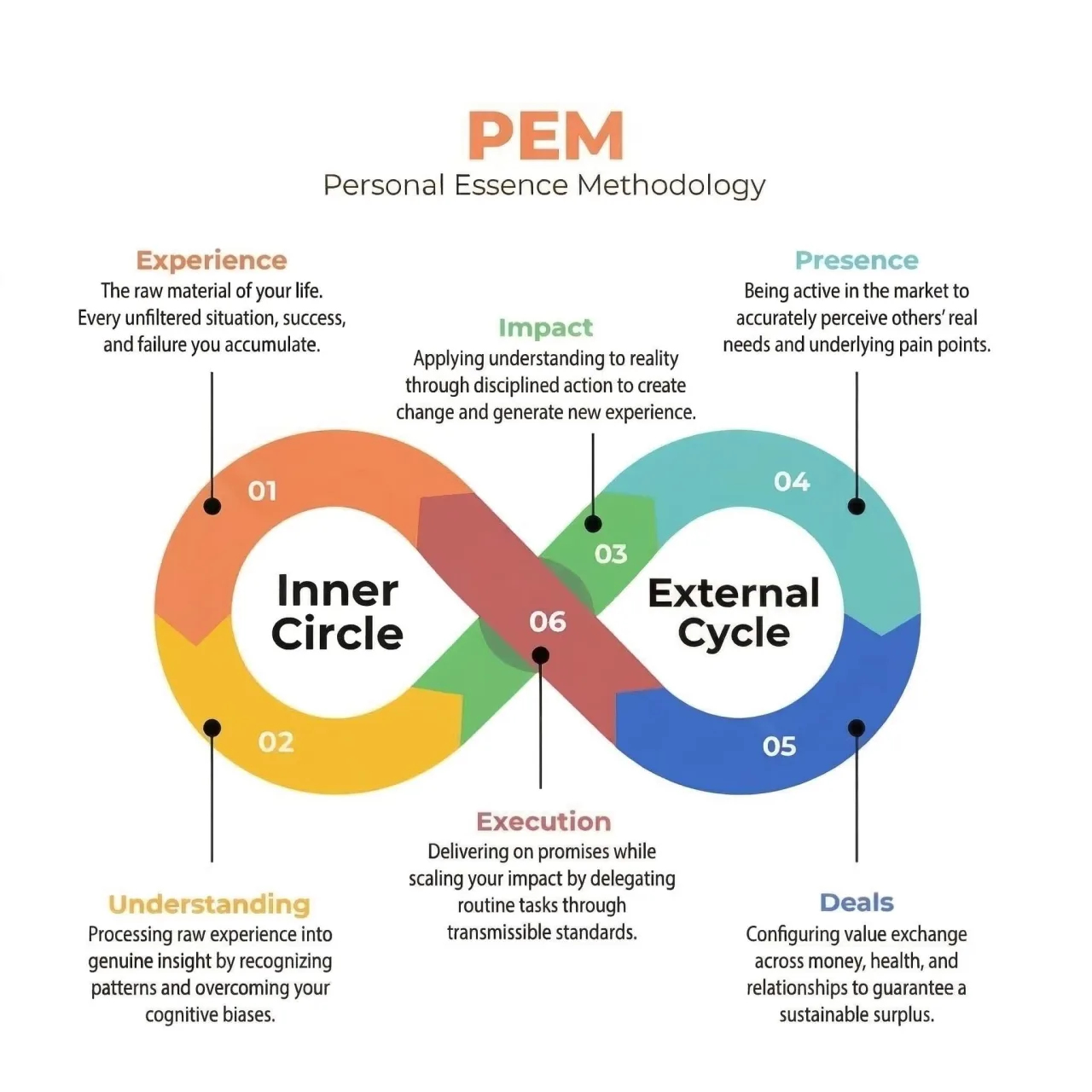
Personal Essence Methodology (PEM) is a system for developing understanding from experience and converting it into trust-based exchange. It was developed from field experience in volatile conditions. Every core principle (Internal Chain, Trust Formula, 6 Resource Domains, Delegation Hierarchy) was tested there.
PEM gives you a structure for making decisions. It treats a career trajectory as a system of measurable parameters that can be diagnosed and optimized.
What makes PEM different?
Three things separate PEM from productivity literature:
-
Tested in practice.
The result of 30 years of observation and 10 years of synthesizing experience through volatility and crisis. Every principle holds where standard frameworks collapse.
-
Grounded in 1,041 scientific sources.
Every claim about cognitive biases, trust, delegation, and configuration is traceable to peer-reviewed research. The full bibliography ships with the methodology.
Browse the full bibliography in the methodology -
Structure over motivation.
Your well-being is a configuration of measurable variables: six resource domains, three trust factors, and two operating cycles. The same configuration produces the same outcome, and a changed configuration produces a different one.
Core methodology blocks
PEM turns intuitive experience into a structured system. It names the dynamics you feel every day and gives you tools to manage them.
The Internal Chain
Experience → Understanding → Impact. This is the compounding mechanism that turns daily work into the ability to make high-stakes decisions. Most professionals accumulate years of experience without processing it into understanding. PEM shows you how.
The External Cycle
Presence → Deals → Execution. The cycle is your direct channel to the market, and it converts understanding into financial results and long-term reputation. Each stage has its own discipline: if visibility drops, deals fall through; if execution fails, trust collapses.
The Trust Formula
Trust = Demonstrated Impact × Transparent Presence × Consistent Alignment. The factors are multiplied, so if any single one drops to zero, trust collapses. That is why highly competent professionals with no visibility often lose to more visible peers.
Six resource domains
Financial, Biological, Social, Reputational, Intellectual, Temporal. Every project spends and replenishes health, time, networks, and energy along with money. Optimizing for money alone quietly drains the rest.
Seven Pillars of Trust-Based Presence
Personal branding, networking, high-touch meetings, expert content, social proof, transparency, and consistency. Together they are a systematic way to build authority. AI makes raw information abundant, so personal trust becomes the primary asset. Granovetter's study of job-finding (American Journal of Sociology, 1973) shows why systematic presence beats a tight inner circle: over 80% of jobs found through contacts came from people seen only occasionally or rarely.
22 archetypes — Initiate to Sovereign
The 22 archetypes map a professional’s trajectory. Each archetype has its own strengths and hidden traps. The free assessment identifies where you stand right now and shows the next move for your archetype.
PEM for Business
How PEM applies to running a business
An early-stage founder and the CEO of an $8M company face different challenges. The PEM playbook series spans three revenue bands from $0 to $100M. It combines original methodology tools with proven global frameworks (including Alex Hormozi’s Grand Slam Offer model), matched to your stage.
0 → $1M
Building market trust and launching first sales
You say this out loud
You are constantly busy and taking courses, yet real paying clients have still not arrived.
$1M → $10M
Systematizing operations and stepping out of daily management
You say this out loud
The business is growing, but you cannot leave the company even for two weeks because key processes stall without personal oversight.
$10M → $100M
Institutionalizing knowledge and eliminating key-person dependency
You say this out loud
The company is profitable and growing, but core expertise is concentrated in key individuals, creating risk for long-term stability.
Chapters 0 and 1 in every playbook are open for free without registration.
| Playbook | Focus | Free preview | Price |
|---|---|---|---|
| I. 0 → $1M | Building market trust and launching first sales | Chapters 0–1 | $47 |
| II. $1M → $10M | Systematizing operations and stepping out of daily management | Chapters 0–1 | $147 |
| III. $10M → $100M | Institutionalizing knowledge and eliminating key-person dependency | Chapters 0–1 | $457 |
Working for yourself
Turn what you are good at into your own thing, and $100k a year from it.
For people who sell what they personally know: coaches, therapists, trainers, consultants, freelancers, teachers, creators. The playbook turns that into a practice you own rather than a job you invented for yourself. You choose a niche small enough to become the best in, set a price and a workload that together earn $100,000 of profit a year, and build a name that brings clients to you without any ad spend. It stays small on purpose: you, one or two assistants, and AI.
The first two chapters are free, no registration needed. The playbook is $37 once, with every future update included.
- Money that matches the craft
- You put your price, your workload and your income model on one page and multiply them out. Either $100,000 a year is reachable, or one of the three has to change.
- Number one somewhere small
- You pick a niche small enough to become the best in it within two or three years, and big enough to carry the $150–300k of revenue the profit comes out of.
- Clients without an ad budget
- You get a promotion routine that works with no ad spend: two or three platforms, a pace you can keep, and a clear rule about what you give away and what people pay for.
The logic of three stages
Idea → Desire → Belief → Confidence → Knowledge
One logical chain runs through the entire series, and each step builds on the previous one. Taking the right action at the wrong time still fails. The playbook you need is the one for the stage you are at now, whatever your ambition.
Where to start
PEM offers four entry formats: a free five-minute assessment, the complete methodology text, a paid Personal Profile, and the business playbook series. Start anywhere, because the formats complement each other.
5 minutes · free
The PEM assessment
22 questions that identify your archetype, your key blind spot, and your next 14-day move. Free without registration.
Take the assessment28 chapters · free
The methodology
The complete methodology text: the Internal Chain, the External Cycle, the Trust Formula, six resource domains, seven pillars of presence, the delegation hierarchy, and the 1,041-source bibliography.
Read the methodologyPersonal Profile · $37
Your personal configuration
The assessment determines your archetype. The Personal Profile gives you a step-by-step action plan: detailed scoring of all six domains, ranked trust factors, and a personal roadmap.
Learn moreImplementation guides · $17
One problem, one guide
Focused go-to-market guides: moving from hourly rates to value pricing, and building partner-led growth. Free preview inside each.
Browse the guidesPEM for Business · from $47
The business playbooks
38 chapters, 37 practical tools, and 16 measurable milestones. Each chapter delivers one specific decision, one tool, and a 90-day action plan.
Another abstract framework will not help. See your real configuration.
Self-assessment alone is unreliable: in Kruger and Dunning's study (Journal of Personality and Social Psychology, 1999), the weakest performers placed themselves at the 62nd percentile while scoring at the 12th. The structured assessment takes 5 minutes and requires no registration. You will see your archetype, your key blind spot, and your next 14-day move.